Knowledge institute of technology and
engineering, Bakrol
Professional Practice And Valuation
1
Topic: Valuation
NAME ENROLLMENT NO.
LOH MITUL 161350106004
PATHAN MOHYUN NAWAZ 161350106009
SINDHA TARUN 161350106010
YADAV ANKUR 161350106011
 Valuation:
 Valuation is the technique of estimation or determining the
fair price or value of property such as building, a factory,
other engineering structures of various types, land etc.
 By valuation the present value of a property is defined. The
present value of property may be decided by its selling
price, or income or rent it may fetch.
 The value of property depends on its structure, life,
maintenance, location, bank interest, etc.
 Purpose of valuation:
Buying or selling property:
When it is required to buy or to sell a property, its valuation is
required.
Taxation:
To assess tax of a property, its valuation is required. Taxes
may be municipal tax, wealth tax, property tax, etc., and all
taxes are fixed on the valuation of the property.
Rent fixation:
In order to determine the rent of a property, valuation is
required. Rent is usually fixed on certain percentage of
valuation (6% to 10% of the valuation).
Security of loans or mortgage:
• When the loans are taken against the security of the property,
its valuation is required.
Compulsory acquisition:
• Sometimes, a property is acquired by law for some public
purpose. In that case, the injured party is to be paid a suitable
amount of compensation for the property thus acquired. To
determine the amount of compensation valuation of property
is required.
Insurance:
• For the purpose of taking out an insurance policy of the
property, the owner desires to know the replacement value of
the property. In that case, the value of land is excluded or
omitted.
Court fees:
• When a case has to be filed with respect to a real estate, it
becomes necessary to affix stamp of suitable amount. This
amount is worked out after arriving at the value of the
property under dispute.
Gift tax:
• When a property is gifted, valuation of the gifted property is
necessary to pay gift tax to the government by the person
whom the property has been gifted.
Balance sheet:
• Sometimes, a company requires valuation of its premises for
the purpose showing them in the balance sheet.
 Estimation:
Before undertaking the construction of a project, it is
necessary to know its probable cost required to complete the
project.
Thus, estimation for any construction work may be defined
as the process of calculating the quantities and cost of various
items required in connection with the work.
Estimate is prepared by calculating the quantities from the
dimensions on the drawings for the various items required to
complete the project and multiplied unit cost of the item
concerned.
 Purposes of estimation:
1. Preliminary study of the project.
2. Administrative approval.
3. To investigate feasibility.
4. To get loan from bank.
5. For insurance purpose.
6. For deciding taxes.
7. To decide rent of a building.
 Different forms of value:
1. Market value
2. Book value
3. Scrap value
4. Salvage value
5. Accommodation value
6. Distress value
7. Monopoly value
8. Replacement value
9. Investment value
10. Sentimental value
11. Speculative value
12. Annual value
13. Potential value
14. Occupation value
15. Present value.
 Market value:
The market value of a property is the amount which can be
obtained at any particular time from the open market if the
property is put for sale.

The market value will differ from time to time according to
demand and supply.
The market value depends on,
• Changes in industry
• Means of transport
• Changes on fashions
• Cost of material and labour etc.
 Book value:
Book value is defined as the value of the property shown in
the account book in that particular year, i.e. the original cost
less the total depreciation till that year.
Book value at the end of particular year
=original cost - total depreciation till the end of that year.
A market value, higher than the book value, indicates profit
for the seller.
 Scrap value:
Scrap value is the value of dismentled materials of a property
at the end of its utility period.
For a building when the life is over at the end of its utility
period the dimentled materials such as steel, bricks, timber,
etc. will fetch a certain amount which is the scrap value of
the building.
The scrap value of a building may be about 10% of its total
cost of construction.
The cost of dismentling and removal of the rubbish material
is deducted from the total receipt from the sale to get the
scrap value.
The scrap value is also known as junk value or demolition
value.
 Salvage value:
It is the estimated value of a property at the end of its useful
life without being dismentled.
It is generally accounted by deducting the depreciation from
its new cost.
But there are times when salvage value is of sizable amount,
and there are other times when it is a minus quantity.
For example, the scrap value of a R.C.C. work will be
negative, as dismantling and removal will be costly.
 Valuation methods for property & land:
A. Valuation methods for property:
1. Rental method
2. Land and Building based method
3. Profit based method
4. Development method
B. Valuation methods for open land:
1. Comparative method
2. Hypothetical method
3. Belting method
 Rental method:
 In this method, the net rental income from a property is calculated
after deducting all outgoings from the gross rent, and year's
purchase (Y.P.) is calculated after adopting the current bank
interest.
 The valuation of a property is worked out as under.
Capitalized value = Net income (rent) * year's purchase
⸫C.V. = N.I. * Y.P.
Net income = Net rent = Gross rent - outgoings.
 When the rent from a property is known, this method is useful for
valuation of a property.
 If the land is free hold, at the end of useful life of a building, land
value is available.
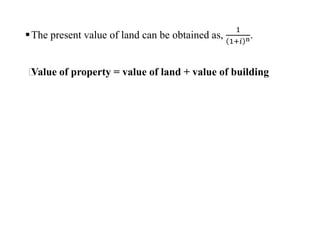
The present value of land can be obtained as,
1
1+𝑖 n.
⸫Value of property = value of land + value of building
 Hypothetical method:
In this method, value of a vacant plot of land is estimated by
capitalizing the assumed rent that can be obtained from a
building, if erected on the land after developing the same and
then deducting the cost of development and building.
This is not a suitable method of valuation of land, because
the cost of land depends on the magnitude of development of
land.
If the land is not fully developed in the assumption then a
little reliance can be placed on this method.
 Procedure of hypothetical method:
i. From the total area of land find out the permissible
covered area.
Permissible covered area
=Total area –
1
3
* area of land as required for open space
ii. Find, rentable area Total covered area - 20% for area of
walls and wastes.
iii. Calculate, net rent per month = Gross rent outgoings. (@
30% of gross rent).
iv. Find out Y.P. since land (perpetual) with interest on capital
at the current bank deposit rate (mini, 10%) and for
redemption of capital (Say 6%).
v. Capitalize the net rent by multiplying the Y.P. deferred for
the development and construction period
vi. Find out the cost of the building from the total covered
area and current plinth area rate.
vii. Workout the development cost of the land.
viii.Find the total cost of building and development cost of
land.
ix. Deduct the total cost of building and development from
the deferred rental value of the building to find the cost of
land.
 Types of rent:
Rent:
Rent may be defined as an annual or periodic payment for the
use of land or building and land.
Various forms of rent are:
1. Standard rent
2. Head rent
3. Rack rent
4. Situation rent
5. Sitting rent
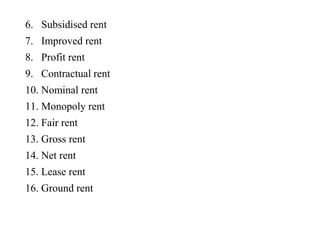
6. Subsidised rent
7. Improved rent
8. Profit rent
9. Contractual rent
10. Nominal rent
11. Monopoly rent
12. Fair rent
13. Gross rent
14. Net rent
15. Lease rent
16. Ground rent
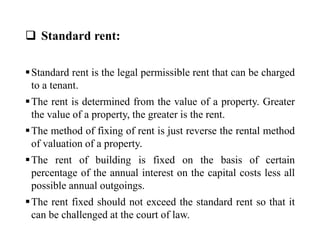
 Standard rent:
Standard rent is the legal permissible rent that can be charged
to a tenant.
The rent is determined from the value of a property. Greater
the value of a property, the greater is the rent.
The method of fixing of rent is just reverse the rental method
of valuation of a property.
The rent of building is fixed on the basis of certain
percentage of the annual interest on the capital costs less all
possible annual outgoings.
The rent fixed should not exceed the standard rent so that it
can be challenged at the court of law.
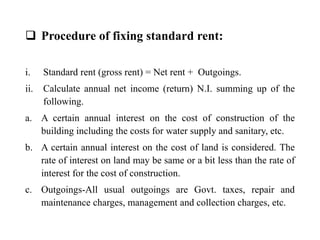
 Procedure of fixing standard rent:
i. Standard rent (gross rent) = Net rent + Outgoings.
ii. Calculate annual net income (return) N.I. summing up of the
following.
a. A certain annual interest on the cost of construction of the
building including the costs for water supply and sanitary, etc.
b. A certain annual interest on the cost of land is considered. The
rate of interest on land may be same or a bit less than the rate of
interest for the cost of construction.
c. Outgoings-All usual outgoings are Govt. taxes, repair and
maintenance charges, management and collection charges, etc.
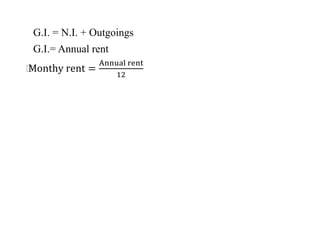
G.I. = N.I. + Outgoings
G.I.= Annual rent
⸫Monthy rent =
Annual rent
12
Valuation

Valuation

  • 1.
    Knowledge institute oftechnology and engineering, Bakrol Professional Practice And Valuation 1 Topic: Valuation NAME ENROLLMENT NO. LOH MITUL 161350106004 PATHAN MOHYUN NAWAZ 161350106009 SINDHA TARUN 161350106010 YADAV ANKUR 161350106011
  • 2.
     Valuation:  Valuationis the technique of estimation or determining the fair price or value of property such as building, a factory, other engineering structures of various types, land etc.  By valuation the present value of a property is defined. The present value of property may be decided by its selling price, or income or rent it may fetch.  The value of property depends on its structure, life, maintenance, location, bank interest, etc.
  • 3.
     Purpose ofvaluation: Buying or selling property: When it is required to buy or to sell a property, its valuation is required. Taxation: To assess tax of a property, its valuation is required. Taxes may be municipal tax, wealth tax, property tax, etc., and all taxes are fixed on the valuation of the property. Rent fixation: In order to determine the rent of a property, valuation is required. Rent is usually fixed on certain percentage of valuation (6% to 10% of the valuation).
  • 4.
    Security of loansor mortgage: • When the loans are taken against the security of the property, its valuation is required. Compulsory acquisition: • Sometimes, a property is acquired by law for some public purpose. In that case, the injured party is to be paid a suitable amount of compensation for the property thus acquired. To determine the amount of compensation valuation of property is required. Insurance: • For the purpose of taking out an insurance policy of the property, the owner desires to know the replacement value of the property. In that case, the value of land is excluded or omitted.
  • 5.
    Court fees: • Whena case has to be filed with respect to a real estate, it becomes necessary to affix stamp of suitable amount. This amount is worked out after arriving at the value of the property under dispute. Gift tax: • When a property is gifted, valuation of the gifted property is necessary to pay gift tax to the government by the person whom the property has been gifted. Balance sheet: • Sometimes, a company requires valuation of its premises for the purpose showing them in the balance sheet.
  • 6.
     Estimation: Before undertakingthe construction of a project, it is necessary to know its probable cost required to complete the project. Thus, estimation for any construction work may be defined as the process of calculating the quantities and cost of various items required in connection with the work. Estimate is prepared by calculating the quantities from the dimensions on the drawings for the various items required to complete the project and multiplied unit cost of the item concerned.
  • 7.
     Purposes ofestimation: 1. Preliminary study of the project. 2. Administrative approval. 3. To investigate feasibility. 4. To get loan from bank. 5. For insurance purpose. 6. For deciding taxes. 7. To decide rent of a building.
  • 8.
     Different formsof value: 1. Market value 2. Book value 3. Scrap value 4. Salvage value 5. Accommodation value 6. Distress value 7. Monopoly value 8. Replacement value 9. Investment value 10. Sentimental value
  • 9.
    11. Speculative value 12.Annual value 13. Potential value 14. Occupation value 15. Present value.
  • 10.
     Market value: Themarket value of a property is the amount which can be obtained at any particular time from the open market if the property is put for sale.  The market value will differ from time to time according to demand and supply. The market value depends on, • Changes in industry • Means of transport • Changes on fashions • Cost of material and labour etc.
  • 11.
     Book value: Bookvalue is defined as the value of the property shown in the account book in that particular year, i.e. the original cost less the total depreciation till that year. Book value at the end of particular year =original cost - total depreciation till the end of that year. A market value, higher than the book value, indicates profit for the seller.
  • 12.
     Scrap value: Scrapvalue is the value of dismentled materials of a property at the end of its utility period. For a building when the life is over at the end of its utility period the dimentled materials such as steel, bricks, timber, etc. will fetch a certain amount which is the scrap value of the building. The scrap value of a building may be about 10% of its total cost of construction. The cost of dismentling and removal of the rubbish material is deducted from the total receipt from the sale to get the scrap value. The scrap value is also known as junk value or demolition value.
  • 13.
     Salvage value: Itis the estimated value of a property at the end of its useful life without being dismentled. It is generally accounted by deducting the depreciation from its new cost. But there are times when salvage value is of sizable amount, and there are other times when it is a minus quantity. For example, the scrap value of a R.C.C. work will be negative, as dismantling and removal will be costly.
  • 14.
     Valuation methodsfor property & land: A. Valuation methods for property: 1. Rental method 2. Land and Building based method 3. Profit based method 4. Development method B. Valuation methods for open land: 1. Comparative method 2. Hypothetical method 3. Belting method
  • 15.
     Rental method: In this method, the net rental income from a property is calculated after deducting all outgoings from the gross rent, and year's purchase (Y.P.) is calculated after adopting the current bank interest.  The valuation of a property is worked out as under. Capitalized value = Net income (rent) * year's purchase ⸫C.V. = N.I. * Y.P. Net income = Net rent = Gross rent - outgoings.  When the rent from a property is known, this method is useful for valuation of a property.  If the land is free hold, at the end of useful life of a building, land value is available.
  • 16.
    The present valueof land can be obtained as, 1 1+𝑖 n. ⸫Value of property = value of land + value of building
  • 17.
     Hypothetical method: Inthis method, value of a vacant plot of land is estimated by capitalizing the assumed rent that can be obtained from a building, if erected on the land after developing the same and then deducting the cost of development and building. This is not a suitable method of valuation of land, because the cost of land depends on the magnitude of development of land. If the land is not fully developed in the assumption then a little reliance can be placed on this method.
  • 18.
     Procedure ofhypothetical method: i. From the total area of land find out the permissible covered area. Permissible covered area =Total area – 1 3 * area of land as required for open space ii. Find, rentable area Total covered area - 20% for area of walls and wastes. iii. Calculate, net rent per month = Gross rent outgoings. (@ 30% of gross rent). iv. Find out Y.P. since land (perpetual) with interest on capital at the current bank deposit rate (mini, 10%) and for redemption of capital (Say 6%).
  • 19.
    v. Capitalize thenet rent by multiplying the Y.P. deferred for the development and construction period vi. Find out the cost of the building from the total covered area and current plinth area rate. vii. Workout the development cost of the land. viii.Find the total cost of building and development cost of land. ix. Deduct the total cost of building and development from the deferred rental value of the building to find the cost of land.
  • 20.
     Types ofrent: Rent: Rent may be defined as an annual or periodic payment for the use of land or building and land. Various forms of rent are: 1. Standard rent 2. Head rent 3. Rack rent 4. Situation rent 5. Sitting rent
  • 21.
    6. Subsidised rent 7.Improved rent 8. Profit rent 9. Contractual rent 10. Nominal rent 11. Monopoly rent 12. Fair rent 13. Gross rent 14. Net rent 15. Lease rent 16. Ground rent
  • 22.
     Standard rent: Standardrent is the legal permissible rent that can be charged to a tenant. The rent is determined from the value of a property. Greater the value of a property, the greater is the rent. The method of fixing of rent is just reverse the rental method of valuation of a property. The rent of building is fixed on the basis of certain percentage of the annual interest on the capital costs less all possible annual outgoings. The rent fixed should not exceed the standard rent so that it can be challenged at the court of law.
  • 23.
     Procedure offixing standard rent: i. Standard rent (gross rent) = Net rent + Outgoings. ii. Calculate annual net income (return) N.I. summing up of the following. a. A certain annual interest on the cost of construction of the building including the costs for water supply and sanitary, etc. b. A certain annual interest on the cost of land is considered. The rate of interest on land may be same or a bit less than the rate of interest for the cost of construction. c. Outgoings-All usual outgoings are Govt. taxes, repair and maintenance charges, management and collection charges, etc.
  • 24.
    G.I. = N.I.+ Outgoings G.I.= Annual rent ⸫Monthy rent = Annual rent 12