Rubrics and Peer-Review in Canvas: Examples from
FAS and HKS
Daniel Jamous, Senior Instructional Technologist, Academic
Technology Services, Harvard University Information Technology
Alice Heath, Master in Public Policy Candidate, Harvard Kennedy
School
Kelly Miller, Lecturer on Applied Physics, Harvard John A. Paulson
School of Engineering and Applied Sciences
Salimah Samji, Manager of Building State Capability Program, Center
for International Development, Harvard Kennedy School
Allison Pingree, Director of Professional Pedagogy, Strengthening
Learning and Teaching Excellence (SLATE), Harvard Kennedy School
IT Summit
June 2 2016
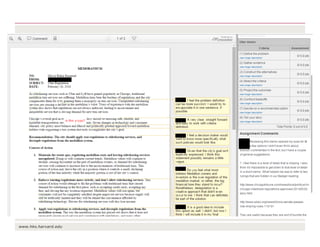
Using	Canvas	for	Peer	Review	at	HKS:	
Policy	Analysis	&	Design	(API-505)
Allison	Pingree &	Alice	Heath
Harvard	IT	Summit
Thursday,	June	2,	2016	- 2:20– 3:15	pm
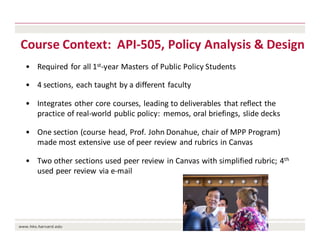
Course	Context:		API-505,	Policy	Analysis	&	Design		
• Required	for	all	1st-year	Masters	of	Public	Policy	Students
• 4	sections,	each	taught	by	a	different	faculty
• Integrates	other	core	courses,	leading	to	deliverables	 that	reflect	the	
practice	of	real-world	public	policy:		memos,	oral	briefings,	slide	decks
• One	section	(course	head,	Prof.	John	Donahue,	chair	of	MPP	Program)	
made	most	extensive	use	of	peer	review	and	rubrics	in	Canvas
• Two	other	sections	used	peer	review	in	Canvas	with	simplified	rubric;	4th
used	peer	review	via	e-mail
Why	Use	Peer	Review	with	a	Rubric?		
Why	in	Canvas?
• We	knew	from	Spring	Exercise	[experiential	 capstone]	that	the	draft-feedback-
rewrite	cycle	is	a	great	tool	for	learning.
• We	also	knew	from	prior	versions	of	this	course	that	the	faculty	simply	couldn’t	
give	detailed	feedback	on	every	draft,	especially	not	in	time	for	it	to	be	useful.
• We’d	learned	from	observing	the	Negotiation	course	that	the	MPPs—especially	
in	cohorts—were	skilled	at	dealing	with	each	other	candidly	but	thoughtfully.
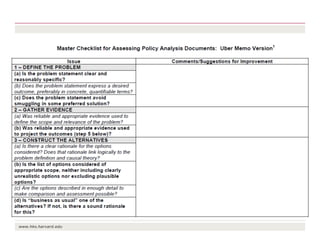
• Course	focus	itself	is	the	evaluation	of	options	along	various	criteria - rubric	
allowed	us	to	be	more	transparent about	quality,	and	practice	what	we	preach.
• We	needed	a	way	to	manage	the	logistical	complexity	of	pairing	up	students	
and	tracking	their	exchanges.
Overall,	How	Did	it	Go?
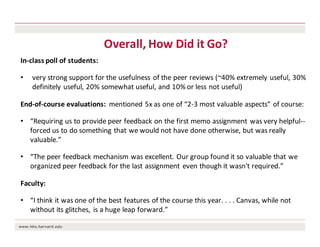
In-class	poll	of	students:	
• very	strong	support	for	the	usefulness	of	the	peer	reviews (~40%	extremely	useful,	30%	
definitely	useful,	20%	somewhat	useful,	and	10%	or	less	not	useful)
End-of-course	evaluations:		mentioned	5x	as	one	of	“2-3	most	valuable	aspects”	of	course:	
• “Requiring	us	to	provide	peer	feedback	on	the	first	memo	assignment	was	very	helpful--
forced	us	to	do	something	that	we	would	not	have	done	otherwise,	but	was	really	
valuable.”
• “The	peer	feedback	mechanism	was	excellent.	Our	group	found	it	so	valuable	that	we	
organized	peer	feedback	for	the	last	assignment	even	though	it	wasn't	required.”
Faculty:	
• “I	think	it	was	one	of	the	best	features	of	the	course	this	year.	.	.	. Canvas,	while	not	
without	its	glitches,	is	a	huge	leap	forward.”
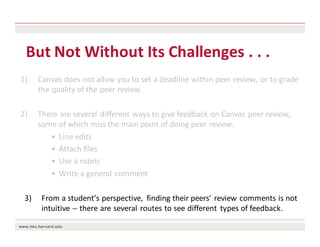
But	Not	Without	Its	Challenges	.	.	.	
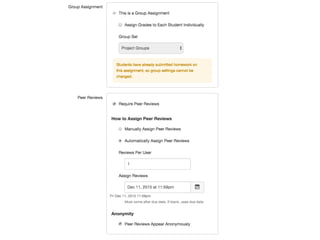
1) Canvas	does	not	allow	you	to	set	a	deadline	within	peer	review,	or	to	grade	
the	quality	of	the	peer	review.
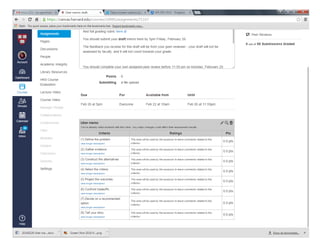
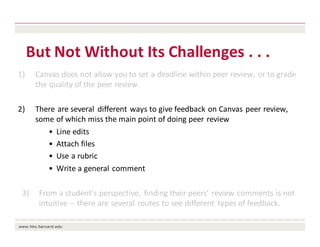
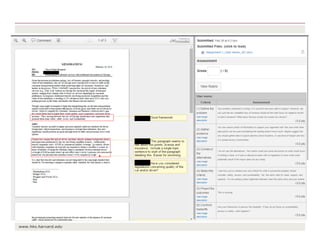
2) There	are	several	 different	ways	to	give	feedback	on	Canvas	peer	review,	
some	of	which	miss	the	main	point	of	doing	peer	review.
• Line	edits
• Attach	files
• Use	a	rubric
• Write	a	general	comment
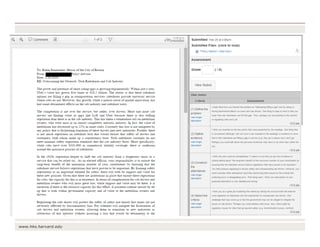
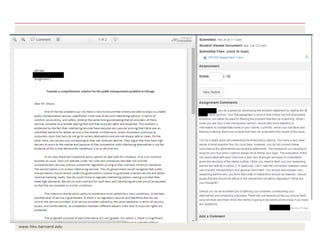
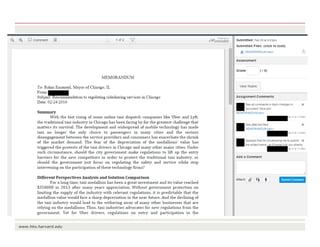
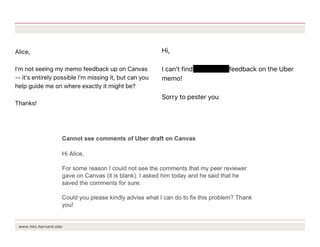
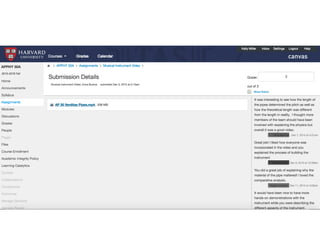
3) From	a	student’s	perspective,	 finding	their	peers’	review	comments	is	not	
intuitive	-- there	are	several	routes	to	see	different	 types	of	feedback.
But	Not	Without	Its	Challenges	.	.	.	
1) Canvas	does	not	allow	you	to	set	a	deadline	within	peer	review,	or	to	grade	
the	quality	of	the	peer	review.
2) There	are	several	 different	ways	to	give	feedback	on	Canvas	peer	review,	
some	of	which	miss	the	main	point	of	doing	peer	review.
• Line	edits
• Attach	files
• Use	a	rubric
• Write	a	general	comment
3) From	a	student’s	perspective,	 finding	their	peers’	review	comments	is	not	
intuitive	-- there	are	several	routes	to	see	different	 types	of	feedback.
But	Not	Without	Its	Challenges	.	.	.	
1) Canvas	does	not	allow	you	to	set	a	deadline	within	peer	review,	or	to	grade	
the	quality	of	the	peer	review.
2) There	are	several	 different	ways	to	give	feedback	on	Canvas	peer	review,	
some	of	which	miss	the	main	point	of	doing	peer	review
• Line	edits
• Attach	files
• Use	a	rubric
• Write	a	general	comment
3) From	a	student’s	perspective,	 finding	their	peers’	review	comments	is	not	
intuitive	-- there	are	several	routes	to	see	different	 types	of	feedback.
But	Not	Without	Its	Challenges	.	.	.	
1) Canvas	does	not	allow	you	to	set	a	deadline	within	peer	review,	or	to	grade	
the	quality	of	the	peer	review.
2) There	are	several	 different	ways	to	give	feedback	on	Canvas	peer	review,	
some	of	which	miss	the	main	point	of	doing	peer	review.
• Line	edits
• Attach	files
• Use	a	rubric
• Write	a	general	comment
3) From	a	student’s	perspective,	 finding	their	peers’	review	comments	is	not	
intuitive	-- there	are	several	routes	to	see	different	 types	of	feedback.
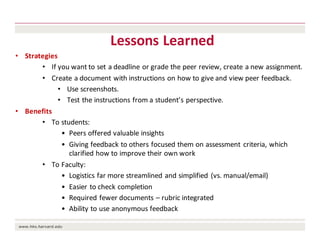
Lessons	Learned
• Strategies
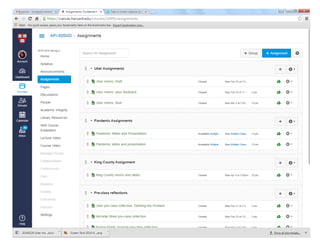
• If	you	want	to	set	a	deadline	or	grade	the	peer	review,	create	a	new	assignment.
• Create	a	document	with	instructions	on	how	to	give	and	view	peer	feedback.
• Use	screenshots.
• Test	the	instructions	from	a	student’s	perspective.
• Benefits
• To	students:
• Peers	offered	valuable	insights
• Giving	feedback	to	others	focused	them	on	assessment	criteria,	which	
clarified	how	to	improve	their	own	work
• To	Faculty:
• Logistics	far	more	streamlined	and	simplified	(vs.	manual/email)
• Easier	to	check	completion
• Required	fewer	documents	– rubric	integrated
• Ability	to	use	anonymous	feedback
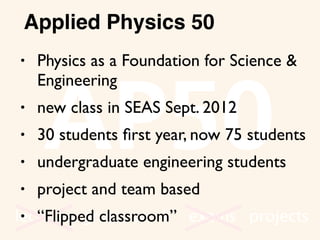
AAP 50 and Canvas
AP50
lectures group work exams projects
• Physics as a Foundation for Science &
Engineering
• new class in SEAS Sept. 2012
• 30 students first year, now 75 students
• undergraduate engineering students
• project and team based
• “Flipped classroom”
Applied Physics 50
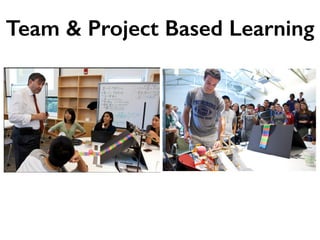
Team & Project Based Learning
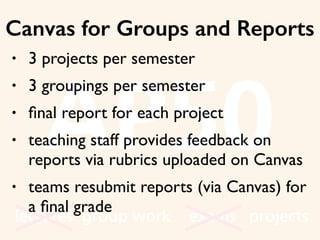
AP50
lectures group work exams projects
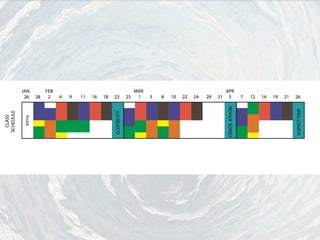
• 3 projects per semester
• 3 groupings per semester
• final report for each project
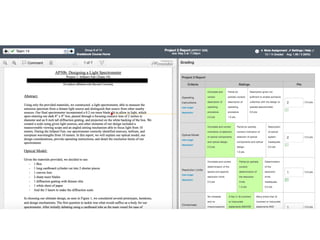
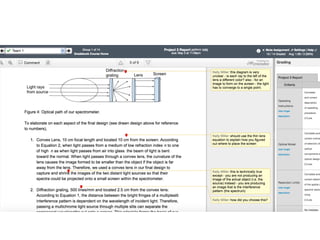
• teaching staff provides feedback on
reports via rubrics uploaded on Canvas
• teams resubmit reports (via Canvas) for
a final grade
Canvas for Groups and Reports
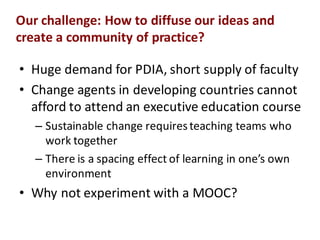
Our$challenge:$How$to$diffuse$our$ideas$and$
create$a$community$of$practice?
• Huge%demand%for%PDIA,%short%supply%of%faculty
• Change%agents%in%developing%countries%cannot%
afford%to%attend%an%executive%education%course
– Sustainable%change%requires%teaching%teams%who%
work%together
– There%is%a%spacing%effect%of%learning%in%one’s%own%
environment%
• Why%not%experiment%with%a%MOOC?
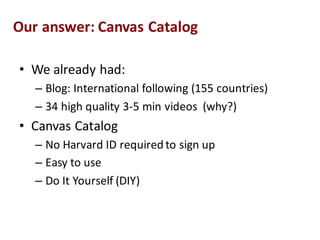
Our$answer:$Canvas$Catalog
• We%already%had:
– Blog:%International%following%(155%countries)
– 34%high%quality%3P5%min%videos%%(why?)
• Canvas%Catalog
– No%Harvard%ID%required%to%sign%up
– Easy%to%use
– Do%It%Yourself%(DIY)
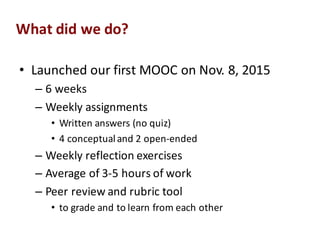
What$did$we$do?
• Launched%our%first%MOOC%on%Nov.%8,%2015
– 6%weeks
– Weekly%assignments
• Written%answers%(no%quiz)
• 4%conceptual%and%2%openPended
– Weekly%reflection%exercises
– Average%of%3P5%hours%of%work
– Peer%review%and%rubric%tool%
• to%grade%and%to%learn%from%each%other
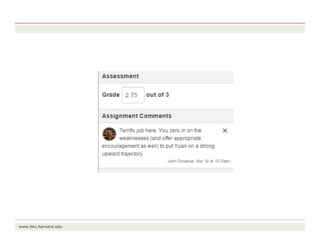
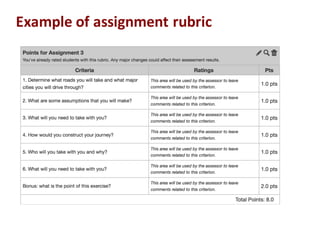
Example$of$assignment$rubric
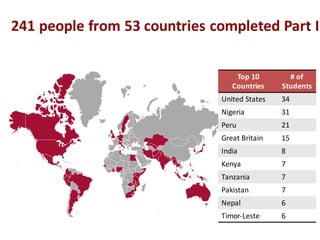
241$people$from$53$countries$completed$Part$I
Top$10$
Countries
# of
Students
United%States 34
Nigeria 31
Peru 21
Great%Britain 15
India 8
Kenya 7
Tanzania 7
Pakistan 7
Nepal 6
TimorPLeste 6
What$did$we$learn?
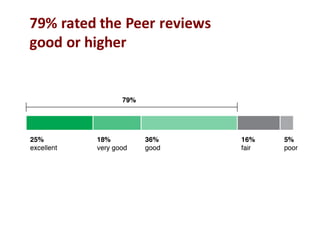
79%$rated$the$Peer$reviews
good$or$higher
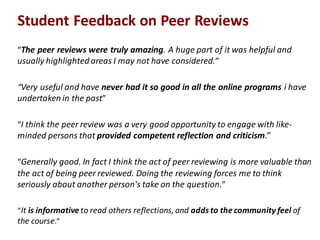
“The$peer$reviews$were$truly$amazing."A"huge"part"of"it"was"helpful"and"
usually"highlighted"areas"I"may"not"have"considered.”
“Very"useful"and"have"never$had$it$so$good$in$all$the$online$programs$i have"
undertaken"in"the"past”
“I"think"the"peer"review"was"a"very"good"opportunity"to"engage"with"like=
minded"persons"that"provided$competent$reflection$and$criticism.”
“Generally"good."In"fact"I"think"the"act"of"peer"reviewing"is"more"valuable"than"
the"act"of"being"peer"reviewed."Doing"the"reviewing"forces"me"to"think"
seriously"about"another"person's"take"on"the"question.”
“It"is$informative$to"read"others"reflections,"and"adds$to$the$community$feel$of"
the"course.”
Student$Feedback$on$Peer$Reviews
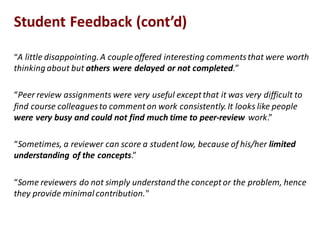
“A"little"disappointing."A"couple"offered"interesting"comments"that"were"worth"
thinking"about"but"others$were$delayed$or$not$completed.”
“Peer"review"assignments"were"very"useful"except"that"it"was"very"difficult"to"
find"course"colleagues"to"comment"on"work"consistently."It"looks"like"people"
were$very$busy$and$could$not$find$much$time$to$peer9review$work.”
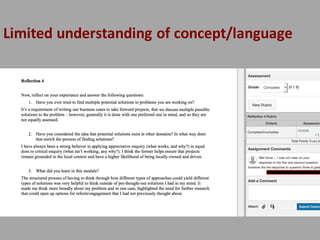
“Sometimes,"a"reviewer"can"score"a"student"low,"because"of"his/her"limited$
understanding$of$the$concepts.”
“Some"reviewers"do"not"simply"understand"the"concept"or"the"problem,"hence"
they"provide"minimal"contribution."
Student$Feedback$(cont’d)
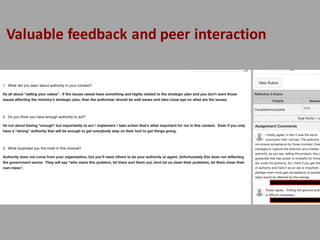
Valuable$feedback$and$peer$interaction
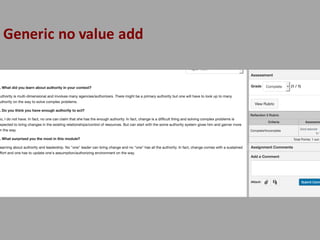
Generic$no$value$add
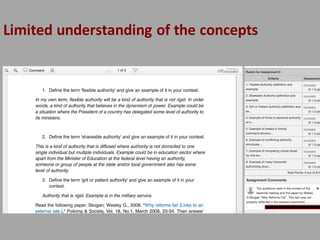
Limited$understanding$of$the$concepts
Limited$understanding$of$concept/language
Where$to$next?
• More%specific%questions/prompts%for%reviewer
– What%did%you%like?
– What%would%you%suggest%for%improvement?
– How%does%this%differ%from%what%you%learnt?
• Assignments
– Hired%graders%
• Flipped%classroom%Fall%2016
– Opportunity%to%test%peer%review%in%residential%
course%(calibrated%reviews)

It summit 2016_combined