VACUUM
INDUCED
UTERINE
TAMPONADE
DEVICE FOR
POSTPARTUM
HEMORRHAGE
AUTHOR NAME: Siddiqua Parveen, PharmD 5thYear
Sultan Ul Uloom College Of Pharmacy
GUIDE NAME: Dr. Anupama Koneru, Principal,
Sultan Ul Uloom College Of Pharmacy
AC04 – GRS - 26
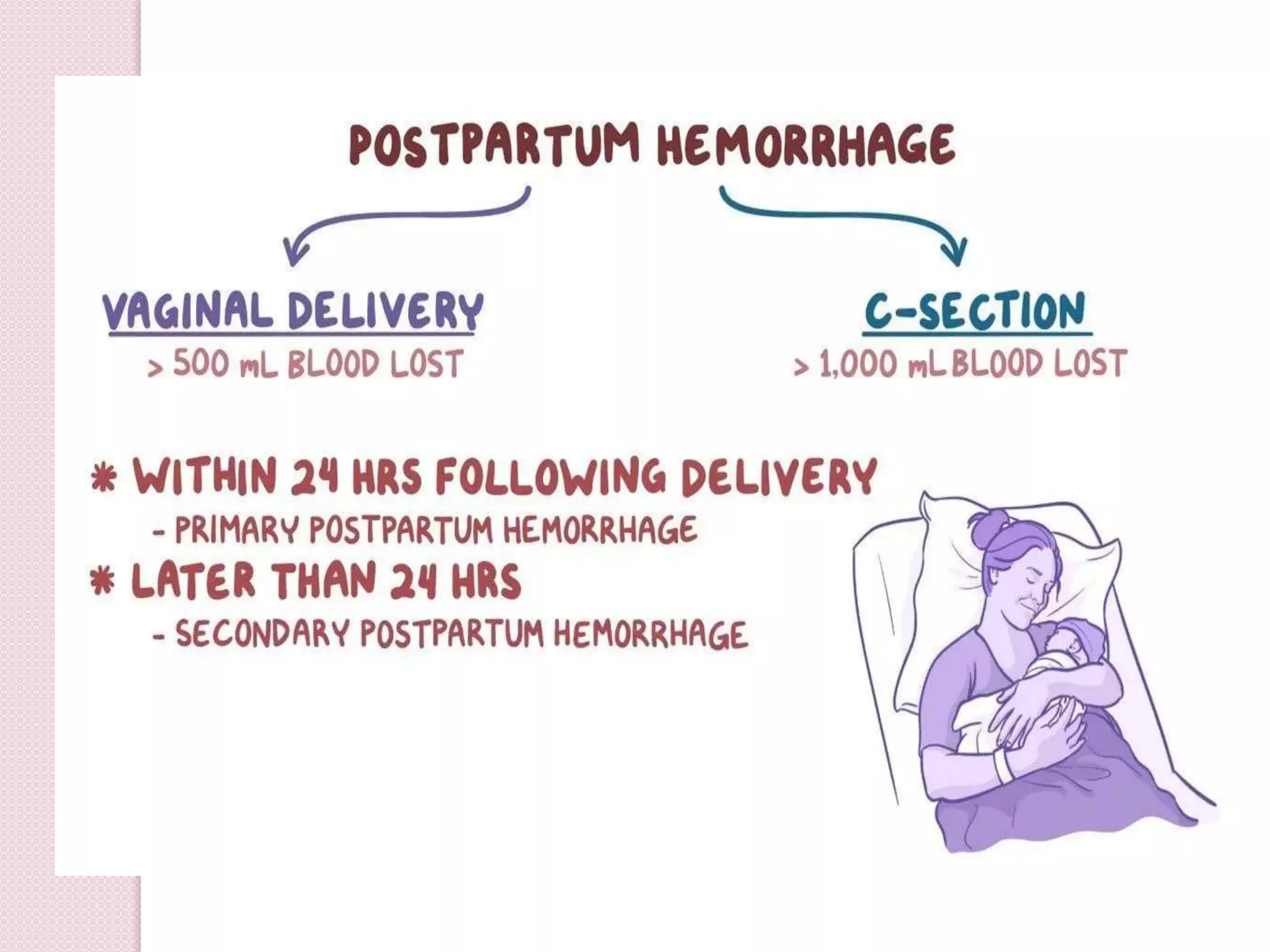
Postpartum hemorrhage (PPH) continues to be
a leading cause of maternal morbidity and
mortality both worldwide and in the United
States. A PPH is defined as the cumulative
blood loss of 1,000 mL or more, or blood loss
accompanied by signs or symptoms of
hypovolemia, within 24 hours following the birth
process (including intrapartum loss).
TREATMENT OPTIONS:
*Fluid resuscitation and sometimes
transfusion
*Uterine massage
*Removal of retained placental tissues and
repair of genital lacerations
*Uterotonics (e.g., oxytocin,
prostaglandins, methylergonovine)
*Sometimes surgical procedures(uterine
artery embolization and surgery)
*If all other methods have failed, a
hysterectomy is the definitive treatment for
hemorrhage.
In October 2020, the US Food
and Drug Administration (FDA)
granted clearance to a novel
device that offers an alternative
treatment option-The Jada
System (Alydia Health), an
intrauterine vacuum-induced
hemorrhage control device.
NEW DEVICE CONTROLS BLEEDING FAST:
In 2020, D’Alton and colleagues reported on
their multicenter, prospective single-arm
treatment study on the effectiveness and safety
of an intrauterine vacuum-induced hemorrhage
control device. This device, the Jada System,
uses low-level vacuum to induce uterine
contraction to control bleeding from uterine
atony. The prospective study, which followed a
2016 feasibility study, enrolled more than 100
women at 12 centers across the United States.
Women were eligible to participate if they
delivered at a gestational age of 34 weeks or
later and had an EBL between 500 and 1,000
mL after a vaginal delivery or an EBL between
1,000 and 1,500 mL after a cesarean delivery
HOW THE DEVICE WORKS:
The Jada System applies low-level
intrauterine vacuum to facilitate the
physiologic forces of uterine contractions
to constrict myometrial blood vessels and
achieve hemostasis. The device is made
of medical grade silicone. Its distal end,
which is placed in the uterus, is an
elliptical loop. The loop’s inner surface
contains 20 vacuum pores. The device’s
proximal end has a vacuum connector.
The vacuum source is hospital-grade wall
suction, but a portable vacuum source
also can be used.
Prior to placing the device, a
manual sweep of the uterine cavity
is performed. If needed,
ultrasonography can be used with
the manual sweep to ensure that
there is no retained placental
tissue or clot. The loop of the Jada
System is then inserted in the
uterine cavity, and the circular
cervical seal, just outside the
external cervical os, is filled with
Low-level vacuum (80 ± 10 mm Hg) is
applied so that pooled blood is evacuated
from the uterus as it collapses .The
volume of any ongoing bleeding is
measured in the suction tubing while the
uterine response to treatment can be
palpated. Once there is no bleeding
without any need for further treatment, the
device should remain in the uterus for at
least 1 hour. The suction is then turned off,
and bleeding is monitored for 30 minutes.
If bleeding remains controlled, the device
can be removed.
Placement of intrauterine vacuum-induced
hemorrhage-control device
Device Usability Assessment
Time Taken To Control Bleeding
SAFETY FINDINGS:
In the prospective study and FDA
review, the device was deemed
safe. There were 8 possibly related
adverse events (endometritis,
laceration disruption, and vaginal
infection), which all resolved
without serious clinical sequelae.
Forty women (38%) received a
blood transfusion, but only 5
required 4 U or more of red blood
cells.
CONTRAINDICATIONS:
The Jada System should not be used
with the following conditions: ongoing
intrauterine pregnancy, untreated uterine
rupture, unresolved uterine inversion,
current cervical cancer, known uterine
anomaly, or current purulent infection of
the vagina, cervix, or uterus. Additionally,
use should be avoided in patients where
the cervix is unable to be dilated to 3 cm,
since that minimum dilation is required
for safe placement of the intrauterine
device.
DURATION OF TREATMENT:
The times to achieve uterine collapse and
control of hemorrhage are both relatively short.
In the prospective study, the initial collapse of
the uterus took a median of 1 minute (IQR, 1–2
min) from the time of vacuum connection.
Bleeding was controlled in less than 5 minutes in
82% of women, with an overall median time of 3
minutes (IQR, 2–5 min). The median duration of
vacuum treatment was 144.0 minutes (IQR,
85.8–295.8 min), which includes the required
minimum of 60 minutes for vacuum treatment
time and 30 minutes of observation without the
vacuum connected but with the device still in
place.
CONCLUSION:
When polled, the majority of clinicians—
98%—reported that the intrauterine
vacuum-induced hemorrhage control
device was easy to use, and 97% would
recommend its use for future patients.
Treatment with the vacuum device was
successful in 94% (100/106, 95%
confidence interval, 88%–98%) of women,
and definitive control of abnormal bleeding
was achieved in a median of 3 minutes
(interquartile range [IQR], 2.0–5.0) after
connection to the vacuum device.
REFERENCES:
*https://pubmed.ncbi.nlm.nih.gov/329099
70/#&gid=article-figures&pid=fig-2-uid-1
*https://www.msdmanuals.com/en-
in/professional/gynecology-and-
obstetrics/abnormalities-and-
complications-of-labor-and-
delivery/postpartum-hemorrhage
*https://journals.lww.com/greenjournal/Ful
ltext/2020/11000/Intrauterine_Vacuum_In
duced_Hemorrhage_Control.4.aspx
*https://www.tandfonline.com/doi/full/10.1
080/17434440.2021.1962288
THANK
YOU

Vacuum induced uterine tamponade device for postpartum hemorrhage

  • 1.
    VACUUM INDUCED UTERINE TAMPONADE DEVICE FOR POSTPARTUM HEMORRHAGE AUTHOR NAME:Siddiqua Parveen, PharmD 5thYear Sultan Ul Uloom College Of Pharmacy GUIDE NAME: Dr. Anupama Koneru, Principal, Sultan Ul Uloom College Of Pharmacy AC04 – GRS - 26
  • 2.
    Postpartum hemorrhage (PPH)continues to be a leading cause of maternal morbidity and mortality both worldwide and in the United States. A PPH is defined as the cumulative blood loss of 1,000 mL or more, or blood loss accompanied by signs or symptoms of hypovolemia, within 24 hours following the birth process (including intrapartum loss).
  • 6.
    TREATMENT OPTIONS: *Fluid resuscitationand sometimes transfusion *Uterine massage *Removal of retained placental tissues and repair of genital lacerations *Uterotonics (e.g., oxytocin, prostaglandins, methylergonovine) *Sometimes surgical procedures(uterine artery embolization and surgery) *If all other methods have failed, a hysterectomy is the definitive treatment for hemorrhage.
  • 7.
    In October 2020,the US Food and Drug Administration (FDA) granted clearance to a novel device that offers an alternative treatment option-The Jada System (Alydia Health), an intrauterine vacuum-induced hemorrhage control device.
  • 8.
    NEW DEVICE CONTROLSBLEEDING FAST: In 2020, D’Alton and colleagues reported on their multicenter, prospective single-arm treatment study on the effectiveness and safety of an intrauterine vacuum-induced hemorrhage control device. This device, the Jada System, uses low-level vacuum to induce uterine contraction to control bleeding from uterine atony. The prospective study, which followed a 2016 feasibility study, enrolled more than 100 women at 12 centers across the United States. Women were eligible to participate if they delivered at a gestational age of 34 weeks or later and had an EBL between 500 and 1,000 mL after a vaginal delivery or an EBL between 1,000 and 1,500 mL after a cesarean delivery
  • 9.
    HOW THE DEVICEWORKS: The Jada System applies low-level intrauterine vacuum to facilitate the physiologic forces of uterine contractions to constrict myometrial blood vessels and achieve hemostasis. The device is made of medical grade silicone. Its distal end, which is placed in the uterus, is an elliptical loop. The loop’s inner surface contains 20 vacuum pores. The device’s proximal end has a vacuum connector. The vacuum source is hospital-grade wall suction, but a portable vacuum source also can be used.
  • 10.
    Prior to placingthe device, a manual sweep of the uterine cavity is performed. If needed, ultrasonography can be used with the manual sweep to ensure that there is no retained placental tissue or clot. The loop of the Jada System is then inserted in the uterine cavity, and the circular cervical seal, just outside the external cervical os, is filled with
  • 11.
    Low-level vacuum (80± 10 mm Hg) is applied so that pooled blood is evacuated from the uterus as it collapses .The volume of any ongoing bleeding is measured in the suction tubing while the uterine response to treatment can be palpated. Once there is no bleeding without any need for further treatment, the device should remain in the uterus for at least 1 hour. The suction is then turned off, and bleeding is monitored for 30 minutes. If bleeding remains controlled, the device can be removed.
  • 12.
    Placement of intrauterinevacuum-induced hemorrhage-control device
  • 13.
    Device Usability Assessment TimeTaken To Control Bleeding
  • 14.
    SAFETY FINDINGS: In theprospective study and FDA review, the device was deemed safe. There were 8 possibly related adverse events (endometritis, laceration disruption, and vaginal infection), which all resolved without serious clinical sequelae. Forty women (38%) received a blood transfusion, but only 5 required 4 U or more of red blood cells.
  • 15.
    CONTRAINDICATIONS: The Jada Systemshould not be used with the following conditions: ongoing intrauterine pregnancy, untreated uterine rupture, unresolved uterine inversion, current cervical cancer, known uterine anomaly, or current purulent infection of the vagina, cervix, or uterus. Additionally, use should be avoided in patients where the cervix is unable to be dilated to 3 cm, since that minimum dilation is required for safe placement of the intrauterine device.
  • 16.
    DURATION OF TREATMENT: Thetimes to achieve uterine collapse and control of hemorrhage are both relatively short. In the prospective study, the initial collapse of the uterus took a median of 1 minute (IQR, 1–2 min) from the time of vacuum connection. Bleeding was controlled in less than 5 minutes in 82% of women, with an overall median time of 3 minutes (IQR, 2–5 min). The median duration of vacuum treatment was 144.0 minutes (IQR, 85.8–295.8 min), which includes the required minimum of 60 minutes for vacuum treatment time and 30 minutes of observation without the vacuum connected but with the device still in place.
  • 17.
    CONCLUSION: When polled, themajority of clinicians— 98%—reported that the intrauterine vacuum-induced hemorrhage control device was easy to use, and 97% would recommend its use for future patients. Treatment with the vacuum device was successful in 94% (100/106, 95% confidence interval, 88%–98%) of women, and definitive control of abnormal bleeding was achieved in a median of 3 minutes (interquartile range [IQR], 2.0–5.0) after connection to the vacuum device.
  • 18.
  • 19.