VACCINATION VS. IMMUNIZATION
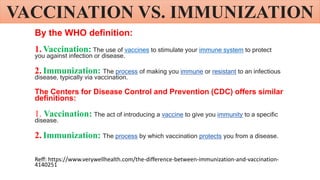
By the WHO definition:
1. Vaccination: The use of vaccines to stimulate your immune system to protect
you against infection or disease.
2. Immunization: The process of making you immune or resistant to an infectious
disease, typically via vaccination.
The Centers for Disease Control and Prevention (CDC) offers similar
definitions:
1. Vaccination: The act of introducing a vaccine to give you immunity to a specific
disease.
2. Immunization: The process by which vaccination protects you from a disease.
Reff: https://www.verywellhealth.com/the-difference-between-immunization-and-vaccination-
4140251
TYPES OF VACCINES
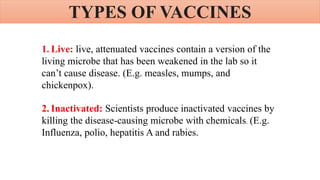
1. Live: live, attenuated vaccines contain a version of the
living microbe that has been weakened in the lab so it
can’t cause disease. (E.g. measles, mumps, and
chickenpox).
2. Inactivated: Scientists produce inactivated vaccines by
killing the disease-causing microbe with chemicals. (E.g.
Influenza, polio, hepatitis A and rabies.
TYPES OF VACCINES
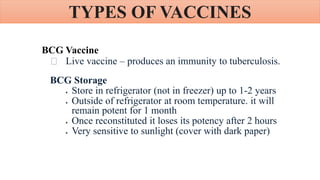
BCG Vaccine
Live vaccine – produces an immunity to tuberculosis.
BCG Storage
 Store in refrigerator (not in freezer) up to 1-2 years
 Outside of refrigerator at room temperature. it will
remain potent for 1 month
 Once reconstituted it loses its potency after 2 hours
 Very sensitive to sunlight (cover with dark paper)
TYPES OF VACCINES
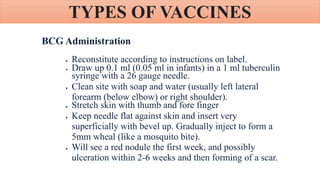
BCG Administration
 Reconstitute according to instructions on label.
 Draw up 0.1 ml (0.05 ml in infants) in a 1 ml tuberculin
syringe with a 26 gauge needle.
 Clean site with soap and water (usually left lateral
forearm (below elbow) or right shoulder).
 Stretch skin with thumb and fore finger
 Keep needle flat against skin and insert very
superficially with bevel up. Gradually inject to form a
5mm wheal (like a mosquito bite).
 Will see a red nodule the first week, and possibly
ulceration within 2-6 weeks and then forming of a scar.

Vaccination vs immunization

  • 1.
    VACCINATION VS. IMMUNIZATION Bythe WHO definition: 1. Vaccination: The use of vaccines to stimulate your immune system to protect you against infection or disease. 2. Immunization: The process of making you immune or resistant to an infectious disease, typically via vaccination. The Centers for Disease Control and Prevention (CDC) offers similar definitions: 1. Vaccination: The act of introducing a vaccine to give you immunity to a specific disease. 2. Immunization: The process by which vaccination protects you from a disease. Reff: https://www.verywellhealth.com/the-difference-between-immunization-and-vaccination- 4140251
  • 2.
    TYPES OF VACCINES 1.Live: live, attenuated vaccines contain a version of the living microbe that has been weakened in the lab so it can’t cause disease. (E.g. measles, mumps, and chickenpox). 2. Inactivated: Scientists produce inactivated vaccines by killing the disease-causing microbe with chemicals. (E.g. Influenza, polio, hepatitis A and rabies.
  • 3.
    TYPES OF VACCINES BCGVaccine Live vaccine – produces an immunity to tuberculosis. BCG Storage  Store in refrigerator (not in freezer) up to 1-2 years  Outside of refrigerator at room temperature. it will remain potent for 1 month  Once reconstituted it loses its potency after 2 hours  Very sensitive to sunlight (cover with dark paper)
  • 4.
    TYPES OF VACCINES BCGAdministration  Reconstitute according to instructions on label.  Draw up 0.1 ml (0.05 ml in infants) in a 1 ml tuberculin syringe with a 26 gauge needle.  Clean site with soap and water (usually left lateral forearm (below elbow) or right shoulder).  Stretch skin with thumb and fore finger  Keep needle flat against skin and insert very superficially with bevel up. Gradually inject to form a 5mm wheal (like a mosquito bite).  Will see a red nodule the first week, and possibly ulceration within 2-6 weeks and then forming of a scar.