The Art of Effectively
Communicating Policy Solutions
                 or
 Swimming in an Empty Pool
         Vira Nanivska, ICPS
           TTF Workshop
      13.05.2011, Kyiv, Ukraine
ICPS Policy Communication Concept
All policy decisions affect people’s interests.
The success or failure of any policy depends on
how fully the policy in question matches group
interests.
Communication, that is, analysis and
consultations, is the core of effective public
policy.
The methodology for public consultations is
adapted from European Commission, US and
Canadian models.
Factors that define
          Think-Tank policy impact in Ukraine

Prevailing concept of public policy in
Ukraine.
Comparison with EU guidelines on public
consultations.
Government capacity to digest TT product.
The quality of the TT product.
Public need for this policy product.
Donor policies on who/what to support.


                                            3
Prevailing Concept of
                   Public Policy Communication in Ukraine
NGO side
 The Ukrainian concept of civil society communication with the government is
 very different from European practice. It is not structured, but rather based on
 moral (the Government is bad) and not technical (what and how to do it)
 principles.
 Most NGOs set up through international aid follow 25 year-old principles:
 – Dissident struggle with the government;
 – No concept of “Informed decisions;”
 – The quality of TT products, i.e. their lack of policy analysis, does not make them
   indispensable.
 – Huge efforts to undertake policy consultation came down to civic councils established
   in every government institution across Ukraine after the Orange Revolution. These
   councils neither represent communities or interest groups, nor do they take part in
   government decision-making processes.


                                                                                     4
Prevailing Concept of Public Policy
                           Communication in Ukraine

Government side

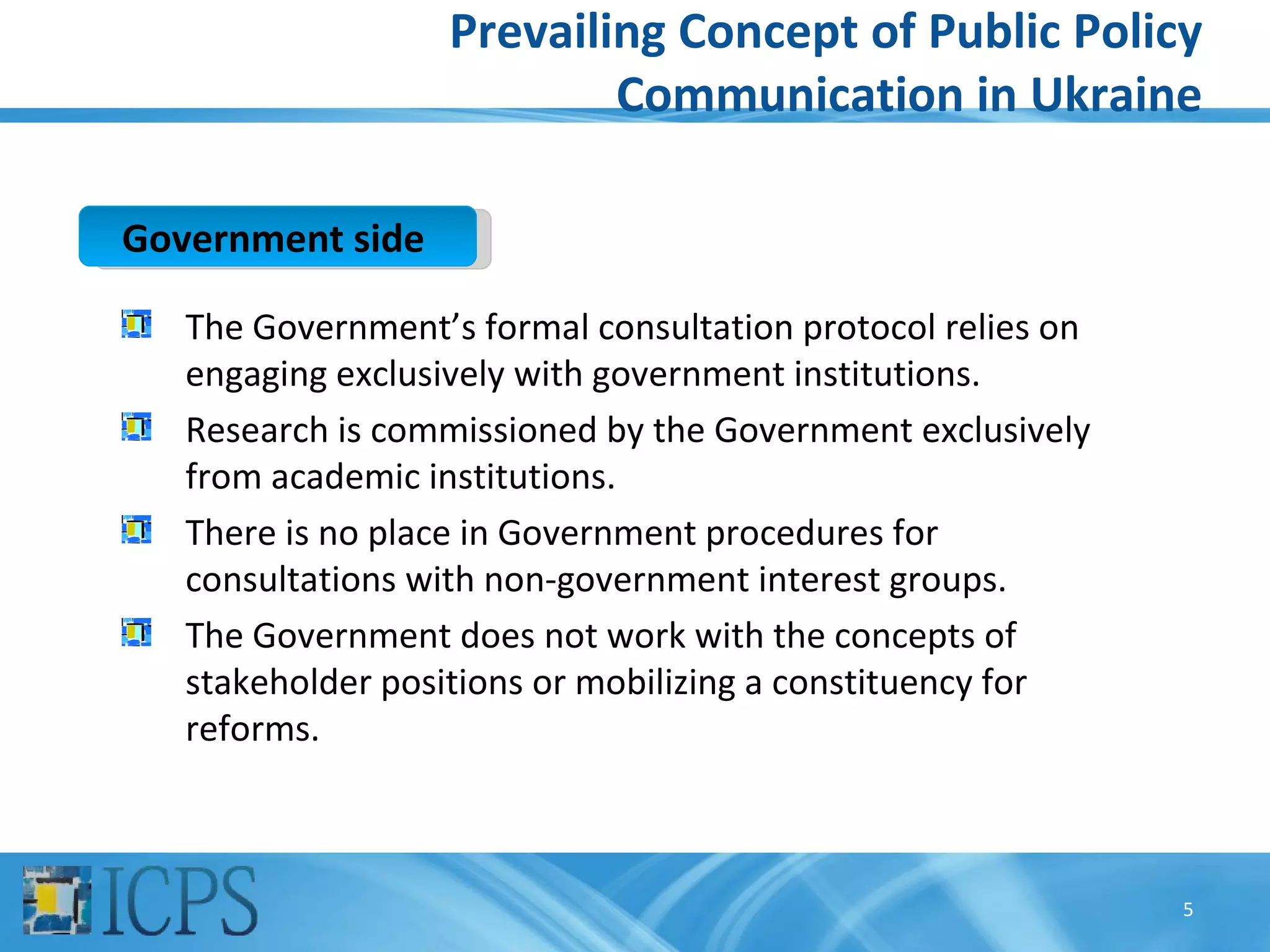
   The Government’s formal consultation protocol relies on
   engaging exclusively with government institutions.
   Research is commissioned by the Government exclusively
   from academic institutions.
   There is no place in Government procedures for
   consultations with non-government interest groups.
   The Government does not work with the concepts of
   stakeholder positions or mobilizing a constituency for
   reforms.


                                                             5
Public consultations in the EU
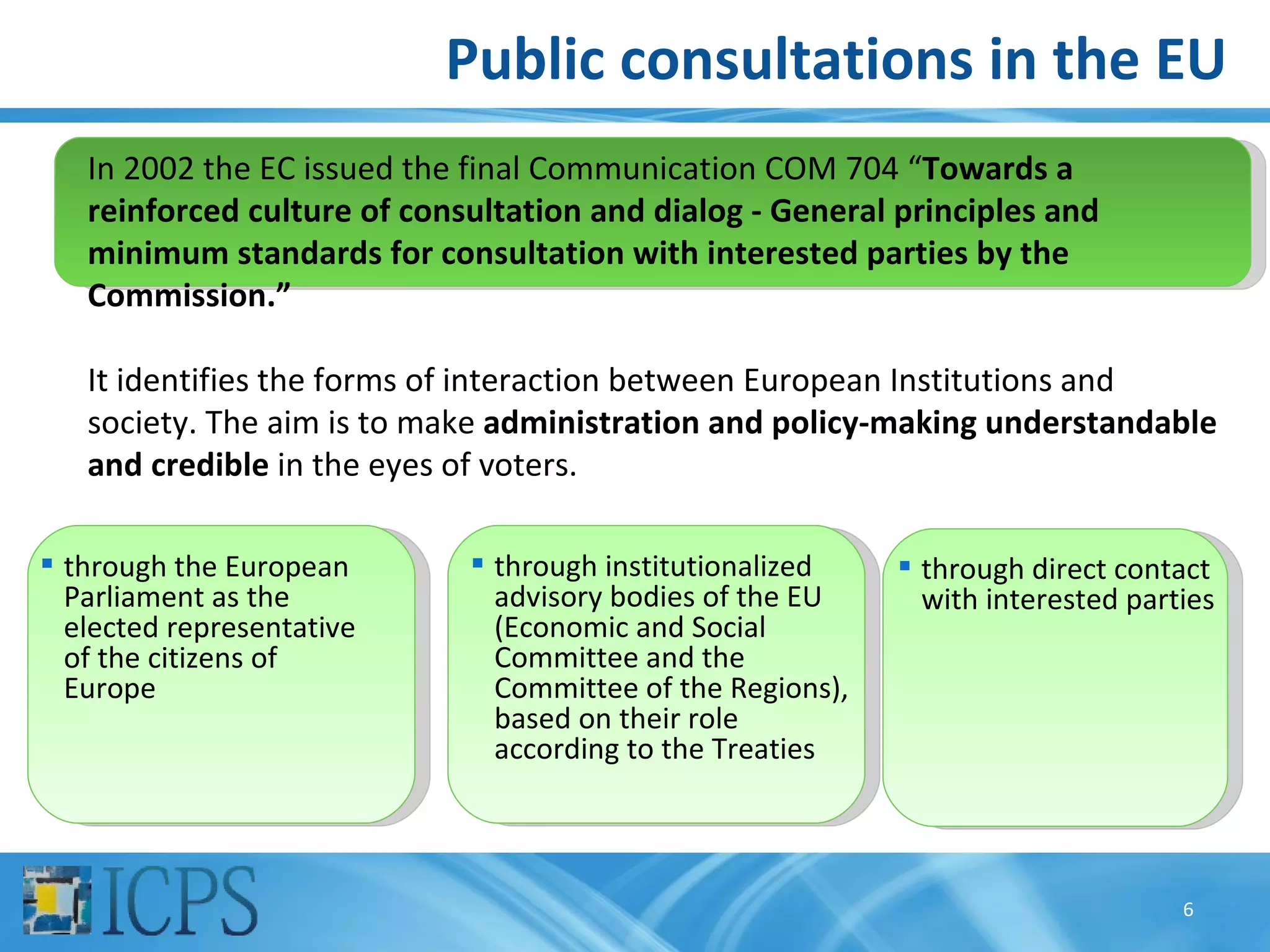
   In 2002 the EC issued the final Communication COM 704 “Towards a
   reinforced culture of consultation and dialog - General principles and
   minimum standards for consultation with interested parties by the
   Commission.”

   It identifies the forms of interaction between European Institutions and
   society. The aim is to make administration and policy-making understandable
   and credible in the eyes of voters.

 through the European        through institutionalized     through direct contact
  Parliament as the            advisory bodies of the EU      with interested parties
  elected representative       (Economic and Social
  of the citizens of           Committee and the
  Europe                       Committee of the Regions),
                               based on their role
                               according to the Treaties


                                                                                  6
Public consultations in the EU
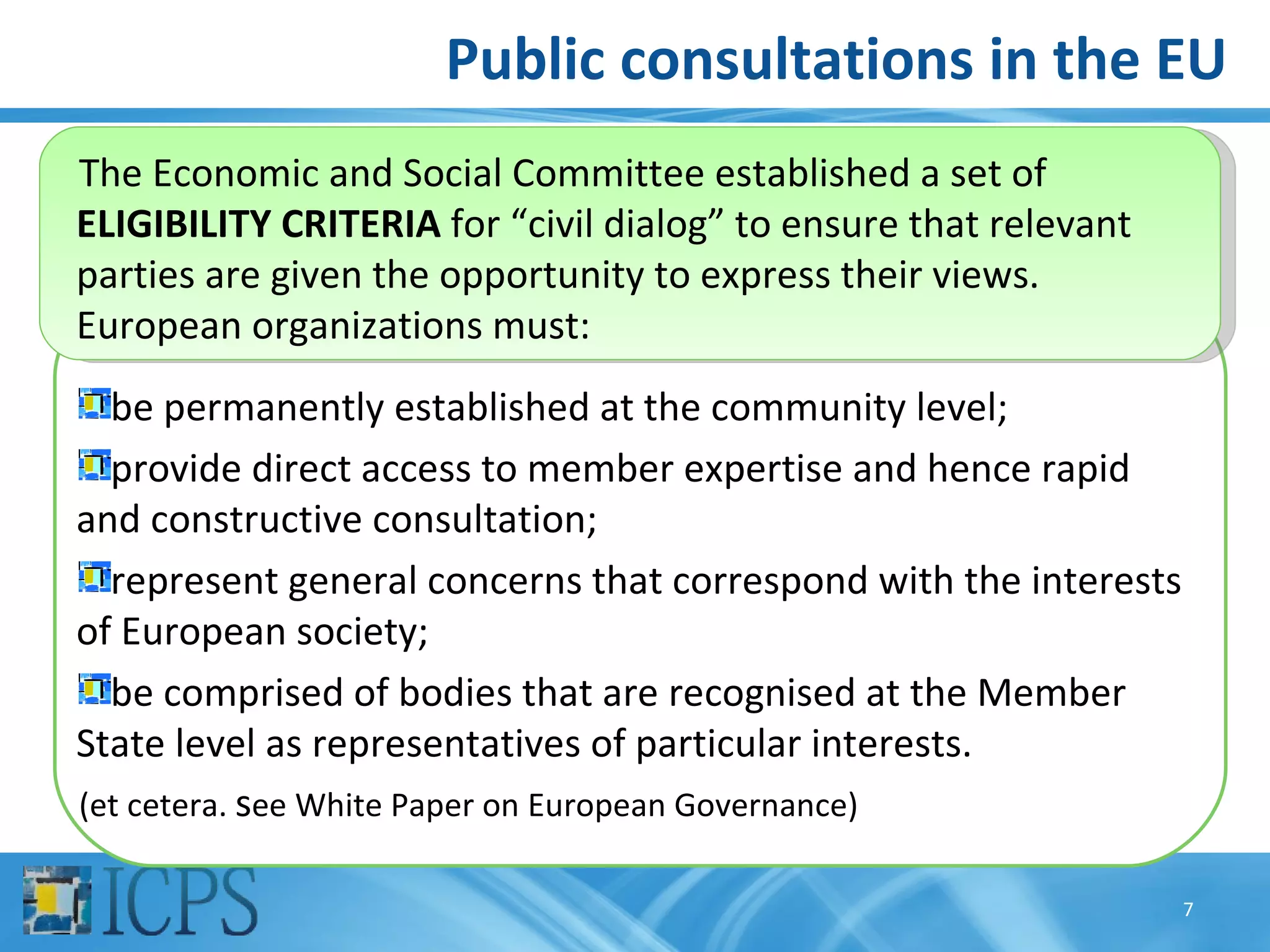
The Economic and Social Committee established a set of
ELIGIBILITY CRITERIA for “civil dialog” to ensure that relevant
parties are given the opportunity to express their views.
European organizations must:
  be permanently established at the community level;
  provide direct access to member expertise and hence rapid
and constructive consultation;
  represent general concerns that correspond with the interests
of European society;
  be comprised of bodies that are recognised at the Member
State level as representatives of particular interests.
(et cetera. see White Paper on European Governance)

                                                                  7
Public consultations in the EU

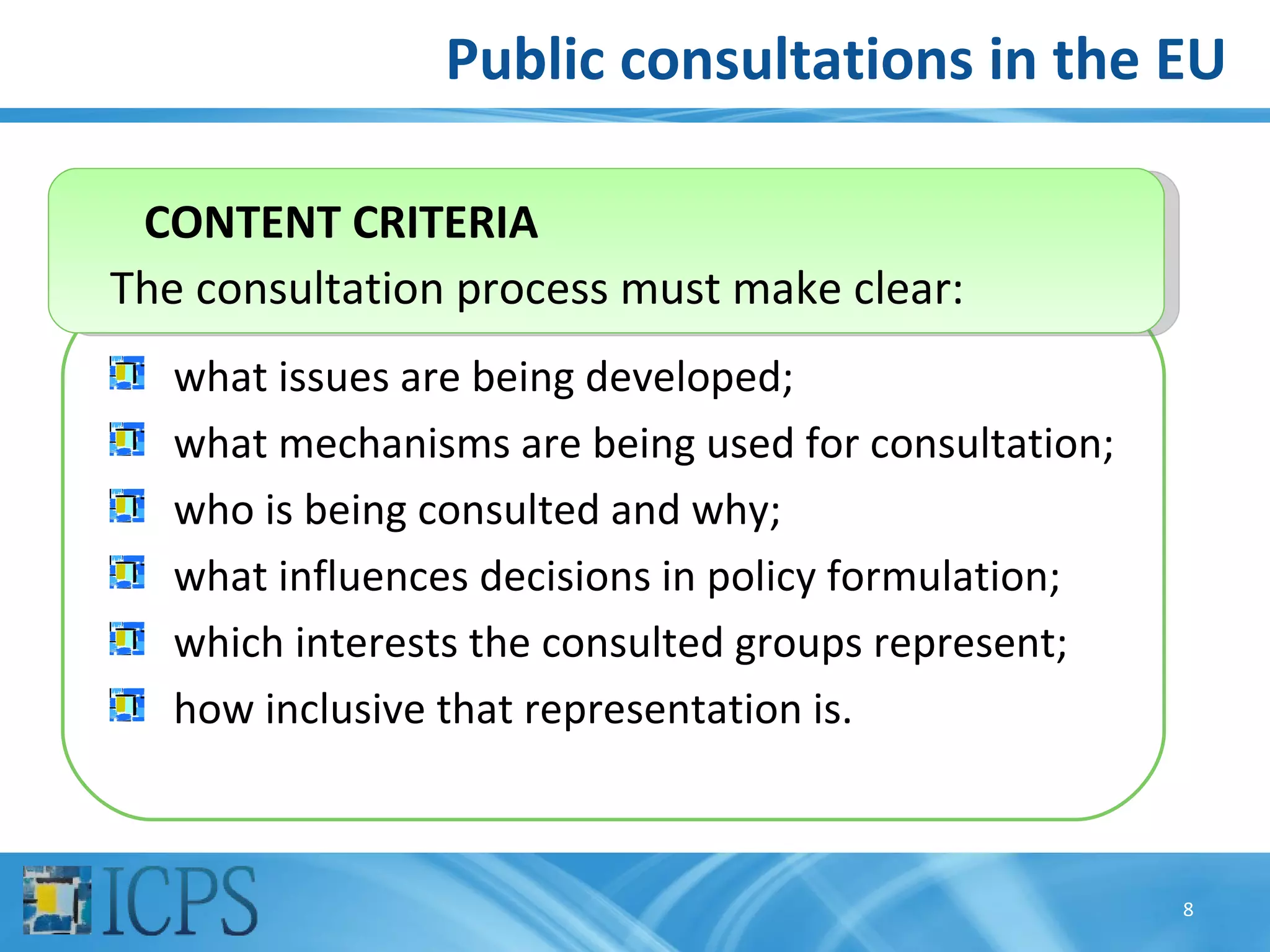
 CONTENT CRITERIA
The consultation process must make clear:
   what issues are being developed;
   what mechanisms are being used for consultation;
   who is being consulted and why;
   what influences decisions in policy formulation;
   which interests the consulted groups represent;
   how inclusive that representation is.


                                                      8
Ukrainian Government Capacity to Digest

There is no working democratic procedure in the Government
for preparing informed decisions.
There is a policy analysis template for submitting documents,
but no quality control over how this template is used.
There are no procedures for consultations with stakeholders;
only Government institutions are consulted.
Only academic institutes are hired by the government to do
research and analysis. Unlike the West, academic institutions,
and not think-tanks, prepare arguments.


                                                            9
The Quality of Think-Tank Products
    What should be in the TT product but never or rarely is

Understanding
– of the government political situation concerning the
  policy issue in question.
– of how this position is connected to ratings and to
  future elections.
Identification
– of the interests and positions of major stakeholders.
– of the most realistic constituency for the policy in
  question.


                                                          10
The Quality of Think-Tank Products
       The relationship between TT & advocacy groups


There is no or little interaction between
advocacy groups and think-tanks in the
effort to influence government policy.

Think-tanks are not able to organize
pressure, while advocacy groups have no
content.


                                                 11
The Quality of Think-Tank Products
                 Global Context for Ukrainian Policy Content

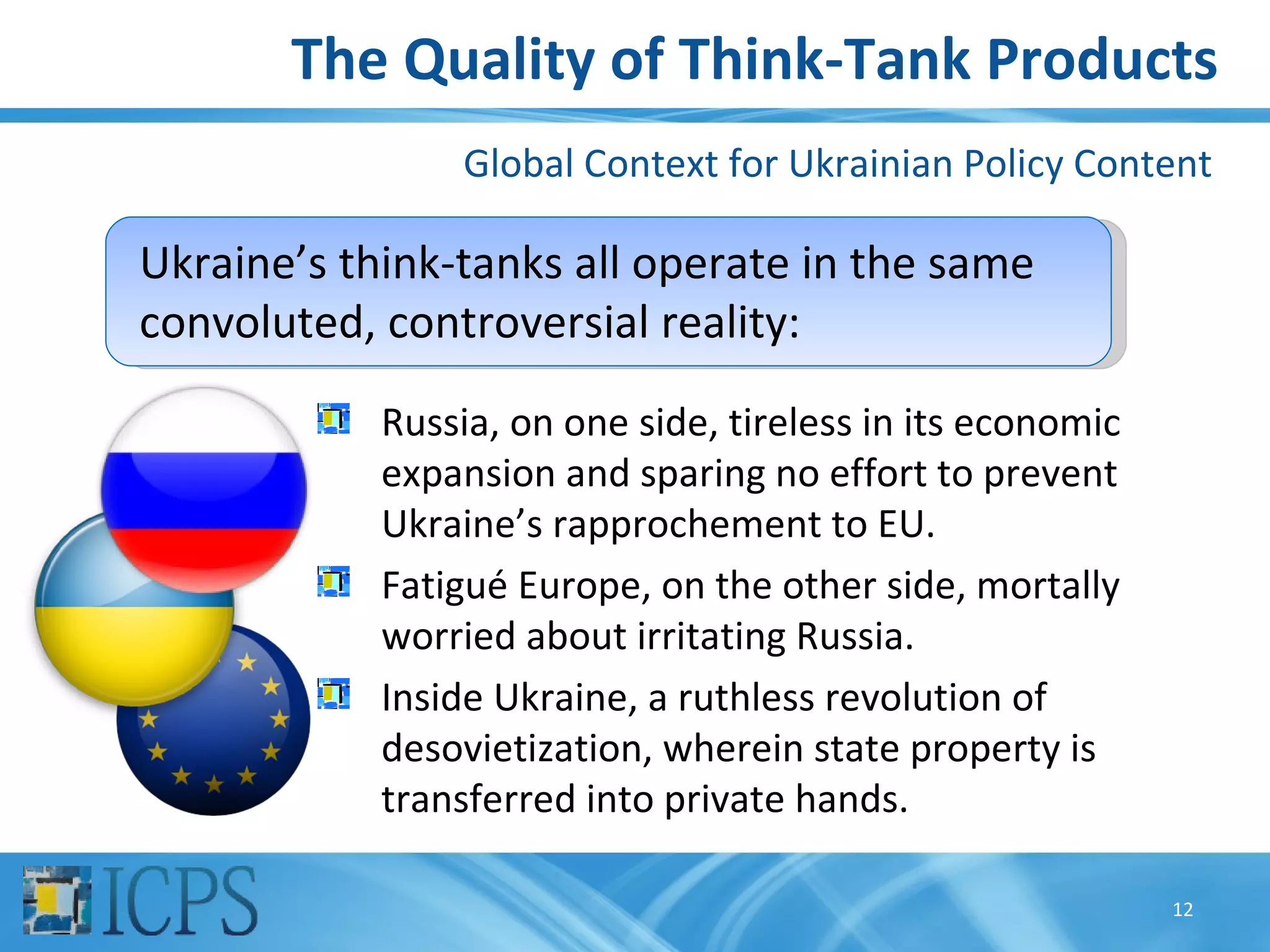
Ukraine’s think-tanks all operate in the same
convoluted, controversial reality:
            Russia, on one side, tireless in its economic
            expansion and sparing no effort to prevent
            Ukraine’s rapprochement to EU.
            Fatigué Europe, on the other side, mortally
            worried about irritating Russia.
            Inside Ukraine, a ruthless revolution of
            desovietization, wherein state property is
            transferred into private hands.

                                                            12
The Quality of Think-Tank Products
                  Global Context for Ukrainian Policy Content

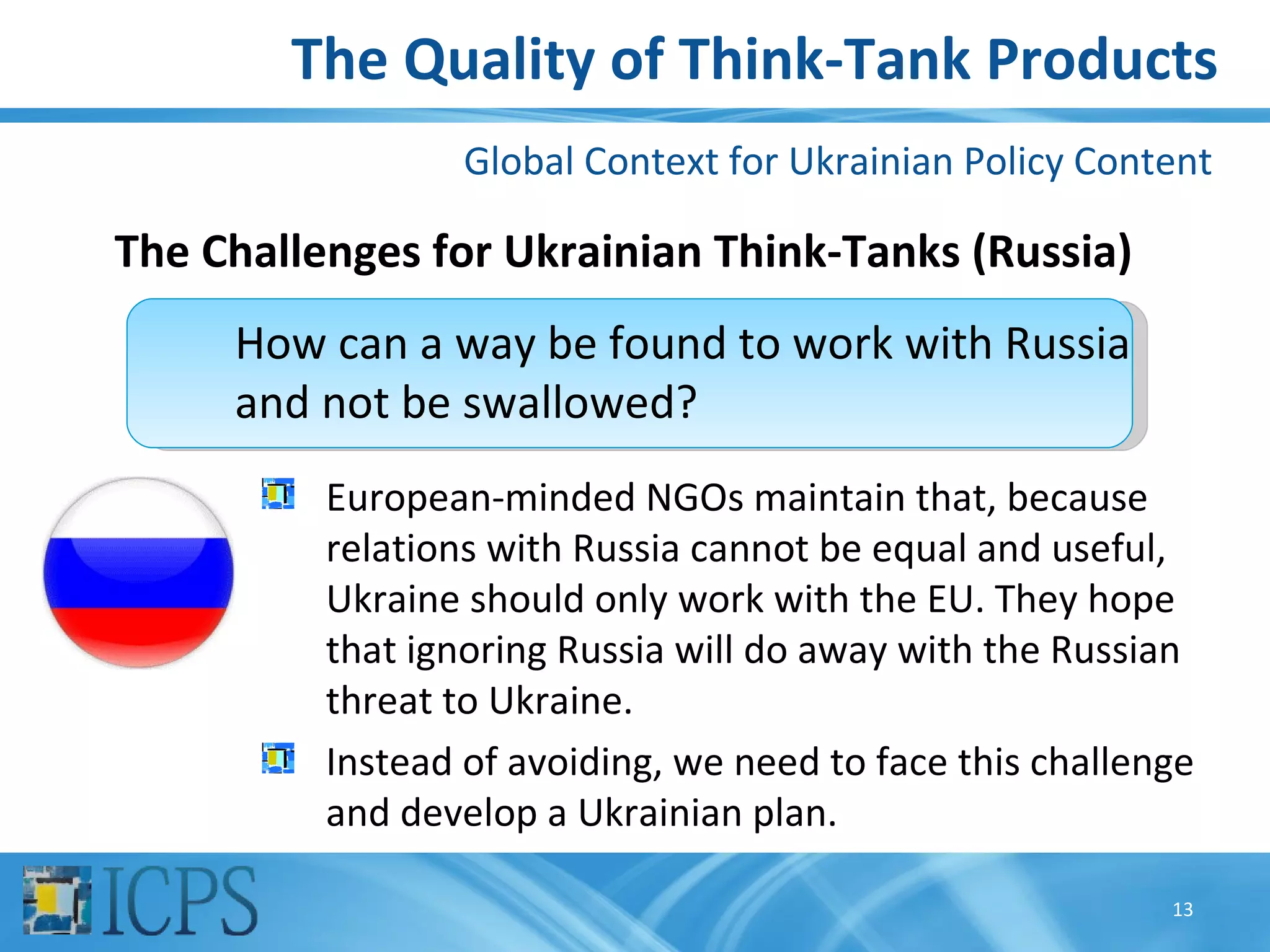
The Challenges for Ukrainian Think-Tanks (Russia)
     How can a way be found to work with Russia
     and not be swallowed?
          European-minded NGOs maintain that, because
          relations with Russia cannot be equal and useful,
          Ukraine should only work with the EU. They hope
          that ignoring Russia will do away with the Russian
          threat to Ukraine.
          Instead of avoiding, we need to face this challenge
          and develop a Ukrainian plan.

                                                           13
The Quality of Think-Tank Products
                 Global Context for Ukrainian Policy Content

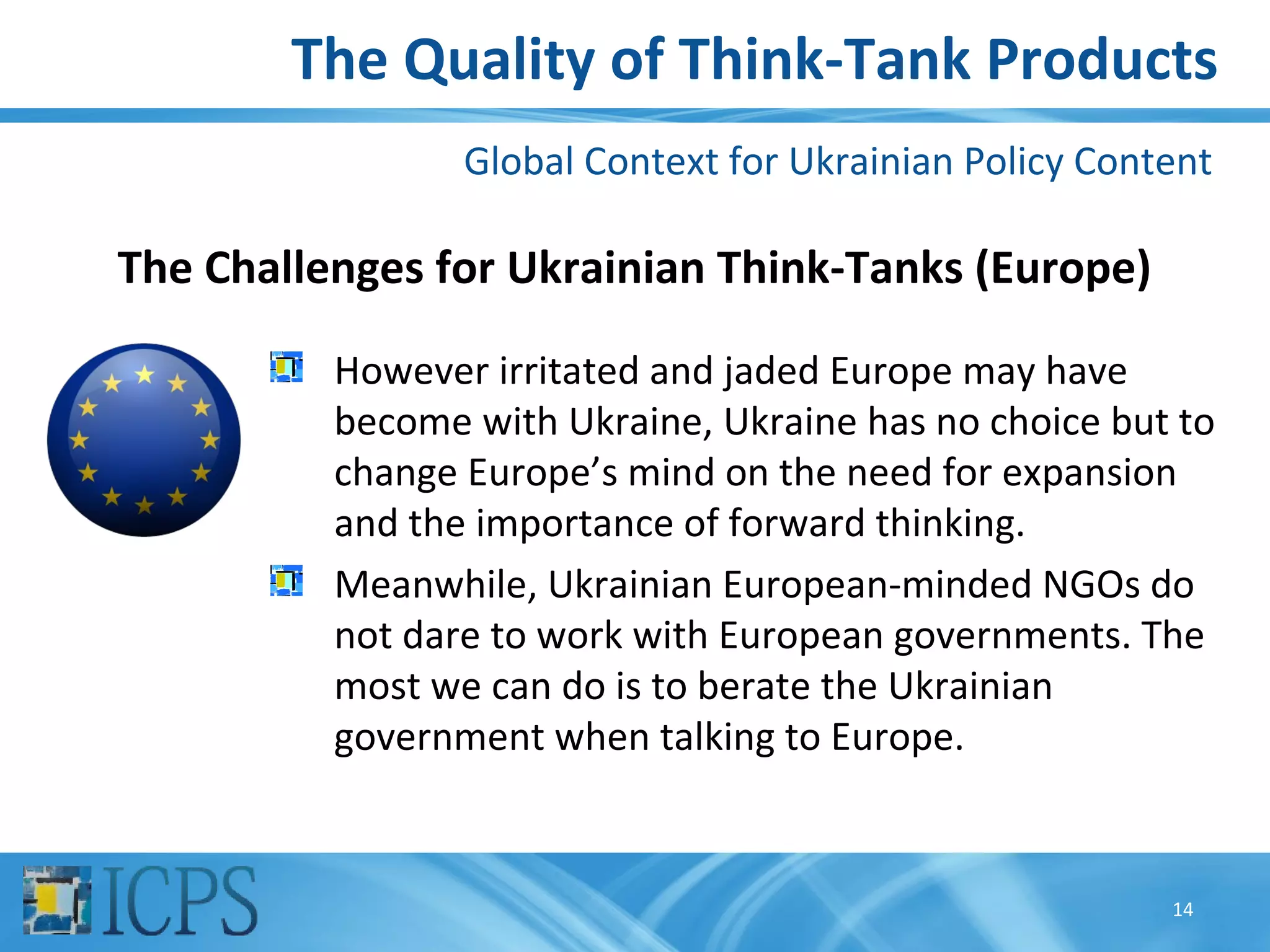
The Challenges for Ukrainian Think-Tanks (Europe)

          However irritated and jaded Europe may have
          become with Ukraine, Ukraine has no choice but to
          change Europe’s mind on the need for expansion
          and the importance of forward thinking.
          Meanwhile, Ukrainian European-minded NGOs do
          not dare to work with European governments. The
          most we can do is to berate the Ukrainian
          government when talking to Europe.


                                                         14
Public need for a policy product

Today in Ukraine, the government, business and civil
society interest groups all have a need for quality analysis,
diagnoses, and recommendations.

   – The Government: because of failing reforms, it
     needs to learn how to mobilize support.
   – Small business: because of the threat of being
     annihilated as a class, it needs to learn how to
     influence policy, not just specific private interest.
   – Big business: because they are losing a qualified
     workforce, they need to influence government
     policy.

                                                                15
The Quality of Think-Tank Products
               Global Context for Ukrainian Policy Content
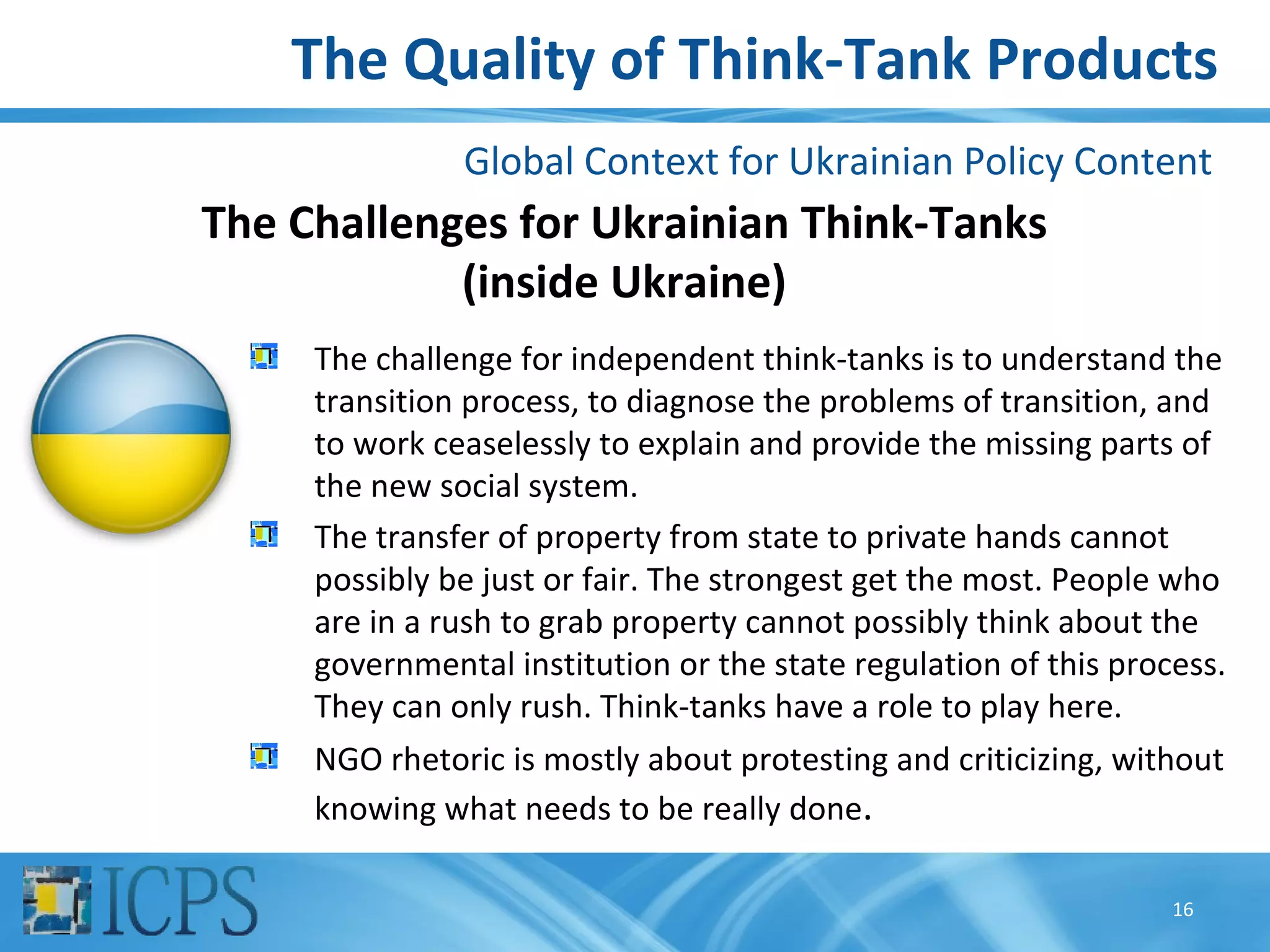
The Challenges for Ukrainian Think-Tanks
            (inside Ukraine)
     The challenge for independent think-tanks is to understand the
     transition process, to diagnose the problems of transition, and
     to work ceaselessly to explain and provide the missing parts of
     the new social system.
     The transfer of property from state to private hands cannot
     possibly be just or fair. The strongest get the most. People who
     are in a rush to grab property cannot possibly think about the
     governmental institution or the state regulation of this process.
     They can only rush. Think-tanks have a role to play here.
     NGO rhetoric is mostly about protesting and criticizing, without
     knowing what needs to be really done.

                                                                  16
Public need for a policy product
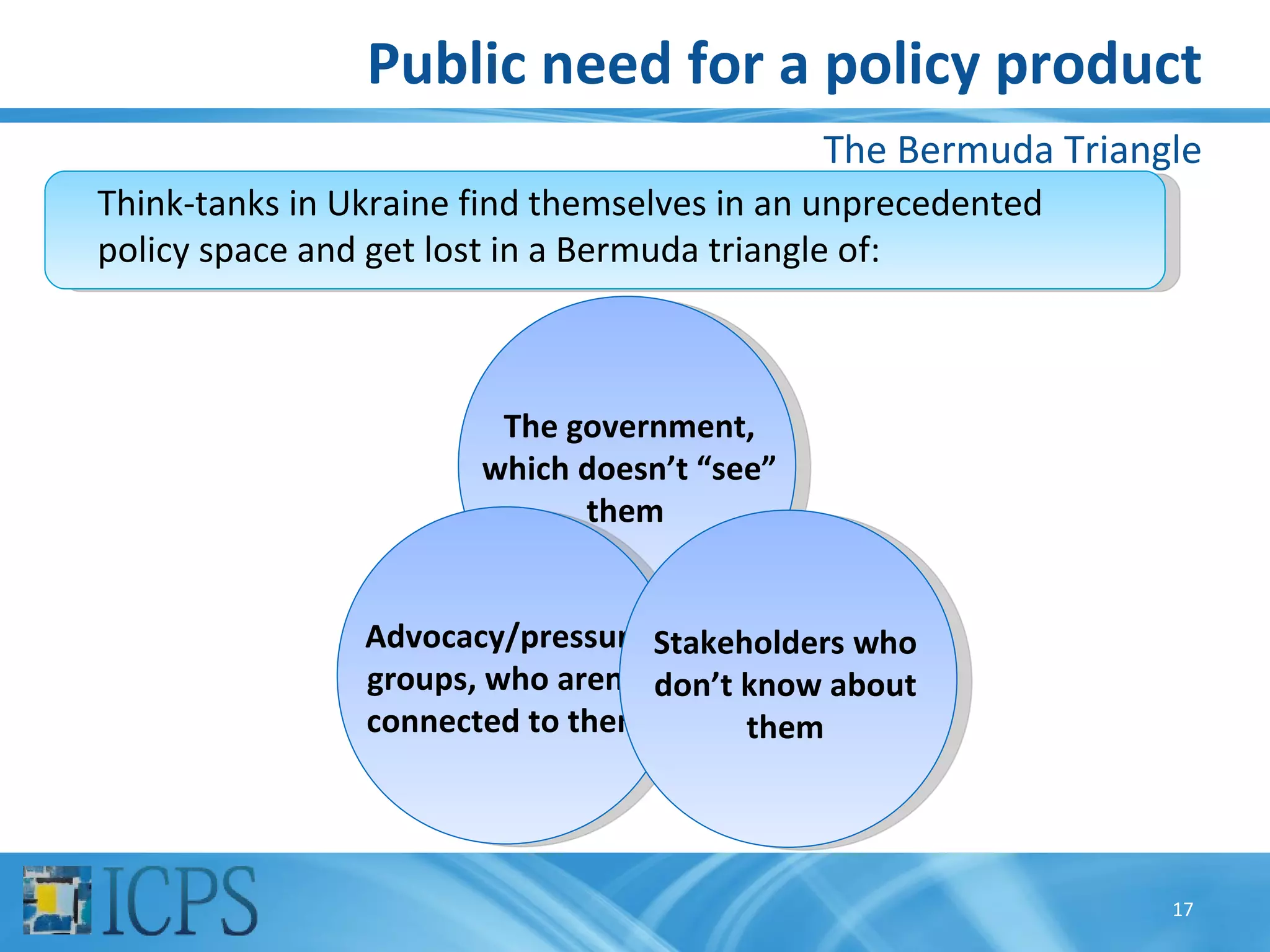
                                             The Bermuda Triangle
Think-tanks in Ukraine find themselves in an unprecedented
policy space and get lost in a Bermuda triangle of:


                        The government,
                       which doesn’t “see”
                             them


                Advocacy/pressure Stakeholders who
                groups, who aren’t don’t know about
                connected to them        them


                                                               17
International Aid Policy

Aid projects are disconnected and not strategic.
Project outcomes are not used as an asset for other
projects.
Donors are immersed in content and not interested
in a policy analysis format.
Except OSI TTF, no donor is interested in the specific
professional qualifications needed to conduct policy
analysis.


                                                    18
International Aid Policy

Projects to develop an influential civil society have
not focused on reforming the government or helping
it establish the structures, procedures, standards
and skills needed to work with civil society.
The treasure of over 20 years of aid projects has
been lost to Ukraine because there are no databases
of projects, of people trained, or of training
materials.


                                                   19
Looking Ahead
Programs need to switch from funding consultations
with an undifferentiated civil society to funding
consultations with defined interest groups.

Consultations with interest groups should follow
established procedures.

Every NGO working in European integration and civil
society should have a very clearly established role and
specialization.

TA beneficiaries should not concentrate on a specific
sector (e.g. agriculture or the arts) but on bringing
about transformational reforms in the country (e.g.
government capacity for democratic market
regulation).

                                                   20

The Art of Effectively Communicating Policy Solutions or Swimming in an Empty Pool

  • 1.
    The Art ofEffectively Communicating Policy Solutions or Swimming in an Empty Pool Vira Nanivska, ICPS TTF Workshop 13.05.2011, Kyiv, Ukraine
  • 2.
    ICPS Policy CommunicationConcept All policy decisions affect people’s interests. The success or failure of any policy depends on how fully the policy in question matches group interests. Communication, that is, analysis and consultations, is the core of effective public policy. The methodology for public consultations is adapted from European Commission, US and Canadian models.
  • 3.
    Factors that define Think-Tank policy impact in Ukraine Prevailing concept of public policy in Ukraine. Comparison with EU guidelines on public consultations. Government capacity to digest TT product. The quality of the TT product. Public need for this policy product. Donor policies on who/what to support. 3
  • 4.
    Prevailing Concept of Public Policy Communication in Ukraine NGO side The Ukrainian concept of civil society communication with the government is very different from European practice. It is not structured, but rather based on moral (the Government is bad) and not technical (what and how to do it) principles. Most NGOs set up through international aid follow 25 year-old principles: – Dissident struggle with the government; – No concept of “Informed decisions;” – The quality of TT products, i.e. their lack of policy analysis, does not make them indispensable. – Huge efforts to undertake policy consultation came down to civic councils established in every government institution across Ukraine after the Orange Revolution. These councils neither represent communities or interest groups, nor do they take part in government decision-making processes. 4
  • 5.
    Prevailing Concept ofPublic Policy Communication in Ukraine Government side The Government’s formal consultation protocol relies on engaging exclusively with government institutions. Research is commissioned by the Government exclusively from academic institutions. There is no place in Government procedures for consultations with non-government interest groups. The Government does not work with the concepts of stakeholder positions or mobilizing a constituency for reforms. 5
  • 6.
    Public consultations inthe EU In 2002 the EC issued the final Communication COM 704 “Towards a reinforced culture of consultation and dialog - General principles and minimum standards for consultation with interested parties by the Commission.” It identifies the forms of interaction between European Institutions and society. The aim is to make administration and policy-making understandable and credible in the eyes of voters.  through the European  through institutionalized  through direct contact Parliament as the advisory bodies of the EU with interested parties elected representative (Economic and Social of the citizens of Committee and the Europe Committee of the Regions), based on their role according to the Treaties 6
  • 7.
    Public consultations inthe EU The Economic and Social Committee established a set of ELIGIBILITY CRITERIA for “civil dialog” to ensure that relevant parties are given the opportunity to express their views. European organizations must: be permanently established at the community level; provide direct access to member expertise and hence rapid and constructive consultation; represent general concerns that correspond with the interests of European society; be comprised of bodies that are recognised at the Member State level as representatives of particular interests. (et cetera. see White Paper on European Governance) 7
  • 8.
    Public consultations inthe EU CONTENT CRITERIA The consultation process must make clear: what issues are being developed; what mechanisms are being used for consultation; who is being consulted and why; what influences decisions in policy formulation; which interests the consulted groups represent; how inclusive that representation is. 8
  • 9.
    Ukrainian Government Capacityto Digest There is no working democratic procedure in the Government for preparing informed decisions. There is a policy analysis template for submitting documents, but no quality control over how this template is used. There are no procedures for consultations with stakeholders; only Government institutions are consulted. Only academic institutes are hired by the government to do research and analysis. Unlike the West, academic institutions, and not think-tanks, prepare arguments. 9
  • 10.
    The Quality ofThink-Tank Products What should be in the TT product but never or rarely is Understanding – of the government political situation concerning the policy issue in question. – of how this position is connected to ratings and to future elections. Identification – of the interests and positions of major stakeholders. – of the most realistic constituency for the policy in question. 10
  • 11.
    The Quality ofThink-Tank Products The relationship between TT & advocacy groups There is no or little interaction between advocacy groups and think-tanks in the effort to influence government policy. Think-tanks are not able to organize pressure, while advocacy groups have no content. 11
  • 12.
    The Quality ofThink-Tank Products Global Context for Ukrainian Policy Content Ukraine’s think-tanks all operate in the same convoluted, controversial reality: Russia, on one side, tireless in its economic expansion and sparing no effort to prevent Ukraine’s rapprochement to EU. Fatigué Europe, on the other side, mortally worried about irritating Russia. Inside Ukraine, a ruthless revolution of desovietization, wherein state property is transferred into private hands. 12
  • 13.
    The Quality ofThink-Tank Products Global Context for Ukrainian Policy Content The Challenges for Ukrainian Think-Tanks (Russia) How can a way be found to work with Russia and not be swallowed? European-minded NGOs maintain that, because relations with Russia cannot be equal and useful, Ukraine should only work with the EU. They hope that ignoring Russia will do away with the Russian threat to Ukraine. Instead of avoiding, we need to face this challenge and develop a Ukrainian plan. 13
  • 14.
    The Quality ofThink-Tank Products Global Context for Ukrainian Policy Content The Challenges for Ukrainian Think-Tanks (Europe) However irritated and jaded Europe may have become with Ukraine, Ukraine has no choice but to change Europe’s mind on the need for expansion and the importance of forward thinking. Meanwhile, Ukrainian European-minded NGOs do not dare to work with European governments. The most we can do is to berate the Ukrainian government when talking to Europe. 14
  • 15.
    Public need fora policy product Today in Ukraine, the government, business and civil society interest groups all have a need for quality analysis, diagnoses, and recommendations. – The Government: because of failing reforms, it needs to learn how to mobilize support. – Small business: because of the threat of being annihilated as a class, it needs to learn how to influence policy, not just specific private interest. – Big business: because they are losing a qualified workforce, they need to influence government policy. 15
  • 16.
    The Quality ofThink-Tank Products Global Context for Ukrainian Policy Content The Challenges for Ukrainian Think-Tanks (inside Ukraine) The challenge for independent think-tanks is to understand the transition process, to diagnose the problems of transition, and to work ceaselessly to explain and provide the missing parts of the new social system. The transfer of property from state to private hands cannot possibly be just or fair. The strongest get the most. People who are in a rush to grab property cannot possibly think about the governmental institution or the state regulation of this process. They can only rush. Think-tanks have a role to play here. NGO rhetoric is mostly about protesting and criticizing, without knowing what needs to be really done. 16
  • 17.
    Public need fora policy product The Bermuda Triangle Think-tanks in Ukraine find themselves in an unprecedented policy space and get lost in a Bermuda triangle of: The government, which doesn’t “see” them Advocacy/pressure Stakeholders who groups, who aren’t don’t know about connected to them them 17
  • 18.
    International Aid Policy Aidprojects are disconnected and not strategic. Project outcomes are not used as an asset for other projects. Donors are immersed in content and not interested in a policy analysis format. Except OSI TTF, no donor is interested in the specific professional qualifications needed to conduct policy analysis. 18
  • 19.
    International Aid Policy Projectsto develop an influential civil society have not focused on reforming the government or helping it establish the structures, procedures, standards and skills needed to work with civil society. The treasure of over 20 years of aid projects has been lost to Ukraine because there are no databases of projects, of people trained, or of training materials. 19
  • 20.
    Looking Ahead Programs needto switch from funding consultations with an undifferentiated civil society to funding consultations with defined interest groups. Consultations with interest groups should follow established procedures. Every NGO working in European integration and civil society should have a very clearly established role and specialization. TA beneficiaries should not concentrate on a specific sector (e.g. agriculture or the arts) but on bringing about transformational reforms in the country (e.g. government capacity for democratic market regulation). 20

Editor's Notes

  • #4 Perhaps TT should be defined at first reference?
  • #13 Is it really desovietization or denationalization?