

From Public
Housing to the
Palaces of the
Great:
Where Does
Art Belong?
agenda 3.30.15
review:
Depression era sees creation of first US housing policy
Huge demand for urban housing in WWII to keep a roof over
factory workers' heads.
Brewster Homes and Cabrini Homes both got their start
during WWII.
After WWII, the approach to building changed: high rises.
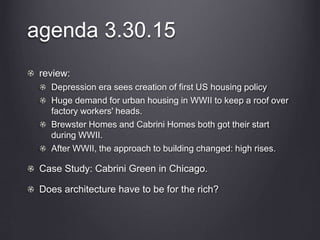
Case Study: Cabrini Green in Chicago.
Does architecture have to be for the rich?
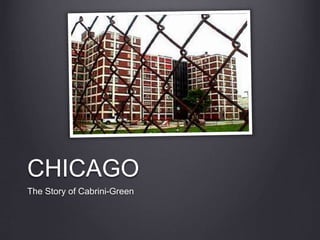
CHICAGO
The Story of Cabrini-Green
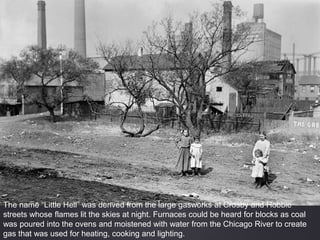
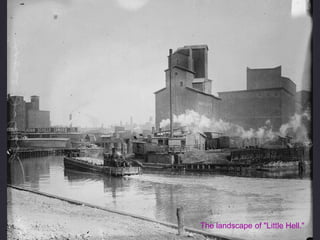
The name “Little Hell” was derived from the large gasworks at Crosby and Hobbie
streets whose flames lit the skies at night. Furnaces could be heard for blocks as coal
was poured into the ovens and moistened with water from the Chicago River to create
gas that was used for heating, cooking and lighting.
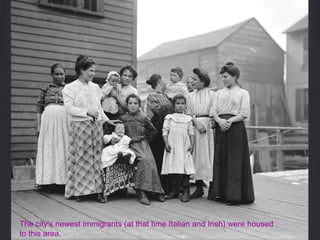
The city's newest immigrants (at that time Italian and Irish) were housed
to this area.
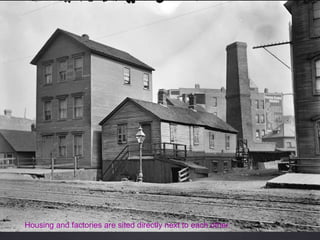
Housing and factories are sited directly next to each other.
The landscape of "Little Hell."
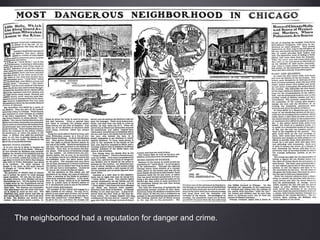
The neighborhood had a reputation for danger and crime.
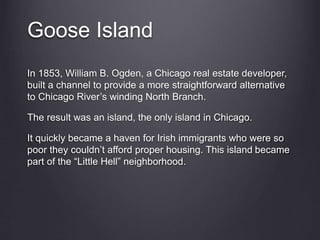
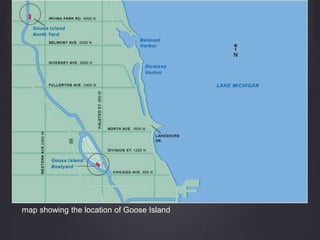
Goose Island
In 1853, William B. Ogden, a Chicago real estate developer,
built a channel to provide a more straightforward alternative
to Chicago River’s winding North Branch.
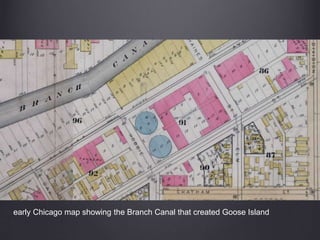
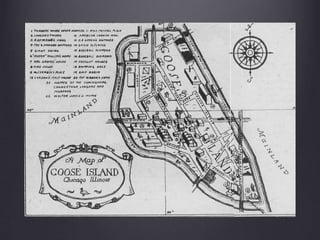
The result was an island, the only island in Chicago.
It quickly became a haven for Irish immigrants who were so
poor they couldn’t afford proper housing. This island became
part of the “Little Hell” neighborhood.
early Chicago map showing the Branch Canal that created Goose Island
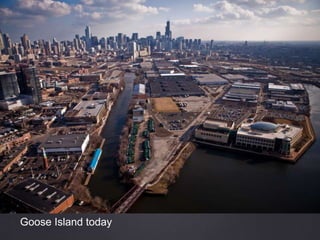
Goose Island
today
Goose Island 2015
Digital Manufacturing and Design Innovation Institute
• awarded to Chicago 2014
• $70 million in federal funds
• $16 million from the state
• another $250 million from private industry, like
General Electric, Rolls-Royce, Procter & Gamble,
Siemens, Lockheed Martin and Dow Chemical Co.
• managed by UI Labs (Universities and
Industries)—a subsidiary of U of I
Goose Island today
Goose Island today
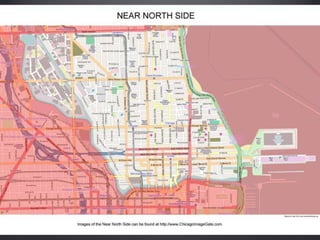
map showing the location of Goose Island
Near North
During World War II, the Chicago Housing Authority razed
the "Little Hell" neighborhood and built a low-rise apartment
project for war workers.
They called it the Frances Cabrini Homes after the first
American canonized by the Catholic Church.
Timeline: Early Years
1929 - Harvey Zorbaugh writes "The Gold Coast and
the Slum: A Sociological Study of Chicago's Near
North Side," contrasting wealthy Gold Coast, with
poor Little Sicily (“Little Hell”)
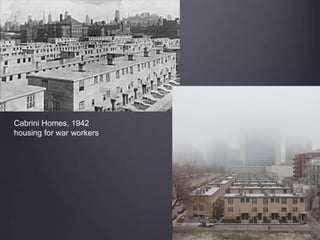
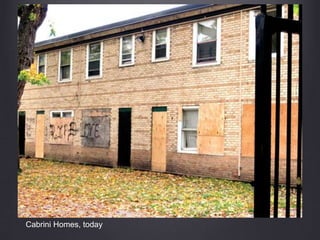
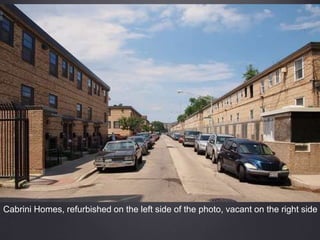
1942 - Frances Cabrini Homes (two-story
rowhouses), with 586 units in 54 buildings,
completed. Initial regulations stipulate 75% white and
25% black residents. Holsman, Burmeister, et al,
architects.
Cabrini Homes, 1942
housing for war workers
Cabrini Homes, today
Cabrini Homes, refurbished on the left side of the photo, vacant on the right side
Alamer Lee Vassar
“I came to Chicago in 1942. I moved into a building at 1230 North
Larrabee on October 2nd of that year. There wasn’t no projects
here then and my husband was in the service. That’s what brought
us up here from Mississippi. I got a job and went to work. Back
then they would beg you when you walked out the door, sayin,’Do
you wanna work for me, do you wanna work for me?’
“It was beautiful down here. They used to have
this festival and parade in the summer, and they
had these lights that run from Chicago [Avenue]
all the way up to North, and we used to sit out
in front of 1230 and look at the people drivin’ by
and parkin’ their cars—whites and colored
people at that time—and everything was lovely,
I mean, beautiful. And the kids they’d go around
Paulette Simpson
“My mother was the second person to move into 502. The
elevator excited me and everything was perfect. If you had a
problem with anything in your house, CHA was out there
within 24 hours or less. They were on top of everything then.
I went to Jenner school. I played out in the playground. I
went to Lower North Center to take dancing classes, and I
used to go to Stanton Park for swimming.”
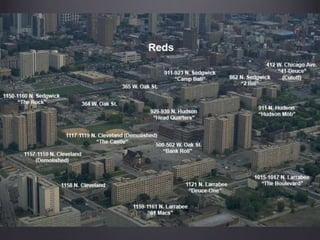
Cabrini Homes, after WWII
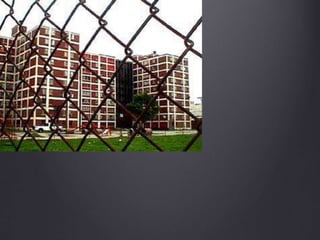
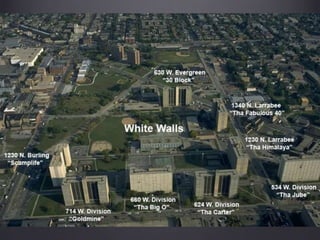
1958 - Cabrini Homes Extension (red brick mid- and high-rises),
with 1,925 units in 15 buildings, is completed. A. Epstein &
Sons, architects.
1962 - Green Homes (1,096 units, north of Division Street) is
completed. Pace Associates, architects.
Wanda Hopkins
“We moved here September 1, 1960. We were the second ones in
the building at 534 W. Division.
When I moved in it was just so beautiful, the buildings wasn’t
grayish the way it is now but really the white color, and the
apartments were so new, and the floors were shining…I was about
four or five…
It was so new and so pretty and the grass was green….My mother
says you’re really crazy to remember all that, but I look at it now
after all these years and I can just remind myself of how it was and
I can tell people that this was not the original plan. But I remember
other families moving in, and these were all white families, and
someone organized the Cub Scouts and the Brownie Scot because
I remember I became a Brownie…I remember the Brownie uniform
and all that, my brothers were in the Cub Scouts.”
Wanda Hopkins (continued)
“Yeah, and we used to live right next door to a white family,
I’ll never forget, we’d spend the night at each other’s house,
stuff that you’d never think of would happen back then. I
remember Alice and Sally. I lived in 402, they lived in 403. My
mother never felt that anything would happen to me when we
spent the night at each other’s house, and her mother never
felt that….It’s almost unheard of now. But I keep tellin’ people
the way it is now was the original plan, and I just wanted
them to know that. I guess that’s why I kept it all in my
memory.”
(p. 53)
Cabrini-Green, 1990s
1994 Chicago receives one of the first HOPE VI (Housing
Opportunities for People Everywhere) grants to redevelop Cabrini-
Green as a mixed-income neighborhood.
1995 Demolition begins.
1997 Chicago unveils Near North Redevelopment Initiative, a
master plan for development in the area. It recommends
demolishing Green Homes and most of Cabrini Extension.
1999 Chicago Housing Authority announces Plan for
Transformation, which will spend $1.5 billion over ten years to
demolish 18,000 apartments and build or rehabilitate 25,000
apartments. Earlier redevelopment plans for Cabrini-Green are
included in the Plan for Transformation. New library, rehabilitated
Seward Park, and new shopping center open.
Old Town Village West townhomes, a new mixed-income development, in the
background is the William Green Homes high-rise, part of Cabrini-Green, later
demolished. [Photo: Lawrence J. Vale]
North Town Village mixed-income housing, on the left, with the last of the
Cabrini-Green high-rises on the right; the high-rise was demolished in 2011.
[Photo: Lawrence J. Vale]
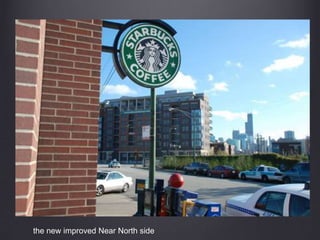
the new improved Near North side
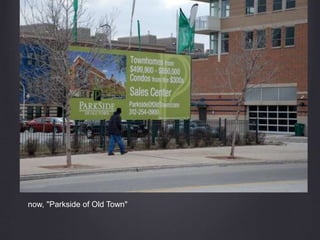
now, "Parkside of Old Town"
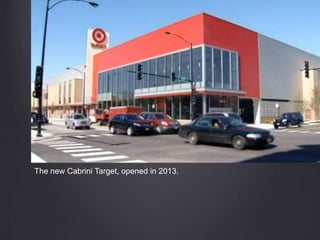
The new Cabrini Target, opened in 2013.
outcome re: low-income units
"And yet, nearly 20 years into the redevelopment, there exist
fewer than 400 replacement public housing units, counting
both the Cabrini site itself and the mixed-income
communities in the broader neighborhood. With nearly 3,000
deeply subsidized apartments already torn down, the 586
Cabrini row houses — the low-rise housing that has so far
survived the clearance — seem likely to fall next."
—"Up," p. 14
outcome, continued
"The CHA assures ex-Cabrini residents forced from vacated
and demolished buildings that they can enter the lottery for
replacement units on site and in the neighborhood; but all the
existing apartments reserved for public housing residents are
already occupied, and the prospect of achieving the 700
units mandated in the consent decree depends upon the
completion of the glacially implemented new construction on
the Cabrini Extension North site — still unfinished from the
HOPE VI grant of 1993. And even if new units do materialize,
the screening processes — even under the more liberal
terms negotiated though the consent decree — ensure that
most ex-Cabrini households will not be welcomed." [Up," p.
14]
“[The American Dream is] that dream of a land in which life should be
better and richer and fuller for everyone, with opportunity for each
according to ability or achievement. It is a difficult dream for the European
upper classes to interpret adequately, and too many of us ourselves have
grown weary and mistrustful of it. It is not a dream of motor cars and high
wages merely, but a dream of social order in which each man and each
woman shall be able to attain to the fullest stature of which they are
innately capable, and be recognized by others for what they are,
regardless of the fortuitous circumstances of birth or position." James
Truslow Adams The Epic of America (1931):
(p.214-215)
Adams’s text is quoted at:
http://www.loc.gov/teachers/classroommaterials/lessons/american-
dream/students/thedream.html
http://www.motherjones.com/politics/2011/02/income-inequality-in-america-chart-graph
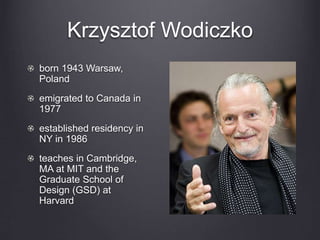
Krzysztof Wodiczko
born 1943 Warsaw,
Poland
emigrated to Canada in
1977
established residency in
NY in 1986
teaches in Cambridge,
MA at MIT and the
Graduate School of
Design (GSD) at
Harvard
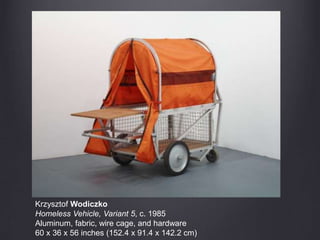
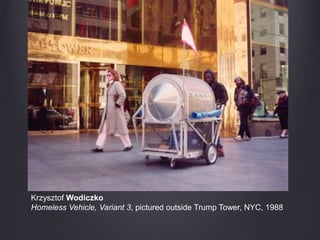
Krzysztof Wodiczko
Homeless Vehicle, Variant 5, c. 1985
Aluminum, fabric, wire cage, and hardware
60 x 36 x 56 inches (152.4 x 91.4 x 142.2 cm)
Krzysztof Wodiczko
Homeless Vehicle, Variant 3, pictured outside Trump Tower, NYC, 1988
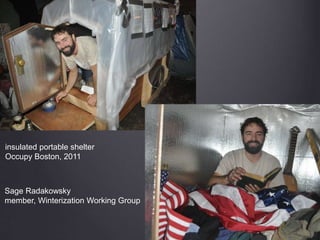
insulated portable shelter
Occupy Boston, 2011
Sage Radakowsky
member, Winterization Working Group
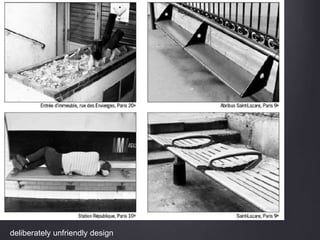
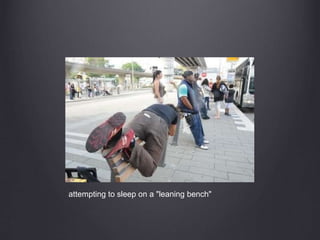
deliberately unfriendly design
attempting to sleep on a "leaning bench"
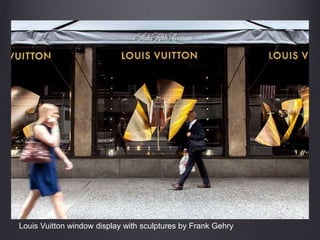
Louis Vuitton window display with sculptures by Frank Gehry
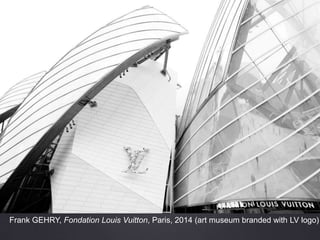
Frank GEHRY, Fondation Louis Vuitton, Paris, 2014 (art museum branded with LV logo)
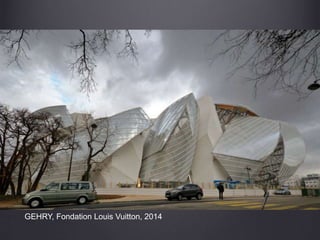
GEHRY, Fondation Louis Vuitton, 2014
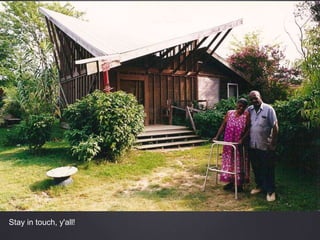
Stay in touch, y'all!
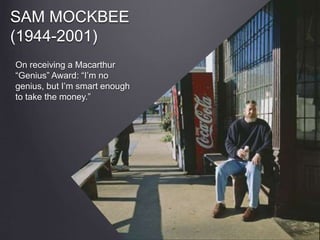
SAM MOCKBEE
(1944-2001)
On receiving a Macarthur
“Genius” Award: “I’m no
genius, but I’m smart enough
to take the money.”
4 examples
• Bryant House (Haybale House), Mason’s Bend, AL, 1994
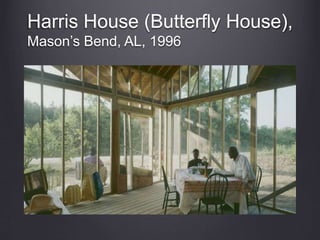
• Harris House (Butterfly House), Mason’s Bend, AL, 1996
• Lucy's House, Mason's Bend, AL, 1997
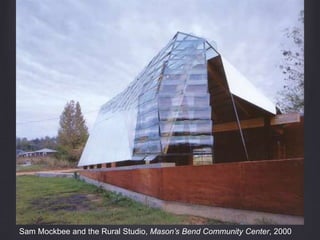
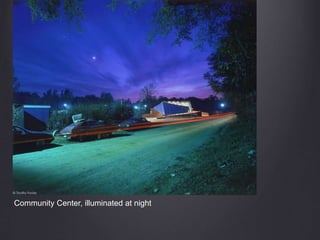
• Mason’s Bend Community Center, Mason’s Bend, AL,
2000
Mockbee's philosophy
"Critical thought requires looking beyond architecture
towards an enhanced understanding of the whole to which it
belongs. Accordingly, the role of architecture should be
placed in relation to other issues of education, healthcare,
transportation, recreation, law enforcement, employment, the
environment, the collective community that impacts on the
lives of both the rich and the poor."
—Samuel Mockbee, "The Rural Studio," 1998
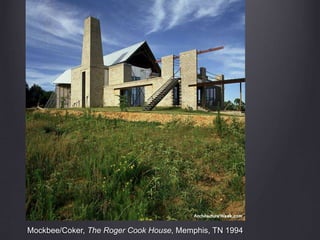
Mockbee/Coker, The Roger Cook House, Memphis, TN 1994
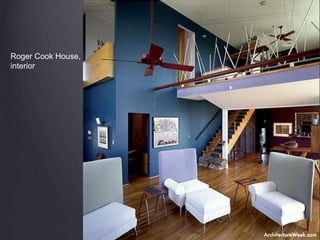
Roger Cook House,
interior
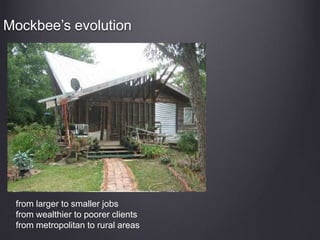
Mockbee’s evolution
from larger to smaller jobs
from wealthier to poorer clients
from metropolitan to rural areas
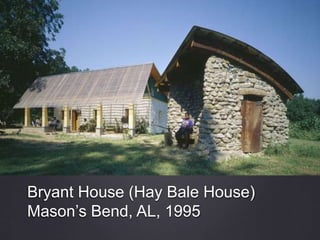
Bryant House (Hay Bale House)
Mason’s Bend, AL, 1995
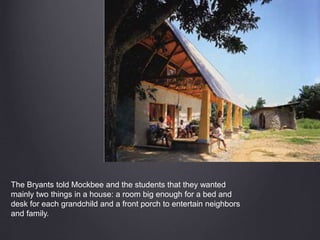
The Bryants told Mockbee and the students that they wanted
mainly two things in a house: a room big enough for a bed and
desk for each grandchild and a front porch to entertain neighbors
and family.
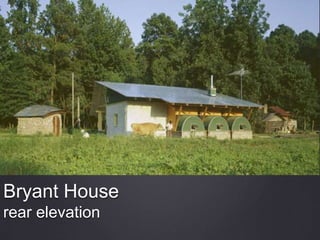
Bryant House
rear elevation
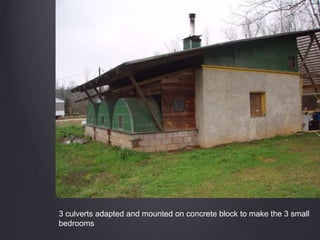
3 culverts adapted and mounted on concrete block to make the 3 small
bedrooms
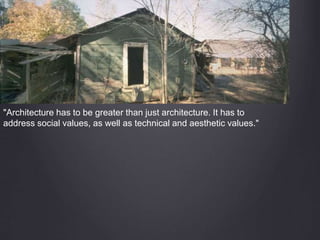
"Architecture has to be greater than just architecture. It has to
address social values, as well as technical and aesthetic values."
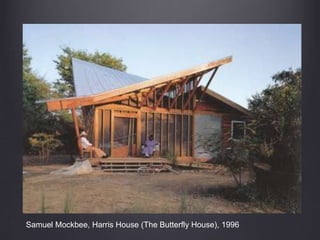
Harris House (Butterfly House),
Mason’s Bend, AL, 1996
Samuel Mockbee, Harris House (The Butterfly House), 1996
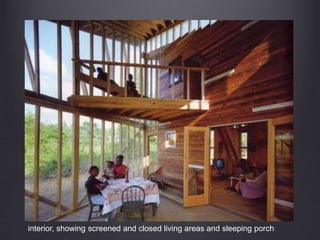
interior, showing screened and closed living areas and sleeping porch
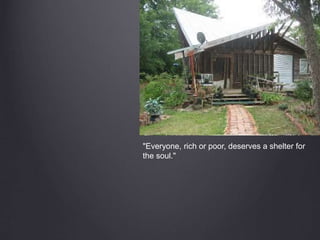
"Everyone, rich or poor, deserves a shelter for
the soul."
Lucy's House, 1997
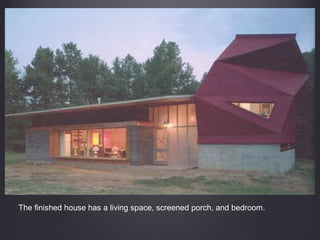
three main elements
• a single-story living space,
• a screened-in porch, and
• tower that doubled as a master bedroom upstairs and
tornado shelter/family room downstairs.
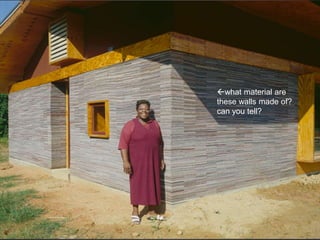
what material are
these walls made of?
can you tell?
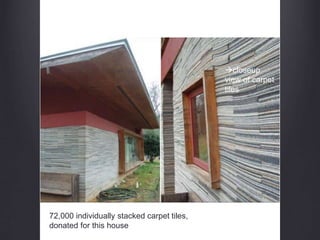
72,000 individually stacked carpet tiles,
donated for this house
closeup
view of carpet
tiles
The finished house has a living space, screened porch, and bedroom.
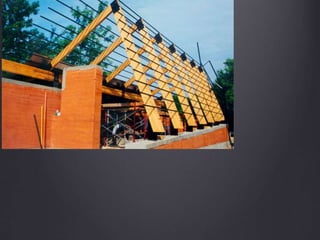
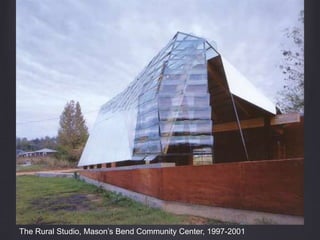
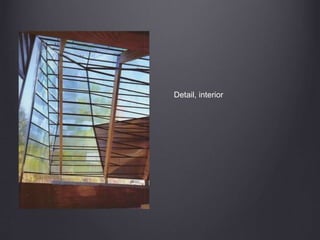
Sam Mockbee and the Rural Studio, Mason’s Bend Community Center, 2000
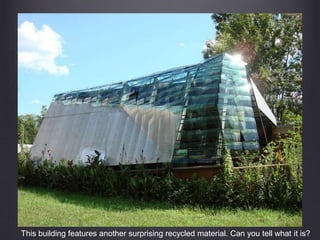
This building features another surprising recycled material. Can you tell what it is?
Detail, interior
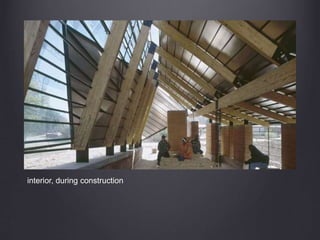
interior, during construction
Community Center, illuminated at night
The Rural Studio, Mason’s Bend Community Center, 1997-2001

UVCSp15Module14.2

  • 1.
    From Public Housing tothe Palaces of the Great: Where Does Art Belong?
  • 2.
    agenda 3.30.15 review: Depression erasees creation of first US housing policy Huge demand for urban housing in WWII to keep a roof over factory workers' heads. Brewster Homes and Cabrini Homes both got their start during WWII. After WWII, the approach to building changed: high rises. Case Study: Cabrini Green in Chicago. Does architecture have to be for the rich?
  • 3.
    CHICAGO The Story ofCabrini-Green
  • 5.
    The name “LittleHell” was derived from the large gasworks at Crosby and Hobbie streets whose flames lit the skies at night. Furnaces could be heard for blocks as coal was poured into the ovens and moistened with water from the Chicago River to create gas that was used for heating, cooking and lighting.
  • 6.
    The city's newestimmigrants (at that time Italian and Irish) were housed to this area.
  • 7.
    Housing and factoriesare sited directly next to each other.
  • 8.
    The landscape of"Little Hell."
  • 9.
    The neighborhood hada reputation for danger and crime.
  • 10.
    Goose Island In 1853,William B. Ogden, a Chicago real estate developer, built a channel to provide a more straightforward alternative to Chicago River’s winding North Branch. The result was an island, the only island in Chicago. It quickly became a haven for Irish immigrants who were so poor they couldn’t afford proper housing. This island became part of the “Little Hell” neighborhood.
  • 11.
    early Chicago mapshowing the Branch Canal that created Goose Island
  • 13.
  • 14.
    Goose Island 2015 DigitalManufacturing and Design Innovation Institute • awarded to Chicago 2014 • $70 million in federal funds • $16 million from the state • another $250 million from private industry, like General Electric, Rolls-Royce, Procter & Gamble, Siemens, Lockheed Martin and Dow Chemical Co. • managed by UI Labs (Universities and Industries)—a subsidiary of U of I
  • 15.
  • 16.
    map showing thelocation of Goose Island
  • 17.
    Near North During WorldWar II, the Chicago Housing Authority razed the "Little Hell" neighborhood and built a low-rise apartment project for war workers. They called it the Frances Cabrini Homes after the first American canonized by the Catholic Church.
  • 18.
    Timeline: Early Years 1929- Harvey Zorbaugh writes "The Gold Coast and the Slum: A Sociological Study of Chicago's Near North Side," contrasting wealthy Gold Coast, with poor Little Sicily (“Little Hell”) 1942 - Frances Cabrini Homes (two-story rowhouses), with 586 units in 54 buildings, completed. Initial regulations stipulate 75% white and 25% black residents. Holsman, Burmeister, et al, architects.
  • 19.
  • 20.
  • 21.
    Cabrini Homes, refurbishedon the left side of the photo, vacant on the right side
  • 22.
    Alamer Lee Vassar “Icame to Chicago in 1942. I moved into a building at 1230 North Larrabee on October 2nd of that year. There wasn’t no projects here then and my husband was in the service. That’s what brought us up here from Mississippi. I got a job and went to work. Back then they would beg you when you walked out the door, sayin,’Do you wanna work for me, do you wanna work for me?’ “It was beautiful down here. They used to have this festival and parade in the summer, and they had these lights that run from Chicago [Avenue] all the way up to North, and we used to sit out in front of 1230 and look at the people drivin’ by and parkin’ their cars—whites and colored people at that time—and everything was lovely, I mean, beautiful. And the kids they’d go around
  • 23.
    Paulette Simpson “My motherwas the second person to move into 502. The elevator excited me and everything was perfect. If you had a problem with anything in your house, CHA was out there within 24 hours or less. They were on top of everything then. I went to Jenner school. I played out in the playground. I went to Lower North Center to take dancing classes, and I used to go to Stanton Park for swimming.”
  • 24.
    Cabrini Homes, afterWWII 1958 - Cabrini Homes Extension (red brick mid- and high-rises), with 1,925 units in 15 buildings, is completed. A. Epstein & Sons, architects. 1962 - Green Homes (1,096 units, north of Division Street) is completed. Pace Associates, architects.
  • 27.
    Wanda Hopkins “We movedhere September 1, 1960. We were the second ones in the building at 534 W. Division. When I moved in it was just so beautiful, the buildings wasn’t grayish the way it is now but really the white color, and the apartments were so new, and the floors were shining…I was about four or five… It was so new and so pretty and the grass was green….My mother says you’re really crazy to remember all that, but I look at it now after all these years and I can just remind myself of how it was and I can tell people that this was not the original plan. But I remember other families moving in, and these were all white families, and someone organized the Cub Scouts and the Brownie Scot because I remember I became a Brownie…I remember the Brownie uniform and all that, my brothers were in the Cub Scouts.”
  • 28.
    Wanda Hopkins (continued) “Yeah,and we used to live right next door to a white family, I’ll never forget, we’d spend the night at each other’s house, stuff that you’d never think of would happen back then. I remember Alice and Sally. I lived in 402, they lived in 403. My mother never felt that anything would happen to me when we spent the night at each other’s house, and her mother never felt that….It’s almost unheard of now. But I keep tellin’ people the way it is now was the original plan, and I just wanted them to know that. I guess that’s why I kept it all in my memory.” (p. 53)
  • 30.
    Cabrini-Green, 1990s 1994 Chicagoreceives one of the first HOPE VI (Housing Opportunities for People Everywhere) grants to redevelop Cabrini- Green as a mixed-income neighborhood. 1995 Demolition begins. 1997 Chicago unveils Near North Redevelopment Initiative, a master plan for development in the area. It recommends demolishing Green Homes and most of Cabrini Extension. 1999 Chicago Housing Authority announces Plan for Transformation, which will spend $1.5 billion over ten years to demolish 18,000 apartments and build or rehabilitate 25,000 apartments. Earlier redevelopment plans for Cabrini-Green are included in the Plan for Transformation. New library, rehabilitated Seward Park, and new shopping center open.
  • 31.
    Old Town VillageWest townhomes, a new mixed-income development, in the background is the William Green Homes high-rise, part of Cabrini-Green, later demolished. [Photo: Lawrence J. Vale]
  • 32.
    North Town Villagemixed-income housing, on the left, with the last of the Cabrini-Green high-rises on the right; the high-rise was demolished in 2011. [Photo: Lawrence J. Vale]
  • 33.
    the new improvedNear North side
  • 34.
  • 35.
    The new CabriniTarget, opened in 2013.
  • 36.
    outcome re: low-incomeunits "And yet, nearly 20 years into the redevelopment, there exist fewer than 400 replacement public housing units, counting both the Cabrini site itself and the mixed-income communities in the broader neighborhood. With nearly 3,000 deeply subsidized apartments already torn down, the 586 Cabrini row houses — the low-rise housing that has so far survived the clearance — seem likely to fall next." —"Up," p. 14
  • 37.
    outcome, continued "The CHAassures ex-Cabrini residents forced from vacated and demolished buildings that they can enter the lottery for replacement units on site and in the neighborhood; but all the existing apartments reserved for public housing residents are already occupied, and the prospect of achieving the 700 units mandated in the consent decree depends upon the completion of the glacially implemented new construction on the Cabrini Extension North site — still unfinished from the HOPE VI grant of 1993. And even if new units do materialize, the screening processes — even under the more liberal terms negotiated though the consent decree — ensure that most ex-Cabrini households will not be welcomed." [Up," p. 14]
  • 43.
    “[The American Dreamis] that dream of a land in which life should be better and richer and fuller for everyone, with opportunity for each according to ability or achievement. It is a difficult dream for the European upper classes to interpret adequately, and too many of us ourselves have grown weary and mistrustful of it. It is not a dream of motor cars and high wages merely, but a dream of social order in which each man and each woman shall be able to attain to the fullest stature of which they are innately capable, and be recognized by others for what they are, regardless of the fortuitous circumstances of birth or position." James Truslow Adams The Epic of America (1931): (p.214-215) Adams’s text is quoted at: http://www.loc.gov/teachers/classroommaterials/lessons/american- dream/students/thedream.html
  • 46.
  • 47.
  • 48.
    Krzysztof Wodiczko born 1943Warsaw, Poland emigrated to Canada in 1977 established residency in NY in 1986 teaches in Cambridge, MA at MIT and the Graduate School of Design (GSD) at Harvard
  • 49.
    Krzysztof Wodiczko Homeless Vehicle,Variant 5, c. 1985 Aluminum, fabric, wire cage, and hardware 60 x 36 x 56 inches (152.4 x 91.4 x 142.2 cm)
  • 50.
    Krzysztof Wodiczko Homeless Vehicle,Variant 3, pictured outside Trump Tower, NYC, 1988
  • 51.
    insulated portable shelter OccupyBoston, 2011 Sage Radakowsky member, Winterization Working Group
  • 53.
  • 54.
    attempting to sleepon a "leaning bench"
  • 55.
    Louis Vuitton windowdisplay with sculptures by Frank Gehry
  • 57.
    Frank GEHRY, FondationLouis Vuitton, Paris, 2014 (art museum branded with LV logo)
  • 58.
  • 59.
  • 60.
    SAM MOCKBEE (1944-2001) On receivinga Macarthur “Genius” Award: “I’m no genius, but I’m smart enough to take the money.”
  • 61.
    4 examples • BryantHouse (Haybale House), Mason’s Bend, AL, 1994 • Harris House (Butterfly House), Mason’s Bend, AL, 1996 • Lucy's House, Mason's Bend, AL, 1997 • Mason’s Bend Community Center, Mason’s Bend, AL, 2000
  • 62.
    Mockbee's philosophy "Critical thoughtrequires looking beyond architecture towards an enhanced understanding of the whole to which it belongs. Accordingly, the role of architecture should be placed in relation to other issues of education, healthcare, transportation, recreation, law enforcement, employment, the environment, the collective community that impacts on the lives of both the rich and the poor." —Samuel Mockbee, "The Rural Studio," 1998
  • 63.
    Mockbee/Coker, The RogerCook House, Memphis, TN 1994
  • 64.
  • 65.
    Mockbee’s evolution from largerto smaller jobs from wealthier to poorer clients from metropolitan to rural areas
  • 66.
    Bryant House (HayBale House) Mason’s Bend, AL, 1995
  • 67.
    The Bryants toldMockbee and the students that they wanted mainly two things in a house: a room big enough for a bed and desk for each grandchild and a front porch to entertain neighbors and family.
  • 68.
  • 69.
    3 culverts adaptedand mounted on concrete block to make the 3 small bedrooms
  • 70.
    "Architecture has tobe greater than just architecture. It has to address social values, as well as technical and aesthetic values."
  • 71.
    Harris House (ButterflyHouse), Mason’s Bend, AL, 1996
  • 72.
    Samuel Mockbee, HarrisHouse (The Butterfly House), 1996
  • 73.
    interior, showing screenedand closed living areas and sleeping porch
  • 74.
    "Everyone, rich orpoor, deserves a shelter for the soul."
  • 75.
    Lucy's House, 1997 threemain elements • a single-story living space, • a screened-in porch, and • tower that doubled as a master bedroom upstairs and tornado shelter/family room downstairs.
  • 76.
    what material are thesewalls made of? can you tell?
  • 77.
    72,000 individually stackedcarpet tiles, donated for this house closeup view of carpet tiles
  • 78.
    The finished househas a living space, screened porch, and bedroom.
  • 80.
    Sam Mockbee andthe Rural Studio, Mason’s Bend Community Center, 2000
  • 81.
    This building featuresanother surprising recycled material. Can you tell what it is?
  • 82.
  • 83.
  • 84.
  • 86.
    The Rural Studio,Mason’s Bend Community Center, 1997-2001