BY
E.M.Roopa Devi
Kongu Engineering College
 It includes the description information about a
Web service necessary to construct a message
body and message headers so that a service
requester can invoke a service.
 The provider of the service publishes the
metadata
 Requester can discover it and use it to construct
messages that can be successfully processed by
the provider.
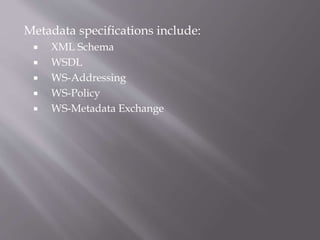
Metadata specifications include:
 XML Schema
 WSDL
 WS-Addressing
 WS-Policy
 WS-Metadata Exchange
 It’s possible that a requester will obtain the
metadata it needs using WS-Metadata Exchange
or another similar mechanism that queries the
WSDL and associated policy files directly
 WS-MetadataExchange uses a feature of WS-
Addressing called “actions” to access the
metadata published by a service provider.
 XML based security technologies are also often
important for protecting the XML data before and
after it’s included in a SOAP message.
 These technologies include:
1. XML Signature
2. XML Encryption
 It is designed to provide integrity, using a
variety of encryption and signature
mechanisms.
 It is used to ensure that service providers can
determine whether or not documents have
been altered in transit and that they are
received once and only once.
 Designed to provide confidentiality, using a
variety of supported encryption algorithms, of
part or all of an XML document to ensure that
the contents of a document cannot be
intercepted and read by unauthorized persons.
 XML Encryption and XML Signature can be
used to protect Web services metadata as well
as data.
 SAML-Security Assertion Markup Language
 SAML can be used on its own for exchanging
authorization information.
 It is an XML-based open-standard for
transferring identity data between two parties:
 an identity provider (IdP) — Performs
authentication and passes the user's identity and
authorization level to the service provider.
 a service provider (SP) — Trusts the identity
provider and authorizes the given user to access the
requested resource
 XACML stands for "eXtensible Access Control
Markup Language”
 It is an XML-based language for access control
that has been standardized by the Technical
Committee of the OASIS consortium.
 It describes both an access control policy
language, request/response language and
reference architecture.
 XKMS stands for XML Key Management
Specification
 It is a specification of XML application/protocol
that allows a simple client to obtain key
information (values, certificates, and
management or trust data) from a Web Service.
 Security concerns apply at every level of the Web
services specification stack and require a variety
of mechanisms to guard against the numerous
challenges and threats that are a part of
distributed computing.
 The mechanisms may have to be used in
combination to guard against a particular threat
or combination of threats.
 WS-Security is designed as a kind of open
framework that can carry any token type.
 It was developed to provide message-level
security on an end-to-end basis for Web services
messages.
 WS-Security headers include the ability to carry
strong authentication formats such as Kerberos
tickets and X.509 certificates and can use XML
Encryption and XML Signature technologies for
further protecting the message contents.
 Additional specifications from IBM, Microsoft,
Verisign, and others further extend and
complement WS-Security, including:
1. WS-SecurityPolicy
2. WS-Trust
3. WS-SecureConversation
4. WS-Federation
 WS-SecurityPolicy—Defines security
assertions detailing a Web service’s
requirements so that the service requester can
meet them.
 WS-Trust—Defines how to establish overall
trust of the security system by acquiring any
needed security tokens (such as Kerberos
tickets) from trusted sources.
 WS-SecureConversation—Defines how to
establish and maintain a persistent context for
a secure session over which multiple Web
service invocations might be sent without
requiring expensive authentication each time.
 WS-Federation—Defines how to bridge
multiple security domains into a federated
session so that a Web service only has to be
authenticated once to access Web services
deployed in multiple security domains.
 Messaging includes SOAP and its various
message exchange patterns (MEP).
 Reliable messaging is the mechanism that
guarantees that one or more messages were
received the appropriate number of times.
 Reliable messaging specifications include:
 WS-Reliability
 WS-Reliable Messaging (from IBM and Microsoft)
 Reliable messaging is a protocol for exchanging
SOAP messages with guaranteed delivery, no
duplicates, and guaranteed message ordering
 It also supports the concept of bridging two
proprietary messaging protocols over the
Internet
 It automates recovery from certain transport-
level error conditions that the application
would otherwise have to deal with on its own.
 Transactions allow multiple operations, usually
on persistent data, to succeed or fail as a unit,
such as processing an order or transferring
funds.
 One of the most important aspects of
transaction processing technologies is their
ability to recover an application to a known
state following an operating system or hard-
ware failure.
 For example, if any failure occurs before a
funds transfer operation is completed (that is,
both the debit and credit operations),
transactions ensure the bank account balances
are what they were before the funds transfer
operation started.
 Web services transaction specifications extend
the concept of the transaction coordinator
 adapt the familiar two-phase commit protocol for
Web services
 define new extended transaction protocols for more
loosely coupled Web services and orchestration flows
 Transaction coordinators currently exist in most
execution environments, including J2EE, the
.NET Framework, and CORBA
 Web services specifications define extensions
for coordinators for compensation-based
protocols and long-running coordinator-
coordinator protocols that bridge software
domains.
 It is a general mechanism for determining a
consistent, predefined outcome for composite
Web service applications.
 The coordinator model includes two major
phases:
 acquisition phase
 second phase
 Acquisition phase - Web services that are
participating in the composite are enrolled with
the coordinator for a specific protocol (such as
two-phase commit, compensation, or business
process)
 Second phase in which the coordinator drives
the agreed-upon protocol to completion
following the end of the execution of the set of
services in the composite.
 When a failure occurs, the coordinator is
responsible for driving the recovery protocol
 WS-Transactions family from BEA, IBM, and
Microsoft:
 WS-Atomic Transactions
 WS-Business Activity
 WS-Coordination
 WS-Composite Application Framework (WS-
CAF) from OASIS:
 WS-Context
 WS-Coordination Framework
 WS-Transaction Management
 Integrating mobile devices into an SOA presents
specific challenges because the mobile devices may
not always be connected to a network.
 Mobile devices may also move through network
connectivity zones, picking up new IP addresses
when they reconnect.
 “Mobilized” software is emerging to integrate
mobile devices quickly and easily into the service-
oriented enterprise.
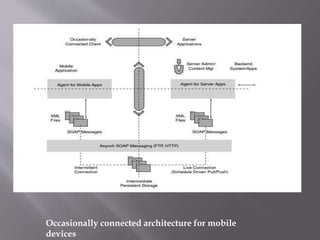
Occasionally connected architecture for mobile
devices
 The SOAP messages in a mobile software
solution are transported from the mobile client
to the server using a store-and-forward
asynchronous protocol that allows the mobile
client to keep working even when a network
connection isn’t available
 When the connection is available, transactions
flow to the server-side SOA-based application
directly using the messaging transport
 When a connection isn’t available, transactions
are stored locally so that they can be
transmitted when a connection becomes
available

Uunit 5-xml&web security

  • 1.
  • 2.
     It includesthe description information about a Web service necessary to construct a message body and message headers so that a service requester can invoke a service.  The provider of the service publishes the metadata  Requester can discover it and use it to construct messages that can be successfully processed by the provider.
  • 3.
    Metadata specifications include: XML Schema  WSDL  WS-Addressing  WS-Policy  WS-Metadata Exchange
  • 4.
     It’s possiblethat a requester will obtain the metadata it needs using WS-Metadata Exchange or another similar mechanism that queries the WSDL and associated policy files directly  WS-MetadataExchange uses a feature of WS- Addressing called “actions” to access the metadata published by a service provider.
  • 5.
     XML basedsecurity technologies are also often important for protecting the XML data before and after it’s included in a SOAP message.  These technologies include: 1. XML Signature 2. XML Encryption
  • 6.
     It isdesigned to provide integrity, using a variety of encryption and signature mechanisms.  It is used to ensure that service providers can determine whether or not documents have been altered in transit and that they are received once and only once.
  • 7.
     Designed toprovide confidentiality, using a variety of supported encryption algorithms, of part or all of an XML document to ensure that the contents of a document cannot be intercepted and read by unauthorized persons.  XML Encryption and XML Signature can be used to protect Web services metadata as well as data.
  • 8.
     SAML-Security AssertionMarkup Language  SAML can be used on its own for exchanging authorization information.  It is an XML-based open-standard for transferring identity data between two parties:  an identity provider (IdP) — Performs authentication and passes the user's identity and authorization level to the service provider.  a service provider (SP) — Trusts the identity provider and authorizes the given user to access the requested resource
  • 9.
     XACML standsfor "eXtensible Access Control Markup Language”  It is an XML-based language for access control that has been standardized by the Technical Committee of the OASIS consortium.  It describes both an access control policy language, request/response language and reference architecture.
  • 10.
     XKMS standsfor XML Key Management Specification  It is a specification of XML application/protocol that allows a simple client to obtain key information (values, certificates, and management or trust data) from a Web Service.
  • 11.
     Security concernsapply at every level of the Web services specification stack and require a variety of mechanisms to guard against the numerous challenges and threats that are a part of distributed computing.  The mechanisms may have to be used in combination to guard against a particular threat or combination of threats.
  • 12.
     WS-Security isdesigned as a kind of open framework that can carry any token type.  It was developed to provide message-level security on an end-to-end basis for Web services messages.  WS-Security headers include the ability to carry strong authentication formats such as Kerberos tickets and X.509 certificates and can use XML Encryption and XML Signature technologies for further protecting the message contents.
  • 13.
     Additional specificationsfrom IBM, Microsoft, Verisign, and others further extend and complement WS-Security, including: 1. WS-SecurityPolicy 2. WS-Trust 3. WS-SecureConversation 4. WS-Federation
  • 14.
     WS-SecurityPolicy—Defines security assertionsdetailing a Web service’s requirements so that the service requester can meet them.  WS-Trust—Defines how to establish overall trust of the security system by acquiring any needed security tokens (such as Kerberos tickets) from trusted sources.
  • 15.
     WS-SecureConversation—Defines howto establish and maintain a persistent context for a secure session over which multiple Web service invocations might be sent without requiring expensive authentication each time.  WS-Federation—Defines how to bridge multiple security domains into a federated session so that a Web service only has to be authenticated once to access Web services deployed in multiple security domains.
  • 16.
     Messaging includesSOAP and its various message exchange patterns (MEP).  Reliable messaging is the mechanism that guarantees that one or more messages were received the appropriate number of times.  Reliable messaging specifications include:  WS-Reliability  WS-Reliable Messaging (from IBM and Microsoft)
  • 17.
     Reliable messagingis a protocol for exchanging SOAP messages with guaranteed delivery, no duplicates, and guaranteed message ordering  It also supports the concept of bridging two proprietary messaging protocols over the Internet  It automates recovery from certain transport- level error conditions that the application would otherwise have to deal with on its own.
  • 18.
     Transactions allowmultiple operations, usually on persistent data, to succeed or fail as a unit, such as processing an order or transferring funds.
  • 19.
     One ofthe most important aspects of transaction processing technologies is their ability to recover an application to a known state following an operating system or hard- ware failure.  For example, if any failure occurs before a funds transfer operation is completed (that is, both the debit and credit operations), transactions ensure the bank account balances are what they were before the funds transfer operation started.
  • 20.
     Web servicestransaction specifications extend the concept of the transaction coordinator  adapt the familiar two-phase commit protocol for Web services  define new extended transaction protocols for more loosely coupled Web services and orchestration flows  Transaction coordinators currently exist in most execution environments, including J2EE, the .NET Framework, and CORBA  Web services specifications define extensions for coordinators for compensation-based protocols and long-running coordinator- coordinator protocols that bridge software domains.
  • 21.
     It isa general mechanism for determining a consistent, predefined outcome for composite Web service applications.  The coordinator model includes two major phases:  acquisition phase  second phase
  • 22.
     Acquisition phase- Web services that are participating in the composite are enrolled with the coordinator for a specific protocol (such as two-phase commit, compensation, or business process)  Second phase in which the coordinator drives the agreed-upon protocol to completion following the end of the execution of the set of services in the composite.  When a failure occurs, the coordinator is responsible for driving the recovery protocol
  • 23.
     WS-Transactions familyfrom BEA, IBM, and Microsoft:  WS-Atomic Transactions  WS-Business Activity  WS-Coordination  WS-Composite Application Framework (WS- CAF) from OASIS:  WS-Context  WS-Coordination Framework  WS-Transaction Management
  • 24.
     Integrating mobiledevices into an SOA presents specific challenges because the mobile devices may not always be connected to a network.  Mobile devices may also move through network connectivity zones, picking up new IP addresses when they reconnect.  “Mobilized” software is emerging to integrate mobile devices quickly and easily into the service- oriented enterprise.
  • 25.
  • 26.
     The SOAPmessages in a mobile software solution are transported from the mobile client to the server using a store-and-forward asynchronous protocol that allows the mobile client to keep working even when a network connection isn’t available  When the connection is available, transactions flow to the server-side SOA-based application directly using the messaging transport  When a connection isn’t available, transactions are stored locally so that they can be transmitted when a connection becomes available