UTILIZATION OF LIMA BEANS
(Phaseolus lunatus L.)
BY
AKANDE ADERONKE ADESOLA
ronkeakande12@gmail.com
INTRODUCTION
 Lima bean are leguminous plant that are
grown for their edible seeds.
 The common names include- butter bean,
sieva bean, sugar bean, madagascar
bean,haba bean burma bean.
 They varies in size ,shape and colour.The
seed are generally cream or green in
colour, although certain varieties features
such as white, purple, red,brown,black.
Lima beans
Types of lima beans
 There are two main types of lima beans;
❖ Bush lima beans
❖ Pole lima beans
Lima beans can be
•Fresh
•Dried
•Fresh frozen
•Canned
•Roasted
Dry Fresh
Canned Fresh frozen
Roasted Dry
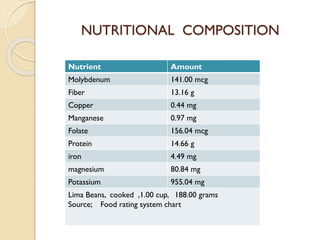
NUTRITIONAL COMPOSITION
Nutrient Amount
Molybdenum 141.00 mcg
Fiber 13.16 g
Copper 0.44 mg
Manganese 0.97 mg
Folate 156.04 mcg
Protein 14.66 g
iron 4.49 mg
magnesium 80.84 mg
Potassium 955.04 mg
Lima Beans, cooked ,1.00 cup, 188.00 grams
Source; Food rating system chart
Advantages associated with lima
beans
 It is rich in dietary fibers that help in
lowering cholesterol as well as blood
sugar level.
 It is also rich in iron ,the source that
helps in proper blood circulation as well
as replenishing lost energy.
 It also help in improving the immune
system.
Advantages associated with lima
beans contˈd
 Manganese present in lima beans is a vital
element of many enzymes that act as
catalyst in the creation of energy as well
as antioxidants.
 Lima beans also contain fairly good
amount of protein that helps in lowering
the risk of heart attacks and other
cardiovascular diseases
USES
 lima beans are used as green baby lima beans
canned in brine either alone or as a component
of mixes of 3-4 beans for use in salads.
 They are also retailed directly to food
consumers as raw beans.
 Lima beans are used industrially in the
production of margarine and salad oil.
 The lima bean flour could also be used to fortify
convenient flours which are low in protein and
fiber.
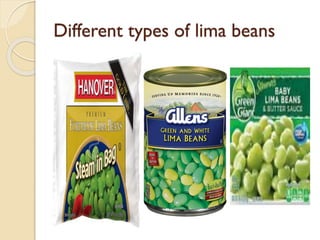
Different types of lima beans
lima bean mix
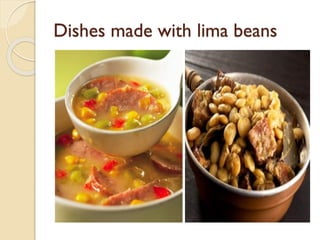
Dishes made with lima beans
CONCLUSION
 lima beans contain some active
components as well as a lot of nutrients
which are very good for body
development.
RECOMMENDATION
 There should be increase effort to
encourage the cultivation, consumption
and utilization of lima beans in order to
help curb food insecurity in nigeria.
REFERENCES
 Nwokolo E. (1996). Lima bens (Phaseolus lunatus ) In: Food and
Feed from Legumes and Oil Seed Edited by Nwokolo E. and J.
Smartt, Chapman and Hall. p. 144-155.
 Saka, J. O.; S. R. Ajibade; O. N. Adeniyan; R. B.Olowoyo and B. A.
Ogunbodede. (2004). Survey of under-utilized grain legume
production system in south-west Agricultural zone of Nigeria.
Journal of Agriculture and Food Information 6 (2/3): 93 108.
 Iheanacho,K.M.E. (2010).Comparative studies of the nutritional
composition of soybean (glycine max) and lima bean (Phaseolus
lunatus).Scientia Africana,9(2),29-35
 Oboh,H.A and Omofoma,C.O. (2008).The effects of heat treated
lima bean (Phaselolus lunatus) on plasma lipids in
hpercholesterolaemic rat.Paskistan Jounal of nutrition.7(5),636-639
THANKYOU FOR
LISTENING.

Utilisation of limabeans

  • 1.
    UTILIZATION OF LIMABEANS (Phaseolus lunatus L.) BY AKANDE ADERONKE ADESOLA ronkeakande12@gmail.com
  • 2.
    INTRODUCTION  Lima beanare leguminous plant that are grown for their edible seeds.  The common names include- butter bean, sieva bean, sugar bean, madagascar bean,haba bean burma bean.  They varies in size ,shape and colour.The seed are generally cream or green in colour, although certain varieties features such as white, purple, red,brown,black.
  • 3.
  • 4.
    Types of limabeans  There are two main types of lima beans; ❖ Bush lima beans ❖ Pole lima beans
  • 5.
    Lima beans canbe •Fresh •Dried •Fresh frozen •Canned •Roasted
  • 6.
  • 7.
  • 8.
  • 9.
    NUTRITIONAL COMPOSITION Nutrient Amount Molybdenum141.00 mcg Fiber 13.16 g Copper 0.44 mg Manganese 0.97 mg Folate 156.04 mcg Protein 14.66 g iron 4.49 mg magnesium 80.84 mg Potassium 955.04 mg Lima Beans, cooked ,1.00 cup, 188.00 grams Source; Food rating system chart
  • 10.
    Advantages associated withlima beans  It is rich in dietary fibers that help in lowering cholesterol as well as blood sugar level.  It is also rich in iron ,the source that helps in proper blood circulation as well as replenishing lost energy.  It also help in improving the immune system.
  • 11.
    Advantages associated withlima beans contˈd  Manganese present in lima beans is a vital element of many enzymes that act as catalyst in the creation of energy as well as antioxidants.  Lima beans also contain fairly good amount of protein that helps in lowering the risk of heart attacks and other cardiovascular diseases
  • 12.
    USES  lima beansare used as green baby lima beans canned in brine either alone or as a component of mixes of 3-4 beans for use in salads.  They are also retailed directly to food consumers as raw beans.  Lima beans are used industrially in the production of margarine and salad oil.  The lima bean flour could also be used to fortify convenient flours which are low in protein and fiber.
  • 13.
  • 14.
  • 15.
    Dishes made withlima beans
  • 16.
    CONCLUSION  lima beanscontain some active components as well as a lot of nutrients which are very good for body development.
  • 17.
    RECOMMENDATION  There shouldbe increase effort to encourage the cultivation, consumption and utilization of lima beans in order to help curb food insecurity in nigeria.
  • 18.
    REFERENCES  Nwokolo E.(1996). Lima bens (Phaseolus lunatus ) In: Food and Feed from Legumes and Oil Seed Edited by Nwokolo E. and J. Smartt, Chapman and Hall. p. 144-155.  Saka, J. O.; S. R. Ajibade; O. N. Adeniyan; R. B.Olowoyo and B. A. Ogunbodede. (2004). Survey of under-utilized grain legume production system in south-west Agricultural zone of Nigeria. Journal of Agriculture and Food Information 6 (2/3): 93 108.  Iheanacho,K.M.E. (2010).Comparative studies of the nutritional composition of soybean (glycine max) and lima bean (Phaseolus lunatus).Scientia Africana,9(2),29-35  Oboh,H.A and Omofoma,C.O. (2008).The effects of heat treated lima bean (Phaselolus lunatus) on plasma lipids in hpercholesterolaemic rat.Paskistan Jounal of nutrition.7(5),636-639
  • 19.