Consortium	for	Integrating	
Energy	Systems	in	Engineering	
and	Science	Education
The	University	of	Texas	El	Paso
Lourdes	Echegoyen (PI)
Director	Campus	Office	for	Undergraduate	Research	Initiatives
Norman	Love	(co-PI) and	Yirong Lin	(co-PI)
Department	of	Mechanical	Engineering
December	12,	2016
UTEP	at	a	Glance
The	University	of	Texas	at	El	Paso's	extraordinary	progress	in	developing	 its	research	
capacity	and	expanding	its	doctoral	programs	has	earned	UTEP	the	designation	as	one	of	
the	state's	"Emerging	Tier	One"	universities	by	the	Texas	Higher	Education	Coordinating	
Board.
• Enrollment:	23,000+
• Faculty:	1,183
• Academics:	7	Colleges:	Business	Administrations,	 Education,	Engineering,	
Health	Sciences,	Liberal	Arts,	Nursing,	and	Science
• Annual	Operating	Budget:	$404.6	million	
• Annual	Research	Expenditures:	$89+	million
Expenditures - Fiscal Years 1992-2015
Source: NSF Survey of Research Expenditures
9.6 10.4
12.9 12.9 13.8 13.7
17.3
14.8
28.0 29.6 31.1
32.9
36.4
36.9
45.7
46.4
50.6 50.6
56.5
66.0
79.6
83.2
79.5
89.4
0
10
20
30
40
50
60
70
80
90
100
In$Millions
Dr. Diana S. Natalicio
UTEP President
Served as Vice Chair,
National Science Board
(NSB)
Vision
• Commitment to creating
access and excellence
• Goal: Tier 1 in Research
and promoting access at
the same time
Col.
of
Eng
• We believe the purpose of public higher education is to educate the populace,
create economic opportunities, and catalyze social mobility.
• We reject the traditional choice between Access and Excellence that
characterized U.S. higher education in the twentieth century and insist upon the
joint attainment and continuing enhancement of both Access and Excellence.
• We must become a Tier I Research University to bring our region the pinnacle of
excellence in public higher education – that is, the full capacity, breadth,
innovation and regional impact of a national research university.
Campus	Office	for	Undergraduate	Research	
Initiatives	(COURI)
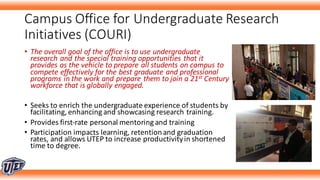
• The	overall	goal	of	the	office	is	to	use	undergraduate	
research	and	the	special	training	opportunities	that	it	
provides	as	the	vehicle	to	prepare	all	students	on	campus	to	
compete	effectively	for	the	best	graduate	and	professional	
programs	in	the	work	and	prepare	them	to	join	a	21st Century	
workforce	that	is	globally	engaged.	
• Seeks	to	enrich	the	undergraduate	experience	of	students	by	
facilitating,	enhancing	and	showcasing	research	training.	
• Provides	first-rate	personal	mentoring	and	training	
• Participation	impacts	learning,	retention	and	graduation	
rates,	and	allows	UTEP	to	increase	productivity	in	shortened	
time	to	degree.
Department	of	Mechanical	Engineering
Core	Programs	
Professional	Graduate	
Programs	
Professional	Development	
and	K-12	Outreach
2016-2017	Student	Enrollment
Undergraduate:	1050
Masters:	55
PhD:	60
• BS	in	Mechanical	
Engineering
• MS	in	Mechanical	
Engineering
• PhD	in	Mechanical	
Engineering	
• Graduate	Certificate	in	
3D	Engineering	and	
Additive	Manufacturing	
• Professional	MS	in	
Aerospace	and	Defense	
Engineering	
• Southwest	Emerging	
Technology	Symposium
• Student	Professional	
Development	Short	Courses
• Shell	Speaker	Series
• NASA	MUREP	Aerospace	
Academy
Mechanical	
Engineering	
Department		
W.	M.	Keck	
Center	for	3D	
Innovation	
NASA	MIRO	
Center	for	
Space	
Exploration	and	
Technology	
Research		
Collaborations	across	the	
Department’s	Boundary	
§ Research	Management	(Advanced	Manufacturing)	
§ Research	Strategies	and	Development	
§ Research	Infrastructure	Development	and	
Management
§ Contracts	and	Grants	
§ Charge	Center/Cost	Center
§ Professional	Staff	and	Research	Faculty
§ Professional	Graduate	Programs	
§ Academic	Management	
§ Students	and	Faculty	
§ Curriculum	
§ Course	Scheduling	
§ Advising	and	Progress	Tracking	
and	Monitoring	
§ Teaching	Innovation	and	
Excellence	
§ Tenure	and	Promotion	
§ Research	Management		(Aerospace	and	Energy)	
§ Research	Strategies	and	Development	
§ Research	Infrastructure	Development	and	
Management
§ Contracts	and	Grants	
§ Professional	Staff	and	Research	Faculty
§ Student	Professional	Development	
Programs
§ K-12	Outreach	Programs
CIESESE	Project	Overview
• Energy	Modules	for	K-12
• Module	development	based	on	existing	curriculum	
• Leveraging	existing	K-12	Academy	at	UTEP	to	maximize	outreach
• Course-Based	Undergraduate	Research	Experiences	(CUREs),	Project	
Based	Learning	(PBL),	and	Flipped	Classroom	Intervention	Topics
• Examples
• Research	Experiences	for	Students
CIESESE	Project	Overview
• Energy	Modules	for	K-12
• Module	development	based	on	existing	curriculum	
• Leveraging	existing	K-12	Academy	at	UTEP	to	maximize	outreach
• Course-Based	Undergraduate	Research	Experiences	(CUREs),	Project	
Based	Learning	(PBL),	and	Flipped	Classroom	Intervention	Topics
• Examples
• Research	Experiences	for	Students
Energy	Modules	for	K-12
• The	current	project	will	utilize	the	MAA	Southwest	at	UTEP	
• Our	goal	will	be	to	inspire	and	prepare	underserved	K-12	students	in	the	
southwest	border	region	for	advanced	studies	and	careers	in	STEM	fields.	
• Specifically	we	will	utilize:
• Modules	currently	based	on	existing	aerospace	NASA	curriculum
• In-school	and	after-school	experiences	for	students
• Active	events	and	activities	geared	for	family	participation
• Outreach	visits	ongoing	with	a	prior	focus	on	the	Maker	Movement
Energy	Modules	for	K-12
q Some	background	on	the	MAA	Southwest:
q Engaged	more	than	1000 direct	participants	last	year
q K-12	Students
q 130	in-service	teachers
q Engaged	thousands	more	non-direct	participants
q Educational	community	outreach	events
q Physical	Educational	Laboratory	located	at	UTEP
q Workspace	to	foster	creativity	and	instruction	in	STEM	fields
Southwest) at the University of Texas at El Paso (UT
12 students in the southwest border region for ad
particularly, aerospace related fields. The MAA Sout
economically disadvantaged
underrepresented in STEM d
The MAA Southwes
UTEP Science, Engineerin
(SEMAA) program, which h
than 5600 direct participants
Additionally, it has enga
participants, including both
community outreach events.
with the overall goals of the
Objective 1: Establish classroom contact time via in
Southwest will continue its long established in-schoo
and structure for its after school model. Since 2013,
the school day by all middle school students enrolled
in the largest school district of El Paso, El Paso
instructors associated with this model have acquir
curriculum, AEL familiarity and NASA-related co
Southwest will continue to strongly support. Also
overall success of the MAA Southwest is its after sch
After school programs provide an opportunity
underserved youth who might not otherwise have
interest in other after school activities. Both progra
the school day by all middle school students enrolled in the Gifted and Talented Program (G&T)
in the largest school district of El Paso, El Paso Independent School District (EPISD). The
instructors associated with this model have acquired significant expertise with the SEMAA
curriculum, AEL familiarity and NASA-related content, and so it is something that MAA
Southwest will continue to strongly support. Also key to the
overall success of the MAA Southwest is its after school model.
After school programs provide an opportunity to engage
underserved youth who might not otherwise have access or
interest in other after school activities. Both program models
incorporate innovative curriculum with inquiry-based lessons
and experiential hands-on activities. The curriculum lessons are
NASA or STEM-related with grade-appropriate content
representative of state testing standards. The MAA Southwest
curriculum incorporates lessons and activities from SEMAA
and NASA. It follows the model of an existing adaptation of the
SEMAA curriculum whereby SEMAA lessons and activities are
embedded into a narrative structure. First piloted in 2013 at
SEMAA by the partnering non-profit, Philosophic Systems
Institute (PSI) of El Paso, it is an interdisciplinary STREAM
approach, a variant on STEM, that incorporates not only the arts,
but also reasoning and logic. Since this adapted curriculum was
received with much interest and success among both teachers
and their students, the MAA Southwest at UTEP will continue
working with PSI as its partner to further develop and update the
Figure 1 Family Café
featured speaker Jen Allred,
Project Engineer of NASA
WSTF
2 | Project Description MU
curriculum according to NASA’s latest endeavors and re
teacher training and coaching.
Objective
events and
The Family
family mem
and its goa
with STEM
parental or
crucial to a
events, the
pathways a
progress a
extracurricu
This is im
portion (83
hold colleg
caregivers a
Figure 2 Family Café educational
workshop at the TecH2O Water Utilities
Center.
Energy	Modules	for	K-12
parental or caregiver understanding and support are
crucial to a student’s career success. Through these
events, the families are made aware of the various
pathways and mechanisms by which a student can
progress and excel in his or her studies and
extracurricular activities in preparation for college.
This is important since, regionally, a significant
portion (83%) of adult El Paso county residents do not
hold college degrees. It serves to educate parents and
caregivers about the increasing opportunities to excel
in NASA and STEM-related careers. These events typically feature speakers who are experts from
NASA such as the recent SEMAA Family
Café speaker Jen Allred, a project engineer
from the nearby NASA White Test Facility
(Fig. 1). Through their talks and
demonstrations, these experts inspire interest
in NASA, aerospace, and STEM-related
research. In Ms. Allred’s case, the speaker
can also serve as a role model to inspire more
girls to pursue STEM-related fields. This is
in fact an important objective of the UTEP
SEMAA program this year that MAA
Southwest will continue. The Family Café
also provides fun and educational
experiential activities for the whole family so
that they may gain further insight about what the program entails. (Fig. 2) Supplementing the
featured speakers and activities is a recognition ceremony that highlights the dedication and
commitment of the attending MAA instructors. Lastly, the STEM-related UTEP student
organizations who are committed long term partners to MAA Southwest including UTEP student
chapters of SWE (Society of Women Engineers) and AIAA (The American Institute of
Aeronautics and Astronautics), serve to educate families about STEM and aerospace-related
degree programs at UTEP and also to directly assist as volunteers to help out where needed.
Objective 3: Conduct outreach visits and camps at UTEP, with a focus on the use of specialized
technology to support maker movement projects: Outreach visits to UTEP typically involve the
Figure 2 Family Café educational
workshop at the TecH2O Water Utilities
Center.
Figure 3 UTEP Aerospace Education Laboratory
3 | Project Description MUREP Aerospace Academy for the Southwest (MAA Southwest)
University of Texas at El Paso
use of, but are not limited to,
UTEP’s Aerospace Education
Lab (AEL). This lab has an
inventory of high technology
engineering, aerospace and
aeronautical teaching tools that
can be used for demonstrations
and hands-on projects (Fig. 3).
Outreach groups include
primarily the MAA Southwest in
school and after school classes,
but it would also be open to other
K-12 groups like robotics clubs,
Girl Scouts troops, and a smaller-
scale Family Café. Outside the
AEL on the UTEP campus are
numerous other points of interest like various
research and instructional laboratories of the
College of Engineering and College of Sciences,
UTEP Centennial Museum, and Chihuahuan
Desert Gardens.
The MAA Southwest at UTEP will have a
particular emphasis on the new ‘maker
movement’ to develop creativity, problem-
solving, teamwork, and build and test skills.
Advanced technologies from the AEL (Fig. 4),
like the Little Bits electronics, and also the
Mechanical Engineering Department’s 3D
Printing Design Studio (Fig. 5) would strongly
support the maker movement endeavors.
I.a (ii) Management Plan
Figure 4 Inventory of Electronics Technologies
Figure 5 3D Printing Design Studio
q More	on	the	MAA	Southwest:
q In-School	Model	(Established)
q Curriculum	carried	out	during	the	school	day	by	middle	school	students	in	the	Gifted	and	
Talented	Program	in	the	El	Paso	Independent	School	District	(largest	in	El	Paso)
q Teachers	are	familiar	with	curriculum,	we	will	continue	to	leverage	these	relationships
q After-School	Model	(Established)
q Narrative	structure	incorporating	energy	based	modules
q The	Family	Café	
q Educates	family	members	about	inspiring	kids	to	become	more	involved	in	STEM
q Parents	and	caregivers	educated	about	increasing	opportunities	to	excel	in	STEM	careers
q Includes	speakers	who	are	experts	
q Example:	Jen	Allred	a	project	engineer	from	NASA	White	Sands	Test	Facility
q Great	role	models	for	kids	involved
Energy	Modules	for	K-12
• CIESESE	planned	activities	for	2016:
• Development	of	Energy	Learning	Modules	for	K-12	(beginning	with	HS	level)
• Energy	Balance
• Combustion
• Chemistry
• Energy	and	the	Environment
• Materials	(Solar	Energy,	Wind	Turbine,	Thermoelectrics)	
• Delivery	of	content	using	computer-based	tools
• Flipped	classroom	delivery	methodology	and	experience	leveraged	(more	on	this	later)
• Delivery	of	content	using	Project-Based	Activities
CIESESE	Project	Overview
• Energy	Modules	for	K-12
• Module	development	based	on	existing	curriculum	
• Leveraging	existing	K-12	Academy	at	UTEP	to	maximize	outreach
• Course-Based	Undergraduate	Research	Experiences	(CUREs),	Project	
Based	Learning	(PBL),	and	Flipped	Classroom	Intervention	Topics
• Examples
• Research	Experiences	for	Students
CUREs,	PBL,	and	Flipped	Classroom
Course-Based	Undergraduate	Research	Experiences:
Helps	students	learn	concepts	in	STEM,	develop	core	concepts,	STEM	competencies,	and	become	
active,	contributing	members	of	the	STEM	community.	
Project-based	learning:
Student-centered	pedagogy	that	students	acquire	a	deeper	knowledge	through	active	exploration	of	
real	world	challenges	and	problems.	Students	learn	about	a	subject	by	working	for	an	extended	
period	of	time	to	investigate	and	respond	to	a	complex	question,	challenges,	or	problem.	It	has	
been	widely	implemented	and	proved	by	the	development	and	assessment	regarding	the	learning	
outcome.	
Flipped	classroom:
Video	lectures	are	viewed	by	students	at	home	before	the	class	session,	while	in-class	time	is	
devoted	to	exercises,	projects,	or	discussions.	This	method	has	overall	positive	results	on	
participating	students	while	it	is	not	widely	implemented	in	college	level.
CUREs,	PBL,	and	Flipped	Classroom
• CURE	Example:
• Experimental	setup:
• Aluminum	beam	with	embedded	piezoelectric	
ceramic
• Oscilloscope	
• Clamp	
• Caliper	
• Objective:	Capture	voltage	variation	of	
piezoelectric	ceramic	with	oscilloscope	to	
obtain	beam’s	vibration	and	compare	with	
calculation
• 3-D	printing	of	composite/energy	
harvesting	materials
Experimental setup for Module III
experiment
CUREs,	PBL,	and	Flipped	Classroom
Project-based	learning	(PBL)
• Solving	problems	and	asking	the	fundamental	principles	and	related	information	 allows	
students	attaining	the	enhanced	knowledge.
• Advantages	such	as	promoting	 inter-communication,	 inter-personal	skillset,	and	critical	
thinking.	
Concepts	of	Project-based	learning	by	Adderly et	al.
1) A	solution	to	a	problem	must	be	involved	in	the	project.
2) Initiative	is	needed	by	the	student/group	 of	students,	as	well	as	a	variety	of	educational	
activities.
3) An	end	product	such	as	a	thesis,	report,	or	model	is	common.
4) Projects	are	performed	 for	a	considerable	length	of	time.
5) Professors	and	teaching	assistants	perform	advisory	roles.	
- These	concepts	plainly	summarize	core	of	project-based	learning	and	clear	roles	of	both	
instructor	and	students	in	this	method.
CUREs,	PBL,	and	Flipped	Classroom
Students performing wind turbine
experiment
Student assessing performance of
thermoelectric material
CUREs,	PBL,	and	Flipped	Classroom
Students performing solar measurement experiment
CUREs,	PBL,	and	Flipped	Classroom
Flipped	classroom
What	are	the	advantages?
• Opens	class	time	for	practicing	ideas,	project,	solving	problems,	assessing	learning,	or	answering	
questions
• Accessibility	and	mobility	(vs.	TV/Satellite	courses	from	past)
Could	someone	use	other	lectures	available	online?
• Yes	but	some	are	not	easily	available	(Mechanical	Design)
How	much	time	does	it	take	to	develop	the	lectures?
• Comparable	to	paper	based	lectures	with	right	hardware	and	software
CUREs,	PBL,	and	Flipped	Classroom
Overview	of	
the	technical	
information
Demonstration	
of	experiment
Sample	
analysis
Structure	of	the	Flipped	Classroom	Delivery
CUREs,	PBL,	and	Flipped	Classroom
Course	Design	for	implementation
• Students	studied	available	online	lectures	
• Introductory	information,	 software	guidance	and	example	applications	were	presented	
to	the	students	via	YouTube
CUREs,	PBL,	and	Flipped	Classroom
Course	Design	for	implementation
• Mechanical	Design,	3	hours	junior	level	course	in	Mechanical	engineering	 department	
at	UTEP
• Design	and	analyze	mechanical	components	such	as	gears	and	shafts	by	implementing	
the	theoretical	concepts	learned	from	prerequisites	courses	such	as	Mechanics	of	
Materials	and	Statics
• Two	classes	with	different	project-based	learning	held	in	Spring	 and	Fall	2015
• Class	is	composed	of	traditional	lecture-based	learning	(lecture,	quizzes,	and	exams)	
with	the	project-based	learning	method
Project
Designing	mechanical	shaft	with	a	design	factor	≥	3,	at	the	same	
time	maintaining	the	greatest	ratio	of	Max	and	Min	Von	Mises	
stresses	possible.	 The	only	constraint	on	this	2nd project	was	1	
meter	length	of	shaft	but	left	to	student	on	selection	of	parameters	
such	as	materials,	radial	dimensions,	 and	overall	design.
a) b)
c) d)
Four	different	design	stages	for	shaft	design:	a)	initial	design	
stage,	b)	addition	of	forces	and	constraints	for	FEA,	c)	stress	
distribution	in	component,	d)	shaft	deformation	under	applied	
load.
CUREs,	PBL,	and	Flipped	Classroom
UTEP	Mechanical	Engineering	has	a	history	of	using	
these	techniques	for	laboratory	and	lecture	based	
classes:	
MECH	1305	(Graphics	and	Design)
MECH	1321	(Statics)
MECH	2340	(Dynamics)
MECH	2311	(Intro	to	Thermal	Fluids)
MECH	3312	(Solids	Laboratory)
MECH	3313	(Fluid	Laboratory)
MECH/IE	4395	(Green	Energy	Engineering)
Lectures	on	YouTube:	
Created	a	channel	students	could	
subscribe	to	and	receive	updates
Students	able	to	watch	lectures	on	most	
mobile	devices
Creates	more	time	in	class	for	Project	
Based	Learning	Activities
https://www.youtube.com/user/UTEPMECHANICAL/about
CUREs,	PBL,	and	Flipped	Classroom
• CIESESE	planned	activities	for	2016:
• Deliver	into	existing	course	infrastructure:
• CUREs
• PBL	activities
• Use	the	Flipped	Classroom:
• With	PBL	and	experiments
• Term	paper	presentations
Project	Overview
• Energy	Modules	for	K-12
• Module	development	based	on	existing	curriculum	
• Leveraging	existing	K-12	Academy	at	UTEP	to	maximize	outreach
• Course-Based	Undergraduate	Research	Experiences	(CUREs),	Project	
Based	Learning	(PBL),	and	Flipped	Classroom	Intervention	Topics
• Examples
• Research	Experiences	for	Students
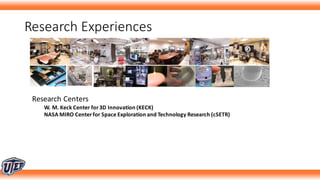
Research	Experiences
Research	Centers
W.	M.	Keck	Center	for	3D	Innovation	(KECK)
NASA	MIRO	Center	for	Space	Exploration	and	Technology	Research	(cSETR)
Research	Experiences	(Keck	Center/ME)
Lick	and	Stick	Wireless	Sensors Pyroelectric	Wireless	Sensors
Embedded	“Smart”	Sensors
Research	Experiences	(cSETR)
JANUS
Robotic Lander Scale Methane
Propulsion Technology Testbed
Directly Heated Oxy-Fuel
Supercritical Combustor
DAEDALUS
Suborbital Payload Scale Methane
Propulsion Technology Testbed
CUBE SAT
Modular Green Propulsion Testbed
Direct Power Extraction
(Magnetohydrodynamics) Using
Oxy-Fuels
Technology Research and
Innovation Acceleration (tRIAc)
Park
Fabens, Texas Airport
400 Acres Occupied with
Expansion to 9600 Acres
Intermediate Pressure Oxy-Fuel
Testing

UTEP