STEM Education and ST M ducation and
After‐School Programs 
“Presenting evidence‐based, unbiased research to g ,
examine the family impact of policies and programs” 
Fourth Family Impact Seminar, 2013
Jeffrey Weld, Ph.D.
Executive Director, Governor’s STEM Advisory Council
Associate Professor, Department of Biology, University of Northern Iowa
Why After‐School STEM? 
• Students spend less than 20% of their waking hours in school
California’s statewide STEM initiative uses afterschool and summer programs… 
• Students spend less than 20% of their waking hours in school.
• In Iowa, 32% (166,583) of K‐12 youth take care of themselves after school.
• 58,123 of Iowa's K‐12 children participate in afterschool programs (and 92% of their   
t ti fi d ith it)
• Student‐centered, inquiry‐based, project‐based, and complementary to   
the academic curriculumparents are satisfied with it).
• An additional 161,290 Iowa children would be likely to participate in an afterschool 
program if available in their community.
the academic curriculum
• Ideal places to deliver STEM activities in innovative ways that have 
relevance to students
• There’s funding ‐ 21st CCLC, SES, SIGs, corporate partnerships                                                       
21st Century Community Learning Centers, Supplemental Educational Services, School Improvement Grants 
[From Iowa After 3pm, an excerpt of America After 3pm, 2009 (After School Alliance, sponsored by JC Penny After School)] 
• Reach a diverse group of students at a time when they often lose interest
• Provide an excellent training ground for future STEM educators
• And, participants…. 
• develop interest in STEM 
• develop capacities to productively engage in STEM learning
• come to value goals of STEM
g g
CSLNet = California Afterschool Network + museums, aquaria, zoos science centers 
http://cslnet.org/
come to value goals of STEM 
[From Defining Youth Outcomes for STEM Learning in Afterschool, Afterschool Alliance, 2012]
Seminar Goal:“ … to better connect 
research and policy, and to promote a 
family perspective in policymaking”family perspective in policymaking
I. How connected (or disconnected) are research ( )
and policy currently, in after‐school STEM  in 
Iowa?
II. How best can we promote family perspective in 
policymaking around after school STEM?policymaking around after‐school STEM? 
I. How connected (or disconnected) are research and 
policy currently, in after‐school STEM  in Iowa?
+
√√
I. How connected (or disconnected) are research and policy 
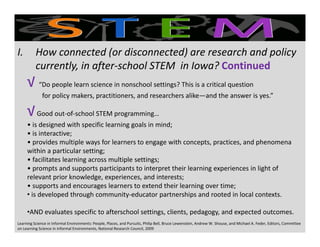
currently, in after‐school STEM  in Iowa? ContinuedContinued
√ √ “Do people learn science in nonschool settings? This is a critical question
for policy makers, practitioners, and researchers alike—and the answer is yes.”
√√√√Good out‐of‐school STEM programming… 
• is designed with specific learning goals in mind;
• is interactive;
• provides multiple ways for learners to engage with concepts, practices, and phenomena 
within a particular setting;
• facilitates learning across multiple settings;
• prompts and supports participants to interpret their learning experiences in light of prompts and supports participants to interpret their learning experiences in light of 
relevant prior knowledge, experiences, and interests;
• supports and encourages learners to extend their learning over time;
• is developed through community‐educator partnerships and rooted in local contexts.
•AND evaluates specific to afterschool settings, clients, pedagogy, and expected outcomes. 
Learning Science in Informal Environments: People, Places, and Pursuits, Philip Bell, Bruce Lewenstein, Andrew W. Shouse, and Michael A. Feder, Editors, Committee 
on Learning Science in Informal Environments, National Research Council, 2009
II. How best can we promote family perspective in  
policymaking around after‐school STEM? 
State STEM Models
√√ PD and materials = Alabama South Carolina Washington State Iowa√  √  PD and materials = Alabama, South Carolina, Washington State, Iowa
√  √  STEM special schools = Ohio, Texas, North Carolina (Iowa?)
√  √  Networks and public‐private partnerships = New York, Tennessee, Wisconsin, Iowa
√  √  Scale‐up STEM programming = Massachusetts*, California**, Iowa***
* Modest – handful of schools, $500,000
** Medium scale (n= 250) completely via out‐of‐school as mentioned
*** Massive (n= 900) blended in school and out Massive (n  900) blended in school and out
To date
Governor’s STEM Advisory Council, July 2011
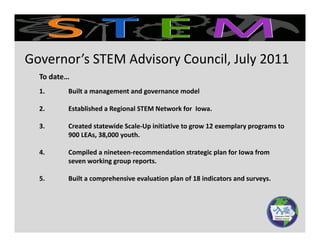
To date… 
1. Built a management and governance model
2 Established a Regional STEM Network for Iowa2. Established a Regional STEM Network for  Iowa.
3. Created statewide Scale‐Up initiative to grow 12 exemplary programs to 
900 LEAs, 38,000 youth.
4. Compiled a nineteen‐recommendation strategic plan for Iowa from 
seven working group reports.
5. Built a comprehensive evaluation plan of 18 indicators and surveys.
Iowa Governor’s
STEM Advisory
Council
State of diversity
STEM Ho‐hum
Fields of dreams
9
www.IowaSTEM.gov
Who’s STEM Council?
10
WhERE’s STEM?
11
www.IowaSTEM.gov
How to Bring STEM?
13
www.IowaSTEM.gov
2012 13
WHAT STEM to Bring?
1. A World in Motion 
2. Fabulous Resources in Energy Education (FREE) 
3 Partnership for Engineering and Educational
2012‐13
3. Partnership for Engineering and Educational 
Resources for Schools (PEERS)
4. FIRST Lego League 
5. FIRST Tech Challenge g
6. HyperStream
7. KidWind
8. Project HOPE 
9. The CASE for Agriculture Education in Iowa 
10. State Science + Technology Fair of Iowa 
11. iExploreSTEM
12 C id STEM I iti ti (CSI)12. Corridor STEM Initiative (CSI)
* PLTW ‐ $249,141 for FY 2013 
14
www.IowaSTEM.gov
www.IowaSTEM.gov
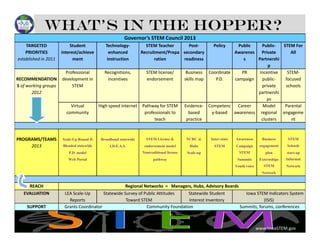
What’s in the Hopper?
Governor’s STEM Council 2013
TARGETED Student Technology STEM Teacher Post Policy Public Public STEM For
1. Open up STEM Professional Development
TARGETED 
PRIORITIES 
established in 2011
Student 
interest/achieve
ment
Technology‐
enhanced 
instruction
STEM Teacher 
Recruitment/Prepa
ration
Post‐
secondary 
readiness
Policy Public 
Awarenes
s
Public‐
Private 
Partnershi
p
STEM For  
All
Professional  Recognitions,  STEM license/  Business  Coordinate  PR  Incentive  STEM‐
2. Re‐think STEM teacher recruitment, Licensing
RECOMMENDATION
S of working groups
2012
development in 
STEM
incentives endorsement skills map P.D. campaign public‐
private 
partnershi
ps
focused 
schools
Virtual  High speed internet Pathway for STEM  Evidence‐ Competenc Career  Model  Parental 
3. One‐stop‐shop web portal for all things STEM
4 STEM focused schools
community
g p y
professionals to 
teach
based 
practice
p
y‐based awareness regional 
clusters
engageme
nt
PROGRAMS/TEAMS Scale Up Round II Broadband statewide STEM License & NCRC @ Inter state Awareness Business STEM
4. STEM‐focused schools
5. Public awareness campaign
PROGRAMS/TEAMS 
2013
Scale-Up Round II
Blended statewide
P.D. model
Web Portal
Broadband statewide
I.D.E.A.S.
STEM License &
endorsement model
Nontraditional license
pathway
NCRC @
Hubs
Scale-up
Inter-state
STEM
Awareness
Campaign
STEM
Summits
Youth voice
Business
engagement
plan
Externships
STEM
STEM
Schools
start-up
Informal
Network
5. Public awareness campaign
6. Incentivize Iowa businesses to partner
Network
REACH Regional Networks  =   Managers, Hubs, Advisory Boards
EVALUATION LEA Scale‐Up 
Reports
Statewide Survey of Public Attitudes 
Toward STEM
Statewide Student 
Interest Inventory
Iowa STEM Indicators System 
(ISIS)
15
www.IowaSTEM.gov
Reports Toward STEM Interest Inventory (ISIS)
SUPPORT Grants Coordinator                                        Community Foundation                                          Summits, forums, conferences
16
Iowa STEM: What’s known so far? 
√√ 26% of Iowans have heard of the acronym STEM√  √  26% of Iowans have heard of the acronym STEM
√  √  48% say their child is being very well prepared in STEM subjects by the school he/she 
attends
√  √  59% of parents say their child is likely to pursue a STEM careerp y y p
√√ 87% of LEA respondents reported they thought the Scale‐Up program had increased 
STEM interest among students quite a bit or a great deal.
√√ 71% of LEA respondents reported they thought the Scale‐Up program had increased 
STEM achievement among students quite a bit or a great deal.
√√ 76% of LEA respondents reported they thought the Scale‐Up program had increased√√ 76% of LEA respondents reported they thought the Scale Up program had increased 
STEM career interest among students quite a bit or a great deal.
√√ 62% of LEA respondents reported they thought the Scale‐Up program had broadened 
STEM Participation among diverse students quite a bit or a great deal
√  = √  = Survey of 2,000 Iowans by the CSBR at UNI, 2012 
√  = √  = Mid‐year Survey of Scale‐Up implementers by the CSBR at UNI, 2013 
STEM Participation among diverse students quite a bit or a great deal.
How connected (or disconnected) are research and policy currently, in 
Circling back… 
after‐school STEM  in Iowa? 
How best can we promote family perspective in policymaking around after‐
school STEM?school STEM? 
Tell Congress you support Afterschool!
h // d i / / ll h f h l i ihttp://www.good.is/posts/tell‐congress‐that‐you‐support‐afterschool‐programs‐in‐your‐community
Thank you
J ff W ld ti di tJeff Weld, executive director
Governor’s STEM Advisory Council
Weld@IowaSTEM.gov
319‐273‐2723
www.IowaSTEM.gov

weld_stem_presentation

  • 1.
    STEM Education and ST M ducationand After‐School Programs  “Presenting evidence‐based, unbiased research to g , examine the family impact of policies and programs”  Fourth Family Impact Seminar, 2013 Jeffrey Weld, Ph.D. Executive Director, Governor’s STEM Advisory Council Associate Professor, Department of Biology, University of Northern Iowa
  • 3.
    Why After‐School STEM?  • Students spendless than 20% of their waking hours in school California’s statewide STEM initiative uses afterschool and summer programs…  • Students spend less than 20% of their waking hours in school. • In Iowa, 32% (166,583) of K‐12 youth take care of themselves after school. • 58,123 of Iowa's K‐12 children participate in afterschool programs (and 92% of their    t ti fi d ith it) • Student‐centered, inquiry‐based, project‐based, and complementary to    the academic curriculumparents are satisfied with it). • An additional 161,290 Iowa children would be likely to participate in an afterschool  program if available in their community. the academic curriculum • Ideal places to deliver STEM activities in innovative ways that have  relevance to students • There’s funding ‐ 21st CCLC, SES, SIGs, corporate partnerships                                                        21st Century Community Learning Centers, Supplemental Educational Services, School Improvement Grants  [From Iowa After 3pm, an excerpt of America After 3pm, 2009 (After School Alliance, sponsored by JC Penny After School)]  • Reach a diverse group of students at a time when they often lose interest • Provide an excellent training ground for future STEM educators • And, participants….  • develop interest in STEM  • develop capacities to productively engage in STEM learning • come to value goals of STEM g g CSLNet = California Afterschool Network + museums, aquaria, zoos science centers  http://cslnet.org/ come to value goals of STEM  [From Defining Youth Outcomes for STEM Learning in Afterschool, Afterschool Alliance, 2012]
  • 4.
    Seminar Goal:“ … to better connect  research and policy, and to promote a  family perspective inpolicymaking”family perspective in policymaking I. How connected (or disconnected) are research ( ) and policy currently, in after‐school STEM  in  Iowa? II. How best can we promote family perspective in  policymaking around after school STEM?policymaking around after‐school STEM? 
  • 5.
  • 6.
    √√ I. How connected (or disconnected) are research and policy  currently, in after‐school STEM  in Iowa? ContinuedContinued √ √ “Do people learn science in nonschool settings? This is a critical question for policy makers, practitioners, and researchers alike—and the answer is yes.” √√√√Good out‐of‐school STEM programming…  • is designed with specific learning goals in mind; • is interactive; • provides multiple ways for learners to engage with concepts, practices, and phenomena  within a particular setting; • facilitates learning across multiple settings; • promptsand supports participants to interpret their learning experiences in light of prompts and supports participants to interpret their learning experiences in light of  relevant prior knowledge, experiences, and interests; • supports and encourages learners to extend their learning over time; • is developed through community‐educator partnerships and rooted in local contexts. •AND evaluates specific to afterschool settings, clients, pedagogy, and expected outcomes.  Learning Science in Informal Environments: People, Places, and Pursuits, Philip Bell, Bruce Lewenstein, Andrew W. Shouse, and Michael A. Feder, Editors, Committee  on Learning Science in Informal Environments, National Research Council, 2009
  • 7.
    II. How best can we promote family perspective in   policymaking around after‐school STEM?  State STEM Models √√ PD andmaterials = Alabama South Carolina Washington State Iowa√  √  PD and materials = Alabama, South Carolina, Washington State, Iowa √  √  STEM special schools = Ohio, Texas, North Carolina (Iowa?) √  √  Networks and public‐private partnerships = New York, Tennessee, Wisconsin, Iowa √  √  Scale‐up STEM programming = Massachusetts*, California**, Iowa*** * Modest – handful of schools, $500,000 ** Medium scale (n= 250) completely via out‐of‐school as mentioned *** Massive (n= 900) blended in school and out Massive (n  900) blended in school and out
  • 8.
    To date Governor’s STEM Advisory Council, July 2011 To date…  1. Built a management and governance model 2Established a Regional STEM Network for Iowa2. Established a Regional STEM Network for  Iowa. 3. Created statewide Scale‐Up initiative to grow 12 exemplary programs to  900 LEAs, 38,000 youth. 4. Compiled a nineteen‐recommendation strategic plan for Iowa from  seven working group reports. 5. Built a comprehensive evaluation plan of 18 indicators and surveys.
  • 9.
  • 10.
  • 11.
  • 13.
    How to BringSTEM? 13 www.IowaSTEM.gov
  • 14.
    2012 13 WHAT STEMto Bring? 1. A World in Motion  2. Fabulous Resources in Energy Education (FREE)  3 Partnership for Engineering and Educational 2012‐13 3. Partnership for Engineering and Educational  Resources for Schools (PEERS) 4. FIRST Lego League  5. FIRST Tech Challenge g 6. HyperStream 7. KidWind 8. Project HOPE  9. The CASE for Agriculture Education in Iowa  10. State Science + Technology Fair of Iowa  11. iExploreSTEM 12 C id STEM I iti ti (CSI)12. Corridor STEM Initiative (CSI) * PLTW ‐ $249,141 for FY 2013  14 www.IowaSTEM.gov www.IowaSTEM.gov
  • 15.
    What’s in theHopper? Governor’s STEM Council 2013 TARGETED Student Technology STEM Teacher Post Policy Public Public STEM For 1. Open up STEM Professional Development TARGETED  PRIORITIES  established in 2011 Student  interest/achieve ment Technology‐ enhanced  instruction STEM Teacher  Recruitment/Prepa ration Post‐ secondary  readiness Policy Public  Awarenes s Public‐ Private  Partnershi p STEM For   All Professional  Recognitions,  STEM license/  Business  Coordinate  PR  Incentive  STEM‐ 2. Re‐think STEM teacher recruitment, Licensing RECOMMENDATION S of working groups 2012 development in  STEM incentives endorsement skills map P.D. campaign public‐ private  partnershi ps focused  schools Virtual  High speed internet Pathway for STEM  Evidence‐ Competenc Career  Model  Parental  3. One‐stop‐shop web portal for all things STEM 4 STEM focused schools community g p y professionals to  teach based  practice p y‐based awareness regional  clusters engageme nt PROGRAMS/TEAMS Scale Up Round II Broadband statewide STEM License & NCRC @ Inter state Awareness Business STEM 4. STEM‐focused schools 5. Public awareness campaign PROGRAMS/TEAMS  2013 Scale-Up Round II Blended statewide P.D. model Web Portal Broadband statewide I.D.E.A.S. STEM License & endorsement model Nontraditional license pathway NCRC @ Hubs Scale-up Inter-state STEM Awareness Campaign STEM Summits Youth voice Business engagement plan Externships STEM STEM Schools start-up Informal Network 5. Public awareness campaign 6. Incentivize Iowa businesses to partner Network REACH Regional Networks  =   Managers, Hubs, Advisory Boards EVALUATION LEA Scale‐Up  Reports Statewide Survey of Public Attitudes  Toward STEM Statewide Student  Interest Inventory Iowa STEM Indicators System  (ISIS) 15 www.IowaSTEM.gov Reports Toward STEM Interest Inventory (ISIS) SUPPORT Grants Coordinator                                        Community Foundation                                          Summits, forums, conferences
  • 16.
  • 17.
    Iowa STEM: What’s known so far?  √√ 26% ofIowans have heard of the acronym STEM√  √  26% of Iowans have heard of the acronym STEM √  √  48% say their child is being very well prepared in STEM subjects by the school he/she  attends √  √  59% of parents say their child is likely to pursue a STEM careerp y y p √√ 87% of LEA respondents reported they thought the Scale‐Up program had increased  STEM interest among students quite a bit or a great deal. √√ 71% of LEA respondents reported they thought the Scale‐Up program had increased  STEM achievement among students quite a bit or a great deal. √√ 76% of LEA respondents reported they thought the Scale‐Up program had increased√√ 76% of LEA respondents reported they thought the Scale Up program had increased  STEM career interest among students quite a bit or a great deal. √√ 62% of LEA respondents reported they thought the Scale‐Up program had broadened  STEM Participation among diverse students quite a bit or a great deal √  = √  = Survey of 2,000 Iowans by the CSBR at UNI, 2012  √  = √  = Mid‐year Survey of Scale‐Up implementers by the CSBR at UNI, 2013  STEM Participation among diverse students quite a bit or a great deal.
  • 18.
  • 19.
    Thank you J ffW ld ti di tJeff Weld, executive director Governor’s STEM Advisory Council Weld@IowaSTEM.gov 319‐273‐2723 www.IowaSTEM.gov