


















Includes The Marine Corps Almanac
America’s Expeditionary Force in Readiness
Concepts & Programs 2013
U.S. Marine Corps
U . S . M a r i n e C o r p s
2013
Concepts & programs
i i
USMC Concepts & Programs 2013
A Message from the
Commandant of the
Marine Corps
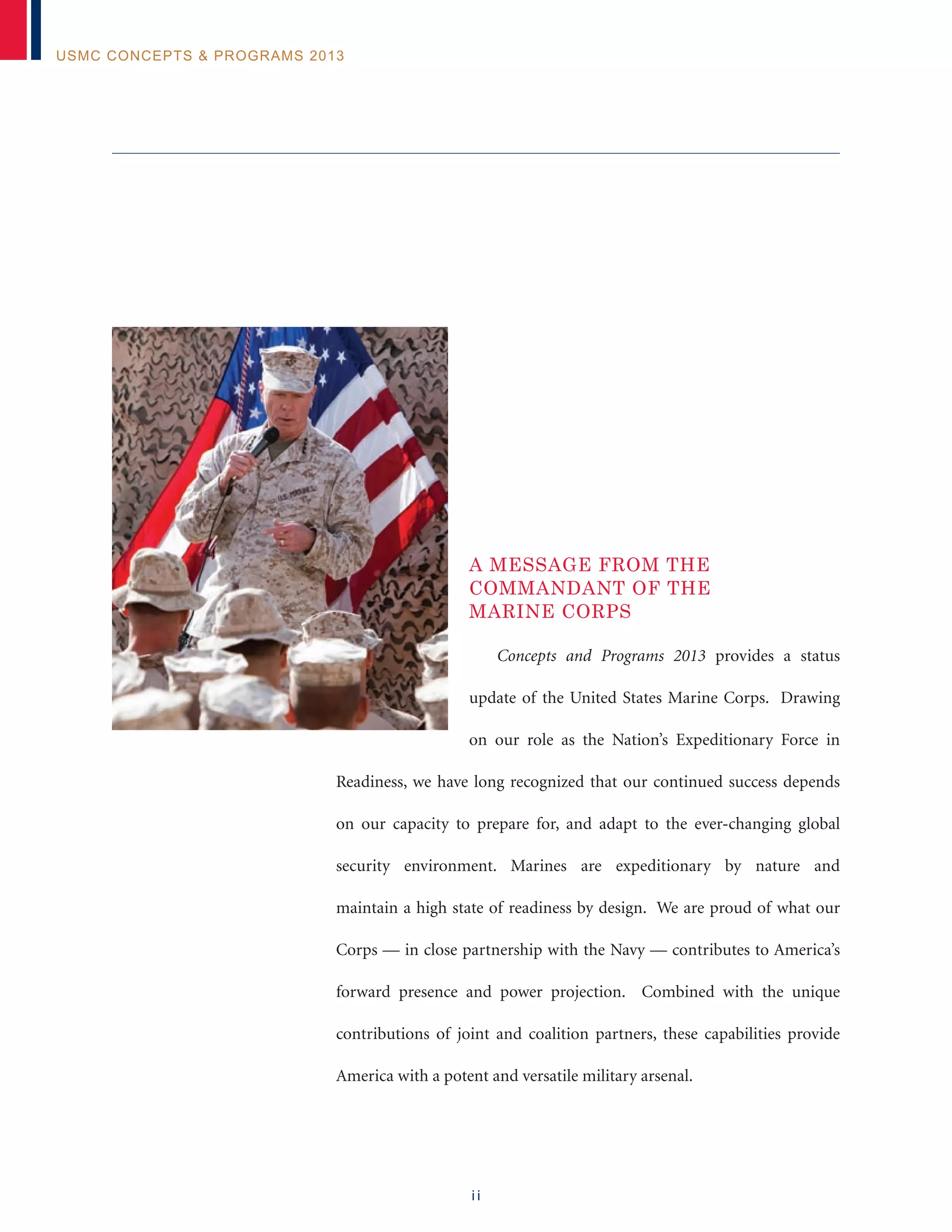
Concepts and Programs 2013 provides a status
update of the United States Marine Corps. Drawing
on our role as the Nation’s Expeditionary Force in
Readiness, we have long recognized that our continued success depends
on our capacity to prepare for, and adapt to the ever-changing global
security environment. Marines are expeditionary by nature and
maintain a high state of readiness by design. We are proud of what our
Corps — in close partnership with the Navy — contributes to America’s
forward presence and power projection. Combined with the unique
contributions of joint and coalition partners, these capabilities provide
America with a potent and versatile military arsenal.
iii
FOREWORD
Our achievements since September 11, 2001 are testament to our long history of innovation.
The dynamic nature of conflict and competition for technological advancement steels our resolve to
ensure that Marines are armed with the necessary weaponry, doctrine and equipment necessary to main-
tain an operational advantage in any engagement. Our focus is not limited to equipment and weapons
systems, but reflects the development of new operational concepts and organizational realignments.
Concepts and Programs 2013 is an excellent resource to better understand the Corps, our capabilities,
and the course we have charted for the future. Optimizing the Marine Corps is a process, not an end-state,
and spans years of investment and experimentation. The results of this continuous process will yield
an increasingly lethal, diverse and versatile array of capabilities we consider vital to meet the demands
of an uncertain security environment.
	 Semper Fidelis,
	 James F. Amos
	 General, U.S. Marine Corps
i v
USMC Concepts & Programs 2013
A Message from the Commandant
of the Marine Corps . .  .  .  .  .  .  .  .  .  .  .  .  .  .  .  . ii
CHAPTER 1:
America’s Expeditionary Force in Readiness. . . . . . . . . . 1
CHAPTER 2: Organization. . . . . . . . . . . . . . . . . . . . . . 10
Introduction . . . . . . . . . . . . . . . . . . . . . . . . . . . . . . . . . . . . 11
Marine Air Ground Task Force (MAGTF). . . . . . . . . . . . 12
Multi-Mission Capable MAGTFs. . . . . . . . . . . . . . . . . . . . 12
MAGTF Composition. . . . . . . . . . . . . . . . . . . . . . . . . . . . . 12
Types of MAGTFs. . . . . . . . . . . . . . . . . . . . . . . . . . . . . . . . 13
Unique Combatant Commander Support. . . . . . . . . . . . 15
MAGTF Sustainability . . . . . . . . . . . . . . . . . . . . . . . . . . . . 16
Maritime Prepositioning Force (MPF). . . . . . . . . . . . . . . 16
Marine Corps Prepositioning Program -
Norway (MCPP-N). . . . . . . . . . . . . . . . . . . . . . . . . . . . . . . 16
Headquarters, U.S. Marine Corps. . . . . . . . . . . . . . . . . . . 17
Headquarters, U.S. Marine Corps
Organizational Chart . . . . . . . . . . . . . . . . . . . . . . . . . . . . . 17
Operating Forces. . . . . . . . . . . . . . . . . . . . . . . . . . . . . . . . . 18
U.S Marine Corps Forces Command
(MARFORCOM). . . . . . . . . . . . . . . . . . . . . . . . . . . . . . . . 18
U.S. Marine Corps Forces Command
Organizational Chart . . . . . . . . . . . . . . . . . . . . . . . . . . . . . 19
U.S. Marine Corps Forces Command Units. . . . . . . . . . . 20
U.S. Marine Corps Forces, Pacific (MARFORPAC). . . . . 22
U.S. Marine Corps Forces Pacific
Organizational Chart . . . . . . . . . . . . . . . . . . . . . . . . . . . . . 23
U.S. Marine Corps Forces Pacific Units. . . . . . . . . . . . . . . 24
U. S. Marine Corps Forces, Special
Operations Command (MARSOC). . . . . . . . . . . . . . . . . . 27
MARSOC Organizational Chart. . . . . . . . . . . . . . . . . . . . 29
U.S. Marine Corps Forces, Reserve . . . . . . . . . . . . . . . . . . 30
U.S. Marine Corps Forces, Reserve
Organizational Chart . . . . . . . . . . . . . . . . . . . . . . . . . . . . . 30
U.S. Marine Corps Forces, Reserve Units. . . . . . . . . . . . . 31
U.S. Marine Corps Forces, Cyberspace
(MARFORCYBER) Command. . . . . . . . . . . . . . . . . . . . . 32
MARFORCYBER Subordinate Units. . . . . . . . . . . . . . . . . 32
MARFORCYBER Organizational Chart. . . . . . . . . . . . . . 32
Installations . . . . . . . . . . . . . . . . . . . . . . . . . . . . . . . . . . . . . 33
Marine Corps Installations Command (MCICOM). . . . 33
Marine Corps Logistics Command (MCLC). . . . . . . . . . 33
Commanding General, Marine Corps Logistics
Command Organizational Chart. . . . . . . . . . . . . . . . . . . . 34
CHAPTER 3: Programs. . . . . . . . . . . . . . . . . . . . . . . . . 36
Introduction . . . . . . . . . . . . . . . . . . . . . . . . . . . . . . . . . . . . 37
Acquisition Categories (ACAT) and Terms. . . . . . . . . . . . 38
Pillar 1: High Quality People . . . . . . . . . . . . . . . . . . . 43
Section 1: Manpower. . . . . . . . . . . . . . . . . . . . . . . . . . . . 44
Introduction . . . . . . . . . . . . . . . . . . . . . . . . . . . . . . . . . . . . 45
Force Structure Review/Drawdown in Forces. . . . . . . . . . 46
TABLE OF CONTENTS
Concepts & Programs 2013
U.S. Marine Corps
v
FOREWORD
End Strength. . . . . . . . . . . . . . . . . . . . . . . . . . . . . . . . . . . . 46
Marine Corps Recruiting Command (MCRC). . . . . . . . 47
Diversity. . . . . . . . . . . . . . . . . . . . . . . . . . . . . . . . . . . . . . . . 47
Manpower Recruiting. . . . . . . . . . . . . . . . . . . . . . . . . . . . . 47
Marine Corps Recruiting Information
Support System (MCRISS). . . . . . . . . . . . . . . . . . . . . . . . . 49
Marine Corps Retention. . . . . . . . . . . . . . . . . . . . . . . . . . . 50
Marine Corps Reserve. . . . . . . . . . . . . . . . . . . . . . . . . . . . . 51
Civilian Marines . . . . . . . . . . . . . . . . . . . . . . . . . . . . . . . . . 51
Section 2: Education . . . . . . . . . . . . . . . . . . . . . . . . . . . . 54
Marine Corps University (MCU) and
Professional Military Education (PME). . . . . . . . . . . . . . 55
College of Distance Education and
Training (CDET). . . . . . . . . . . . . . . . . . . . . . . . . . . . . . . . . 56
Pillar 2: Unit Readiness. . . . . . . . . . . . . . . . . . . . . . . . 59
Section 1: Keeping Faith With Marines, Sailors,
and their Families. . . . . . . . . . . . . . . . . . . . . . . . . . . . . . . . 60
Introduction . . . . . . . . . . . . . . . . . . . . . . . . . . . . . . . . . . . . 61
Defense Readiness Reporting System-
Marine Corps (DRRS-MC). . . . . . . . . . . . . . . . . . . . . . . . 62
Medical Readiness Reporting System (MRRS). . . . . . . . . 62
Family Support Programs. . . . . . . . . . . . . . . . . . . . . . . . . . 63
Integrated Behavioral Health. . . . . . . . . . . . . . . . . . . . . . . 64
Sexual Assault Prevention & Response. . . . . . . . . . . . . . . 65
Wounded Warrior Regiment (WWR). . . . . . . . . . . . . . . . 65
Semper Fit and Recreation/Exchange Services. . . . . . . . . 66
Personal and Professional Development. . . . . . . . . . . . . . 67
Section 2: Equipping the Marine. . . . . . . . . . . . . . . . . . 68
Introduction . . . . . . . . . . . . . . . . . . . . . . . . . . . . . . . . . . . . 69
M27 Infantry Automatic Rifle (IAR). . . . . . . . . . . . . . . . . 70
Marine Expeditionary Rifle Squad (MERS). . . . . . . . . . . 70
Family of Ballistic Protection Systems (FBPS). . . . . . . . . 71
Clothing and Flame Resistant Organizational
Gear (FROG). . . . . . . . . . . . . . . . . . . . . . . . . . . . . . . . . . . . 73
Family of Mountain Cold Weather Clothing
and Equipment (FMCWCE). . . . . . . . . . . . . . . . . . . . . . . 74
Squad Thermal Sight (STS). . . . . . . . . . . . . . . . . . . . . . . . 75
Route Reconnaissance and Clearance (R2C)
Family of Systems. . . . . . . . . . . . . . . . . . . . . . . . . . . . . . . . 75
Section 3: Investing in the Education and
Training of our Marines . . . . . . . . . . . . . . . . . . . . . . . . . . 78
Introduction . . . . . . . . . . . . . . . . . . . . . . . . . . . . . . . . . . . . 79
Training and Education Command (TECOM)
Organization. . . . . . . . . . . . . . . . . . . . . . . . . . . . . . . . . . . . 80
Courses and Facilities. . . . . . . . . . . . . . . . . . . . . . . . . . . . . 81
Training. . . . . . . . . . . . . . . . . . . . . . . . . . . . . . . . . . . . . . . . 81
MAGTF Training. . . . . . . . . . . . . . . . . . . . . . . . . . . . . . . . . 81
Predeployment Training Program (PTP). . . . . . . . . . . . . 81
Command and Control Training and Education Center
of Excellence (C2TECOE) . . . . . . . . . . . . . . . . . . . . . . . . . 83
Marine Corps Tactics and Operations
Group (MCTOG). . . . . . . . . . . . . . . . . . . . . . . . . . . . . . . . 84
Marine Corps Logistics Operations Group (MCLOG). . . 86
Joint, Interagency, and Multinational (JIM) Training. . . 87
Future Training: MAGTF Training Program . . . . . . . . . . 88
Training and Education Enablers. . . . . . . . . . . . . . . . . . . . 89
Marine Corps Training Information Management
System (MCTIMS). . . . . . . . . . . . . . . . . . . . . . . . . . . . . . . 89
Modeling and Simulations (M&S) . . . . . . . . . . . . . . . . . . 90
Mission-Capable Training Ranges. . . . . . . . . . . . . . . . . . . 91
Combined Arms Command and Control Trainer
Upgrade System (CACCTUS). . . . . . . . . . . . . . . . . . . . . . 93
Squad Immersive Training Environments (SITE). . . . . . 94
Supporting Arms Virtual Trainers (SAVT). . . . . . . . . . . . 94
Marine Corps History Division. . . . . . . . . . . . . . . . . . . . . 95
National Museum of the Marine Corps (NMMC) . . . . . 96
Center for Advanced Operational Culture and
Learning (CAOCL). . . . . . . . . . . . . . . . . . . . . . . . . . . . . . . 97
Section 4: Fire Support. . . . . . . . . . . . . . . . . . . . . . . . . 100
Introduction . . . . . . . . . . . . . . . . . . . . . . . . . . . . . . . . . . . 101
High Mobility Artillery Rocket System (HIMARS). . . . 102
Lightweight 155mm Howitzer (LW155). . . . . . . . . . . . . 103
Advanced Field Artillery Tactical Data System
(AFATDS) Family of Systems. . . . . . . . . . . . . . . . . . . . . . 104
Family of Target Acquisition Systems (FTAS). . . . . . . . . 105
Escalation of Force-Mission Module (EoF-MM). . . . . . 106
Section 5: Command and Control/
Situational Awareness (C2/SA). . . . . . . . . . . . . . . . . . . . 108
Introduction . . . . . . . . . . . . . . . . . . . . . . . . . . . . . . . . . . . 109
v i
USMC Concepts & Programs 2013
Aviation Command and Control System (AC2) Family
of Systems (FOS) and MACCS FOS Sustainment . . . . . 110
Global Command and Control System-Tactical Combat
Operations (GCCS-TCO) System. . . . . . . . . . . . . . . . . . 111
Common Aviation Command and
Control System (CAC2S). . . . . . . . . . . . . . . . . . . . . . . . . 112
Theater Battle Management Core System (TBMCS). . . 113
Combat Operations Center (COC). . . . . . . . . . . . . . . . . 113
Ground-Based Operational Surveillance System
(Expeditionary) (G-BOSS(E)). . . . . . . . . . . . . . . . . . . . . 114
Section 6: Expeditionary Energy. . . . . . . . . . . . . . . . . 116
Introduction . . . . . . . . . . . . . . . . . . . . . . . . . . . . . . . . . . . 117
Expeditionary Energy: From Bases to Battlefield. . . . . . 118
Section 7: Marine Corps Intelligence, Surveillance,
and Reconnaissance Enterprise (MCISRE) . . . . . . . . . 122
Introduction . . . . . . . . . . . . . . . . . . . . . . . . . . . . . . . . . . . 123
MCISRE Construct. . . . . . . . . . . . . . . . . . . . . . . . . . . . . . 125
Operational Overview . . . . . . . . . . . . . . . . . . . . . . . . . . . 125
Section 8: Expeditionary Logistics. . . . . . . . . . . . . . . . 128
Introduction . . . . . . . . . . . . . . . . . . . . . . . . . . . . . . . . . . . 129
Electronic Maintenance Support System (EMSS). . . . . 130
Family of Field Medical Equipment (FFME). . . . . . . . . 130
Marine Corps Family of Power and Environmental
Control Equipment. . . . . . . . . . . . . . . . . . . . . . . . . . . . . . 131
Family of Combat Field Feeding Systems. . . . . . . . . . . . 132
Section 9: Preparing for Tomorrow’s Fight . . . . . . . . 134
Introduction . . . . . . . . . . . . . . . . . . . . . . . . . . . . . . . . . . . 135
Marine Corps Security Cooperation
Group (MCSCG). . . . . . . . . . . . . . . . . . . . . . . . . . . . . . . . 136
PILLAR 3: Capability & Capacity to Meet
DoD Strategic Requirements. . . . . . . . . . . . . . . . . . . . . 139
Section 1: Amphibious and Pre-positioning Ships. . . 140
Naval Expeditionary Capability in the 21st Century . . 141
Maritime Support to Expeditionary Operations. . . . . . 142
Amphibious Warships. . . . . . . . . . . . . . . . . . . . . . . . . . . . 144
Landing Craft Air Cushion (LCAC)/
Ship-to-Shore Connector (SSC) . . . . . . . . . . . . . . . . . . . 146
Evolution of Maritime Prepositioning . . . . . . . . . . . . . . 146
Joint High Speed Vessel (JHSV). . . . . . . . . . . . . . . . . . . . 148
PILLAR 4: Infrastructure Sustainment. . . . . . . . . . . . 151
Section 1: Providing Capable Bases and Stations . . . 152
Introduction . . . . . . . . . . . . . . . . . . . . . . . . . . . . . . . . . . . 153
Installations and Military Construction. . . . . . . . . . . . . 154
Infrastructure Sustainment . . . . . . . . . . . . . . . . . . . . . . . 154
Installations Energy. . . . . . . . . . . . . . . . . . . . . . . . . . . . . . 154
Range Modernization/Transformation (RM/T). . . . . . . 155
Housing. . . . . . . . . . . . . . . . . . . . . . . . . . . . . . . . . . . . . . . 156
Environmental, Natural, and Cultural
Resources Stewardship. . . . . . . . . . . . . . . . . . . . . . . . . . . 157
PILLAR 5: Equipment Modernization. . . . . . . . . . . . . 159
Section 1: Equipping the Marine. . . . . . . . . . . . . . . . . 160
Follow-On-To Shoulder Launched
Multi-Purpose Assault Weapon (FOTS). . . . . . . . . . . . . 161
Marine Enhancement Program (MEP). . . . . . . . . . . . . . 161
Family of Improved Load Bearing
Equipment (FILBE). . . . . . . . . . . . . . . . . . . . . . . . . . . . . . 162
Family of Individual Warfighter Equipment (IWE). . . . 163
Section 2: Ground Combat Tactical Vehicles. . . . . . . 166
Mobility for the 21st Century. . . . . . . . . . . . . . . . . . . . . . 167
Ground Combat Tactical Vehicle Strategy (GCTVS). . . 168
Assault Amphibious Vehicle (AAV7A1)
Family of Vehicles Upgrade . . . . . . . . . . . . . . . . . . . . . . . 169
Joint Light Tactical Vehicle (JLTV)
Family of Vehicles (FOV) . . . . . . . . . . . . . . . . . . . . . . . . . 170
Amphibious Combat Vehicle (ACV). . . . . . . . . . . . . . . . 171
Marine Personnel Carrier (MPC). . . . . . . . . . . . . . . . . . 172
High Mobility Multipurpose Wheeled
Vehicle (HMMWV) . . . . . . . . . . . . . . . . . . . . . . . . . . . . . 173
Medium Tactical Vehicle Replacement (MTVR). . . . . . 173
Logistics Vehicle System Replacement (LVSR). . . . . . . . 175
Section 3: Aviation . . . . . . . . . . . . . . . . . . . . . . . . . . . . 176
Aviation Strategy for the 21st Century. . . . . . . . . . . . . . 177
F-35B Short Take-Off Vertical Landing (STOVL)
and C (Carrier Variant) Lightning II Joint
Strike Fighter (JSF). . . . . . . . . . . . . . . . . . . . . . . . . . . . . . 178
Joint Strike Fighter (JSF) Transition Plan. . . . . . . . . . . . 179
Marine Air Ground Task Force Electronic Warfare
(MAGTF EW). . . . . . . . . . . . . . . . . . . . . . . . . . . . . . . . . . 179
MV-22B Osprey. . . . . . . . . . . . . . . . . . . . . . . . . . . . . . . . . 181
vii
FOREWORD
H-1 Upgrades (UH-1Y Venom/AH-1Z Viper). . . . . . . . 182
KC-130J. . . . . . . . . . . . . . . . . . . . . . . . . . . . . . . . . . . . . . . 183
CH-53K Heavy Lift Helicopter. . . . . . . . . . . . . . . . . . . . . 184
Unmanned Aircraft Systems (UAS). . . . . . . . . . . . . . . . . 186
AN/TPS 80 Ground/Air Task Oriented Radar
(G/ATOR) . . . . . . . . . . . . . . . . . . . . . . . . . . . . . . . . . . . . . 188
P-19A Aircraft Rescue and Fire Fighting (ARFF)
Vehicle Replacement (P-19R). . . . . . . . . . . . . . . . . . . . . . 189
Section 4: Fire Support. . . . . . . . . . . . . . . . . . . . . . . . . 192
Expeditionary Fire Support System (EFSS) . . . . . . . . . . 193
Target Location, Designation, and
Hand-off System (TLDHS) . . . . . . . . . . . . . . . . . . . . . . . 193
Mission Payload Module–Non-Lethal Weapons
System (MPM-NLWS). . . . . . . . . . . . . . . . . . . . . . . . . . . 194
Ocular Interruption System. . . . . . . . . . . . . . . . . . . . . . . 195
Disable Point Target (DPT). . . . . . . . . . . . . . . . . . . . . . . 196
DoD Non-Lethal Weapons Program. . . . . . . . . . . . . . . . 196
Section 5: Command and Control/
Situational Awareness (C2/SA). . . . . . . . . . . . . . . . . . . . 198
Introduction . . . . . . . . . . . . . . . . . . . . . . . . . . . . . . . . . . . 199
Marine Air Ground Task Force (MAGTF)
Command and Control Vision Statement . . . . . . . . . . . 200
Marine Corps Information Enterprise
(MCIENT) Strategy . . . . . . . . . . . . . . . . . . . . . . . . . . . . . 200
MCIENT Core Components. . . . . . . . . . . . . . . . . . . . . . 203
Marine Corps Enterprise Information
Technology Services (MCEITS). . . . . . . . . . . . . . . . . . . . 204
Global Combat Support System-
Marine Corps (GCSS-MC). . . . . . . . . . . . . . . . . . . . . . . . 205
Composite Tracking Network (CTN). . . . . . . . . . . . . . . 206
Joint Battle Command- Platform (JBC-P)
Family of Systems. . . . . . . . . . . . . . . . . . . . . . . . . . . . . . . 207
Networking On-the-Move (NOTM) Increment 1. . . . . 207
Tactical Networking Systems. . . . . . . . . . . . . . . . . . . . . . 208
Tactical Communication Modernization (TCM). . . . . 210
Tactical Data Network (TDN)
Data Distribution System- Modular (DDS-M). . . . . . . 211
Ground-Based Air Defense
Transformation (GBAD-T). . . . . . . . . . . . . . . . . . . . . . . 212
AN/TPS-59(V)3 Radar System . . . . . . . . . . . . . . . . . . . . 212
Identity Dominance System (IDS). . . . . . . . . . . . . . . . . . 213
Counter Radio-Controlled Improvised Explosive
Device (RCIED) Electronic Warfare (CREW). . . . . . . . 214
Section 6: Intelligence, Surveillance
and Reconnaissance. . . . . . . . . . . . . . . . . . . . . . . . . . . . . 216
Distributed Common Ground System-Marine Corps
(DCGS-MC) Enterprise. . . . . . . . . . . . . . . . . . . . . . . . . . 217
Intelligence Analysis System (IAS)
Family of Systems (FOS) . . . . . . . . . . . . . . . . . . . . . . . . . 217
Technical Control and Analysis Center (TCAC) . . . . . . 218
Sensitive Compartmented Information
Communications (SCI Comms). . . . . . . . . . . . . . . . . . . 219
Counter Intelligence and Human
Intelligence Equipment Program (CIHEP). . . . . . . . . . 219
MAGTF Secondary Imagery Dissemination
System (MSIDS). . . . . . . . . . . . . . . . . . . . . . . . . . . . . . . . 220
Remote Video Viewing Terminal (RVVT) . . . . . . . . . . . 221
Wide Field of View Persistent Surveillance (WFVPS). . . 221
21st Century Marine Expeditionary Intelligence
Analysis (MEIA-21). . . . . . . . . . . . . . . . . . . . . . . . . . . . . . 222
Tactical Exploitation of National
Capabilities (TENCAP) . . . . . . . . . . . . . . . . . . . . . . . . .  223
Team Portable Collection System Multi-Platform
Capable (TPCS-MPC) . . . . . . . . . . . . . . . . . . . . . . . . . .  223
Intelligence Support to Cyberspace Operations. . . . . . . 224
CHAPTER 4: Marine Corps Almanac . . . . . . . . . . . . 226
Introduction . . . . . . . . . . . . . . . . . . . . . . . . . . . . . . . . . . . 227
Active Officer Data. . . . . . . . . . . . . . . . . . . . . . . . . . . . . . 228
Active Enlisted Data . . . . . . . . . . . . . . . . . . . . . . . . . . . . . 231
Reserve Officer Data. . . . . . . . . . . . . . . . . . . . . . . . . . . . . 235
Reserve Enlisted Data. . . . . . . . . . . . . . . . . . . . . . . . . . . . 237
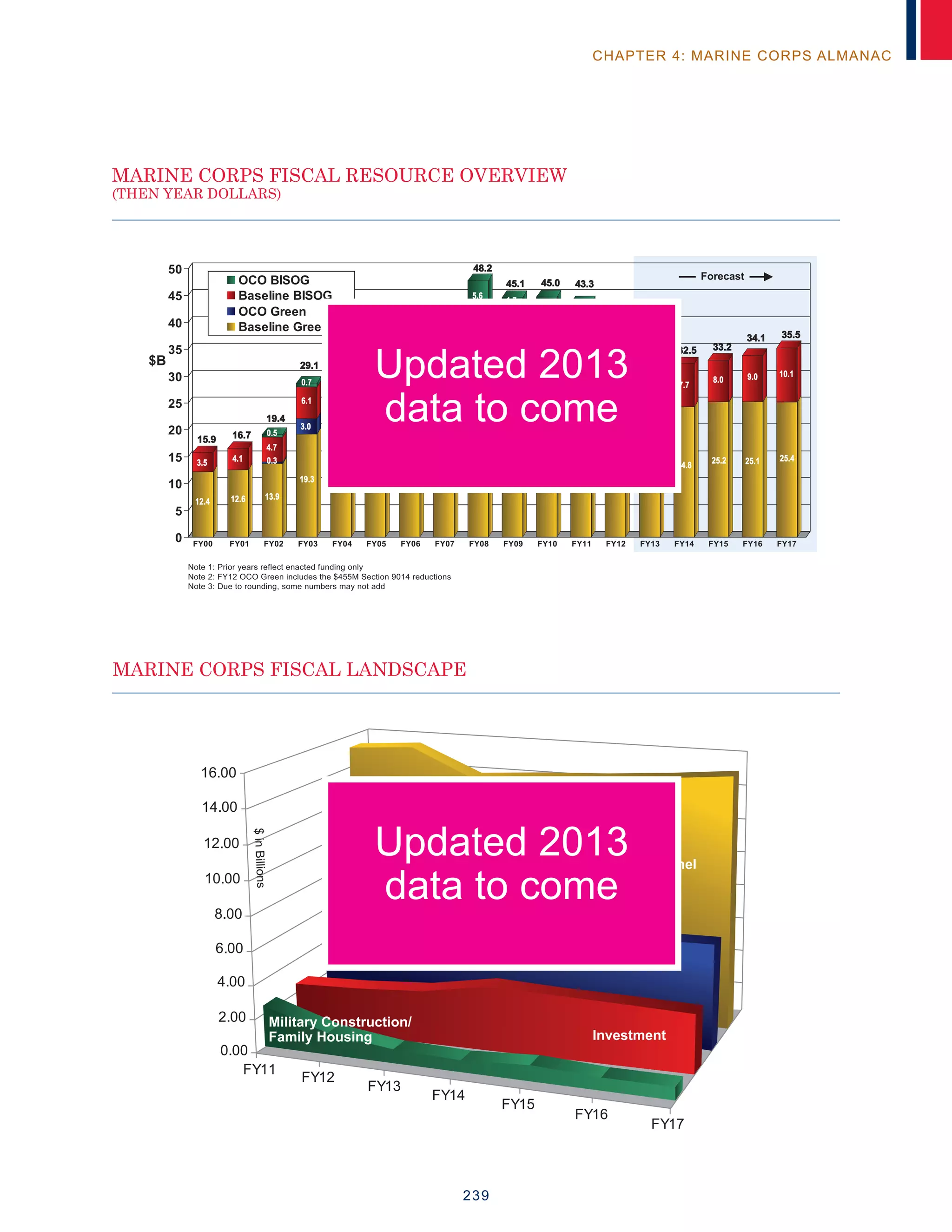
Marine Corps Fiscal Resource Overview Chart. . . . . . . 239
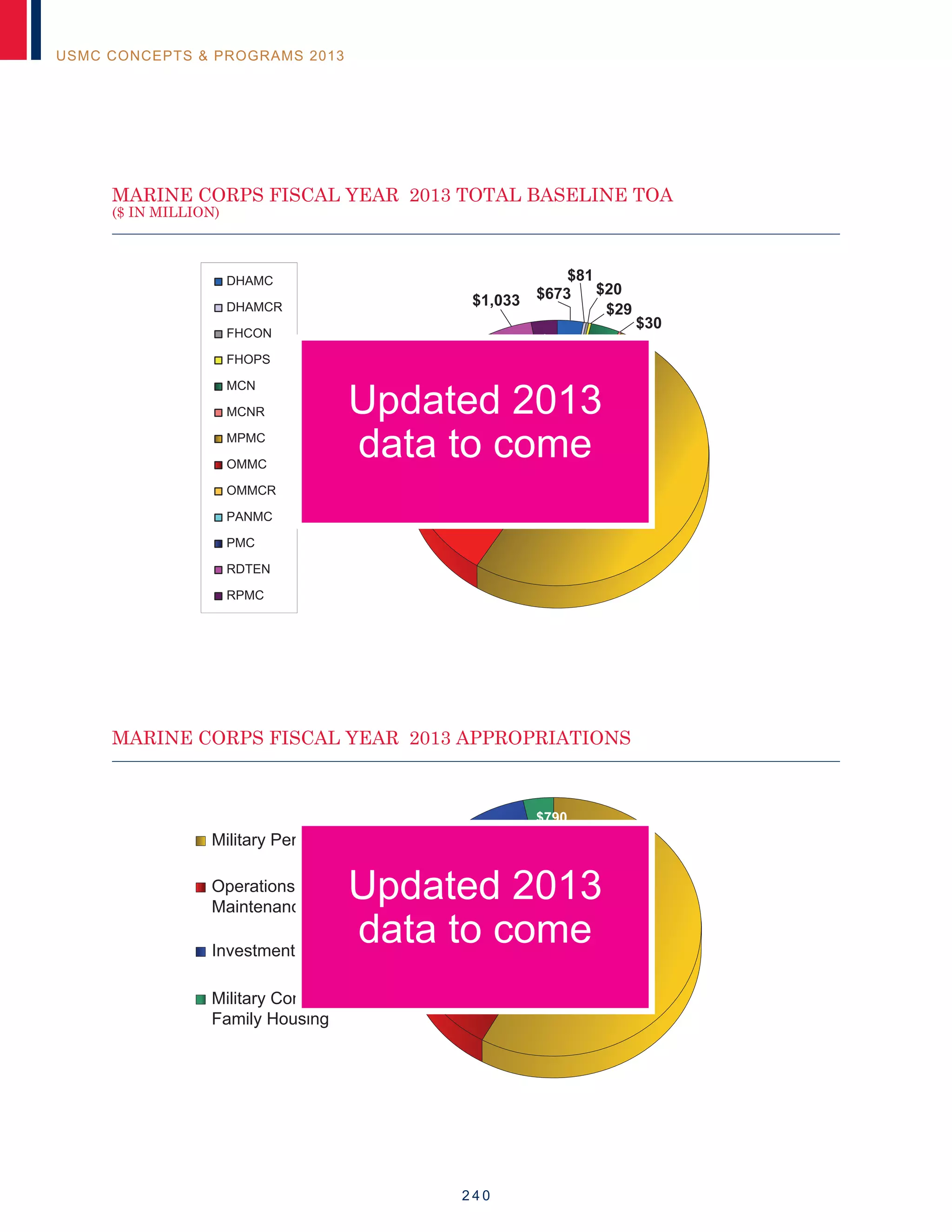
FY12 TOA Chart. . . . . . . . . . . . . . . . . . . . . . . . . . . . . . . . 240
FY12 Appropriations Chart. . . . . . . . . . . . . . . . . . . . . . . 240
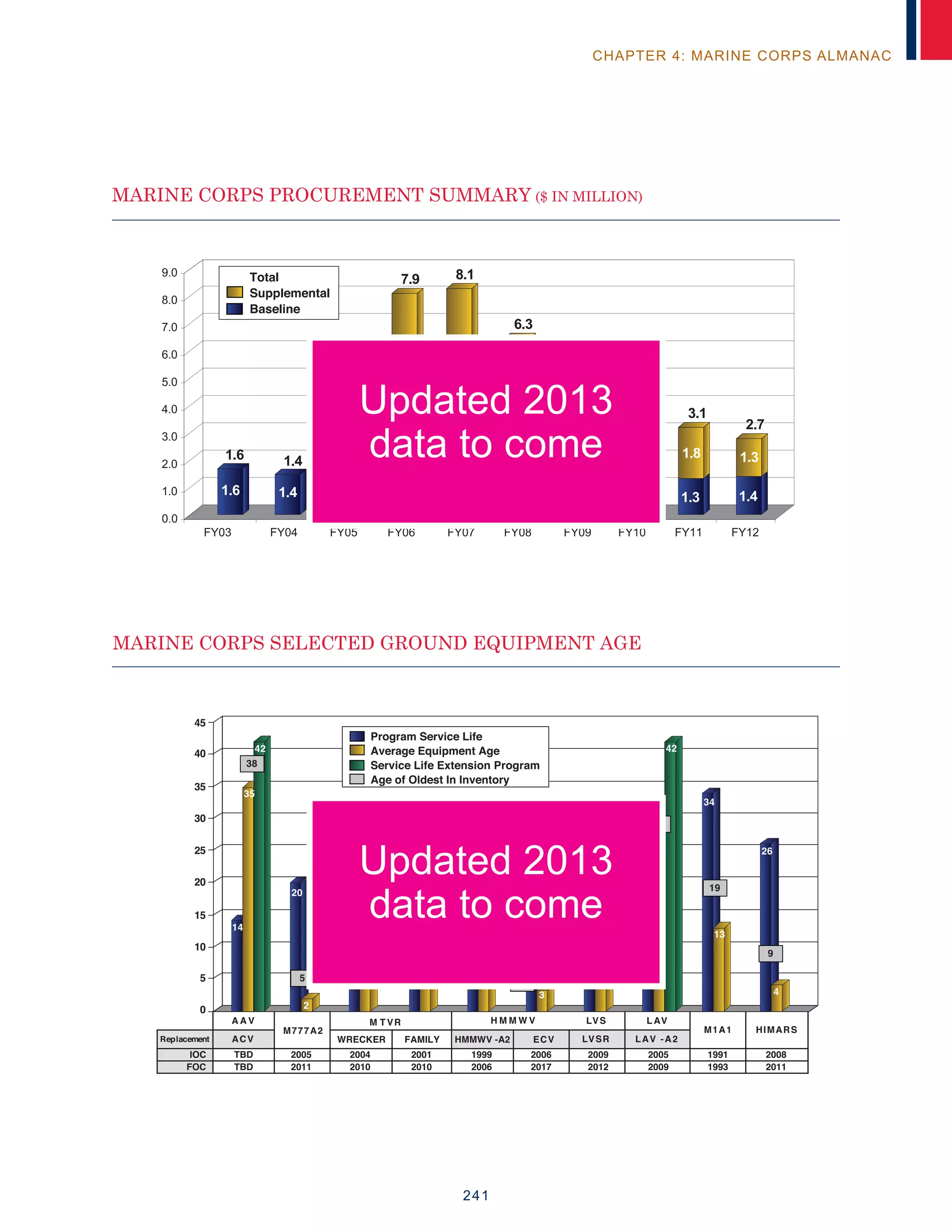
Marine Corps Procurement Chart. . . . . . . . . . . . . . . . . . 241
Marine Corps Ground Equipment Age Chart. . . . . . . . 241
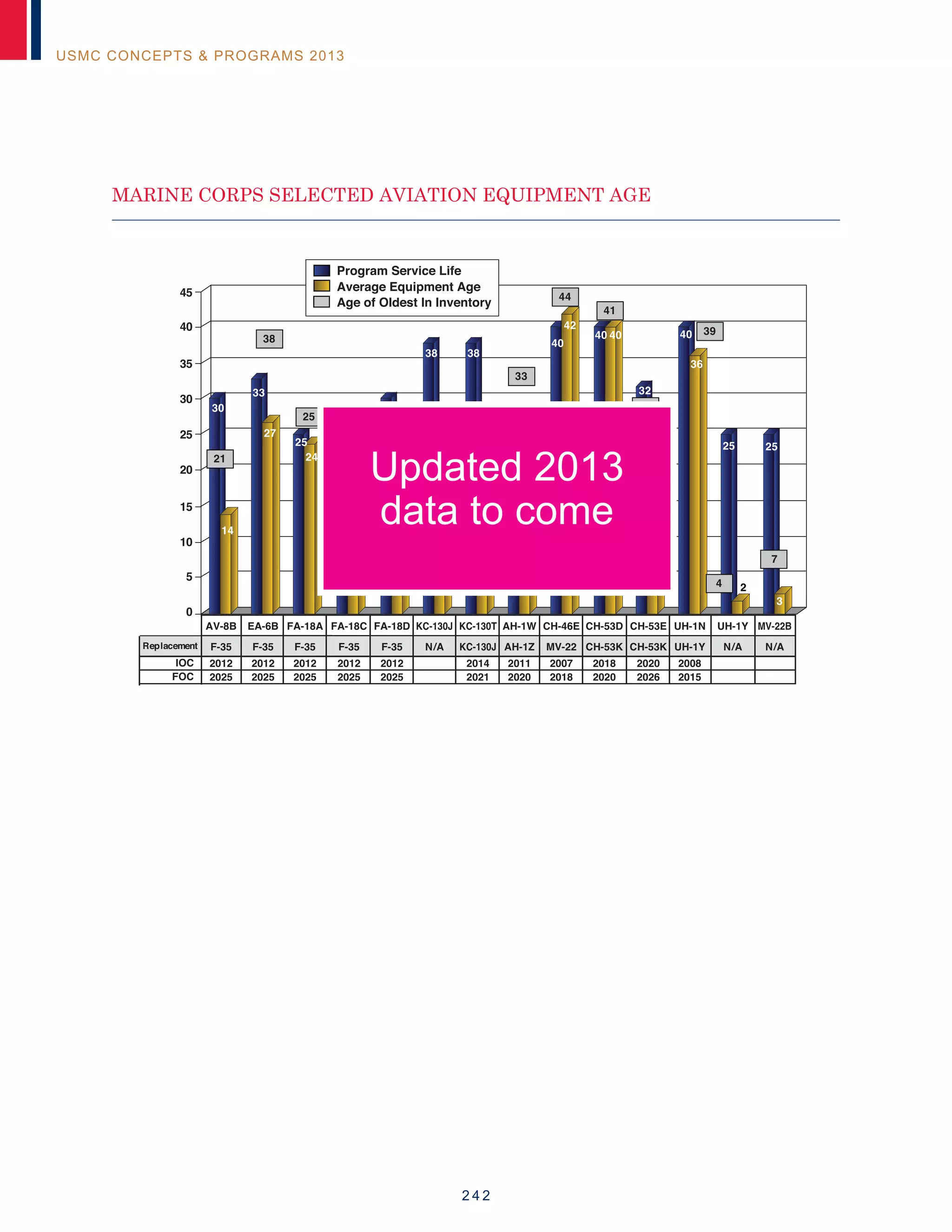
Marine Corps Aircraft Age Chart. . . . . . . . . . . . . . . . . . . 242
INDEX. . . . . . . . . . . . . . . . . . . . . . . . . . . . . . . . . . . . . . . 243
CHAPTER 1
1
chapter 1: The USMC America’s Expeditionary Force in Readiness
The Marine Corps is America’s Expeditionary Force in Readiness
–– a balanced air-ground-logistics team. We are forward deployed and
forward engaged, shaping, training, deterring, and responding to all
manner of crises and contingencies. We create options and decision
space for our Nation’s leaders. Alert and ready, we respond to today’s
crisis with forces available today. Responsive and scalable, we team with
other Services, interagency partners, and allies. We enable and partici-
pate in joint and combined operations of any magnitude. A “middle-
weight”force,we are light enough to get there quickly, but heavy enough
to carry the day upon arrival, and capable of operating independent of
local infrastructure. We operate throughout the spectrum of threats ––
irregular, hybrid, conventional –– particularly in the gray areas where
they overlap. Marines are always ready to respond whenever the Nation
calls…wherever the President may direct.
General James F. Amos, USMC
Commandant of the Marine Corps
Strategic Demands and the Security Environment
The United States is a maritime nation, whose interests are inextricably
wound in the networks of global trade and a stable international order. Ours
remains the world’s largest economy, critically dependent on the global
commons for our livelihood, as more than 90 percent of the world’s commerce
travels by sea.
Protecting our citizens, allies and interests in this global system is vital for
our prosperity and security. While the United States seeks peace and stability,
armed intervention is sometimes necessary to preserve them. History reminds
us that, no matter how strong our conventional capabilities may be, clever en-
THE UNITED STATES MARINE CORPS:
AMERICA’S EXPEDITIONARY FORCE
IN READINESS
2
USMC Concepts & Programs 2013
emies find “windows of vulnerability” to exploit. This
human dimension creates vast uncertainties and de-
mands a security establishment capable of responding
to a wide range of threats.
As we look ahead, we see a world of increasing in-
stability, failing states, and conflict provoked by both
conventional enemies and transnational threats. The
complexity and scope of conflict continues to evolve
and change rapidly. Both friends and potential en-
emies are increasingly bound through economic in-
terdependence, shifting balances of power, and the
effects of the information age. The information age
and globalization have brought a diffusion of military
power, to a greater number of states and to non-state
and criminal actors. Global stressors such as poverty,
urbanization, overpopulation, competition over scarce
natural resources, and natural disasters increase ten-
sion and instability.
While millions have benefitted from globalization,
millions of others have suffered social and economic
disruptions. Those who perceive themselves as “left
out” of a globalizing world are ripe for exploitation by
rogue states, non-state actors, and criminal elements
that thrive in the chaotic margins of the global or-
der. Irregular challenges are thus becoming the new
“regular” in the future security environment as terror-
ism, economic warfare, and cyber warfare present new
modes of competition.
Much of the world’s population is concentrated
along the world’s coastlines. These littoral regions are
linked to our national interests and the global economy
and are the primary operating area for our Navy-Ma-
rine Corps team. Our naval and maritime capabilities
are designed to address the range of instabilities and
threats found in the critical seam between the water
and the land. Naval expeditionary forces provide an
important backstop for today’s unpredictable threats.
Forward-deployed Marines represent the Nation’s in-
surance policy against the threats and disruptions in
the global security environment.
3
chapter 1: The USMC America’s Expeditionary Force in Readiness
The Role of the Marine Corps
Today’s Marine Corps is purpose-built for the
current and future security environments. The Ma-
rine Corps is the right force, at the right time, contrib-
uting the right capabilities to the defense of our na-
tion and its interests around the globe. Our potential
enemies are observant, adaptive, and cunning. They
strike without warning, often in places and at times
we least expect. Our Nation needs a force ready to
move toward the sound of chaos, responding swiftly
to crisis and creating the space and time for strategic
decision-making. America needs a forward-deployed
force capable of defending its interests, even when ac-
cess is denied. Our nation has such a force. They are
called Marines.
The Marine Corps is a naval service, operating in
close partnership with the world’s greatest Navy. To-
gether, we share a remarkable heritage that predates
the signing of our Constitution. Together, we lever-
age the access provided by the sea to protect the vast
global commons, while ensuring our ability to project
our national power and influence into the littoral re-
gions. Naval forces deter aggression through forward
presence, contain crises, respond to natural disasters,
and buy strategic decision time for our nation’s lead-
ers. Well-trained Navy-Marine teams are located off
the coast of anticipated crisis areas every day, poised to
swiftly respond.
The flexibility of the Marine Corps and its am-
phibious capabilities align the service well with the
security demands articulated in the 2012 Strategic
Guidance for the 21st Century. The Marine Corps val-
ue in a wide range of missions, its ability to operate
without a large footprint ashore, and its ability to scale
up in times of crisis make them an essential tool for
national decision-makers and joint commanders. Ma-
rines smoothly integrate with the other elements of the
joint force, enable interagency efforts, and are a natu-
ral partner to special operations. Where U.S. citizens,
allies or interests are threatened, maritime response
capabilities provide a range of rapid intervention op-
tions. When conflict escalates, their ability to conduct
forcible entry operations in a major contingency serves
as a rheostat for the thoughtful and appropriate appli-
cation of military power.
Marine Corps Operations
During the past year, the Marine Corps has been
actively engaged around the world. While continuing
to meet operational commitments in Afghanistan, the
Marine Corps simultaneously worked with over ninety
allies and partners to build effective institutions that
contribute to global stability and security. Marines
continue to respond to global crises as they emerge,
with two-thirds of the Marine Corps operationally
committed on a daily basis. Even while providing a
significant contribution to Operation Enduring Free-
4
USMC Concepts & Programs 2013
dom (OEF), our Marine Expeditionary Units (MEUs)
and other task-organized Marine Air Ground Task
Forces (MAGTFs) supported national security objec-
tives throughout the globe. Marines provided forward
presence, deterrence, and theater security cooperation
activities, and contributed to building partner capaci-
ties in every geographic combatant command.
Afghanistan 	
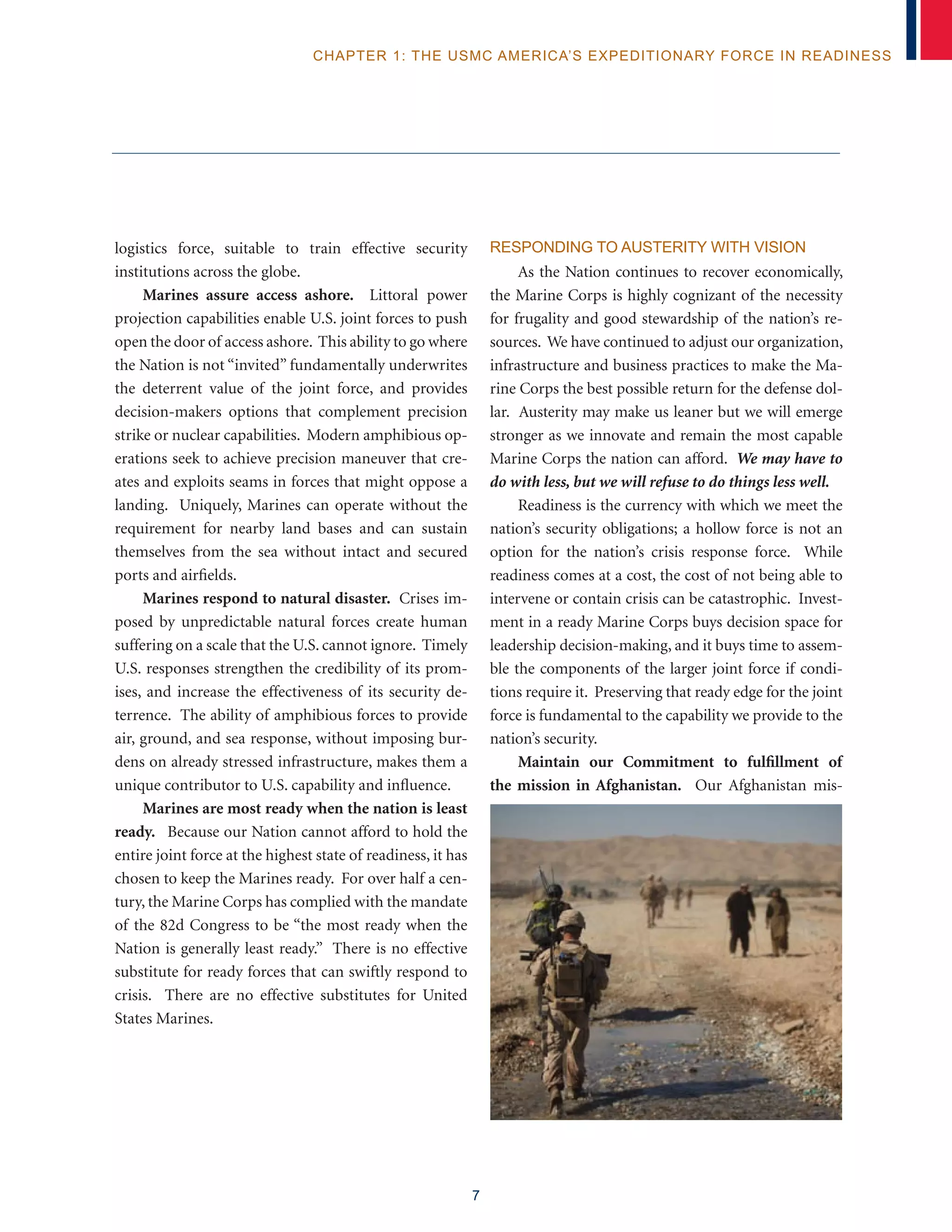
The Marine Corps’ number-one priority is pro-
viding the best trained and equipped Marine units to
Afghanistan. Over 7,000 Active and Reserve Marines
remain engaged in operations in the Helmand and
Nimroz provinces in Regional Command Southwest
(RC-SW). Marines,along with nine Coalition partners
and 32,000 Afghan National Security Forces in RC-SW,
strive to deny the Taliban safe haven, restore stability to
the most violent regions of Afghanistan, and give hope
to the Afghan people. We have made significant prog-
ress in degrading the Taliban’s ability to organize and
disrupt the efforts of the Afghan government, while
building Afghan security institutions and improving
the political and social conditions within RC-SW.
As the Afghan government’s ability to provide
security increases, the confidence of the population
will be restored, accelerating the achievement of gov-
ernance, economic, and social objectives. Marines in
Helmand Province have helped open 86 schools, pro-
viding a “new normal” of daily classroom participa-
tion. Our efforts have contributed to the education
of more than 121,000 children, including more than
28,000 female students, representing a 432% increase
since 2005. Healthcare is another area of vast improve-
ment. Over the last six years health clinics serving the
needs of the Helmand population have increased from
six to 57.
Global Crisis Response
Marines remain vigilant around the globe, re-
sponding to crises spawned by instability, civil conflict,
and humanitarian disaster. The Marine Corps pro-
vides six rotational MEUs and numerous special-pur-
pose MAGTFs, each capable of responding when con-
ditions deteriorate. For example, for more than 150
days during 2012, the 24th MEU remained on station,
ready to protect American interests and provide deci-
sion space to our leaders in the wake of violent protests
across the Middle East and North Africa.
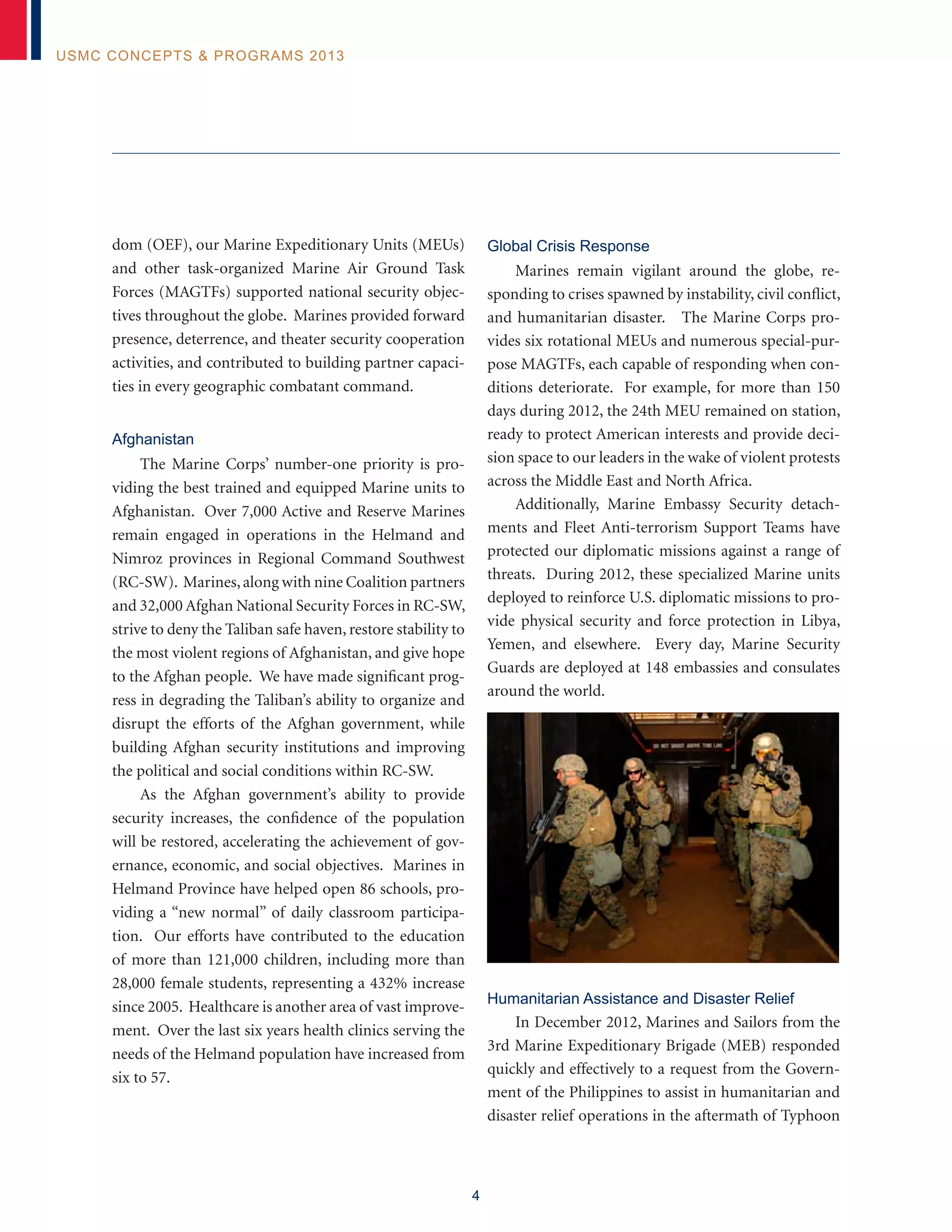
Additionally, Marine Embassy Security detach-
ments and Fleet Anti-terrorism Support Teams have
protected our diplomatic missions against a range of
threats. During 2012, these specialized Marine units
deployed to reinforce U.S. diplomatic missions to pro-
vide physical security and force protection in Libya,
Yemen, and elsewhere. Every day, Marine Security
Guards are deployed at 148 embassies and consulates
around the world.
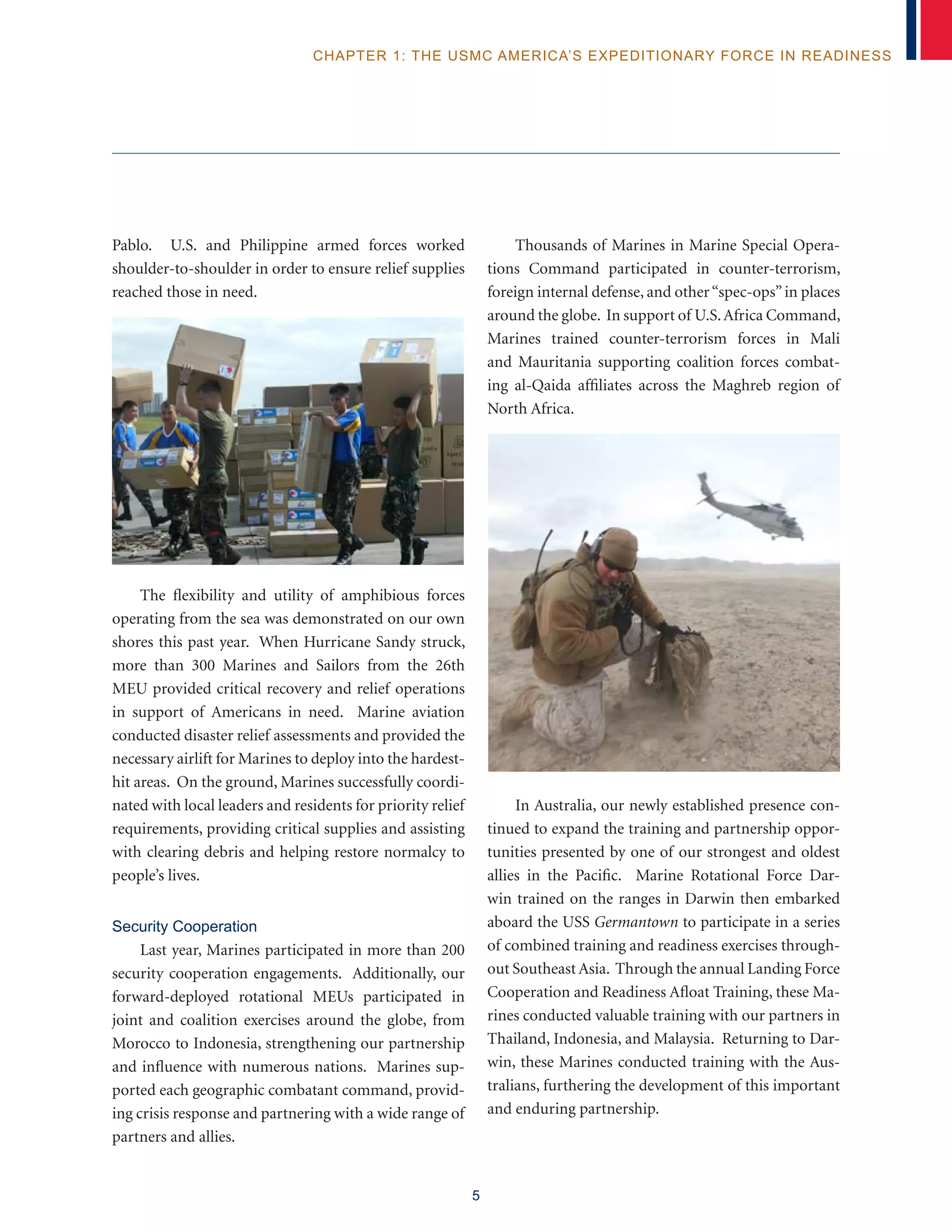
Humanitarian Assistance and Disaster Relief
In December 2012, Marines and Sailors from the
3rd Marine Expeditionary Brigade (MEB) responded
quickly and effectively to a request from the Govern-
ment of the Philippines to assist in humanitarian and
disaster relief operations in the aftermath of Typhoon
5
chapter 1: The USMC America’s Expeditionary Force in Readiness
Pablo. U.S. and Philippine armed forces worked
shoulder-to-shoulder in order to ensure relief supplies
reached those in need. 	
The flexibility and utility of amphibious forces
operating from the sea was demonstrated on our own
shores this past year. When Hurricane Sandy struck,
more than 300 Marines and Sailors from the 26th
MEU provided critical recovery and relief operations
in support of Americans in need. Marine aviation
conducted disaster relief assessments and provided the
necessary airlift for Marines to deploy into the hardest-
hit areas. On the ground, Marines successfully coordi-
nated with local leaders and residents for priority relief
requirements, providing critical supplies and assisting
with clearing debris and helping restore normalcy to
people’s lives.
Security Cooperation
Last year, Marines participated in more than 200
security cooperation engagements. Additionally, our
forward-deployed rotational MEUs participated in
joint and coalition exercises around the globe, from
Morocco to Indonesia, strengthening our partnership
and influence with numerous nations. Marines sup-
ported each geographic combatant command, provid-
ing crisis response and partnering with a wide range of
partners and allies.
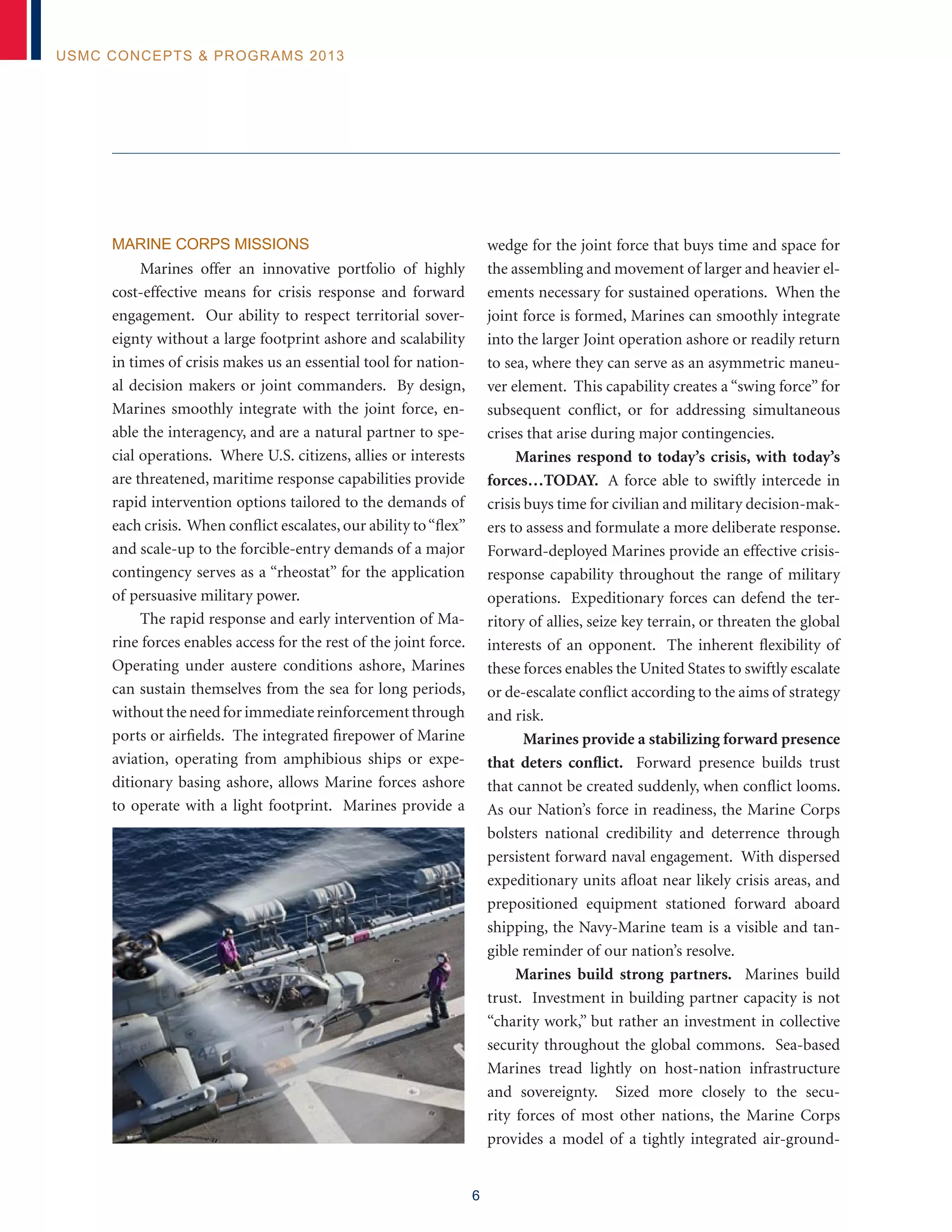
Thousands of Marines in Marine Special Opera-
tions Command participated in counter-terrorism,
foreign internal defense, and other“spec-ops”in places
around the globe. In support of U.S.Africa Command,
Marines trained counter-terrorism forces in Mali
and Mauritania supporting coalition forces combat-
ing al-Qaida affiliates across the Maghreb region of
North Africa.
In Australia, our newly established presence con-
tinued to expand the training and partnership oppor-
tunities presented by one of our strongest and oldest
allies in the Pacific. Marine Rotational Force Dar-
win trained on the ranges in Darwin then embarked
aboard the USS Germantown to participate in a series
of combined training and readiness exercises through-
out Southeast Asia. Through the annual Landing Force
Cooperation and Readiness Afloat Training, these Ma-
rines conducted valuable training with our partners in
Thailand, Indonesia, and Malaysia. Returning to Dar-
win, these Marines conducted training with the Aus-
tralians, furthering the development of this important
and enduring partnership.
6
USMC Concepts & Programs 2013
Marine Corps Missions
Marines offer an innovative portfolio of highly
cost-effective means for crisis response and forward
engagement. Our ability to respect territorial sover-
eignty without a large footprint ashore and scalability
in times of crisis makes us an essential tool for nation-
al decision makers or joint commanders. By design,
Marines smoothly integrate with the joint force, en-
able the interagency, and are a natural partner to spe-
cial operations. Where U.S. citizens, allies or interests
are threatened, maritime response capabilities provide
rapid intervention options tailored to the demands of
each crisis. When conflict escalates, our ability to“flex”
and scale-up to the forcible-entry demands of a major
contingency serves as a “rheostat” for the application
of persuasive military power.
The rapid response and early intervention of Ma-
rine forces enables access for the rest of the joint force.
Operating under austere conditions ashore, Marines
can sustain themselves from the sea for long periods,
withouttheneedforimmediatereinforcementthrough
ports or airfields. The integrated firepower of Marine
aviation, operating from amphibious ships or expe-
ditionary basing ashore, allows Marine forces ashore
to operate with a light footprint. Marines provide a
wedge for the joint force that buys time and space for
the assembling and movement of larger and heavier el-
ements necessary for sustained operations. When the
joint force is formed, Marines can smoothly integrate
into the larger Joint operation ashore or readily return
to sea, where they can serve as an asymmetric maneu-
ver element. This capability creates a “swing force” for
subsequent conflict, or for addressing simultaneous
crises that arise during major contingencies.
Marines respond to today’s crisis, with today’s
forces…TODAY. A force able to swiftly intercede in
crisis buys time for civilian and military decision-mak-
ers to assess and formulate a more deliberate response.
Forward-deployed Marines provide an effective crisis-
response capability throughout the range of military
operations. Expeditionary forces can defend the ter-
ritory of allies, seize key terrain, or threaten the global
interests of an opponent. The inherent flexibility of
these forces enables the United States to swiftly escalate
or de-escalate conflict according to the aims of strategy
and risk.
Marines provide a stabilizing forward presence
that deters conflict. Forward presence builds trust
that cannot be created suddenly, when conflict looms.
As our Nation’s force in readiness, the Marine Corps
bolsters national credibility and deterrence through
persistent forward naval engagement. With dispersed
expeditionary units afloat near likely crisis areas, and
prepositioned equipment stationed forward aboard
shipping, the Navy-Marine team is a visible and tan-
gible reminder of our nation’s resolve.
Marines build strong partners. Marines build
trust. Investment in building partner capacity is not
“charity work,” but rather an investment in collective
security throughout the global commons. Sea-based
Marines tread lightly on host-nation infrastructure
and sovereignty. Sized more closely to the secu-
rity forces of most other nations, the Marine Corps
provides a model of a tightly integrated air-ground-
7
chapter 1: The USMC America’s Expeditionary Force in Readiness
logistics force, suitable to train effective security
institutions across the globe.
Marines assure access ashore. Littoral power
projection capabilities enable U.S. joint forces to push
open the door of access ashore. This ability to go where
the Nation is not “invited” fundamentally underwrites
the deterrent value of the joint force, and provides
decision-makers options that complement precision
strike or nuclear capabilities. Modern amphibious op-
erations seek to achieve precision maneuver that cre-
ates and exploits seams in forces that might oppose a
landing. Uniquely, Marines can operate without the
requirement for nearby land bases and can sustain
themselves from the sea without intact and secured
ports and airfields.
Marines respond to natural disaster. Crises im-
posed by unpredictable natural forces create human
suffering on a scale that the U.S. cannot ignore. Timely
U.S. responses strengthen the credibility of its prom-
ises, and increase the effectiveness of its security de-
terrence. The ability of amphibious forces to provide
air, ground, and sea response, without imposing bur-
dens on already stressed infrastructure, makes them a
unique contributor to U.S. capability and influence.
Marines are most ready when the nation is least
ready. Because our Nation cannot afford to hold the
entire joint force at the highest state of readiness, it has
chosen to keep the Marines ready. For over half a cen-
tury, the Marine Corps has complied with the mandate
of the 82d Congress to be “the most ready when the
Nation is generally least ready.” There is no effective
substitute for ready forces that can swiftly respond to
crisis. There are no effective substitutes for United
States Marines.
Responding to Austerity with Vision
As the Nation continues to recover economically,
the Marine Corps is highly cognizant of the necessity
for frugality and good stewardship of the nation’s re-
sources. We have continued to adjust our organization,
infrastructure and business practices to make the Ma-
rine Corps the best possible return for the defense dol-
lar. Austerity may make us leaner but we will emerge
stronger as we innovate and remain the most capable
Marine Corps the nation can afford. We may have to
do with less, but we will refuse to do things less well.
Readiness is the currency with which we meet the
nation’s security obligations; a hollow force is not an
option for the nation’s crisis response force. While
readiness comes at a cost, the cost of not being able to
intervene or contain crisis can be catastrophic. Invest-
ment in a ready Marine Corps buys decision space for
leadership decision-making, and it buys time to assem-
ble the components of the larger joint force if condi-
tions require it. Preserving that ready edge for the joint
force is fundamental to the capability we provide to the
nation’s security.
Maintain our Commitment to fulfillment of
the mission in Afghanistan. Our Afghanistan mis-
8
USMC Concepts & Programs 2013
sion is not complete until the last Marine is home, our
wounded warriors have healed, and the families of our
fallen have been taken care of. As long as Marines are
forward deployed in a combat theater, they will receive
our first priority, the center of our thoughts and our
last ounce of energy.
Reset and Reconstitute the Force. Our mission
is not complete until our equipment is reset and our
force is reconstituted. That equipment is central to our
ability to respond to future missions. As stewards of
the taxpayer, Marines have initiated heroic efforts to
recover, refurbish, and repair equipment.
Rebalance to the Pacific. Rebalancing to the Pa-
cific theater is a central element of our national strat-
egy which builds on the decades-long presence of Ma-
rines who operate across its land, water and airspace
every day. We will not just “be” in the Pacific, we will
“be effective” in the Pacific through distributed, multi-
mission-capable MAGTFs. We will preserve our global
responsiveness, while developing opportunities in this
priority theater.
Advance Littoral Concepts. The changing nature
of the security threats to the Nation demands contin-
ued innovation. Operational Maneuver From The Sea
and Ship-to-Objective Maneuver remain our capstone
warfighting concepts, and we will continue to focus on
our ability to execute them while furthering the con-
cept of Single Naval Battle to provide a seamless pro-
jection of naval power from blue-water to operations
ashore. We must have the organizational and process
discipline to manage our concepts through their full
life cycle, providing focus and guidance for innovation,
training, and experimentation.
Invest in our Marines. The superior qualities of
the individual Marine provide our warfighting edge.
That begins with recruiting and retaining the highest
quality talent and applies to our active duty,reserve,and
civilian workforces. Marines are expected to shoulder
increasingly complex burdens in the emerging security
environment we must adopt our educational establish-
ments and training venues to ensure their readiness for
the complexity of modern conflict.
Invest in Innovation. In addition to training and
education, we will create mechanisms to embrace in-
novation across the force to move our concepts from
theory to practice. We will leverage our human capital
through experimentation and innovation at every level
and create responsive mechanisms to reduce the“flash-
to-bang” process of transforming innovative ideas to
force implementation.
Care for our Wounded Warriors. After a decade
of war, the continued physical, moral, and mental
health of all of our Marines remains paramount. Those
who bear the physical and mental wounds of war must
remain our first concern. We will continue to extend
every effort to heal our wounded, support their fami-
lies, and help young Marines and Sailors increase their
resilience.
Keep Faith with Marines and their Families. The
faith of the American people has improved the qual-
ity of life for our Marines and families during the last
decade and we must protect those gains in an era of
increasing fiscal constraints. Our families share in our
burdens, our values, and our risks, and their service
9
chapter 1: The USMC America’s Expeditionary Force in Readiness
must be honored through quality programs and access
to much-needed resources.
The Nation’s Expeditionary
Force of Choice
Marines have always responded to change in ways
both timely and timeless. While our concepts, training,
and equipment have adapted, our fundamental charac-
ter has not. Marines remain physically strong, mentally
agile, and imminently practical warfighters. The cohe-
sion, fidelity, and expeditionary mindset of Marines are
a proven recipe for success. Marines will continue to
live hard, train hard, and fight hard, providing the Na-
tion with a ready capability to contain the crisis, plug
the gap, hold the line, fight and win.
In short, America’s Marines are a hedge against
the unexpected and dangerous in a security environ-
ment that remains fraught with challenges. A com-
pelling security investment, the Marine Corps provides
significant return on investment for every security dol-
lar. When the Nation pays the “sticker price” for its
Marines, it gets not only the least-expensive force in
the U.S. defense arsenal, it also gets one that is highly
skilled, forward deployed, and able to operate across
the full range of military operations. Expeditionary
naval forces provide an effective hedge against both
the Nation’s most likely and most dangerous security
challenges. We do not know where or when we will
fight, but we know that we will be ready when the bugle
sounds. We do not know whom we will fight, but even
the toughest adversaries have not proven our equal. We
will remain Americas “middleweight” expeditionary
force in readiness . . . Semper Fidelis.
CHAPTER 2
11
chapter 2: organization
Introduction
The Marine Corps is a crisis response expeditionary force which is task-
organized and able to conduct operations across the entire spectrum of
military operations. Fundamentally, the Corps is a “middleweight force”
that fills the void in our Nation’s defense structure between light Special Op-
erations Forces (SOF) and heavier conventional units. The Corps provides
scalable and adaptive forces that complement the lighter and heavier forces.
During the last several years, the Marine Corps has grown in size to
202,100 Active Component Marines to meet the demands of global commit-
ments and combat operations. The organization of the Corps has changed in
order to adapt to the complex environment, even as it retained the flexibility
and agility to respond to future needs. During this period of rapid growth, the
Marine Corps has maintained balanced, combined-arms capabilities adapted
to the new demands of regional conflicts, while developing agile and capable
forces to meet future hybrid threats as well.The same will be true of the Marine
Corps as it adjusts to post-Iraq and post-Afghanistan environments, which
will include a capabilities-based force reduction to an end strength of 182,100
active duty Marines by fiscal year 2016.
Chapter 2 outlines the Marine Corps combined-arms structure and
organization and highlights the unique capabilities that Marines bring to
the fight.
organization
1 2
USMC Concepts & Programs 2013
MARINE AIR-GROUND TASK
FORCE (MAGTF)
TheMAGTFistheMarineCorpsprincipalorganiza-
tional construct for conducting missions across the range
of military operations. MAGTFs provide combatant
commanders with scalable, versatile expeditionary forces
able to assure allies, deter potential adversaries, provide
persistent U.S. presence with little or no footprint ashore,
and respond to a broad range of contingency, crisis, and
conflict situations. They are balanced combined-arms
force packages containing command, ground, aviation,
and logistics elements. A single commander leads and
coordinates this combined-arms team through all phas-
es of deployment and employment. MAGTF teams live
and train together, further increasing their cohesion and
fighting power.
MULTI-MISSION CAPABLE MAGTFs
Tailored to meet combatant commanders’require-
ments, MAGTFs operate as an integrated force in the
air, land, maritime and cyberspace domains. The naval
character of MAGTFs enhances their global mobility,
lethality, and staying power.
Embarked aboard amphibious ships or deployed
using other means, multi-mission capable MAGTFs
provide U.S. civilian and military leaders with the abil-
ity to conduct the following activities:
• Move forces into crisis areas without revealing their
exact destinations or intentions
• Provide continuous presence in international waters
• Commence execution of a mission within six to 48
hours of receiving a warning order
• Provide immediate national response in support of
humanitarian and natural disaster relief operations
• Provide credible but non-provocative combat power
over the horizon for rapid employment as the initial
response to a crisis
• Support diplomatic processes for peaceful crisis
resolution before employing immediate-response
combat forces
• Respond to crises through the measured projection
of combat power ashore — day or night and under
all weather conditions
• Introduce additional Marine forces sequentially into
a theater of operations
• Operate independent of established airfields, basing
agreements, and overflight rights
• Conduct combat operations ashore, relying on
MAGTF-organic combat service support
• Conduct theater security cooperation to build
partner capacity
• Enable the introduction of follow-on forces by
securing staging areas ashore or bypassing littoral
defenses by going further inland
• Operate in rural and urban environments, and dur-
ing chemical, biological, radiological, and nuclear
situations
• Withdraw rapidly at the conclusion of operations
• Participate fully in the joint planning process and
successfully integrate MAGTF operations with those
of the joint force and enable larger joint operations
• Integrate with and complement the efforts of SOF
• Support service, joint, and national efforts to main-
tain freedom of action in cyberspace
MAGTF Composition
The Marine Corps task organizes for combat in
accordance with its statutory mandate to provide forc-
es of combined arms, including aviation, by forming
integrated combined-arms MAGTFs. As the name in-
dicates, MAGTFs are organized for the specific tasks
at hand and specifically tailored by mission for rapid
deployment by air and/or sea. No matter what their
mission or mode of deployment, MAGTFs are com-
prised of four deployable elements that are supported
from Marine Corps bases and stations.
13
chapter 2: organization
Command Element (CE)
The CE contains the MAGTF headquarters and
other units that provide operations, intelligence, lo-
gistics, communications, and administrative support.
As with all other elements of the MAGTF, the CE is
scalable and task organized to provide the Command,
Control, Communications, Computers, Intelligence,
and joint interoperability necessary for effective plan-
ning and execution of operations.
Ground Combat Element (GCE)
The GCE is task organized to conduct ground op-
erations to support the MAGTF mission. This element
includes infantry,artillery,reconnaissance,armor,light
armor, assault amphibian, engineer, and other forces as
needed. The GCE can vary in size and composition.
Its makeup can range from a light, air-transportable
reinforced company to a relatively heavy, mechanized
unit that includes one or more Marine divisions, or
any other type of Marine Corps ground combat unit
that meets the demands of a particular mission.
Aviation Combat Element (ACE)
The ACE conducts offensive, defensive, and all
other air operations to support the MAGTF mission.
The ACE is task-organized to perform the six functions
of Marine aviation required to support the MAGTF
mission — assault support, anti-air warfare, offensive
air support, electronic warfare, control of aircraft and
missiles, and aerial reconnaissance –– which could in-
clude aviation support to humanitarian assistance and
disaster relief operations. The ACE is formed around
an aviation headquarters with appropriate air control
agencies, combat, combat-support, and combat-ser-
vice support units. The ACE can vary in size and com-
position from an aviation detachment of specifically
required aircraft to one or more Marine aircraft wings
consisting of multiple fixed and rotary-wing aircraft of
several types and capabilities.
Logistics Combat Element (LCE)
The LCE is task organized to provide the full range
of combat logistics functions and capabilities neces-
sary to maintain the continued readiness and sustain-
ability of the MAGTF as a whole. It is formed around
a combat logistics headquarters and may vary in size
and composition from a support detachment to one or
more Marine Logistics Groups (MLG).
Types of MAGTFs
There are four types of MAGTFs: the Marine Ex-
peditionary Force (MEF); the Marine Expeditionary
Brigade (MEB); the Marine Expeditionary Unit (MEU);
and the Special Purpose MAGTF.
Marine Expeditionary Force
The MEF is the principal Marine Corps warfight-
ing organization during larger crises or contingencies.
Normally commanded by a Lieutenant General, a MEF
can range in size from one division and aircraft wing to
multiple divisions and aircraft wings,together with one
or more logistics groups. MEFs are capable of amphib-
ious operations and sustained operations ashore in any
geographic environment.With appropriate augmenta-
tion, the MEF CE is capable of performing as a Joint
Task Force (JTF) headquarters. MEFs often deploy in
echelon and designate the lead element as the MEF
(Forward).
MEFs are the primary “standing MAGTFs” in
peacetime and wartime. The Marine Corps is orga-
nized with three standing MEFs, each with a Marine
division, aircraft wing, and logistics group. The I Ma-
rine Expeditionary Force (I MEF) is located at bases in
California and Arizona. The II Marine Expeditionary
Force (II MEF) is located at bases in North Carolina
and South Carolina. And the III Marine Expeditionary
Force (III MEF) is located at bases in Okinawa, main-
land Japan, and Hawaii, with future plans for bases in
Guam and Australia.
1 4
USMC Concepts  Programs 2013
Marine Expeditionary Brigade
TheMEBisthemid-sizedMAGTFthatcaninclude
up to 20,000 Marines and is normally commanded by
a Brigadier General. The MEB is scalable, capable of
full spectrum operations, and self-sustaining for 30
days. Three standing MEB command elements will be
activated by the end of FY 2013. The standing MEB
command elements do not have permanently assigned
forces, but maintain habitual relationships with asso-
ciated major subordinate elements through planning
and exercises. When mobilized, the MEB is comprised
of a reinforced infantry regiment, a composite Marine
Aircraft Group, and a Combat Logistics Regiment.
MEBs provide combatant commanders with scal-
able warfighting capability across the range of military
operations and can conduct amphibious assaults and
operations ashore in any geographic environment. As
an expeditionary force, it is capable of rapid deploy-
ment and employment via amphibious shipping (nor-
mally 17 amphibious ships), strategic air and sealift,
geographic or maritime pre-positioning force assets,
or any combination of these. A MEB can operate in-
dependently, serve as the forward echelon of a MEF or
act as a JTF headquarters with augmentation.
Concept Development  Integration Department
is conducting a detailed assessment of future MEB
structure requirements. Results of this effort will be
published in 2013, and will provide a thorough guide
for the future size, composition, and capabilities of this
type of MAGTF.
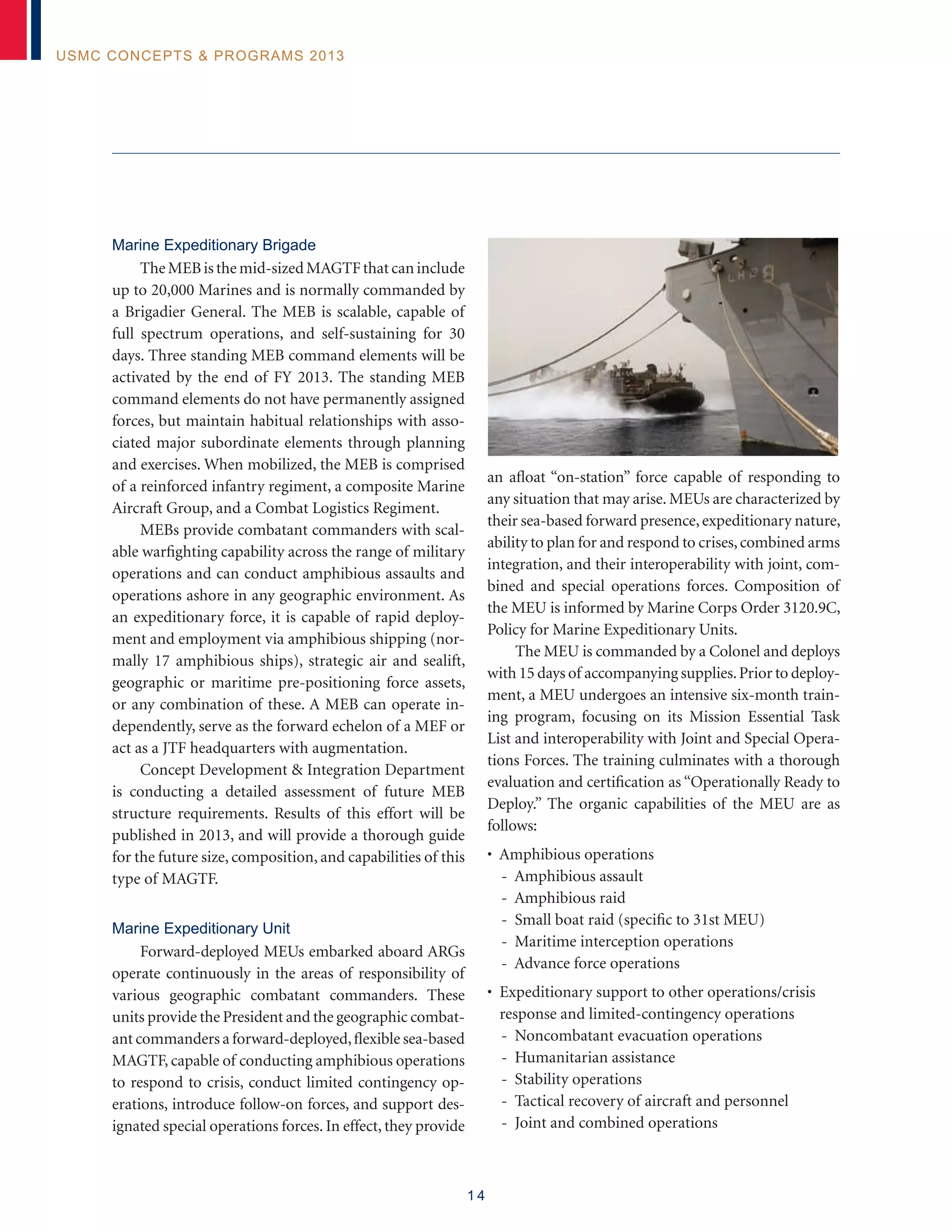
Marine Expeditionary Unit
Forward-deployed MEUs embarked aboard ARGs
operate continuously in the areas of responsibility of
various geographic combatant commanders. These
units provide the President and the geographic combat-
ant commanders a forward-deployed,flexible sea-based
MAGTF, capable of conducting amphibious operations
to respond to crisis, conduct limited contingency op-
erations, introduce follow-on forces, and support des-
ignated special operations forces. In effect, they provide
an afloat “on-station” force capable of responding to
any situation that may arise. MEUs are characterized by
their sea-based forward presence,expeditionary nature,
ability to plan for and respond to crises,combined arms
integration, and their interoperability with joint, com-
bined and special operations forces. Composition of
the MEU is informed by Marine Corps Order 3120.9C,
Policy for Marine Expeditionary Units.
The MEU is commanded by a Colonel and deploys
with 15 days of accompanying supplies.Prior to deploy-
ment, a MEU undergoes an intensive six-month train-
ing program, focusing on its Mission Essential Task
List and interoperability with Joint and Special Opera-
tions Forces. The training culminates with a thorough
evaluation and certification as “Operationally Ready to
Deploy.” The organic capabilities of the MEU are as
follows:
• Amphibious operations
- Amphibious assault
- Amphibious raid
- Small boat raid (specific to 31st MEU)
- Maritime interception operations
- Advance force operations
• Expeditionary support to other operations/crisis
response and limited-contingency operations
- Noncombatant evacuation operations
- Humanitarian assistance
- Stability operations
- Tactical recovery of aircraft and personnel
- Joint and combined operations
15
chapter 2: organization
- Aviation operations from expeditionary sites
- Theater security cooperation activities
- Airfield and port seizures
• Theater security cooperation operations to build
the capacity of partner nations and increase in-
teroperability.
Prior to deployment, the MEF commander ex-
ercises full command of his organic MEU. Once em-
barked, MEU command relationships are delineated
by the Geographic Combatant Commander (GCC) and
are normally assigned operational control (OPCON)
to the naval service component. However, during crisis
response and contingency operations GCCs may shift
OPCON of the MEU as articulated in Joint Publication
(JP) 3-02, Amphibious Operations:
While the full range of command relationship op-
tions as outlined in JP 1, Doctrine for the Armed
Forces of the United States, are available, in am-
phibious operations, service component com-
manders normally retain operational control (OP-
CON) of their respective forces. If the Joint Force
Commander organizes along functional lines,
functional component commanders will normally
exercise OPCON over all their parent Services’
forces and tactical control (TACON) over other
Services’ forces attached or made available for
tasking.
Special Purpose MAGTF (SPMAGTF)
A SPMAGTF is task organized to accomplish a
specific mission, operation, or regionally focused ex-
ercise. They can be organized, trained, and equipped
with Marine forces to conduct a wide variety of expe-
ditionary operations ranging from peacetime missions,
to training exercises, and responses to contingencies
and crises. SPMAGTFs can support theater campaign
plans, security cooperation, and civil-military opera-
tions requirements.
SPMAGTFs have capabilities, mobility, and sus-
tainability commensurate with mission requirements
in order to increase interoperability with, and pro-
vide training to, less developed military forces. The
SPMAGTF can be tasked with building partner na-
tion security capacity and supporting partner na-
tion security efforts in specific regional areas. The
SPMAGTF provides the combatant commander
with a flexible expeditionary force employment op-
tion that further augments the traditional capabili-
ties provided by the Marine Corps. SPMAGTFs are
normally designated by the service headquarters
in response to combatant commander requirements.
The Nation’s MAGTFs thus provide a continuum
of capabilities to support naval, combatant command-
er, and national requirements. These MAGTFs joined
by special-purpose forces and unique Marine forces
enable the Corps to address the full range of conven-
tional, unconventional, and irregular/hybrid threats as
well as other taskings as the President might require.
Unique Combatant
Commander Support
A combatant commander or subordinate joint
force commander might also require Marine forces
that do not have all elements of a MAGTF. These forces
are not given a specific MAGTF designation. Examples
include the Black Sea Rotational Force (BSRF) and
Marine Rotational Force-Darwin, which participate
in security cooperation to build military capacity, pro-
vide regional stability,and develop lasting partnerships
with nations in the region.
In addition, as the Marine Corps evaluates po-
tential hybrid threats, we believe there likely will be a
requirement for smaller combined-arms task forces.
These task forces will operate in an environment where
greater capabilities are pushed to lower levels, thus en-
abling distributed operations at increasing distances.
These task forces will depend upon increased tactical
mobility and must maintain a high state of readiness.
At the same time, they must retain the capability to
integrate quickly into a larger, more lethal force on
short notice.
The Marine Corps ethos, training and warfighting
philosophy makes Marines ideally suited to these types
1 6
USMC Concepts  Programs 2013
of units and operations. However, we must ensure that
our organizational designs, as well as planning and
command and control capabilities, preserve the opera-
tional agility required to answer the demands of the
complex future operating environment, and consis-
tently fulfill the needs of our combatant commanders.
MAGTF Sustainability
A fundamental characteristic of a MAGTF is its
ability to operate for extended periods as an expedi-
tionary force, relying on its integral combat logis-
tics element and internal resources for sustainment.
All MAGTFs have inherent sustainability that allows
them to be self-sufficient for planned periods. Larger
MAGTFs have a deeper, broader, and more capable
organic support capability. Different size MAGTFs de-
ploy with sufficient accompanying supplies to support
joint operations. MAGTFs can augment their organic
sustainability by using external support from Navy
organizations, host-nation support agreements, inter-
service support agreements, and in-theater cross-ser-
vice agreements.
Maritime Prepositioning
Force (MPF)
The MPF is a strategic power-projection capability
that combines the lift capacity, flexibility, and respon-
siveness of surface ships with the speed of strategic air-
lift. Strategically forward deployed around the globe,
the maritime prepositioning ships (MPS) of the MPF
provide geographic combatant commanders with per-
sistent forward presence and rapid crisis response by
prepositioning the combat equipment and supplies to
support up to two MEBs for 30 days.
The MPF is organized into two Maritime Prepo-
sitioning Ship Squadrons (MPSRON) with 12 ships
overall. By 2015, there will be 14 ships. MPSRON-2
is based at Diego Garcia in the Indian Ocean, and
MPSRON-3 is based in the Guam-Saipan area of the
western Pacific Ocean.
These interoperable MPSRONs are each designed
to “marry-up” with a fly-in echelon to support the
rapid closure of a MEB. The MPF can also support
smaller or larger MAGTFs by employing as few as
one or as many as 12 MPF ships. The MPF consists of
government-owned ships operated by Military Sealift
Command (MSC). When needed, these ships move to
a crisis region and offload either in port or offshore via
in-stream offload. Offloaded equipment and supplies
are then “married up” with Marines arriving at nearby
airfields. The end result is a combat-ready MAGTF
rapidly established ashore, using minimal in-country
reception facilities. The MAGTF combat capability
provided by MPF is capable of supporting geographic
combatant commander military operations across the
range of military operations.
MARINE CORPS PREPOSITIONING PROGRAM–
NORWAY (MCPP-N)
MCPP-N enhances the operational responsiveness
of all geographic combatant commanders by provid-
ing mission-tailored, prepositioned support to Marine
Corps expeditionary operations globally. The exist-
ing equipment set is being reshaped, with the addi-
tion of communications and ordnance assets, to sup-
port a MAGTF built around an infantry battalion task
force and composite aviation squadron. Quantities of
equipment and supplies currently stored in Norway
will also be adjusted to provide a balanced equipment
set appropriate to support the new force list. MCPP-
N will retain its primary role of augmenting up to a
MEB-sized force to support the reinforcement of Nor-
way and U.S. Marine Corps expeditionary operations.
MCPP-N materiel is stored in six caves and two air-
fields spread across Norway and is available for rapid
preparation and marshaling at aerial, sea, or rail ports
of debarkation in support of deploying MAGTFs. This
forward prepositioning reduces reaction time and
eliminates the need to otherwise deploy this equip-
ment from locations in the continental United States,
with all the attendant burdens on strategic lift that this
would entail.
17
chapter 2: organization
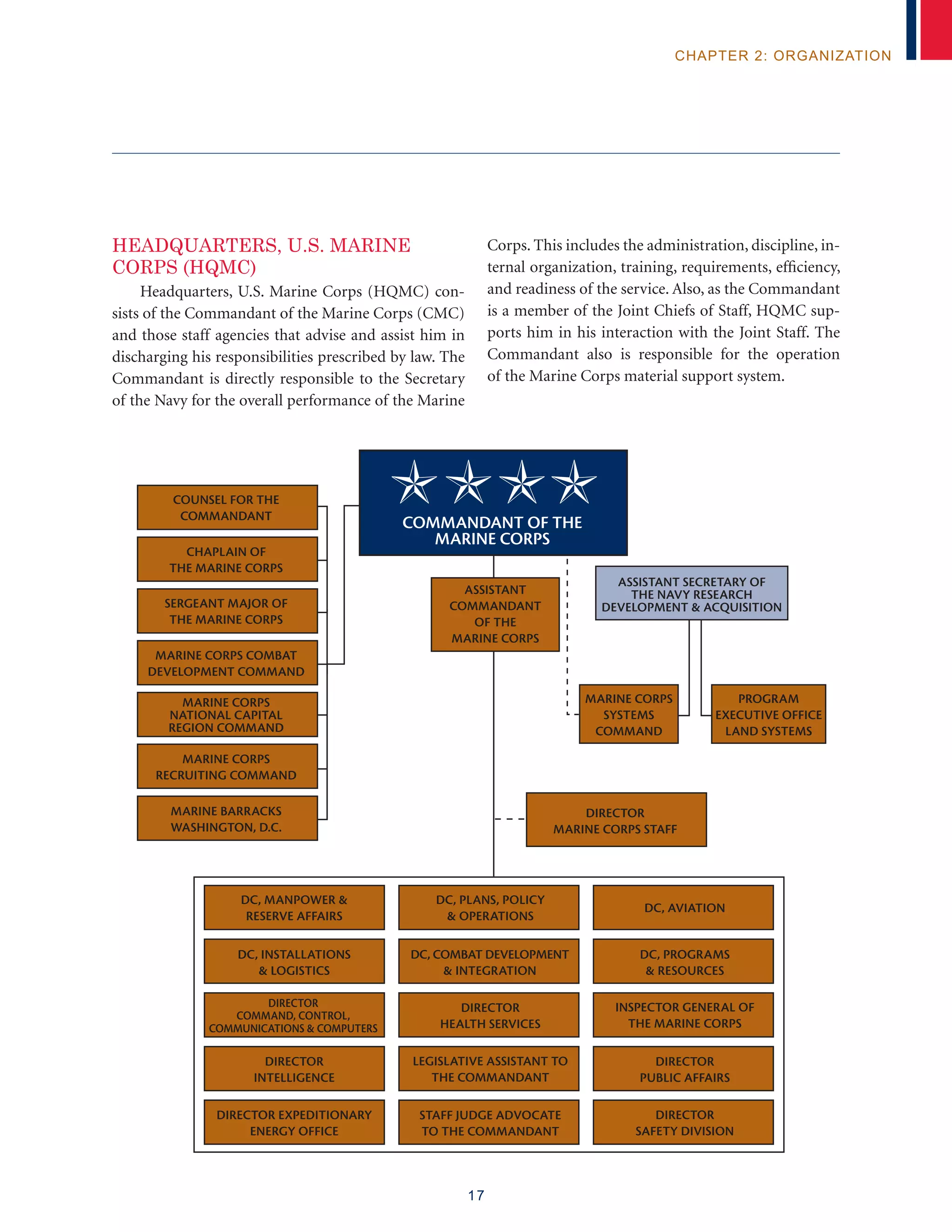
Headquarters, U.S. Marine
Corps (HQMC)
Headquarters, U.S. Marine Corps (HQMC) con-
sists of the Commandant of the Marine Corps (CMC)
and those staff agencies that advise and assist him in
discharging his responsibilities prescribed by law. The
Commandant is directly responsible to the Secretary
of the Navy for the overall performance of the Marine
Corps. This includes the administration, discipline, in-
ternal organization, training, requirements, efficiency,
and readiness of the service. Also, as the Commandant
is a member of the Joint Chiefs of Staff, HQMC sup-
ports him in his interaction with the Joint Staff. The
Commandant also is responsible for the operation
of the Marine Corps material support system.
DC, plans, policy
 operations
DC, Combat development
 integration
Director
Health Services
Legislative Assistant to
the Commandant
Staff Judge Advocate
To The Commandant
DC, Manpower 
Reserve Affairs
DC, Installations
 Logistics
Director
Command, Control,
Communications  Computers
Director
Intelligence
Director Expeditionary
Energy Office
Dc, Aviation
DC, Programs
 Resources
Inspector General of
the Marine Corps
Director
Public Affairs
Director
Safety Division
Assistant
Commandant
of the
Marine Corps
Director
Marine Corps Staff
Commandant of the
Marine Corps
Counsel for the
Commandant
Chaplain of
the marine corps
Sergeant Major of
the Marine Corps
marine corps combat
development command
marine corps
national capital
Region command
Marine Corps
Recruiting Command
Marine Barracks
Washington, D.C.
marine corps
systems
command
Program
Executive Office
Land Systems
Assistant Secretary of
the navy research
development  acquisition
1 8
USMC Concepts  Programs 2013
Operating Forces
Operating forces — the heart of the Marine Corps
— provide the forward presence, crisis response, and
combat power that the Corps makes available to com-
batant commanders.The Marine Corps has established
three, permanent commands to provide forces to uni-
fied combatant commanders:
• U.S. Marine Corps Forces Command (MAR-
FORCOM)
• U.S. Marine Corps Forces, Pacific (MARFORPAC)
• U.S. Marine Corps Forces, Special
Operations Command (MARFORSOC).
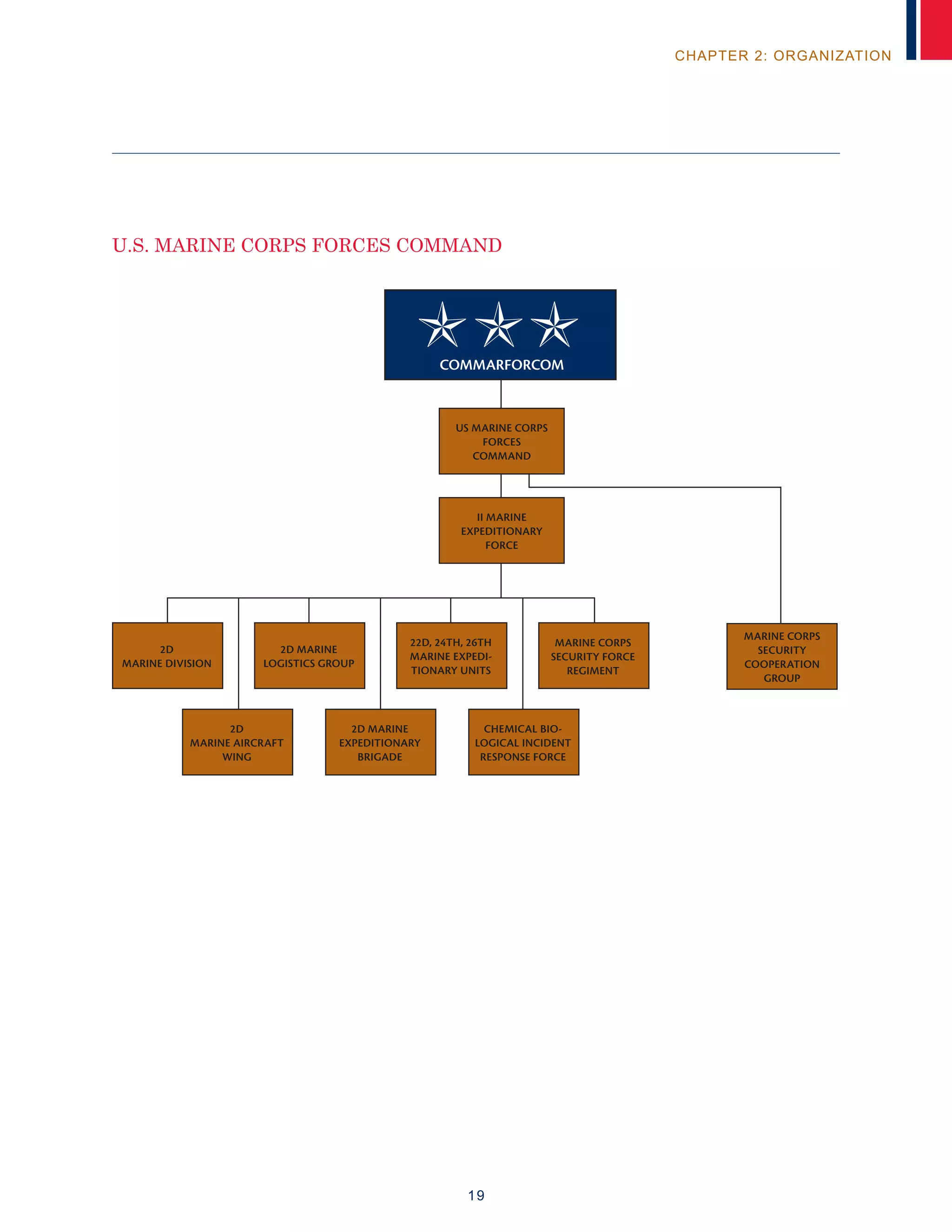
Control of MARFORCOM is retained by the Ma-
rine Corps. The II Marine Expeditionary Force (II
MEF), and other unique capabilities maintained under
the Commander, MARFORCOM, are made available,
by the Commandant of the Marine Corps, via the Joint
Chiefs of Staff global force management allocation
process. The Commander, MARFORPAC is assigned
to the Commander, U.S. Pacific Command (PACOM),
and provides I MEF and III MEF to PACOM. The
Commander, MARFORSOC is assigned to the Com-
mander, Special Operations Command (SOCOM) and
provides assigned forces to SOCOM.
Theseassignmentsreflectthepeacetimedisposition
of Marine Corps forces. Marine forces are apportioned
to the remaining geographic and functional combatant
commands — the U.S. Southern Command (SOUTH-
COM), U.S. Northern Command (NORTHCOM),
U.S. European Command (EUCOM), U.S. Central
Command (CENTCOM), U.S. Africa Command
(AFRICOM), U.S. Strategic Command (STRATCOM),
U.S. Cyber Command (CYBERCOM), and U.S. Forces
Korea (USFK) — for contingency planning, and are
provided to these commands when directed by the
Secretary of Defense.
The following sections highlight some of these
organizations and several of the other unique organi-
zations in the operating forces.
MARINE CORPS FORCES
COMMAND (MARFORCOM)
Located in Norfolk, Virginia, the Commander,
MARFORCOM is tasked with the following activities:
• Commanding Active Component (AC), Marine
Corps-retained operating forces
• Executing force sourcing and synchronization to
provide joint commanders with the Marine Corps
forces they require
• Directing deployment planning and the execution
of Marine Corps-retained operating forces in
support of combatant commander and service
requirements
• Serving as Commanding General, Fleet Marine
Forces Atlantic (CG FMFLANT) and commanding
embarked Marine Corps forces
• Coordinating Marine Corps-Navy integration of
operational initiatives and advising the Command-
er, U.S. Fleet Forces Command (USFF) on Navy
support to Marine Corps forces assigned to naval
ships, bases, and installations
• Serving as Commander, Marine Forces Europe
• Serving as Commander,Marine Corps Bases Atlantic
• Conducting service-directed operational tasks as
required.
Within the past year, Marine Corps Installations
Command (MCICOM) has reached full operation-
al capability (FOC). The 24 active installations and
11 airfields are divided into three regions: Marine
Corps Installations Pacific (MCIPAC), Marine Corps
Installations East (MCIEAST), and Marine Corps
Installations West (MCIWEST). The 30,000 active
forces assigned to MCICOM provide timely support
to the Marines, Sailors, and families from the operat-
ing forces and maintenance depots.
19
chapter 2: organization
2d
Marine Division
2d
Marine Aircraft
Wing
2d Marine
Logistics group
2d Marine
Expeditionary
Brigade
22d, 24th, 26th
Marine Expedi-
tionary Units
chemical bio-
logical incident
response force
marine corps
security force
regiment
US Marine Corps
Forces
command
Marine Corps
security
cooperation
group
II Marine
Expeditionary
Force
U.S. Marine Corps Forces Command
commarforcom
2 0
USMC Concepts  Programs 2013
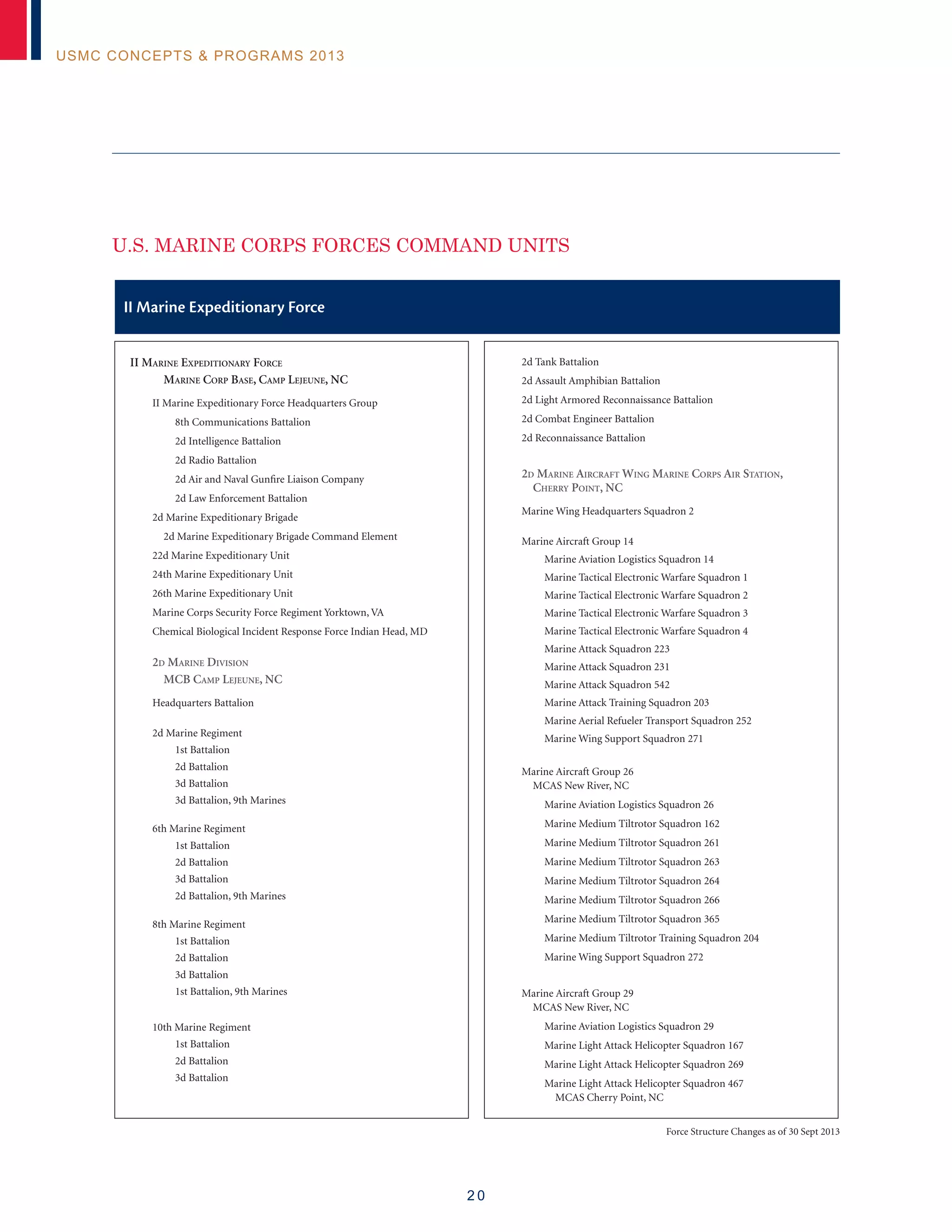
U.S. Marine Corps Forces Command Units
II Marine Expeditionary Force
	 Marine Corp Base, Camp Lejeune, NC
II Marine Expeditionary Force Headquarters Group
		 8th Communications Battalion
		 2d Intelligence Battalion
		 2d Radio Battalion
		 2d Air and Naval Gunfire Liaison Company
		 2d Law Enforcement Battalion
2d Marine Expeditionary Brigade
	 2d Marine Expeditionary Brigade Command Element
22d Marine Expeditionary Unit
24th Marine Expeditionary Unit
26th Marine Expeditionary Unit
Marine Corps Security Force Regiment Yorktown, VA
Chemical Biological Incident Response Force Indian Head, MD
2d Marine Division
	 MCB Camp Lejeune, NC
Headquarters Battalion
2d Marine Regiment
		 1st Battalion
		 2d Battalion
		 3d Battalion
		 3d Battalion, 9th Marines
6th Marine Regiment
		 1st Battalion
		 2d Battalion
		 3d Battalion
		 2d Battalion, 9th Marines
8th Marine Regiment
		 1st Battalion
		 2d Battalion
		 3d Battalion
		 1st Battalion, 9th Marines
10th Marine Regiment
		 1st Battalion
		 2d Battalion
		 3d Battalion
2d Tank Battalion
2d Assault Amphibian Battalion
2d Light Armored Reconnaissance Battalion
2d Combat Engineer Battalion
2d Reconnaissance Battalion
2d Marine Aircraft Wing Marine Corps Air Station,
	Cherry Point, NC
Marine Wing Headquarters Squadron 2
Marine Aircraft Group 14
		 Marine Aviation Logistics Squadron 14
		 Marine Tactical Electronic Warfare Squadron 1
		 Marine Tactical Electronic Warfare Squadron 2
		 Marine Tactical Electronic Warfare Squadron 3
		 Marine Tactical Electronic Warfare Squadron 4
		 Marine Attack Squadron 223
		 Marine Attack Squadron 231
		 Marine Attack Squadron 542
		 Marine Attack Training Squadron 203
		 Marine Aerial Refueler Transport Squadron 252
		 Marine Wing Support Squadron 271
		
Marine Aircraft Group 26
	 MCAS New River, NC
		 Marine Aviation Logistics Squadron 26
		 Marine Medium Tiltrotor Squadron 162
		 Marine Medium Tiltrotor Squadron 261
		 Marine Medium Tiltrotor Squadron 263
		 Marine Medium Tiltrotor Squadron 264
		 Marine Medium Tiltrotor Squadron 266
		 Marine Medium Tiltrotor Squadron 365
		 Marine Medium Tiltrotor Training Squadron 204
		 Marine Wing Support Squadron 272
Marine Aircraft Group 29
	 MCAS New River, NC
		 Marine Aviation Logistics Squadron 29
		 Marine Light Attack Helicopter Squadron 167
		 Marine Light Attack Helicopter Squadron 269
		 Marine Light Attack Helicopter Squadron 467 			
			 MCAS Cherry Point, NC
Force Structure Changes as of 30 Sept 2013
21
chapter 2: organization
II Marine Expeditionary Force (cont.)
		 Marine Heavy Helicopter Squadron 366
			 MCAS Cherry Point, NC
		 Marine Heavy Helicopter Squadron 461
		 Marine Heavy Helicopter Squadron 464
		 Marine Heavy Helicopter Training Squadron 302
		 Marine Wing Support Squadron 274
Marine Aircraft Group 31 				
	 MCAS Beaufort, SC
		 Marine Aviation Logistics Squadron 31
		 Marine Fighter Attack Squadron 115
		 Marine Fighter Attack Squadron 122
		 Marine Fighter Attack Squadron 251
		 Marine Fighter Attack Squadron 312
		 Marine All Weather Fighter Attack Squadron 224
		 Marine All Weather Fighter Attack Squadron 533
		 Marine Fighter Attack Training Squadron 501 		
		 (Eglin Air Force Base, FL)
		 Marine Wing Support Squadron 273
Marine Air Control Group 28
		 Marine Tactical Air Command Squadron 28
		 Marine Air Control Squadron 2
		 Marine Air Support Squadron 1
		 Marine Wing Communications Squadron 28
		 2d Low Altitude Air Defense Battalion
		 Marine Unmanned Aerial Vehicle Squadron 2
2d Marine Logistics Group
	 MCB Camp Lejeune, NC
HQBN, 2D MLG
		 MEU Logistics Battalion 22
		 MEU Logistics Battalion 24
		 MEU Logistics Battalion 26
Combat Logistics Regiment 2
		 Combat Logistics Battalion 2
		 Combat Logistics Battalion 6
		 Combat Logistics Battalion 8
Combat Logistics Regiment 25
		 2d Maintenance Battalion
		 2d Medical Battalion
		 2d Supply Battalion
		 Combat Logistics Company 21
			 MCAS Cherry Point, NC
		 Combat Logistics Company 23
			 MCAS Beaufort, SC
8th Engineer Support Battalion
2d Dental Battalion
U.S. Marine Corps Forces Command Units
Force Structure Changes as of 30 Sept 2013
2 2
USMC Concepts  Programs 2013
U.S. MARINE CORPS FORCES,
PACIFIC (MARFORPAC)
MARFORPAC has three command roles and re-
sponsibilities. The command serves as U.S. Marine
Corps component to U.S. Pacific Command (USPA-
COM), U.S. Marine Corps component to U.S. Forces
Korea (USFK), and Fleet Marine Forces Commander
to Pacific Fleet. In addition to its service component
responsibilities, MARFORPAC could be tasked to act
as a joint task force command element.
With its headquarters located aboard Camp H. M.
Smith, HI, MARFORPAC is the largest field command
in the Marine Corps, having control of two-thirds of
Marine Corps operational forces. Commander, MAR-
FORPAC commands all U.S. Marine Corps forces as-
signed to USPACOM — approximately 86,400 Ma-
rines, Sailors and Civilians — operating in a diverse
geographic area stretching from Yuma, Arizona to
Goa, India.
The Commander, MARFORPAC supports na-
tional and theater strategic objectives, and exercises
Marine Corps component responsibilities in support
of operational and concept plans, theater security co-
operation, foreign humanitarian assistance, homeland
defense, force posture, and lay down. This includes a
planned rotational presence in northwestern Austra-
lia, and protection of installations and forces in the
USPACOM area of responsibility (AOR).
Annually, MARFORPAC conducts more than 160
major multi-lateral and bi-lateral exercises and theater
security cooperation engagements with some 30 allies
and partners in the Asia-Pacific region. MARFORPAC
forces also rapidly respond to a yearly average of 14
humanitarian-assistance and disaster-relief (HA/DR)
operations.
Through unity of effort, MARFORPAC exercises
coordinating authority in a consultative relationship
with MCICOM for operational force base support re-
quirements, Defense Policy Review Initiative (DPRI)
requirements in Japan and Guam, USPACOM Unified
Campaign Plan (UCP) and contingency planning re-
quirements, and other installation-support initiatives
affecting the Marine Corps in the PACOM AOR.
While Marine Corps Installations Command
exercises command and administrative control over
all bases and stations of the Marine Corps, two of
MCICOM’s regional commands, MCIWEST and
MCIPAC, have USPACOM-assigned forces as tenants.
As such, COMMARFORPAC exercises tactical control
of MCIPAC and MCIWEST, or both, when supporting
USPACOM (UCP) tasking and operational missions.
During exceptional circumstances that require
U.S. response in the PACOM AOR, such as HA/DR,
or major combat operations, COMMARFORPAC, in
consultation and accord with COMMCICOM, may as-
sume operational control of MCIPAC and MCIWEST
and their assigned installations.
23
chapter 2: organization
U.S. MARINE CORPS FORCES, PACIFIC
MARFORPAC retains ADCON over MARFORK during Armistice.
MARFORPAC exercises Coordinating Authority in a consultative rela-
tionship with MCICOM over operational force base requirements and
installation support initiatives.
MARFORPAC retains TACON of MCIPAC and MCIWEST when
supporting CDR, USPACOM UCP tasking, as well as OPCON during
exceptional circumstances such as crisis/contingency response, de-
pending on CDRUSPACOM requirements.
US Marine Corps
Forces
korea
MCIPAC
MCIWEST
MCICOM
Fleet Marine
Forces Pacific
US Marine Corps
Forces Pacific
commarforPAC
I Marine Expeditionary
Force
1st
Marine Division
3d
Marine Aircraft Wing
1st Marine
Logistics Group
1st
Marine Expeditionary
Brigade
11th, 13th, 15th
Marine Expeditionary
Units
31st Marine
Expeditionary Unit
III Marine Expeditionary
Force
3d
Marine Division
1st
Marine Aircraft Wing
3d Marine Logistics
Group
3d Marine
Expeditionary Brigade
LEGEND
2 4
USMC Concepts  Programs 2013
U.S. Marine Corps Forces Pacific Units
I Marine Expeditionary Force
	 Marine Corps Base, Camp Pendleton, CA
I Marine Expeditionary Force Headquarters Group
	 9th Communications Battalion
	 1st Intelligence Battalion
	 1st Radio Battalion
	 1st Air and Naval Gunfire Liaison Company
	 1st Law Enforcement Battalion
1st Marine Expeditionary Brigade
11th Marine Expeditionary Unit
13th Marine Expeditionary Unit
15th Marine Expeditionary Unit
1st Marine Division
	 MCB Camp Pendleton, CA
Headquarters Battalion
1st Marine Regiment
		 1st Battalion
		 2d Battalion
		 3d Battalion
		 1st Battalion, 4th Marines
5th Marine Regiment
		 1st Battalion
		 2d Battalion
		 3d Battalion
		 2d Battalion, 4th Marines
7th Marine Regiment 		
	 Marine Corps Air Ground Combat Center, 29 Palms, CA
		 1st Battalion
		 2d Battalion
		 3d Battalion
		 3d Battalion, 4th Marines
11th Marine Regiment
		 1st Battalion
		 2d Battalion
		 3d Battalion MCAGCC, 29 Palms, CA
		 5th Battalion (HIMARS)
1st Tank Battalion 					
	 MCAGCC, 29 Palms, CA
3d Assault Amphibian Battalion Company D 				
	 MCAGCC, 29 Palms, CA
1st Light Armored Reconnaissance Battalion
3d Light Armored Reconnaissance Battalion
	 MCAGCC, 29 Palms, CA
1st Combat Engineer Battalion
3d Combat Engineer Battalion
	 MCAGCC, 29 Palms, CA
1st Reconnaissance Battalion
3d Marine Aircraft Wing
	 Marine Corps Air Station, Miramar, CA
Marine Wing Headquarters Squadron 3
Marine Aircraft Group 11
	 Marine Aviation Logistics Squadron 11
	 Marine Fighter Attack Squadron 232
	 Marine Fighter Attack Squadron 314
	 Marine Fighter Attack Squadron 323
	 Marine All Weather Fighter Attack Squadron 121
	 Marine All Weather Fighter Attack Squadron 225
	 Marine Aerial Refueler Transport Squadron 352
	 Marine Fighter Attack Training Squadron 101
	 Marine Wing Support Squadron 373
Marine Aircraft Group 13 					
	 MCAS Yuma, AZ
		 Marine Aviation Logistics Squadron 13
		 Marine Attack Squadron 211
		 Marine Attack Squadron 214
		 Marine Attack Squadron 311
		 Marine Attack Squadron 513
		 Marine Wing Support Squadron 371
Marine Aircraft Group 16
		 Marine Aviation Logistics Squadron 16
		 Marine Medium Tiltrotor Squadron 161
		 Marine Medium Tiltrotor Squadron 163		
		 Marine Medium Helicopter Squadron 165
		 Marine Medium Tiltrotor Squadron 166
		 Marine Medium Tiltrotor Squadron 363
		 Marine Heavy Helicopter Squadron 361
		 Marine Heavy Helicopter Squadron 462
		 Marine Heavy Helicopter Squadron 465
Force Structure Changes as of 30 Sept 2013
25
chapter 2: organization
I Marine Expeditionary Force (cont.)
		 Marine Heavy Helicopter Squadron 466
		 Marine Wing Support Squadron 374
			 MCAGCC 29 Palms, CA
Marine Aircraft Group 39 				
	 MCAS Camp Pendleton, CA
		 Marine Aviation Logistics Squadron 39
		 Marine Light Attack Helicopter Squadron 169
		 Marine Light Attack Helicopter Squadron 267
		 Marine Light Attack Helicopter Squadron 369
		 Marine Light Attack Helicopter Squadron 469
		 Marine Light Attack Helicopter Training
			 Squadron 303
		 Marine Medium Helicopter Squadron 268
		 Marine Medium Helicopter Squadron 364
		 Marine Medium Helicopter Training Squadron 164
		 Marine Wing Support Squadron 372
Marine Air Control Group 38
		 Marine Tactical Air Command Squadron 38
		 Marine Air Control Squadron 1
			 MCAS Yuma, AZ
		 Marine Air Support Squadron 3
			 MCAS Camp Pendleton, CA
		 Marine Wing Communications Squadron 38
		 3d Low Altitude Air Defense Battalion
			 MCAS Camp Pendleton, CA
		 Marine Unmanned Aerial Vehicle Squadron 1 		
		 MCAGCC 29 Palms, CA
		 Marine Unmanned Aerial Vehicle Squadron 3 		
		 MCAGCC 29 Palms, CA
1st Marine Logistics Group
	 MCB Camp Pendleton, CA
Combat Logistics Regiment 1
		 Combat Logistics Battalion 1
		 Combat Logistics Battalion 5
		 Combat Logistics Battalion 7
			 MCAGCC 29 Palms, CA
Combat Logistics Regiment 15
		 1st Maintenance Battalion
		 1st Medical Battalion
		 1st Supply Battalion
		 Combat Logistics Company 11
			 MCAS Miramar, CA
		 Combat Logistics Company 16
			 MCAS Yuma, AZ
Combat Logistics Regiment 17
		 MEU Logistics Battalion 11
		 MEU Logistics Battalion 13
		 MEU Logistics Battalion 15
7th Engineer Support Battalion
1st Dental Battalion
U.S. Marine Corps Forces Pacific Units
Force Structure Changes as of 30 Sept 2013
2 6
USMC Concepts  Programs 2013
U.S. Marine Corps Forces Pacific Units
III Marine Expeditionary Force
	 Marine Corps Bases, Okinawa, Japan
III Marine Expeditionary Force Headquarters Group
	 7th Communications Battalion
	 3d Intelligence Battalion
	 3d Radio Battalion MCB Kaneohe Bay, HI
	 5th Air and Naval Gunfire Liaison Company
	 3d Law Enforcement Battalion
3d Marine Expeditionary Brigade
	 3d Marine Expeditionary Brigade
		 Command Element
31st Marine Expeditionary Unit
3d Marine Division
	 Marine Corps Bases, Okinawa, Japan
Headquarters Battalion
3d Marine Regiment MCB Kaneohe Bay, HI
		 1st Battalion
		 2d Battalion
		 3d Battalion
4th Marine Regiment
		 Units sourced via Unit Deployment Program(UDP)
12th Marine Regiment
		 1st Battalion MCB Kaneohe Bay, HI
		 3d Battalion
3d Combat Assault Battalion
3d Reconnaissance Battalion
1st Marine Aircraft Wing
	 Marine Corps Bases, Okinawa, Japan
Marine Wing Headquarters Squadron 1
Marine Aircraft Group 12
	 MCAS Iwakuni, Japan
		 Marine Aviation Logistics Squadron 12
		 Marine All Weather Fighter Attack Squadron 242
		 Marine Wing Support Squadron 171
			 MCAS Iwakuni, Japan
Marine Aircraft Group 24 (-)
	 MCAS Kaneohe Bay, HI
		 Marine Aviation Logistics Squadron 24 (-)
		 Marine Light Attack Helicopter Squadron 367
		 Marine Heavy Helicopter Squadron 362
		 Marine Heavy Helicopter Squadron 463 (CH-53E)
		 Marine Wing Support Detachment 24
Marine Aircraft Group 36
	 MCAS Futenma, Okinawa, Japan
		 Marine Aviation Logistics Squadron 36
		 Marine Medium Helicopter Squadron 262
		 Marine Medium Tiltrotor Squadron 265
		 Marine Aerial Refueler Transport Squadron 152
		 Marine Wing Support Squadron 172
Marine Air Control Group 18
	 MCAS Futenma, Okinawa, Japan
		 Marine Tactical Air Command Squadron 18
		 Marine Air Control Squadron 4
		 Marine Air Support Squadron 2
		 Marine Wing Communications Squadron 18
3d Marine Logistics Group
	 Marine Corps Bases, Okinawa, Japan
Combat Logistics Regiment 3
		 Combat Logistics Battalion 3
			 MCB Kaneohe Bay, HI
		 Combat Logistics Battalion 4
Combat Logistics Regiment 35
		 3d Maintenance Battalion
		 3d Medical Battalion
		 3d Supply Battalion
		 Combat Logistics Company 36
			 MCAS Iwakuni, Japan
Combat Logistics Regiment 37	
		 MEU Logistics Battalion 31
9th Engineer Support Battalion
3d Dental Battalion
Force Structure Changes as of 30 Sept 2013
27
chapter 2: organization
U.S. MARINE CORPS FORCES, SPECIAL
OPERATIONS COMMAND (MARSOC)
In October 2005, the Secretary of Defense directed
the Marine Corps to form a service component of U.S.
Special Operations Command (USSOCOM) and be-
gin providing forces to the commander of USSOCOM.
MARSOC was formally established February 24, 2006
and is the Marine Corps component of USSOCOM.
Headquartered at Camp Lejeune, NC, MARSOC
trains, organizes, equips, and, when directed by the
Commander USSOCOM, deploys task organized, scal-
able and responsive Marine Corps special operations
forces (SOF) worldwide in support of combatant com-
manders and other agencies.
MARSOC will ultimately grow to a total force
of approximately 4,000 Marines, Sailors, and civilian
employees, including smaller numbers of the other
branches of service. MARSOC includes three subordi-
nate commands: the Marine Special Operations Regi-
ment (MSOR), which consists of three Marine special
operations battalions (1st MSOB at Camp Pendleton,
CA, and 2d and 3d MSOB at Camp Lejeune, NC); the
Marine Special Operations Support Group (MSOSG),
which consists of three battalions (Marine Special Op-
erations Combat Support Battalion and Marine Spe-
cial Operations Logistics Battalion at Camp Lejeune,
NC and Marine Special Operations Support Battalion
at Camp Pendleton, CA.); and the Marine Special Op-
erations School (MSOS) at Camp Lejeune, NC.
A Marine Corps major general commands MAR-
SOC with a supporting staff designed to be compat-
ible with all the functional areas within USSOCOM
and Headquarters, U.S. Marine Corps. The MARSOC
headquarters is responsible for identifying Marine
special operations-unique requirements; developing
Marine SOF tactics, techniques, procedures and doc-
trine; and executing assigned missions in accordance
with designated conditions and standards.
From its inception in 2006 through 2012, MAR-
SOC has conducted more than 125 operational over-
seas unit deployments of Marine Special Operations
Teams (MSOTs) and Marine Special Operations Com-
panies (MSOCs) in support of the geographic combat-
ant commanders. While MARSOC’s primary focus has
been the support of operations in Afghanistan, units
have been involved in many other missions that span
the globe. To date, MARSOC has conducted missions
in over 18 different countries. The majority of these
missions focus on training partner nation forces, as-
sisting in counter-narcoterrorism efforts and provid-
ing other subject matter expert guidance to countries
in component commands such as U.S. Africa Com-
mand, U.S. Pacific Command, U.S. Southern Com-
mand and U.S. Central Command. In 2009, MARSOC
deployed its first Special Operations Task Force HQ,
built around a Marine Special Operations Battalion,
to Afghanistan. MARSOC continues to deploy SOTFs
to Afghanistan, recently executing the fourth such de-
ployment. These MARSOC SOTFs provide command,
control, coordination and support to multiple SOF
elements from MARSOC, U.S. Army Special Opera-
tions Command (USASOC) and Naval Special War-
fare Command (NSWCOM) throughout RC West and
Southwest, an area of over 100,000 square miles.
MARSOC Core Activities. Special Operations re-
quireuniquemodesof employment,tacticaltechniques
and training, and are often conducted in hostile, de-
nied or politically sensitive environments. MARSOC
is made up of regionally grounded and operationally
astute Multidimensional Operators, formed into spe-
cial operations teams that are forward deployed to
conduct shaping, deterrence and crisis response opera-
tions. MARSOC is tasked by SOCOM with providing
units specially trained in the following primary SOF
core activities:
2 8
USMC Concepts  Programs 2013
• Direct Action (DA)
• Special Reconnaissance (SR)
• Security Force Assistance (SFA)
• Counter-insurgency (COIN)
• Foreign Internal Defense (FID)
• Counterterrorism (CT)
• Information Operations (IO)
MARSOC is also tasked to provide support for
Civil Affairs Operations, Military Information Sup-
port Operations, Unconventional Warfare and Coun-
ter Proliferation operations, as well as training, equip-
ping, planning for and providing forces to execute SOF
Command and Control.
MARSOC Subordinate Units
Marine Special Operations Regiment (MSOR):
MSOR consists of a Headquarters Company and three
Marine Special Operations Battalions (1st, 2d, and 3d).
The regiment provides tailored, military combat-skills
trainingandadvisorsupportforidentifiedforeignforc-
es, in order to enhance their tactical capabilities and to
prepare the environment as directed by USSOCOM as
well as the capability to form the nucleus of a joint spe-
cial operations task force. Marines and Sailors of the
MSOR train, advise, and assist host nation forces - in-
cluding naval and maritime military and paramilitary
forces - to enable them to support their governments’
internal security and stability; to counter subversion;
and to reduce the risk of violence from internal and
external threats. MSOR deployments are coordinated
by MARSOC through USSOCOM, in accordance with
engagement priorities for overseas contingency opera-
tions. MSOR HQ is located at Camp Lejeune, NC.
Marine Special Operations Battalions (MSOB):
The 1st, 2d, and 3d MSOBs are organized, trained, and
equipped to deploy for worldwide missions. The bat-
talions are commanded by a Marine lieutenant colonel
and consist of four MSOCs, which, when designated
for deployment, are task organized with personnel
uniquely skilled in special equipment support, intel-
ligence, and fire-support. Each MSOC is commanded
by a Marine major and is capable of deploying task
organized, expeditionary Marine SOF providing the
above listed core activities in support of the geographic
combatant commanders. MSOCs are also uniquely or-
ganized and tailored to conduct distributed operations
in the littorals with counter-insurgency expertise and
language and cultural capability. Each team within the
company is designed and capable of limited split-team
operations and trained to conduct FID, DA and SR
missions both unilaterally and with partnered nation
forces. 1st MSOB is located at Camp Pendleton, CA,
and the 2nd and 3rd MSOBs are located at Camp
Lejeune, NC.
Marine Special Operations Support Group
(MSOSG): The MSOSG provides support capabilities
for worldwide special operations missions as directed
by the MARSOC commander. The MSOSG specifi-
cally provides all-source intelligence fusion, combined
arms coordination, multi-purpose canine capability,
special operations communications, and combat ser-
vice support capability to MARSOC forces through
its Combat Support Battalion, Logistics Battalion, and
Support Battalion. The MSOSG deploys its capabilities
in tailored operational support detachments as part of
each MSOC and of each SOTF. The Support Group,
Combat Support Battalion, and Logistics Battalion are
located at Camp Lejeune, NC; the Support Battalion is
located at Camp Pendleton to provide direct support
to 1st MSOB.
Marine Special Operations School (MSOS):
MSOS screens, assesses, selects, and trains Marines
and Sailors for special operations assignments in
MARSOC; provides both initial and advanced in-
dividual special operations training; and serves as
MARSOC’s training and education proponent in
support of MARSOC requirements. MSOS is located
at Camp Lejeune, NC.
29
chapter 2: organization
Marine Special
Operations
support group
support
battalion
1st marine
special
operations
battalion
logistics
battalion
2d marine
special
operations
battalion
combat
support
battalion
3d marine
special
operations
battalion
Marine Special
Operations
regiment
Marine Special
Operations
school
marsoc
3 0
USMC Concepts  Programs 2013
MARINE FORCES
RESERVE (MARFORRES)
Headquartered in New Orleans, Louisiana, MAR-
FORRES is responsible for providing trained units and
qualified individuals for active-duty service in times of
war, national emergency, or in support of contingency
operations. Marine Corps force expansion is made
possible by activation of the Marine Corps Reserve. As
an operational reserve, MARFORRES provides per-
sonnel and operational tempo relief for active compo-
nent forces during times of peace.
Like the active component, MARFORRES is a
combined-arms force with balanced ground, aviation,
and logistics combat support units. MARFORRES
capabilities are managed through MARFORCOM as
part of his global force management responsibilities
for the Commandant. Commander, MARFORRES is
also Commander, Marine Forces Northern Command
(MARFORNORTH) and serves as the Marine compo-
nent of NORTHCOM.
As of September 30, 2013, MARFORRES will have
units located at 182 training centers in 47 states, Puerto
Rico and the District of Columbia. The MARFORRES,
in keeping with the Marine Corps Total Force concept,
has been an integral force provider across the spectrum
of combat and peacetime engagement. The ethos of
MARFORRES is mobilization and combat readiness.
This ensures the men and women of the Reserve stand
ready, willing and able to answer the Nation’s call at
home and abroad at a moment’s notice.
4TH MARINE
DIVISION
NEW ORLEANS, LA
1st civil affairs
group
camp pendleton, CA
4TH MARINE
AIRCRAFT WING
NEW ORLEANS, LA
4th Marine
Logistics Group
New Orleans, LA
force Headquarters
Group
New Orleans, LA
4TH CIVIL
AFFAIRS GROUP
WASHINGTON, DC
4TH ANGLICO
WEST PALM BEACH, FL
INTELLIGENCE
SUPPORT BATTALION
NEW ORLEANS, LA
Marine Corps
Individual Reserve
Support Activity
NEW ORLEANS, LA
Law enforcement
battalion
minneapolis, MN
commarforres
3D CIVIL
AFFAIRS GROUP
Great Lakes, IL
3D ANGLICO
BELL, CA
31
chapter 2: organization
Marine Forces Reserve Units
Force Structure Changes as of 30 Sept 2013
Force Headquarters Group 	 New Orleans, LA
	 Intelligence Support Battalion 	 New Orleans, LA
	 4th Air and Naval Gunfire
	 Liaison Company 	 West Palm Beach, FL
	 6th Air and Naval Gunfire
	 Liaison Company 	 Concord, CA
	 1st Civil Affairs Group 	 MCB Camp Pendleton, CA
	 2d Civil Affairs Group 	 Miami, FL
	 3d Civil Affairs Group 	 NS Great Lakes, IL
	 4th Law Enforcement Battalion 	 St. Paul, MN
	 6th Communications Battalion 	 Brooklyn, NY
4th Marine Division 	New Orleans, LA
	
23d Marine Regiment 		 San Bruno, CA
	 1st Battalion 		 Houston, TX
	 2d Battalion 		 Pasadena, CA
	 3d Battalion 		 Bridgeton, MO
	 2d Battalion, 24th Marines 	 Chicago, IL
		
25th Marine Regiment 	 Ft. Devens, MA
	 1st Battalion 		 Ft. Devens, MA
	 2d Battalion 		 Garden City, NY
	 3d Battalion 		 Brook Park, OH
	 1st Battalion, 24th Marines 	 Mount Clemens, MI
14th Marine Regiment 	 Fort Worth, TX
	 2d Battalion (HIMARS) 	 Grand Prairie, TX
	 3d Battalion 		 Bristol, PA
	 5th Battalion 		 Seal Beach, CA
	 3d Force Reconnaissance Company 	 Mobile, AL
	 4th Force Reconnaissance Company 	 Alameda, CA
	 4th Tank Battalion 	 San Diego, CA
	 4th Assault Amphibian Battalion 	 Tampa, FL
	 4th Light Armored Reconnaissance
	 Battalion 		 MCB Camp Pendleton, CA
	 4th Combat Engineer Battalion 	 Baltimore, MD
	 4th Reconnaissance Battalion 	 San Antonio, TX
4th Marine Aircraft Wing 	New Orleans, LA
Marine Transport Squadron
	 Det VMR Andrews AFB 	 Andrews Air Force Base, MD
	 Det VMR JRB Belle Chase 	 New Orleans, LA
Marine Aircraft Group 41 	 JRB Fort Worth, TX
	 Marine Aviation Logistics Squadron 41 	 JRB Forth Worth, TX
	 Marine Medium Tilt-Rotor
	 Squadron 764 	 Miramar, CA
	 Marine Fighter Attack Squadron 112 	 JRB Fort Worth, TX
	 Marine Aerial Refueler Transport
	 Squadron 234 	 JRB Fort Worth, TX
	 Marine Fighter Training Squadron 401 	 MCAS Yuma, AZ
	 Marine Wing Support Squadron 473 	 MCAS Miramar, CA
Marine Aircraft Group 49 	 JRB McGuire-Dix-Lakehurst, NJ
	 Marine Aviation Logistics Squadron 49 	 Stewart ANG Base, NY
	 Marine Aerial Refueler Transport
	 Squadron 452 	 Stewart ANG Base, NY
	 Marine Medium Helicopter
	 Squadron 774 	 NAS Norfolk, VA
	 Marine Heavy Helicopter Squadron 772 	 JRB McGuire-Dix-Lakehurst, NJ
	 Marine Light Attack Helicopter
	 Squadron 773 	 Warner Robins AFB, GA
	 Marine Wing Support Squadron 471 	 Minneapolis, MN
	 Marine Wing Support Squadron 472 	 JRB McGuire-Dix-Lakehurst, NJ
Marine Air Control Group 48 	 Great Lakes, IL
	 Marine Tactical Air Command
	 Squadron 48 		 Great Lakes, IL
	 Marine Air Control Squadron 24 	 Virginia Beach, VA
	 Marine Air Support Squadron 6 	 Westover Air Reserve Base, MA
	 Marine Wing Communications
	 Squadron 48 		 Great Lakes, IL
	 Marine Unmanned Aerial Vehicle
	 Squadron 4 		 MCAS Yuma, AZ
Marine Aviation Training Support Group 42 	 NAS Pensacola, FL
				
4th Marine Logistics Group 	New Orleans, LA
	 Combat Logistics Regiment 4	 Kansas City, KS
	 Combat Logistics Battalion 23 	 Fort Lewis, WA
	 Combat Logistics Battalion 451 	 Charlotte, NC
	 4th Dental Battalion 	 Marietta, GA
	 4th Medical Battalion 	 San Diego, CA
	 6th Engineer Support Battalion 	 Portland, OR
	 Combat Logistics Regiment 45 	 Marietta, GA
	 Combat Logistics Battalion 453 	 Aurora, CO
	 Combat Logistics Battalion 25 	 Red Bank, NJ
3 2
USMC Concepts  Programs 2013
U.S. MARINE CORPS FORCES, CYBERSPACE
COMMAND (MARFORCYBER)
Recognizing the significance of the cyberspace
domain to national security, the Secretary of Defense
directed the establishment of U.S. Cyber Command
(CYBERCOM) as a sub-unified command under the
U.S. Strategic Command. The primary objective of
CYBERCOM is to integrate the computer network
operations capabilities of the services and agencies in
support of the National Strategy to Secure Cyberspace
(NSSC).
In response, the Marine Corps established U.S.
Marine Corps Forces Cyberspace Command (MAR-
FORCYBER) in October 2009. (This was comple-
mented by the standing up of the Navy’s U.S. Tenth
Fleet/Fleet Cyber Command in January 2010.) MAR-
FORCYBER’s mission is to plan, coordinate, integrate,
synchronize, and direct full spectrum Marine Corps
cyberspace operations. This includes Department
of Defense (DoD) Global Information Grid (GIG)
operations, defensive cyber operations, and when di-
rected, planning and executing offensive cyberspace
operations. These operations support the Marine Air
Ground Task Force (MAGTF), joint, and combined cy-
berspace requirements that enable freedom of action
across all warfighting domains and deny the same to
adversarial forces.
MARFORCYBER Subordinate Units
Marine Corps Network Operations and Security
Center (MCNOSC)
The MCNOSC’s mission is to direct global net-
work operations and defense of the Marine Corps En-
terprise Network (MCEN). MCNOSC also provides
technical leadership to facilitate seamless information
exchange by Marine and joint forces operating world-
wide.The MCNOSC is the Corps nucleus for enterprise
data network operations and defense, network support
to deploying forces, and technical development of net-
work-enabled information technology (IT) solutions.
The MCNOSC activities include the following:
• Operating and defending the
enterprise aspects of the MCEN
• Col­lecting and sharing Global Information Grid
(GIG) situational awareness
• Reporting and directing actions that proactively
address threats and vulnerabilities
• Responding to operational incidents
• Providing technical leadership to ensure that Ma-
rine Corps and joint capabilities leverage new tech-
nologies to the advantage of the Marine warfighter.
MCNOSC personnel monitor MCEN operations
around the clock through an array of strategically po-
sitioned sensors and a “24/7” watch floor to ensure the
availability and security of the network. Under the op-
erational control of MARFORCYBER, the MCNOSC
conducts preventative actions, attack detection, and
incident response to counter rapidly expanding, in-
creasingly diverse, and ever-more complex threats to
defend the MCEN against cyber attack and enable the
Marine Corps use of cyberspace.
Company L, Marine Cryptologic
Support Battalion (MCSB)
Assigned under the operational control of MAR-
FORCYBER, Company L’s mission is to plan and
execute offensive cyberspace operations in order to
support joint and Marine Corps requirements. Addi-
tionally, Company L deploys Marines to provide tai-
lored subject matter expertise in support of MEF and
MAGTF operations.
MCNOSC Co L, MCSB
marFORCYBER
33
chapter 2: organization
INSTALLATIONS
MARINE CORPS INSTALLATIONS COMMAND
(MCICOM)
The Commandant of the Marine Corps (CMC)
directed a reorganization of the Installations and Lo-
gistics Department, Headquarters Marine Corps, to
include the creation of Marine Corps Installations
Command (MCICOM) subordinate to the Deputy
Commandant, Installation and Logistics. The CMC
further stipulated that MCICOM would consist of a
Headquarters located at Washington, D.C., and three
subordinate commands: Marine Corps Installations
East; Marine Corps Installations Pacific; and Marine
Corps Installations West. MCICOM achieved full op-
erational capability at the commencement of FY 2013.
Marine Corps installations directly support Ma-
rine Corps Operating Forces, individual Marines,
and family members. They are essential components
in the foundation of national defense as they are the
force projection platforms that support training, sus-
tainment, mobilization, deployment, embarkation,
redeployment, reconstitution, and force protection.
However, our installations face the most significant
challenges in their history including increasing mis-
sion scope and complexity, declining resources, and
growing threats to their long-term viability. The most
pressing mission challenge is to maintain high quality
installation support despite resource constraints.
Marine Corps Logistics Command (MCLC)
Headquartered in Albany, Georgia, MCLC pro-
vides worldwide, integrated logistics, supply chain, and
distribution management; maintenance management;
and strategic prepositioning capability in support of
the operating forces and other supported units. The
services and support provided by MCLC maximize
supported unit readiness, synchronize distribution
processes, and support Marine Corps enterprise and
program-level total life cycle management.
MCLC is the Marine Corps Executive Agent for
the tactical coordination, planning, and execution of
ground equipment reset and is responsible for end-to-
end ground equipment reset from Southwest Asia ac-
tions from theater, through the appropriate Operation
Enduring Freedom (OEF) Reset Account and until all
reset maintenance actions are complete. As such, the
Command is fully engaged in expediting, tracking,
and processing principle end items and other classes
of supply from Afghanistan.Additionally, MCLC man-
ages the enterprise lifecycle maintenance program that
is used to reset designated ground weapon systems.
Through Marine Corps Logistics Command (For-
ward) (MCLC (Fwd)), located in Afghanistan, MCLC
provides critical sustainment logistics support to Ma-
rine forces currently deployed to Afghanistan. MCLC
(Fwd) also executes in-theater reset actions, conducts
the retrograde of equipment, and assists the redeploy-
ment actions of Marine Forces Central Command and
the OEF Marine Air Ground Task Force.
MCLC is structured to execute its core competen-
cies via its four subordinate commands, its Marine
Expeditionary Force (MEF) Support Teams co-located
with each MEF and Marine Forces Reserve Headquar-
ters, and its liaison officers in the National Capital
Region, at Marine Corps Systems Command and the
Program Executive Office-Land Systems.
Blount Island Command
Blount Island Command (BIC), located in Jack-
sonville, Florida, ensures that ground equipment and
supplies associated with Marine Corps prepositioning
programs afloat and ashore are of the highest state of
readiness. BIC services the Marine Corps entire mari-
time prepositioning fleet, currently consisting of 12
ships and growing to 14 by 2015, within a three-year
period, and also services the Marine Corps’ equipment
maintained in the Norwegian caves as part of the Ma-
rine Corps Prepositioning Program-Norway. The BIC
facility is being expanded to handle the demands of the
future Maritime Prepositioning Force (MPF) program
over the long term. In addition to the MPF mission,
BIC manages the Marine Expeditionary Unit (MEU)
3 4
USMC Concepts  Programs 2013
Augmentation Program (MAP). Supporting the
MEU’s that serve as U.S. Central Command’s strategic
reserve, the MAP is an inventory of equipment, mainly
rolling stock and armored vehicles, on call in Kuwait.
Marine Depot Maintenance Command
In December 2011, the Commandant of the Ma-
rine Corps approved the establishment of MCLC’s
subordinate command, the Marine Depot Mainte-
nance Command (MDMC). MDMC headquarters is
located in Albany, Georgia with Production Plants in
Albany and Barstow, California which consolidated
the two production plants under a single headquarters,
will reduce overhead, provide greater flexibility, and
gain critical efficiencies to better support Marines in
combat and in training. The production plants repair,
rebuild, and modify all types of Marine Corps ground-
combat, combat-support, and combat-service sup-
port equipment. These two production plants can be
rapidly realigned for new capability and capacity to
meet the immediate needs of the warfighter, to include
the ongoing deployment of maintenance teams to OEF
to provide support for combat operations and the con-
tinuing execution of the reset of equipment returned
from Afghanistan. Both production plants are desig-
nated as Centers of Industrial and Technical Excel-
lence for ground and amphibious combat and combat
support systems, combat/tactical vehicles, automotive/
construction equipment, ordance/weapons, general-
purpose equipment, and communications/electronics
equipment.
Marine Corps Logistics Command (Forward)
MCLC (Fwd) directs MCLC operations conduct-
ed in Afghanistan in order to provide service-level
operational logistics support to Marine Corps forces
as directed by Commander U.S. Marine Corps Forces
Central Command and to execute in-theater Rede-
ployment and Retrograde in support of Reset and Re-
constitution actions. It provides other services and ca-
pabilities that align with the MCLC core competencies
of supply, maintenance, and distribution to sustain the
readiness of combat forces and allow them to focus on
their tactical mission. Areas of effort includes manage-
ment of a forward-in-stores capability, which is an in-
ventory of critical equipment that is used to replace
damaged or destroyed items immediately instead of
waiting for them to be shipped from the United States.
MCLC (Fwd) manages the principle end item rota-
tion program; an effort designed to maintain a steady
flow of refurbished equipment throughout the theater
and coordinates the use of available in-theater main-
tenance resources to keep equipment combat ready.
Finally, MCLC (Fwd) is responsible for the retrograde
of USMC equipment from Afghanistan by identifing,
accounting for, and shipping equipment to its reset
destination.
COMMANDING GENERAL,
MARINE CORPS
LOGISTICS COMMAND
BLOUNT ISLAND COMMAND
JACKSONVILLE, FL
Maintenance Center
Barstow, Ca
Maintenance Center
albany, GA
35
chapter 2: organization
Marine Corps Logistics Command (MCLC)
Headquarters Group (HQ)
MCLC HQ Group, located in Albany, Georgia,
provides for the safety and welfare, ensures good order
and discipline, and maintains individual readiness for
all Marines and sailors assigned to the headquarters
and MDMC.
CHAPTER 3
37
chapter 3: programs
Introduction
The primary role of the Marine Corps in the 21st century is to be the
Nation’s Expeditionary Force-in-Readiness. It is a force that provides
combined-arms operating forces — including integrated aviation and
logistical components — for service as part of naval, joint, and combined
forces world wide. The Marine Corps fills a unique role in the capability
range of America’s armed forces. A Middleweight Force, we are lighter than
the Army, and heavier than Special Operations Forces (SOF). Marine Corps
forces magnify U.S. power-projection capabilities, ensuring American
military power remains influential during peacetime, compelling in crisis,
and decisive in war.
As we look ahead, we will reinvigorate and reinforce our credentials as a
lighter, faster, hard-hitting, expeditionary, and sea-based Marine Corps that
relies on agility, shock, and surprise. Innovation and fiscal responsibility like-
wise will continue to be hallmarks of the Marine Corps. We are continuing to
invest limited resources to restore combat capability and enhance our Marines’
readiness at home and in overseas operating areas. We also are monitoring our
total investment requirements and measuring them against changing opera-
tional demands. In Marine Corps ground and aviation programs, for example,
we continue to test, develop, and procure dual-use systems and employ emerg-
ing technology. Throughout, however, our focus remains on the individual
Marine’s ability to carry out the tasks at hand.
Chapter Three of the 2013 Edition of Concepts and Programs provides
information on Marine Corps programs of record and major end-item equip-
ment, which will ensure that current and future Marines have what they need
to accomplish the mission.
PROGRAMS
3 8
USMC Concepts  Programs 2013
ACQUISITION CATEGORIES (ACAT)
and terms
The category of an acquisition program shall gen-
erally be determined based upon an assessment of cost,
complex and risk.A description of the most commonly
discussed Acquisition Category (ACAT) levels follows:
ACAT I: Major Defense Acquisition Pro-
grams (MDAP)
The Undersecretary of Defense for Acquisition,
Technology, and Logistics (USD(ATL)) designates
MDAPs as ACAT ID (Defense Acquisition Board) or
ACAT IC (Component). The Milestone Decision Au-
thority (MDA) for an ACAT ID program is USD(ATL),
and the MDA for ACAT IC (Component) Department
of the Navy (DON) programs is the Secretary of the
Navy or the Assistant Secretary of the Navy Research,
Development  Acquisition (ASN(RDA)). To achieve
this level of designation, a program must exceed $365
million in FY 2000 dollars in research and develop-
ment funding, exceed $2.190 billion in FY 2000 dollars
in procurement funding or be designated as “Special
Interest” by the MDA.
The Marine Corps leads the following ACAT I
programs: the MV-22 Osprey Program; the Global
Combat Support System; the Ground Aviation Task
Oriented Radar; the Medium Tactical Vehicle Replace-
ment; and the Common Aviation Command and Con-
trol System. The Marine Corps also participates in nu-
merous joint ACAT I programs, including the Global
Broadcast Service, the Joint Light Tactical Vehicle, and
the Joint Tactical Radio System.
ACAT IA: Major Automated
Information Systems (MAIS)
USD(ATL) designates MAIS programs as ACAT
IAM (MAIS) or ACAT IAC (Component) and is the
MDA for ACAT IAM programs, unless delegated to
the Assistant Secretary of Defense for Networks and
Information Integration (ASD(NII)). The ASN(RDA)
is the MDA for DON ACAT IAC programs. These are
the largest automated information system (AIS) acqui-
sition programs. There are several cost thresholds for
this level, which include AIS programs with single-year
funding, in all appropriations in excess of $32 million
in FY 2000 dollars, with total program cost in excess of
$126 million in FY 2000 dollars, or total lifecycle costs
in excess of $378 million in FY 2000 dollars, or desig-
nated as “Special Interest” by the MDA.
ACAT II
These programs do not meet the threshold for
ACAT I, but have research and development funding
in excess of $140 million or procurement funding in
excess of $660 million. They are also known as Ma-
jor Systems and the USD(ATL) or his designee is the
MDA for ACAT II programs. The Marine Corps funds
two ACAT II program: the Logistics Vehicle Systems
Replacement and the Lightweight 155 Howitzer.
ACAT III
Programs that do not meet the cost threshold for
ACAT I or II but involve combat capability are desig-
nated ACAT III or IV programs. Within the Marine
Corps, the designation generally depends on the level
of program management and oversight assigned by
Commander, Marine Corps Systems Command, Pro-
gram Executive Officer Land Systems, or the Direct
Reporting Program Manager when that applies. The
Marine Corps currently manages more than 24 ACAT
III programs.
ACAT IV
There are two categories of ACAT IV programs.
ACAT IVT (Test) programs require Operational Test
and Evaluation (OTE), while ACAT IVM (Moni-
tor) programs do not. Commander, Operational Test
and Evaluation Force (COMOPTEVFOR) or Director,
Marine Corps Operational Test and Evaluation Activ-
ity (Director, MCOTEA) may elect to monitor ACAT
IVM programs. The Marine Corps manages nearly 40
such programs.
39
chapter 3: programs
Abbreviated Acquisition Programs (AAPs)
AAPs are programs that do not meet the criteria
for ACAT IV or above and does not require operation-
al test and evaluation. Developmental costs for AAPs
cannot exceed $10 million and total program value
cannot exceed $50 million. For information technol-
ogy systems, developmental costs cannot exceed $15
million, or program costs exceed $30 million. For the
past several years, the Marine Corps manages approxi-
mately 100 AAP programs at any given time.
Operations and Support Programs
(OS Programs)
As total life-cycle managers of already acquired
and fielded systems, the Marine Corp Systems Com-
mand maintains control and management oversight
responsibilities for more than 300 independent sys-
tems needed to support the warfighter.
Acquisition Phases and Terms
Materiel Solution Analysis Phase (Pre-Milestone
A): The purpose of this phase is to assess potential
materiel solutions and to satisfy the phase-specific
entrance criteria for the next program milestone des-
ignated by the MDA. The most promising systems
concepts shall be defined, in part, by broad objectives
for performance and the identification of interoper-
ability and integration requirements within a family of
systems or system of systems. The Materiel Solution
Analysis Phase ends when the Analysis of Alternatives
(AoA) has been completed, materiel solution options
for the capability need identified in the approved Ini-
tial Capabilities Document (ICD) have been recom-
mended, and the phase-specific entrance criteria for
the initial review milestone have been satisfied.
Technology Development Phase (Pre-Milestone
B): The purpose of this phase is to reduce technol-
ogy risk, to determine and mature the appropriate set
of technologies to be integrated into a full system, and
to demonstrate critical technology elements on proto-
types. Technology Development is a continuous tech-
nology discovery and development process reflecting
close collaboration between the science and technol-
ogy (ST) community, the user, and the system de-
veloper. It is an iterative process designed to assess the
viability of technologies while simultaneously refining
user requirements.
Engineering and Manufacturing Development
(Pre-Milestone C): This is the phase in which a system
or increment of capability is developed. Work in this
phase includes reduction of integration and manu-
facturing risk, ensuring operational supportability,
human systems engineering, design for the ability to
produce, and demonstration of system integration, in-
teroperability and utility.
Production and Deployment (Post-Milestone
C): This is the phase in which the operational capa-
bility that satisfies mission needs is achieved through
operational test and evaluation to determine effective-
ness, and suitability. Milestone C authorizes entry into
Low Rate Initial Production (LRIP, for MDAPs and
major systems), into production or procurement (for
non-major systems that do not require LRIP), or into
limited deployment in support of operational testing
for MAIS programs or software-intensive systems with
no production components. The MDAPs and other
programs on the Office of the Secretary of Defense
(OSD) Test and Evaluation Oversight List, Production
and Deployment have two major efforts –– LRIP and
Full-Rate Production and Deployment –– and require
a Full-Rate Production (FRP) Decision Review. For
MAIS programs or software intensive systems with no
production components, the FRP Decision Review is
referred to as the Full Deployment Decision Review.
A Non-Developmental Item (NDI): An NDI is
any previously developed item of supply used exclu-
sively for government purposes by a federal agency,
a state or local government, or a foreign government
with which the United States has a mutual defense
cooperation agreement. An NDI requires only minor
modifications or modifications of the type customar-
4 0
USMC Concepts  Programs 2013
ily available in the commercial marketplace in order to
meet the requirements of the Marine Corps.
Initial Operational Capability (IOC): In general,
IOC is reached when some units or organizations in
the force structure scheduled to receive a system have
received it and have the ability to employ and main-
tain it. The specifics for any particular system IOC are
defined in that system’s Capability Development
Document (CDD) and Capability Production
Document (CPD).
Full Operational Capability (FOC): In general,
FOC is attained when all units and organizations in
the force structure scheduled to receive a system have
received it and have the ability to employ and main-
tain it. The specifics for any particular system FOC are
defined in that system’s CDD and CPD.
41
chapter 3: programs
4 2
USMC Concepts  Programs 2013
Pillar 1:
High Quality People
section 1: Manpower
45
chapter 3: programs
Introduction
Our Marine Corps is an expeditionary force fully trained and capable
of executing assigned missions. Our strategic guidance rightfully focuses
our attention on the Pacific and Central Command regions. Navy-Marine
Corps forward basing, response capabilities and plans are already positioned
to support that strategy, yet we will remain vigilant and capable to respond
on short notice in other areas of the world as our Nation requires. Marines
continually stand ready to contribute to a decisive joint force and can help
provide access for that force wherever needed.
Our Corps of today and tomorrow will maintain its high standards
of training, education, leadership, and discipline while contributing vital
capabilities to the Joint Force across the spectrum of military opera-
tions. The emerging strategy revalidates our role as America’s Expedi-
tionary Force in Readiness. Our partnership with the Navy enables a
forward-deployed and engaged force that shapes, deters, responds, and
projects power well into the future.
4 6
USMC Concepts  Programs 2013
Force Structure Review/
Drawdown in Forces
The Marine Corps conducted a capabilities-based
Force Structure Review beginning in the fall of 2010
in order to organize, rebalance and posture the force
for the challenges of the emerging security environ-
ment of the future. The Force Structure Review Group
(FSRG) incorporated the lessons learned from 10 years
of combat and addressed 21st century challenges con-
fronting our Nation and its Marine Corps. The review’s
charter included efficient force structure planning,
later termed as “best value,” with regard to capability,
cost and readiness relative to the operational require-
ments of the forward-engaged geographic combatant
commanders. The 2010 FSRG concluded with a CMC
approved plan to field a comprehensive force, with an
approximate end strength of 186,800, which meets the
Title 10 requirements of the Marine Corps in crisis
response and forward presence. However, further fis-
cal constraints articulated within the Fiscal Year 2013
Presidential Budget required additional adjustments
to the FSRG’s proposed force, drawing down to ap-
proximately 182,100 end strength. The adjusted force
structure, however, maintained the overall theme and
charter of FSRG, employing wargamed contingencies
in capability draw down, while yet maintaining overall
capabilities necessary in the 21st century for Marines
to fulfill their primary role as America’s Expeditionary
Force in Readiness, even at a reduced capacity.
End Strength
Fiscal Year 2013 marks the first year of a four-year
drawdown period as the Marine Corps moves toward
the 182,100 force. Personnel costs account for about
60 cents of every Marine Corps dollar, and the result-
ing 182,100 Marine active duty force, supported by our
Reserve component, retains the capacity and capability
to support steady state and crisis response operations
through rotational deployments and to rapidly surge in
support of major contingency operations.
As we reduce our active component end strength,
we must manage the rate of reduction carefully and re-
sponsibly. The Marine Corps plans to draw down our
end strength by approximately 5,000 Marines per year.
The continued resourcing of this gradual ramp down is
vital to keeping faith with our Marines, many of whom
have served in combat, and their families. This pace
of drawdown will allow for completion of our mission
in Afghanistan while ensuring proper resiliency in the
force relative to dwell times. As our Nation contin-
ues to reduce the size of its Armed Forces, the Marine
Corps will guard against the tendency to focus on pre-
9/11 end strength levels which would neither account
for the lessons learned from 10 years of war, nor ad-
dress the irregular warfare needs of the modern bat-
tlefield. Our 182,100 Marine Corps represents fewer
infantry battalions, artillery battalions, fixed wing avia-
tion squadrons, and general support combat logistics
battalions than we had prior to 9/11. However, it adds
cyber warfare capability, special operators, wartime
enablers, and higher unit manning levels—all lessons
gleaned from ten years of combat operations. It is a
very capable force.
We are also committed to keeping faith with Ma-
rines, Sailors and their families who have sacrificed so
much over the past decade of war. Personnel reduc-
tions that become precipitous are among the worst
measures that can be employed to save money. Our
all-volunteer force is built upon a reasonable opportu-
nity for retention and advancement. Unplanned and
unexpected wholesale cuts undermine the faith and
47
chapter 3: programs
confidence in service leadership and create long-term
experience deficits with negative operational impacts.
Such an approach would no doubt do significant long-
term damage to our ability to recruit and maintain a
quality force.
MARINE CORPS RECRUITING
COMMAND (MCRC)
Headquartered in Quantico, VA, Marine Corps
Recruiting Command (MCRC) conducts operations to
recruit qualified individuals for enlistment or commis-
sioning into the United States Marine Corps and Ma-
rine Corps Reserve. The goal is to attain the assigned
Total Force personnel requirements by component
and category in accordance with the applicable fiscal
year Marine Corps accessions strategy (Manpower Ac-
cessions Plan Memoranda), the Recruiting Operations
Order, and as otherwise directed by the Commandant
of the Marine Corps. MCRC consists of two recruit-
ing regions with three recruiting districts each. MCRC
has 3,760 Marine Corps recruiters operating out of 48
recruiting stations, 615 recruiting sub-stations, and
72 officer-selection sites. MCRC maintains facilities
throughout the continental United States, Alaska, Ha-
waii, Puerto Rico, Guam, the U.S. Virgin Islands, and
the Northern Mariana Islands.
Diversity
Rapidly changing demographics of the Nation will
continue to propel diversity forward as a strategic is-
sue. Key to the Marine Corps diversity effort is the
understanding that the objective is not to structure a
force that merely reflects current demographics. It is
through actively seeking the best and brightest young
men and women from all communities in the Nation
that we achieve diversity of intellect, talent, culture
and demographic representation—all of which raise
the total capability of our Corps. Efforts to generate
more awareness about officer programs in underrep-
resented communities are underway. Since 2011, we
have conducted leadership seminars at many locations
throughout our country, introducing diverse college
undergraduates and key influencers to Marine leader-
ship traits and Marine Corps leadership opportunities.
We are actively seeking out new communities within
which to continue this effort. While minority officer
accessions saw an increase during Fiscal Year 2012,
we must nurture this gain and future successes with
effective career development and mentorship initia-
tives. Doing so will set the conditions for more diverse
officer profile projections. Overall, we seek to com-
municate the Marine Corps diversity mission through
community outreach and recruit marketing; to ensure
continued opportunities for merit based development
and advancement; and to optimize training and edu-
cation to increase the understanding for all Marines of
the value that diversity brings to the Total Force.
MANPOWER RECRUITING
FY 2012 was another productive year for the
Marines of Marine Corps Recruiting Command as
their sustained recruiting efforts resulted in 35,964
total force non-prior service enlisted, 1,464 officer, and
4,210 prior service Marine accessions with historic
highs in quality indicators. The tireless effort of the
recruiting force was instrumental in the Marine Corps
4 8
USMC Concepts  Programs 2013
attainment of the overall end strength goal of 198,000.
Moving into FY 2013, MCRC remains poised to meet
future accession requirements and the challenges of
recruiting an all volunteer force, by maintaining an ap-
propriately sized and resourced recruiting force.
Recruiting remains the lifeblood of the Marine
Corps. The efforts of the recruiting force and the qual-
ity of the individual Marine remains the bedrock upon
which the Corps is built. To recruit the high quality
men and women necessary to earn the title of “Ma-
rine” requires an equal investment toward who be-
comes a recruiter. Those chosen to become recruiters
undergo extensive screening at their home station to
ensure qualifications for this demanding independent
duty are met. These are the best the Marine Corps has
to offer and they are specifically chosen to be ambas-
sadors of the Marine Corps to communities across
America. The intent is to have a Marine Corps repre-
sentative that embodies the values of the Corps to the
American public and inspires and influences young
men and women to seek the challenge of becoming a
Marine. This is further refined by providing intensive
training at Recruiters School, so that each recruiter is
thoroughly prepared and armed with the most cur-
rent information, policies, and techniques to face the
multi-faceted challenges associated with recruiting
duty. This training is continuously reinforced and is
built upon throughout a recruiter’s tour to ensure pro-
ficiency, preparedness, and success.
Even before a prospective applicant meets with a
recruiter in person, it is likely that they have, in some
way, already been exposed to the Marine Corps mes-
sage of making Marines, winning our nation’s battles
and developing quality citizens. This is strategically
accomplished through comprehensive marketing and
advertising programs. These programs serve to rein-
force the elite warrior image and send the same positive
message that is communicated daily by the individual
recruiter and supported by the recruiter’s collateral
materials. These programs are also critical in main-
taining our message, emphasizing core competencies
of building brand awareness; generating quality leads
for recruiters and developing recruiter support mate-
rial for use in the recruiting process. High-quality ad-
vertising efforts properly focused on the target markets
of prospective recruits and their influencers create and
maintain awareness of Marine Corps opportunities
amongst America’s young men and women.
Paid advertising continues to be the most effec-
tive means to connect with the public and, as a result,
remains the focus of MCRC’s advertising efforts. As
advertising costs increase, it is vital that our advertis-
ing budgets remain competitive in order to ensure that
our recruiting message reaches the right audience. The
ever-present reality of a down-sizing Marine Corps,
an active operational war front, and a reduced bud-
get presents new challenges in FY 2013 and beyond.
MCRC is able to avoid historical post-drawdown
surges in the out years by maintaining the manpower
and funding that is required to meet Marine Corps
personnel and strength levels. Marine Corps recruit-
ing successes during the past several years are a direct
reflection of the superior efforts of a quality recruiting
force and the supporting arms of effective marketing
and advertising programs.
MCRC achieved success in FY 2012 by making 100
percent of our enlisted shipping objectives and exceed-
ing the quality standards for both the Department of
Defense (DoD) and the Marine Corps. For example,
99.9 percent of those shipped to recruit training were
Tier 1 high school graduates, above the DoD and Ma-
rine Corps standards of 90 and 95 percent, respectively.
Additionally, 75.3 percent were in the I-IIIA upper
49
chapter 3: programs
mental group, which again is well above the DoD and
Marine Corps standards of 60 percent and 63 percent,
respectively. The Marine Corps Reserve achieved 100
percent of its recruiting goals with the accession of
5,450 Non-Prior Service Marines. Of these, 99.9 per-
cent were Tier I high school graduates and 78.1 percent
were in the I-IIIA mental groups. In addition, MCRC
accessed 4,210 Prior Service Marines into the Marine
Corps Reserves, achieving 100 percent of the objective.
Success was also achieved in the officer mission by
obtaining 101 percent in all categories of air, ground,
and law. Coupled with the contributions of the U.S.
Naval Academy (USNA) and the Naval Reserve Officer
Training Corps (NROTC) programs,the overall annual
officer requirement was met. With a drive on finding
the highest caliber of officers, the Marine Corps Of-
ficer Selection Teams are focusing on college campus
markets for contracting future officers through the
Platoon Leaders Class (PLC) Program. Every effort is
being made to ensure that the quality of the future Of-
ficer Corps is maintained for years to come.
Diversity representation throughout the Marine
Corps, both in enlisted and officer ranks, remains an
important priority. FY 2012 showed continued prog-
ress in MCRC’s efforts to further diversify new officer
accessions. Hispanic officer accessions saw an increase
for the fourth consecutive year, and for the first time
ever,MCRCawardedthemaximumallotmentof 4-year
Frederick C. Branch Scholarships. The All Commu-
nity Approach remains the beat that drives MCRC’s
battle rhythm in engaging the American public and
increasing the Corps connectedness to the society we
serve. MCRC is carrying the message of leadership
opportunities within the Corps to all segments. With
this determined approach, MCRC will help potential
applicants see the Marine Corps as a primary option
and it raises officer program awareness with younger
audiences, in turn feeding our seeding programs.
The results achieved during FY 2012 have upheld
Marine Corps Recruiting Commands legacy of re-
cruiting success. The same intensity, dedication, and
commitment to achieving mission that have been the
foundation of past success will remain the guide to
the future.
MARINE CORPS RECRUITING
INFORMATION SUPPORT
SYSTEM (MCRISS)
Description
The MCRISS streamlines the entire enlistment
process and provides immediate benefits in man-hour
savings by eliminating redundant data entry and im-
proving the quality of information available. More-
over, the system directly interfaces with and supports
key information technology initiatives from the U.S.
Military Entrance Processing Command by electroni-
cally scheduling applicants for processing and receiv-
ing electronic processing results. MCRISS interfaces
with the Office of Personnel Management to ensure
security background checks are fully completed on
each applicant. MCRISS harnesses state-of-the-art
technology and provides the Marine Corps Recruit-
ing Command with a solid foundation from which to
grow future manpower information systems such as
MCRISS-Recruiting Sub-Station (RSS) and MCRISS-
Officer Selection System (OSS).
The deployment of MCRISS-RSS and OSS auto-
mates both the officer and enlisted side of recruiting
at the recruiter/officer selection officer (OSO) level
by organizing every effort and providing the proven
framework of systematic recruiting. Systematic re-
cruiting establishes procedures for standardization,
management/planning, training, and action by focus-
ing the OSO, RSS SNCOIC and recruiter on those ac-
tivities and programs vital to effective recruiting. This
effort will further eliminate redundant data entry and
save the most valuable asset, time.
5 0
USMC Concepts  Programs 2013
Operational Impact
Time is the officer or enlisted recruiter’s greatest
challenge and most precious asset. A Marine’s achieve-
ment and success on recruiting duty is measured only
by the number of qualified quality individuals inter-
viewed, contracted, and shipped to recruit training
or Officer Candidate School. MCRISS-RSS/OSS, cou-
pled with solid skills, will systematically organize the
Marine’s day, week, and month, thereby saving time
and making the demanding task of “mission accom-
plishment” more efficient and effective. With added
organization, the recruiter will be armed to con-
duct prospecting in an efficient manner, thus saving
time and ensuring consistency in the execution of
prospecting plans.
Program Status
FY 2013 effort will include a hardware refresh in
order to adequately support the future growth and
functionality of MCRISS by leveraging industry best
practices. Also, future endeavors will include expand-
ing the system to support mobile technology. A mobile
technology initiative will deliver the utmost flexibility.
The initiatives for FY 2013 will be focused and concert-
ed efforts resulting in a system that is efficient, effective,
and utilized by all levels of recruiting.
MARINE CORPS RETENTION
Enlisted Personnel
Enlisted retention achievements contribute to the
Marine Corps success in reaching key end strength
milestones and ensuring the proper grade composition
and experience levels in the enlisted career force. The
Marine Corps continues to retain both first-term and
subsequent-term enlisted Marines in order to shape
the Non-Commissioned Officer and Staff Non-Com-
missioned Officer leadership required to meet its ac-
tive component end strength. In Fiscal Year 2012, we
achieved our desired end strength and enforced strict
first-term boat-space caps. In addition to achieving
our aggregate retention mission, we achieved an im-
pressive 97.2 percent Military Occupational Specialty
match with our first-term alignment program, which
ensures proper grade shaping for the future career
force. Retention goals will remain aggressive as the Ma-
rine Corps continues to shape its enlisted career force.
The Selective Reenlistment Bonus Program (SRBP)
has aided reenlistment endeavors and improved reten-
tion for many of our critical skill shortages.
Although SRBP greatly assists with retention suc-
cess, intangible attributes such as pride of service and
satisfaction of leadership remain significant influences
on retention. All leaders within the officer and enlisted
ranks must ensure Marines are educated on the im-
portance of retention and on our evolving retention
policies and incentives. Leaders must emphasize the
intangibles of service to aid quality Marines in their
individual reenlistment decisions.
Marine Corps retention efforts are enhanced by
career planners who specialize and assist command-
ers in the retention of Marines. Also supporting re-
tention efforts is the Enlisted Career Counseling and
Performance Evaluation Unit resident in the Enlisted
Assignments Branch at Headquarters Marine Corps.
The Marines in this unit provide career guidance to
enlisted career Marines, performance evaluations on
retention and retirement requests, and informational
briefs to commands throughout the Marine Corps.
51
chapter 3: programs
The unit also provides formal instruction on promo-
tion and career progression to all academies, the Ser-
geants’ Course, Career Course, Advanced Course, and
Infantry Unit Leaders’ Course. It conducts command
visits at home and abroad, reaching more than 150,000
personnel per year.
Officers
The Marine Corps officer retention goal is to re-
tain the best and most fully qualified officers in the
right grades and with the right skills to provide the
capabilities required in the operating forces. Histori-
cally, the aggregate officer retention rate has been 91.8
percent. For Fiscal Year 2012, we achieved a retention
rate of 92.5 percent. Regardless of this great success,
the Marine Corps continues to look for indicators of
higher attrition in future years.
Overall, officer retention is excellent. Shortages
do exist in certain grades and skills, but we are tak-
ing actions to properly shape the composition of the
officer corps. To this end, the Marine Corps has both
monetary and non-monetary programs in place. All
of these programs provide incentives to officers for
continued service while retaining Marine Corps flex-
ibility to meet requirements across the Marine Corps
Total Force.
Marine Corps Reserve
Reserve Marines understand the need to protect
the American way of life. Dedicated men and women
continue to volunteer to serve their country in the Ma-
rine Corps Reserve and share the sacrifices made by
the Total Force in today’s conflicts. The Marine Corps
Reserve fills critical requirements supporting overseas
contingency operations and the needs of combatant
commanders worldwide. At home, Marine Forces Re-
serve (MARFORRES) maintains units and assets pre-
positioned throughout the country ready to assist not
only national defense missions, but also civil-military
activities such as disaster relief.
Despite the current high operational tempo, the
Marine Corps continues to meet its Reserve recruiting
mission. New Marines and prior service Marines are
accessed into our Reserve at a rate of approximately
25 percent of the Selected Reserve’s end strength per
year, providing continued capability to augment and
reinforce the Active Component. The Reserve Officer
Commissioning Program is enabling the Reserve Com-
ponent to meet the demand for platoon leaders and
company grade officers in our combat arms battalions.
This program, combined with increased recruiting of
all prior service officers and pilots through increased
affiliation bonuses, inactive duty training travel, Active
and Reserve Component transition opportunities, and
primary military occupational specialty retraining, is
providing the leadership needed in our Selected Ma-
rine Corps Reserve units.
The Marine Corps Reserve is a full partner in the
Marine Corps Total Force. Reserve Marines continue
to prove their dedication to their country and fellow
citizens. Their honor, courage, and commitment to
warfighting excellence, while maintaining close ties
to their community, truly set them apart as “citizen
soldiers.” MARFORRES will continue to serve as an
integral part of the Marine Corps Total Force in ac-
complishing its assigned mission as an expeditionary
force in readiness.
civilian marines
Civilian Marines are valuable assets to the Marine
Corps Total Force team, providing critical support in
numerous areas throughout the Corps. The Civilian
Marine workforce totaled approximately 33,000 em-
ployees at the end of Fiscal Year 2012.
Civilian Marines work in true partnership with
Marines and play an important role in current combat
operations, research and development, and acquisi-
tion. They provide invaluable assistance, especially to
5 2
USMC Concepts  Programs 2013
Marines returning from deployment and their fami-
lies, as well as traditional services vital to base and sta-
tion operations.
The Marine Corps is committed to having a civil-
ian workforce equipped with the leadership skills and
technical competencies necessary to meet all chal-
lenges, today and into the future. Through commu-
nity management and career-development initiatives,
Civilian Marines are able to remain a team of experts
strategically integrated into the mission of the Corps.
For instance, the Marine Corps Acculturation Pro-
gram enables our civilians to learn and better under-
stand their supporting roles, develop an appreciation
of Marine Corps culture and history, and learn how
their work fits into the Marine Corps mission.
The Marine Corps maintains relations with nine
federal unions representing nearly 17,000 Civilian Ma-
rines. Guided by the Federal Service Labor-Manage-
ment law, the Marine Corps supports a proactive labor
relations program that manages strategies for effective
communication, investigation, and establishment of
work-life balance to create a more positive and effec-
tive workplace environment.
53
chapter 3: programs
section 2: Education
55
chapter 3: programs
EDUCATION
Marine Corps University (MCU)
and Professional Military
Education (PME)
The MCU, also known as “Education Command,”
oversees a series of schools that Marines attend pro-
gressively throughout their careers, regardless of
military occupations. Incorporating pedagogical ap-
proaches common to any higher education institu-
tion, the combined doctoral- level and military faculty
strives to foster critical thinking and decision-making
skills through a balance of directed readings and writ-
ings, guest lectures, historical case studies, small-group
discussions, military planning exercises, and shared ex-
periences. The Commission of Colleges of the South-
ern Association of Colleges and Schools accredited
the MCU.
MCU is the Professional Military Education (PME)
advocate for the Marine Corps and is charged with de-
veloping, implementing and monitoring PME policies
and programs and educating the force. The progressive
PME learning system is designed to educate Marines
by grade throughout their careers. PME programs
consist of resident and nonresident instruction, pro-
fessional self-study, and professional reading program.
Resident programs present a unique learning oppor-
tunity in that they allow sister service, interagency, and
foreign service students to participate in the education
and exchange of ideas with Marine students. Nonresi-
dent programs are also critical to the education of the
force, as a majority of the population must pursue
education via distance education rather than resident
instruction.
The main campus of MCU is located at Quan-
tico, Virginia, and consists of the following officer
PME schools and colleges: the Expeditionary Warfare
School for captains; the Command and Staff College
for majors; the School of Advanced Warfighting for
second-year majors; and the Marine Corps War Col-
lege for lieutenant colonels.The Senior Planner Course
was first offered in 2010 for colonels, and a Reserve Of-
ficers Course was introduced in 2011 for lieutenant
colonels and colonels. The Senior Planner Course also
has included master/first master and master gunnery
sergeants/sergeants major.
Enlisted resident education is conducted at the six
regional Staff Noncommissioned Officer Academies
worldwide that offer the Sergeants, Career, and Ad-
vanced Courses. The Senior Enlisted PME Course was
first introduced in 2008 and is offered for master ser-
geants/first sergeants and master gunnery sergeants/
sergeants major.
The MCU’s Lejeune Leadership Institute has as-
sumed the mission of leadership development for ci-
vilian Marines. The Civilian Leadership Development
Program (CDLP) will consist of a regionally delivered
blended seminar-learning program.
The curricula of both the resident and non-
resident education programs will continue to ad-
dress Marine Air Ground Task Force proficiency in
the core warfighting functions of combined arms,
amphibious operations, and maritime prepositioning
operations, in addition to developing and expanding
the Corps irregular warfare and counterinsurgency
capabilities. MCU is implementing the 35th Com-
mandant Marine Corps Planning Guidance by further
developing the University into a world-class insti-
tution and expanding opportunities for officer and
enlisted PME.
Enlisted PME programs continue to be re-
vised to ensure resident and nonresident pro-
grams are coordinated, relevant, and meet the
needs of the operating forces. In 2011, the Marine
Corps College of Distance Education and Train-
ing (CDET) began development of a new series of
distance learning products for enlisted Marines. Lead-
ing Marines for lance corporals and the Advanced
Course pre-work for gunnery sergeants can be taken
on the Marine Distance Learning Network,MarineNet.
The Corporals Course will open in 2012.
The CDET has successfully established Blended
Seminar PME distance-education programs for the
5 6
USMC Concepts  Programs 2013
Expeditionary Warfare School and the Command and
Staff College. This innovative hybrid offering com-
bines distance learning with short-duration residency
periods in Quantico to expand course capacity beyond
historical levels, making these courses more available
to USMC, joint, interagency, and partner nation offi-
cers. Students in these programs interact with a truly
diverse, international blend of peers and all participate
in the resident schools’ graduation ceremonies.
The Center for Middle East Studies has been
joined by the Center for East Asian Studies, expand-
ing MCU’s strategic studies capacity. MCU will con-
tinue to broaden its regional coverage to research and
publish on regional areas of significance to the Marine
Corps and the Nation and on issues associated with
strategic assessments, regional security, diplomacy, al-
liance relations, technological and military develop-
ments, and U.S. foreign policy. A major component of
the centers will be outreach to other PME institutions,
civilian academic programs, and research institutes.
MCUleadershipisexploringaconceptof establish-
ing regional campuses to give the university the capac-
ity to expand and engage the student population both
onsite and online in worldwide educational environ-
ment. This will provide CDLP and PME to major bases
and stations since a significant percentage of Marines
complete their PME and CDLP via distance learning.
By providing comprehensive and immediate access to
MCU research and academic resources, students and
faculty assemble and participate in a learning environ-
ment delivering courses with the use of technologies
that link home campus with regional campuses and
individual students to a greater extent than in the past.
Regional campuses, nonresident courses, and blended
seminars will permit a global education presence and
centralized management of training and education re-
sources. Through its combined emphasis on courses,
symposia, and publications, MCU will continue to
develop Marines, sister service members, interagency
personnel, and multinational partners.
COLLEGE OF DISTANCE
EDUCATION AND TRAINING (CDET)
Description
The Marine Corps Distance Learning Program
(MCDLP) fielded the Marine Distance Learning
Network,(MarineNet) in 1998 and is the Marine Corps
learning management system and infrastructure that
enables Marines to receive training and education via
the appropriate interactive media, when and where
the learning is needed. As an ACAT III Program man-
aged by the College of Distance Education and Train-
ing (CDET) and Program Manager, Training Systems,
the MCDLP provides the operational forces access to
the distance learning resources and performance sup-
port tools that increases the effectiveness of training
and education through use of technology. CDET is
responsible for the design, development, and delivery
of electronic training courses and products that meet
vital Marine Corps training and educational require-
ments. CDET Professional Military Education (PME)
programs provide the requisite PME for over 80% of
all Marine officers (Chief Warrant Officer through
Major). CDET enlisted PME programs, many current-
ly in development, will impact all the Corps enlisted
leaders (Lance Corporal through Gunnery Sergeant).
MarineNet courseware facilitates career progression
and expedites the training process by granting rapid
online course enrollments and completions.Test scores
are available immediately and students are able to print
courseware completion certificates online. Student ac-
tivity is electronically entered into the Marine Corps
Total Force System via the Marine Corps Training In-
formation Management System database providing
promotion points, self education bonus points, and
reserve retirement credits. To meet the access require-
ments of the operational forces, CDET has fielded
42 Learning Resource Centers (LRCs) to the major
Marine Corps bases and stations.
Available electronic courseware products provide
training and education for:
• Pre-Deployment
• Annual training requirements
57
chapter 3: programs
• Military occupational specialties
• Culture and language
• Professional military education
(Officer and Enlisted)
• Business skills and information
technology courses
OPERATIONAL IMPACT
MCDLP contributes to operational readiness by
providing all Marines with immediate access to re-
quired pre-deployment training, military occupa-
tional specialty common skills training opportunities,
and professional military education. Distance learning
capabilities fill critical gaps in the training and educa-
tion continuum and can reduce the amount of time
Marines are required to be away from their home duty
station attending formal training. MCDLP gives the
commander a better-trained Marine while increasing
personnel availability.
PROGRAM STATUS
Throughout the Marine Corps, 42 LRCs have been
fielded and are currently operational.
Pillar 2:
Unit Readiness
section 1: Keeping Faith With
Marines, Sailors, and their Families
61
chapter 3: programs
Introduction
We expect and require extraordinary loyalty from our Marines and Sailors
—loyalty to country, family, and Corps. Our Nation has been at war more
than a decade, placing unprecedented burdens on Marines, Sailors, families,
Wounded Warriors, and the families of the fallen. They have all made tremen-
dous sacrifices, many in the face of danger; we owe our complete loyalty back
to them all.
We will work to ensure the critical needs of our families are met during
times of deployment and in garrison by providing the services, facilities and
programs to develop the strength and skills needed to thrive while facing the
challenges of operational tempo. If wounded, injured or ill (WII), we will seek
out every available resource to restore Marines to health. We will enable the
return to active duty for those seeking it. For those unable to do so, we will
responsibly transition them to civilian life. We will support and protect the
spouses and families of our wounded and those of our fallen Marines. There
are several areas and programs central to our tenet of “keeping faith with Ma-
rines, Sailors and their families.”
6 2
USMC Concepts  Programs 2013
DEFENSE READINESS
REPORTING SYSTEM –
MARINE CORPS (DRRS-MC)
Description
The DRRS is the next-generation Marine Corps
authoritative data systems for force readiness report-
ing. The Marine Corps began development of DRRS-
MC in April 2009 to function as part of the DRRS
Enterprise (DRRS-E), a collection of approved hard-
ware and software components culminating in a DoD-
wide web-based user interface. Similar to DRRS-Army
and DRRS Navy, DRRS-MC merges resource-based
(personnel, equipment supply, equipment condition,
training) and Mission Essential Task (MET)-based
reporting to simplify the readiness reporting process.
DRRS-MC has been a relatively low-cost, high-divi-
dend investment that has had a positive impact on the
ability of Marine commanders to assess the operation-
al readiness of their units.
Operational Impact
DRRS-MC supports the Five Pillars of Institution-
al Readiness construct by allowing Marine command-
ers to accurately and efficiently report the readiness of
their units to Headquarters Marine Corps (HQMC).
The goal is to simplify and expedite the reporting pro-
cess by using streamlined information flow that be-
gins and ends with an intuitive web-based interface.
DRSS-MC allows commanders to report unit readi-
ness in terms of resources, ability to conduct METs,
and overall readiness to execute a unit’s core mission
and its assigned missions. DRRS-MC allows users to
view current and historical readiness information us-
ing graphical user interface screens to efficiently dis-
play readiness information. DRRS-MC is designed as
an executive information system that begins at a sum-
mary level and allows a “drill-down” view capability to
access detailed readiness information.
Program Status
The Marine Corps went “live” with DRRS-MC on
April 30, 2010 with the fielding of the Net-centric User
Status Report application. This application enabled
unit commanders to submit readiness reports con-
taining both resource data and mission assessments.
The DRRS-MC business intelligence tool, the Marine
Readiness Management Output Tool, was fielded at
the end of FY 2010 and enables Marine Expedition-
ary Forces, Marine Corps Forces (MARFORs), and
HQMC to assess force readiness with greater clarity.
The DRRS-MC business intelligence tool is undergo-
ing a significant series of functional enhancements to
further meet requirements of the user community. In
November 2012, the USMC fielded an Enterprise Mes-
saging web-service capability in DRRS-MC, allowing
USMC Mission Assessments and Resource data to be
consumed by the DRRS-E. This new capability enables
senior DoD leadership, including Combatant Com-
manders, to view and consume USMC readiness data.
DRRS-MC is expected to reach full operational capa-
bility in FY 2014.
MEDICAL READINESS REPORTING
SYSTEM (MRRS)
Description
The MRRS is the Individual Medical Readiness
(IMR) reporting system for the Marine Corps. MRRS
effectively standardizes the reporting of IMR and
deployment health. It collects, tracks, and reports
individual medical/dental readiness for both the
TING SYSTEM – MARINE CORPS (DRRS-MC)
ation Marine Corps authoritative data systems for force
Corps began development of DRRS-MC in April 2009
RS Enterprise (DRRS-E), a collection of approved
onents culminating in a DoD-wide web-based user
and DRRS Navy, DRRS-MC merges resource-based
equipment condition, training) and Mission Essential
implify the readiness reporting process. DRRS-MC has
dividend investment that has had a positive impact on
s to assess the operational readiness of their units.
Pillars of Institutional Readiness construct by allowing
ely and efficiently report the readiness of their units to
MC). The goal is to simplify and expedite the reporting
formation flow
intuitive web-
MC allows
ness in terms
t METs, and
a unit’s core
ns. DRRS-MC
and historical
raphical user
ently display
C is designed
em that begins at a summary level and allows a “drill-
detailed readiness information.
63
chapter 3: programs
active and reserve components, ensuring the Marine
Corps meets Department of Defense and Congressio-
nal requirements. MRRS is a low-cost, high-dividend
investment that has had a positive impact on the
ability of Marine commanders to assess the medical
readiness of their units.
Operational Impact
Medical readiness reporting is the responsibility of
the commander. MRRS allows Marine commanders
to accurately and efficiently report the medical readi-
ness of their units. With MRRS, IMR reporting has be-
come institutionalized. Data is updated in real time,
allowing commanders to gain immediate awareness
on the deployment health status of their units, down
to the individual Marine. In addition to tracking unit
and individual medical readiness, the capability exists
within MRRS to track Marines and Sailors who have
been diagnosed with Traumatic Brain Injury (TBI)
– and those who have experienced concussive events
that may produce TBI – from their “point of injury”
to “return to full duty.” This will give commanders
the ability to monitor the status of a Marine who has
suffered a concussive event, in combat or at home sta-
tion, and if necessary, ensure that Marine is referred to
the appropriate health care provider. A similar appli-
cation has been developed for Post Traumatic Stress
Disorder.
Program Status
MRRS has been operational since 2006. The
USMC continues to make minor enhancements to
MRRS to meet service, Joint and the Office of the
Secretary of Defense requirements for Unit Medical
Readiness visibility and IMR reporting.
FAMILY SUPPORT PROGRAMS
While we recruit Marines, we retain families. The
readiness of our families is directly linked to the readi-
ness of our Corps. Because almost 50 percent of our
Marines are married, investment in our families is
critical to the long-term health of our Corps. For our
active duty population, we have almost 90,000 spouses,
more than 117,000 children, and approximately 280
dependent parents and other dependents. The Marine
Corps is a young force, with 61 percent being 25 years
old or younger. Almost 39 percent of our enlisted force
is between the ranks of private and lance corporal (pay
grades E-1 to E-3), and almost 62 percent of Marines
are on their first enlistment. Our personal and fam-
ily readiness planning carefully considers these demo-
graphics.
The Marine Corps is committed to providing Ma-
rines and their families with a comprehensive and ef-
fective support system. Periods of increased utilization
are expected both during the existing wartime mission
and as Marines return to garrison life and reunite with
6 4
USMC Concepts  Programs 2013
families. Effective strategic communications on chang-
ing benefits will be essential to ensure complete trans-
parency and opportunity for families to adjust their
individual family plans while maintaining a consistent
quality of life.
Our Family Readiness Programs strengthen
and fortify Marines and families by providing official
unit communications, readiness preparedness train-
ing, information on and referral to qualified helping
professionals, and vital unit/installation/community
connection. Just as our Marines are required to be
in a constant state of readiness, so must our Marine
families. We know that in order to develop, maintain,
and sustain their personal and family readiness and
resiliency, we must provide innovative programs and
services that are timely and relevant. Technology en-
ablers such as e-Marine and Marine On-line have been
incorporated into the family readiness program to
keep Marines and family members apprised of events.
Well-trained and equipped Family Readiness Officers
act as a critical program connector. They actively seek
partnerships with other helping professionals and le-
verage family member volunteers to support the unit,
personal and family readiness mission.
Our Family Care Program utilizes integrated
capabilities that support the care and development
of Marine Corps children from birth to age 18 and
family members with disabilities. These programs—
Child, Youth and Teen Program (CYTP), Exceptional
Family Member Program (EFMP) and the School Li-
aison Programs — attend to both typical and unique
family needs that may challenge the resiliency, health,
education, and overall well-being of our Marine Corps
children.
CYTP supports families in balancing the demands
of meeting mission requirements and parental respon-
sibilities by offering families quality,affordable,accessi-
ble child care and youth and teen recreation programs.
Services may be located on or off the installation and
respond to the full-day, part-day and hourly needs of
Marine Corps families. CYTP strives to deliver stan-
dardized, consistent, predictable programs across all
installations thereby reducing the stress of the military
lifestyle on children, youth and teens. EFMP improves
the quality of life for families that support a member
with a disability. EFMP ensures that Marines are as-
signed to duty stations where the required support and
services are available. This allows the Marine to focus
on the mission, benefiting the Marine’s unit and career
progression. Our School Liaison Programs provide
the critical link between commanders, communities,
schools, and families of military school-age children
to provide clarity and direction that is vital to assure
all stakeholders operate cohesively in a standardized
manner.
Integrated Behavioral Health
Marines continue to make significant contribu-
tions to the war effort around the globe. After more
than a decade of sustained conflict, many are experi-
encing considerable stress from multiple deployment
cycles, the rigors of combat, high operational tem-
pos, and the anxieties of separation. Marines, Sailors,
and their families continue to receive access to high
quality, comprehensive behavioral health services.
The Behavioral Health Program seeks to maximize
65
chapter 3: programs
resources to improve access to quality behavioral
health care services.
The Behavioral Health Program provides resourc-
es to address the concerns facing Marines, Sailors, and
their families today including new parent support, life
and relationship skills, interventions for family vio-
lence, combat and operational stress control, suicide
prevention, and substance abuse prevention. In addi-
tion, the Behavioral Health Program is increasing the
number of trained behavioral health personnel avail-
able to provide counseling services and treatment.
Sustaining the wellness and optimal functioning
of Marines, Sailors, and their families remains the top
priority of the Marine Corps. To succeed in this en-
deavor our Behavioral Health Program is empowering
leaders through training and awareness programs that
strategically target common behavioral health risk and
protective factors and whose goal is earlier prevention
and intervention. The recent development of Marine
Total Fitness, a unifying framework that promotes a
holistic view of health including mind, body, social,
and spiritual elements, helps to guide the development
of wellness. The efforts of the Behavioral Health Pro-
gram and engaged leadership enhances unit, personal
and family readiness.
SEXUAL ASSAULT PREVENTION
AND RESPONSE
Sexual assault is a crime that is incompatible with
Marine Corps values of honor, courage, and commit-
ment. Not only does it undermine mission readiness
and unit cohesion, sexual assault results in an irrevoca-
ble loss of faith in the institution and violates the basic
principles every Marine has vowed to defend.
Tasked with determining how best to stop this“ab-
erration” within the Corps, the Commandant’s hand-
selected Operational Planning Team devised the 2012
Sexual Assault Prevention and Response (SAPR) Cam-
paign Plan to reinvigorate the existing SAPR program
through the implementation of new prevention and
victim care initiatives. Large-scale Marine Corps-wide
training initiatives were implemented utilizing a top-
down leadership model, in order that the impact of
sexual assault and its overarching effects on the Corps
were clearly understood by all. Commanders and their
senior enlisted leaders will continue to establish an en-
vironment that is non-permissive to any misconduct,
especially the crime of sexual assault. But the duty of
preventing sexual assault belongs inherently to Ma-
rines of every rank.
The SAPR Program remains steadfast in its com-
mitment to victim care. Response systems have been
strengthened through advocacy training and have
heightened focus on world class victim care. The Ma-
rine Corps remains focused in its commitment to en-
suring all victims of sexual assault receive supportive
services that preserve their dignity and safety. In addi-
tion to the successful implementation of these initia-
tives, SAPR recognizes that sexual assault remains an
underreported crime. We will continue to reinforce
our prevention and response efforts, while holding fast
to the fact that one instance of sexual assault is one
too many.
Wounded Warrior Regiment
(WWR)
Through our Wounded Warrior Regiment
(WWR), the Marine Corps will continue to provide
non-medical care to honor the sacrifices of our Na-
tion’s wounded, ill, and injured (WII) Marines and
their family members. WII Marines are highly resil-
ient. Whether they return to full duty or resume their
lives in their civilian communities, they are remarkable
individuals whose hard-won experiences are highly
valuable to our Nation. The Marine Corps believes
that WII Marines’ best days are not behind them, but
are still to come. The WWR supports WII Marines
and families to ensure that this belief is realized.
In caring for WII Marines and their families, the
WWR has confirmed that their needs are varied and
6 6
USMC Concepts  Programs 2013
highly dependent upon many factors, including the
acuity of the Marine’s wound, illness, or injury; his or
her family support system; and the phase and location
of recovery. WII Marines and their families are a high-
ly unique population and must receive programs and
services commensurate with their particular situation.
For the Marine Corps, care for WII Marines is not a
process; it is a relationship.
Headquartered at Marine Corps Base Quantico,
the WWR is a military command with detachments
around the globe to ensure care is provided when and
where it is needed. The Marine Corps makes no dis-
tinction for the purposes of providing care. Marines
wounded in combat, Marines injured in the line of
duty, and Marines who fall ill, may all benefit from
the WWR’s comprehensive non-medical care. This
non-medical care is provided in many ways, to in-
clude preparing and executing recovery plans, disabil-
ity evaluation system advocacy, liaison to the medical
community (including behavioral health), resource
and information referral, navigating pay and entitle-
ments, and community reintegration.
Marines do not need to be assigned to the WWR
to receive care and support. Under the Marine Corps
care construct, only the most medically acute cases are
joined to a regimental element. When joined, these
WII Marines and their families benefit from high-
touch recovery oversight via multi-disciplinary teams
consisting of medical and non-medical experts who
regularly confer to ensure a holistic recovery. WII Ma-
rines whose medical conditions do not trigger assign-
ment to a regimental element are also supported by the
WWR’s non-medical recovery care experts and pro-
grams and services. The WWR also supports Marine
Commanders by providing them with the information
and resources they need to care for their WII Marines.
The Marine Corps has pledged to“keep faith”with
those who have served. The WWR is a fundamental
component of this pledge. Whether we are a Nation
at war or in times of peace, the WWR will continue
to successfully meet the advocacy, non-medical sup-
port, and care coordination needs of WII Marines and
their families.
SEMPER FIT AND RECREATION /
EXCHANGE SERVICES
The Marine Corps Total Fitness Campaign is sup-
ported through partnership with the Semper Fit and
Exchange Services programs. These programs are
aligned to support the social and physical cords of Ma-
rine Total Fitness, to sustain a high quality of life and
community health, and to enhance the Marine Corps
mission, focus, and readiness.
Highlights of significant 2012 initiatives include
the High Intensity Tactical Training (HITT) program,
a comprehensive strength and conditioning program
specific to optimizing physical performance and com-
bat readiness for all active duty and reserve Marines.
HITT takes functional fitness and strength and condi-
tioning to the next level for the Corps. Aquatic Cadence
and Reconditioning is another program unveiled in
2012. Currently operating at 15 pools around the Ma-
rine Corps, this program is focused on pool running
and workouts lasting 20 to 60 minutes. The workouts
are low-impact and easier on joints than running on a
road. The program has been getting positive reviews
from Marines who find it to be even more challenging
than the more traditional workout.
The “For the Leathernecks” Comedy and Enter-
tainment tour is a unique event which brings come-
dians and musicians on-installation to perform free of
67
chapter 3: programs
charge and has been popular with Marines and Sailors.
These shows build esprit de corps and unit cohesion
to support the Marine Corps Total Fitness strategies.
In 2012, the “For the Leathernecks” tour reached over
10,000 single Marines, many of which recently re-
turned from a deployment or training exercise. Ap-
proximately 24 more shows across the Marine Corps
are scheduled for 2013.
Operation Adrenaline Rush (OAR), currently of-
fered at Marine Corps Air Station (MCAS) Yuma and
Camp Lejeune, assists Marines in reintegration after
deployment by empowering small unit leaders, main-
taining combat readiness, and reinforcing unit cohe-
sion through high adventure, outdoor activities like
white water rafting or rock climbing. There are plans
to expand OAR to several other installations in 2013.
Special congratulations go to two other Marine
Corps special activities — the All-Marine Boxing and
Rugby teams — that won their respective Armed Forc-
es Championships in 2012.
Marine Corps Community Services Business Op-
erations provide lifestyle relevant products and services
below market price, which Marines and families need
and desire to support household and financial health
both in garrison and while deployed. In 2012, the Ma-
rine Corps Exchange (MCX) celebrated its 115th anni-
versary. It has come a long way since 1897 and remains
steadfast in its support of Marines,Sailors,and families.
The MCX continues to support the Commandant’s
priority of “keeping faith with Marines and families”
by providing a quality, relevant, and accessible benefit.
In 2012, we made important infrastructure improve-
ments; several new and renovated branded Exchanges
opened, including at Twentynine Palms, Henderson
Hall, Camp Lejeune, and Camp Pendleton. The MCX
remains conscious of the changing needs of Marines
and families while seeking efficiencies and implement-
ing best business practices. With MCX, Marines and
their families can rely upon a high quality product, at a
fair, competitive price, and know that the proceeds are
invested in their community, creating a stronger Ma-
rine Corps and enhancing overall community health.
PERSONAL AND PROFESSIONAL
DEVELOPMENT PROGRAM
As our Nation’s force in readiness, Marines stand
combat-ready. The Commandant is committed to
ensuring they also stand transition-ready through a
Personal and Professional Development Program that
will be integrated into Marines’ careers. The Marine
Corps is transforming its transition assistance so that
it engages Marines throughout their military careers.
Marines will develop long-term education and career
goals and will be equipped with the skills needed to
successfully reintegrate into civilian life. Our first
phase revolutionized our Transition Readiness Semi-
nar, which now contains both core and pathway con-
tent that tailors a Marine’s transition to his or her goals
while meeting specific transition readiness standards.
Our next phase will enhance outreach to those who
require localized support through our Marine for Life
Program and its Marine for Life representatives that
will help Marines develop and maintain local networks
of Marine-friendly individuals, employers, and organi-
zations. Our Personal and Professional Development
Program will also focus on spouse employment and
effective financial management strategies.
This approach positions the Marine Corps to bet-
ter support Marines and families during their military
service and while they prepare for their eventual rein-
tegration into civilian life. Transition will no longer
be a culminating event to a Marine’s service, rather
it will become a vital part of a Marine’s continuous
personal and professional development from recruit
to veteran. Whether they choose to be reservists, stu-
dents, business owners, or employees, our Marines and
their families will return as quality citizens with a plan
for success.
section 2: Equipping the Marine
69
chapter 3: programs
Introduction
The Individual Marine is the heart and soul of the Nation’s Marine Corps.
The Individual Marine is trained, educated, and equipped to operate across
the broadest spectrum of missions and tasks — a “middleweight” fighter op-
timized for crisis response but equally capable in global engagement, irregular
warfare, or responding to larger threats worldwide.
Marine ground combat forces will be staffed with disciplined, highly
trained, well-educated, and superbly led Marines who thrive in uncertainty,
exploit chaos, solve complex problems through simple means, and take pru-
dent, ethical, and decisive action. These Marines will be armed with superior
weapons and equipment that enhance shared understanding of the battlespace
and enable rapid, coordinated action — all without overburdening the Indi-
vidual Marine or compromising our expeditionary agility.
Today’s Marines are operating superbly in every clime and place. The
Marine Corps leadership has an obligation to their Marines, their families, and
the Nation to be prepared for tomorrow with an eye to lightening the current
fighting load. While a Marine’s focus in the field is on excellence and mission
accomplishment, the focus of Marine Corps programs is on the“tools”needed
for operational success. America’s Marines deserve nothing but the best that
the Nation can afford.
7 0
USMC Concepts  Programs 2013
M27 INFANTRY
AUTOMATIC RIFLE (IAR)
Description
The IAR significantly enhances the automatic rifle-
man’s maneuverability and displacement speed, while
also providing the ability to suppress or destroy targets
of most immediate concern to the fire team.
Operational Impact
The automatic rifle will significantly enhance the
automatic rifleman’s maneuverability and displace-
ment speed, while also providing the ability to sup-
press or destroy targets of most immediate concern to
the fire team.
Program Status
Following the Milestone C decision in 2009, the
IAR underwent a Limited User Evaluation (LUE) with
participation by three Operation Enduring Freedom
active-duty infantry battalions, a reserve infantry
battalion, and an active-duty light armored recon-
naissance battalion. The LUE assessment collection
included a post-workup assessments and a 100-day
deployment assessment. Due to positive feedback from
the deployed units, the Commandant of the Marine
Corps terminated the Limited User Evaluation in favor
of a Full-Rate Production Decision in third quarter of
FY 2011. A Fielding Decision was achieved and fielding
began in second quarter FY 2012. Initial Operational
Capability was achieved third quarter FY 2012 and Full
Operational Capability is scheduled for second quarter
FY 2013. The full AAO has been purchased.
Procurement Profile:	 FY 13	 FY 14
Quantity: 	 0 	 0
Developer/Manufacturer:
Heckler  Koch, Ashburn, VA
MARINE EXPEDITIONARY RIFLE
SQUAD (MERS)
Description
The MERS is responsible for the Squad as a System.
The focus is on the Marine as a human and everything
worn, carried and consumed by the squad as a capabil-
ity provider. MERS is the steward of the Marine rifle
squad’s suite of equipment and works with all the pro-
gram managers at Marine Corps Systems Command
to optimize and integrate the rifle squad’s equipment.
The program has founded the Gruntworks Squad In-
tegration Facility located on Camp Barrett at The Basic
School. The facility provides a venue to engineer, eval-
uate, and refine the capabilities and limitations of all
equipment in development and under consideration
for procurement that will be delivered to the infantry
squad. This dynamic facility uses a human factors lab,
equipment prototyping and modification workshop,
a mobility platform integration area, and an Opera-
tional Environment Simulator focused on equipment
evaluation in order to accomplish equipment mod-
ernization and integration initiatives. Human Systems
71
chapter 3: programs
Integration and ergonomics are applied to the physical
integration of the infantry squad’s equipment.
Operational Impact
Ergonomic solutions coupled with weight, stiff-
ness and bulk reductions enhance the mobility of the
squad while providing simple, reliable, and trainable
integrated equipment solutions.
Program Status
Integration efforts during 2013 include:
• Metric for mobility of Marines utilizing the
Marine Corps Load Effects Assessment Program
(MC-LEAP)
• Integration of the Joint Battle Command –
Platform (JBC-P) into the Marine rifle squad
• Improvements in the weight distribution and load
carriage methodology within the squad using
metrics for mobility
• Infantry weapon as a system ergonomic
enhancements
• Thermal strain and physiological studies in the
operational environment
• Research into efficient power generation and power/
data distribution on the Marine
• Integration and anthropometry of the Marine in
mobility platforms under development such as Joint
Light Tactical Vehicle, Amphibious Combat Vehicle,
and Marine Personnel Carrier
• Integration of the various unique items carried in
the billet positions within the squad
FAMILY OF BALLISTIC
PROTECTION SYSTEMS (FBPS)
Description
The Marine Corps (FBPS) is comprised of criti-
cal individual armor systems that save lives, reduce the
severity of combat injuries, and increase combat ef-
fectiveness. It also provides Marines with the ability to
adapt their armor load to address the tactical situation.
FBPS includes the latest in personal protective equip-
ment and load-bearing equipment, including the fol-
lowing: Improved Modular Tactical Vest (IMTV), Plate
Carrier (PC); Full Spectrum Battle Equipment (FSBE);
Body Armor System Combat Vehicle Crewman; Light
Weight Helmet (LWH); Protective Undergarment
(PUG); Protective Over Garment (POG); Enhanced
Combat Helmet (ECH); and Improved Ballistic Eye-
wear (IBE).
In February 2007, the Marine Corps transitioned
to the Modular Tactical Vest (MTV) for troops de-
ployed in Overseas Contingency Operations. The
MTV provided improved load carriage, fighting load
integration, and emergency release capability over the
legacy Outer Tactical Vest. In response to MTV design
deficiencies identified during field use,the program of-
fice developed the IMTV. The IMTV improved armor
and fighting load integration, resulting in increased
mobility and lethality while reducing system complex-
ity and overall weight in comparison with the MTV.
Initial fielding was initiated during the first quarter of
FY 2012.
7 2
USMC Concepts  Programs 2013
The Scalable Plate Carrier (SPC) was issued as
an additional ballistic vest for Marines operating in
jungle environments and the mountainous regions of
Afghanistan, beginning in 2008. The SPC provides an
option for commanders to address certain mission and
threat requirements. Compared to the MTV, the SPC
allows for greater individual maneuverability, agility,
and mobility with reduced thermal stress in jungle and
hot mountainous environments. The SPC is intended
to address a predominantly direct fire threat and of-
fers the same level of ballistic performance as the MTV.
The system reduces overall weight by minimizing the
soft armor required beyond that needed to address the
direct-fire threat. The SPC is being replaced with the
Plate Carrier (PC).
The USMC PC is now the Marine Corps armor
Program of Record.The PC is a government-developed
design that improves shoulder comfort, improves load
carriage, incorporates an emergency release capabil-
ity when compared to the SPC, and shares 95 percent
commonality with the IMTV.
The FSBE provides a tailorable suite of torso and
headborne ballistic protection, short-duration under-
water breathing capability, flotation, and limited load
carriage to meet the specific mission profiles required
by the Marine Corps Special Mission communities.
The Tier 1 PUG was developed to protect the skin
from the effects of sand and small debris used in Im-
provised Explosive Devices. There are two phases to
this effort. The first phase, which began initial fielding
during the first quarter of FY 2012, provides an imme-
diate solution in support of Marines in Afghanistan.
The second phase calls for exploring and the develop-
ment of new protection systems for the lower extremi-
ties. To facilitate this effort, a Pelvic Protection work-
ing group has been assembled under the Natick Soldier
Research Development and Engineering Center. The
working group coordinates Army and Marine Corps
efforts that explore more effective and less restrictive
solutions to reduce the lower extremity casualties suf-
fered by Marines and Soldiers.
The Tier 2 POG was developed to provide in-
creased coverage to the pelvic region against high ve-
locity fragmentation. There are two phases to this ef-
fort. The first phase provided an immediate solution
in support of Marines in Afghanistan. Initial fielding
of the POG was initiated during the first quarter of FY
2012. The second phase calls for the development of
new protection systems for the lower extremities that
integrate with the final Tier 1 PUG design. Marine
Corps Systems Command is working with the Office
of Naval Research and the Naval Research Laboratory
as well as the Army to develop more effective and less
restrictive solutions to reduce the lower extremity ca-
sualties being suffered by Marines and Soldiers.
In addition to body armor, Product Manager, In-
fantry Combat Equipment (PdM ICE) also procures
the current LWH and Modular Integrated Communi-
cations Helmet (MICH). The LWH and MICH are the
helmets that have been used by Marines during over-
seas contingencies since 2004.
Starting in 2009, Enhanced Combat Helmet
(ECH) has been in development. Developmental test-
ing has shown the ECH has resistance to select small
arms penetration and superior fragmentation protec-
tion at the same weight of presently fielded helmets.
The ECH is a protective helmet consisting of a ballis-
tic protective shell, pad suspension system, four-point
retention system, reversible helmet cover, night vision
goggle bracket, and attachment hardware. The ECH
shell has the shape of the Army’s Advanced Combat
Helmet for improved field of view, sound localization,
and equipment integration.
The Improved Ballistic Eyewear (IBE) has replaced
the Military Eyewear Protection System (MEPS) Eye
Safety Systems (ESS) ICE spectacle. The IBE is de-
signed to protect Marines against sun, wind, dust,
and ballistic hazards that are common on the battle-
field. The IBE is fielded as a system, one spectacle and
one goggle.
73
chapter 3: programs
Operational Impact
The FBPS allows the incremental enhancement of
individual components within the program as techno-
logical improvements become available, while ensur-
ing integration with fielding and developing Personal
Protective Equipment (PPE). Working closely with
the U.S. Army, with whom the USMC shares ballistic
performance requirements and testing standards, the
Marine Corps is fielding tested PPE tailored to the dy-
namic operational environment.
Program Status
The FBPS is equipping the operating forces with
technologically advanced and highly effective PPE. As
technology advances, there is a continuous upgrade
and replacement of personal protective systems based
on battlefield comments and threat information. The
Marine Corps is already developing the concept and
armor behind the Modular Scalable Protection System
which will integrate armor requirements into one sys-
tem that will include iterative product improvement
and additions.
Procurement Profile:	 FY 13	 FY 14
Quantity:
ECH 	 77,000	 0
PC	 55,882	 41,947
PUG 	 183,600	 0
NEXTGENSAPI PLATE	 30,000	 0
Developer/Manufacturer:
ECH: Ceradyne, Inc., Costa Mesa, California
FSBE: The Resource Center, Jamestown, New York
IBE: Eye Safety Systems, Inc. (ESS), Foothill Ranch,
California
IMTV: Carter Enterprises, Brooklyn, NY and KDH, Eden,
North Carolina
PC: Carter Enterprises, Brooklyn, NY; KDH, Eden, NC;
Ibiley Manufacturing, Miami, Florida
POG: Hawk Protection, Inc., Pembroke Pines, Florida
PUG: Armorworks, Chandler, Arizona
LWH: BAE Systems, Jessup, Pennsylvania
CLOTHING AND FLAME RESISTANT
ORGANIZATIONAL GEAR (FROG)
Description
In February 2007, the
Marine Corps began field-
ing FROG – including gloves,
balaclava, long-sleeved under-
shirt, combat shirt, and com-
bat trousers — to all deployed
and deploying Marines. As part
of this effort, the Marine Corps
recently added the Inclement
Weather Combat Shirt (IWCS)
to the FROG capability set.
This pullover shirt is designed
to be worn with body armor
and provide protection against
the effects of adverse weather
conditions such as rain, wind,
and snow while maintaining the current level of flame-
resistant protection.A product-improvement initiative
is underway in response to durability deficiencies ex-
perienced in Afghanistan and to improve integration
through design changes. In addition, the requirement
for Woodland Marine Pattern FROG combat shirt,
trouser and IWCS are required to provide improved
camouflage and concealment in areas with green
vegetation.
Operational Impact
This lifesaving ensemble of flame-resistant cloth-
ing items mitigates flash-flame exposure injuries
caused by Improvised Explosive Devices. The Marine
Corps continues development of FROG to reduce
weight, increase comfort, improve durability, and in-
crease flame-resistant properties.
Program Status
The FROG ensemble is post Milestone C and is
being fielded.
7 4
USMC Concepts  Programs 2013
Procurement Profile:	 FY 13	 FY 14
Quantity:
Woodland Sets 35,000 15,000
Developer/Manufacturer:
FRGloves: Camelback, Petaluma, CA; Botach Tactical,
Los Angeles, CA; Promotion Plus Inc, North Royalton, OH
Combat shirt and Trouser: Propper ECommerce Inc,
Weldon Spring, MO; Provengo LLC, Oceanside, NY
Inclement Weather Combat Shirt: Short Bark Industries,
Vonore, TN
Mid-weight Balaclava: Southeastern Rehabilitation,
Corbin, KY
Lightweight Balaclava: Dawn Enterprises, Inc,
Blackfoot, ID
LSt-shirts: Peckham Vocational Industries,
Lansing, MI
FAMILY OF MOUNTAIN COLD
WEATHER CLOTHING AND
EQUIPMENT (FMCWCE)
Description
Thepurposeof theMountainColdWeatherCloth-
ing and Equipment Program (MCWCP) is to increase
the survivability, mobility, and lethality of Marines in
mountainous and cold-weather environments, at al-
titudes in excess of 15,000 feet, and at temperatures
that fall as low as -25 degrees Fahrenheit. Clothing and
equipment addressed by the FMCWCE include skis,
snowshoes, cold-weather hydration systems, sleeping
systems, climbing equipment, mobility enhancement
equipment, cold-weather clothing systems, and cold-
weather footwear.
In September 2008, the Marine Corps identified a
need to provide a smaller and lighter sleep system to
replace the Modular Sleep System (MSS). The Three-
Season Sleep System (3S) leverages technological ad-
vances in textiles and insulation to increase environ-
mental protection while reducing weight and volume
compared to the previous sleeping bag. The 3S, when
incorporated with the layered clothing system Marines
already carry, provides 15 degrees of greater protec-
tion, is one pound lighter, and is eight percent smaller
by volume than the MSS patrol bag. The 3S is designed
for 20 degrees with lightweight insulating layers and
as low as 10 degrees when wearing recommended
MCWCP insulating clothing layers.. The 3S increases
mobility and survivability by permitting Marines to
operate across a greater temperature range than could
be achieved with the previous MSS.
The 3S is being fielded. In FY 2012, the Marine
Corps will address temperatures between 10 and -20 de-
grees with the Extreme Cold Weather Bag (ExCWB).
The FMCWCE also encompasses the Mountain
Cold Weather Clothing Program (MCWCP), which
consists of the following:
• Lightweight Exposure Suit (Parka and Trousers)
• Extreme Cold Weather Parka, Trouser, and Bootie
• Snow Camouflage Parka, Trousers and Pack Cover
• Extreme Cold Weather Mitten System (a mitten
shell with liner and light-duty flame-resistant glove
insert)
• Windpro Fleece Jacket
• Flame-Resistant Silkweight
Underwear
• Flame-Resistant Midweight
Underwear.
The MCWCP is in the operations and support
phase.
Operational Impact
The FMCWCE allows Marines to operate in ev-
ery climate and place by providing the clothing and
equipment required to survive in harsh mountain cold
weather environments.The program drives innovation
and improvement in the commercial market, which
leads to lighter weight and higher performing clothing
and equipment for the warfighter.
75
chapter 3: programs
Program Status
Many of the programs within the FMCWCE are
post-Milestone C and are either being fielded or sus-
tained. The ExCWB will be a new effort in FY 2012.
Procurement Profile:	 FY 13	 FY 14
Quantity:
ExCWB	 20,332	 105,000
Folding Mat	 22,222	 37,072
All Purpose Liner	 26,000	 58,798
Ski System	 0	 1,203
Developer/Manufacturer:
ExCWB: NISH: Readyone Industries, El Paso, TX
Ski System: NISH: Pioneer Adult Rehab Center (PARC),
Clearfield, UT
Folding Mat: NISH: Pioneer Vocational/
Industrial Services Inc., Danville, KY
All Purpose Liner: NIB: Industries for the Blind, Winston
Salem, NC
SQUAD THERMAL SIGHT (STS)
Description
The STS will be a lightweight thermal imager that
can be used in the handheld mode or in the weapon-
mounted, clip-on mode that is compatible with the
AN/PVQ-31 Rifle Combat Optic, the magnified day
optic used on the M16A4 service rifle, and M4 carbine.
The STS will have an integrated Class 3B infrared (IR)
laser pointer with two modes of operation: training
(eye-safe) and tactical (non-eye safe). The IR pointer
will assist in target designation when used with image-
intensification night-vision devices.
Operational Impact
The STS will better enable Marines to detect and
recognize potential targets, danger areas, and items of
interest in low light as well as all other lighting condi-
tions. The integrated laser pointer will allow Marines
to designate potential threats to other team members
equipped with image-intensified night-vision devices,
thus improving situational awareness and facilitating
control of organic weapon fire. As recently as early
2012, Marines have had to carry two separate devic-
es to satisfy the requirement for thermal imaging in
weapon-mounted and hand-held configurations. The
fielding of one device that is optimized to function in
both modes leads to an overall weight-savings for the
individual Marine and also reduces the logistical bur-
den and support.
Program Status
The STS program will attain Initial Operational
Capability during FY 2014 and Full Operational Capa-
bility during FY 2015.
Procurement Profile:	 FY 13	 FY 14
Quantity:	 25	 863
Developer/Manufacturer:
TBD
ROUTE RECONNAISSANCE
AND CLEARANCE (R2C) FAMILY
OF SYSTEMS
Description
The R2C capability set mitigates the threat of
mines, improvised explosive devices (IEDs) and ob-
stacles along routes in Marine Air Ground Task Force
areas of operation. R2C units can perform standoff
detection, interrogation, marking, and clearance of ex-
plosive and non-explosive obstacles in order to ensure
the mobility of friendly forces. In addition, it provides
a rapidly employable set capable of performing route
reconnaissance to obtain information about key ter-
rain features, route conditions, and obstacles along
specific routes. The R2C set will reside in Combat En-
gineer Battalions (CEB). First and Second CEBs will
be assigned three sets each.
7 6
USMC Concepts  Programs 2013
Operational Impact
This mobility capability is essential for maintaining
access, shaping the battlespace, establishing the initia-
tive, positioning forces, and supporting dispersed forc-
es. This capability ensures maneuver and sustainment
forces reach their objectives when subject to attack by
the variety of explosive weapons and ambushes charac-
teristic of irregular warfare. It provides warfighter and
system survivability against asymmetric threats. R2C
operations also enable the effective execution of the sta-
bility operations tasks of initial humanitarian assistance,
limited governance, restoration of essential public ser-
vices, and other reconstruction assistance by providing
access and protection to the executing forces and agen-
cies and gathers geospatial information vital for mobil-
ity planning.
Program Status
The Increment I Capability Production Document
(CPD) was approved by the Marine Requirements
Oversight Council in August 2009. Increment I con-
sists of procuring light weight mine rollers, robots, ve-
hicle mounted mine detectors, and light weight route
clearance blades. The Increment II CPD was approved
in July 2011. Increment II consists of rebuilding CAT-
EGORY I, II, and III Mine Resistant Ambush Pro-
tected (MRAP) vehicles, adding an interrogation arm
and Vehicle Optic Senor System (VOSS) onto CAT II
Mine Resistent Ambush Protected (MRAPS), and pro-
curement of the ENFIRE automated route reconnais-
sance kits. Increment III requirements documents are
planned for signature in 2013. Increment III will add
emerging R2C capabilities to the Family of Systems.
Procurement Profile:	 FY 13	 FY 14
Quantity:
Blades	 46	 0
Robots	 46	 0
ENFIRE	 23	 0
Developer/Manufacturer:
The R2C Family of Systems uses products from multiple
vendors and government agencies, with the largest
being Force Protection Industries, Inc. (FPII), Charles-
ton, SC, and General Dynamics Land Systems, Sterling
Heights, MI.
77
chapter 3: programs
section 3: Investing in the Education
and Training of our Marines
79
chapter 3: programs
Introduction
We will maintain professional military education and training programs
that prepare Marines for the stress of combat operations and equip them with
the skills to meet the challenges of life as a Marine. Founded on our core val-
ues, our education and training curricula strengthen individual resilience and
support a wide range of operational capabilities. We are leveraging compe-
tencies in entry-level and skills-progression training, and re-emphasizing core
competencies in combined arms and amphibious operations. Future training
will also center on the MAGTF Training Program, which will develop the es-
sential unit capabilities to conduct integrated operations. We are transforming
the Marine Corps University into a world-class institution and are widening
opportunities in career-level schools for our company-grade officers. We are
likewise increasing enlisted resident courses and are adding more distance-
education learning opportunities and requirements, especially at the junior
enlisted and non-commissioned officer level.
8 0
USMC Concepts  Programs 2013
TRAINING AND EDUCATION
COMMAND (TECOM)
Located in Quantico, VA, TECOM is a key com-
ponent of Marine Corps Combat Development Com-
mand (MCCDC). TECOM is tasked with the devel-
opment, coordination, resourcing, execution, and
evaluation of training and education concepts, poli-
cies, plans, and programs to ensure Marines are pre-
pared to meet the challenges of present and future
operational environments. The major subordinate
commands within TECOM that carry out this mission
are described below.
MARINE CORPS RECRUIT DEPOTS (MCRDs)
PARRIS ISLAND, SOUTH CAROLINA AND SAN
DIEGO, CALIFORNIA
The Marine Corps Recruit Depots (MCRDs)
are responsible for basic training also known as
“Boot Camp.” This process, in which recruits are
cut off from the civilian world and inducted into
Marine Corps lifestyle, is conducted over a 13 week
period. Upon completion, recruits earn the title “Ma-
rine” and then move on to additional combat or other
military occupational specialty training.
TRAINING COMMAND (TRNGCMD)
Located in Quantico, VA, TRNGCMD is the Ma-
rine Corps proponent for military occupational spe-
cialty individual-skill training. TRNGCMD analyzes,
designs, develops, resources, implements, and evalu-
ates standards-based individual training in order to
provide combat capable Marines to the operating
forces. TRNGCMD accomplishes its mission by ex-
ercising command over each of the Marine Corps for-
mal schools, Marine Corps detachments at other Ser-
vices’ bases, and the Marine Aviation Training Support
Groups located across the United States.
EDUCATION COMMAND (EDCOM)
Located in Quantico, VA, home of the Marine
Corps University, EDCOM is responsible for develop-
ing,delivering,and evaluating the professional military
education programs through resident and distance ed-
ucation programs to prepare leaders to meet the chal-
lenges of the national security environment. EDCOM
also preserves, promotes, and displays the history and
heritage of the Marine Corps through the History and
Museum Division and the National Museum of the
Marine Corps.
MAGTF TRAINING COMMAND (MAGTF-TC)
Located in Twentynine Palms, CA, MAGTF-TC is
responsible for designing,executing,and assessing Ma-
rine Air Ground Tasks Forces (MAGTFs) and Major
Subordinate Element level training exercises. MAGTF-
TC conducts relevant live-fire combined arms train-
ing, urban operations, and joint and coalition level
integration training that promotes operational forces
readiness.
Marine Corps
recruit depot
san diego, ca
Marine Corps
recruit depot
parris island, sc
training
command
quantico, va
education
command
quantico, va
magtf training
command
29 palms, ca
COMMANDING GENERAL,
training  Education
command
81
chapter 3: programs
Courses and Facilities
A broadly capable middleweight force will meet
future requirements through the integration of newly
acquired and traditional operational competencies. To
remainAmerica’sExpeditionaryForceinReadiness,the
Marine Corps requires balanced, high-quality training
and education at all levels. As history has repeatedly
shown, wars are won by the better-trained force, not
necessarily the larger one.In the midst of ongoing com-
bat operations, the Marine Corps is realigning educa-
tion and training efforts to enable Marines and Sailors
to succeed in conducting distributed operations in in-
creasingly complex environments against any threat.
To meet these challenges, the Marine Corps Training
and Education Command (TECOM) will provide the
training courses and facilities that are responsive and
relevant for preparing individual Marines and Marine
Corps units via targeted, progressive training and con-
tinuous assessment.
Our current training is focused on preparing Ma-
rine units for combat, counterinsurgency and stability
operations in support of Operation Enduring Freedom
(OEF) . The past 10 years of combat have demonstrat-
ed that there is a positive correlation between quality
training and education and individual/unit readiness;
both directly translate to operational success. There-
fore, as we draw-down from Afghanistan, our training
and education will rebalance to support the execu-
tion of a wider range of operational capabilities. We
will achieve this balance by leveraging competencies
in entry-level and skills progression training and by
re-emphasizing core competencies in combined arms
and amphibious operations, irregular warfare, human-
itarian assistance, and inter-agency coordination. In
addition, we are making the investments necessary to
implement the recommendations of the 2006 Officer
Professional Military Education Study (The Wilhelm
Report) to transform the Marine Corps University
(MCU) into a “world class institution.” These efforts
will ensure that Marines are prepared to meet the chal-
lenges of post-OEF operational environments.
Our training and education programs will culmi-
nate with the MAGTF Training Program. Through a
standardized training approach, the MAGTF Training
Program will develop the essential unit capabilities
necessary to conduct integrated MAGTF operations.
Building on lessons learned over the past 10 years, this
approach includes focused battle staff training and a
service assessment exercise modeled on the current
exercise, Enhanced Mojave Viper. Additionally, we will
continue conducting large scale exercises that integrate
training and assessment of the MAGTF as a whole. The
MAGTF Training Program facilitates the Marine Corps
ability to provide multi-capable MAGTFs prepared for
operations in complex, joint and multi-national envi-
ronments against hybrid threats.
In order to fully realize these training and educa-
tion enhancements, we will continue investing in the
resources, technologies and innovations that enable
them. These investments include modernizing our
training ranges, training devices, and infrastructure to
ensure quality resources are available to support the
training of Marines, individual to MAGTF. We will
also leverage advanced technologies and simulation
systems to create realistic, fully immersive training
environments.
TRAINING
MAGTF TRAINING
PRE-DEPLOYMENT TRAINING
PROGRAM (PTP)
MARINE AIR GROUND TASK FORCE (MAGTF)
TRAINING
The Marine Corps has developed an extensive PTP,
based on the Pre-Deployment Training Continuum, to
prepare Marines for today’s operational environments.
The PTP establishes a coherent progression of skill lev-
el training conducted by commanders and evaluated at
PTP Mission Rehearsal Exercises (MRXs). Training is
conducted in four nested “blocks” in ascending com-
8 2
USMC Concepts  Programs 2013
petency levels. Marine Expeditionary Force command-
ers determine what level of competency is required for
each deploying unit based on mission-essential task
analysis. MEF commanders set unit priority for service
level training events and ensure units participating
in service-level training events have appropriate sup-
port attachments during respective blocks of training.
The following training blocks comprise the PTP
Continuum.
Block 1
Block 1A and 1B training consists of Sustained
Core Skills Training, Core Plus Skills Training, and Ma-
rine Corps Common Skills Sustainment Training. Core
Plus Skills are those combat-focused skills that are envi-
ronment, mission, rank, or billet specific and are devel-
oped after a Marine is assigned to an operational unit.
Block 1 training also includes formal schools training.
Career progression training is critical to effective build-
ing block training, and the intent is for all incoming
leaders to have received the appropriate schooling prior
to beginning the units’ collective training. For aviation
units,Block1providesresidentinstructordevelopment,
certification, and sustainment of the qualifications and
designations of individual aircrew and maintainers for
annual training requirements.
Block 2
Block 2 training consists of Core Capabilities
Training conducted within a unit. Core Capabilities are
the essential collective functions a unit must be capable
of performing during extended combat operations. For
battalion-sized units, Block 2 is company-level and be-
low training. For squadrons, Block 2 is Core Skills re-
finement and flight-leadership development, normally
single-ship through division-flight operations.
Block 3
Block 3 training is based on unit Mission Essential
Tasks (METs) and consists of Advanced Core Capabili-
ties (or Core Plus for Aviation) Training conducted by
a unit and by the unit’s higher headquarters. For battal-
ion-sized units, Block 3 is battalion-level training. For
aviation units, Block 3 is squadron-level integration
with adjacent aviation and supported ground units
utilizing formalized command and control functions
to perform assigned METs to their required output
standards.
Block 4
Block 4 training is battalion/squadron-level core
competency training and is also known as the unit’s
Mission Rehearsal Exercise (MRE). Block 4 training is
a unit’s “graduation” pre-deployment training exercise
andisindividuallytailoredtosupportandassessaunit’s
ability to perform tasks on its assigned Mission Essen-
tial Task Lists.Battalion and higher deploying units will
typically undergo a Training and Education Command
(TECOM)-supported MRX. Deploying units that do
not participate in an MRX complete an Alternate Mis-
sion Rehearsal Exercise that is supported by the par-
ent MEF. The MRX provides information for the MEF
Commanding General’s unit certification process.
Enhanced Mojave Viper
Conducted onboard the Marine Corps Air-
Ground Combat Center (MCAGCC) in Twentynine
Palms, California, Enhanced Mojave Viper is a 28-
day full-spectrum MRX that focuses on providing a
service-level assessment of battalions and squadrons
in preparation for deployment. The exercise scenario
allows units to combine their core Marine Corps com-
petencies with Afghanistan-specific capabilities. The
exercise force composition consists of two infantry
battalions,a combat logistics battalion,and three flying
squadrons (fixed wing, rotary wing, and assault sup-
port). Throughout the exercise, units undergo training
and assessment in offensive operations, defensive op-
erations, stability operations and counterinsurgency.
Under various conditions, including desert, limited
83
chapter 3: programs
visibility, urban, rural, joint, and interagency missions,
units are provided a live-fire, combined-arms training
venue that closely resembles the conditions in which
they will operate once deployed.
Mountain Exercise
Mountain Exercise is a 28-day, Block 3 Marine Air
Ground Task Force (MAGTF) exercise conducted at
the Marine Corps Mountain Warfare Training Center
(MCMWTC) at Bridgeport, California. This exercise
focuses on military mountaineering technical skills,
and tactical operations across the warfighting func-
tions, at medium to high altitudes in complex and
compartmentalized terrain and in all weather condi-
tions. The exercise is also conducted on the Lucky Boy
Pass unimproved road network and the Hawthorne
Army Depot (HWAD), Hawthorne, Nevada; Ryan
Canyon Road’s unimproved road network, and Naval
Air Station Fallon, Nevada.
Mountain Exercise includes the following five
phases:
• Phase I, Preparation and Deployment, involves se-
lected individuals attending the MCMWTC formal
programs of instruction, which are focused at con-
ducting operations in mountainous,medium to high
altitude, and in a cold-weather environment. Phase I
also includes the arrival of the units’ advanced and
main body, pre-environment training, the staff par-
ticipating in the Mountain Operations Staff Plan-
ning Course, and a communication exercise.
• Phase II, Shaping, is focused on Basic Mobility, in-
cluding military mountaineering mobility, survival,
and technical skills and a company-platoon exercise.
• Phase III, Decisive Action, is focused on conducting
offensive, defensive, joint, and coalition operations.
• Phase IV, Security and Stability Operations, is fo-
cused on mounted/dismounted counter-improvised
explosive device training patrolling operations, mili-
tary operations on urban terrain (MOUT), cultural
engagements, and limited combined arms company
live fire.
• Phase V, Redeployment, is focused on the unit retro-
grading to its home station.
COMMAND AND CONTROL
TRAINING AND EDUCATION
CENTER OF EXCELLENCE
(C2TECOE)
Description
The Command and Control Training and Educa-
tion Center of Excellence (C2 TECOE) serves as the
central Marine Corps agency for command and con-
trol training and education issues through all levels of
MarineAir Ground Task Force (MAGTF) commanders
and their staffs.In conjunction with appropriate Train-
ing and Education Command (TECOM) staff sections,
it provides integrated and timely coordinated solutions
for validated C2 training and education requirements
among TECOM, the operating forces, the Advocates,
Headquarters Marine Corps, Marine Corps Systems
Command (MCSC), the Marine Corps Warfighting
Lab (MCWL), and selected joint, service, and coalition
agencies. Additionally, it identifies, tracks, and investi-
gates the potential impacts of future MAGTF warfight-
ing requirements or prospective changes within the C2
training and education continuum.
Operational Impact
The C2 TECOE provides Active and Reserve Com-
ponent commanders, their staffs, and individual Ma-
rines timely and relevant home-station and mobile
training team training in the art and science of com-
mand and control to enable them to act more decisive-
ly and effectively than the enemy. C2 TECOE works
in concert with the Marine Corps Tactics and Opera-
tions Group (MCTOG), the Marine Corps Logistics
Operations Group (MCLOG), Marine Aviation War-
fare Training Squadron (MAWTS)-1, and the MAGTF
Staff Training Program (MSTP). The Center advances
the mastery of command and control in the operating
8 4
USMC Concepts  Programs 2013
forces through individual C2 operator and watch offi-
cer/watch chief and initial collective Battle Staff Train-
ing offered through its five, regionally situated subor-
dinate MAGTF Integrated Systems Training Centers
(MISTCs). These training centers are located at Camp
Lejeune, North Carolina; Camp Pendleton, California;
Twentynine Palms, California; Kaneohe Bay, Hawaii;
and Okinawa, Japan, and are integral components
of the MAGTF Training Program’s C2 training
continuum.
The MISTCs are under the operational and ad-
ministrative control of the C2 TECOE and directly
support the MEFs and the formal schools through a
building block approach that focuses on C2 training
tailored to unit size and type that culminates in in-
creasingly complex series of battle drills that exercise
unit standard operating procedures; introduce the lat-
est tactics, techniques, procedures (TTPs); and incor-
porate C2 best practices.
The C2 TECOE is the lead proponent for the C2
Training and Readiness Manual. They work closely
with the TECOM Ground Training Division and the
Deputy Commandant for Plans, Policies and Opera-
tions to establish C2 training standards, regulations
and practices regarding the training of Marines for
combat. This supports unit commanders, who will
continue to develop their own training plans to sus-
tain proficiency and assess their units’ progress toward
attaining combat readiness. The C2 TECOE will con-
tinue to develop and maintain programs of instruc-
tion ensuring skill-training requirements support the
building block approach in a formal school setting at
each MISTC.
The C2 TECOE preserves and promotes C2 train-
ing for Operating Force Marines by coordinating with
the Deputy Commandant for Combat Development,
Deputy Commandant Advocates in HQMC, and liais-
ing with the Marine Corps System Command Product
Group system acquisitions processes. This includes
participating in several ongoing manpower personnel
and training plan IPTs to ensure that appropriate C2
sustainment training is incorporated throughout the
lifecycle of a program. Additionally, the C2 TECOE
is the lead doctrinal proponent for the Marine Corps
Warfighting Publication (MCWP) 3-40.2 Information
Management due to be published in mid-2012.
Program Status
The C2 TECOE currently offers more than 20 pro-
grams of instruction through its MISTCs that support
C2 operator, systems administrator, advanced systems
courses, watch officer/watch chief courses and collec-
tive Battle Staff Training, with six more POIs under
development. Additionally, it has a Commanders C2
Systems Overview course to acquaint operating force
commanders with the tools available to them in today’s
digital Combat Operations Center. The C2 TECOE
and its MISTCs effectively support the C2 training
continuum from the individual Marine to the initial
collective level that feeds more advanced collective
training contained within the forthcoming Service-
level Battle Staff Training Program, Integrated Train-
ing Exercise and Large Scale Exercise, all components
of the MAGTF Training Program.
MARINE CORPS TACTICS AND
OPERATIONS GROUP (MCTOG)
The Marine Corps Tactics and Operations Group
was established in February 2008 under the cognizance
of Training and Education Command (TECOM) to
implement the Operations and Tactics Training Pro-
gram (OTTP). Located onboard Marine Corps Air
Ground Combat Center, Twentynine Palms, MCTOG
is a subordinate organization to Marine Air Ground
Task Force (MAGTF) Training Command.
The mission of MCTOG is to provide standard-
ized, advanced training and certification to Ground
Combat Element (GCE) Operations Officers, Op-
erations Chiefs, and other selected GCE training spe-
cialists in operations, combined-arms planning and
85
chapter 3: programs
integration. MCTOG also supports unit readiness
planning at the company, battalion, and regiment lev-
els to support GCE training and readiness events. This
is accomplished through the Tactical MAGTF Integra-
tion Course (TMIC). In addition, MCTOG provides
advanced collective training to company through regi-
ment battle staffs by executing the Battle Staff Train-
ing Program (BSTP). Lastly, MCTOG serves as the
proponent lead to develop specified GCE publications,
ensures GCE doctrine is nested and consistent both
horizontally and vertically within the MAGTF con-
struct, and ensures GCE doctrine and individual and
collective training and readiness events are mutually
supporting to enhance the combat readiness of GCE
units.
Operations and Tactics
Training Program
The OTTP increases combat effectiveness by de-
veloping a professional training culture, institutional-
izing standardization, and accelerating innovation at
all levels within the GCE. The three pillars of the OTTP
are the TMIC, the BSTP, and the synchronization of
GCE Doctrine and training and readiness events. The
desired end state of the OTTP encompasses the follow-
ing objectives:
• Ensure full interoperability of GCE units through
standardization of tactics, techniques, and proce-
dures in publications and in practice in the operat-
ing forces
• Inculcate GCE companies, battalions, and regiments
with a higher level of training capability and rigor
across the warfighting functions
• Codify and provide the training requirements for key
GCE staff members to build expertise in the training,
preparation, and employment of GCE units on the
complex battlefields of the future
• Implement mechanisms to ensure GCE doctrine,
standards, training, and requirements maintain pace
with the changing threat environment and emerging
operational concepts
• Enhance GCE unit preparation/performance in
combat operations
Tactical MAGTF Integration Course
and Ground Operations Chief Course
(GOCC)
TheblendedTMICandGOCCarethemethodused
to train and certify Operations and Tactics Instructors
(OTIs) for the GCE. The GCE Operations Officer and
Operations Chief must be certified as an OTI prior to
being assigned to their designated billet. The OTIs are
the unit proponents of standardization and, as such, as-
sist the commander in the preparation of the unit for
combat, tactical planning, and command and control
of operations. The OTIs assist their commanders with
the identification of unit-specific training requirements
and deficiencies as a result of evolving operational and
threat environments. OTIs support the GCE by being:
• Master training designers able to implement and
manage the unit readiness program
• Skilled in the art and science of planning and execut-
ing operations in complex environments
• Skilled in the art and science of command and control
across the range of military operations
• Proponents of standardization to enable integration
and interoperability with external organizations and
enablers
• Advocates of best practices,lessons learned,resources,
and emerging concepts.
Intelligence Tactics Instructor
Course
Intelligence Officers and Chiefs are a secondary
training audience during the execution of TMIC. A
gap analysis determined that intelligence officers and
chiefs assigned to GCE units lacked certain capabili-
ties and understanding of GCE operations. The Intelli-
gence Department of HQMC, in concert with TECOM
and MCTOG, developed a six-week parallel-tracked
GCE Intelligence Tactics Instructor (ITI) Course that
8 6
USMC Concepts  Programs 2013
provides specific intelligence training and then links
the student with TMIC to solidify the intelligence and
operations integration.
Battle Staff Training Program
The Battle Staff Training Program (BSTP) is the
method by which MCTOG assists commanders and
OTIs in training units in advanced, collective Battle
Staff command and control and planning skills. The
BSTP prepares units to integrate Service, joint, and
interagency assets in support of their anticipated mis-
sions during deployment. In addition, the BSTP uses
tailored unit training packages, exercise support, and
unit defined Mobile Training Team support packages
to train unit battle staffs either at the MCTOG Battle
Lab, or in support of Home Station Training. Further-
more, MCTOG is focused on the regiment, battalion,
or company commander and staff in the information
management, problem solving and resolution pro-
cesses encountered in the current and future operating
environments.
Synchronization of GCE
Doctrine and Training and Readiness
The MCTOG is the critical link between the GCE
Advocate (the Deputy Commandant for Plans, Policies,
and Operations) and the means by which the doctrine,
tactics, techniques, procedures, training standards, cur-
ricula, and institutional training programs are estab-
lished and kept current.As such, MCTOG will assist the
GCE Advocate in developing standardized GCE indi-
vidual and collective capabilities that are linked to best
practices, current TTPs, and emerging requirements.
MARINE CORPS LOGISTICS
OPERATIONS GROUP (MCLOG)
Deputy Commandant, Installations and Logistics
and Commanding General, Training and Education
Command, partnered to establish the Marine Corps
Logistics Operations Group (MCLOG). The MCLOG
provides a capability similar to the Marine Corps Tac-
tics and Operations Group (MCTOG) and Marine
Aviation War­fare Training Squadron (MAWTS)-1 for
logistics units in the operating forces. MCLOG will re-
port to the Commanding General, Marine Air Ground
Task Force Training Command (MAGTF TC), and will
be located at Twentynine Palms.
MCLOG will serve as the following:
• The single logistics operations training element re-
sponsible to synchronize the logistics training and
education continuum on behalf of the Logistics
Advocate
• The lead for providing advanced and standardized
tactical logistics operations training and education
on behalf of the Logistics Advocate
• The logistics doctrine proponent on behalf of the
Logistics Advocate.
MCLOG will implement the Logistics Tactics
Training Program (LTTP) to enhance combat readiness
and performance of logistics personnel and Logistics
Combat Element (LCE) units in MAGTF operations.
The cornerstone of the LTTP will be the graduate-
level logistics operations courses, and the assignment
of graduates to logistics operations officer billets in all
elements of the MAGTF.
MCLOG also will work with MCTOG and
MAWTS-1 to integrate Ground Combat Element; Avi-
ation Combat Element; and LCE training and tactics,
techniques, and procedures within the Tactical Logis-
tics Operation Center (TLOC) through an Advanced
Unit Collective training program that will assist LCE
unit staffs in C2 and planning skills with a focus on lo-
gistics operations. This program will use tailored unit
training packages, exercise support, and unit defined
Mobile Training Team support packages to train logis-
tics unit battle staffs either at the MCLOG facility, or in
support of home station training.
87
chapter 3: programs
JOINT, INTERAGENCY, AND MULTI-
NATIONAL (JIM) TRAINING
Leveraging several joint initiatives from the Office
of the Secretary of Defense, the Chairman Joint Chiefs
of Staff, and the newly formed J7 (Joint and Coalition
Warfighting, or JCW) on the Joint Staff, Training and
Education Command incorporates joint, interagency,
and multinational training context into dynamic, ca-
pabilities-based training in support of national secu-
rity requirements.
Joint Training
Through the OSD-sponsored Joint National
Training Capability (JNTC), the Training and Educa-
tion Command (TECOM) has integrated specific joint
context solutions to identified joint training shortfalls
at U.S. Marine Corps Joint National Training Capabil-
ity-accredited programs, which include:
• Marine Air Ground Task Force Training Command
(MAGTF TC), Twentynine Palms, California
• Marine Aviation Weapons and
Tactics Squadron-1 (MAWTS-1), Yuma, Arizona
• Marine Air Ground Task Force Staff Training Pro-
gram (MSTP), Quantico, Virginia
• Mountain Warfare Training Center (MWTC),
Bridgeport, California
• Marine Corps Tactics and Operations Group (MC-
TOG), Twentynine Palms, California
The JNTC also provides several tools that support
the incorporation of joint training into Service Title 10
responsibilities. One of these tools is the Joint Training
Enterprise Network (JTEN) that is the communica-
tions network for JNTC. The JTEN is a high-capacity,
reconfigurable network that supports joint training
exercises, and the evaluation of new warfighting con-
cepts.Additionally,it allows for inter- and intra-Service
forces to link“Service-owned”training and simulation
networks to train in a live, virtual and constructive en-
vironment that blends live tactical forces with manned
simulators and sophisticated computer models. A sec-
ond tool is the JNTC sponsored, Joint Training Coor-
dination Program, which assists Marine Corps JNTC-
accredited programs in gaining participation of others
services at their training and exercises.
Interagency Cooperation
and Training: Interagency Coopera-
tion and Training
TECOM leverages interagency participation such
as subject matter expert attendance at pre-deployment
training to increase realism and meet mission-train-
ing standards at pre-deployment training programs.
Through efforts with the U.S. Agency for International
Development, the Marine Corps Civil-Military Opera-
tions School, and MCTOG, deploying units have been
trained in the use of the District Stability Framework
assessment tool, which assists commanders with iden-
tifying the root causes of instability in their location,
and target efforts to address these problems. Similarly,
TECOM provides input to civilian training efforts to
make them more accessible to Marine units, such as the
Department of Agriculture’s Agricultural Development
for Afghanistan Pre-Deployment Training program.
TECOM also assists the State Department’s Bureau
of Conflict and Stabilization Operations by support-
ing annual training aboard Marine Corps Base (MCB)
Quantico for a civilian capstone exercise centering on
the Civilian Response Corps.
Multinational Training
Coalition partners are invited to participate in
service-level training when feasible and relevant. One
focus area is on operational level interaction, primarily
through coordination and reciprocal participation in
mission rehearsal exercises with partner nations where
USMC units will serve as higher headquarters during
current operations. Additionally, institutional-level
interoperability is being pursued through staff and
instructor exchange programs in respective training
organizations. Opportunities to incorporate coalition
partners into MAGTF TC training events such as En-
8 8
USMC Concepts  Programs 2013
hanced Mohave Viper or the Weapons and Tactics In-
structor Course are frequently pursued and exploited.
FUTURE TRAINING: MAGTF
TRAINING PROGRAM
The Training and Education Command (TECOM)
is developing the next generation of training for Ma-
rine operating forces to prepare for future fights and
operating environments. The Marine air Ground Task
Force (MAGTF) Training Program will establish, de-
fine, and integrate the requirements for training pro-
grams and resources that will facilitate the develop-
ment of warfighting capabilities in those operational
forces comprising a MAGTF.
Battle Staff Training
Program (BSTP)
The BSTP is designed to provide training to battle
staffs across all the elements of the MAGTF, at echelons
from a battalion, or squadron, to Marine Expedition-
ary Force (MEF)-level. Most importantly, the BSTP
integrates individual and collective training, provided
by multiple organizations from across TECOM, into
a single training continuum beginning with training
of command and control systems operators, and con-
cludes with a command post exercise that tests the abil-
ities of the entire staff. The BSTP provides an invalu-
able tool for the commander to assist in the training of
his staff, and provides the commander with a detailed
understanding of the full staff-training continuum.
Integrated Training
Exercise (ITX)
The ITX provides a battalion- or squadron-level
collective training event supporting training in skills
required to accomplish assigned core mission essen-
tial tasks, and serves as the Service level assessment of
a unit. This program will be similar in scale to the type
of combined arms training that was conducted prior to
Operations Iraqi Freedom and Enduring Freedom and
the Mojave Viper pre-deployment training program.
It will include all elements of the MAGTF including
command, ground combat, logistics combat, and avia-
tion combat elements. ITX will provide training on the
techniques of MAGTF integration at the tactical level
and the technical skills allowing subordinate units of
the MAGTF to work together.
Large-Scale Exercise (LSE)
TheLSEisaMarineExpeditionaryBrigade(MEB)/
MEF-level exercise program that will use live-virtual-
constructive training linked through a supporting net-
work across the United States and with amphibious
forces afloat, or ashore, to focus on the integration of
headquarters organizations and their ability to con-
duct integrated MAGTF operations. It can be used as
the final pre-deployment training event for a MAGTF
that as has been designated to deploy, or it will serve
as an exercise to validate the ability of the MAGTF to
execute designated core mission-essential tasks, de-
pending on requirements of the MEF commander. The
LSE will increase joint and amphibious capabilities as
the Marine Corps reconstitutes its full amphibious
capability.
Amphibious Core Training
The Marine Corps is developing and refining key
training programs to reinvigorate our amphibious
capability. TECOM is preparing individual Marines
through training and education at the Marine Corps
89
chapter 3: programs
Expeditionary Warfare School, the Marine Corps
Command and Staff College, and various courses at
the Expeditionary Warfare Training Groups Atlantic
and Pacific, such as the Type Commander Amphibious
Training. We will prepare MAGTFs by training along-
side the Navy through such exercises as amphibious
landing exercises and MEB-level exercises.
Training and
Education Enablers
MARINE CORPS TRAINING
INFORMATION MANAGEMENT
SYSTEM (MCTIMS)
MCTIMS is the Marine Corps emerging enter-
prise information system for training development
and management. An official program of record with
Marine Corps Systems Command oversight, MCTIMS
web-enabled applications work in concert with Oracle
databases containing USMC training information to
provide integrated applications that serve all Marine
Corps training development and management needs.
MCTIMS is the authoritative data source for all
training data, generating, maintaining, sharing, and
reporting training data as required by other Marine
Corps and service-level systems. Early MCTIMS de-
velopments directly supported the mission of TECOM
to provide entry-level trained Marines to the operat-
ing forces and supporting establishment. In the near
future, units will use MCTIMS to develop the units’
training plans, training schedules, and record training
achievements.
MCTIMS is a government-owned software appli-
cation that is available for use by the total force. The
system standardizes Marine Corps training develop-
ment and management by aligning to the Systems Ap-
proach to Training process.
Training  Readiness (TR)
Development Module
The TR Development Module is the backbone
of the MCTIMS suite of modules. This module is used
during TR Development and Review Conferences
to build or maintain individual and collective events
and manage TR data. The TECOM and Education
Command (EDCOM) staff uses this web-based ap-
plication to capture individual and collective training
standards for an occupational field and Military Occu-
pational Specialty (MOS) to produce the TR manual.
TR Manuals provide commanders in the Operating
Forces, Supporting Establishment, and formal learning
centers with a tool for the planning and implementa-
tion of progressive training that ultimately will ensure
individual and collective proficiency.
Military Occupational Specialty (MOS)
Manual Module
The MOS Manual Module supports TECOM’s
Ground Training Division mission to manage the MOS
Manual for the Marine Corps. This module provides
the capability to store web-based MOS Manual data to
expedite the annual review and reduce the labor associ-
ated with management of the MOS Manual.
MOS Roadmap Module
TECOM and EDCOM use this web-based applica-
tion to guide individual Marines on career training and
education. Roadmaps are single-source documents
containing grade-specific information related to train-
ing and education requirements from which Marines
can make informed career decisions regarding assign-
ment, training and education requirements and career
progression opportunities. Leaders use the roadmap as
an aid to counsel and mentor subordinates.
9 0
USMC Concepts  Programs 2013
Unit Training Management (UTM) and
Individual Marine Management (IMM)
Modules
The UTM and IMM modules are the latest MC-
TIMS development efforts designed to directly support
the Operating Force. The UTM module provides com-
manders with a toolkit that aligns with the unit train-
ing management process outlined in Marine Corps
Reference Publication 3-0A, the Unit Training Man-
agement Guide. This capability enables commanders
and their staff to execute doctrinal UTM practices via
an automated system. Other capabilities within this
module will allow units to record, track, and evaluate
all unit collective-training requirements.
Additional MCTIMS
Developments to Support
the Marine Corps
Two additional MCTIMS developments fielded
during FY 2011 are the Curriculum Library and the
Electronic Training Jacket (ETJ). The Curriculum Li-
brary provides Marines in the operating forces access to
formallearningcentercoursematerialstosupporttrain-
ing and standardize instructional materials throughout
the Marine Corps. Marines operating forces will be able
to access lesson plans, student outlines, instructor prep-
aration guides, and media to support unit training re-
quirements. The ETJ provides a cradle-to-grave record
of all training accomplishments for all Marines view-
able by the individual Marine or their commander.
Other Formal School
Management Capabilities
The Curriculum Management (CMD) Module.
TECOM and EDCOM staff and schoolhouse curricu-
lum developers use this web-based application to cre-
ate and manage curriculum for Marine Corps formal
schools. The use of this module is mandated for the
production of Marine Corps programs of instruction.
The Student Evaluation (SEV) Module. TECOM
and EDCOM staffs use this web-based application to
construct tests, record test data, track student scores
and grade point averages, and generate reports. The
SEV module controls the synchronization of this data
with the external Question-Mark Perception applica-
tions. Student evaluation is also used to create survey
questionnaires and track student responses.
The Student Management Module. TECOM staff
uses this web-based application to manage rosters,
units, and individual students for Marine Corps formal
schools.
Student Registrar. The Student Registrar Module
is management by the Formal School Training Divi-
sion, TECOM. The TECOM and EDCOM staffs use
this web-based application to manage class rosters and
student registrations.
MODELING  SIMULATIONS (MS)
TRAINING AND EDUCATION
ENABLERS
Marine Air Ground Task Force (MAGTF) Train-
ing Simulations Division (MTSD), a directorate of the
Training and Education Command (TECOM), has
established a training modeling and simulation com-
munity of interest to facilitate information exchange
and address specific focus areas, such as infantry skills
simulations, staff training environment. MTSD also
addresses simulation system integration, interoperabil-
ity, interconnectivity, compatibility, and networking.
Participants in this forum are drawn from across the
Marine Corps and the science and technology commu-
nity. With this forum’s input, TECOM has published
the Training and Education Modeling and Simulation
Master Plan. The purpose of the plan is to inform Ma-
rines and other stakeholders of current and future ef-
forts pertaining to training simulations and to guide the
development and sustainment of effective simulation-
based training in support of the operating forces.
91
chapter 3: programs
Small-unit training is receiving particular focus by
TECOM to prepare Marines for today’s and future op-
erating environments. The Squad Immersive Training
Environment(SITE)programwillsignificantlyenhance
collective training for the squad. SITE is envisioned as
a multifaceted “toolkit” of integrated live, virtual, and
constructive training capabilities that commanders can
leverage to train their small units at all points along the
training continuum. The SITE “toolkit” should include
current virtual and live training systems appropriate for
small units, and future capabilities that leverage emerg-
ing technologies.
TECOM has participated in numerous joint initia-
tives focused on immersive training at the squad and
platoon levels. In support of the Enhanced Company
Operations (ECO) concept, MTSD is examining the
networking and interoperability of selected staff train-
ing, combined arms, combat convoy, combat vehicle,
and aviation simulation systems to enable better train-
ing capabilities among critical MAGTF building blocks.
These efforts will be integrated within the emerging
Small unit Integrated Training Environment (SuITE)
program to provide the domain for ECO.
TECOM’s request to integrate the Marine Corps
MAGTF Tactical Warfare Simulation system into its
joint live, virtual, and constructive (JLVC) federation
was approved. This incorporation will provide higher
simulation fidelity of MAGTF and amphibious opera-
tions in joint exercises and enable the Marine Corps to
better leverage the many JLVC tools to support Service
training and Combatant Commander regional en-
gagement exercises. TECOM is pursuing appropriate
linkages among existing Marine Corps simulations to
provide more robust capabilities and examining simu-
lations that address political, military, economic, social,
infrastructure, and information issues.
Finally, the MROC approved TECOM’s Live, Vir-
tual, and Constructive Training Environment (LVC-
TE) Initial Capabilities Document that outlined desired
LVC-TE capabilities. This analysis identified gaps in the
Marine Corps ability to network current capabilities
and delineated integration standards for future capa-
bilities. TECOM is further examining networking re-
quirements to link simulation systems with each other
and with live domain capabilities,and as well as provide
access to existing Marine Corps, joint, interagency, and
multinational partner training and modeling simula-
tion networks. Such a network would support distrib-
uted training venues between MAGTF elements, en-
able large-scale MAGTF exercises, and facilitate Marine
Corps participation in future joint and other exercises.
MISSION-CAPABLE TRAINING
RANGES
Marine Corps combat readiness depends on the
continued availability of Ranges and Training Areas
(RTAs) that provide opportunities for realistic, mis-
sion-oriented training in multiple, complex environ-
ments. To this end, the Marine Corps Training and
Education Command (TECOM) continues to execute
the comprehensive Mission-Capable Ranges Program.
The purpose of Mission-Capable Ranges is to plan,
program for, and execute the development, modern-
ization and sustainment of RTAs, and the delivery of
comprehensive range services and training support
to the warfighter. Mission-Capable Ranges is require-
ments-driven, incorporating standards articulated in
Marine Corps Reference Publication (MCRP) 3-0C
Operational Training Ranges Required Capabilities, and
requirements-based assessments of the capabilities of
RTAs.
TECOM has established six cornerstone objectives
9 2
USMC Concepts  Programs 2013
for Mission-Capable Ranges, including:
• Preserve and enhance the live-fire combined
arms training capabilities of Marine Corps Air
Ground Combat Center/Marine Air Ground Task
Force (MAGTF) Training Command, Twenty-
nine Palms, and Marine Corps Air Station (MCAS)
Yuma Range Complex
• Recapture and enhance MAGTF and unit training
capabilities of the nation’s two premier littoral train-
ing areas, Camp Lejeune and Camp Pendleton
• Leverage technology to support every level of train-
ing with a goal of providing timely and objective
feedback to the training audience
• Honor our commitments to protecting the environ-
ment, while preserving and enhancing our ability to
conduct live-fire and maneuver training
• Facilitate cross-service employment of Marine Corps
training ranges, and ensuring Marine Corps access
to other-service ranges
• Support the Joint National Training Capability with
the common range infrastructure and systems archi-
tecture to ensure effective joint training
Mission-Capable Ranges provides the Marine
Corps with a comprehensive, fully developed strategy
for providing modern RTAs and related services that
are focused on current and future needs of the warf-
ighter. The cornerstone of the program is range mod-
ernization through:
• Sustainment of ranges to maintain capabilities and
protect range investments
• Re-capitalization to upgrade or replace existing
ranges and range resources
• Investment in new ranges that leverage advanced
range instrumentation, targets, and training systems.
In recent years, the program has focused primar-
ily on range modernization at the installation level
and on assessing and supporting initiatives to address
long-term requirements for sufficient land area and
airspace for training. At our installations, Mission-Ca-
pable Ranges has delivered the range resources to sup-
port training requirements emerging from the theaters
of operation, particularly those relating to urban and
counter-IED tactics. Since 2006, the program has made
unprecedented investments (approximately $700 mil-
lion) in Marine Corps training infrastructure.
As we look to the future, the program will increase
its focus on realistic, immersive training environments
for our Marines using integrated systems for tactical
engagement, range instrumentation, interactive tar-
gets, threat simulators, and after-action review. Addi-
tionally, TECOM has initiated a comprehensive effort
to field Training Support Centers at our major training
bases to facilitate efficient and effective utilization of
the full suite of RTAs and other training resources by
the operating forces.
With regard to service-level initiatives, Mission-
Capable Ranges has focused on three shortfalls:
• The inability of Marine Corps ranges to fully exercise
93
chapter 3: programs
a large MAGTF in a realistic, doctrinally appropriate
training scenario
• Inadequate training opportunities for the Marine
units stationed in the western Pacific and Hawaii
• Inadequate aviation training facilities on the east
coast of the United States with range capabili-
ties such as those provided by MCAS Yuma on the
west coast.
TECOM will continue to focus on meeting these
deficits. Concurrently, TECOM will engage in for-
ward–looking initiatives as it confronts future chal-
lenges to RTA capabilities, including potential limita-
tions on resources available for range modernization
and sustainment. Sufficient commitments to sustain-
ing and enhancing range capabilities are necessary to
ensure RTAs continue to fully support the training re-
quirements of the Marine Corps.
Combined Arms Command and
Control Trainer Upgrade
System (CACCTUS)
Description
The CACCTUS is a combined arms staff training
system that, when fully fielded will enable comprehen-
sive Marine Corps staff, unit, team, and individual
training at home station Combined-Arms Staff Train-
ing (CAST) facilities, and through distributed train-
ing involving CAST facilities across the Marine Corps.
CACCTUS is an upgrade to the USMC’s CAST that
provides fire support training for Marine Air Ground
Task Force (MAGTF) elements up to and including the
Marine Expeditionary Brigade (MEB) level.
Using the system components and simulation
capabilities, two-dimensional and three-dimensional
visuals, interfaced Command, Control, Communica-
tion, Computers and Intelligence (C4I), synthetic ter-
rain, and an After-Action Review (AAR), CACCTUS
immerses trainees in a realistic, scenario-driven envi-
ronment. The simulated scenarios enable command-
ers and their battle staffs to train or rehearse combined
arms tactics, techniques, procedures and decision-
making processes prior to any physical engagement.
In addition, CACCTUS provides training across live,
virtual, and constructive training networks through
interoperability with appropriate C4I systems in a
training environment.
Operational Impact
The CACCTUS provides critical combined arms
command and control integration and fire support
coordination training to units leading up to and
just prior to participating in live fire exercises and
deployment.
Program Status
All five CAST facilities have been fielded with Ver-
sion 5.2.1. Authority to operate as a standalone system
was granted in August 2011.
Procurement Profile:	 FY 13	 FY 14
Quantity:	 0	 0
Developer/Manufacturer:
Riptide Software, Inc. Oviedo, Florida
9 4
USMC Concepts  Programs 2013
SQUAD IMMERSIVE TRAINING
ENVIRONMENTS (SITE)
Description
SITE is an integrating training construct focused
on preparing squads for missions in the contemporary
operating environment. These environments will pro-
vide the commander training venues to better prepare
infantry squads, while enhancing existing training sys-
tems that meet the essential training capabilities for
small unit and squad leader development. SITE also
provides centralized management and oversight for
the small unit and squad training capabilities, with
decentralized execution for development and field-
ing of individual increments. The program leverages
efforts across the Science and Technology communi-
ty and provides means to aid the transition of most
technologically advanced capabilities into Programs
of Record.
Operational Impact
SITE addresses the following training capability
gaps:
• Enable proper employment of Operational
Weapons and Realistic Casualty Determination
• Provide realistic Battlefield Effects to set the
conditions for maneuver
• Enable proper employment of operational
equipment
• Support Infantry Squad Core Competencies
• Provide realistic environmental conditions for
required geographic regions
• Provide realistic characteristics of a “Thinking”
Opposing Force
• Provide realistic indigenous population
• Provide the ability to conduct Mission Planning
and Rehearsal
• Provide realistic contemporary operating environ-
ment entities
• Provide stimulation of senses to enhance realism
of training and support decision making
• Provide high fidelity After-Action Reviews
Provides USMC Vision and Strategy 2025-CMC
Planning Guidance:
• Improve training and experience level for Maneuver
Unit Squad Leaders.
Program Status
Research Development Test and Evaluation is
planned in FY 2013 for Live Core System enhancements
and in FY 2014 for Virtual Core System enhancements.
Procurement Profile:	 FY 13	 FY 14
Quantity:	 0	 0
Developer/Manufacturer:
TBD
SUPPORTING ARMS VIRTUAL
TRAINERS (SAVT)
Description
The SAVT advances the training capability, op-
erational readiness, and tactical proficiency of Marine
Corps joint terminal attack controllers,forward observ-
ers, and forward air controllers. This virtual simulator
provides personnel with training scenarios that require
the placement of tactical ordnance on selected targets
using Joint Close Air Support procedures and observed
95
chapter 3: programs
fire procedures. These scenarios will allow for practical
application of Naval Surface Fire Support, artillery and
mortar fire, neutralization, suppression, illumination,
interdiction, and harassment fire missions.
Operational Impact
Simulation events can replace 33 percent of
Marine Corps live-fire Training and Readiness re-
quirements, as well as Joint Service currency training
requirements.
Program Status
Six systems have been installed, one each at Camp
Lejeune, Twentynine Palms, Camp Pendleton, Marine
Corps Base Hawaii, Marine Corps Air Stations Yuma,
and Okinawa. During January 2012, the MCAS Yuma
system was part of the Proof of Concept linking the
SAVT with the AV-8B aircraft trainer. The Yuma SAVT
has been assigned to Aviation Weapons Systems Re-
quirements Branch for further refinement with the
inter-operability between these two systems and other
simulation trainers in the future.
Procurement Profile:	 FY 13	 FY 14
Quantity:	 0	 0
Developer/Manufacturer:
TJ Inc., Christmas, Florida
MARINE CORPS HISTORY DIVISION
The History Division’s mission is to provide
knowledge of the Marine Corps past to ensure an un-
derstanding of its present and future for the Marine
Corps and the American people. The division does so
in the following ways:
• By making the Corps hard-earned experience and of-
ficial history available for practical study and use
• Preserving a written, spoken, and visual record of its
activities and traditions by collecting papers, articles,
images, and interviews of lasting historical interest
• Assisting in the Marine Corps use of military history
to aid in professional military education and train-
ing and to provide background and precedents for
decision-making.
Division historians, working in close coordination
with the National Museum of the Marine Corps, col-
lect, research, write, publish, and distribute accounts
that are professional presentations of permanent his-
torical value to the Marine Corps and materially con-
tribute to the military, political and social history of
the United States and its armed forces. During 2009,
the History Division moved into facilities on the cam-
pus of Marine Corps University (MCU).
The History Division has four Branches — His-
tory, Reference, Editing and Design, and Headquarters.
Each branch contributes to the research, writing, and
editing of the official histories of the Marine Corps.For
example, the Reference Branch fulfills several specific
functions and to perform these functions maintains
topical working files that cover five areas: (1) specific
history subjects; (2) biographical files on prominent
Marines; (3) unit files; (4) photo files; and (5) geo-
graphic area files.
As part of its mission, the Division also conducts
research, writes battle studies, deploys combat histo-
rians with operational units to collect and preserve
primary source materials; conducts interviews with a
wide variety of current and former Marines in support
of the Division’s research and writing efforts; edits,
designs, produces, prints, warehouses, and distributes
products; compiles, edits and publishes Fortitudine,
the quarterly bulletin of the Marine Corps Historical
Program; and carries out all functions of the Marine
Corps University Press. Founded in 2008, the Marine
Corps University Press seeks to further the vision, edu-
cational objectives and curriculum of MCU through
scholarly dialogue not offered in other forums.
The Marine Corps University Press published
the first issue of the Marine Corps University Journal
9 6
USMC Concepts  Programs 2013
in 2010 and plans to produce two issues in 2011. The
journal features articles, interviews and reviews on
issues of strategy and international security. During
2010, History Division also expanded the operations
of MCU Press. It will maintain progress on a multi-
year effort to scan and process key Reference Branch
materials to make them available in a digital format.
The History Division’s website (www.history.usmc.
mil) is continually being improved and expanded, as
is the Marine Corps University Press website (www.
tecom.usmc.mil/mcu/mcupress/).	
NATIONAL MUSEUM OF THE
MARINE CORPS (NMMC)
The President of the United States dedicated the
National Museum of the Marine Corps (NMMC) on
November 10, 2006. Located in Quantico,Virginia, the
NMMC is one of the most popular cultural attractions,
with an average annual visitor attendance of more than
500,000 during each of its first five years. Its exhibi-
tions recreate environments and immerse visitors into
Marine Corps action. NMMC’s mission encompasses
the following activities:
• Collecting and preserving objects that reflect the his-
tory of the Corps
• Interpreting Marine Corps history
• Educating students and families
• Conducting collections-based research
• Supporting the recruitment, education, and reten-
tion of Marines.
The National Museum is being constructed in
phases, the first of which includes approximately
120,000 square feet. It opened with permanent galler-
ies dedicated to “Making Marines,” World War II, the
Korean War, and the Vietnam War. In 2010, three ad-
ditional galleries opened to tell the story of the Marine
Corps from 1775 through World War I. In immersive
exhibits, visitors take their places alongside Marines in
battle. Aircraft, tanks, and other vehicles are promi-
nently displayed, and period uniforms, weapons, med-
als, flags, and other artifacts help visitors trace the his-
tory of the Corps. Future phases will add a giant-screen
theater, classrooms, an art gallery, visible storage, and
more exhibition space to the flagship building. A cha-
pel that overlooks the Museum and Semper Fidelis
Memorial Park opened in October 2009. Also planned
as part of the 135-acre “Marine Corps Heritage Cen-
ter” are a hotel and conference center, artifact storage
and restoration building, and additions to Semper Fi-
delis Memorial Park.
The NMMC reports to Marine Corps University
and is federally funded and staffed by Marine Corps
civilian employees and uniformed Marines. However,
its construction and expansion would not be possible
without the assistance of the Marine Corps Heritage
Foundation. This strong public-private partnership,
approved by Congress in 2001, allowed for the con-
struction of an iconic building and the delivery of the
highest-quality programs.
The strength of any history museum rests with its
collections. NMMC’s keystone objects that represent
how Marines have waged war since 1775 — weapons,
tanks, vehicles, aircraft — were transferred to the mu-
seum by the Marine Corps. But pride in being a Ma-
rine has prompted many generations of Leathernecks
to donate their personal items to the permanent col-
lection. Because the museum is charged with caring for
its collections — some 42,000 objects — in perpetuity,
curators add to the collection very selectively, consult-
ing a formal collections rationale for guidance. Stew-
ardship responsibilities are divided among five broad
categories: ordnance; uniforms and heraldry; aviation;
art; and general collections. Curators and collections
managers work together to fully account for the col-
lection.
As is often the case with museums, less than ten
percent of NMMC’s objects are on exhibition at any
one time. Most of them are in storage at Marine Corps
Base Quantico, while some objects are on loan to other
museums around the country. A team dedicated to the
97
chapter 3: programs
preservation of aircraft, vehicles, artillery pieces, and
other large artifacts completes the detailed restoration
of several artifacts each year.
Working with curators and historians, an in-house
exhibitions team designs and oversees permanent and
temporary installations, including the Commandant’s
Corridor at the Pentagon. Museum educators use these
exhibits to craft formal education programs that meet
the needs of classroom teachers and are linked to spe-
cific standards of learning.
Education at the museum can definitely be fun,
especially for “Little Marines”, with puppet shows,
hands-on activities, story telling, trains, and gallery
hunts. Popular family day programs are offered on
the second Saturday of each month. Marines attending
formal schools also make good use of the Museum as
part of their professional military education.
Since World War II, the Corps has been instruct-
ing a small number of Marines to “go to war and do
art!”Continuing in that tradition, in 2010 the Museum
deployed one artist to Haiti, and training sites in the
United States to capture what today’s warriors are ac-
complishing. More than 60 works from the combat art
collection were featured in an exhibit at the Arch dur-
ing Marine Week Saint Louis in 2011.
In 2009, the Museum received the Themed Enter-
tainment Association’s award for Best New Museum,
and the Secretary of the Navy recognized the muse-
um with the Award of Merit for Group Achievement.
The museum stands as a proud acknowledgement of
the courage and commitment to duty delivered by all
Marines, in support of today’s Marine Corps fami-
lies, and as an inspiration to the next generations of
Americans.
In addition to the NMMC, command-specific
museums are located at Recruit Depots San Diego,
California, and Parris Island, South Carolina; Marine
Corps Air Station Miramar, California; and at the
Marine Corps Mountain Warfare Training Center
Historical Display at Bridgeport, California. These
museums reflect the unique interests and objectives
of those facilities. For additional information, see
www.usmcmuseum.org.
Center for Advanced
Operational Culture and
Learning (CAOCL)
The CAOCL is tasked with ensuring that Marines
are regionally focused, globally prepared, and effective
at navigating and influencing culturally complex 21st-
century operating environments. CAOCL provides
operationally relevant products and services and ac-
complishes its mission by ensuring a comprehensive
response to the Corps needs through various means.
Policy and Planning
CAOCL supports the Marine Corps in formulat-
ing policies, plans, and strategies to address regional
understanding, operational culture, and language fa-
miliarization requirements across the doctrine, orga-
nization, training, materiel, leadership and education,
personnel, and facilities (DOTMLPF) spectrum.
Regional, Culture, and Language
Familiarization (RCLF) Program
CAOCL serves as the administrator and coordina-
tor of the Marine Corps RCLF Program, which is a ca-
reer-long training and education program that begins
at accession and instills, develops, and sustains a basic
language, regional, culture capability in our career Ma-
rines to ensure that the Corps has assets within each
unit to assist in operational planning and execution in
all operationally significant regions of the world. The
RCLF Program is still under development but has met
several key milestones on the path to full implemen-
tation, with three of six planned officer instructional
blocks launched and five enlisted instructional blocks
becoming available in 2012. As of late 2011, there were
more than 8,000 Marine officers with regional as-
signments, with enrollment set to substantially grow
9 8
USMC Concepts  Programs 2013
with the launch of the enlisted instructional block for
sergeants.
Pre-deployment Training
and Resources
Language Familiarization Training. CAOCL
serves as the central point of coordination for language
familiarization training for all general-purpose Force
Marines other than Foreign Area Officers and profes-
sional linguists. CAOCL uses a combination of on-
staff language instructors, Defense Language Institute
language instructors, and computer-based language
training products to meet the operational require-
ments of Marines and units preparing for worldwide
deployments. CAOCL language familiarization pro-
grams, regardless of method of delivery, focus on mis-
sion-oriented tactical phrases most likely to be used by
Marines during exercises and operations.
CAOCL maintains Language Learning Resource
Centers (LLRCs), which are technology-enhanced
classrooms equipped with culture and language study
materials and software, at eight major Marine Corps
bases and stations to facilitate culture and language
training for individual Marines and units. This helps
commands meet pre-deployment training require-
ments and home-station sustainment training require-
ments. CAOCL also provides phrase cards for ready
reference in deployed environments.
Operational Culture Training. CAOCL provides
operational culture training via mobile training teams
for Marines and units deploying anywhere in the world,
focused on those operationally relevant aspects of cul-
ture that will enhance Marines’ ability to navigate and
influence a specific operating environment during the
accomplishment of their missions.
CAOCL provides Operational Culture-General
instruction, preparing units with skills to work within
any culture around the world. The center also provides
Operational Culture-Specific classes and briefs for
units who need to learn about the cultures they will
operate within during a specific deployment and mis-
sion. CAOCL likewise assists units in practicing tech-
niques for incorporating operational culture into their
planning process. CAOCL incorporates the integral
skills of using an interpreter, understanding and us-
ing non-verbal communications, and interacting with
a foreign population into culture training. Focusing
primarily on commanders and key personnel, CAOCL
also provides Key Leader Engagement training, which
combines culture and language skills for effective
cross-cultural communications. Additionally, CAOCL
publishes and distributes a variety of cultural reference
material and field guides to assist Marines while de-
ployed or during training.
CAOCL Liaison Officers at each Marine Expedi-
tionary Force (MEF) assist Marine units in accessing
resources, scheduling training, and fulfilling culture
and language training requirements.
Operational Support
CAOCL provides subject matter experts in direct
support of the operating forces. These experts assist
commanders in understanding the cultural terrain of
the battlespace and in planning operations. They serve
as evaluators and advisors during mission rehearsal
exercises, assist in scenario and exercise design when
requested, and provide a reach-back resource for de-
ployed forces for issues related to operational culture.
Cultural Advisors to MEF and Ground Combat Ele-
ment (GCE) commanders serve as special staff offi-
cers during pre-deployment training and deploy with
the units as integral members of operational staffs for
specified deployments to provide personal advice to
commanders and to assist in integrating operational
culture into the planning process.
Professor of Operational Culture
CAOCL maintains a faculty member at Marine
Corps University (MCU) for providing instruction
during Professional Military Education to MCU stu-
dents on the concept of operational culture and its ap-
99
chapter 3: programs
plication in Marine Corps planning and operations.
The professor also conducts ongoing research on the
subject of operational culture.
Translational Research Group
The Translational Research Group (TRG) supports
CAOCL’s activities by providing the scientific basis and
scholarship — specifically oriented on Marine Corps
missions and guidance — required for training, educa-
tion, policy, and programming. The TRG conducts the
work necessary to ensure that the globally applicable
concepts and skills of social science are “operational-
ized”for use by Marines, as well as leveraging expertise
from other organizations. TRG also has responsibil-
ity for developing valid assessment platforms to en-
sure CAOCL’s activities are meeting the needs of the
operating forces. TRG brings together scientists with
critical disciplinary backgrounds that are uncommon
in the Department of Defense. Therefore, although fo-
cused on CAOCL, TRG’s expertise is also brought to
bear on broader issues of interest to the Corps Training
and Education Command, such as resiliency.
section 4: Fire Support
101
chapter 3: programs
Introduction
In 2007, the “Major Combat Operations Analysis for Fiscal Years 2014
to 2024” study scrutinized the in-service organic fire support of the Marine
Air-Ground Task Force (MAGTF) to determine the adequacy, integration, and
modernization requirements for ground, aviation, and naval surface fires. The
Marine Corps also performed a supplemental historical study using Operation
Iraqi Freedom data to examine MAGTF fires in the full spectrum of warfare.
These studies reconfirmed our development of complementary systems of
ground indirect fires.
Ground indirect fires require a medium-caliber cannon artillery capabil-
ity, an extended-range ground-based rocket capability, and a capability with
greater lethality than current mortars but greater tactical mobility than in-ser-
vice artillery systems. This provides a balanced, expeditionary, ground-based
fires capability that is responsive, complementary, redundant, and within the
range and lethality requirements of the targets the Marine Corps will face
across the full range of military operations.
The foundation of ground indirect fires is the M777A2 Lightweight
155mm howitzer that, through design innovation, navigation and positioning
aides, and digital fire control offers significant improvements in lethality, sur-
vivability, mobility, and durability compared to the M198 howitzer. The High-
Mobility Artillery Rocket System (HIMARS) fills a critical range and volume
gap in Marine Corps fire-support assets. HIMARS provides an extended-
range precision capability to Marine forces. The third “leg” of Marine Corps
ground indirect fires is the Expeditionary Fire Support System (EFSS), a towed
120mm mortar. EFSS will be the principal indirect fire support system for he-
licopter- and tiltrotor-borne forces executing ship-to-objective-maneuver as
part of a MAGTF. When paired with an Internally Transportable Vehicle, EFSS
can be transported on board MV-22 and CH-53E/K aircraft. EFSS-equipped
units will have immediately responsive, organic indirect fires at ranges beyond
current infantry battalion mortars.
Several additional innovative systems related to fire support significantly
enhance the warfighting efficiency and effectiveness of the MAGTF, including
the Advanced Field Artillery Tactical Data System, and the Target Location,
Designation and Handoff system. In addition, the development of precision
guided munitions, such as Excalibur, Guided Multiple-Launch Rocket System
and the Precision Extended Range Munition, has shown lethality on the bat-
tlefield while minimizing collateral damage.
1 0 2
USMC Concepts  Programs 2013
HIGH MOBILITY ARTILLERY
ROCKET SYSTEM (HIMARS)
Description
HIMARS is a C-130 aircraft-transportable,
wheeled, indirect-fire, rocket/missile system capable
of firing all rockets and missiles in the in-service and
future Multiple-Launch Rocket System Family of Mu-
nitions (MFOM). The HIMARS launcher consists of
a fire-control system, carrier (automotive platform),
and launcher-loader module that will perform all op-
erations necessary to complete a fire mission. The basic
system is defined as one launcher, two resupply vehi-
cles, and two resupply trailers and munitions.
Operational Impact
HIMARS addresses an identified, critical warfight-
ing deficiency in Marine Corps fire support. HIMARS
primarily employs the guided MLRS rocket to provide
precision fires in support of maneuver forces.HIMARS
is a transformational responsive, general-support/
general support-reinforcing, precision, indirect fire
weapon system that accurately engages targets at long
ranges (greater than 40 miles) with high volumes of le-
thal fire under all weather conditions and throughout
all phases of combat operations ashore.
Program Status
The HIMARS program is in the operations and
support phase. HIMARS achieved Initial Operational
Capability in the fourth quarter of FY 2008 and Full
Operational Capability in FY 2010. In early 2012, HI-
MARS was fielded to two additional battalions (one
active and one Reserve) in the Marine Corps. The
program continues to procure munitions in support
of operations and sustainment.
Procurement Profile:	 FY 13	 FY 14
Quantity: 	 0	 0
Developer/Manufacturer:
Launcher and MFOM: Lockheed Martin Corporation,
Missiles and Fire Control Division, Dallas, Texas
LIGHTWEIGHT 155MM HOWITZER
(LW155)
Description
The LW155 is a joint Marine Corps/Army program
whose mission is to develop, produce, field and sustain
a towed 155mm howitzer. Designated the M777A2, the
LW155 replaces the M198 Howitzer providing direct,
reinforcing and general support fires for both services.
The LW155 incorporates innovative design tech-
nologies to reduce the system weight to less than
10,000 pounds while providing increased mobility,
survivability, deployability and sustainability in expe-
ditionary operations throughout the world. It is the
first ground combat system whose major structures
103
chapter 3: programs
are made of high-strength titanium alloy resulting in a
weight savings of more than 7,000 pounds when com-
pared to the M198 system. The system makes exten-
sive use of hydraulics to operate the breech, loading
tray, and suspension system reducing crew size and fa-
tigue. The M777A2 provides significant improvements
in displacement and emplacement, capable of being
emplaced in less than 3 minutes and displaced in 2-3
minutes. A primer feed mechanism supports firing a
maximum of four rounds per minute, with sustained
firing of two rounds per minute. The M777A2 is capa-
ble of firing unassisted high-explosive projectiles using
conventional and modular propellants to a range of 15
miles and rocket-assisted projectiles to approximately
19 miles.
The M777A2 is a pre-planned upgrade to the ini-
tial M777 design that adds a Digital Fire Control Sys-
tem (DFCS) improving pointing accuracy to 1 mil.
The DFCS uses a global positioning system, an inertial
navigation unit, and a vehicle motion sensor to accu-
rately locate and orient the weapon to deliver greater
accuracy and responsiveness. The system integrates ra-
dios for voice and digital communications and a chief
of section display that can be mounted into the cab
of the prime mover for use as a navigation aid dur-
ing towing. The systems mission computer processes
fire missions and outputs pointing information to on-
board gunners and chief of section displays. A planned
software upgrade will support on-board ballistic com-
putations commencing in the fall of 2013.
Operational Impact
The LW155 provides significantly greater combat
capability to troops. The weight reduction improves
transportability and mobility without impacting range
and accuracy. The M777A2 is towed by the USMC Me-
dium Tactical Vehicle Replacement and can be airlifted
by the CH-53E/K, CH47D and the MV-22B Osprey
into remote high-altitude locations inaccessible by
ground transportation.
The M777A2 can fire the precision guided Ex-
calibur munitions up to 24 miles with sufficient ac-
curacy, for example, to target commensurate portions
of a building, reducing the chance of non-combatant
casualties and enabling supporting fire to be deliv-
ered much closer to friendly troops. The M777A2 has
proven it is battle worthy and reliable, achieving an
operational availability greater than 90% supporting
Operation Enduring Freedom for USMC, Army and
Canadian forces.
Program Status
The LW155 has been in-service with the U.S. Ma-
rine Corps and Army since 2005 and is deployed in
current operations. The Marine Corps has procured
its full approved acquisition objective of 511 M777A2
howitzers while the Army has purchased 488 systems.
Both services will take final deliveries during 2013.
The Canadian army purchased 37 base-model M777s
under a foreign military sale contract while the Aus-
tralian army has purchased 54 M777A2s to date. The
Government of India has also expressed interest in
purchasing the M777A2 submitting a Letter of Request
for 145 systems in Nov 2012.
Developer/Manufacturer:
The M777A2 prime contractor is BAE Systems located in
Barrow in Furness in the United Kingdom. BAE Systems
manages a supply chain consisting of both US and UK ven-
dors who deliver components for final integration at BAE
systems integration facility in Hattiesburg, MS. The Program
Manager -Towed Artillery Systems also supplies a number
of Government Furnished Equipment items, including the
Cannon Assembly manufactured by Watervliet Arsenal.
Final acceptance testing occurs at Yuma Proving Grounds.
1 0 4
USMC Concepts  Programs 2013
ADVANCED FIELD ARTILLERY
TACTICAL DATA SYSTEM (AFATDS)
FAMILY OF SYSTEMS
Description
The GYK-60 AFATDS
is an automated fire-sup-
port Command and Con-
trol system that provides
the Marine Air Ground
Task Force (MAGTF) the
ability to rapidly integrate
all fire-support assets into maneuver plans via digi-
tal data communications links. AFATDS supports the
timely exchange of fire-support information and target
processing essential to survival on the modern battle-
field through the integration of all fire support assets,
including artillery, rockets, mortars, naval surface fire
support, and close air support. Additionally, the PYG-1
Back-Up Computer System (BUCS) and Mobile Tacti-
cal Shelter (MTS) are subsystems of the AFATDS pro-
gram that fulfill requirements identified in the USMC
AFATDS Operational and Organizational Concept.
The AN/PYG-1 BUCS is
a hand-held computer system
that resides on a Ruggedized
Personal Digital Assistant de-
signed to provide a back-up
capability for computing bal-
listic firing solutions, as well
as survey and meteorological
functions, in support of field
artillery cannon systems. The
BUCS hosts the following three
software applications:
• Centaur, the Light-Weight Technical Fire Direction
System application for computing safety parameters
and artillery technical firing solutions
• Field Artillery Survey Program software to compute
artillery survey data
• The meteorological software application to convert
raw meteorological Plot Balloon readings into bal-
listic and computer meteorological messages
The TSQ-17 MTS is a modified U.S. Army-pro-
cured shelter mounted on a High-Mobility Multiple
Wheeled Vehicle employed by the battery Fire Direc-
tion Center (FDC), Battery Operations Center, and
Fire Support Teams. It provides environmental protec-
tion for the AFATDS, its associated peripherals, and the
AFATDS operators. The MTS is designed to protect
against wind driven sand, dust, and rain. It will also
permit FDC and liaison sections to perform required
tasks at night without compromising light discipline.
The MTS provides environmental protection at the
battery level, while the Combat Operations Center
provides environmental protection for AFATDS at the
battalion and above.
Operational Impact
AFATDS will be the primary Commanders Fire
Support Coordination System employed from Ma-
rine Expeditionary Force to battery-level operations.
AFATDS will be used to provide the commander with
the ability to rapidly employ all fire-support assets at
his disposal. This will allow him the flexibility to de-
termine what weapon systems to employ in shaping
and dominating his battle space. AFATDS will great-
ly enhance the interchange of tactical data between
all MAGTF tactical command and control systems
through the use of graphics, common operating ap-
plications, and communications.
105
chapter 3: programs
Program Status
The AFATDS program is an Evolutionary Acqui-
sition program, designated an Acquisition Category
II for the Army. The AFATDS is a multiple service
program and the Army is the Executive Service. The
AFATDS program is in Sustainment. MTS achieved
Initial Operational Capability in first quarter FY 2012.
Full Operational Capability will be achieved in second
quarter FY 2013.
Procurement Profile:	 FY 13	 FY 14
Quantity: 	 0	 0
Developer/Manufacturer:
AFATDS: Raytheon, Ft Wayne, IN
BUCS: Fire Support Engineering Division, Army
MTS: SPAWAR, Charleston, SC
FAMILY OF TARGET ACQUISITION
SYSTEMS (FTAS)
Description
The FTAS is the Ground Combat Element’s indi-
rect-fire acquisition capability. The FTAS comprises
the TPQ-46 Firefinder Ground Weapons Locating Ra-
dar (GWLR), the TPQ-48 Lightweight Counter Mor-
tar Radar (LCMR), and the TSQ-267 Target Processing
Set (TPS).
Operational Impact
The AN/TPQ-46 Firefinder has the ability to lo-
cate indirect-fire weapons — which include mortars,
artillery, and rockets — within a 1,600 mil search
sector from ranges of 0.75 to 24 kilometers. It is the
primary indirect fire-detection system in the Marine
Corps. The TPQ-48 LCMR provides a 6,400 mil mor-
tar-detection capability at ranges of 1 to 5 kilometers,
short-range detection coverage, and slewing/cueing
intelligence to the TPQ-46 via the TSQ-267.
The TSQ-267 TPS is the command and control
node of the FTAS capability, providing radar deploy-
ment orders, support functions, and target data to the
counter-fire/countermeasure-servicing agent. The TPS
uses the Advanced Field Artillery Tactical Data System
as its primary communication, and Command and
Control tool. As a program within Program Manager
Radar Systems, the capability is being fielded under an
Abbreviated Acquisition Program (AAP).
Program Status
The FTAS Program Office is supporting the warf-
ighter with all three systems. The Firefinder and LCMR
are deployed to Afghanistan supporting operations as-
sociated with Operation Enduring Freedom. The Ma-
rine Corps recently procured and fielded an additional
22 Firefinder radar systems to support expanded re-
quirements. These procurements supported an in-
creased Approved Acquisition Objective (AAO) for
the Firefinder from 22 to 44 systems. The LCMR was
procured and fielded under an AAP as a solution for
an approved Urgent Universal Needs Statement, with
an AAO of 46 systems. Procurements for both the Fire-
finder and LCMR were funded using Overseas Con-
tingency Operations supplemental procurement fund-
ing. The AAO for the TPS is seven sets, two for each
active-duty artillery regiment and one for the Reserve
Component. Full Operational Capability for the TPS
occurred in September 2011.
Procurement Profile:	 FY 13	 FY 14
Quantity: 	 0	 0
Developer/Manufacturer:
AFATDS: Raytheon, Ft Wayne, IN
1 0 6
USMC Concepts  Programs 2013
ESCALATION OF FORCE-MISSION
MODULE (EoF-MM)
Description
The Escalation of Force-Mission Module (EoF-
MM) consists of multifunctional, non-lethal systems
and force protection equipment needed to minimize
friendly and civilian casualties. The EoF-MM is the re-
placement of the in-service Non-Lethal Capability Sets
(NLCS) and Force Protection Capability Sets (FPCS)
procured in the 1990s and 2000s.
The EoF-MM consists of selected equipment
that is used during escalation of force situations. The
equipment and supplies contained in the EoF-MM al-
low the Marine to accomplish several different tasks in
direct support of defined Marine Corps missions.
The EoF-MM consists of commercial-off- the-
shelf (COTS) and government-off-the shelf (GOTS)
equipment. The COTS/GOTS equipment is config-
ured into capability groups, capability modules, and
equipment sets. The groupings and modules define
the location of the COTS/GOTS within the contain-
ers. The grouping and module structure will facilitate
easier transport by tailoring to the mission demands
and replacing and adding of new technologies.
The EoF-MM consists of three capability groups,
ten capability modules. Each module consists of spe-
cific equipment necessary to support that module’s
capability mission. The modules are configured to fit
within four Quadcon containers.
Operational Impact
The EoF-MM provides the appropriate equipment
to employ a variety of non-lethal tactics and conduct
a range of non-lethal operations. The fielding of the
EoF-MM to the operating forces is intended to aug-
ment and complement existing lethal capabilities.
Capability Groups	 Capability Modules
Checkpoint Group	 Vehicle Check Point
	 Entry Control Point
	 Urban Patrol
	 Establish and
	 Secure Perimeter
	 Convoy Security
	 Clear Facilities
	 Conduct Cordon
Crowd Control
Group	 Crowd Control
	 Detain Personnel
	 and Conduct Search
Training Group	 Training
Program Status
The EoF-MM program is currently in the
Operation and Support phase. However, due to the
operational need for additional systems, the program
will return to the Production and Deployment phase
in order to procure an additional 40 systems. The
award of a contact should occur in the third quarter
of FY 2012.
Procurement Profile: 	 FY 13	 FY 14
Quantity: 	 20	 20
Developer/Manufacturer: TBD
107
chapter 3: programs
Section 5: Command and Control/
Situational Awareness (C2/SA)
109
chapter 3: programs
Introduction
The Marine Corps Command and Control (C2) Initial Capabilities Docu-
ment (ICD), approved by the Joint Requirements Oversight Council in Feb-
ruary 2008, and the Marine Corps Functional Concept for C2, approved in
2009, incorporate joint integrating concepts and C2 mandates. Together, they
articulate our goal of delivering end-to-end, fully integrated, cross-functional
capability, including forward-deployed and reach-back functions. They em-
phasize that C2 must be leader-centric and network-enabled, and that individ-
ual Marines must understand their commander’s intent and be able to carry
out complex operations. The C2 ICD, Functional Concept, and the Marine
Corps Information Enterprise strategy described in this section will enable
Marine Air Ground Task Force (MAGTF) commanders to exercise effective
C2 and bring together all warfighting functions into an effective fighting force.
In addition, these programs support the ability of the MAGTFs to function in
an integrated naval environment and participate in or lead joint and multina-
tional operations.
1 1 0
USMC Concepts  Programs 2013
AVIATION COMMAND AND
CONTROL (AC2) FAMILY OF
SYSTEMS (FOS) AND MARINE AIR
COMMAND AND CONTROL SYSTEM
(MACCS) FOS SUSTAINMENT
Description
The AC2 FoS and the MACCS FoS sustainment
efforts support the systems employed by Marine Air
Command and Control System tactical agencies and
operational facilities. Each MACCS agency performs
different functions and tasks and using different equip-
ment suites fielded and supported by squadrons within
the Marine Air Control Group (MACG) in support of
the Aviation Combat Element.The tactical agencies are
the Tactical Air Command Center (TACC), the Tacti-
cal Air Operations Center (TAOC), and the Direct Air
Support Center (DASC).
The core future AC2 FoS consists of the following
systems:
• Common Aviation Command and Control System
(CAC2S), which achieved IOC in FY 2012 for phase 1
• Ground/Air Task Oriented Radar (G/ATOR), which
will achieve IOC in FY 2016
• Composite Tracking Network, which achieved IOC
in FY 2011)
• AN/TPS-59 radar, which is already fielded
The current MACCS FoS is in the operations and
support life cycle phase and will be replaced by CAC2S
phase 2:
• TYQ-23(V)4 Tactical Air Operations Module
(TAOM)
• TSQ-269 Mobile TAOM (MTAOM)
• TYQ-101 Communications Data Link System
(CDLS)
• MRQ-12(V)4 Communications
Interface System (CIS)
• TYQ-87(V)2 Sector Anti Air Warfare Facility
(SAAWF)
• UYQ-3B Direct Air Support Center/Airborne Sys-
tem (DASC/AS)
• MSQ-124 Air Defense Communications Platform
(ADCP)
• URC-107(V)10 Joint Tactical Information Distribu-
tion System (JTIDS) Terminal
In addition to the core MACCS FoS, the FoS Sus-
tainment Project Office has management responsibili-
ties for the following equipment that will not be re-
placed by CAC2S:
• Link Management System Multi-
Tactical Data Link (LMS-MT)
• GRC-171B(V)4 Ultra High Frequency (UHF) Radio
• USQ-140(V)11(C) Multifunctional Information
Distribution System (MIDS) Low Volume Terminal
(LVT),
• TYQ-145 Beyond Line of Sight
Gateway (BLOS-GW)
• GRC-256 High Frequency Radio
The MACCS FoS is responsible for one program
that is in the deployment (as well as the OS) phase.
The TSQ-269 MTAOM achieved Initial Operational
Capability in November 2011, with fielding continu-
ing throughout FY 2012.
Operational Impact
The MACCS FoS Sustainment Project Office en-
sures these systems, supporting the TACC, TAOC, and
DASC, remain ready, relevant, and capable until Full
Operational Capability of CAC2S is achieved in 2018.
This is accomplished through selected engineering ini-
tiatives, software sustainment, and maintenance of the
appropriate logistics resources.
Program Status
The re-baselined CAC2S program schedule has
impacted all projected MACCS FoS support require-
ments and program funding. The MACCS FoS item-
exit dates have been extended. Currently, the MACCS
FoS will remain fielded through the end of calendar
year 2018.
111
chapter 3: programs
Global Command and Control
System-Tactical Combat
Operations (GCCS-TCO) System
Description
The GCCS uses joint system-of-record software
to provide select command-and-control capabilities
throughout the Marine Corps. These capabilities facil-
itate the planning, execution, and management of op-
erations, including unit readiness reporting of person-
nel, equipment, and training. Planning, executing, and
managing operations is done via the Joint Operations
Planning and Execution System, and unit readiness re-
porting is done via the Global Status of Resources and
Training System (GSORTS). GCCS is fielded at the
regiment and above echelons of command. TCO is
the principle tool within the Marine Air-Ground Task
Force for generating situational awareness through the
distribution of the Common Tactical Picture (CTP).
TCO also is the primary entry point for the joint-level
Common Operational Picture (COP). TCO provides
commanders at all echelons with the ability to map and
display friendly and enemy locations, as well as plan,
develop, display, and transmit overlays of intended
movement. TCO also provides commanders the abil-
ity to receive, fuse, store, develop, transmit, and display
commander’s critical information requirements.
Operational Impact
GCCS is the joint command and control system
that provides commanders with the information and
capability to plan, execute, and manage operations, as
well as the capability to report unit readiness. TCO
provides the access and ability to contribute to the
situational awareness provided by the CTP and COP,
both internally to the Marine Corps and within the
joint community.
Program Status
The GCCS program has reached the Approved Ac-
quisition Object of 194 servers and 320 clients. GCCS
is in the sustainment phase of its acquisition lifecycle.
GCCS capabilities will be combined with the Joint Tacti-
cal Common Operational Picture Workstation in FY14,
and the GCCS program will merge with TCO.
TCO is in the sustainment phase of its acquisi-
tion lifecycle, having reached Full Operational Capa-
bility in 1996. TCO will continue to sustain software
upgrades across the Future Year Defense Plan as well
as Marine Corps-wide hardware upgrade of both the
Tactical Common Operational Picture Server and the
Intelligence Operations Workstation Version 1 client in
FY 2013.
Procurement Profile:	 FY 13	 FY 14
Quantity:	 0	 0
Developer/Manufacturer:
Defense Information Systems Agency (DISA),
Falls Church, VA
1 1 2
USMC Concepts  Programs 2013
COMMON AVIATION COMMAND
AND CONTROL SYSTEM (CAC2S)
Description
CAC2S will provide a complete and coordinated
modernization of Marine Air Command and Control
System (MACCS) equipment. CAC2S will replace cur-
rent dissimilar systems and provide the Marine Air-
GroundTaskForceAviationCombatElement(MAGTF
ACE) with the necessary hardware,software,and facili-
ties to effectively command,control,and coordinate air
operations integrated with naval, joint, and combined
command and control units. CAC2S will be comprised
of standardized modular and scalable tactical facilities,
hardware, and software that will significantly increase
battlefield mobility and reduce the physical size and
logistical footprint of the MACCS.
Operational Impact
CAC2S is an Acquisition Category IAC, Major
Automated Information System program. It has been
restructured with a revised acquisition strategy to
ensure the CAC2S program fields’ ready and proven
technologies at the earliest opportunity. To achieve
this goal, Increment I requirements will be achieved in
two phases.
Phase 1 accommodates rapid fielding of opera-
tionally relevant capabilities, including mobility, situ-
ational awareness, tactical communications, informa-
tion dissemination, and operational flexibility that will
establish the baseline CAC2S capabilities. This phase
will upgrade fielded MACCS equipment with mature,
ready technologies and will establish an initial product
baseline Processing and Display Subsystem (PDS) and
Communications Subsystem (CS). Naval Surface War-
fare Center,Crane,Indiana,will oversee the integration
and upgrades of the previously developed and fielded
systems (e.g., AN/TSQ-239 COC and AN/MRQ-12)
into CAC2S PDS and CS.
Phase 2 has been structured to accommodate the
integration of technologies necessary for the CAC2S
Sensor Data Subsystem (SDS) to meet remaining ACE
battle management and command and control re-
quirements. This phase will build upon the capabilities
of the Phase 1 product baseline by integrating the SDS
with the Phase 1 PDS into a single subsystem (Avia-
tion Command  Control Subsystem (AC2S) and with
the CS, thereby fully meeting CAC2S Increment I
requirements.
Program Status
CAC2S requirements were originally documented
in an Operational Requirements Document in Febru-
ary 2003. The CAC2S requirements were further re-
fined in a Capability Production Document and ap-
proved by the Joint Requirements Oversight Council
in September 2007.
The program was designated a MAIS program
on December 26, 2007, and elevated to an ACAT IAC.
CAC2S Phase 1 successfully completed its Initial Op-
erational Test and Evaluation in the third quarter of
FY 2011. Subsequently, Phase 1 received its Full De-
ployment Decision in the fourth quarter of FY 2011
and Limited Deployment Capability (LDC) in Febru-
ary 2012. Phase 2 is currently in the Engineering and
Manufacturing Development (EMD) phase with a
Milestone C decision anticipated in the fourth quar-
ter of FY 2014. The AAO for CAC2S Increment I is 50
AC2S, and 75 CS. Initial Operational Capability (IOC)
for Phase 1 commenced 17 January 2012 with the
first operational unit (MASS-3) at Camp Pendleton,
CA, followed by 2d Marine Aircraft Wing (2d MAW),
Cherry Point, NC, in August 2012.
113
chapter 3: programs
THEATER BATTLE MANAGEMENT
CORE SYSTEMS (TBMCS)
Description
TBMCS is an air war-planning tool mandated by
the Chairman of the Joint Chiefs of Staff for the gener-
ation, dissemination, and execution of the Air Tasking
Order/Airspace Control Order (ATO/ACO). The host
system resides with the Aviation Command Element in
the TacticalAir Command Center (TACC) with remote
systems located throughout the Marine Air-Ground
Task Force to enable dynamic mission updates.
Operational Impact
TBMCS is the principal aviation command and
control) tool within Marine aviation C2 systems and
the Theater Air Ground System for the development
and execution of the ATO. It is a key system that sup-
ports ATO planning and development and provides
the automated tools necessary to generate, disseminate,
and execute the ATO/ACO in joint, coalition, and Ma-
rine Corps-only contingencies.
Program Status
The USAF placed TBMCS into sustainment in
2007 following the release of version 1.1.3 which is
now fielded throughout the operating forces and the
joint community. The USAF Program Office (PO),
in conjunction with the USN, USA and USMC Pro-
gram Offices continue to sustain version 1.1.3 while
planning for the eventual transition to a new system
of record which the USAF PO is currently working on
with the joint community. The Marine Corps PO has
fielded TBMCS Maintenance Release (MR) 1/Service
Pack (SP) 27, which provides key assault support en-
hancements for both planning and execution, and is
in the final process of testing and approval for release
of TBMCS MR2/SP1 which will provide USMC users
with operating system and hardware upgrades.
COMBAT OPERATIONS
CENTER (COC)
Description
The COC is a deployable, self-contained, central-
ized facility that provides shared command and control
and situational awareness functionalities in a collabor-
ative environment. The system is designed to enhance
the tactical common operational picture for all levels
of the Marine Air Ground Task Force (MAGTF). It is
a commercial-off-the-shelf, total turn-key, integrated
hardware solution using unit-provided radios, legacy
and re-hosted tactical data applications, and prime
movers to provide mobility, modularity, and scalabil-
ity for each assigned mission. From 1996 to 2011 there
were three COC system variants (V) in production —
the (V)2, (V)3, and (V)4 — scaled to the major subor-
dinate command, the regiment/group, and the battal-
ion/squadron, respectively. COC supports the MAGTF
throughout the full range of military operations and
enables critical warfighting functions: Command and
Control (C2), intelligence, maneuver, fires, force pro-
tection, and logistics.
The COC program office is upgrading the existing
COCs to introduce an enhanced, integrated software
baseline supporting warfighter needs, the COC C2
Software Package. Based on service oriented architec-
ture principles, this baseline will enable existing Tacti-
cal Data Systems (TDS) to share their data, producing
an identical common tactical picture. To support such
a robust software capability, the COC program will
field a major hardware refresh in FY 2013 and FY 2014.
1 1 4
USMC Concepts  Programs 2013
This hardware upgrade will be provided to support
virtualization of COC software and the fielding of the
COC C2 Software Package in FY 2012. The COC C2
Software Package is derived from the Tactical Service
Oriented Architecture (TSOA), which is a set of reus-
able software components that can be used anywhere
in the Marine Corps. These components are built to a
newly defined MAGTF C2 Software Architecture that
establishes the foundation for C2. The processes, pat-
terns, practices used to develop components for the
TSOA are described by the Expeditionary Software De-
velopment System.The deployment of Rapid Response
Integration Teams to units in the fleet will directly sup-
port tailored, rapid application development.
Operational Impact
COCs have been deployed to Operation Iraqi Free-
dom and Operation Enduring Freedom, as well as many
other operational exercises and missions around the
globe. COCs provide capabilities to present, display, and
communicate the commander’s intent and required
information in support of expeditionary maneuver
warfare and all aspects of mid-intensity warfare. COC’s
integration of commercial- and government-off-the-
shelf technologies shorten the decision making cycle by
providing intelligence and information on friendly and
enemy locations and activities in a consolidated, easily
recognizable video display viewed simultaneously by all
staff functions within the COC complex.
Program Status
The current Approved Acquisition Objective for all
COC Variants is 309. The AN/TSQ-239 (V) 2, 3, and 4
reached Full Operational Capability in December 2011.
(V) 2-4 are post-full-rate production and are in the op-
erations and support phase of the acquisition life cycle.
The COC program will continue to incorporate engi-
neering changes and equipment technical refresh and
insertion in order to address operational requirements
for improved technical capabilities and new system in-
terface requirements.
The COC (V)1, Marine Expeditionary Force level
variant, is a new start Abbreviated Acquisition Program
currently in production and uses the Deployable Joint
Command and Control system as a baseline for the ma-
teriel solution. Three systems are allocated for procure-
ment, one for each MEF. Initial Operational Capability
will occur in FY 2014.
Procurement Profile:	 FY 13	 FY 14
Quantity:
(V)1: 3 0
Developer/Manufacturer:
(V)2/3/4: General Dynamics C4 Systems, Scottsdale, AZ
(V)1: Naval Surface Warfare Center, Panama City
Division, FL
GROUND-BASED OPERATIONAL
SURVEILLANCE SYSTEM
EXPEDITIONARY (G-BOSS(E))
Description
The G-BOSS(E) provides organic, around-the-
clock persistent surveillance capabilities through the
use of multi-spectral sensors and ground-surveillance
radars configured on three distinct, mobile and flexible
(heavy, medium, and light) platforms supporting an
array of missions. All three variants can be employed
by any size Marine Air-Ground Task Force, or elements
within the MAGTF, in order to expand a commander’s
view of the battlespace. Sensor-derived information
can be shared internally between sensor nodes and
relayed to the Combat Operations Center (COC) for
further analysis and sharing across the Global Infor-
mation Grid. Information can be forwarded to intel-
ligence, operations, and fire-support agencies or used
organically as real-time actionable intelligence.
115
chapter 3: programs
Operational Impact
This will be a Marine Expeditionary Force (MEF)-
level asset to be employed by the lower echelon units
based on the assigned mission. The system allows for
operation at permanent installations, forward oper-
ating bases (FOBs), combat outposts, and temporary
tactical locations to observe the perimeter, avenues
of approach, and/or areas of interest. Larger long-
term FOBs and combat outposts will rely upon the
heavy variant for long-range and close-in surveillance
to observe areas and avenues of potential enemy ap-
proach. The medium (light trailer transportable) and
light (man-transportable) variants will provide com-
pany-size maneuver elements with surveillance and
detection capabilities at smaller, short-term tactical
locations.
Program Status
The G-BOSS family of systems is employed by
the Marine Corps in Operation Enduring Freedom,
based upon numerous Urgent Universal Need State-
ments. The G-BOSS Program Office is procuring and
delivering G-BOSS Tower, G-BOSS Lite, and Cerberus
Lite systems to theater while continuing to move for-
ward on the transition to the G-BOSS(E) Acquisition
Program that will consist of a mix of the heavy, me-
dium, and light variants. The G-BOSS(E) Initial Op-
erational Capability is scheduled for FY 2015 and Full
Operational Capability is scheduled for FY 2019.
Procurement Profile: 	 FY 13	 FY 14
Quantity:	 0	 0
Developer/Manufacturer:
NSWC Crane Division, Crane, IN
DRS Technologies, Parsippany, NJ
Argon ST, Fairfax, VA
MTEQ, Kilmarnock, VA
FLIR Systems Inc., Wilsonville, OR
section 6: Expeditionary Energy
117
chapter 3: programs
Introduction
“The current and future operating environment requires an
expeditionary mindset geared toward increased efficiency
and reduced consumption, which will make our forces lighter
and faster.”
Gen James F. Amos
Commandant, U.S. Marine Corps
In 2011 the Commandant called on the Marine Corps to change the way
we think about energy as we man, train, and equip our expeditionary force.
As a Corps, we recognize that over the last ten years of combat, we have be-
come more lethal, but have become critically dependent on fuel and batteries,
putting our expeditionary capabilities and Marines at risk. Yet, the current
and future security environment demands a “middle weight force,” flexible to
respond to a host of threats at a moment’s notice, and able to sustain itself for
significant periods, at a time and place of its choosing. Modernizing our capa-
bilities in expeditionary energy is critical to maintaining operational capabilities
and readiness of the Force, for today’s fight and tomorrow’s conflicts.
In March 2011 the Commandant issued the Marine Corps Expeditionary
Energy Strategy and Implementation Plan (Strategy) with the goal of increasing
our combat effectiveness through ethos, efficiency and renewable energy—
from “Bases to Battlefield.” The goal of the Strategy is simple: a lighter, faster
and more lethal force, which goes farther and stays longer on every gallon of
fuel, every kilowatt of energy it requires. Specifically, the Strategy directs the
Marine Corps, by 2025, to create a Marine Air Ground Task Force (MAGTF)
capable of maneuvering from the sea, and only requiring liquid fuel for mobil-
ity systems once ashore. This means C4I and life support systems will be pow-
ered by alternative and renewable energy and our vehicles will power larger
ground systems when required. Recognizing that to achieve this bold vision
would require institutional change, the Marine Corps put in place an frame-
work to guide our efforts: the Strategy, the Expeditionary Energy, Water, and
Waste Capabilities Based Assessment and Initial Capabilities Document (E2W2
CBA/ICD), together with the 2012 Marine Corps Science and Technology
Strategic Plan provide an investment plan to drive modernization in expedi-
tionary energy.
1 1 8
USMC Concepts  Programs 2013
Expeditionary Energy:
From Bases to Battlefield
The Future Force
One of the Commandant’s six critical pillars of
modernization for the Corps, Marine Corps invest-
ments in energy efficient equipment and renewable
energy are essential to building a lighter, more capable
MAGTF. Translating into greater military capability,
these investments mean increased tactical and opera-
tional tempo, and reduced vulnerabilities during re-
supply. In short, they can mean the difference between
reaching “Baghdad” or waiting for resupply. They save
Marines time, with more focus on the enemy and less
time spent planning and executing sustainment mis-
sions. Most importantly, by investing in training Ma-
rines we are reinforcing our expeditionary mindset,
teaching Marines that resource efficiency is a force
multiplier that increases combat effectiveness.
Requirements
In September 2011, the Assistant Commandant
of the Marine Corps signed a comprehensive require-
ments document to guide our investments in our
equipment and our people: the E2W2 CBA/ICD. This
document provides the analytical framework for de-
veloping the solutions to build the future force. The
E2W2 CBA/ICD identifies 152 gaps,including materiel
and non-materiel gaps, and together with the Strategy,
provides a prioritized roadmap that the Marine Corps
is using to systematically focus investments and drive
combat development.
Catalyzing the next generation of capabilities, the
Marine Corps 2012 Science and Technology Strategic
Plan is the third element of our framework. It identi-
fies six priority areas to lead turn the ST enterprise:
(1) expeditionary energy harvesting; (2) temperature-
independent electronics; (3) expeditionary water har-
vesting;(4)energy-efficient,combat-effectivemobility;
(5) optimized personnel performance; and (6) energy
storage other than liquid.
Experimental Forward
Operating Base
In November 2009, the Deputy Commandant for
Combat Development and Integration established
the Experimental Forward Operating Base (ExFOB)
to identify, evaluate, and accelerate the Marine Corps
materiel solutions to achieve the mission of the Strat-
egy. ExFOB brings together stakeholders from across
the Marine Corps requirements, acquisitions, and sci-
ence and technology-development communities to
systematically focus on capability gaps identified in
the E2W2 CBA/ICD. A semi-annual event, ExFOB in-
vites industry to demonstrate off-the-shelf technolo-
gies with potential to address Marine Corps needs.
Promising technologies are put into the hands of Ma-
rines for extended user evaluation under combat and
training conditions. Qualitative and quantitative data
collected during ExFOB inform requirements, reduce
investment risk, and build Marines’ confidence in new
capabilities.
ExFOB has taken new capabilities “from concept
to combat” in less than a year—twice. In 2010 ExFOB
sourced commercial and Marine Corps technologies,
trained an infantry company with renewable energy
systems, and deployed them to Afghanistan in winter
2010. Marines learned that these capabilities could
reduce risk and increase effectiveness at the forward
operating edge, such as enabling a foot patrol to oper-
ate for three weeks without battery resupply, operating
119
chapter 3: programs
patrol bases entirely on renewable energy, and dra-
matically reducing fuel demand at a company outpost.
In summer 2011, Marines evaluated ExFOB’s hybrid
power solutions and efficient air conditioners at Pa-
trol Base Boldak in Afghanistan. This effort tackled
our largest ground power user — command and con-
trol operations — and enabled a leap forward in our
understanding of the military requirement for hybrid
power. In 2012, the Marine Corps put this knowledge
to work in preparing the Analysis of Alternatives for
hybrid energy systems, a critical benchmark in accel-
erating the acquisition of an entirely new means of
powering the force.
Since 2010 ExFOB has:
• Reviewed over 280 technologies
• Evaluated over 75 technologies at ExFOB
demonstrations
• Purchased and deployed 11 different
technologies to combat in Afghanistan
• Transitioned 4 Technologies to Programs
of Record
• Led the requirements development of
battlefield hybrid power
• Collaborated with industry to develop high
efficiency flexible solar
• Collaborated with industry to develop small
unit water purification systems
• Integrated and evaluated fuel saving auxiliary
power units for combat logistics vehicles
• Informed $352M in USMC investment and
interests within HQMC processes and within
the Expeditionary Force Development System.
Bases to Battlefield
The Strategy recognized that because Marines live,
train, and fight as an expeditionary force, it is essential
to foster energy efficient habits at our bases that Ma-
rines will translate to the battlefield. At installations,
the Marine Corps has made real progress in harness-
ing renewable energy resources and building more
efficient buildings and systems to drive down energy
costs. To achieve the Commandant’s vision of an ener-
gy-efficient, combat effective Marine Corps, every unit
and every Marine at our bases and stations, including
our civilian Marines and our family members, must
make energy a priority. A culture that values resources
and increases energy efficiency at our installations will
strengthen the readiness and capability of our force.
The Expeditionary Energy
Office (E2
O)
Established in October 2009, the USMC Expedi-
tionary Energy Office (E2O) is responsible for analyz-
ing, developing, and directing Marine Corps energy
strategy “in order to optimize expeditionary capa-
bilities across all warfighting functions.” E2O, a Di-
rector-level office within Headquarters Marine Corps
(HQMC) reporting to the Assistant Commandant,
works closely with the combat and technology devel-
opment communities. E2O serves as the Proponent
for Expeditionary Energy in the force development
process. Additionally, E2O is tasked with advising the
Marine Requirements Oversight Council (MROC) on
all energy and resource-related requirements, acquisi-
tions, and programmatic decisions.And, in accordance
with the National Defense Authorization Act for Fiscal
Year 2009, the Secretary of the Navy assigned the E2O
responsibilities as the Marine Corps Senior Official for
Operational Energy.
Program Investments
Our investments are focused on supporting Ma-
rines in combat today, but also on increasing the com-
bat effectiveness of the future force. We are driving
energy performance considerations into the acquisi-
tion and requirements processes, improving new and
legacy systems as well as future upgrades.
We calculate our “Return on Investment” in terms
of military capability gained through dramatic savings
1 2 0
USMC Concepts  Programs 2013
in weight and fuel transported. For example, within
the FYDP, we expect our investments to improve the
energy effectiveness of our Marine Expeditionary Bri-
gades (MEB) by about 9 percent. We estimate that the
future MEB, over a 365 day operation, will be able to
operate one month longer on the same amount of
fuel that it demands today. It will need 208 fewer fuel
trucks, thereby saving seven million pounds of fuel
per year.
Initial investments in current programs and new
areas put us on track to achieve the mission of the
Strategy by 2025. They include:
• Accelerating expeditionary energy systems — So-
lar Portable Alternative Communications Energy
System (SPACES) and Ground Renewable Expedi-
tionary Energy Network Systems (GREENS) — to
Afghanistan (complete in March 2012), and the
Fleet Forces
• Implementing mobile electric power sources to
achieve ~22 percent fuel efficiency across the fleet
of systems (Army funded development and USMC
funded procurement)
• FieldingEnhancedEfficiencyEnvironmentalControl
Units (E3CU) to achieve ~15-25 percent improved
fuel efficiency beginning in 2012, with the next-gen-
eration family of ECUs entering service in 2014
• Developing fuel economy improvements for Medi-
um Tactical Vehicle Replacement (MTVR) vehicles,
anticipating 15 percent increased efficiency
• Executing ExFOB demonstrations twice a year
• Exercising and training renewable energy systems at
events including Steel Knight 2012, Weapons Tactics
Instructors Course, and Enhanced Mohave Viper
• Improving expeditionary energy modeling and
simulation capability to guide future program in-
vestments across the MAGTF
• Training in expeditionary energy ethos for entry-lev-
el Marines; developing improved training and edu-
cation that includes ethos, energy planning, manage-
ment, production, distribution and storage concepts
and practices
• Supporting a Naval Postgraduate School multi-dis-
ciplinary student research program in expeditionary
energy, beginning fall of 2012
These and future efforts are guided by formal re-
quirements, which include:
• USMC E2W2 CBA/ICD
• Urgent Statement of Needs for Energy-Efficient Light-
ing for Expeditionary Shelter System
• Urgent Statement of Needs for Expeditionary Shelter
System Energy-Efficient Insulating Liner
• Urgent Statement of Needs for the Solar Portable Alter-
native Communications Energy System and Ground
Renewable Expeditionary Energy Network Systems
• Energy Efficiency Key Performance Parameter
included in Ground-Based Optical Surveillance
System (Expeditionary) Capability Development
Document
• MAGTFExpeditionaryHybridPowerSystem(MEHPS)
Analysis of Alternatives
“Transforming the way we use energy is
essential to rebalance our Corps and prepare
it for the future.”
Gen James F. Amos
Commandant, U.S. Marine Corps
121
chapter 3: programs
section 7: MARINE CORPS INTELLIGENCE,
SURVEILLANCE, AND RECONNAISSANCE
ENTERPRISE (MCISRE)
123
chapter 3: programs
Introduction
Marine Corps Intelligence is more than support to operations — it is
continuous operations, oriented on global, dynamic threats as well as secu-
rity cooperation engagements necessary to enable prudent action in pursuit of
national interests. The MCISRE is an innovative, operational approach to the
intelligence warfighting function, providing timely, reliable, and understand-
able intelligence information that forms the basis of Marine Corps planning
and operations. The multi-domain, collaborative, worldwide construct of
the MCISRE provides the crucial operational edge required for Marine
Corps forces.
The MCISRE is not driven by the crisis of the moment. Rather, it is a
“24/7/365” predictive analysis process with the global reach of operational
Marine Expeditionary Force (MEF) Intelligence Centers (MICs) backed by
the Marine Corps Intelligence Activity (MCIA) and its connectivity to the
Combat Support Agencies (CSAs) and National Intelligence Community (IC).
To ensure its viability, Marine Corps Intelligence will continue to evolve and
maintain vigilance over a complex, technically sophisticated threat environ-
ment by seizing technological opportunities to increase MCISRE capabilities
and capacities.
Today
The MCISRE supports the Marine Corps intelligence unity of effort
across the air, ground, maritime, and cyberspace domains. This strategy syn-
chronizes current USMC intelligence programs, units, and personnel at every
echelon across the operating forces and supporting establishment to enable
collaboration and sharing of all information and federated intelligence in
support of the Marine Air Ground Task Force (MAGTF).
To date, the MCISRE strategy continues implementing an enterprise solu-
tion in which all ISR functions, sources, and methods across the total force are
leveraged and shared for operational success. A major milestone has been the
creation of MICs that enable MEF units to train as they fight by providing ana-
lytical and intelligenceproduction support from garrison locations to deployed
forces, supporting the Commandant’s “Lighten the MAGTF” initiative as well
as reducing the required number of forward-deployed personnel. Other major
advances include the creation of the Headquarters, Marine Corps Intelligence
Department Technology Innovation Division led by the Enterprise Chief
Technology Officer, a comprehensive intelligence professionalization program
across the Enterprise, and advanced analytic training, methods, and tools
1 2 4
USMC Concepts  Programs 2013
that enable standardized, collaborative predictive
analysis across the Enterprise.
These recent advances place ISR capability and
capacity at all echelons throughout the total force in-
tegrating intelligence information to respond to and
reduce uncertainty within complex threat environ-
ments.As budgets decrease and global threats multiply,
the MCISRE embraces operational flexibility through
adaptive responses in operating concepts, doctrine,
training, and equipment.
Tomorrow
When fully implemented, the MCISRE will pro-
vide each component element access to shared knowl-
edge, data, resources, and expertise from across the
enterprise, as well as joint, national, and contributing
partner agencies. The ability to “See,” “Understand,”
and “Act” enables a highly trained, networked, and
analytically astute intelligence force to enhance deci-
sion-making at all echelons, while meeting intelligence
quality and information-sharing standards required
by Department of Defense (DoD) and National Intel-
ligence Directives.
MCISRE High-Level Operational View (OV-1)
125
chapter 3: programs
MCISRE Construct
Fixed Site: The MCISRE Fixed Site is managed by
the MCIA in Quantico, Virginia. It serves as the Ma-
rine Corps principal connection to national agencies
and exposes all USMC ISR data to the IC. The fixed
site is the primary enterprise data storage and archival
site and serves as the primary reach-back site for Gar-
rison Nodes.
Garrison Nodes: MICs are operationalizing gar-
rison capacity in support of operational forces world-
wide. They serve as critical reach-back nodes for ex-
peditionary forces. The MICs conduct intelligence
planning, analysis, and production in collaboration
with MCIA, expeditionary forces, or designated joint
force elements. These reach-back sites are located at
each of the three MEFs and are capable of supporting
forward operations from garrison or deploying to aug-
ment tactical, expeditionary nodes.
Expeditionary Nodes: Expeditionary nodes are
deployed with the MAGTF. They are scalable, aligned
to the mission, and provide intelligence planning, di-
rection, collection, analysis, production, and dissemi-
nation of intelligence and combat information to the
MAGTF and joint forces.
Operational Overview
The MCISRE is built on three core pillars to sup-
portMAGTFintelligencerequirementsinbothgarrison
and deployed environments: (1) Persistent ISR (P-ISR)
enables the MAGTF to“See”; (2) Distributed Common
GroundSystem–MarineCorpsEnterprise(DCGS-MC)
enables intelligence professionals to“Understand”; and
(3) Intelligence, Dissemination, and Utilization (IDU)
enables the MAGTF to “Act.” Individual components
of these pillars are further described under Chapter 3,
Pillar 5, Section 6: Intelligence, Surveillance, and
Reconnaissance Systems and Equipment.
1 2 6
USMC Concepts  Programs 2013
“See” with Persistent-ISR: P-ISR provides the
means for intelligence planning, directing, and col-
lecting. Through P-ISR, the Marine Corps is building
a holistic intelligence-collection strategy that lever-
ages joint and national ISR assets to augment organic
battlefield sensors. The P-ISR strategy synchronizes
organic MAGTF ISR collection assets with support
from joint and CSA resources to provide leaders at all
echelons the ability to use intelligence and combat in-
formation.
“Understand” with Distributed Common
Ground System–Marine Corps Enterprise (DCGS-
MC) Enterprise: DCGS-MC provides the founda-
tion to expose and discover data from a multitude
of geospatial intelligence (GEOINT), human intelli-
gence (HUMINT), signals intelligence (SIGINT), and
	
  
127
chapter 3: programs
other sources to provide all-source intelligence pro-
duction. DCGS-MC is the USMC component of the
DoD DCGS Enterprise that performs all aspects of
MCISRE data processing, exploitation, exposure, dis-
covery, analysis, and production. DCGS-MC consists
of a family of systems that is scalable, modular, and
tactically deployable. The DCGS-MC Enterprise com-
prises the DCGS-MC program of record and several
other programs. This critical capability increases the
amount and precision of information and intelligence
made available to operators, decision-makers and
intelligence professionals across and at all echelons
of the MAGTF.
“Act” with IDU: The Intelligence Dissemination
and Utilization (IDU) concept strives not only to de-
liver intelligence, but also to integrate it with opera-
tions and planning. IDU includes the systems, people,
and processes associated with dissemination, integra-
tion, use, and evaluation of intelligence. The IDU con-
cept enables precise action and the prudent re-tasking
of P-ISR capabilities. IDU is the act of identifying and
conveying relevant combat information and intel-
ligence to satisfy MAGTF intelligence requirements.
IDU incorporates continuous feedback to ensure the
right combat information and intelligence is delivered
to the right consumer at the right time. IDU com-
prises those capabilities associated with the dissemina-
tion, integration, evaluation, and feedback steps of the
Marine Corps intelligence process.
section 8: EXPEDITIONARY LOGISTICS
129
chapter 3: programs
Introduction
Logistics is a fundamental element of MAGTF expeditionary operations.
The MAGTF expeditionary logistics capability supports a balanced, multi-ca-
pable force that is integral to the strategic direction described in Marine Corps
Vision and Strategy 2025. Marine expeditionary forces are self-contained and
self-sustained forces that have everything necessary to accomplish the mission
– from individual equipment to expeditionary airfields and medical treatment
facilities. These forces are structured to meet a wide range of contingency op-
erations and possess the logistics capabilities needed to initiate an operation,
sustain forces, and reconstitute for follow-on missions.
MAGTF Expeditionary Logistics includes the information systems, equip-
ment, and processes to train, deploy, employ, and sustain Marine forces across
the range of military operations. Enablers include:
• Electronic Maintenance Support System
• Family of Combat Field Feeding Systems
• Family of Field Medical Equipment
• Family of Power and Environmental Control Equipment
These are key for continuous MAGTF operations on a distributed battle-
field. The Marine Corps vision of the future requires fundamental changes in
the way we provide logistics support to our MAGTFs.
1 3 0
USMC Concepts  Programs 2013
ELECTRONIC MAINTENANCE
SUPPORT SYSTEM (EMSS)
Description
The Electronic Maintenance Support System
(EMSS) is a key Marine Corps maintenance aid de-
signed to enhance combat service support to Marine
Air-Ground Task Forces while deployed or in garrison.
EMSS consists of an electronic maintenance device
(EMD) and server backbone. The EMD consists of a
rugged, lightweight, one-man portable maintenance
device that the maintainer can employ at the point of
repair to interface with the equipment/system under-
going repair, view technical data, and document main-
tenance actions.
The EMD is capable of supporting multiple plat-
forms and systems across maintenance communities
and provides the necessary technical conduit to enable
maintainers to gain access to the Global Information
Grid via the EMSS server backbone. EMSS provides a
means to archive and download maintenance data col-
lected from the EMD, host maintenance applications,
and provides easy access to authoritative technical
data with automatic updates as changes occur. EMSS
can operate in a connected, disconnected, and wire-
less mode and provide access to subject matter experts
over USMC networks.
Additionally, EMSS provides reach back capabil-
ity to SME/Program Office personnel to enhance and
assist in maintenance of weapon systems and support
equipment. EMSS is a critical enabler of logistic mod-
ernization efforts (Item Unique Identification and
Condition Based Maintenance).
Operational Impact
EMSS provides ground maintenance personnel
with an electronic decision support tool capable of
wireless connectivity and access to web-based applica-
tions and technical data via Global Command Support
System – Marine Corps, interactive electronic techni-
cal manuals, computer-based training, forms, and
files. EMSS will reduce no-evidence of failure, lower
cost of maintenance, eliminate paper publications and
assist the maintainer in becoming more effective and
efficient by providing networked tools and electronic
information, enabling sustained performance and
readiness of Marine Corps weapon systems anywhere
on the battlefield.
Program Status
EMSS has received a full fielding decision for
2141, 2147 and 3521 military occupational special-
ties (MOSs). Fielding is 100 percent complete. Future
efforts will field EMSS to the 11xx, 13xx, 28xx, 59xx
MOSs.
Procurement Profile:	 FY 13	 FY 14
Quantity:	 2,000	 2,000
Developer/Manufacturer:
Developer/Manufacturer: Special Projects Engineering and
Research (SPEAR) Team, Naval Surface Warfare Center,
Crane, IN (systems integrator)
FAMILY OF FIELD MEDICAL
EQUIPMENT (FFME)
Description
TheFFMEconsistsofmedicalcapabilitysetsknown
as Authorized Medical Allowance Lists (AMALs), Au-
thorized Dental Allowance Lists (ADALs), and medical
kits. These sets provide the Marine Air-Ground Task
Force commander with the health-care capabilities
required to maintain the combat effectiveness of the
force and safely stabilize and evacuate casualties from
the battlefield. There are 30 different AMALs/ADAL
and four medical kits fielded to Marine Corps units.
AMALs,ADALs,and medical kits provide Medical Bat-
talions, Dental Battalions, unit medical personnel, and
individual Marines and Sailors with the equipment,
consumables, and medicine required to treat patients
in a field or combat environment.
131
chapter 3: programs
Operational Impact
The type of FFME that supports the MAGTF in-
cludes forward resuscitative care, shock trauma, and
first-responder capability sets that provide life-saving
care as far forward on the battlefield as possible. In
addition, FFME also includes preventive medicine ca-
pability sets designed to prevent the spread of disease.
Loss of any of these capabilities would adversely af-
fect health-care management throughout the Marine
Corps and potentially result in the loss of life.
Each AMAL,ADAL, and medical kit is modeled by
the Naval Health Research Center (NHRC), verified by
subject matter experts, and stocked to reflect current
casualty rates and protocols. Planned enhancements to
FFME capability sets to improve the quality of health
care provided to the warfighter include a Portable Pa-
tient Transport Life Support System, Infrascanner for
the early detection of subdural hematomas, and the
Mobile Anesthesia Delivery Module. Other efforts in-
clude joint research and development efforts for tour-
niquets and hematology analyzers.
Program Status
A review with NHRC, HQMC, CDI, MCSC, and
subject matter experts is conducted on each AMAL,
ADAL, and medical kit every four years. The AMAL/
ADAL or medical kit is then updated with the latest
state-of-the-art medical technology and reconfigured
based on current casualty rates and protocols. New
or updated equipment added to the AMAL, ADAL, or
medical kit is fielded the year following a review with
obsolete equipment being disposed of properly.
MARINE CORPS FAMILY OF POWER
AND ENVIRONMENTAL CONTROL
EQUIPMENT
Description
The Marine Corps Family of Power Equipment
encompasses a portfolio program to procure, update,
and replenish continuously more than 30,000 items
of power equipment, including skid-mounted and
trailer-mounted diesel generators, floodlights, power
distribution sets, electrician toolkits, power supplies,
radio power adaptors, battery chargers, renewable
energy systems, and on-board vehicle power systems.
The Marine Corps Family of Environmental Control
Equipment continuously procures, updates, and re-
plenishes more than 8,000 items that include tactically
hardened Environmental Control Units, refrigerated
containers, and refrigeration tool kits. Both families of
equipment are used to support all command, ground
combat, aviation, and logistics elements throughout
the Marine Corps that require tactical power and envi-
ronmental control in support of air control,communi-
cation/information systems, life support systems, and
general power/heating-ventilation-air conditioning
requirements. Paramount in each family is fielding En-
vironmental Protection Agency-compliant equipment
to meet stringent air quality and zero-ozone depleting
standards, while maintaining military compatibility,
energy efficiency, transportability, durability, and sim-
plicity of operation.
Operational Impact
Procurement of these systems will ensure that
the Command Element, Aviation Combat Element,
Ground Combat Element, and Logistics Combat Ele-
ment entities have the ability to support all require-
ments of the Marine Air Ground Task Force with de-
ployable and energy efficient equipment.
1 3 2
USMC Concepts  Programs 2013
Program Status
Within the families of power equipment and en-
vironmental control equipment, various items are
replaced as determined appropriate by the life cycle
manager, Product Manager, Expeditionary Power Sys-
tems. All items are managed as acquisition or abbrevi-
ated-acquisition programs, with multiple acquisition
programs in progress at any point in time.
Procurement Profile:	 FY 13	 FY 14
Quantity:	 5,400	 5,250
Developer/Manufacturer:
Environmental Control Units: Hunter Defense, Geneva, OH
Current Tactical Generators: Dewey Electronics, Oakland,
NJ; DRS-Fermont , Bridgeport, CT;
AMMPS Tactical Generators: ONAN Cummins,
Minneapolis, MN
Battery Chargers: Bren-tronics Inc., Commack, NY
Battery Managers and Analyzers: PulseTech Corporation,
Waco, TX
Refrigerated Containers: SeaBox Inc., East Rutherford, NJ
Cargo Containers: SeaBox Inc., East Rutherford, NJ;
CMCI, Charleston, SC; and Garrett Container Company,
Accident, MD
Radio Power Adaptors: IRIS Technology, Irvine CA and
Graywacke, Mansfield, OH
Power Supplies: AMETEK, San Diego, CA
Renewable Energy Systems: IRIS Technology, Irvine, CA;
UEC Electronics, Hanahan, SC; and LM Engineering,
Youngstown, OH
Power Distribution: LEX Products, Shelton, CT
Floodlights: Magnum Products, Berlin, WI
Integrated Trailer, ECU and Generator: Magnum Products,
Berlin, WI
On-Board Vehicle Power System: Oshkosh Corp.,
Oshkosh, WI and DRS, Huntsville, AL
FAMILY OF COMBAT FIELD
FEEDING SYSTEMS
Description
The CFFS team provides material solutions that
give the Operating Forces the capability of feeding Ma-
rines and Sailors in an expeditionary environment.
The Expeditionary Field Kitchen (EFK) is a rap-
idly deployable, mobile, and fully self-sustaining kitch-
en capable of preparing a minimum of 500 meals up
to three times per day. The EFK is configured within
an 8-by-8 by 20-foot. International Organization for
Standardization (ISO) container for transportation
and is compatible with current and project Marine
Corps transport assets (Medium Tactical Vehicle Re-
placement (MTVR) with MCC20 container trailer).
The kitchen includes an array of food-serving equip-
ment assembled in the expandable ISO container. The
transition from shipment mode to operational mode
includes placing mobile appliance units into a food
preparation and sanitation configuration.
Operational Impact
The EFK provides a mid-level feeding system to
support expeditionary field mess operations as far for-
ward as possible on the battlefield in support of the
scheme of maneuver and logistical requirements of the
Marine Air-Ground Task Force.
Program Status
The EFK is being fielded in FY 2013 and FY 2014
with expected Full Operational Capability scheduled
during FY 2016.
Procurement Profile:	 FY 13	 FY 14
Quantity:
EFK	 72	 34
Developer/Manufacturer:
Sotera Defense Solutions, Easton, MD
133
chapter 3: programs
section 9: Preparing for
Tomorrow’s Fight
135
chapter 3: programs
Introduction
We are preparing for tomorrow’s fight in three critical areas: cyber war-
fare; special operations; and security cooperation. Modern armed forces can-
not conduct high-tempo, effective operations without reliable information
and communications networks and assured access to cyberspace and space.
The Marine Corps Forces Cyberspace Command is the focus of our organic
cyber capabilities and capacities needed to retain speed, precision, and lethal-
ity. The Marine Corps Special Operations Command is the Corps contribu-
tion to the U.S. Special Operations Command and maintains a shared heri-
tage and strong bond with its parent service as “soldiers from the sea.” The
Marine Corps Security Cooperation Group capitalizes on our theater security
cooperation and partnership activities with allies and partners, providing our
leaders with strategic options to shape outcomes, prevent conflicts, strengthen
“at-risk” states, and deny enemy safe-havens.
1 3 6
USMC Concepts  Programs 2013
MARINE CORPS SECURITY
COOPERATION GROUP (MCSCG)
The Marine Corps Security Cooperation Group
(MCSCG) achieved full operational capability in Oc-
tober 2012 as a unique command that consolidates all
facets of security cooperation (SC) to include advisor
skills, training and assessment expertise, and security
assistance program management. MCSCG is com-
manded by a Marine colonel and has a total of 203
personnel organized into a headquarters staff, instruc-
tor group, and regionally aligned coordination, liai-
son, and assessment teams (CLATs). The command
is assigned as a subordinate element of Marine Forces
Command (MARFORCOM).
The MCSCG mission is to execute and enable se-
curity cooperation programs, training, planning, and
activities in order to ensure unity of effort in support
of USMCandRegionalMarineComponentCommand
(MARFOR) objectives and in coordination with oper-
ating forces and MAGTFs. These include assessments,
planning support, SC related education and training,
and advisory support to ensure the accomplishment of
USMC and Regional Marine Force (MARFORs) Com-
ponent Command SC objectives. MCSCG achieves
this by concentrating on these three SC focus areas:
Build relationships, facilitate access and building
partner capacity (BPC).
MCSCG accomplishes its mission through six
principal lines of effort in order to provide integrated
security cooperation solutions:
1. Security Assistance/International Programs: Coor-
dinate and manage Security Assistance education
and training programs.
2. Foreign Security Force – Capability Based Assess-
ments: Conduct detailed and comprehensive as-
sessments that inform the SC Planning Cycle.
3. Security Cooperation Engagement Plans: Devel-
op long term and enduring Security Cooperation
Engagement Plans with our partners and pro-
vide deployable planning support elements to the
regional MARFORs.
4. Education: Provide resident and deployable instruc-
tion to Marine Corps personnel assigned to manage
SC activities.
5. Training: Provide SC training to Marines tasked to
conduct SC missions.
6. Unity of Effort: SC coordination across USMC and
Maritime services.
137
chapter 3: programs
Building PartneR
capacity (BPC)
• Security Force
Assistance (SFA)
• Security Assistance (SA)
Building relationships
• Key Leader Engagements
• Mil to Mil Talks
• Exchange Programs
facilitate access
• Routine Visits
• Basing / Over Flight
Pillar 3:
Capability  Capacity to Meet DoD
Strategic Requirements
Section 1: Amphibious and
Pre-positioning Ships
141
chapter 3: programs
Naval Expeditionary Capability
in the 21st Century
The United States is a Global Maritime Nation. It remains the world’s
largest economy, critically dependant on the global commons for our liveli-
hood. Over 90% of the world’s commerce travels by sea. Global populations
continue to shift to the littoral regions along the oceans’ coastlines; 21 of the
world’s 28 mega-cities lie within 62 miles of a coastline. Protecting our citizens,
allies and interests in this global system is necessary for both our prosperity
and security.
The sea provides the primary global common through which American
power is projected. Marines (an inherently naval force) and the amphibious
warships which carry them, use the oceans as maneuver space in order to in-
fluence potential crises from the sea without forcing escalation or aggravating
sovereignty. Amphibious forces are designed to provide a wide range of capa-
bilities from the sea. They can loiter unseen over the horizon or provide a vis-
ible deterrent. Our presence equals access, which creates options and decision
space for our Nation’s leaders. With modern aviation and surface connectors,
Marine forces can provide kinetic strike or responsive maneuver from hun-
dreds of miles out to sea.
1 4 2
USMC Concepts  Programs 2013
MARITIME SUPPORT TO
EXPEDITIONARY OPERATIONS
During the 1920s and 1930s, the Navy and Marine
Corps began experimenting with new concepts and
techniques that would change the way they conduct-
ed expeditionary operations. The Navy experimented
with aircraft carrier operations using a converted coal
ship and two partially completed battle cruisers. The
Marine Corps experimented with amphibious trac-
tors, close-air support, and combined arms to devel-
op doctrine, concepts of operations, and training for
amphibious operations. The inter-war years of ex-
perimentation and concept development resulted in a
Navy and Marine Corps team that won the war in the
Pacific during World War II.
Today, we are at a similar point in the evolution
of new expeditionary capabilities, and a similar com-
mitment to experimentation and concept develop-
ment is shaping the Marine Corps and Navy for the
21st Century. The concept of sea basing is maturing
and becoming a reality as new platforms and technolo-
gies that allow us to operate more effectively from a sea
base are delivered. Until recently, Marines have been
able to conduct sea-based operations only from am-
phibious shipping, because today’s prepositioned ma-
teriel and equipment can be employed only once forces
are assembled ashore. Additionally, our prepositioned
equipment has been perceived as a “break glass in time
of war”capability. It is no longer primarily reserved for
major combat operations.
Meeting the demands of today’s security environ-
ment means that our amphibious and preposition-
ing assets must be more integrated to better support
steady-state operational requirements. We also must
eliminate the false perception that amphibious and
pre-positioning capabilities are separate and distinct.
Amphibious and prepositioning capabilities are com-
plementary and in the future will become more in-
teroperable and mutually supportive across the range
of military operations. Both capabilities must evolve
to provide greater utility, particularly in irregular war-
fare and other low to mid-intensity operations, while
retaining the capability to fully support major combat
operations. In particular, our Maritime Prepositioning
Force (MPF) must develop a full at-sea arrival and as-
sembly capability to better support maneuver opera-
tions ashore.
Expeditionary Naval Forces In Support
of National Strategy
The tri-Service A Cooperative Strategy for 21st Cen-
tury Seapower states that forward-deployed and glob-
ally engaged Marine Corps expeditionary forces, with
the Navy and Coast Guard,“…act across the full range
of military operations to secure the United States from
direct attack; secure strategic access and retain global
freedom of action; strengthen existing and emerging
alliances and partnerships; and establish favorable
security conditions.” Most significantly, these “persis-
tently present and combat-ready” maritime forces also
“provide the Nation’s primary forcible-entry option in
an era of declining access.”
The Marine Corps amphibious and preposition-
ing capabilities contribute to the Joint Force’s expe-
ditionary capability and fulfill the Nation’s maritime
strategic imperatives as follows:
• Limiting regional conflict with forward-deployed,
decisive maritime power
• Deterring major-power war
• Winning our Nation’s wars
• Contributing to homeland defense in depth
• Fostering and sustaining cooperative relationships
with more international powers, and
• Preventing or containing local disruptions before
they impact the global system
Operating in concert with the Navy and the Coast
Guard, Marine Corps expeditionary forces can be
employed from a sea base to complement other joint
means of projecting influence and power. These forces
leverage the advantages afforded by our command of
the seas and ability to dominate the maritime domain
to conduct operations in the littorals. The Marine
143
chapter 3: programs
Corps core competencies are the foundation for our
expeditionary forces’ significant contributions to the
Nation’s security.
Operational Role of Marine Corps
Expeditionary Forces
Our strategies and concepts address the following
requirements: the ability to maintain open and secure
sea lines of communication for our maritime nation;
the ability to maneuver across and project power from
the sea; the ability to work with partner nations and
allies to conduct humanitarian relief or noncomba-
tant evacuation operations; and the ability to conduct
persistent and sustained littoral operations along any
coastline in the world.
Marine Corps expeditionary forces provide a bal-
anced and scalable set of capabilities to counter irregu-
lar threats, respond to emerging crises, and conduct
major combat operations. In this era of strategic un-
certainty, a forward deployed expeditionary force, con-
sistently engaged and postured for rapid response, is
critical for national security in the future as it is today.
The Marine Corps expeditionary capability is enabled
by the complementary employment of amphibious
shipping and prepositioned equipment. Together they
provide responsive and scalable options to project in-
fluence and power and provide support across the full
spectrum of operations to include engagement opera-
tions and crisis response.
The deployment of the 22d and 24th Marine
Expeditionary Units (MEUs) on board amphibious
shipping and the prepositioning ship USNS 1st Lt.
Jack Lummus to support humanitarian and disaster-
relief operations in Haiti in 2010 is an example of the
Marine Corps capability to rapidly respond to crisis.
These forces provide a similar capability to respond
at the high end of the military operations spectrum
to create littoral maneuver space for the Joint Force.
The expeditionary character, versatility, and agility of
Marine Corps expeditionary forces provide the Nation
with the asymmetric advantage of seamlessly adjusting
the size of its military footprint to match the changing
situation ashore.
Today’s Amphibious Capability
Among the many capabilities provided by integra-
tion of combat-ready Marine Air Ground Task Forces
(MAGTFs) with multi-mission amphibious ships,
three are of critical importance:
• Forward presence to support engagement and the-
ater security cooperation
• A ready force to immediately respond to emergent
crises
• A credible and sustainable forcible-entry capability
Forward-deployed amphibious forces are unique
in that they are postured to immediately respond to
crises while conducting persistent forward engage-
ment to prevent and deter threats, particularly in the
areas of instability in the littorals. Often the mere pres-
ence of an amphibious force capable of delivering a
powerful amphibious blow at a point and time of its
own choosing is enough to stabilize an escalating crisis.
The inherent versatility and flexibility of amphibi-
ous forces — exemplified by their ability to conduct
missions across the range of military operations —
achieves advantages disproportionate to the resources
employed.
An amphibious capability creates four strategic
benefits for a nation that depends on its ability to ex-
ploit its command of the seas to project influence and
power, as follows:
• Increased Freedom of Action: Amphibious forces
can use the maritime domain as a base from which
to conduct operations. They can loiter indefinitely
in international waters and maneuver ashore at the
time and place of their choosing.
• Deterrence: While a standoff strike is sometimes an
adequate response, other situations require the rapid
insertion of sustainable combat forces — “boots on
the ground” — to underscore the Nation’s commit-
ment to an ally or friend.
• Assured Access: Amphibious forces contribute
1 4 4
USMC Concepts  Programs 2013
unique and essential capabilities toward the Nation’s
ability to take advantage of the freedom of the high
seas to enter a region without regard to access con-
straints and impediments and to sustain sea-based
operations almost indefinitely without need for in-
theater host-government support.
• Uncertainty for Adversaries: A credible forcible-en-
try capability compels potential adversaries to invest
in a broad range of systems and spread their defenses
over larger areas of concern.
The lengthy experience of the Marine Corps in
conducting forward engagement and security cooper-
ation operations in the littorals has dispelled the mis-
perception that forcible entry is the only yardstick by
which the requirement for amphibious capability and
capacity is measured. More relevant metrics in today’s
security environment,as underscored in the 2010 Qua-
drennial Defense Review, are the capability to conduct
persistent forward engagement activities and provide
a crisis-response force while retaining the capability to
respond to major contingencies.
The importance of amphibious forces is highlight-
ed by the increased employment of Marine Corps ex-
peditionary forces since the end of the Cold War. From
1946 through 1989, amphibious forces were employed
on average 2.5 times per year; since 1990, the rate has
increased to about 5.5 times per year. The demand for
amphibious forces to support steady-state operations is
projected to increase even more in the coming years as
combatantcommandersplacegreateremphasisoncon-
ducting sea-based persistent forward-engagement ac-
tivities throughout their areas of responsibility. Viewed
another way, combatant commanders’ global demand
for amphibious ready groups and MEUs has increased
86 percent and 53 percent for independent amphibious
ships during the FY 2007 to FY 2011 period.
The ability to meet the demand for amphibious
ships with the programmed amphibious fleet is a criti-
cal concern. When forward-presence requirements are
factored in with the 2.0 Marine Expeditionary Brigade
(MEB) assault-echelon lift needs, the requirement
calls for 38 amphibious ships, 11 of which must be
aviation-capable large-deck warships. Because of fiscal
constraints, however, the FY 2012 programmed force
level calls for 32 ships. The increased demand for am-
phibious forces thus has placed a strain on amphibious
shipping as the employment of amphibious forces has
increased while the inventory of amphibious ships has
declined. Newly delivered amphibious ships, such as
the San Antonio (LPD 17)-class landing platform dock
ships, are more capable than the ships they replace.
However, a ship can be in only one place at a time. Al-
though the fleet retains a responsive surge capability,
the constrained number of in-service ships precludes
fully supporting the growing demand for rotational
MEU and Global Fleet Station deployments and other
requirements. The Marine Corps amphibious ship and
associated ship-to-shore connector requirements are
highlighted in the following pages.
Amphibious Warships
Amphibious warfare ships are the centerpieces of
the Navy-Marine Corps presence, forcible-entry, and
sea-basing capabilities and continue to play essential
roles in global operations. These ships are equipped
with aviation- and surface-assault capabilities that,
when coupled with their inherent survivability and
self-defense systems, support a broad range of mission
requirements. They provide the most formidable ex-
peditionary forcible-entry capability in the world, the
development and maintenance of which is the respon-
sibility of the Marine Corps under U.S. Code Title 10.
The Marine Corps operational requirement is for
two Marine Expeditionary Brigade Assault Echelons
(MEB AE) of forcible-entry capability reinforced with
two additional MEBs from the Maritime Preposition-
ing Force. The two-MEB AE forcible-entry capabil-
ity requires 34 amphibious warfare ships (17 ships
per MEB). When forward-presence requirements are
considered with the 2.0 MEB lift requirement, the
AE requirements total 38 ships. Of these 38 ships, 11
must be aviation-capable large-deck ships — Landing
145
chapter 3: programs
Helicopter Assault (LHA), Landing Helicopter Dock
(LHD), or Landing Helicopter Assault (Replacement)
LHA(R) — to accommodate the MEB’s Aviation
Combat Element.
Nine large-deck ships (eight Wasp-class LHDs
and one Tarawa-class LHA) are in service in 2012. The
eighth Wasp-class multi-purpose amphibious assault
ship, the USS Makin Island (LHD 8), was delivered in
2009. LHD 8 is similar to LHD 1 through LHD 7, but
is powered by gas turbine engines and has all-electric
auxiliaries.
Amphibious Assault Ship
Replacement (LHA(R))
The amphibious fleet is organized for persistent
forward presence as the foundation for other critical
roles, missions, and tasks. It includes nine amphibious
ready groups (ARGs), each consisting of three am-
phibious ships. The centerpiece of the ARG is a Wasp
(LHD 1)-class or Tarawa (LHA 1)-class amphibious
assault ship. The sole Tarawa-class amphibious assault
ship will be decommissioned in FY 2014. The first of
two transitional LHA Replacement (LHA(R)) ships,
the USS America (LHA 6), began construction in 2008.
LHA 6 design modifications enhance aviation support
for MV-22B Osprey and F-35B Joint Strike Fighter
operations. Removal of the well deck provides for an
extended hangar deck with two wider high-bay areas,
each fitted with an overhead crane for aircraft mainte-
nance. Other enhancements include a reconfigurable
command and control complex, a hospital facility,
and extensive support activities. Efforts are underway
to incorporate a well deck into the FY 2016 LHA(R)
platform and to incorporate changes in the basic ship
design to ensure optimized aviation and surface opera-
tions and service life.
San Antonio-Class (LPD 17) Amphibious
Transport Dock Ship
The LPD 17 San Antonio-class amphibious warfare
ship represents the Department of the Navy’s commit-
ment to a modern expeditionary fleet. The first five
ships of the class — the USS San Antonio (LPD 17),
USS New Orleans (LPD 18), USS Mesa Verde (LPD 19),
USS Green Bay (LPD 20), and USS New York (LPD 21)
— have been commissioned. The San Antonio-class
LPDs are replacing the remaining ships of the Austin
(LPD 4) class.
The LPD 17’s unique design expands force cover-
age and decreases the reaction times of forward-de-
ployed MEUs. In forcible-entry operations, the LPD17
helps maintain a robust surface assault and rapid off-
load capability for the MAGTF well into the future.
The San Antonio class warships incorporate advanced
characteristics for amphibious ships. Each ship has 699
enhanced berths for embarked Marines, plus a surge
capacity of another 101 berths. Each also has a vehicle-
stowage capacity of 24,600 square feet, cargo-stowage
capacity of more than 33,000 cubic feet,and a well deck
sized for two landing craft air cushions (LCAC) or one
1 4 6
USMC Concepts  Programs 2013
landing craft utility (LCU). Flight decks can support
operations by two CH-53E/K Super Stallions, two MV-
22B Osprey tilt-rotor aircraft, four CH-46E Sea Knight
helicopters, or a mix of H-1 attack/utility helicopters.
The ships in this class also are outfitted with two Roll-
ing Airframe Missile launchers for self-defense and
incorporate design features that significantly reduce
their radar cross-sections when compared to previous
amphibious ships.
Developer/Manufacturer:
Huntington Ingalls Industries (formerly Northrop
Grumman Ship Systems), Pascagoula, Mississippi
LANDING CRAFT AIR CUSHION
(LCAC) / SHIP-TO-SHORE
CONNECTOR (SSC)
The LCAC is a high-speed, fully amphibious craft
with a design payload of 60 tons at speeds in excess of
40 knots and a nominal range of 200 nautical miles. The
LCAC’s ability to ride on a cushion of air allows it to
operate directly from the well decks of amphibious war-
ships and to access more than 70 percent of the world’s
beaches, compared to 17 percent for conventional land-
ing craft. A service life extension program (SLEP) began
in late 2000 for the 72 active LCACs, which provides ma-
jor refurbishment that will extend craft life to 30 years.
The goal is to carry out five LCAC SLEPs per year. Dur-
ing SLEP, LCACs receive a system upgrade that includes
new command,control,communication,and navigation
equipment; buoyancy box and rotating machinery refur-
bishment; enhanced engines; and upgrades of the cur-
rent skirt system with an improved deep skirt, thereby
increasing the performance envelope.
The Ship-to-Shore Connector (SSC) program is
developing a replacement for the in-service LCACs
and the LCAC service-life extension program (SLEP)
as these craft reach the ends of their service lives. In
2007 the Navy Resources, Requirements Review board
selected the 74 Short-Ton Air-Cushion Vehicle con-
cept in an approved Initial Capabilities Development
Document as the LCAC replacement platform.
The Joint Requirements Oversight Council ap-
proved the Capability Development Document in 2010.
The contract for the detail, design, and construction of a
SSC test and training craft was awarded to Textron, Inc.
in 2012.
EVOLUTION OF MARITIME
PREPOSITIONING
The Marine Corps prepositioning programs con-
sist of the Maritime Prepositioning Force (MPF) Pro-
gram and the Marine Corps Prepositioning Program
– Norway (MCPP-N). The MPF Program provides
equipment and supplies to enable the rapid deploy-
ment and employment of two Marine Expeditionary
Brigades (MEBs) from afloat prepositioned shipping.
MCPP-N provides equipment and supplies for a cri-
147
chapter 3: programs
sis response Marine Air Ground Task Force (MAGTF)
and three theater security engagement MAGTFs from
a shore-based prepositioning site. The MPF program
will continue to evolve to meet the challenges of a con-
strained fiscal environment as well as a strategic envi-
ronment with greater anti-access challenges.
Maritime Prepositioning Ship Squadron-One
(MPSRON-1) was eliminated and its ships were either
transferred to the U.S. Transportation Command’s
Strategic Sealift Fleet or reassigned to MPSRON-2 or
-3. The Marine Corps and Navy collaborated exten-
sively to enhance the capabilities of the two remain-
ing MPSRONs, to include the addition of a legacy
MPF ship to each MPSRON. This enhancement at-
tained a higher lift capacity of the MEB requirement
per MPSRON, retained critical sea-basing enabling
capabilities within each MPSRON, and maintained
the Maritime Prepositioning Force’s ability to support
geographic combatant commander requirements. In
addition, Marine Corps afloat and ashore preposition-
ing programs are programmed for other significant
changes through 2025 and beyond. Changes will occur
in the afloat program, where the capability to conduct
sustained sea-based operations with limited host-na-
tion infrastructure in the Joint Operating Area (JOA)
will provide a greatly expanded set of options for the
combatant commanders. A detailed integration plan
has been developed to ensure the new capabilities are
seamlessly incorporated into the existing program.
The first stages of this plan have already been re-
alized. Each MPSRON has increased organic ship-to-
shore movement capability with the fielding of the
Improved Navy Lighterage System (INLS). The INLS
provides operability in higher sea states and greater
throughput capacity than the legacy lighterage it re-
places. The MPF also has been recapitalized with Mili-
tary Sealift Command (MSC) either purchasing or ter-
minating the program’s leased ships.
Another major enhancement is the integration of
four Large Medium-Speed Roll-On/Roll-Off (LMSR)
ships which provide more stowage space to accommo-
date the larger and more numerous equipment of the
MEB. Three LMSRs are already in service with the pro-
gram; the fourth will be integrated in February 2013.
While the prepositioning program provides sig-
nificant capability to the combatant commanders, it is
limited in some areas, especially the ability to conduct
sea-based operations. The closure of forces requires a
secure airfield and a secure port or beach landing site in
the JOA — a significant constraint to some operations.
In-service MPF platforms can embark limited person-
nel pierside, at anchor, or while in transit. However,
the platforms lack the billeting and support services
to facilitate a sea-based force. Additionally, equipment
and supplies are administratively stowed to maximize
all available space. This administrative “dense pack-
ing” of the ships precludes the conduct of assembly
operations aboard MPF ships. In-service MPF plat-
forms can support the limited employment of forces
from a sea base, but this requires significant planning
prior to back-loading the ships during the preceding
MPF maintenance cycle. Also, since there are no main-
tenance facilities aboard in-service MPF vessels, all re-
constitution must be done ashore before back loading
any of the equipment or supplies.
Between 2013 and 2015, additional ships will be
integrated into the MPSRONs. Each new platform will
incrementally transform the existing MPSRONs and
provide an immediate operational benefit to combat-
ant commanders. Dry cargo/ammunition ships enable
selective access to and the offload of supplies, allowing
the building of tailored sustainment packages for forc-
es operating ashore. Mobile Landing Platforms will
provide the capability to conduct at-sea, sea state-3
selective offload and vehicle/cargo transfer from an
LMSR to ship-to-shore connector craft. During this
transition period, training and exercises will focus on
the development of new tactics, techniques, and proce-
dures as well as doctrinal and organizational changes
to fully realize the enhanced ability and operational
utility of afloat prepositioning.
1 4 8
USMC Concepts  Programs 2013
Joint High Speed Vessel (JHSV)
The JHSV will provide the critical intra-theater,
surface connector capability that will enable the joint
force commander to project forces and sustainment
at high speeds over operational distances. The JHSV
will be capable of self-deploying to the theater of op-
erations and, once in theater, provide the high-speed
means to move forces and supplies within that theater.
Specifically, the JHSV will provide the capability to
deliver equipment, personnel, and supplies over the
intra-theater ranges to shallow, austere, and degraded
ports. It will provide support to seabasing and will
bridge the gap between low-speed sealift and high-
speed airlift.
The JHSV lead ship — USNS Spearhead (JHSV
1) — completed acceptance trials in 2012 with three
additional ships in various stages of construction at
Austal USA in Mobile, AL. The current contract is
for 10 ships. Two high-speed commercial ferries,
renamed the USNS Guam and USNS Puerto Rico
have also been purchased. In the interim, high-
speed vessels will continue to be leased in the Pacific
Command area of responsibility to satisfy compelling
requirements.
149
chapter 3: programs
1 5 0
USMC Concepts  Programs 2013
Pillar 4:
Infrastructure Sustainment
section 1: Providing Capable
Bases and Stations
153
chapter 3: programs
Introduction
Logistics is a fundamental element of Marine Air Ground Task Force
(MAGTF) expeditionary operations. The MAGTF expeditionary logistics ca-
pability supports a balanced, multi-capable force that is integral to the stra-
tegic direction described in Marine Corps Vision and Strategy 2025. Marine
expeditionary forces are self-contained and self-sustained forces that have ev-
erything necessary to accomplish the mission — from individual equipment
to expeditionary airfields and medical treatment facilities. These forces are
structured to meet a wide range of contingency operations and possess the
logistics capabilities needed to initiate an operation, sustain forces, and recon-
stitute for follow-on missions.
MAGTF Expeditionary Logistics includes the information systems,
equipment, and processes to train, deploy, employ, and sustain Marine forces
across the range of military operations. Enablers include:
• Electronic Maintenance Support System
• Family of Combat Field Feeding Systems
• Family of Field Medical Equipment
• Family of Power and Environmental Control Equipment
These are key for continuous MAGTF operations on a distributed battle-
field. The Marine Corps vision of the future requires fundamental changes in
the way we provide logistics support to our MAGTFs.
1 5 4
USMC Concepts  Programs 2013
Installations and Military
Construction
Marine Corps bases and stations represent an irre-
placeable national asset today and as far into the future
as we can project. They are fundamental to combat
readiness, particularly the pre-deployment training,
launching, sustaining, and reconstituting of Marine
operating forces. In 2025, Marine Corps installations
will provide an even higher quality training environ-
ment directly supporting the Total Force in Readi-
ness through acquisition and maintenance of essential
training facilities. Additionally, those bases and sta-
tions are and will continue to be integral to the quality
of life of Marines, Sailors, and their families through
provision of a range of support facilities and related
infrastructure.
The operation and maintenance of these instal-
lations, as well as their future development and use,
require planning, wise investment, and sound execu-
tion. Numerous Corps-wide efforts are underway to
ensure Marine Corps installations are ready, respon-
sive, and capable of meeting current and future sup-
port requirements.
The Marine Corps has more than $58 billion and
133 million square feet worth of facilities that are used
to train, house, and provide excellent quality of life for
Marines and their families. Examples of these facilities
are barracks, runways, sewage treatment plants, roads,
and electrical lines. These facilities are used to per-
form mission-essential tasks and must be appropriate-
ly maintained. Adequately sustaining facilities is the
highest facilities management priority.
The Marine Corps has a multi-faceted Military
Construction program that is addressing: baseline in-
frastructure improvements, operational and quality of
life projects at existing installations, and the Defense
Posture Review Initiative to move Marines to Guam.
The FY 2013 proposal of $741 million is critical to
maintaining and improving installations and provid-
ing adequate facilities both in the continental United
States and overseas.
Infrastructure Sustainment
Facilities sustainment supports the Marine Corps
mission by ensuring facilities are maintained and re-
paired so that they can effectively be used for their des-
ignated purposes. As resources overall and Military
Construction funds in particular, become more con-
strained, the Marine Corps will continue to rely on the
sound stewardship of existing facilities and infrastruc-
ture to support mission requirements. In FY 2013, the
Marine Corps has programmed facilities sustainment
funding at 90 percent of the Department of Defense
(DoD) Facilities Sustainment Model, resulting in a fa-
cilities sustainment budget of $653 million. Even this
relatively strong commitment could result in some fa-
cility degradation according to the DoD model. Since
FY 2004, the Marine Corps has been able to execute
more than 90 percent of the Office of the Secretary of
Defense Sustainment Model each year, and it is pos-
sible that such opportunities to exceed our initial
programming objectives for facilities sustainment
will again arise in FY 2013.
Installations Energy
The Marine Corps recognizes the operational im-
perative to address an energy strategy at all levels of
leadership and in all theaters of operation, from our
“Bases to the Battlefields.” Critical to this is a shared
155
chapter 3: programs
“ethos” within our force that efficient use of vital re-
sources increases combat effectiveness. We must edu-
cate and inform everyone who lives, trains, and works
on our installations — energy users — about their
daily impact on the energy footprint and then provide
them with tools to manage and improve their energy
and water use. Awareness starts with an understand-
ing of the value of energy, at home and deployed, and
ends with accountability. In the end, we increase in-
stallation energy security while reducing the cost of
purchased utilities.
The USMC Expeditionary Energy Strategy pro-
vides additional guidance and specific actions to
implement the strategy. There are five key enabling
concepts to implementation: awareness and account-
ability; measuring and improving performance; en-
ergy efficiency as a component of planning; proactive
employment of new technologies; and energy security
and environmental stewardship. These actions will
enable the Marine Corps to implement the Deputies
Management Advisory Group strategies to: invest in
energy efficiency; develop an energy ethos; and reduce
conventional energy dependence.
Facilities Energy Investments
Our investments support enabling concepts by
putting metering and meter data management systems
in place to make energy usage information available
to Marine units on our bases as well as to our facilities
managers. We are also making significant investments
in basic facilities infrastructure to improve the efficien-
cy of our existing buildings and the energy consuming
systems in them. New construction is efficient and
cost effective to meet requirements for energy efficien-
cy and sustainability. Installation Commanders will
make operational improvements as appropriate using
improved information on energy use. These efforts
will provide a comprehensive approach for achieving
energy efficiency standards and goals.
We are partnering with private companies to pro-
vide secure, cost effective, renewable power taking ad-
vantage of incentives available to our private partners,
which allows us to meet renewable energy mandates.
Where practical, these efforts will improve energy se-
curity for our installations and the country by reduc-
ing reliance on foreign energy sources.
Garrison Mobile Equipment (GME)
GME provides commercially available equipment
supporting installation transportation requirements
such as transportation, firefighting, rescue, construc-
tion, and material handling. The fleet includes over
14,000 vehicles.
The Marine Corps has an aggressive program for
petroleum fuel reduction and conservation in the GME
fleet. The Service repeatedly exceeds the requirements
of the Energy Policy Act of 1992 Alternative Fuel Ve-
hicle acquisition requirements and has been a leader
in the Department of Defense and other Federal agen-
cies in the adoption of efficient vehicle technologies
and the use of alternative fuels, including electricity,
E85, compressed natural gas, hybrids, biodiesel, and
hydrogen.
RANGE MODERNIZATION/
TRANSFORMATION (RM/T)
Description
The RM/T program modernizes major Marine
Corps live training ranges with a dynamic training
system capable of real-time and post-mission battle
tracking, data collection, and the delivery of value-
added after-action reviews. Interface with installation
command and control training centers — including
the Battle Staff Training Facility, Combined Arms Staff
Trainer, and Battle Staff Simulation Center — will fa-
cilitate the production of multiple scenario events that
deliver relevant and realistic training. Integrating live
and simulated training technologies, the fielded capa-
bilities actively enhance live-fire, force-on-target, and
force-on-force training through extensive after-action
1 5 6
USMC Concepts  Programs 2013
reviews with ground-truth feedback, realistic repre-
sentation of opposing forces, and enhanced range and
exercise control capabilities.
Operational Impact
RM/T aligns Marine Corps live training with the
tenets of Training Transformation–Joint National
Training Capability and Joint Assessment and Evalu-
ation Capability. Instrumentation allows service and
joint virtual and constructive forces to interact with
Marine Corps live training forces from distributed lo-
cations. Eventually expanded to incorporate coalition
forces, Marine Air Ground Task Force (MAGTF) live
training in open and urban terrain is enhanced by pro-
viding capabilities to conduct realistic training. This
will exercise all battlefield operating systems, and allow
continuous assessment of performance, interoperabil-
ity and identification of emerging requirements.
Program Status
Sponsored by the Range and Training Area Man-
agement Division, Training and Education Command,
and managed by Program Manager Training Systems,
Marine Corps Systems Command, RM/T is the final
integrated design of live training programs of record
that upgrade Marine Corps training capabilities in an
incremental manner. Development and production ef-
forts are under way for urban training environments,
ground position location systems, instrumented tac-
tical engagement simulation systems, opposing force
threat systems (including targets), and data collection
systems to instrument the live training environment at
multiple Marine Corps bases and stations.
A parallel effort is enhancing the RM/T Data Col-
lection System (Marine Corps-Instrumented Training
System) to provide interface of Improvised Explosive
Device and Joint Counter Radio controlled Improvised
Explosive Device Electronic Warfare System surrogate
devices with live training audiences and to extend the
R/MT Data Collection System functions from exercise
design through playback and after-action review.
Housing
Bachelor Enlisted Quarters (BEQ)
Bachelor housing is one of the Commandant’s top
Military Construction priorities. The Commandant’s
BEQ Initiative, initiated in 2006, provided more than
$2.7 billion in construction funds to correct barracks
space shortfalls, implement renovations, and provide
collateral equipment. These initiatives will eliminate
existing BEQ space deficiencies and inadequate bar-
racks and achieve the Marine Corps desired “2+0” as-
signment standard by FY 2014.
The new BEQs will be highly modern living fa-
cilities for Marines and Sailors and will include rooms
with improved aesthetics and bathroom configura-
tions, enhanced recreation and laundry areas and will
be designed to optimize climate control and energy
efficiency.
Family Housing
By September 2007, the Marine Corps had priva-
tized all family housing units where it was economi-
cally advantageous and authorized (for example, mili-
tary housing legislative authorities prohibit housing
privatization at overseas locations). Privatization of
housing was done to provide better quality homes,
community support facilities, and maintenance ser-
vices that were not possible through the Military Con-
struction, and Operations and Maintenance processes
of the past. In early 2011, there are more than 22,000
units of housing privatized and less than 1,000 Marine
Corps-owned and -managed units remaining.
The Marine Corps has leveraged private financing
to government investment at a ratio of approximately
4 to 1. This has enabled the Marine Corps to quickly
and significantly upgrade family housing infrastruc-
ture and improve housing management. As a defining
metric, the family housing occupant satisfaction levels
continue to be much higher than when the housing
units were owned by the Service. Housing referral, the
process of assisting military families to find housing, is
still retained by the government.
157
chapter 3: programs
Constructing deficit housing will continue
through 2014, principally at Camp Pendleton, CA;
Camp Lejeune, NC; and Marine Corps Air Ground
Combat Center, Twentynine Palms, CA. New units
constructed at these facilities will be modern and
energy efficient, and will continue to improve the
quality of life of Marines, Sailors, and their families.
Environmental, Natural,
and Cultural Resources
Stewardship
The Marine Corps serves as custodian and stew-
ard of approximately 2.3 million acres of some of the
most environmentally sensitive and diverse areas of
the country and the world, including large portions
of the Mojave and Sonoran Deserts, some of the last
remaining sub-tropical rain forest in Asia, and numer-
ous fresh and saltwater waters and wetlands. These
lands provide areas where our Marines live and train as
well as habitat for an abundance of wildlife species, in-
cluding 59 federally listed threatened and endangered
plant and animal species. These same lands contain a
diversity of cultural resources, including archaeologi-
cal sites; historic buildings, structures, and objects; cul-
tural landscapes and resources of traditional, religious,
or cultural significance to Native American tribes or
Native Hawaiian organizations. These resources re-
flect thousands of years of human activity, including
important developments in our Nation’s history and
the role of the military in that history, and embody
our shared historical experiences. Many of our instal-
lations are also located in areas with regional air and
water quality issues that require the Marine Corps to
meet stringent requirements to ensure environmental
protection and improvement and mission success.
Effective environmental management of these re-
sources ensures mission readiness by allowing the Ma-
rine Corps to sustain and enhance these lands, while
protecting the health of our citizens, Marines, and
the valuable resources entrusted to us by our Nation.
Land is a finite, valuable commodity. Unless properly
managed, Marine Corps lands can become damaged
to the point where realistic training can no longer take
place. Marine Corps use of land must be sustainable
so the Marine Corps may use its lands frequently and
repeatedly. In addition, the American people have
placed intrinsic values on stewardship of natural and
cultural resources. These values have been translated
into laws requiring the Marine Corps to protect and
preserve human health and the environment. In most
instances, Federal and state laws and regulations apply
to the Marine Corps in the same way they do to our ci-
vilian counterparts. Failure to comply with these laws
can lead to fines, penalties, and judicial, legislative, and
executive decisions denying the Marine Corps access
to land for training.
1 5 8
159
159
Pillar 5:
Equipment Modernization
section 1: Equipping the Marine
161
chapter 3: programs
FOLLOW-ON TO SHOULDER
LAUNCHED MULTI-PURPOSE
ASSAULT WEAPON (FOTS)
Description
The Shoulder Launched Multi-Purpose Assault
Weapon (SMAW) II is the materiel solution to the
FOTS capability requirement defined in a Capability
Development Document. The SMAW II system will
consist of a new launcher to replace the existing SMAW
Mk153 Mod 0 launcher, and the multi-purpose, fire-
from-enclosure (FFE), encased round. The SMAW II
launcher will be functionally and physically compat-
ible with existing SMAW legacy rounds.
Operational Impact
The SMAW II provides the Marine Corps Assault
Team the ability to engage targets from inside an en-
closure or in a confined space (e.g. alleyway), which
significantly improves the team’s tactical flexibility
and survivability. The system provides a lighter, more
maintainable, and more reliable launcher, which in-
corporates state-of-the art technology not resident in
legacy system.
Program Status
The Launcher will reach Initial Operational Capa-
bility (IOC) in FY 2013 and Full Operational Capabil-
ity (FOC) in FY 2016. The Rocket (FFE Round) will
reach IOC in FY2014 and FOC in FY 2017.
Procurement Profile:	 FY 13	 FY 14
Quantity:
Launchers	 0	 0
FFE Rounds	 0	 0
Developer/Manufacturer:
FFE Round: Nammo Talley, Incorporated, Mesa, AZ
Launcher: Raytheon Missiles Systems, Tucson, AZ
MARINE ENHANCEMENT PROGRAM
(MEP)
Description
The Marine Corps stood up the MEP in 1989 in
response to congressional guidance for the Corps to
establish programs dedicated to improving the“lethal-
ity, comfort and survivability” of the individual Ma-
rine. The primary focus of the program is on low-cost,
low-visibility materiel solutions that can be rapidly
fielded and that typically do not compete well against
larger, high-profile items in the Department of the
Navy’s budget.
The MEP thus ensures improvements for the in-
dividual Infantryman are identified and quickly tran-
sitioned into practical solutions. This goal is achieved
through an accelerated acquisition process that takes
advantage of commercially available technologies to
provide lighter, more improved “infantry items” to the
1 6 2
USMC Concepts  Programs 2013
Marines as quickly as possible. Depending upon when
the item is needed, its complexity, risk and cost, it can
take from 90 days to two years to test, modify as appro-
priate, procure and field the item to the Marine.
Operational Impact
Items procured and fielded under the MEP seek
to reduce the load, increase the survivability, enhance
the safety and improve the lethality of the individual
Marine Infantryman across the spectrum of opera-
tional environments. MEP systems are intended pri-
marily for the Marine Infantryman within the Ground
Combat Element (GCE). When applicable, MEP items
have also transitioned to support other Military Oc-
cupational Specialties within the GCE (e.g., Combat
Engineers and Artilleryman) and across the Marine
Air Ground Task Force (e.g., Supply, Maintenance,
Administration and Ordnance). In recent years, the
MEP has funded several critical programs, includ-
ing: Field Tarp, Flame-Resistant Organizational Gear,
Modular Tactical Vest, Multi-Purpose Bayonet, Rifle
Combat Optic, Individual Water Purification Block I
(Miox Pen), Tactical Handbook, Unit Leaders, Small,
Grip Pod for the M16 and M203, Handheld Flash-
light, Three Season Sleep System, Pocket Laser Range
Finder, Marine Corps Pack, Hearing Armour (hearing
protection), Solar Portable Power System, the Vehicle
Mounted Battery Charger, Patrol Planning Tool and
the Improved Helmet Suspension/Retention System.
Program Status
The MEP Working Group includes core representa-
tives from Plans, Policies and Operations, Marine Corps
Combat Development and Integration, and Marine
Corps Systems Command. Nominations for the MEP
initiatives come from Marines via the website, email
and the Advocate, or through review of the U.S. Army’s
Soldiers Enhancement Program for capabilities match-
ing a Marine Corps need. Nominated capabilities must
focus on Commercial-Off-The-Shelf or Non-Develop-
mental Items that can be executed quickly. The potential
MEP initiatives for 2013 include: Small Arms Collima-
tor, Modular/Scalable Protection System and Enhanced
Hearing Protection.
FAMILY OF IMPROVED LOAD
BEARING EQUIPMENT (FILBE)
Description
The FILBE comprises load-carrying systems and
components. It is designed to provide a stable platform
for carrying equipment and supplies needed across
the spectrum of individual and unit operations. The
FILBE includes the load carriage system for the USMC
(USMC Pack system), the holster for the service pistols
(USMC Holster),the Corpsman Assault System (CAS),
IndividualWater Purification System (IWPS),sub-belt,
body armor pouch suite, and the USMC Chest Rig.
The USMC Pack system incorporates an external
composite frame and is designed to better integrate
with body armor systems. The USMC Pack system will
be fielded as a system consisting of a main pack, an
assault pack, a hydration carrier, and five sustainment
pouches of differing sizes.
The USMC Holster is an integrated system us-
ing a modular composite holster that is replacing the
fielded M-12 holster. The USMC Holster will provide
three mounting platforms: the belt platform for gar-
rison duty; the drop-leg platform to support combat
dismounted use; and the Pocket Attachment Ladders
System (PALS) platform to support a chest-mounted
position for tactical operations.
163
chapter 3: programs
The CAS is a modular four-bag system that will
provide rapid access to medical equipment and con-
sumables. It supports first-responder capabilities tai-
lored to the duration and casualty expectations of a
full range of combat and non-combat operations. The
CAS will integrate with the different USMC body ar-
mor systems and will be compatible with the USMC
Pack system.
The IWPS is a critical element of the Marine’s in-
dividual load. It is intended to provide the warfighter
with the capability to produce microbiologically safe
water from any freshwater source while operating in
austere environments.It will reduce waterborne patho-
gens (viruses, bacteria, and protozoan cysts), sediment,
and bad taste and odor. IWPS includes an oxidant and
ultra-filter device (pump or in-line filter).
The Sub-Belt provides for attachment of the
USMC Holster and pouches via PALS to optimize load
distribution and an alternative placement of pouches
to the chest rig and body armor systems.
The ILBE pouches are a series of robust, special-
ized pouches capable of carrying the basic ammuni-
tion load required to support and sustain the indi-
vidual Marine during combat operations. The pouch
suite will be a collection of individual pouches geared
toward the Marine’s load carriage requirements.
The USMC Chest Rig provides the individual
Marine the means to carry the fighting load in a
modular system. It allows for rapid reconfiguration
of the fighting load between fielded Personal Protec-
tion Equipment (PPE) or employed in a stand-alone
configuration.
Operational Impact
The FILBE program provides Marines improved
scalability, modularity, and integration with other
fielded body armor and individual equipment. It al-
lows Marines to efficiently carry mission loads across
the full-spectrum of combat and non-combat op-
erations. The USMC Holster allows Marines better
weapons carriage and the ability to rapidly engage
targets from the holster implementing current combat
marksmanship techniques. The CAS will enhance first
responder capabilities by providing the Corpsman a
smaller, lighter, and efficient pack system responsive to
the different mission requirements.
Program Status
The USMC Pack system reached Initial Opera-
tional Capability (IOC) in FY 2012 and will reach Full
Operational Capability (FOC) in FY 2013. The USMC
Holster IOC and FOC were reached in FY 2012.
Procurement Profile:	 FY 13	 FY 14
Quantity:
USMC Pack 	 36,071 	 0
CAS 	 10,000 	 0
IWPS 	 130,100 	 14,456
SUB-BELT	 269,662	 0
POUCH SUITE	TBD	TBD
Developer/Manufacturer:
USMC Pack/Sub-belt: Eagle Industries, Fenton, MO
Propper International, Mayaguez, Puerto Rico
CAS: TBD
IWPS: TBD
Pouch Suite: TBD
FAMILY OF INDIVIDUAL
WARFIGHTER EQUIPMENT (IWE)
Description
The IWE consists of multiple programs that pro-
vide increased warfighter capability, protection, and
sustainment in combat environments. There are more
than 100 IWE projects within the Family of IWE.Many
of these programs were the result of Universal Needs
Statement (UNS) requirements or requests from Ma-
rine Corps operating forces. The Family of IWE pro-
grams include:
Multipurpose Compact Attachable Light (MCAL);
1 6 4
USMC Concepts  Programs 2013
Night Vision Goggle Compatible Light; Enhanced Bed
Net System; Handheld Flashlight; High Intensity Min-
iature Illumination System; Multi-Purpose Bayonet;
Mechanical Breachers Kit; Martial Arts Kit; Chaplain’s
Kit; Field Tarp; ILBE Waterproof Bags; Marine Corps
Wire Cutter; Marine Corps Strap Cutter; Entrenching
Tools; Collapsible Waterbag; and Engineer Tools
Operational Impact
The IWE provides Marines individually issued
items that enhance their combat capabilities, have re-
duced weight, increase energy efficiency and provide a
unique capability to the operating forces.
Program Status
IWE programs are in various phases of the ac-
quisitions process ranging from the Engineering and
Manufacturing Development phase to Operations and
Support phase.
Procurement Profile:	 FY 13	 FY 14
Quantity:
MCAL 	 9,204	 14,336
Developer/Manufacturer:
Streamlight Eagleville, PA
165
chapter 3: programs
section 2: Ground Combat
Tactical Vehicles
167
chapter 3: programs
Mobility for the 21st Century
As the middleweight force, we are light enough to the point of friction
quickly, heavy enough to carry the day upon arrival, and capable of operat-
ing independent of local infrastructure. Initiated in 2008, the Marine Corps
founded the Ground Combat and Tactical Vehicle Strategy. It provides a basis
for planning, programming, and budgeting the ground maneuver and mobil-
ity capabilities and needs for the Marine Corps as America’s Expeditionary
Force in Readiness – a balanced, air-ground logistics team. We are forward-
deployed and forward-engaged: shaping, training, deterring, and responding
to all manner of crises and contingencies. This Strategy guides planning for
the right mix of vehicles capable of supporting the spectrum of operations.
1 6 8
USMC Concepts  Programs 2013
GROUND COMBAT and TACTICAL
VEHICLE STRATEGY (GCTVS)
Description
The objective of the Ground Combat Vehicle Strat-
egy is to field a ground combat vehicle portfolio, struc-
tured to support three balanced Marine Expeditionary
Forces (MEFs). One MEF will be capable of a two-Ma-
rine Expeditionary Brigade (MEB) sea-based, assured-
access operation with one MEB in Assault Follow On
Reserve; all MEFs will be capable of conducting irregu-
lar warfare and sustained operations ashore across the
range of military operations. Vehicles within the GCTV
portfolio will have the balance of performance, protec-
tion, payload, transportability, and fuel efficiency to
support rapid concentration and dispersion of Marine
Air-Ground Task Force (MAGTF) combat power, sup-
port strategic deployment concepts, and meet and sus-
tain worldwide Marine Corps commitments.
Four pre-planned Marine Requirements Over-
sight Council decision points control execution of the
strategy to meet the GCTV objective. Future decision
points will guide planning to inform Program Objective
Memoranda (POMs) 2013,2014,and 2016 decisions re-
garding ground mobility investments. The information
supporting each decision point will provide cost, effec-
tiveness, and risk information on alternative courses of
action relevant to the issues challenging successful field-
ing of the future fleet.
Operational Impact
The Marine Corps requires the ability to maneuver
and sustain combat power across the range of military
operations and in various environments,from theArctic
to the desert. The combat and tactical vehicles required
to achieve this must provide appropriate force-level ma-
neuver capabilities,including compatibility with rotary-
wing and surface assets, sustainability, and complemen-
tary to enhance tactical flexibility and minimize risk.
The GCTV strategy manages the future inventory
in heavy, medium, and light vehicle categories that are
further divided into combat and tactical vehicle types.
Combat vehicles facilitate maneuver of combat teams
while tactical vehicles facilitate the distribution of sus-
tainment material and services by logistics teams. The
three combat vehicle and three tactical vehicle categories
are correlated to the range of military operations and
operating environments to meet performance, protec-
tion, payload, and transportability characteristics. The
entire portfolio of vehicles will have these characteristics
to achieve the following objectives:
• Support rapid transition between concentration and
dispersion of MAGTF combat power by fielding ve-
hicles with modular and adaptable armor in multiple
capability categories
• Support strategic deployment concepts by closely
managing transport weights and prepositioning ob-
jectives
• Provide capacity to meet and sustain simultaneous
Marine Corps commitments worldwide by maintain-
ing operational availability and optimizing mix and
distribution across the enterprise
Combat Vehicles
The Expeditionary Armored Forces Initial Capabil-
ity Document (EAF ICD) is a USMC capability-based
assessment (CBA) focused on the mounted components
of the Ground Combat Element that informed the de-
velopment of the combat vehicle categories to support
the range of military operations. The EAF ICD and the
169
chapter 3: programs
GCTV Strategy define a triad of heavy, medium, and
light combat vehicles to create a balanced force capable
of achieving desired ends in the irregular spectrum of
conflict while retaining core competencies against tra-
ditional threats.
Tactical Vehicles
The Ground Combat Forces Light Tactical Mobility
Initial Capability Document (GCFLTM ICD) is one of
several service and joint CBAs and requirements docu-
ments that informed development of tactical vehicle
categories to support military operations. To minimize
the risk associated with unprotected legacy tactical ve-
hicles operating in asymmetric environments, the GC-
FLTM ICD and the GCTV Strategy define a future fleet
of tactical vehicles designed with adaptable armor and
improved protection accomplished through the pro-
curement of current armoring solutions.
Program Status
The GCTV Strategy is currently in its third phase
of implementation. Decision Point 1 already has in-
formed POM 2010 investments, and Decision Point 2
did the same for POM 2012 investments. A key output
of Decision Point 2 analysis is a planned 10,000 vehicle
approved acquisition objective (AAO) reduction by the
fourth quarter of calendar year 2013. Fiscal implemen-
tation of that reduction will inform POM 2013. The
POM 2012 endgame will set the course for key Requests
For Information to be addressed during Decision Points
3a and 3b, which will informing POM 2013 and POM
2014 investments, respectively.
The Marine Corps will continue to take a holistic
approach to its GCTV Strategy. Actions occurring dur-
ing FY 2012 included:
• Invested in Assault Amphibious Vehicle upgrades in
order to improve seamless ship to shore transition
• Accelerated the Marine Personnel Carrier program to
provide sufficient lift ashore
• Initiated the Amphibious Combat Vehicle program
based on a revised set of requirements, key perfor-
mance parameters, and key system attributes
• Assessed the weight, payload, protection, and cost of
the Marine Corps light vehicle fleet and determine the
appropriate future mix of Joint Light TacticalVehicles,
High Mobility Multi-purpose WheeledVehicles (HM-
MWV) and inform HMMWV recapitalization and
reconstitution efforts.
• Examined HMMWV survivability upgrade program
to leverage on-hand vehicles.
ASSAULT AMPHIBIOUS VEHICLE
(AAV7A1) FAMILY OF VEHICLES
UPGRADE
Description
Initially fielded in 1972, the Assault Amphibious
Vehicle (AAV) remains the primary general-support
armor personnel carrier (APC) for Marine infantry.
The AAV family of vehicles consists of the AAVP7A1
Reliability, Availability, Maintainability/Rebuild to
Standard (RAM/RS) APC and two supporting mis-
sion-role variants: AAVC7A1 RAM/RS Command and
AAVR7A1 RAM/RS Recovery. The AAV7A1 RAM/RS
family of vehicles provides ship-to-shore-to-objective
mobility as well as direct fire-support with organic
weapons.
Programmed to be replaced by a new amphibi-
ous combat vehicle, the AAV7A1 RAM/RS family of
1 7 0
USMC Concepts  Programs 2013
vehicles will continue to serve the Marine Corps until
at least 2030. The AAV7A1 RAM/RS family of vehicles
previously underwent a series of capability enhance-
ments to improve mobility and reliability and to ex-
tend the platforms’ service lives.
The AAV Upgrade Program will further improve
survivability and land and water mobility of the AAV,
serving as a capability bridge to fielding and replace-
ment by a new amphibious combat vehicle. This ini-
tiative will improve force protection and platform sur-
vivability by integrating technically mature upgrades
into the existing hull. These upgrades are slated for
approximately 392 AAVP7A1 RAM/RS with potential
select upgrades applied to the Command and Recov-
ery variants.
Operational Impact
The upgraded AAV will provide significant sur-
vivability improvements through increased protec-
tion against current and future threats. Through im-
provements in physical armor systems and supporting
subsystems within the hull of the AAV, the upgraded
vehicles will increase protection to embarked Marines
and crew.
Program Status
The AAV Upgrade Program will enter the acquisi-
tion life cycle at Milestone B during FY 2013 and be-
gin the engineering, manufacturing and development
phase. Developmental Testing is planned for late FY
2014 followed by Live Fire Testing in FY 2015. Mile-
stone C, authorizing entrance into the Production and
Deployment Phase, is scheduled for late FY 2015 and
IOC in late FY 2017.
JOINT LIGHT TACTICAL VEHICLE
(JLTV) FAMILY OF VEHICLES (FOV)
Description
The JLTV FOV is a joint Army/Marine Corps
program to procure the next generation of light tacti-
cal vehicles and companion trailers. JLTV objectives
are to improve the mobility and payload of the light
tactical vehicle fleet, while providing increased surviv-
ability through modular protection within the weight
constraints of the expeditionary force. The JLTV
program will also strive to minimize operations and
maintenance costs by maximizing vehicle commonal-
ity, increased reliability, and better fuel efficiency, while
garnering additional procurement savings through ef-
fective competition throughout program execution.
JLTVs can be configured to support multiple mission
packages, derived from two base vehicle configura-
tions, the 4-door Combat Tactical Vehicle and 2-door
Combat Support Vehicle. The commonality of com-
ponents, maintenance procedures, and training among
all configurations will minimize total ownership costs.
Operational Impact
The JLTV FOV will be capable of operating across
a broad spectrum of terrain and weather conditions.
The approved JLTV Capabilities Development Docu-
ment (CDD) identifies the capabilities of the next gen-
eration of light tactical vehicles required to support
joint forces across the full range of military operations
and to provide a vital force enabler, multiplier, and ex-
tender.
The joint service program is intended to replace a
portion of the Army and Marine Corps High Mobility
Multipurpose Wheeled Vehicle (HMMWV) fleet with
JLTVs as part of the ground equipment modernization
effort. The JLTV’s performance characteristics will ex-
ceed those of the armored HMMWV Expanded Ca-
pability Vehicle (ECV), and will ensure the additional
protection and mobility required by the Marine Air
Ground Task Force and joint forces. The JLTV FOV
will provide the warfighter with increased protection
171
chapter 3: programs
through the use of scalable armor solutions, while re-
turning light tactical vehicle payloads lost due to the
armoring of the HMMWV fleet. The JLTV FOV will
also increase warfighter maneuver capacity by provid-
ing expeditionary mobility on the modern battlefield.
The vehicles will be transportable by CH53 rotary
wing aircraft and amphibious/Maritime Preposition-
ing Squadron ships.
Program Status
The JLTV CDD was approved by the Joint Require-
ments Oversight Council in January 2012. The JLTV
program is in the Engineering and Manufacturing De-
velopment (EMD) phase following a successful Mile-
stone B decision in August 2012. During September
2012 EMD phase contracts were competitively award-
ed to AM General, Lockheed Martin, and Oshkosh
Defense for the design and build of 22 prototypes per
vendor. Delivery of the vehicles will be followed by 14
months of government testing. Marine Corps Initial
Operating Capability for the JLTV FOV is scheduled
for September 2017 with Full Operational Capability
occurring in September 2021.
Developer/Manufacturer: AM General, Lockheed Martin,
and Oshkosh Defense
Amphibious Combat
Vehicle (ACV)
Description
The ACV is a new-start, pre-Major Defense Acqui-
sition Program that will provide an advanced genera-
tion, armored, amphibious combat vehicle. The ACV
will be the primary means of tactical mobility for the
Marine rifle squad — both at sea and ashore. The ACV
will autonomously deliver the assault echelon from
amphibious shipping at launch distances at or beyond
the visual horizon, with speed to enable the rapid
buildup ashore, and provide combat-ready Marines at
the objective. The ACV will possess ground mobility
and speed similar to the M1A1 during sustained oper-
ations ashore and will possess the capability to provide
organic, direct fire support to dismounted infantry in
the attack. The ACV will protect the force during of-
fensive and defensive operations, providing 360-de-
gree protection against direct fire, indirect fire, mines,
and improvised explosive device threats.
The ACV will replace the legacy Amphibious As-
sault Vehicle that was fielded in 1972 and will be more
than 40 years old when ACV is fielded. The ACV will
be configured in two mission role variants: Personnel
and Command and Control.
Operational Impact
The ACV’s over-the-horizon launch capability
enables the Navy and Marine Corps team to project
power from the sea base — and conduct joint forcible
entry if required — while providing force protection
for the amphibious task force. The ACV will support
ship-to-objective maneuver mobility and amphibious
maneuver by providing the capability to launch from
amphibious ships at operational distances, seamlessly
transition between sea and land domains, establish
footholds where conditions preclude other types of
entry, and enable rapid build-up of combat power
before an enemy can react. The ACV will enhance
the Ground Combat Element’s tactical and opera-
Amphibious Combat Vehicle
(ACV)
1 7 2
USMC Concepts  Programs 2013
tional mobility with a balanced level of performance,
protection and payload. This balance makes the ACV
operationally relevant across the full range of military
operations. The vehicle will be well protected against
the entire range of known and emerging threats while
maintaining robust performance requirements in sup-
port of the Marine Corps mission profile.
Program Status
TheACV is in the Material SolutionAnalysis Phase
of the Joint Capabilities Integration and Development
System process. An analysis of alternatives (AoA) has
been completed. The scope of the AoA included devel-
opment of life cycle cost estimates for each alternative
considering major cost drivers, acquisition and sus-
tainment strategies, and fully burdened cost of energy.
The AoA has now paved the way for requirements re-
finement in an effort to transition the program to the
next phase of acquisition development.
Marine Personnel
Carrier (MPC)
Description
The MPC will be effective across the range of mili-
tary operations during sustained operations ashore
and reinforce the assault echelon during forcible-entry
operations. Both MPC and the new amphibious com-
bat vehicle will replace the legacy Amphibious Assault
Vehicles in the Assault Amphibian (AA) Battalions of
Marine divisions. An MPC Company is designed to
lift an infantry battalion in conjunction with the in-
fantry’s organic wheeled assets. MPC will field a base
vehicle (MPC-P) and two supporting mission role
variants (MPC-C (command) and MPC-R (recovery).
Two MPC-Ps can transport a reinforced rifle squad.
The MPC-C supports mobile battalion command ech-
elon/fire-support coordination center functions and
the MPC-R fulfills mobile recovery and maintenance
requirements.
Operational Impact
The MPC supports expeditionary maneuver war-
fare and the requirements of the Ground Combat El-
ement maneuver task force by providing a platform
that possesses a balance of performance, protection,
and payload attributes. The vehicle will be well pro-
tected against the full range of known and emerging
threats while maintaining robust performance require-
ments in support of the Marine Corps mission profile
(30 percent on road / 70 percent off road). The MPC
is effective on land while maneuvering with other
wheeled and tracked combat and tactical vehicles,
possesses sufficient lethality to protect the vehicle and
support dismounted infantry in the attack, and re-
tains sufficient payload to carry the infantry’s combat
loads, mission-essential equipment, and days of sup-
ply. The MPC will meet the many and varied demands
of MAGTF operations.
Additionally, the MPC will possess a viable tacti-
cal water mobility capability.Although not intended to
achieve operational water mobility performance levels
(e.g., the over-the-horizon maneuver capability), the
MPC will use the sea in the littoral operating area as
maneuver space, breach inland water obstacles and
thereby increase the MAGTF commander’s maneuver,
options and the complexity of the threat faced by our
enemies.
Program Status
In June of 2008, the Marine Requirements Over-
sight Council validated the MPC requirement and ap-
proved the solution as an advanced-generation eight-
wheeled armored personnel carrier to be integrated
into the AA Battalions. The initiative envisions a Mate-
riel Development Decision in FY 2013 or FY 2014,after
which the program would enter the acquisition life cy-
cle at Milestone B. The MPC program, once launched,
will rely on full and open competition throughout the
developmental cycle.
173
chapter 3: programs
HIGH MOBILITY MULTIPURPOSE
WHEELED VEHICLE (HMMWV)
EXPANDED CAPACITY VEHICLE
(HMMWV-ECV)
Description
The ECV is the fourth-generation design of the
HMMWV and has replaced the aging fleet of base-
line A1 variants and some A2 variants. The HMMWV
was originally fielded with Marine Corps units in the
mid-1980s. Upgrades to the HMMWV ECV include
a more powerful and environmentally compliant 6.5L
turbo engine, microprocessor controlled engine elec-
tronic start system, increased payload (500 pounds),
improved corrosion prevention, and access panels to
facilitate maintenance.
Operational Impact
To successfully accomplish their missions, Marine
Air-Ground Task Forces (MAGTFs) require a light tac-
tical vehicle for command and control, troop trans-
port, light cargo and shelter transport, a towed weap-
ons prime mover, and weapons platform throughout
all areas of the battlefield or mission area. In addition,
71 Marine Corps component programs use the HM-
MWV as their prime mover. For units that require
specific vehicle configurations, vehicle kits, capable of
being installed at the intermediate level of maintenance
or below are provided.
Program Status
Since February 2010, the Marine Corps has pro-
cured a limited number of specialty variant ECVs, as
the approved acquisition objective for the fleet is being
reduced. However, with plans to keep the HMMWV
fleet in the Marine Corps inventory until the year 2030,
efforts have begun on the HMMWV Sustainment Mod-
ification Initiative (SMI) to explore concepts to restore
payload, reliability and automotive performance lost
due to the increased weight of armoring. An upgraded
power train, brakes, suspension, axles, and wheels are
among those components and subsystems targeted for
improvement. Four test concepts ranging in capability
and cost are scheduled to be designed and built during
2013 for evaluation. Upon conclusion of testing, the
Marine Corps will select one SMI concept based upon
performance and affordability to go forward with a full
and open competition for production. The Marine
Corps anticipates fielding the improved HMMWV SMI
concept to the Operating Forces beginning in 2016.
Original Developer/Manufacturer:
AM General, South Bend, IN,
HMMWV SMI Vendor: TBD
MEDIUM TACTICAL VEHICLE
REPLACEMENT (MTVR)
Description
The MTVR program replaced the medium truck
fleet (M809/M939) series 5-ton trucks with state-of-
the art commercial automotive technology. The MTVR
has an increased payload of 7.1 tons off-road and 15
tons on-road, a high-performance suspension, traction
control, central tire inflation system, automatic trans-
mission, and corrosion technology upgrades.
MTVR family of vehicles includes a cargo variant
(both standard and extended wheel base configura-
1 7 4
USMC Concepts  Programs 2013
tions), dump truck, a wrecker, and a tractor. The dump
and wrecker variants maintain maximum commonal-
ity with the basic MTVR cargo chassis while perform-
ing their unique missions. The tractor variant serves as
the prime mover for the Mk 970 refueling trailer and
the M777 155mm howitzer. The Navy also uses MTVR
vehicles for Naval Construction Battalion (Seabee) op-
erations. The High Mobility Artillery Rocket System
(HIMARS) Re-supply vehicle (and associated trailer)
is an MTVR variant that was procured as part of the
USMC HIMARS program.
The MTVR Armor System (MAS) provides com-
plete 360-degree protection as well as overhead and
underbody protection for the crew compartment us-
ing Mil-A-46100 High Hard Steel and Metal Compos-
ite standards. It is designed for the 22-year service life
of the vehicle. The MAS can withstand small-arms fire,
improvised explosive devices, and mines. It includes
upgraded suspension, air conditioning system, re-
movable armored troop carrier (with ballistic glass),
machine gun mounts, and the Marine Corps trans-
parent armor gun shield. The reducible-height
configuration of MAS allows for removal of cab roof
to accommodate maritime prepositioned shipping
space requirements.
Operational Impact
More than 1,000 MTVRs have seen service in sup-
port of Operation Iraqi Freedom, Operation Enduring
Freedom, and humanitarian-assistance and disaster-
relief missions. With its 70 percent off-road mis-
sion profile and highly survivable armor package, the
MTVR has been heavily used in contingency opera-
tions as well as missions in support of humanitarian
operations.
Program Status
The MAS is installed on all MTVR variants de-
ployed to hostile environments. The MTVR Program
Office has continued to improve the MAS in response
to Urgent Universal Needs Statements. These improve-
ments include the addition of increased underbody
blast protection, fuel tank fire-protection kits, and
300-amp alternator kits (e.g., for powering counter-
IED technologies), as well as developing the reduc-
ible-height MAS configuration. In addition, live-fire
testing has resulted in additional MAS upgrades for
non-reducible armored MTVRs and for the armored
troop carrier. The program office is developing ad-
ditional safety and crew protection upgrades, such as
an automatic fire suppression systems and emergency
egress windshields, in response to additional urgent
need statements. The program office is also working
with the Office of Naval Research under the Future
Naval Capability program to develop a fuel economy
upgrade kit. The approved acquisition objective of the
MTVR is 8,750 vehicles. A follow-on production order
was placed at the end of FY 2012 to procure 207 cargo
variants and an interservice exchange agreement with
the Navy is being executed for 29 Dump Truck variants
toward the goal of achieving the desired variant mix
within the approved acquisition objective.
Procurement Profile:	 FY 13	 FY 14
Quantity:	 32	 0
Developer/Manufacturer:
Oshkosh Defense Corporation, Oshkosh, WI
175
chapter 3: programs
LOGISTICS VEHICLE SYSTEM
REPLACEMENT (LVSR)
Description
The LVSR replaces the current Marine Corps
heavy-tactical wheeled vehicle, the Logistics Vehicle
System. The LVSR cargo variant transports several car-
gos,including: bulk liquids; ammunition; standardized
containers; bulk, break bulk, and palletized cargo; and
bridging equipment. The LVSR has wrecker and trac-
tor variants as well and is being fielded throughout the
Marine Air Ground Task Force (MAGTF). The vehicle
base design includes factory-installed floor armor and
is also designed to accept an add-on armor kit for in-
creased crew protection.
The vehicle is equipped with an independent sus-
pension system for superior off-road mobility in the
most severe environments. The LVSR features an on-
road payload capacity of 22.5 tons and an off-road
payload capacity of 16.5 tons. Its maneuverability is in-
creased by four-axle steering capabilities. The LVSR is
also equipped with advanced electronics system for in-
cab diagnostics of the vehicle’s critical systems. It uses
a single-source lubrication system for easier mainte-
nance and has a 600-horsepower C15 engine.
Operational Impact
To successfully accomplish their mission, MAGTFs
require a heavy ground logistics distribution system
that is highly mobile, efficient, reliable, and flexible.
This system must be capable of operating over in-
creased distances with increased payloads. The LVSR
will rapidly distribute all classes of supply, while in-
cluding a self-loading and unloading capability. The
LVSR addresses one of the most significant Marine
Corps challenges in Afghanistan, that of getting sup-
plies, equipment, and logistics into the remote areas in
which Marines routinely operate.
Program Status
LVSR achieved Initial Operational Capability in
September 2009. The original indefinite delivery/in-
definite quantity contract for the LVSR was awarded
in May 2006 to Oshkosh Defense, Oshkosh, Wiscon-
sin. The approved acquisition objective of the LVSR is
2,000 vehicles. Full-rate vehicle production began in
December 2008 and includes add-on armor “B” kits,
in addition to the factory-installed integral “A” kit
armor. Add-on armor can be applied in the field by
maintenance activities. By the end of FY 2012, the full
Approved Acquisition Objective of 2000 vehicles was
procured consisting of 1489 Cargo variant, 349 Trac-
tor variants, and 162 Wrecker variants . The Program
Office and Logistics Command are conducting Reset
and Reconstitution planning which may result in ad-
ditional vehicle procurements.
Procurement Profile:	 FY 13	 FY 14
Quantity:
Cargo variant	 0	 0
Tractor variant	 0	 0
Wrecker variant	 0	 0
Developer/Manufacturer:
Oshkosh Defense Corporation, Oshkosh, WI
section 3: Aviation
177
chapter 3: programs
Aviation Strategy for the 21st Century
Across the spectrum of military operations Marine fixed and rotary-
wing aircraft shape the battlespace, often in direct support of Marines on the
ground. The MAGTF air-ground combined-arms team has proven unequalled
in answering the Nation’s call across the spectrum of operations, from human-
itarian assistance to delivering ordnance on target during crisis and conflict.
Today, the priority is to replace legacy aircraft, some of which have
been flying since the Vietnam War, with far more capable aircraft. The Ma-
rine Corps challenge is to remain engaged operationally, sustaining the force
while executing a transition strategy for the future. In that regard, the FY 2013
Marine Aviation Plan is a phased plan with a ten year and beyond horizon
that incorporates force structure changes while balancing active-duty and
reserve components of the total force. Our numerous transition task forces
are critical enablers; leading the way as we transition from legacy aircraft to
new platforms.
The Marine Corps transition strategy can be separated into two mutu-
ally supportive, challenging efforts: sustain the legacy fleet and transition to
new aircraft. The Aviation Plan is our roadmap for navigating through these
challenges, to ensure our continued capability to carry out all six functions
of Marine Aviation: (1) assault support; (2) anti-aircraft warfare; (3) offen-
sive air support; (4) electronic warfare; (5) control of aircraft and missiles;
and (6) aerial reconnaissance. This “living” document outlines the Marine
Corps multiyear transition plan to a dramatically changed fleet, and provides
details for:
• Legacy aircraft modernization and sustainment
• Marine Aviation Command and Control System (MACCS)
modernization and sustainment
• Aviation Ground Support (AGS) systems sustainment
• F-35B and F-35C Joint Strike Fighter (JSF) transition
• MV-22B Osprey transition
• H-1 upgrades program (UH-1Y and AH-1Z)
• KC-130J transition and Harvest HAWK system introduction
• CH-53K program and heavy lift requirements
• Unmanned aircraft systems (UAS) programs and upgrades
• Operational support aircraft sustainment and upgrades
• Common Aviation Command and Control System (CAC2S)
• AN/TPS-80 Ground/Air Task Oriented Radar (G/ATOR)
• Composite Tracking Network (CTN)
1 7 8
USMC Concepts  Programs 2013
F-35B SHORT TAKE-OFF VERTICAL
LANDING (STOVL) AND C (CARRIER
VARIANT) LIGHTNING II JOINT
STRIKE FIGHTER (JSF)
Description
The F-35 JSF is the next generation strike weapons
system designed to meet an advanced threat, while im-
proving lethality, survivability, and supportability. It
will be the cornerstone of a multi-mission joint force
possessing improved mission flexibility and unprece-
dented effectiveness to engage and destroy both air and
ground threats. The F-35 is designed to participate in
a wide variety of operations from routine, recurring
military activities, to Major Theater War, and peace-
keeping operations.
The F-35 was developed using a complete analy-
sis of legacy aircraft shortfalls, emerging threats, and
consideration of future operating locations. This ap-
proach led to an aircraft design that incorporates ad-
vanced stealth characteristics and a powerful sensor
suite that provides superior awareness to the pilot and
ensures increased survivability and lethality in all en-
vironments.
The F-35 has an autonomous capability to strike
a broad range of moving or fixed targets, either day or
night and in adverse weather conditions. These tar-
gets include air and ground threats, as well as enemy
surface units at sea and anti-ship or land attack cruise
missiles. The F-35 can complete the entire kill chain
without reliance on external sources by using fused
information from its onboard systems and/or other
F-35s. This capability allows shortened engagement
times, less exposure to threats, and retains the element
of surprise. Together these elements allow the pilot to
control the tactical environment using proactive tac-
tics. When operating in a less restrictive environment
the F-35 provides sensor data to Marine Air-Ground
Task Force (MAGTF) command and control agencies
to enable intelligence collection and targeting across
the force.
The F-35 brings unprecedented lethality, surviv-
ability, and maintainability never possible in legacy
fighter attack aircraft. These attributes have been
designed into the aircraft from the beginning of the
process and ensure flexibility to counter even more so-
phisticated threats as they emerge.
Operational Impact
The F-35 JSF brings strategic agility, operational
flexibility and tactical supremacy to the MAGTF. The
F-35B variant unites fifth generation stealth, precision
weapons and multi-spectral sensors with expedition-
ary responsiveness of a Short Take-off and Vertical
Landing (STOVL) fighter-attack platform. The F-35B
will replace AV-8B, F/A-18A/C/D, and EA-6B aircraft.
Having a single aircraft capable of performing all these
missions decreases logistical requirements and in-
creases operational effectiveness.
The F-35 is a force-multiplier for the MAGTF
commander. It can operate without degradation with-
in anti-access or highly contested airspace providing
an advanced engagement capability that is not possible
with legacy aircraft. The F-35 fuses information from
all of its sensors and displays it to the pilot on large
panoramic cockpit displays. This comprehensive and
intuitive display provides complete situation aware-
ness to the pilot, showing the location and status of
both enemy and friendly forces.
The ability for the F-35 to accomplish the entire
kill chain independently minimizes reliance on other
179
chapter 3: programs
support aircraft. This reduces logistical requirements,
further decreasing strains on MAGTF resources.
Program Status
Highlights of the F-35B program:
• May 12: VMFAT-501 begins F-35B flight
operations at Eglin Air Force Base
• September 12: 948 total F-35B flights
• October 2011: L Class ship trials
• Estimated Initial Operational Capability
(IOC): Late 2015
• Estimated Full Operational Capability
(FOC): TBD
Procurement Profile:	 FY 13	 FY 14
Quantity:	 6	 6
Developer/Manufacturer:
Lockheed Martin, Fort Worth, TX
JOINT STRIKE FIGHTER (JSF)
TRANSITION PLAN
The Marine Corps will employ the F-35B and
F-35C to support the six functions of Marine Corps
aviation. This remarkable breadth of employment will
allow the Marine Corps to decrease its tactical aviation
inventory while increasing aircraft lethality, surviv-
ability, and supportability compared to those of legacy
aircraft.
The VMFAT-501 “Warlords,” the first Marine
Corps JSF STOVL training squadron,stood up onApril
2, 2010 as part of the JSF Integrated Training Center
at Eglin AFB, FL. VMFAT-501 will be assigned to 2d
Marine Aircraft Wing for operational control and ad-
ministrative control, but the Warlords will maintain a
command training relationship and co-location with
the U.S. Air Force 33rd Fighter Wing. Students are
expected to start training in 2012. The Operational
Test and Evaluation (OTE) detachment stands up
at Edwards AFB during 2014 and commences Block
2.0 OTE in 2015.
The Marine Corps will acquire 357 STOVL air-
craft and 63 CV aircraft for a total of 420 JSFs. Once
the F-35 enters service, the Marine Corps will begin
retirement of AV-8Bs and F/A-18A-Ds.All legacy tacti-
cal strike aircraft platforms should be retired by 2031.
Marine Air Ground Task
Force Electronic Warfare
(MAGTF EW)
Description
The USMC’s EA-6B Prowler will be decommis-
sioned by the end of FY 2019. This “sundown” plan,
combined with rapidly changing dynamics in the elec-
tromagnetic operating environment (EMOE),compels
an evolutionary approach to the complex problem set
of electromagnetic spectrum (EMS) control.
The Marine Corps will address its electronic war-
fare requirements through a concept known as MAGTF
EW, an integrated family-of-systems approach of dis-
tributed, platform-agnostic attack and receive capa-
bilities. Far from a compromise plan for the retirement
of the EA-6B, the MAGTF EW strategy will unite air,
land, and sea-based EMS-dependent technologies to
ensure collaborative, efficient, and effective control of
the EMS.
1 8 0
USMC Concepts  Programs 2013
Future growth of MAGTF EW will allow for the
progressive inclusion of technologies and capabilities
from other Services and commercial vendors. At pres-
ent, the following capabilities comprise the MAGTF
EW portfolio in development:
• Intrepid Tiger II (IT-2) – A modular, commercial-
off-the shelf based Electronic Warfare pod designed
to address irregular warfare targets. The V(1) variant
will fly aboard tactical aircraft (TACAIR) assets, the
V(2) will fly aboard unmanned aerial systems (UAS),
and the V(3) will fly aboard rotary-wing airframes.
• Software Reprogrammable Payload (SRP) – A
small-format, software-definable, multi-channel,
radio-reprogrammable digital technology for radio
relay, network management/monitoring, internet
routing, and dynamic bandwidth allocation. SRP
contributes to MAGTF EW by providing robust EMS
maneuver and adaptability in stressed EMOEs.
• EW Service Architecture (EWSA) – An extensible
data exchange and hardware protocol intended to
connect EW/SIGINT airborne nodes to ground Op-
erators, Cyber/EW Control Cells (C/EWCCs), and
other air EW nodes. EWSA will provide “on-de-
mand EW fires” in operational conditions under C/
EWCC control, and will unite Air EW, Ground EW
and SIGINT via an adaptive network with multiple
waveforms. Additionally, EWSA will also provide
basic digital interoperability between air platforms.
Scaled and Distributed
Electronic Warfare
Battle Management
Marine	
  Air-­‐Ground	
  Task	
  Force	
  Electronic	
  Warfare
!peraonal	
  Concept	
  Graphic	
  
FOR OFFICIAL USE ONLY
01001001010100101010101101101011011001010
1
010010101110110010101110100101010100101010010101000
1
Communications
Attack
Signal
Exploitation
Protection
Reach Back
Spectrum
Surveillance
Communications
Attack
Information
Operations
LFOC
Electronic Warfare
Battle Management
Maneuver Element
Electronic Warfare
Battle Management
Full Spectrum
Intelligence, Surveillance, and
Reconnaissance
	
  •	
  2lectromagnec	
  5pectrum	
  system	
  of	
  systems	
  strategy	
  for	
  8a9les:ace	
  ;ontrol
	
  •	
  Ada:=e	
  expedionary	
  poer	
  pro=econ	
  via	
  scala?le	
  distri?uted	
  e@ects
	
  •	
  Minimized	
  external	
  dependencies;	
  maximized	
  external	
  co:a?ilit@
	
  •	
  Joint	
  Force	
  value	
  via	
  exported	
  effects	
  versus	
  exported	
  capa?ilies
FSCC
Electronic Warfare
Battle Management
Suppression of
Enemy Air Defenses
and battlefield
surveillance sensors
181
chapter 3: programs
Operational Impact
The Marine Corps operational dependence upon
the EMS is increasing in amount, type, density, and
complexity. Active pursuit of the MAGTF EW strategy
allows the Corps an opportunity to replace the low-
density, platform-centric EA-6B Prowler capability
with a scalable, organic, adaptable and cost-effective
system-of-systems for EMS control. This system will
be equally applicable across the range of military op-
erations. When fully realized, MAGTF EW will consti-
tute an improvement over current capabilities.
Program Status
The Marine Requirements Oversight Council ap-
proved the MAGTF EW Information Systems Initial
Capabilities Document (IS ICD) in September 2012.
MAGTF EW is a distinct program of record and is
funded against the FY 2014 FYDP.
IT-2 Block 0 is currently deployed in early opera-
tional capability status on AV-8B Harriers. IT-2 Block
1 will incorporate EW Support / surveillance capabili-
ties, and the later Block X variant will move beyond
irregular warfare targets to include counter-radar
capabilities.
SRP has demonstrated capability in live-flight
tests aboard the KC-130J. The next spiral of SRP may
incorporate TTNT waveform capability, Link-16, and
advanced NSA-accredited crypto capabilities.
EWSA functionality has been demonstrated in
tactical demonstrations, with more demonstrations of
increasing complexity planned. EWSA is being shared
with Army EW, and interested commercial vendors,
to pursue new capabilities from a normalized frame
of reference and to encourage its adoption by other
agencies.
Procurement Profile:	 FY 13 FY 14
Quantity: 	 0 0
Developer/Manufacturer:
Various (NAVAIR, NRL, and prospective
commercial vendors)
MV-22B OSPREY
Description
The V-22 Osprey tilt-rotor aircraft, the only
such operational military aircraft in the world, is an
advanced-technology vertical/short takeoff and land-
ing (VSTOL), multi-purpose tactical aircraft that is
replacing the current fleet of Vietnam-era CH-46E 
CH-53D helicopters. The V-22 is a multi-mission air-
craft designed for use by the Marine Corps, Navy, and
Air Force.
The USMC variant, the MV-22B, joins the Joint
High-Speed Vessel (JHSV) and Landing Craft Air
Cushion (LCAC) as the sea-basing connectors neces-
sary to execute expeditionary maneuver warfare. Spe-
cific missions for the MV-22B include expeditionary
assault from land or sea, medium-lift assault support,
aerial delivery, tactical recovery of aircraft and person-
nel, air evacuation, and rapid insertion and extraction.
The MV-22B design incorporates sophisticated
and mature composite materials technology, “fly-by-
wire” flight controls, advanced manufacturing pro-
cesses, and digital cockpits. The MV-22B’s prop-rotor
system, engine, and transmissions are mounted on
each wingtip and allow it to operate as a helicopter for
takeoff and landing. Once airborne, the nacelles rotate
forward 90 degrees, transitioning the MV-22B into a
high-speed, high-altitude, and fuel-efficient turboprop
aircraft.
1 8 2
USMC Concepts  Programs 2013
Operational Impact
The MV-22B is becoming the cornerstone of Ma-
rine Corps assault support capability, with the speed,
endurance, and survivability needed to fight and win
on tomorrow’s battlefield. This combat multiplier
represents a quantum improvement in strategic mo-
bility and tactical flexibility for expeditionary forces.
The Osprey has a 325-nautical mile combat radius,
can cruise at 262 knots, and is capable of carrying 24
combat-equipped Marines or a 12,500-pound external
load. With a 2,100 nautical-mile single-aerial refueling
range, the aircraft also has a strategic self-deployment
capability.
Program Status
The Marine Corps transition from the CH-46E to
the MV-22B continues at the approximate rate of 3 Os-
preys delivered per month and two squadrons transi-
tioned per year. Production of the MV-22B is based on
a block production strategy, which is designed to pro-
vide continual lifecycle and capability improvements
throughout the lifetime of the platform.
Block A aircraft are designed to serve as non-de-
ployable training aircraft, and they include software
enhancements, a nacelle reconfiguration, and addi-
tional reliability and maintainability improvements
compared to the original aircraft design. As of January
2013, 30 Block A aircraft have been delivered and are
primarily in service at Marine Corps Air Station New
River.
Block B aircraft are the deployable configuration
of the MV-22B Osprey. These aircraft provide im-
provements in effectiveness and maintainability for
operators and maintainers, including improved access
to the nacelle for inspection purposes and substantial
reliability and maintenance improvements across the
entire platform. As of January 2013, 108 Block B air-
craft have been delivered to the fleet.
Block C aircraft incorporate mission enhance-
ments and increased operational capability. En-
hancements include weather radar, a forward-firing
ALE-47 dispenser, improved hover coupled features,
an improved environmental conditioning system, and
a troop commander situational awareness station. As
of January 2013, 31 Block C aircraft have been deliv-
ered to the fleet.
Procurement Profile:	 FY 13	 FY 14
Quantity:
Block C 	 17	 18
Developer/Manufacturer:
Bell Helicopter Textron, Fort Worth, TX
The Boeing Company, Philadelphia, PA
H-1 Upgrades
(UH-1Y Venom/AH-1Z Viper)
Description
The H-1 program (UH-1Y/AH-1Z) replaces the
current two-bladed rotor system on the UH-1N and
AH-1W aircraft with new four-bladed, all-composite
rotor systems coupled with a sophisticated, fully inte-
grated, state-of-the-art cockpit in both aircraft models.
The UH-1Y and AH-1Z also incorporate new perfor-
mance-matched transmissions, a four-bladed tail ro-
tor, and upgraded landing gear. Additionally, structur-
al modifications to the AH-1Z provide the aircraft six
weapons stations, two more than on the AH-1W. The
advanced cockpit common to both aircraft reduces
183
chapter 3: programs
operator workload, improves situational awareness,
and provides growth potential for future weapons and
joint interoperability. The cockpit integrates onboard
planning, communications, digital fire control, self-
contained navigation, day/night targeting and weap-
ons systems in mirror-imaged crew stations.
Operational Impact
The UH-1Y Venom (commonly referred to as
“Yankee”) and the AH-1Z Viper (referred to as“Zulu”)
share 85 percent of replaceable components, which
significantly benefit Marine Air Ground Task Force
maintainability and supportability. The H-1 program
effectively mitigates the narrow power margins of the
UH-1N and the high aircrew workloads of the AH-1W
while enhancing tactical capability, operational effec-
tiveness and sustainability of our attack and utility he-
licopter fleet.
UH-1Ns are being rapidly pushed towards retire-
ment due to airframe and engine fatigue, which rou-
tinely force aircrew into flight regimes with narrow
power margins and little room for error. Continued
implementation of the “Yankee Forward” strategy —
an effort to accelerate replacement of UH-1Ns with
the new UH-1Ys as quickly as possible — is a top Ma-
rine Corps aviation priority. Significant operational
demands, aircraft attrition, and the current shortfall
of attack and utility helicopters, has forged the Marine
Corps “build new” strategy for its UH-1Y and AH-1Z
fleet. The success of this effort will more rapidly re-
duce the current USMC Attack helicopter shortfall.
The UH-1Y conducted its first deployment with
the 13th Marine Expeditionary Unit (MEU) in 2009
and has been deployed to Afghanistan since October
2009. Transition to the UH-1Y is complete at Marine
Air Group (MAG)-39 and has shifted to MAG-29
on the East Coast. The first AH-1Z deployment was
with the 11th MEU in November 2011. Of note, this
is the first time the AH-1Z and UH-1Y have deployed
alongside each other; fully exploiting the benefits of
85 percent commonality.
Program Status
Ninety-two production aircraft (66 UH-1Ys and
26 AH-1Zs) were delivered through the end of Oct
2012. The UH-1Y achieved Initial Operational Capa-
bility in August 2008 and the AH-1Z achieved IOC in
February 2011. The H-1 Upgrades overall procure-
ment objective is 160 UH-1Ys and 189 AH-1Zs.
Procurement Profile:	 FY 13	 FY 14
Quantity: 	 28	 27
Developer/Manufacturer:
Airframe: Bell Helicopter Textron Inc., Fort Worth, TX
Integrated Cockpit: Northrop Grumman,
Woodland Hills, CA
AH-1Z Target Sight System: Lockheed Martin, Orlando, FL
KC-130J
Description
The KC-130J is a versatile four-engine tactical air-
to-air refueling and assault-support aircraft which pro-
vides the only organic long-range, fixed-wing assault-
support capability to the Marine Corps. The KC-130J
features increased efficiency over legacy KC-130 vari-
ants. The Rolls Royce AE 2100D3 propulsion system
with Dowty R391 advanced-technology six-bladed
1 8 4
USMC Concepts  Programs 2013
propeller system provides thirty percent more thrust,
twenty four percent faster time to climb and twenty
percent better fuel efficiency.
A state-of-the-art flight station and integrated ad-
vanced defensive system enables fewer aircrew to per-
form the same missions. Other improvements include
an advanced cargo ramp and door, capable of operat-
ing at airspeeds up to two hundred fifty knots and an
improved air-to-air refueling system which enables in-
creased fuel transfer rates without requiring the instal-
lation of the fuselage fuel tank. All active component
legacy KC-130 aircraft have been replaced with KC-
130Js. Once reserve component squadrons have transi-
tioned to the KC-130J, the Marine Corps will have one
type, model, and series of this versatile aircraft.
Operational Impact
The KC-130J provides tactical air-to-air refuel-
ing for fixed-wing, rotary-wing, and tilt-rotor aircraft;
rapid ground refueling of aircraft or tactical vehicles;
assault air transport of air-landed or air-delivered
(parachute) personnel and equipment; airborne com-
mand and control augmentation; pathfinder support;
battlefield illumination; tactical aero-medical evacua-
tion; and is an enabler for tactical recovery of aircraft
and personnel.
In response to an Urgent Universal Need, the
Marine Corps has acquired a bolt-on/bolt-off Multi-
Sensor Imagery Reconnaissance (MIR)/Weapon Mis-
sion Kit for KC-130J aircraft. This kit, known as Har-
vest HAWK, rapidly reconfigures the KC-130J aircraft
into a platform capable of performing persistent MIR,
targeting and delivery of precision fires using Hellfire
as well as Griffin and Viper strike stand-off precision
guided munitions. The KC-130J brings increased ca-
pability and mission flexibility to combat planning
and operations.
Program Status
The Marine Corps KC-130J requirement (active
and reserve) is seventy-nine aircraft. The KC-130J is
currently in production with forty-six aircraft deliv-
ered. A forty-seventh KC-130J is on contract for deliv-
ery by May 30, 2014. Initial Operational Capability was
achieved in February 2005.
Procurement Profile:	 FY 13	 FY 14
Quantity: 	 0	 2
Developer/Manufacturer:
Lockheed Martin Aeronautics Company, Marietta, GA
CH-53K HEAVY LIFT HELICOPTER
Description
The CH-53K is critical to sea-based expedition-
ary maneuver warfare for the Marine Corps of 2025.
As Marine Air Ground Task Force (MAGTF) equip-
ment gets heavier, demand for vertical heavy lift as-
sets increase. Heavier equipment, such as up-armored
High Mobility Multipurpose Wheeled Vehicles (HM-
MWVs), the future Joint Light Tactical Vehicle (JLTV),
and the Light Armored Vehicle (LAV) eliminate medi-
um-lift assets as lift platforms and increase demand for
the heavy-lift CH-53K.
The CH-53K provides the Marine Corps with the
ability to transport 36,000 pounds of external cargo
and is specifically designed to lift 27,000 pounds of
cargo up to 110 nautical miles in support of future
warfighting concepts. The CH-53K generates nearly
185
chapter 3: programs
three times the external lift capability of the CH-53E
under the same environmental conditions, while fit-
ting within the same shipboard footprint.Performance
improvements enable vertical insertion of dual-slung
up-armored HMMWVs, the JLTV, LAV, or three in-
dividually tailored resupply loads delivered to three
different operating bases using the independent triple-
hook external load system.
The CH-53K provides unparalleled lift and range
capability under high-temperature and high-altitude
austere conditions, similar to those found in Afghani-
stan,thereby greatly expanding the commander’s oper-
ational reach. It is the only fully“marinized”helicopter
that can lift 100 percent of MAGTF equipment from
amphibious shipping to inland objectives. The CH-
53K, having more lift capacity than present day heavy-
lift assets, becomes the aircraft of choice to minimize
the MAGTF footprint while maximizing operational
efficiency.
Major system improvements include more pow-
erful engines, an increased lift capability, an enhanced
drive train, advanced composite rotor blades, a mod-
ern digital cockpit, improved external and internal car-
go handling systems, and increased survivability and
force-protection measures. The CH-53K is designed
to greatly improve heavy-lift performance and sur-
vivability while reducing shipboard logistical require-
ments, operating costs, and direct maintenance man
hours-per-flight hour compared to the CH-53E.
Operational Impact
CH-53K maintainability and reliability enhance-
ments decrease recurring operating costs significantly,
while improving aircraft efficiency and operational ef-
fectiveness compared with the CH-53E. Survivability
and force protection enhancements significantly in-
crease protection for aircrew and passengers. The CH-
53K will transport three independent external loads
tailored to individual unit requirements and provide
the critical logistics air bridge to facilitate sea-based
and distributed operations.
Program Status
In 2012, the CH-53K program made significant
progress. The Ground Test Vehicle (GTV) completed
assembly in Oct at Sikorsky’s Florida Assembly and
Flight Operations (FAFO) facility in West Palm Beach,
Florida, and entered the system validation test phase.
The GTV will undergo tests ensuring safe operations
of the Engineering Development Model (EDM) flight
vehicles. All four EDM’s are currently in assembly at
FAFO, EDM-1 is 40 percent complete and will deliver
in Oct 2013, and will conduct the first CH-53K flight
in 2014. Milestone C is scheduled for FY16 with Initial
Operating Capability scheduled for the first quarter of
fiscal year 2019.
General Electric (GE) continues to make great
strides with the CH-53K GE38 engine. A new engine,
specifically developed to power the CH-53K, the GE38
has achieved over 2400 successful test hours and re-
cently completed the rigorous 1000 hour Missionized
Durability Testing. The GE38 (required to produce
7500 shaft-horse-power) has sustained 7760 SHP and
peaked at a robust 8300 SHP.
The first Marine Maintenance Detachment and
Integrated Test Team will arrive at FAFO in January
2013. The maintenance detachments will function as
work center supervisors, training other Marines on the
CH-53K, and assisting in logistics support develop-
ment. These Marines will also assist in the assembly of
all four EDM’s and support subsequent tests. The In-
1 8 6
USMC Concepts  Programs 2013
tegrated Test Team will work hand-in-hand with their
Sikorsky counterparts in test plan development and
implementation.
The Foreign Military Sales (FMS) potential of
this aircraft continues to grow. Milestone C marks the
first opportunity for the U.S. Government to establish
FMS contracts with foreign governments, with several
countries already expressing interest in the CH-53K.
Developer/Manufacturer:
Sikorsky Aircraft Corporation (SAC), United Technologies
Corporation (UTC), Stratford, CT
UNMANNED AIRCRAFT
SYSTEMS (UAS)
Description
The Marine Corps has employed UAS since 1986.
Since 2001, the demand for dedicated aerial recon-
naissance aircraft has grown exponentially, and UAS
have played a critical part in supporting the aerial re-
connaissance requirement. The Marine Corps has re-
fined its UAS requirements and concept of operations
(CONOPS) and has begun the procurement and field-
ing of improved systems at every level of the Marine
Air Ground Task Force (MAGTF).
The Marine Corps UAS CONOPS divides UAS
requirements into three levels that coincide with the
various echelons of command in the MAGTF. The
larger and more capable systems support higher levels
of command, whereas the smaller but more numerous
systems directly support lower tactical units.
USMC UAS Requirements include the following:
• Marine Corps Tactical UAS (MCTUAS):
RQ-7B Shadow
• Small Tactical UAS (STUAS): RQ-21A Integrator
• Small UAS (SUAS): RQ-11B Raven
OPERATIONAL IMPACT
The Marine Expeditionary Force (MEF) and Ma-
rine Expeditionary Brigade (MEB) are supported by
MCTUAS, the largest of our UAS systems, the RQ-
7B Shadow UAS. The first system was deployed with
VMU-1 to support Operation Iraqi Freedom in Sep-
tember 2007. Employing MCTUAS electro-optical
and infrared (EO/IR) sensors, communications relay
payloads, and laser designators, commanders on the
ground have increased visual and communications
access within their areas of responsibility. The VMU
squadron supports the Marine Corps Ground Com-
bat Element (GCE) with route reconnaissance, fires
integration and force-protection prior to, during, and
post-mission.
Program Status
RQ-7B Shadow programmed upgrades include
tactical common data link (TCDL), UHF capability,
187
chapter 3: programs
weaponization, and a universal ground control sta-
tion (UGCS) that will increase joint interoperability
with other aircraft, UAS, and data systems. Procured
as a near-term solution to shortfalls in the older RQ-
2B program, the RQ-7B provides multiple capabilities
to the MAGTF. Upgrades to the RQ-7B are planned
through FY 2018. These upgrades will support the
transition to a larger (Group-4) UAS that will provide
the MAGTF with persistent ISR, strike, and electronic
warfare, on board a faster UAS platform with an im-
proved endurance and payload capacity while main-
taining an expeditionary footprint.
Operational Impact: SUAS
The Marine Expeditionary Unit (MEU) and the in-
fantry regiment are supported by STUAS,with support-
ing personnel sourced as detachments from the VMU.
The STUAS system is designed to provide reconnais-
sance, communications relay, and target acquisition in
support of the GCE. The Marine Corps currently pro-
vides STUAS support to the GCE with the Aerosonde
UAS under an ISR services contract with AAI.
PROGRAM STATUS: RQ-21A Integrator
The Marine Corps selected the RQ-21A Integrator
(produced by Insitu Inc.) as a government-owned ma-
terial solution for the STUAS requirement. As 32 RQ-
21 systems are fielded, they will replace the remaining
contract intelligence, surveillance and reconnaissance
(ISR) services in Operation Enduring Freedom. The
RQ-21A program is in Engineering Manufacturing
and Development and is planned for IOC in the fourth
quarter of FY 2013.
PROGRAM STATUS: RQ-11B Raven
The RQ-11B Raven is produced by AeroVironment
Inc. In 2008, 439 RQ-11 systems began replacing the
older RQ-14 Dragon Eye. The Marine Corps has also
purchased limited quantities of the smaller Wasp III
UAS (also produced by AeroVironment Inc.) to per-
form a user assessment for a potential add to the UAS
family of systems.
OTHER UAS APPLICATIONS
Cargo UAS has been added as an initiative to en-
hance our assault support capabilities and to reduce
the vulnerability of ground logistics supporting Ma-
rines stationed at remote combat outposts. Two Lock-
heed Martin/Kaman KMAX Cargo UAS deployed to
OEF in 2011 in support of a Military User Assessment
with theVMU as a government-owned/contractor-op-
erated cargo UAS service. The MUA will help to form
future CONOPS and a formal program of record that
will provide the MAGTF with a UAS system capable
of cycling five tons of supplies between a support base
and remote outpost within a 24-hour period.
Electronic Attack and UAS. The Marine Corps
will incorporate an electronic warfare (EW) capabil-
ity into current and future UAS platforms, partly to
address the eventual retirement of EA-6B Prowlers.
This UAS EW capability will comprise a portion of
the system-of systems-approach by which electronic
warfare capabilities are distributed across manned
and unmanned aerial systems. The system-of systems
approach allows the nation to move away from low-
density/high-demand assets (such as the EA-6B) and
make EW ubiquitous across the battle space.
Procurement Profile:	 FY 13	 FY 14
Quantity:
RQ-7B (MCTUAS) 	 0	 0
RQ-21 (STUAS)	 4	 4
RQ-11 (SUAS)	 13	 0
1 8 8
USMC Concepts  Programs 2013
AN/TPS 80 GROUND/AIR TASK
ORIENTED RADAR (G/ATOR)
Description
The AN/TPS-80 G/ATOR is a highly expedi-
tionary, three-dimensional, short-to-medium-range
multi-role radar designed to detect low-observable,
low-radar cross section targets such as rockets, artil-
lery, mortars, cruise missiles, and unmanned aircraft
systems. The G/ATOR is being developed and fielded
in three increments and will be employed by the Ma-
rine Air Ground Task Force (MAGTF) across the range
of military operations. The three increments will cover
both ground and aviation missions and will replace
three in-service legacy radars and the functionality of
two retired systems.
Increment I is the air defense/surveillance radar
(AD/SR). It will provide real-time radar measurement
data to the Tactical Air Operations Center through the
TYQ-23(V)4 TacticalAir Operations Module,TSQ-269
Mobile Tactical Air Operations Module, Composite
Tracking Network, and the Common Aviation Com-
mand and Control System. Increment I can also func-
tion as a short-range air-defense radar and will pro-
vide fire control quality data to a future ground-based
air-defense weapon system. Increment II will fill the
ground weapons locating radar requirement and will
provide a counter-battery and target acquisition capa-
bility for the Ground Combat Element. Increment IV
is the expeditionary airport surveillance radar and will
provide air traffic control capabilities to the MAGTF.
G/ATOR consists of three major subsystems: the
radar equipment group (REG), the communications
equipment group (CEG), and the power equipment
group (PEG). The REG is integrated radar and trailer
combination towed behind a medium-tactical vehicle
replacement (MTVR) platform. The CEG is a pallet-
ized communications and radar control systems trans-
portedbythearmoredM1151A1High-MobilityMulti-
purpose Wheeled Vehicle. The PEG is a pallet assembly
containing a tactical generator, cables, and ancillary
equipment transported in the bed of the MTVR.
The REG, CEG, and PEG without prime movers
are considered mission-essential equipment and are
rapidly deployable via heavy-lift helicopters, tilt-rotor
aircraft, KC-130s, or ground vehicles during the ini-
tial stages of operations. This system can augment
sea-based air-defense sensors and command and con-
trol capabilities. G/ATOR will provide naval and joint
forces with an expeditionary radar and cruise missile
detection capability that extends landward battlespace
coverage. When fully fielded, the diverse capabilities of
G/ATOR and the many warfighting functions it sup-
ports will make it a highly valued asset to the MAGTF
commander.
Operational Impact
G/ATOR’s expeditionary, multi-role capabilities
represent the next generation of ground radar tech-
nology. This radar will provide crucial enhancements
to warfighting capabilities for Marine Corps and joint
force commanders, as it possesses greater range, ac-
curacy and detection capabilities against current and
emerging threats. The G/ATOR will also provide in-
creased mobility, reliability and improved situational
awareness with the ability to act as the landward
xtension of seabased defenses and enable strikes
against inland targets.
Program Status
The AN/TPS-80 G/ATOR was designated an
ACAT IC by the Under Secretary of Defense for Acqui-
189
chapter 3: programs
sition, Technology and Logistics in October 2011. The
Department of the Navy will continue to be the lead
acquisition agency for G/ATOR. G/ATOR is currently
in Developmental Testing (DT); the final phase of DT
and the Operational Assessment for G/ATOR will be
conducted in Yuma, AZ in early 2013, with a Milestone
C Low-Rate Initial Production Decision to follow. The
approved acquisition objective is 57 units.
Procurement Profile:	 FY 13	 FY 14
Quantity: 	 2	 0 	
Developer/Manufacturer:
Northrop Grumman Electronic Systems,
Linthicum, MD
P-19A AIRCRAFT RESCUE AND
FIRE FIGHTING (ARFF) VEHICLE
REPLACEMENT (P-19R)
DESCRIPTION
The P-19A Aircraft Rescue Fire Fighting (ARFF)
Vehicle Replacement is intended to replace the A/
S32 P-19A Aircraft Crash and Structure Fire Fighting
Truck, known as the P-19A. The P-19A was introduced
into service in 1984, with an intended service life of 12
years but has been in service in excess of 28 years. The
primary mission of the P-19R is fighting aircraft fires
and crew rescue. The secondary mission of the vehicle
is to fight other types of fires, such as brush and struc-
tural fires. The P-19A is currently the Marine Corps
sole tactical Aircraft Fire Fighting Vehicle capable of
supporting both garrison and expeditionary air fields.
The P-19R ARFF vehicle will meet both the 2012
National Fire Protection Association - 414 standards
and the expeditionary firefighting and aircraft res-
cue requirements of the Marine Corps. This pro-
gram will replace P-19A’s at both Operational Force
(OPFOR) units and Garrison Mobile Equipment
(GME) Air Facilities located at the Bases and Sta-
tions. The legacy P-19A cannot be economically up-
graded to meet the mandated in the 2012 NFPA 414
standards. Most predominantly absent on the P-19A’s
are various crew safety-related upgrades including;
three-point crew restraints, anti-lock braking, and
roll-over warnings.
The P-19R will have functional capabilities to
minimize the consequences of fire and emergency in-
cidents including: fire suppression and extinguishment
on aircraft and structures, crew extrication and rescue.
Capabilities include the ability to seat a four person
crew and meeting USMC mobility and transport-
ability requirements at base and stations, and forward
operation bases. It is equipped with fire suppression
compounds and extinguishing agents, handheld ex-
tinguishers, and specialized rescue tools to extinguish
aircraft fires, protect rescue personnel, cool explosive
ordnance, extract aircrews, and successfully accom-
plish each rescue mission.
OPERATIONAL IMPACT
The P-19R can be transported to the area of op-
erations via strategic airlift (C-17 (Threshold) and C-5
(Objective) aircraft) or surface platforms. The legacy
P-19A fleet is undergoing critical readiness issues stem-
ming from reliability and electrical failures due to the
age of the vehicles. The current P-19A is a maintenance
challenge to station and wing mechanics, resulting in
less than 75 percent material readiness levels.
1 9 0
USMC Concepts  Programs 2013
PROGRAM STATUS
The P-19R Capabilities Development Document
has been signed by Deputy Commandant, Combat
Development  Integration, and the program should
receive its Milestone B decision in the second Quar-
ter of FY 2013. The original Authorized Acquisition
Objective (AAO) of 180 vehicles is anticipated to be
reduced to 164 based on the MIP trade space review.
The Solicitation has been approved, RFP released and
proposals are due in December of 2012. The P-19R
Initial Operational Capability (IOC) is planned for FY
2016. IOC is achieved when one MWSS has received a
complete issue of P-19Rs; the assigned mechanics and
crews have received initial training at the operator/
crew, field and sustainment levels; and sufficient repair
parts are in place to support operations. The Marine
Corps is pursuing P-19R Full Operating Capability by
FY 2020 to meet the AAO.
Procurement Profile:	 FY 13	 FY 14
Quantity:
Test Articles	 2	 0
Low Rate Initial Production	 0	 4
Developer/Manufacturer: TBD
	
  
191
chapter 3: programs
section 4: Fire Support
193
chapter 3: programs
EXPEDITIONARY FIRE SUPPORT
SYSTEM (EFSS)
Description
The EFSS is the third and final system of the
land-based fire-support triad that also includes the
Lightweight 155mm Howitzer and the High-Mobility
Artillery Rocket System (HIMARS). Accompany-
ing Marine Air-Ground Task Forces (MAGTFs) in all
types of expeditionary operations, EFSS is the primary
indirect fire-support system for the vertical assault
element of the ship-to-objective maneuver force. As
such, the EFSS mortar section — the M327 120mm
Rifled Towed Mortar, the Prime Mover Weapon, the
Prime Mover Trailer, and Ammunition Trailer with a
basic load of ammunition — and its crew are internal-
ly transportable by two CH-53 helicopters or two MV-
22B tilt-rotor aircraft, and possess the greatest possible
range and flexibility of employment for operational
maneuver from the sea.
Operational Impact
The EFSS expands the maneuver commander’s
spectrum of fire-support options and capabilities
to successfully engage a spectrum of point and area
targets, including motorized, light armored, and dis-
mounted personnel; command and control systems;
and indirect-fire systems.The EFSS affords the MAGTF
commander increased flexibility in tailoring his fire-
support systems to support the scheme of maneuver.
EFSS-supported units are particularly well suited for
missions requiring speed, tactical agility, and vertical
transportability. The EFSS design and configuration
ensure that its tactical mobility, in the air and on the
ground, is equal to that of the force supported.
Program Status
The EFSS Program is in production and deploy-
ment. Full rate production was approved in June
2008 and Initial Operational Capability was achieved
in March 2009, when one artillery regiment received
six EFSS. The EFSS Approved Acquisition Objective
(AAO) has been procured and will complete delivery
and fielding during 2013.
Procurement Profile:	 FY 13	 FY 14
Quantity:	 0	 0
Developer/Manufacturer:
General Dynamics Ordnance and Tactical Systems,
St. Petersburg, FL
TARGET LOCATION, DESIGNATION,
AND HAND-OFF SYSTEM (TLDHS)
Description
A joint fires/combined-arms tool, the TLDHS is a
modular, man-portable equipment suite that provides
the capability to quickly and accurately acquire targets
in day, night, and near-all weather visibility conditions.
It is the first system within the Department of Defense
approved for fielding that allows observers to control
Close Air Support (CAS) as well as artillery and naval
fire-support missions on a single system using digital
communications.
Operational Impact
TLDHS enables operators to conduct target acqui-
sition and target hand-off to fire support agencies us-
ing existing and planned communications equipment
1 9 4
USMC Concepts  Programs 2013
to support maneuver units of the Marine Air Ground
Task Force. Operators are able to accurately determine
and designate a target’s location and then digitally
transmit (hand-off) these target data to supporting-
arms elements. The TLDHS employs a laser designa-
tor for precision-guided munitions and laser spot
trackers, and it also generates accurate coordinates for
global positioning system-guided weapons, including
Excalibur rounds and Joint Direct Attack Munitions.
The primary operators are forward air controllers
(FAC) and joint terminal attack controller (JTAC) for
CAS, forward observers (FO) and joint forward ob-
servers for field artillery missions, firepower control
teams of the air and naval gunfire liaison companies,
Marine Corps Special Operations Command, and the
supporting training commands.
TLDHS is interoperable with several systems, in-
cluding AFATDS, Naval Fire Control System, Joint Tac-
tical Common Operational Picture Workstation Gate-
way, Common Laser Range Finder, and the PRC-117
Tactical Combat Net Radio. Tactical air control parties
often employ TLDHS in conjunction with intelligence,
surveillance and reconnaissance assets.
Program Status
TLDHS Block II is in sustainment. TLDHS Block
II provides extended CAS functionality for the FAC/
JTAC via enhanced digital interfaces with the A-10,
F-16, AV-8B and F/A-18 aircraft. Block II also adds the
ability for FOs to conduct indirect-fire missions via the
AFATDS. Block II hardware is being refreshed in FY
2013 and FY 2014.
Procurement Profile:	 FY 13	 FY 14
Quantity:
(Block II hardware refresh)	 200	 200
Developer/Manufacturer:
Stauder Technologies, Saint Peters, MO
MISSION PAYLOAD MODULE–
NON-LETHAL WEAPONS SYSTEM
(MPM-NLWS)
Description
The Mission Payload Module–Non-Lethal Weap-
ons System (MPM-NLWS) will allow Marine Corps
forces to conduct counter-personnel missions by
providing a new vehicle-mounted, non-lethal tube-
launched munitions delivery system capable of sup-
pressing human targets (i.e., the ability to degrade one
or more functions or capabilities of a human target to
render it ineffective) with minimal risk of significant
injury. The MPM-NLWS will mount onto the Ma-
rine Corps Transparent Gun Shield (MCTAGS) on
the High-Mobility, Multipurpose, Wheeled Vehicle
(HMMWV) or its replacement. Increment One of
the MPM-NLWS will deliver an enhanced pyrotech-
nic (thermobaric effect) munition from a tube-launch
system. Future increments of the MPM-NLWS may
include mounting the system to additional vehicles
(e.g., Light Armored Vehicle (LAV), Medium Tactical
Vehicle Replacement, Joint Light Tactical Vehicle, and
naval vessels. In addition, future increments may in-
clude additional munitions — including obscuration,
illumination, and other rounds — to provide a more
flexible response capability and enable the system to
address future emerging capability gaps.
195
chapter 3: programs
Operational Impact
Compared to current non-lethal weapon systems,
the MPM-NLWS will provide significant improve-
ments primarily in range, standoff distance, duration
of effects, area coverage, volume of fire, and non-lethal
effects. MPM-NLWS munitions will be designed to
suppress personnel with minimal risk of significant
injury and can be selectively employed in order to pro-
vide a graduated response option to scenarios involv-
ing crowd control, access or area denial, convoy opera-
tions, or engaging a lethal threat.
Program Status
The program is currently in the Engineering,
Manufacturing and Development (EMD) phase of the
acquisition process, after receiving a favorable Mile-
stone B decision and approval to release the Request
for Proposal for an EMD contract in May 2012. The
Marine Corps will award a single contract to conduct
the EMD Phase. During this phase, the contractor
will complete the system design and provide systems
(launchers and munitions) to the Government for for-
mal system qualification testing. A Milestone C deci-
sion is planned for the first quarter of FY 2015. Based
on a favorable MS C decision, a contract option will
be awarded to the EMD contractor for the production
of the Low-Rate Initial Production quantities for the
Initial Operational Test and Evaluation. Operation-
al testing is planned for the first quarter of FY 2015.
Initial Operational Capability is planned for fourth
quarter of FY 2016 and Full Operational Capability for
fourth quarter of FY 2017. The approved acquisition
objective is 312 systems.
Procurement Profile: 	 FY 12	 FY 13
Quantity: 	 0	 0
Developer/Manufacturer: TBD
OCULAR INTERRUPTION SYSTEM
Description
The Ocular In-
terruption (OI) sys-
tem will be a perma-
nent replacement for
the GLARE MOUT
532P-M and LA-9/P
Green Beam Laser
Systems that were
fielded to Marine
Corps units in the
U.S. Central Com-
mand area of respon-
sibility in response to
an Urgent Universal Need Statement. The OI system
will be a weapons-mounted or hand-held dazzling laser
employed during Escalation of Force (EoF) situations
and will provide a non-lethal, force protection/force
application capability to warn and visually suppress
targeted personnel at ranges from 10 to 500 meters.
The device will use bright light to cause visual field
obscuration in targeted individuals and will mitigate
the risk of inadvertent lasing through the use of auto-
matic engineering controls. It is intended to be used as
a visual warning capability in order to gain the atten-
tion of personnel approaching lethal force-authorized
zones, with an inherent capability to visually suppress
as the range from operator to target decreases.
Operational Impact
The OI device will allow personnel engaged
in combat, stability and security, and force protec-
tion operations to employ an intense visual cue-
ing device to hail and warn personnel and vehicle
operators at safe standoff distances. This will pro-
vide commanders with a complementary, non-le-
thal hailing and warning capability in support of
their EoF missions and protect Marines against
the threat of a vehicle-borne improvised explosive
device.
1 9 6
USMC Concepts  Programs 2013
Program Status
The program is scheduled to achieve a Milestone C
decision in FY 2014. Initial Operational Test and Eval-
uation is to occur in FY 2014. A total of 1,482 systems
will be procured, with Initial Operational Capability
scheduled for FY 2015 and Full Operational Capability
in FY 2019.
Procurement Profile: 	 FY 12	 FY 13
Quantity: 	 0	 0
Developer/Manufacturer: TBD
Disable Point Target (DPT)
Description
Operational Forces have an immediate require-
ment for additional capabilities that provide Marines
with increased standoff when employing non-lethal
(NL) effects. There is a critical need to accurately inca-
pacitate individuals while simultaneously keeping Ma-
rines beyond the reach of a hostile threat. Currently
fielded individual personnel incapacitation systems
require Marines to be in close proximity to the threat.
This close range places the Marine at greater risk and
compresses the Marine’s decision and response times.
The next generation non-lethal un-tethered personnel
incapacitation system will permit Marines to acquire
targets during both day and night operations at a range
greater than 21 feet.
Operational Impact
Operating forces continue to need additional ca-
pabilities that increase options along the use of force
continuum. The capability to engage and incapacitate
point targets with precision accuracy during crowd
control/human shield situations or when facing am-
biguous threats is critical. The requirement to incapac-
itate individuals refers to the capability of dissuading
or rendering individuals incapable of acting or react-
ing, so that friendly forces may gain control, minimize
interference, and/or accomplish a task. The next gener-
ation NL Untethered Personnel Incapacitation System
will provide this capability at distances greater than
current systems. Recent Science and Technology ex-
perimentation and research have demonstrated prac-
tical, available opportunities in this area. This system
will increase the standoff distance between the Marine
and a potential threat, allowing more time to deter-
mine intent and to escalate force, if necessary.
Program Status
An Analysis of Alternatives is being conducted on
the Disable Point Target program.
Procurement Profile: 	 FY 12	 FY 13
Quantity: 	 0	 0
Developer/Manufacturer: TBD
DoD Non-Lethal Weapons
Program
The Department of Defense (DoD) Non-Lethal
Weapons Program stimulates and coordinates non-le-
thal weapons requirements of the U.S. Armed Services
and is the resource sponsor for the development of
technologies to satisfy these requirements. The Com-
mandant of the U.S. Marine Corps serves as the DOD
Non-Lethal Weapons Executive Agent.
Located at Marine Corps Base Quantico, the Joint
Non-Lethal Weapons Directorate serves as the Execu-
tive Agent’s day-to-day management office. The U.S.
Armed Services work with the Combatant Command-
ers and the Executive Agent through a joint process to
identify requirements and coordinate the planning,
programming and funding of non-lethal weapons re-
search, development, and test and evaluation. These
efforts directly support the services and U.S. Special
Operations Command in their efforts to procure and
197
chapter 3: programs
field a wide range of non-lethal capabilities. All legal
and arms-compliance reviews must be completed be-
fore fielding of non-lethal weapons.
In the 15 years since the program’s inception, the
need for non-lethal weapons, devices and munitions
— both counter-personnel and counter-materiel —
continues to grow in support of the multitude of DOD
missions being conducted around the world. Whether
engaged in counterterrorism, stability and reconstruc-
tion, or anti-piracy operations, U.S. forces will need to
be adept at employing less-than-lethal techniques to
complement lethal capabilities and to have the means
to satisfy a critical tenet common to counterinsurgency
operations: protection of the population.
In recent years, the program has achieved success
in fielding programs of record and responding to ur-
gent operational needs. An array of non-lethal weap-
ons, devices, and munitions are available now for con-
ducting checkpoint operations, convoys, area security,
patrols, detainee operations, crowd control, maritime
operations, and other missions. Today’s non-lethal in-
ventory includes acoustic hailing devices, vehicle ar-
resting devices, electric stun guns, vehicle launched
grenades, multi-sensory munitions, optical distracters
and voice translation devices — all proven technolo-
gies that provide reversible effects and applicability
across the spectrum of irregular operations.
Non-lethal weapons are explicitly designed and
primarily employed to incapacitate personnel or ma-
teriel while minimizing fatalities, significant injury to
personnel, and undesired damage to property in the
target area or environment. Non-lethal capabilities
have matured from the days of riot batons and rubber
bullets, but much more needs to be done to increase
versatility and further expand the range of non-lethal
options available to U.S. forces. Several new or im-
proved capabilities are currently advancing through
the development process including the:
• Vehicle Arresting Device
• Improved Acoustic Hailing Device
• 12-Gauge Extended Range Marking Munition
• Mission Payload Module
• Airburst Non-Lethal Munition
• Improved Flash-Bang Grenade
• Green Laser Interdiction System
• Ocular Interruption Device
Additionally, extensive research has been conduct-
ed on next generation non-lethal directed energy ca-
pabilities that show great promise in providing vehicle
stopping, vessel stopping, and area denial applications
at extended ranges. The DOD Non-Lethal Weapons
Program is committed to supporting the U.S. Armed
Services with a wide range of proven non-lethal weap-
ons, munitions and devices to support full spectrum
operations in complex environments.
For more information, please visit: http://jnlwp.
defense.gov.
section 5: Command and Control/
Situational Awareness (C2/SA)
199
chapter 3: programs
Introduction
The Marine Corps Command and Control (C2) Initial Capabilities Docu-
ment (ICD), approved by the Joint Requirements Oversight Council in Feb-
ruary 2008, and the Marine Corps Functional Concept for C2, approved in
2009, incorporate joint integrating concepts and C2 mandates. Together, they
articulate our goal of delivering end-to-end, fully integrated, cross-functional
capability, including forward-deployed and reach-back functions. They em-
phasize that C2 must be leader-centric and network-enabled, and that individ-
ual Marines must understand their commander’s intent and be able to carry
out complex operations. The C2 ICD, Functional Concept, and the Marine
Corps Information Enterprise strategy described in this section will enable
Marine Air Ground Task Force (MAGTF) commanders to exercise effective
C2 and bring together all warfighting functions into an effective fighting force.
In addition, these programs support the ability of the MAGTFs to function in
an integrated naval environment and participate in or lead joint and multina-
tional operations.
2 0 0
USMC Concepts  Programs 2013
MARINE AIR GROUND TASK FORCE
(MAGTF) COMMAND AND CONTROL
VISION STATEMENT
MAGTF C2 focuses on the simple premise of get-
ting the right information to the right Marine at the
right time in order to make timely and informed deci-
sions. MAGTF C2 is leader-centric, network-enabled
and is intended to support the continuous decision
making cycle of commanders at every level to ensure
they are positioned to best plan, direct, coordinate, and
control. Networked C2 capabilities will connect all el-
ements of the MAGTF with joint forces and mission
partners to create unparalleled information sharing
and collaboration, adaptive organizations, and a great-
er unity of effort via synchronization and integration
of force elements at the lowest levels. Commanders
will have the ability to command and control disaggre-
gated forces across great distances to allow Enhanced
MAGTF Operations (EMO) down to the company
level and below. MAGTF C2 has, at its core, the fol-
lowing ideas:
• Commander/Leader Centric
• Network enabled
• Information Assurance
• Collaborative, shared situational understanding
• Performed by all echelons
• Can be performed anywhere in the operational
environment
MAGTF C2 ROADMAP
The Deputy Commandant of Combat Develop-
ment and Integration has published the C2 Roadmap
for FY 2013 (https://ehqmc.usmc.mil/org/mccdc/de-
fault.aspx). The MAGTF C2 Roadmap document is
capability-based and informs resource and acquisition
oversight requirements. This yearly update to the FY12
baseline expands upon the previous annual version and
evolves in coordination with other Capability Portfo-
lio Management (CPM) and other elements of HQMC
to provide a streamlined foundation for informed de-
cision making. The FY13 edition of the MAGTF C2
Roadmap will address FY13-FY21 proceedings, focus-
ing on the Program Objective Memorandum (POM)-
15 investment cycle.
MARINE CORPS INFORMATION
ENTERPRISE (MCIENT) STRATEGY
The Marine Corps Information Enterprise is
defined as the Marine Corps information resources,
assets, services, and processes required to achieve de-
cision and execution superiority, and to share infor-
mation and knowledge across the Marine Corps and
with mission partners. The MCIENT Strategy prepares
the Marine Corps for the future by establishing a vi-
sion for the Marine Corps as an information enterprise
and by providing the objectives necessary for enhanc-
ing Service core competencies, defeating adversaries,
supporting allies and mission partners, and perform-
ing the Marine Corps legislated role.
Vision
The Marine Corps will continue to meet the chal-
lenges of a complex security environment, fight and
win the Nation’s battles, and endure as the Nation’s
expeditionary force in readiness. To ensure these im-
peratives, the Marine Corps must evolve into a knowl-
edge-based force that leverages seamless enterprise ca-
pabilities across the spectrum of conflict in order to
enhance decision making, achieve knowledge superi-
ority, and gain tactical, operational, and strategic ad-
vantage over the Nation’s adversaries.
Strategy
Achieving the vision requires the development of
improved mobile, seamless, and secure communica-
tions and IT services across the Marine Corps Infor-
mation Enterprise. Communications and services with
these characteristics facilitate collaboration,coordinated
actions, and instant or near real-time access to mission-
201
chapter 3: programs
critical data, information, and knowledge. To evolve the
Corps into a knowledge-based force that achieves deci-
sion and execution superiority in traditional warfight-
ing domains, cyberspace, and business mission areas,
investments in core MCIENT components are crucial.
Investments for the Marine Corps Enterprise Net-
work (MCEN) and the Marine Corps Information
Technology Environment (MCITE) will focus on en-
suring their ability to more effectively deliver, display,
and manage data, information, and knowledge across
the enterprise.
These investments will emphasize better ways for
rapidly infusing emerging technologies that enhance
command and control , extend the reach of forward-de-
ployed forces, and improve organizational and tactical
agility.Investments will be planned from the perspective
of ensuring bandwidth-limited Marines and mission
partners have improved access to mission-critical data,
information, and knowledge, wherever and whenever
needed,and in an understandable format.Enterprise in-
vestments will also focus on workforce education, train-
ing, and professionalization programs. Such initiatives
will be designed to ensure Marines, Civilian Marines,
and support contractors know how to use improved
enterprise governance tools, policies, and technological
capabilities to create advantage in a dynamic strategic
landscape.
Finally, the Marine Corps Information Enterprise
will embody an institutional sense and practice for le-
veraging, protecting, and defending data, information,
and knowledge as decisive strategic assets. To this end,
the Marine Corps will infuse within its cyberspace capa-
bilities an institutionalized Information Assurance (IA)
practice for ensuring data, information, and knowledge
yield decisive advantage to the Corps and the Nation,
and not the enemy.
Characteristics
Focused on Deployed Forces: In the future, the
location of MAGTF or other USMC forward-deployed
forces will vary depending upon the operating con-
text, mission, and the extent to which Marines interact
with internal and external organizations and individ-
ual mission partners. The Marine Corps will leverage
multi-capable MAGTFs with Marines who are trained
Figure 1. MCIENT Model
2 0 2
USMC Concepts  Programs 2013
to perform a multitude of tasks in varying operation-
al contexts and at differing levels of unit aggregation.
MCIENT components will support these Marines by
facilitating the development and fielding of mobile,
seamless, and secure communications and IT services
that provide robust collaboration tools and instant or
near real-time access to mission-critical data, informa-
tion, and knowledge.
Attuned to the Strategic Environment: The
MCIENT is attuned to the strategic environment by
facilitating the development and fielding of tools that
help Marines, Civilian Marines, and contractors better
assess, adapt to, and influence changes in a dynamic
strategic landscape. Attuning the enterprise to the
strategic environment requires a special emphasis on
leveraging intelligence, including cyber-intelligence,
for proactive and reactive mitigation of cyber attacks
and threats, and for successful execution across the full
spectrum operations.
Grounded in Effective Governance: Effective gov-
ernance implies a mechanism for ensuring that Ma-
rine Corps Information Enterprise capabilities are de-
veloped and fielded in support of Marine Corps goals
and objectives. Figure 1, the MCIENT model provides
a framework for integrating common functional re-
quirements, applicable to MCIENT components, into
Information Enterprise objectives. The Marine Corps
Information Enterprise Strategy is thus the mechanism
for leveraging the MCIENT model to influence en-
terprise Force Development priorities. The MCIENT
strategy provides the Marine Corps single, top-level
Information Enterprise objectives used to inform fu-
ture capability decisions, supporting plans, concepts,
and programming initiatives.
Secure and Seamless Marine Corps Information
Environment: MCIENT core components enhance
the ability for Marines and their mission partners to
access the information they need in austere and dis-
tributed environments, whenever they need it. The
Director C4/Chief Information Officer of the Ma-
rine Corps will coordinate with other organizations
to define the implementations required for ensuring
information is visible, accessible, discoverable, and un-
derstandable in a way consistent with the effective use
of constrained bandwidth. Additionally, through pro-
grams of record and Marine Corps IT regionalization
practices, information will be distributed to deployed
forces and staged as far forward as required to ensure
availability in a bandwidth-constrained environment.
Structured and unstructured data spanning all func-
tional areas will support the distribution, forward
staging, and sharing among all command echelons. Fi-
nally, creating a secure and seamless Information Envi-
ronment requires an Enterprise Architecture (EA) that
integrates all Marine Corps components who manage
segment architectures within the MCIENT (e.g., Bat-
tlespace Awareness and Force Application).
Institutionalized Information Assurance: Insti-
tutionalizing Information Assurance across the Ma-
rine Corps means that Marines and systems embody
a sense and capability for valuing information as a
strategic asset. It requires a total-force approach to
ensure that IA skill sets and proficiencies are codified
and ingrained through doctrine, policy, education, and
training. IA ensures the confidentiality, integrity, avail-
ability, authenticity, and non-repudiation of enterprise
information and the information system on which the
information resides. By continuing to professionalize
the IA workforce, the Marine Corps can better leverage
enterprise information to help negotiate and succeed
in a dynamic security environment. Additionally, the
Marine Corps will continue to use existing develop-
ment processes and continue to refine certification
and accreditation processes to ensure IA requirements
are identified and included early in a systems design
project. Continual refinement and incorporation of
emerging policies and guidance from the IA and ac-
quisitions communities will better ensure IA controls
are inherent to the system, thus providing superior
and transparent threat protection across a wide range
of missions.
203
chapter 3: programs
MCIENT CORE COMPONENTS
Marine Corps Enterprise Network: At the foun-
dation of the MCIENT model shown in Figure 3 is the
Marine Corps Enterprise Network. The MCEN is de-
fined as the Marine Corps network-of-networks and
approved interconnected network segments, which
comprise people, processes, logical and physical infra-
structure, architecture, topology, and cyberspace op-
erations.
The MCEN is characterized at a minimum to in-
clude: (1) Programs of Record (PORs) that provide
network services to forward-deployed forces (e.g., the
Support Wide Area Network) operating in the USMC.
mil namespace and in USMC-routable Internet Pro-
tocol (IP) addresses; and (2) Operations and Main-
tenance (OM) functions that provision data trans-
portation, enterprise information technology (IT),
network services, and boundary defense (e.g., Marine
Corps Enterprise IT Services).
Additionally, the MCEN’s physical infrastructure
is analogous to the Defense Information System Net-
work (DISN) and the Local Exchange Carrier (LEC),
as it enables the Marine Corps Information Technol-
ogy Environment and the flow of data, information,
and knowledge across the Marine Corps Information
Environment. The MCEN interfaces with external net-
works to provide information and resource sharing, as
well as access to external services.
Finally, when end-user devices, sensors, applica-
tions, and appliances are connected to the MCEN, they
become part of the network through a relationship es-
tablished at an interface point. Interfaces, as indicat-
ed by the circular arrows connecting the MCEN and
MCITE in the figure, represent an important feature of
the model that must be managed effectively to ensure
component layer integration. Each MCIENT compo-
nent layer contributes to the next higher layer by pro-
viding services through an approved interface.
Marine Corps Information Technology Envi-
ronment: Figure 3 depicts the MCEN and MCITE as
inextricably linked, but distinguishes the MCITE layer
as that encompassing all Marine Corps-owned and
-operated IT — including those technologies inher-
ent and not inherent to the MCEN’s core operation.
Information technologies directly associated with op-
erating the MCEN’s logical and physical infrastructure
are always considered an inherent part of the MCEN’s
core operation, and are always considered a permanent
portion of the MCITE.
However, information technologies not associ-
ated with the MCEN’s core operation (e.g., technolo-
gies such as Smart Phones, or the Data Distribution
System-Modular, and all end systems) are considered
ancillary and are therefore only considered a part of
the MCEN when they are connected to it through an
approved interface. Like inherent MCEN technologies,
ancillary technologies are always considered a perma-
nent portion of the MCITE. The circular arrows in
Figure 3 indicate the inextricable but often ephemeral
link between the MCEN and the MCITE. This distinc-
tion and relationship is important to note in order to
highlight the intent of the MCITE layer as an encom-
passing construct around all Marine Corps IT, whether
inherent to the MCEN or ancillary to it. This distinc-
tion is essential for policy matters and architecture ini-
tiatives.
Marine Corps Information Environment: The
MCIE represents the broad domain for all forms of
communication. It comprises Marine Corps data,
information, knowledge, and the management pro-
cesses for ensuring their effective distribution and use
across the Marine Corps and with mission partners.
The MCIE often leverages, but does not always depend
upon, technology and communications systems to fa-
cilitate the flow of data, information, and knowledge
across the enterprise. Therefore, the MCIE represents a
broad domain within which all communication takes
place (e.g., explicit and implicit communications).
Within the MCIE data, information, and knowledge is
shared, situational understanding is achieved, and de-
cisions are made.
2 0 4
USMC Concepts  Programs 2013
MARINE CORPS ENTERPRISE
INFORMATION TECHNOLOGY
SERVICES (MCEITS)
Description
MCEITS is an enterprise information technology
capability that delivers value to Marine Corps decision-
makers, application owners, information managers,
and network users. MCEITS is the enterprise comput-
ing and communications capability in the Marine Air-
Ground Task Force command and control framework.
MCEITS provides enterprise Information Technology
services contained within a world-class application
and data hosting environment with supporting com-
munications, computing network, information assur-
ance, and enterprise services infrastructure supporting
net-centric operations. MCEITS enables Marine Corps
Information Technology portfolio consolidation of
Information Technology facilities, infrastructure, and
services.
The MCEITS service management design contains
industry best practices and will utilize Information
Technology Infrastructure Library-based principles
and methods to provide capabilities to meet operating
forcesandsupportingestablishmentrequirements.The
MCEITS System Integration Environment provides
Marine Corps application owners and developers with
formal application integration and evaluation process-
es and staging environment. The application inclusion
process includes documented, defined, repeatable pro-
cesses supporting the migration of applications into
the operational environment. The MCEITS manage-
ment effort will provide the documents that contain
guidance for the successful management, evaluation
and integration of new and modified enterprise ser-
vices into the MCEITS operations environment.
The MCEITS operations environment provides
the common Information Technology infrastructure,
allowing the Marine Corps to achieve greater effective-
ness and efficiency in the delivery and support of its
Information Technology service operations relating to
data management, application support, and informa-
tion sharing. MCEITS operations coordinates and car-
ries out proactive and reactive activities supporting all
the data, applications, and services in its environment
including, utility computing, dedicated server provi-
sioning, capacity utilization, operations scheduling,
event and incident monitoring and resolution, prob-
lem management, system backup and restoration, and
continuity of operations planning.
Operational Impact
MCEITS will enable access to Marine Corps en-
terprise data, information, applications and services. It
will also provide a collaborative information-sharing
environment across the business and warfighter do-
mains. MCEITS includes an enterprise platform with a
common hardware, software, and facilities infrastruc-
ture required to support managed hosting services,
non-managed hosting services and provisioned host-
ing services for Marine Corps applications. MCEITS
delivers and manages its hosting services at agreed lev-
els as defined by Service Level Agreements to Marine
Corps application owners. It provides Marine Corps
users with access to the core enterprise services neces-
sary to enable rapid collaboration, efficient discovery,
and access to trusted data and information through
an enterprise portal framework. It provides users
quick access to all hosted applications and core enter-
prise services by enabling single sign-on capabilities.
MCEITS is delivering an agile Information Technology
infrastructure that can easily adapt to evolving Marine
Corps software, hardware, data, services, and manage-
ment requirements while providing an enterprise view
into the Information Technology environment, facili-
tating greater reuse of existing Information Technol-
ogy assets.
Program Status
MCEITS achieved Milestone C on June 28, 2011
and Initial Operational Capability on July 6, 2011.
MCEITS is proceeding with Release 2 to deliver high
205
chapter 3: programs
availability, disaster recovery and continuity of op-
erations capabilities to achieve Full Operational
Capability.
Procurement Profile:	 FY 13	 FY 14
Quantity:	 0	 0
Developer/Manufacturer:
N/A
GLOBAL COMBAT SUPPORT
SYSTEM- MARINE CORPS (GCSS-MC)
Description
GCSS-MC is the Marine Corps web-enabled, de-
ployable logistics information system that provides the
backbone for all logistics information exchanges re-
quired to effectively request, distribute, and maintain
critical battlefield equipment and supplies. The sys-
tem is being fielded as an Acquisition Category (ACAT
IAM) program also known as a Major Automated In-
formation Systems. To achieve this level of designa-
tion, a program must exceed $365 million in research
and development funding and procurement funding
and be designated as “Special Interest” by Congress.
GCSS-MC is designed to initially replace three legacy
based systems; Marine Corps Integrated Maintenance
Management, Asset Tracking for Logistics and Supply
and Supported Activities Supply System. As the pri-
mary technology enabler for the Marine Corps Logis-
tics Modernization strategy, the core of GCSS-MC is a
modern, commercially available off-the-shelf (COTS)
enterprise resource planning software package based
on Oracle’s 11i e-Business Suite. With a sizable Busi-
ness Process Reengineering effort, GCSS-MC enables
the warfighter to use GCSS-MC both in garrison and
while deployed, providing logistics chain “reach-back”
from the battlefield.
Operational Impact
Marines in combat require a rapid and flexible lo-
gistics capability responsive to the 21st century battle-
field. GCSS-MC answers this critical operational im-
perative. Providing a deployable, single point-of-entry
for retail logistics transactions, GCSS-MC introduces
cutting edge enabling technology in support of logis-
tics operations, while facilitating modernization of
aged logistics processes and procedures. Key to sus-
taining deployed logistics operations is the GCSS-MC
enhancement of asset visibility and supplies account-
ability. Critical performance objectives include re-
duced logistics response, reduced customer wait time,
and decreased dependence on forward-positioned
stocks. Commanders will benefit from GCSS-MC
due to increased Logistics Chain intelligence vital to
effective command and control functions. Supply,
Maintenance, and Distribution Marines will experi-
ence increased efficiency in planning, accountability
and expedited delivery of supplies and equipment to
supported units. GCSS-MC Increment 1 contains two
distinct releases and will ride on the existing Marine
Corps Tactical Data network. Release 1.1 provides for
basic Supply, Maintenance, and Asset Tracking func-
tionalities, while Release 1.2 centers on the system’s
ability to operate in an expeditionary logistics environ-
ment in support of the Marine Air Ground Task Force
by providing a cross-domain solution (i.e., unclassified
and classified exchange of information) and data syn-
chronization (e.g., continued operation in a discon-
nected environment) for deployed units. GCSS-MC is
tied to GCSS-Joint within the GCSS Family of Systems
to enable a Department of Defense system of record
enabling joint logistics command and control.
Program Status
Increment 1: Release 1.1 has been fully imple-
mented in the III Marine Expeditionary Force Area of
Operations, which includes Okinawa, mainland Japan,
and Hawaii. Release 1.1 Total Force Implementation to
2 0 6
USMC Concepts  Programs 2013
all operational units, bases and stations in the Conti-
nental United States began in September of 2011, and
was completed in late 2012. Development of the de-
ployable Release 1.2 capability is ongoing, with fielding
expected to begin during 2013.
Metrics collection is a strong component of GCSS-
MC. Initial operations in Okinawa indicates significant
improvements in Order Ship Time, Repair Cycle Time,
and Time to First Status. The full impact of these lo-
gistics enhancements will take time to assess and inter-
pret although initial data indicates positive results.
Increment II/Future Increments: Current projec-
tions include an essential major Oracle COTS software
upgrade to the e-business suite. Key system enhance-
ments for Asset Logistics Management also include
enhanced wholesale functionality, such as Warehouse
Management solutions, Item Unique Identification,
and other force multiplier capabilities to processes
and reporting. Other improvements may include In-
Transit Visibility and Standard Financial Information
Structure accounting, along with continuous process
improvements to Supply Chain Management and data
warehousing capabilities.
Post Deployment System Support Program
(PDSS): PDSS supports GCSS-MC fielding by pro-
viding all necessary maintenance and sustainment ac-
tivities for systems in production/sustainment, and the
remaining systems as they migrate from development
into sustainment. These activities include support of
the GCSS-MC PDSS Model which is based on imple-
mentingInformationTechnologyServiceManagement
within the Information Technology Infrastructure.
Developer/Manufacturer:
Oracle USA, Inc, Redwood Shores, CA
COMPOSITE TRACKING
NETWORK (CTN)
Description
CTN is the adaptation of the U.S. Navy Coopera-
tive Engagement Capability (CEC) to satisfy Marine
Corps expeditionary maneuver warfare requirements.
The network will provide Marine Corps aviation com-
mand and control (C2) agencies the ability to distrib-
ute composite tracking and fire control data to Marine
Corps and Navy C2 and weapons systems. CTN is an
essential element in the Marine Corps future Com-
mand, Control, Communications, Computers and In-
telligence architecture.
Operational Impact
CTN will provide the Marine Air-Ground Task
Force (MAGTF) commander a sensor-netting solution
that will help defend friendly forces from aircraft and
cruise missiles. Near real-time correlation of local and
remote sensor data, via the CEC/CTN network, will
provide the MAGTF commander precise and accurate
target-quality track data and will improve situational
awareness and battlespace coverage.
Program Status
CTN has completed AN/TPS-59 Long-Range
Radar interface development. The software interface
development for Aviation C2 and Ground/Aviation
Task Oriented Radar (G/ATOR) are underway. Mile-
stone C was achieved in the first quarter of FY 2009,
and the software began Low Rate Initial Production in
early 2010. Initial Operational Capability was achieved
March 2011. The Approved Acquisition Objective is 25
systems — ten initial procurement and the remaining
15 dependent upon funding and required manpower
adjustments.
Procurement Profile:	 FY 13	 FY 14
Quantity:	 0	 0
Developer/Manufacturer:
Naval Surface Warfare Center, Crane Division, Crane, IN
207
chapter 3: programs
Joint Battle Command-
Platform (JBC-P)
Family Of Systems
Description
JBC-P Family of Systems (FoS) is the Marine
Corps primary battlefield Command and Control
(C2) system. It provides tactical input and output of
battlefield digitized position location information and
Situational Awareness (SA) at the company, squad, and
vehicle levels. It enables enhanced combat effective-
ness of friendly forces. It populates the common tacti-
cal picture and supports development of the common
operational picture. JBC-P FoS supports the full range
of military operations. JBC-P is Increment II of the
Force XXI Battle Command Brigade and Below pro-
gram. JBC-P builds on the experience of evolutionary
development of digital battle command information
systems and provides integrated, on-the-move, timely,
relevant C2/SA information to tactical combat, com-
bat support and combat service support command-
ers, leaders, and key C2 nodes. JBC-P FoS provides
mounted, dismounted, and command post C2/SA ca-
pability and will become the cornerstone of the Joint
Blue Force Situational Awareness envisioned to sup-
port the joint warfighter.
Operational Impact
JBC-P FoS provides the Marine squad leader, pla-
toon commander, and company commander the abil-
ity to send and receive updated tactical information,
changes to their respective operating environment, and
minute-to-minute changes in location of friendly forces
and other units within their immediate and extended
battlespace.
Program Status
JBC-P FoS Increment II is scheduled for Opera-
tional Test in FY 2013. Fielding will begin in FY 2014.
Procurement Profile:	 FY 13	 FY 14
Quantity:	 0	 1,354*
* Procurement information is for Dismounted
Initiative 1 only
Developer/Manufacturer:
JBC-P is an Army-led partnership of the U.S. Army,
Marine Corps, and the Software Engineering Directorate
in Huntsville, AL.
Networking On-The-Move
(NOTM) Increment 1
Description
NOTM Increment 1 is a transformational Com-
mand and Control (C2) capability for all elements of
the Marine Air Ground Task Force (MAGTF). Incre-
ment 1 specifically targets urgent U.S Central Com-
mand requirements but the program is envisioned to
address broader requirements in an incremental ap-
proach. Leveraging expertise and lessons learned from
developing Mobile Modular Command and Control
systems operating in Operation Enduring Freedom
since 2009, Increment 1 is an Urgent Statement of
Need based rapid acquisition and fielding program
providing robust C2 On-The-Move through wideband
Satellite Communications and terrestrial data links.
Consisting of four subsystems, Point of Presence Ve-
hicle Kit (POP-VK) (A03877G), Staff Vehicle Kit (SV
Kit) (A03887G), Staff Kit (SK) (A04057G), and TEP
Modem Kit (TMK) (A03957G), NOTM Increment 1
provides three network enclaves, Secret Internet Proto-
col Router, Unclassified but Sensitive Internet Protocol
Router and Mission Specific while incorporating Full
Motion Video,Voice Over Internet Protocol, and other
network centric capabilities all integrated on standard
USMC tactical vehicles. SV Kits and SK utilize rugge-
dized laptops with a full suite of Joint Common Tacti-
cal Workstation software accessing the Common Tacti-
cal Picture and other C2 facilitating applications from
the POP-VK to the rear command operations center.
Operational Impact
NOTM Increment 1 enables commanders to bet-
ter exercise C2 while OTM and Beyond Line of Site and
provides transmission paths that enable mobile forces,
2 0 8
USMC Concepts  Programs 2013
across the MAGTF to collaborate, access information,
and to exchange voice, video, and data in a dynamic en-
vironment while OTM and at the halt.
Program Status
IOC: March 2013
FOC: August 2014
Procurement Profile:	 FY 13	 FY 14
Quantity:
POP-VK	 43	 16
SV Kit	 85	 32
SK	 170	 6
TMK	 4	 5
Developer/Manufacturer:
Space and Naval Warfare Systems Command
(SPAWAR)
Pelatron Inc. Honolulu, HI
Tactical Networking Systems
Description
Tactical Networking Systems is a portfolio of core
baseband networking hardware and software config-
ured as a family of services that facilitates end-user
services requirements of multiple security enclaves
for Marine Air-Ground Task Force (MAGTF) tactical
communications networks. The portfolio comprises
the Joint Enhanced Core Communications System
(JECCS); the Tactical Data Network (TDN), which in-
cludes the Data Distribution System-Modular (DDS-
M) Core, and Expansion modules; the Digital Techni-
cal Control (DTC); and the Transition Switch Module
(TSM).
JECCS is the joint task force (JTF) enabler, a“first-
in” integrated, processor-controlled communications
and management system that provides Command and
Control (C2) capabilities supporting a Marine Expe-
ditionary Unit (MEU) deployment ashore or the early
phases of a deployment by a larger command element,
such as a MAGTF or JTF commander’s mission into
an area of operations. It provides the primary inter-
face between subscriber equipment and the long haul
multi-channel transmission systems. JECCS facilitates
secure and non-secure voice and data communica-
tions, switching functions, network routing, and man-
agement functions. JECCS multiplexes Marine Corps
Tri-Band satellite systems, Tropospheric Scatter Mi-
crowave Radio Terminal (AN/TRC-170), and Digital
Wideband Transmission System (AN/MRC-142) into
an integrated network. This integration enables access
to Defense Information Services Network (DISN) tele-
communication services, wide and local area networks,
Secret Internet Protocol Router Network (SIPRNet),
and Sensitive but Unclassified Internet Protocol Rout-
er Network (NIPRNet) networks and physical network
management services, messaging services, Internation-
al Maritime Satellite, Global Broadcast System (GBS),
and Ultra High Frequency-Tactical Satellite (UHF-
TACSAT) capabilities.
TDN DDS-M provides an Internet Protocol (IP)-
based data networking capability for communications
support to organizations organic to a MAGTF. The
transit-cased DDS-M provides an extension of the
DISN, SIPRNet, and NIPRNet, as well as a coalition
networking capability. It provides the backbone tacti-
cal data communications infrastructure to the MAGTF
commander in the form of an integrated data network
providing the capability to access a single data network
enclave, authenticate users and equipment, send and
receive electronic mail, share and store files, directory
services, disaster recovery/ COOP, perform required
information assurance functions, Integrated Services
Digital Network, transparent routing and switching of
digital messages between the LAN, circuit switch, and
EPLRS sub networks. The DDS-M provides Marine
Corps maneuver elements with a flexible, survivable,
scalable, and modular IP data transport capability that
enables access to strategic, supporting establishment,
joint, and other service tactical data networks.
DTC provides a deployable technical control func-
209
chapter 3: programs
tion for the MAGTF commander. The DTC performs
control and management functions over expanding
digital communications systems, integrating the com-
munications assets of a node into an efficient system
that provides the MAGTF commander with seamless
communications while making efficient use of limited
bandwidth and equipment. The DTC is the central
management facility, terminating all terrestrial links
and switch circuits for major commands. Data cir-
cuits and miscellaneous subscriber circuits are inter-
connected, as required. The DTC consists of an S-280
shelter that is modified to accommodate commercial
off-the-shelf (COTS), government off-the-shelf, and
non-developmental item technical control and ancil-
lary equipment.
TSM provides a flexible unit level switch that re-
placed legacy TRI-TAC switches (SB-3614, SB-3865,
AN/TTC-42) with more robust voice and data switch-
ing, data transport, and bandwidth management capa-
bilities. The TSM consists of three functional suites of
equipment mounted in transit cases: (1) the Deploy-
able End Office Suite (DEOS); (2) the Remote Sub-
scriberAccess Module (RSAM); and (3) the Deployable
Integrated Transport System (DITS). TSM maintains
USMC joint interoperability as the other services tran-
sition to COTS switching technologies. The modular
design of the TSM provides the capability to add or
delete equipment without adversely affecting existing
communications architectures. A further emerging re-
quirement is to incorporate a Voice over Internet Pro-
tocol (VoIP) capability.
Operational Impact
JECCS meets the Joint Task Force Enabler (JTFE)
mission requirements with a “first-in” backbone con-
nectivity capability that accesses the Defense Informa-
tion Network Standard Tactical Entry Point, Nonse-
cure Internet Protocol/Secret Internet Protocol Router
Network, Video Teleconference, and Defense Switch
Network. JECCS augments both current and some
planned communications architectures and provides
technical control and network management services
for a broad range of switching and radio connectivity
requirements.
TDN DDS-M provides its subscribers with basic
data transfer and switching services; access to strategic,
supporting establishment, joint, and other service com-
ponent tactical data networks; network management
capabilities; and value-added services such as message
handling, directory services, file sharing, and terminal
emulation support. It will provide IP connectivity for
tactical data systems and the Defense Message System.
DTC provides the resources for the technical con-
troller to exercise effective operational control over
the communications links, trunks, and groups within
a deployed Marine Corps network. DTC is located at
the Marine Force Component, Marine Expedition-
ary Forces (MEFs), and Major Subordinate Command
(MSC) HQ C2 nodes. Within a MAGTF node, the DTC
can connect to multiple transmission systems such as
satellite systems, multi-channel systems, single channel
radio systems, and cable. From the MEF user’s perspec-
tive, the DTC provides the multiplexing and link man-
agement of four general categories of information. The
DTC manages voice/circuit switches, data switches, and
dedicated circuits.
TSM is employed at all levels of the MAGTF to
effect voice and limited data switching capability. The
modular design allows units to implement the system
according to the mission needs. The equipment is op-
erated and maintained by MSC, Marine Expeditionary
Unit, Marine Expeditionary Brigade, and MEF commu-
nications personnel. The number of TSM packages de-
ployed to a theater will be commensurate with the size
of the operation/contingency. The TSM equipment has
been fielded to all levels of the MAGTF.
Program Status
Initial Operational Capability (IOC) for Core
Module Suites was completed in 2012. Full Operational
Capability (FOC) for Core Module Suites is expected
to take place in fourth quarter of FY 2013. IOC for
2 1 0
USMC Concepts  Programs 2013
Expansion Modules is scheduled for the second quarter
of FY 2014 with FOC occurring in second quarter of
FY 2015.
JECCS underwent an IA upgrade during FY 2012
to ensure compliance with IA requirements. A series of
Engineering Change Proposals (ECPs) are planned dur-
ing FY 2013 – FY 2015 to preclude any obsolescence, in-
teroperability, and information assurance issues.
DTC has undergone a system refresh, and IOC was
achieved in 2012. FOC is expected to take place by the
third quarter of FY 2013.
TSM is in sustainment with replacement of obsolete
components being conducted through ongoing ECPs.
Initial development of a VoIP capability is expected to
begin during FY 2013. A comprehensive review of the
Authorized Acquisition Objective for TSM will be con-
cluded during FY 2013. This review is expected to re-
duce quantities for DEOS and RSAM.
Procurement Profile:	 FY 13	 FY 14
Quantity:
DDS-M	 477 	 0
JECCS	 14 	 0
TSM-DEOS	 221 	 0
RSAM	 855 	 0
DITS	 128 	 0
Developer/Manufacturer:
DDS-M: General Dynamics C4 Systems, Taunton, MA
JECCS: SPAWAR, Charleston, SC
DTC and TSM: SPAWAR, Charleston, SC
Tactical Communication
Modernization (TCM)
Description
TCM is a family of radio systems that bridges
the gap between legacy systems — non-networking,
non-communication security (COMSEC) moderniza-
tion compliant — and forecasts delivery of advanced
systems that operate Joint Networking Waveforms
such as Soldier Radio Waveform, Wideband Network-
ing Waveform, and Mobile User Objective System
(MUOS). TCM addresses the requirement to enhance,
improve, upgrade, and sustain tactical radios while
achieving interoperability and minimizing the effects
of equipment obsolescence. TCM procurements sup-
port National Security Agency COMSEC moderniza-
tion requirements that must be compliant no later
than 2024. This entails replacing thousands of Multi-
Band Radio (MBR) systems and High Frequency (HF)
systems such as the AN/PRC-117F and AN/PRC-150.
Operational Impact
TCM provides the primary means of secure voice
and data networked communications for mounted
and dismounted forces. It also provides push-to-talk
and networked radios that operate across multiple fre-
quency bands and modes of operation. TCM enables
Command and Control and Situational Awareness for
all elements of the Marine Air Ground Task Force and
networked data communication down to the squad/
team level.
Program Status
The TCM line consists of multiple radios at various
levels of development, procurement and sustainment.
Currently in the sustainment phase are: high frequency
radios; (AN/PRC-150, AN/VRC-104, AN/TRC-209 and
AN/MRC-148), MBRs; (AN/PRC-117F and AN/VRC-
103); Tactical Handheld Radios (THHRs); (AN/PRC-
148(V)2/3, AN/PRC-152, and AN/VRC-110/112/113),
as well as the Integrated Intra-Squad Radios (IISR).
211
chapter 3: programs
Legacy systems, such as Enhanced Position Locating
and Reporting System, will not be supporter after 2016.
Radios in the procurement phase include: the MBR II;
(AN/VRC-117G, AN/VRC-114(V)1, and AN/MRC-
145B),Wideband THHR; and MUOS. Planning for the
follow-on generation of IISR and HF radios to address
lifecycle and COMSEC modernization compliance is
underway.
Procurement Profile:	 FY 13	 FY 14
Quantity:
MBR II 	 385	 367	
MUOS	 N/A	 TBD	
Developer/Manufacturer:
Harris- Melbourne, FL
Thales- Clarksburg, MD
Motorola- Schaumburg, IL
Raytheon- Waltham, MA
Tactical Data Network (TDN)
Data Distribution System-
Modular (DDS-M)
Description
The TDN DDS-M provides the tactical Unclassi-
fiedbutSensitiveInternetProtocolRouter,SecretInter-
net Protocol Router, and Coalition Network backbone
data communications infrastructure to the Marine Air
Ground Task Force (MAGTF). DDS-M allows users
to access to web surfing, send and receive e-mail, file
sharing/storage, perform required Information Assur-
ance functions, and to host mission-essential appli-
cations. DDS-M provides firewalls, servers and data
infrastructure components that allow tactical and de-
ployed USMC forces to connect to the Defense Infor-
mation Systems Agency and Theater and USMC Enter-
prise Networks. Programs such as Combat Operations
Center, Common Aviation Command and Control
System, and Common Logistics Command and Con-
trol System utilize DDS-M for world-wide connectiv-
ity. DDS-M is comprised of both core and expansion
modules. Core modules include the Configuration
Module (CM), Communications Switch Module, LAN
Services Module, LAN Extension Module, Application
Server Module and Data Storage Module. Expansion
modules include the WAN Service Module (WSM),
Multimedia Control Module, Multimedia Distribution
Module, Enterprise Switch Module (ESM), Deployed
Information Assurance Tools Suite, and Information
Assurance Module (IAM).
Operational Impact
TDN DDS-M provides extension of the Marine
Corps Enterprise Network via the Global Information
Grid to forward deployed forces – i.e. the last tactical
mile. The modular packaging of the DDS-M provides
a ‘take what the mission needs’ employment concept
within the MAGTF.
Program Status
Core Module Suites:
IOC: 4Q FY12
FOC: 4Q FY13
Expansion Modules:
IOC: 2Q FY14
FOC: 2Q FY15
Procurement Profile:	 FY 13	 FY 14
Quantity:
Core Module Suites: 477	 0
Expansion Modules:
	 WSM(V)1	 0	 49
	 WSM(V)2	 0	 880
	ESM	 0	 62
	 Power Module	 0	 111
	 IAM	 0	 148
CM	 0	 148
Developer/Manufacturer:
General Dynamics- West Falls Church, VA
2 1 2
USMC Concepts  Programs 2013
GROUND-BASED AIR DEFENSE
TRANSFORMATION (GBAD-T)
Description
GBAD-T is the Marine Corps only organic ground-
based air defense capability. GBAD-T uses the High-
Mobility Multipurpose Wheeled Vehicle (HMMWV)-
based Advanced Man-Portable Air Defense System
(A-MANPADS) and the Stinger missile to defeat both
fixed- and rotary-wing threats.
Operational Impact
Employing A-MANPADS and the Stinger mis-
sile, the Low-Altitude Air Defense (LAAD) Battalions
provide the MAGTF low-altitude, short-range air de-
fense asset against enemy air threats. LAAD battalion
detachments deploy with Marine Expeditionary Units
(MEUs) as part of the Marine Air Control Group de-
tachment.
The A-MANPADS Increment I program enhances
the legacy systems’ command and control suite. The
hardware and software upgrade provides an enhanced
fire-control and air/ground situational-awareness ca-
pability to the LAAD Battalions. Increment I uses Joint
Range Extension Application Protocol,a joint-certified
data link, ensuring compatibility with legacy and fu-
ture C2 architectures. Increment I radios are satellite-
communications capable.
Program Status
In May 2009, the Marine Requirements Oversight
Council approved the GBAD Initial Capabilities Docu-
ment (ICD) that validated existing capability gaps
against low-observable/low-radar cross-section threats.
The GBAD Analysis of Alternatives identified candidate
material solutions for the Stinger missile replacement
that fill the gaps identified in the GBAD ICD. The Ma-
rine Corps will execute a service life extension program
of the Stinger missile to maintain a GBAD capability
as a bridge to a to-be-determined weapons system to
be programmed for Program Objective Memoranda
(POMs) 2015 and 2016. The future weapon system is
envisioned to provide continuous, on-the-move, low-
altitude air defense for the Marine Air Ground Task
Force (MAGTF). The program will examine future
capabilities, such as an integrated multi-mission tur-
ret with a gun, missiles, and directed-energy weapons,
which support future material and technology solutions
and the joint on-the-move engagement sequence.
Procurement Profile:	 FY 13	 FY 14
Quantity:
Section Lead
Vehicles 	 10 	 3
Fire Unit Vehicles	 41 	 9
Developer/Manufacturer:
Naval Surface Warfare Center Crane
Division, Crane, IN
AN/TPS-59A(V)3 RADAR SYSTEM
Description
The AN/TPS-59 was fielded in 1985 and is the only
Marine Air Ground Task Force (MAGTF) long-range,
three-dimensional, air surveillance, theater ballistic
missile defense (TBMD)-capable radar. The AN/TPS-
59A(V)3 a is transportable, solid-state L-band radar
that serves as the MAGTF’s principal air-surveillance
radar and is integrated into the TYQ-23(V)4 Tactical
Air Operations Module. The radar may also be con-
figured for operation with the MSQ-124 Air Defense
Communication Platform to provide TBM track data
to the Joint Tactical Information Distribution System
via the Tactical Digital Information Link-Joint Service
Link-16 network.
The TPS-59(V)3 is a component in the Navy’s Co-
operative Engagement Capability in the littoral envi-
ronment and is the Marine Corps lead sensor in the
Composite Tracking Network.
213
chapter 3: programs
Operational Impact
The AN/TPS-59A(V)3 radar system is optimized
to detect and track TBMs and air-breathing aircraft tar-
gets that constitute threats to MAGTF operations. Ma-
rine Air Control Squadrons employ the radar during
sustained operations ashore and as part of the joint the-
ater integrated air and missile defense architecture. The
radar system supports the MAGTF commander in anti-
air warfare operations and en-route traffic control to
a distance of 300 nautical miles and TBM surveillance
to 400 nautical miles. The radar system is deployed to
Operation Enduring Freedom and in direct support of
MAGTF operations.
Program Status
The AN/TPS-59A(V)3 Radar System is in the op-
erations and support phase. In order to maintain the
radar to 2025, an incremental sustainment strategy of
engineering change proposals and technical refresh ef-
forts will address diminishing manufacturing sources,
material shortages, and obsolescence issues. Addition-
ally, per Department of Defense mandate, a Mode 5
Identification Friend or Foe capability will be incor-
porated into the AN/TPS-59A(V)3 in the FY 2014 to
FY 2015 timeframe.
Procurement Profile:	 FY 13	 FY 14
Quantity: 	 0 	 0
Developer/Manufacturer:
Lockheed Martin Mission Systems and Sensors,
Syracuse, NY
IDENTITY DOMINANCE
SYSTEM (IDS)
Description
The requirement for an enduring Marine Corps
biometric capability originated from urgent warfighter
requests to support counter-insurgency operations in
Iraq and Afghanistan. The Biometric Automated Tool-
set (BAT) is a fielded, commercial-off-the-shelf item
that is fulfilling that immediate need. The Identity
Dominance System (IDS) will replace BAT with im-
provements such as increased data storage and longer
battery life.
The IDS will be a multimodal biometric system
that collects and compares unique, individual biomet-
ric characteristics to enroll, identify, and track persons
of interest and build digital dossiers on the individuals
for purposes that include anti-terrorism/force protec-
tion,local employee screening,detention management,
civil affairs, base access, humanitarian assistance, pop-
ulation control, counter intelligence, and high-value
target identification. The IDS is designed as a three-
tiered system with hardware and software including a
server suite capability, a client suite capability, and a
family of handheld capabilities.
Operational Impact
The primary mission of the IDS is to provide the
Marine Air Ground Task Force (MAGTF) and other
Department of Defense (DOD) forces with the means
to identify persons encountered in the battlespace. The
capability requires the MAGTF commander be able to
collect,match,store,and share biometric data.The IDS
will enable Marines to collect biometric, biographical,
and reference information on an individual and match
this locally developed information with pre-existing
information available to the expeditionary force.
Program Status
In August 2012, a Marine Corps Systems Com-
mand Acquisition Decision Memorandum designated
the IDS as an Abbreviated Acquisition Program and
2 1 4
USMC Concepts  Programs 2013
the Program Decision Authority to Program Manager,
Marine Air Ground Task Force Command, Control
and Communications. The Marine Corps intends to
be a customer of the larger DOD Biometrics program
but will maintain an interim capability until the joint
solution is available. The Army schedule for the joint
solution shows and Initial Operational Capability for
IDS-Marine Corps in FY 2019.
Developer/Manufacturer: TBD
COUNTER RADIO-CONTROLLED
IMPROVISED EXPLOSIVE DEVICE
(RCIED) ELECTRONIC WARFARE
(CREW)
Description
The RCIED CREW systems are vehicle-mounted
and man-portable backpack active/reactive electronic
countermeasure systems designed to counter high and
low-powered radio controlled IEDs.
Operational Impact
The Marine Corps CREW program provides Ma-
rines with an effective electronic warfare capability to
counter the threat posed by RCIEDs and to improve
force protection. The CREW Vehicle Receiver/Jam-
mer (CVRJ) is the primary vehicle-mounted jammer,
while the Thor III dismounted system is the in-service
man-portable system. Thor III provides coverage and
protection from RCIEDs when Marines are dismount-
ed and operating outside the protective envelope of
mounted CREW systems.
Program Status
The Marine Corps CREW program was designat-
ed as an Acquisition Category II program in February
2007 and achieved a full rate production decision in
March 2007. The CREW program initially acquired a
total of 10,089 Chameleon and Hunter systems. This
initial capability evolved into CREW 2.1, the CVRJ.
The December 2008 approval of the Joint CREW 3.3
Capabilities Development Document and February
2009 approval of the CREW Program Office Acquisi-
tion Strategy/Acquisition Plan led to the procurement
of up to 8,000 CVRJs. CVRJ and THOR III legacy sys-
tems will be maintained and sustained to meet the op-
erational requirements of the Combatant Commands.
Planned Approved Acquisition Objective for the
enduring CREW requirement is 2,410 total systems:
1845 Mounted and 565 Dismounted systems.
Procurement Profile:	 FY 13	 FY 14
Quantity: 	 0 	 0
Developer/Manufacturer:
CVRJ: International Telephone and Telegraph (ITT),
White Plains, NY
Chameleon: General Dynamics, Falls Church, VA
Thor III: Sierra Nevada Corporation, Sparks, NV
215
chapter 3: programs
section 6: Intelligence,
Surveillance and Reconnaissance
217
chapter 3: programs
Distributed common ground
system-marine corps (DCGS-MC)
ENTERPRISE
DCGS-MC, in compliance with the Department
of Defense (DOD) DCGS Family of Systems concept
and policies, is a service-level effort to migrate select
Marine Corps intelligence, surveillance, and recon-
naissance (ISR) capabilities into a single, integrated,
net-centric baseline. As part of the processing, exploi-
tation, analysis, and production component of the Ma-
rine Corps ISR Enterprise, DCGS-MC will comprise
functional capability sets that support Marine intel-
ligence analysts across the Marine Air Ground Task
Force (MAGTF) and supporting establishment by
making organic and external all-source ISR data more
visible, accessible, and understandable. The DCGS In-
tegration Backbone provides foundational interoper-
ability among the Services’ DCGS programs.
Operational Impact
DCGS-MC will migrate selected legacy ISR pro-
cessing, exploitation, analysis, and production capabil-
ities, resulting in increased unit-level and enterprise-
level capacity for ingesting sensor data, streamlined
production of intelligence information, and enhanced
management of finished intelligence products.
Program Status
The DCGS-MC program Increment 1 achieved
Milestone B during the fourth quarter of FY 2011 and
was granted authority to enter into the Engineering
and Manufacturing Development Phase. DCGS-MC
will continue to leverage the developmental efforts of
other services’ DCGS programs. The program acqui-
sition strategy is based on incremental development
optimized to rapidly introduce government and com-
mercial technologies, enterprise standards, and modu-
lar hardware components in order to minimize costs
and reduce program risk. The program subsumed the
Tactical Exploitation Group and Topographic Produc-
tion Capability programs during FY 2010 as part of the
Increment I development. The DCGS-MC Capability
Development Document (CDD) is anticipated to be
approved for conversion to an Information Systems
CDD by the joint staff during second quarter FY 2013.
Approval of this updated requirements document will
enable DCGS-MC to more rapidly and efficiently inte-
grate and field emerging technologies.
Procurement Profile:	 FY 13	 FY 14
Quantity:	 0	 25
Developer/Manufacturer:
The Space and Naval Warfare Systems Command
Systems Center Atlantic (SSC LANT) is the lead systems
integrator.
INTELLIGENCE ANALYSIS SYSTEM
(IAS) FAMILY OF SYSTEMS (FoS)
Description
IAS FoS provides the all-source analysis capabili-
ties within the Distributed Common Ground System
– Marine Corps Enterprise. It uses a three-tiered ap-
proach for receiving, parsing, and analyzing informa-
tion from multiple sources to fuse and disseminate
all-source intelligence products and threat warnings.
Tier I, the Marine Expeditionary Force (MEF) IAS,
is a mobile system that supports the MEF Command
Element. Tier II is the Intelligence Operations Server
that supports intelligence operations at the major sub-
ordinate commands within the Divisions, Regiments,
Wings, and Groups. Tier III is the Intelligence Opera-
tionsWorkstation that supports intelligence operations
at the battalion, squadron, and company levels using
client/server and web-based technology to network
with intelligence sections and units at higher echelons.
The IW can also function as a stand-alone worksta-
tion in a disconnected or degraded communication
environment.
2 1 8
USMC Concepts  Programs 2013
Operational Impact
Fielding of IAS FoS has provided Marine Air
Ground Task Force commanders with a mobile, all-
source, intelligence data analysis, fusion and dissemi-
nation capability as well as access to time-sensitive
intelligence information that is crucial to the military
decision-making process and battlespace awareness.
Program Status
The IAS FoS is in the operations and support
phase of the acquisition process.All systems are fielded
to the operating forces and Marine Reserve units. IAS
FoS executes periodic hardware, software, and periph-
eral upgrades.
Procurement Profile:	 FY 13	 FY 14
Quantity:
Tier I	 10	 0
Tier II	 0	 1,717
Developer/Manufacturer:
Space and Naval Warfare Systems Center, Charleston, SC
is the lead systems integrator.
TECHNICAL CONTROL AND
ANALYSIS CENTER (TCAC)
Description
TCAC is the Marine Corps primary signals intel-
ligence (SIGINT) analysis system. TCAC satisfies the
Marine Corps requirement for a semi-automated tacti-
cal SIGINT and ElectronicWarfare (EW) fusion system
that can perform the processing, analysis, and report-
ing functions of the Radio Battalions (RadBn), Marine
Special Operations Intelligence Battalion, and Ma-
rine Tactical Electronic Warfare Squadrons (VMAQ).
TCAC fuses signals intelligence data from organic, the-
ater, and national collection platforms and is the focal
point of the RadBn SIGINT operations. TCAC deliv-
ers an enhanced automated intelligence processing,
analyzing, and reporting capability that improves the
total control and management of SIGINT and EW
capabilities, including the production and dissemina-
tion of SIGINT/EW information for the Marine Air
Ground Task Force (MAGTF).
Operational Impact
TCAC is the primary system that enables SIGINT
Marines to provide planning support and timely and
accurate, fused signals intelligence to the MAGTF.
TCAC is deployed in support of MAGTF operations
worldwide in two configurations: the TCAC Remote
Analysis Workstation (RAWS) and the Transportable
Workstation.
Program Status
TCAC is a fully fielded, post-Milestone C program
that is undergoing incremental upgrades to improve
current capabilities. Major enhancements include a
Windows Server upgrade, Full Disk Encryption, a ful-
ly integrated audio processing capability, a Semantic
Wiki with user-defined alerts, Digital Network Intelli-
gence analysis capability, and integration with the Real
Time Regional Gateway.
Procurement Profile:	 FY 13	 FY 14
Quantity:
TCAC RAWS	 15 	 0
Transportable Workstation 	 500	 0
Developer/Manufacturer:
Space and Naval Warfare Systems Center, San Diego, CA
is the lead systems integrator.
219
chapter 3: programs
SENSITIVE COMPARTMENTED
INFORMATION COMMUNICATIONS
(SCI COMMS)
Description
SCI Comms is the former Trojan Special Purpose
Integrated Remote Intelligence Terminal (Trojan SPIR-
IT) program and focuses on meeting broad-ranging
intelligence communications requirements. SCI Com-
ms is a portfolio consisting of several high-bandwidth
communications systems, including man-portable,
palletized, and trailer-mounted variants. Each system
provides a unique, mission-specific capability. How-
ever, all systems provide the Marine Air-Ground Task
Force (MAGTF) commander a near real-time means
to move perishable data for the production of timely,
actionable intelligence.
Operational Impact
SCI Comms provides MAGTF commanders short-
and long-haul, deployable and secure communication
capabilities using existing networks and access provid-
ers (examples include the Defense Intelligence Activ-
ity, the Defense Information Systems Agency, or the
U.S. Army Intelligence and Security Command). SCI
communications are deployed in support of MAGTF
intelligence units worldwide and provide dedicated,
mission critical intelligence communications.
Program Status
SCI Comms approved acquisition objective is
32 palletized systems, 20 mobile systems and 18 Team
terminals.
Developer/Manufacturer:
Trojan SPIRIT LITE (V)1: U.S. Army Communications
Electronics Command (CECOM) Intelligence and Informa-
tion Warfare Directorate (I2WD) -- now part of U.S. Army
Research, Development and Engineering Command
(Provisional), Fort Monmouth, N.J. -- is the material devel-
oper for the TROJAN family, including TROJAN SPIRIT
II and TROJAN SPIRIT LITE. The combat developer is
the U.S. Army Intelligence Center  Fort Huachuca, Ariz.,
with the U.S. Army Intelligence and Security Command,
TROJAN Management Office, serving as executive agent
for the system. The system is fabricated and integrated by
CECOM I2WD with the largest subcontractor being Global
SATCOM Technologies, Gaithersburg, Md. for the satellite
communications subsystem.
High Band Special Intelligence Mobile Terminal (HBSI–
MT): PM WIN-T, Aberdeen, Maryland (Contracting Office),
HBSI-MT fabricated and integrated by General Dynamics,
Duluth, GA.
HBSI Team Terminal: DJC2 Program Office, Pensacola, Fl;
SWE-DISH: Rockwell Collins, Duluth, GA
COUNTER-INTELLIGENCE AND
HUMAN INTELLIGENCE
EQUIPMENT PROGRAM (CIHEP)
Description
CIHEP supports the full spectrum of counter-
intelligence (CI) and human intelligence (HUMINT)
operations with imagery, commercial satellite commu-
nications, auxiliary power, automated data processing,
and sensitive technical support equipment. All equip-
ment is stored and transported in lightweight, modu-
lar, and deployable cases to facilitate task organization
of equipment for assigned missions. The standardized
CIHEP software baseline provides reporting, analysis,
communications, mapping, still and video image pro-
cessing, and Common Operational Picture applica-
tions.
Operational Impact
CIHEP enhances the Counterintelligence HU-
MINT Detachment (CHT) ability to conduct HU-
MINT and CI operations in support of Marine Air
Ground Task Force missions at the tactical, opera-
tional, and service levels. The equipment suite pro-
vides CHTs with an organic capability to research col-
lection requirements, process collected information,
2 2 0
USMC Concepts  Programs 2013
produce intelligence reports, and disseminate those
reports securely to supported commanders and the
Intelligence Community. The equipment also provides
limited organic technical support to CI and HUMINT
operations.
Program Status
In fourth quarter of FY 2012, CIHEP was suc-
cessfully granted a full rate production determination
by the milestone decision authority to proceed with
the CIHEP Modification to Systems (Mods). CIHEP
Mods includes a surveillance communication, media
exploitation, and technical support capability. CIHEP
is scheduled to return to the milestone decision au-
thority to request a fielding decision by third quarter
FY 2013. The existing components within CIHEP are
in sustainment, and selected components are refreshed
annually.
Procurement Profile:	 FY 13	 FY 14
Quantity:
Communication Set	 30	 0
Technical Support Set 	 66	 0
Media Exploitation Light 	 86	 0
Module Refresh 	 0	 166
Communication Suite 	 0	 230
Developer/Manufacturer:
Various, including: Canon U.S.A., Inc., Lake Success,
NY; Harris Communications Corp, Rochester, NY; IDEAL
Technology Corporation, Orlando, FL; Klas Telecom, Inc.,
Washington, D.C.; Panasonic Corp., Secaucus, NY; and
Thales Communications, Rockville, MD.
MAGTF SECONDARY IMAGERY
DISSEMINATION SYSTEM (MSIDS)
Description
Marine Air-Ground Task Force (MAGTF) Second-
ary Imagery Dissemination System (MSIDS) provides
the capability to capture key ground view perspective
intelligence and puts an imagery collection asset with
the local commander. The MSIDS Family of Systems
(FoS) meets three different mission profiles. The first
mission profile provides the MAGTF the capability to
take digital imagery of named areas of interest from
forward positions and transmit them via organic field
radios to tactical and theater command and control
facilities in near real time. The second mission pro-
file provides all MAGTF intelligence sections, artillery,
tank,civil affairs,Combat Engineer Battalions,logistics
units and other various units the ability to take pic-
tures and video for Battle Damage Assessment, Force
Protection or intelligence gathering. The third mis-
sion profile is to edit, manipulate, annotate, and brief
collected imagery, and to disseminate imagery and in-
telligence products to adjacent or higher units.
Operational Impact
MSIDS provides the only self-contained, hand-
held, ground-perspective imagery capability to
MAGTF units and is essential in intelligence collec-
tion, mission planning, battle damage assessments and
force protection.
Program Status
MSIDS consists entirely of commercially available
off-the-shelf components. Approximately one-fifth of
the system’s components are refreshed each year. The
approved acquisition objective is 5,698 units.
Procurement Profile:	 FY 13	 FY 14
Quantity:
Data Controllers	 1000	 0
Advanced Video Suites	 65	 0
Thermal Components	 100 	 0
221
chapter 3: programs
Advanced Camera Suites 	 0	 606
Basic Camera Suites	 0	 1182
Base Stations	 0	 137
Developer/Manufacturer:
Various vendors, including Canon, Epson, Sony, Panasonic,
ITT, Bogen-Manfrotto, ViaSat, FLIR, Integrity Data Inc.
REMOTE VIDEO VIEWING
TERMINAL (RVVT)
Description
The RVVT allows viewing and exploitation of
video and metadata from multiple unmanned aircraft
systems and manned LITENING pod-equipped air-
craft. As a program of record, the RVVT will replace
the previous two generations of remote viewing ter-
minals (ROVER and VideoScout) that were fielded
through the Urgent Universal Need Statement process.
RVVT will also assume the operations and sustain-
ment of these legacy systems.
Operational Impact
RVVT provides the Marine Air Ground Task
Force (MAGTF) a more complete view of the battle-
field by allowing Marines to view video from vari-
ous theater and organic intelligence, surveillance and
reconnaissance assets that are in the MAGTF area of
operations in a compact portable form-factor. RVVT
allows Marine forward air controllers, joint tactical air
controllers, and commanders at regiment and below
to view real-time video, capture and exploit the data,
and receive platform metadata for precision targeting
thus increasing battlespace awareness and enabling the
warfighter to characterize and engage threats more ef-
fectively.
Program Status
RVVT is in the pre-materiel solution analysis
phase.Thecurrentfocusof theprogramismaintenance
and sustainment of the VideoScout systems until the
RVVT program of record systems are fielded, which
is scheduled for FY 2016. Milestone B is scheduled for
FY 2013, and Milestone C is scheduled for FY 2015.
The Marine Corps procured a total of 599 VideoScout
systems during FY 2010 and FY 2011 and is consider-
ing an engineering change proposal to meet a Suite A
(Type 1) encryption requirement for VideoScout.
Procurement Profile:	 FY 13	 FY 14
Quantity:
VideoScout 	 0	 0
RVVT	 0	 36
WIDE FIELD OF VIEW PERSISTENT
SURVEILLANCE (WFVPS)
Description
In response to a Joint Urgent Operations Need
Statement (JUONS) from the U.S. Central Command,
the Marine Corps is developing and fielding a ground
receive station (GRS) with automated data handling
and intelligence analysis that will enable Marine Forces
to employ a dedicatedWideAreaAirborne Surveillance
sensor payload on Marine Corps organic unmanned
aerial system (UAS). WFVPS will be able to downlink
wide area images from any Common Data Link (CDL)-
compliant wide area system, and will direct collection
from the Wide Focal Plane Array Camera (WFPAC).
In near real time, it will generate automated tracking
of vehicle-sized movers and perform intelligence fu-
sion on a subset of the imagery. Post-mission, WFVPS
will generate automated tracking of all vehicle-sized
movers and perform intelligence fusion across the en-
tire mission area and duration.
WFVPS is one of four multi-service programs
supporting the WFPAC quick-reaction capability in
response to the JUONS. As part of the MCISR-E, the
GRS will be integrated into the DCGS-MC program
of record.
2 2 2
USMC Concepts  Programs 2013
Operational Impact
This system will provide the ability to receive and
disseminate imagery down-linked from the wide field
of view sensor via the SIPRnet. WFVPS imagery will
be incorporated into multi-intelligence products at the
Intelligence Battalion.
Program Status
The system is scheduled for a Field User Evalu-
ation during the first quarter of 2013. The evalua-
tion will inform future program of record efforts. In
FY 2013, WFVPS will transition to a program of
record. Ground receive stations will be fielded to each
Marine Expeditionary Force and to the supporting
establishment.
Procurement Profile:	 FY 13	 FY 14
Quantity: 	 3	 1
Developer/Manufacturer:
Los Alamos National Laboratory, NM.
21ST CENTURY MARINE
EXPEDITIONARY INTELLIGENCE
ANALYSIS (MEIA-21)
Description
MEIA-21 is a non-material analysis moderniza-
tion program to improve intelligence analysis from the
Company Level Intelligence Cell to the Service Intelli-
gence Center. The program creates the applied analytic
tradecraft methods used to answer mission-specific
questions that lead to the production of intelligence.
Applied tradecraft is created by specialist organiza-
tions within Marine Intelligence that consolidate and
improve intelligence techniques and methods. As it is
developed, applied analytic tradecraft is inserted in
an enterprise environment for intelligence analysts to
use in addressing a wide range of operational require-
ments. MEIA-21 is the Marine Corps Director of In-
telligence analysis program to provide applied analytic
techniques to meet the intelligence challenges of the
21st-century operating environment.
Operational Impact
MEIA-21 provides Marine intelligence analysts at
all levels within the Marine Air Ground Task Force a
strong set of applied analytic tradecraft to accurately
answer intelligence questions and provide command-
ers with actionable intelligence. It institutionalizes new
and proven analytic techniques by creating a culture
within Marine Intelligence to structure, capture, re-
fine, train, archive, and disseminate analytic tradecraft.
MEIA-21 is the pathway to overcoming the analytic
shortfalls of the present and to increasing and sustain-
ing the professionalism of Marine Corps intelligence
analysis. The creation of analytically rigorous Marine
Corps applied intelligence tradecraft, based on prin-
ciples from the social and physical sciences, will lead to
higher reliability, reduced errors, significant explana-
tory power, and self-correcting techniques. Further,
it generates new knowledge and reliable, actionable
intelligence about the enemy and the environment in
which the enemy operates.
Program Status
In 2011, Marine Intelligence collected, improved,
and disseminated 27 individual elements of applied
analytic tradecraft for training and operational use.
In 2012, Center for Marine Expeditionary Intelligence
Knowledge (CMEIK) refined and validated 23 Struc-
tured Methods and Techniques (SMATs) with an ex-
ternal Social Science Board; created nine new SMATs;
produced a handbook of social science theories appli-
cable to SMATs; and developed a framework for foun-
dational SMATs to support and/or feed into other,
more complex SMATs. CMEIK conducted five training
sessions targeted at developing tradecraft facilitators at
intelligence units throughout the Marine Corps intel-
ligence enterprise. In addition, CMEIK collaborated
with Advanced Analytics tool developers to automate
some of the processes associated with SMATs.
223
chapter 3: programs
TACTICAL EXPLOITATION
OF NATIONAL CAPABILITIES
(TENCAP)
Description
The mission of the Marine Corps TENCAP pro-
gram is to exploit in-service national reconnaissance
systems and programs by examining both technical
and operational capabilities, implementing training,
and sponsoring prototyping capabilities and concept
demonstrations to directly support Marine Corps op-
erating forces.The program objectives seek to optimize
the tactical use of current national systems, maximize
the tactical utility built into future systems, and rap-
idly deliver emerging technologies to the operating
forces in order to provide greater access to national
systems data.
Operational Impact
The TENCAP program advocates for tactical re-
quirements to be addressed in the development of new
national intelligence systems. The program transitions
results of demonstrations and field user valuations
to the Marine Corps Intelligence Activity for Service
analytical use; Marine Corps Systems Command for
acquisition decisions; Marine Corps Combat Devel-
opment Command for appropriate doctrine, training,
or force structure actions; or other government orga-
nizations as appropriate. The program also supports
and conducts various intelligence planning and study
efforts as directed by the Marine Corps Director of In-
telligence.
Program Status
The Marine Corps TENCAP program moved
under the operational control and governance of the
Intelligence Department Technology Innovation Divi-
sion during the spring of 2011.
Team Portable Collection
System Multi-Platform
Capable (TPCS-MPC)
Description
The TPCS-MPC provides the Marine Air Ground
Task Force (MAGTF) with integrated, semi-automat-
ed signals intelligence (SIGINT) equipment. With it,
MAGTF Marines can conduct communications intelli-
gence, direction-finding, and computer-aided SIGINT
analysis, as well as provide indications and warnings,
electronic warfare support, and limited cyber opera-
tions. TPCS-MPC is scalable to meet tactical mission
requirements, having single collection outstations for
stand-alone requirements and integrated capabilities.
The primary emphasis is on rapid procurement of
commercially available off-the-shelf, government off-
the-shelf, and non-developmental item technologies
and systems. The program focuses on limited integra-
tion to allow rapid fielding of new capabilities to Ra-
dio Battalions (RadBns). TPCS-MPC suites consist of
platform integration kits (PIK) that provide the inter-
face devices required to deploy various configurations
of the exploitation modules on non-dedicated plat-
forms, such as the Mine-Resistant Ambush-Protected
(MRAP) vehicle.
Operational Impact
TPCS-MPC will provide enhanced SIGINT suites
and PIKs to enable installation of the system into
RadBns and Marine Special Operations Command or-
ganic ground platforms. TPCS-MPC will be operated
in a dismounted mode, or stationary mode and mobile
modes when installed on a platform. In response to the
Deputy Commandant for Combat Capabilities and
Integration guidance, the program office has pursued
development of PIKs to provide armored protection
against asymmetric threats. PIK development will be
determined by existing and planned RadBn platform
assets. Planned PIK development will be the up-ar-
mored High Mobility Multipurpose Wheeled Vehicle,
the Integrated Assault Platform, the MRAP and the
Light Armored Vehicle.
2 2 4
USMC Concepts  Programs 2013
Program Status
The TPCS-MPC Block 0 achieved Full Operation-
al Capability in 2009. TPCS-MPC achieved Milestone
C in May 2011 and Initial Operational Capability in
third quarter of FY 2012. Additional systems will be
delivered in second and fourth quarter FY 2013 with
full operational capability planned for fourth quarter
FY 2013.
Procurement Profile:	 FY 13	 FY 14
Quantity:
Master Station	 29	 0
Advanced Case	 35	 0
Modular Case	 54	 0
Locate Case	 73	 0
Work Station	 236	 0
Intelligence Support To
Cyberspace Operations
Description
The development of Marine Corps cyberspace
capabilities is critical in ensuring Marine Air Ground
Task Force (MAGTF) Commanders can successfully
maneuver and achieve desired effects within the cyber-
space domain. MAGTF Commanders rely on timely
and accurate intelligence, and increasingly this intel-
ligence resides in the cyberspace domain. To achieve
operational objectives in cyberspace, the Marine Corps
is coordinating across multiple departments and agen-
cies to develop a codified, repeatable, and integrated
process for providing cyberspace capabilities to the
MAGTF. This process will require both offensive and
defensive capabilities which are synchronized with ex-
ternal cyberspace organizations that have capabilities
and authorities not resident in the MAGTF.
Critical to this process is a cyber national tactical
integration (NTI) model that draws on existing nation-
al authorities and capabilities to meet emerging cyber
requirements from the operating forces. This effort
will link the existing cyber capabilities already resident
within the MAGTF, such as Radio Battalion, to na-
tional agencies and create a more responsive MAGTF
support process. Additionally, these cyberspace capa-
bilities, when supported by the larger Marine Corps
Intelligence Surveillance Reconnaissance Enterprise,
will provide the MAGTF Commander comprehensive
and multi-sensor support to cyberspace operations
and enable the exploitation, defense, and delivery of
fires throughout the cyber domain.
HQMC Intelligence Department, Marine Forces
Cyber Command, and other Marine Corps entities and
stakeholders have partnered with Marine Corps and
other national organizations to develop the required
policies to support this critical cyber NTI process. In-
cluded in this process is assessing required manpower
growth in select cyber-related Marine Operational
Specialties, reviewing cyber-related training require-
ments, research materiel and non-materiel solutions
to existing cyberspace capability gaps, and developing
initiatives to better access and leverage existing nation-
al infrastructure to support the MAGTF.
225
chapter 3: programs
CHAPTER 4
227
CHAPTER 4: MARINE CORPS ALMANAC
INTRODUCTION
This chapter provides a brief snapshot of the Marine Corps at the end
of FY 2012. It includes a brief description of Marine Corps demographics,
fiscal posture, and the age of primary equipment. As such it gives some
insight into the resources that we fuse together to create the world’s premier
fighting force.
MARINE CORPS ALMANAC
2 2 8
USMC CONCEPTS  PROGRAMS 2013
ACTIVE DUTY OFFICER ACCESSIONS
ACTIVE DUTY OFFICER AGE DISTRIBUTION
	MECEP/ECP/MCP	 174	 10.4%
	NROTC	 228	 13.6%
	 Officer Candidate Course	 216	 12.9%
	 Platoon Leader Course	 566	 33.9%
	 Military Academies	 261	 15.6%
	 Warrant Officer Program	 216	 12.9%
	Other	 10	 0.6%
	Total	 21,822	 100%
	Age	 Number	 Percent
	Type	 Number	 Percent
ACTIVE DUTY OFFICER GRADE DISTRIBUTION
	 Warrant Officer	 2,092	 9.6%
	 Second Lieutenant	 2,511	 11.5%
	 First Lieutenant	 3,657	 16.8%
	Captain	 6,909	 31.7%
	Major	 3,906	 17.9%
	 Lieutenant Colonel	 1,923	 8.8%
	Colonel	 687	 3.2%
	 General Officer	 91	 0.4%
	Total	 21,776	 100%
	Rank	 Number	 Percent
	22	 22	 0.1%
	22	 269	 1.2%
	23	 755	 3.5%
	24	 1,012	 4.6%
	25	 1,215	 5.6%
	26	 1,219	 5.6%
	27	 1,235	 5.7%
	28	 1,136	 5.2%
	29	 1,103	 5.1%
	30	 1,064	 4.9%
	31-35	 4,683	 21.5%
	36-40	 3,972	 18.2%
	41+	 4,091	 18.8%
	Total	 21,776	 100.0%
229
CHAPTER 4: MARINE CORPS ALMANAC
ACTIVE DUTY OFFICER OCCUPATIONAL FIELD DISTRIBUTION
	Primary		 Female	 Male	 Total
	MOS Code	 Description	 Officer	 Officer	 Officer
	 01	 Personnel  Administration	 184	 565	 749
	02	 Intelligence	 90	 1,307	 1,397
	03	 Infantry	 0	 2,594	 2,594
	04	 Logistics	 209	 1,582	 1,791
	06	 Communications	 90	 1,168	 1,258
	 08	 Field Artillery	 0	 1,068	 1,068
	09	 Training	 0	 3	 3
	11	 Utilities	 3	 41	 44
	13	 Engineer	 41	 672	 713
	 18	 Tank  AAV	 0	 377	 377
	21	 Ordnance	 2	 138	 140
	 23	 Ammunition  EOD	 3	 138	 141
	 26	 Signals Intelligence	 3	 38	 41
	 28	 Ground Electronics Maintenance	 4	 102	 106
	 30	 Supply Administration  Operations	 92	 676	 768
	 31	 Distribution Management	 4	 30	 34
	 33	 Food Service	 6	 35	 41
	 34	 Financial Management	 35	 340	 375
	 35	 Motor Transport	 1	 102	 103
	 41	 Marine Corps Community Services	 2	 11	 13
	 43	 Public Affairs	 42	 121	 163
	 44	 Legal Services	 84	 554	 638
	 46	 Combat Camera	 2	 20	 22
	 48	 Recruiting  Career Planning	 0	 15	 15	
	55	 Music	 2	 20	 22
	 57	 CBRN Defense	 3	 117	 120
	 58	 Military Police and Corrections	 27	 284	 311
	 59	 Electronics Maintenance	 1	 74	 75
	 60	 Aircraft Maintenance	 29	 454	 483
	 63	 Organizational Avionics Maintenance	 1	 134	 135
	 65	 Aviation Ordnance	 2	 91	 93
	 66	 Aviation Logistics	 31	 277	 308
	 68	 METOC Services	 1	 32	 33
	 70	 Airfield Services	 1	 37	 38
	 72	 Air Control, Support  Anti-Air	 56	 598	 654
	 73	 Navigation Officer	 1	 26	 27
	75	 Pilot/NFOs	 199	 5,343	 5,542
	 80	 Miscellaneous Requirements	 97	 1,244	 1,341	
	Total		 1,348	 20,428	 21,776
2 3 0
USMC CONCEPTS  PROGRAMS 2013
ACTIVE DUTY OFFICER GENDER DISTRIBUTION
		 Number	 Percent	
		 1,348	6.2%
		 20,498	 93.8%
	Total	 21,776	 100%
Female
Male
ACTIVE DUTY OFFICER GRADE BY GENDER
	Rank	 # Male	 % Male 	 # Female	 % Female	 Total
	Warrant Officer 1	 185	 0.9%	 16	 1.2%	 201
	Chief Warrant Officer 2	 876	 4.3%	 43	 3.2%	 919
	Chief Warrant Officer 3	 547	 2.7%	 31	 2.3%	 578
	Chief Warrant Officer 4	 280	 1.4%	 14	 1.0%	 294
	Chief Warrant Officer 5	 95	 0.5%	 5	 0.4%	 100
	2nd Lieutenant	 2,258	11.1%	253	18.8%	2,511
	1st Lieutenant	 3,389	16.6%	268	19.9%	3,657
	Captain	 6,461	31.6%	448	33.2%	6,909
	Major	 3,704	18.1%	202	15.0%	3,906
	Lieutenant Colonel	1,875	9.2%	48	3.6%	1,923
	Colonel	 668	3.3%	19	1.4%	687
	General Officers	 90	0.4%	1	0.1%	91
	Total	 20,428	100.0%	1,348	100.0%	21,776	
	Civilian	 Military	 Guard/Reserve	 Children/Other
	Spouses	 Spouses	 Spouses	 Dependents
	14,169	 891	 63	 23,447
ACTIVE DUTY OFFICER MARINE FAMILIES
231
CHAPTER 4: MARINE CORPS ALMANAC
ACTIVE DUTY OFFICER RACIAL AND GENDER DISTRIBUTION
	 	 Black 	 Black	 Hispanic	 Hispanic	 White	 White	 Other	 Other
	 Rank	 Female	Male	Female	 Male	 Female	Male	Female	Male	Total
	 WO/CWO	22	231	23	220	57	1,389	7	143	2,092
	 2ndLt	 24	 103	 15	 134	 193	 1,848	 21	 173	2,511
	 1stLt	 8	 118	 21	 172	 187	 2,717	 52	 382	3,657
	 Capt	 24	 279	 40	 348	 346	 5,403	 38	 431	6,909
	 Maj	 26	 273	 17	 220	 129	 2,988	 30	 223	3,906
	 LtCol	 3	 103	 3	 71	 39	 1,615	 3	 86	1,923
	 Col	 1	 22		 9	 16	 623	 2	 14	687
	Gen		6	1	 3		79		2	91
	Total	108	1,135	120	1,177	967	16,662	153	1,454	21,776	
			 30,508	
			 6
	 Total Active Accessions	 30,514	
			 5,5,450
			 4,210	
			 9,660
	 Total USMC		 40,174
Non-prior Service Accessions
Prior Service Accessions
Non-prior Service Accessions
Prior Service Accessions
Total Reserve Accessions
ACTIVE AND RESERVE ENLISTED ACCESSIONS
2 3 2
USMC CONCEPTS  PROGRAMS 2013
	Primary		 Female	 Male	 Total
	MOS Code	 Description	 Enlisted	 Enlisted	 Enlisted
	 01	 Personnel  Administration	 1,687	 5,401	 7,088
	02	 Intelligence	 426	 3,137	 3,563
	03	 Infantry	 0	 31,892	 31,892
	04	 Logistics	 476	 3,531	 4,007
	 05	 MAGTF Plans	 41	 362	 403
	06	 Communications	 1,287	 13,505	 14,792
	 08	 Field Artillery	 0	 4,675	 4,675
	11	 Utilities	 220	 2,627	 2,847
	13	 Engineer	 355	 7,986	 8,341
	 18	 Tank  AAV	 0	 2,899	 2,899
	 21	 Ground Ordnance Maintenance	 73	 4,107	 4,180
	 23	 Ammunition  EOD	 201	 1,939	 2,140
	 26	 Signals Intelligence	 392	 2,891	 3,283
	 28	 Grd. Electronics Maint.	 160	 4,921	 5,081
	 30	 Supply Admininstration  Operations	 1,510	 5,344	 6,854
	 31	 Distribution Managememt	 114	 464	 578
	 33	 Food Service	 412	 1,905	 2,317
	 34	 Financial Management	 234	 1,051	 1,285
	 35	 Motor Transport	 783	 13,071	 13,854
	 41	 Marine Corps Community Services	 12	 123	 135
	 43	 Public Affairs	 125	 355	 480
	 44	 Legal Services	 111	 428	 539
	 46	 Combat Camera	 116	 403	 519
	 48	 Recruiting  Career Planning	 65	 379	 444
	55	 Music	 164	 793	 957
	 57	 CBRN Defense	 61	 852	 913
	 58	 Military Police  Corrections	 361	 4,361	 4,722
	 59	 Electronics Maintenance	 89	 1,498	 1,587
	 60	 Aircraft Maintenance	 477	 4,833	 5,310
	 61	 Aircraft Maintenance (Rotary Wing)	 263	 7,195	 7,458
	 62	 Aircraft Maintentance (Fixed Wing)	 164	 3,945	 4,109
	 63	 Organizational Avionics Maintenance	 373	 4,393	 4,766
	 64	 Intermediate Avionics Maintenance	 212	 2,882	 3,094
	 65	 Aviation Ordnance	 199	 2,724	 2,923
	 66	 Aviation Logistics	 387	 1,747	 2,134
	 68	 Meteorology  Oceanography	 57	 412	 469
	 70	 Airfield Services	 215	 2,016	 2,231
	 72	 Air Control, Support  Anti-Air	 133	 1,907	 2,040
	 73	 Navigation Officer	 10	 200	 210
	 80	 Miscellaneous Requirements	 529	 8,658	 9,187
	 84	 Career Recruiting	 8	 505	 513
	89	 SgtMaj/1stSgt	 91	 1,507	 1,598
	Total		 12,593	163,824	176,417
ACTIVE DUTY ENLISTED OCCUPATIONAL FIELD DISTRIBUTION
233
CHAPTER 4: MARINE CORPS ALMANAC
	 Rank	 # Male	 % Male 	 # Female	 % Female 	 Total
	Private	 12,553	 7.7%	 800	 6.4%	 13,353
	 Private First Class	 18,670	 11.4%	 1,712	 13.6%	 20,382
	 Lance Corporal	 44,708	 27.3%	 3,586	 28.5%	 48,294
	Corporal	 32,170	 19.6%	 2,719	 21.6%	 34,889
	Sergeant	 26,521	 16.2%	 1,973	 15.7%	 28,494
	 Staff Sergeant	 15,347	 9.4%	 996	 7.9%	 16,343
	 Gunnery Sergeant	 8,547	 5.2%	 540	 4.3%	 9,087
	1stSgt/MSgt	 3,754	 2.3%	 203	 1.6%	 3,957
	SgtMaj/MGySgt	 1,554	 0.9%	 64	 0.5%	 1,618
	 Total	 163,824	 100%	 12,593	 100%	176,417
ACTIVE DUTY ENLISTED GENDER DISTRIBUTION
ACTIVE DUTY ENLISTED GRADE BY GENDER
ACTIVE DUTY ENLISTED MARINE FAMILIES
	Civilian	 Military	 Guard/Reserve	 Children/Other
	Spouses	 Spouses	 Spouses	 Dependents
	72,530	 6,438	 463	 85,554
		 Number	 Percent	
		 12,593	7.1%
		 163,824	 92.9%
	Total	 176,417	100%
Female
Male
2 3 4
USMC CONCEPTS  PROGRAMS 2013
ACTIVE DUTY ENLISTED RACIAL AND GENDER DISTRIBUTION
	 	 Black 	 Black	 Hispanic	 Hispanic	 White	 White	 Other	 Other
	 Rank	 Female	Male	Female	 Male	 Female	 Male	Female	Male	Total
	Private	 111	 1,234	 131	 1,763	 512	 8,987	 46	 569	13,353
	Private First Class	 272	 1,825	 296	 2,383	 1,044	 13,576	 100	 886	 20,382
	 Lance Corporal	 518	 3,660	 528	 4,846	 2,277	 33,979	 263	 2,223	 48,294
	Corporal	 417	 3,012	 418	 3,300	 1,604	 23,961	 280	 1,897	 34,889
	Sergeant	 340	 2,890	 382	 3,688	 1,023	 17,759	 228	 2,184	28,494
	Staff Sergeant	209	2,236	219	 2,552	 444	 9,352	124	1,207	16,343
	Gunnery Sergeant	 119	 1,434	 122	 1,418	 241	 5,069	 58	 626	 9,087
	1stSgt/MSgt	 68	 733	 36	 514	 83	 2,216	 16	 291	 3,957
	SgtMaj/MGySgt	24	394	9	 146	 28	924	3	90	1,618
	 Total	 2,078	 17,418	 2,141	 20,610	 7,256	 115,823	 1,118	 9,973	176,417
235
CHAPTER 4: MARINE CORPS ALMANAC
	Age	 Number	 Percent
	Rank	 Number	 Percent
	22	 0	 0.00%
	22	 7	 0.17%
	23	 34	 0.84%
	24	 56	 1.38%
	25	 71	 1.75%
	26	 91	 2.25%
	27	 107	 2.64%
	28	 131	 3.23%
	29	 124	 3.06%
	30	 125	 3.08%
	31-35	 738	 18.21%
	36-40	 843	 20.80%
	41-45	 953	 23.52%
	46-50	 600	 14.81%
	51-55	 156	 3.85%
	56-60	 15	 0.39%
	61+	 1	 0.02%
	Total	 4,052	 100%
	 Warrant Officer	 297	 7.3%
	 Second Lieutenant	 383	 9.5%
	 First Lieutenant	 181	 4.5%
	Captain	 828	 20.4%
	Major	 1,083	 26.7%
	 Lieutenant Colonel	 955	 23.6%
	Colonel	 313	 7.7%
	 General Officer	 12	 0.3%
	Total	 4,052	 100%
RESERVE OFFICER AGE DISTRIBUTION
RESERVE OFFICER GRADE DISTRIBUTION
2 3 6
USMC CONCEPTS  PROGRAMS 2013
	Primary		 Female	 Male	 Total
	MOS Code	 Description	 Officer	 Officer	 Officer
SELECTED MARINE CORPS RESERVE OFFICER
OCCUPATIONAL FIELD DISTRIBUTION
	 01	 Personnel  Administration	 40	 116	 156
	02	 Intelligence	 28	 334	 362
	03	 Infantry	 0	 550	 550
	04	 Logistics	 61	 329	 390
	 05	 MAGTF Plans	 0	 1	 1
	06	 Communications	 17	 210	 227
	 08	 Field Artillery	 0	 221	 221
	09	 Training	 0	 0	 0
	11	 Utilities	 0	 12	 12
	13	 Engineer	 13	 154	 167
	 18	 Tank  AAV	 0	 112	 112
	21	 Ordnance	 0	 6	 6
	 23	 Ammunition  EOD	 0	 8	 8
	 26	 Signals Intelligence	 1	 2	 3
	 28	 Ground Electronics Maintenance	 0	 5	 5
	 30	 Supply Administration  Operations	 23	 138	 161
	 31	 Distribution Management	 0	 2	 2
	 33	 Food Service	 0	 1	 1
	 34	 Financial Management	 6	 27	 33
	 35	 Motor Transport	 0	 17	 17
	 41	 Marine Corps Community Services	 0	 0	 0
	 43	 Public Affairs	 13	 19	 32
	 44	 Legal Services	 17	 191	 208
	 46	 Combat Camera	 0	 0	 0
	 48	 Recruiting  Career Planning	 0	 0	 0
	55	 Music	 0	 0	 0
	 57	 CBRN Defense	 1	 32	 33
	 58	 Military Police and Corrections	 6	 53	 59
	 59	 Electronics Maintenance	 0	 3	 3
	 60	 Aircraft Maintenance	 2	 43	 45
	 63	 Organizational Avionics Maintenance	 0	 3	 3
	 65	 Aviation Ordnance	 0	 10	 10
	 66	 Aviation Logistics	 6	 31	 37
	 68	 METOC Services	 0	 2	 2
	 70	 Airfield Services	 0	 8	 8
	 72	 Air Control, Support Anti-Air	 15	 104	 119
	 73	 Navigation Officer	 0	 4	 4
	75	 Pilot/NFOs	 22	 560	 582
	 80	 Miscellaneous Requirements	 14	 459	 473
	Total		 285	 3,767	 4,052
237
CHAPTER 4: MARINE CORPS ALMANAC
	Age	 Number	 Percent
	Rank	 Number	 Percent
	17-18	 810	 2.11%
	19	 2,751	 7.15%
	20	 3,637	 9.45%
	21	 4,169	 10.83%
	22	 4,356	 11.32%
	23	 4,056	 10.54%
	24	 3,899	 10.13%
	25	 3,164	 8.22%
	26-30	 7,432	 19.31%
	31-35	 2,258	 5.87%
	36-40	 1,057	 2.75%
	41-45	 632	 1.64%
	46-50	 225	 0.58%
	51-55	 39	 0.10%
	56-60	 6	 0.02%
	60+	 1	 0.00%
	Total	 38,492	 100%
	Private	 3,224	 8.38%
	 Private First Class	 4,711	 12.24%
	 Lance Corporal	 15,540	 40.37%
	Corporal	 6,275	 16.30%
	Sergeant	 5,076	 13.19%
	 Staff Sergeant	 1,896	 4.93%
	 Gunnery Sergeant	 1,153	 3.00%
	1stSgt/MSgt	 435	 1.13%
	SgtMaj/MGySgt	 182	 0.47%
	Total	 38,492	 100%
RESERVE ENLISTED AGE DISTRIBUTION
RESERVE ENLISTED GRADE DISTRIBUTION
2 3 8
USMC CONCEPTS  PROGRAMS 2013
RESERVE ENLISTED OCCUPATIONAL FIELD DISTRIBUTION
	Primary		 Female	 Male	 Total
	MOS Code	 Description	 Enlisted	 Enlisted	 Enlisted
	 01	 Personnel  Administration	 329	 1,297	 1,626
	02	 Intelligence	 37	 560	 597
	03	 Infantry	 0	 7,947	 7,947
	04	 Logistics	 96	 1,224	 1,320
	 05	 MAGTF Plans	 2	 31	 33
	06	 Communications	 137	 3,194	 3,331
	 08	 Field Artillery	 0	 1,129	 1,129
	09	 Training	 0	 0	 0
	11	 Utilities	 48	 706	 754
	13	 Engineer	 88	 3,137	 3,225
	 18	 Tank  AAV	 0	 719	 719
	 21	 Ground Ordnance Maintenance	 12	 892	 904
	 23	 Ammunition  EOD	 19	 478	 497
	 26	 Signals Intelligence	 9	 34	 43
	 28	 Ground Electronics Maintenance	 7	 658	 665
	 30	 Supply Admininstration  Operations	 234	 1,303	 1,537
	 31	 Distribution Managememt	 25	 131	 156
	 33	 Food Service	 45	 525	 570
	 34	 Financial Management	 8	 27	 35
	 35	 Motor Transport	 121	 3,999	 4,120
	 41	 Marine Corps Community Services	 0	 1	 1
	 43	 Public Affairs	 1	 15	 16
	 44	 Legal Services	 1	 20	 21
	 46	 Combat Camera	 3	 8	 11
	 48	 Recruiting  Career Planning	 8	 62	 70
	55	 Music	 2	 1	 3
	 57	 CBRN Defense	 5	 227	 232
	 58	 Military Police  Corrections	 33	 803	 836
	 59	 Electronics Maintenance	 5	 106	 111
	 60	 Aircraft Maintenance	 36	 321	 357
	 61	 Aircraft Maintenance (Rotary Wing)	 10	 323	 333
	 62	 Aircraft Maintentance (Fixed Wing)	 7	 251	 258
	 63	 Organizational Avionics Maintenance	 10	 192	 202
	 64	 Intermediate Avionics Maintenance	 9	 129	 138
	 65	 Aviation Ordnance	 14	 172	 186
	 66	 Aviation Logistics	 44	 199	 243
	 68	 Meteorology  Oceanography	 1	 22	 23
	 70	 Airfield Services	 25	 314	 339
	 72	 Air Control, Support  Anti-Air	 15	 145	 160
	 73	 Navigation Officer	 1	 18	 19
	 80	 Miscellaneous Requirements	 101	 5,373	 5,474
	 84	 Career Recruiting	 1	 37	 38
	89	 SgtMaj/1stSgt	 6	 207	 213
	 99	 Miscellaneous Requirements	 0	 0	 0	 	
	 Total		 1,555	 36,937	 38,492
239
CHAPTER 4: MARINE CORPS ALMANAC
Marine Corps Fiscal Resource Overview
Last Updated: RFC 2-Feb-12
0
5
10
15
20
25
30
35
40
45
50
$B
FY00 FY01 FY02 FY03 FY04 FY05 FY06 FY07 FY08 FY09 FY10 FY11 FY12 FY13 FY14 FY15 FY16 FY17
Note 1: Prior years reflect enacted funding only
Note 2: FY12 OCO Green includes the $455M Section 9014 reductions
Note 3: Due to rounding, some numbers may not add
OCO BISOG
Baseline BISOG
OCO Green
Baseline Green
12.4
3.5
12.6
4.1
13.9
4.7
0.5
0.3
19.3
0.7
6.1
3.0
0.2
6.3
2.1
18.7
17.2
8.1
6.0
0.4
0.8
7.2
9.6
17.2 17.6
7.4
13.4
1.4
22.0
12.5
8.1
5.6
24.6
9.5
9.3
1.7
26.1
9.4
6.9
2.6
26.0
2.5
8.0
6.8
1.4
7.7
1.1
7.1
5.7
25.3
40.0
48.2
45.1
39.8
34.8
27.3
31.7
29.1
19.4
16.715.9
43.345.0
23.9
6.9
24.8
7.7
25.2
8.0
25.1
9.0 10.1
25.4
35.5
39.0
32.5
34.1
Forecast
33.2
MARINE CORPS FISCAL RESOURCE OVERVIEW
(THEN YEAR DOLLARS)
MARINE CORPS FISCAL LANDSCAPE
FY11
FY12
FY13
FY14
FY15
FY16
FY17
0.00
2.00
4.00
6.00
8.00
10.00
12.00
14.00
16.00
$inBillions
Military Personnel
Operations and
Maintenance
Investment
Military Construction/
Family Housing
Updated 2013
data to come
Updated 2013
data to come
2 4 0
USMC CONCEPTS  PROGRAMS 2013
Marine Corps Fiscal Year 2013 Total Baseline TOA
MPMC
RPMC
DHAMC
DHAMCR
FHCON
FHOPS
OMMC
OMMCR
PMC
PANMC
RDTEN
MCN
MCNR
$711$665
$1,623
$5,983
$12,481
$20
$29
$30
$81
$1,033
$298
$272
$673
MARINE CORPS FISCAL YEAR 2013 TOTAL BASELINE TOA
($ IN MILLION)
MARINE CORPS FISCAL YEAR 2013 APPROPRIATIONS
Marine Corps Fiscal Year 2013 Appropriations
$13,901$6,255
$2,954
$790
Military Personnel
Operations and
Maintenance
Investment
Military Construction/
Family Housing
Updated 2013
data to come
Updated 2013
data to come
241
CHAPTER 4: MARINE CORPS ALMANAC
Marine Corps Procurement Summary ($ in Millions)
0.0
1.0
2.0
3.0
4.0
5.0
6.0
7.0
8.0
9.0
FY03 FY04 FY05 FY06 FY07 FY08 FY09 FY10 FY11 FY12
Total
Baseline
Supplemental
3.4
1.4 1.61.6
1.41.6
5.0
4.2
7.2
2.7
3.1 2.2
1.8
3.7
0.9
3.6
1.3 1.6 1.3
7.9 8.1
6.3
4.1
3.8
3.1
1.3
1.4
2.7
MARINE CORPS PROCUREMENT SUMMARY ($ IN MILLION)
MARINE CORPS SELECTED GROUND EQUIPMENT AGEMarine Corps Selected Ground Equipment Ages
VALSVLVAA
Replacement
M777A2
ACV HMMWV -A2 ECVWRECKER FAMILY LVSR LAV -A2
IOC
FOC
TBD
TBD
2005
2011
2004
2010
2001
2010
1999
2006
2006
2017
2009
2012
2005
2009
1991
1993
2008
2011
M T VR
M1A1
H M M W V
HIMARS
45
40
35
30
25
20
15
10
5
0
Program Service Life
Service Life Extension Program
Average Equipment Age
Age of Oldest In Inventory
42
35
14
20
2
22 22
23
20 20
42
34
13
26
15 15
5
8
3 4
38
5
27
19
30
9
4
12
7
22
8
10
Updated 2013
data to come
Updated 2013
data to come
2 4 2
USMC CONCEPTS  PROGRAMS 2013
MARINE CORPS SELECTED AVIATION EQUIPMENT AGEMarine Corps Selected Aviation Equipment Ages
AV-8B
Replacement F-35
2012
2025
IOC
FOC
EA-6B
F-35
2012
2025
FA-18A
F-35
2012
2025
FA-18C
F-35
2012
2025
FA-18D
F-35
2012
2025
AH-1W
AH-1Z
2011
2020
2014
2021
CH-46E
MV-22
2007
2018
CH-53D
CH-53K
2018
2020
CH-53E
CH-53K
2020
2026
UH-1N
UH-1Y
2008
2015
UH-1Y
N/A
MV-22B
N/A
KC-130J
N/A
KC-130T
KC-130J
45
40
35
30
25
20
15
10
5
0
Program Service Life
Average Equipment Age
Age of Oldest In Inventory
30 30
38 38
14
33
27
25 25
40
40 40
32
42
21
20
5
24
25
17
16
38
27
33
44
41
39
30
10
4
7
23
23
25
21
22
40
36
25 25
3
2
Updated 2013
data to come
Concepts and Programs is printed annually by the Program
Assessment and Evaluation Division, Program and Resources
Department, HQMC, 3000 Marine Corps Pentagon,Washington,
D.C. 20350-3000 under printing and distribution guidelines
established by Marines.
Postmaster: Send change of addresses to:
Commandant of the Marine Corps (PR, PAE)
Concepts and Programs Program Manager
3000 Marine Corps Pentagon
Washington, D.C. 20350-3000
To find Concepts and Programs on the web, go to:
http://www.hqmc.marines.mil/pandr/ConceptsandPrograms.aspx
For additional copies call: 703-695-7663
U.S. MARINE CORPS
The Pacific is a vast maritime theater that is vital to our nation’s strategic
interests. In support of our national strategy we are adjusting our Pacific
laydown to meet the challenges of the 21st century. By doing so, Marines
are uniquely suited to provide a forward and real presence as America’s
Expeditionary Force in Readiness. We will continue to strengthen relation-
ships through engagement with allies and build new partnerships across
the breadth of this region where the Marine Corps came of age.
General James F. Amos, Commandant of the Marine Corps
U.S. Marine Corps
The Pacific is a vast maritime theater that is vital to our nation’s strategic
interests. In support of our national strategy we are adjusting our Pacific
laydown to meet the challenges of the 21st century. By doing so, Marines
are uniquely suited to provide a forward and real presence as America’s
Expeditionary Force in Readiness. We will continue to strengthen rela-
tionships through engagement with allies and build new partnerships
across the breadth of this region where the Marine Corps came of age.
General James F. Amos, Commandant of the Marine Corps
	FPO

USMC Concepts and Programs 2013

  • 1.
    Includes The MarineCorps Almanac America’s Expeditionary Force in Readiness Concepts & Programs 2013 U.S. Marine Corps
  • 2.
    U . S. M a r i n e C o r p s 2013 Concepts & programs
  • 3.
    i i USMC Concepts& Programs 2013 A Message from the Commandant of the Marine Corps Concepts and Programs 2013 provides a status update of the United States Marine Corps. Drawing on our role as the Nation’s Expeditionary Force in Readiness, we have long recognized that our continued success depends on our capacity to prepare for, and adapt to the ever-changing global security environment. Marines are expeditionary by nature and maintain a high state of readiness by design. We are proud of what our Corps — in close partnership with the Navy — contributes to America’s forward presence and power projection. Combined with the unique contributions of joint and coalition partners, these capabilities provide America with a potent and versatile military arsenal.
  • 4.
    iii FOREWORD Our achievements sinceSeptember 11, 2001 are testament to our long history of innovation. The dynamic nature of conflict and competition for technological advancement steels our resolve to ensure that Marines are armed with the necessary weaponry, doctrine and equipment necessary to main- tain an operational advantage in any engagement. Our focus is not limited to equipment and weapons systems, but reflects the development of new operational concepts and organizational realignments. Concepts and Programs 2013 is an excellent resource to better understand the Corps, our capabilities, and the course we have charted for the future. Optimizing the Marine Corps is a process, not an end-state, and spans years of investment and experimentation. The results of this continuous process will yield an increasingly lethal, diverse and versatile array of capabilities we consider vital to meet the demands of an uncertain security environment. Semper Fidelis, James F. Amos General, U.S. Marine Corps
  • 5.
    i v USMC Concepts& Programs 2013 A Message from the Commandant of the Marine Corps . . . . . . . . . . . . . . . . . ii CHAPTER 1: America’s Expeditionary Force in Readiness. . . . . . . . . . 1 CHAPTER 2: Organization. . . . . . . . . . . . . . . . . . . . . . 10 Introduction . . . . . . . . . . . . . . . . . . . . . . . . . . . . . . . . . . . . 11 Marine Air Ground Task Force (MAGTF). . . . . . . . . . . . 12 Multi-Mission Capable MAGTFs. . . . . . . . . . . . . . . . . . . . 12 MAGTF Composition. . . . . . . . . . . . . . . . . . . . . . . . . . . . . 12 Types of MAGTFs. . . . . . . . . . . . . . . . . . . . . . . . . . . . . . . . 13 Unique Combatant Commander Support. . . . . . . . . . . . 15 MAGTF Sustainability . . . . . . . . . . . . . . . . . . . . . . . . . . . . 16 Maritime Prepositioning Force (MPF). . . . . . . . . . . . . . . 16 Marine Corps Prepositioning Program - Norway (MCPP-N). . . . . . . . . . . . . . . . . . . . . . . . . . . . . . . 16 Headquarters, U.S. Marine Corps. . . . . . . . . . . . . . . . . . . 17 Headquarters, U.S. Marine Corps Organizational Chart . . . . . . . . . . . . . . . . . . . . . . . . . . . . . 17 Operating Forces. . . . . . . . . . . . . . . . . . . . . . . . . . . . . . . . . 18 U.S Marine Corps Forces Command (MARFORCOM). . . . . . . . . . . . . . . . . . . . . . . . . . . . . . . . 18 U.S. Marine Corps Forces Command Organizational Chart . . . . . . . . . . . . . . . . . . . . . . . . . . . . . 19 U.S. Marine Corps Forces Command Units. . . . . . . . . . . 20 U.S. Marine Corps Forces, Pacific (MARFORPAC). . . . . 22 U.S. Marine Corps Forces Pacific Organizational Chart . . . . . . . . . . . . . . . . . . . . . . . . . . . . . 23 U.S. Marine Corps Forces Pacific Units. . . . . . . . . . . . . . . 24 U. S. Marine Corps Forces, Special Operations Command (MARSOC). . . . . . . . . . . . . . . . . . 27 MARSOC Organizational Chart. . . . . . . . . . . . . . . . . . . . 29 U.S. Marine Corps Forces, Reserve . . . . . . . . . . . . . . . . . . 30 U.S. Marine Corps Forces, Reserve Organizational Chart . . . . . . . . . . . . . . . . . . . . . . . . . . . . . 30 U.S. Marine Corps Forces, Reserve Units. . . . . . . . . . . . . 31 U.S. Marine Corps Forces, Cyberspace (MARFORCYBER) Command. . . . . . . . . . . . . . . . . . . . . 32 MARFORCYBER Subordinate Units. . . . . . . . . . . . . . . . . 32 MARFORCYBER Organizational Chart. . . . . . . . . . . . . . 32 Installations . . . . . . . . . . . . . . . . . . . . . . . . . . . . . . . . . . . . . 33 Marine Corps Installations Command (MCICOM). . . . 33 Marine Corps Logistics Command (MCLC). . . . . . . . . . 33 Commanding General, Marine Corps Logistics Command Organizational Chart. . . . . . . . . . . . . . . . . . . . 34 CHAPTER 3: Programs. . . . . . . . . . . . . . . . . . . . . . . . . 36 Introduction . . . . . . . . . . . . . . . . . . . . . . . . . . . . . . . . . . . . 37 Acquisition Categories (ACAT) and Terms. . . . . . . . . . . . 38 Pillar 1: High Quality People . . . . . . . . . . . . . . . . . . . 43 Section 1: Manpower. . . . . . . . . . . . . . . . . . . . . . . . . . . . 44 Introduction . . . . . . . . . . . . . . . . . . . . . . . . . . . . . . . . . . . . 45 Force Structure Review/Drawdown in Forces. . . . . . . . . . 46 TABLE OF CONTENTS Concepts & Programs 2013 U.S. Marine Corps
  • 6.
    v FOREWORD End Strength. .. . . . . . . . . . . . . . . . . . . . . . . . . . . . . . . . . . 46 Marine Corps Recruiting Command (MCRC). . . . . . . . 47 Diversity. . . . . . . . . . . . . . . . . . . . . . . . . . . . . . . . . . . . . . . . 47 Manpower Recruiting. . . . . . . . . . . . . . . . . . . . . . . . . . . . . 47 Marine Corps Recruiting Information Support System (MCRISS). . . . . . . . . . . . . . . . . . . . . . . . . 49 Marine Corps Retention. . . . . . . . . . . . . . . . . . . . . . . . . . . 50 Marine Corps Reserve. . . . . . . . . . . . . . . . . . . . . . . . . . . . . 51 Civilian Marines . . . . . . . . . . . . . . . . . . . . . . . . . . . . . . . . . 51 Section 2: Education . . . . . . . . . . . . . . . . . . . . . . . . . . . . 54 Marine Corps University (MCU) and Professional Military Education (PME). . . . . . . . . . . . . . 55 College of Distance Education and Training (CDET). . . . . . . . . . . . . . . . . . . . . . . . . . . . . . . . . 56 Pillar 2: Unit Readiness. . . . . . . . . . . . . . . . . . . . . . . . 59 Section 1: Keeping Faith With Marines, Sailors, and their Families. . . . . . . . . . . . . . . . . . . . . . . . . . . . . . . . 60 Introduction . . . . . . . . . . . . . . . . . . . . . . . . . . . . . . . . . . . . 61 Defense Readiness Reporting System- Marine Corps (DRRS-MC). . . . . . . . . . . . . . . . . . . . . . . . 62 Medical Readiness Reporting System (MRRS). . . . . . . . . 62 Family Support Programs. . . . . . . . . . . . . . . . . . . . . . . . . . 63 Integrated Behavioral Health. . . . . . . . . . . . . . . . . . . . . . . 64 Sexual Assault Prevention & Response. . . . . . . . . . . . . . . 65 Wounded Warrior Regiment (WWR). . . . . . . . . . . . . . . . 65 Semper Fit and Recreation/Exchange Services. . . . . . . . . 66 Personal and Professional Development. . . . . . . . . . . . . . 67 Section 2: Equipping the Marine. . . . . . . . . . . . . . . . . . 68 Introduction . . . . . . . . . . . . . . . . . . . . . . . . . . . . . . . . . . . . 69 M27 Infantry Automatic Rifle (IAR). . . . . . . . . . . . . . . . . 70 Marine Expeditionary Rifle Squad (MERS). . . . . . . . . . . 70 Family of Ballistic Protection Systems (FBPS). . . . . . . . . 71 Clothing and Flame Resistant Organizational Gear (FROG). . . . . . . . . . . . . . . . . . . . . . . . . . . . . . . . . . . . 73 Family of Mountain Cold Weather Clothing and Equipment (FMCWCE). . . . . . . . . . . . . . . . . . . . . . . 74 Squad Thermal Sight (STS). . . . . . . . . . . . . . . . . . . . . . . . 75 Route Reconnaissance and Clearance (R2C) Family of Systems. . . . . . . . . . . . . . . . . . . . . . . . . . . . . . . . 75 Section 3: Investing in the Education and Training of our Marines . . . . . . . . . . . . . . . . . . . . . . . . . . 78 Introduction . . . . . . . . . . . . . . . . . . . . . . . . . . . . . . . . . . . . 79 Training and Education Command (TECOM) Organization. . . . . . . . . . . . . . . . . . . . . . . . . . . . . . . . . . . . 80 Courses and Facilities. . . . . . . . . . . . . . . . . . . . . . . . . . . . . 81 Training. . . . . . . . . . . . . . . . . . . . . . . . . . . . . . . . . . . . . . . . 81 MAGTF Training. . . . . . . . . . . . . . . . . . . . . . . . . . . . . . . . . 81 Predeployment Training Program (PTP). . . . . . . . . . . . . 81 Command and Control Training and Education Center of Excellence (C2TECOE) . . . . . . . . . . . . . . . . . . . . . . . . . 83 Marine Corps Tactics and Operations Group (MCTOG). . . . . . . . . . . . . . . . . . . . . . . . . . . . . . . . 84 Marine Corps Logistics Operations Group (MCLOG). . . 86 Joint, Interagency, and Multinational (JIM) Training. . . 87 Future Training: MAGTF Training Program . . . . . . . . . . 88 Training and Education Enablers. . . . . . . . . . . . . . . . . . . . 89 Marine Corps Training Information Management System (MCTIMS). . . . . . . . . . . . . . . . . . . . . . . . . . . . . . . 89 Modeling and Simulations (M&S) . . . . . . . . . . . . . . . . . . 90 Mission-Capable Training Ranges. . . . . . . . . . . . . . . . . . . 91 Combined Arms Command and Control Trainer Upgrade System (CACCTUS). . . . . . . . . . . . . . . . . . . . . . 93 Squad Immersive Training Environments (SITE). . . . . . 94 Supporting Arms Virtual Trainers (SAVT). . . . . . . . . . . . 94 Marine Corps History Division. . . . . . . . . . . . . . . . . . . . . 95 National Museum of the Marine Corps (NMMC) . . . . . 96 Center for Advanced Operational Culture and Learning (CAOCL). . . . . . . . . . . . . . . . . . . . . . . . . . . . . . . 97 Section 4: Fire Support. . . . . . . . . . . . . . . . . . . . . . . . . 100 Introduction . . . . . . . . . . . . . . . . . . . . . . . . . . . . . . . . . . . 101 High Mobility Artillery Rocket System (HIMARS). . . . 102 Lightweight 155mm Howitzer (LW155). . . . . . . . . . . . . 103 Advanced Field Artillery Tactical Data System (AFATDS) Family of Systems. . . . . . . . . . . . . . . . . . . . . . 104 Family of Target Acquisition Systems (FTAS). . . . . . . . . 105 Escalation of Force-Mission Module (EoF-MM). . . . . . 106 Section 5: Command and Control/ Situational Awareness (C2/SA). . . . . . . . . . . . . . . . . . . . 108 Introduction . . . . . . . . . . . . . . . . . . . . . . . . . . . . . . . . . . . 109
  • 7.
    v i USMC Concepts& Programs 2013 Aviation Command and Control System (AC2) Family of Systems (FOS) and MACCS FOS Sustainment . . . . . 110 Global Command and Control System-Tactical Combat Operations (GCCS-TCO) System. . . . . . . . . . . . . . . . . . 111 Common Aviation Command and Control System (CAC2S). . . . . . . . . . . . . . . . . . . . . . . . . 112 Theater Battle Management Core System (TBMCS). . . 113 Combat Operations Center (COC). . . . . . . . . . . . . . . . . 113 Ground-Based Operational Surveillance System (Expeditionary) (G-BOSS(E)). . . . . . . . . . . . . . . . . . . . . 114 Section 6: Expeditionary Energy. . . . . . . . . . . . . . . . . 116 Introduction . . . . . . . . . . . . . . . . . . . . . . . . . . . . . . . . . . . 117 Expeditionary Energy: From Bases to Battlefield. . . . . . 118 Section 7: Marine Corps Intelligence, Surveillance, and Reconnaissance Enterprise (MCISRE) . . . . . . . . . 122 Introduction . . . . . . . . . . . . . . . . . . . . . . . . . . . . . . . . . . . 123 MCISRE Construct. . . . . . . . . . . . . . . . . . . . . . . . . . . . . . 125 Operational Overview . . . . . . . . . . . . . . . . . . . . . . . . . . . 125 Section 8: Expeditionary Logistics. . . . . . . . . . . . . . . . 128 Introduction . . . . . . . . . . . . . . . . . . . . . . . . . . . . . . . . . . . 129 Electronic Maintenance Support System (EMSS). . . . . 130 Family of Field Medical Equipment (FFME). . . . . . . . . 130 Marine Corps Family of Power and Environmental Control Equipment. . . . . . . . . . . . . . . . . . . . . . . . . . . . . . 131 Family of Combat Field Feeding Systems. . . . . . . . . . . . 132 Section 9: Preparing for Tomorrow’s Fight . . . . . . . . 134 Introduction . . . . . . . . . . . . . . . . . . . . . . . . . . . . . . . . . . . 135 Marine Corps Security Cooperation Group (MCSCG). . . . . . . . . . . . . . . . . . . . . . . . . . . . . . . . 136 PILLAR 3: Capability & Capacity to Meet DoD Strategic Requirements. . . . . . . . . . . . . . . . . . . . . 139 Section 1: Amphibious and Pre-positioning Ships. . . 140 Naval Expeditionary Capability in the 21st Century . . 141 Maritime Support to Expeditionary Operations. . . . . . 142 Amphibious Warships. . . . . . . . . . . . . . . . . . . . . . . . . . . . 144 Landing Craft Air Cushion (LCAC)/ Ship-to-Shore Connector (SSC) . . . . . . . . . . . . . . . . . . . 146 Evolution of Maritime Prepositioning . . . . . . . . . . . . . . 146 Joint High Speed Vessel (JHSV). . . . . . . . . . . . . . . . . . . . 148 PILLAR 4: Infrastructure Sustainment. . . . . . . . . . . . 151 Section 1: Providing Capable Bases and Stations . . . 152 Introduction . . . . . . . . . . . . . . . . . . . . . . . . . . . . . . . . . . . 153 Installations and Military Construction. . . . . . . . . . . . . 154 Infrastructure Sustainment . . . . . . . . . . . . . . . . . . . . . . . 154 Installations Energy. . . . . . . . . . . . . . . . . . . . . . . . . . . . . . 154 Range Modernization/Transformation (RM/T). . . . . . . 155 Housing. . . . . . . . . . . . . . . . . . . . . . . . . . . . . . . . . . . . . . . 156 Environmental, Natural, and Cultural Resources Stewardship. . . . . . . . . . . . . . . . . . . . . . . . . . . 157 PILLAR 5: Equipment Modernization. . . . . . . . . . . . . 159 Section 1: Equipping the Marine. . . . . . . . . . . . . . . . . 160 Follow-On-To Shoulder Launched Multi-Purpose Assault Weapon (FOTS). . . . . . . . . . . . . 161 Marine Enhancement Program (MEP). . . . . . . . . . . . . . 161 Family of Improved Load Bearing Equipment (FILBE). . . . . . . . . . . . . . . . . . . . . . . . . . . . . . 162 Family of Individual Warfighter Equipment (IWE). . . . 163 Section 2: Ground Combat Tactical Vehicles. . . . . . . 166 Mobility for the 21st Century. . . . . . . . . . . . . . . . . . . . . . 167 Ground Combat Tactical Vehicle Strategy (GCTVS). . . 168 Assault Amphibious Vehicle (AAV7A1) Family of Vehicles Upgrade . . . . . . . . . . . . . . . . . . . . . . . 169 Joint Light Tactical Vehicle (JLTV) Family of Vehicles (FOV) . . . . . . . . . . . . . . . . . . . . . . . . . 170 Amphibious Combat Vehicle (ACV). . . . . . . . . . . . . . . . 171 Marine Personnel Carrier (MPC). . . . . . . . . . . . . . . . . . 172 High Mobility Multipurpose Wheeled Vehicle (HMMWV) . . . . . . . . . . . . . . . . . . . . . . . . . . . . . 173 Medium Tactical Vehicle Replacement (MTVR). . . . . . 173 Logistics Vehicle System Replacement (LVSR). . . . . . . . 175 Section 3: Aviation . . . . . . . . . . . . . . . . . . . . . . . . . . . . 176 Aviation Strategy for the 21st Century. . . . . . . . . . . . . . 177 F-35B Short Take-Off Vertical Landing (STOVL) and C (Carrier Variant) Lightning II Joint Strike Fighter (JSF). . . . . . . . . . . . . . . . . . . . . . . . . . . . . . 178 Joint Strike Fighter (JSF) Transition Plan. . . . . . . . . . . . 179 Marine Air Ground Task Force Electronic Warfare (MAGTF EW). . . . . . . . . . . . . . . . . . . . . . . . . . . . . . . . . . 179 MV-22B Osprey. . . . . . . . . . . . . . . . . . . . . . . . . . . . . . . . . 181
  • 8.
    vii FOREWORD H-1 Upgrades (UH-1YVenom/AH-1Z Viper). . . . . . . . 182 KC-130J. . . . . . . . . . . . . . . . . . . . . . . . . . . . . . . . . . . . . . . 183 CH-53K Heavy Lift Helicopter. . . . . . . . . . . . . . . . . . . . . 184 Unmanned Aircraft Systems (UAS). . . . . . . . . . . . . . . . . 186 AN/TPS 80 Ground/Air Task Oriented Radar (G/ATOR) . . . . . . . . . . . . . . . . . . . . . . . . . . . . . . . . . . . . . 188 P-19A Aircraft Rescue and Fire Fighting (ARFF) Vehicle Replacement (P-19R). . . . . . . . . . . . . . . . . . . . . . 189 Section 4: Fire Support. . . . . . . . . . . . . . . . . . . . . . . . . 192 Expeditionary Fire Support System (EFSS) . . . . . . . . . . 193 Target Location, Designation, and Hand-off System (TLDHS) . . . . . . . . . . . . . . . . . . . . . . . 193 Mission Payload Module–Non-Lethal Weapons System (MPM-NLWS). . . . . . . . . . . . . . . . . . . . . . . . . . . 194 Ocular Interruption System. . . . . . . . . . . . . . . . . . . . . . . 195 Disable Point Target (DPT). . . . . . . . . . . . . . . . . . . . . . . 196 DoD Non-Lethal Weapons Program. . . . . . . . . . . . . . . . 196 Section 5: Command and Control/ Situational Awareness (C2/SA). . . . . . . . . . . . . . . . . . . . 198 Introduction . . . . . . . . . . . . . . . . . . . . . . . . . . . . . . . . . . . 199 Marine Air Ground Task Force (MAGTF) Command and Control Vision Statement . . . . . . . . . . . 200 Marine Corps Information Enterprise (MCIENT) Strategy . . . . . . . . . . . . . . . . . . . . . . . . . . . . . 200 MCIENT Core Components. . . . . . . . . . . . . . . . . . . . . . 203 Marine Corps Enterprise Information Technology Services (MCEITS). . . . . . . . . . . . . . . . . . . . 204 Global Combat Support System- Marine Corps (GCSS-MC). . . . . . . . . . . . . . . . . . . . . . . . 205 Composite Tracking Network (CTN). . . . . . . . . . . . . . . 206 Joint Battle Command- Platform (JBC-P) Family of Systems. . . . . . . . . . . . . . . . . . . . . . . . . . . . . . . 207 Networking On-the-Move (NOTM) Increment 1. . . . . 207 Tactical Networking Systems. . . . . . . . . . . . . . . . . . . . . . 208 Tactical Communication Modernization (TCM). . . . . 210 Tactical Data Network (TDN) Data Distribution System- Modular (DDS-M). . . . . . . 211 Ground-Based Air Defense Transformation (GBAD-T). . . . . . . . . . . . . . . . . . . . . . . 212 AN/TPS-59(V)3 Radar System . . . . . . . . . . . . . . . . . . . . 212 Identity Dominance System (IDS). . . . . . . . . . . . . . . . . . 213 Counter Radio-Controlled Improvised Explosive Device (RCIED) Electronic Warfare (CREW). . . . . . . . 214 Section 6: Intelligence, Surveillance and Reconnaissance. . . . . . . . . . . . . . . . . . . . . . . . . . . . . 216 Distributed Common Ground System-Marine Corps (DCGS-MC) Enterprise. . . . . . . . . . . . . . . . . . . . . . . . . . 217 Intelligence Analysis System (IAS) Family of Systems (FOS) . . . . . . . . . . . . . . . . . . . . . . . . . 217 Technical Control and Analysis Center (TCAC) . . . . . . 218 Sensitive Compartmented Information Communications (SCI Comms). . . . . . . . . . . . . . . . . . . 219 Counter Intelligence and Human Intelligence Equipment Program (CIHEP). . . . . . . . . . 219 MAGTF Secondary Imagery Dissemination System (MSIDS). . . . . . . . . . . . . . . . . . . . . . . . . . . . . . . . 220 Remote Video Viewing Terminal (RVVT) . . . . . . . . . . . 221 Wide Field of View Persistent Surveillance (WFVPS). . . 221 21st Century Marine Expeditionary Intelligence Analysis (MEIA-21). . . . . . . . . . . . . . . . . . . . . . . . . . . . . . 222 Tactical Exploitation of National Capabilities (TENCAP) . . . . . . . . . . . . . . . . . . . . . . . . . 223 Team Portable Collection System Multi-Platform Capable (TPCS-MPC) . . . . . . . . . . . . . . . . . . . . . . . . . . 223 Intelligence Support to Cyberspace Operations. . . . . . . 224 CHAPTER 4: Marine Corps Almanac . . . . . . . . . . . . 226 Introduction . . . . . . . . . . . . . . . . . . . . . . . . . . . . . . . . . . . 227 Active Officer Data. . . . . . . . . . . . . . . . . . . . . . . . . . . . . . 228 Active Enlisted Data . . . . . . . . . . . . . . . . . . . . . . . . . . . . . 231 Reserve Officer Data. . . . . . . . . . . . . . . . . . . . . . . . . . . . . 235 Reserve Enlisted Data. . . . . . . . . . . . . . . . . . . . . . . . . . . . 237 Marine Corps Fiscal Resource Overview Chart. . . . . . . 239 FY12 TOA Chart. . . . . . . . . . . . . . . . . . . . . . . . . . . . . . . . 240 FY12 Appropriations Chart. . . . . . . . . . . . . . . . . . . . . . . 240 Marine Corps Procurement Chart. . . . . . . . . . . . . . . . . . 241 Marine Corps Ground Equipment Age Chart. . . . . . . . 241 Marine Corps Aircraft Age Chart. . . . . . . . . . . . . . . . . . . 242 INDEX. . . . . . . . . . . . . . . . . . . . . . . . . . . . . . . . . . . . . . . 243
  • 9.
  • 10.
    1 chapter 1: TheUSMC America’s Expeditionary Force in Readiness The Marine Corps is America’s Expeditionary Force in Readiness –– a balanced air-ground-logistics team. We are forward deployed and forward engaged, shaping, training, deterring, and responding to all manner of crises and contingencies. We create options and decision space for our Nation’s leaders. Alert and ready, we respond to today’s crisis with forces available today. Responsive and scalable, we team with other Services, interagency partners, and allies. We enable and partici- pate in joint and combined operations of any magnitude. A “middle- weight”force,we are light enough to get there quickly, but heavy enough to carry the day upon arrival, and capable of operating independent of local infrastructure. We operate throughout the spectrum of threats –– irregular, hybrid, conventional –– particularly in the gray areas where they overlap. Marines are always ready to respond whenever the Nation calls…wherever the President may direct. General James F. Amos, USMC Commandant of the Marine Corps Strategic Demands and the Security Environment The United States is a maritime nation, whose interests are inextricably wound in the networks of global trade and a stable international order. Ours remains the world’s largest economy, critically dependent on the global commons for our livelihood, as more than 90 percent of the world’s commerce travels by sea. Protecting our citizens, allies and interests in this global system is vital for our prosperity and security. While the United States seeks peace and stability, armed intervention is sometimes necessary to preserve them. History reminds us that, no matter how strong our conventional capabilities may be, clever en- THE UNITED STATES MARINE CORPS: AMERICA’S EXPEDITIONARY FORCE IN READINESS
  • 11.
    2 USMC Concepts &Programs 2013 emies find “windows of vulnerability” to exploit. This human dimension creates vast uncertainties and de- mands a security establishment capable of responding to a wide range of threats. As we look ahead, we see a world of increasing in- stability, failing states, and conflict provoked by both conventional enemies and transnational threats. The complexity and scope of conflict continues to evolve and change rapidly. Both friends and potential en- emies are increasingly bound through economic in- terdependence, shifting balances of power, and the effects of the information age. The information age and globalization have brought a diffusion of military power, to a greater number of states and to non-state and criminal actors. Global stressors such as poverty, urbanization, overpopulation, competition over scarce natural resources, and natural disasters increase ten- sion and instability. While millions have benefitted from globalization, millions of others have suffered social and economic disruptions. Those who perceive themselves as “left out” of a globalizing world are ripe for exploitation by rogue states, non-state actors, and criminal elements that thrive in the chaotic margins of the global or- der. Irregular challenges are thus becoming the new “regular” in the future security environment as terror- ism, economic warfare, and cyber warfare present new modes of competition. Much of the world’s population is concentrated along the world’s coastlines. These littoral regions are linked to our national interests and the global economy and are the primary operating area for our Navy-Ma- rine Corps team. Our naval and maritime capabilities are designed to address the range of instabilities and threats found in the critical seam between the water and the land. Naval expeditionary forces provide an important backstop for today’s unpredictable threats. Forward-deployed Marines represent the Nation’s in- surance policy against the threats and disruptions in the global security environment.
  • 12.
    3 chapter 1: TheUSMC America’s Expeditionary Force in Readiness The Role of the Marine Corps Today’s Marine Corps is purpose-built for the current and future security environments. The Ma- rine Corps is the right force, at the right time, contrib- uting the right capabilities to the defense of our na- tion and its interests around the globe. Our potential enemies are observant, adaptive, and cunning. They strike without warning, often in places and at times we least expect. Our Nation needs a force ready to move toward the sound of chaos, responding swiftly to crisis and creating the space and time for strategic decision-making. America needs a forward-deployed force capable of defending its interests, even when ac- cess is denied. Our nation has such a force. They are called Marines. The Marine Corps is a naval service, operating in close partnership with the world’s greatest Navy. To- gether, we share a remarkable heritage that predates the signing of our Constitution. Together, we lever- age the access provided by the sea to protect the vast global commons, while ensuring our ability to project our national power and influence into the littoral re- gions. Naval forces deter aggression through forward presence, contain crises, respond to natural disasters, and buy strategic decision time for our nation’s lead- ers. Well-trained Navy-Marine teams are located off the coast of anticipated crisis areas every day, poised to swiftly respond. The flexibility of the Marine Corps and its am- phibious capabilities align the service well with the security demands articulated in the 2012 Strategic Guidance for the 21st Century. The Marine Corps val- ue in a wide range of missions, its ability to operate without a large footprint ashore, and its ability to scale up in times of crisis make them an essential tool for national decision-makers and joint commanders. Ma- rines smoothly integrate with the other elements of the joint force, enable interagency efforts, and are a natu- ral partner to special operations. Where U.S. citizens, allies or interests are threatened, maritime response capabilities provide a range of rapid intervention op- tions. When conflict escalates, their ability to conduct forcible entry operations in a major contingency serves as a rheostat for the thoughtful and appropriate appli- cation of military power. Marine Corps Operations During the past year, the Marine Corps has been actively engaged around the world. While continuing to meet operational commitments in Afghanistan, the Marine Corps simultaneously worked with over ninety allies and partners to build effective institutions that contribute to global stability and security. Marines continue to respond to global crises as they emerge, with two-thirds of the Marine Corps operationally committed on a daily basis. Even while providing a significant contribution to Operation Enduring Free-
  • 13.
    4 USMC Concepts &Programs 2013 dom (OEF), our Marine Expeditionary Units (MEUs) and other task-organized Marine Air Ground Task Forces (MAGTFs) supported national security objec- tives throughout the globe. Marines provided forward presence, deterrence, and theater security cooperation activities, and contributed to building partner capaci- ties in every geographic combatant command. Afghanistan The Marine Corps’ number-one priority is pro- viding the best trained and equipped Marine units to Afghanistan. Over 7,000 Active and Reserve Marines remain engaged in operations in the Helmand and Nimroz provinces in Regional Command Southwest (RC-SW). Marines,along with nine Coalition partners and 32,000 Afghan National Security Forces in RC-SW, strive to deny the Taliban safe haven, restore stability to the most violent regions of Afghanistan, and give hope to the Afghan people. We have made significant prog- ress in degrading the Taliban’s ability to organize and disrupt the efforts of the Afghan government, while building Afghan security institutions and improving the political and social conditions within RC-SW. As the Afghan government’s ability to provide security increases, the confidence of the population will be restored, accelerating the achievement of gov- ernance, economic, and social objectives. Marines in Helmand Province have helped open 86 schools, pro- viding a “new normal” of daily classroom participa- tion. Our efforts have contributed to the education of more than 121,000 children, including more than 28,000 female students, representing a 432% increase since 2005. Healthcare is another area of vast improve- ment. Over the last six years health clinics serving the needs of the Helmand population have increased from six to 57. Global Crisis Response Marines remain vigilant around the globe, re- sponding to crises spawned by instability, civil conflict, and humanitarian disaster. The Marine Corps pro- vides six rotational MEUs and numerous special-pur- pose MAGTFs, each capable of responding when con- ditions deteriorate. For example, for more than 150 days during 2012, the 24th MEU remained on station, ready to protect American interests and provide deci- sion space to our leaders in the wake of violent protests across the Middle East and North Africa. Additionally, Marine Embassy Security detach- ments and Fleet Anti-terrorism Support Teams have protected our diplomatic missions against a range of threats. During 2012, these specialized Marine units deployed to reinforce U.S. diplomatic missions to pro- vide physical security and force protection in Libya, Yemen, and elsewhere. Every day, Marine Security Guards are deployed at 148 embassies and consulates around the world. Humanitarian Assistance and Disaster Relief In December 2012, Marines and Sailors from the 3rd Marine Expeditionary Brigade (MEB) responded quickly and effectively to a request from the Govern- ment of the Philippines to assist in humanitarian and disaster relief operations in the aftermath of Typhoon
  • 14.
    5 chapter 1: TheUSMC America’s Expeditionary Force in Readiness Pablo. U.S. and Philippine armed forces worked shoulder-to-shoulder in order to ensure relief supplies reached those in need. The flexibility and utility of amphibious forces operating from the sea was demonstrated on our own shores this past year. When Hurricane Sandy struck, more than 300 Marines and Sailors from the 26th MEU provided critical recovery and relief operations in support of Americans in need. Marine aviation conducted disaster relief assessments and provided the necessary airlift for Marines to deploy into the hardest- hit areas. On the ground, Marines successfully coordi- nated with local leaders and residents for priority relief requirements, providing critical supplies and assisting with clearing debris and helping restore normalcy to people’s lives. Security Cooperation Last year, Marines participated in more than 200 security cooperation engagements. Additionally, our forward-deployed rotational MEUs participated in joint and coalition exercises around the globe, from Morocco to Indonesia, strengthening our partnership and influence with numerous nations. Marines sup- ported each geographic combatant command, provid- ing crisis response and partnering with a wide range of partners and allies. Thousands of Marines in Marine Special Opera- tions Command participated in counter-terrorism, foreign internal defense, and other“spec-ops”in places around the globe. In support of U.S.Africa Command, Marines trained counter-terrorism forces in Mali and Mauritania supporting coalition forces combat- ing al-Qaida affiliates across the Maghreb region of North Africa. In Australia, our newly established presence con- tinued to expand the training and partnership oppor- tunities presented by one of our strongest and oldest allies in the Pacific. Marine Rotational Force Dar- win trained on the ranges in Darwin then embarked aboard the USS Germantown to participate in a series of combined training and readiness exercises through- out Southeast Asia. Through the annual Landing Force Cooperation and Readiness Afloat Training, these Ma- rines conducted valuable training with our partners in Thailand, Indonesia, and Malaysia. Returning to Dar- win, these Marines conducted training with the Aus- tralians, furthering the development of this important and enduring partnership.
  • 15.
    6 USMC Concepts &Programs 2013 Marine Corps Missions Marines offer an innovative portfolio of highly cost-effective means for crisis response and forward engagement. Our ability to respect territorial sover- eignty without a large footprint ashore and scalability in times of crisis makes us an essential tool for nation- al decision makers or joint commanders. By design, Marines smoothly integrate with the joint force, en- able the interagency, and are a natural partner to spe- cial operations. Where U.S. citizens, allies or interests are threatened, maritime response capabilities provide rapid intervention options tailored to the demands of each crisis. When conflict escalates, our ability to“flex” and scale-up to the forcible-entry demands of a major contingency serves as a “rheostat” for the application of persuasive military power. The rapid response and early intervention of Ma- rine forces enables access for the rest of the joint force. Operating under austere conditions ashore, Marines can sustain themselves from the sea for long periods, withouttheneedforimmediatereinforcementthrough ports or airfields. The integrated firepower of Marine aviation, operating from amphibious ships or expe- ditionary basing ashore, allows Marine forces ashore to operate with a light footprint. Marines provide a wedge for the joint force that buys time and space for the assembling and movement of larger and heavier el- ements necessary for sustained operations. When the joint force is formed, Marines can smoothly integrate into the larger Joint operation ashore or readily return to sea, where they can serve as an asymmetric maneu- ver element. This capability creates a “swing force” for subsequent conflict, or for addressing simultaneous crises that arise during major contingencies. Marines respond to today’s crisis, with today’s forces…TODAY. A force able to swiftly intercede in crisis buys time for civilian and military decision-mak- ers to assess and formulate a more deliberate response. Forward-deployed Marines provide an effective crisis- response capability throughout the range of military operations. Expeditionary forces can defend the ter- ritory of allies, seize key terrain, or threaten the global interests of an opponent. The inherent flexibility of these forces enables the United States to swiftly escalate or de-escalate conflict according to the aims of strategy and risk. Marines provide a stabilizing forward presence that deters conflict. Forward presence builds trust that cannot be created suddenly, when conflict looms. As our Nation’s force in readiness, the Marine Corps bolsters national credibility and deterrence through persistent forward naval engagement. With dispersed expeditionary units afloat near likely crisis areas, and prepositioned equipment stationed forward aboard shipping, the Navy-Marine team is a visible and tan- gible reminder of our nation’s resolve. Marines build strong partners. Marines build trust. Investment in building partner capacity is not “charity work,” but rather an investment in collective security throughout the global commons. Sea-based Marines tread lightly on host-nation infrastructure and sovereignty. Sized more closely to the secu- rity forces of most other nations, the Marine Corps provides a model of a tightly integrated air-ground-
  • 16.
    7 chapter 1: TheUSMC America’s Expeditionary Force in Readiness logistics force, suitable to train effective security institutions across the globe. Marines assure access ashore. Littoral power projection capabilities enable U.S. joint forces to push open the door of access ashore. This ability to go where the Nation is not “invited” fundamentally underwrites the deterrent value of the joint force, and provides decision-makers options that complement precision strike or nuclear capabilities. Modern amphibious op- erations seek to achieve precision maneuver that cre- ates and exploits seams in forces that might oppose a landing. Uniquely, Marines can operate without the requirement for nearby land bases and can sustain themselves from the sea without intact and secured ports and airfields. Marines respond to natural disaster. Crises im- posed by unpredictable natural forces create human suffering on a scale that the U.S. cannot ignore. Timely U.S. responses strengthen the credibility of its prom- ises, and increase the effectiveness of its security de- terrence. The ability of amphibious forces to provide air, ground, and sea response, without imposing bur- dens on already stressed infrastructure, makes them a unique contributor to U.S. capability and influence. Marines are most ready when the nation is least ready. Because our Nation cannot afford to hold the entire joint force at the highest state of readiness, it has chosen to keep the Marines ready. For over half a cen- tury, the Marine Corps has complied with the mandate of the 82d Congress to be “the most ready when the Nation is generally least ready.” There is no effective substitute for ready forces that can swiftly respond to crisis. There are no effective substitutes for United States Marines. Responding to Austerity with Vision As the Nation continues to recover economically, the Marine Corps is highly cognizant of the necessity for frugality and good stewardship of the nation’s re- sources. We have continued to adjust our organization, infrastructure and business practices to make the Ma- rine Corps the best possible return for the defense dol- lar. Austerity may make us leaner but we will emerge stronger as we innovate and remain the most capable Marine Corps the nation can afford. We may have to do with less, but we will refuse to do things less well. Readiness is the currency with which we meet the nation’s security obligations; a hollow force is not an option for the nation’s crisis response force. While readiness comes at a cost, the cost of not being able to intervene or contain crisis can be catastrophic. Invest- ment in a ready Marine Corps buys decision space for leadership decision-making, and it buys time to assem- ble the components of the larger joint force if condi- tions require it. Preserving that ready edge for the joint force is fundamental to the capability we provide to the nation’s security. Maintain our Commitment to fulfillment of the mission in Afghanistan. Our Afghanistan mis-
  • 17.
    8 USMC Concepts &Programs 2013 sion is not complete until the last Marine is home, our wounded warriors have healed, and the families of our fallen have been taken care of. As long as Marines are forward deployed in a combat theater, they will receive our first priority, the center of our thoughts and our last ounce of energy. Reset and Reconstitute the Force. Our mission is not complete until our equipment is reset and our force is reconstituted. That equipment is central to our ability to respond to future missions. As stewards of the taxpayer, Marines have initiated heroic efforts to recover, refurbish, and repair equipment. Rebalance to the Pacific. Rebalancing to the Pa- cific theater is a central element of our national strat- egy which builds on the decades-long presence of Ma- rines who operate across its land, water and airspace every day. We will not just “be” in the Pacific, we will “be effective” in the Pacific through distributed, multi- mission-capable MAGTFs. We will preserve our global responsiveness, while developing opportunities in this priority theater. Advance Littoral Concepts. The changing nature of the security threats to the Nation demands contin- ued innovation. Operational Maneuver From The Sea and Ship-to-Objective Maneuver remain our capstone warfighting concepts, and we will continue to focus on our ability to execute them while furthering the con- cept of Single Naval Battle to provide a seamless pro- jection of naval power from blue-water to operations ashore. We must have the organizational and process discipline to manage our concepts through their full life cycle, providing focus and guidance for innovation, training, and experimentation. Invest in our Marines. The superior qualities of the individual Marine provide our warfighting edge. That begins with recruiting and retaining the highest quality talent and applies to our active duty,reserve,and civilian workforces. Marines are expected to shoulder increasingly complex burdens in the emerging security environment we must adopt our educational establish- ments and training venues to ensure their readiness for the complexity of modern conflict. Invest in Innovation. In addition to training and education, we will create mechanisms to embrace in- novation across the force to move our concepts from theory to practice. We will leverage our human capital through experimentation and innovation at every level and create responsive mechanisms to reduce the“flash- to-bang” process of transforming innovative ideas to force implementation. Care for our Wounded Warriors. After a decade of war, the continued physical, moral, and mental health of all of our Marines remains paramount. Those who bear the physical and mental wounds of war must remain our first concern. We will continue to extend every effort to heal our wounded, support their fami- lies, and help young Marines and Sailors increase their resilience. Keep Faith with Marines and their Families. The faith of the American people has improved the qual- ity of life for our Marines and families during the last decade and we must protect those gains in an era of increasing fiscal constraints. Our families share in our burdens, our values, and our risks, and their service
  • 18.
    9 chapter 1: TheUSMC America’s Expeditionary Force in Readiness must be honored through quality programs and access to much-needed resources. The Nation’s Expeditionary Force of Choice Marines have always responded to change in ways both timely and timeless. While our concepts, training, and equipment have adapted, our fundamental charac- ter has not. Marines remain physically strong, mentally agile, and imminently practical warfighters. The cohe- sion, fidelity, and expeditionary mindset of Marines are a proven recipe for success. Marines will continue to live hard, train hard, and fight hard, providing the Na- tion with a ready capability to contain the crisis, plug the gap, hold the line, fight and win. In short, America’s Marines are a hedge against the unexpected and dangerous in a security environ- ment that remains fraught with challenges. A com- pelling security investment, the Marine Corps provides significant return on investment for every security dol- lar. When the Nation pays the “sticker price” for its Marines, it gets not only the least-expensive force in the U.S. defense arsenal, it also gets one that is highly skilled, forward deployed, and able to operate across the full range of military operations. Expeditionary naval forces provide an effective hedge against both the Nation’s most likely and most dangerous security challenges. We do not know where or when we will fight, but we know that we will be ready when the bugle sounds. We do not know whom we will fight, but even the toughest adversaries have not proven our equal. We will remain Americas “middleweight” expeditionary force in readiness . . . Semper Fidelis.
  • 19.
  • 20.
    11 chapter 2: organization Introduction TheMarine Corps is a crisis response expeditionary force which is task- organized and able to conduct operations across the entire spectrum of military operations. Fundamentally, the Corps is a “middleweight force” that fills the void in our Nation’s defense structure between light Special Op- erations Forces (SOF) and heavier conventional units. The Corps provides scalable and adaptive forces that complement the lighter and heavier forces. During the last several years, the Marine Corps has grown in size to 202,100 Active Component Marines to meet the demands of global commit- ments and combat operations. The organization of the Corps has changed in order to adapt to the complex environment, even as it retained the flexibility and agility to respond to future needs. During this period of rapid growth, the Marine Corps has maintained balanced, combined-arms capabilities adapted to the new demands of regional conflicts, while developing agile and capable forces to meet future hybrid threats as well.The same will be true of the Marine Corps as it adjusts to post-Iraq and post-Afghanistan environments, which will include a capabilities-based force reduction to an end strength of 182,100 active duty Marines by fiscal year 2016. Chapter 2 outlines the Marine Corps combined-arms structure and organization and highlights the unique capabilities that Marines bring to the fight. organization
  • 21.
    1 2 USMC Concepts& Programs 2013 MARINE AIR-GROUND TASK FORCE (MAGTF) TheMAGTFistheMarineCorpsprincipalorganiza- tional construct for conducting missions across the range of military operations. MAGTFs provide combatant commanders with scalable, versatile expeditionary forces able to assure allies, deter potential adversaries, provide persistent U.S. presence with little or no footprint ashore, and respond to a broad range of contingency, crisis, and conflict situations. They are balanced combined-arms force packages containing command, ground, aviation, and logistics elements. A single commander leads and coordinates this combined-arms team through all phas- es of deployment and employment. MAGTF teams live and train together, further increasing their cohesion and fighting power. MULTI-MISSION CAPABLE MAGTFs Tailored to meet combatant commanders’require- ments, MAGTFs operate as an integrated force in the air, land, maritime and cyberspace domains. The naval character of MAGTFs enhances their global mobility, lethality, and staying power. Embarked aboard amphibious ships or deployed using other means, multi-mission capable MAGTFs provide U.S. civilian and military leaders with the abil- ity to conduct the following activities: • Move forces into crisis areas without revealing their exact destinations or intentions • Provide continuous presence in international waters • Commence execution of a mission within six to 48 hours of receiving a warning order • Provide immediate national response in support of humanitarian and natural disaster relief operations • Provide credible but non-provocative combat power over the horizon for rapid employment as the initial response to a crisis • Support diplomatic processes for peaceful crisis resolution before employing immediate-response combat forces • Respond to crises through the measured projection of combat power ashore — day or night and under all weather conditions • Introduce additional Marine forces sequentially into a theater of operations • Operate independent of established airfields, basing agreements, and overflight rights • Conduct combat operations ashore, relying on MAGTF-organic combat service support • Conduct theater security cooperation to build partner capacity • Enable the introduction of follow-on forces by securing staging areas ashore or bypassing littoral defenses by going further inland • Operate in rural and urban environments, and dur- ing chemical, biological, radiological, and nuclear situations • Withdraw rapidly at the conclusion of operations • Participate fully in the joint planning process and successfully integrate MAGTF operations with those of the joint force and enable larger joint operations • Integrate with and complement the efforts of SOF • Support service, joint, and national efforts to main- tain freedom of action in cyberspace MAGTF Composition The Marine Corps task organizes for combat in accordance with its statutory mandate to provide forc- es of combined arms, including aviation, by forming integrated combined-arms MAGTFs. As the name in- dicates, MAGTFs are organized for the specific tasks at hand and specifically tailored by mission for rapid deployment by air and/or sea. No matter what their mission or mode of deployment, MAGTFs are com- prised of four deployable elements that are supported from Marine Corps bases and stations.
  • 22.
    13 chapter 2: organization CommandElement (CE) The CE contains the MAGTF headquarters and other units that provide operations, intelligence, lo- gistics, communications, and administrative support. As with all other elements of the MAGTF, the CE is scalable and task organized to provide the Command, Control, Communications, Computers, Intelligence, and joint interoperability necessary for effective plan- ning and execution of operations. Ground Combat Element (GCE) The GCE is task organized to conduct ground op- erations to support the MAGTF mission. This element includes infantry,artillery,reconnaissance,armor,light armor, assault amphibian, engineer, and other forces as needed. The GCE can vary in size and composition. Its makeup can range from a light, air-transportable reinforced company to a relatively heavy, mechanized unit that includes one or more Marine divisions, or any other type of Marine Corps ground combat unit that meets the demands of a particular mission. Aviation Combat Element (ACE) The ACE conducts offensive, defensive, and all other air operations to support the MAGTF mission. The ACE is task-organized to perform the six functions of Marine aviation required to support the MAGTF mission — assault support, anti-air warfare, offensive air support, electronic warfare, control of aircraft and missiles, and aerial reconnaissance –– which could in- clude aviation support to humanitarian assistance and disaster relief operations. The ACE is formed around an aviation headquarters with appropriate air control agencies, combat, combat-support, and combat-ser- vice support units. The ACE can vary in size and com- position from an aviation detachment of specifically required aircraft to one or more Marine aircraft wings consisting of multiple fixed and rotary-wing aircraft of several types and capabilities. Logistics Combat Element (LCE) The LCE is task organized to provide the full range of combat logistics functions and capabilities neces- sary to maintain the continued readiness and sustain- ability of the MAGTF as a whole. It is formed around a combat logistics headquarters and may vary in size and composition from a support detachment to one or more Marine Logistics Groups (MLG). Types of MAGTFs There are four types of MAGTFs: the Marine Ex- peditionary Force (MEF); the Marine Expeditionary Brigade (MEB); the Marine Expeditionary Unit (MEU); and the Special Purpose MAGTF. Marine Expeditionary Force The MEF is the principal Marine Corps warfight- ing organization during larger crises or contingencies. Normally commanded by a Lieutenant General, a MEF can range in size from one division and aircraft wing to multiple divisions and aircraft wings,together with one or more logistics groups. MEFs are capable of amphib- ious operations and sustained operations ashore in any geographic environment.With appropriate augmenta- tion, the MEF CE is capable of performing as a Joint Task Force (JTF) headquarters. MEFs often deploy in echelon and designate the lead element as the MEF (Forward). MEFs are the primary “standing MAGTFs” in peacetime and wartime. The Marine Corps is orga- nized with three standing MEFs, each with a Marine division, aircraft wing, and logistics group. The I Ma- rine Expeditionary Force (I MEF) is located at bases in California and Arizona. The II Marine Expeditionary Force (II MEF) is located at bases in North Carolina and South Carolina. And the III Marine Expeditionary Force (III MEF) is located at bases in Okinawa, main- land Japan, and Hawaii, with future plans for bases in Guam and Australia.
  • 23.
    1 4 USMC Concepts Programs 2013 Marine Expeditionary Brigade TheMEBisthemid-sizedMAGTFthatcaninclude up to 20,000 Marines and is normally commanded by a Brigadier General. The MEB is scalable, capable of full spectrum operations, and self-sustaining for 30 days. Three standing MEB command elements will be activated by the end of FY 2013. The standing MEB command elements do not have permanently assigned forces, but maintain habitual relationships with asso- ciated major subordinate elements through planning and exercises. When mobilized, the MEB is comprised of a reinforced infantry regiment, a composite Marine Aircraft Group, and a Combat Logistics Regiment. MEBs provide combatant commanders with scal- able warfighting capability across the range of military operations and can conduct amphibious assaults and operations ashore in any geographic environment. As an expeditionary force, it is capable of rapid deploy- ment and employment via amphibious shipping (nor- mally 17 amphibious ships), strategic air and sealift, geographic or maritime pre-positioning force assets, or any combination of these. A MEB can operate in- dependently, serve as the forward echelon of a MEF or act as a JTF headquarters with augmentation. Concept Development Integration Department is conducting a detailed assessment of future MEB structure requirements. Results of this effort will be published in 2013, and will provide a thorough guide for the future size, composition, and capabilities of this type of MAGTF. Marine Expeditionary Unit Forward-deployed MEUs embarked aboard ARGs operate continuously in the areas of responsibility of various geographic combatant commanders. These units provide the President and the geographic combat- ant commanders a forward-deployed,flexible sea-based MAGTF, capable of conducting amphibious operations to respond to crisis, conduct limited contingency op- erations, introduce follow-on forces, and support des- ignated special operations forces. In effect, they provide an afloat “on-station” force capable of responding to any situation that may arise. MEUs are characterized by their sea-based forward presence,expeditionary nature, ability to plan for and respond to crises,combined arms integration, and their interoperability with joint, com- bined and special operations forces. Composition of the MEU is informed by Marine Corps Order 3120.9C, Policy for Marine Expeditionary Units. The MEU is commanded by a Colonel and deploys with 15 days of accompanying supplies.Prior to deploy- ment, a MEU undergoes an intensive six-month train- ing program, focusing on its Mission Essential Task List and interoperability with Joint and Special Opera- tions Forces. The training culminates with a thorough evaluation and certification as “Operationally Ready to Deploy.” The organic capabilities of the MEU are as follows: • Amphibious operations - Amphibious assault - Amphibious raid - Small boat raid (specific to 31st MEU) - Maritime interception operations - Advance force operations • Expeditionary support to other operations/crisis response and limited-contingency operations - Noncombatant evacuation operations - Humanitarian assistance - Stability operations - Tactical recovery of aircraft and personnel - Joint and combined operations
  • 24.
    15 chapter 2: organization -Aviation operations from expeditionary sites - Theater security cooperation activities - Airfield and port seizures • Theater security cooperation operations to build the capacity of partner nations and increase in- teroperability. Prior to deployment, the MEF commander ex- ercises full command of his organic MEU. Once em- barked, MEU command relationships are delineated by the Geographic Combatant Commander (GCC) and are normally assigned operational control (OPCON) to the naval service component. However, during crisis response and contingency operations GCCs may shift OPCON of the MEU as articulated in Joint Publication (JP) 3-02, Amphibious Operations: While the full range of command relationship op- tions as outlined in JP 1, Doctrine for the Armed Forces of the United States, are available, in am- phibious operations, service component com- manders normally retain operational control (OP- CON) of their respective forces. If the Joint Force Commander organizes along functional lines, functional component commanders will normally exercise OPCON over all their parent Services’ forces and tactical control (TACON) over other Services’ forces attached or made available for tasking. Special Purpose MAGTF (SPMAGTF) A SPMAGTF is task organized to accomplish a specific mission, operation, or regionally focused ex- ercise. They can be organized, trained, and equipped with Marine forces to conduct a wide variety of expe- ditionary operations ranging from peacetime missions, to training exercises, and responses to contingencies and crises. SPMAGTFs can support theater campaign plans, security cooperation, and civil-military opera- tions requirements. SPMAGTFs have capabilities, mobility, and sus- tainability commensurate with mission requirements in order to increase interoperability with, and pro- vide training to, less developed military forces. The SPMAGTF can be tasked with building partner na- tion security capacity and supporting partner na- tion security efforts in specific regional areas. The SPMAGTF provides the combatant commander with a flexible expeditionary force employment op- tion that further augments the traditional capabili- ties provided by the Marine Corps. SPMAGTFs are normally designated by the service headquarters in response to combatant commander requirements. The Nation’s MAGTFs thus provide a continuum of capabilities to support naval, combatant command- er, and national requirements. These MAGTFs joined by special-purpose forces and unique Marine forces enable the Corps to address the full range of conven- tional, unconventional, and irregular/hybrid threats as well as other taskings as the President might require. Unique Combatant Commander Support A combatant commander or subordinate joint force commander might also require Marine forces that do not have all elements of a MAGTF. These forces are not given a specific MAGTF designation. Examples include the Black Sea Rotational Force (BSRF) and Marine Rotational Force-Darwin, which participate in security cooperation to build military capacity, pro- vide regional stability,and develop lasting partnerships with nations in the region. In addition, as the Marine Corps evaluates po- tential hybrid threats, we believe there likely will be a requirement for smaller combined-arms task forces. These task forces will operate in an environment where greater capabilities are pushed to lower levels, thus en- abling distributed operations at increasing distances. These task forces will depend upon increased tactical mobility and must maintain a high state of readiness. At the same time, they must retain the capability to integrate quickly into a larger, more lethal force on short notice. The Marine Corps ethos, training and warfighting philosophy makes Marines ideally suited to these types
  • 25.
    1 6 USMC Concepts Programs 2013 of units and operations. However, we must ensure that our organizational designs, as well as planning and command and control capabilities, preserve the opera- tional agility required to answer the demands of the complex future operating environment, and consis- tently fulfill the needs of our combatant commanders. MAGTF Sustainability A fundamental characteristic of a MAGTF is its ability to operate for extended periods as an expedi- tionary force, relying on its integral combat logis- tics element and internal resources for sustainment. All MAGTFs have inherent sustainability that allows them to be self-sufficient for planned periods. Larger MAGTFs have a deeper, broader, and more capable organic support capability. Different size MAGTFs de- ploy with sufficient accompanying supplies to support joint operations. MAGTFs can augment their organic sustainability by using external support from Navy organizations, host-nation support agreements, inter- service support agreements, and in-theater cross-ser- vice agreements. Maritime Prepositioning Force (MPF) The MPF is a strategic power-projection capability that combines the lift capacity, flexibility, and respon- siveness of surface ships with the speed of strategic air- lift. Strategically forward deployed around the globe, the maritime prepositioning ships (MPS) of the MPF provide geographic combatant commanders with per- sistent forward presence and rapid crisis response by prepositioning the combat equipment and supplies to support up to two MEBs for 30 days. The MPF is organized into two Maritime Prepo- sitioning Ship Squadrons (MPSRON) with 12 ships overall. By 2015, there will be 14 ships. MPSRON-2 is based at Diego Garcia in the Indian Ocean, and MPSRON-3 is based in the Guam-Saipan area of the western Pacific Ocean. These interoperable MPSRONs are each designed to “marry-up” with a fly-in echelon to support the rapid closure of a MEB. The MPF can also support smaller or larger MAGTFs by employing as few as one or as many as 12 MPF ships. The MPF consists of government-owned ships operated by Military Sealift Command (MSC). When needed, these ships move to a crisis region and offload either in port or offshore via in-stream offload. Offloaded equipment and supplies are then “married up” with Marines arriving at nearby airfields. The end result is a combat-ready MAGTF rapidly established ashore, using minimal in-country reception facilities. The MAGTF combat capability provided by MPF is capable of supporting geographic combatant commander military operations across the range of military operations. MARINE CORPS PREPOSITIONING PROGRAM– NORWAY (MCPP-N) MCPP-N enhances the operational responsiveness of all geographic combatant commanders by provid- ing mission-tailored, prepositioned support to Marine Corps expeditionary operations globally. The exist- ing equipment set is being reshaped, with the addi- tion of communications and ordnance assets, to sup- port a MAGTF built around an infantry battalion task force and composite aviation squadron. Quantities of equipment and supplies currently stored in Norway will also be adjusted to provide a balanced equipment set appropriate to support the new force list. MCPP- N will retain its primary role of augmenting up to a MEB-sized force to support the reinforcement of Nor- way and U.S. Marine Corps expeditionary operations. MCPP-N materiel is stored in six caves and two air- fields spread across Norway and is available for rapid preparation and marshaling at aerial, sea, or rail ports of debarkation in support of deploying MAGTFs. This forward prepositioning reduces reaction time and eliminates the need to otherwise deploy this equip- ment from locations in the continental United States, with all the attendant burdens on strategic lift that this would entail.
  • 26.
    17 chapter 2: organization Headquarters,U.S. Marine Corps (HQMC) Headquarters, U.S. Marine Corps (HQMC) con- sists of the Commandant of the Marine Corps (CMC) and those staff agencies that advise and assist him in discharging his responsibilities prescribed by law. The Commandant is directly responsible to the Secretary of the Navy for the overall performance of the Marine Corps. This includes the administration, discipline, in- ternal organization, training, requirements, efficiency, and readiness of the service. Also, as the Commandant is a member of the Joint Chiefs of Staff, HQMC sup- ports him in his interaction with the Joint Staff. The Commandant also is responsible for the operation of the Marine Corps material support system. DC, plans, policy operations DC, Combat development integration Director Health Services Legislative Assistant to the Commandant Staff Judge Advocate To The Commandant DC, Manpower Reserve Affairs DC, Installations Logistics Director Command, Control, Communications Computers Director Intelligence Director Expeditionary Energy Office Dc, Aviation DC, Programs Resources Inspector General of the Marine Corps Director Public Affairs Director Safety Division Assistant Commandant of the Marine Corps Director Marine Corps Staff Commandant of the Marine Corps Counsel for the Commandant Chaplain of the marine corps Sergeant Major of the Marine Corps marine corps combat development command marine corps national capital Region command Marine Corps Recruiting Command Marine Barracks Washington, D.C. marine corps systems command Program Executive Office Land Systems Assistant Secretary of the navy research development acquisition
  • 27.
    1 8 USMC Concepts Programs 2013 Operating Forces Operating forces — the heart of the Marine Corps — provide the forward presence, crisis response, and combat power that the Corps makes available to com- batant commanders.The Marine Corps has established three, permanent commands to provide forces to uni- fied combatant commanders: • U.S. Marine Corps Forces Command (MAR- FORCOM) • U.S. Marine Corps Forces, Pacific (MARFORPAC) • U.S. Marine Corps Forces, Special Operations Command (MARFORSOC). Control of MARFORCOM is retained by the Ma- rine Corps. The II Marine Expeditionary Force (II MEF), and other unique capabilities maintained under the Commander, MARFORCOM, are made available, by the Commandant of the Marine Corps, via the Joint Chiefs of Staff global force management allocation process. The Commander, MARFORPAC is assigned to the Commander, U.S. Pacific Command (PACOM), and provides I MEF and III MEF to PACOM. The Commander, MARFORSOC is assigned to the Com- mander, Special Operations Command (SOCOM) and provides assigned forces to SOCOM. Theseassignmentsreflectthepeacetimedisposition of Marine Corps forces. Marine forces are apportioned to the remaining geographic and functional combatant commands — the U.S. Southern Command (SOUTH- COM), U.S. Northern Command (NORTHCOM), U.S. European Command (EUCOM), U.S. Central Command (CENTCOM), U.S. Africa Command (AFRICOM), U.S. Strategic Command (STRATCOM), U.S. Cyber Command (CYBERCOM), and U.S. Forces Korea (USFK) — for contingency planning, and are provided to these commands when directed by the Secretary of Defense. The following sections highlight some of these organizations and several of the other unique organi- zations in the operating forces. MARINE CORPS FORCES COMMAND (MARFORCOM) Located in Norfolk, Virginia, the Commander, MARFORCOM is tasked with the following activities: • Commanding Active Component (AC), Marine Corps-retained operating forces • Executing force sourcing and synchronization to provide joint commanders with the Marine Corps forces they require • Directing deployment planning and the execution of Marine Corps-retained operating forces in support of combatant commander and service requirements • Serving as Commanding General, Fleet Marine Forces Atlantic (CG FMFLANT) and commanding embarked Marine Corps forces • Coordinating Marine Corps-Navy integration of operational initiatives and advising the Command- er, U.S. Fleet Forces Command (USFF) on Navy support to Marine Corps forces assigned to naval ships, bases, and installations • Serving as Commander, Marine Forces Europe • Serving as Commander,Marine Corps Bases Atlantic • Conducting service-directed operational tasks as required. Within the past year, Marine Corps Installations Command (MCICOM) has reached full operation- al capability (FOC). The 24 active installations and 11 airfields are divided into three regions: Marine Corps Installations Pacific (MCIPAC), Marine Corps Installations East (MCIEAST), and Marine Corps Installations West (MCIWEST). The 30,000 active forces assigned to MCICOM provide timely support to the Marines, Sailors, and families from the operat- ing forces and maintenance depots.
  • 28.
    19 chapter 2: organization 2d MarineDivision 2d Marine Aircraft Wing 2d Marine Logistics group 2d Marine Expeditionary Brigade 22d, 24th, 26th Marine Expedi- tionary Units chemical bio- logical incident response force marine corps security force regiment US Marine Corps Forces command Marine Corps security cooperation group II Marine Expeditionary Force U.S. Marine Corps Forces Command commarforcom
  • 29.
    2 0 USMC Concepts Programs 2013 U.S. Marine Corps Forces Command Units II Marine Expeditionary Force II Marine Expeditionary Force Marine Corp Base, Camp Lejeune, NC II Marine Expeditionary Force Headquarters Group 8th Communications Battalion 2d Intelligence Battalion 2d Radio Battalion 2d Air and Naval Gunfire Liaison Company 2d Law Enforcement Battalion 2d Marine Expeditionary Brigade 2d Marine Expeditionary Brigade Command Element 22d Marine Expeditionary Unit 24th Marine Expeditionary Unit 26th Marine Expeditionary Unit Marine Corps Security Force Regiment Yorktown, VA Chemical Biological Incident Response Force Indian Head, MD 2d Marine Division MCB Camp Lejeune, NC Headquarters Battalion 2d Marine Regiment 1st Battalion 2d Battalion 3d Battalion 3d Battalion, 9th Marines 6th Marine Regiment 1st Battalion 2d Battalion 3d Battalion 2d Battalion, 9th Marines 8th Marine Regiment 1st Battalion 2d Battalion 3d Battalion 1st Battalion, 9th Marines 10th Marine Regiment 1st Battalion 2d Battalion 3d Battalion 2d Tank Battalion 2d Assault Amphibian Battalion 2d Light Armored Reconnaissance Battalion 2d Combat Engineer Battalion 2d Reconnaissance Battalion 2d Marine Aircraft Wing Marine Corps Air Station, Cherry Point, NC Marine Wing Headquarters Squadron 2 Marine Aircraft Group 14 Marine Aviation Logistics Squadron 14 Marine Tactical Electronic Warfare Squadron 1 Marine Tactical Electronic Warfare Squadron 2 Marine Tactical Electronic Warfare Squadron 3 Marine Tactical Electronic Warfare Squadron 4 Marine Attack Squadron 223 Marine Attack Squadron 231 Marine Attack Squadron 542 Marine Attack Training Squadron 203 Marine Aerial Refueler Transport Squadron 252 Marine Wing Support Squadron 271 Marine Aircraft Group 26 MCAS New River, NC Marine Aviation Logistics Squadron 26 Marine Medium Tiltrotor Squadron 162 Marine Medium Tiltrotor Squadron 261 Marine Medium Tiltrotor Squadron 263 Marine Medium Tiltrotor Squadron 264 Marine Medium Tiltrotor Squadron 266 Marine Medium Tiltrotor Squadron 365 Marine Medium Tiltrotor Training Squadron 204 Marine Wing Support Squadron 272 Marine Aircraft Group 29 MCAS New River, NC Marine Aviation Logistics Squadron 29 Marine Light Attack Helicopter Squadron 167 Marine Light Attack Helicopter Squadron 269 Marine Light Attack Helicopter Squadron 467 MCAS Cherry Point, NC Force Structure Changes as of 30 Sept 2013
  • 30.
    21 chapter 2: organization IIMarine Expeditionary Force (cont.) Marine Heavy Helicopter Squadron 366 MCAS Cherry Point, NC Marine Heavy Helicopter Squadron 461 Marine Heavy Helicopter Squadron 464 Marine Heavy Helicopter Training Squadron 302 Marine Wing Support Squadron 274 Marine Aircraft Group 31 MCAS Beaufort, SC Marine Aviation Logistics Squadron 31 Marine Fighter Attack Squadron 115 Marine Fighter Attack Squadron 122 Marine Fighter Attack Squadron 251 Marine Fighter Attack Squadron 312 Marine All Weather Fighter Attack Squadron 224 Marine All Weather Fighter Attack Squadron 533 Marine Fighter Attack Training Squadron 501 (Eglin Air Force Base, FL) Marine Wing Support Squadron 273 Marine Air Control Group 28 Marine Tactical Air Command Squadron 28 Marine Air Control Squadron 2 Marine Air Support Squadron 1 Marine Wing Communications Squadron 28 2d Low Altitude Air Defense Battalion Marine Unmanned Aerial Vehicle Squadron 2 2d Marine Logistics Group MCB Camp Lejeune, NC HQBN, 2D MLG MEU Logistics Battalion 22 MEU Logistics Battalion 24 MEU Logistics Battalion 26 Combat Logistics Regiment 2 Combat Logistics Battalion 2 Combat Logistics Battalion 6 Combat Logistics Battalion 8 Combat Logistics Regiment 25 2d Maintenance Battalion 2d Medical Battalion 2d Supply Battalion Combat Logistics Company 21 MCAS Cherry Point, NC Combat Logistics Company 23 MCAS Beaufort, SC 8th Engineer Support Battalion 2d Dental Battalion U.S. Marine Corps Forces Command Units Force Structure Changes as of 30 Sept 2013
  • 31.
    2 2 USMC Concepts Programs 2013 U.S. MARINE CORPS FORCES, PACIFIC (MARFORPAC) MARFORPAC has three command roles and re- sponsibilities. The command serves as U.S. Marine Corps component to U.S. Pacific Command (USPA- COM), U.S. Marine Corps component to U.S. Forces Korea (USFK), and Fleet Marine Forces Commander to Pacific Fleet. In addition to its service component responsibilities, MARFORPAC could be tasked to act as a joint task force command element. With its headquarters located aboard Camp H. M. Smith, HI, MARFORPAC is the largest field command in the Marine Corps, having control of two-thirds of Marine Corps operational forces. Commander, MAR- FORPAC commands all U.S. Marine Corps forces as- signed to USPACOM — approximately 86,400 Ma- rines, Sailors and Civilians — operating in a diverse geographic area stretching from Yuma, Arizona to Goa, India. The Commander, MARFORPAC supports na- tional and theater strategic objectives, and exercises Marine Corps component responsibilities in support of operational and concept plans, theater security co- operation, foreign humanitarian assistance, homeland defense, force posture, and lay down. This includes a planned rotational presence in northwestern Austra- lia, and protection of installations and forces in the USPACOM area of responsibility (AOR). Annually, MARFORPAC conducts more than 160 major multi-lateral and bi-lateral exercises and theater security cooperation engagements with some 30 allies and partners in the Asia-Pacific region. MARFORPAC forces also rapidly respond to a yearly average of 14 humanitarian-assistance and disaster-relief (HA/DR) operations. Through unity of effort, MARFORPAC exercises coordinating authority in a consultative relationship with MCICOM for operational force base support re- quirements, Defense Policy Review Initiative (DPRI) requirements in Japan and Guam, USPACOM Unified Campaign Plan (UCP) and contingency planning re- quirements, and other installation-support initiatives affecting the Marine Corps in the PACOM AOR. While Marine Corps Installations Command exercises command and administrative control over all bases and stations of the Marine Corps, two of MCICOM’s regional commands, MCIWEST and MCIPAC, have USPACOM-assigned forces as tenants. As such, COMMARFORPAC exercises tactical control of MCIPAC and MCIWEST, or both, when supporting USPACOM (UCP) tasking and operational missions. During exceptional circumstances that require U.S. response in the PACOM AOR, such as HA/DR, or major combat operations, COMMARFORPAC, in consultation and accord with COMMCICOM, may as- sume operational control of MCIPAC and MCIWEST and their assigned installations.
  • 32.
    23 chapter 2: organization U.S.MARINE CORPS FORCES, PACIFIC MARFORPAC retains ADCON over MARFORK during Armistice. MARFORPAC exercises Coordinating Authority in a consultative rela- tionship with MCICOM over operational force base requirements and installation support initiatives. MARFORPAC retains TACON of MCIPAC and MCIWEST when supporting CDR, USPACOM UCP tasking, as well as OPCON during exceptional circumstances such as crisis/contingency response, de- pending on CDRUSPACOM requirements. US Marine Corps Forces korea MCIPAC MCIWEST MCICOM Fleet Marine Forces Pacific US Marine Corps Forces Pacific commarforPAC I Marine Expeditionary Force 1st Marine Division 3d Marine Aircraft Wing 1st Marine Logistics Group 1st Marine Expeditionary Brigade 11th, 13th, 15th Marine Expeditionary Units 31st Marine Expeditionary Unit III Marine Expeditionary Force 3d Marine Division 1st Marine Aircraft Wing 3d Marine Logistics Group 3d Marine Expeditionary Brigade LEGEND
  • 33.
    2 4 USMC Concepts Programs 2013 U.S. Marine Corps Forces Pacific Units I Marine Expeditionary Force I Marine Expeditionary Force Marine Corps Base, Camp Pendleton, CA I Marine Expeditionary Force Headquarters Group 9th Communications Battalion 1st Intelligence Battalion 1st Radio Battalion 1st Air and Naval Gunfire Liaison Company 1st Law Enforcement Battalion 1st Marine Expeditionary Brigade 11th Marine Expeditionary Unit 13th Marine Expeditionary Unit 15th Marine Expeditionary Unit 1st Marine Division MCB Camp Pendleton, CA Headquarters Battalion 1st Marine Regiment 1st Battalion 2d Battalion 3d Battalion 1st Battalion, 4th Marines 5th Marine Regiment 1st Battalion 2d Battalion 3d Battalion 2d Battalion, 4th Marines 7th Marine Regiment Marine Corps Air Ground Combat Center, 29 Palms, CA 1st Battalion 2d Battalion 3d Battalion 3d Battalion, 4th Marines 11th Marine Regiment 1st Battalion 2d Battalion 3d Battalion MCAGCC, 29 Palms, CA 5th Battalion (HIMARS) 1st Tank Battalion MCAGCC, 29 Palms, CA 3d Assault Amphibian Battalion Company D MCAGCC, 29 Palms, CA 1st Light Armored Reconnaissance Battalion 3d Light Armored Reconnaissance Battalion MCAGCC, 29 Palms, CA 1st Combat Engineer Battalion 3d Combat Engineer Battalion MCAGCC, 29 Palms, CA 1st Reconnaissance Battalion 3d Marine Aircraft Wing Marine Corps Air Station, Miramar, CA Marine Wing Headquarters Squadron 3 Marine Aircraft Group 11 Marine Aviation Logistics Squadron 11 Marine Fighter Attack Squadron 232 Marine Fighter Attack Squadron 314 Marine Fighter Attack Squadron 323 Marine All Weather Fighter Attack Squadron 121 Marine All Weather Fighter Attack Squadron 225 Marine Aerial Refueler Transport Squadron 352 Marine Fighter Attack Training Squadron 101 Marine Wing Support Squadron 373 Marine Aircraft Group 13 MCAS Yuma, AZ Marine Aviation Logistics Squadron 13 Marine Attack Squadron 211 Marine Attack Squadron 214 Marine Attack Squadron 311 Marine Attack Squadron 513 Marine Wing Support Squadron 371 Marine Aircraft Group 16 Marine Aviation Logistics Squadron 16 Marine Medium Tiltrotor Squadron 161 Marine Medium Tiltrotor Squadron 163 Marine Medium Helicopter Squadron 165 Marine Medium Tiltrotor Squadron 166 Marine Medium Tiltrotor Squadron 363 Marine Heavy Helicopter Squadron 361 Marine Heavy Helicopter Squadron 462 Marine Heavy Helicopter Squadron 465 Force Structure Changes as of 30 Sept 2013
  • 34.
    25 chapter 2: organization IMarine Expeditionary Force (cont.) Marine Heavy Helicopter Squadron 466 Marine Wing Support Squadron 374 MCAGCC 29 Palms, CA Marine Aircraft Group 39 MCAS Camp Pendleton, CA Marine Aviation Logistics Squadron 39 Marine Light Attack Helicopter Squadron 169 Marine Light Attack Helicopter Squadron 267 Marine Light Attack Helicopter Squadron 369 Marine Light Attack Helicopter Squadron 469 Marine Light Attack Helicopter Training Squadron 303 Marine Medium Helicopter Squadron 268 Marine Medium Helicopter Squadron 364 Marine Medium Helicopter Training Squadron 164 Marine Wing Support Squadron 372 Marine Air Control Group 38 Marine Tactical Air Command Squadron 38 Marine Air Control Squadron 1 MCAS Yuma, AZ Marine Air Support Squadron 3 MCAS Camp Pendleton, CA Marine Wing Communications Squadron 38 3d Low Altitude Air Defense Battalion MCAS Camp Pendleton, CA Marine Unmanned Aerial Vehicle Squadron 1 MCAGCC 29 Palms, CA Marine Unmanned Aerial Vehicle Squadron 3 MCAGCC 29 Palms, CA 1st Marine Logistics Group MCB Camp Pendleton, CA Combat Logistics Regiment 1 Combat Logistics Battalion 1 Combat Logistics Battalion 5 Combat Logistics Battalion 7 MCAGCC 29 Palms, CA Combat Logistics Regiment 15 1st Maintenance Battalion 1st Medical Battalion 1st Supply Battalion Combat Logistics Company 11 MCAS Miramar, CA Combat Logistics Company 16 MCAS Yuma, AZ Combat Logistics Regiment 17 MEU Logistics Battalion 11 MEU Logistics Battalion 13 MEU Logistics Battalion 15 7th Engineer Support Battalion 1st Dental Battalion U.S. Marine Corps Forces Pacific Units Force Structure Changes as of 30 Sept 2013
  • 35.
    2 6 USMC Concepts Programs 2013 U.S. Marine Corps Forces Pacific Units III Marine Expeditionary Force III Marine Expeditionary Force Marine Corps Bases, Okinawa, Japan III Marine Expeditionary Force Headquarters Group 7th Communications Battalion 3d Intelligence Battalion 3d Radio Battalion MCB Kaneohe Bay, HI 5th Air and Naval Gunfire Liaison Company 3d Law Enforcement Battalion 3d Marine Expeditionary Brigade 3d Marine Expeditionary Brigade Command Element 31st Marine Expeditionary Unit 3d Marine Division Marine Corps Bases, Okinawa, Japan Headquarters Battalion 3d Marine Regiment MCB Kaneohe Bay, HI 1st Battalion 2d Battalion 3d Battalion 4th Marine Regiment Units sourced via Unit Deployment Program(UDP) 12th Marine Regiment 1st Battalion MCB Kaneohe Bay, HI 3d Battalion 3d Combat Assault Battalion 3d Reconnaissance Battalion 1st Marine Aircraft Wing Marine Corps Bases, Okinawa, Japan Marine Wing Headquarters Squadron 1 Marine Aircraft Group 12 MCAS Iwakuni, Japan Marine Aviation Logistics Squadron 12 Marine All Weather Fighter Attack Squadron 242 Marine Wing Support Squadron 171 MCAS Iwakuni, Japan Marine Aircraft Group 24 (-) MCAS Kaneohe Bay, HI Marine Aviation Logistics Squadron 24 (-) Marine Light Attack Helicopter Squadron 367 Marine Heavy Helicopter Squadron 362 Marine Heavy Helicopter Squadron 463 (CH-53E) Marine Wing Support Detachment 24 Marine Aircraft Group 36 MCAS Futenma, Okinawa, Japan Marine Aviation Logistics Squadron 36 Marine Medium Helicopter Squadron 262 Marine Medium Tiltrotor Squadron 265 Marine Aerial Refueler Transport Squadron 152 Marine Wing Support Squadron 172 Marine Air Control Group 18 MCAS Futenma, Okinawa, Japan Marine Tactical Air Command Squadron 18 Marine Air Control Squadron 4 Marine Air Support Squadron 2 Marine Wing Communications Squadron 18 3d Marine Logistics Group Marine Corps Bases, Okinawa, Japan Combat Logistics Regiment 3 Combat Logistics Battalion 3 MCB Kaneohe Bay, HI Combat Logistics Battalion 4 Combat Logistics Regiment 35 3d Maintenance Battalion 3d Medical Battalion 3d Supply Battalion Combat Logistics Company 36 MCAS Iwakuni, Japan Combat Logistics Regiment 37 MEU Logistics Battalion 31 9th Engineer Support Battalion 3d Dental Battalion Force Structure Changes as of 30 Sept 2013
  • 36.
    27 chapter 2: organization U.S.MARINE CORPS FORCES, SPECIAL OPERATIONS COMMAND (MARSOC) In October 2005, the Secretary of Defense directed the Marine Corps to form a service component of U.S. Special Operations Command (USSOCOM) and be- gin providing forces to the commander of USSOCOM. MARSOC was formally established February 24, 2006 and is the Marine Corps component of USSOCOM. Headquartered at Camp Lejeune, NC, MARSOC trains, organizes, equips, and, when directed by the Commander USSOCOM, deploys task organized, scal- able and responsive Marine Corps special operations forces (SOF) worldwide in support of combatant com- manders and other agencies. MARSOC will ultimately grow to a total force of approximately 4,000 Marines, Sailors, and civilian employees, including smaller numbers of the other branches of service. MARSOC includes three subordi- nate commands: the Marine Special Operations Regi- ment (MSOR), which consists of three Marine special operations battalions (1st MSOB at Camp Pendleton, CA, and 2d and 3d MSOB at Camp Lejeune, NC); the Marine Special Operations Support Group (MSOSG), which consists of three battalions (Marine Special Op- erations Combat Support Battalion and Marine Spe- cial Operations Logistics Battalion at Camp Lejeune, NC and Marine Special Operations Support Battalion at Camp Pendleton, CA.); and the Marine Special Op- erations School (MSOS) at Camp Lejeune, NC. A Marine Corps major general commands MAR- SOC with a supporting staff designed to be compat- ible with all the functional areas within USSOCOM and Headquarters, U.S. Marine Corps. The MARSOC headquarters is responsible for identifying Marine special operations-unique requirements; developing Marine SOF tactics, techniques, procedures and doc- trine; and executing assigned missions in accordance with designated conditions and standards. From its inception in 2006 through 2012, MAR- SOC has conducted more than 125 operational over- seas unit deployments of Marine Special Operations Teams (MSOTs) and Marine Special Operations Com- panies (MSOCs) in support of the geographic combat- ant commanders. While MARSOC’s primary focus has been the support of operations in Afghanistan, units have been involved in many other missions that span the globe. To date, MARSOC has conducted missions in over 18 different countries. The majority of these missions focus on training partner nation forces, as- sisting in counter-narcoterrorism efforts and provid- ing other subject matter expert guidance to countries in component commands such as U.S. Africa Com- mand, U.S. Pacific Command, U.S. Southern Com- mand and U.S. Central Command. In 2009, MARSOC deployed its first Special Operations Task Force HQ, built around a Marine Special Operations Battalion, to Afghanistan. MARSOC continues to deploy SOTFs to Afghanistan, recently executing the fourth such de- ployment. These MARSOC SOTFs provide command, control, coordination and support to multiple SOF elements from MARSOC, U.S. Army Special Opera- tions Command (USASOC) and Naval Special War- fare Command (NSWCOM) throughout RC West and Southwest, an area of over 100,000 square miles. MARSOC Core Activities. Special Operations re- quireuniquemodesof employment,tacticaltechniques and training, and are often conducted in hostile, de- nied or politically sensitive environments. MARSOC is made up of regionally grounded and operationally astute Multidimensional Operators, formed into spe- cial operations teams that are forward deployed to conduct shaping, deterrence and crisis response opera- tions. MARSOC is tasked by SOCOM with providing units specially trained in the following primary SOF core activities:
  • 37.
    2 8 USMC Concepts Programs 2013 • Direct Action (DA) • Special Reconnaissance (SR) • Security Force Assistance (SFA) • Counter-insurgency (COIN) • Foreign Internal Defense (FID) • Counterterrorism (CT) • Information Operations (IO) MARSOC is also tasked to provide support for Civil Affairs Operations, Military Information Sup- port Operations, Unconventional Warfare and Coun- ter Proliferation operations, as well as training, equip- ping, planning for and providing forces to execute SOF Command and Control. MARSOC Subordinate Units Marine Special Operations Regiment (MSOR): MSOR consists of a Headquarters Company and three Marine Special Operations Battalions (1st, 2d, and 3d). The regiment provides tailored, military combat-skills trainingandadvisorsupportforidentifiedforeignforc- es, in order to enhance their tactical capabilities and to prepare the environment as directed by USSOCOM as well as the capability to form the nucleus of a joint spe- cial operations task force. Marines and Sailors of the MSOR train, advise, and assist host nation forces - in- cluding naval and maritime military and paramilitary forces - to enable them to support their governments’ internal security and stability; to counter subversion; and to reduce the risk of violence from internal and external threats. MSOR deployments are coordinated by MARSOC through USSOCOM, in accordance with engagement priorities for overseas contingency opera- tions. MSOR HQ is located at Camp Lejeune, NC. Marine Special Operations Battalions (MSOB): The 1st, 2d, and 3d MSOBs are organized, trained, and equipped to deploy for worldwide missions. The bat- talions are commanded by a Marine lieutenant colonel and consist of four MSOCs, which, when designated for deployment, are task organized with personnel uniquely skilled in special equipment support, intel- ligence, and fire-support. Each MSOC is commanded by a Marine major and is capable of deploying task organized, expeditionary Marine SOF providing the above listed core activities in support of the geographic combatant commanders. MSOCs are also uniquely or- ganized and tailored to conduct distributed operations in the littorals with counter-insurgency expertise and language and cultural capability. Each team within the company is designed and capable of limited split-team operations and trained to conduct FID, DA and SR missions both unilaterally and with partnered nation forces. 1st MSOB is located at Camp Pendleton, CA, and the 2nd and 3rd MSOBs are located at Camp Lejeune, NC. Marine Special Operations Support Group (MSOSG): The MSOSG provides support capabilities for worldwide special operations missions as directed by the MARSOC commander. The MSOSG specifi- cally provides all-source intelligence fusion, combined arms coordination, multi-purpose canine capability, special operations communications, and combat ser- vice support capability to MARSOC forces through its Combat Support Battalion, Logistics Battalion, and Support Battalion. The MSOSG deploys its capabilities in tailored operational support detachments as part of each MSOC and of each SOTF. The Support Group, Combat Support Battalion, and Logistics Battalion are located at Camp Lejeune, NC; the Support Battalion is located at Camp Pendleton to provide direct support to 1st MSOB. Marine Special Operations School (MSOS): MSOS screens, assesses, selects, and trains Marines and Sailors for special operations assignments in MARSOC; provides both initial and advanced in- dividual special operations training; and serves as MARSOC’s training and education proponent in support of MARSOC requirements. MSOS is located at Camp Lejeune, NC.
  • 38.
    29 chapter 2: organization MarineSpecial Operations support group support battalion 1st marine special operations battalion logistics battalion 2d marine special operations battalion combat support battalion 3d marine special operations battalion Marine Special Operations regiment Marine Special Operations school marsoc
  • 39.
    3 0 USMC Concepts Programs 2013 MARINE FORCES RESERVE (MARFORRES) Headquartered in New Orleans, Louisiana, MAR- FORRES is responsible for providing trained units and qualified individuals for active-duty service in times of war, national emergency, or in support of contingency operations. Marine Corps force expansion is made possible by activation of the Marine Corps Reserve. As an operational reserve, MARFORRES provides per- sonnel and operational tempo relief for active compo- nent forces during times of peace. Like the active component, MARFORRES is a combined-arms force with balanced ground, aviation, and logistics combat support units. MARFORRES capabilities are managed through MARFORCOM as part of his global force management responsibilities for the Commandant. Commander, MARFORRES is also Commander, Marine Forces Northern Command (MARFORNORTH) and serves as the Marine compo- nent of NORTHCOM. As of September 30, 2013, MARFORRES will have units located at 182 training centers in 47 states, Puerto Rico and the District of Columbia. The MARFORRES, in keeping with the Marine Corps Total Force concept, has been an integral force provider across the spectrum of combat and peacetime engagement. The ethos of MARFORRES is mobilization and combat readiness. This ensures the men and women of the Reserve stand ready, willing and able to answer the Nation’s call at home and abroad at a moment’s notice. 4TH MARINE DIVISION NEW ORLEANS, LA 1st civil affairs group camp pendleton, CA 4TH MARINE AIRCRAFT WING NEW ORLEANS, LA 4th Marine Logistics Group New Orleans, LA force Headquarters Group New Orleans, LA 4TH CIVIL AFFAIRS GROUP WASHINGTON, DC 4TH ANGLICO WEST PALM BEACH, FL INTELLIGENCE SUPPORT BATTALION NEW ORLEANS, LA Marine Corps Individual Reserve Support Activity NEW ORLEANS, LA Law enforcement battalion minneapolis, MN commarforres 3D CIVIL AFFAIRS GROUP Great Lakes, IL 3D ANGLICO BELL, CA
  • 40.
    31 chapter 2: organization MarineForces Reserve Units Force Structure Changes as of 30 Sept 2013 Force Headquarters Group New Orleans, LA Intelligence Support Battalion New Orleans, LA 4th Air and Naval Gunfire Liaison Company West Palm Beach, FL 6th Air and Naval Gunfire Liaison Company Concord, CA 1st Civil Affairs Group MCB Camp Pendleton, CA 2d Civil Affairs Group Miami, FL 3d Civil Affairs Group NS Great Lakes, IL 4th Law Enforcement Battalion St. Paul, MN 6th Communications Battalion Brooklyn, NY 4th Marine Division New Orleans, LA 23d Marine Regiment San Bruno, CA 1st Battalion Houston, TX 2d Battalion Pasadena, CA 3d Battalion Bridgeton, MO 2d Battalion, 24th Marines Chicago, IL 25th Marine Regiment Ft. Devens, MA 1st Battalion Ft. Devens, MA 2d Battalion Garden City, NY 3d Battalion Brook Park, OH 1st Battalion, 24th Marines Mount Clemens, MI 14th Marine Regiment Fort Worth, TX 2d Battalion (HIMARS) Grand Prairie, TX 3d Battalion Bristol, PA 5th Battalion Seal Beach, CA 3d Force Reconnaissance Company Mobile, AL 4th Force Reconnaissance Company Alameda, CA 4th Tank Battalion San Diego, CA 4th Assault Amphibian Battalion Tampa, FL 4th Light Armored Reconnaissance Battalion MCB Camp Pendleton, CA 4th Combat Engineer Battalion Baltimore, MD 4th Reconnaissance Battalion San Antonio, TX 4th Marine Aircraft Wing New Orleans, LA Marine Transport Squadron Det VMR Andrews AFB Andrews Air Force Base, MD Det VMR JRB Belle Chase New Orleans, LA Marine Aircraft Group 41 JRB Fort Worth, TX Marine Aviation Logistics Squadron 41 JRB Forth Worth, TX Marine Medium Tilt-Rotor Squadron 764 Miramar, CA Marine Fighter Attack Squadron 112 JRB Fort Worth, TX Marine Aerial Refueler Transport Squadron 234 JRB Fort Worth, TX Marine Fighter Training Squadron 401 MCAS Yuma, AZ Marine Wing Support Squadron 473 MCAS Miramar, CA Marine Aircraft Group 49 JRB McGuire-Dix-Lakehurst, NJ Marine Aviation Logistics Squadron 49 Stewart ANG Base, NY Marine Aerial Refueler Transport Squadron 452 Stewart ANG Base, NY Marine Medium Helicopter Squadron 774 NAS Norfolk, VA Marine Heavy Helicopter Squadron 772 JRB McGuire-Dix-Lakehurst, NJ Marine Light Attack Helicopter Squadron 773 Warner Robins AFB, GA Marine Wing Support Squadron 471 Minneapolis, MN Marine Wing Support Squadron 472 JRB McGuire-Dix-Lakehurst, NJ Marine Air Control Group 48 Great Lakes, IL Marine Tactical Air Command Squadron 48 Great Lakes, IL Marine Air Control Squadron 24 Virginia Beach, VA Marine Air Support Squadron 6 Westover Air Reserve Base, MA Marine Wing Communications Squadron 48 Great Lakes, IL Marine Unmanned Aerial Vehicle Squadron 4 MCAS Yuma, AZ Marine Aviation Training Support Group 42 NAS Pensacola, FL 4th Marine Logistics Group New Orleans, LA Combat Logistics Regiment 4 Kansas City, KS Combat Logistics Battalion 23 Fort Lewis, WA Combat Logistics Battalion 451 Charlotte, NC 4th Dental Battalion Marietta, GA 4th Medical Battalion San Diego, CA 6th Engineer Support Battalion Portland, OR Combat Logistics Regiment 45 Marietta, GA Combat Logistics Battalion 453 Aurora, CO Combat Logistics Battalion 25 Red Bank, NJ
  • 41.
    3 2 USMC Concepts Programs 2013 U.S. MARINE CORPS FORCES, CYBERSPACE COMMAND (MARFORCYBER) Recognizing the significance of the cyberspace domain to national security, the Secretary of Defense directed the establishment of U.S. Cyber Command (CYBERCOM) as a sub-unified command under the U.S. Strategic Command. The primary objective of CYBERCOM is to integrate the computer network operations capabilities of the services and agencies in support of the National Strategy to Secure Cyberspace (NSSC). In response, the Marine Corps established U.S. Marine Corps Forces Cyberspace Command (MAR- FORCYBER) in October 2009. (This was comple- mented by the standing up of the Navy’s U.S. Tenth Fleet/Fleet Cyber Command in January 2010.) MAR- FORCYBER’s mission is to plan, coordinate, integrate, synchronize, and direct full spectrum Marine Corps cyberspace operations. This includes Department of Defense (DoD) Global Information Grid (GIG) operations, defensive cyber operations, and when di- rected, planning and executing offensive cyberspace operations. These operations support the Marine Air Ground Task Force (MAGTF), joint, and combined cy- berspace requirements that enable freedom of action across all warfighting domains and deny the same to adversarial forces. MARFORCYBER Subordinate Units Marine Corps Network Operations and Security Center (MCNOSC) The MCNOSC’s mission is to direct global net- work operations and defense of the Marine Corps En- terprise Network (MCEN). MCNOSC also provides technical leadership to facilitate seamless information exchange by Marine and joint forces operating world- wide.The MCNOSC is the Corps nucleus for enterprise data network operations and defense, network support to deploying forces, and technical development of net- work-enabled information technology (IT) solutions. The MCNOSC activities include the following: • Operating and defending the enterprise aspects of the MCEN • Col­lecting and sharing Global Information Grid (GIG) situational awareness • Reporting and directing actions that proactively address threats and vulnerabilities • Responding to operational incidents • Providing technical leadership to ensure that Ma- rine Corps and joint capabilities leverage new tech- nologies to the advantage of the Marine warfighter. MCNOSC personnel monitor MCEN operations around the clock through an array of strategically po- sitioned sensors and a “24/7” watch floor to ensure the availability and security of the network. Under the op- erational control of MARFORCYBER, the MCNOSC conducts preventative actions, attack detection, and incident response to counter rapidly expanding, in- creasingly diverse, and ever-more complex threats to defend the MCEN against cyber attack and enable the Marine Corps use of cyberspace. Company L, Marine Cryptologic Support Battalion (MCSB) Assigned under the operational control of MAR- FORCYBER, Company L’s mission is to plan and execute offensive cyberspace operations in order to support joint and Marine Corps requirements. Addi- tionally, Company L deploys Marines to provide tai- lored subject matter expertise in support of MEF and MAGTF operations. MCNOSC Co L, MCSB marFORCYBER
  • 42.
    33 chapter 2: organization INSTALLATIONS MARINECORPS INSTALLATIONS COMMAND (MCICOM) The Commandant of the Marine Corps (CMC) directed a reorganization of the Installations and Lo- gistics Department, Headquarters Marine Corps, to include the creation of Marine Corps Installations Command (MCICOM) subordinate to the Deputy Commandant, Installation and Logistics. The CMC further stipulated that MCICOM would consist of a Headquarters located at Washington, D.C., and three subordinate commands: Marine Corps Installations East; Marine Corps Installations Pacific; and Marine Corps Installations West. MCICOM achieved full op- erational capability at the commencement of FY 2013. Marine Corps installations directly support Ma- rine Corps Operating Forces, individual Marines, and family members. They are essential components in the foundation of national defense as they are the force projection platforms that support training, sus- tainment, mobilization, deployment, embarkation, redeployment, reconstitution, and force protection. However, our installations face the most significant challenges in their history including increasing mis- sion scope and complexity, declining resources, and growing threats to their long-term viability. The most pressing mission challenge is to maintain high quality installation support despite resource constraints. Marine Corps Logistics Command (MCLC) Headquartered in Albany, Georgia, MCLC pro- vides worldwide, integrated logistics, supply chain, and distribution management; maintenance management; and strategic prepositioning capability in support of the operating forces and other supported units. The services and support provided by MCLC maximize supported unit readiness, synchronize distribution processes, and support Marine Corps enterprise and program-level total life cycle management. MCLC is the Marine Corps Executive Agent for the tactical coordination, planning, and execution of ground equipment reset and is responsible for end-to- end ground equipment reset from Southwest Asia ac- tions from theater, through the appropriate Operation Enduring Freedom (OEF) Reset Account and until all reset maintenance actions are complete. As such, the Command is fully engaged in expediting, tracking, and processing principle end items and other classes of supply from Afghanistan.Additionally, MCLC man- ages the enterprise lifecycle maintenance program that is used to reset designated ground weapon systems. Through Marine Corps Logistics Command (For- ward) (MCLC (Fwd)), located in Afghanistan, MCLC provides critical sustainment logistics support to Ma- rine forces currently deployed to Afghanistan. MCLC (Fwd) also executes in-theater reset actions, conducts the retrograde of equipment, and assists the redeploy- ment actions of Marine Forces Central Command and the OEF Marine Air Ground Task Force. MCLC is structured to execute its core competen- cies via its four subordinate commands, its Marine Expeditionary Force (MEF) Support Teams co-located with each MEF and Marine Forces Reserve Headquar- ters, and its liaison officers in the National Capital Region, at Marine Corps Systems Command and the Program Executive Office-Land Systems. Blount Island Command Blount Island Command (BIC), located in Jack- sonville, Florida, ensures that ground equipment and supplies associated with Marine Corps prepositioning programs afloat and ashore are of the highest state of readiness. BIC services the Marine Corps entire mari- time prepositioning fleet, currently consisting of 12 ships and growing to 14 by 2015, within a three-year period, and also services the Marine Corps’ equipment maintained in the Norwegian caves as part of the Ma- rine Corps Prepositioning Program-Norway. The BIC facility is being expanded to handle the demands of the future Maritime Prepositioning Force (MPF) program over the long term. In addition to the MPF mission, BIC manages the Marine Expeditionary Unit (MEU)
  • 43.
    3 4 USMC Concepts Programs 2013 Augmentation Program (MAP). Supporting the MEU’s that serve as U.S. Central Command’s strategic reserve, the MAP is an inventory of equipment, mainly rolling stock and armored vehicles, on call in Kuwait. Marine Depot Maintenance Command In December 2011, the Commandant of the Ma- rine Corps approved the establishment of MCLC’s subordinate command, the Marine Depot Mainte- nance Command (MDMC). MDMC headquarters is located in Albany, Georgia with Production Plants in Albany and Barstow, California which consolidated the two production plants under a single headquarters, will reduce overhead, provide greater flexibility, and gain critical efficiencies to better support Marines in combat and in training. The production plants repair, rebuild, and modify all types of Marine Corps ground- combat, combat-support, and combat-service sup- port equipment. These two production plants can be rapidly realigned for new capability and capacity to meet the immediate needs of the warfighter, to include the ongoing deployment of maintenance teams to OEF to provide support for combat operations and the con- tinuing execution of the reset of equipment returned from Afghanistan. Both production plants are desig- nated as Centers of Industrial and Technical Excel- lence for ground and amphibious combat and combat support systems, combat/tactical vehicles, automotive/ construction equipment, ordance/weapons, general- purpose equipment, and communications/electronics equipment. Marine Corps Logistics Command (Forward) MCLC (Fwd) directs MCLC operations conduct- ed in Afghanistan in order to provide service-level operational logistics support to Marine Corps forces as directed by Commander U.S. Marine Corps Forces Central Command and to execute in-theater Rede- ployment and Retrograde in support of Reset and Re- constitution actions. It provides other services and ca- pabilities that align with the MCLC core competencies of supply, maintenance, and distribution to sustain the readiness of combat forces and allow them to focus on their tactical mission. Areas of effort includes manage- ment of a forward-in-stores capability, which is an in- ventory of critical equipment that is used to replace damaged or destroyed items immediately instead of waiting for them to be shipped from the United States. MCLC (Fwd) manages the principle end item rota- tion program; an effort designed to maintain a steady flow of refurbished equipment throughout the theater and coordinates the use of available in-theater main- tenance resources to keep equipment combat ready. Finally, MCLC (Fwd) is responsible for the retrograde of USMC equipment from Afghanistan by identifing, accounting for, and shipping equipment to its reset destination. COMMANDING GENERAL, MARINE CORPS LOGISTICS COMMAND BLOUNT ISLAND COMMAND JACKSONVILLE, FL Maintenance Center Barstow, Ca Maintenance Center albany, GA
  • 44.
    35 chapter 2: organization MarineCorps Logistics Command (MCLC) Headquarters Group (HQ) MCLC HQ Group, located in Albany, Georgia, provides for the safety and welfare, ensures good order and discipline, and maintains individual readiness for all Marines and sailors assigned to the headquarters and MDMC.
  • 45.
  • 46.
    37 chapter 3: programs Introduction Theprimary role of the Marine Corps in the 21st century is to be the Nation’s Expeditionary Force-in-Readiness. It is a force that provides combined-arms operating forces — including integrated aviation and logistical components — for service as part of naval, joint, and combined forces world wide. The Marine Corps fills a unique role in the capability range of America’s armed forces. A Middleweight Force, we are lighter than the Army, and heavier than Special Operations Forces (SOF). Marine Corps forces magnify U.S. power-projection capabilities, ensuring American military power remains influential during peacetime, compelling in crisis, and decisive in war. As we look ahead, we will reinvigorate and reinforce our credentials as a lighter, faster, hard-hitting, expeditionary, and sea-based Marine Corps that relies on agility, shock, and surprise. Innovation and fiscal responsibility like- wise will continue to be hallmarks of the Marine Corps. We are continuing to invest limited resources to restore combat capability and enhance our Marines’ readiness at home and in overseas operating areas. We also are monitoring our total investment requirements and measuring them against changing opera- tional demands. In Marine Corps ground and aviation programs, for example, we continue to test, develop, and procure dual-use systems and employ emerg- ing technology. Throughout, however, our focus remains on the individual Marine’s ability to carry out the tasks at hand. Chapter Three of the 2013 Edition of Concepts and Programs provides information on Marine Corps programs of record and major end-item equip- ment, which will ensure that current and future Marines have what they need to accomplish the mission. PROGRAMS
  • 47.
    3 8 USMC Concepts Programs 2013 ACQUISITION CATEGORIES (ACAT) and terms The category of an acquisition program shall gen- erally be determined based upon an assessment of cost, complex and risk.A description of the most commonly discussed Acquisition Category (ACAT) levels follows: ACAT I: Major Defense Acquisition Pro- grams (MDAP) The Undersecretary of Defense for Acquisition, Technology, and Logistics (USD(ATL)) designates MDAPs as ACAT ID (Defense Acquisition Board) or ACAT IC (Component). The Milestone Decision Au- thority (MDA) for an ACAT ID program is USD(ATL), and the MDA for ACAT IC (Component) Department of the Navy (DON) programs is the Secretary of the Navy or the Assistant Secretary of the Navy Research, Development Acquisition (ASN(RDA)). To achieve this level of designation, a program must exceed $365 million in FY 2000 dollars in research and develop- ment funding, exceed $2.190 billion in FY 2000 dollars in procurement funding or be designated as “Special Interest” by the MDA. The Marine Corps leads the following ACAT I programs: the MV-22 Osprey Program; the Global Combat Support System; the Ground Aviation Task Oriented Radar; the Medium Tactical Vehicle Replace- ment; and the Common Aviation Command and Con- trol System. The Marine Corps also participates in nu- merous joint ACAT I programs, including the Global Broadcast Service, the Joint Light Tactical Vehicle, and the Joint Tactical Radio System. ACAT IA: Major Automated Information Systems (MAIS) USD(ATL) designates MAIS programs as ACAT IAM (MAIS) or ACAT IAC (Component) and is the MDA for ACAT IAM programs, unless delegated to the Assistant Secretary of Defense for Networks and Information Integration (ASD(NII)). The ASN(RDA) is the MDA for DON ACAT IAC programs. These are the largest automated information system (AIS) acqui- sition programs. There are several cost thresholds for this level, which include AIS programs with single-year funding, in all appropriations in excess of $32 million in FY 2000 dollars, with total program cost in excess of $126 million in FY 2000 dollars, or total lifecycle costs in excess of $378 million in FY 2000 dollars, or desig- nated as “Special Interest” by the MDA. ACAT II These programs do not meet the threshold for ACAT I, but have research and development funding in excess of $140 million or procurement funding in excess of $660 million. They are also known as Ma- jor Systems and the USD(ATL) or his designee is the MDA for ACAT II programs. The Marine Corps funds two ACAT II program: the Logistics Vehicle Systems Replacement and the Lightweight 155 Howitzer. ACAT III Programs that do not meet the cost threshold for ACAT I or II but involve combat capability are desig- nated ACAT III or IV programs. Within the Marine Corps, the designation generally depends on the level of program management and oversight assigned by Commander, Marine Corps Systems Command, Pro- gram Executive Officer Land Systems, or the Direct Reporting Program Manager when that applies. The Marine Corps currently manages more than 24 ACAT III programs. ACAT IV There are two categories of ACAT IV programs. ACAT IVT (Test) programs require Operational Test and Evaluation (OTE), while ACAT IVM (Moni- tor) programs do not. Commander, Operational Test and Evaluation Force (COMOPTEVFOR) or Director, Marine Corps Operational Test and Evaluation Activ- ity (Director, MCOTEA) may elect to monitor ACAT IVM programs. The Marine Corps manages nearly 40 such programs.
  • 48.
    39 chapter 3: programs AbbreviatedAcquisition Programs (AAPs) AAPs are programs that do not meet the criteria for ACAT IV or above and does not require operation- al test and evaluation. Developmental costs for AAPs cannot exceed $10 million and total program value cannot exceed $50 million. For information technol- ogy systems, developmental costs cannot exceed $15 million, or program costs exceed $30 million. For the past several years, the Marine Corps manages approxi- mately 100 AAP programs at any given time. Operations and Support Programs (OS Programs) As total life-cycle managers of already acquired and fielded systems, the Marine Corp Systems Com- mand maintains control and management oversight responsibilities for more than 300 independent sys- tems needed to support the warfighter. Acquisition Phases and Terms Materiel Solution Analysis Phase (Pre-Milestone A): The purpose of this phase is to assess potential materiel solutions and to satisfy the phase-specific entrance criteria for the next program milestone des- ignated by the MDA. The most promising systems concepts shall be defined, in part, by broad objectives for performance and the identification of interoper- ability and integration requirements within a family of systems or system of systems. The Materiel Solution Analysis Phase ends when the Analysis of Alternatives (AoA) has been completed, materiel solution options for the capability need identified in the approved Ini- tial Capabilities Document (ICD) have been recom- mended, and the phase-specific entrance criteria for the initial review milestone have been satisfied. Technology Development Phase (Pre-Milestone B): The purpose of this phase is to reduce technol- ogy risk, to determine and mature the appropriate set of technologies to be integrated into a full system, and to demonstrate critical technology elements on proto- types. Technology Development is a continuous tech- nology discovery and development process reflecting close collaboration between the science and technol- ogy (ST) community, the user, and the system de- veloper. It is an iterative process designed to assess the viability of technologies while simultaneously refining user requirements. Engineering and Manufacturing Development (Pre-Milestone C): This is the phase in which a system or increment of capability is developed. Work in this phase includes reduction of integration and manu- facturing risk, ensuring operational supportability, human systems engineering, design for the ability to produce, and demonstration of system integration, in- teroperability and utility. Production and Deployment (Post-Milestone C): This is the phase in which the operational capa- bility that satisfies mission needs is achieved through operational test and evaluation to determine effective- ness, and suitability. Milestone C authorizes entry into Low Rate Initial Production (LRIP, for MDAPs and major systems), into production or procurement (for non-major systems that do not require LRIP), or into limited deployment in support of operational testing for MAIS programs or software-intensive systems with no production components. The MDAPs and other programs on the Office of the Secretary of Defense (OSD) Test and Evaluation Oversight List, Production and Deployment have two major efforts –– LRIP and Full-Rate Production and Deployment –– and require a Full-Rate Production (FRP) Decision Review. For MAIS programs or software intensive systems with no production components, the FRP Decision Review is referred to as the Full Deployment Decision Review. A Non-Developmental Item (NDI): An NDI is any previously developed item of supply used exclu- sively for government purposes by a federal agency, a state or local government, or a foreign government with which the United States has a mutual defense cooperation agreement. An NDI requires only minor modifications or modifications of the type customar-
  • 49.
    4 0 USMC Concepts Programs 2013 ily available in the commercial marketplace in order to meet the requirements of the Marine Corps. Initial Operational Capability (IOC): In general, IOC is reached when some units or organizations in the force structure scheduled to receive a system have received it and have the ability to employ and main- tain it. The specifics for any particular system IOC are defined in that system’s Capability Development Document (CDD) and Capability Production Document (CPD). Full Operational Capability (FOC): In general, FOC is attained when all units and organizations in the force structure scheduled to receive a system have received it and have the ability to employ and main- tain it. The specifics for any particular system FOC are defined in that system’s CDD and CPD.
  • 50.
  • 51.
    4 2 USMC Concepts Programs 2013
  • 52.
  • 53.
  • 54.
    45 chapter 3: programs Introduction OurMarine Corps is an expeditionary force fully trained and capable of executing assigned missions. Our strategic guidance rightfully focuses our attention on the Pacific and Central Command regions. Navy-Marine Corps forward basing, response capabilities and plans are already positioned to support that strategy, yet we will remain vigilant and capable to respond on short notice in other areas of the world as our Nation requires. Marines continually stand ready to contribute to a decisive joint force and can help provide access for that force wherever needed. Our Corps of today and tomorrow will maintain its high standards of training, education, leadership, and discipline while contributing vital capabilities to the Joint Force across the spectrum of military opera- tions. The emerging strategy revalidates our role as America’s Expedi- tionary Force in Readiness. Our partnership with the Navy enables a forward-deployed and engaged force that shapes, deters, responds, and projects power well into the future.
  • 55.
    4 6 USMC Concepts Programs 2013 Force Structure Review/ Drawdown in Forces The Marine Corps conducted a capabilities-based Force Structure Review beginning in the fall of 2010 in order to organize, rebalance and posture the force for the challenges of the emerging security environ- ment of the future. The Force Structure Review Group (FSRG) incorporated the lessons learned from 10 years of combat and addressed 21st century challenges con- fronting our Nation and its Marine Corps. The review’s charter included efficient force structure planning, later termed as “best value,” with regard to capability, cost and readiness relative to the operational require- ments of the forward-engaged geographic combatant commanders. The 2010 FSRG concluded with a CMC approved plan to field a comprehensive force, with an approximate end strength of 186,800, which meets the Title 10 requirements of the Marine Corps in crisis response and forward presence. However, further fis- cal constraints articulated within the Fiscal Year 2013 Presidential Budget required additional adjustments to the FSRG’s proposed force, drawing down to ap- proximately 182,100 end strength. The adjusted force structure, however, maintained the overall theme and charter of FSRG, employing wargamed contingencies in capability draw down, while yet maintaining overall capabilities necessary in the 21st century for Marines to fulfill their primary role as America’s Expeditionary Force in Readiness, even at a reduced capacity. End Strength Fiscal Year 2013 marks the first year of a four-year drawdown period as the Marine Corps moves toward the 182,100 force. Personnel costs account for about 60 cents of every Marine Corps dollar, and the result- ing 182,100 Marine active duty force, supported by our Reserve component, retains the capacity and capability to support steady state and crisis response operations through rotational deployments and to rapidly surge in support of major contingency operations. As we reduce our active component end strength, we must manage the rate of reduction carefully and re- sponsibly. The Marine Corps plans to draw down our end strength by approximately 5,000 Marines per year. The continued resourcing of this gradual ramp down is vital to keeping faith with our Marines, many of whom have served in combat, and their families. This pace of drawdown will allow for completion of our mission in Afghanistan while ensuring proper resiliency in the force relative to dwell times. As our Nation contin- ues to reduce the size of its Armed Forces, the Marine Corps will guard against the tendency to focus on pre- 9/11 end strength levels which would neither account for the lessons learned from 10 years of war, nor ad- dress the irregular warfare needs of the modern bat- tlefield. Our 182,100 Marine Corps represents fewer infantry battalions, artillery battalions, fixed wing avia- tion squadrons, and general support combat logistics battalions than we had prior to 9/11. However, it adds cyber warfare capability, special operators, wartime enablers, and higher unit manning levels—all lessons gleaned from ten years of combat operations. It is a very capable force. We are also committed to keeping faith with Ma- rines, Sailors and their families who have sacrificed so much over the past decade of war. Personnel reduc- tions that become precipitous are among the worst measures that can be employed to save money. Our all-volunteer force is built upon a reasonable opportu- nity for retention and advancement. Unplanned and unexpected wholesale cuts undermine the faith and
  • 56.
    47 chapter 3: programs confidencein service leadership and create long-term experience deficits with negative operational impacts. Such an approach would no doubt do significant long- term damage to our ability to recruit and maintain a quality force. MARINE CORPS RECRUITING COMMAND (MCRC) Headquartered in Quantico, VA, Marine Corps Recruiting Command (MCRC) conducts operations to recruit qualified individuals for enlistment or commis- sioning into the United States Marine Corps and Ma- rine Corps Reserve. The goal is to attain the assigned Total Force personnel requirements by component and category in accordance with the applicable fiscal year Marine Corps accessions strategy (Manpower Ac- cessions Plan Memoranda), the Recruiting Operations Order, and as otherwise directed by the Commandant of the Marine Corps. MCRC consists of two recruit- ing regions with three recruiting districts each. MCRC has 3,760 Marine Corps recruiters operating out of 48 recruiting stations, 615 recruiting sub-stations, and 72 officer-selection sites. MCRC maintains facilities throughout the continental United States, Alaska, Ha- waii, Puerto Rico, Guam, the U.S. Virgin Islands, and the Northern Mariana Islands. Diversity Rapidly changing demographics of the Nation will continue to propel diversity forward as a strategic is- sue. Key to the Marine Corps diversity effort is the understanding that the objective is not to structure a force that merely reflects current demographics. It is through actively seeking the best and brightest young men and women from all communities in the Nation that we achieve diversity of intellect, talent, culture and demographic representation—all of which raise the total capability of our Corps. Efforts to generate more awareness about officer programs in underrep- resented communities are underway. Since 2011, we have conducted leadership seminars at many locations throughout our country, introducing diverse college undergraduates and key influencers to Marine leader- ship traits and Marine Corps leadership opportunities. We are actively seeking out new communities within which to continue this effort. While minority officer accessions saw an increase during Fiscal Year 2012, we must nurture this gain and future successes with effective career development and mentorship initia- tives. Doing so will set the conditions for more diverse officer profile projections. Overall, we seek to com- municate the Marine Corps diversity mission through community outreach and recruit marketing; to ensure continued opportunities for merit based development and advancement; and to optimize training and edu- cation to increase the understanding for all Marines of the value that diversity brings to the Total Force. MANPOWER RECRUITING FY 2012 was another productive year for the Marines of Marine Corps Recruiting Command as their sustained recruiting efforts resulted in 35,964 total force non-prior service enlisted, 1,464 officer, and 4,210 prior service Marine accessions with historic highs in quality indicators. The tireless effort of the recruiting force was instrumental in the Marine Corps
  • 57.
    4 8 USMC Concepts Programs 2013 attainment of the overall end strength goal of 198,000. Moving into FY 2013, MCRC remains poised to meet future accession requirements and the challenges of recruiting an all volunteer force, by maintaining an ap- propriately sized and resourced recruiting force. Recruiting remains the lifeblood of the Marine Corps. The efforts of the recruiting force and the qual- ity of the individual Marine remains the bedrock upon which the Corps is built. To recruit the high quality men and women necessary to earn the title of “Ma- rine” requires an equal investment toward who be- comes a recruiter. Those chosen to become recruiters undergo extensive screening at their home station to ensure qualifications for this demanding independent duty are met. These are the best the Marine Corps has to offer and they are specifically chosen to be ambas- sadors of the Marine Corps to communities across America. The intent is to have a Marine Corps repre- sentative that embodies the values of the Corps to the American public and inspires and influences young men and women to seek the challenge of becoming a Marine. This is further refined by providing intensive training at Recruiters School, so that each recruiter is thoroughly prepared and armed with the most cur- rent information, policies, and techniques to face the multi-faceted challenges associated with recruiting duty. This training is continuously reinforced and is built upon throughout a recruiter’s tour to ensure pro- ficiency, preparedness, and success. Even before a prospective applicant meets with a recruiter in person, it is likely that they have, in some way, already been exposed to the Marine Corps mes- sage of making Marines, winning our nation’s battles and developing quality citizens. This is strategically accomplished through comprehensive marketing and advertising programs. These programs serve to rein- force the elite warrior image and send the same positive message that is communicated daily by the individual recruiter and supported by the recruiter’s collateral materials. These programs are also critical in main- taining our message, emphasizing core competencies of building brand awareness; generating quality leads for recruiters and developing recruiter support mate- rial for use in the recruiting process. High-quality ad- vertising efforts properly focused on the target markets of prospective recruits and their influencers create and maintain awareness of Marine Corps opportunities amongst America’s young men and women. Paid advertising continues to be the most effec- tive means to connect with the public and, as a result, remains the focus of MCRC’s advertising efforts. As advertising costs increase, it is vital that our advertis- ing budgets remain competitive in order to ensure that our recruiting message reaches the right audience. The ever-present reality of a down-sizing Marine Corps, an active operational war front, and a reduced bud- get presents new challenges in FY 2013 and beyond. MCRC is able to avoid historical post-drawdown surges in the out years by maintaining the manpower and funding that is required to meet Marine Corps personnel and strength levels. Marine Corps recruit- ing successes during the past several years are a direct reflection of the superior efforts of a quality recruiting force and the supporting arms of effective marketing and advertising programs. MCRC achieved success in FY 2012 by making 100 percent of our enlisted shipping objectives and exceed- ing the quality standards for both the Department of Defense (DoD) and the Marine Corps. For example, 99.9 percent of those shipped to recruit training were Tier 1 high school graduates, above the DoD and Ma- rine Corps standards of 90 and 95 percent, respectively. Additionally, 75.3 percent were in the I-IIIA upper
  • 58.
    49 chapter 3: programs mentalgroup, which again is well above the DoD and Marine Corps standards of 60 percent and 63 percent, respectively. The Marine Corps Reserve achieved 100 percent of its recruiting goals with the accession of 5,450 Non-Prior Service Marines. Of these, 99.9 per- cent were Tier I high school graduates and 78.1 percent were in the I-IIIA mental groups. In addition, MCRC accessed 4,210 Prior Service Marines into the Marine Corps Reserves, achieving 100 percent of the objective. Success was also achieved in the officer mission by obtaining 101 percent in all categories of air, ground, and law. Coupled with the contributions of the U.S. Naval Academy (USNA) and the Naval Reserve Officer Training Corps (NROTC) programs,the overall annual officer requirement was met. With a drive on finding the highest caliber of officers, the Marine Corps Of- ficer Selection Teams are focusing on college campus markets for contracting future officers through the Platoon Leaders Class (PLC) Program. Every effort is being made to ensure that the quality of the future Of- ficer Corps is maintained for years to come. Diversity representation throughout the Marine Corps, both in enlisted and officer ranks, remains an important priority. FY 2012 showed continued prog- ress in MCRC’s efforts to further diversify new officer accessions. Hispanic officer accessions saw an increase for the fourth consecutive year, and for the first time ever,MCRCawardedthemaximumallotmentof 4-year Frederick C. Branch Scholarships. The All Commu- nity Approach remains the beat that drives MCRC’s battle rhythm in engaging the American public and increasing the Corps connectedness to the society we serve. MCRC is carrying the message of leadership opportunities within the Corps to all segments. With this determined approach, MCRC will help potential applicants see the Marine Corps as a primary option and it raises officer program awareness with younger audiences, in turn feeding our seeding programs. The results achieved during FY 2012 have upheld Marine Corps Recruiting Commands legacy of re- cruiting success. The same intensity, dedication, and commitment to achieving mission that have been the foundation of past success will remain the guide to the future. MARINE CORPS RECRUITING INFORMATION SUPPORT SYSTEM (MCRISS) Description The MCRISS streamlines the entire enlistment process and provides immediate benefits in man-hour savings by eliminating redundant data entry and im- proving the quality of information available. More- over, the system directly interfaces with and supports key information technology initiatives from the U.S. Military Entrance Processing Command by electroni- cally scheduling applicants for processing and receiv- ing electronic processing results. MCRISS interfaces with the Office of Personnel Management to ensure security background checks are fully completed on each applicant. MCRISS harnesses state-of-the-art technology and provides the Marine Corps Recruit- ing Command with a solid foundation from which to grow future manpower information systems such as MCRISS-Recruiting Sub-Station (RSS) and MCRISS- Officer Selection System (OSS). The deployment of MCRISS-RSS and OSS auto- mates both the officer and enlisted side of recruiting at the recruiter/officer selection officer (OSO) level by organizing every effort and providing the proven framework of systematic recruiting. Systematic re- cruiting establishes procedures for standardization, management/planning, training, and action by focus- ing the OSO, RSS SNCOIC and recruiter on those ac- tivities and programs vital to effective recruiting. This effort will further eliminate redundant data entry and save the most valuable asset, time.
  • 59.
    5 0 USMC Concepts Programs 2013 Operational Impact Time is the officer or enlisted recruiter’s greatest challenge and most precious asset. A Marine’s achieve- ment and success on recruiting duty is measured only by the number of qualified quality individuals inter- viewed, contracted, and shipped to recruit training or Officer Candidate School. MCRISS-RSS/OSS, cou- pled with solid skills, will systematically organize the Marine’s day, week, and month, thereby saving time and making the demanding task of “mission accom- plishment” more efficient and effective. With added organization, the recruiter will be armed to con- duct prospecting in an efficient manner, thus saving time and ensuring consistency in the execution of prospecting plans. Program Status FY 2013 effort will include a hardware refresh in order to adequately support the future growth and functionality of MCRISS by leveraging industry best practices. Also, future endeavors will include expand- ing the system to support mobile technology. A mobile technology initiative will deliver the utmost flexibility. The initiatives for FY 2013 will be focused and concert- ed efforts resulting in a system that is efficient, effective, and utilized by all levels of recruiting. MARINE CORPS RETENTION Enlisted Personnel Enlisted retention achievements contribute to the Marine Corps success in reaching key end strength milestones and ensuring the proper grade composition and experience levels in the enlisted career force. The Marine Corps continues to retain both first-term and subsequent-term enlisted Marines in order to shape the Non-Commissioned Officer and Staff Non-Com- missioned Officer leadership required to meet its ac- tive component end strength. In Fiscal Year 2012, we achieved our desired end strength and enforced strict first-term boat-space caps. In addition to achieving our aggregate retention mission, we achieved an im- pressive 97.2 percent Military Occupational Specialty match with our first-term alignment program, which ensures proper grade shaping for the future career force. Retention goals will remain aggressive as the Ma- rine Corps continues to shape its enlisted career force. The Selective Reenlistment Bonus Program (SRBP) has aided reenlistment endeavors and improved reten- tion for many of our critical skill shortages. Although SRBP greatly assists with retention suc- cess, intangible attributes such as pride of service and satisfaction of leadership remain significant influences on retention. All leaders within the officer and enlisted ranks must ensure Marines are educated on the im- portance of retention and on our evolving retention policies and incentives. Leaders must emphasize the intangibles of service to aid quality Marines in their individual reenlistment decisions. Marine Corps retention efforts are enhanced by career planners who specialize and assist command- ers in the retention of Marines. Also supporting re- tention efforts is the Enlisted Career Counseling and Performance Evaluation Unit resident in the Enlisted Assignments Branch at Headquarters Marine Corps. The Marines in this unit provide career guidance to enlisted career Marines, performance evaluations on retention and retirement requests, and informational briefs to commands throughout the Marine Corps.
  • 60.
    51 chapter 3: programs Theunit also provides formal instruction on promo- tion and career progression to all academies, the Ser- geants’ Course, Career Course, Advanced Course, and Infantry Unit Leaders’ Course. It conducts command visits at home and abroad, reaching more than 150,000 personnel per year. Officers The Marine Corps officer retention goal is to re- tain the best and most fully qualified officers in the right grades and with the right skills to provide the capabilities required in the operating forces. Histori- cally, the aggregate officer retention rate has been 91.8 percent. For Fiscal Year 2012, we achieved a retention rate of 92.5 percent. Regardless of this great success, the Marine Corps continues to look for indicators of higher attrition in future years. Overall, officer retention is excellent. Shortages do exist in certain grades and skills, but we are tak- ing actions to properly shape the composition of the officer corps. To this end, the Marine Corps has both monetary and non-monetary programs in place. All of these programs provide incentives to officers for continued service while retaining Marine Corps flex- ibility to meet requirements across the Marine Corps Total Force. Marine Corps Reserve Reserve Marines understand the need to protect the American way of life. Dedicated men and women continue to volunteer to serve their country in the Ma- rine Corps Reserve and share the sacrifices made by the Total Force in today’s conflicts. The Marine Corps Reserve fills critical requirements supporting overseas contingency operations and the needs of combatant commanders worldwide. At home, Marine Forces Re- serve (MARFORRES) maintains units and assets pre- positioned throughout the country ready to assist not only national defense missions, but also civil-military activities such as disaster relief. Despite the current high operational tempo, the Marine Corps continues to meet its Reserve recruiting mission. New Marines and prior service Marines are accessed into our Reserve at a rate of approximately 25 percent of the Selected Reserve’s end strength per year, providing continued capability to augment and reinforce the Active Component. The Reserve Officer Commissioning Program is enabling the Reserve Com- ponent to meet the demand for platoon leaders and company grade officers in our combat arms battalions. This program, combined with increased recruiting of all prior service officers and pilots through increased affiliation bonuses, inactive duty training travel, Active and Reserve Component transition opportunities, and primary military occupational specialty retraining, is providing the leadership needed in our Selected Ma- rine Corps Reserve units. The Marine Corps Reserve is a full partner in the Marine Corps Total Force. Reserve Marines continue to prove their dedication to their country and fellow citizens. Their honor, courage, and commitment to warfighting excellence, while maintaining close ties to their community, truly set them apart as “citizen soldiers.” MARFORRES will continue to serve as an integral part of the Marine Corps Total Force in ac- complishing its assigned mission as an expeditionary force in readiness. civilian marines Civilian Marines are valuable assets to the Marine Corps Total Force team, providing critical support in numerous areas throughout the Corps. The Civilian Marine workforce totaled approximately 33,000 em- ployees at the end of Fiscal Year 2012. Civilian Marines work in true partnership with Marines and play an important role in current combat operations, research and development, and acquisi- tion. They provide invaluable assistance, especially to
  • 61.
    5 2 USMC Concepts Programs 2013 Marines returning from deployment and their fami- lies, as well as traditional services vital to base and sta- tion operations. The Marine Corps is committed to having a civil- ian workforce equipped with the leadership skills and technical competencies necessary to meet all chal- lenges, today and into the future. Through commu- nity management and career-development initiatives, Civilian Marines are able to remain a team of experts strategically integrated into the mission of the Corps. For instance, the Marine Corps Acculturation Pro- gram enables our civilians to learn and better under- stand their supporting roles, develop an appreciation of Marine Corps culture and history, and learn how their work fits into the Marine Corps mission. The Marine Corps maintains relations with nine federal unions representing nearly 17,000 Civilian Ma- rines. Guided by the Federal Service Labor-Manage- ment law, the Marine Corps supports a proactive labor relations program that manages strategies for effective communication, investigation, and establishment of work-life balance to create a more positive and effec- tive workplace environment.
  • 62.
  • 63.
  • 64.
    55 chapter 3: programs EDUCATION MarineCorps University (MCU) and Professional Military Education (PME) The MCU, also known as “Education Command,” oversees a series of schools that Marines attend pro- gressively throughout their careers, regardless of military occupations. Incorporating pedagogical ap- proaches common to any higher education institu- tion, the combined doctoral- level and military faculty strives to foster critical thinking and decision-making skills through a balance of directed readings and writ- ings, guest lectures, historical case studies, small-group discussions, military planning exercises, and shared ex- periences. The Commission of Colleges of the South- ern Association of Colleges and Schools accredited the MCU. MCU is the Professional Military Education (PME) advocate for the Marine Corps and is charged with de- veloping, implementing and monitoring PME policies and programs and educating the force. The progressive PME learning system is designed to educate Marines by grade throughout their careers. PME programs consist of resident and nonresident instruction, pro- fessional self-study, and professional reading program. Resident programs present a unique learning oppor- tunity in that they allow sister service, interagency, and foreign service students to participate in the education and exchange of ideas with Marine students. Nonresi- dent programs are also critical to the education of the force, as a majority of the population must pursue education via distance education rather than resident instruction. The main campus of MCU is located at Quan- tico, Virginia, and consists of the following officer PME schools and colleges: the Expeditionary Warfare School for captains; the Command and Staff College for majors; the School of Advanced Warfighting for second-year majors; and the Marine Corps War Col- lege for lieutenant colonels.The Senior Planner Course was first offered in 2010 for colonels, and a Reserve Of- ficers Course was introduced in 2011 for lieutenant colonels and colonels. The Senior Planner Course also has included master/first master and master gunnery sergeants/sergeants major. Enlisted resident education is conducted at the six regional Staff Noncommissioned Officer Academies worldwide that offer the Sergeants, Career, and Ad- vanced Courses. The Senior Enlisted PME Course was first introduced in 2008 and is offered for master ser- geants/first sergeants and master gunnery sergeants/ sergeants major. The MCU’s Lejeune Leadership Institute has as- sumed the mission of leadership development for ci- vilian Marines. The Civilian Leadership Development Program (CDLP) will consist of a regionally delivered blended seminar-learning program. The curricula of both the resident and non- resident education programs will continue to ad- dress Marine Air Ground Task Force proficiency in the core warfighting functions of combined arms, amphibious operations, and maritime prepositioning operations, in addition to developing and expanding the Corps irregular warfare and counterinsurgency capabilities. MCU is implementing the 35th Com- mandant Marine Corps Planning Guidance by further developing the University into a world-class insti- tution and expanding opportunities for officer and enlisted PME. Enlisted PME programs continue to be re- vised to ensure resident and nonresident pro- grams are coordinated, relevant, and meet the needs of the operating forces. In 2011, the Marine Corps College of Distance Education and Train- ing (CDET) began development of a new series of distance learning products for enlisted Marines. Lead- ing Marines for lance corporals and the Advanced Course pre-work for gunnery sergeants can be taken on the Marine Distance Learning Network,MarineNet. The Corporals Course will open in 2012. The CDET has successfully established Blended Seminar PME distance-education programs for the
  • 65.
    5 6 USMC Concepts Programs 2013 Expeditionary Warfare School and the Command and Staff College. This innovative hybrid offering com- bines distance learning with short-duration residency periods in Quantico to expand course capacity beyond historical levels, making these courses more available to USMC, joint, interagency, and partner nation offi- cers. Students in these programs interact with a truly diverse, international blend of peers and all participate in the resident schools’ graduation ceremonies. The Center for Middle East Studies has been joined by the Center for East Asian Studies, expand- ing MCU’s strategic studies capacity. MCU will con- tinue to broaden its regional coverage to research and publish on regional areas of significance to the Marine Corps and the Nation and on issues associated with strategic assessments, regional security, diplomacy, al- liance relations, technological and military develop- ments, and U.S. foreign policy. A major component of the centers will be outreach to other PME institutions, civilian academic programs, and research institutes. MCUleadershipisexploringaconceptof establish- ing regional campuses to give the university the capac- ity to expand and engage the student population both onsite and online in worldwide educational environ- ment. This will provide CDLP and PME to major bases and stations since a significant percentage of Marines complete their PME and CDLP via distance learning. By providing comprehensive and immediate access to MCU research and academic resources, students and faculty assemble and participate in a learning environ- ment delivering courses with the use of technologies that link home campus with regional campuses and individual students to a greater extent than in the past. Regional campuses, nonresident courses, and blended seminars will permit a global education presence and centralized management of training and education re- sources. Through its combined emphasis on courses, symposia, and publications, MCU will continue to develop Marines, sister service members, interagency personnel, and multinational partners. COLLEGE OF DISTANCE EDUCATION AND TRAINING (CDET) Description The Marine Corps Distance Learning Program (MCDLP) fielded the Marine Distance Learning Network,(MarineNet) in 1998 and is the Marine Corps learning management system and infrastructure that enables Marines to receive training and education via the appropriate interactive media, when and where the learning is needed. As an ACAT III Program man- aged by the College of Distance Education and Train- ing (CDET) and Program Manager, Training Systems, the MCDLP provides the operational forces access to the distance learning resources and performance sup- port tools that increases the effectiveness of training and education through use of technology. CDET is responsible for the design, development, and delivery of electronic training courses and products that meet vital Marine Corps training and educational require- ments. CDET Professional Military Education (PME) programs provide the requisite PME for over 80% of all Marine officers (Chief Warrant Officer through Major). CDET enlisted PME programs, many current- ly in development, will impact all the Corps enlisted leaders (Lance Corporal through Gunnery Sergeant). MarineNet courseware facilitates career progression and expedites the training process by granting rapid online course enrollments and completions.Test scores are available immediately and students are able to print courseware completion certificates online. Student ac- tivity is electronically entered into the Marine Corps Total Force System via the Marine Corps Training In- formation Management System database providing promotion points, self education bonus points, and reserve retirement credits. To meet the access require- ments of the operational forces, CDET has fielded 42 Learning Resource Centers (LRCs) to the major Marine Corps bases and stations. Available electronic courseware products provide training and education for: • Pre-Deployment • Annual training requirements
  • 66.
    57 chapter 3: programs •Military occupational specialties • Culture and language • Professional military education (Officer and Enlisted) • Business skills and information technology courses OPERATIONAL IMPACT MCDLP contributes to operational readiness by providing all Marines with immediate access to re- quired pre-deployment training, military occupa- tional specialty common skills training opportunities, and professional military education. Distance learning capabilities fill critical gaps in the training and educa- tion continuum and can reduce the amount of time Marines are required to be away from their home duty station attending formal training. MCDLP gives the commander a better-trained Marine while increasing personnel availability. PROGRAM STATUS Throughout the Marine Corps, 42 LRCs have been fielded and are currently operational.
  • 68.
  • 69.
    section 1: KeepingFaith With Marines, Sailors, and their Families
  • 70.
    61 chapter 3: programs Introduction Weexpect and require extraordinary loyalty from our Marines and Sailors —loyalty to country, family, and Corps. Our Nation has been at war more than a decade, placing unprecedented burdens on Marines, Sailors, families, Wounded Warriors, and the families of the fallen. They have all made tremen- dous sacrifices, many in the face of danger; we owe our complete loyalty back to them all. We will work to ensure the critical needs of our families are met during times of deployment and in garrison by providing the services, facilities and programs to develop the strength and skills needed to thrive while facing the challenges of operational tempo. If wounded, injured or ill (WII), we will seek out every available resource to restore Marines to health. We will enable the return to active duty for those seeking it. For those unable to do so, we will responsibly transition them to civilian life. We will support and protect the spouses and families of our wounded and those of our fallen Marines. There are several areas and programs central to our tenet of “keeping faith with Ma- rines, Sailors and their families.”
  • 71.
    6 2 USMC Concepts Programs 2013 DEFENSE READINESS REPORTING SYSTEM – MARINE CORPS (DRRS-MC) Description The DRRS is the next-generation Marine Corps authoritative data systems for force readiness report- ing. The Marine Corps began development of DRRS- MC in April 2009 to function as part of the DRRS Enterprise (DRRS-E), a collection of approved hard- ware and software components culminating in a DoD- wide web-based user interface. Similar to DRRS-Army and DRRS Navy, DRRS-MC merges resource-based (personnel, equipment supply, equipment condition, training) and Mission Essential Task (MET)-based reporting to simplify the readiness reporting process. DRRS-MC has been a relatively low-cost, high-divi- dend investment that has had a positive impact on the ability of Marine commanders to assess the operation- al readiness of their units. Operational Impact DRRS-MC supports the Five Pillars of Institution- al Readiness construct by allowing Marine command- ers to accurately and efficiently report the readiness of their units to Headquarters Marine Corps (HQMC). The goal is to simplify and expedite the reporting pro- cess by using streamlined information flow that be- gins and ends with an intuitive web-based interface. DRSS-MC allows commanders to report unit readi- ness in terms of resources, ability to conduct METs, and overall readiness to execute a unit’s core mission and its assigned missions. DRRS-MC allows users to view current and historical readiness information us- ing graphical user interface screens to efficiently dis- play readiness information. DRRS-MC is designed as an executive information system that begins at a sum- mary level and allows a “drill-down” view capability to access detailed readiness information. Program Status The Marine Corps went “live” with DRRS-MC on April 30, 2010 with the fielding of the Net-centric User Status Report application. This application enabled unit commanders to submit readiness reports con- taining both resource data and mission assessments. The DRRS-MC business intelligence tool, the Marine Readiness Management Output Tool, was fielded at the end of FY 2010 and enables Marine Expedition- ary Forces, Marine Corps Forces (MARFORs), and HQMC to assess force readiness with greater clarity. The DRRS-MC business intelligence tool is undergo- ing a significant series of functional enhancements to further meet requirements of the user community. In November 2012, the USMC fielded an Enterprise Mes- saging web-service capability in DRRS-MC, allowing USMC Mission Assessments and Resource data to be consumed by the DRRS-E. This new capability enables senior DoD leadership, including Combatant Com- manders, to view and consume USMC readiness data. DRRS-MC is expected to reach full operational capa- bility in FY 2014. MEDICAL READINESS REPORTING SYSTEM (MRRS) Description The MRRS is the Individual Medical Readiness (IMR) reporting system for the Marine Corps. MRRS effectively standardizes the reporting of IMR and deployment health. It collects, tracks, and reports individual medical/dental readiness for both the TING SYSTEM – MARINE CORPS (DRRS-MC) ation Marine Corps authoritative data systems for force Corps began development of DRRS-MC in April 2009 RS Enterprise (DRRS-E), a collection of approved onents culminating in a DoD-wide web-based user and DRRS Navy, DRRS-MC merges resource-based equipment condition, training) and Mission Essential implify the readiness reporting process. DRRS-MC has dividend investment that has had a positive impact on s to assess the operational readiness of their units. Pillars of Institutional Readiness construct by allowing ely and efficiently report the readiness of their units to MC). The goal is to simplify and expedite the reporting formation flow intuitive web- MC allows ness in terms t METs, and a unit’s core ns. DRRS-MC and historical raphical user ently display C is designed em that begins at a summary level and allows a “drill- detailed readiness information.
  • 72.
    63 chapter 3: programs activeand reserve components, ensuring the Marine Corps meets Department of Defense and Congressio- nal requirements. MRRS is a low-cost, high-dividend investment that has had a positive impact on the ability of Marine commanders to assess the medical readiness of their units. Operational Impact Medical readiness reporting is the responsibility of the commander. MRRS allows Marine commanders to accurately and efficiently report the medical readi- ness of their units. With MRRS, IMR reporting has be- come institutionalized. Data is updated in real time, allowing commanders to gain immediate awareness on the deployment health status of their units, down to the individual Marine. In addition to tracking unit and individual medical readiness, the capability exists within MRRS to track Marines and Sailors who have been diagnosed with Traumatic Brain Injury (TBI) – and those who have experienced concussive events that may produce TBI – from their “point of injury” to “return to full duty.” This will give commanders the ability to monitor the status of a Marine who has suffered a concussive event, in combat or at home sta- tion, and if necessary, ensure that Marine is referred to the appropriate health care provider. A similar appli- cation has been developed for Post Traumatic Stress Disorder. Program Status MRRS has been operational since 2006. The USMC continues to make minor enhancements to MRRS to meet service, Joint and the Office of the Secretary of Defense requirements for Unit Medical Readiness visibility and IMR reporting. FAMILY SUPPORT PROGRAMS While we recruit Marines, we retain families. The readiness of our families is directly linked to the readi- ness of our Corps. Because almost 50 percent of our Marines are married, investment in our families is critical to the long-term health of our Corps. For our active duty population, we have almost 90,000 spouses, more than 117,000 children, and approximately 280 dependent parents and other dependents. The Marine Corps is a young force, with 61 percent being 25 years old or younger. Almost 39 percent of our enlisted force is between the ranks of private and lance corporal (pay grades E-1 to E-3), and almost 62 percent of Marines are on their first enlistment. Our personal and fam- ily readiness planning carefully considers these demo- graphics. The Marine Corps is committed to providing Ma- rines and their families with a comprehensive and ef- fective support system. Periods of increased utilization are expected both during the existing wartime mission and as Marines return to garrison life and reunite with
  • 73.
    6 4 USMC Concepts Programs 2013 families. Effective strategic communications on chang- ing benefits will be essential to ensure complete trans- parency and opportunity for families to adjust their individual family plans while maintaining a consistent quality of life. Our Family Readiness Programs strengthen and fortify Marines and families by providing official unit communications, readiness preparedness train- ing, information on and referral to qualified helping professionals, and vital unit/installation/community connection. Just as our Marines are required to be in a constant state of readiness, so must our Marine families. We know that in order to develop, maintain, and sustain their personal and family readiness and resiliency, we must provide innovative programs and services that are timely and relevant. Technology en- ablers such as e-Marine and Marine On-line have been incorporated into the family readiness program to keep Marines and family members apprised of events. Well-trained and equipped Family Readiness Officers act as a critical program connector. They actively seek partnerships with other helping professionals and le- verage family member volunteers to support the unit, personal and family readiness mission. Our Family Care Program utilizes integrated capabilities that support the care and development of Marine Corps children from birth to age 18 and family members with disabilities. These programs— Child, Youth and Teen Program (CYTP), Exceptional Family Member Program (EFMP) and the School Li- aison Programs — attend to both typical and unique family needs that may challenge the resiliency, health, education, and overall well-being of our Marine Corps children. CYTP supports families in balancing the demands of meeting mission requirements and parental respon- sibilities by offering families quality,affordable,accessi- ble child care and youth and teen recreation programs. Services may be located on or off the installation and respond to the full-day, part-day and hourly needs of Marine Corps families. CYTP strives to deliver stan- dardized, consistent, predictable programs across all installations thereby reducing the stress of the military lifestyle on children, youth and teens. EFMP improves the quality of life for families that support a member with a disability. EFMP ensures that Marines are as- signed to duty stations where the required support and services are available. This allows the Marine to focus on the mission, benefiting the Marine’s unit and career progression. Our School Liaison Programs provide the critical link between commanders, communities, schools, and families of military school-age children to provide clarity and direction that is vital to assure all stakeholders operate cohesively in a standardized manner. Integrated Behavioral Health Marines continue to make significant contribu- tions to the war effort around the globe. After more than a decade of sustained conflict, many are experi- encing considerable stress from multiple deployment cycles, the rigors of combat, high operational tem- pos, and the anxieties of separation. Marines, Sailors, and their families continue to receive access to high quality, comprehensive behavioral health services. The Behavioral Health Program seeks to maximize
  • 74.
    65 chapter 3: programs resourcesto improve access to quality behavioral health care services. The Behavioral Health Program provides resourc- es to address the concerns facing Marines, Sailors, and their families today including new parent support, life and relationship skills, interventions for family vio- lence, combat and operational stress control, suicide prevention, and substance abuse prevention. In addi- tion, the Behavioral Health Program is increasing the number of trained behavioral health personnel avail- able to provide counseling services and treatment. Sustaining the wellness and optimal functioning of Marines, Sailors, and their families remains the top priority of the Marine Corps. To succeed in this en- deavor our Behavioral Health Program is empowering leaders through training and awareness programs that strategically target common behavioral health risk and protective factors and whose goal is earlier prevention and intervention. The recent development of Marine Total Fitness, a unifying framework that promotes a holistic view of health including mind, body, social, and spiritual elements, helps to guide the development of wellness. The efforts of the Behavioral Health Pro- gram and engaged leadership enhances unit, personal and family readiness. SEXUAL ASSAULT PREVENTION AND RESPONSE Sexual assault is a crime that is incompatible with Marine Corps values of honor, courage, and commit- ment. Not only does it undermine mission readiness and unit cohesion, sexual assault results in an irrevoca- ble loss of faith in the institution and violates the basic principles every Marine has vowed to defend. Tasked with determining how best to stop this“ab- erration” within the Corps, the Commandant’s hand- selected Operational Planning Team devised the 2012 Sexual Assault Prevention and Response (SAPR) Cam- paign Plan to reinvigorate the existing SAPR program through the implementation of new prevention and victim care initiatives. Large-scale Marine Corps-wide training initiatives were implemented utilizing a top- down leadership model, in order that the impact of sexual assault and its overarching effects on the Corps were clearly understood by all. Commanders and their senior enlisted leaders will continue to establish an en- vironment that is non-permissive to any misconduct, especially the crime of sexual assault. But the duty of preventing sexual assault belongs inherently to Ma- rines of every rank. The SAPR Program remains steadfast in its com- mitment to victim care. Response systems have been strengthened through advocacy training and have heightened focus on world class victim care. The Ma- rine Corps remains focused in its commitment to en- suring all victims of sexual assault receive supportive services that preserve their dignity and safety. In addi- tion to the successful implementation of these initia- tives, SAPR recognizes that sexual assault remains an underreported crime. We will continue to reinforce our prevention and response efforts, while holding fast to the fact that one instance of sexual assault is one too many. Wounded Warrior Regiment (WWR) Through our Wounded Warrior Regiment (WWR), the Marine Corps will continue to provide non-medical care to honor the sacrifices of our Na- tion’s wounded, ill, and injured (WII) Marines and their family members. WII Marines are highly resil- ient. Whether they return to full duty or resume their lives in their civilian communities, they are remarkable individuals whose hard-won experiences are highly valuable to our Nation. The Marine Corps believes that WII Marines’ best days are not behind them, but are still to come. The WWR supports WII Marines and families to ensure that this belief is realized. In caring for WII Marines and their families, the WWR has confirmed that their needs are varied and
  • 75.
    6 6 USMC Concepts Programs 2013 highly dependent upon many factors, including the acuity of the Marine’s wound, illness, or injury; his or her family support system; and the phase and location of recovery. WII Marines and their families are a high- ly unique population and must receive programs and services commensurate with their particular situation. For the Marine Corps, care for WII Marines is not a process; it is a relationship. Headquartered at Marine Corps Base Quantico, the WWR is a military command with detachments around the globe to ensure care is provided when and where it is needed. The Marine Corps makes no dis- tinction for the purposes of providing care. Marines wounded in combat, Marines injured in the line of duty, and Marines who fall ill, may all benefit from the WWR’s comprehensive non-medical care. This non-medical care is provided in many ways, to in- clude preparing and executing recovery plans, disabil- ity evaluation system advocacy, liaison to the medical community (including behavioral health), resource and information referral, navigating pay and entitle- ments, and community reintegration. Marines do not need to be assigned to the WWR to receive care and support. Under the Marine Corps care construct, only the most medically acute cases are joined to a regimental element. When joined, these WII Marines and their families benefit from high- touch recovery oversight via multi-disciplinary teams consisting of medical and non-medical experts who regularly confer to ensure a holistic recovery. WII Ma- rines whose medical conditions do not trigger assign- ment to a regimental element are also supported by the WWR’s non-medical recovery care experts and pro- grams and services. The WWR also supports Marine Commanders by providing them with the information and resources they need to care for their WII Marines. The Marine Corps has pledged to“keep faith”with those who have served. The WWR is a fundamental component of this pledge. Whether we are a Nation at war or in times of peace, the WWR will continue to successfully meet the advocacy, non-medical sup- port, and care coordination needs of WII Marines and their families. SEMPER FIT AND RECREATION / EXCHANGE SERVICES The Marine Corps Total Fitness Campaign is sup- ported through partnership with the Semper Fit and Exchange Services programs. These programs are aligned to support the social and physical cords of Ma- rine Total Fitness, to sustain a high quality of life and community health, and to enhance the Marine Corps mission, focus, and readiness. Highlights of significant 2012 initiatives include the High Intensity Tactical Training (HITT) program, a comprehensive strength and conditioning program specific to optimizing physical performance and com- bat readiness for all active duty and reserve Marines. HITT takes functional fitness and strength and condi- tioning to the next level for the Corps. Aquatic Cadence and Reconditioning is another program unveiled in 2012. Currently operating at 15 pools around the Ma- rine Corps, this program is focused on pool running and workouts lasting 20 to 60 minutes. The workouts are low-impact and easier on joints than running on a road. The program has been getting positive reviews from Marines who find it to be even more challenging than the more traditional workout. The “For the Leathernecks” Comedy and Enter- tainment tour is a unique event which brings come- dians and musicians on-installation to perform free of
  • 76.
    67 chapter 3: programs chargeand has been popular with Marines and Sailors. These shows build esprit de corps and unit cohesion to support the Marine Corps Total Fitness strategies. In 2012, the “For the Leathernecks” tour reached over 10,000 single Marines, many of which recently re- turned from a deployment or training exercise. Ap- proximately 24 more shows across the Marine Corps are scheduled for 2013. Operation Adrenaline Rush (OAR), currently of- fered at Marine Corps Air Station (MCAS) Yuma and Camp Lejeune, assists Marines in reintegration after deployment by empowering small unit leaders, main- taining combat readiness, and reinforcing unit cohe- sion through high adventure, outdoor activities like white water rafting or rock climbing. There are plans to expand OAR to several other installations in 2013. Special congratulations go to two other Marine Corps special activities — the All-Marine Boxing and Rugby teams — that won their respective Armed Forc- es Championships in 2012. Marine Corps Community Services Business Op- erations provide lifestyle relevant products and services below market price, which Marines and families need and desire to support household and financial health both in garrison and while deployed. In 2012, the Ma- rine Corps Exchange (MCX) celebrated its 115th anni- versary. It has come a long way since 1897 and remains steadfast in its support of Marines,Sailors,and families. The MCX continues to support the Commandant’s priority of “keeping faith with Marines and families” by providing a quality, relevant, and accessible benefit. In 2012, we made important infrastructure improve- ments; several new and renovated branded Exchanges opened, including at Twentynine Palms, Henderson Hall, Camp Lejeune, and Camp Pendleton. The MCX remains conscious of the changing needs of Marines and families while seeking efficiencies and implement- ing best business practices. With MCX, Marines and their families can rely upon a high quality product, at a fair, competitive price, and know that the proceeds are invested in their community, creating a stronger Ma- rine Corps and enhancing overall community health. PERSONAL AND PROFESSIONAL DEVELOPMENT PROGRAM As our Nation’s force in readiness, Marines stand combat-ready. The Commandant is committed to ensuring they also stand transition-ready through a Personal and Professional Development Program that will be integrated into Marines’ careers. The Marine Corps is transforming its transition assistance so that it engages Marines throughout their military careers. Marines will develop long-term education and career goals and will be equipped with the skills needed to successfully reintegrate into civilian life. Our first phase revolutionized our Transition Readiness Semi- nar, which now contains both core and pathway con- tent that tailors a Marine’s transition to his or her goals while meeting specific transition readiness standards. Our next phase will enhance outreach to those who require localized support through our Marine for Life Program and its Marine for Life representatives that will help Marines develop and maintain local networks of Marine-friendly individuals, employers, and organi- zations. Our Personal and Professional Development Program will also focus on spouse employment and effective financial management strategies. This approach positions the Marine Corps to bet- ter support Marines and families during their military service and while they prepare for their eventual rein- tegration into civilian life. Transition will no longer be a culminating event to a Marine’s service, rather it will become a vital part of a Marine’s continuous personal and professional development from recruit to veteran. Whether they choose to be reservists, stu- dents, business owners, or employees, our Marines and their families will return as quality citizens with a plan for success.
  • 77.
  • 78.
    69 chapter 3: programs Introduction TheIndividual Marine is the heart and soul of the Nation’s Marine Corps. The Individual Marine is trained, educated, and equipped to operate across the broadest spectrum of missions and tasks — a “middleweight” fighter op- timized for crisis response but equally capable in global engagement, irregular warfare, or responding to larger threats worldwide. Marine ground combat forces will be staffed with disciplined, highly trained, well-educated, and superbly led Marines who thrive in uncertainty, exploit chaos, solve complex problems through simple means, and take pru- dent, ethical, and decisive action. These Marines will be armed with superior weapons and equipment that enhance shared understanding of the battlespace and enable rapid, coordinated action — all without overburdening the Indi- vidual Marine or compromising our expeditionary agility. Today’s Marines are operating superbly in every clime and place. The Marine Corps leadership has an obligation to their Marines, their families, and the Nation to be prepared for tomorrow with an eye to lightening the current fighting load. While a Marine’s focus in the field is on excellence and mission accomplishment, the focus of Marine Corps programs is on the“tools”needed for operational success. America’s Marines deserve nothing but the best that the Nation can afford.
  • 79.
    7 0 USMC Concepts Programs 2013 M27 INFANTRY AUTOMATIC RIFLE (IAR) Description The IAR significantly enhances the automatic rifle- man’s maneuverability and displacement speed, while also providing the ability to suppress or destroy targets of most immediate concern to the fire team. Operational Impact The automatic rifle will significantly enhance the automatic rifleman’s maneuverability and displace- ment speed, while also providing the ability to sup- press or destroy targets of most immediate concern to the fire team. Program Status Following the Milestone C decision in 2009, the IAR underwent a Limited User Evaluation (LUE) with participation by three Operation Enduring Freedom active-duty infantry battalions, a reserve infantry battalion, and an active-duty light armored recon- naissance battalion. The LUE assessment collection included a post-workup assessments and a 100-day deployment assessment. Due to positive feedback from the deployed units, the Commandant of the Marine Corps terminated the Limited User Evaluation in favor of a Full-Rate Production Decision in third quarter of FY 2011. A Fielding Decision was achieved and fielding began in second quarter FY 2012. Initial Operational Capability was achieved third quarter FY 2012 and Full Operational Capability is scheduled for second quarter FY 2013. The full AAO has been purchased. Procurement Profile: FY 13 FY 14 Quantity: 0 0 Developer/Manufacturer: Heckler Koch, Ashburn, VA MARINE EXPEDITIONARY RIFLE SQUAD (MERS) Description The MERS is responsible for the Squad as a System. The focus is on the Marine as a human and everything worn, carried and consumed by the squad as a capabil- ity provider. MERS is the steward of the Marine rifle squad’s suite of equipment and works with all the pro- gram managers at Marine Corps Systems Command to optimize and integrate the rifle squad’s equipment. The program has founded the Gruntworks Squad In- tegration Facility located on Camp Barrett at The Basic School. The facility provides a venue to engineer, eval- uate, and refine the capabilities and limitations of all equipment in development and under consideration for procurement that will be delivered to the infantry squad. This dynamic facility uses a human factors lab, equipment prototyping and modification workshop, a mobility platform integration area, and an Opera- tional Environment Simulator focused on equipment evaluation in order to accomplish equipment mod- ernization and integration initiatives. Human Systems
  • 80.
    71 chapter 3: programs Integrationand ergonomics are applied to the physical integration of the infantry squad’s equipment. Operational Impact Ergonomic solutions coupled with weight, stiff- ness and bulk reductions enhance the mobility of the squad while providing simple, reliable, and trainable integrated equipment solutions. Program Status Integration efforts during 2013 include: • Metric for mobility of Marines utilizing the Marine Corps Load Effects Assessment Program (MC-LEAP) • Integration of the Joint Battle Command – Platform (JBC-P) into the Marine rifle squad • Improvements in the weight distribution and load carriage methodology within the squad using metrics for mobility • Infantry weapon as a system ergonomic enhancements • Thermal strain and physiological studies in the operational environment • Research into efficient power generation and power/ data distribution on the Marine • Integration and anthropometry of the Marine in mobility platforms under development such as Joint Light Tactical Vehicle, Amphibious Combat Vehicle, and Marine Personnel Carrier • Integration of the various unique items carried in the billet positions within the squad FAMILY OF BALLISTIC PROTECTION SYSTEMS (FBPS) Description The Marine Corps (FBPS) is comprised of criti- cal individual armor systems that save lives, reduce the severity of combat injuries, and increase combat ef- fectiveness. It also provides Marines with the ability to adapt their armor load to address the tactical situation. FBPS includes the latest in personal protective equip- ment and load-bearing equipment, including the fol- lowing: Improved Modular Tactical Vest (IMTV), Plate Carrier (PC); Full Spectrum Battle Equipment (FSBE); Body Armor System Combat Vehicle Crewman; Light Weight Helmet (LWH); Protective Undergarment (PUG); Protective Over Garment (POG); Enhanced Combat Helmet (ECH); and Improved Ballistic Eye- wear (IBE). In February 2007, the Marine Corps transitioned to the Modular Tactical Vest (MTV) for troops de- ployed in Overseas Contingency Operations. The MTV provided improved load carriage, fighting load integration, and emergency release capability over the legacy Outer Tactical Vest. In response to MTV design deficiencies identified during field use,the program of- fice developed the IMTV. The IMTV improved armor and fighting load integration, resulting in increased mobility and lethality while reducing system complex- ity and overall weight in comparison with the MTV. Initial fielding was initiated during the first quarter of FY 2012.
  • 81.
    7 2 USMC Concepts Programs 2013 The Scalable Plate Carrier (SPC) was issued as an additional ballistic vest for Marines operating in jungle environments and the mountainous regions of Afghanistan, beginning in 2008. The SPC provides an option for commanders to address certain mission and threat requirements. Compared to the MTV, the SPC allows for greater individual maneuverability, agility, and mobility with reduced thermal stress in jungle and hot mountainous environments. The SPC is intended to address a predominantly direct fire threat and of- fers the same level of ballistic performance as the MTV. The system reduces overall weight by minimizing the soft armor required beyond that needed to address the direct-fire threat. The SPC is being replaced with the Plate Carrier (PC). The USMC PC is now the Marine Corps armor Program of Record.The PC is a government-developed design that improves shoulder comfort, improves load carriage, incorporates an emergency release capabil- ity when compared to the SPC, and shares 95 percent commonality with the IMTV. The FSBE provides a tailorable suite of torso and headborne ballistic protection, short-duration under- water breathing capability, flotation, and limited load carriage to meet the specific mission profiles required by the Marine Corps Special Mission communities. The Tier 1 PUG was developed to protect the skin from the effects of sand and small debris used in Im- provised Explosive Devices. There are two phases to this effort. The first phase, which began initial fielding during the first quarter of FY 2012, provides an imme- diate solution in support of Marines in Afghanistan. The second phase calls for exploring and the develop- ment of new protection systems for the lower extremi- ties. To facilitate this effort, a Pelvic Protection work- ing group has been assembled under the Natick Soldier Research Development and Engineering Center. The working group coordinates Army and Marine Corps efforts that explore more effective and less restrictive solutions to reduce the lower extremity casualties suf- fered by Marines and Soldiers. The Tier 2 POG was developed to provide in- creased coverage to the pelvic region against high ve- locity fragmentation. There are two phases to this ef- fort. The first phase provided an immediate solution in support of Marines in Afghanistan. Initial fielding of the POG was initiated during the first quarter of FY 2012. The second phase calls for the development of new protection systems for the lower extremities that integrate with the final Tier 1 PUG design. Marine Corps Systems Command is working with the Office of Naval Research and the Naval Research Laboratory as well as the Army to develop more effective and less restrictive solutions to reduce the lower extremity ca- sualties being suffered by Marines and Soldiers. In addition to body armor, Product Manager, In- fantry Combat Equipment (PdM ICE) also procures the current LWH and Modular Integrated Communi- cations Helmet (MICH). The LWH and MICH are the helmets that have been used by Marines during over- seas contingencies since 2004. Starting in 2009, Enhanced Combat Helmet (ECH) has been in development. Developmental test- ing has shown the ECH has resistance to select small arms penetration and superior fragmentation protec- tion at the same weight of presently fielded helmets. The ECH is a protective helmet consisting of a ballis- tic protective shell, pad suspension system, four-point retention system, reversible helmet cover, night vision goggle bracket, and attachment hardware. The ECH shell has the shape of the Army’s Advanced Combat Helmet for improved field of view, sound localization, and equipment integration. The Improved Ballistic Eyewear (IBE) has replaced the Military Eyewear Protection System (MEPS) Eye Safety Systems (ESS) ICE spectacle. The IBE is de- signed to protect Marines against sun, wind, dust, and ballistic hazards that are common on the battle- field. The IBE is fielded as a system, one spectacle and one goggle.
  • 82.
    73 chapter 3: programs OperationalImpact The FBPS allows the incremental enhancement of individual components within the program as techno- logical improvements become available, while ensur- ing integration with fielding and developing Personal Protective Equipment (PPE). Working closely with the U.S. Army, with whom the USMC shares ballistic performance requirements and testing standards, the Marine Corps is fielding tested PPE tailored to the dy- namic operational environment. Program Status The FBPS is equipping the operating forces with technologically advanced and highly effective PPE. As technology advances, there is a continuous upgrade and replacement of personal protective systems based on battlefield comments and threat information. The Marine Corps is already developing the concept and armor behind the Modular Scalable Protection System which will integrate armor requirements into one sys- tem that will include iterative product improvement and additions. Procurement Profile: FY 13 FY 14 Quantity: ECH 77,000 0 PC 55,882 41,947 PUG 183,600 0 NEXTGENSAPI PLATE 30,000 0 Developer/Manufacturer: ECH: Ceradyne, Inc., Costa Mesa, California FSBE: The Resource Center, Jamestown, New York IBE: Eye Safety Systems, Inc. (ESS), Foothill Ranch, California IMTV: Carter Enterprises, Brooklyn, NY and KDH, Eden, North Carolina PC: Carter Enterprises, Brooklyn, NY; KDH, Eden, NC; Ibiley Manufacturing, Miami, Florida POG: Hawk Protection, Inc., Pembroke Pines, Florida PUG: Armorworks, Chandler, Arizona LWH: BAE Systems, Jessup, Pennsylvania CLOTHING AND FLAME RESISTANT ORGANIZATIONAL GEAR (FROG) Description In February 2007, the Marine Corps began field- ing FROG – including gloves, balaclava, long-sleeved under- shirt, combat shirt, and com- bat trousers — to all deployed and deploying Marines. As part of this effort, the Marine Corps recently added the Inclement Weather Combat Shirt (IWCS) to the FROG capability set. This pullover shirt is designed to be worn with body armor and provide protection against the effects of adverse weather conditions such as rain, wind, and snow while maintaining the current level of flame- resistant protection.A product-improvement initiative is underway in response to durability deficiencies ex- perienced in Afghanistan and to improve integration through design changes. In addition, the requirement for Woodland Marine Pattern FROG combat shirt, trouser and IWCS are required to provide improved camouflage and concealment in areas with green vegetation. Operational Impact This lifesaving ensemble of flame-resistant cloth- ing items mitigates flash-flame exposure injuries caused by Improvised Explosive Devices. The Marine Corps continues development of FROG to reduce weight, increase comfort, improve durability, and in- crease flame-resistant properties. Program Status The FROG ensemble is post Milestone C and is being fielded.
  • 83.
    7 4 USMC Concepts Programs 2013 Procurement Profile: FY 13 FY 14 Quantity: Woodland Sets 35,000 15,000 Developer/Manufacturer: FRGloves: Camelback, Petaluma, CA; Botach Tactical, Los Angeles, CA; Promotion Plus Inc, North Royalton, OH Combat shirt and Trouser: Propper ECommerce Inc, Weldon Spring, MO; Provengo LLC, Oceanside, NY Inclement Weather Combat Shirt: Short Bark Industries, Vonore, TN Mid-weight Balaclava: Southeastern Rehabilitation, Corbin, KY Lightweight Balaclava: Dawn Enterprises, Inc, Blackfoot, ID LSt-shirts: Peckham Vocational Industries, Lansing, MI FAMILY OF MOUNTAIN COLD WEATHER CLOTHING AND EQUIPMENT (FMCWCE) Description Thepurposeof theMountainColdWeatherCloth- ing and Equipment Program (MCWCP) is to increase the survivability, mobility, and lethality of Marines in mountainous and cold-weather environments, at al- titudes in excess of 15,000 feet, and at temperatures that fall as low as -25 degrees Fahrenheit. Clothing and equipment addressed by the FMCWCE include skis, snowshoes, cold-weather hydration systems, sleeping systems, climbing equipment, mobility enhancement equipment, cold-weather clothing systems, and cold- weather footwear. In September 2008, the Marine Corps identified a need to provide a smaller and lighter sleep system to replace the Modular Sleep System (MSS). The Three- Season Sleep System (3S) leverages technological ad- vances in textiles and insulation to increase environ- mental protection while reducing weight and volume compared to the previous sleeping bag. The 3S, when incorporated with the layered clothing system Marines already carry, provides 15 degrees of greater protec- tion, is one pound lighter, and is eight percent smaller by volume than the MSS patrol bag. The 3S is designed for 20 degrees with lightweight insulating layers and as low as 10 degrees when wearing recommended MCWCP insulating clothing layers.. The 3S increases mobility and survivability by permitting Marines to operate across a greater temperature range than could be achieved with the previous MSS. The 3S is being fielded. In FY 2012, the Marine Corps will address temperatures between 10 and -20 de- grees with the Extreme Cold Weather Bag (ExCWB). The FMCWCE also encompasses the Mountain Cold Weather Clothing Program (MCWCP), which consists of the following: • Lightweight Exposure Suit (Parka and Trousers) • Extreme Cold Weather Parka, Trouser, and Bootie • Snow Camouflage Parka, Trousers and Pack Cover • Extreme Cold Weather Mitten System (a mitten shell with liner and light-duty flame-resistant glove insert) • Windpro Fleece Jacket • Flame-Resistant Silkweight Underwear • Flame-Resistant Midweight Underwear. The MCWCP is in the operations and support phase. Operational Impact The FMCWCE allows Marines to operate in ev- ery climate and place by providing the clothing and equipment required to survive in harsh mountain cold weather environments.The program drives innovation and improvement in the commercial market, which leads to lighter weight and higher performing clothing and equipment for the warfighter.
  • 84.
    75 chapter 3: programs ProgramStatus Many of the programs within the FMCWCE are post-Milestone C and are either being fielded or sus- tained. The ExCWB will be a new effort in FY 2012. Procurement Profile: FY 13 FY 14 Quantity: ExCWB 20,332 105,000 Folding Mat 22,222 37,072 All Purpose Liner 26,000 58,798 Ski System 0 1,203 Developer/Manufacturer: ExCWB: NISH: Readyone Industries, El Paso, TX Ski System: NISH: Pioneer Adult Rehab Center (PARC), Clearfield, UT Folding Mat: NISH: Pioneer Vocational/ Industrial Services Inc., Danville, KY All Purpose Liner: NIB: Industries for the Blind, Winston Salem, NC SQUAD THERMAL SIGHT (STS) Description The STS will be a lightweight thermal imager that can be used in the handheld mode or in the weapon- mounted, clip-on mode that is compatible with the AN/PVQ-31 Rifle Combat Optic, the magnified day optic used on the M16A4 service rifle, and M4 carbine. The STS will have an integrated Class 3B infrared (IR) laser pointer with two modes of operation: training (eye-safe) and tactical (non-eye safe). The IR pointer will assist in target designation when used with image- intensification night-vision devices. Operational Impact The STS will better enable Marines to detect and recognize potential targets, danger areas, and items of interest in low light as well as all other lighting condi- tions. The integrated laser pointer will allow Marines to designate potential threats to other team members equipped with image-intensified night-vision devices, thus improving situational awareness and facilitating control of organic weapon fire. As recently as early 2012, Marines have had to carry two separate devic- es to satisfy the requirement for thermal imaging in weapon-mounted and hand-held configurations. The fielding of one device that is optimized to function in both modes leads to an overall weight-savings for the individual Marine and also reduces the logistical bur- den and support. Program Status The STS program will attain Initial Operational Capability during FY 2014 and Full Operational Capa- bility during FY 2015. Procurement Profile: FY 13 FY 14 Quantity: 25 863 Developer/Manufacturer: TBD ROUTE RECONNAISSANCE AND CLEARANCE (R2C) FAMILY OF SYSTEMS Description The R2C capability set mitigates the threat of mines, improvised explosive devices (IEDs) and ob- stacles along routes in Marine Air Ground Task Force areas of operation. R2C units can perform standoff detection, interrogation, marking, and clearance of ex- plosive and non-explosive obstacles in order to ensure the mobility of friendly forces. In addition, it provides a rapidly employable set capable of performing route reconnaissance to obtain information about key ter- rain features, route conditions, and obstacles along specific routes. The R2C set will reside in Combat En- gineer Battalions (CEB). First and Second CEBs will be assigned three sets each.
  • 85.
    7 6 USMC Concepts Programs 2013 Operational Impact This mobility capability is essential for maintaining access, shaping the battlespace, establishing the initia- tive, positioning forces, and supporting dispersed forc- es. This capability ensures maneuver and sustainment forces reach their objectives when subject to attack by the variety of explosive weapons and ambushes charac- teristic of irregular warfare. It provides warfighter and system survivability against asymmetric threats. R2C operations also enable the effective execution of the sta- bility operations tasks of initial humanitarian assistance, limited governance, restoration of essential public ser- vices, and other reconstruction assistance by providing access and protection to the executing forces and agen- cies and gathers geospatial information vital for mobil- ity planning. Program Status The Increment I Capability Production Document (CPD) was approved by the Marine Requirements Oversight Council in August 2009. Increment I con- sists of procuring light weight mine rollers, robots, ve- hicle mounted mine detectors, and light weight route clearance blades. The Increment II CPD was approved in July 2011. Increment II consists of rebuilding CAT- EGORY I, II, and III Mine Resistant Ambush Pro- tected (MRAP) vehicles, adding an interrogation arm and Vehicle Optic Senor System (VOSS) onto CAT II Mine Resistent Ambush Protected (MRAPS), and pro- curement of the ENFIRE automated route reconnais- sance kits. Increment III requirements documents are planned for signature in 2013. Increment III will add emerging R2C capabilities to the Family of Systems. Procurement Profile: FY 13 FY 14 Quantity: Blades 46 0 Robots 46 0 ENFIRE 23 0 Developer/Manufacturer: The R2C Family of Systems uses products from multiple vendors and government agencies, with the largest being Force Protection Industries, Inc. (FPII), Charles- ton, SC, and General Dynamics Land Systems, Sterling Heights, MI.
  • 86.
  • 87.
    section 3: Investingin the Education and Training of our Marines
  • 88.
    79 chapter 3: programs Introduction Wewill maintain professional military education and training programs that prepare Marines for the stress of combat operations and equip them with the skills to meet the challenges of life as a Marine. Founded on our core val- ues, our education and training curricula strengthen individual resilience and support a wide range of operational capabilities. We are leveraging compe- tencies in entry-level and skills-progression training, and re-emphasizing core competencies in combined arms and amphibious operations. Future training will also center on the MAGTF Training Program, which will develop the es- sential unit capabilities to conduct integrated operations. We are transforming the Marine Corps University into a world-class institution and are widening opportunities in career-level schools for our company-grade officers. We are likewise increasing enlisted resident courses and are adding more distance- education learning opportunities and requirements, especially at the junior enlisted and non-commissioned officer level.
  • 89.
    8 0 USMC Concepts Programs 2013 TRAINING AND EDUCATION COMMAND (TECOM) Located in Quantico, VA, TECOM is a key com- ponent of Marine Corps Combat Development Com- mand (MCCDC). TECOM is tasked with the devel- opment, coordination, resourcing, execution, and evaluation of training and education concepts, poli- cies, plans, and programs to ensure Marines are pre- pared to meet the challenges of present and future operational environments. The major subordinate commands within TECOM that carry out this mission are described below. MARINE CORPS RECRUIT DEPOTS (MCRDs) PARRIS ISLAND, SOUTH CAROLINA AND SAN DIEGO, CALIFORNIA The Marine Corps Recruit Depots (MCRDs) are responsible for basic training also known as “Boot Camp.” This process, in which recruits are cut off from the civilian world and inducted into Marine Corps lifestyle, is conducted over a 13 week period. Upon completion, recruits earn the title “Ma- rine” and then move on to additional combat or other military occupational specialty training. TRAINING COMMAND (TRNGCMD) Located in Quantico, VA, TRNGCMD is the Ma- rine Corps proponent for military occupational spe- cialty individual-skill training. TRNGCMD analyzes, designs, develops, resources, implements, and evalu- ates standards-based individual training in order to provide combat capable Marines to the operating forces. TRNGCMD accomplishes its mission by ex- ercising command over each of the Marine Corps for- mal schools, Marine Corps detachments at other Ser- vices’ bases, and the Marine Aviation Training Support Groups located across the United States. EDUCATION COMMAND (EDCOM) Located in Quantico, VA, home of the Marine Corps University, EDCOM is responsible for develop- ing,delivering,and evaluating the professional military education programs through resident and distance ed- ucation programs to prepare leaders to meet the chal- lenges of the national security environment. EDCOM also preserves, promotes, and displays the history and heritage of the Marine Corps through the History and Museum Division and the National Museum of the Marine Corps. MAGTF TRAINING COMMAND (MAGTF-TC) Located in Twentynine Palms, CA, MAGTF-TC is responsible for designing,executing,and assessing Ma- rine Air Ground Tasks Forces (MAGTFs) and Major Subordinate Element level training exercises. MAGTF- TC conducts relevant live-fire combined arms train- ing, urban operations, and joint and coalition level integration training that promotes operational forces readiness. Marine Corps recruit depot san diego, ca Marine Corps recruit depot parris island, sc training command quantico, va education command quantico, va magtf training command 29 palms, ca COMMANDING GENERAL, training Education command
  • 90.
    81 chapter 3: programs Coursesand Facilities A broadly capable middleweight force will meet future requirements through the integration of newly acquired and traditional operational competencies. To remainAmerica’sExpeditionaryForceinReadiness,the Marine Corps requires balanced, high-quality training and education at all levels. As history has repeatedly shown, wars are won by the better-trained force, not necessarily the larger one.In the midst of ongoing com- bat operations, the Marine Corps is realigning educa- tion and training efforts to enable Marines and Sailors to succeed in conducting distributed operations in in- creasingly complex environments against any threat. To meet these challenges, the Marine Corps Training and Education Command (TECOM) will provide the training courses and facilities that are responsive and relevant for preparing individual Marines and Marine Corps units via targeted, progressive training and con- tinuous assessment. Our current training is focused on preparing Ma- rine units for combat, counterinsurgency and stability operations in support of Operation Enduring Freedom (OEF) . The past 10 years of combat have demonstrat- ed that there is a positive correlation between quality training and education and individual/unit readiness; both directly translate to operational success. There- fore, as we draw-down from Afghanistan, our training and education will rebalance to support the execu- tion of a wider range of operational capabilities. We will achieve this balance by leveraging competencies in entry-level and skills progression training and by re-emphasizing core competencies in combined arms and amphibious operations, irregular warfare, human- itarian assistance, and inter-agency coordination. In addition, we are making the investments necessary to implement the recommendations of the 2006 Officer Professional Military Education Study (The Wilhelm Report) to transform the Marine Corps University (MCU) into a “world class institution.” These efforts will ensure that Marines are prepared to meet the chal- lenges of post-OEF operational environments. Our training and education programs will culmi- nate with the MAGTF Training Program. Through a standardized training approach, the MAGTF Training Program will develop the essential unit capabilities necessary to conduct integrated MAGTF operations. Building on lessons learned over the past 10 years, this approach includes focused battle staff training and a service assessment exercise modeled on the current exercise, Enhanced Mojave Viper. Additionally, we will continue conducting large scale exercises that integrate training and assessment of the MAGTF as a whole. The MAGTF Training Program facilitates the Marine Corps ability to provide multi-capable MAGTFs prepared for operations in complex, joint and multi-national envi- ronments against hybrid threats. In order to fully realize these training and educa- tion enhancements, we will continue investing in the resources, technologies and innovations that enable them. These investments include modernizing our training ranges, training devices, and infrastructure to ensure quality resources are available to support the training of Marines, individual to MAGTF. We will also leverage advanced technologies and simulation systems to create realistic, fully immersive training environments. TRAINING MAGTF TRAINING PRE-DEPLOYMENT TRAINING PROGRAM (PTP) MARINE AIR GROUND TASK FORCE (MAGTF) TRAINING The Marine Corps has developed an extensive PTP, based on the Pre-Deployment Training Continuum, to prepare Marines for today’s operational environments. The PTP establishes a coherent progression of skill lev- el training conducted by commanders and evaluated at PTP Mission Rehearsal Exercises (MRXs). Training is conducted in four nested “blocks” in ascending com-
  • 91.
    8 2 USMC Concepts Programs 2013 petency levels. Marine Expeditionary Force command- ers determine what level of competency is required for each deploying unit based on mission-essential task analysis. MEF commanders set unit priority for service level training events and ensure units participating in service-level training events have appropriate sup- port attachments during respective blocks of training. The following training blocks comprise the PTP Continuum. Block 1 Block 1A and 1B training consists of Sustained Core Skills Training, Core Plus Skills Training, and Ma- rine Corps Common Skills Sustainment Training. Core Plus Skills are those combat-focused skills that are envi- ronment, mission, rank, or billet specific and are devel- oped after a Marine is assigned to an operational unit. Block 1 training also includes formal schools training. Career progression training is critical to effective build- ing block training, and the intent is for all incoming leaders to have received the appropriate schooling prior to beginning the units’ collective training. For aviation units,Block1providesresidentinstructordevelopment, certification, and sustainment of the qualifications and designations of individual aircrew and maintainers for annual training requirements. Block 2 Block 2 training consists of Core Capabilities Training conducted within a unit. Core Capabilities are the essential collective functions a unit must be capable of performing during extended combat operations. For battalion-sized units, Block 2 is company-level and be- low training. For squadrons, Block 2 is Core Skills re- finement and flight-leadership development, normally single-ship through division-flight operations. Block 3 Block 3 training is based on unit Mission Essential Tasks (METs) and consists of Advanced Core Capabili- ties (or Core Plus for Aviation) Training conducted by a unit and by the unit’s higher headquarters. For battal- ion-sized units, Block 3 is battalion-level training. For aviation units, Block 3 is squadron-level integration with adjacent aviation and supported ground units utilizing formalized command and control functions to perform assigned METs to their required output standards. Block 4 Block 4 training is battalion/squadron-level core competency training and is also known as the unit’s Mission Rehearsal Exercise (MRE). Block 4 training is a unit’s “graduation” pre-deployment training exercise andisindividuallytailoredtosupportandassessaunit’s ability to perform tasks on its assigned Mission Essen- tial Task Lists.Battalion and higher deploying units will typically undergo a Training and Education Command (TECOM)-supported MRX. Deploying units that do not participate in an MRX complete an Alternate Mis- sion Rehearsal Exercise that is supported by the par- ent MEF. The MRX provides information for the MEF Commanding General’s unit certification process. Enhanced Mojave Viper Conducted onboard the Marine Corps Air- Ground Combat Center (MCAGCC) in Twentynine Palms, California, Enhanced Mojave Viper is a 28- day full-spectrum MRX that focuses on providing a service-level assessment of battalions and squadrons in preparation for deployment. The exercise scenario allows units to combine their core Marine Corps com- petencies with Afghanistan-specific capabilities. The exercise force composition consists of two infantry battalions,a combat logistics battalion,and three flying squadrons (fixed wing, rotary wing, and assault sup- port). Throughout the exercise, units undergo training and assessment in offensive operations, defensive op- erations, stability operations and counterinsurgency. Under various conditions, including desert, limited
  • 92.
    83 chapter 3: programs visibility,urban, rural, joint, and interagency missions, units are provided a live-fire, combined-arms training venue that closely resembles the conditions in which they will operate once deployed. Mountain Exercise Mountain Exercise is a 28-day, Block 3 Marine Air Ground Task Force (MAGTF) exercise conducted at the Marine Corps Mountain Warfare Training Center (MCMWTC) at Bridgeport, California. This exercise focuses on military mountaineering technical skills, and tactical operations across the warfighting func- tions, at medium to high altitudes in complex and compartmentalized terrain and in all weather condi- tions. The exercise is also conducted on the Lucky Boy Pass unimproved road network and the Hawthorne Army Depot (HWAD), Hawthorne, Nevada; Ryan Canyon Road’s unimproved road network, and Naval Air Station Fallon, Nevada. Mountain Exercise includes the following five phases: • Phase I, Preparation and Deployment, involves se- lected individuals attending the MCMWTC formal programs of instruction, which are focused at con- ducting operations in mountainous,medium to high altitude, and in a cold-weather environment. Phase I also includes the arrival of the units’ advanced and main body, pre-environment training, the staff par- ticipating in the Mountain Operations Staff Plan- ning Course, and a communication exercise. • Phase II, Shaping, is focused on Basic Mobility, in- cluding military mountaineering mobility, survival, and technical skills and a company-platoon exercise. • Phase III, Decisive Action, is focused on conducting offensive, defensive, joint, and coalition operations. • Phase IV, Security and Stability Operations, is fo- cused on mounted/dismounted counter-improvised explosive device training patrolling operations, mili- tary operations on urban terrain (MOUT), cultural engagements, and limited combined arms company live fire. • Phase V, Redeployment, is focused on the unit retro- grading to its home station. COMMAND AND CONTROL TRAINING AND EDUCATION CENTER OF EXCELLENCE (C2TECOE) Description The Command and Control Training and Educa- tion Center of Excellence (C2 TECOE) serves as the central Marine Corps agency for command and con- trol training and education issues through all levels of MarineAir Ground Task Force (MAGTF) commanders and their staffs.In conjunction with appropriate Train- ing and Education Command (TECOM) staff sections, it provides integrated and timely coordinated solutions for validated C2 training and education requirements among TECOM, the operating forces, the Advocates, Headquarters Marine Corps, Marine Corps Systems Command (MCSC), the Marine Corps Warfighting Lab (MCWL), and selected joint, service, and coalition agencies. Additionally, it identifies, tracks, and investi- gates the potential impacts of future MAGTF warfight- ing requirements or prospective changes within the C2 training and education continuum. Operational Impact The C2 TECOE provides Active and Reserve Com- ponent commanders, their staffs, and individual Ma- rines timely and relevant home-station and mobile training team training in the art and science of com- mand and control to enable them to act more decisive- ly and effectively than the enemy. C2 TECOE works in concert with the Marine Corps Tactics and Opera- tions Group (MCTOG), the Marine Corps Logistics Operations Group (MCLOG), Marine Aviation War- fare Training Squadron (MAWTS)-1, and the MAGTF Staff Training Program (MSTP). The Center advances the mastery of command and control in the operating
  • 93.
    8 4 USMC Concepts Programs 2013 forces through individual C2 operator and watch offi- cer/watch chief and initial collective Battle Staff Train- ing offered through its five, regionally situated subor- dinate MAGTF Integrated Systems Training Centers (MISTCs). These training centers are located at Camp Lejeune, North Carolina; Camp Pendleton, California; Twentynine Palms, California; Kaneohe Bay, Hawaii; and Okinawa, Japan, and are integral components of the MAGTF Training Program’s C2 training continuum. The MISTCs are under the operational and ad- ministrative control of the C2 TECOE and directly support the MEFs and the formal schools through a building block approach that focuses on C2 training tailored to unit size and type that culminates in in- creasingly complex series of battle drills that exercise unit standard operating procedures; introduce the lat- est tactics, techniques, procedures (TTPs); and incor- porate C2 best practices. The C2 TECOE is the lead proponent for the C2 Training and Readiness Manual. They work closely with the TECOM Ground Training Division and the Deputy Commandant for Plans, Policies and Opera- tions to establish C2 training standards, regulations and practices regarding the training of Marines for combat. This supports unit commanders, who will continue to develop their own training plans to sus- tain proficiency and assess their units’ progress toward attaining combat readiness. The C2 TECOE will con- tinue to develop and maintain programs of instruc- tion ensuring skill-training requirements support the building block approach in a formal school setting at each MISTC. The C2 TECOE preserves and promotes C2 train- ing for Operating Force Marines by coordinating with the Deputy Commandant for Combat Development, Deputy Commandant Advocates in HQMC, and liais- ing with the Marine Corps System Command Product Group system acquisitions processes. This includes participating in several ongoing manpower personnel and training plan IPTs to ensure that appropriate C2 sustainment training is incorporated throughout the lifecycle of a program. Additionally, the C2 TECOE is the lead doctrinal proponent for the Marine Corps Warfighting Publication (MCWP) 3-40.2 Information Management due to be published in mid-2012. Program Status The C2 TECOE currently offers more than 20 pro- grams of instruction through its MISTCs that support C2 operator, systems administrator, advanced systems courses, watch officer/watch chief courses and collec- tive Battle Staff Training, with six more POIs under development. Additionally, it has a Commanders C2 Systems Overview course to acquaint operating force commanders with the tools available to them in today’s digital Combat Operations Center. The C2 TECOE and its MISTCs effectively support the C2 training continuum from the individual Marine to the initial collective level that feeds more advanced collective training contained within the forthcoming Service- level Battle Staff Training Program, Integrated Train- ing Exercise and Large Scale Exercise, all components of the MAGTF Training Program. MARINE CORPS TACTICS AND OPERATIONS GROUP (MCTOG) The Marine Corps Tactics and Operations Group was established in February 2008 under the cognizance of Training and Education Command (TECOM) to implement the Operations and Tactics Training Pro- gram (OTTP). Located onboard Marine Corps Air Ground Combat Center, Twentynine Palms, MCTOG is a subordinate organization to Marine Air Ground Task Force (MAGTF) Training Command. The mission of MCTOG is to provide standard- ized, advanced training and certification to Ground Combat Element (GCE) Operations Officers, Op- erations Chiefs, and other selected GCE training spe- cialists in operations, combined-arms planning and
  • 94.
    85 chapter 3: programs integration.MCTOG also supports unit readiness planning at the company, battalion, and regiment lev- els to support GCE training and readiness events. This is accomplished through the Tactical MAGTF Integra- tion Course (TMIC). In addition, MCTOG provides advanced collective training to company through regi- ment battle staffs by executing the Battle Staff Train- ing Program (BSTP). Lastly, MCTOG serves as the proponent lead to develop specified GCE publications, ensures GCE doctrine is nested and consistent both horizontally and vertically within the MAGTF con- struct, and ensures GCE doctrine and individual and collective training and readiness events are mutually supporting to enhance the combat readiness of GCE units. Operations and Tactics Training Program The OTTP increases combat effectiveness by de- veloping a professional training culture, institutional- izing standardization, and accelerating innovation at all levels within the GCE. The three pillars of the OTTP are the TMIC, the BSTP, and the synchronization of GCE Doctrine and training and readiness events. The desired end state of the OTTP encompasses the follow- ing objectives: • Ensure full interoperability of GCE units through standardization of tactics, techniques, and proce- dures in publications and in practice in the operat- ing forces • Inculcate GCE companies, battalions, and regiments with a higher level of training capability and rigor across the warfighting functions • Codify and provide the training requirements for key GCE staff members to build expertise in the training, preparation, and employment of GCE units on the complex battlefields of the future • Implement mechanisms to ensure GCE doctrine, standards, training, and requirements maintain pace with the changing threat environment and emerging operational concepts • Enhance GCE unit preparation/performance in combat operations Tactical MAGTF Integration Course and Ground Operations Chief Course (GOCC) TheblendedTMICandGOCCarethemethodused to train and certify Operations and Tactics Instructors (OTIs) for the GCE. The GCE Operations Officer and Operations Chief must be certified as an OTI prior to being assigned to their designated billet. The OTIs are the unit proponents of standardization and, as such, as- sist the commander in the preparation of the unit for combat, tactical planning, and command and control of operations. The OTIs assist their commanders with the identification of unit-specific training requirements and deficiencies as a result of evolving operational and threat environments. OTIs support the GCE by being: • Master training designers able to implement and manage the unit readiness program • Skilled in the art and science of planning and execut- ing operations in complex environments • Skilled in the art and science of command and control across the range of military operations • Proponents of standardization to enable integration and interoperability with external organizations and enablers • Advocates of best practices,lessons learned,resources, and emerging concepts. Intelligence Tactics Instructor Course Intelligence Officers and Chiefs are a secondary training audience during the execution of TMIC. A gap analysis determined that intelligence officers and chiefs assigned to GCE units lacked certain capabili- ties and understanding of GCE operations. The Intelli- gence Department of HQMC, in concert with TECOM and MCTOG, developed a six-week parallel-tracked GCE Intelligence Tactics Instructor (ITI) Course that
  • 95.
    8 6 USMC Concepts Programs 2013 provides specific intelligence training and then links the student with TMIC to solidify the intelligence and operations integration. Battle Staff Training Program The Battle Staff Training Program (BSTP) is the method by which MCTOG assists commanders and OTIs in training units in advanced, collective Battle Staff command and control and planning skills. The BSTP prepares units to integrate Service, joint, and interagency assets in support of their anticipated mis- sions during deployment. In addition, the BSTP uses tailored unit training packages, exercise support, and unit defined Mobile Training Team support packages to train unit battle staffs either at the MCTOG Battle Lab, or in support of Home Station Training. Further- more, MCTOG is focused on the regiment, battalion, or company commander and staff in the information management, problem solving and resolution pro- cesses encountered in the current and future operating environments. Synchronization of GCE Doctrine and Training and Readiness The MCTOG is the critical link between the GCE Advocate (the Deputy Commandant for Plans, Policies, and Operations) and the means by which the doctrine, tactics, techniques, procedures, training standards, cur- ricula, and institutional training programs are estab- lished and kept current.As such, MCTOG will assist the GCE Advocate in developing standardized GCE indi- vidual and collective capabilities that are linked to best practices, current TTPs, and emerging requirements. MARINE CORPS LOGISTICS OPERATIONS GROUP (MCLOG) Deputy Commandant, Installations and Logistics and Commanding General, Training and Education Command, partnered to establish the Marine Corps Logistics Operations Group (MCLOG). The MCLOG provides a capability similar to the Marine Corps Tac- tics and Operations Group (MCTOG) and Marine Aviation War­fare Training Squadron (MAWTS)-1 for logistics units in the operating forces. MCLOG will re- port to the Commanding General, Marine Air Ground Task Force Training Command (MAGTF TC), and will be located at Twentynine Palms. MCLOG will serve as the following: • The single logistics operations training element re- sponsible to synchronize the logistics training and education continuum on behalf of the Logistics Advocate • The lead for providing advanced and standardized tactical logistics operations training and education on behalf of the Logistics Advocate • The logistics doctrine proponent on behalf of the Logistics Advocate. MCLOG will implement the Logistics Tactics Training Program (LTTP) to enhance combat readiness and performance of logistics personnel and Logistics Combat Element (LCE) units in MAGTF operations. The cornerstone of the LTTP will be the graduate- level logistics operations courses, and the assignment of graduates to logistics operations officer billets in all elements of the MAGTF. MCLOG also will work with MCTOG and MAWTS-1 to integrate Ground Combat Element; Avi- ation Combat Element; and LCE training and tactics, techniques, and procedures within the Tactical Logis- tics Operation Center (TLOC) through an Advanced Unit Collective training program that will assist LCE unit staffs in C2 and planning skills with a focus on lo- gistics operations. This program will use tailored unit training packages, exercise support, and unit defined Mobile Training Team support packages to train logis- tics unit battle staffs either at the MCLOG facility, or in support of home station training.
  • 96.
    87 chapter 3: programs JOINT,INTERAGENCY, AND MULTI- NATIONAL (JIM) TRAINING Leveraging several joint initiatives from the Office of the Secretary of Defense, the Chairman Joint Chiefs of Staff, and the newly formed J7 (Joint and Coalition Warfighting, or JCW) on the Joint Staff, Training and Education Command incorporates joint, interagency, and multinational training context into dynamic, ca- pabilities-based training in support of national secu- rity requirements. Joint Training Through the OSD-sponsored Joint National Training Capability (JNTC), the Training and Educa- tion Command (TECOM) has integrated specific joint context solutions to identified joint training shortfalls at U.S. Marine Corps Joint National Training Capabil- ity-accredited programs, which include: • Marine Air Ground Task Force Training Command (MAGTF TC), Twentynine Palms, California • Marine Aviation Weapons and Tactics Squadron-1 (MAWTS-1), Yuma, Arizona • Marine Air Ground Task Force Staff Training Pro- gram (MSTP), Quantico, Virginia • Mountain Warfare Training Center (MWTC), Bridgeport, California • Marine Corps Tactics and Operations Group (MC- TOG), Twentynine Palms, California The JNTC also provides several tools that support the incorporation of joint training into Service Title 10 responsibilities. One of these tools is the Joint Training Enterprise Network (JTEN) that is the communica- tions network for JNTC. The JTEN is a high-capacity, reconfigurable network that supports joint training exercises, and the evaluation of new warfighting con- cepts.Additionally,it allows for inter- and intra-Service forces to link“Service-owned”training and simulation networks to train in a live, virtual and constructive en- vironment that blends live tactical forces with manned simulators and sophisticated computer models. A sec- ond tool is the JNTC sponsored, Joint Training Coor- dination Program, which assists Marine Corps JNTC- accredited programs in gaining participation of others services at their training and exercises. Interagency Cooperation and Training: Interagency Coopera- tion and Training TECOM leverages interagency participation such as subject matter expert attendance at pre-deployment training to increase realism and meet mission-train- ing standards at pre-deployment training programs. Through efforts with the U.S. Agency for International Development, the Marine Corps Civil-Military Opera- tions School, and MCTOG, deploying units have been trained in the use of the District Stability Framework assessment tool, which assists commanders with iden- tifying the root causes of instability in their location, and target efforts to address these problems. Similarly, TECOM provides input to civilian training efforts to make them more accessible to Marine units, such as the Department of Agriculture’s Agricultural Development for Afghanistan Pre-Deployment Training program. TECOM also assists the State Department’s Bureau of Conflict and Stabilization Operations by support- ing annual training aboard Marine Corps Base (MCB) Quantico for a civilian capstone exercise centering on the Civilian Response Corps. Multinational Training Coalition partners are invited to participate in service-level training when feasible and relevant. One focus area is on operational level interaction, primarily through coordination and reciprocal participation in mission rehearsal exercises with partner nations where USMC units will serve as higher headquarters during current operations. Additionally, institutional-level interoperability is being pursued through staff and instructor exchange programs in respective training organizations. Opportunities to incorporate coalition partners into MAGTF TC training events such as En-
  • 97.
    8 8 USMC Concepts Programs 2013 hanced Mohave Viper or the Weapons and Tactics In- structor Course are frequently pursued and exploited. FUTURE TRAINING: MAGTF TRAINING PROGRAM The Training and Education Command (TECOM) is developing the next generation of training for Ma- rine operating forces to prepare for future fights and operating environments. The Marine air Ground Task Force (MAGTF) Training Program will establish, de- fine, and integrate the requirements for training pro- grams and resources that will facilitate the develop- ment of warfighting capabilities in those operational forces comprising a MAGTF. Battle Staff Training Program (BSTP) The BSTP is designed to provide training to battle staffs across all the elements of the MAGTF, at echelons from a battalion, or squadron, to Marine Expedition- ary Force (MEF)-level. Most importantly, the BSTP integrates individual and collective training, provided by multiple organizations from across TECOM, into a single training continuum beginning with training of command and control systems operators, and con- cludes with a command post exercise that tests the abil- ities of the entire staff. The BSTP provides an invalu- able tool for the commander to assist in the training of his staff, and provides the commander with a detailed understanding of the full staff-training continuum. Integrated Training Exercise (ITX) The ITX provides a battalion- or squadron-level collective training event supporting training in skills required to accomplish assigned core mission essen- tial tasks, and serves as the Service level assessment of a unit. This program will be similar in scale to the type of combined arms training that was conducted prior to Operations Iraqi Freedom and Enduring Freedom and the Mojave Viper pre-deployment training program. It will include all elements of the MAGTF including command, ground combat, logistics combat, and avia- tion combat elements. ITX will provide training on the techniques of MAGTF integration at the tactical level and the technical skills allowing subordinate units of the MAGTF to work together. Large-Scale Exercise (LSE) TheLSEisaMarineExpeditionaryBrigade(MEB)/ MEF-level exercise program that will use live-virtual- constructive training linked through a supporting net- work across the United States and with amphibious forces afloat, or ashore, to focus on the integration of headquarters organizations and their ability to con- duct integrated MAGTF operations. It can be used as the final pre-deployment training event for a MAGTF that as has been designated to deploy, or it will serve as an exercise to validate the ability of the MAGTF to execute designated core mission-essential tasks, de- pending on requirements of the MEF commander. The LSE will increase joint and amphibious capabilities as the Marine Corps reconstitutes its full amphibious capability. Amphibious Core Training The Marine Corps is developing and refining key training programs to reinvigorate our amphibious capability. TECOM is preparing individual Marines through training and education at the Marine Corps
  • 98.
    89 chapter 3: programs ExpeditionaryWarfare School, the Marine Corps Command and Staff College, and various courses at the Expeditionary Warfare Training Groups Atlantic and Pacific, such as the Type Commander Amphibious Training. We will prepare MAGTFs by training along- side the Navy through such exercises as amphibious landing exercises and MEB-level exercises. Training and Education Enablers MARINE CORPS TRAINING INFORMATION MANAGEMENT SYSTEM (MCTIMS) MCTIMS is the Marine Corps emerging enter- prise information system for training development and management. An official program of record with Marine Corps Systems Command oversight, MCTIMS web-enabled applications work in concert with Oracle databases containing USMC training information to provide integrated applications that serve all Marine Corps training development and management needs. MCTIMS is the authoritative data source for all training data, generating, maintaining, sharing, and reporting training data as required by other Marine Corps and service-level systems. Early MCTIMS de- velopments directly supported the mission of TECOM to provide entry-level trained Marines to the operat- ing forces and supporting establishment. In the near future, units will use MCTIMS to develop the units’ training plans, training schedules, and record training achievements. MCTIMS is a government-owned software appli- cation that is available for use by the total force. The system standardizes Marine Corps training develop- ment and management by aligning to the Systems Ap- proach to Training process. Training Readiness (TR) Development Module The TR Development Module is the backbone of the MCTIMS suite of modules. This module is used during TR Development and Review Conferences to build or maintain individual and collective events and manage TR data. The TECOM and Education Command (EDCOM) staff uses this web-based ap- plication to capture individual and collective training standards for an occupational field and Military Occu- pational Specialty (MOS) to produce the TR manual. TR Manuals provide commanders in the Operating Forces, Supporting Establishment, and formal learning centers with a tool for the planning and implementa- tion of progressive training that ultimately will ensure individual and collective proficiency. Military Occupational Specialty (MOS) Manual Module The MOS Manual Module supports TECOM’s Ground Training Division mission to manage the MOS Manual for the Marine Corps. This module provides the capability to store web-based MOS Manual data to expedite the annual review and reduce the labor associ- ated with management of the MOS Manual. MOS Roadmap Module TECOM and EDCOM use this web-based applica- tion to guide individual Marines on career training and education. Roadmaps are single-source documents containing grade-specific information related to train- ing and education requirements from which Marines can make informed career decisions regarding assign- ment, training and education requirements and career progression opportunities. Leaders use the roadmap as an aid to counsel and mentor subordinates.
  • 99.
    9 0 USMC Concepts Programs 2013 Unit Training Management (UTM) and Individual Marine Management (IMM) Modules The UTM and IMM modules are the latest MC- TIMS development efforts designed to directly support the Operating Force. The UTM module provides com- manders with a toolkit that aligns with the unit train- ing management process outlined in Marine Corps Reference Publication 3-0A, the Unit Training Man- agement Guide. This capability enables commanders and their staff to execute doctrinal UTM practices via an automated system. Other capabilities within this module will allow units to record, track, and evaluate all unit collective-training requirements. Additional MCTIMS Developments to Support the Marine Corps Two additional MCTIMS developments fielded during FY 2011 are the Curriculum Library and the Electronic Training Jacket (ETJ). The Curriculum Li- brary provides Marines in the operating forces access to formallearningcentercoursematerialstosupporttrain- ing and standardize instructional materials throughout the Marine Corps. Marines operating forces will be able to access lesson plans, student outlines, instructor prep- aration guides, and media to support unit training re- quirements. The ETJ provides a cradle-to-grave record of all training accomplishments for all Marines view- able by the individual Marine or their commander. Other Formal School Management Capabilities The Curriculum Management (CMD) Module. TECOM and EDCOM staff and schoolhouse curricu- lum developers use this web-based application to cre- ate and manage curriculum for Marine Corps formal schools. The use of this module is mandated for the production of Marine Corps programs of instruction. The Student Evaluation (SEV) Module. TECOM and EDCOM staffs use this web-based application to construct tests, record test data, track student scores and grade point averages, and generate reports. The SEV module controls the synchronization of this data with the external Question-Mark Perception applica- tions. Student evaluation is also used to create survey questionnaires and track student responses. The Student Management Module. TECOM staff uses this web-based application to manage rosters, units, and individual students for Marine Corps formal schools. Student Registrar. The Student Registrar Module is management by the Formal School Training Divi- sion, TECOM. The TECOM and EDCOM staffs use this web-based application to manage class rosters and student registrations. MODELING SIMULATIONS (MS) TRAINING AND EDUCATION ENABLERS Marine Air Ground Task Force (MAGTF) Train- ing Simulations Division (MTSD), a directorate of the Training and Education Command (TECOM), has established a training modeling and simulation com- munity of interest to facilitate information exchange and address specific focus areas, such as infantry skills simulations, staff training environment. MTSD also addresses simulation system integration, interoperabil- ity, interconnectivity, compatibility, and networking. Participants in this forum are drawn from across the Marine Corps and the science and technology commu- nity. With this forum’s input, TECOM has published the Training and Education Modeling and Simulation Master Plan. The purpose of the plan is to inform Ma- rines and other stakeholders of current and future ef- forts pertaining to training simulations and to guide the development and sustainment of effective simulation- based training in support of the operating forces.
  • 100.
    91 chapter 3: programs Small-unittraining is receiving particular focus by TECOM to prepare Marines for today’s and future op- erating environments. The Squad Immersive Training Environment(SITE)programwillsignificantlyenhance collective training for the squad. SITE is envisioned as a multifaceted “toolkit” of integrated live, virtual, and constructive training capabilities that commanders can leverage to train their small units at all points along the training continuum. The SITE “toolkit” should include current virtual and live training systems appropriate for small units, and future capabilities that leverage emerg- ing technologies. TECOM has participated in numerous joint initia- tives focused on immersive training at the squad and platoon levels. In support of the Enhanced Company Operations (ECO) concept, MTSD is examining the networking and interoperability of selected staff train- ing, combined arms, combat convoy, combat vehicle, and aviation simulation systems to enable better train- ing capabilities among critical MAGTF building blocks. These efforts will be integrated within the emerging Small unit Integrated Training Environment (SuITE) program to provide the domain for ECO. TECOM’s request to integrate the Marine Corps MAGTF Tactical Warfare Simulation system into its joint live, virtual, and constructive (JLVC) federation was approved. This incorporation will provide higher simulation fidelity of MAGTF and amphibious opera- tions in joint exercises and enable the Marine Corps to better leverage the many JLVC tools to support Service training and Combatant Commander regional en- gagement exercises. TECOM is pursuing appropriate linkages among existing Marine Corps simulations to provide more robust capabilities and examining simu- lations that address political, military, economic, social, infrastructure, and information issues. Finally, the MROC approved TECOM’s Live, Vir- tual, and Constructive Training Environment (LVC- TE) Initial Capabilities Document that outlined desired LVC-TE capabilities. This analysis identified gaps in the Marine Corps ability to network current capabilities and delineated integration standards for future capa- bilities. TECOM is further examining networking re- quirements to link simulation systems with each other and with live domain capabilities,and as well as provide access to existing Marine Corps, joint, interagency, and multinational partner training and modeling simula- tion networks. Such a network would support distrib- uted training venues between MAGTF elements, en- able large-scale MAGTF exercises, and facilitate Marine Corps participation in future joint and other exercises. MISSION-CAPABLE TRAINING RANGES Marine Corps combat readiness depends on the continued availability of Ranges and Training Areas (RTAs) that provide opportunities for realistic, mis- sion-oriented training in multiple, complex environ- ments. To this end, the Marine Corps Training and Education Command (TECOM) continues to execute the comprehensive Mission-Capable Ranges Program. The purpose of Mission-Capable Ranges is to plan, program for, and execute the development, modern- ization and sustainment of RTAs, and the delivery of comprehensive range services and training support to the warfighter. Mission-Capable Ranges is require- ments-driven, incorporating standards articulated in Marine Corps Reference Publication (MCRP) 3-0C Operational Training Ranges Required Capabilities, and requirements-based assessments of the capabilities of RTAs. TECOM has established six cornerstone objectives
  • 101.
    9 2 USMC Concepts Programs 2013 for Mission-Capable Ranges, including: • Preserve and enhance the live-fire combined arms training capabilities of Marine Corps Air Ground Combat Center/Marine Air Ground Task Force (MAGTF) Training Command, Twenty- nine Palms, and Marine Corps Air Station (MCAS) Yuma Range Complex • Recapture and enhance MAGTF and unit training capabilities of the nation’s two premier littoral train- ing areas, Camp Lejeune and Camp Pendleton • Leverage technology to support every level of train- ing with a goal of providing timely and objective feedback to the training audience • Honor our commitments to protecting the environ- ment, while preserving and enhancing our ability to conduct live-fire and maneuver training • Facilitate cross-service employment of Marine Corps training ranges, and ensuring Marine Corps access to other-service ranges • Support the Joint National Training Capability with the common range infrastructure and systems archi- tecture to ensure effective joint training Mission-Capable Ranges provides the Marine Corps with a comprehensive, fully developed strategy for providing modern RTAs and related services that are focused on current and future needs of the warf- ighter. The cornerstone of the program is range mod- ernization through: • Sustainment of ranges to maintain capabilities and protect range investments • Re-capitalization to upgrade or replace existing ranges and range resources • Investment in new ranges that leverage advanced range instrumentation, targets, and training systems. In recent years, the program has focused primar- ily on range modernization at the installation level and on assessing and supporting initiatives to address long-term requirements for sufficient land area and airspace for training. At our installations, Mission-Ca- pable Ranges has delivered the range resources to sup- port training requirements emerging from the theaters of operation, particularly those relating to urban and counter-IED tactics. Since 2006, the program has made unprecedented investments (approximately $700 mil- lion) in Marine Corps training infrastructure. As we look to the future, the program will increase its focus on realistic, immersive training environments for our Marines using integrated systems for tactical engagement, range instrumentation, interactive tar- gets, threat simulators, and after-action review. Addi- tionally, TECOM has initiated a comprehensive effort to field Training Support Centers at our major training bases to facilitate efficient and effective utilization of the full suite of RTAs and other training resources by the operating forces. With regard to service-level initiatives, Mission- Capable Ranges has focused on three shortfalls: • The inability of Marine Corps ranges to fully exercise
  • 102.
    93 chapter 3: programs alarge MAGTF in a realistic, doctrinally appropriate training scenario • Inadequate training opportunities for the Marine units stationed in the western Pacific and Hawaii • Inadequate aviation training facilities on the east coast of the United States with range capabili- ties such as those provided by MCAS Yuma on the west coast. TECOM will continue to focus on meeting these deficits. Concurrently, TECOM will engage in for- ward–looking initiatives as it confronts future chal- lenges to RTA capabilities, including potential limita- tions on resources available for range modernization and sustainment. Sufficient commitments to sustain- ing and enhancing range capabilities are necessary to ensure RTAs continue to fully support the training re- quirements of the Marine Corps. Combined Arms Command and Control Trainer Upgrade System (CACCTUS) Description The CACCTUS is a combined arms staff training system that, when fully fielded will enable comprehen- sive Marine Corps staff, unit, team, and individual training at home station Combined-Arms Staff Train- ing (CAST) facilities, and through distributed train- ing involving CAST facilities across the Marine Corps. CACCTUS is an upgrade to the USMC’s CAST that provides fire support training for Marine Air Ground Task Force (MAGTF) elements up to and including the Marine Expeditionary Brigade (MEB) level. Using the system components and simulation capabilities, two-dimensional and three-dimensional visuals, interfaced Command, Control, Communica- tion, Computers and Intelligence (C4I), synthetic ter- rain, and an After-Action Review (AAR), CACCTUS immerses trainees in a realistic, scenario-driven envi- ronment. The simulated scenarios enable command- ers and their battle staffs to train or rehearse combined arms tactics, techniques, procedures and decision- making processes prior to any physical engagement. In addition, CACCTUS provides training across live, virtual, and constructive training networks through interoperability with appropriate C4I systems in a training environment. Operational Impact The CACCTUS provides critical combined arms command and control integration and fire support coordination training to units leading up to and just prior to participating in live fire exercises and deployment. Program Status All five CAST facilities have been fielded with Ver- sion 5.2.1. Authority to operate as a standalone system was granted in August 2011. Procurement Profile: FY 13 FY 14 Quantity: 0 0 Developer/Manufacturer: Riptide Software, Inc. Oviedo, Florida
  • 103.
    9 4 USMC Concepts Programs 2013 SQUAD IMMERSIVE TRAINING ENVIRONMENTS (SITE) Description SITE is an integrating training construct focused on preparing squads for missions in the contemporary operating environment. These environments will pro- vide the commander training venues to better prepare infantry squads, while enhancing existing training sys- tems that meet the essential training capabilities for small unit and squad leader development. SITE also provides centralized management and oversight for the small unit and squad training capabilities, with decentralized execution for development and field- ing of individual increments. The program leverages efforts across the Science and Technology communi- ty and provides means to aid the transition of most technologically advanced capabilities into Programs of Record. Operational Impact SITE addresses the following training capability gaps: • Enable proper employment of Operational Weapons and Realistic Casualty Determination • Provide realistic Battlefield Effects to set the conditions for maneuver • Enable proper employment of operational equipment • Support Infantry Squad Core Competencies • Provide realistic environmental conditions for required geographic regions • Provide realistic characteristics of a “Thinking” Opposing Force • Provide realistic indigenous population • Provide the ability to conduct Mission Planning and Rehearsal • Provide realistic contemporary operating environ- ment entities • Provide stimulation of senses to enhance realism of training and support decision making • Provide high fidelity After-Action Reviews Provides USMC Vision and Strategy 2025-CMC Planning Guidance: • Improve training and experience level for Maneuver Unit Squad Leaders. Program Status Research Development Test and Evaluation is planned in FY 2013 for Live Core System enhancements and in FY 2014 for Virtual Core System enhancements. Procurement Profile: FY 13 FY 14 Quantity: 0 0 Developer/Manufacturer: TBD SUPPORTING ARMS VIRTUAL TRAINERS (SAVT) Description The SAVT advances the training capability, op- erational readiness, and tactical proficiency of Marine Corps joint terminal attack controllers,forward observ- ers, and forward air controllers. This virtual simulator provides personnel with training scenarios that require the placement of tactical ordnance on selected targets using Joint Close Air Support procedures and observed
  • 104.
    95 chapter 3: programs fireprocedures. These scenarios will allow for practical application of Naval Surface Fire Support, artillery and mortar fire, neutralization, suppression, illumination, interdiction, and harassment fire missions. Operational Impact Simulation events can replace 33 percent of Marine Corps live-fire Training and Readiness re- quirements, as well as Joint Service currency training requirements. Program Status Six systems have been installed, one each at Camp Lejeune, Twentynine Palms, Camp Pendleton, Marine Corps Base Hawaii, Marine Corps Air Stations Yuma, and Okinawa. During January 2012, the MCAS Yuma system was part of the Proof of Concept linking the SAVT with the AV-8B aircraft trainer. The Yuma SAVT has been assigned to Aviation Weapons Systems Re- quirements Branch for further refinement with the inter-operability between these two systems and other simulation trainers in the future. Procurement Profile: FY 13 FY 14 Quantity: 0 0 Developer/Manufacturer: TJ Inc., Christmas, Florida MARINE CORPS HISTORY DIVISION The History Division’s mission is to provide knowledge of the Marine Corps past to ensure an un- derstanding of its present and future for the Marine Corps and the American people. The division does so in the following ways: • By making the Corps hard-earned experience and of- ficial history available for practical study and use • Preserving a written, spoken, and visual record of its activities and traditions by collecting papers, articles, images, and interviews of lasting historical interest • Assisting in the Marine Corps use of military history to aid in professional military education and train- ing and to provide background and precedents for decision-making. Division historians, working in close coordination with the National Museum of the Marine Corps, col- lect, research, write, publish, and distribute accounts that are professional presentations of permanent his- torical value to the Marine Corps and materially con- tribute to the military, political and social history of the United States and its armed forces. During 2009, the History Division moved into facilities on the cam- pus of Marine Corps University (MCU). The History Division has four Branches — His- tory, Reference, Editing and Design, and Headquarters. Each branch contributes to the research, writing, and editing of the official histories of the Marine Corps.For example, the Reference Branch fulfills several specific functions and to perform these functions maintains topical working files that cover five areas: (1) specific history subjects; (2) biographical files on prominent Marines; (3) unit files; (4) photo files; and (5) geo- graphic area files. As part of its mission, the Division also conducts research, writes battle studies, deploys combat histo- rians with operational units to collect and preserve primary source materials; conducts interviews with a wide variety of current and former Marines in support of the Division’s research and writing efforts; edits, designs, produces, prints, warehouses, and distributes products; compiles, edits and publishes Fortitudine, the quarterly bulletin of the Marine Corps Historical Program; and carries out all functions of the Marine Corps University Press. Founded in 2008, the Marine Corps University Press seeks to further the vision, edu- cational objectives and curriculum of MCU through scholarly dialogue not offered in other forums. The Marine Corps University Press published the first issue of the Marine Corps University Journal
  • 105.
    9 6 USMC Concepts Programs 2013 in 2010 and plans to produce two issues in 2011. The journal features articles, interviews and reviews on issues of strategy and international security. During 2010, History Division also expanded the operations of MCU Press. It will maintain progress on a multi- year effort to scan and process key Reference Branch materials to make them available in a digital format. The History Division’s website (www.history.usmc. mil) is continually being improved and expanded, as is the Marine Corps University Press website (www. tecom.usmc.mil/mcu/mcupress/). NATIONAL MUSEUM OF THE MARINE CORPS (NMMC) The President of the United States dedicated the National Museum of the Marine Corps (NMMC) on November 10, 2006. Located in Quantico,Virginia, the NMMC is one of the most popular cultural attractions, with an average annual visitor attendance of more than 500,000 during each of its first five years. Its exhibi- tions recreate environments and immerse visitors into Marine Corps action. NMMC’s mission encompasses the following activities: • Collecting and preserving objects that reflect the his- tory of the Corps • Interpreting Marine Corps history • Educating students and families • Conducting collections-based research • Supporting the recruitment, education, and reten- tion of Marines. The National Museum is being constructed in phases, the first of which includes approximately 120,000 square feet. It opened with permanent galler- ies dedicated to “Making Marines,” World War II, the Korean War, and the Vietnam War. In 2010, three ad- ditional galleries opened to tell the story of the Marine Corps from 1775 through World War I. In immersive exhibits, visitors take their places alongside Marines in battle. Aircraft, tanks, and other vehicles are promi- nently displayed, and period uniforms, weapons, med- als, flags, and other artifacts help visitors trace the his- tory of the Corps. Future phases will add a giant-screen theater, classrooms, an art gallery, visible storage, and more exhibition space to the flagship building. A cha- pel that overlooks the Museum and Semper Fidelis Memorial Park opened in October 2009. Also planned as part of the 135-acre “Marine Corps Heritage Cen- ter” are a hotel and conference center, artifact storage and restoration building, and additions to Semper Fi- delis Memorial Park. The NMMC reports to Marine Corps University and is federally funded and staffed by Marine Corps civilian employees and uniformed Marines. However, its construction and expansion would not be possible without the assistance of the Marine Corps Heritage Foundation. This strong public-private partnership, approved by Congress in 2001, allowed for the con- struction of an iconic building and the delivery of the highest-quality programs. The strength of any history museum rests with its collections. NMMC’s keystone objects that represent how Marines have waged war since 1775 — weapons, tanks, vehicles, aircraft — were transferred to the mu- seum by the Marine Corps. But pride in being a Ma- rine has prompted many generations of Leathernecks to donate their personal items to the permanent col- lection. Because the museum is charged with caring for its collections — some 42,000 objects — in perpetuity, curators add to the collection very selectively, consult- ing a formal collections rationale for guidance. Stew- ardship responsibilities are divided among five broad categories: ordnance; uniforms and heraldry; aviation; art; and general collections. Curators and collections managers work together to fully account for the col- lection. As is often the case with museums, less than ten percent of NMMC’s objects are on exhibition at any one time. Most of them are in storage at Marine Corps Base Quantico, while some objects are on loan to other museums around the country. A team dedicated to the
  • 106.
    97 chapter 3: programs preservationof aircraft, vehicles, artillery pieces, and other large artifacts completes the detailed restoration of several artifacts each year. Working with curators and historians, an in-house exhibitions team designs and oversees permanent and temporary installations, including the Commandant’s Corridor at the Pentagon. Museum educators use these exhibits to craft formal education programs that meet the needs of classroom teachers and are linked to spe- cific standards of learning. Education at the museum can definitely be fun, especially for “Little Marines”, with puppet shows, hands-on activities, story telling, trains, and gallery hunts. Popular family day programs are offered on the second Saturday of each month. Marines attending formal schools also make good use of the Museum as part of their professional military education. Since World War II, the Corps has been instruct- ing a small number of Marines to “go to war and do art!”Continuing in that tradition, in 2010 the Museum deployed one artist to Haiti, and training sites in the United States to capture what today’s warriors are ac- complishing. More than 60 works from the combat art collection were featured in an exhibit at the Arch dur- ing Marine Week Saint Louis in 2011. In 2009, the Museum received the Themed Enter- tainment Association’s award for Best New Museum, and the Secretary of the Navy recognized the muse- um with the Award of Merit for Group Achievement. The museum stands as a proud acknowledgement of the courage and commitment to duty delivered by all Marines, in support of today’s Marine Corps fami- lies, and as an inspiration to the next generations of Americans. In addition to the NMMC, command-specific museums are located at Recruit Depots San Diego, California, and Parris Island, South Carolina; Marine Corps Air Station Miramar, California; and at the Marine Corps Mountain Warfare Training Center Historical Display at Bridgeport, California. These museums reflect the unique interests and objectives of those facilities. For additional information, see www.usmcmuseum.org. Center for Advanced Operational Culture and Learning (CAOCL) The CAOCL is tasked with ensuring that Marines are regionally focused, globally prepared, and effective at navigating and influencing culturally complex 21st- century operating environments. CAOCL provides operationally relevant products and services and ac- complishes its mission by ensuring a comprehensive response to the Corps needs through various means. Policy and Planning CAOCL supports the Marine Corps in formulat- ing policies, plans, and strategies to address regional understanding, operational culture, and language fa- miliarization requirements across the doctrine, orga- nization, training, materiel, leadership and education, personnel, and facilities (DOTMLPF) spectrum. Regional, Culture, and Language Familiarization (RCLF) Program CAOCL serves as the administrator and coordina- tor of the Marine Corps RCLF Program, which is a ca- reer-long training and education program that begins at accession and instills, develops, and sustains a basic language, regional, culture capability in our career Ma- rines to ensure that the Corps has assets within each unit to assist in operational planning and execution in all operationally significant regions of the world. The RCLF Program is still under development but has met several key milestones on the path to full implemen- tation, with three of six planned officer instructional blocks launched and five enlisted instructional blocks becoming available in 2012. As of late 2011, there were more than 8,000 Marine officers with regional as- signments, with enrollment set to substantially grow
  • 107.
    9 8 USMC Concepts Programs 2013 with the launch of the enlisted instructional block for sergeants. Pre-deployment Training and Resources Language Familiarization Training. CAOCL serves as the central point of coordination for language familiarization training for all general-purpose Force Marines other than Foreign Area Officers and profes- sional linguists. CAOCL uses a combination of on- staff language instructors, Defense Language Institute language instructors, and computer-based language training products to meet the operational require- ments of Marines and units preparing for worldwide deployments. CAOCL language familiarization pro- grams, regardless of method of delivery, focus on mis- sion-oriented tactical phrases most likely to be used by Marines during exercises and operations. CAOCL maintains Language Learning Resource Centers (LLRCs), which are technology-enhanced classrooms equipped with culture and language study materials and software, at eight major Marine Corps bases and stations to facilitate culture and language training for individual Marines and units. This helps commands meet pre-deployment training require- ments and home-station sustainment training require- ments. CAOCL also provides phrase cards for ready reference in deployed environments. Operational Culture Training. CAOCL provides operational culture training via mobile training teams for Marines and units deploying anywhere in the world, focused on those operationally relevant aspects of cul- ture that will enhance Marines’ ability to navigate and influence a specific operating environment during the accomplishment of their missions. CAOCL provides Operational Culture-General instruction, preparing units with skills to work within any culture around the world. The center also provides Operational Culture-Specific classes and briefs for units who need to learn about the cultures they will operate within during a specific deployment and mis- sion. CAOCL likewise assists units in practicing tech- niques for incorporating operational culture into their planning process. CAOCL incorporates the integral skills of using an interpreter, understanding and us- ing non-verbal communications, and interacting with a foreign population into culture training. Focusing primarily on commanders and key personnel, CAOCL also provides Key Leader Engagement training, which combines culture and language skills for effective cross-cultural communications. Additionally, CAOCL publishes and distributes a variety of cultural reference material and field guides to assist Marines while de- ployed or during training. CAOCL Liaison Officers at each Marine Expedi- tionary Force (MEF) assist Marine units in accessing resources, scheduling training, and fulfilling culture and language training requirements. Operational Support CAOCL provides subject matter experts in direct support of the operating forces. These experts assist commanders in understanding the cultural terrain of the battlespace and in planning operations. They serve as evaluators and advisors during mission rehearsal exercises, assist in scenario and exercise design when requested, and provide a reach-back resource for de- ployed forces for issues related to operational culture. Cultural Advisors to MEF and Ground Combat Ele- ment (GCE) commanders serve as special staff offi- cers during pre-deployment training and deploy with the units as integral members of operational staffs for specified deployments to provide personal advice to commanders and to assist in integrating operational culture into the planning process. Professor of Operational Culture CAOCL maintains a faculty member at Marine Corps University (MCU) for providing instruction during Professional Military Education to MCU stu- dents on the concept of operational culture and its ap-
  • 108.
    99 chapter 3: programs plicationin Marine Corps planning and operations. The professor also conducts ongoing research on the subject of operational culture. Translational Research Group The Translational Research Group (TRG) supports CAOCL’s activities by providing the scientific basis and scholarship — specifically oriented on Marine Corps missions and guidance — required for training, educa- tion, policy, and programming. The TRG conducts the work necessary to ensure that the globally applicable concepts and skills of social science are “operational- ized”for use by Marines, as well as leveraging expertise from other organizations. TRG also has responsibil- ity for developing valid assessment platforms to en- sure CAOCL’s activities are meeting the needs of the operating forces. TRG brings together scientists with critical disciplinary backgrounds that are uncommon in the Department of Defense. Therefore, although fo- cused on CAOCL, TRG’s expertise is also brought to bear on broader issues of interest to the Corps Training and Education Command, such as resiliency.
  • 109.
  • 110.
    101 chapter 3: programs Introduction In2007, the “Major Combat Operations Analysis for Fiscal Years 2014 to 2024” study scrutinized the in-service organic fire support of the Marine Air-Ground Task Force (MAGTF) to determine the adequacy, integration, and modernization requirements for ground, aviation, and naval surface fires. The Marine Corps also performed a supplemental historical study using Operation Iraqi Freedom data to examine MAGTF fires in the full spectrum of warfare. These studies reconfirmed our development of complementary systems of ground indirect fires. Ground indirect fires require a medium-caliber cannon artillery capabil- ity, an extended-range ground-based rocket capability, and a capability with greater lethality than current mortars but greater tactical mobility than in-ser- vice artillery systems. This provides a balanced, expeditionary, ground-based fires capability that is responsive, complementary, redundant, and within the range and lethality requirements of the targets the Marine Corps will face across the full range of military operations. The foundation of ground indirect fires is the M777A2 Lightweight 155mm howitzer that, through design innovation, navigation and positioning aides, and digital fire control offers significant improvements in lethality, sur- vivability, mobility, and durability compared to the M198 howitzer. The High- Mobility Artillery Rocket System (HIMARS) fills a critical range and volume gap in Marine Corps fire-support assets. HIMARS provides an extended- range precision capability to Marine forces. The third “leg” of Marine Corps ground indirect fires is the Expeditionary Fire Support System (EFSS), a towed 120mm mortar. EFSS will be the principal indirect fire support system for he- licopter- and tiltrotor-borne forces executing ship-to-objective-maneuver as part of a MAGTF. When paired with an Internally Transportable Vehicle, EFSS can be transported on board MV-22 and CH-53E/K aircraft. EFSS-equipped units will have immediately responsive, organic indirect fires at ranges beyond current infantry battalion mortars. Several additional innovative systems related to fire support significantly enhance the warfighting efficiency and effectiveness of the MAGTF, including the Advanced Field Artillery Tactical Data System, and the Target Location, Designation and Handoff system. In addition, the development of precision guided munitions, such as Excalibur, Guided Multiple-Launch Rocket System and the Precision Extended Range Munition, has shown lethality on the bat- tlefield while minimizing collateral damage.
  • 111.
    1 0 2 USMCConcepts Programs 2013 HIGH MOBILITY ARTILLERY ROCKET SYSTEM (HIMARS) Description HIMARS is a C-130 aircraft-transportable, wheeled, indirect-fire, rocket/missile system capable of firing all rockets and missiles in the in-service and future Multiple-Launch Rocket System Family of Mu- nitions (MFOM). The HIMARS launcher consists of a fire-control system, carrier (automotive platform), and launcher-loader module that will perform all op- erations necessary to complete a fire mission. The basic system is defined as one launcher, two resupply vehi- cles, and two resupply trailers and munitions. Operational Impact HIMARS addresses an identified, critical warfight- ing deficiency in Marine Corps fire support. HIMARS primarily employs the guided MLRS rocket to provide precision fires in support of maneuver forces.HIMARS is a transformational responsive, general-support/ general support-reinforcing, precision, indirect fire weapon system that accurately engages targets at long ranges (greater than 40 miles) with high volumes of le- thal fire under all weather conditions and throughout all phases of combat operations ashore. Program Status The HIMARS program is in the operations and support phase. HIMARS achieved Initial Operational Capability in the fourth quarter of FY 2008 and Full Operational Capability in FY 2010. In early 2012, HI- MARS was fielded to two additional battalions (one active and one Reserve) in the Marine Corps. The program continues to procure munitions in support of operations and sustainment. Procurement Profile: FY 13 FY 14 Quantity: 0 0 Developer/Manufacturer: Launcher and MFOM: Lockheed Martin Corporation, Missiles and Fire Control Division, Dallas, Texas LIGHTWEIGHT 155MM HOWITZER (LW155) Description The LW155 is a joint Marine Corps/Army program whose mission is to develop, produce, field and sustain a towed 155mm howitzer. Designated the M777A2, the LW155 replaces the M198 Howitzer providing direct, reinforcing and general support fires for both services. The LW155 incorporates innovative design tech- nologies to reduce the system weight to less than 10,000 pounds while providing increased mobility, survivability, deployability and sustainability in expe- ditionary operations throughout the world. It is the first ground combat system whose major structures
  • 112.
    103 chapter 3: programs aremade of high-strength titanium alloy resulting in a weight savings of more than 7,000 pounds when com- pared to the M198 system. The system makes exten- sive use of hydraulics to operate the breech, loading tray, and suspension system reducing crew size and fa- tigue. The M777A2 provides significant improvements in displacement and emplacement, capable of being emplaced in less than 3 minutes and displaced in 2-3 minutes. A primer feed mechanism supports firing a maximum of four rounds per minute, with sustained firing of two rounds per minute. The M777A2 is capa- ble of firing unassisted high-explosive projectiles using conventional and modular propellants to a range of 15 miles and rocket-assisted projectiles to approximately 19 miles. The M777A2 is a pre-planned upgrade to the ini- tial M777 design that adds a Digital Fire Control Sys- tem (DFCS) improving pointing accuracy to 1 mil. The DFCS uses a global positioning system, an inertial navigation unit, and a vehicle motion sensor to accu- rately locate and orient the weapon to deliver greater accuracy and responsiveness. The system integrates ra- dios for voice and digital communications and a chief of section display that can be mounted into the cab of the prime mover for use as a navigation aid dur- ing towing. The systems mission computer processes fire missions and outputs pointing information to on- board gunners and chief of section displays. A planned software upgrade will support on-board ballistic com- putations commencing in the fall of 2013. Operational Impact The LW155 provides significantly greater combat capability to troops. The weight reduction improves transportability and mobility without impacting range and accuracy. The M777A2 is towed by the USMC Me- dium Tactical Vehicle Replacement and can be airlifted by the CH-53E/K, CH47D and the MV-22B Osprey into remote high-altitude locations inaccessible by ground transportation. The M777A2 can fire the precision guided Ex- calibur munitions up to 24 miles with sufficient ac- curacy, for example, to target commensurate portions of a building, reducing the chance of non-combatant casualties and enabling supporting fire to be deliv- ered much closer to friendly troops. The M777A2 has proven it is battle worthy and reliable, achieving an operational availability greater than 90% supporting Operation Enduring Freedom for USMC, Army and Canadian forces. Program Status The LW155 has been in-service with the U.S. Ma- rine Corps and Army since 2005 and is deployed in current operations. The Marine Corps has procured its full approved acquisition objective of 511 M777A2 howitzers while the Army has purchased 488 systems. Both services will take final deliveries during 2013. The Canadian army purchased 37 base-model M777s under a foreign military sale contract while the Aus- tralian army has purchased 54 M777A2s to date. The Government of India has also expressed interest in purchasing the M777A2 submitting a Letter of Request for 145 systems in Nov 2012. Developer/Manufacturer: The M777A2 prime contractor is BAE Systems located in Barrow in Furness in the United Kingdom. BAE Systems manages a supply chain consisting of both US and UK ven- dors who deliver components for final integration at BAE systems integration facility in Hattiesburg, MS. The Program Manager -Towed Artillery Systems also supplies a number of Government Furnished Equipment items, including the Cannon Assembly manufactured by Watervliet Arsenal. Final acceptance testing occurs at Yuma Proving Grounds.
  • 113.
    1 0 4 USMCConcepts Programs 2013 ADVANCED FIELD ARTILLERY TACTICAL DATA SYSTEM (AFATDS) FAMILY OF SYSTEMS Description The GYK-60 AFATDS is an automated fire-sup- port Command and Con- trol system that provides the Marine Air Ground Task Force (MAGTF) the ability to rapidly integrate all fire-support assets into maneuver plans via digi- tal data communications links. AFATDS supports the timely exchange of fire-support information and target processing essential to survival on the modern battle- field through the integration of all fire support assets, including artillery, rockets, mortars, naval surface fire support, and close air support. Additionally, the PYG-1 Back-Up Computer System (BUCS) and Mobile Tacti- cal Shelter (MTS) are subsystems of the AFATDS pro- gram that fulfill requirements identified in the USMC AFATDS Operational and Organizational Concept. The AN/PYG-1 BUCS is a hand-held computer system that resides on a Ruggedized Personal Digital Assistant de- signed to provide a back-up capability for computing bal- listic firing solutions, as well as survey and meteorological functions, in support of field artillery cannon systems. The BUCS hosts the following three software applications: • Centaur, the Light-Weight Technical Fire Direction System application for computing safety parameters and artillery technical firing solutions • Field Artillery Survey Program software to compute artillery survey data • The meteorological software application to convert raw meteorological Plot Balloon readings into bal- listic and computer meteorological messages The TSQ-17 MTS is a modified U.S. Army-pro- cured shelter mounted on a High-Mobility Multiple Wheeled Vehicle employed by the battery Fire Direc- tion Center (FDC), Battery Operations Center, and Fire Support Teams. It provides environmental protec- tion for the AFATDS, its associated peripherals, and the AFATDS operators. The MTS is designed to protect against wind driven sand, dust, and rain. It will also permit FDC and liaison sections to perform required tasks at night without compromising light discipline. The MTS provides environmental protection at the battery level, while the Combat Operations Center provides environmental protection for AFATDS at the battalion and above. Operational Impact AFATDS will be the primary Commanders Fire Support Coordination System employed from Ma- rine Expeditionary Force to battery-level operations. AFATDS will be used to provide the commander with the ability to rapidly employ all fire-support assets at his disposal. This will allow him the flexibility to de- termine what weapon systems to employ in shaping and dominating his battle space. AFATDS will great- ly enhance the interchange of tactical data between all MAGTF tactical command and control systems through the use of graphics, common operating ap- plications, and communications.
  • 114.
    105 chapter 3: programs ProgramStatus The AFATDS program is an Evolutionary Acqui- sition program, designated an Acquisition Category II for the Army. The AFATDS is a multiple service program and the Army is the Executive Service. The AFATDS program is in Sustainment. MTS achieved Initial Operational Capability in first quarter FY 2012. Full Operational Capability will be achieved in second quarter FY 2013. Procurement Profile: FY 13 FY 14 Quantity: 0 0 Developer/Manufacturer: AFATDS: Raytheon, Ft Wayne, IN BUCS: Fire Support Engineering Division, Army MTS: SPAWAR, Charleston, SC FAMILY OF TARGET ACQUISITION SYSTEMS (FTAS) Description The FTAS is the Ground Combat Element’s indi- rect-fire acquisition capability. The FTAS comprises the TPQ-46 Firefinder Ground Weapons Locating Ra- dar (GWLR), the TPQ-48 Lightweight Counter Mor- tar Radar (LCMR), and the TSQ-267 Target Processing Set (TPS). Operational Impact The AN/TPQ-46 Firefinder has the ability to lo- cate indirect-fire weapons — which include mortars, artillery, and rockets — within a 1,600 mil search sector from ranges of 0.75 to 24 kilometers. It is the primary indirect fire-detection system in the Marine Corps. The TPQ-48 LCMR provides a 6,400 mil mor- tar-detection capability at ranges of 1 to 5 kilometers, short-range detection coverage, and slewing/cueing intelligence to the TPQ-46 via the TSQ-267. The TSQ-267 TPS is the command and control node of the FTAS capability, providing radar deploy- ment orders, support functions, and target data to the counter-fire/countermeasure-servicing agent. The TPS uses the Advanced Field Artillery Tactical Data System as its primary communication, and Command and Control tool. As a program within Program Manager Radar Systems, the capability is being fielded under an Abbreviated Acquisition Program (AAP). Program Status The FTAS Program Office is supporting the warf- ighter with all three systems. The Firefinder and LCMR are deployed to Afghanistan supporting operations as- sociated with Operation Enduring Freedom. The Ma- rine Corps recently procured and fielded an additional 22 Firefinder radar systems to support expanded re- quirements. These procurements supported an in- creased Approved Acquisition Objective (AAO) for the Firefinder from 22 to 44 systems. The LCMR was procured and fielded under an AAP as a solution for an approved Urgent Universal Needs Statement, with an AAO of 46 systems. Procurements for both the Fire- finder and LCMR were funded using Overseas Con- tingency Operations supplemental procurement fund- ing. The AAO for the TPS is seven sets, two for each active-duty artillery regiment and one for the Reserve Component. Full Operational Capability for the TPS occurred in September 2011. Procurement Profile: FY 13 FY 14 Quantity: 0 0 Developer/Manufacturer: AFATDS: Raytheon, Ft Wayne, IN
  • 115.
    1 0 6 USMCConcepts Programs 2013 ESCALATION OF FORCE-MISSION MODULE (EoF-MM) Description The Escalation of Force-Mission Module (EoF- MM) consists of multifunctional, non-lethal systems and force protection equipment needed to minimize friendly and civilian casualties. The EoF-MM is the re- placement of the in-service Non-Lethal Capability Sets (NLCS) and Force Protection Capability Sets (FPCS) procured in the 1990s and 2000s. The EoF-MM consists of selected equipment that is used during escalation of force situations. The equipment and supplies contained in the EoF-MM al- low the Marine to accomplish several different tasks in direct support of defined Marine Corps missions. The EoF-MM consists of commercial-off- the- shelf (COTS) and government-off-the shelf (GOTS) equipment. The COTS/GOTS equipment is config- ured into capability groups, capability modules, and equipment sets. The groupings and modules define the location of the COTS/GOTS within the contain- ers. The grouping and module structure will facilitate easier transport by tailoring to the mission demands and replacing and adding of new technologies. The EoF-MM consists of three capability groups, ten capability modules. Each module consists of spe- cific equipment necessary to support that module’s capability mission. The modules are configured to fit within four Quadcon containers. Operational Impact The EoF-MM provides the appropriate equipment to employ a variety of non-lethal tactics and conduct a range of non-lethal operations. The fielding of the EoF-MM to the operating forces is intended to aug- ment and complement existing lethal capabilities. Capability Groups Capability Modules Checkpoint Group Vehicle Check Point Entry Control Point Urban Patrol Establish and Secure Perimeter Convoy Security Clear Facilities Conduct Cordon Crowd Control Group Crowd Control Detain Personnel and Conduct Search Training Group Training Program Status The EoF-MM program is currently in the Operation and Support phase. However, due to the operational need for additional systems, the program will return to the Production and Deployment phase in order to procure an additional 40 systems. The award of a contact should occur in the third quarter of FY 2012. Procurement Profile: FY 13 FY 14 Quantity: 20 20 Developer/Manufacturer: TBD
  • 116.
  • 117.
    Section 5: Commandand Control/ Situational Awareness (C2/SA)
  • 118.
    109 chapter 3: programs Introduction TheMarine Corps Command and Control (C2) Initial Capabilities Docu- ment (ICD), approved by the Joint Requirements Oversight Council in Feb- ruary 2008, and the Marine Corps Functional Concept for C2, approved in 2009, incorporate joint integrating concepts and C2 mandates. Together, they articulate our goal of delivering end-to-end, fully integrated, cross-functional capability, including forward-deployed and reach-back functions. They em- phasize that C2 must be leader-centric and network-enabled, and that individ- ual Marines must understand their commander’s intent and be able to carry out complex operations. The C2 ICD, Functional Concept, and the Marine Corps Information Enterprise strategy described in this section will enable Marine Air Ground Task Force (MAGTF) commanders to exercise effective C2 and bring together all warfighting functions into an effective fighting force. In addition, these programs support the ability of the MAGTFs to function in an integrated naval environment and participate in or lead joint and multina- tional operations.
  • 119.
    1 1 0 USMCConcepts Programs 2013 AVIATION COMMAND AND CONTROL (AC2) FAMILY OF SYSTEMS (FOS) AND MARINE AIR COMMAND AND CONTROL SYSTEM (MACCS) FOS SUSTAINMENT Description The AC2 FoS and the MACCS FoS sustainment efforts support the systems employed by Marine Air Command and Control System tactical agencies and operational facilities. Each MACCS agency performs different functions and tasks and using different equip- ment suites fielded and supported by squadrons within the Marine Air Control Group (MACG) in support of the Aviation Combat Element.The tactical agencies are the Tactical Air Command Center (TACC), the Tacti- cal Air Operations Center (TAOC), and the Direct Air Support Center (DASC). The core future AC2 FoS consists of the following systems: • Common Aviation Command and Control System (CAC2S), which achieved IOC in FY 2012 for phase 1 • Ground/Air Task Oriented Radar (G/ATOR), which will achieve IOC in FY 2016 • Composite Tracking Network, which achieved IOC in FY 2011) • AN/TPS-59 radar, which is already fielded The current MACCS FoS is in the operations and support life cycle phase and will be replaced by CAC2S phase 2: • TYQ-23(V)4 Tactical Air Operations Module (TAOM) • TSQ-269 Mobile TAOM (MTAOM) • TYQ-101 Communications Data Link System (CDLS) • MRQ-12(V)4 Communications Interface System (CIS) • TYQ-87(V)2 Sector Anti Air Warfare Facility (SAAWF) • UYQ-3B Direct Air Support Center/Airborne Sys- tem (DASC/AS) • MSQ-124 Air Defense Communications Platform (ADCP) • URC-107(V)10 Joint Tactical Information Distribu- tion System (JTIDS) Terminal In addition to the core MACCS FoS, the FoS Sus- tainment Project Office has management responsibili- ties for the following equipment that will not be re- placed by CAC2S: • Link Management System Multi- Tactical Data Link (LMS-MT) • GRC-171B(V)4 Ultra High Frequency (UHF) Radio • USQ-140(V)11(C) Multifunctional Information Distribution System (MIDS) Low Volume Terminal (LVT), • TYQ-145 Beyond Line of Sight Gateway (BLOS-GW) • GRC-256 High Frequency Radio The MACCS FoS is responsible for one program that is in the deployment (as well as the OS) phase. The TSQ-269 MTAOM achieved Initial Operational Capability in November 2011, with fielding continu- ing throughout FY 2012. Operational Impact The MACCS FoS Sustainment Project Office en- sures these systems, supporting the TACC, TAOC, and DASC, remain ready, relevant, and capable until Full Operational Capability of CAC2S is achieved in 2018. This is accomplished through selected engineering ini- tiatives, software sustainment, and maintenance of the appropriate logistics resources. Program Status The re-baselined CAC2S program schedule has impacted all projected MACCS FoS support require- ments and program funding. The MACCS FoS item- exit dates have been extended. Currently, the MACCS FoS will remain fielded through the end of calendar year 2018.
  • 120.
    111 chapter 3: programs GlobalCommand and Control System-Tactical Combat Operations (GCCS-TCO) System Description The GCCS uses joint system-of-record software to provide select command-and-control capabilities throughout the Marine Corps. These capabilities facil- itate the planning, execution, and management of op- erations, including unit readiness reporting of person- nel, equipment, and training. Planning, executing, and managing operations is done via the Joint Operations Planning and Execution System, and unit readiness re- porting is done via the Global Status of Resources and Training System (GSORTS). GCCS is fielded at the regiment and above echelons of command. TCO is the principle tool within the Marine Air-Ground Task Force for generating situational awareness through the distribution of the Common Tactical Picture (CTP). TCO also is the primary entry point for the joint-level Common Operational Picture (COP). TCO provides commanders at all echelons with the ability to map and display friendly and enemy locations, as well as plan, develop, display, and transmit overlays of intended movement. TCO also provides commanders the abil- ity to receive, fuse, store, develop, transmit, and display commander’s critical information requirements. Operational Impact GCCS is the joint command and control system that provides commanders with the information and capability to plan, execute, and manage operations, as well as the capability to report unit readiness. TCO provides the access and ability to contribute to the situational awareness provided by the CTP and COP, both internally to the Marine Corps and within the joint community. Program Status The GCCS program has reached the Approved Ac- quisition Object of 194 servers and 320 clients. GCCS is in the sustainment phase of its acquisition lifecycle. GCCS capabilities will be combined with the Joint Tacti- cal Common Operational Picture Workstation in FY14, and the GCCS program will merge with TCO. TCO is in the sustainment phase of its acquisi- tion lifecycle, having reached Full Operational Capa- bility in 1996. TCO will continue to sustain software upgrades across the Future Year Defense Plan as well as Marine Corps-wide hardware upgrade of both the Tactical Common Operational Picture Server and the Intelligence Operations Workstation Version 1 client in FY 2013. Procurement Profile: FY 13 FY 14 Quantity: 0 0 Developer/Manufacturer: Defense Information Systems Agency (DISA), Falls Church, VA
  • 121.
    1 1 2 USMCConcepts Programs 2013 COMMON AVIATION COMMAND AND CONTROL SYSTEM (CAC2S) Description CAC2S will provide a complete and coordinated modernization of Marine Air Command and Control System (MACCS) equipment. CAC2S will replace cur- rent dissimilar systems and provide the Marine Air- GroundTaskForceAviationCombatElement(MAGTF ACE) with the necessary hardware,software,and facili- ties to effectively command,control,and coordinate air operations integrated with naval, joint, and combined command and control units. CAC2S will be comprised of standardized modular and scalable tactical facilities, hardware, and software that will significantly increase battlefield mobility and reduce the physical size and logistical footprint of the MACCS. Operational Impact CAC2S is an Acquisition Category IAC, Major Automated Information System program. It has been restructured with a revised acquisition strategy to ensure the CAC2S program fields’ ready and proven technologies at the earliest opportunity. To achieve this goal, Increment I requirements will be achieved in two phases. Phase 1 accommodates rapid fielding of opera- tionally relevant capabilities, including mobility, situ- ational awareness, tactical communications, informa- tion dissemination, and operational flexibility that will establish the baseline CAC2S capabilities. This phase will upgrade fielded MACCS equipment with mature, ready technologies and will establish an initial product baseline Processing and Display Subsystem (PDS) and Communications Subsystem (CS). Naval Surface War- fare Center,Crane,Indiana,will oversee the integration and upgrades of the previously developed and fielded systems (e.g., AN/TSQ-239 COC and AN/MRQ-12) into CAC2S PDS and CS. Phase 2 has been structured to accommodate the integration of technologies necessary for the CAC2S Sensor Data Subsystem (SDS) to meet remaining ACE battle management and command and control re- quirements. This phase will build upon the capabilities of the Phase 1 product baseline by integrating the SDS with the Phase 1 PDS into a single subsystem (Avia- tion Command Control Subsystem (AC2S) and with the CS, thereby fully meeting CAC2S Increment I requirements. Program Status CAC2S requirements were originally documented in an Operational Requirements Document in Febru- ary 2003. The CAC2S requirements were further re- fined in a Capability Production Document and ap- proved by the Joint Requirements Oversight Council in September 2007. The program was designated a MAIS program on December 26, 2007, and elevated to an ACAT IAC. CAC2S Phase 1 successfully completed its Initial Op- erational Test and Evaluation in the third quarter of FY 2011. Subsequently, Phase 1 received its Full De- ployment Decision in the fourth quarter of FY 2011 and Limited Deployment Capability (LDC) in Febru- ary 2012. Phase 2 is currently in the Engineering and Manufacturing Development (EMD) phase with a Milestone C decision anticipated in the fourth quar- ter of FY 2014. The AAO for CAC2S Increment I is 50 AC2S, and 75 CS. Initial Operational Capability (IOC) for Phase 1 commenced 17 January 2012 with the first operational unit (MASS-3) at Camp Pendleton, CA, followed by 2d Marine Aircraft Wing (2d MAW), Cherry Point, NC, in August 2012.
  • 122.
    113 chapter 3: programs THEATERBATTLE MANAGEMENT CORE SYSTEMS (TBMCS) Description TBMCS is an air war-planning tool mandated by the Chairman of the Joint Chiefs of Staff for the gener- ation, dissemination, and execution of the Air Tasking Order/Airspace Control Order (ATO/ACO). The host system resides with the Aviation Command Element in the TacticalAir Command Center (TACC) with remote systems located throughout the Marine Air-Ground Task Force to enable dynamic mission updates. Operational Impact TBMCS is the principal aviation command and control) tool within Marine aviation C2 systems and the Theater Air Ground System for the development and execution of the ATO. It is a key system that sup- ports ATO planning and development and provides the automated tools necessary to generate, disseminate, and execute the ATO/ACO in joint, coalition, and Ma- rine Corps-only contingencies. Program Status The USAF placed TBMCS into sustainment in 2007 following the release of version 1.1.3 which is now fielded throughout the operating forces and the joint community. The USAF Program Office (PO), in conjunction with the USN, USA and USMC Pro- gram Offices continue to sustain version 1.1.3 while planning for the eventual transition to a new system of record which the USAF PO is currently working on with the joint community. The Marine Corps PO has fielded TBMCS Maintenance Release (MR) 1/Service Pack (SP) 27, which provides key assault support en- hancements for both planning and execution, and is in the final process of testing and approval for release of TBMCS MR2/SP1 which will provide USMC users with operating system and hardware upgrades. COMBAT OPERATIONS CENTER (COC) Description The COC is a deployable, self-contained, central- ized facility that provides shared command and control and situational awareness functionalities in a collabor- ative environment. The system is designed to enhance the tactical common operational picture for all levels of the Marine Air Ground Task Force (MAGTF). It is a commercial-off-the-shelf, total turn-key, integrated hardware solution using unit-provided radios, legacy and re-hosted tactical data applications, and prime movers to provide mobility, modularity, and scalabil- ity for each assigned mission. From 1996 to 2011 there were three COC system variants (V) in production — the (V)2, (V)3, and (V)4 — scaled to the major subor- dinate command, the regiment/group, and the battal- ion/squadron, respectively. COC supports the MAGTF throughout the full range of military operations and enables critical warfighting functions: Command and Control (C2), intelligence, maneuver, fires, force pro- tection, and logistics. The COC program office is upgrading the existing COCs to introduce an enhanced, integrated software baseline supporting warfighter needs, the COC C2 Software Package. Based on service oriented architec- ture principles, this baseline will enable existing Tacti- cal Data Systems (TDS) to share their data, producing an identical common tactical picture. To support such a robust software capability, the COC program will field a major hardware refresh in FY 2013 and FY 2014.
  • 123.
    1 1 4 USMCConcepts Programs 2013 This hardware upgrade will be provided to support virtualization of COC software and the fielding of the COC C2 Software Package in FY 2012. The COC C2 Software Package is derived from the Tactical Service Oriented Architecture (TSOA), which is a set of reus- able software components that can be used anywhere in the Marine Corps. These components are built to a newly defined MAGTF C2 Software Architecture that establishes the foundation for C2. The processes, pat- terns, practices used to develop components for the TSOA are described by the Expeditionary Software De- velopment System.The deployment of Rapid Response Integration Teams to units in the fleet will directly sup- port tailored, rapid application development. Operational Impact COCs have been deployed to Operation Iraqi Free- dom and Operation Enduring Freedom, as well as many other operational exercises and missions around the globe. COCs provide capabilities to present, display, and communicate the commander’s intent and required information in support of expeditionary maneuver warfare and all aspects of mid-intensity warfare. COC’s integration of commercial- and government-off-the- shelf technologies shorten the decision making cycle by providing intelligence and information on friendly and enemy locations and activities in a consolidated, easily recognizable video display viewed simultaneously by all staff functions within the COC complex. Program Status The current Approved Acquisition Objective for all COC Variants is 309. The AN/TSQ-239 (V) 2, 3, and 4 reached Full Operational Capability in December 2011. (V) 2-4 are post-full-rate production and are in the op- erations and support phase of the acquisition life cycle. The COC program will continue to incorporate engi- neering changes and equipment technical refresh and insertion in order to address operational requirements for improved technical capabilities and new system in- terface requirements. The COC (V)1, Marine Expeditionary Force level variant, is a new start Abbreviated Acquisition Program currently in production and uses the Deployable Joint Command and Control system as a baseline for the ma- teriel solution. Three systems are allocated for procure- ment, one for each MEF. Initial Operational Capability will occur in FY 2014. Procurement Profile: FY 13 FY 14 Quantity: (V)1: 3 0 Developer/Manufacturer: (V)2/3/4: General Dynamics C4 Systems, Scottsdale, AZ (V)1: Naval Surface Warfare Center, Panama City Division, FL GROUND-BASED OPERATIONAL SURVEILLANCE SYSTEM EXPEDITIONARY (G-BOSS(E)) Description The G-BOSS(E) provides organic, around-the- clock persistent surveillance capabilities through the use of multi-spectral sensors and ground-surveillance radars configured on three distinct, mobile and flexible (heavy, medium, and light) platforms supporting an array of missions. All three variants can be employed by any size Marine Air-Ground Task Force, or elements within the MAGTF, in order to expand a commander’s view of the battlespace. Sensor-derived information can be shared internally between sensor nodes and relayed to the Combat Operations Center (COC) for further analysis and sharing across the Global Infor- mation Grid. Information can be forwarded to intel- ligence, operations, and fire-support agencies or used organically as real-time actionable intelligence.
  • 124.
    115 chapter 3: programs OperationalImpact This will be a Marine Expeditionary Force (MEF)- level asset to be employed by the lower echelon units based on the assigned mission. The system allows for operation at permanent installations, forward oper- ating bases (FOBs), combat outposts, and temporary tactical locations to observe the perimeter, avenues of approach, and/or areas of interest. Larger long- term FOBs and combat outposts will rely upon the heavy variant for long-range and close-in surveillance to observe areas and avenues of potential enemy ap- proach. The medium (light trailer transportable) and light (man-transportable) variants will provide com- pany-size maneuver elements with surveillance and detection capabilities at smaller, short-term tactical locations. Program Status The G-BOSS family of systems is employed by the Marine Corps in Operation Enduring Freedom, based upon numerous Urgent Universal Need State- ments. The G-BOSS Program Office is procuring and delivering G-BOSS Tower, G-BOSS Lite, and Cerberus Lite systems to theater while continuing to move for- ward on the transition to the G-BOSS(E) Acquisition Program that will consist of a mix of the heavy, me- dium, and light variants. The G-BOSS(E) Initial Op- erational Capability is scheduled for FY 2015 and Full Operational Capability is scheduled for FY 2019. Procurement Profile: FY 13 FY 14 Quantity: 0 0 Developer/Manufacturer: NSWC Crane Division, Crane, IN DRS Technologies, Parsippany, NJ Argon ST, Fairfax, VA MTEQ, Kilmarnock, VA FLIR Systems Inc., Wilsonville, OR
  • 125.
  • 126.
    117 chapter 3: programs Introduction “Thecurrent and future operating environment requires an expeditionary mindset geared toward increased efficiency and reduced consumption, which will make our forces lighter and faster.” Gen James F. Amos Commandant, U.S. Marine Corps In 2011 the Commandant called on the Marine Corps to change the way we think about energy as we man, train, and equip our expeditionary force. As a Corps, we recognize that over the last ten years of combat, we have be- come more lethal, but have become critically dependent on fuel and batteries, putting our expeditionary capabilities and Marines at risk. Yet, the current and future security environment demands a “middle weight force,” flexible to respond to a host of threats at a moment’s notice, and able to sustain itself for significant periods, at a time and place of its choosing. Modernizing our capa- bilities in expeditionary energy is critical to maintaining operational capabilities and readiness of the Force, for today’s fight and tomorrow’s conflicts. In March 2011 the Commandant issued the Marine Corps Expeditionary Energy Strategy and Implementation Plan (Strategy) with the goal of increasing our combat effectiveness through ethos, efficiency and renewable energy— from “Bases to Battlefield.” The goal of the Strategy is simple: a lighter, faster and more lethal force, which goes farther and stays longer on every gallon of fuel, every kilowatt of energy it requires. Specifically, the Strategy directs the Marine Corps, by 2025, to create a Marine Air Ground Task Force (MAGTF) capable of maneuvering from the sea, and only requiring liquid fuel for mobil- ity systems once ashore. This means C4I and life support systems will be pow- ered by alternative and renewable energy and our vehicles will power larger ground systems when required. Recognizing that to achieve this bold vision would require institutional change, the Marine Corps put in place an frame- work to guide our efforts: the Strategy, the Expeditionary Energy, Water, and Waste Capabilities Based Assessment and Initial Capabilities Document (E2W2 CBA/ICD), together with the 2012 Marine Corps Science and Technology Strategic Plan provide an investment plan to drive modernization in expedi- tionary energy.
  • 127.
    1 1 8 USMCConcepts Programs 2013 Expeditionary Energy: From Bases to Battlefield The Future Force One of the Commandant’s six critical pillars of modernization for the Corps, Marine Corps invest- ments in energy efficient equipment and renewable energy are essential to building a lighter, more capable MAGTF. Translating into greater military capability, these investments mean increased tactical and opera- tional tempo, and reduced vulnerabilities during re- supply. In short, they can mean the difference between reaching “Baghdad” or waiting for resupply. They save Marines time, with more focus on the enemy and less time spent planning and executing sustainment mis- sions. Most importantly, by investing in training Ma- rines we are reinforcing our expeditionary mindset, teaching Marines that resource efficiency is a force multiplier that increases combat effectiveness. Requirements In September 2011, the Assistant Commandant of the Marine Corps signed a comprehensive require- ments document to guide our investments in our equipment and our people: the E2W2 CBA/ICD. This document provides the analytical framework for de- veloping the solutions to build the future force. The E2W2 CBA/ICD identifies 152 gaps,including materiel and non-materiel gaps, and together with the Strategy, provides a prioritized roadmap that the Marine Corps is using to systematically focus investments and drive combat development. Catalyzing the next generation of capabilities, the Marine Corps 2012 Science and Technology Strategic Plan is the third element of our framework. It identi- fies six priority areas to lead turn the ST enterprise: (1) expeditionary energy harvesting; (2) temperature- independent electronics; (3) expeditionary water har- vesting;(4)energy-efficient,combat-effectivemobility; (5) optimized personnel performance; and (6) energy storage other than liquid. Experimental Forward Operating Base In November 2009, the Deputy Commandant for Combat Development and Integration established the Experimental Forward Operating Base (ExFOB) to identify, evaluate, and accelerate the Marine Corps materiel solutions to achieve the mission of the Strat- egy. ExFOB brings together stakeholders from across the Marine Corps requirements, acquisitions, and sci- ence and technology-development communities to systematically focus on capability gaps identified in the E2W2 CBA/ICD. A semi-annual event, ExFOB in- vites industry to demonstrate off-the-shelf technolo- gies with potential to address Marine Corps needs. Promising technologies are put into the hands of Ma- rines for extended user evaluation under combat and training conditions. Qualitative and quantitative data collected during ExFOB inform requirements, reduce investment risk, and build Marines’ confidence in new capabilities. ExFOB has taken new capabilities “from concept to combat” in less than a year—twice. In 2010 ExFOB sourced commercial and Marine Corps technologies, trained an infantry company with renewable energy systems, and deployed them to Afghanistan in winter 2010. Marines learned that these capabilities could reduce risk and increase effectiveness at the forward operating edge, such as enabling a foot patrol to oper- ate for three weeks without battery resupply, operating
  • 128.
    119 chapter 3: programs patrolbases entirely on renewable energy, and dra- matically reducing fuel demand at a company outpost. In summer 2011, Marines evaluated ExFOB’s hybrid power solutions and efficient air conditioners at Pa- trol Base Boldak in Afghanistan. This effort tackled our largest ground power user — command and con- trol operations — and enabled a leap forward in our understanding of the military requirement for hybrid power. In 2012, the Marine Corps put this knowledge to work in preparing the Analysis of Alternatives for hybrid energy systems, a critical benchmark in accel- erating the acquisition of an entirely new means of powering the force. Since 2010 ExFOB has: • Reviewed over 280 technologies • Evaluated over 75 technologies at ExFOB demonstrations • Purchased and deployed 11 different technologies to combat in Afghanistan • Transitioned 4 Technologies to Programs of Record • Led the requirements development of battlefield hybrid power • Collaborated with industry to develop high efficiency flexible solar • Collaborated with industry to develop small unit water purification systems • Integrated and evaluated fuel saving auxiliary power units for combat logistics vehicles • Informed $352M in USMC investment and interests within HQMC processes and within the Expeditionary Force Development System. Bases to Battlefield The Strategy recognized that because Marines live, train, and fight as an expeditionary force, it is essential to foster energy efficient habits at our bases that Ma- rines will translate to the battlefield. At installations, the Marine Corps has made real progress in harness- ing renewable energy resources and building more efficient buildings and systems to drive down energy costs. To achieve the Commandant’s vision of an ener- gy-efficient, combat effective Marine Corps, every unit and every Marine at our bases and stations, including our civilian Marines and our family members, must make energy a priority. A culture that values resources and increases energy efficiency at our installations will strengthen the readiness and capability of our force. The Expeditionary Energy Office (E2 O) Established in October 2009, the USMC Expedi- tionary Energy Office (E2O) is responsible for analyz- ing, developing, and directing Marine Corps energy strategy “in order to optimize expeditionary capa- bilities across all warfighting functions.” E2O, a Di- rector-level office within Headquarters Marine Corps (HQMC) reporting to the Assistant Commandant, works closely with the combat and technology devel- opment communities. E2O serves as the Proponent for Expeditionary Energy in the force development process. Additionally, E2O is tasked with advising the Marine Requirements Oversight Council (MROC) on all energy and resource-related requirements, acquisi- tions, and programmatic decisions.And, in accordance with the National Defense Authorization Act for Fiscal Year 2009, the Secretary of the Navy assigned the E2O responsibilities as the Marine Corps Senior Official for Operational Energy. Program Investments Our investments are focused on supporting Ma- rines in combat today, but also on increasing the com- bat effectiveness of the future force. We are driving energy performance considerations into the acquisi- tion and requirements processes, improving new and legacy systems as well as future upgrades. We calculate our “Return on Investment” in terms of military capability gained through dramatic savings
  • 129.
    1 2 0 USMCConcepts Programs 2013 in weight and fuel transported. For example, within the FYDP, we expect our investments to improve the energy effectiveness of our Marine Expeditionary Bri- gades (MEB) by about 9 percent. We estimate that the future MEB, over a 365 day operation, will be able to operate one month longer on the same amount of fuel that it demands today. It will need 208 fewer fuel trucks, thereby saving seven million pounds of fuel per year. Initial investments in current programs and new areas put us on track to achieve the mission of the Strategy by 2025. They include: • Accelerating expeditionary energy systems — So- lar Portable Alternative Communications Energy System (SPACES) and Ground Renewable Expedi- tionary Energy Network Systems (GREENS) — to Afghanistan (complete in March 2012), and the Fleet Forces • Implementing mobile electric power sources to achieve ~22 percent fuel efficiency across the fleet of systems (Army funded development and USMC funded procurement) • FieldingEnhancedEfficiencyEnvironmentalControl Units (E3CU) to achieve ~15-25 percent improved fuel efficiency beginning in 2012, with the next-gen- eration family of ECUs entering service in 2014 • Developing fuel economy improvements for Medi- um Tactical Vehicle Replacement (MTVR) vehicles, anticipating 15 percent increased efficiency • Executing ExFOB demonstrations twice a year • Exercising and training renewable energy systems at events including Steel Knight 2012, Weapons Tactics Instructors Course, and Enhanced Mohave Viper • Improving expeditionary energy modeling and simulation capability to guide future program in- vestments across the MAGTF • Training in expeditionary energy ethos for entry-lev- el Marines; developing improved training and edu- cation that includes ethos, energy planning, manage- ment, production, distribution and storage concepts and practices • Supporting a Naval Postgraduate School multi-dis- ciplinary student research program in expeditionary energy, beginning fall of 2012 These and future efforts are guided by formal re- quirements, which include: • USMC E2W2 CBA/ICD • Urgent Statement of Needs for Energy-Efficient Light- ing for Expeditionary Shelter System • Urgent Statement of Needs for Expeditionary Shelter System Energy-Efficient Insulating Liner • Urgent Statement of Needs for the Solar Portable Alter- native Communications Energy System and Ground Renewable Expeditionary Energy Network Systems • Energy Efficiency Key Performance Parameter included in Ground-Based Optical Surveillance System (Expeditionary) Capability Development Document • MAGTFExpeditionaryHybridPowerSystem(MEHPS) Analysis of Alternatives “Transforming the way we use energy is essential to rebalance our Corps and prepare it for the future.” Gen James F. Amos Commandant, U.S. Marine Corps
  • 130.
  • 131.
    section 7: MARINECORPS INTELLIGENCE, SURVEILLANCE, AND RECONNAISSANCE ENTERPRISE (MCISRE)
  • 132.
    123 chapter 3: programs Introduction MarineCorps Intelligence is more than support to operations — it is continuous operations, oriented on global, dynamic threats as well as secu- rity cooperation engagements necessary to enable prudent action in pursuit of national interests. The MCISRE is an innovative, operational approach to the intelligence warfighting function, providing timely, reliable, and understand- able intelligence information that forms the basis of Marine Corps planning and operations. The multi-domain, collaborative, worldwide construct of the MCISRE provides the crucial operational edge required for Marine Corps forces. The MCISRE is not driven by the crisis of the moment. Rather, it is a “24/7/365” predictive analysis process with the global reach of operational Marine Expeditionary Force (MEF) Intelligence Centers (MICs) backed by the Marine Corps Intelligence Activity (MCIA) and its connectivity to the Combat Support Agencies (CSAs) and National Intelligence Community (IC). To ensure its viability, Marine Corps Intelligence will continue to evolve and maintain vigilance over a complex, technically sophisticated threat environ- ment by seizing technological opportunities to increase MCISRE capabilities and capacities. Today The MCISRE supports the Marine Corps intelligence unity of effort across the air, ground, maritime, and cyberspace domains. This strategy syn- chronizes current USMC intelligence programs, units, and personnel at every echelon across the operating forces and supporting establishment to enable collaboration and sharing of all information and federated intelligence in support of the Marine Air Ground Task Force (MAGTF). To date, the MCISRE strategy continues implementing an enterprise solu- tion in which all ISR functions, sources, and methods across the total force are leveraged and shared for operational success. A major milestone has been the creation of MICs that enable MEF units to train as they fight by providing ana- lytical and intelligenceproduction support from garrison locations to deployed forces, supporting the Commandant’s “Lighten the MAGTF” initiative as well as reducing the required number of forward-deployed personnel. Other major advances include the creation of the Headquarters, Marine Corps Intelligence Department Technology Innovation Division led by the Enterprise Chief Technology Officer, a comprehensive intelligence professionalization program across the Enterprise, and advanced analytic training, methods, and tools
  • 133.
    1 2 4 USMCConcepts Programs 2013 that enable standardized, collaborative predictive analysis across the Enterprise. These recent advances place ISR capability and capacity at all echelons throughout the total force in- tegrating intelligence information to respond to and reduce uncertainty within complex threat environ- ments.As budgets decrease and global threats multiply, the MCISRE embraces operational flexibility through adaptive responses in operating concepts, doctrine, training, and equipment. Tomorrow When fully implemented, the MCISRE will pro- vide each component element access to shared knowl- edge, data, resources, and expertise from across the enterprise, as well as joint, national, and contributing partner agencies. The ability to “See,” “Understand,” and “Act” enables a highly trained, networked, and analytically astute intelligence force to enhance deci- sion-making at all echelons, while meeting intelligence quality and information-sharing standards required by Department of Defense (DoD) and National Intel- ligence Directives. MCISRE High-Level Operational View (OV-1)
  • 134.
    125 chapter 3: programs MCISREConstruct Fixed Site: The MCISRE Fixed Site is managed by the MCIA in Quantico, Virginia. It serves as the Ma- rine Corps principal connection to national agencies and exposes all USMC ISR data to the IC. The fixed site is the primary enterprise data storage and archival site and serves as the primary reach-back site for Gar- rison Nodes. Garrison Nodes: MICs are operationalizing gar- rison capacity in support of operational forces world- wide. They serve as critical reach-back nodes for ex- peditionary forces. The MICs conduct intelligence planning, analysis, and production in collaboration with MCIA, expeditionary forces, or designated joint force elements. These reach-back sites are located at each of the three MEFs and are capable of supporting forward operations from garrison or deploying to aug- ment tactical, expeditionary nodes. Expeditionary Nodes: Expeditionary nodes are deployed with the MAGTF. They are scalable, aligned to the mission, and provide intelligence planning, di- rection, collection, analysis, production, and dissemi- nation of intelligence and combat information to the MAGTF and joint forces. Operational Overview The MCISRE is built on three core pillars to sup- portMAGTFintelligencerequirementsinbothgarrison and deployed environments: (1) Persistent ISR (P-ISR) enables the MAGTF to“See”; (2) Distributed Common GroundSystem–MarineCorpsEnterprise(DCGS-MC) enables intelligence professionals to“Understand”; and (3) Intelligence, Dissemination, and Utilization (IDU) enables the MAGTF to “Act.” Individual components of these pillars are further described under Chapter 3, Pillar 5, Section 6: Intelligence, Surveillance, and Reconnaissance Systems and Equipment.
  • 135.
    1 2 6 USMCConcepts Programs 2013 “See” with Persistent-ISR: P-ISR provides the means for intelligence planning, directing, and col- lecting. Through P-ISR, the Marine Corps is building a holistic intelligence-collection strategy that lever- ages joint and national ISR assets to augment organic battlefield sensors. The P-ISR strategy synchronizes organic MAGTF ISR collection assets with support from joint and CSA resources to provide leaders at all echelons the ability to use intelligence and combat in- formation. “Understand” with Distributed Common Ground System–Marine Corps Enterprise (DCGS- MC) Enterprise: DCGS-MC provides the founda- tion to expose and discover data from a multitude of geospatial intelligence (GEOINT), human intelli- gence (HUMINT), signals intelligence (SIGINT), and  
  • 136.
    127 chapter 3: programs othersources to provide all-source intelligence pro- duction. DCGS-MC is the USMC component of the DoD DCGS Enterprise that performs all aspects of MCISRE data processing, exploitation, exposure, dis- covery, analysis, and production. DCGS-MC consists of a family of systems that is scalable, modular, and tactically deployable. The DCGS-MC Enterprise com- prises the DCGS-MC program of record and several other programs. This critical capability increases the amount and precision of information and intelligence made available to operators, decision-makers and intelligence professionals across and at all echelons of the MAGTF. “Act” with IDU: The Intelligence Dissemination and Utilization (IDU) concept strives not only to de- liver intelligence, but also to integrate it with opera- tions and planning. IDU includes the systems, people, and processes associated with dissemination, integra- tion, use, and evaluation of intelligence. The IDU con- cept enables precise action and the prudent re-tasking of P-ISR capabilities. IDU is the act of identifying and conveying relevant combat information and intel- ligence to satisfy MAGTF intelligence requirements. IDU incorporates continuous feedback to ensure the right combat information and intelligence is delivered to the right consumer at the right time. IDU com- prises those capabilities associated with the dissemina- tion, integration, evaluation, and feedback steps of the Marine Corps intelligence process.
  • 137.
  • 138.
    129 chapter 3: programs Introduction Logisticsis a fundamental element of MAGTF expeditionary operations. The MAGTF expeditionary logistics capability supports a balanced, multi-ca- pable force that is integral to the strategic direction described in Marine Corps Vision and Strategy 2025. Marine expeditionary forces are self-contained and self-sustained forces that have everything necessary to accomplish the mission – from individual equipment to expeditionary airfields and medical treatment facilities. These forces are structured to meet a wide range of contingency op- erations and possess the logistics capabilities needed to initiate an operation, sustain forces, and reconstitute for follow-on missions. MAGTF Expeditionary Logistics includes the information systems, equip- ment, and processes to train, deploy, employ, and sustain Marine forces across the range of military operations. Enablers include: • Electronic Maintenance Support System • Family of Combat Field Feeding Systems • Family of Field Medical Equipment • Family of Power and Environmental Control Equipment These are key for continuous MAGTF operations on a distributed battle- field. The Marine Corps vision of the future requires fundamental changes in the way we provide logistics support to our MAGTFs.
  • 139.
    1 3 0 USMCConcepts Programs 2013 ELECTRONIC MAINTENANCE SUPPORT SYSTEM (EMSS) Description The Electronic Maintenance Support System (EMSS) is a key Marine Corps maintenance aid de- signed to enhance combat service support to Marine Air-Ground Task Forces while deployed or in garrison. EMSS consists of an electronic maintenance device (EMD) and server backbone. The EMD consists of a rugged, lightweight, one-man portable maintenance device that the maintainer can employ at the point of repair to interface with the equipment/system under- going repair, view technical data, and document main- tenance actions. The EMD is capable of supporting multiple plat- forms and systems across maintenance communities and provides the necessary technical conduit to enable maintainers to gain access to the Global Information Grid via the EMSS server backbone. EMSS provides a means to archive and download maintenance data col- lected from the EMD, host maintenance applications, and provides easy access to authoritative technical data with automatic updates as changes occur. EMSS can operate in a connected, disconnected, and wire- less mode and provide access to subject matter experts over USMC networks. Additionally, EMSS provides reach back capabil- ity to SME/Program Office personnel to enhance and assist in maintenance of weapon systems and support equipment. EMSS is a critical enabler of logistic mod- ernization efforts (Item Unique Identification and Condition Based Maintenance). Operational Impact EMSS provides ground maintenance personnel with an electronic decision support tool capable of wireless connectivity and access to web-based applica- tions and technical data via Global Command Support System – Marine Corps, interactive electronic techni- cal manuals, computer-based training, forms, and files. EMSS will reduce no-evidence of failure, lower cost of maintenance, eliminate paper publications and assist the maintainer in becoming more effective and efficient by providing networked tools and electronic information, enabling sustained performance and readiness of Marine Corps weapon systems anywhere on the battlefield. Program Status EMSS has received a full fielding decision for 2141, 2147 and 3521 military occupational special- ties (MOSs). Fielding is 100 percent complete. Future efforts will field EMSS to the 11xx, 13xx, 28xx, 59xx MOSs. Procurement Profile: FY 13 FY 14 Quantity: 2,000 2,000 Developer/Manufacturer: Developer/Manufacturer: Special Projects Engineering and Research (SPEAR) Team, Naval Surface Warfare Center, Crane, IN (systems integrator) FAMILY OF FIELD MEDICAL EQUIPMENT (FFME) Description TheFFMEconsistsofmedicalcapabilitysetsknown as Authorized Medical Allowance Lists (AMALs), Au- thorized Dental Allowance Lists (ADALs), and medical kits. These sets provide the Marine Air-Ground Task Force commander with the health-care capabilities required to maintain the combat effectiveness of the force and safely stabilize and evacuate casualties from the battlefield. There are 30 different AMALs/ADAL and four medical kits fielded to Marine Corps units. AMALs,ADALs,and medical kits provide Medical Bat- talions, Dental Battalions, unit medical personnel, and individual Marines and Sailors with the equipment, consumables, and medicine required to treat patients in a field or combat environment.
  • 140.
    131 chapter 3: programs OperationalImpact The type of FFME that supports the MAGTF in- cludes forward resuscitative care, shock trauma, and first-responder capability sets that provide life-saving care as far forward on the battlefield as possible. In addition, FFME also includes preventive medicine ca- pability sets designed to prevent the spread of disease. Loss of any of these capabilities would adversely af- fect health-care management throughout the Marine Corps and potentially result in the loss of life. Each AMAL,ADAL, and medical kit is modeled by the Naval Health Research Center (NHRC), verified by subject matter experts, and stocked to reflect current casualty rates and protocols. Planned enhancements to FFME capability sets to improve the quality of health care provided to the warfighter include a Portable Pa- tient Transport Life Support System, Infrascanner for the early detection of subdural hematomas, and the Mobile Anesthesia Delivery Module. Other efforts in- clude joint research and development efforts for tour- niquets and hematology analyzers. Program Status A review with NHRC, HQMC, CDI, MCSC, and subject matter experts is conducted on each AMAL, ADAL, and medical kit every four years. The AMAL/ ADAL or medical kit is then updated with the latest state-of-the-art medical technology and reconfigured based on current casualty rates and protocols. New or updated equipment added to the AMAL, ADAL, or medical kit is fielded the year following a review with obsolete equipment being disposed of properly. MARINE CORPS FAMILY OF POWER AND ENVIRONMENTAL CONTROL EQUIPMENT Description The Marine Corps Family of Power Equipment encompasses a portfolio program to procure, update, and replenish continuously more than 30,000 items of power equipment, including skid-mounted and trailer-mounted diesel generators, floodlights, power distribution sets, electrician toolkits, power supplies, radio power adaptors, battery chargers, renewable energy systems, and on-board vehicle power systems. The Marine Corps Family of Environmental Control Equipment continuously procures, updates, and re- plenishes more than 8,000 items that include tactically hardened Environmental Control Units, refrigerated containers, and refrigeration tool kits. Both families of equipment are used to support all command, ground combat, aviation, and logistics elements throughout the Marine Corps that require tactical power and envi- ronmental control in support of air control,communi- cation/information systems, life support systems, and general power/heating-ventilation-air conditioning requirements. Paramount in each family is fielding En- vironmental Protection Agency-compliant equipment to meet stringent air quality and zero-ozone depleting standards, while maintaining military compatibility, energy efficiency, transportability, durability, and sim- plicity of operation. Operational Impact Procurement of these systems will ensure that the Command Element, Aviation Combat Element, Ground Combat Element, and Logistics Combat Ele- ment entities have the ability to support all require- ments of the Marine Air Ground Task Force with de- ployable and energy efficient equipment.
  • 141.
    1 3 2 USMCConcepts Programs 2013 Program Status Within the families of power equipment and en- vironmental control equipment, various items are replaced as determined appropriate by the life cycle manager, Product Manager, Expeditionary Power Sys- tems. All items are managed as acquisition or abbrevi- ated-acquisition programs, with multiple acquisition programs in progress at any point in time. Procurement Profile: FY 13 FY 14 Quantity: 5,400 5,250 Developer/Manufacturer: Environmental Control Units: Hunter Defense, Geneva, OH Current Tactical Generators: Dewey Electronics, Oakland, NJ; DRS-Fermont , Bridgeport, CT; AMMPS Tactical Generators: ONAN Cummins, Minneapolis, MN Battery Chargers: Bren-tronics Inc., Commack, NY Battery Managers and Analyzers: PulseTech Corporation, Waco, TX Refrigerated Containers: SeaBox Inc., East Rutherford, NJ Cargo Containers: SeaBox Inc., East Rutherford, NJ; CMCI, Charleston, SC; and Garrett Container Company, Accident, MD Radio Power Adaptors: IRIS Technology, Irvine CA and Graywacke, Mansfield, OH Power Supplies: AMETEK, San Diego, CA Renewable Energy Systems: IRIS Technology, Irvine, CA; UEC Electronics, Hanahan, SC; and LM Engineering, Youngstown, OH Power Distribution: LEX Products, Shelton, CT Floodlights: Magnum Products, Berlin, WI Integrated Trailer, ECU and Generator: Magnum Products, Berlin, WI On-Board Vehicle Power System: Oshkosh Corp., Oshkosh, WI and DRS, Huntsville, AL FAMILY OF COMBAT FIELD FEEDING SYSTEMS Description The CFFS team provides material solutions that give the Operating Forces the capability of feeding Ma- rines and Sailors in an expeditionary environment. The Expeditionary Field Kitchen (EFK) is a rap- idly deployable, mobile, and fully self-sustaining kitch- en capable of preparing a minimum of 500 meals up to three times per day. The EFK is configured within an 8-by-8 by 20-foot. International Organization for Standardization (ISO) container for transportation and is compatible with current and project Marine Corps transport assets (Medium Tactical Vehicle Re- placement (MTVR) with MCC20 container trailer). The kitchen includes an array of food-serving equip- ment assembled in the expandable ISO container. The transition from shipment mode to operational mode includes placing mobile appliance units into a food preparation and sanitation configuration. Operational Impact The EFK provides a mid-level feeding system to support expeditionary field mess operations as far for- ward as possible on the battlefield in support of the scheme of maneuver and logistical requirements of the Marine Air-Ground Task Force. Program Status The EFK is being fielded in FY 2013 and FY 2014 with expected Full Operational Capability scheduled during FY 2016. Procurement Profile: FY 13 FY 14 Quantity: EFK 72 34 Developer/Manufacturer: Sotera Defense Solutions, Easton, MD
  • 142.
  • 143.
    section 9: Preparingfor Tomorrow’s Fight
  • 144.
    135 chapter 3: programs Introduction Weare preparing for tomorrow’s fight in three critical areas: cyber war- fare; special operations; and security cooperation. Modern armed forces can- not conduct high-tempo, effective operations without reliable information and communications networks and assured access to cyberspace and space. The Marine Corps Forces Cyberspace Command is the focus of our organic cyber capabilities and capacities needed to retain speed, precision, and lethal- ity. The Marine Corps Special Operations Command is the Corps contribu- tion to the U.S. Special Operations Command and maintains a shared heri- tage and strong bond with its parent service as “soldiers from the sea.” The Marine Corps Security Cooperation Group capitalizes on our theater security cooperation and partnership activities with allies and partners, providing our leaders with strategic options to shape outcomes, prevent conflicts, strengthen “at-risk” states, and deny enemy safe-havens.
  • 145.
    1 3 6 USMCConcepts Programs 2013 MARINE CORPS SECURITY COOPERATION GROUP (MCSCG) The Marine Corps Security Cooperation Group (MCSCG) achieved full operational capability in Oc- tober 2012 as a unique command that consolidates all facets of security cooperation (SC) to include advisor skills, training and assessment expertise, and security assistance program management. MCSCG is com- manded by a Marine colonel and has a total of 203 personnel organized into a headquarters staff, instruc- tor group, and regionally aligned coordination, liai- son, and assessment teams (CLATs). The command is assigned as a subordinate element of Marine Forces Command (MARFORCOM). The MCSCG mission is to execute and enable se- curity cooperation programs, training, planning, and activities in order to ensure unity of effort in support of USMCandRegionalMarineComponentCommand (MARFOR) objectives and in coordination with oper- ating forces and MAGTFs. These include assessments, planning support, SC related education and training, and advisory support to ensure the accomplishment of USMC and Regional Marine Force (MARFORs) Com- ponent Command SC objectives. MCSCG achieves this by concentrating on these three SC focus areas: Build relationships, facilitate access and building partner capacity (BPC). MCSCG accomplishes its mission through six principal lines of effort in order to provide integrated security cooperation solutions: 1. Security Assistance/International Programs: Coor- dinate and manage Security Assistance education and training programs. 2. Foreign Security Force – Capability Based Assess- ments: Conduct detailed and comprehensive as- sessments that inform the SC Planning Cycle. 3. Security Cooperation Engagement Plans: Devel- op long term and enduring Security Cooperation Engagement Plans with our partners and pro- vide deployable planning support elements to the regional MARFORs. 4. Education: Provide resident and deployable instruc- tion to Marine Corps personnel assigned to manage SC activities. 5. Training: Provide SC training to Marines tasked to conduct SC missions. 6. Unity of Effort: SC coordination across USMC and Maritime services.
  • 146.
    137 chapter 3: programs BuildingPartneR capacity (BPC) • Security Force Assistance (SFA) • Security Assistance (SA) Building relationships • Key Leader Engagements • Mil to Mil Talks • Exchange Programs facilitate access • Routine Visits • Basing / Over Flight
  • 148.
    Pillar 3: Capability Capacity to Meet DoD Strategic Requirements
  • 149.
    Section 1: Amphibiousand Pre-positioning Ships
  • 150.
    141 chapter 3: programs NavalExpeditionary Capability in the 21st Century The United States is a Global Maritime Nation. It remains the world’s largest economy, critically dependant on the global commons for our liveli- hood. Over 90% of the world’s commerce travels by sea. Global populations continue to shift to the littoral regions along the oceans’ coastlines; 21 of the world’s 28 mega-cities lie within 62 miles of a coastline. Protecting our citizens, allies and interests in this global system is necessary for both our prosperity and security. The sea provides the primary global common through which American power is projected. Marines (an inherently naval force) and the amphibious warships which carry them, use the oceans as maneuver space in order to in- fluence potential crises from the sea without forcing escalation or aggravating sovereignty. Amphibious forces are designed to provide a wide range of capa- bilities from the sea. They can loiter unseen over the horizon or provide a vis- ible deterrent. Our presence equals access, which creates options and decision space for our Nation’s leaders. With modern aviation and surface connectors, Marine forces can provide kinetic strike or responsive maneuver from hun- dreds of miles out to sea.
  • 151.
    1 4 2 USMCConcepts Programs 2013 MARITIME SUPPORT TO EXPEDITIONARY OPERATIONS During the 1920s and 1930s, the Navy and Marine Corps began experimenting with new concepts and techniques that would change the way they conduct- ed expeditionary operations. The Navy experimented with aircraft carrier operations using a converted coal ship and two partially completed battle cruisers. The Marine Corps experimented with amphibious trac- tors, close-air support, and combined arms to devel- op doctrine, concepts of operations, and training for amphibious operations. The inter-war years of ex- perimentation and concept development resulted in a Navy and Marine Corps team that won the war in the Pacific during World War II. Today, we are at a similar point in the evolution of new expeditionary capabilities, and a similar com- mitment to experimentation and concept develop- ment is shaping the Marine Corps and Navy for the 21st Century. The concept of sea basing is maturing and becoming a reality as new platforms and technolo- gies that allow us to operate more effectively from a sea base are delivered. Until recently, Marines have been able to conduct sea-based operations only from am- phibious shipping, because today’s prepositioned ma- teriel and equipment can be employed only once forces are assembled ashore. Additionally, our prepositioned equipment has been perceived as a “break glass in time of war”capability. It is no longer primarily reserved for major combat operations. Meeting the demands of today’s security environ- ment means that our amphibious and preposition- ing assets must be more integrated to better support steady-state operational requirements. We also must eliminate the false perception that amphibious and pre-positioning capabilities are separate and distinct. Amphibious and prepositioning capabilities are com- plementary and in the future will become more in- teroperable and mutually supportive across the range of military operations. Both capabilities must evolve to provide greater utility, particularly in irregular war- fare and other low to mid-intensity operations, while retaining the capability to fully support major combat operations. In particular, our Maritime Prepositioning Force (MPF) must develop a full at-sea arrival and as- sembly capability to better support maneuver opera- tions ashore. Expeditionary Naval Forces In Support of National Strategy The tri-Service A Cooperative Strategy for 21st Cen- tury Seapower states that forward-deployed and glob- ally engaged Marine Corps expeditionary forces, with the Navy and Coast Guard,“…act across the full range of military operations to secure the United States from direct attack; secure strategic access and retain global freedom of action; strengthen existing and emerging alliances and partnerships; and establish favorable security conditions.” Most significantly, these “persis- tently present and combat-ready” maritime forces also “provide the Nation’s primary forcible-entry option in an era of declining access.” The Marine Corps amphibious and preposition- ing capabilities contribute to the Joint Force’s expe- ditionary capability and fulfill the Nation’s maritime strategic imperatives as follows: • Limiting regional conflict with forward-deployed, decisive maritime power • Deterring major-power war • Winning our Nation’s wars • Contributing to homeland defense in depth • Fostering and sustaining cooperative relationships with more international powers, and • Preventing or containing local disruptions before they impact the global system Operating in concert with the Navy and the Coast Guard, Marine Corps expeditionary forces can be employed from a sea base to complement other joint means of projecting influence and power. These forces leverage the advantages afforded by our command of the seas and ability to dominate the maritime domain to conduct operations in the littorals. The Marine
  • 152.
    143 chapter 3: programs Corpscore competencies are the foundation for our expeditionary forces’ significant contributions to the Nation’s security. Operational Role of Marine Corps Expeditionary Forces Our strategies and concepts address the following requirements: the ability to maintain open and secure sea lines of communication for our maritime nation; the ability to maneuver across and project power from the sea; the ability to work with partner nations and allies to conduct humanitarian relief or noncomba- tant evacuation operations; and the ability to conduct persistent and sustained littoral operations along any coastline in the world. Marine Corps expeditionary forces provide a bal- anced and scalable set of capabilities to counter irregu- lar threats, respond to emerging crises, and conduct major combat operations. In this era of strategic un- certainty, a forward deployed expeditionary force, con- sistently engaged and postured for rapid response, is critical for national security in the future as it is today. The Marine Corps expeditionary capability is enabled by the complementary employment of amphibious shipping and prepositioned equipment. Together they provide responsive and scalable options to project in- fluence and power and provide support across the full spectrum of operations to include engagement opera- tions and crisis response. The deployment of the 22d and 24th Marine Expeditionary Units (MEUs) on board amphibious shipping and the prepositioning ship USNS 1st Lt. Jack Lummus to support humanitarian and disaster- relief operations in Haiti in 2010 is an example of the Marine Corps capability to rapidly respond to crisis. These forces provide a similar capability to respond at the high end of the military operations spectrum to create littoral maneuver space for the Joint Force. The expeditionary character, versatility, and agility of Marine Corps expeditionary forces provide the Nation with the asymmetric advantage of seamlessly adjusting the size of its military footprint to match the changing situation ashore. Today’s Amphibious Capability Among the many capabilities provided by integra- tion of combat-ready Marine Air Ground Task Forces (MAGTFs) with multi-mission amphibious ships, three are of critical importance: • Forward presence to support engagement and the- ater security cooperation • A ready force to immediately respond to emergent crises • A credible and sustainable forcible-entry capability Forward-deployed amphibious forces are unique in that they are postured to immediately respond to crises while conducting persistent forward engage- ment to prevent and deter threats, particularly in the areas of instability in the littorals. Often the mere pres- ence of an amphibious force capable of delivering a powerful amphibious blow at a point and time of its own choosing is enough to stabilize an escalating crisis. The inherent versatility and flexibility of amphibi- ous forces — exemplified by their ability to conduct missions across the range of military operations — achieves advantages disproportionate to the resources employed. An amphibious capability creates four strategic benefits for a nation that depends on its ability to ex- ploit its command of the seas to project influence and power, as follows: • Increased Freedom of Action: Amphibious forces can use the maritime domain as a base from which to conduct operations. They can loiter indefinitely in international waters and maneuver ashore at the time and place of their choosing. • Deterrence: While a standoff strike is sometimes an adequate response, other situations require the rapid insertion of sustainable combat forces — “boots on the ground” — to underscore the Nation’s commit- ment to an ally or friend. • Assured Access: Amphibious forces contribute
  • 153.
    1 4 4 USMCConcepts Programs 2013 unique and essential capabilities toward the Nation’s ability to take advantage of the freedom of the high seas to enter a region without regard to access con- straints and impediments and to sustain sea-based operations almost indefinitely without need for in- theater host-government support. • Uncertainty for Adversaries: A credible forcible-en- try capability compels potential adversaries to invest in a broad range of systems and spread their defenses over larger areas of concern. The lengthy experience of the Marine Corps in conducting forward engagement and security cooper- ation operations in the littorals has dispelled the mis- perception that forcible entry is the only yardstick by which the requirement for amphibious capability and capacity is measured. More relevant metrics in today’s security environment,as underscored in the 2010 Qua- drennial Defense Review, are the capability to conduct persistent forward engagement activities and provide a crisis-response force while retaining the capability to respond to major contingencies. The importance of amphibious forces is highlight- ed by the increased employment of Marine Corps ex- peditionary forces since the end of the Cold War. From 1946 through 1989, amphibious forces were employed on average 2.5 times per year; since 1990, the rate has increased to about 5.5 times per year. The demand for amphibious forces to support steady-state operations is projected to increase even more in the coming years as combatantcommandersplacegreateremphasisoncon- ducting sea-based persistent forward-engagement ac- tivities throughout their areas of responsibility. Viewed another way, combatant commanders’ global demand for amphibious ready groups and MEUs has increased 86 percent and 53 percent for independent amphibious ships during the FY 2007 to FY 2011 period. The ability to meet the demand for amphibious ships with the programmed amphibious fleet is a criti- cal concern. When forward-presence requirements are factored in with the 2.0 Marine Expeditionary Brigade (MEB) assault-echelon lift needs, the requirement calls for 38 amphibious ships, 11 of which must be aviation-capable large-deck warships. Because of fiscal constraints, however, the FY 2012 programmed force level calls for 32 ships. The increased demand for am- phibious forces thus has placed a strain on amphibious shipping as the employment of amphibious forces has increased while the inventory of amphibious ships has declined. Newly delivered amphibious ships, such as the San Antonio (LPD 17)-class landing platform dock ships, are more capable than the ships they replace. However, a ship can be in only one place at a time. Al- though the fleet retains a responsive surge capability, the constrained number of in-service ships precludes fully supporting the growing demand for rotational MEU and Global Fleet Station deployments and other requirements. The Marine Corps amphibious ship and associated ship-to-shore connector requirements are highlighted in the following pages. Amphibious Warships Amphibious warfare ships are the centerpieces of the Navy-Marine Corps presence, forcible-entry, and sea-basing capabilities and continue to play essential roles in global operations. These ships are equipped with aviation- and surface-assault capabilities that, when coupled with their inherent survivability and self-defense systems, support a broad range of mission requirements. They provide the most formidable ex- peditionary forcible-entry capability in the world, the development and maintenance of which is the respon- sibility of the Marine Corps under U.S. Code Title 10. The Marine Corps operational requirement is for two Marine Expeditionary Brigade Assault Echelons (MEB AE) of forcible-entry capability reinforced with two additional MEBs from the Maritime Preposition- ing Force. The two-MEB AE forcible-entry capabil- ity requires 34 amphibious warfare ships (17 ships per MEB). When forward-presence requirements are considered with the 2.0 MEB lift requirement, the AE requirements total 38 ships. Of these 38 ships, 11 must be aviation-capable large-deck ships — Landing
  • 154.
    145 chapter 3: programs HelicopterAssault (LHA), Landing Helicopter Dock (LHD), or Landing Helicopter Assault (Replacement) LHA(R) — to accommodate the MEB’s Aviation Combat Element. Nine large-deck ships (eight Wasp-class LHDs and one Tarawa-class LHA) are in service in 2012. The eighth Wasp-class multi-purpose amphibious assault ship, the USS Makin Island (LHD 8), was delivered in 2009. LHD 8 is similar to LHD 1 through LHD 7, but is powered by gas turbine engines and has all-electric auxiliaries. Amphibious Assault Ship Replacement (LHA(R)) The amphibious fleet is organized for persistent forward presence as the foundation for other critical roles, missions, and tasks. It includes nine amphibious ready groups (ARGs), each consisting of three am- phibious ships. The centerpiece of the ARG is a Wasp (LHD 1)-class or Tarawa (LHA 1)-class amphibious assault ship. The sole Tarawa-class amphibious assault ship will be decommissioned in FY 2014. The first of two transitional LHA Replacement (LHA(R)) ships, the USS America (LHA 6), began construction in 2008. LHA 6 design modifications enhance aviation support for MV-22B Osprey and F-35B Joint Strike Fighter operations. Removal of the well deck provides for an extended hangar deck with two wider high-bay areas, each fitted with an overhead crane for aircraft mainte- nance. Other enhancements include a reconfigurable command and control complex, a hospital facility, and extensive support activities. Efforts are underway to incorporate a well deck into the FY 2016 LHA(R) platform and to incorporate changes in the basic ship design to ensure optimized aviation and surface opera- tions and service life. San Antonio-Class (LPD 17) Amphibious Transport Dock Ship The LPD 17 San Antonio-class amphibious warfare ship represents the Department of the Navy’s commit- ment to a modern expeditionary fleet. The first five ships of the class — the USS San Antonio (LPD 17), USS New Orleans (LPD 18), USS Mesa Verde (LPD 19), USS Green Bay (LPD 20), and USS New York (LPD 21) — have been commissioned. The San Antonio-class LPDs are replacing the remaining ships of the Austin (LPD 4) class. The LPD 17’s unique design expands force cover- age and decreases the reaction times of forward-de- ployed MEUs. In forcible-entry operations, the LPD17 helps maintain a robust surface assault and rapid off- load capability for the MAGTF well into the future. The San Antonio class warships incorporate advanced characteristics for amphibious ships. Each ship has 699 enhanced berths for embarked Marines, plus a surge capacity of another 101 berths. Each also has a vehicle- stowage capacity of 24,600 square feet, cargo-stowage capacity of more than 33,000 cubic feet,and a well deck sized for two landing craft air cushions (LCAC) or one
  • 155.
    1 4 6 USMCConcepts Programs 2013 landing craft utility (LCU). Flight decks can support operations by two CH-53E/K Super Stallions, two MV- 22B Osprey tilt-rotor aircraft, four CH-46E Sea Knight helicopters, or a mix of H-1 attack/utility helicopters. The ships in this class also are outfitted with two Roll- ing Airframe Missile launchers for self-defense and incorporate design features that significantly reduce their radar cross-sections when compared to previous amphibious ships. Developer/Manufacturer: Huntington Ingalls Industries (formerly Northrop Grumman Ship Systems), Pascagoula, Mississippi LANDING CRAFT AIR CUSHION (LCAC) / SHIP-TO-SHORE CONNECTOR (SSC) The LCAC is a high-speed, fully amphibious craft with a design payload of 60 tons at speeds in excess of 40 knots and a nominal range of 200 nautical miles. The LCAC’s ability to ride on a cushion of air allows it to operate directly from the well decks of amphibious war- ships and to access more than 70 percent of the world’s beaches, compared to 17 percent for conventional land- ing craft. A service life extension program (SLEP) began in late 2000 for the 72 active LCACs, which provides ma- jor refurbishment that will extend craft life to 30 years. The goal is to carry out five LCAC SLEPs per year. Dur- ing SLEP, LCACs receive a system upgrade that includes new command,control,communication,and navigation equipment; buoyancy box and rotating machinery refur- bishment; enhanced engines; and upgrades of the cur- rent skirt system with an improved deep skirt, thereby increasing the performance envelope. The Ship-to-Shore Connector (SSC) program is developing a replacement for the in-service LCACs and the LCAC service-life extension program (SLEP) as these craft reach the ends of their service lives. In 2007 the Navy Resources, Requirements Review board selected the 74 Short-Ton Air-Cushion Vehicle con- cept in an approved Initial Capabilities Development Document as the LCAC replacement platform. The Joint Requirements Oversight Council ap- proved the Capability Development Document in 2010. The contract for the detail, design, and construction of a SSC test and training craft was awarded to Textron, Inc. in 2012. EVOLUTION OF MARITIME PREPOSITIONING The Marine Corps prepositioning programs con- sist of the Maritime Prepositioning Force (MPF) Pro- gram and the Marine Corps Prepositioning Program – Norway (MCPP-N). The MPF Program provides equipment and supplies to enable the rapid deploy- ment and employment of two Marine Expeditionary Brigades (MEBs) from afloat prepositioned shipping. MCPP-N provides equipment and supplies for a cri-
  • 156.
    147 chapter 3: programs sisresponse Marine Air Ground Task Force (MAGTF) and three theater security engagement MAGTFs from a shore-based prepositioning site. The MPF program will continue to evolve to meet the challenges of a con- strained fiscal environment as well as a strategic envi- ronment with greater anti-access challenges. Maritime Prepositioning Ship Squadron-One (MPSRON-1) was eliminated and its ships were either transferred to the U.S. Transportation Command’s Strategic Sealift Fleet or reassigned to MPSRON-2 or -3. The Marine Corps and Navy collaborated exten- sively to enhance the capabilities of the two remain- ing MPSRONs, to include the addition of a legacy MPF ship to each MPSRON. This enhancement at- tained a higher lift capacity of the MEB requirement per MPSRON, retained critical sea-basing enabling capabilities within each MPSRON, and maintained the Maritime Prepositioning Force’s ability to support geographic combatant commander requirements. In addition, Marine Corps afloat and ashore preposition- ing programs are programmed for other significant changes through 2025 and beyond. Changes will occur in the afloat program, where the capability to conduct sustained sea-based operations with limited host-na- tion infrastructure in the Joint Operating Area (JOA) will provide a greatly expanded set of options for the combatant commanders. A detailed integration plan has been developed to ensure the new capabilities are seamlessly incorporated into the existing program. The first stages of this plan have already been re- alized. Each MPSRON has increased organic ship-to- shore movement capability with the fielding of the Improved Navy Lighterage System (INLS). The INLS provides operability in higher sea states and greater throughput capacity than the legacy lighterage it re- places. The MPF also has been recapitalized with Mili- tary Sealift Command (MSC) either purchasing or ter- minating the program’s leased ships. Another major enhancement is the integration of four Large Medium-Speed Roll-On/Roll-Off (LMSR) ships which provide more stowage space to accommo- date the larger and more numerous equipment of the MEB. Three LMSRs are already in service with the pro- gram; the fourth will be integrated in February 2013. While the prepositioning program provides sig- nificant capability to the combatant commanders, it is limited in some areas, especially the ability to conduct sea-based operations. The closure of forces requires a secure airfield and a secure port or beach landing site in the JOA — a significant constraint to some operations. In-service MPF platforms can embark limited person- nel pierside, at anchor, or while in transit. However, the platforms lack the billeting and support services to facilitate a sea-based force. Additionally, equipment and supplies are administratively stowed to maximize all available space. This administrative “dense pack- ing” of the ships precludes the conduct of assembly operations aboard MPF ships. In-service MPF plat- forms can support the limited employment of forces from a sea base, but this requires significant planning prior to back-loading the ships during the preceding MPF maintenance cycle. Also, since there are no main- tenance facilities aboard in-service MPF vessels, all re- constitution must be done ashore before back loading any of the equipment or supplies. Between 2013 and 2015, additional ships will be integrated into the MPSRONs. Each new platform will incrementally transform the existing MPSRONs and provide an immediate operational benefit to combat- ant commanders. Dry cargo/ammunition ships enable selective access to and the offload of supplies, allowing the building of tailored sustainment packages for forc- es operating ashore. Mobile Landing Platforms will provide the capability to conduct at-sea, sea state-3 selective offload and vehicle/cargo transfer from an LMSR to ship-to-shore connector craft. During this transition period, training and exercises will focus on the development of new tactics, techniques, and proce- dures as well as doctrinal and organizational changes to fully realize the enhanced ability and operational utility of afloat prepositioning.
  • 157.
    1 4 8 USMCConcepts Programs 2013 Joint High Speed Vessel (JHSV) The JHSV will provide the critical intra-theater, surface connector capability that will enable the joint force commander to project forces and sustainment at high speeds over operational distances. The JHSV will be capable of self-deploying to the theater of op- erations and, once in theater, provide the high-speed means to move forces and supplies within that theater. Specifically, the JHSV will provide the capability to deliver equipment, personnel, and supplies over the intra-theater ranges to shallow, austere, and degraded ports. It will provide support to seabasing and will bridge the gap between low-speed sealift and high- speed airlift. The JHSV lead ship — USNS Spearhead (JHSV 1) — completed acceptance trials in 2012 with three additional ships in various stages of construction at Austal USA in Mobile, AL. The current contract is for 10 ships. Two high-speed commercial ferries, renamed the USNS Guam and USNS Puerto Rico have also been purchased. In the interim, high- speed vessels will continue to be leased in the Pacific Command area of responsibility to satisfy compelling requirements.
  • 158.
  • 159.
    1 5 0 USMCConcepts Programs 2013
  • 160.
  • 161.
    section 1: ProvidingCapable Bases and Stations
  • 162.
    153 chapter 3: programs Introduction Logisticsis a fundamental element of Marine Air Ground Task Force (MAGTF) expeditionary operations. The MAGTF expeditionary logistics ca- pability supports a balanced, multi-capable force that is integral to the stra- tegic direction described in Marine Corps Vision and Strategy 2025. Marine expeditionary forces are self-contained and self-sustained forces that have ev- erything necessary to accomplish the mission — from individual equipment to expeditionary airfields and medical treatment facilities. These forces are structured to meet a wide range of contingency operations and possess the logistics capabilities needed to initiate an operation, sustain forces, and recon- stitute for follow-on missions. MAGTF Expeditionary Logistics includes the information systems, equipment, and processes to train, deploy, employ, and sustain Marine forces across the range of military operations. Enablers include: • Electronic Maintenance Support System • Family of Combat Field Feeding Systems • Family of Field Medical Equipment • Family of Power and Environmental Control Equipment These are key for continuous MAGTF operations on a distributed battle- field. The Marine Corps vision of the future requires fundamental changes in the way we provide logistics support to our MAGTFs.
  • 163.
    1 5 4 USMCConcepts Programs 2013 Installations and Military Construction Marine Corps bases and stations represent an irre- placeable national asset today and as far into the future as we can project. They are fundamental to combat readiness, particularly the pre-deployment training, launching, sustaining, and reconstituting of Marine operating forces. In 2025, Marine Corps installations will provide an even higher quality training environ- ment directly supporting the Total Force in Readi- ness through acquisition and maintenance of essential training facilities. Additionally, those bases and sta- tions are and will continue to be integral to the quality of life of Marines, Sailors, and their families through provision of a range of support facilities and related infrastructure. The operation and maintenance of these instal- lations, as well as their future development and use, require planning, wise investment, and sound execu- tion. Numerous Corps-wide efforts are underway to ensure Marine Corps installations are ready, respon- sive, and capable of meeting current and future sup- port requirements. The Marine Corps has more than $58 billion and 133 million square feet worth of facilities that are used to train, house, and provide excellent quality of life for Marines and their families. Examples of these facilities are barracks, runways, sewage treatment plants, roads, and electrical lines. These facilities are used to per- form mission-essential tasks and must be appropriate- ly maintained. Adequately sustaining facilities is the highest facilities management priority. The Marine Corps has a multi-faceted Military Construction program that is addressing: baseline in- frastructure improvements, operational and quality of life projects at existing installations, and the Defense Posture Review Initiative to move Marines to Guam. The FY 2013 proposal of $741 million is critical to maintaining and improving installations and provid- ing adequate facilities both in the continental United States and overseas. Infrastructure Sustainment Facilities sustainment supports the Marine Corps mission by ensuring facilities are maintained and re- paired so that they can effectively be used for their des- ignated purposes. As resources overall and Military Construction funds in particular, become more con- strained, the Marine Corps will continue to rely on the sound stewardship of existing facilities and infrastruc- ture to support mission requirements. In FY 2013, the Marine Corps has programmed facilities sustainment funding at 90 percent of the Department of Defense (DoD) Facilities Sustainment Model, resulting in a fa- cilities sustainment budget of $653 million. Even this relatively strong commitment could result in some fa- cility degradation according to the DoD model. Since FY 2004, the Marine Corps has been able to execute more than 90 percent of the Office of the Secretary of Defense Sustainment Model each year, and it is pos- sible that such opportunities to exceed our initial programming objectives for facilities sustainment will again arise in FY 2013. Installations Energy The Marine Corps recognizes the operational im- perative to address an energy strategy at all levels of leadership and in all theaters of operation, from our “Bases to the Battlefields.” Critical to this is a shared
  • 164.
    155 chapter 3: programs “ethos”within our force that efficient use of vital re- sources increases combat effectiveness. We must edu- cate and inform everyone who lives, trains, and works on our installations — energy users — about their daily impact on the energy footprint and then provide them with tools to manage and improve their energy and water use. Awareness starts with an understand- ing of the value of energy, at home and deployed, and ends with accountability. In the end, we increase in- stallation energy security while reducing the cost of purchased utilities. The USMC Expeditionary Energy Strategy pro- vides additional guidance and specific actions to implement the strategy. There are five key enabling concepts to implementation: awareness and account- ability; measuring and improving performance; en- ergy efficiency as a component of planning; proactive employment of new technologies; and energy security and environmental stewardship. These actions will enable the Marine Corps to implement the Deputies Management Advisory Group strategies to: invest in energy efficiency; develop an energy ethos; and reduce conventional energy dependence. Facilities Energy Investments Our investments support enabling concepts by putting metering and meter data management systems in place to make energy usage information available to Marine units on our bases as well as to our facilities managers. We are also making significant investments in basic facilities infrastructure to improve the efficien- cy of our existing buildings and the energy consuming systems in them. New construction is efficient and cost effective to meet requirements for energy efficien- cy and sustainability. Installation Commanders will make operational improvements as appropriate using improved information on energy use. These efforts will provide a comprehensive approach for achieving energy efficiency standards and goals. We are partnering with private companies to pro- vide secure, cost effective, renewable power taking ad- vantage of incentives available to our private partners, which allows us to meet renewable energy mandates. Where practical, these efforts will improve energy se- curity for our installations and the country by reduc- ing reliance on foreign energy sources. Garrison Mobile Equipment (GME) GME provides commercially available equipment supporting installation transportation requirements such as transportation, firefighting, rescue, construc- tion, and material handling. The fleet includes over 14,000 vehicles. The Marine Corps has an aggressive program for petroleum fuel reduction and conservation in the GME fleet. The Service repeatedly exceeds the requirements of the Energy Policy Act of 1992 Alternative Fuel Ve- hicle acquisition requirements and has been a leader in the Department of Defense and other Federal agen- cies in the adoption of efficient vehicle technologies and the use of alternative fuels, including electricity, E85, compressed natural gas, hybrids, biodiesel, and hydrogen. RANGE MODERNIZATION/ TRANSFORMATION (RM/T) Description The RM/T program modernizes major Marine Corps live training ranges with a dynamic training system capable of real-time and post-mission battle tracking, data collection, and the delivery of value- added after-action reviews. Interface with installation command and control training centers — including the Battle Staff Training Facility, Combined Arms Staff Trainer, and Battle Staff Simulation Center — will fa- cilitate the production of multiple scenario events that deliver relevant and realistic training. Integrating live and simulated training technologies, the fielded capa- bilities actively enhance live-fire, force-on-target, and force-on-force training through extensive after-action
  • 165.
    1 5 6 USMCConcepts Programs 2013 reviews with ground-truth feedback, realistic repre- sentation of opposing forces, and enhanced range and exercise control capabilities. Operational Impact RM/T aligns Marine Corps live training with the tenets of Training Transformation–Joint National Training Capability and Joint Assessment and Evalu- ation Capability. Instrumentation allows service and joint virtual and constructive forces to interact with Marine Corps live training forces from distributed lo- cations. Eventually expanded to incorporate coalition forces, Marine Air Ground Task Force (MAGTF) live training in open and urban terrain is enhanced by pro- viding capabilities to conduct realistic training. This will exercise all battlefield operating systems, and allow continuous assessment of performance, interoperabil- ity and identification of emerging requirements. Program Status Sponsored by the Range and Training Area Man- agement Division, Training and Education Command, and managed by Program Manager Training Systems, Marine Corps Systems Command, RM/T is the final integrated design of live training programs of record that upgrade Marine Corps training capabilities in an incremental manner. Development and production ef- forts are under way for urban training environments, ground position location systems, instrumented tac- tical engagement simulation systems, opposing force threat systems (including targets), and data collection systems to instrument the live training environment at multiple Marine Corps bases and stations. A parallel effort is enhancing the RM/T Data Col- lection System (Marine Corps-Instrumented Training System) to provide interface of Improvised Explosive Device and Joint Counter Radio controlled Improvised Explosive Device Electronic Warfare System surrogate devices with live training audiences and to extend the R/MT Data Collection System functions from exercise design through playback and after-action review. Housing Bachelor Enlisted Quarters (BEQ) Bachelor housing is one of the Commandant’s top Military Construction priorities. The Commandant’s BEQ Initiative, initiated in 2006, provided more than $2.7 billion in construction funds to correct barracks space shortfalls, implement renovations, and provide collateral equipment. These initiatives will eliminate existing BEQ space deficiencies and inadequate bar- racks and achieve the Marine Corps desired “2+0” as- signment standard by FY 2014. The new BEQs will be highly modern living fa- cilities for Marines and Sailors and will include rooms with improved aesthetics and bathroom configura- tions, enhanced recreation and laundry areas and will be designed to optimize climate control and energy efficiency. Family Housing By September 2007, the Marine Corps had priva- tized all family housing units where it was economi- cally advantageous and authorized (for example, mili- tary housing legislative authorities prohibit housing privatization at overseas locations). Privatization of housing was done to provide better quality homes, community support facilities, and maintenance ser- vices that were not possible through the Military Con- struction, and Operations and Maintenance processes of the past. In early 2011, there are more than 22,000 units of housing privatized and less than 1,000 Marine Corps-owned and -managed units remaining. The Marine Corps has leveraged private financing to government investment at a ratio of approximately 4 to 1. This has enabled the Marine Corps to quickly and significantly upgrade family housing infrastruc- ture and improve housing management. As a defining metric, the family housing occupant satisfaction levels continue to be much higher than when the housing units were owned by the Service. Housing referral, the process of assisting military families to find housing, is still retained by the government.
  • 166.
    157 chapter 3: programs Constructingdeficit housing will continue through 2014, principally at Camp Pendleton, CA; Camp Lejeune, NC; and Marine Corps Air Ground Combat Center, Twentynine Palms, CA. New units constructed at these facilities will be modern and energy efficient, and will continue to improve the quality of life of Marines, Sailors, and their families. Environmental, Natural, and Cultural Resources Stewardship The Marine Corps serves as custodian and stew- ard of approximately 2.3 million acres of some of the most environmentally sensitive and diverse areas of the country and the world, including large portions of the Mojave and Sonoran Deserts, some of the last remaining sub-tropical rain forest in Asia, and numer- ous fresh and saltwater waters and wetlands. These lands provide areas where our Marines live and train as well as habitat for an abundance of wildlife species, in- cluding 59 federally listed threatened and endangered plant and animal species. These same lands contain a diversity of cultural resources, including archaeologi- cal sites; historic buildings, structures, and objects; cul- tural landscapes and resources of traditional, religious, or cultural significance to Native American tribes or Native Hawaiian organizations. These resources re- flect thousands of years of human activity, including important developments in our Nation’s history and the role of the military in that history, and embody our shared historical experiences. Many of our instal- lations are also located in areas with regional air and water quality issues that require the Marine Corps to meet stringent requirements to ensure environmental protection and improvement and mission success. Effective environmental management of these re- sources ensures mission readiness by allowing the Ma- rine Corps to sustain and enhance these lands, while protecting the health of our citizens, Marines, and the valuable resources entrusted to us by our Nation. Land is a finite, valuable commodity. Unless properly managed, Marine Corps lands can become damaged to the point where realistic training can no longer take place. Marine Corps use of land must be sustainable so the Marine Corps may use its lands frequently and repeatedly. In addition, the American people have placed intrinsic values on stewardship of natural and cultural resources. These values have been translated into laws requiring the Marine Corps to protect and preserve human health and the environment. In most instances, Federal and state laws and regulations apply to the Marine Corps in the same way they do to our ci- vilian counterparts. Failure to comply with these laws can lead to fines, penalties, and judicial, legislative, and executive decisions denying the Marine Corps access to land for training.
  • 167.
  • 168.
  • 169.
  • 170.
    161 chapter 3: programs FOLLOW-ONTO SHOULDER LAUNCHED MULTI-PURPOSE ASSAULT WEAPON (FOTS) Description The Shoulder Launched Multi-Purpose Assault Weapon (SMAW) II is the materiel solution to the FOTS capability requirement defined in a Capability Development Document. The SMAW II system will consist of a new launcher to replace the existing SMAW Mk153 Mod 0 launcher, and the multi-purpose, fire- from-enclosure (FFE), encased round. The SMAW II launcher will be functionally and physically compat- ible with existing SMAW legacy rounds. Operational Impact The SMAW II provides the Marine Corps Assault Team the ability to engage targets from inside an en- closure or in a confined space (e.g. alleyway), which significantly improves the team’s tactical flexibility and survivability. The system provides a lighter, more maintainable, and more reliable launcher, which in- corporates state-of-the art technology not resident in legacy system. Program Status The Launcher will reach Initial Operational Capa- bility (IOC) in FY 2013 and Full Operational Capabil- ity (FOC) in FY 2016. The Rocket (FFE Round) will reach IOC in FY2014 and FOC in FY 2017. Procurement Profile: FY 13 FY 14 Quantity: Launchers 0 0 FFE Rounds 0 0 Developer/Manufacturer: FFE Round: Nammo Talley, Incorporated, Mesa, AZ Launcher: Raytheon Missiles Systems, Tucson, AZ MARINE ENHANCEMENT PROGRAM (MEP) Description The Marine Corps stood up the MEP in 1989 in response to congressional guidance for the Corps to establish programs dedicated to improving the“lethal- ity, comfort and survivability” of the individual Ma- rine. The primary focus of the program is on low-cost, low-visibility materiel solutions that can be rapidly fielded and that typically do not compete well against larger, high-profile items in the Department of the Navy’s budget. The MEP thus ensures improvements for the in- dividual Infantryman are identified and quickly tran- sitioned into practical solutions. This goal is achieved through an accelerated acquisition process that takes advantage of commercially available technologies to provide lighter, more improved “infantry items” to the
  • 171.
    1 6 2 USMCConcepts Programs 2013 Marines as quickly as possible. Depending upon when the item is needed, its complexity, risk and cost, it can take from 90 days to two years to test, modify as appro- priate, procure and field the item to the Marine. Operational Impact Items procured and fielded under the MEP seek to reduce the load, increase the survivability, enhance the safety and improve the lethality of the individual Marine Infantryman across the spectrum of opera- tional environments. MEP systems are intended pri- marily for the Marine Infantryman within the Ground Combat Element (GCE). When applicable, MEP items have also transitioned to support other Military Oc- cupational Specialties within the GCE (e.g., Combat Engineers and Artilleryman) and across the Marine Air Ground Task Force (e.g., Supply, Maintenance, Administration and Ordnance). In recent years, the MEP has funded several critical programs, includ- ing: Field Tarp, Flame-Resistant Organizational Gear, Modular Tactical Vest, Multi-Purpose Bayonet, Rifle Combat Optic, Individual Water Purification Block I (Miox Pen), Tactical Handbook, Unit Leaders, Small, Grip Pod for the M16 and M203, Handheld Flash- light, Three Season Sleep System, Pocket Laser Range Finder, Marine Corps Pack, Hearing Armour (hearing protection), Solar Portable Power System, the Vehicle Mounted Battery Charger, Patrol Planning Tool and the Improved Helmet Suspension/Retention System. Program Status The MEP Working Group includes core representa- tives from Plans, Policies and Operations, Marine Corps Combat Development and Integration, and Marine Corps Systems Command. Nominations for the MEP initiatives come from Marines via the website, email and the Advocate, or through review of the U.S. Army’s Soldiers Enhancement Program for capabilities match- ing a Marine Corps need. Nominated capabilities must focus on Commercial-Off-The-Shelf or Non-Develop- mental Items that can be executed quickly. The potential MEP initiatives for 2013 include: Small Arms Collima- tor, Modular/Scalable Protection System and Enhanced Hearing Protection. FAMILY OF IMPROVED LOAD BEARING EQUIPMENT (FILBE) Description The FILBE comprises load-carrying systems and components. It is designed to provide a stable platform for carrying equipment and supplies needed across the spectrum of individual and unit operations. The FILBE includes the load carriage system for the USMC (USMC Pack system), the holster for the service pistols (USMC Holster),the Corpsman Assault System (CAS), IndividualWater Purification System (IWPS),sub-belt, body armor pouch suite, and the USMC Chest Rig. The USMC Pack system incorporates an external composite frame and is designed to better integrate with body armor systems. The USMC Pack system will be fielded as a system consisting of a main pack, an assault pack, a hydration carrier, and five sustainment pouches of differing sizes. The USMC Holster is an integrated system us- ing a modular composite holster that is replacing the fielded M-12 holster. The USMC Holster will provide three mounting platforms: the belt platform for gar- rison duty; the drop-leg platform to support combat dismounted use; and the Pocket Attachment Ladders System (PALS) platform to support a chest-mounted position for tactical operations.
  • 172.
    163 chapter 3: programs TheCAS is a modular four-bag system that will provide rapid access to medical equipment and con- sumables. It supports first-responder capabilities tai- lored to the duration and casualty expectations of a full range of combat and non-combat operations. The CAS will integrate with the different USMC body ar- mor systems and will be compatible with the USMC Pack system. The IWPS is a critical element of the Marine’s in- dividual load. It is intended to provide the warfighter with the capability to produce microbiologically safe water from any freshwater source while operating in austere environments.It will reduce waterborne patho- gens (viruses, bacteria, and protozoan cysts), sediment, and bad taste and odor. IWPS includes an oxidant and ultra-filter device (pump or in-line filter). The Sub-Belt provides for attachment of the USMC Holster and pouches via PALS to optimize load distribution and an alternative placement of pouches to the chest rig and body armor systems. The ILBE pouches are a series of robust, special- ized pouches capable of carrying the basic ammuni- tion load required to support and sustain the indi- vidual Marine during combat operations. The pouch suite will be a collection of individual pouches geared toward the Marine’s load carriage requirements. The USMC Chest Rig provides the individual Marine the means to carry the fighting load in a modular system. It allows for rapid reconfiguration of the fighting load between fielded Personal Protec- tion Equipment (PPE) or employed in a stand-alone configuration. Operational Impact The FILBE program provides Marines improved scalability, modularity, and integration with other fielded body armor and individual equipment. It al- lows Marines to efficiently carry mission loads across the full-spectrum of combat and non-combat op- erations. The USMC Holster allows Marines better weapons carriage and the ability to rapidly engage targets from the holster implementing current combat marksmanship techniques. The CAS will enhance first responder capabilities by providing the Corpsman a smaller, lighter, and efficient pack system responsive to the different mission requirements. Program Status The USMC Pack system reached Initial Opera- tional Capability (IOC) in FY 2012 and will reach Full Operational Capability (FOC) in FY 2013. The USMC Holster IOC and FOC were reached in FY 2012. Procurement Profile: FY 13 FY 14 Quantity: USMC Pack 36,071 0 CAS 10,000 0 IWPS 130,100 14,456 SUB-BELT 269,662 0 POUCH SUITE TBD TBD Developer/Manufacturer: USMC Pack/Sub-belt: Eagle Industries, Fenton, MO Propper International, Mayaguez, Puerto Rico CAS: TBD IWPS: TBD Pouch Suite: TBD FAMILY OF INDIVIDUAL WARFIGHTER EQUIPMENT (IWE) Description The IWE consists of multiple programs that pro- vide increased warfighter capability, protection, and sustainment in combat environments. There are more than 100 IWE projects within the Family of IWE.Many of these programs were the result of Universal Needs Statement (UNS) requirements or requests from Ma- rine Corps operating forces. The Family of IWE pro- grams include: Multipurpose Compact Attachable Light (MCAL);
  • 173.
    1 6 4 USMCConcepts Programs 2013 Night Vision Goggle Compatible Light; Enhanced Bed Net System; Handheld Flashlight; High Intensity Min- iature Illumination System; Multi-Purpose Bayonet; Mechanical Breachers Kit; Martial Arts Kit; Chaplain’s Kit; Field Tarp; ILBE Waterproof Bags; Marine Corps Wire Cutter; Marine Corps Strap Cutter; Entrenching Tools; Collapsible Waterbag; and Engineer Tools Operational Impact The IWE provides Marines individually issued items that enhance their combat capabilities, have re- duced weight, increase energy efficiency and provide a unique capability to the operating forces. Program Status IWE programs are in various phases of the ac- quisitions process ranging from the Engineering and Manufacturing Development phase to Operations and Support phase. Procurement Profile: FY 13 FY 14 Quantity: MCAL 9,204 14,336 Developer/Manufacturer: Streamlight Eagleville, PA
  • 174.
  • 175.
    section 2: GroundCombat Tactical Vehicles
  • 176.
    167 chapter 3: programs Mobilityfor the 21st Century As the middleweight force, we are light enough to the point of friction quickly, heavy enough to carry the day upon arrival, and capable of operat- ing independent of local infrastructure. Initiated in 2008, the Marine Corps founded the Ground Combat and Tactical Vehicle Strategy. It provides a basis for planning, programming, and budgeting the ground maneuver and mobil- ity capabilities and needs for the Marine Corps as America’s Expeditionary Force in Readiness – a balanced, air-ground logistics team. We are forward- deployed and forward-engaged: shaping, training, deterring, and responding to all manner of crises and contingencies. This Strategy guides planning for the right mix of vehicles capable of supporting the spectrum of operations.
  • 177.
    1 6 8 USMCConcepts Programs 2013 GROUND COMBAT and TACTICAL VEHICLE STRATEGY (GCTVS) Description The objective of the Ground Combat Vehicle Strat- egy is to field a ground combat vehicle portfolio, struc- tured to support three balanced Marine Expeditionary Forces (MEFs). One MEF will be capable of a two-Ma- rine Expeditionary Brigade (MEB) sea-based, assured- access operation with one MEB in Assault Follow On Reserve; all MEFs will be capable of conducting irregu- lar warfare and sustained operations ashore across the range of military operations. Vehicles within the GCTV portfolio will have the balance of performance, protec- tion, payload, transportability, and fuel efficiency to support rapid concentration and dispersion of Marine Air-Ground Task Force (MAGTF) combat power, sup- port strategic deployment concepts, and meet and sus- tain worldwide Marine Corps commitments. Four pre-planned Marine Requirements Over- sight Council decision points control execution of the strategy to meet the GCTV objective. Future decision points will guide planning to inform Program Objective Memoranda (POMs) 2013,2014,and 2016 decisions re- garding ground mobility investments. The information supporting each decision point will provide cost, effec- tiveness, and risk information on alternative courses of action relevant to the issues challenging successful field- ing of the future fleet. Operational Impact The Marine Corps requires the ability to maneuver and sustain combat power across the range of military operations and in various environments,from theArctic to the desert. The combat and tactical vehicles required to achieve this must provide appropriate force-level ma- neuver capabilities,including compatibility with rotary- wing and surface assets, sustainability, and complemen- tary to enhance tactical flexibility and minimize risk. The GCTV strategy manages the future inventory in heavy, medium, and light vehicle categories that are further divided into combat and tactical vehicle types. Combat vehicles facilitate maneuver of combat teams while tactical vehicles facilitate the distribution of sus- tainment material and services by logistics teams. The three combat vehicle and three tactical vehicle categories are correlated to the range of military operations and operating environments to meet performance, protec- tion, payload, and transportability characteristics. The entire portfolio of vehicles will have these characteristics to achieve the following objectives: • Support rapid transition between concentration and dispersion of MAGTF combat power by fielding ve- hicles with modular and adaptable armor in multiple capability categories • Support strategic deployment concepts by closely managing transport weights and prepositioning ob- jectives • Provide capacity to meet and sustain simultaneous Marine Corps commitments worldwide by maintain- ing operational availability and optimizing mix and distribution across the enterprise Combat Vehicles The Expeditionary Armored Forces Initial Capabil- ity Document (EAF ICD) is a USMC capability-based assessment (CBA) focused on the mounted components of the Ground Combat Element that informed the de- velopment of the combat vehicle categories to support the range of military operations. The EAF ICD and the
  • 178.
    169 chapter 3: programs GCTVStrategy define a triad of heavy, medium, and light combat vehicles to create a balanced force capable of achieving desired ends in the irregular spectrum of conflict while retaining core competencies against tra- ditional threats. Tactical Vehicles The Ground Combat Forces Light Tactical Mobility Initial Capability Document (GCFLTM ICD) is one of several service and joint CBAs and requirements docu- ments that informed development of tactical vehicle categories to support military operations. To minimize the risk associated with unprotected legacy tactical ve- hicles operating in asymmetric environments, the GC- FLTM ICD and the GCTV Strategy define a future fleet of tactical vehicles designed with adaptable armor and improved protection accomplished through the pro- curement of current armoring solutions. Program Status The GCTV Strategy is currently in its third phase of implementation. Decision Point 1 already has in- formed POM 2010 investments, and Decision Point 2 did the same for POM 2012 investments. A key output of Decision Point 2 analysis is a planned 10,000 vehicle approved acquisition objective (AAO) reduction by the fourth quarter of calendar year 2013. Fiscal implemen- tation of that reduction will inform POM 2013. The POM 2012 endgame will set the course for key Requests For Information to be addressed during Decision Points 3a and 3b, which will informing POM 2013 and POM 2014 investments, respectively. The Marine Corps will continue to take a holistic approach to its GCTV Strategy. Actions occurring dur- ing FY 2012 included: • Invested in Assault Amphibious Vehicle upgrades in order to improve seamless ship to shore transition • Accelerated the Marine Personnel Carrier program to provide sufficient lift ashore • Initiated the Amphibious Combat Vehicle program based on a revised set of requirements, key perfor- mance parameters, and key system attributes • Assessed the weight, payload, protection, and cost of the Marine Corps light vehicle fleet and determine the appropriate future mix of Joint Light TacticalVehicles, High Mobility Multi-purpose WheeledVehicles (HM- MWV) and inform HMMWV recapitalization and reconstitution efforts. • Examined HMMWV survivability upgrade program to leverage on-hand vehicles. ASSAULT AMPHIBIOUS VEHICLE (AAV7A1) FAMILY OF VEHICLES UPGRADE Description Initially fielded in 1972, the Assault Amphibious Vehicle (AAV) remains the primary general-support armor personnel carrier (APC) for Marine infantry. The AAV family of vehicles consists of the AAVP7A1 Reliability, Availability, Maintainability/Rebuild to Standard (RAM/RS) APC and two supporting mis- sion-role variants: AAVC7A1 RAM/RS Command and AAVR7A1 RAM/RS Recovery. The AAV7A1 RAM/RS family of vehicles provides ship-to-shore-to-objective mobility as well as direct fire-support with organic weapons. Programmed to be replaced by a new amphibi- ous combat vehicle, the AAV7A1 RAM/RS family of
  • 179.
    1 7 0 USMCConcepts Programs 2013 vehicles will continue to serve the Marine Corps until at least 2030. The AAV7A1 RAM/RS family of vehicles previously underwent a series of capability enhance- ments to improve mobility and reliability and to ex- tend the platforms’ service lives. The AAV Upgrade Program will further improve survivability and land and water mobility of the AAV, serving as a capability bridge to fielding and replace- ment by a new amphibious combat vehicle. This ini- tiative will improve force protection and platform sur- vivability by integrating technically mature upgrades into the existing hull. These upgrades are slated for approximately 392 AAVP7A1 RAM/RS with potential select upgrades applied to the Command and Recov- ery variants. Operational Impact The upgraded AAV will provide significant sur- vivability improvements through increased protec- tion against current and future threats. Through im- provements in physical armor systems and supporting subsystems within the hull of the AAV, the upgraded vehicles will increase protection to embarked Marines and crew. Program Status The AAV Upgrade Program will enter the acquisi- tion life cycle at Milestone B during FY 2013 and be- gin the engineering, manufacturing and development phase. Developmental Testing is planned for late FY 2014 followed by Live Fire Testing in FY 2015. Mile- stone C, authorizing entrance into the Production and Deployment Phase, is scheduled for late FY 2015 and IOC in late FY 2017. JOINT LIGHT TACTICAL VEHICLE (JLTV) FAMILY OF VEHICLES (FOV) Description The JLTV FOV is a joint Army/Marine Corps program to procure the next generation of light tacti- cal vehicles and companion trailers. JLTV objectives are to improve the mobility and payload of the light tactical vehicle fleet, while providing increased surviv- ability through modular protection within the weight constraints of the expeditionary force. The JLTV program will also strive to minimize operations and maintenance costs by maximizing vehicle commonal- ity, increased reliability, and better fuel efficiency, while garnering additional procurement savings through ef- fective competition throughout program execution. JLTVs can be configured to support multiple mission packages, derived from two base vehicle configura- tions, the 4-door Combat Tactical Vehicle and 2-door Combat Support Vehicle. The commonality of com- ponents, maintenance procedures, and training among all configurations will minimize total ownership costs. Operational Impact The JLTV FOV will be capable of operating across a broad spectrum of terrain and weather conditions. The approved JLTV Capabilities Development Docu- ment (CDD) identifies the capabilities of the next gen- eration of light tactical vehicles required to support joint forces across the full range of military operations and to provide a vital force enabler, multiplier, and ex- tender. The joint service program is intended to replace a portion of the Army and Marine Corps High Mobility Multipurpose Wheeled Vehicle (HMMWV) fleet with JLTVs as part of the ground equipment modernization effort. The JLTV’s performance characteristics will ex- ceed those of the armored HMMWV Expanded Ca- pability Vehicle (ECV), and will ensure the additional protection and mobility required by the Marine Air Ground Task Force and joint forces. The JLTV FOV will provide the warfighter with increased protection
  • 180.
    171 chapter 3: programs throughthe use of scalable armor solutions, while re- turning light tactical vehicle payloads lost due to the armoring of the HMMWV fleet. The JLTV FOV will also increase warfighter maneuver capacity by provid- ing expeditionary mobility on the modern battlefield. The vehicles will be transportable by CH53 rotary wing aircraft and amphibious/Maritime Preposition- ing Squadron ships. Program Status The JLTV CDD was approved by the Joint Require- ments Oversight Council in January 2012. The JLTV program is in the Engineering and Manufacturing De- velopment (EMD) phase following a successful Mile- stone B decision in August 2012. During September 2012 EMD phase contracts were competitively award- ed to AM General, Lockheed Martin, and Oshkosh Defense for the design and build of 22 prototypes per vendor. Delivery of the vehicles will be followed by 14 months of government testing. Marine Corps Initial Operating Capability for the JLTV FOV is scheduled for September 2017 with Full Operational Capability occurring in September 2021. Developer/Manufacturer: AM General, Lockheed Martin, and Oshkosh Defense Amphibious Combat Vehicle (ACV) Description The ACV is a new-start, pre-Major Defense Acqui- sition Program that will provide an advanced genera- tion, armored, amphibious combat vehicle. The ACV will be the primary means of tactical mobility for the Marine rifle squad — both at sea and ashore. The ACV will autonomously deliver the assault echelon from amphibious shipping at launch distances at or beyond the visual horizon, with speed to enable the rapid buildup ashore, and provide combat-ready Marines at the objective. The ACV will possess ground mobility and speed similar to the M1A1 during sustained oper- ations ashore and will possess the capability to provide organic, direct fire support to dismounted infantry in the attack. The ACV will protect the force during of- fensive and defensive operations, providing 360-de- gree protection against direct fire, indirect fire, mines, and improvised explosive device threats. The ACV will replace the legacy Amphibious As- sault Vehicle that was fielded in 1972 and will be more than 40 years old when ACV is fielded. The ACV will be configured in two mission role variants: Personnel and Command and Control. Operational Impact The ACV’s over-the-horizon launch capability enables the Navy and Marine Corps team to project power from the sea base — and conduct joint forcible entry if required — while providing force protection for the amphibious task force. The ACV will support ship-to-objective maneuver mobility and amphibious maneuver by providing the capability to launch from amphibious ships at operational distances, seamlessly transition between sea and land domains, establish footholds where conditions preclude other types of entry, and enable rapid build-up of combat power before an enemy can react. The ACV will enhance the Ground Combat Element’s tactical and opera- Amphibious Combat Vehicle (ACV)
  • 181.
    1 7 2 USMCConcepts Programs 2013 tional mobility with a balanced level of performance, protection and payload. This balance makes the ACV operationally relevant across the full range of military operations. The vehicle will be well protected against the entire range of known and emerging threats while maintaining robust performance requirements in sup- port of the Marine Corps mission profile. Program Status TheACV is in the Material SolutionAnalysis Phase of the Joint Capabilities Integration and Development System process. An analysis of alternatives (AoA) has been completed. The scope of the AoA included devel- opment of life cycle cost estimates for each alternative considering major cost drivers, acquisition and sus- tainment strategies, and fully burdened cost of energy. The AoA has now paved the way for requirements re- finement in an effort to transition the program to the next phase of acquisition development. Marine Personnel Carrier (MPC) Description The MPC will be effective across the range of mili- tary operations during sustained operations ashore and reinforce the assault echelon during forcible-entry operations. Both MPC and the new amphibious com- bat vehicle will replace the legacy Amphibious Assault Vehicles in the Assault Amphibian (AA) Battalions of Marine divisions. An MPC Company is designed to lift an infantry battalion in conjunction with the in- fantry’s organic wheeled assets. MPC will field a base vehicle (MPC-P) and two supporting mission role variants (MPC-C (command) and MPC-R (recovery). Two MPC-Ps can transport a reinforced rifle squad. The MPC-C supports mobile battalion command ech- elon/fire-support coordination center functions and the MPC-R fulfills mobile recovery and maintenance requirements. Operational Impact The MPC supports expeditionary maneuver war- fare and the requirements of the Ground Combat El- ement maneuver task force by providing a platform that possesses a balance of performance, protection, and payload attributes. The vehicle will be well pro- tected against the full range of known and emerging threats while maintaining robust performance require- ments in support of the Marine Corps mission profile (30 percent on road / 70 percent off road). The MPC is effective on land while maneuvering with other wheeled and tracked combat and tactical vehicles, possesses sufficient lethality to protect the vehicle and support dismounted infantry in the attack, and re- tains sufficient payload to carry the infantry’s combat loads, mission-essential equipment, and days of sup- ply. The MPC will meet the many and varied demands of MAGTF operations. Additionally, the MPC will possess a viable tacti- cal water mobility capability.Although not intended to achieve operational water mobility performance levels (e.g., the over-the-horizon maneuver capability), the MPC will use the sea in the littoral operating area as maneuver space, breach inland water obstacles and thereby increase the MAGTF commander’s maneuver, options and the complexity of the threat faced by our enemies. Program Status In June of 2008, the Marine Requirements Over- sight Council validated the MPC requirement and ap- proved the solution as an advanced-generation eight- wheeled armored personnel carrier to be integrated into the AA Battalions. The initiative envisions a Mate- riel Development Decision in FY 2013 or FY 2014,after which the program would enter the acquisition life cy- cle at Milestone B. The MPC program, once launched, will rely on full and open competition throughout the developmental cycle.
  • 182.
    173 chapter 3: programs HIGHMOBILITY MULTIPURPOSE WHEELED VEHICLE (HMMWV) EXPANDED CAPACITY VEHICLE (HMMWV-ECV) Description The ECV is the fourth-generation design of the HMMWV and has replaced the aging fleet of base- line A1 variants and some A2 variants. The HMMWV was originally fielded with Marine Corps units in the mid-1980s. Upgrades to the HMMWV ECV include a more powerful and environmentally compliant 6.5L turbo engine, microprocessor controlled engine elec- tronic start system, increased payload (500 pounds), improved corrosion prevention, and access panels to facilitate maintenance. Operational Impact To successfully accomplish their missions, Marine Air-Ground Task Forces (MAGTFs) require a light tac- tical vehicle for command and control, troop trans- port, light cargo and shelter transport, a towed weap- ons prime mover, and weapons platform throughout all areas of the battlefield or mission area. In addition, 71 Marine Corps component programs use the HM- MWV as their prime mover. For units that require specific vehicle configurations, vehicle kits, capable of being installed at the intermediate level of maintenance or below are provided. Program Status Since February 2010, the Marine Corps has pro- cured a limited number of specialty variant ECVs, as the approved acquisition objective for the fleet is being reduced. However, with plans to keep the HMMWV fleet in the Marine Corps inventory until the year 2030, efforts have begun on the HMMWV Sustainment Mod- ification Initiative (SMI) to explore concepts to restore payload, reliability and automotive performance lost due to the increased weight of armoring. An upgraded power train, brakes, suspension, axles, and wheels are among those components and subsystems targeted for improvement. Four test concepts ranging in capability and cost are scheduled to be designed and built during 2013 for evaluation. Upon conclusion of testing, the Marine Corps will select one SMI concept based upon performance and affordability to go forward with a full and open competition for production. The Marine Corps anticipates fielding the improved HMMWV SMI concept to the Operating Forces beginning in 2016. Original Developer/Manufacturer: AM General, South Bend, IN, HMMWV SMI Vendor: TBD MEDIUM TACTICAL VEHICLE REPLACEMENT (MTVR) Description The MTVR program replaced the medium truck fleet (M809/M939) series 5-ton trucks with state-of- the art commercial automotive technology. The MTVR has an increased payload of 7.1 tons off-road and 15 tons on-road, a high-performance suspension, traction control, central tire inflation system, automatic trans- mission, and corrosion technology upgrades. MTVR family of vehicles includes a cargo variant (both standard and extended wheel base configura-
  • 183.
    1 7 4 USMCConcepts Programs 2013 tions), dump truck, a wrecker, and a tractor. The dump and wrecker variants maintain maximum commonal- ity with the basic MTVR cargo chassis while perform- ing their unique missions. The tractor variant serves as the prime mover for the Mk 970 refueling trailer and the M777 155mm howitzer. The Navy also uses MTVR vehicles for Naval Construction Battalion (Seabee) op- erations. The High Mobility Artillery Rocket System (HIMARS) Re-supply vehicle (and associated trailer) is an MTVR variant that was procured as part of the USMC HIMARS program. The MTVR Armor System (MAS) provides com- plete 360-degree protection as well as overhead and underbody protection for the crew compartment us- ing Mil-A-46100 High Hard Steel and Metal Compos- ite standards. It is designed for the 22-year service life of the vehicle. The MAS can withstand small-arms fire, improvised explosive devices, and mines. It includes upgraded suspension, air conditioning system, re- movable armored troop carrier (with ballistic glass), machine gun mounts, and the Marine Corps trans- parent armor gun shield. The reducible-height configuration of MAS allows for removal of cab roof to accommodate maritime prepositioned shipping space requirements. Operational Impact More than 1,000 MTVRs have seen service in sup- port of Operation Iraqi Freedom, Operation Enduring Freedom, and humanitarian-assistance and disaster- relief missions. With its 70 percent off-road mis- sion profile and highly survivable armor package, the MTVR has been heavily used in contingency opera- tions as well as missions in support of humanitarian operations. Program Status The MAS is installed on all MTVR variants de- ployed to hostile environments. The MTVR Program Office has continued to improve the MAS in response to Urgent Universal Needs Statements. These improve- ments include the addition of increased underbody blast protection, fuel tank fire-protection kits, and 300-amp alternator kits (e.g., for powering counter- IED technologies), as well as developing the reduc- ible-height MAS configuration. In addition, live-fire testing has resulted in additional MAS upgrades for non-reducible armored MTVRs and for the armored troop carrier. The program office is developing ad- ditional safety and crew protection upgrades, such as an automatic fire suppression systems and emergency egress windshields, in response to additional urgent need statements. The program office is also working with the Office of Naval Research under the Future Naval Capability program to develop a fuel economy upgrade kit. The approved acquisition objective of the MTVR is 8,750 vehicles. A follow-on production order was placed at the end of FY 2012 to procure 207 cargo variants and an interservice exchange agreement with the Navy is being executed for 29 Dump Truck variants toward the goal of achieving the desired variant mix within the approved acquisition objective. Procurement Profile: FY 13 FY 14 Quantity: 32 0 Developer/Manufacturer: Oshkosh Defense Corporation, Oshkosh, WI
  • 184.
    175 chapter 3: programs LOGISTICSVEHICLE SYSTEM REPLACEMENT (LVSR) Description The LVSR replaces the current Marine Corps heavy-tactical wheeled vehicle, the Logistics Vehicle System. The LVSR cargo variant transports several car- gos,including: bulk liquids; ammunition; standardized containers; bulk, break bulk, and palletized cargo; and bridging equipment. The LVSR has wrecker and trac- tor variants as well and is being fielded throughout the Marine Air Ground Task Force (MAGTF). The vehicle base design includes factory-installed floor armor and is also designed to accept an add-on armor kit for in- creased crew protection. The vehicle is equipped with an independent sus- pension system for superior off-road mobility in the most severe environments. The LVSR features an on- road payload capacity of 22.5 tons and an off-road payload capacity of 16.5 tons. Its maneuverability is in- creased by four-axle steering capabilities. The LVSR is also equipped with advanced electronics system for in- cab diagnostics of the vehicle’s critical systems. It uses a single-source lubrication system for easier mainte- nance and has a 600-horsepower C15 engine. Operational Impact To successfully accomplish their mission, MAGTFs require a heavy ground logistics distribution system that is highly mobile, efficient, reliable, and flexible. This system must be capable of operating over in- creased distances with increased payloads. The LVSR will rapidly distribute all classes of supply, while in- cluding a self-loading and unloading capability. The LVSR addresses one of the most significant Marine Corps challenges in Afghanistan, that of getting sup- plies, equipment, and logistics into the remote areas in which Marines routinely operate. Program Status LVSR achieved Initial Operational Capability in September 2009. The original indefinite delivery/in- definite quantity contract for the LVSR was awarded in May 2006 to Oshkosh Defense, Oshkosh, Wiscon- sin. The approved acquisition objective of the LVSR is 2,000 vehicles. Full-rate vehicle production began in December 2008 and includes add-on armor “B” kits, in addition to the factory-installed integral “A” kit armor. Add-on armor can be applied in the field by maintenance activities. By the end of FY 2012, the full Approved Acquisition Objective of 2000 vehicles was procured consisting of 1489 Cargo variant, 349 Trac- tor variants, and 162 Wrecker variants . The Program Office and Logistics Command are conducting Reset and Reconstitution planning which may result in ad- ditional vehicle procurements. Procurement Profile: FY 13 FY 14 Quantity: Cargo variant 0 0 Tractor variant 0 0 Wrecker variant 0 0 Developer/Manufacturer: Oshkosh Defense Corporation, Oshkosh, WI
  • 185.
  • 186.
    177 chapter 3: programs AviationStrategy for the 21st Century Across the spectrum of military operations Marine fixed and rotary- wing aircraft shape the battlespace, often in direct support of Marines on the ground. The MAGTF air-ground combined-arms team has proven unequalled in answering the Nation’s call across the spectrum of operations, from human- itarian assistance to delivering ordnance on target during crisis and conflict. Today, the priority is to replace legacy aircraft, some of which have been flying since the Vietnam War, with far more capable aircraft. The Ma- rine Corps challenge is to remain engaged operationally, sustaining the force while executing a transition strategy for the future. In that regard, the FY 2013 Marine Aviation Plan is a phased plan with a ten year and beyond horizon that incorporates force structure changes while balancing active-duty and reserve components of the total force. Our numerous transition task forces are critical enablers; leading the way as we transition from legacy aircraft to new platforms. The Marine Corps transition strategy can be separated into two mutu- ally supportive, challenging efforts: sustain the legacy fleet and transition to new aircraft. The Aviation Plan is our roadmap for navigating through these challenges, to ensure our continued capability to carry out all six functions of Marine Aviation: (1) assault support; (2) anti-aircraft warfare; (3) offen- sive air support; (4) electronic warfare; (5) control of aircraft and missiles; and (6) aerial reconnaissance. This “living” document outlines the Marine Corps multiyear transition plan to a dramatically changed fleet, and provides details for: • Legacy aircraft modernization and sustainment • Marine Aviation Command and Control System (MACCS) modernization and sustainment • Aviation Ground Support (AGS) systems sustainment • F-35B and F-35C Joint Strike Fighter (JSF) transition • MV-22B Osprey transition • H-1 upgrades program (UH-1Y and AH-1Z) • KC-130J transition and Harvest HAWK system introduction • CH-53K program and heavy lift requirements • Unmanned aircraft systems (UAS) programs and upgrades • Operational support aircraft sustainment and upgrades • Common Aviation Command and Control System (CAC2S) • AN/TPS-80 Ground/Air Task Oriented Radar (G/ATOR) • Composite Tracking Network (CTN)
  • 187.
    1 7 8 USMCConcepts Programs 2013 F-35B SHORT TAKE-OFF VERTICAL LANDING (STOVL) AND C (CARRIER VARIANT) LIGHTNING II JOINT STRIKE FIGHTER (JSF) Description The F-35 JSF is the next generation strike weapons system designed to meet an advanced threat, while im- proving lethality, survivability, and supportability. It will be the cornerstone of a multi-mission joint force possessing improved mission flexibility and unprece- dented effectiveness to engage and destroy both air and ground threats. The F-35 is designed to participate in a wide variety of operations from routine, recurring military activities, to Major Theater War, and peace- keeping operations. The F-35 was developed using a complete analy- sis of legacy aircraft shortfalls, emerging threats, and consideration of future operating locations. This ap- proach led to an aircraft design that incorporates ad- vanced stealth characteristics and a powerful sensor suite that provides superior awareness to the pilot and ensures increased survivability and lethality in all en- vironments. The F-35 has an autonomous capability to strike a broad range of moving or fixed targets, either day or night and in adverse weather conditions. These tar- gets include air and ground threats, as well as enemy surface units at sea and anti-ship or land attack cruise missiles. The F-35 can complete the entire kill chain without reliance on external sources by using fused information from its onboard systems and/or other F-35s. This capability allows shortened engagement times, less exposure to threats, and retains the element of surprise. Together these elements allow the pilot to control the tactical environment using proactive tac- tics. When operating in a less restrictive environment the F-35 provides sensor data to Marine Air-Ground Task Force (MAGTF) command and control agencies to enable intelligence collection and targeting across the force. The F-35 brings unprecedented lethality, surviv- ability, and maintainability never possible in legacy fighter attack aircraft. These attributes have been designed into the aircraft from the beginning of the process and ensure flexibility to counter even more so- phisticated threats as they emerge. Operational Impact The F-35 JSF brings strategic agility, operational flexibility and tactical supremacy to the MAGTF. The F-35B variant unites fifth generation stealth, precision weapons and multi-spectral sensors with expedition- ary responsiveness of a Short Take-off and Vertical Landing (STOVL) fighter-attack platform. The F-35B will replace AV-8B, F/A-18A/C/D, and EA-6B aircraft. Having a single aircraft capable of performing all these missions decreases logistical requirements and in- creases operational effectiveness. The F-35 is a force-multiplier for the MAGTF commander. It can operate without degradation with- in anti-access or highly contested airspace providing an advanced engagement capability that is not possible with legacy aircraft. The F-35 fuses information from all of its sensors and displays it to the pilot on large panoramic cockpit displays. This comprehensive and intuitive display provides complete situation aware- ness to the pilot, showing the location and status of both enemy and friendly forces. The ability for the F-35 to accomplish the entire kill chain independently minimizes reliance on other
  • 188.
    179 chapter 3: programs supportaircraft. This reduces logistical requirements, further decreasing strains on MAGTF resources. Program Status Highlights of the F-35B program: • May 12: VMFAT-501 begins F-35B flight operations at Eglin Air Force Base • September 12: 948 total F-35B flights • October 2011: L Class ship trials • Estimated Initial Operational Capability (IOC): Late 2015 • Estimated Full Operational Capability (FOC): TBD Procurement Profile: FY 13 FY 14 Quantity: 6 6 Developer/Manufacturer: Lockheed Martin, Fort Worth, TX JOINT STRIKE FIGHTER (JSF) TRANSITION PLAN The Marine Corps will employ the F-35B and F-35C to support the six functions of Marine Corps aviation. This remarkable breadth of employment will allow the Marine Corps to decrease its tactical aviation inventory while increasing aircraft lethality, surviv- ability, and supportability compared to those of legacy aircraft. The VMFAT-501 “Warlords,” the first Marine Corps JSF STOVL training squadron,stood up onApril 2, 2010 as part of the JSF Integrated Training Center at Eglin AFB, FL. VMFAT-501 will be assigned to 2d Marine Aircraft Wing for operational control and ad- ministrative control, but the Warlords will maintain a command training relationship and co-location with the U.S. Air Force 33rd Fighter Wing. Students are expected to start training in 2012. The Operational Test and Evaluation (OTE) detachment stands up at Edwards AFB during 2014 and commences Block 2.0 OTE in 2015. The Marine Corps will acquire 357 STOVL air- craft and 63 CV aircraft for a total of 420 JSFs. Once the F-35 enters service, the Marine Corps will begin retirement of AV-8Bs and F/A-18A-Ds.All legacy tacti- cal strike aircraft platforms should be retired by 2031. Marine Air Ground Task Force Electronic Warfare (MAGTF EW) Description The USMC’s EA-6B Prowler will be decommis- sioned by the end of FY 2019. This “sundown” plan, combined with rapidly changing dynamics in the elec- tromagnetic operating environment (EMOE),compels an evolutionary approach to the complex problem set of electromagnetic spectrum (EMS) control. The Marine Corps will address its electronic war- fare requirements through a concept known as MAGTF EW, an integrated family-of-systems approach of dis- tributed, platform-agnostic attack and receive capa- bilities. Far from a compromise plan for the retirement of the EA-6B, the MAGTF EW strategy will unite air, land, and sea-based EMS-dependent technologies to ensure collaborative, efficient, and effective control of the EMS.
  • 189.
    1 8 0 USMCConcepts Programs 2013 Future growth of MAGTF EW will allow for the progressive inclusion of technologies and capabilities from other Services and commercial vendors. At pres- ent, the following capabilities comprise the MAGTF EW portfolio in development: • Intrepid Tiger II (IT-2) – A modular, commercial- off-the shelf based Electronic Warfare pod designed to address irregular warfare targets. The V(1) variant will fly aboard tactical aircraft (TACAIR) assets, the V(2) will fly aboard unmanned aerial systems (UAS), and the V(3) will fly aboard rotary-wing airframes. • Software Reprogrammable Payload (SRP) – A small-format, software-definable, multi-channel, radio-reprogrammable digital technology for radio relay, network management/monitoring, internet routing, and dynamic bandwidth allocation. SRP contributes to MAGTF EW by providing robust EMS maneuver and adaptability in stressed EMOEs. • EW Service Architecture (EWSA) – An extensible data exchange and hardware protocol intended to connect EW/SIGINT airborne nodes to ground Op- erators, Cyber/EW Control Cells (C/EWCCs), and other air EW nodes. EWSA will provide “on-de- mand EW fires” in operational conditions under C/ EWCC control, and will unite Air EW, Ground EW and SIGINT via an adaptive network with multiple waveforms. Additionally, EWSA will also provide basic digital interoperability between air platforms. Scaled and Distributed Electronic Warfare Battle Management Marine  Air-­‐Ground  Task  Force  Electronic  Warfare !peraonal  Concept  Graphic   FOR OFFICIAL USE ONLY 01001001010100101010101101101011011001010 1 010010101110110010101110100101010100101010010101000 1 Communications Attack Signal Exploitation Protection Reach Back Spectrum Surveillance Communications Attack Information Operations LFOC Electronic Warfare Battle Management Maneuver Element Electronic Warfare Battle Management Full Spectrum Intelligence, Surveillance, and Reconnaissance  •  2lectromagnec  5pectrum  system  of  systems  strategy  for  8a9les:ace  ;ontrol  •  Ada:=e  expedionary  poer  pro=econ  via  scala?le  distri?uted  e@ects  •  Minimized  external  dependencies;  maximized  external  co:a?ilit@  •  Joint  Force  value  via  exported  effects  versus  exported  capa?ilies FSCC Electronic Warfare Battle Management Suppression of Enemy Air Defenses and battlefield surveillance sensors
  • 190.
    181 chapter 3: programs OperationalImpact The Marine Corps operational dependence upon the EMS is increasing in amount, type, density, and complexity. Active pursuit of the MAGTF EW strategy allows the Corps an opportunity to replace the low- density, platform-centric EA-6B Prowler capability with a scalable, organic, adaptable and cost-effective system-of-systems for EMS control. This system will be equally applicable across the range of military op- erations. When fully realized, MAGTF EW will consti- tute an improvement over current capabilities. Program Status The Marine Requirements Oversight Council ap- proved the MAGTF EW Information Systems Initial Capabilities Document (IS ICD) in September 2012. MAGTF EW is a distinct program of record and is funded against the FY 2014 FYDP. IT-2 Block 0 is currently deployed in early opera- tional capability status on AV-8B Harriers. IT-2 Block 1 will incorporate EW Support / surveillance capabili- ties, and the later Block X variant will move beyond irregular warfare targets to include counter-radar capabilities. SRP has demonstrated capability in live-flight tests aboard the KC-130J. The next spiral of SRP may incorporate TTNT waveform capability, Link-16, and advanced NSA-accredited crypto capabilities. EWSA functionality has been demonstrated in tactical demonstrations, with more demonstrations of increasing complexity planned. EWSA is being shared with Army EW, and interested commercial vendors, to pursue new capabilities from a normalized frame of reference and to encourage its adoption by other agencies. Procurement Profile: FY 13 FY 14 Quantity: 0 0 Developer/Manufacturer: Various (NAVAIR, NRL, and prospective commercial vendors) MV-22B OSPREY Description The V-22 Osprey tilt-rotor aircraft, the only such operational military aircraft in the world, is an advanced-technology vertical/short takeoff and land- ing (VSTOL), multi-purpose tactical aircraft that is replacing the current fleet of Vietnam-era CH-46E CH-53D helicopters. The V-22 is a multi-mission air- craft designed for use by the Marine Corps, Navy, and Air Force. The USMC variant, the MV-22B, joins the Joint High-Speed Vessel (JHSV) and Landing Craft Air Cushion (LCAC) as the sea-basing connectors neces- sary to execute expeditionary maneuver warfare. Spe- cific missions for the MV-22B include expeditionary assault from land or sea, medium-lift assault support, aerial delivery, tactical recovery of aircraft and person- nel, air evacuation, and rapid insertion and extraction. The MV-22B design incorporates sophisticated and mature composite materials technology, “fly-by- wire” flight controls, advanced manufacturing pro- cesses, and digital cockpits. The MV-22B’s prop-rotor system, engine, and transmissions are mounted on each wingtip and allow it to operate as a helicopter for takeoff and landing. Once airborne, the nacelles rotate forward 90 degrees, transitioning the MV-22B into a high-speed, high-altitude, and fuel-efficient turboprop aircraft.
  • 191.
    1 8 2 USMCConcepts Programs 2013 Operational Impact The MV-22B is becoming the cornerstone of Ma- rine Corps assault support capability, with the speed, endurance, and survivability needed to fight and win on tomorrow’s battlefield. This combat multiplier represents a quantum improvement in strategic mo- bility and tactical flexibility for expeditionary forces. The Osprey has a 325-nautical mile combat radius, can cruise at 262 knots, and is capable of carrying 24 combat-equipped Marines or a 12,500-pound external load. With a 2,100 nautical-mile single-aerial refueling range, the aircraft also has a strategic self-deployment capability. Program Status The Marine Corps transition from the CH-46E to the MV-22B continues at the approximate rate of 3 Os- preys delivered per month and two squadrons transi- tioned per year. Production of the MV-22B is based on a block production strategy, which is designed to pro- vide continual lifecycle and capability improvements throughout the lifetime of the platform. Block A aircraft are designed to serve as non-de- ployable training aircraft, and they include software enhancements, a nacelle reconfiguration, and addi- tional reliability and maintainability improvements compared to the original aircraft design. As of January 2013, 30 Block A aircraft have been delivered and are primarily in service at Marine Corps Air Station New River. Block B aircraft are the deployable configuration of the MV-22B Osprey. These aircraft provide im- provements in effectiveness and maintainability for operators and maintainers, including improved access to the nacelle for inspection purposes and substantial reliability and maintenance improvements across the entire platform. As of January 2013, 108 Block B air- craft have been delivered to the fleet. Block C aircraft incorporate mission enhance- ments and increased operational capability. En- hancements include weather radar, a forward-firing ALE-47 dispenser, improved hover coupled features, an improved environmental conditioning system, and a troop commander situational awareness station. As of January 2013, 31 Block C aircraft have been deliv- ered to the fleet. Procurement Profile: FY 13 FY 14 Quantity: Block C 17 18 Developer/Manufacturer: Bell Helicopter Textron, Fort Worth, TX The Boeing Company, Philadelphia, PA H-1 Upgrades (UH-1Y Venom/AH-1Z Viper) Description The H-1 program (UH-1Y/AH-1Z) replaces the current two-bladed rotor system on the UH-1N and AH-1W aircraft with new four-bladed, all-composite rotor systems coupled with a sophisticated, fully inte- grated, state-of-the-art cockpit in both aircraft models. The UH-1Y and AH-1Z also incorporate new perfor- mance-matched transmissions, a four-bladed tail ro- tor, and upgraded landing gear. Additionally, structur- al modifications to the AH-1Z provide the aircraft six weapons stations, two more than on the AH-1W. The advanced cockpit common to both aircraft reduces
  • 192.
    183 chapter 3: programs operatorworkload, improves situational awareness, and provides growth potential for future weapons and joint interoperability. The cockpit integrates onboard planning, communications, digital fire control, self- contained navigation, day/night targeting and weap- ons systems in mirror-imaged crew stations. Operational Impact The UH-1Y Venom (commonly referred to as “Yankee”) and the AH-1Z Viper (referred to as“Zulu”) share 85 percent of replaceable components, which significantly benefit Marine Air Ground Task Force maintainability and supportability. The H-1 program effectively mitigates the narrow power margins of the UH-1N and the high aircrew workloads of the AH-1W while enhancing tactical capability, operational effec- tiveness and sustainability of our attack and utility he- licopter fleet. UH-1Ns are being rapidly pushed towards retire- ment due to airframe and engine fatigue, which rou- tinely force aircrew into flight regimes with narrow power margins and little room for error. Continued implementation of the “Yankee Forward” strategy — an effort to accelerate replacement of UH-1Ns with the new UH-1Ys as quickly as possible — is a top Ma- rine Corps aviation priority. Significant operational demands, aircraft attrition, and the current shortfall of attack and utility helicopters, has forged the Marine Corps “build new” strategy for its UH-1Y and AH-1Z fleet. The success of this effort will more rapidly re- duce the current USMC Attack helicopter shortfall. The UH-1Y conducted its first deployment with the 13th Marine Expeditionary Unit (MEU) in 2009 and has been deployed to Afghanistan since October 2009. Transition to the UH-1Y is complete at Marine Air Group (MAG)-39 and has shifted to MAG-29 on the East Coast. The first AH-1Z deployment was with the 11th MEU in November 2011. Of note, this is the first time the AH-1Z and UH-1Y have deployed alongside each other; fully exploiting the benefits of 85 percent commonality. Program Status Ninety-two production aircraft (66 UH-1Ys and 26 AH-1Zs) were delivered through the end of Oct 2012. The UH-1Y achieved Initial Operational Capa- bility in August 2008 and the AH-1Z achieved IOC in February 2011. The H-1 Upgrades overall procure- ment objective is 160 UH-1Ys and 189 AH-1Zs. Procurement Profile: FY 13 FY 14 Quantity: 28 27 Developer/Manufacturer: Airframe: Bell Helicopter Textron Inc., Fort Worth, TX Integrated Cockpit: Northrop Grumman, Woodland Hills, CA AH-1Z Target Sight System: Lockheed Martin, Orlando, FL KC-130J Description The KC-130J is a versatile four-engine tactical air- to-air refueling and assault-support aircraft which pro- vides the only organic long-range, fixed-wing assault- support capability to the Marine Corps. The KC-130J features increased efficiency over legacy KC-130 vari- ants. The Rolls Royce AE 2100D3 propulsion system with Dowty R391 advanced-technology six-bladed
  • 193.
    1 8 4 USMCConcepts Programs 2013 propeller system provides thirty percent more thrust, twenty four percent faster time to climb and twenty percent better fuel efficiency. A state-of-the-art flight station and integrated ad- vanced defensive system enables fewer aircrew to per- form the same missions. Other improvements include an advanced cargo ramp and door, capable of operat- ing at airspeeds up to two hundred fifty knots and an improved air-to-air refueling system which enables in- creased fuel transfer rates without requiring the instal- lation of the fuselage fuel tank. All active component legacy KC-130 aircraft have been replaced with KC- 130Js. Once reserve component squadrons have transi- tioned to the KC-130J, the Marine Corps will have one type, model, and series of this versatile aircraft. Operational Impact The KC-130J provides tactical air-to-air refuel- ing for fixed-wing, rotary-wing, and tilt-rotor aircraft; rapid ground refueling of aircraft or tactical vehicles; assault air transport of air-landed or air-delivered (parachute) personnel and equipment; airborne com- mand and control augmentation; pathfinder support; battlefield illumination; tactical aero-medical evacua- tion; and is an enabler for tactical recovery of aircraft and personnel. In response to an Urgent Universal Need, the Marine Corps has acquired a bolt-on/bolt-off Multi- Sensor Imagery Reconnaissance (MIR)/Weapon Mis- sion Kit for KC-130J aircraft. This kit, known as Har- vest HAWK, rapidly reconfigures the KC-130J aircraft into a platform capable of performing persistent MIR, targeting and delivery of precision fires using Hellfire as well as Griffin and Viper strike stand-off precision guided munitions. The KC-130J brings increased ca- pability and mission flexibility to combat planning and operations. Program Status The Marine Corps KC-130J requirement (active and reserve) is seventy-nine aircraft. The KC-130J is currently in production with forty-six aircraft deliv- ered. A forty-seventh KC-130J is on contract for deliv- ery by May 30, 2014. Initial Operational Capability was achieved in February 2005. Procurement Profile: FY 13 FY 14 Quantity: 0 2 Developer/Manufacturer: Lockheed Martin Aeronautics Company, Marietta, GA CH-53K HEAVY LIFT HELICOPTER Description The CH-53K is critical to sea-based expedition- ary maneuver warfare for the Marine Corps of 2025. As Marine Air Ground Task Force (MAGTF) equip- ment gets heavier, demand for vertical heavy lift as- sets increase. Heavier equipment, such as up-armored High Mobility Multipurpose Wheeled Vehicles (HM- MWVs), the future Joint Light Tactical Vehicle (JLTV), and the Light Armored Vehicle (LAV) eliminate medi- um-lift assets as lift platforms and increase demand for the heavy-lift CH-53K. The CH-53K provides the Marine Corps with the ability to transport 36,000 pounds of external cargo and is specifically designed to lift 27,000 pounds of cargo up to 110 nautical miles in support of future warfighting concepts. The CH-53K generates nearly
  • 194.
    185 chapter 3: programs threetimes the external lift capability of the CH-53E under the same environmental conditions, while fit- ting within the same shipboard footprint.Performance improvements enable vertical insertion of dual-slung up-armored HMMWVs, the JLTV, LAV, or three in- dividually tailored resupply loads delivered to three different operating bases using the independent triple- hook external load system. The CH-53K provides unparalleled lift and range capability under high-temperature and high-altitude austere conditions, similar to those found in Afghani- stan,thereby greatly expanding the commander’s oper- ational reach. It is the only fully“marinized”helicopter that can lift 100 percent of MAGTF equipment from amphibious shipping to inland objectives. The CH- 53K, having more lift capacity than present day heavy- lift assets, becomes the aircraft of choice to minimize the MAGTF footprint while maximizing operational efficiency. Major system improvements include more pow- erful engines, an increased lift capability, an enhanced drive train, advanced composite rotor blades, a mod- ern digital cockpit, improved external and internal car- go handling systems, and increased survivability and force-protection measures. The CH-53K is designed to greatly improve heavy-lift performance and sur- vivability while reducing shipboard logistical require- ments, operating costs, and direct maintenance man hours-per-flight hour compared to the CH-53E. Operational Impact CH-53K maintainability and reliability enhance- ments decrease recurring operating costs significantly, while improving aircraft efficiency and operational ef- fectiveness compared with the CH-53E. Survivability and force protection enhancements significantly in- crease protection for aircrew and passengers. The CH- 53K will transport three independent external loads tailored to individual unit requirements and provide the critical logistics air bridge to facilitate sea-based and distributed operations. Program Status In 2012, the CH-53K program made significant progress. The Ground Test Vehicle (GTV) completed assembly in Oct at Sikorsky’s Florida Assembly and Flight Operations (FAFO) facility in West Palm Beach, Florida, and entered the system validation test phase. The GTV will undergo tests ensuring safe operations of the Engineering Development Model (EDM) flight vehicles. All four EDM’s are currently in assembly at FAFO, EDM-1 is 40 percent complete and will deliver in Oct 2013, and will conduct the first CH-53K flight in 2014. Milestone C is scheduled for FY16 with Initial Operating Capability scheduled for the first quarter of fiscal year 2019. General Electric (GE) continues to make great strides with the CH-53K GE38 engine. A new engine, specifically developed to power the CH-53K, the GE38 has achieved over 2400 successful test hours and re- cently completed the rigorous 1000 hour Missionized Durability Testing. The GE38 (required to produce 7500 shaft-horse-power) has sustained 7760 SHP and peaked at a robust 8300 SHP. The first Marine Maintenance Detachment and Integrated Test Team will arrive at FAFO in January 2013. The maintenance detachments will function as work center supervisors, training other Marines on the CH-53K, and assisting in logistics support develop- ment. These Marines will also assist in the assembly of all four EDM’s and support subsequent tests. The In-
  • 195.
    1 8 6 USMCConcepts Programs 2013 tegrated Test Team will work hand-in-hand with their Sikorsky counterparts in test plan development and implementation. The Foreign Military Sales (FMS) potential of this aircraft continues to grow. Milestone C marks the first opportunity for the U.S. Government to establish FMS contracts with foreign governments, with several countries already expressing interest in the CH-53K. Developer/Manufacturer: Sikorsky Aircraft Corporation (SAC), United Technologies Corporation (UTC), Stratford, CT UNMANNED AIRCRAFT SYSTEMS (UAS) Description The Marine Corps has employed UAS since 1986. Since 2001, the demand for dedicated aerial recon- naissance aircraft has grown exponentially, and UAS have played a critical part in supporting the aerial re- connaissance requirement. The Marine Corps has re- fined its UAS requirements and concept of operations (CONOPS) and has begun the procurement and field- ing of improved systems at every level of the Marine Air Ground Task Force (MAGTF). The Marine Corps UAS CONOPS divides UAS requirements into three levels that coincide with the various echelons of command in the MAGTF. The larger and more capable systems support higher levels of command, whereas the smaller but more numerous systems directly support lower tactical units. USMC UAS Requirements include the following: • Marine Corps Tactical UAS (MCTUAS): RQ-7B Shadow • Small Tactical UAS (STUAS): RQ-21A Integrator • Small UAS (SUAS): RQ-11B Raven OPERATIONAL IMPACT The Marine Expeditionary Force (MEF) and Ma- rine Expeditionary Brigade (MEB) are supported by MCTUAS, the largest of our UAS systems, the RQ- 7B Shadow UAS. The first system was deployed with VMU-1 to support Operation Iraqi Freedom in Sep- tember 2007. Employing MCTUAS electro-optical and infrared (EO/IR) sensors, communications relay payloads, and laser designators, commanders on the ground have increased visual and communications access within their areas of responsibility. The VMU squadron supports the Marine Corps Ground Com- bat Element (GCE) with route reconnaissance, fires integration and force-protection prior to, during, and post-mission. Program Status RQ-7B Shadow programmed upgrades include tactical common data link (TCDL), UHF capability,
  • 196.
    187 chapter 3: programs weaponization,and a universal ground control sta- tion (UGCS) that will increase joint interoperability with other aircraft, UAS, and data systems. Procured as a near-term solution to shortfalls in the older RQ- 2B program, the RQ-7B provides multiple capabilities to the MAGTF. Upgrades to the RQ-7B are planned through FY 2018. These upgrades will support the transition to a larger (Group-4) UAS that will provide the MAGTF with persistent ISR, strike, and electronic warfare, on board a faster UAS platform with an im- proved endurance and payload capacity while main- taining an expeditionary footprint. Operational Impact: SUAS The Marine Expeditionary Unit (MEU) and the in- fantry regiment are supported by STUAS,with support- ing personnel sourced as detachments from the VMU. The STUAS system is designed to provide reconnais- sance, communications relay, and target acquisition in support of the GCE. The Marine Corps currently pro- vides STUAS support to the GCE with the Aerosonde UAS under an ISR services contract with AAI. PROGRAM STATUS: RQ-21A Integrator The Marine Corps selected the RQ-21A Integrator (produced by Insitu Inc.) as a government-owned ma- terial solution for the STUAS requirement. As 32 RQ- 21 systems are fielded, they will replace the remaining contract intelligence, surveillance and reconnaissance (ISR) services in Operation Enduring Freedom. The RQ-21A program is in Engineering Manufacturing and Development and is planned for IOC in the fourth quarter of FY 2013. PROGRAM STATUS: RQ-11B Raven The RQ-11B Raven is produced by AeroVironment Inc. In 2008, 439 RQ-11 systems began replacing the older RQ-14 Dragon Eye. The Marine Corps has also purchased limited quantities of the smaller Wasp III UAS (also produced by AeroVironment Inc.) to per- form a user assessment for a potential add to the UAS family of systems. OTHER UAS APPLICATIONS Cargo UAS has been added as an initiative to en- hance our assault support capabilities and to reduce the vulnerability of ground logistics supporting Ma- rines stationed at remote combat outposts. Two Lock- heed Martin/Kaman KMAX Cargo UAS deployed to OEF in 2011 in support of a Military User Assessment with theVMU as a government-owned/contractor-op- erated cargo UAS service. The MUA will help to form future CONOPS and a formal program of record that will provide the MAGTF with a UAS system capable of cycling five tons of supplies between a support base and remote outpost within a 24-hour period. Electronic Attack and UAS. The Marine Corps will incorporate an electronic warfare (EW) capabil- ity into current and future UAS platforms, partly to address the eventual retirement of EA-6B Prowlers. This UAS EW capability will comprise a portion of the system-of systems-approach by which electronic warfare capabilities are distributed across manned and unmanned aerial systems. The system-of systems approach allows the nation to move away from low- density/high-demand assets (such as the EA-6B) and make EW ubiquitous across the battle space. Procurement Profile: FY 13 FY 14 Quantity: RQ-7B (MCTUAS) 0 0 RQ-21 (STUAS) 4 4 RQ-11 (SUAS) 13 0
  • 197.
    1 8 8 USMCConcepts Programs 2013 AN/TPS 80 GROUND/AIR TASK ORIENTED RADAR (G/ATOR) Description The AN/TPS-80 G/ATOR is a highly expedi- tionary, three-dimensional, short-to-medium-range multi-role radar designed to detect low-observable, low-radar cross section targets such as rockets, artil- lery, mortars, cruise missiles, and unmanned aircraft systems. The G/ATOR is being developed and fielded in three increments and will be employed by the Ma- rine Air Ground Task Force (MAGTF) across the range of military operations. The three increments will cover both ground and aviation missions and will replace three in-service legacy radars and the functionality of two retired systems. Increment I is the air defense/surveillance radar (AD/SR). It will provide real-time radar measurement data to the Tactical Air Operations Center through the TYQ-23(V)4 TacticalAir Operations Module,TSQ-269 Mobile Tactical Air Operations Module, Composite Tracking Network, and the Common Aviation Com- mand and Control System. Increment I can also func- tion as a short-range air-defense radar and will pro- vide fire control quality data to a future ground-based air-defense weapon system. Increment II will fill the ground weapons locating radar requirement and will provide a counter-battery and target acquisition capa- bility for the Ground Combat Element. Increment IV is the expeditionary airport surveillance radar and will provide air traffic control capabilities to the MAGTF. G/ATOR consists of three major subsystems: the radar equipment group (REG), the communications equipment group (CEG), and the power equipment group (PEG). The REG is integrated radar and trailer combination towed behind a medium-tactical vehicle replacement (MTVR) platform. The CEG is a pallet- ized communications and radar control systems trans- portedbythearmoredM1151A1High-MobilityMulti- purpose Wheeled Vehicle. The PEG is a pallet assembly containing a tactical generator, cables, and ancillary equipment transported in the bed of the MTVR. The REG, CEG, and PEG without prime movers are considered mission-essential equipment and are rapidly deployable via heavy-lift helicopters, tilt-rotor aircraft, KC-130s, or ground vehicles during the ini- tial stages of operations. This system can augment sea-based air-defense sensors and command and con- trol capabilities. G/ATOR will provide naval and joint forces with an expeditionary radar and cruise missile detection capability that extends landward battlespace coverage. When fully fielded, the diverse capabilities of G/ATOR and the many warfighting functions it sup- ports will make it a highly valued asset to the MAGTF commander. Operational Impact G/ATOR’s expeditionary, multi-role capabilities represent the next generation of ground radar tech- nology. This radar will provide crucial enhancements to warfighting capabilities for Marine Corps and joint force commanders, as it possesses greater range, ac- curacy and detection capabilities against current and emerging threats. The G/ATOR will also provide in- creased mobility, reliability and improved situational awareness with the ability to act as the landward xtension of seabased defenses and enable strikes against inland targets. Program Status The AN/TPS-80 G/ATOR was designated an ACAT IC by the Under Secretary of Defense for Acqui-
  • 198.
    189 chapter 3: programs sition,Technology and Logistics in October 2011. The Department of the Navy will continue to be the lead acquisition agency for G/ATOR. G/ATOR is currently in Developmental Testing (DT); the final phase of DT and the Operational Assessment for G/ATOR will be conducted in Yuma, AZ in early 2013, with a Milestone C Low-Rate Initial Production Decision to follow. The approved acquisition objective is 57 units. Procurement Profile: FY 13 FY 14 Quantity: 2 0 Developer/Manufacturer: Northrop Grumman Electronic Systems, Linthicum, MD P-19A AIRCRAFT RESCUE AND FIRE FIGHTING (ARFF) VEHICLE REPLACEMENT (P-19R) DESCRIPTION The P-19A Aircraft Rescue Fire Fighting (ARFF) Vehicle Replacement is intended to replace the A/ S32 P-19A Aircraft Crash and Structure Fire Fighting Truck, known as the P-19A. The P-19A was introduced into service in 1984, with an intended service life of 12 years but has been in service in excess of 28 years. The primary mission of the P-19R is fighting aircraft fires and crew rescue. The secondary mission of the vehicle is to fight other types of fires, such as brush and struc- tural fires. The P-19A is currently the Marine Corps sole tactical Aircraft Fire Fighting Vehicle capable of supporting both garrison and expeditionary air fields. The P-19R ARFF vehicle will meet both the 2012 National Fire Protection Association - 414 standards and the expeditionary firefighting and aircraft res- cue requirements of the Marine Corps. This pro- gram will replace P-19A’s at both Operational Force (OPFOR) units and Garrison Mobile Equipment (GME) Air Facilities located at the Bases and Sta- tions. The legacy P-19A cannot be economically up- graded to meet the mandated in the 2012 NFPA 414 standards. Most predominantly absent on the P-19A’s are various crew safety-related upgrades including; three-point crew restraints, anti-lock braking, and roll-over warnings. The P-19R will have functional capabilities to minimize the consequences of fire and emergency in- cidents including: fire suppression and extinguishment on aircraft and structures, crew extrication and rescue. Capabilities include the ability to seat a four person crew and meeting USMC mobility and transport- ability requirements at base and stations, and forward operation bases. It is equipped with fire suppression compounds and extinguishing agents, handheld ex- tinguishers, and specialized rescue tools to extinguish aircraft fires, protect rescue personnel, cool explosive ordnance, extract aircrews, and successfully accom- plish each rescue mission. OPERATIONAL IMPACT The P-19R can be transported to the area of op- erations via strategic airlift (C-17 (Threshold) and C-5 (Objective) aircraft) or surface platforms. The legacy P-19A fleet is undergoing critical readiness issues stem- ming from reliability and electrical failures due to the age of the vehicles. The current P-19A is a maintenance challenge to station and wing mechanics, resulting in less than 75 percent material readiness levels.
  • 199.
    1 9 0 USMCConcepts Programs 2013 PROGRAM STATUS The P-19R Capabilities Development Document has been signed by Deputy Commandant, Combat Development Integration, and the program should receive its Milestone B decision in the second Quar- ter of FY 2013. The original Authorized Acquisition Objective (AAO) of 180 vehicles is anticipated to be reduced to 164 based on the MIP trade space review. The Solicitation has been approved, RFP released and proposals are due in December of 2012. The P-19R Initial Operational Capability (IOC) is planned for FY 2016. IOC is achieved when one MWSS has received a complete issue of P-19Rs; the assigned mechanics and crews have received initial training at the operator/ crew, field and sustainment levels; and sufficient repair parts are in place to support operations. The Marine Corps is pursuing P-19R Full Operating Capability by FY 2020 to meet the AAO. Procurement Profile: FY 13 FY 14 Quantity: Test Articles 2 0 Low Rate Initial Production 0 4 Developer/Manufacturer: TBD  
  • 200.
  • 201.
  • 202.
    193 chapter 3: programs EXPEDITIONARYFIRE SUPPORT SYSTEM (EFSS) Description The EFSS is the third and final system of the land-based fire-support triad that also includes the Lightweight 155mm Howitzer and the High-Mobility Artillery Rocket System (HIMARS). Accompany- ing Marine Air-Ground Task Forces (MAGTFs) in all types of expeditionary operations, EFSS is the primary indirect fire-support system for the vertical assault element of the ship-to-objective maneuver force. As such, the EFSS mortar section — the M327 120mm Rifled Towed Mortar, the Prime Mover Weapon, the Prime Mover Trailer, and Ammunition Trailer with a basic load of ammunition — and its crew are internal- ly transportable by two CH-53 helicopters or two MV- 22B tilt-rotor aircraft, and possess the greatest possible range and flexibility of employment for operational maneuver from the sea. Operational Impact The EFSS expands the maneuver commander’s spectrum of fire-support options and capabilities to successfully engage a spectrum of point and area targets, including motorized, light armored, and dis- mounted personnel; command and control systems; and indirect-fire systems.The EFSS affords the MAGTF commander increased flexibility in tailoring his fire- support systems to support the scheme of maneuver. EFSS-supported units are particularly well suited for missions requiring speed, tactical agility, and vertical transportability. The EFSS design and configuration ensure that its tactical mobility, in the air and on the ground, is equal to that of the force supported. Program Status The EFSS Program is in production and deploy- ment. Full rate production was approved in June 2008 and Initial Operational Capability was achieved in March 2009, when one artillery regiment received six EFSS. The EFSS Approved Acquisition Objective (AAO) has been procured and will complete delivery and fielding during 2013. Procurement Profile: FY 13 FY 14 Quantity: 0 0 Developer/Manufacturer: General Dynamics Ordnance and Tactical Systems, St. Petersburg, FL TARGET LOCATION, DESIGNATION, AND HAND-OFF SYSTEM (TLDHS) Description A joint fires/combined-arms tool, the TLDHS is a modular, man-portable equipment suite that provides the capability to quickly and accurately acquire targets in day, night, and near-all weather visibility conditions. It is the first system within the Department of Defense approved for fielding that allows observers to control Close Air Support (CAS) as well as artillery and naval fire-support missions on a single system using digital communications. Operational Impact TLDHS enables operators to conduct target acqui- sition and target hand-off to fire support agencies us- ing existing and planned communications equipment
  • 203.
    1 9 4 USMCConcepts Programs 2013 to support maneuver units of the Marine Air Ground Task Force. Operators are able to accurately determine and designate a target’s location and then digitally transmit (hand-off) these target data to supporting- arms elements. The TLDHS employs a laser designa- tor for precision-guided munitions and laser spot trackers, and it also generates accurate coordinates for global positioning system-guided weapons, including Excalibur rounds and Joint Direct Attack Munitions. The primary operators are forward air controllers (FAC) and joint terminal attack controller (JTAC) for CAS, forward observers (FO) and joint forward ob- servers for field artillery missions, firepower control teams of the air and naval gunfire liaison companies, Marine Corps Special Operations Command, and the supporting training commands. TLDHS is interoperable with several systems, in- cluding AFATDS, Naval Fire Control System, Joint Tac- tical Common Operational Picture Workstation Gate- way, Common Laser Range Finder, and the PRC-117 Tactical Combat Net Radio. Tactical air control parties often employ TLDHS in conjunction with intelligence, surveillance and reconnaissance assets. Program Status TLDHS Block II is in sustainment. TLDHS Block II provides extended CAS functionality for the FAC/ JTAC via enhanced digital interfaces with the A-10, F-16, AV-8B and F/A-18 aircraft. Block II also adds the ability for FOs to conduct indirect-fire missions via the AFATDS. Block II hardware is being refreshed in FY 2013 and FY 2014. Procurement Profile: FY 13 FY 14 Quantity: (Block II hardware refresh) 200 200 Developer/Manufacturer: Stauder Technologies, Saint Peters, MO MISSION PAYLOAD MODULE– NON-LETHAL WEAPONS SYSTEM (MPM-NLWS) Description The Mission Payload Module–Non-Lethal Weap- ons System (MPM-NLWS) will allow Marine Corps forces to conduct counter-personnel missions by providing a new vehicle-mounted, non-lethal tube- launched munitions delivery system capable of sup- pressing human targets (i.e., the ability to degrade one or more functions or capabilities of a human target to render it ineffective) with minimal risk of significant injury. The MPM-NLWS will mount onto the Ma- rine Corps Transparent Gun Shield (MCTAGS) on the High-Mobility, Multipurpose, Wheeled Vehicle (HMMWV) or its replacement. Increment One of the MPM-NLWS will deliver an enhanced pyrotech- nic (thermobaric effect) munition from a tube-launch system. Future increments of the MPM-NLWS may include mounting the system to additional vehicles (e.g., Light Armored Vehicle (LAV), Medium Tactical Vehicle Replacement, Joint Light Tactical Vehicle, and naval vessels. In addition, future increments may in- clude additional munitions — including obscuration, illumination, and other rounds — to provide a more flexible response capability and enable the system to address future emerging capability gaps.
  • 204.
    195 chapter 3: programs OperationalImpact Compared to current non-lethal weapon systems, the MPM-NLWS will provide significant improve- ments primarily in range, standoff distance, duration of effects, area coverage, volume of fire, and non-lethal effects. MPM-NLWS munitions will be designed to suppress personnel with minimal risk of significant injury and can be selectively employed in order to pro- vide a graduated response option to scenarios involv- ing crowd control, access or area denial, convoy opera- tions, or engaging a lethal threat. Program Status The program is currently in the Engineering, Manufacturing and Development (EMD) phase of the acquisition process, after receiving a favorable Mile- stone B decision and approval to release the Request for Proposal for an EMD contract in May 2012. The Marine Corps will award a single contract to conduct the EMD Phase. During this phase, the contractor will complete the system design and provide systems (launchers and munitions) to the Government for for- mal system qualification testing. A Milestone C deci- sion is planned for the first quarter of FY 2015. Based on a favorable MS C decision, a contract option will be awarded to the EMD contractor for the production of the Low-Rate Initial Production quantities for the Initial Operational Test and Evaluation. Operation- al testing is planned for the first quarter of FY 2015. Initial Operational Capability is planned for fourth quarter of FY 2016 and Full Operational Capability for fourth quarter of FY 2017. The approved acquisition objective is 312 systems. Procurement Profile: FY 12 FY 13 Quantity: 0 0 Developer/Manufacturer: TBD OCULAR INTERRUPTION SYSTEM Description The Ocular In- terruption (OI) sys- tem will be a perma- nent replacement for the GLARE MOUT 532P-M and LA-9/P Green Beam Laser Systems that were fielded to Marine Corps units in the U.S. Central Com- mand area of respon- sibility in response to an Urgent Universal Need Statement. The OI system will be a weapons-mounted or hand-held dazzling laser employed during Escalation of Force (EoF) situations and will provide a non-lethal, force protection/force application capability to warn and visually suppress targeted personnel at ranges from 10 to 500 meters. The device will use bright light to cause visual field obscuration in targeted individuals and will mitigate the risk of inadvertent lasing through the use of auto- matic engineering controls. It is intended to be used as a visual warning capability in order to gain the atten- tion of personnel approaching lethal force-authorized zones, with an inherent capability to visually suppress as the range from operator to target decreases. Operational Impact The OI device will allow personnel engaged in combat, stability and security, and force protec- tion operations to employ an intense visual cue- ing device to hail and warn personnel and vehicle operators at safe standoff distances. This will pro- vide commanders with a complementary, non-le- thal hailing and warning capability in support of their EoF missions and protect Marines against the threat of a vehicle-borne improvised explosive device.
  • 205.
    1 9 6 USMCConcepts Programs 2013 Program Status The program is scheduled to achieve a Milestone C decision in FY 2014. Initial Operational Test and Eval- uation is to occur in FY 2014. A total of 1,482 systems will be procured, with Initial Operational Capability scheduled for FY 2015 and Full Operational Capability in FY 2019. Procurement Profile: FY 12 FY 13 Quantity: 0 0 Developer/Manufacturer: TBD Disable Point Target (DPT) Description Operational Forces have an immediate require- ment for additional capabilities that provide Marines with increased standoff when employing non-lethal (NL) effects. There is a critical need to accurately inca- pacitate individuals while simultaneously keeping Ma- rines beyond the reach of a hostile threat. Currently fielded individual personnel incapacitation systems require Marines to be in close proximity to the threat. This close range places the Marine at greater risk and compresses the Marine’s decision and response times. The next generation non-lethal un-tethered personnel incapacitation system will permit Marines to acquire targets during both day and night operations at a range greater than 21 feet. Operational Impact Operating forces continue to need additional ca- pabilities that increase options along the use of force continuum. The capability to engage and incapacitate point targets with precision accuracy during crowd control/human shield situations or when facing am- biguous threats is critical. The requirement to incapac- itate individuals refers to the capability of dissuading or rendering individuals incapable of acting or react- ing, so that friendly forces may gain control, minimize interference, and/or accomplish a task. The next gener- ation NL Untethered Personnel Incapacitation System will provide this capability at distances greater than current systems. Recent Science and Technology ex- perimentation and research have demonstrated prac- tical, available opportunities in this area. This system will increase the standoff distance between the Marine and a potential threat, allowing more time to deter- mine intent and to escalate force, if necessary. Program Status An Analysis of Alternatives is being conducted on the Disable Point Target program. Procurement Profile: FY 12 FY 13 Quantity: 0 0 Developer/Manufacturer: TBD DoD Non-Lethal Weapons Program The Department of Defense (DoD) Non-Lethal Weapons Program stimulates and coordinates non-le- thal weapons requirements of the U.S. Armed Services and is the resource sponsor for the development of technologies to satisfy these requirements. The Com- mandant of the U.S. Marine Corps serves as the DOD Non-Lethal Weapons Executive Agent. Located at Marine Corps Base Quantico, the Joint Non-Lethal Weapons Directorate serves as the Execu- tive Agent’s day-to-day management office. The U.S. Armed Services work with the Combatant Command- ers and the Executive Agent through a joint process to identify requirements and coordinate the planning, programming and funding of non-lethal weapons re- search, development, and test and evaluation. These efforts directly support the services and U.S. Special Operations Command in their efforts to procure and
  • 206.
    197 chapter 3: programs fielda wide range of non-lethal capabilities. All legal and arms-compliance reviews must be completed be- fore fielding of non-lethal weapons. In the 15 years since the program’s inception, the need for non-lethal weapons, devices and munitions — both counter-personnel and counter-materiel — continues to grow in support of the multitude of DOD missions being conducted around the world. Whether engaged in counterterrorism, stability and reconstruc- tion, or anti-piracy operations, U.S. forces will need to be adept at employing less-than-lethal techniques to complement lethal capabilities and to have the means to satisfy a critical tenet common to counterinsurgency operations: protection of the population. In recent years, the program has achieved success in fielding programs of record and responding to ur- gent operational needs. An array of non-lethal weap- ons, devices, and munitions are available now for con- ducting checkpoint operations, convoys, area security, patrols, detainee operations, crowd control, maritime operations, and other missions. Today’s non-lethal in- ventory includes acoustic hailing devices, vehicle ar- resting devices, electric stun guns, vehicle launched grenades, multi-sensory munitions, optical distracters and voice translation devices — all proven technolo- gies that provide reversible effects and applicability across the spectrum of irregular operations. Non-lethal weapons are explicitly designed and primarily employed to incapacitate personnel or ma- teriel while minimizing fatalities, significant injury to personnel, and undesired damage to property in the target area or environment. Non-lethal capabilities have matured from the days of riot batons and rubber bullets, but much more needs to be done to increase versatility and further expand the range of non-lethal options available to U.S. forces. Several new or im- proved capabilities are currently advancing through the development process including the: • Vehicle Arresting Device • Improved Acoustic Hailing Device • 12-Gauge Extended Range Marking Munition • Mission Payload Module • Airburst Non-Lethal Munition • Improved Flash-Bang Grenade • Green Laser Interdiction System • Ocular Interruption Device Additionally, extensive research has been conduct- ed on next generation non-lethal directed energy ca- pabilities that show great promise in providing vehicle stopping, vessel stopping, and area denial applications at extended ranges. The DOD Non-Lethal Weapons Program is committed to supporting the U.S. Armed Services with a wide range of proven non-lethal weap- ons, munitions and devices to support full spectrum operations in complex environments. For more information, please visit: http://jnlwp. defense.gov.
  • 207.
    section 5: Commandand Control/ Situational Awareness (C2/SA)
  • 208.
    199 chapter 3: programs Introduction TheMarine Corps Command and Control (C2) Initial Capabilities Docu- ment (ICD), approved by the Joint Requirements Oversight Council in Feb- ruary 2008, and the Marine Corps Functional Concept for C2, approved in 2009, incorporate joint integrating concepts and C2 mandates. Together, they articulate our goal of delivering end-to-end, fully integrated, cross-functional capability, including forward-deployed and reach-back functions. They em- phasize that C2 must be leader-centric and network-enabled, and that individ- ual Marines must understand their commander’s intent and be able to carry out complex operations. The C2 ICD, Functional Concept, and the Marine Corps Information Enterprise strategy described in this section will enable Marine Air Ground Task Force (MAGTF) commanders to exercise effective C2 and bring together all warfighting functions into an effective fighting force. In addition, these programs support the ability of the MAGTFs to function in an integrated naval environment and participate in or lead joint and multina- tional operations.
  • 209.
    2 0 0 USMCConcepts Programs 2013 MARINE AIR GROUND TASK FORCE (MAGTF) COMMAND AND CONTROL VISION STATEMENT MAGTF C2 focuses on the simple premise of get- ting the right information to the right Marine at the right time in order to make timely and informed deci- sions. MAGTF C2 is leader-centric, network-enabled and is intended to support the continuous decision making cycle of commanders at every level to ensure they are positioned to best plan, direct, coordinate, and control. Networked C2 capabilities will connect all el- ements of the MAGTF with joint forces and mission partners to create unparalleled information sharing and collaboration, adaptive organizations, and a great- er unity of effort via synchronization and integration of force elements at the lowest levels. Commanders will have the ability to command and control disaggre- gated forces across great distances to allow Enhanced MAGTF Operations (EMO) down to the company level and below. MAGTF C2 has, at its core, the fol- lowing ideas: • Commander/Leader Centric • Network enabled • Information Assurance • Collaborative, shared situational understanding • Performed by all echelons • Can be performed anywhere in the operational environment MAGTF C2 ROADMAP The Deputy Commandant of Combat Develop- ment and Integration has published the C2 Roadmap for FY 2013 (https://ehqmc.usmc.mil/org/mccdc/de- fault.aspx). The MAGTF C2 Roadmap document is capability-based and informs resource and acquisition oversight requirements. This yearly update to the FY12 baseline expands upon the previous annual version and evolves in coordination with other Capability Portfo- lio Management (CPM) and other elements of HQMC to provide a streamlined foundation for informed de- cision making. The FY13 edition of the MAGTF C2 Roadmap will address FY13-FY21 proceedings, focus- ing on the Program Objective Memorandum (POM)- 15 investment cycle. MARINE CORPS INFORMATION ENTERPRISE (MCIENT) STRATEGY The Marine Corps Information Enterprise is defined as the Marine Corps information resources, assets, services, and processes required to achieve de- cision and execution superiority, and to share infor- mation and knowledge across the Marine Corps and with mission partners. The MCIENT Strategy prepares the Marine Corps for the future by establishing a vi- sion for the Marine Corps as an information enterprise and by providing the objectives necessary for enhanc- ing Service core competencies, defeating adversaries, supporting allies and mission partners, and perform- ing the Marine Corps legislated role. Vision The Marine Corps will continue to meet the chal- lenges of a complex security environment, fight and win the Nation’s battles, and endure as the Nation’s expeditionary force in readiness. To ensure these im- peratives, the Marine Corps must evolve into a knowl- edge-based force that leverages seamless enterprise ca- pabilities across the spectrum of conflict in order to enhance decision making, achieve knowledge superi- ority, and gain tactical, operational, and strategic ad- vantage over the Nation’s adversaries. Strategy Achieving the vision requires the development of improved mobile, seamless, and secure communica- tions and IT services across the Marine Corps Infor- mation Enterprise. Communications and services with these characteristics facilitate collaboration,coordinated actions, and instant or near real-time access to mission-
  • 210.
    201 chapter 3: programs criticaldata, information, and knowledge. To evolve the Corps into a knowledge-based force that achieves deci- sion and execution superiority in traditional warfight- ing domains, cyberspace, and business mission areas, investments in core MCIENT components are crucial. Investments for the Marine Corps Enterprise Net- work (MCEN) and the Marine Corps Information Technology Environment (MCITE) will focus on en- suring their ability to more effectively deliver, display, and manage data, information, and knowledge across the enterprise. These investments will emphasize better ways for rapidly infusing emerging technologies that enhance command and control , extend the reach of forward-de- ployed forces, and improve organizational and tactical agility.Investments will be planned from the perspective of ensuring bandwidth-limited Marines and mission partners have improved access to mission-critical data, information, and knowledge, wherever and whenever needed,and in an understandable format.Enterprise in- vestments will also focus on workforce education, train- ing, and professionalization programs. Such initiatives will be designed to ensure Marines, Civilian Marines, and support contractors know how to use improved enterprise governance tools, policies, and technological capabilities to create advantage in a dynamic strategic landscape. Finally, the Marine Corps Information Enterprise will embody an institutional sense and practice for le- veraging, protecting, and defending data, information, and knowledge as decisive strategic assets. To this end, the Marine Corps will infuse within its cyberspace capa- bilities an institutionalized Information Assurance (IA) practice for ensuring data, information, and knowledge yield decisive advantage to the Corps and the Nation, and not the enemy. Characteristics Focused on Deployed Forces: In the future, the location of MAGTF or other USMC forward-deployed forces will vary depending upon the operating con- text, mission, and the extent to which Marines interact with internal and external organizations and individ- ual mission partners. The Marine Corps will leverage multi-capable MAGTFs with Marines who are trained Figure 1. MCIENT Model
  • 211.
    2 0 2 USMCConcepts Programs 2013 to perform a multitude of tasks in varying operation- al contexts and at differing levels of unit aggregation. MCIENT components will support these Marines by facilitating the development and fielding of mobile, seamless, and secure communications and IT services that provide robust collaboration tools and instant or near real-time access to mission-critical data, informa- tion, and knowledge. Attuned to the Strategic Environment: The MCIENT is attuned to the strategic environment by facilitating the development and fielding of tools that help Marines, Civilian Marines, and contractors better assess, adapt to, and influence changes in a dynamic strategic landscape. Attuning the enterprise to the strategic environment requires a special emphasis on leveraging intelligence, including cyber-intelligence, for proactive and reactive mitigation of cyber attacks and threats, and for successful execution across the full spectrum operations. Grounded in Effective Governance: Effective gov- ernance implies a mechanism for ensuring that Ma- rine Corps Information Enterprise capabilities are de- veloped and fielded in support of Marine Corps goals and objectives. Figure 1, the MCIENT model provides a framework for integrating common functional re- quirements, applicable to MCIENT components, into Information Enterprise objectives. The Marine Corps Information Enterprise Strategy is thus the mechanism for leveraging the MCIENT model to influence en- terprise Force Development priorities. The MCIENT strategy provides the Marine Corps single, top-level Information Enterprise objectives used to inform fu- ture capability decisions, supporting plans, concepts, and programming initiatives. Secure and Seamless Marine Corps Information Environment: MCIENT core components enhance the ability for Marines and their mission partners to access the information they need in austere and dis- tributed environments, whenever they need it. The Director C4/Chief Information Officer of the Ma- rine Corps will coordinate with other organizations to define the implementations required for ensuring information is visible, accessible, discoverable, and un- derstandable in a way consistent with the effective use of constrained bandwidth. Additionally, through pro- grams of record and Marine Corps IT regionalization practices, information will be distributed to deployed forces and staged as far forward as required to ensure availability in a bandwidth-constrained environment. Structured and unstructured data spanning all func- tional areas will support the distribution, forward staging, and sharing among all command echelons. Fi- nally, creating a secure and seamless Information Envi- ronment requires an Enterprise Architecture (EA) that integrates all Marine Corps components who manage segment architectures within the MCIENT (e.g., Bat- tlespace Awareness and Force Application). Institutionalized Information Assurance: Insti- tutionalizing Information Assurance across the Ma- rine Corps means that Marines and systems embody a sense and capability for valuing information as a strategic asset. It requires a total-force approach to ensure that IA skill sets and proficiencies are codified and ingrained through doctrine, policy, education, and training. IA ensures the confidentiality, integrity, avail- ability, authenticity, and non-repudiation of enterprise information and the information system on which the information resides. By continuing to professionalize the IA workforce, the Marine Corps can better leverage enterprise information to help negotiate and succeed in a dynamic security environment. Additionally, the Marine Corps will continue to use existing develop- ment processes and continue to refine certification and accreditation processes to ensure IA requirements are identified and included early in a systems design project. Continual refinement and incorporation of emerging policies and guidance from the IA and ac- quisitions communities will better ensure IA controls are inherent to the system, thus providing superior and transparent threat protection across a wide range of missions.
  • 212.
    203 chapter 3: programs MCIENTCORE COMPONENTS Marine Corps Enterprise Network: At the foun- dation of the MCIENT model shown in Figure 3 is the Marine Corps Enterprise Network. The MCEN is de- fined as the Marine Corps network-of-networks and approved interconnected network segments, which comprise people, processes, logical and physical infra- structure, architecture, topology, and cyberspace op- erations. The MCEN is characterized at a minimum to in- clude: (1) Programs of Record (PORs) that provide network services to forward-deployed forces (e.g., the Support Wide Area Network) operating in the USMC. mil namespace and in USMC-routable Internet Pro- tocol (IP) addresses; and (2) Operations and Main- tenance (OM) functions that provision data trans- portation, enterprise information technology (IT), network services, and boundary defense (e.g., Marine Corps Enterprise IT Services). Additionally, the MCEN’s physical infrastructure is analogous to the Defense Information System Net- work (DISN) and the Local Exchange Carrier (LEC), as it enables the Marine Corps Information Technol- ogy Environment and the flow of data, information, and knowledge across the Marine Corps Information Environment. The MCEN interfaces with external net- works to provide information and resource sharing, as well as access to external services. Finally, when end-user devices, sensors, applica- tions, and appliances are connected to the MCEN, they become part of the network through a relationship es- tablished at an interface point. Interfaces, as indicat- ed by the circular arrows connecting the MCEN and MCITE in the figure, represent an important feature of the model that must be managed effectively to ensure component layer integration. Each MCIENT compo- nent layer contributes to the next higher layer by pro- viding services through an approved interface. Marine Corps Information Technology Envi- ronment: Figure 3 depicts the MCEN and MCITE as inextricably linked, but distinguishes the MCITE layer as that encompassing all Marine Corps-owned and -operated IT — including those technologies inher- ent and not inherent to the MCEN’s core operation. Information technologies directly associated with op- erating the MCEN’s logical and physical infrastructure are always considered an inherent part of the MCEN’s core operation, and are always considered a permanent portion of the MCITE. However, information technologies not associ- ated with the MCEN’s core operation (e.g., technolo- gies such as Smart Phones, or the Data Distribution System-Modular, and all end systems) are considered ancillary and are therefore only considered a part of the MCEN when they are connected to it through an approved interface. Like inherent MCEN technologies, ancillary technologies are always considered a perma- nent portion of the MCITE. The circular arrows in Figure 3 indicate the inextricable but often ephemeral link between the MCEN and the MCITE. This distinc- tion and relationship is important to note in order to highlight the intent of the MCITE layer as an encom- passing construct around all Marine Corps IT, whether inherent to the MCEN or ancillary to it. This distinc- tion is essential for policy matters and architecture ini- tiatives. Marine Corps Information Environment: The MCIE represents the broad domain for all forms of communication. It comprises Marine Corps data, information, knowledge, and the management pro- cesses for ensuring their effective distribution and use across the Marine Corps and with mission partners. The MCIE often leverages, but does not always depend upon, technology and communications systems to fa- cilitate the flow of data, information, and knowledge across the enterprise. Therefore, the MCIE represents a broad domain within which all communication takes place (e.g., explicit and implicit communications). Within the MCIE data, information, and knowledge is shared, situational understanding is achieved, and de- cisions are made.
  • 213.
    2 0 4 USMCConcepts Programs 2013 MARINE CORPS ENTERPRISE INFORMATION TECHNOLOGY SERVICES (MCEITS) Description MCEITS is an enterprise information technology capability that delivers value to Marine Corps decision- makers, application owners, information managers, and network users. MCEITS is the enterprise comput- ing and communications capability in the Marine Air- Ground Task Force command and control framework. MCEITS provides enterprise Information Technology services contained within a world-class application and data hosting environment with supporting com- munications, computing network, information assur- ance, and enterprise services infrastructure supporting net-centric operations. MCEITS enables Marine Corps Information Technology portfolio consolidation of Information Technology facilities, infrastructure, and services. The MCEITS service management design contains industry best practices and will utilize Information Technology Infrastructure Library-based principles and methods to provide capabilities to meet operating forcesandsupportingestablishmentrequirements.The MCEITS System Integration Environment provides Marine Corps application owners and developers with formal application integration and evaluation process- es and staging environment. The application inclusion process includes documented, defined, repeatable pro- cesses supporting the migration of applications into the operational environment. The MCEITS manage- ment effort will provide the documents that contain guidance for the successful management, evaluation and integration of new and modified enterprise ser- vices into the MCEITS operations environment. The MCEITS operations environment provides the common Information Technology infrastructure, allowing the Marine Corps to achieve greater effective- ness and efficiency in the delivery and support of its Information Technology service operations relating to data management, application support, and informa- tion sharing. MCEITS operations coordinates and car- ries out proactive and reactive activities supporting all the data, applications, and services in its environment including, utility computing, dedicated server provi- sioning, capacity utilization, operations scheduling, event and incident monitoring and resolution, prob- lem management, system backup and restoration, and continuity of operations planning. Operational Impact MCEITS will enable access to Marine Corps en- terprise data, information, applications and services. It will also provide a collaborative information-sharing environment across the business and warfighter do- mains. MCEITS includes an enterprise platform with a common hardware, software, and facilities infrastruc- ture required to support managed hosting services, non-managed hosting services and provisioned host- ing services for Marine Corps applications. MCEITS delivers and manages its hosting services at agreed lev- els as defined by Service Level Agreements to Marine Corps application owners. It provides Marine Corps users with access to the core enterprise services neces- sary to enable rapid collaboration, efficient discovery, and access to trusted data and information through an enterprise portal framework. It provides users quick access to all hosted applications and core enter- prise services by enabling single sign-on capabilities. MCEITS is delivering an agile Information Technology infrastructure that can easily adapt to evolving Marine Corps software, hardware, data, services, and manage- ment requirements while providing an enterprise view into the Information Technology environment, facili- tating greater reuse of existing Information Technol- ogy assets. Program Status MCEITS achieved Milestone C on June 28, 2011 and Initial Operational Capability on July 6, 2011. MCEITS is proceeding with Release 2 to deliver high
  • 214.
    205 chapter 3: programs availability,disaster recovery and continuity of op- erations capabilities to achieve Full Operational Capability. Procurement Profile: FY 13 FY 14 Quantity: 0 0 Developer/Manufacturer: N/A GLOBAL COMBAT SUPPORT SYSTEM- MARINE CORPS (GCSS-MC) Description GCSS-MC is the Marine Corps web-enabled, de- ployable logistics information system that provides the backbone for all logistics information exchanges re- quired to effectively request, distribute, and maintain critical battlefield equipment and supplies. The sys- tem is being fielded as an Acquisition Category (ACAT IAM) program also known as a Major Automated In- formation Systems. To achieve this level of designa- tion, a program must exceed $365 million in research and development funding and procurement funding and be designated as “Special Interest” by Congress. GCSS-MC is designed to initially replace three legacy based systems; Marine Corps Integrated Maintenance Management, Asset Tracking for Logistics and Supply and Supported Activities Supply System. As the pri- mary technology enabler for the Marine Corps Logis- tics Modernization strategy, the core of GCSS-MC is a modern, commercially available off-the-shelf (COTS) enterprise resource planning software package based on Oracle’s 11i e-Business Suite. With a sizable Busi- ness Process Reengineering effort, GCSS-MC enables the warfighter to use GCSS-MC both in garrison and while deployed, providing logistics chain “reach-back” from the battlefield. Operational Impact Marines in combat require a rapid and flexible lo- gistics capability responsive to the 21st century battle- field. GCSS-MC answers this critical operational im- perative. Providing a deployable, single point-of-entry for retail logistics transactions, GCSS-MC introduces cutting edge enabling technology in support of logis- tics operations, while facilitating modernization of aged logistics processes and procedures. Key to sus- taining deployed logistics operations is the GCSS-MC enhancement of asset visibility and supplies account- ability. Critical performance objectives include re- duced logistics response, reduced customer wait time, and decreased dependence on forward-positioned stocks. Commanders will benefit from GCSS-MC due to increased Logistics Chain intelligence vital to effective command and control functions. Supply, Maintenance, and Distribution Marines will experi- ence increased efficiency in planning, accountability and expedited delivery of supplies and equipment to supported units. GCSS-MC Increment 1 contains two distinct releases and will ride on the existing Marine Corps Tactical Data network. Release 1.1 provides for basic Supply, Maintenance, and Asset Tracking func- tionalities, while Release 1.2 centers on the system’s ability to operate in an expeditionary logistics environ- ment in support of the Marine Air Ground Task Force by providing a cross-domain solution (i.e., unclassified and classified exchange of information) and data syn- chronization (e.g., continued operation in a discon- nected environment) for deployed units. GCSS-MC is tied to GCSS-Joint within the GCSS Family of Systems to enable a Department of Defense system of record enabling joint logistics command and control. Program Status Increment 1: Release 1.1 has been fully imple- mented in the III Marine Expeditionary Force Area of Operations, which includes Okinawa, mainland Japan, and Hawaii. Release 1.1 Total Force Implementation to
  • 215.
    2 0 6 USMCConcepts Programs 2013 all operational units, bases and stations in the Conti- nental United States began in September of 2011, and was completed in late 2012. Development of the de- ployable Release 1.2 capability is ongoing, with fielding expected to begin during 2013. Metrics collection is a strong component of GCSS- MC. Initial operations in Okinawa indicates significant improvements in Order Ship Time, Repair Cycle Time, and Time to First Status. The full impact of these lo- gistics enhancements will take time to assess and inter- pret although initial data indicates positive results. Increment II/Future Increments: Current projec- tions include an essential major Oracle COTS software upgrade to the e-business suite. Key system enhance- ments for Asset Logistics Management also include enhanced wholesale functionality, such as Warehouse Management solutions, Item Unique Identification, and other force multiplier capabilities to processes and reporting. Other improvements may include In- Transit Visibility and Standard Financial Information Structure accounting, along with continuous process improvements to Supply Chain Management and data warehousing capabilities. Post Deployment System Support Program (PDSS): PDSS supports GCSS-MC fielding by pro- viding all necessary maintenance and sustainment ac- tivities for systems in production/sustainment, and the remaining systems as they migrate from development into sustainment. These activities include support of the GCSS-MC PDSS Model which is based on imple- mentingInformationTechnologyServiceManagement within the Information Technology Infrastructure. Developer/Manufacturer: Oracle USA, Inc, Redwood Shores, CA COMPOSITE TRACKING NETWORK (CTN) Description CTN is the adaptation of the U.S. Navy Coopera- tive Engagement Capability (CEC) to satisfy Marine Corps expeditionary maneuver warfare requirements. The network will provide Marine Corps aviation com- mand and control (C2) agencies the ability to distrib- ute composite tracking and fire control data to Marine Corps and Navy C2 and weapons systems. CTN is an essential element in the Marine Corps future Com- mand, Control, Communications, Computers and In- telligence architecture. Operational Impact CTN will provide the Marine Air-Ground Task Force (MAGTF) commander a sensor-netting solution that will help defend friendly forces from aircraft and cruise missiles. Near real-time correlation of local and remote sensor data, via the CEC/CTN network, will provide the MAGTF commander precise and accurate target-quality track data and will improve situational awareness and battlespace coverage. Program Status CTN has completed AN/TPS-59 Long-Range Radar interface development. The software interface development for Aviation C2 and Ground/Aviation Task Oriented Radar (G/ATOR) are underway. Mile- stone C was achieved in the first quarter of FY 2009, and the software began Low Rate Initial Production in early 2010. Initial Operational Capability was achieved March 2011. The Approved Acquisition Objective is 25 systems — ten initial procurement and the remaining 15 dependent upon funding and required manpower adjustments. Procurement Profile: FY 13 FY 14 Quantity: 0 0 Developer/Manufacturer: Naval Surface Warfare Center, Crane Division, Crane, IN
  • 216.
    207 chapter 3: programs JointBattle Command- Platform (JBC-P) Family Of Systems Description JBC-P Family of Systems (FoS) is the Marine Corps primary battlefield Command and Control (C2) system. It provides tactical input and output of battlefield digitized position location information and Situational Awareness (SA) at the company, squad, and vehicle levels. It enables enhanced combat effective- ness of friendly forces. It populates the common tacti- cal picture and supports development of the common operational picture. JBC-P FoS supports the full range of military operations. JBC-P is Increment II of the Force XXI Battle Command Brigade and Below pro- gram. JBC-P builds on the experience of evolutionary development of digital battle command information systems and provides integrated, on-the-move, timely, relevant C2/SA information to tactical combat, com- bat support and combat service support command- ers, leaders, and key C2 nodes. JBC-P FoS provides mounted, dismounted, and command post C2/SA ca- pability and will become the cornerstone of the Joint Blue Force Situational Awareness envisioned to sup- port the joint warfighter. Operational Impact JBC-P FoS provides the Marine squad leader, pla- toon commander, and company commander the abil- ity to send and receive updated tactical information, changes to their respective operating environment, and minute-to-minute changes in location of friendly forces and other units within their immediate and extended battlespace. Program Status JBC-P FoS Increment II is scheduled for Opera- tional Test in FY 2013. Fielding will begin in FY 2014. Procurement Profile: FY 13 FY 14 Quantity: 0 1,354* * Procurement information is for Dismounted Initiative 1 only Developer/Manufacturer: JBC-P is an Army-led partnership of the U.S. Army, Marine Corps, and the Software Engineering Directorate in Huntsville, AL. Networking On-The-Move (NOTM) Increment 1 Description NOTM Increment 1 is a transformational Com- mand and Control (C2) capability for all elements of the Marine Air Ground Task Force (MAGTF). Incre- ment 1 specifically targets urgent U.S Central Com- mand requirements but the program is envisioned to address broader requirements in an incremental ap- proach. Leveraging expertise and lessons learned from developing Mobile Modular Command and Control systems operating in Operation Enduring Freedom since 2009, Increment 1 is an Urgent Statement of Need based rapid acquisition and fielding program providing robust C2 On-The-Move through wideband Satellite Communications and terrestrial data links. Consisting of four subsystems, Point of Presence Ve- hicle Kit (POP-VK) (A03877G), Staff Vehicle Kit (SV Kit) (A03887G), Staff Kit (SK) (A04057G), and TEP Modem Kit (TMK) (A03957G), NOTM Increment 1 provides three network enclaves, Secret Internet Proto- col Router, Unclassified but Sensitive Internet Protocol Router and Mission Specific while incorporating Full Motion Video,Voice Over Internet Protocol, and other network centric capabilities all integrated on standard USMC tactical vehicles. SV Kits and SK utilize rugge- dized laptops with a full suite of Joint Common Tacti- cal Workstation software accessing the Common Tacti- cal Picture and other C2 facilitating applications from the POP-VK to the rear command operations center. Operational Impact NOTM Increment 1 enables commanders to bet- ter exercise C2 while OTM and Beyond Line of Site and provides transmission paths that enable mobile forces,
  • 217.
    2 0 8 USMCConcepts Programs 2013 across the MAGTF to collaborate, access information, and to exchange voice, video, and data in a dynamic en- vironment while OTM and at the halt. Program Status IOC: March 2013 FOC: August 2014 Procurement Profile: FY 13 FY 14 Quantity: POP-VK 43 16 SV Kit 85 32 SK 170 6 TMK 4 5 Developer/Manufacturer: Space and Naval Warfare Systems Command (SPAWAR) Pelatron Inc. Honolulu, HI Tactical Networking Systems Description Tactical Networking Systems is a portfolio of core baseband networking hardware and software config- ured as a family of services that facilitates end-user services requirements of multiple security enclaves for Marine Air-Ground Task Force (MAGTF) tactical communications networks. The portfolio comprises the Joint Enhanced Core Communications System (JECCS); the Tactical Data Network (TDN), which in- cludes the Data Distribution System-Modular (DDS- M) Core, and Expansion modules; the Digital Techni- cal Control (DTC); and the Transition Switch Module (TSM). JECCS is the joint task force (JTF) enabler, a“first- in” integrated, processor-controlled communications and management system that provides Command and Control (C2) capabilities supporting a Marine Expe- ditionary Unit (MEU) deployment ashore or the early phases of a deployment by a larger command element, such as a MAGTF or JTF commander’s mission into an area of operations. It provides the primary inter- face between subscriber equipment and the long haul multi-channel transmission systems. JECCS facilitates secure and non-secure voice and data communica- tions, switching functions, network routing, and man- agement functions. JECCS multiplexes Marine Corps Tri-Band satellite systems, Tropospheric Scatter Mi- crowave Radio Terminal (AN/TRC-170), and Digital Wideband Transmission System (AN/MRC-142) into an integrated network. This integration enables access to Defense Information Services Network (DISN) tele- communication services, wide and local area networks, Secret Internet Protocol Router Network (SIPRNet), and Sensitive but Unclassified Internet Protocol Rout- er Network (NIPRNet) networks and physical network management services, messaging services, Internation- al Maritime Satellite, Global Broadcast System (GBS), and Ultra High Frequency-Tactical Satellite (UHF- TACSAT) capabilities. TDN DDS-M provides an Internet Protocol (IP)- based data networking capability for communications support to organizations organic to a MAGTF. The transit-cased DDS-M provides an extension of the DISN, SIPRNet, and NIPRNet, as well as a coalition networking capability. It provides the backbone tacti- cal data communications infrastructure to the MAGTF commander in the form of an integrated data network providing the capability to access a single data network enclave, authenticate users and equipment, send and receive electronic mail, share and store files, directory services, disaster recovery/ COOP, perform required information assurance functions, Integrated Services Digital Network, transparent routing and switching of digital messages between the LAN, circuit switch, and EPLRS sub networks. The DDS-M provides Marine Corps maneuver elements with a flexible, survivable, scalable, and modular IP data transport capability that enables access to strategic, supporting establishment, joint, and other service tactical data networks. DTC provides a deployable technical control func-
  • 218.
    209 chapter 3: programs tionfor the MAGTF commander. The DTC performs control and management functions over expanding digital communications systems, integrating the com- munications assets of a node into an efficient system that provides the MAGTF commander with seamless communications while making efficient use of limited bandwidth and equipment. The DTC is the central management facility, terminating all terrestrial links and switch circuits for major commands. Data cir- cuits and miscellaneous subscriber circuits are inter- connected, as required. The DTC consists of an S-280 shelter that is modified to accommodate commercial off-the-shelf (COTS), government off-the-shelf, and non-developmental item technical control and ancil- lary equipment. TSM provides a flexible unit level switch that re- placed legacy TRI-TAC switches (SB-3614, SB-3865, AN/TTC-42) with more robust voice and data switch- ing, data transport, and bandwidth management capa- bilities. The TSM consists of three functional suites of equipment mounted in transit cases: (1) the Deploy- able End Office Suite (DEOS); (2) the Remote Sub- scriberAccess Module (RSAM); and (3) the Deployable Integrated Transport System (DITS). TSM maintains USMC joint interoperability as the other services tran- sition to COTS switching technologies. The modular design of the TSM provides the capability to add or delete equipment without adversely affecting existing communications architectures. A further emerging re- quirement is to incorporate a Voice over Internet Pro- tocol (VoIP) capability. Operational Impact JECCS meets the Joint Task Force Enabler (JTFE) mission requirements with a “first-in” backbone con- nectivity capability that accesses the Defense Informa- tion Network Standard Tactical Entry Point, Nonse- cure Internet Protocol/Secret Internet Protocol Router Network, Video Teleconference, and Defense Switch Network. JECCS augments both current and some planned communications architectures and provides technical control and network management services for a broad range of switching and radio connectivity requirements. TDN DDS-M provides its subscribers with basic data transfer and switching services; access to strategic, supporting establishment, joint, and other service com- ponent tactical data networks; network management capabilities; and value-added services such as message handling, directory services, file sharing, and terminal emulation support. It will provide IP connectivity for tactical data systems and the Defense Message System. DTC provides the resources for the technical con- troller to exercise effective operational control over the communications links, trunks, and groups within a deployed Marine Corps network. DTC is located at the Marine Force Component, Marine Expedition- ary Forces (MEFs), and Major Subordinate Command (MSC) HQ C2 nodes. Within a MAGTF node, the DTC can connect to multiple transmission systems such as satellite systems, multi-channel systems, single channel radio systems, and cable. From the MEF user’s perspec- tive, the DTC provides the multiplexing and link man- agement of four general categories of information. The DTC manages voice/circuit switches, data switches, and dedicated circuits. TSM is employed at all levels of the MAGTF to effect voice and limited data switching capability. The modular design allows units to implement the system according to the mission needs. The equipment is op- erated and maintained by MSC, Marine Expeditionary Unit, Marine Expeditionary Brigade, and MEF commu- nications personnel. The number of TSM packages de- ployed to a theater will be commensurate with the size of the operation/contingency. The TSM equipment has been fielded to all levels of the MAGTF. Program Status Initial Operational Capability (IOC) for Core Module Suites was completed in 2012. Full Operational Capability (FOC) for Core Module Suites is expected to take place in fourth quarter of FY 2013. IOC for
  • 219.
    2 1 0 USMCConcepts Programs 2013 Expansion Modules is scheduled for the second quarter of FY 2014 with FOC occurring in second quarter of FY 2015. JECCS underwent an IA upgrade during FY 2012 to ensure compliance with IA requirements. A series of Engineering Change Proposals (ECPs) are planned dur- ing FY 2013 – FY 2015 to preclude any obsolescence, in- teroperability, and information assurance issues. DTC has undergone a system refresh, and IOC was achieved in 2012. FOC is expected to take place by the third quarter of FY 2013. TSM is in sustainment with replacement of obsolete components being conducted through ongoing ECPs. Initial development of a VoIP capability is expected to begin during FY 2013. A comprehensive review of the Authorized Acquisition Objective for TSM will be con- cluded during FY 2013. This review is expected to re- duce quantities for DEOS and RSAM. Procurement Profile: FY 13 FY 14 Quantity: DDS-M 477 0 JECCS 14 0 TSM-DEOS 221 0 RSAM 855 0 DITS 128 0 Developer/Manufacturer: DDS-M: General Dynamics C4 Systems, Taunton, MA JECCS: SPAWAR, Charleston, SC DTC and TSM: SPAWAR, Charleston, SC Tactical Communication Modernization (TCM) Description TCM is a family of radio systems that bridges the gap between legacy systems — non-networking, non-communication security (COMSEC) moderniza- tion compliant — and forecasts delivery of advanced systems that operate Joint Networking Waveforms such as Soldier Radio Waveform, Wideband Network- ing Waveform, and Mobile User Objective System (MUOS). TCM addresses the requirement to enhance, improve, upgrade, and sustain tactical radios while achieving interoperability and minimizing the effects of equipment obsolescence. TCM procurements sup- port National Security Agency COMSEC moderniza- tion requirements that must be compliant no later than 2024. This entails replacing thousands of Multi- Band Radio (MBR) systems and High Frequency (HF) systems such as the AN/PRC-117F and AN/PRC-150. Operational Impact TCM provides the primary means of secure voice and data networked communications for mounted and dismounted forces. It also provides push-to-talk and networked radios that operate across multiple fre- quency bands and modes of operation. TCM enables Command and Control and Situational Awareness for all elements of the Marine Air Ground Task Force and networked data communication down to the squad/ team level. Program Status The TCM line consists of multiple radios at various levels of development, procurement and sustainment. Currently in the sustainment phase are: high frequency radios; (AN/PRC-150, AN/VRC-104, AN/TRC-209 and AN/MRC-148), MBRs; (AN/PRC-117F and AN/VRC- 103); Tactical Handheld Radios (THHRs); (AN/PRC- 148(V)2/3, AN/PRC-152, and AN/VRC-110/112/113), as well as the Integrated Intra-Squad Radios (IISR).
  • 220.
    211 chapter 3: programs Legacysystems, such as Enhanced Position Locating and Reporting System, will not be supporter after 2016. Radios in the procurement phase include: the MBR II; (AN/VRC-117G, AN/VRC-114(V)1, and AN/MRC- 145B),Wideband THHR; and MUOS. Planning for the follow-on generation of IISR and HF radios to address lifecycle and COMSEC modernization compliance is underway. Procurement Profile: FY 13 FY 14 Quantity: MBR II 385 367 MUOS N/A TBD Developer/Manufacturer: Harris- Melbourne, FL Thales- Clarksburg, MD Motorola- Schaumburg, IL Raytheon- Waltham, MA Tactical Data Network (TDN) Data Distribution System- Modular (DDS-M) Description The TDN DDS-M provides the tactical Unclassi- fiedbutSensitiveInternetProtocolRouter,SecretInter- net Protocol Router, and Coalition Network backbone data communications infrastructure to the Marine Air Ground Task Force (MAGTF). DDS-M allows users to access to web surfing, send and receive e-mail, file sharing/storage, perform required Information Assur- ance functions, and to host mission-essential appli- cations. DDS-M provides firewalls, servers and data infrastructure components that allow tactical and de- ployed USMC forces to connect to the Defense Infor- mation Systems Agency and Theater and USMC Enter- prise Networks. Programs such as Combat Operations Center, Common Aviation Command and Control System, and Common Logistics Command and Con- trol System utilize DDS-M for world-wide connectiv- ity. DDS-M is comprised of both core and expansion modules. Core modules include the Configuration Module (CM), Communications Switch Module, LAN Services Module, LAN Extension Module, Application Server Module and Data Storage Module. Expansion modules include the WAN Service Module (WSM), Multimedia Control Module, Multimedia Distribution Module, Enterprise Switch Module (ESM), Deployed Information Assurance Tools Suite, and Information Assurance Module (IAM). Operational Impact TDN DDS-M provides extension of the Marine Corps Enterprise Network via the Global Information Grid to forward deployed forces – i.e. the last tactical mile. The modular packaging of the DDS-M provides a ‘take what the mission needs’ employment concept within the MAGTF. Program Status Core Module Suites: IOC: 4Q FY12 FOC: 4Q FY13 Expansion Modules: IOC: 2Q FY14 FOC: 2Q FY15 Procurement Profile: FY 13 FY 14 Quantity: Core Module Suites: 477 0 Expansion Modules: WSM(V)1 0 49 WSM(V)2 0 880 ESM 0 62 Power Module 0 111 IAM 0 148 CM 0 148 Developer/Manufacturer: General Dynamics- West Falls Church, VA
  • 221.
    2 1 2 USMCConcepts Programs 2013 GROUND-BASED AIR DEFENSE TRANSFORMATION (GBAD-T) Description GBAD-T is the Marine Corps only organic ground- based air defense capability. GBAD-T uses the High- Mobility Multipurpose Wheeled Vehicle (HMMWV)- based Advanced Man-Portable Air Defense System (A-MANPADS) and the Stinger missile to defeat both fixed- and rotary-wing threats. Operational Impact Employing A-MANPADS and the Stinger mis- sile, the Low-Altitude Air Defense (LAAD) Battalions provide the MAGTF low-altitude, short-range air de- fense asset against enemy air threats. LAAD battalion detachments deploy with Marine Expeditionary Units (MEUs) as part of the Marine Air Control Group de- tachment. The A-MANPADS Increment I program enhances the legacy systems’ command and control suite. The hardware and software upgrade provides an enhanced fire-control and air/ground situational-awareness ca- pability to the LAAD Battalions. Increment I uses Joint Range Extension Application Protocol,a joint-certified data link, ensuring compatibility with legacy and fu- ture C2 architectures. Increment I radios are satellite- communications capable. Program Status In May 2009, the Marine Requirements Oversight Council approved the GBAD Initial Capabilities Docu- ment (ICD) that validated existing capability gaps against low-observable/low-radar cross-section threats. The GBAD Analysis of Alternatives identified candidate material solutions for the Stinger missile replacement that fill the gaps identified in the GBAD ICD. The Ma- rine Corps will execute a service life extension program of the Stinger missile to maintain a GBAD capability as a bridge to a to-be-determined weapons system to be programmed for Program Objective Memoranda (POMs) 2015 and 2016. The future weapon system is envisioned to provide continuous, on-the-move, low- altitude air defense for the Marine Air Ground Task Force (MAGTF). The program will examine future capabilities, such as an integrated multi-mission tur- ret with a gun, missiles, and directed-energy weapons, which support future material and technology solutions and the joint on-the-move engagement sequence. Procurement Profile: FY 13 FY 14 Quantity: Section Lead Vehicles 10 3 Fire Unit Vehicles 41 9 Developer/Manufacturer: Naval Surface Warfare Center Crane Division, Crane, IN AN/TPS-59A(V)3 RADAR SYSTEM Description The AN/TPS-59 was fielded in 1985 and is the only Marine Air Ground Task Force (MAGTF) long-range, three-dimensional, air surveillance, theater ballistic missile defense (TBMD)-capable radar. The AN/TPS- 59A(V)3 a is transportable, solid-state L-band radar that serves as the MAGTF’s principal air-surveillance radar and is integrated into the TYQ-23(V)4 Tactical Air Operations Module. The radar may also be con- figured for operation with the MSQ-124 Air Defense Communication Platform to provide TBM track data to the Joint Tactical Information Distribution System via the Tactical Digital Information Link-Joint Service Link-16 network. The TPS-59(V)3 is a component in the Navy’s Co- operative Engagement Capability in the littoral envi- ronment and is the Marine Corps lead sensor in the Composite Tracking Network.
  • 222.
    213 chapter 3: programs OperationalImpact The AN/TPS-59A(V)3 radar system is optimized to detect and track TBMs and air-breathing aircraft tar- gets that constitute threats to MAGTF operations. Ma- rine Air Control Squadrons employ the radar during sustained operations ashore and as part of the joint the- ater integrated air and missile defense architecture. The radar system supports the MAGTF commander in anti- air warfare operations and en-route traffic control to a distance of 300 nautical miles and TBM surveillance to 400 nautical miles. The radar system is deployed to Operation Enduring Freedom and in direct support of MAGTF operations. Program Status The AN/TPS-59A(V)3 Radar System is in the op- erations and support phase. In order to maintain the radar to 2025, an incremental sustainment strategy of engineering change proposals and technical refresh ef- forts will address diminishing manufacturing sources, material shortages, and obsolescence issues. Addition- ally, per Department of Defense mandate, a Mode 5 Identification Friend or Foe capability will be incor- porated into the AN/TPS-59A(V)3 in the FY 2014 to FY 2015 timeframe. Procurement Profile: FY 13 FY 14 Quantity: 0 0 Developer/Manufacturer: Lockheed Martin Mission Systems and Sensors, Syracuse, NY IDENTITY DOMINANCE SYSTEM (IDS) Description The requirement for an enduring Marine Corps biometric capability originated from urgent warfighter requests to support counter-insurgency operations in Iraq and Afghanistan. The Biometric Automated Tool- set (BAT) is a fielded, commercial-off-the-shelf item that is fulfilling that immediate need. The Identity Dominance System (IDS) will replace BAT with im- provements such as increased data storage and longer battery life. The IDS will be a multimodal biometric system that collects and compares unique, individual biomet- ric characteristics to enroll, identify, and track persons of interest and build digital dossiers on the individuals for purposes that include anti-terrorism/force protec- tion,local employee screening,detention management, civil affairs, base access, humanitarian assistance, pop- ulation control, counter intelligence, and high-value target identification. The IDS is designed as a three- tiered system with hardware and software including a server suite capability, a client suite capability, and a family of handheld capabilities. Operational Impact The primary mission of the IDS is to provide the Marine Air Ground Task Force (MAGTF) and other Department of Defense (DOD) forces with the means to identify persons encountered in the battlespace. The capability requires the MAGTF commander be able to collect,match,store,and share biometric data.The IDS will enable Marines to collect biometric, biographical, and reference information on an individual and match this locally developed information with pre-existing information available to the expeditionary force. Program Status In August 2012, a Marine Corps Systems Com- mand Acquisition Decision Memorandum designated the IDS as an Abbreviated Acquisition Program and
  • 223.
    2 1 4 USMCConcepts Programs 2013 the Program Decision Authority to Program Manager, Marine Air Ground Task Force Command, Control and Communications. The Marine Corps intends to be a customer of the larger DOD Biometrics program but will maintain an interim capability until the joint solution is available. The Army schedule for the joint solution shows and Initial Operational Capability for IDS-Marine Corps in FY 2019. Developer/Manufacturer: TBD COUNTER RADIO-CONTROLLED IMPROVISED EXPLOSIVE DEVICE (RCIED) ELECTRONIC WARFARE (CREW) Description The RCIED CREW systems are vehicle-mounted and man-portable backpack active/reactive electronic countermeasure systems designed to counter high and low-powered radio controlled IEDs. Operational Impact The Marine Corps CREW program provides Ma- rines with an effective electronic warfare capability to counter the threat posed by RCIEDs and to improve force protection. The CREW Vehicle Receiver/Jam- mer (CVRJ) is the primary vehicle-mounted jammer, while the Thor III dismounted system is the in-service man-portable system. Thor III provides coverage and protection from RCIEDs when Marines are dismount- ed and operating outside the protective envelope of mounted CREW systems. Program Status The Marine Corps CREW program was designat- ed as an Acquisition Category II program in February 2007 and achieved a full rate production decision in March 2007. The CREW program initially acquired a total of 10,089 Chameleon and Hunter systems. This initial capability evolved into CREW 2.1, the CVRJ. The December 2008 approval of the Joint CREW 3.3 Capabilities Development Document and February 2009 approval of the CREW Program Office Acquisi- tion Strategy/Acquisition Plan led to the procurement of up to 8,000 CVRJs. CVRJ and THOR III legacy sys- tems will be maintained and sustained to meet the op- erational requirements of the Combatant Commands. Planned Approved Acquisition Objective for the enduring CREW requirement is 2,410 total systems: 1845 Mounted and 565 Dismounted systems. Procurement Profile: FY 13 FY 14 Quantity: 0 0 Developer/Manufacturer: CVRJ: International Telephone and Telegraph (ITT), White Plains, NY Chameleon: General Dynamics, Falls Church, VA Thor III: Sierra Nevada Corporation, Sparks, NV
  • 224.
  • 225.
  • 226.
    217 chapter 3: programs Distributedcommon ground system-marine corps (DCGS-MC) ENTERPRISE DCGS-MC, in compliance with the Department of Defense (DOD) DCGS Family of Systems concept and policies, is a service-level effort to migrate select Marine Corps intelligence, surveillance, and recon- naissance (ISR) capabilities into a single, integrated, net-centric baseline. As part of the processing, exploi- tation, analysis, and production component of the Ma- rine Corps ISR Enterprise, DCGS-MC will comprise functional capability sets that support Marine intel- ligence analysts across the Marine Air Ground Task Force (MAGTF) and supporting establishment by making organic and external all-source ISR data more visible, accessible, and understandable. The DCGS In- tegration Backbone provides foundational interoper- ability among the Services’ DCGS programs. Operational Impact DCGS-MC will migrate selected legacy ISR pro- cessing, exploitation, analysis, and production capabil- ities, resulting in increased unit-level and enterprise- level capacity for ingesting sensor data, streamlined production of intelligence information, and enhanced management of finished intelligence products. Program Status The DCGS-MC program Increment 1 achieved Milestone B during the fourth quarter of FY 2011 and was granted authority to enter into the Engineering and Manufacturing Development Phase. DCGS-MC will continue to leverage the developmental efforts of other services’ DCGS programs. The program acqui- sition strategy is based on incremental development optimized to rapidly introduce government and com- mercial technologies, enterprise standards, and modu- lar hardware components in order to minimize costs and reduce program risk. The program subsumed the Tactical Exploitation Group and Topographic Produc- tion Capability programs during FY 2010 as part of the Increment I development. The DCGS-MC Capability Development Document (CDD) is anticipated to be approved for conversion to an Information Systems CDD by the joint staff during second quarter FY 2013. Approval of this updated requirements document will enable DCGS-MC to more rapidly and efficiently inte- grate and field emerging technologies. Procurement Profile: FY 13 FY 14 Quantity: 0 25 Developer/Manufacturer: The Space and Naval Warfare Systems Command Systems Center Atlantic (SSC LANT) is the lead systems integrator. INTELLIGENCE ANALYSIS SYSTEM (IAS) FAMILY OF SYSTEMS (FoS) Description IAS FoS provides the all-source analysis capabili- ties within the Distributed Common Ground System – Marine Corps Enterprise. It uses a three-tiered ap- proach for receiving, parsing, and analyzing informa- tion from multiple sources to fuse and disseminate all-source intelligence products and threat warnings. Tier I, the Marine Expeditionary Force (MEF) IAS, is a mobile system that supports the MEF Command Element. Tier II is the Intelligence Operations Server that supports intelligence operations at the major sub- ordinate commands within the Divisions, Regiments, Wings, and Groups. Tier III is the Intelligence Opera- tionsWorkstation that supports intelligence operations at the battalion, squadron, and company levels using client/server and web-based technology to network with intelligence sections and units at higher echelons. The IW can also function as a stand-alone worksta- tion in a disconnected or degraded communication environment.
  • 227.
    2 1 8 USMCConcepts Programs 2013 Operational Impact Fielding of IAS FoS has provided Marine Air Ground Task Force commanders with a mobile, all- source, intelligence data analysis, fusion and dissemi- nation capability as well as access to time-sensitive intelligence information that is crucial to the military decision-making process and battlespace awareness. Program Status The IAS FoS is in the operations and support phase of the acquisition process.All systems are fielded to the operating forces and Marine Reserve units. IAS FoS executes periodic hardware, software, and periph- eral upgrades. Procurement Profile: FY 13 FY 14 Quantity: Tier I 10 0 Tier II 0 1,717 Developer/Manufacturer: Space and Naval Warfare Systems Center, Charleston, SC is the lead systems integrator. TECHNICAL CONTROL AND ANALYSIS CENTER (TCAC) Description TCAC is the Marine Corps primary signals intel- ligence (SIGINT) analysis system. TCAC satisfies the Marine Corps requirement for a semi-automated tacti- cal SIGINT and ElectronicWarfare (EW) fusion system that can perform the processing, analysis, and report- ing functions of the Radio Battalions (RadBn), Marine Special Operations Intelligence Battalion, and Ma- rine Tactical Electronic Warfare Squadrons (VMAQ). TCAC fuses signals intelligence data from organic, the- ater, and national collection platforms and is the focal point of the RadBn SIGINT operations. TCAC deliv- ers an enhanced automated intelligence processing, analyzing, and reporting capability that improves the total control and management of SIGINT and EW capabilities, including the production and dissemina- tion of SIGINT/EW information for the Marine Air Ground Task Force (MAGTF). Operational Impact TCAC is the primary system that enables SIGINT Marines to provide planning support and timely and accurate, fused signals intelligence to the MAGTF. TCAC is deployed in support of MAGTF operations worldwide in two configurations: the TCAC Remote Analysis Workstation (RAWS) and the Transportable Workstation. Program Status TCAC is a fully fielded, post-Milestone C program that is undergoing incremental upgrades to improve current capabilities. Major enhancements include a Windows Server upgrade, Full Disk Encryption, a ful- ly integrated audio processing capability, a Semantic Wiki with user-defined alerts, Digital Network Intelli- gence analysis capability, and integration with the Real Time Regional Gateway. Procurement Profile: FY 13 FY 14 Quantity: TCAC RAWS 15 0 Transportable Workstation 500 0 Developer/Manufacturer: Space and Naval Warfare Systems Center, San Diego, CA is the lead systems integrator.
  • 228.
    219 chapter 3: programs SENSITIVECOMPARTMENTED INFORMATION COMMUNICATIONS (SCI COMMS) Description SCI Comms is the former Trojan Special Purpose Integrated Remote Intelligence Terminal (Trojan SPIR- IT) program and focuses on meeting broad-ranging intelligence communications requirements. SCI Com- ms is a portfolio consisting of several high-bandwidth communications systems, including man-portable, palletized, and trailer-mounted variants. Each system provides a unique, mission-specific capability. How- ever, all systems provide the Marine Air-Ground Task Force (MAGTF) commander a near real-time means to move perishable data for the production of timely, actionable intelligence. Operational Impact SCI Comms provides MAGTF commanders short- and long-haul, deployable and secure communication capabilities using existing networks and access provid- ers (examples include the Defense Intelligence Activ- ity, the Defense Information Systems Agency, or the U.S. Army Intelligence and Security Command). SCI communications are deployed in support of MAGTF intelligence units worldwide and provide dedicated, mission critical intelligence communications. Program Status SCI Comms approved acquisition objective is 32 palletized systems, 20 mobile systems and 18 Team terminals. Developer/Manufacturer: Trojan SPIRIT LITE (V)1: U.S. Army Communications Electronics Command (CECOM) Intelligence and Informa- tion Warfare Directorate (I2WD) -- now part of U.S. Army Research, Development and Engineering Command (Provisional), Fort Monmouth, N.J. -- is the material devel- oper for the TROJAN family, including TROJAN SPIRIT II and TROJAN SPIRIT LITE. The combat developer is the U.S. Army Intelligence Center Fort Huachuca, Ariz., with the U.S. Army Intelligence and Security Command, TROJAN Management Office, serving as executive agent for the system. The system is fabricated and integrated by CECOM I2WD with the largest subcontractor being Global SATCOM Technologies, Gaithersburg, Md. for the satellite communications subsystem. High Band Special Intelligence Mobile Terminal (HBSI– MT): PM WIN-T, Aberdeen, Maryland (Contracting Office), HBSI-MT fabricated and integrated by General Dynamics, Duluth, GA. HBSI Team Terminal: DJC2 Program Office, Pensacola, Fl; SWE-DISH: Rockwell Collins, Duluth, GA COUNTER-INTELLIGENCE AND HUMAN INTELLIGENCE EQUIPMENT PROGRAM (CIHEP) Description CIHEP supports the full spectrum of counter- intelligence (CI) and human intelligence (HUMINT) operations with imagery, commercial satellite commu- nications, auxiliary power, automated data processing, and sensitive technical support equipment. All equip- ment is stored and transported in lightweight, modu- lar, and deployable cases to facilitate task organization of equipment for assigned missions. The standardized CIHEP software baseline provides reporting, analysis, communications, mapping, still and video image pro- cessing, and Common Operational Picture applica- tions. Operational Impact CIHEP enhances the Counterintelligence HU- MINT Detachment (CHT) ability to conduct HU- MINT and CI operations in support of Marine Air Ground Task Force missions at the tactical, opera- tional, and service levels. The equipment suite pro- vides CHTs with an organic capability to research col- lection requirements, process collected information,
  • 229.
    2 2 0 USMCConcepts Programs 2013 produce intelligence reports, and disseminate those reports securely to supported commanders and the Intelligence Community. The equipment also provides limited organic technical support to CI and HUMINT operations. Program Status In fourth quarter of FY 2012, CIHEP was suc- cessfully granted a full rate production determination by the milestone decision authority to proceed with the CIHEP Modification to Systems (Mods). CIHEP Mods includes a surveillance communication, media exploitation, and technical support capability. CIHEP is scheduled to return to the milestone decision au- thority to request a fielding decision by third quarter FY 2013. The existing components within CIHEP are in sustainment, and selected components are refreshed annually. Procurement Profile: FY 13 FY 14 Quantity: Communication Set 30 0 Technical Support Set 66 0 Media Exploitation Light 86 0 Module Refresh 0 166 Communication Suite 0 230 Developer/Manufacturer: Various, including: Canon U.S.A., Inc., Lake Success, NY; Harris Communications Corp, Rochester, NY; IDEAL Technology Corporation, Orlando, FL; Klas Telecom, Inc., Washington, D.C.; Panasonic Corp., Secaucus, NY; and Thales Communications, Rockville, MD. MAGTF SECONDARY IMAGERY DISSEMINATION SYSTEM (MSIDS) Description Marine Air-Ground Task Force (MAGTF) Second- ary Imagery Dissemination System (MSIDS) provides the capability to capture key ground view perspective intelligence and puts an imagery collection asset with the local commander. The MSIDS Family of Systems (FoS) meets three different mission profiles. The first mission profile provides the MAGTF the capability to take digital imagery of named areas of interest from forward positions and transmit them via organic field radios to tactical and theater command and control facilities in near real time. The second mission pro- file provides all MAGTF intelligence sections, artillery, tank,civil affairs,Combat Engineer Battalions,logistics units and other various units the ability to take pic- tures and video for Battle Damage Assessment, Force Protection or intelligence gathering. The third mis- sion profile is to edit, manipulate, annotate, and brief collected imagery, and to disseminate imagery and in- telligence products to adjacent or higher units. Operational Impact MSIDS provides the only self-contained, hand- held, ground-perspective imagery capability to MAGTF units and is essential in intelligence collec- tion, mission planning, battle damage assessments and force protection. Program Status MSIDS consists entirely of commercially available off-the-shelf components. Approximately one-fifth of the system’s components are refreshed each year. The approved acquisition objective is 5,698 units. Procurement Profile: FY 13 FY 14 Quantity: Data Controllers 1000 0 Advanced Video Suites 65 0 Thermal Components 100 0
  • 230.
    221 chapter 3: programs AdvancedCamera Suites 0 606 Basic Camera Suites 0 1182 Base Stations 0 137 Developer/Manufacturer: Various vendors, including Canon, Epson, Sony, Panasonic, ITT, Bogen-Manfrotto, ViaSat, FLIR, Integrity Data Inc. REMOTE VIDEO VIEWING TERMINAL (RVVT) Description The RVVT allows viewing and exploitation of video and metadata from multiple unmanned aircraft systems and manned LITENING pod-equipped air- craft. As a program of record, the RVVT will replace the previous two generations of remote viewing ter- minals (ROVER and VideoScout) that were fielded through the Urgent Universal Need Statement process. RVVT will also assume the operations and sustain- ment of these legacy systems. Operational Impact RVVT provides the Marine Air Ground Task Force (MAGTF) a more complete view of the battle- field by allowing Marines to view video from vari- ous theater and organic intelligence, surveillance and reconnaissance assets that are in the MAGTF area of operations in a compact portable form-factor. RVVT allows Marine forward air controllers, joint tactical air controllers, and commanders at regiment and below to view real-time video, capture and exploit the data, and receive platform metadata for precision targeting thus increasing battlespace awareness and enabling the warfighter to characterize and engage threats more ef- fectively. Program Status RVVT is in the pre-materiel solution analysis phase.Thecurrentfocusof theprogramismaintenance and sustainment of the VideoScout systems until the RVVT program of record systems are fielded, which is scheduled for FY 2016. Milestone B is scheduled for FY 2013, and Milestone C is scheduled for FY 2015. The Marine Corps procured a total of 599 VideoScout systems during FY 2010 and FY 2011 and is consider- ing an engineering change proposal to meet a Suite A (Type 1) encryption requirement for VideoScout. Procurement Profile: FY 13 FY 14 Quantity: VideoScout 0 0 RVVT 0 36 WIDE FIELD OF VIEW PERSISTENT SURVEILLANCE (WFVPS) Description In response to a Joint Urgent Operations Need Statement (JUONS) from the U.S. Central Command, the Marine Corps is developing and fielding a ground receive station (GRS) with automated data handling and intelligence analysis that will enable Marine Forces to employ a dedicatedWideAreaAirborne Surveillance sensor payload on Marine Corps organic unmanned aerial system (UAS). WFVPS will be able to downlink wide area images from any Common Data Link (CDL)- compliant wide area system, and will direct collection from the Wide Focal Plane Array Camera (WFPAC). In near real time, it will generate automated tracking of vehicle-sized movers and perform intelligence fu- sion on a subset of the imagery. Post-mission, WFVPS will generate automated tracking of all vehicle-sized movers and perform intelligence fusion across the en- tire mission area and duration. WFVPS is one of four multi-service programs supporting the WFPAC quick-reaction capability in response to the JUONS. As part of the MCISR-E, the GRS will be integrated into the DCGS-MC program of record.
  • 231.
    2 2 2 USMCConcepts Programs 2013 Operational Impact This system will provide the ability to receive and disseminate imagery down-linked from the wide field of view sensor via the SIPRnet. WFVPS imagery will be incorporated into multi-intelligence products at the Intelligence Battalion. Program Status The system is scheduled for a Field User Evalu- ation during the first quarter of 2013. The evalua- tion will inform future program of record efforts. In FY 2013, WFVPS will transition to a program of record. Ground receive stations will be fielded to each Marine Expeditionary Force and to the supporting establishment. Procurement Profile: FY 13 FY 14 Quantity: 3 1 Developer/Manufacturer: Los Alamos National Laboratory, NM. 21ST CENTURY MARINE EXPEDITIONARY INTELLIGENCE ANALYSIS (MEIA-21) Description MEIA-21 is a non-material analysis moderniza- tion program to improve intelligence analysis from the Company Level Intelligence Cell to the Service Intelli- gence Center. The program creates the applied analytic tradecraft methods used to answer mission-specific questions that lead to the production of intelligence. Applied tradecraft is created by specialist organiza- tions within Marine Intelligence that consolidate and improve intelligence techniques and methods. As it is developed, applied analytic tradecraft is inserted in an enterprise environment for intelligence analysts to use in addressing a wide range of operational require- ments. MEIA-21 is the Marine Corps Director of In- telligence analysis program to provide applied analytic techniques to meet the intelligence challenges of the 21st-century operating environment. Operational Impact MEIA-21 provides Marine intelligence analysts at all levels within the Marine Air Ground Task Force a strong set of applied analytic tradecraft to accurately answer intelligence questions and provide command- ers with actionable intelligence. It institutionalizes new and proven analytic techniques by creating a culture within Marine Intelligence to structure, capture, re- fine, train, archive, and disseminate analytic tradecraft. MEIA-21 is the pathway to overcoming the analytic shortfalls of the present and to increasing and sustain- ing the professionalism of Marine Corps intelligence analysis. The creation of analytically rigorous Marine Corps applied intelligence tradecraft, based on prin- ciples from the social and physical sciences, will lead to higher reliability, reduced errors, significant explana- tory power, and self-correcting techniques. Further, it generates new knowledge and reliable, actionable intelligence about the enemy and the environment in which the enemy operates. Program Status In 2011, Marine Intelligence collected, improved, and disseminated 27 individual elements of applied analytic tradecraft for training and operational use. In 2012, Center for Marine Expeditionary Intelligence Knowledge (CMEIK) refined and validated 23 Struc- tured Methods and Techniques (SMATs) with an ex- ternal Social Science Board; created nine new SMATs; produced a handbook of social science theories appli- cable to SMATs; and developed a framework for foun- dational SMATs to support and/or feed into other, more complex SMATs. CMEIK conducted five training sessions targeted at developing tradecraft facilitators at intelligence units throughout the Marine Corps intel- ligence enterprise. In addition, CMEIK collaborated with Advanced Analytics tool developers to automate some of the processes associated with SMATs.
  • 232.
    223 chapter 3: programs TACTICALEXPLOITATION OF NATIONAL CAPABILITIES (TENCAP) Description The mission of the Marine Corps TENCAP pro- gram is to exploit in-service national reconnaissance systems and programs by examining both technical and operational capabilities, implementing training, and sponsoring prototyping capabilities and concept demonstrations to directly support Marine Corps op- erating forces.The program objectives seek to optimize the tactical use of current national systems, maximize the tactical utility built into future systems, and rap- idly deliver emerging technologies to the operating forces in order to provide greater access to national systems data. Operational Impact The TENCAP program advocates for tactical re- quirements to be addressed in the development of new national intelligence systems. The program transitions results of demonstrations and field user valuations to the Marine Corps Intelligence Activity for Service analytical use; Marine Corps Systems Command for acquisition decisions; Marine Corps Combat Devel- opment Command for appropriate doctrine, training, or force structure actions; or other government orga- nizations as appropriate. The program also supports and conducts various intelligence planning and study efforts as directed by the Marine Corps Director of In- telligence. Program Status The Marine Corps TENCAP program moved under the operational control and governance of the Intelligence Department Technology Innovation Divi- sion during the spring of 2011. Team Portable Collection System Multi-Platform Capable (TPCS-MPC) Description The TPCS-MPC provides the Marine Air Ground Task Force (MAGTF) with integrated, semi-automat- ed signals intelligence (SIGINT) equipment. With it, MAGTF Marines can conduct communications intelli- gence, direction-finding, and computer-aided SIGINT analysis, as well as provide indications and warnings, electronic warfare support, and limited cyber opera- tions. TPCS-MPC is scalable to meet tactical mission requirements, having single collection outstations for stand-alone requirements and integrated capabilities. The primary emphasis is on rapid procurement of commercially available off-the-shelf, government off- the-shelf, and non-developmental item technologies and systems. The program focuses on limited integra- tion to allow rapid fielding of new capabilities to Ra- dio Battalions (RadBns). TPCS-MPC suites consist of platform integration kits (PIK) that provide the inter- face devices required to deploy various configurations of the exploitation modules on non-dedicated plat- forms, such as the Mine-Resistant Ambush-Protected (MRAP) vehicle. Operational Impact TPCS-MPC will provide enhanced SIGINT suites and PIKs to enable installation of the system into RadBns and Marine Special Operations Command or- ganic ground platforms. TPCS-MPC will be operated in a dismounted mode, or stationary mode and mobile modes when installed on a platform. In response to the Deputy Commandant for Combat Capabilities and Integration guidance, the program office has pursued development of PIKs to provide armored protection against asymmetric threats. PIK development will be determined by existing and planned RadBn platform assets. Planned PIK development will be the up-ar- mored High Mobility Multipurpose Wheeled Vehicle, the Integrated Assault Platform, the MRAP and the Light Armored Vehicle.
  • 233.
    2 2 4 USMCConcepts Programs 2013 Program Status The TPCS-MPC Block 0 achieved Full Operation- al Capability in 2009. TPCS-MPC achieved Milestone C in May 2011 and Initial Operational Capability in third quarter of FY 2012. Additional systems will be delivered in second and fourth quarter FY 2013 with full operational capability planned for fourth quarter FY 2013. Procurement Profile: FY 13 FY 14 Quantity: Master Station 29 0 Advanced Case 35 0 Modular Case 54 0 Locate Case 73 0 Work Station 236 0 Intelligence Support To Cyberspace Operations Description The development of Marine Corps cyberspace capabilities is critical in ensuring Marine Air Ground Task Force (MAGTF) Commanders can successfully maneuver and achieve desired effects within the cyber- space domain. MAGTF Commanders rely on timely and accurate intelligence, and increasingly this intel- ligence resides in the cyberspace domain. To achieve operational objectives in cyberspace, the Marine Corps is coordinating across multiple departments and agen- cies to develop a codified, repeatable, and integrated process for providing cyberspace capabilities to the MAGTF. This process will require both offensive and defensive capabilities which are synchronized with ex- ternal cyberspace organizations that have capabilities and authorities not resident in the MAGTF. Critical to this process is a cyber national tactical integration (NTI) model that draws on existing nation- al authorities and capabilities to meet emerging cyber requirements from the operating forces. This effort will link the existing cyber capabilities already resident within the MAGTF, such as Radio Battalion, to na- tional agencies and create a more responsive MAGTF support process. Additionally, these cyberspace capa- bilities, when supported by the larger Marine Corps Intelligence Surveillance Reconnaissance Enterprise, will provide the MAGTF Commander comprehensive and multi-sensor support to cyberspace operations and enable the exploitation, defense, and delivery of fires throughout the cyber domain. HQMC Intelligence Department, Marine Forces Cyber Command, and other Marine Corps entities and stakeholders have partnered with Marine Corps and other national organizations to develop the required policies to support this critical cyber NTI process. In- cluded in this process is assessing required manpower growth in select cyber-related Marine Operational Specialties, reviewing cyber-related training require- ments, research materiel and non-materiel solutions to existing cyberspace capability gaps, and developing initiatives to better access and leverage existing nation- al infrastructure to support the MAGTF.
  • 234.
  • 235.
  • 236.
    227 CHAPTER 4: MARINECORPS ALMANAC INTRODUCTION This chapter provides a brief snapshot of the Marine Corps at the end of FY 2012. It includes a brief description of Marine Corps demographics, fiscal posture, and the age of primary equipment. As such it gives some insight into the resources that we fuse together to create the world’s premier fighting force. MARINE CORPS ALMANAC
  • 237.
    2 2 8 USMCCONCEPTS PROGRAMS 2013 ACTIVE DUTY OFFICER ACCESSIONS ACTIVE DUTY OFFICER AGE DISTRIBUTION MECEP/ECP/MCP 174 10.4% NROTC 228 13.6% Officer Candidate Course 216 12.9% Platoon Leader Course 566 33.9% Military Academies 261 15.6% Warrant Officer Program 216 12.9% Other 10 0.6% Total 21,822 100% Age Number Percent Type Number Percent ACTIVE DUTY OFFICER GRADE DISTRIBUTION Warrant Officer 2,092 9.6% Second Lieutenant 2,511 11.5% First Lieutenant 3,657 16.8% Captain 6,909 31.7% Major 3,906 17.9% Lieutenant Colonel 1,923 8.8% Colonel 687 3.2% General Officer 91 0.4% Total 21,776 100% Rank Number Percent 22 22 0.1% 22 269 1.2% 23 755 3.5% 24 1,012 4.6% 25 1,215 5.6% 26 1,219 5.6% 27 1,235 5.7% 28 1,136 5.2% 29 1,103 5.1% 30 1,064 4.9% 31-35 4,683 21.5% 36-40 3,972 18.2% 41+ 4,091 18.8% Total 21,776 100.0%
  • 238.
    229 CHAPTER 4: MARINECORPS ALMANAC ACTIVE DUTY OFFICER OCCUPATIONAL FIELD DISTRIBUTION Primary Female Male Total MOS Code Description Officer Officer Officer 01 Personnel Administration 184 565 749 02 Intelligence 90 1,307 1,397 03 Infantry 0 2,594 2,594 04 Logistics 209 1,582 1,791 06 Communications 90 1,168 1,258 08 Field Artillery 0 1,068 1,068 09 Training 0 3 3 11 Utilities 3 41 44 13 Engineer 41 672 713 18 Tank AAV 0 377 377 21 Ordnance 2 138 140 23 Ammunition EOD 3 138 141 26 Signals Intelligence 3 38 41 28 Ground Electronics Maintenance 4 102 106 30 Supply Administration Operations 92 676 768 31 Distribution Management 4 30 34 33 Food Service 6 35 41 34 Financial Management 35 340 375 35 Motor Transport 1 102 103 41 Marine Corps Community Services 2 11 13 43 Public Affairs 42 121 163 44 Legal Services 84 554 638 46 Combat Camera 2 20 22 48 Recruiting Career Planning 0 15 15 55 Music 2 20 22 57 CBRN Defense 3 117 120 58 Military Police and Corrections 27 284 311 59 Electronics Maintenance 1 74 75 60 Aircraft Maintenance 29 454 483 63 Organizational Avionics Maintenance 1 134 135 65 Aviation Ordnance 2 91 93 66 Aviation Logistics 31 277 308 68 METOC Services 1 32 33 70 Airfield Services 1 37 38 72 Air Control, Support Anti-Air 56 598 654 73 Navigation Officer 1 26 27 75 Pilot/NFOs 199 5,343 5,542 80 Miscellaneous Requirements 97 1,244 1,341 Total 1,348 20,428 21,776
  • 239.
    2 3 0 USMCCONCEPTS PROGRAMS 2013 ACTIVE DUTY OFFICER GENDER DISTRIBUTION Number Percent 1,348 6.2% 20,498 93.8% Total 21,776 100% Female Male ACTIVE DUTY OFFICER GRADE BY GENDER Rank # Male % Male # Female % Female Total Warrant Officer 1 185 0.9% 16 1.2% 201 Chief Warrant Officer 2 876 4.3% 43 3.2% 919 Chief Warrant Officer 3 547 2.7% 31 2.3% 578 Chief Warrant Officer 4 280 1.4% 14 1.0% 294 Chief Warrant Officer 5 95 0.5% 5 0.4% 100 2nd Lieutenant 2,258 11.1% 253 18.8% 2,511 1st Lieutenant 3,389 16.6% 268 19.9% 3,657 Captain 6,461 31.6% 448 33.2% 6,909 Major 3,704 18.1% 202 15.0% 3,906 Lieutenant Colonel 1,875 9.2% 48 3.6% 1,923 Colonel 668 3.3% 19 1.4% 687 General Officers 90 0.4% 1 0.1% 91 Total 20,428 100.0% 1,348 100.0% 21,776 Civilian Military Guard/Reserve Children/Other Spouses Spouses Spouses Dependents 14,169 891 63 23,447 ACTIVE DUTY OFFICER MARINE FAMILIES
  • 240.
    231 CHAPTER 4: MARINECORPS ALMANAC ACTIVE DUTY OFFICER RACIAL AND GENDER DISTRIBUTION Black Black Hispanic Hispanic White White Other Other Rank Female Male Female Male Female Male Female Male Total WO/CWO 22 231 23 220 57 1,389 7 143 2,092 2ndLt 24 103 15 134 193 1,848 21 173 2,511 1stLt 8 118 21 172 187 2,717 52 382 3,657 Capt 24 279 40 348 346 5,403 38 431 6,909 Maj 26 273 17 220 129 2,988 30 223 3,906 LtCol 3 103 3 71 39 1,615 3 86 1,923 Col 1 22 9 16 623 2 14 687 Gen 6 1 3 79 2 91 Total 108 1,135 120 1,177 967 16,662 153 1,454 21,776 30,508 6 Total Active Accessions 30,514 5,5,450 4,210 9,660 Total USMC 40,174 Non-prior Service Accessions Prior Service Accessions Non-prior Service Accessions Prior Service Accessions Total Reserve Accessions ACTIVE AND RESERVE ENLISTED ACCESSIONS
  • 241.
    2 3 2 USMCCONCEPTS PROGRAMS 2013 Primary Female Male Total MOS Code Description Enlisted Enlisted Enlisted 01 Personnel Administration 1,687 5,401 7,088 02 Intelligence 426 3,137 3,563 03 Infantry 0 31,892 31,892 04 Logistics 476 3,531 4,007 05 MAGTF Plans 41 362 403 06 Communications 1,287 13,505 14,792 08 Field Artillery 0 4,675 4,675 11 Utilities 220 2,627 2,847 13 Engineer 355 7,986 8,341 18 Tank AAV 0 2,899 2,899 21 Ground Ordnance Maintenance 73 4,107 4,180 23 Ammunition EOD 201 1,939 2,140 26 Signals Intelligence 392 2,891 3,283 28 Grd. Electronics Maint. 160 4,921 5,081 30 Supply Admininstration Operations 1,510 5,344 6,854 31 Distribution Managememt 114 464 578 33 Food Service 412 1,905 2,317 34 Financial Management 234 1,051 1,285 35 Motor Transport 783 13,071 13,854 41 Marine Corps Community Services 12 123 135 43 Public Affairs 125 355 480 44 Legal Services 111 428 539 46 Combat Camera 116 403 519 48 Recruiting Career Planning 65 379 444 55 Music 164 793 957 57 CBRN Defense 61 852 913 58 Military Police Corrections 361 4,361 4,722 59 Electronics Maintenance 89 1,498 1,587 60 Aircraft Maintenance 477 4,833 5,310 61 Aircraft Maintenance (Rotary Wing) 263 7,195 7,458 62 Aircraft Maintentance (Fixed Wing) 164 3,945 4,109 63 Organizational Avionics Maintenance 373 4,393 4,766 64 Intermediate Avionics Maintenance 212 2,882 3,094 65 Aviation Ordnance 199 2,724 2,923 66 Aviation Logistics 387 1,747 2,134 68 Meteorology Oceanography 57 412 469 70 Airfield Services 215 2,016 2,231 72 Air Control, Support Anti-Air 133 1,907 2,040 73 Navigation Officer 10 200 210 80 Miscellaneous Requirements 529 8,658 9,187 84 Career Recruiting 8 505 513 89 SgtMaj/1stSgt 91 1,507 1,598 Total 12,593 163,824 176,417 ACTIVE DUTY ENLISTED OCCUPATIONAL FIELD DISTRIBUTION
  • 242.
    233 CHAPTER 4: MARINECORPS ALMANAC Rank # Male % Male # Female % Female Total Private 12,553 7.7% 800 6.4% 13,353 Private First Class 18,670 11.4% 1,712 13.6% 20,382 Lance Corporal 44,708 27.3% 3,586 28.5% 48,294 Corporal 32,170 19.6% 2,719 21.6% 34,889 Sergeant 26,521 16.2% 1,973 15.7% 28,494 Staff Sergeant 15,347 9.4% 996 7.9% 16,343 Gunnery Sergeant 8,547 5.2% 540 4.3% 9,087 1stSgt/MSgt 3,754 2.3% 203 1.6% 3,957 SgtMaj/MGySgt 1,554 0.9% 64 0.5% 1,618 Total 163,824 100% 12,593 100% 176,417 ACTIVE DUTY ENLISTED GENDER DISTRIBUTION ACTIVE DUTY ENLISTED GRADE BY GENDER ACTIVE DUTY ENLISTED MARINE FAMILIES Civilian Military Guard/Reserve Children/Other Spouses Spouses Spouses Dependents 72,530 6,438 463 85,554 Number Percent 12,593 7.1% 163,824 92.9% Total 176,417 100% Female Male
  • 243.
    2 3 4 USMCCONCEPTS PROGRAMS 2013 ACTIVE DUTY ENLISTED RACIAL AND GENDER DISTRIBUTION Black Black Hispanic Hispanic White White Other Other Rank Female Male Female Male Female Male Female Male Total Private 111 1,234 131 1,763 512 8,987 46 569 13,353 Private First Class 272 1,825 296 2,383 1,044 13,576 100 886 20,382 Lance Corporal 518 3,660 528 4,846 2,277 33,979 263 2,223 48,294 Corporal 417 3,012 418 3,300 1,604 23,961 280 1,897 34,889 Sergeant 340 2,890 382 3,688 1,023 17,759 228 2,184 28,494 Staff Sergeant 209 2,236 219 2,552 444 9,352 124 1,207 16,343 Gunnery Sergeant 119 1,434 122 1,418 241 5,069 58 626 9,087 1stSgt/MSgt 68 733 36 514 83 2,216 16 291 3,957 SgtMaj/MGySgt 24 394 9 146 28 924 3 90 1,618 Total 2,078 17,418 2,141 20,610 7,256 115,823 1,118 9,973 176,417
  • 244.
    235 CHAPTER 4: MARINECORPS ALMANAC Age Number Percent Rank Number Percent 22 0 0.00% 22 7 0.17% 23 34 0.84% 24 56 1.38% 25 71 1.75% 26 91 2.25% 27 107 2.64% 28 131 3.23% 29 124 3.06% 30 125 3.08% 31-35 738 18.21% 36-40 843 20.80% 41-45 953 23.52% 46-50 600 14.81% 51-55 156 3.85% 56-60 15 0.39% 61+ 1 0.02% Total 4,052 100% Warrant Officer 297 7.3% Second Lieutenant 383 9.5% First Lieutenant 181 4.5% Captain 828 20.4% Major 1,083 26.7% Lieutenant Colonel 955 23.6% Colonel 313 7.7% General Officer 12 0.3% Total 4,052 100% RESERVE OFFICER AGE DISTRIBUTION RESERVE OFFICER GRADE DISTRIBUTION
  • 245.
    2 3 6 USMCCONCEPTS PROGRAMS 2013 Primary Female Male Total MOS Code Description Officer Officer Officer SELECTED MARINE CORPS RESERVE OFFICER OCCUPATIONAL FIELD DISTRIBUTION 01 Personnel Administration 40 116 156 02 Intelligence 28 334 362 03 Infantry 0 550 550 04 Logistics 61 329 390 05 MAGTF Plans 0 1 1 06 Communications 17 210 227 08 Field Artillery 0 221 221 09 Training 0 0 0 11 Utilities 0 12 12 13 Engineer 13 154 167 18 Tank AAV 0 112 112 21 Ordnance 0 6 6 23 Ammunition EOD 0 8 8 26 Signals Intelligence 1 2 3 28 Ground Electronics Maintenance 0 5 5 30 Supply Administration Operations 23 138 161 31 Distribution Management 0 2 2 33 Food Service 0 1 1 34 Financial Management 6 27 33 35 Motor Transport 0 17 17 41 Marine Corps Community Services 0 0 0 43 Public Affairs 13 19 32 44 Legal Services 17 191 208 46 Combat Camera 0 0 0 48 Recruiting Career Planning 0 0 0 55 Music 0 0 0 57 CBRN Defense 1 32 33 58 Military Police and Corrections 6 53 59 59 Electronics Maintenance 0 3 3 60 Aircraft Maintenance 2 43 45 63 Organizational Avionics Maintenance 0 3 3 65 Aviation Ordnance 0 10 10 66 Aviation Logistics 6 31 37 68 METOC Services 0 2 2 70 Airfield Services 0 8 8 72 Air Control, Support Anti-Air 15 104 119 73 Navigation Officer 0 4 4 75 Pilot/NFOs 22 560 582 80 Miscellaneous Requirements 14 459 473 Total 285 3,767 4,052
  • 246.
    237 CHAPTER 4: MARINECORPS ALMANAC Age Number Percent Rank Number Percent 17-18 810 2.11% 19 2,751 7.15% 20 3,637 9.45% 21 4,169 10.83% 22 4,356 11.32% 23 4,056 10.54% 24 3,899 10.13% 25 3,164 8.22% 26-30 7,432 19.31% 31-35 2,258 5.87% 36-40 1,057 2.75% 41-45 632 1.64% 46-50 225 0.58% 51-55 39 0.10% 56-60 6 0.02% 60+ 1 0.00% Total 38,492 100% Private 3,224 8.38% Private First Class 4,711 12.24% Lance Corporal 15,540 40.37% Corporal 6,275 16.30% Sergeant 5,076 13.19% Staff Sergeant 1,896 4.93% Gunnery Sergeant 1,153 3.00% 1stSgt/MSgt 435 1.13% SgtMaj/MGySgt 182 0.47% Total 38,492 100% RESERVE ENLISTED AGE DISTRIBUTION RESERVE ENLISTED GRADE DISTRIBUTION
  • 247.
    2 3 8 USMCCONCEPTS PROGRAMS 2013 RESERVE ENLISTED OCCUPATIONAL FIELD DISTRIBUTION Primary Female Male Total MOS Code Description Enlisted Enlisted Enlisted 01 Personnel Administration 329 1,297 1,626 02 Intelligence 37 560 597 03 Infantry 0 7,947 7,947 04 Logistics 96 1,224 1,320 05 MAGTF Plans 2 31 33 06 Communications 137 3,194 3,331 08 Field Artillery 0 1,129 1,129 09 Training 0 0 0 11 Utilities 48 706 754 13 Engineer 88 3,137 3,225 18 Tank AAV 0 719 719 21 Ground Ordnance Maintenance 12 892 904 23 Ammunition EOD 19 478 497 26 Signals Intelligence 9 34 43 28 Ground Electronics Maintenance 7 658 665 30 Supply Admininstration Operations 234 1,303 1,537 31 Distribution Managememt 25 131 156 33 Food Service 45 525 570 34 Financial Management 8 27 35 35 Motor Transport 121 3,999 4,120 41 Marine Corps Community Services 0 1 1 43 Public Affairs 1 15 16 44 Legal Services 1 20 21 46 Combat Camera 3 8 11 48 Recruiting Career Planning 8 62 70 55 Music 2 1 3 57 CBRN Defense 5 227 232 58 Military Police Corrections 33 803 836 59 Electronics Maintenance 5 106 111 60 Aircraft Maintenance 36 321 357 61 Aircraft Maintenance (Rotary Wing) 10 323 333 62 Aircraft Maintentance (Fixed Wing) 7 251 258 63 Organizational Avionics Maintenance 10 192 202 64 Intermediate Avionics Maintenance 9 129 138 65 Aviation Ordnance 14 172 186 66 Aviation Logistics 44 199 243 68 Meteorology Oceanography 1 22 23 70 Airfield Services 25 314 339 72 Air Control, Support Anti-Air 15 145 160 73 Navigation Officer 1 18 19 80 Miscellaneous Requirements 101 5,373 5,474 84 Career Recruiting 1 37 38 89 SgtMaj/1stSgt 6 207 213 99 Miscellaneous Requirements 0 0 0 Total 1,555 36,937 38,492
  • 248.
    239 CHAPTER 4: MARINECORPS ALMANAC Marine Corps Fiscal Resource Overview Last Updated: RFC 2-Feb-12 0 5 10 15 20 25 30 35 40 45 50 $B FY00 FY01 FY02 FY03 FY04 FY05 FY06 FY07 FY08 FY09 FY10 FY11 FY12 FY13 FY14 FY15 FY16 FY17 Note 1: Prior years reflect enacted funding only Note 2: FY12 OCO Green includes the $455M Section 9014 reductions Note 3: Due to rounding, some numbers may not add OCO BISOG Baseline BISOG OCO Green Baseline Green 12.4 3.5 12.6 4.1 13.9 4.7 0.5 0.3 19.3 0.7 6.1 3.0 0.2 6.3 2.1 18.7 17.2 8.1 6.0 0.4 0.8 7.2 9.6 17.2 17.6 7.4 13.4 1.4 22.0 12.5 8.1 5.6 24.6 9.5 9.3 1.7 26.1 9.4 6.9 2.6 26.0 2.5 8.0 6.8 1.4 7.7 1.1 7.1 5.7 25.3 40.0 48.2 45.1 39.8 34.8 27.3 31.7 29.1 19.4 16.715.9 43.345.0 23.9 6.9 24.8 7.7 25.2 8.0 25.1 9.0 10.1 25.4 35.5 39.0 32.5 34.1 Forecast 33.2 MARINE CORPS FISCAL RESOURCE OVERVIEW (THEN YEAR DOLLARS) MARINE CORPS FISCAL LANDSCAPE FY11 FY12 FY13 FY14 FY15 FY16 FY17 0.00 2.00 4.00 6.00 8.00 10.00 12.00 14.00 16.00 $inBillions Military Personnel Operations and Maintenance Investment Military Construction/ Family Housing Updated 2013 data to come Updated 2013 data to come
  • 249.
    2 4 0 USMCCONCEPTS PROGRAMS 2013 Marine Corps Fiscal Year 2013 Total Baseline TOA MPMC RPMC DHAMC DHAMCR FHCON FHOPS OMMC OMMCR PMC PANMC RDTEN MCN MCNR $711$665 $1,623 $5,983 $12,481 $20 $29 $30 $81 $1,033 $298 $272 $673 MARINE CORPS FISCAL YEAR 2013 TOTAL BASELINE TOA ($ IN MILLION) MARINE CORPS FISCAL YEAR 2013 APPROPRIATIONS Marine Corps Fiscal Year 2013 Appropriations $13,901$6,255 $2,954 $790 Military Personnel Operations and Maintenance Investment Military Construction/ Family Housing Updated 2013 data to come Updated 2013 data to come
  • 250.
    241 CHAPTER 4: MARINECORPS ALMANAC Marine Corps Procurement Summary ($ in Millions) 0.0 1.0 2.0 3.0 4.0 5.0 6.0 7.0 8.0 9.0 FY03 FY04 FY05 FY06 FY07 FY08 FY09 FY10 FY11 FY12 Total Baseline Supplemental 3.4 1.4 1.61.6 1.41.6 5.0 4.2 7.2 2.7 3.1 2.2 1.8 3.7 0.9 3.6 1.3 1.6 1.3 7.9 8.1 6.3 4.1 3.8 3.1 1.3 1.4 2.7 MARINE CORPS PROCUREMENT SUMMARY ($ IN MILLION) MARINE CORPS SELECTED GROUND EQUIPMENT AGEMarine Corps Selected Ground Equipment Ages VALSVLVAA Replacement M777A2 ACV HMMWV -A2 ECVWRECKER FAMILY LVSR LAV -A2 IOC FOC TBD TBD 2005 2011 2004 2010 2001 2010 1999 2006 2006 2017 2009 2012 2005 2009 1991 1993 2008 2011 M T VR M1A1 H M M W V HIMARS 45 40 35 30 25 20 15 10 5 0 Program Service Life Service Life Extension Program Average Equipment Age Age of Oldest In Inventory 42 35 14 20 2 22 22 23 20 20 42 34 13 26 15 15 5 8 3 4 38 5 27 19 30 9 4 12 7 22 8 10 Updated 2013 data to come Updated 2013 data to come
  • 251.
    2 4 2 USMCCONCEPTS PROGRAMS 2013 MARINE CORPS SELECTED AVIATION EQUIPMENT AGEMarine Corps Selected Aviation Equipment Ages AV-8B Replacement F-35 2012 2025 IOC FOC EA-6B F-35 2012 2025 FA-18A F-35 2012 2025 FA-18C F-35 2012 2025 FA-18D F-35 2012 2025 AH-1W AH-1Z 2011 2020 2014 2021 CH-46E MV-22 2007 2018 CH-53D CH-53K 2018 2020 CH-53E CH-53K 2020 2026 UH-1N UH-1Y 2008 2015 UH-1Y N/A MV-22B N/A KC-130J N/A KC-130T KC-130J 45 40 35 30 25 20 15 10 5 0 Program Service Life Average Equipment Age Age of Oldest In Inventory 30 30 38 38 14 33 27 25 25 40 40 40 32 42 21 20 5 24 25 17 16 38 27 33 44 41 39 30 10 4 7 23 23 25 21 22 40 36 25 25 3 2 Updated 2013 data to come
  • 252.
    Concepts and Programsis printed annually by the Program Assessment and Evaluation Division, Program and Resources Department, HQMC, 3000 Marine Corps Pentagon,Washington, D.C. 20350-3000 under printing and distribution guidelines established by Marines. Postmaster: Send change of addresses to: Commandant of the Marine Corps (PR, PAE) Concepts and Programs Program Manager 3000 Marine Corps Pentagon Washington, D.C. 20350-3000 To find Concepts and Programs on the web, go to: http://www.hqmc.marines.mil/pandr/ConceptsandPrograms.aspx For additional copies call: 703-695-7663
  • 253.
    U.S. MARINE CORPS ThePacific is a vast maritime theater that is vital to our nation’s strategic interests. In support of our national strategy we are adjusting our Pacific laydown to meet the challenges of the 21st century. By doing so, Marines are uniquely suited to provide a forward and real presence as America’s Expeditionary Force in Readiness. We will continue to strengthen relation- ships through engagement with allies and build new partnerships across the breadth of this region where the Marine Corps came of age. General James F. Amos, Commandant of the Marine Corps
  • 254.
    U.S. Marine Corps ThePacific is a vast maritime theater that is vital to our nation’s strategic interests. In support of our national strategy we are adjusting our Pacific laydown to meet the challenges of the 21st century. By doing so, Marines are uniquely suited to provide a forward and real presence as America’s Expeditionary Force in Readiness. We will continue to strengthen rela- tionships through engagement with allies and build new partnerships across the breadth of this region where the Marine Corps came of age. General James F. Amos, Commandant of the Marine Corps FPO