Introduction  to Plain Language
Why use Plain Language? What is Plain Language?
Why use Plain Language? We’re all busy people.  We don’t want to waste a lot of time trying to translate difficult, wordy documents.
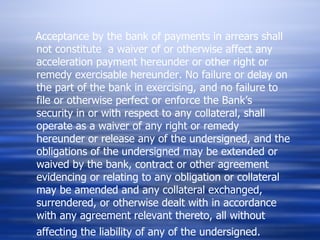
Acceptance by the bank of payments in arrears shall not constitute  a waiver of or otherwise affect any acceleration payment hereunder or other right or remedy exercisable hereunder. No failure or delay on the part of the bank in exercising, and no failure to file or otherwise perfect or enforce the Bank’s security in or with respect to any collateral, shall operate as a waiver of any right or remedy hereunder or release any of the undersigned, and the obligations of the undersigned may be extended or waived by the bank, contract or other agreement evidencing or relating to any obligation or collateral may be amended and any collateral exchanged, surrendered, or otherwise dealt with in accordance with any agreement relevant thereto, all without affecting the liability of any of the undersigned.
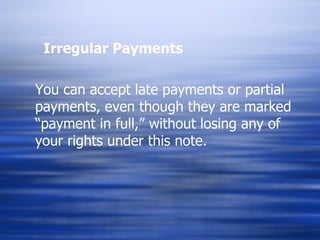
Irregular Payments You can accept late payments or partial payments, even though they are marked “payment in full,” without losing any of your rights under this note.
What happens if users don’t understand your documents? You may have to:   Write explanatory sections or notes   Write an explanatory document
What is Plain Language? A document is in plain language if users can  Find what they need Understand what they find Use what they find to meet their needs
What are the basic elements of plain language? Logical organization with the reader in mind “ You” and other pronouns Active voice Short sentences Common, everyday words Easy-to-read design features
Organize for your audience Organize your information the way the audience needs or expects it.
Identify your audience Why does the reader need to read document? What is average user expertise? Can you write to everyone interested, not just experts? Remember that no one wants to labor to understand your document.
Organize to serve the reader Identify with your reader Anticipate likely questions or confusing concepts Organize document to answer questions in the order and language readers will most likely ask them Provide useful headings
Informative headings help the reader navigate the document Clear headings are often the best, especially in documents that readers come to with questions, such as regulations, financial matters or concepts.
Use pronouns Pronouns pull readers in and make it relevant to them Reader needs to do less “translation” Pronouns let you eliminate lots of words
How do you use pronouns? Refer to your organization as “we” Refer to the reader as “you” in the text and as “I” in questions
Without pronouns To establish eligibility for a grant, an applicant must show that the applicant is an Indian and that the present housing of the applicant is substandard and inadequate.  ( 28 words)
With Pronouns To establish eligibility for a grant, you must show that you are an Indian and that your present housing is substandard and inadequate.  (23 words)
Avoid Passive Voice The person doing the action follows the verb. A form of the verb “to be” is combined with the past participle of another verb. The frog was swallowed by Fred.
Passive Voice Can disguise who does what: A frog was swallowed. Active Voice Makes it clear who does what: Fred swallowed a frog.
Passive Voice Can be awkward: Consultation from respondents was obtained to determine the estimated burden. Active Voice   Is more direct: We consulted with respondents to  determine the estimated burden.
Passive Voice Is often longer: The application must be completed by the applicant and received by the financial office by June 1st. 17 words Active Voice Cuts down the number of words: We must receive your application by June 1st.  8 words
Use short sections and paragraphs Shorter units of text are more manageable, less intimidating White space and headings are clues to what’s important
Use short sentences Short sentences avoid confusion Treat only one subject in each sentence Average sentence length: 20 words Maximum sentence length: 40 words
Use common words Use Use Help Method Needs Limits Issue Not Utilize Facilitate Methodology Necessitates  Parameters Promulgate
Use “must” Instead of “shall” Use “must” for obligation Use “must not” for prohibitions “ Shall” is ambiguous  “ Shall” is not a common everyday word
Avoid confusing words and constructions Avoid: Using undefined abbreviations  Using two different terms for the same thing (such as car, vehicle, auto) Using the same term for different things
Giving a word an obscure meaning (defining “car” to include trucks) Using legal or technical jargon Using strings of nouns (“surface water quality protection rules”)
Place words carefully Keep subjects and objects close to their verbs Put modifiers next to words they modify Put exceptions and long conditions after the main clause
Does word placement matter? Yesterday a mad dog bit five men in the north end. Yesterday, in the north end, a mad dog bit five men.
We will send you copies of any comments we receive after the comment period closes. After the comment period closes, we will send you copies of any comments we receive. Word placement cont’d
Design your document for easy reading White space makes a document easier to read Vertical lists and tables aid readability and add white space
Use vertical lists Vertical lists - Make it easy for the reader to identify all the items or steps in a process Add blank space for easy reading Help your reader see the structure of your document
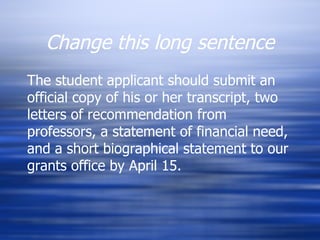
Change this long sentence The student applicant should submit an official copy of his or her transcript, two letters of recommendation from professors, a statement of financial need, and a short biographical statement to our grants office by April 15.
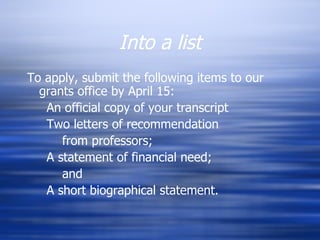
Into a list To apply, submit the following items to our grants office by April 15: An official copy of your transcript Two letters of recommendation  from professors; A statement of financial need;  and  A short biographical statement.
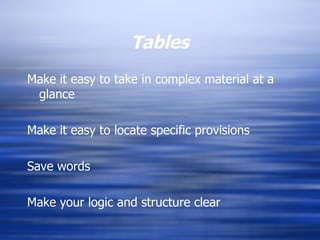
Tables Make it easy to take in complex material at a glance Make it easy to locate specific provisions Save words Make your logic and structure clear
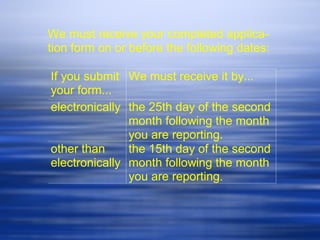
We must receive your completed application form on or before the 15th day of the second month following the month you are reporting if you do not submit your application electronically or the 25th day of the second month following the month you are reporting if you submit your application electronically.
 
You will: Write more effectively and with more impact Get better results Provide better customer service If you write in Plain Language

PEG INTRO

  • 1.
    Introduction toPlain Language
  • 2.
    Why use PlainLanguage? What is Plain Language?
  • 3.
    Why use PlainLanguage? We’re all busy people. We don’t want to waste a lot of time trying to translate difficult, wordy documents.
  • 4.
    Acceptance by thebank of payments in arrears shall not constitute a waiver of or otherwise affect any acceleration payment hereunder or other right or remedy exercisable hereunder. No failure or delay on the part of the bank in exercising, and no failure to file or otherwise perfect or enforce the Bank’s security in or with respect to any collateral, shall operate as a waiver of any right or remedy hereunder or release any of the undersigned, and the obligations of the undersigned may be extended or waived by the bank, contract or other agreement evidencing or relating to any obligation or collateral may be amended and any collateral exchanged, surrendered, or otherwise dealt with in accordance with any agreement relevant thereto, all without affecting the liability of any of the undersigned.
  • 5.
    Irregular Payments Youcan accept late payments or partial payments, even though they are marked “payment in full,” without losing any of your rights under this note.
  • 6.
    What happens ifusers don’t understand your documents? You may have to: Write explanatory sections or notes Write an explanatory document
  • 7.
    What is PlainLanguage? A document is in plain language if users can Find what they need Understand what they find Use what they find to meet their needs
  • 8.
    What are thebasic elements of plain language? Logical organization with the reader in mind “ You” and other pronouns Active voice Short sentences Common, everyday words Easy-to-read design features
  • 9.
    Organize for youraudience Organize your information the way the audience needs or expects it.
  • 10.
    Identify your audienceWhy does the reader need to read document? What is average user expertise? Can you write to everyone interested, not just experts? Remember that no one wants to labor to understand your document.
  • 11.
    Organize to servethe reader Identify with your reader Anticipate likely questions or confusing concepts Organize document to answer questions in the order and language readers will most likely ask them Provide useful headings
  • 12.
    Informative headings helpthe reader navigate the document Clear headings are often the best, especially in documents that readers come to with questions, such as regulations, financial matters or concepts.
  • 13.
    Use pronouns Pronounspull readers in and make it relevant to them Reader needs to do less “translation” Pronouns let you eliminate lots of words
  • 14.
    How do youuse pronouns? Refer to your organization as “we” Refer to the reader as “you” in the text and as “I” in questions
  • 15.
    Without pronouns Toestablish eligibility for a grant, an applicant must show that the applicant is an Indian and that the present housing of the applicant is substandard and inadequate. ( 28 words)
  • 16.
    With Pronouns Toestablish eligibility for a grant, you must show that you are an Indian and that your present housing is substandard and inadequate. (23 words)
  • 17.
    Avoid Passive VoiceThe person doing the action follows the verb. A form of the verb “to be” is combined with the past participle of another verb. The frog was swallowed by Fred.
  • 18.
    Passive Voice Candisguise who does what: A frog was swallowed. Active Voice Makes it clear who does what: Fred swallowed a frog.
  • 19.
    Passive Voice Canbe awkward: Consultation from respondents was obtained to determine the estimated burden. Active Voice Is more direct: We consulted with respondents to determine the estimated burden.
  • 20.
    Passive Voice Isoften longer: The application must be completed by the applicant and received by the financial office by June 1st. 17 words Active Voice Cuts down the number of words: We must receive your application by June 1st. 8 words
  • 21.
    Use short sectionsand paragraphs Shorter units of text are more manageable, less intimidating White space and headings are clues to what’s important
  • 22.
    Use short sentencesShort sentences avoid confusion Treat only one subject in each sentence Average sentence length: 20 words Maximum sentence length: 40 words
  • 23.
    Use common wordsUse Use Help Method Needs Limits Issue Not Utilize Facilitate Methodology Necessitates Parameters Promulgate
  • 24.
    Use “must” Insteadof “shall” Use “must” for obligation Use “must not” for prohibitions “ Shall” is ambiguous “ Shall” is not a common everyday word
  • 25.
    Avoid confusing wordsand constructions Avoid: Using undefined abbreviations Using two different terms for the same thing (such as car, vehicle, auto) Using the same term for different things
  • 26.
    Giving a wordan obscure meaning (defining “car” to include trucks) Using legal or technical jargon Using strings of nouns (“surface water quality protection rules”)
  • 27.
    Place words carefullyKeep subjects and objects close to their verbs Put modifiers next to words they modify Put exceptions and long conditions after the main clause
  • 28.
    Does word placementmatter? Yesterday a mad dog bit five men in the north end. Yesterday, in the north end, a mad dog bit five men.
  • 29.
    We will sendyou copies of any comments we receive after the comment period closes. After the comment period closes, we will send you copies of any comments we receive. Word placement cont’d
  • 30.
    Design your documentfor easy reading White space makes a document easier to read Vertical lists and tables aid readability and add white space
  • 31.
    Use vertical listsVertical lists - Make it easy for the reader to identify all the items or steps in a process Add blank space for easy reading Help your reader see the structure of your document
  • 32.
    Change this longsentence The student applicant should submit an official copy of his or her transcript, two letters of recommendation from professors, a statement of financial need, and a short biographical statement to our grants office by April 15.
  • 33.
    Into a listTo apply, submit the following items to our grants office by April 15: An official copy of your transcript Two letters of recommendation from professors; A statement of financial need; and A short biographical statement.
  • 34.
    Tables Make iteasy to take in complex material at a glance Make it easy to locate specific provisions Save words Make your logic and structure clear
  • 35.
    We must receiveyour completed application form on or before the 15th day of the second month following the month you are reporting if you do not submit your application electronically or the 25th day of the second month following the month you are reporting if you submit your application electronically.
  • 36.
  • 37.
    You will: Writemore effectively and with more impact Get better results Provide better customer service If you write in Plain Language