Using Text to Build Semantics
Networks for Pharmacogenomics


                  George Karystianis


   Adrien Coulet, Nigam Shah, Yael Garten, Mark Musen, Russ B. Altman

                 Journal of Biomedical informatics (2010)
Motivation
●   Manually crafted rules to define relationships
    between entities.
        –   Limited scope domains.
●   Pharmacogenomics.
        –   Semantic complexity.
●   Enhance the PharmaGKB.
●   Large size of literature.
●   NLP techniques promising.
                                                 2
Aim
●   Automatic relationship extraction.
●   Entity mapping in a schema.
        –   Semantic network structure.
●   Curation of PGx knowledge.
●   Resource for knowledge discovery.


                                          3
However...


             4
What is the meaning of
Pharmacogenomics?


                         5
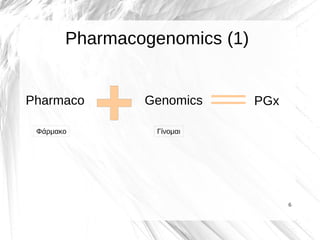
Pharmacogenomics (1)


Pharmaco       Genomics       PGx

 Φάρμακο         Γίνομαι


                                    6
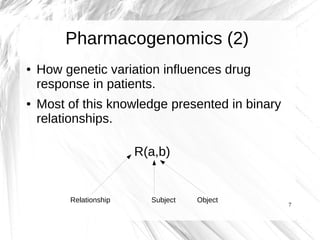
Pharmacogenomics (2)
●   How genetic variation influences drug
    response in patients.
●   Most of this knowledge presented in binary
    relationships.

                        R(a,b)


         Relationship     Subject   Object
                                                 7
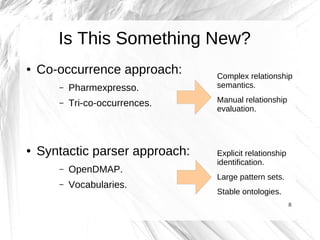
Is This Something New?
●   Co-occurrence approach:      Complex relationship
       –   Pharmexpresso.        semantics.

       –   Tri-co-occurrences.   Manual relationship
                                 evaluation.


●   Syntactic parser approach:   Explicit relationship
                                 identification.
       –   OpenDMAP.
                                 Large pattern sets.
       –   Vocabularies.
                                 Stable ontologies.
                                                         8
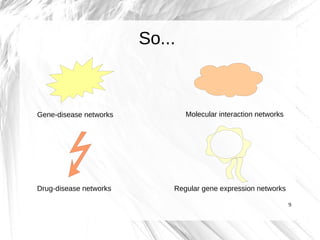
So...


Gene-disease networks           Molecular interaction networks


Drug-disease networks       Regular gene expression networks

                                                                 9
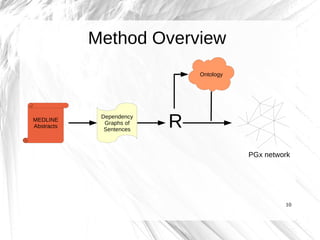
Method Overview
                              Ontology


MEDLINE
Abstracts
             Dependency
              Graphs of
              Sentences
                          R
                                         PGx network


                                                  10
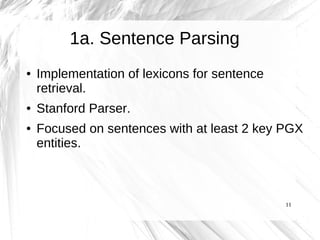
1a. Sentence Parsing
●   Implementation of lexicons for sentence
    retrieval.
●   Stanford Parser.
●   Focused on sentences with at least 2 key PGX
    entities.


                                              11
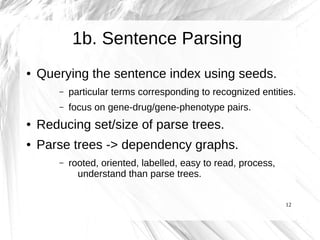
1b. Sentence Parsing
●   Querying the sentence index using seeds.
        –   particular terms corresponding to recognized entities.
        –   focus on gene-drug/gene-phenotype pairs.
●   Reducing set/size of parse trees.
●   Parse trees -> dependency graphs.
        –   rooted, oriented, labelled, easy to read, process,
              understand than parse trees.


                                                                 12
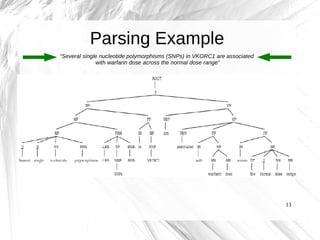
Parsing Example
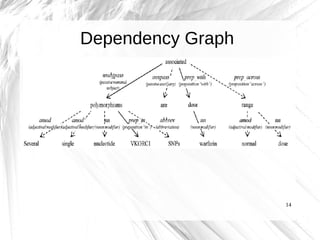
“Several single nucleotide polymorphisms (SNPs) in VKORC1 are associated
              with warfarin dose across the normal dose range”


                                                                           13
Dependency Graph


                   14
2a. Relation Extraction
●   Sentence analysis for raw relationship
    extraction.
●   Seed recognition:
       –   through PharmGKB lexicons.
●   Seed expansion:
       –   edge traversal of DG to see if the seed is a key entity
             or a modified entity.


                                                               15
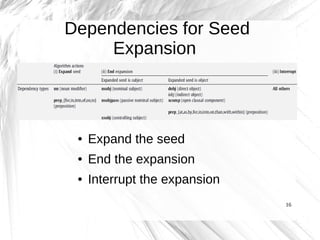
Dependencies for Seed
     Expansion


 ●   Expand the seed
 ●   End the expansion
 ●   Interrupt the expansion
                               16
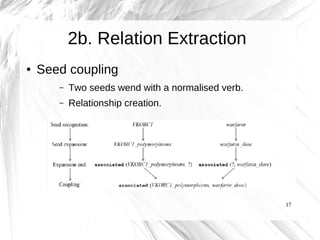
2b. Relation Extraction
●   Seed coupling
       –   Two seeds wend with a normalised verb.
       –   Relationship creation.


                                                    17
2c. Relation Extraction
●   Evaluation of precision:
        –   manual precision evaluation of extracting raw
             relationships.
        –   random selection of 220 raw relationships.
        –   classification-complete and true, incomplete and true,
              false.


                                                               18
3. Ontology Construction
●   Identification of R types.
●   Hierarchical organisation of R types and E.
        –   4 lists: most frequent, the most frequent modified
              entities by genes, drugs, phenotype.
●   Refine choice available.


                                                                 19
4a. Relationship Normalization
●   Application of ontology to relationship
    instances.
●   Creation of set of normalised relationships.
●   Normalization of entity names:
        –   modified entity name returned in normalized form
             according to ontology.
        –   Decomposition of modified entity to iterate for the
             construction of normalised form.

                                                                  20
Example


          21
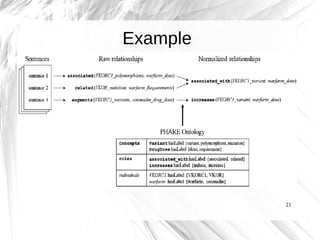
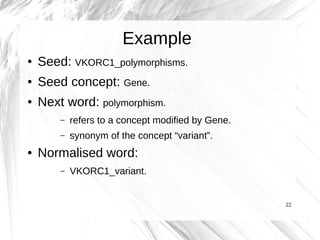
Example
●   Seed: VKORC1_polymorphisms.
●   Seed concept: Gene.
●   Next word: polymorphism.
        –   refers to a concept modified by Gene.
        –   synonym of the concept “variant”.
●   Normalised word:
        –   VKORC1_variant.


                                                    22
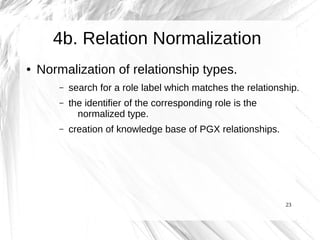
4b. Relation Normalization
●   Normalization of relationship types.
        –   search for a role label which matches the relationship.
        –   the identifier of the corresponding role is the
              normalized type.
        –   creation of knowledge base of PGX relationships.


                                                               23
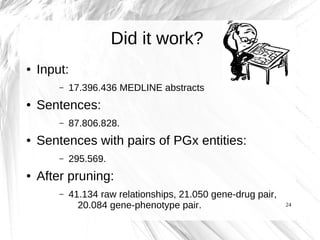
Did it work?
●   Input:
        –   17.396.436 MEDLINE abstracts
●   Sentences:
        –   87.806.828.
●   Sentences with pairs of PGx entities:
        –   295.569.
●   After pruning:
        –   41.134 raw relationships, 21.050 gene-drug pair,
              20.084 gene-phenotype pair.                      24
25
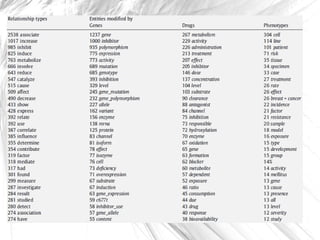
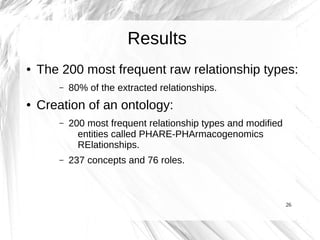
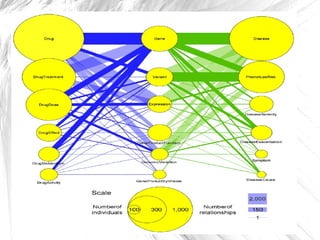
Results
●   The 200 most frequent raw relationship types:
        –   80% of the extracted relationships.
●   Creation of an ontology:
        –   200 most frequent relationship types and modified
              entities called PHARE-PHArmacogenomics
              RElationships.
        –   237 concepts and 76 roles.


                                                                26
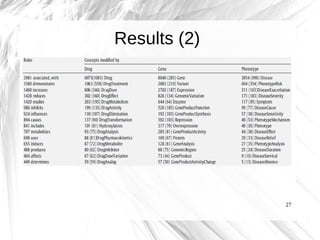
Results (2)


              27
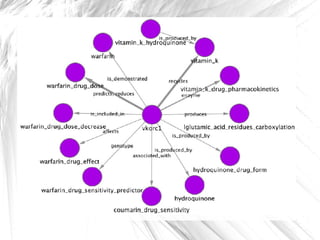
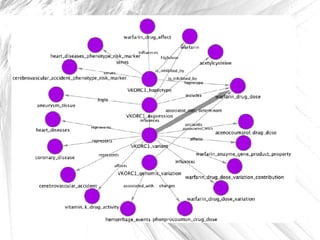
Results (3)


              28
29
30
Discussion (1)
●   Identification of both PGx entities.
●   Identification of PGx modified entities.
●   Use of key entity lexicons for discovery and
    normalization of modified entities.
●   Record and recognition of modified entities
    under very general textual conditions.
●   Flexible, precise method.
                                                   31
Discussion (2)
●   Concern: lower recall due to the large corpus
    size.
        –   improve precision with full text parsing.
●   Applicable to other domains.
        –   Human effort required for the ontology creation.


                                                               32
Conclusions (1)
●   New method for PGX relationship extraction.
●   Use of key PGX entities to identify modified
    entities.
●   Capture and normalization of raw
    relationships.
●   Automatic labelling of parsed sentences.


                                                   33
Conclusions (2)
●   Creation of a knowledge base.
●   Creation of relationship summaries between:
       –   Genes, drugs, phenotypes.
●   Novel approach for PGX text processing.


                                              34
Questions?
         (in French ^_^)


                           Questions?


質問 ?

                           Ερωτήσεις;
Preguntas?
                                        35

Using text to build semantic networks for pharmacaogenomics2

  • 1.
    Using Text toBuild Semantics Networks for Pharmacogenomics George Karystianis Adrien Coulet, Nigam Shah, Yael Garten, Mark Musen, Russ B. Altman Journal of Biomedical informatics (2010)
  • 2.
    Motivation ● Manually crafted rules to define relationships between entities. – Limited scope domains. ● Pharmacogenomics. – Semantic complexity. ● Enhance the PharmaGKB. ● Large size of literature. ● NLP techniques promising. 2
  • 3.
    Aim ● Automatic relationship extraction. ● Entity mapping in a schema. – Semantic network structure. ● Curation of PGx knowledge. ● Resource for knowledge discovery. 3
  • 4.
  • 5.
    What is themeaning of Pharmacogenomics? 5
  • 6.
    Pharmacogenomics (1) Pharmaco Genomics PGx Φάρμακο Γίνομαι 6
  • 7.
    Pharmacogenomics (2) ● How genetic variation influences drug response in patients. ● Most of this knowledge presented in binary relationships. R(a,b) Relationship Subject Object 7
  • 8.
    Is This SomethingNew? ● Co-occurrence approach: Complex relationship – Pharmexpresso. semantics. – Tri-co-occurrences. Manual relationship evaluation. ● Syntactic parser approach: Explicit relationship identification. – OpenDMAP. Large pattern sets. – Vocabularies. Stable ontologies. 8
  • 9.
    So... Gene-disease networks Molecular interaction networks Drug-disease networks Regular gene expression networks 9
  • 10.
    Method Overview Ontology MEDLINE Abstracts Dependency Graphs of Sentences R PGx network 10
  • 11.
    1a. Sentence Parsing ● Implementation of lexicons for sentence retrieval. ● Stanford Parser. ● Focused on sentences with at least 2 key PGX entities. 11
  • 12.
    1b. Sentence Parsing ● Querying the sentence index using seeds. – particular terms corresponding to recognized entities. – focus on gene-drug/gene-phenotype pairs. ● Reducing set/size of parse trees. ● Parse trees -> dependency graphs. – rooted, oriented, labelled, easy to read, process, understand than parse trees. 12
  • 13.
    Parsing Example “Several singlenucleotide polymorphisms (SNPs) in VKORC1 are associated with warfarin dose across the normal dose range” 13
  • 14.
  • 15.
    2a. Relation Extraction ● Sentence analysis for raw relationship extraction. ● Seed recognition: – through PharmGKB lexicons. ● Seed expansion: – edge traversal of DG to see if the seed is a key entity or a modified entity. 15
  • 16.
    Dependencies for Seed Expansion ● Expand the seed ● End the expansion ● Interrupt the expansion 16
  • 17.
    2b. Relation Extraction ● Seed coupling – Two seeds wend with a normalised verb. – Relationship creation. 17
  • 18.
    2c. Relation Extraction ● Evaluation of precision: – manual precision evaluation of extracting raw relationships. – random selection of 220 raw relationships. – classification-complete and true, incomplete and true, false. 18
  • 19.
    3. Ontology Construction ● Identification of R types. ● Hierarchical organisation of R types and E. – 4 lists: most frequent, the most frequent modified entities by genes, drugs, phenotype. ● Refine choice available. 19
  • 20.
    4a. Relationship Normalization ● Application of ontology to relationship instances. ● Creation of set of normalised relationships. ● Normalization of entity names: – modified entity name returned in normalized form according to ontology. – Decomposition of modified entity to iterate for the construction of normalised form. 20
  • 21.
  • 22.
    Example ● Seed: VKORC1_polymorphisms. ● Seed concept: Gene. ● Next word: polymorphism. – refers to a concept modified by Gene. – synonym of the concept “variant”. ● Normalised word: – VKORC1_variant. 22
  • 23.
    4b. Relation Normalization ● Normalization of relationship types. – search for a role label which matches the relationship. – the identifier of the corresponding role is the normalized type. – creation of knowledge base of PGX relationships. 23
  • 24.
    Did it work? ● Input: – 17.396.436 MEDLINE abstracts ● Sentences: – 87.806.828. ● Sentences with pairs of PGx entities: – 295.569. ● After pruning: – 41.134 raw relationships, 21.050 gene-drug pair, 20.084 gene-phenotype pair. 24
  • 25.
  • 26.
    Results ● The 200 most frequent raw relationship types: – 80% of the extracted relationships. ● Creation of an ontology: – 200 most frequent relationship types and modified entities called PHARE-PHArmacogenomics RElationships. – 237 concepts and 76 roles. 26
  • 27.
  • 28.
  • 29.
  • 30.
  • 31.
    Discussion (1) ● Identification of both PGx entities. ● Identification of PGx modified entities. ● Use of key entity lexicons for discovery and normalization of modified entities. ● Record and recognition of modified entities under very general textual conditions. ● Flexible, precise method. 31
  • 32.
    Discussion (2) ● Concern: lower recall due to the large corpus size. – improve precision with full text parsing. ● Applicable to other domains. – Human effort required for the ontology creation. 32
  • 33.
    Conclusions (1) ● New method for PGX relationship extraction. ● Use of key PGX entities to identify modified entities. ● Capture and normalization of raw relationships. ● Automatic labelling of parsed sentences. 33
  • 34.
    Conclusions (2) ● Creation of a knowledge base. ● Creation of relationship summaries between: – Genes, drugs, phenotypes. ● Novel approach for PGX text processing. 34
  • 35.
    Questions? (in French ^_^) Questions? 質問 ? Ερωτήσεις; Preguntas? 35