USING SOCIAL MEDIA TOOLS FOR ACADEMIC COMMUNICATION
Communicating                    … in 10 min
…
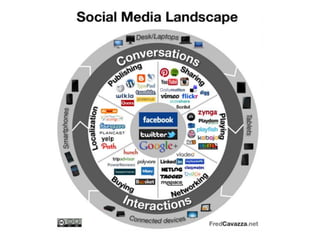
• Social Media landscape in HE

• The study:
    – Methodology
    – Summary of findings
    – Discussions

• Conclusions
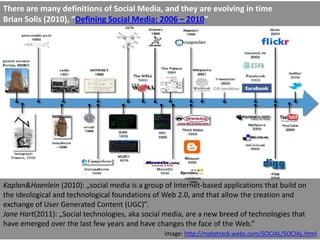
There are many definitions of Social Media, and they are evolving in time
Brian Solis (2010), “Defining Social Media: 2006 – 2010”


Kaplan&Haenlein (2010): „social media is a group of Internet-based applications that build on
the ideological and technological foundations of Web 2.0, and that allow the creation and
exchange of User Generated Content (UGC)”.
Jane Hart(2011): „Social technologies, aka social media, are a new breed of technologies that
have emerged over the last few years and have changes the face of the Web.”
                                                 image: http://matetrack.webs.com/SOCIAL/SOCIAL.html
Amy Campbell (2010)
3 characteristics of social
media: the majority of
content is user generated, a
high degree of
participation/interaction
between users, and easily
integrates with other sites.

Anthony J. Bradley (2010)
6 core principles:
participation, collective,
transparency, independence,
persistence and emergence.

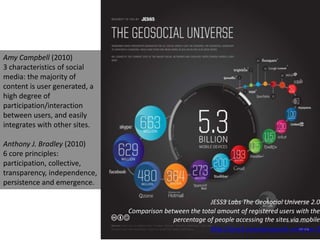
                                                         JESS3 Labs The Geosocial Universe 2.0
                               Comparison between the total amount of registered users with the
                                             percentage of people accessing the sites via mobile
                                                         http://jess3.com/geosocial-universe-2
??? … Social Media in universities
• How faculty members
   use    Social Media?
• Which are the potential
   benefits, challenges
    and disadvantages?
• How the usage can be
          extended?
• Is there a need
   for training the educational actors?
Method

- an online questionnaire
- via academic SNS
- time: February-March 2012
- 79 respondents
Respondents profile:
        WHO ARE THEY?

AGE
36-45 years (37%)
less than 35 years (43%)

                           GENDER
                            41M (52%)
                            38F (48%)
Respondents profile:
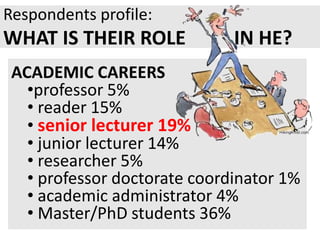
WHAT IS THEIR ROLE            IN HE?
 ACADEMIC CAREERS
   •professor 5%
   • reader 15%
   • senior lecturer 19%
   • junior lecturer 14%
   • researcher 5%
   • professor doctorate coordinator 1%
   • academic administrator 4%
   • Master/PhD students 36%
Respondents profile:
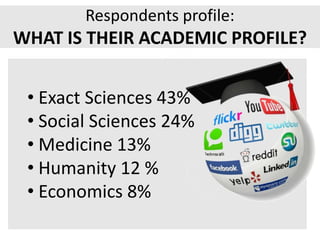
WHAT IS THEIR ACADEMIC PROFILE?


 • Exact Sciences 43%
 • Social Sciences 24%
 • Medicine 13%
 • Humanity 12 %
 • Economics 8%
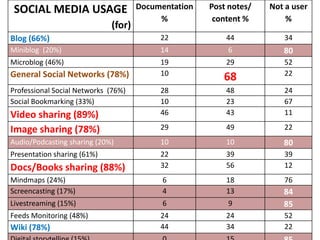
SOCIAL MEDIA USAGE                  Documentation   Post notes/   Not a user
                                          %           content %        %
                             (for)
Blog (66%)                                22             44           34
Miniblog (20%)                            14             6            80
Microblog (46%)                           19             29           52
General Social Networks (78%)             10                          22
                                                        68
Professional Social Networks (76%)        28             48           24
Social Bookmarking (33%)                  10             23           67
Video sharing (89%)                       46             43           11

Image sharing (78%)                       29             49           22
Audio/Podcasting sharing (20%)            10             10           80
Presentation sharing (61%)                22             39           39
Docs/Books sharing (88%)                  32             56           12
Mindmaps (24%)                             6             18           76
Screencasting (17%)                        4             13           84
Livestreaming (15%)                        6             9            85
Feeds Monitoring (48%)                    24             24           52
Wiki (78%)                                44             34           22
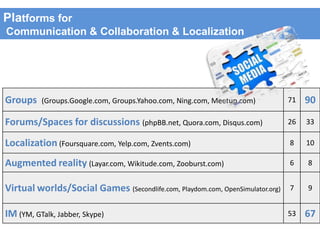
Platforms for
Communication & Collaboration & Localization


Groups    (Groups.Google.com, Groups.Yahoo.com, Ning.com, Meetup.com)          71   90

Forums/Spaces for discussions (phpBB.net, Quora.com, Disqus.com)               26   33

Localization (Foursquare.com, Yelp.com, Zvents.com)                            8    10

Augmented reality (Layar.com, Wikitude.com, Zooburst.com)                      6    8


Virtual worlds/Social Games (Secondlife.com, Playdom.com, OpenSimulator.org)   7    9


IM (YM, GTalk, Jabber, Skype)                                                  53   67
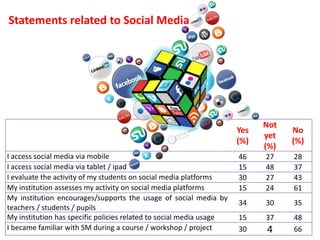
Statements related to Social Media


                                                                           Not
                                                                     Yes         No
                                                                           yet
                                                                     (%)         (%)
                                                                           (%)
I access social media via mobile                                     46    27    28
I access social media via tablet / ipad                              15    48    37
I evaluate the activity of my students on social media platforms     30    27    43
My institution assesses my activity on social media platforms        15    24    61
My institution encourages/supports the usage of social media by
                                                                     34    30    35
teachers / students / pupils
My institution has specific policies related to social media usage   15    37    48
I became familiar with SM during a course / workshop / project       30    4     66
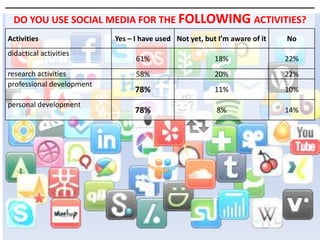
DO YOU USE SOCIAL MEDIA FOR THE FOLLOWING ACTIVITIES?
Activities                 Yes – I have used Not yet, but I’m aware of it   No
didactical activities
                                 61%                     18%                22%
research activities              58%                     20%                22%
professional development
                                 78%                     11%                10%
personal development
                                 78%                     8%                 14%
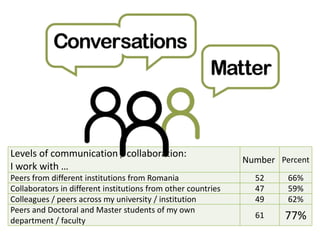
Levels of communication / collaboration:
                                                               Number Percent
I work with …
Peers from different institutions from Romania                   52     66%
Collaborators in different institutions from other countries     47     59%
Colleagues / peers across my university / institution            49     62%
Peers and Doctoral and Master students of my own
department / faculty
                                                                 61    77%
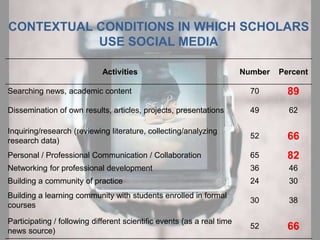
CONTEXTUAL CONDITIONS IN WHICH SCHOLARS
           USE SOCIAL MEDIA

                             Activities                                 Number   Percent

Searching news, academic content                                          70       89
Dissemination of own results, articles, projects, presentations           49       62

Inquiring/research (reviewing literature, collecting/analyzing
research data)
                                                                          52       66
Personal / Professional Communication / Collaboration                     65       82
Networking for professional development                                   36       46
Building a community of practice                                          24       30
Building a learning community with students enrolled in formal
                                                                          30       38
courses

Participating / following different scientific events (as a real time
news source)
                                                                          52       66
ADVANTAGES

•   accessibility and ease of use
•   cost reduction
•   flexibility, transparency and autonomy of applications
•   educational „recruit ability”
•   changing teachers’ attitudes
•   engaging / enriching / empowering students’
    interactions and participation
•   collaborative characteristics
•   establishing relationships and conversations
•   facilitating learning
•   social interactions
ADVANTAGES

•   teaching / learning digital skills
•   easily-accessible creativity
•   „use of authentic study materials”
•   „easy socialization”
•   a modern approach of educational subjects
•   feedback
•   easy monitoring online presence and reputation
•   collaborative participation
•   using open education / open educational
    resources
DISADVANTAGES
•   content trivialisation
•   security of data and persons
•   online information / cognitive overload
•   equality or e-quality
•   difficult management of digital identity
•   anonymity
•   ethical concerns
•   institutional norms
•   time spent on social media sites
•   emotional barriers
•   a certain life style and/or an organisational culture
•   artificial communication
•   the noise
•   the activity with / within social media isn’t recognised as academic
a social media education ??


OR social media in education ??
Tune your
                                                       communication!
                                                     to flicko all owners of photographs


                       Gabriela GROSSECK              Carmen HOLOTESCU
                       Department of Psychology     Timsoft / Politehnica
   Thank               West University of Timisoara University of Timisoara
                       Romania                      Romania
   you !
to flicko all owners   blog: grosseck.blogspot.com    blog: timsoft.ro/blog
  of photographs       twitter: ggrosseck             twitter: cami13
                       cirip: Gabriela                cirip: cami13

Using Social Media for Academic Communication

  • 1.
    USING SOCIAL MEDIATOOLS FOR ACADEMIC COMMUNICATION
  • 2.
    Communicating … in 10 min … • Social Media landscape in HE • The study: – Methodology – Summary of findings – Discussions • Conclusions
  • 4.
    There are manydefinitions of Social Media, and they are evolving in time Brian Solis (2010), “Defining Social Media: 2006 – 2010” Kaplan&Haenlein (2010): „social media is a group of Internet-based applications that build on the ideological and technological foundations of Web 2.0, and that allow the creation and exchange of User Generated Content (UGC)”. Jane Hart(2011): „Social technologies, aka social media, are a new breed of technologies that have emerged over the last few years and have changes the face of the Web.” image: http://matetrack.webs.com/SOCIAL/SOCIAL.html
  • 5.
    Amy Campbell (2010) 3characteristics of social media: the majority of content is user generated, a high degree of participation/interaction between users, and easily integrates with other sites. Anthony J. Bradley (2010) 6 core principles: participation, collective, transparency, independence, persistence and emergence. JESS3 Labs The Geosocial Universe 2.0 Comparison between the total amount of registered users with the percentage of people accessing the sites via mobile http://jess3.com/geosocial-universe-2
  • 6.
    ??? … SocialMedia in universities • How faculty members use Social Media? • Which are the potential benefits, challenges and disadvantages? • How the usage can be extended? • Is there a need for training the educational actors?
  • 7.
    Method - an onlinequestionnaire - via academic SNS - time: February-March 2012 - 79 respondents
  • 8.
    Respondents profile: WHO ARE THEY? AGE 36-45 years (37%) less than 35 years (43%) GENDER 41M (52%) 38F (48%)
  • 9.
    Respondents profile: WHAT ISTHEIR ROLE IN HE? ACADEMIC CAREERS •professor 5% • reader 15% • senior lecturer 19% • junior lecturer 14% • researcher 5% • professor doctorate coordinator 1% • academic administrator 4% • Master/PhD students 36%
  • 10.
    Respondents profile: WHAT ISTHEIR ACADEMIC PROFILE? • Exact Sciences 43% • Social Sciences 24% • Medicine 13% • Humanity 12 % • Economics 8%
  • 11.
    SOCIAL MEDIA USAGE Documentation Post notes/ Not a user % content % % (for) Blog (66%) 22 44 34 Miniblog (20%) 14 6 80 Microblog (46%) 19 29 52 General Social Networks (78%) 10 22 68 Professional Social Networks (76%) 28 48 24 Social Bookmarking (33%) 10 23 67 Video sharing (89%) 46 43 11 Image sharing (78%) 29 49 22 Audio/Podcasting sharing (20%) 10 10 80 Presentation sharing (61%) 22 39 39 Docs/Books sharing (88%) 32 56 12 Mindmaps (24%) 6 18 76 Screencasting (17%) 4 13 84 Livestreaming (15%) 6 9 85 Feeds Monitoring (48%) 24 24 52 Wiki (78%) 44 34 22
  • 12.
    Platforms for Communication &Collaboration & Localization Groups (Groups.Google.com, Groups.Yahoo.com, Ning.com, Meetup.com) 71 90 Forums/Spaces for discussions (phpBB.net, Quora.com, Disqus.com) 26 33 Localization (Foursquare.com, Yelp.com, Zvents.com) 8 10 Augmented reality (Layar.com, Wikitude.com, Zooburst.com) 6 8 Virtual worlds/Social Games (Secondlife.com, Playdom.com, OpenSimulator.org) 7 9 IM (YM, GTalk, Jabber, Skype) 53 67
  • 13.
    Statements related toSocial Media Not Yes No yet (%) (%) (%) I access social media via mobile 46 27 28 I access social media via tablet / ipad 15 48 37 I evaluate the activity of my students on social media platforms 30 27 43 My institution assesses my activity on social media platforms 15 24 61 My institution encourages/supports the usage of social media by 34 30 35 teachers / students / pupils My institution has specific policies related to social media usage 15 37 48 I became familiar with SM during a course / workshop / project 30 4 66
  • 14.
    DO YOU USESOCIAL MEDIA FOR THE FOLLOWING ACTIVITIES? Activities Yes – I have used Not yet, but I’m aware of it No didactical activities 61% 18% 22% research activities 58% 20% 22% professional development 78% 11% 10% personal development 78% 8% 14%
  • 15.
    Levels of communication/ collaboration: Number Percent I work with … Peers from different institutions from Romania 52 66% Collaborators in different institutions from other countries 47 59% Colleagues / peers across my university / institution 49 62% Peers and Doctoral and Master students of my own department / faculty 61 77%
  • 16.
    CONTEXTUAL CONDITIONS INWHICH SCHOLARS USE SOCIAL MEDIA Activities Number Percent Searching news, academic content 70 89 Dissemination of own results, articles, projects, presentations 49 62 Inquiring/research (reviewing literature, collecting/analyzing research data) 52 66 Personal / Professional Communication / Collaboration 65 82 Networking for professional development 36 46 Building a community of practice 24 30 Building a learning community with students enrolled in formal 30 38 courses Participating / following different scientific events (as a real time news source) 52 66
  • 17.
    ADVANTAGES • accessibility and ease of use • cost reduction • flexibility, transparency and autonomy of applications • educational „recruit ability” • changing teachers’ attitudes • engaging / enriching / empowering students’ interactions and participation • collaborative characteristics • establishing relationships and conversations • facilitating learning • social interactions
  • 18.
    ADVANTAGES • teaching / learning digital skills • easily-accessible creativity • „use of authentic study materials” • „easy socialization” • a modern approach of educational subjects • feedback • easy monitoring online presence and reputation • collaborative participation • using open education / open educational resources
  • 19.
    DISADVANTAGES • content trivialisation • security of data and persons • online information / cognitive overload • equality or e-quality • difficult management of digital identity • anonymity • ethical concerns • institutional norms • time spent on social media sites • emotional barriers • a certain life style and/or an organisational culture • artificial communication • the noise • the activity with / within social media isn’t recognised as academic
  • 20.
    a social mediaeducation ?? OR social media in education ??
  • 21.
    Tune your communication! to flicko all owners of photographs Gabriela GROSSECK Carmen HOLOTESCU Department of Psychology Timsoft / Politehnica Thank West University of Timisoara University of Timisoara Romania Romania you ! to flicko all owners blog: grosseck.blogspot.com blog: timsoft.ro/blog of photographs twitter: ggrosseck twitter: cami13 cirip: Gabriela cirip: cami13