Using Research Conventions
& Manuals (MLA and APA )
BY Mam Bushra
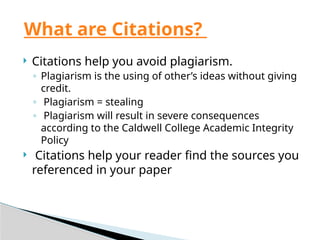
 Citations help you avoid plagiarism.
◦ Plagiarism is the using of other’s ideas without giving
credit.
◦ Plagiarism = stealing
◦ Plagiarism will result in severe consequences
according to the Caldwell College Academic Integrity
Policy
 Citations help your reader find the sources you
referenced in your paper
What are Citations?
“VIOLATIONS OF ACADEMIC INTEGRITY
 Academic dishonesty includes but is not necessarily limited to the following:
 Cheating
1. Unauthorized use of materials during tests and examinations.
2. Unauthorized possession of test or examination material prior to the administration
of same.
3. Altering assigned grades.
4. Submitting, as one’s own work, assignments (for example, papers, data, computer
assignments, or artistic works) obtained in whole or in part from another, unless specifically
authorized to do so by the instructor.
 Fabricating
Inventing data or other information to reach a desired conclusion.
 Plagiarism
The unacknowledged, undocumented presentation of words or ideas which are the
intellectual property of another as one’s own.
1. Direct quotation, that is, even a few of the exact words of a source, must be indicated
by the use of quotation marks or indentation of the text and be properly documented.
2. 2. Passages which parallel the thought or expression of the source, even without using
the same words, must be properly documented.”
“Academic Integrity Policy.” Undergraduate Catalog 2013-2014. Caldwell College. Caldwell
College, 2013. Web. 3 Oct. 2013.
Academic Integrity Policy
 MLA stands for Modern Language Association.
◦ Who uses MLA style?
◦ The humanities use MLA style including: art,
literature, music, philosophy and others.
 APA stands for American Psychological
Association.
◦ Who uses APA style?
◦ The social sciences use APA style including: business,
communication, education, psychology and others.
Types of Citation Formats
 Part 1- In-text Citations
◦ Direct quotations or paraphrase of other
people's words in your paper from the
sources you read •
 Part 2- Works Cited Page/ References Page
◦ List of all the sources you cited by in-text
citations in your paper
◦ After your paper is finished your in-text
citations should match up to your Works
Cited page/ References Page
2 Part Process
 Taking someone's words exactly. When you copy
someone's words exactly you must put "quotes "
around the words to show you did not write them.
•
 MLA: McBride opens his novel by describing his
lack of knowledge about his mother, "As a boy, I
never knew where my mother was from - where
she was born, who her parents were" (6).
 APA: According to Howard (2007), “…children who
regularly drink soda have an increased likelihood
of overweight and obesity” (p. 74).
In-text Citations -Direct Quotation
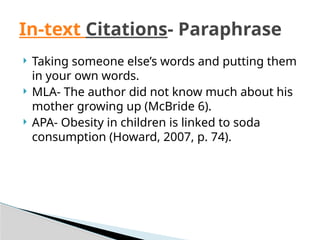
 Taking someone else’s words and putting them
in your own words.
 MLA- The author did not know much about his
mother growing up (McBride 6).
 APA- Obesity in children is linked to soda
consumption (Howard, 2007, p. 74).
In-text Citations- Paraphrase
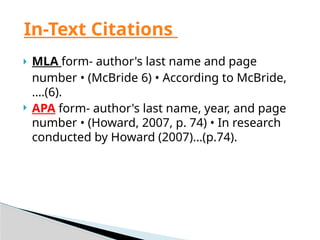
 MLA form- author's last name and page
number • (McBride 6) • According to McBride,
….(6).
 APA form- author's last name, year, and page
number • (Howard, 2007, p. 74) • In research
conducted by Howard (2007)…(p.74).
In-Text Citations
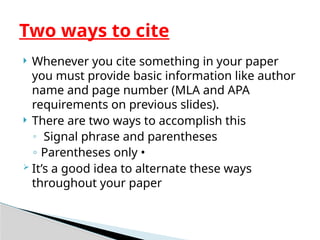
 Whenever you cite something in your paper
you must provide basic information like author
name and page number (MLA and APA
requirements on previous slides).
 There are two ways to accomplish this
◦ Signal phrase and parentheses
◦ Parentheses only •
 It’s a good idea to alternate these ways
throughout your paper
Two ways to cite
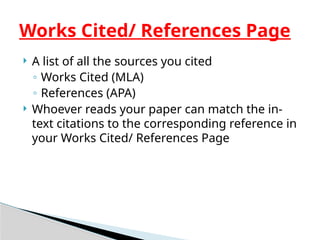
 A list of all the sources you cited
◦ Works Cited (MLA)
◦ References (APA)
 Whoever reads your paper can match the in-
text citations to the corresponding reference in
your Works Cited/ References Page
Works Cited/ References Page
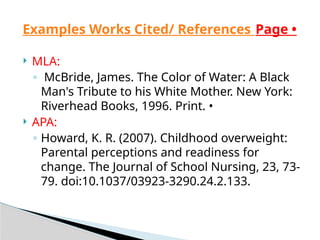
 MLA:
◦ McBride, James. The Color of Water: A Black
Man's Tribute to his White Mother. New York:
Riverhead Books, 1996. Print. •
 APA:
◦ Howard, K. R. (2007). Childhood overweight:
Parental perceptions and readiness for
change. The Journal of School Nursing, 23, 73-
79. doi:10.1037/03923-3290.24.2.133.
Examples Works Cited/ References Page •
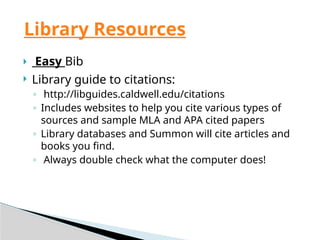
 Easy Bib
 Library guide to citations:
◦ http://libguides.caldwell.edu/citations
◦ Includes websites to help you cite various types of
sources and sample MLA and APA cited papers
◦ Library databases and Summon will cite articles and
books you find.
◦ Always double check what the computer does!
Library Resources
Using Research Conventions & Manuals (MLA and.pptx

  • 1.
    Using Research Conventions &Manuals (MLA and APA ) BY Mam Bushra
  • 2.
     Citations helpyou avoid plagiarism. ◦ Plagiarism is the using of other’s ideas without giving credit. ◦ Plagiarism = stealing ◦ Plagiarism will result in severe consequences according to the Caldwell College Academic Integrity Policy  Citations help your reader find the sources you referenced in your paper What are Citations?
  • 3.
    “VIOLATIONS OF ACADEMICINTEGRITY  Academic dishonesty includes but is not necessarily limited to the following:  Cheating 1. Unauthorized use of materials during tests and examinations. 2. Unauthorized possession of test or examination material prior to the administration of same. 3. Altering assigned grades. 4. Submitting, as one’s own work, assignments (for example, papers, data, computer assignments, or artistic works) obtained in whole or in part from another, unless specifically authorized to do so by the instructor.  Fabricating Inventing data or other information to reach a desired conclusion.  Plagiarism The unacknowledged, undocumented presentation of words or ideas which are the intellectual property of another as one’s own. 1. Direct quotation, that is, even a few of the exact words of a source, must be indicated by the use of quotation marks or indentation of the text and be properly documented. 2. 2. Passages which parallel the thought or expression of the source, even without using the same words, must be properly documented.” “Academic Integrity Policy.” Undergraduate Catalog 2013-2014. Caldwell College. Caldwell College, 2013. Web. 3 Oct. 2013. Academic Integrity Policy
  • 4.
     MLA standsfor Modern Language Association. ◦ Who uses MLA style? ◦ The humanities use MLA style including: art, literature, music, philosophy and others.  APA stands for American Psychological Association. ◦ Who uses APA style? ◦ The social sciences use APA style including: business, communication, education, psychology and others. Types of Citation Formats
  • 5.
     Part 1-In-text Citations ◦ Direct quotations or paraphrase of other people's words in your paper from the sources you read •  Part 2- Works Cited Page/ References Page ◦ List of all the sources you cited by in-text citations in your paper ◦ After your paper is finished your in-text citations should match up to your Works Cited page/ References Page 2 Part Process
  • 6.
     Taking someone'swords exactly. When you copy someone's words exactly you must put "quotes " around the words to show you did not write them. •  MLA: McBride opens his novel by describing his lack of knowledge about his mother, "As a boy, I never knew where my mother was from - where she was born, who her parents were" (6).  APA: According to Howard (2007), “…children who regularly drink soda have an increased likelihood of overweight and obesity” (p. 74). In-text Citations -Direct Quotation
  • 7.
     Taking someoneelse’s words and putting them in your own words.  MLA- The author did not know much about his mother growing up (McBride 6).  APA- Obesity in children is linked to soda consumption (Howard, 2007, p. 74). In-text Citations- Paraphrase
  • 8.
     MLA form-author's last name and page number • (McBride 6) • According to McBride, ….(6).  APA form- author's last name, year, and page number • (Howard, 2007, p. 74) • In research conducted by Howard (2007)…(p.74). In-Text Citations
  • 9.
     Whenever youcite something in your paper you must provide basic information like author name and page number (MLA and APA requirements on previous slides).  There are two ways to accomplish this ◦ Signal phrase and parentheses ◦ Parentheses only •  It’s a good idea to alternate these ways throughout your paper Two ways to cite
  • 10.
     A listof all the sources you cited ◦ Works Cited (MLA) ◦ References (APA)  Whoever reads your paper can match the in- text citations to the corresponding reference in your Works Cited/ References Page Works Cited/ References Page
  • 11.
     MLA: ◦ McBride,James. The Color of Water: A Black Man's Tribute to his White Mother. New York: Riverhead Books, 1996. Print. •  APA: ◦ Howard, K. R. (2007). Childhood overweight: Parental perceptions and readiness for change. The Journal of School Nursing, 23, 73- 79. doi:10.1037/03923-3290.24.2.133. Examples Works Cited/ References Page •
  • 12.
     Easy Bib Library guide to citations: ◦ http://libguides.caldwell.edu/citations ◦ Includes websites to help you cite various types of sources and sample MLA and APA cited papers ◦ Library databases and Summon will cite articles and books you find. ◦ Always double check what the computer does! Library Resources