PRESENTED BY
Using Redis Streams to build
Event-driven Microservices and
User Interface in Clojure(Script)
Bobby Calderwood
Evident Systems, Founder
bobby@evidentsystems.com
@bobbycalderwood
PRESENTED BY
• Software Engineer @Cognitect for 4+ years, Consulting and Datomic
• Distinguished Engineer @CapitalOne for 3+ years, helping redesign and move
mission-critical banking systems to the cloud
• Founder @Evident_Systems, helping smaller banks redesign and move
mission-critical banking systems to the cloud
• Meet with me! http://meet.evident.systems/founder
Hello, I’m Bobby Calderwood!
PRESENTED BY
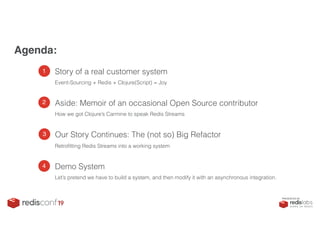
1 Story of a real customer system
Event-Sourcing + Redis + Clojure(Script) = Joy
2 Aside: Memoir of an occasional Open Source contributor
How we got Clojure’s Carmine to speak Redis Streams
3 Our Story Continues: The (not so) Big Refactor
Retrofitting Redis Streams into a working system
Agenda:
4 Demo System
Let’s pretend we have to build a system, and then modify it with an asynchronous integration.
PRESENTED BY
• Major automobile manufacturer
• Greenfield system for new capability, political proving ground for stack and process
• Highly asynchronous image processing and significant UI display/manipulation
• Possible need for data re-processing/re-play, undo/redo, audit, and sharing with
other teams
• We decided to architect it using Event Sourcing on Streaming Data using
Redis, and implemented in Clojure(Script)
I was solving a customer problem
PRESENTED BY
Why Event Sourcing
& Streaming?
PRESENTED BY
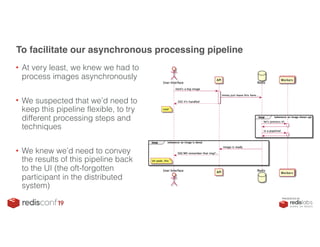
• At very least, we knew we had to
process images asynchronously
• We suspected that we’d need to
keep this pipeline flexible, to try
different processing steps and
techniques
• We knew we’d need to convey
the results of this pipeline back
to the UI (the oft-forgotten
participant in the distributed
system)
To facilitate our asynchronous processing pipeline
PRESENTED BY
• Integration among microservices becomes complex and burdensome
– Balkanization of data stores
– Data “owner” determines data access pattern
– Non-determinism == impossibility of reasoning about system:
• state
• causality/time
• modes of failure
Because HTTP APIs aren’t enough
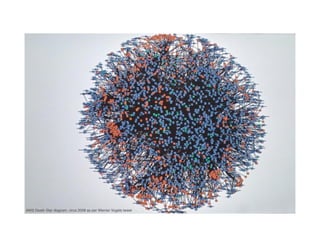
AWS Death Star diagram, circa 2008 as per Werner Vogels tweet
PRESENTED BY
• Request/response protocols face a fundamental epistemological problem
– What is happening, anything new?
– When should I check for new data?
– Who’s responsible to tell me?
Because HTTP APIs aren’t enough
PRESENTED BY
• Event Sourcing provides as-of
consistency across distributed
participants
• Streaming Data protocols convey new
data/events to interested participants
(subscribers)
• Any participant can simulate
synchrony and consistency by
blocking and waiting for a specific
event
Streaming Data + Event Sourcing Facilitate Distributed Consistency
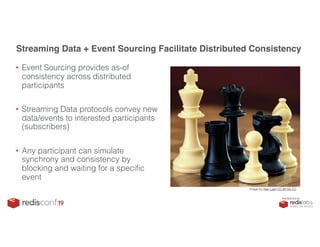
Image by Alan Light CC BY-SA 3.0
PRESENTED BY
• “Situated Programs” a la Rich Hickey:
– interact with other systems
– often interact with humans
– remain in use for long periods of time
– are situated in a changing world
– use other people’s code
• In large enterprises
– audit/compliance/governance
– certain eventual integration with many new possible systems and data
consumers
– across many teams and organizational units who (basically) trust each other
More generally, to solve a specific type of problem
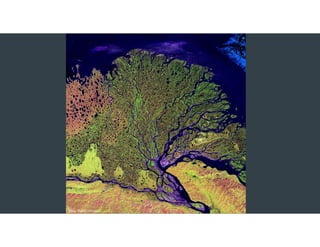
Nasa, Public Domain
PRESENTED BY
Why Redis?
(for streaming data)
PRESENTED BY
‘cause your last slide
definitely said “Kafka”
PRESENTED BY
• Redis is ubiquitous: you (or your customer) already has it in the stack
• Redis is battle-tested, and Ops is comfortable with it
• Redis is (often) easier to operate than Kafka (with some tradeoffs)
Redis is Already There, and Just Works
PRESENTED BY
• After Kafka Popularized, Salvatore noticed gap in Redis, as he described: http://
antirez.com/news/114
• Existing data structures got almost there
– Sorted Sets: memory hungry, clients can’t block awaiting new records, order not
stable
– Lists: linear time to scan, can’t seek to specific position, no fan-out to multiple
consumers
– Pub/Sub: doesn’t maintain history, can’t do windowed aggregation, etc.
• Redis Streams maintains range-queryable history, and efficiently conveys to
awaiting clients
Redis recently added Streams
PRESENTED BY
Why Clojure?
PRESENTED BY
• Clojure is a fantastic all-purpose programming language whose philosophy aligns
well with event sourcing, streaming data
• We needed to build all components quickly, with a small team of Clojurists:
– UI in ClojureScript
– React + Reagent + re-frame
– Access to JavaScript libraries with Clojure language semantics
– HTTP API in Clojure + Pedestal (+ GraphQL via Lacinia)
– Workers in Clojure
• Clojure’s core.async library provide in-process semantics aligned with streaming data
Clojure(Script) is powerful and full-stack
PRESENTED BY
• Very solid, simple Redis client
• Generated from Redis artifacts (on which more to come)
• Stays close to Redis semantics
Clojure has Carmine
PRESENTED BY
But Carmine didn’t have Streams…
PRESENTED BY
• ~1 hour after Salvatore’s blog post dropped, I filed https://github.com/
ptaoussanis/carmine/issues/208
• But I felt Open Source guilt, so I opened https://github.com/ptaoussanis/
carmine/pull/210
• But Carmine is generated from Redis Docs JSON, which didn’t yet include
Streams operations, so I filed https://github.com/antirez/redis-doc/issues/943,
and opened https://github.com/antirez/redis-doc/pull/963
…so we added support for Streams
PRESENTED BY
And support for all the above was
added incredibly quickly!
PRESENTED BY
• We had already built the HTTP API and processing pipeline
• Both components were producers and consumers of events
• Our implementation was limited in its scalability/fault-tolerance, so we needed
to re-work
• Ugh, how much re-work to support Streams?!?
…but not quickly enough to prevent re-work
PRESENTED BY
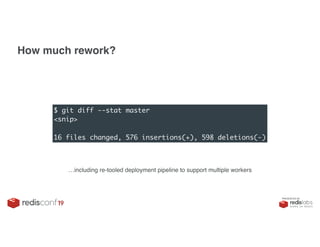
…including re-tooled deployment pipeline to support multiple workers
How much rework?
$ git diff --stat master
<snip>
16 files changed, 576 insertions(+), 598 deletions(-)
PRESENTED BY
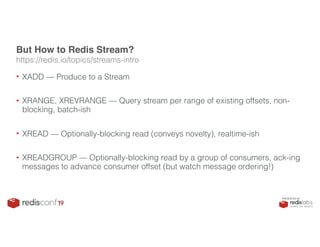
• XADD — Produce to a Stream
• XRANGE, XREVRANGE — Query stream per range of existing offsets, non-
blocking, batch-ish
• XREAD — Optionally-blocking read (conveys novelty), realtime-ish
• XREADGROUP — Optionally-blocking read by a group of consumers, ack-ing
messages to advance consumer offset (but watch message ordering!)
But How to Redis Stream?
https://redis.io/topics/streams-intro
PRESENTED BY
And Now,
A Completely Unrelated
Demo App!
PRESENTED BY
• Always use Clojure, so that your major distributed systems refactorings can be
a net code reduction!
• Sharpen your tools: contribute to open source!
• Use Event Sourcing!
– Kafka for big/important/durable/expensive things
– Redis for smaller things https://redis.io/topics/streams-intro
• Check out my demo app! https://github.com/bobby/redisconf19-demo
Conclusion
Thank you!
bobby@evidentsystems.com
@bobbycalderwood
PRESENTED BY

Using Redis Streams To Build Event Driven Microservices And User Interface In Clojure Bobby Calderwood

  • 1.
    PRESENTED BY Using RedisStreams to build Event-driven Microservices and User Interface in Clojure(Script) Bobby Calderwood Evident Systems, Founder bobby@evidentsystems.com @bobbycalderwood
  • 2.
    PRESENTED BY • SoftwareEngineer @Cognitect for 4+ years, Consulting and Datomic • Distinguished Engineer @CapitalOne for 3+ years, helping redesign and move mission-critical banking systems to the cloud • Founder @Evident_Systems, helping smaller banks redesign and move mission-critical banking systems to the cloud • Meet with me! http://meet.evident.systems/founder Hello, I’m Bobby Calderwood!
  • 3.
    PRESENTED BY 1 Storyof a real customer system Event-Sourcing + Redis + Clojure(Script) = Joy 2 Aside: Memoir of an occasional Open Source contributor How we got Clojure’s Carmine to speak Redis Streams 3 Our Story Continues: The (not so) Big Refactor Retrofitting Redis Streams into a working system Agenda: 4 Demo System Let’s pretend we have to build a system, and then modify it with an asynchronous integration.
  • 4.
    PRESENTED BY • Majorautomobile manufacturer • Greenfield system for new capability, political proving ground for stack and process • Highly asynchronous image processing and significant UI display/manipulation • Possible need for data re-processing/re-play, undo/redo, audit, and sharing with other teams • We decided to architect it using Event Sourcing on Streaming Data using Redis, and implemented in Clojure(Script) I was solving a customer problem
  • 5.
    PRESENTED BY Why EventSourcing & Streaming?
  • 6.
    PRESENTED BY • Atvery least, we knew we had to process images asynchronously • We suspected that we’d need to keep this pipeline flexible, to try different processing steps and techniques • We knew we’d need to convey the results of this pipeline back to the UI (the oft-forgotten participant in the distributed system) To facilitate our asynchronous processing pipeline
  • 7.
    PRESENTED BY • Integrationamong microservices becomes complex and burdensome – Balkanization of data stores – Data “owner” determines data access pattern – Non-determinism == impossibility of reasoning about system: • state • causality/time • modes of failure Because HTTP APIs aren’t enough
  • 8.
    AWS Death Stardiagram, circa 2008 as per Werner Vogels tweet
  • 9.
    PRESENTED BY • Request/responseprotocols face a fundamental epistemological problem – What is happening, anything new? – When should I check for new data? – Who’s responsible to tell me? Because HTTP APIs aren’t enough
  • 10.
    PRESENTED BY • EventSourcing provides as-of consistency across distributed participants • Streaming Data protocols convey new data/events to interested participants (subscribers) • Any participant can simulate synchrony and consistency by blocking and waiting for a specific event Streaming Data + Event Sourcing Facilitate Distributed Consistency Image by Alan Light CC BY-SA 3.0
  • 11.
    PRESENTED BY • “SituatedPrograms” a la Rich Hickey: – interact with other systems – often interact with humans – remain in use for long periods of time – are situated in a changing world – use other people’s code • In large enterprises – audit/compliance/governance – certain eventual integration with many new possible systems and data consumers – across many teams and organizational units who (basically) trust each other More generally, to solve a specific type of problem
  • 12.
  • 14.
  • 15.
    PRESENTED BY ‘cause yourlast slide definitely said “Kafka”
  • 16.
    PRESENTED BY • Redisis ubiquitous: you (or your customer) already has it in the stack • Redis is battle-tested, and Ops is comfortable with it • Redis is (often) easier to operate than Kafka (with some tradeoffs) Redis is Already There, and Just Works
  • 17.
    PRESENTED BY • AfterKafka Popularized, Salvatore noticed gap in Redis, as he described: http:// antirez.com/news/114 • Existing data structures got almost there – Sorted Sets: memory hungry, clients can’t block awaiting new records, order not stable – Lists: linear time to scan, can’t seek to specific position, no fan-out to multiple consumers – Pub/Sub: doesn’t maintain history, can’t do windowed aggregation, etc. • Redis Streams maintains range-queryable history, and efficiently conveys to awaiting clients Redis recently added Streams
  • 18.
  • 19.
    PRESENTED BY • Clojureis a fantastic all-purpose programming language whose philosophy aligns well with event sourcing, streaming data • We needed to build all components quickly, with a small team of Clojurists: – UI in ClojureScript – React + Reagent + re-frame – Access to JavaScript libraries with Clojure language semantics – HTTP API in Clojure + Pedestal (+ GraphQL via Lacinia) – Workers in Clojure • Clojure’s core.async library provide in-process semantics aligned with streaming data Clojure(Script) is powerful and full-stack
  • 20.
    PRESENTED BY • Verysolid, simple Redis client • Generated from Redis artifacts (on which more to come) • Stays close to Redis semantics Clojure has Carmine
  • 21.
    PRESENTED BY But Carminedidn’t have Streams…
  • 22.
    PRESENTED BY • ~1hour after Salvatore’s blog post dropped, I filed https://github.com/ ptaoussanis/carmine/issues/208 • But I felt Open Source guilt, so I opened https://github.com/ptaoussanis/ carmine/pull/210 • But Carmine is generated from Redis Docs JSON, which didn’t yet include Streams operations, so I filed https://github.com/antirez/redis-doc/issues/943, and opened https://github.com/antirez/redis-doc/pull/963 …so we added support for Streams
  • 23.
    PRESENTED BY And supportfor all the above was added incredibly quickly!
  • 24.
    PRESENTED BY • Wehad already built the HTTP API and processing pipeline • Both components were producers and consumers of events • Our implementation was limited in its scalability/fault-tolerance, so we needed to re-work • Ugh, how much re-work to support Streams?!? …but not quickly enough to prevent re-work
  • 25.
    PRESENTED BY …including re-tooleddeployment pipeline to support multiple workers How much rework? $ git diff --stat master <snip> 16 files changed, 576 insertions(+), 598 deletions(-)
  • 26.
    PRESENTED BY • XADD— Produce to a Stream • XRANGE, XREVRANGE — Query stream per range of existing offsets, non- blocking, batch-ish • XREAD — Optionally-blocking read (conveys novelty), realtime-ish • XREADGROUP — Optionally-blocking read by a group of consumers, ack-ing messages to advance consumer offset (but watch message ordering!) But How to Redis Stream? https://redis.io/topics/streams-intro
  • 27.
    PRESENTED BY And Now, ACompletely Unrelated Demo App!
  • 28.
    PRESENTED BY • Alwaysuse Clojure, so that your major distributed systems refactorings can be a net code reduction! • Sharpen your tools: contribute to open source! • Use Event Sourcing! – Kafka for big/important/durable/expensive things – Redis for smaller things https://redis.io/topics/streams-intro • Check out my demo app! https://github.com/bobby/redisconf19-demo Conclusion
  • 29.
  • 30.