Using Open Access Content: Ten Simple Observations SciVee & Beyond the PDF Philip E. Bourne University of California San Diego [email_address] www.sdsc.edu/pb http://www.slideshare.net/pebourne/p-lo-s
My Two Lectures The promise  - Open Access, Open Science with particular reference to PLoS The fulfillment  - What Open Access facilitates and examples of how it benefits science
The fulfillment  - What Open Access facilitates and examples of how it benefits science What you might get from this lecture: How others are using open science including open access content Ideas for how you might use the content
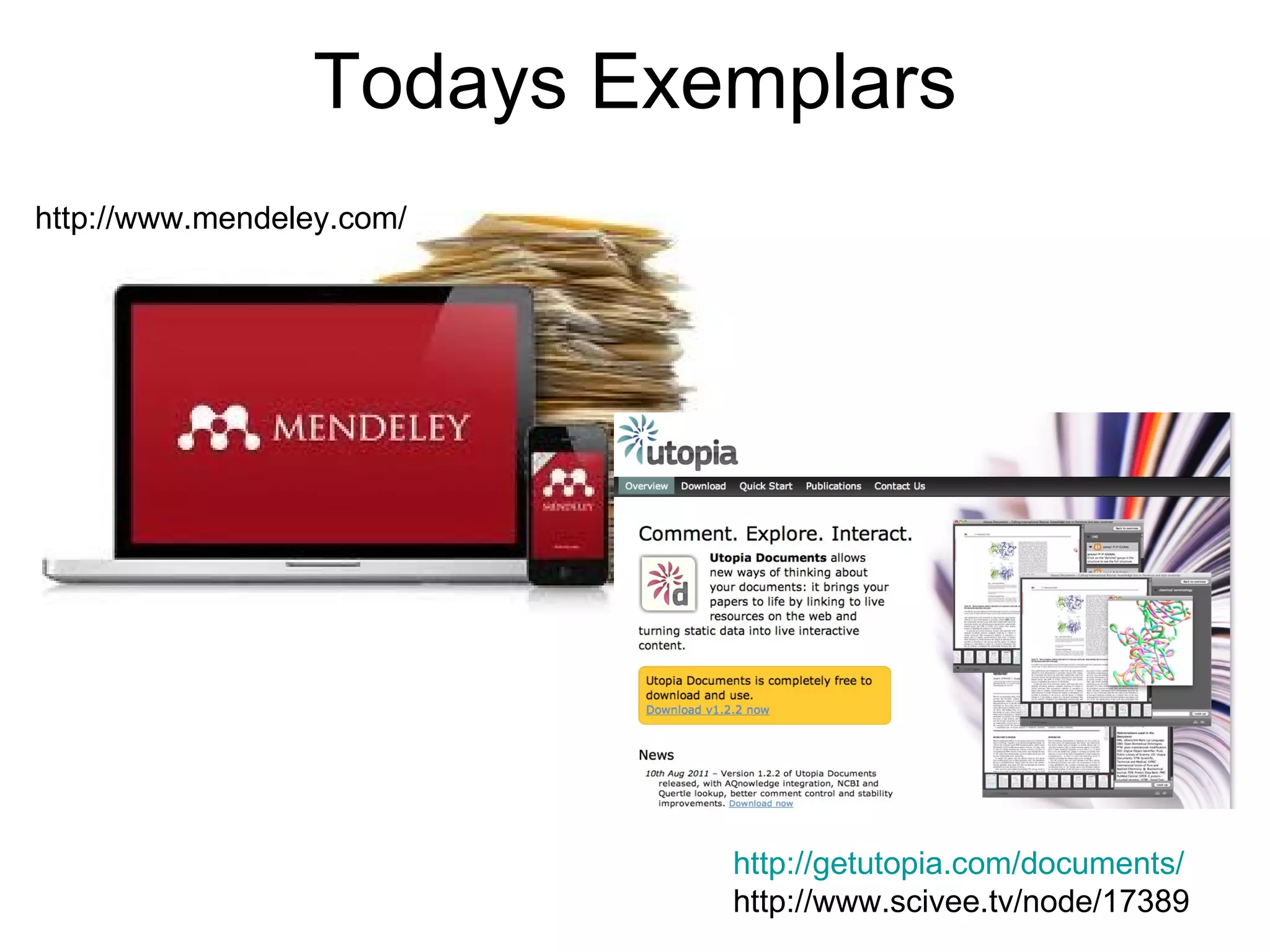
Todays Exemplars http://www.mendeley.com/ http://getutopia.com/documents/ http://www.scivee.tv/node/17389
Let me Start with a Few Observations Observation 1. Scientific culture is causing us to try and write more and read more
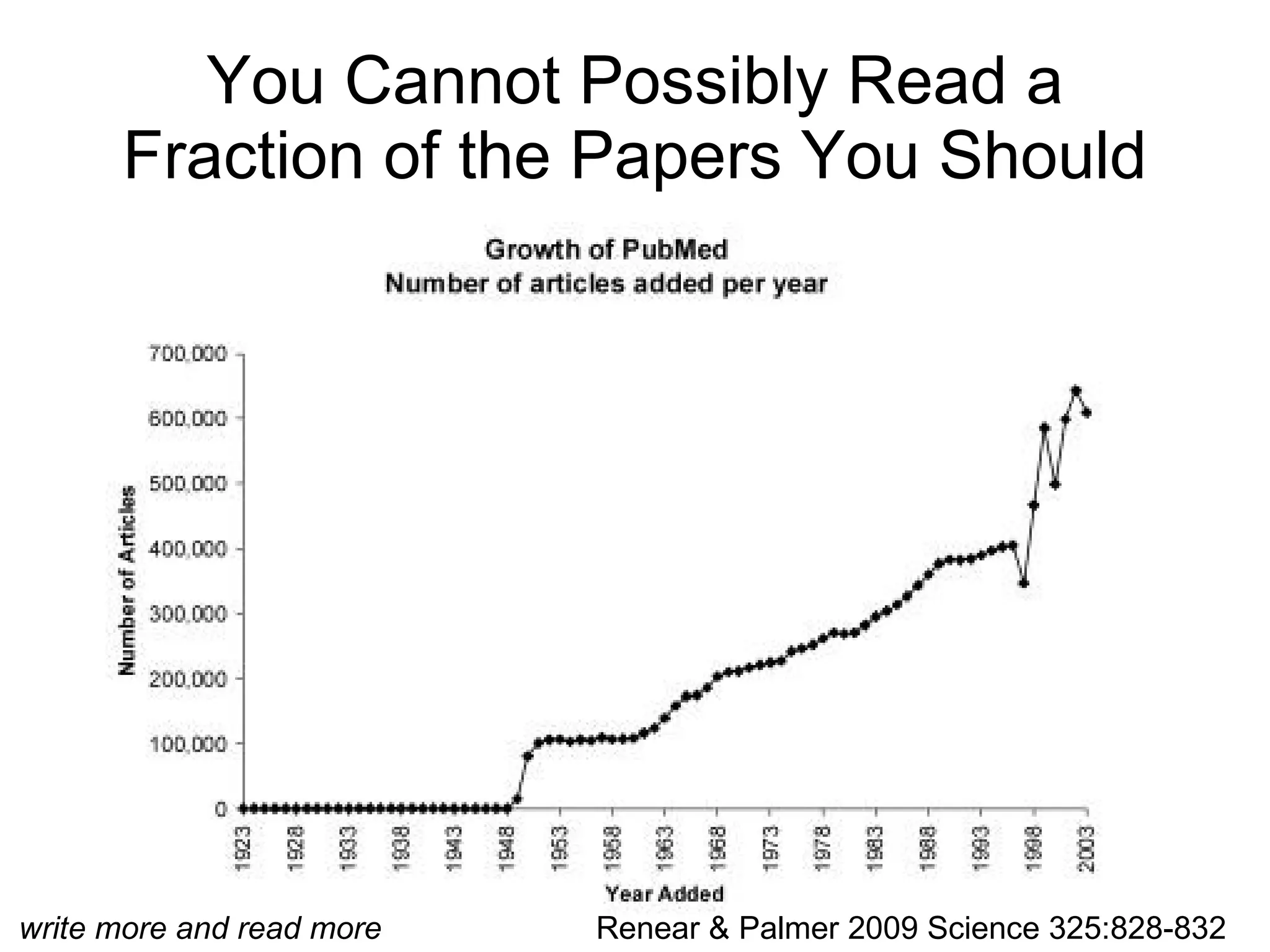
You Cannot Possibly Read a Fraction of the Papers You Should write more and read more Renear & Palmer 2009 Science 325:828-832
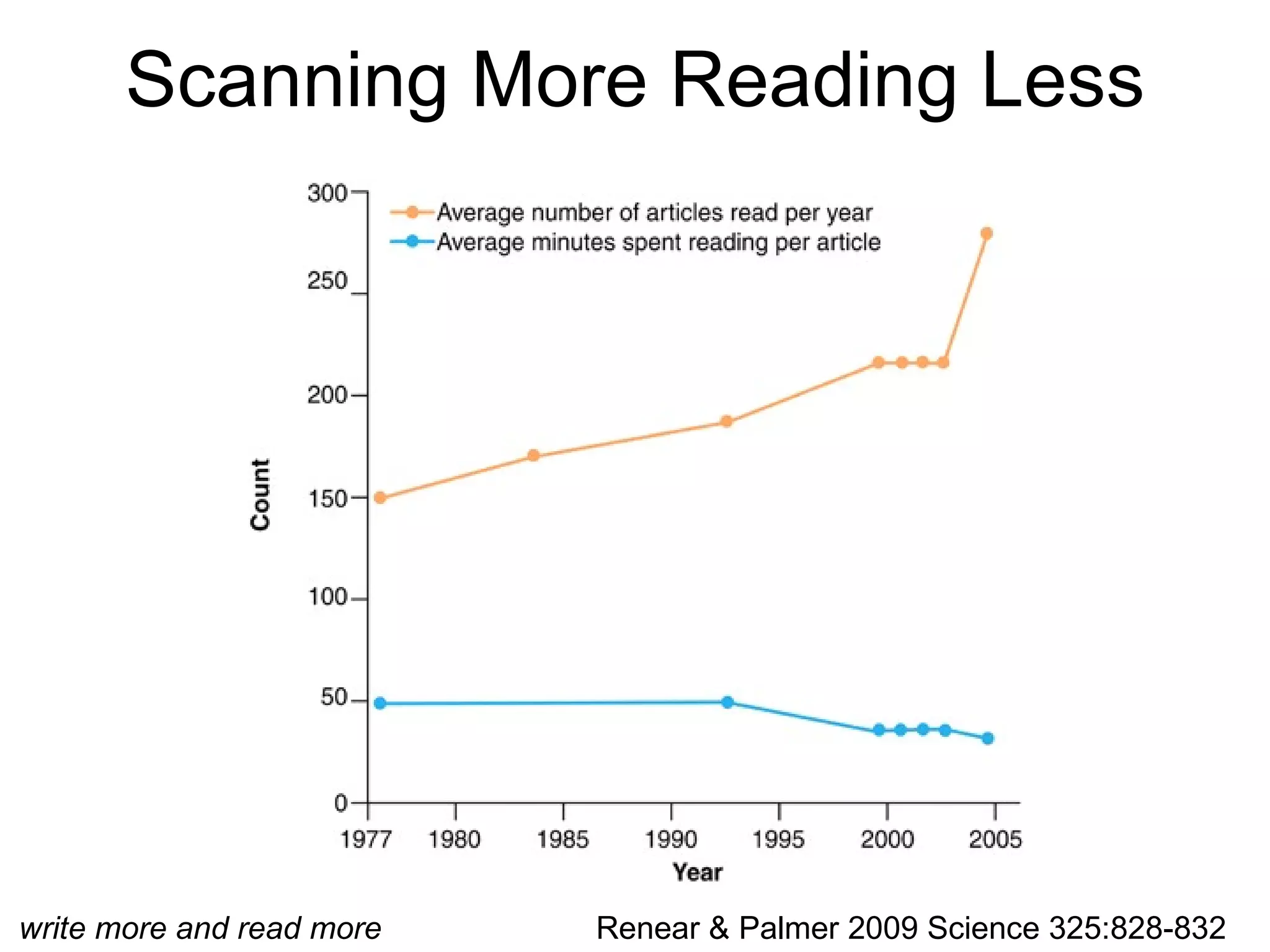
Scanning More Reading Less Renear & Palmer 2009 Science 325:828-832 write more and read more
And So… There has been a paradigm shift which places more emphasis on writing and less on reading – witness blogs, use of literature aggregators (e.g. PubMed), H-factors, etc. We need help in assimilating knowledge write more and read more
Observation 2 In 1993 there were very few electronic journals, by 2003 nearly all were on-line, by 2013 there will be little or no paper Most traditional publishers have only really achieved an electronic print like experience – the power of the medium is for the taking
Observation 3. The Sociology of Scientific Disciplines is Different
Observation 4: The biomedical sciences is progressive: Alternative business models have gained ground – Open Access Databases are becoming more like journals and journals are becoming more like databases New modes of knowledge and data access are gaining some ground e.g. Textpresso – ontology-based mining and retrieval system iHOP Information Hyperlinked over Proteins
Observation 5. I Believe Open Access IF Fully Accepted Could Profoundly Change Scholarly Discourse It remains a big IF Open Access: Taking Full Advantage of the Content PLoS Comp. Biol. 2008 4(3) e1000037
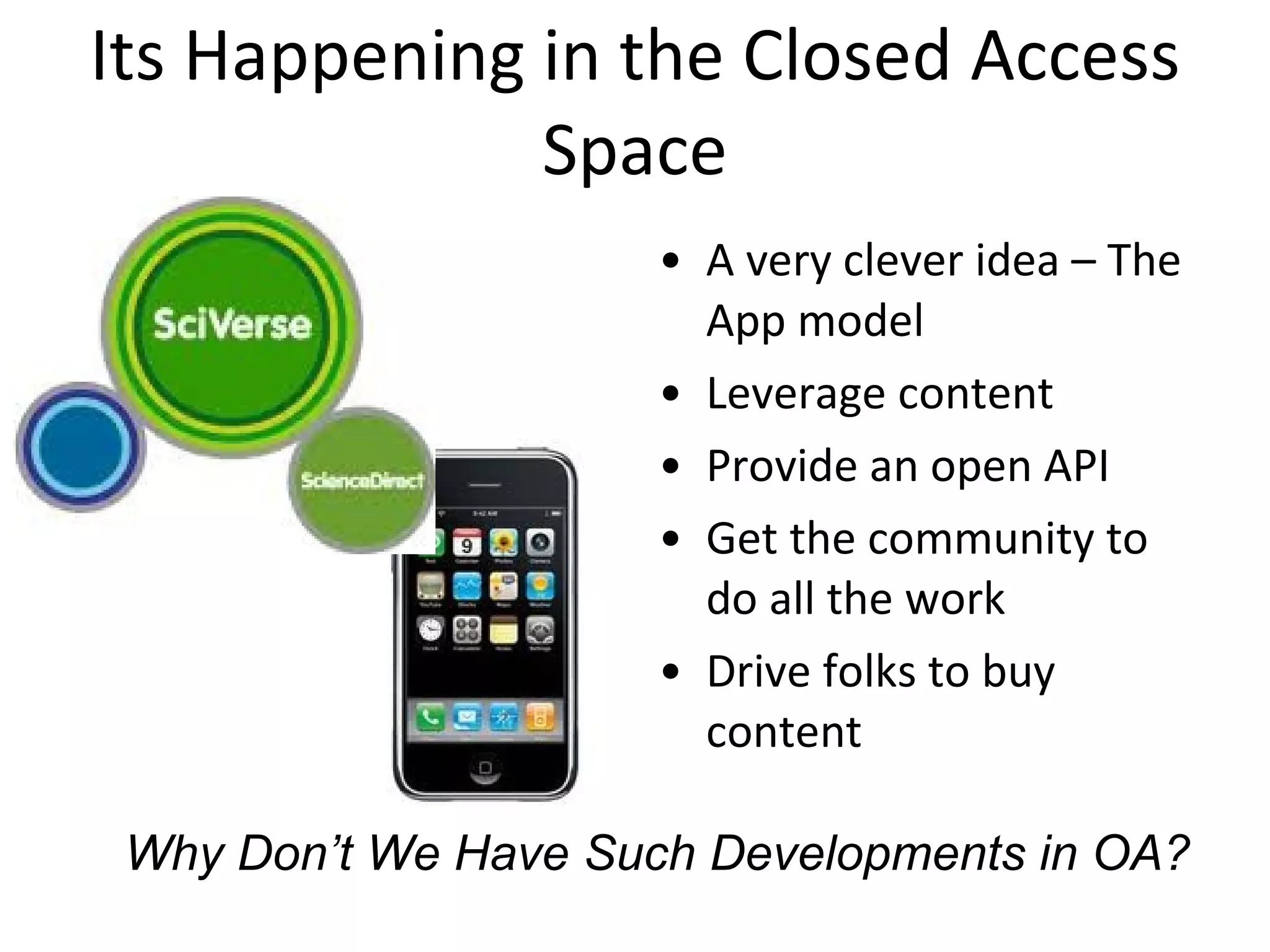
Its Happening in the Closed Access Space A very clever idea – The App model Leverage content Provide an open API Get the community to do all the work Drive folks to buy content Why Don’ t We Have Such Developments in OA?
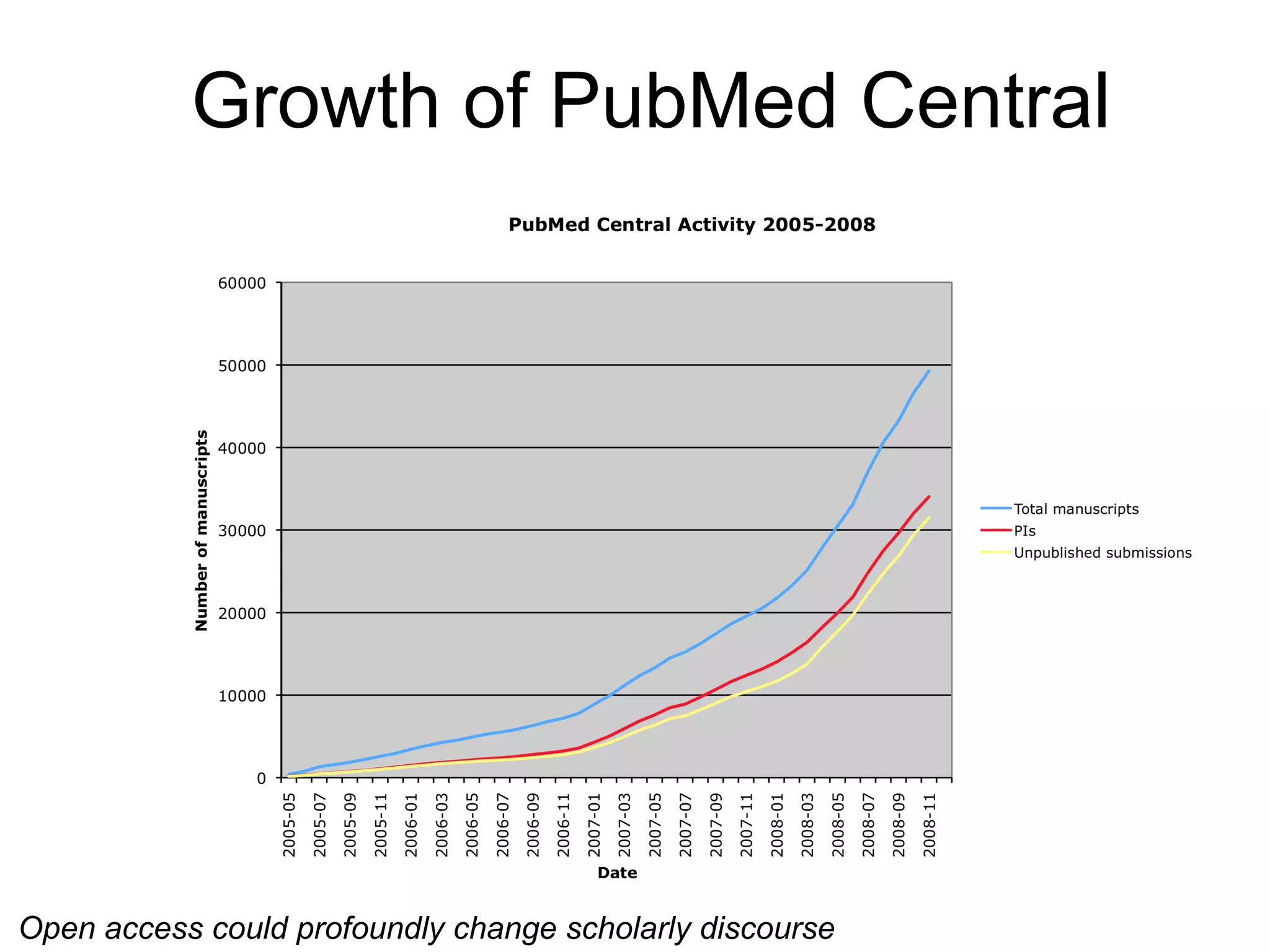
Growth of PubMed Central Open access could profoundly change scholarly discourse
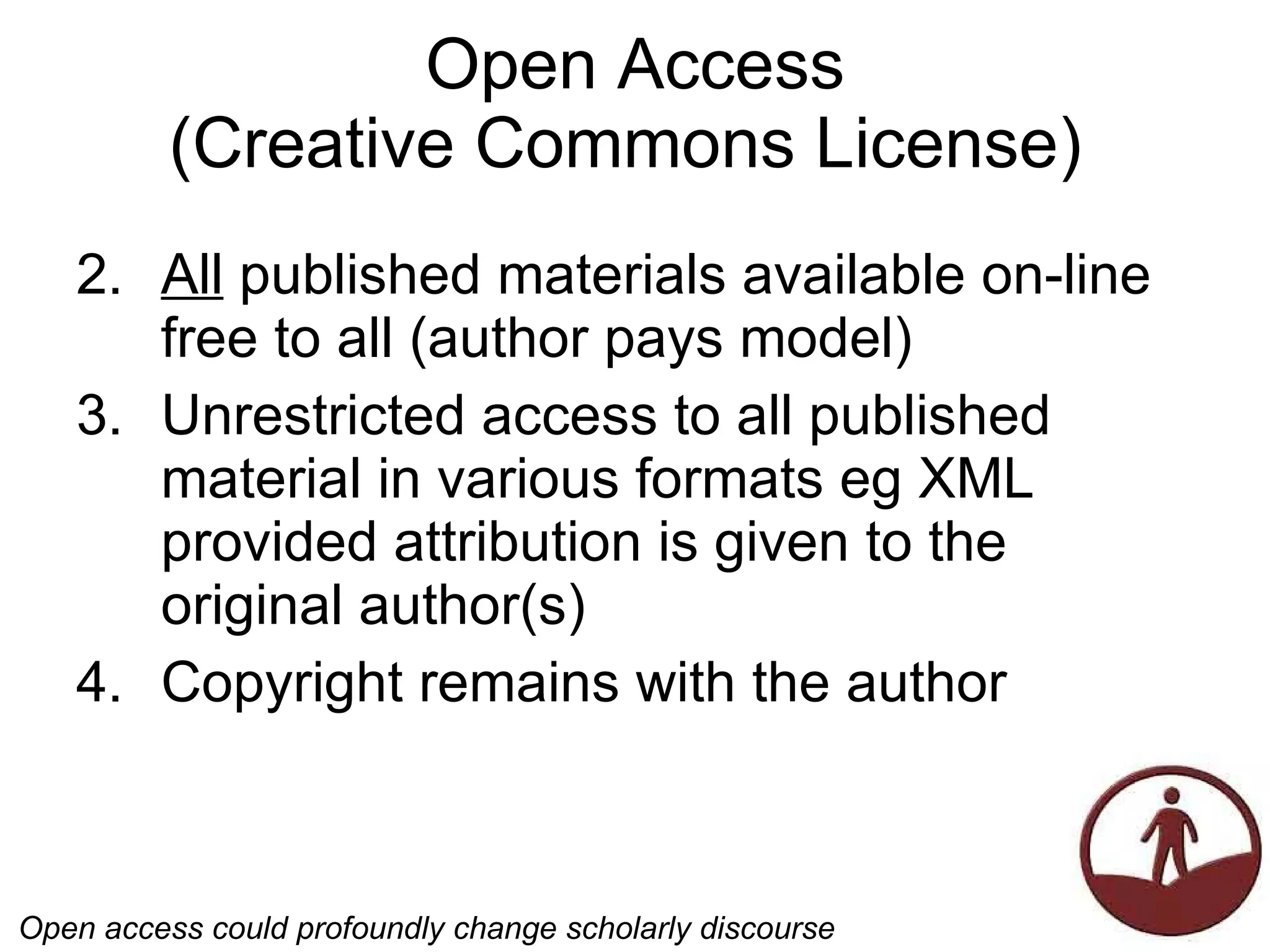
Open Access (Creative Commons License)  All  published materials available on-line free to all (author pays model) Unrestricted access to all published material in various formats eg XML provided attribution is given to the original author(s) Copyright remains with the author  Open access could profoundly change scholarly discourse
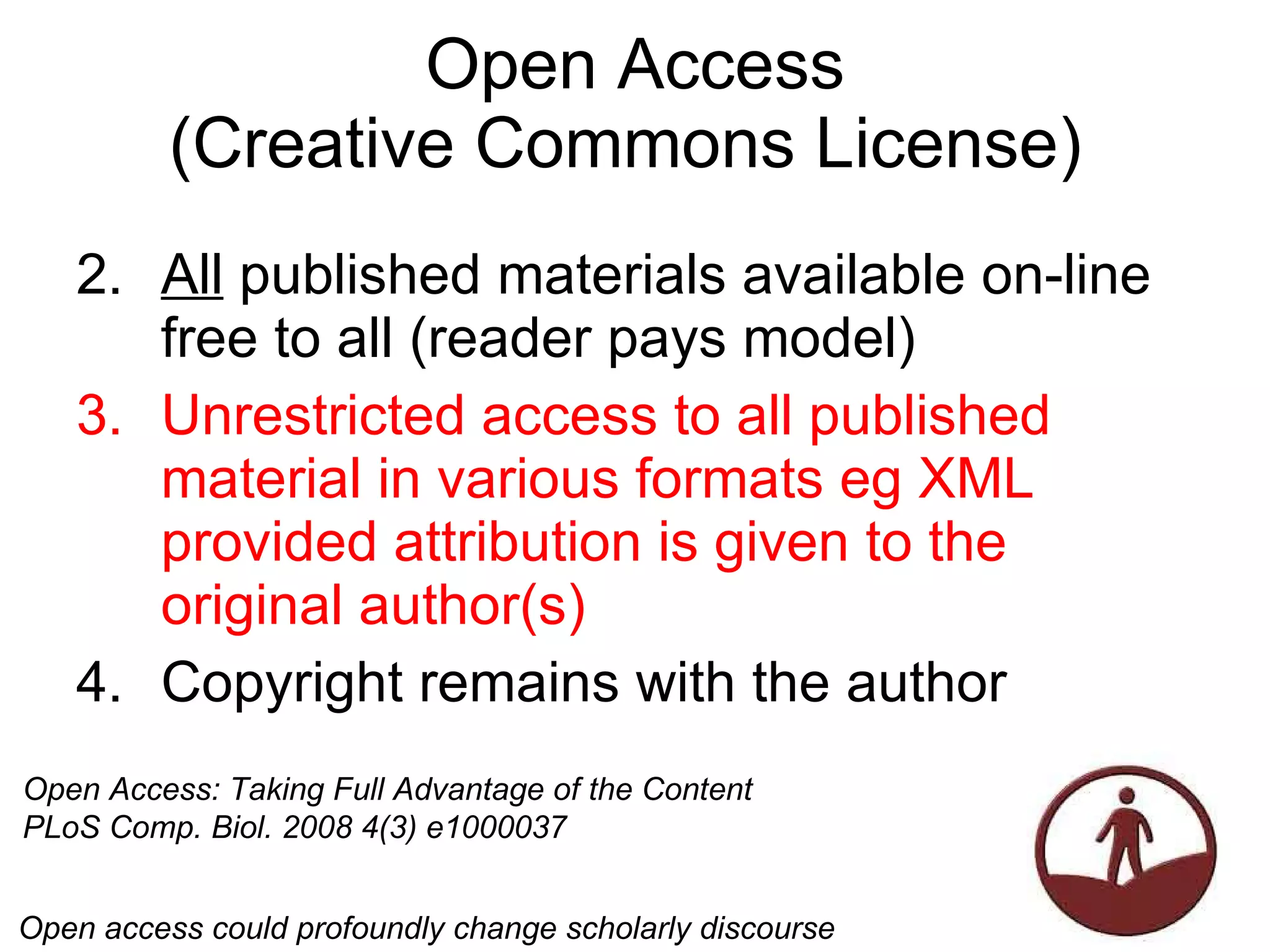
Open Access (Creative Commons License)  All  published materials available on-line free to all (reader pays model) Unrestricted access to all published material in various formats eg XML provided attribution is given to the original author(s) Copyright remains with the author  Open Access: Taking Full Advantage of the Content PLoS Comp. Biol. 2008 4(3) e1000037 Open access could profoundly change scholarly discourse
Observation 6 A biological database is not really that different from a biological journal – this can be exploited PLoS Comp. Biol . 2005 1(3) e34
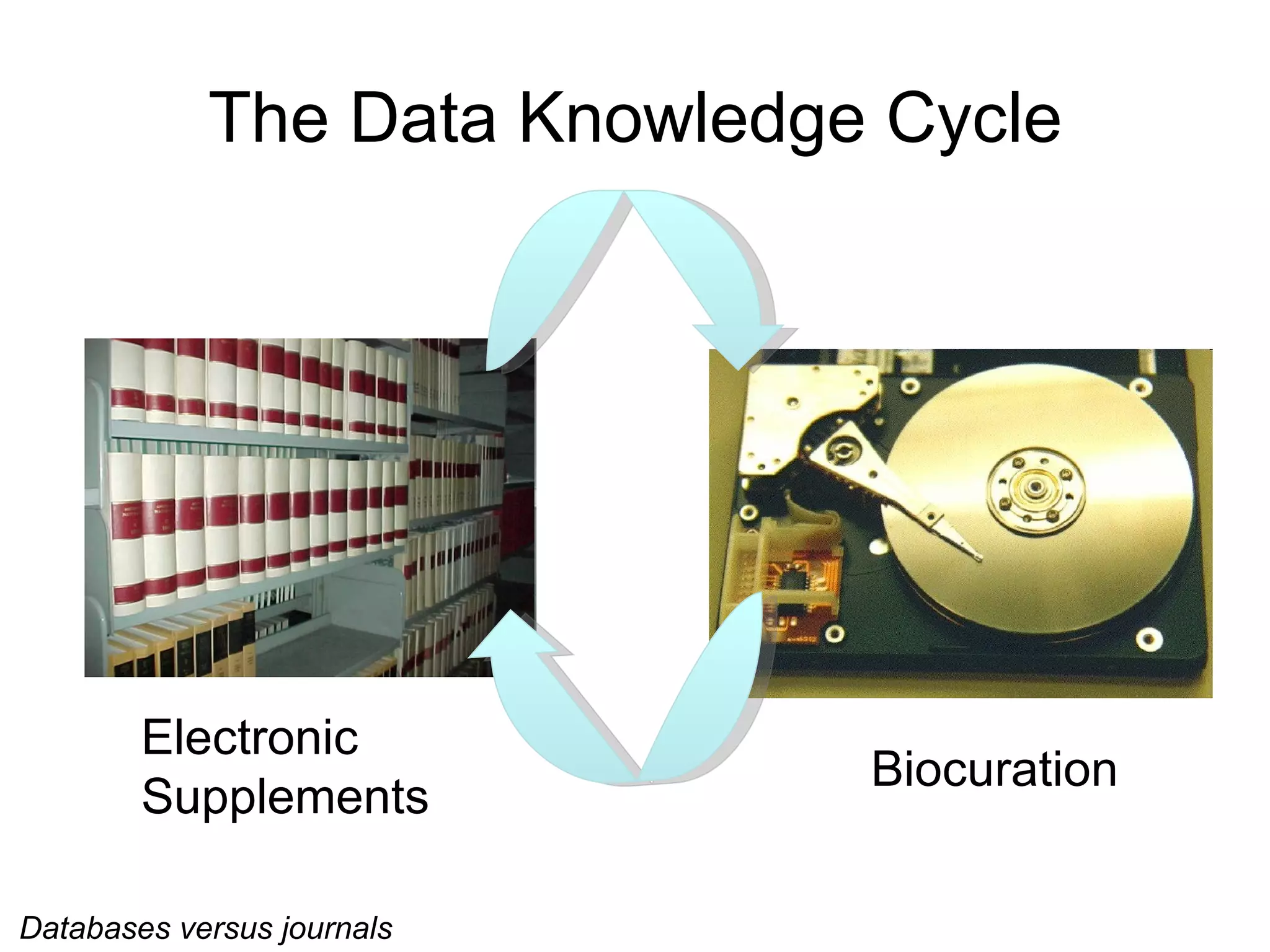
The Data Knowledge Cycle Biocuration Electronic  Supplements Databases versus journals
Both Are Under Stress PubMed contains ~21M entries (May 2011) ~100,000 papers indexed per month In Feb 2009: 67,406,898 interactive searches were done 92,216,786 entries were viewed 1330 databases reported in NAR 2011 MetaBase  http://biodatabase.org  reports 2,651 entries edited 12,587 times PLoS Comp. Biol . 2005 1(3) e34
Some More Comparisons Journals have a pretty standardized interface Journals have a business model The quality is declining as numbers increase (?) Audience believes they are sustainable Efforts to make the interfaces different! Little attempt at a business model compared to the Web 2.0 world Quality is increasing (?) Not well sustained PLoS Comp. Biol. 2008. 4(7): e1000136 Databases versus journals
Some More Comparisons New publishing models eg open access, self publishing, open review Web 2.0 influence eg social networks Use of rich media The review process is failing New metrics Read and write eg Wikis New services eg restful, widgets Use of Rich Media Crowd review emerging Databases versus journals
Duh If we need to acquire more knowledge quickly If more literature and data are becoming open If both are under stress Why don ’t we merge journals and databases for a new learning experience
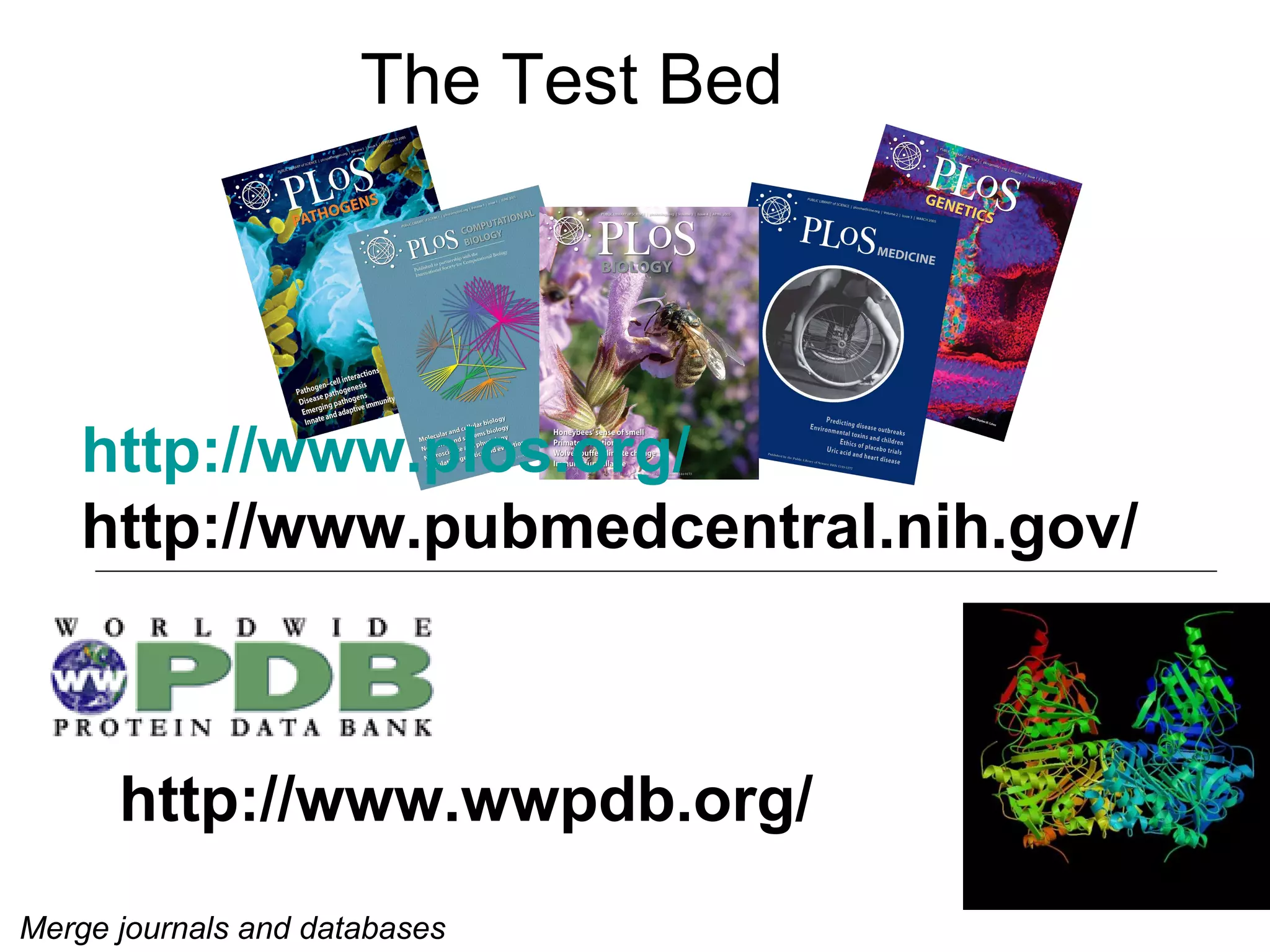
The Test Bed http://www.wwpdb.org/ http://www.plos.org/   http://www.pubmedcentral.nih.gov/ Merge journals and databases
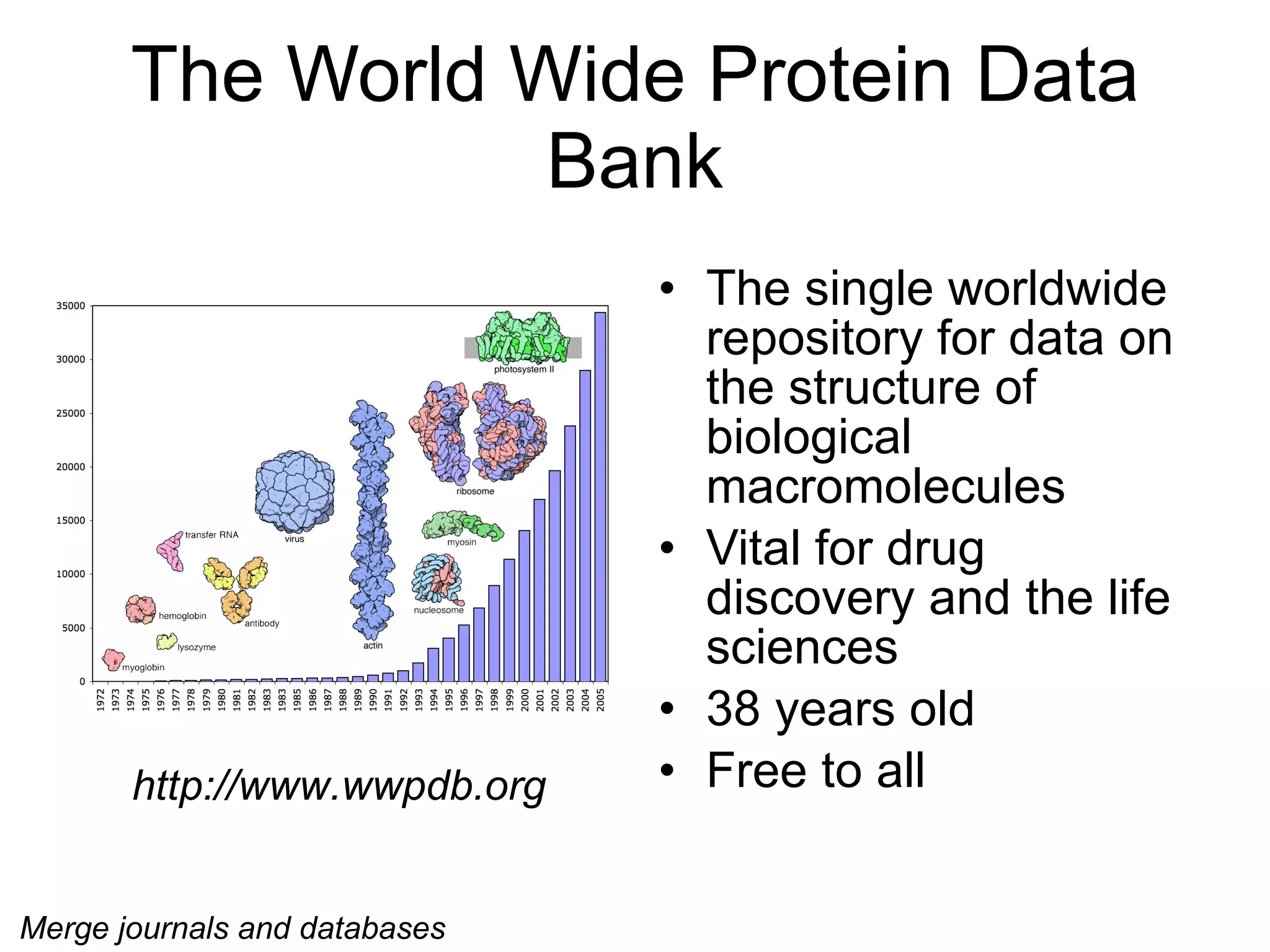
The World Wide Protein Data Bank The single worldwide repository for data on the structure of biological macromolecules Vital for drug discovery and the life sciences 38 years old Free to all http://www.wwpdb.org Merge journals and databases
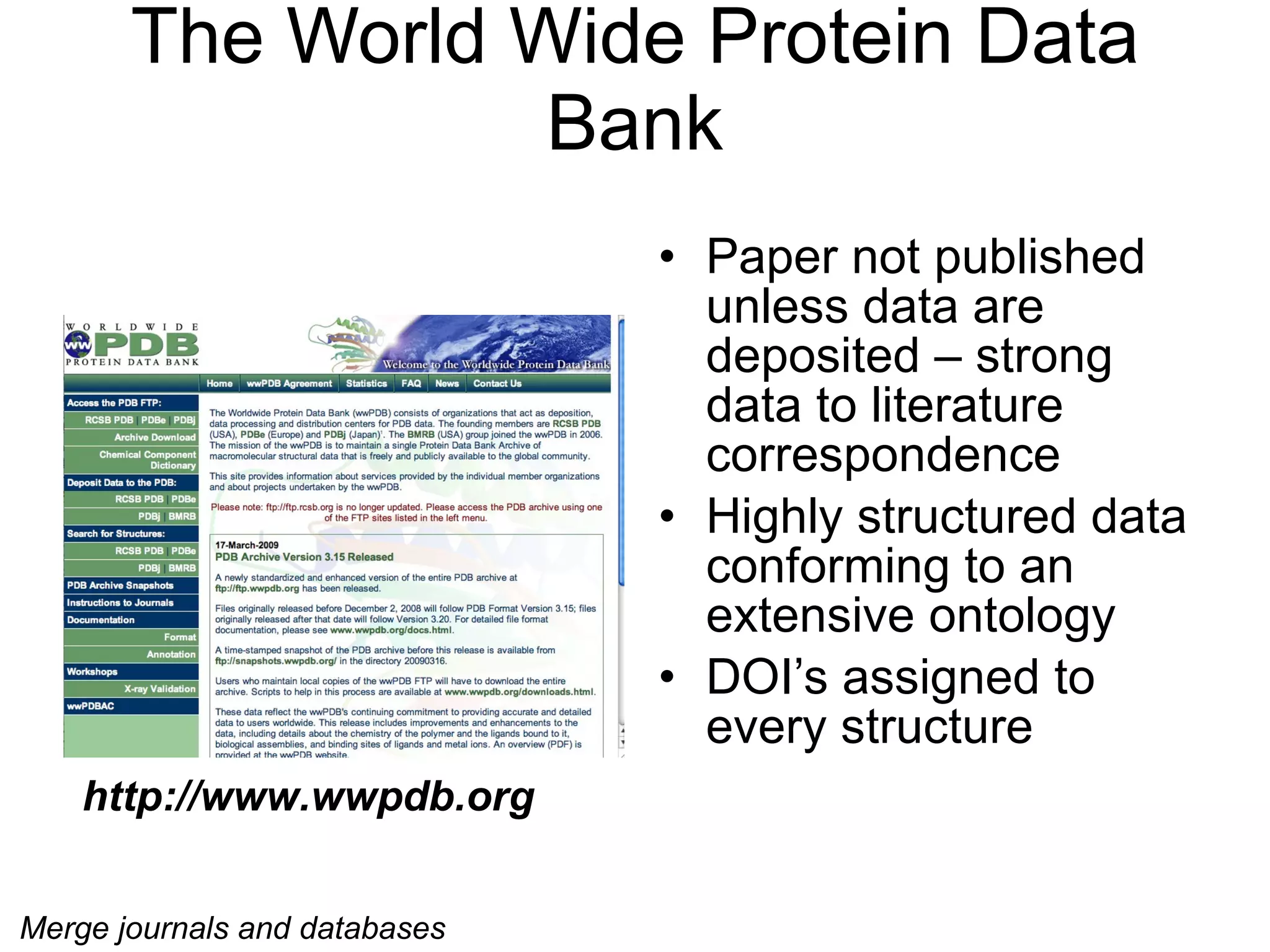
The World Wide Protein Data Bank Paper not published unless data are deposited – strong data to literature correspondence Highly structured data conforming to an extensive ontology DOI ’s assigned to every structure http://www.wwpdb.org Merge journals and databases
The PLoS/PMC Corpus – Under the Hood Conforms well/partially to the NLM DTD – little markup of content PMC – some PDFs ! The lack of conformance will come back to haunt us!
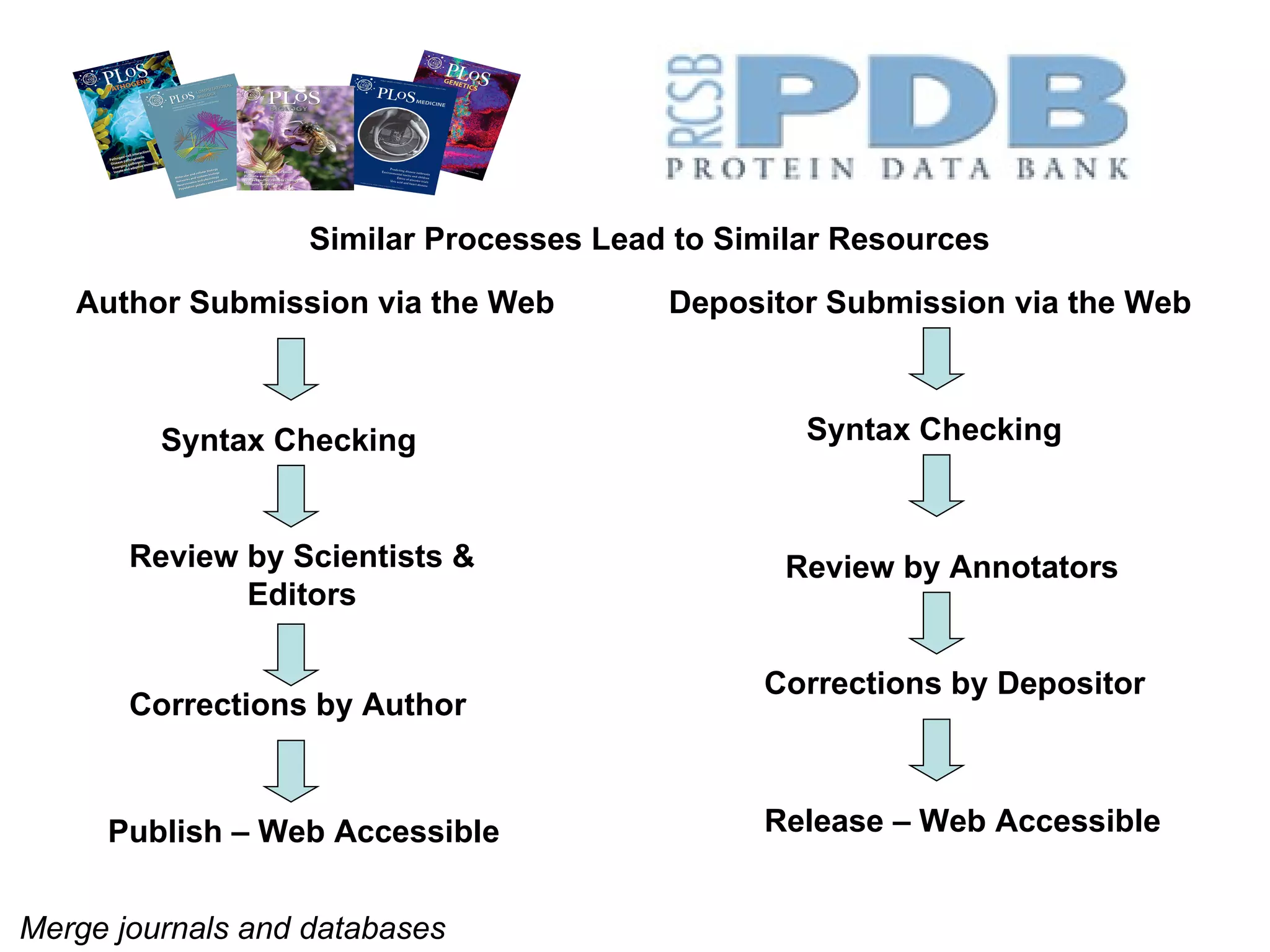
Author Submission via the Web Depositor Submission via the Web Syntax Checking Syntax Checking Review by Scientists & Editors Review by Annotators Corrections by Author Corrections by Depositor Publish – Web Accessible Release – Web Accessible Similar Processes Lead to Similar Resources Merge journals and databases
So the processes are not that dissimilar it is the final product that is perceived so differently Even that might be changing slowly? PLoS Comp. Biol.  2008 4(12) e1000247 Merge journals and databases
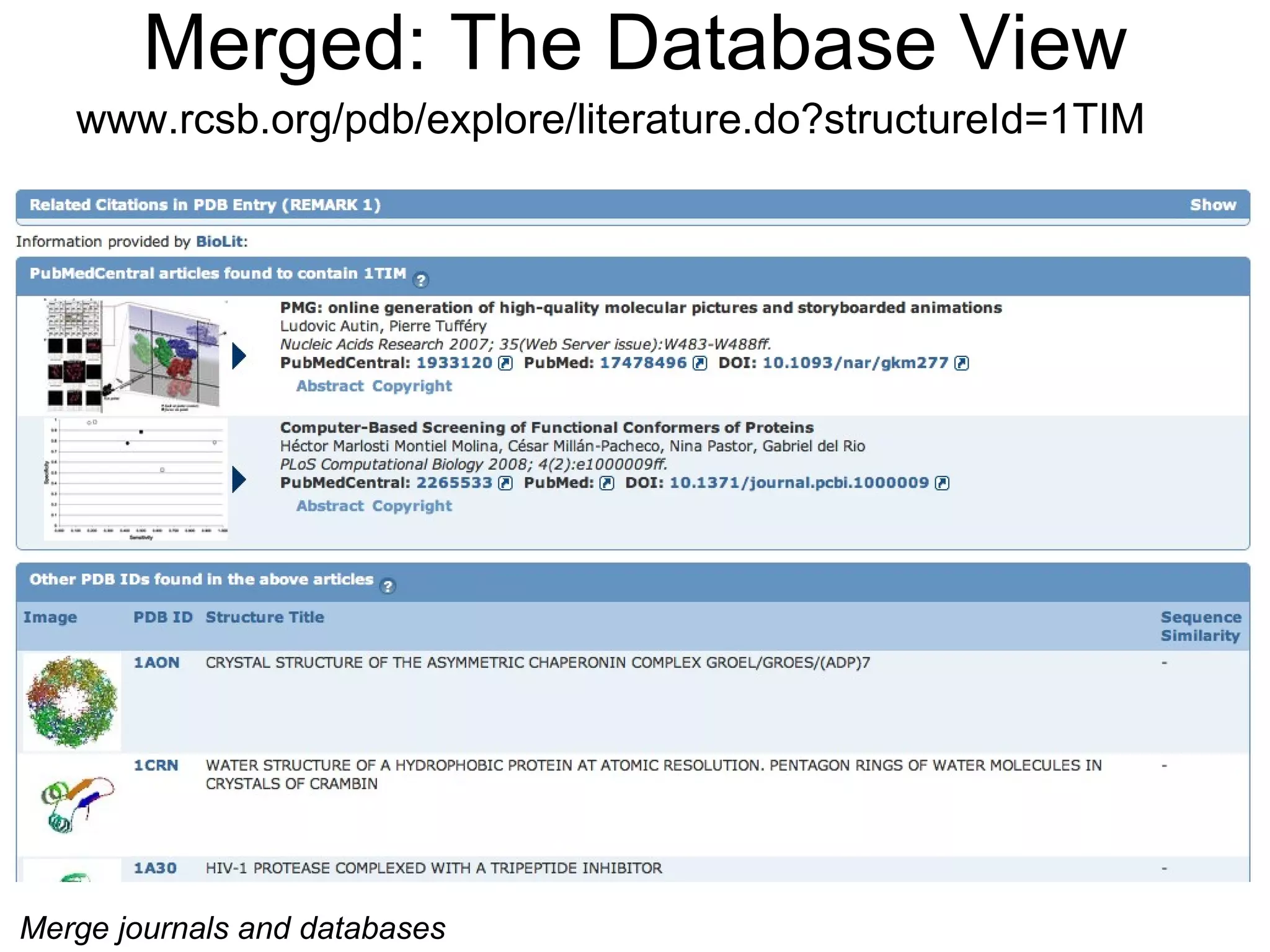
Merged: The Database View www.rcsb.org/pdb/explore/literature.do?structureId=1TIM Merge journals and databases
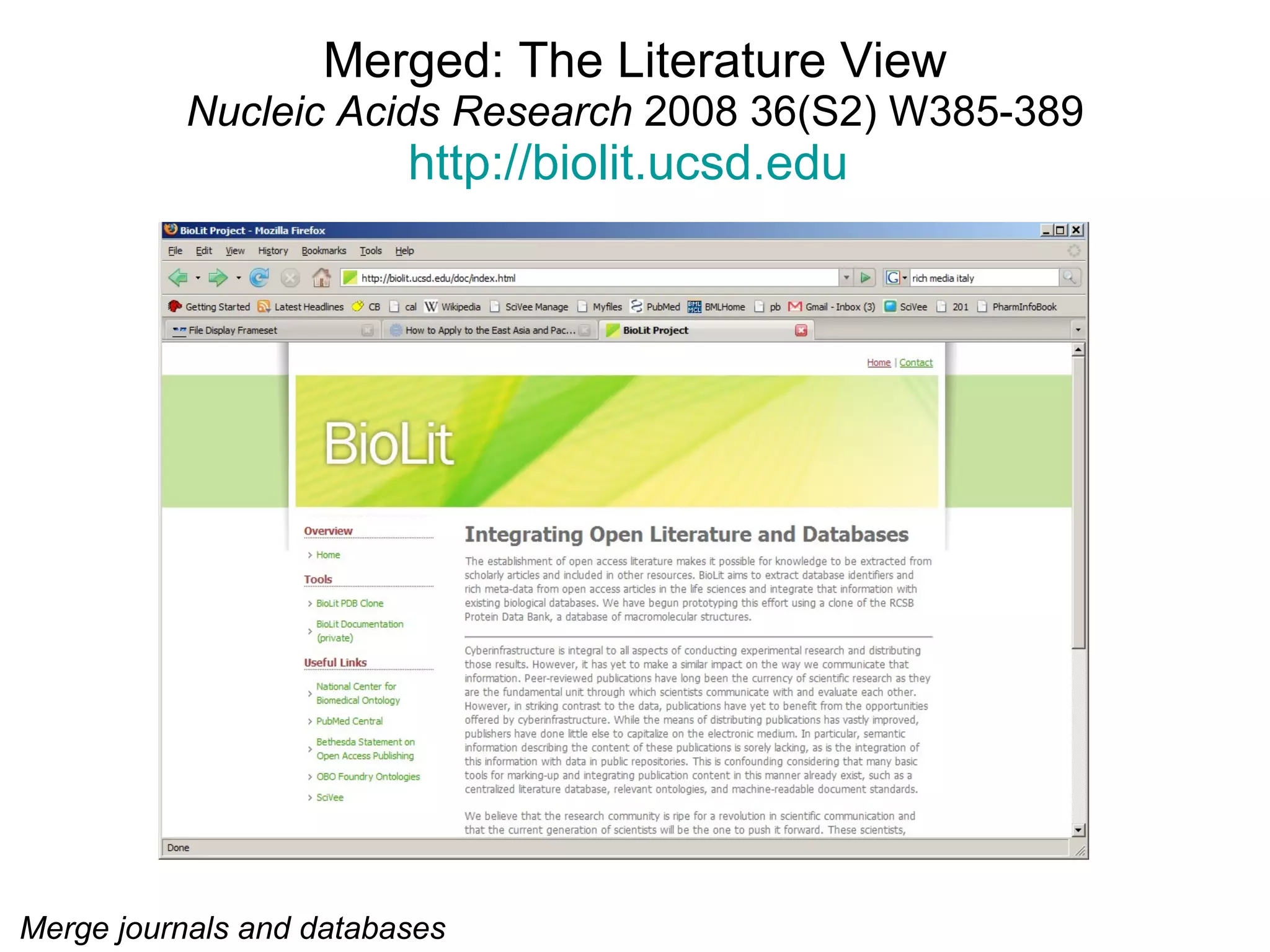
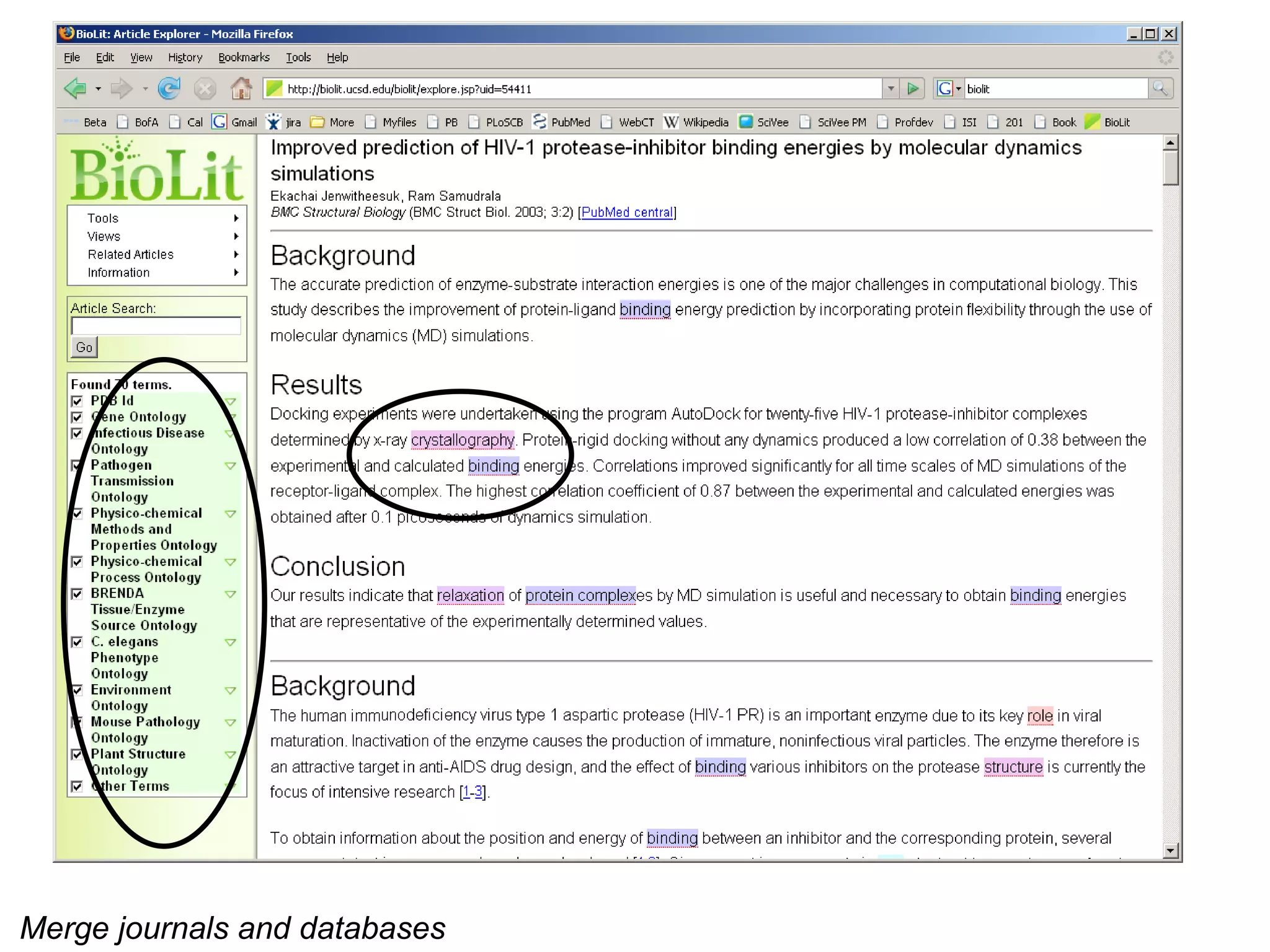
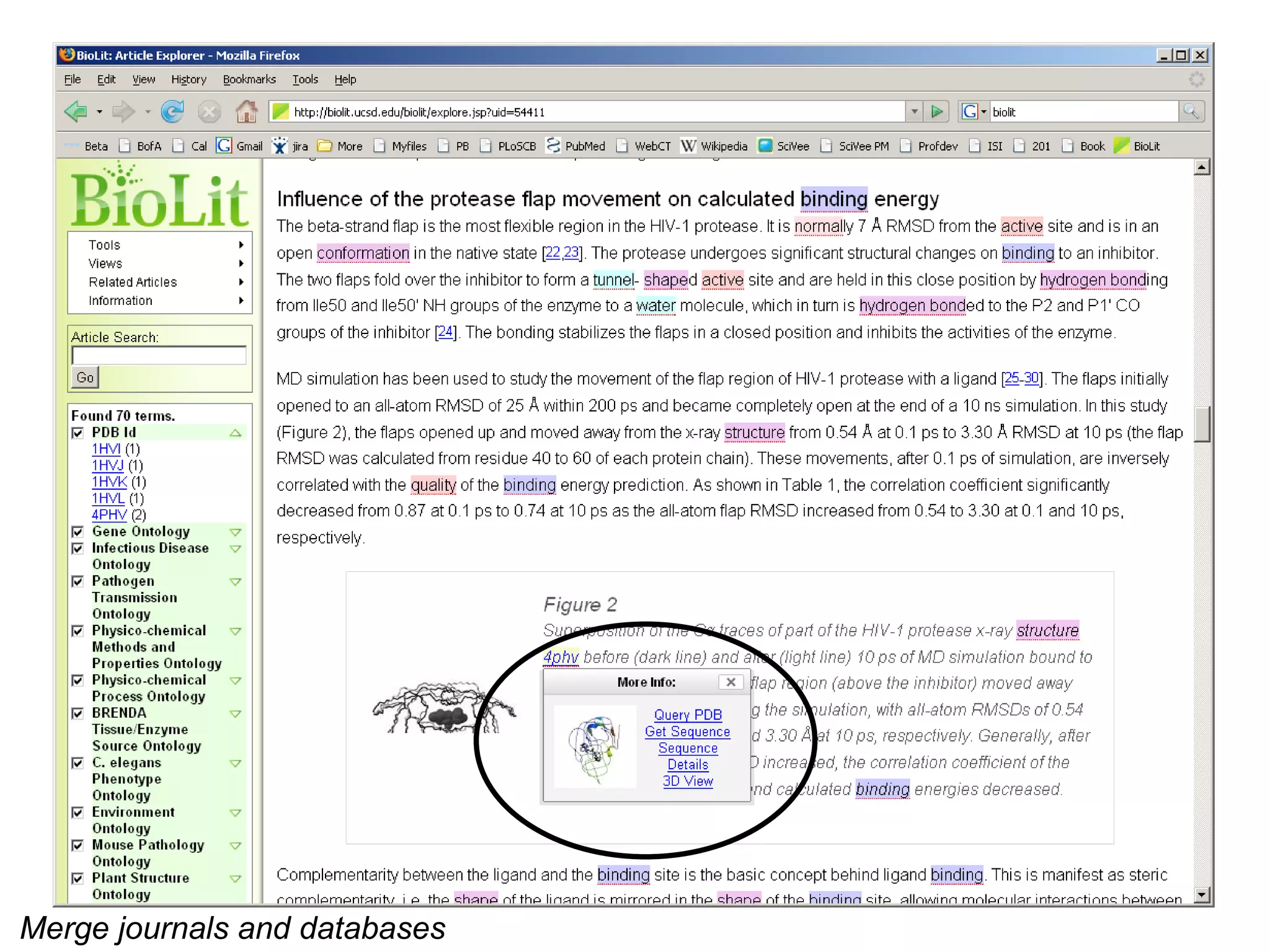
Merged: The Literature View Nucleic Acids Research  2008 36(S2) W385-389 http://biolit.ucsd.edu   Merge journals and databases
Merge journals and databases
ICTP Trieste, December 10, 2007 Merge journals and databases
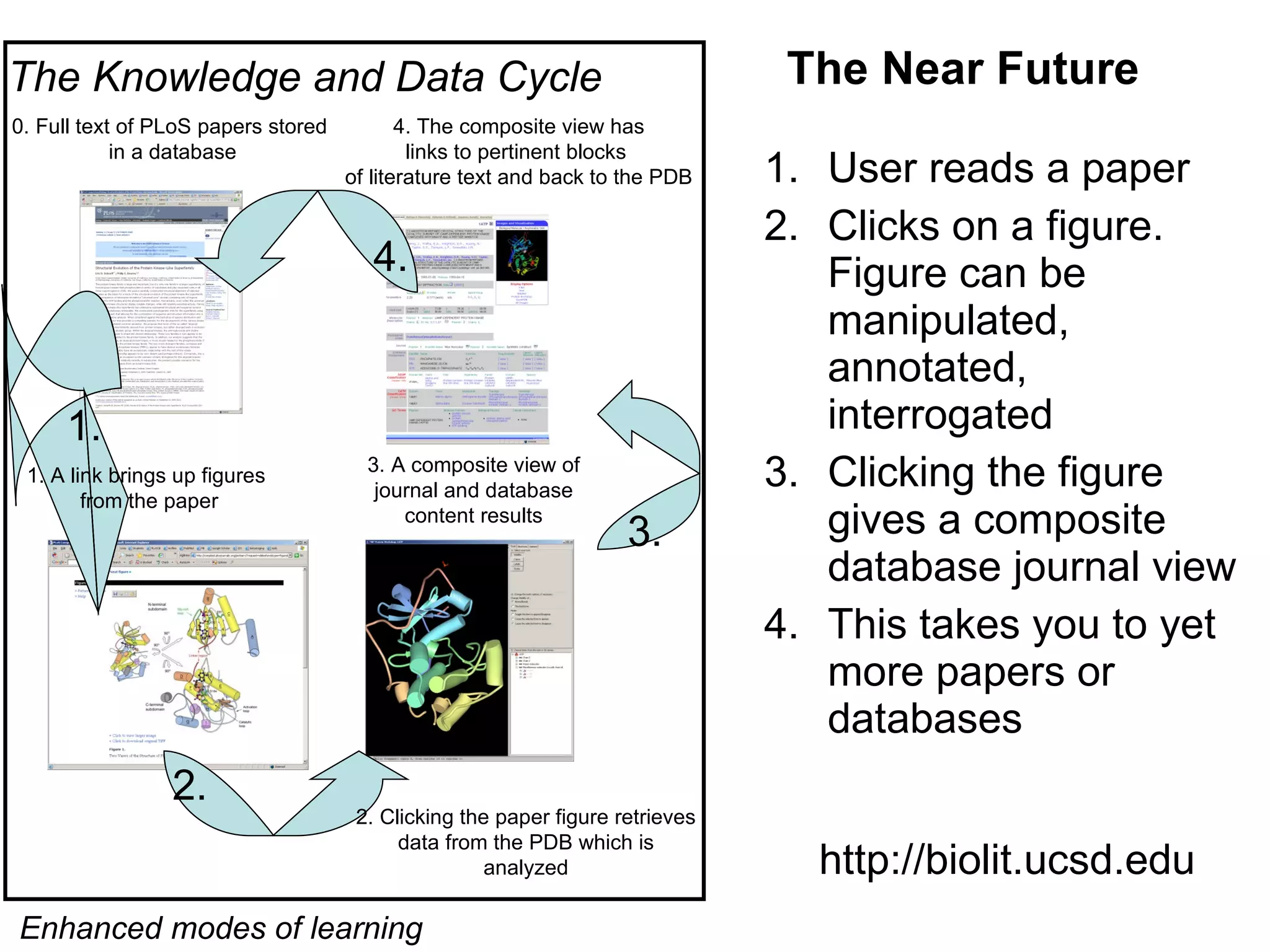
The Near Future User reads a paper Clicks on a figure. Figure can be manipulated, annotated, interrogated Clicking the figure gives a composite database journal view This takes you to yet more papers or databases 1. A link brings up figures  from the paper 0. Full text of PLoS papers stored  in a database 2. Clicking the paper figure retrieves data from the PDB which is analyzed 3. A composite view of journal and database content results 4. The composite view has links to pertinent blocks  of literature text and back to the PDB 1. 2. 3. 4. The Knowledge and Data Cycle http://biolit.ucsd.edu Enhanced modes of learning
Observation 7: This is Literature Post-processing Better to Get the Authors Involved Authors are the absolute experts on the content More effective distribution of labor Add metadata before the article enters the publishing process Merge journals and databases – requires semantic enrichment
Word 2007 Add-in for authors Allows authors to add metadata as they write, before they submit the manuscript Authors are assisted by automated term recognition OBO ontologies Database IDs Metadata are embedded directly into the manuscript document via XML tags, OOXML format Open Machine-readable Open source, Microsoft Public License http://www.codeplex.com/ucsdbiolit Merge journals and databases – requires semantic enrichment
Challenges Author use Familiarity with ontologies, terms Agreement between co-authors End-use of semantically enriched manuscript Combine with NLM XML standard Article Authoring Add-in Merge journals and databases – requires semantic enrichment
Challenges: Author Use IF one or more publishers fast tracked a paper that had semantic markup I would argue it would catch on in no time Merge journals and databases – requires semantic enrichment
Observation 8: There Are Some Simple Things We Can Do to Mine the Corpus
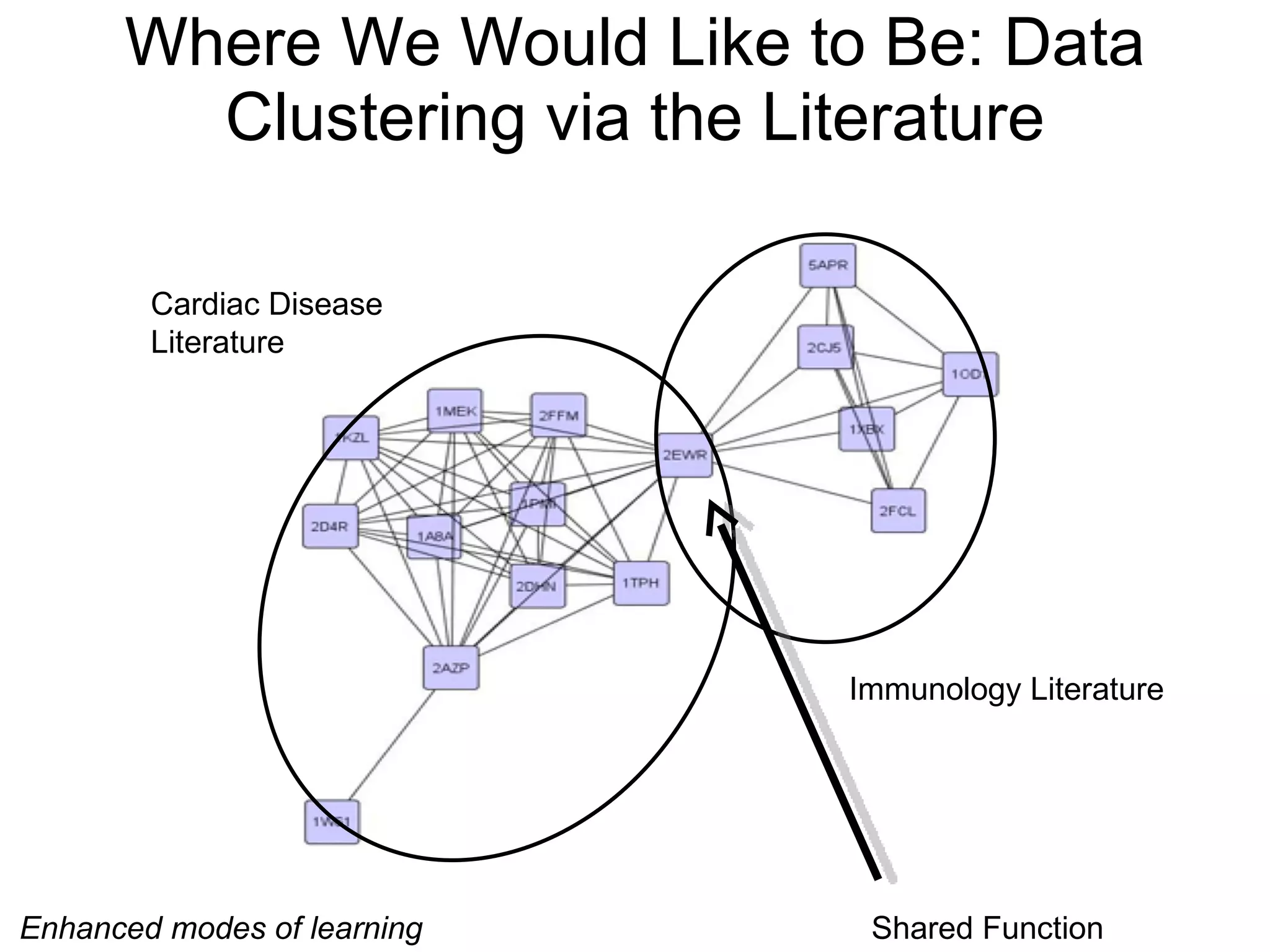
Where We Would Like to Be: Data Clustering via the Literature Shared Function Enhanced modes of learning Immunology Literature Cardiac Disease Literature
Observation 9: The Use of Rich Media is Underutilized
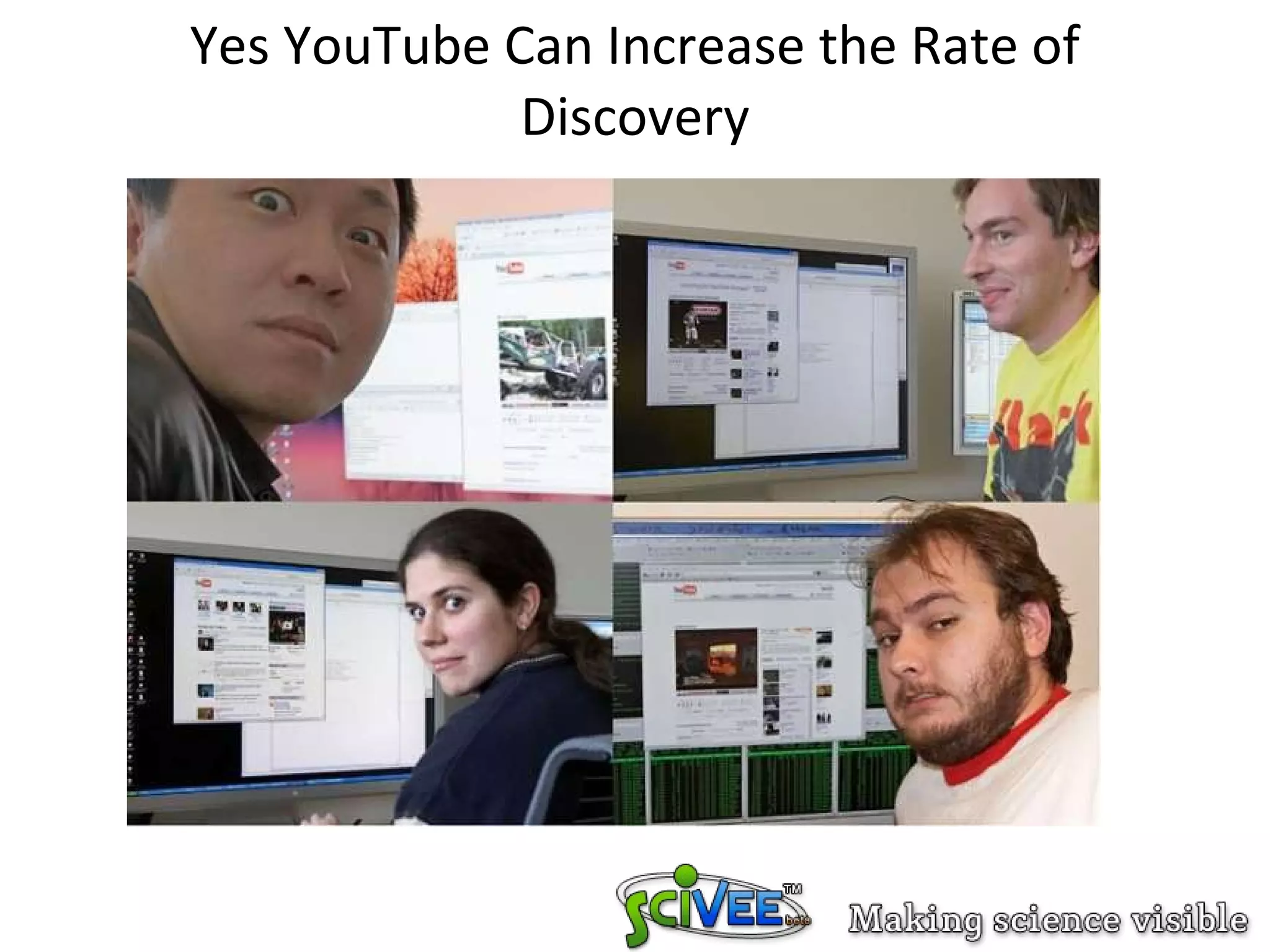
Yes YouTube Can Increase the Rate of Discovery
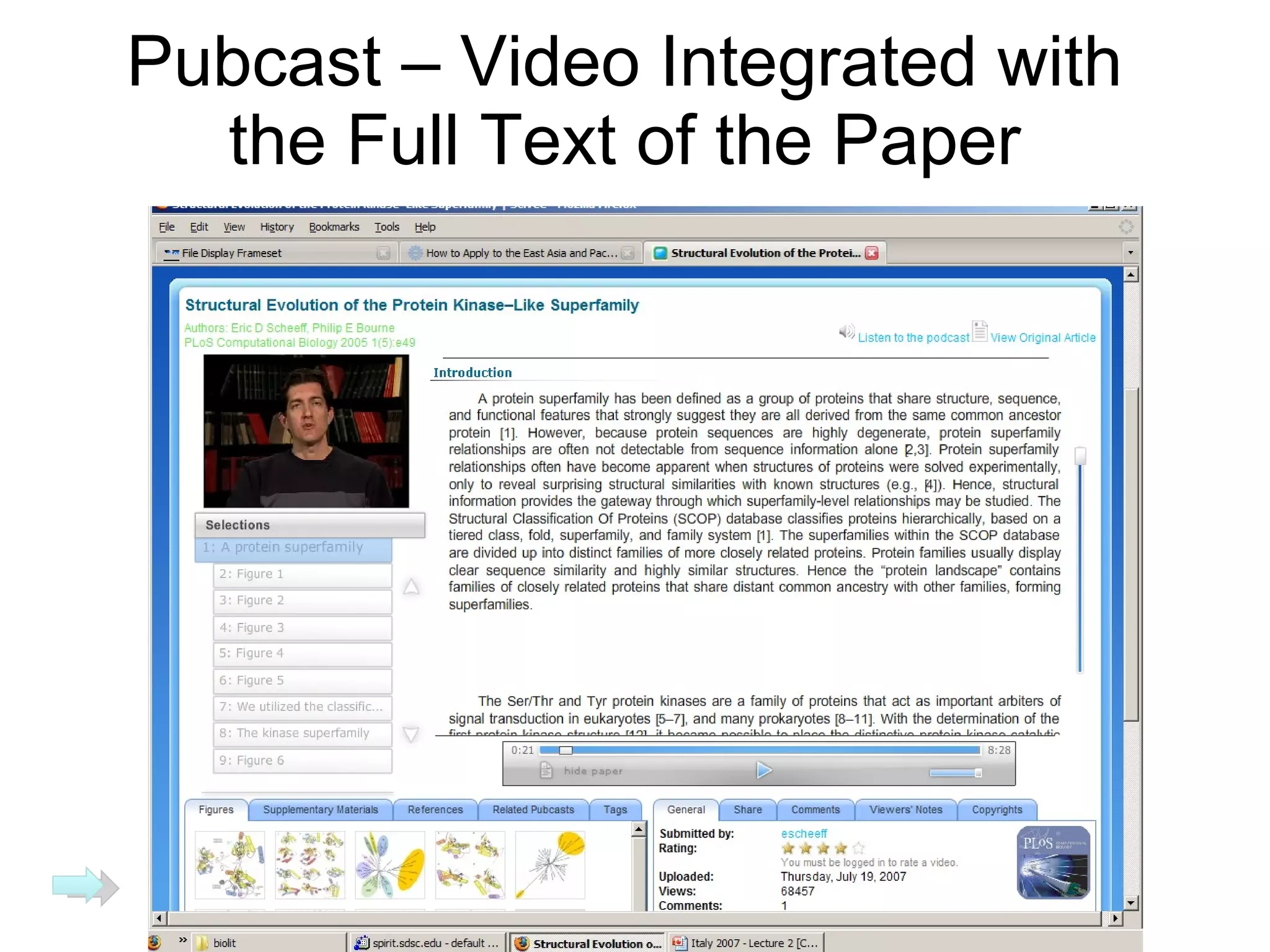
Pubcast – Video Integrated with the Full Text of the Paper
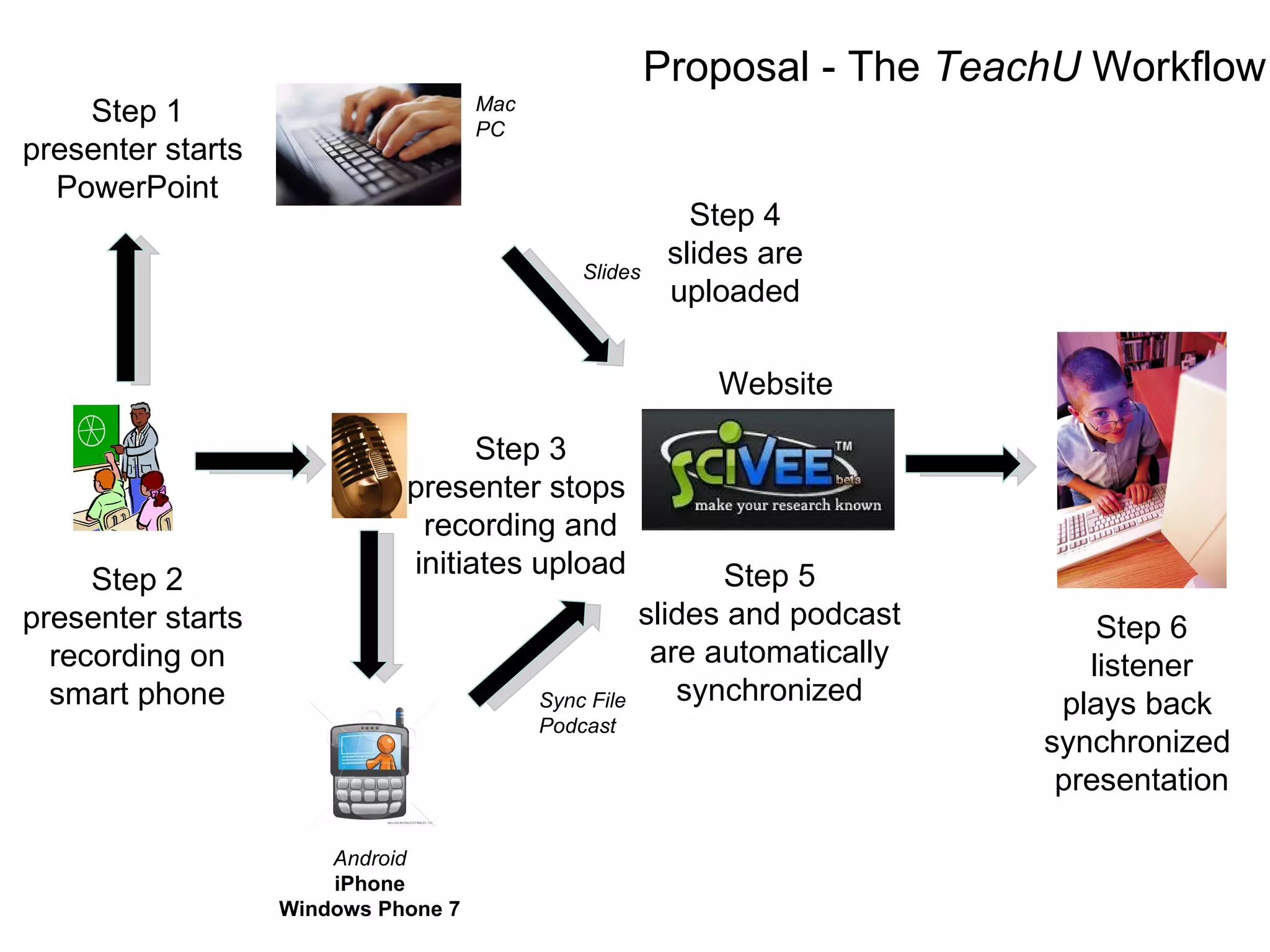
Android iPhone Windows Phone 7 Step 1 presenter starts  PowerPoint Step 2 presenter starts  recording on smart phone Step 3 presenter stops  recording and initiates upload Slides Website Step 5 slides and podcast are automatically synchronized Sync File Podcast Step 6 listener plays back  synchronized  presentation Proposal - The  TeachU  Workflow Mac PC Step 4 slides are uploaded
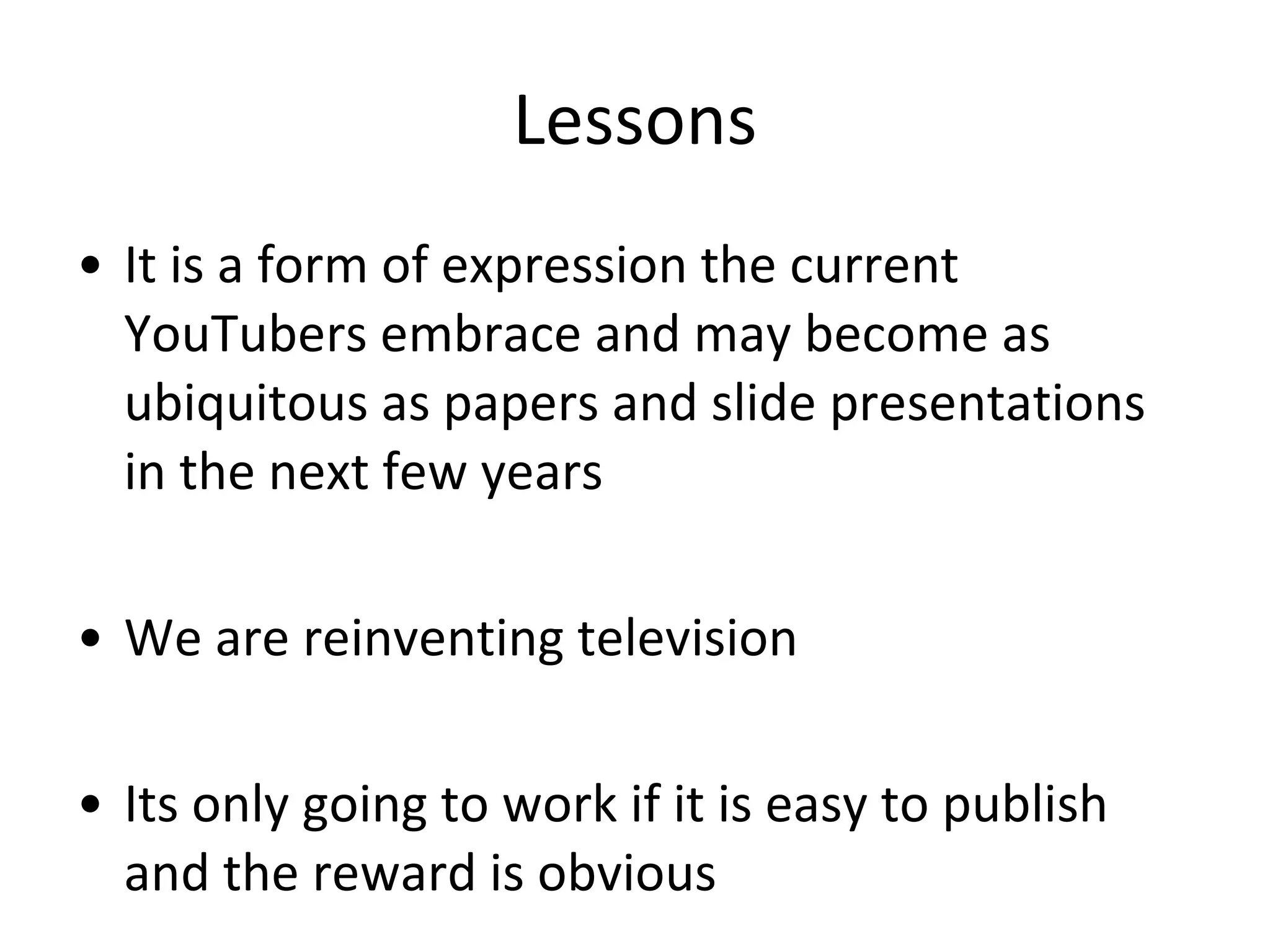
Lessons It is a form of expression the current YouTubers embrace and may become as ubiquitous as papers and slide presentations in the next few years We are reinventing television Its only going to work if it is easy to publish and the reward is obvious
Observation 10: Scientific Reproducability Requires we Publish Workflows
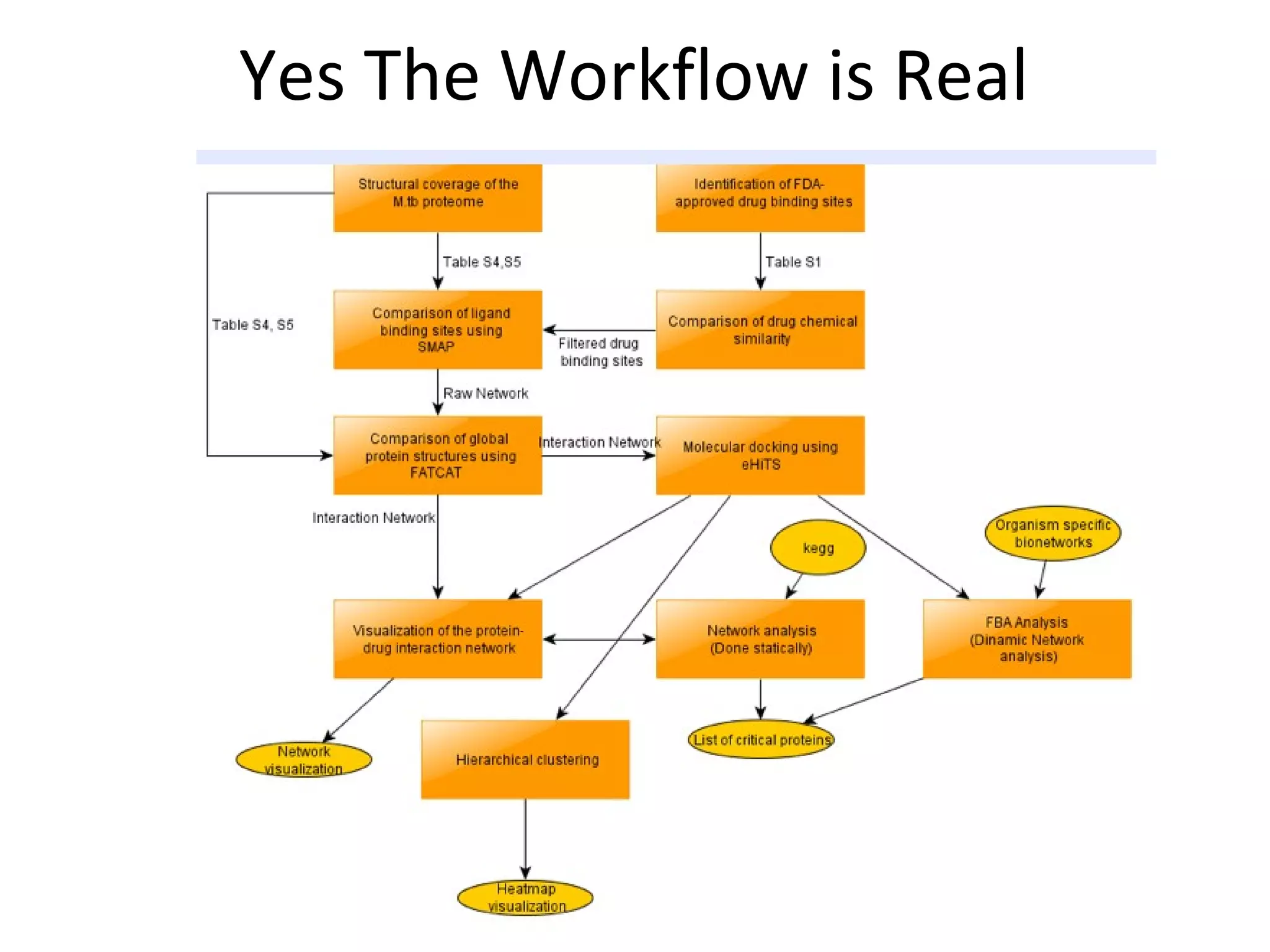
Yes The Workflow is Real
Reproducibility My views of reproducibility: We all express the importance, but the only time it is tested is when something is truly novel or error is suspected Reproducability covers a spectrum of meaning – by whom and with how much effort The longer the time lag the less likely something is reproducible
Workflow Tools Might be the Answer Taverna Wings
Consider an Example: Our Own Experience in Capturing the Scientific Process to Make it Open and Reproducable Its hard and embarrassing We have a working prototype using Wings I can feel the potential productivity gains My students are more doubtful Its been a lot of fun and will enable us to improve our processes regardless of the workflow system itself
Problems with Publishing Workflows Workflows are not linear Workflow : paper is not 1:1 Confidentiality Peer review Infrastructure Community acceptance Reward system No publisher seems willing to touch them
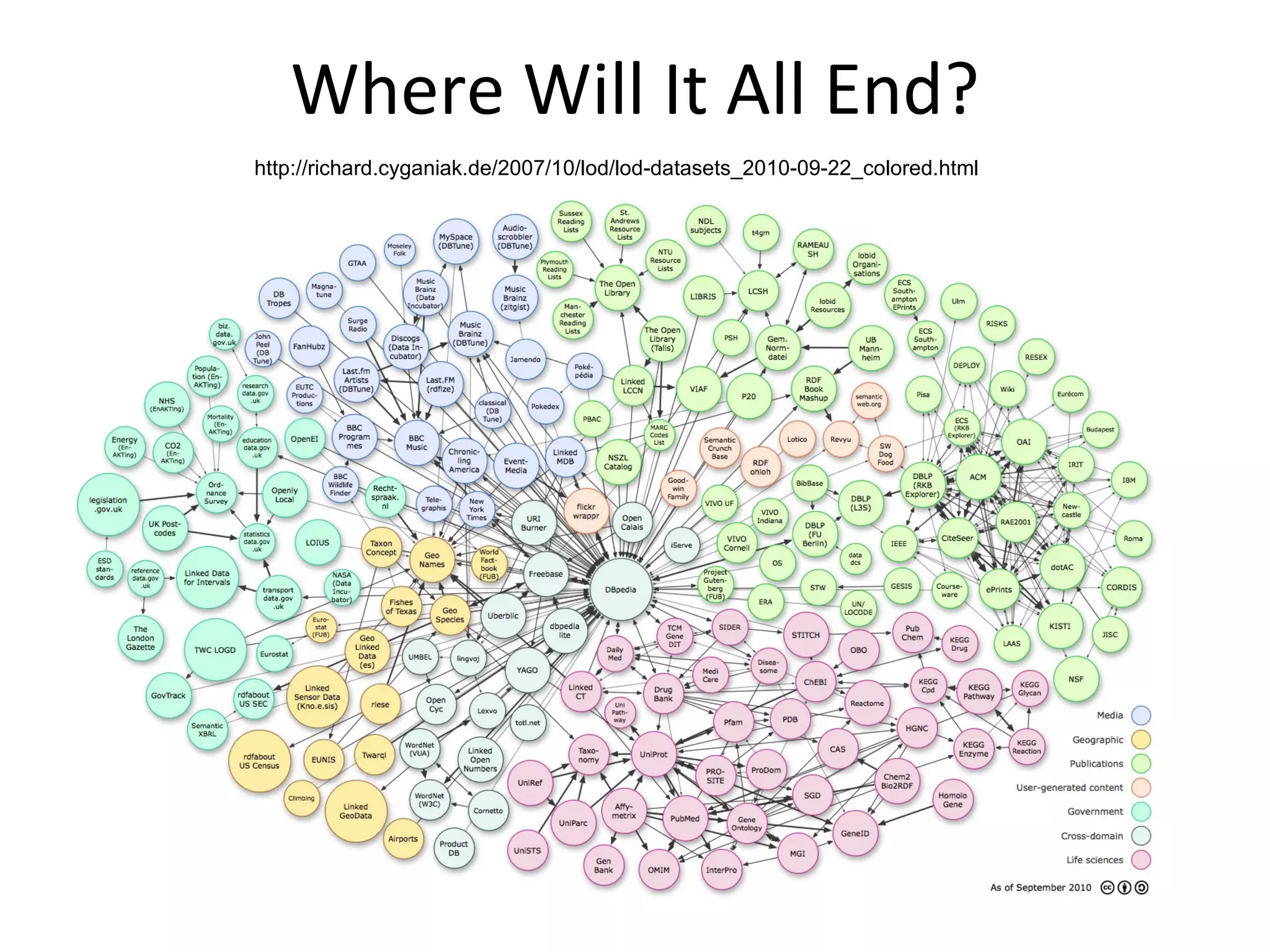
Where Will It All End? http://richard.cyganiak.de/2007/10/lod/lod-datasets_2010-09-22_colored.html
General References What Do I Want from the Publisher of the Future PLoS Comp Biol  6(5): e1000787 Fourth Paradigm: Data Intensive Scientific Discovery http://research.microsoft.com/enus/ collaboration/fourthparadigm/
References to Exemplars Semantic Biochemical Journal - 2010: Using Utopia Article of the Future, Cell, 2009:
 Prospect, Royal Society of Chemistry, 2009:
 Adventures in Semantic Publishing, Oxford U, 2009: The Structured Digital Abstract, Seringhaus/Gerstein, 2008
 CWA Nanopublications  –  2010
 https://sites.google.com/site/beyondthepdf/ https://sites.google.com/site/futureofresearchcommunications/
Acknowledgements BioLit Team Lynn Fink Parker Williams Marco Martinez Rahul Chandran Greg Quinn Microsoft Scholarly Communications Pablo Fernicola Lee Dirks Savas Parastitidas Alex Wade Tony Hey wwPDB Team Boki Beran Wolfgnag Bluhm Andreas Prlic Greg Quinn Peter Rose Ben Yutick Chunxaio Zhu http://biolit.ucsd.edu http://www.codeplex.com/ucsdbiolit
Questions? [email_address]

Using OA Content

  • 1.
    Using Open AccessContent: Ten Simple Observations SciVee & Beyond the PDF Philip E. Bourne University of California San Diego [email_address] www.sdsc.edu/pb http://www.slideshare.net/pebourne/p-lo-s
  • 2.
    My Two LecturesThe promise - Open Access, Open Science with particular reference to PLoS The fulfillment - What Open Access facilitates and examples of how it benefits science
  • 3.
    The fulfillment - What Open Access facilitates and examples of how it benefits science What you might get from this lecture: How others are using open science including open access content Ideas for how you might use the content
  • 4.
    Todays Exemplars http://www.mendeley.com/http://getutopia.com/documents/ http://www.scivee.tv/node/17389
  • 5.
    Let me Startwith a Few Observations Observation 1. Scientific culture is causing us to try and write more and read more
  • 6.
    You Cannot PossiblyRead a Fraction of the Papers You Should write more and read more Renear & Palmer 2009 Science 325:828-832
  • 7.
    Scanning More ReadingLess Renear & Palmer 2009 Science 325:828-832 write more and read more
  • 8.
    And So… Therehas been a paradigm shift which places more emphasis on writing and less on reading – witness blogs, use of literature aggregators (e.g. PubMed), H-factors, etc. We need help in assimilating knowledge write more and read more
  • 9.
    Observation 2 In1993 there were very few electronic journals, by 2003 nearly all were on-line, by 2013 there will be little or no paper Most traditional publishers have only really achieved an electronic print like experience – the power of the medium is for the taking
  • 10.
    Observation 3. TheSociology of Scientific Disciplines is Different
  • 11.
    Observation 4: Thebiomedical sciences is progressive: Alternative business models have gained ground – Open Access Databases are becoming more like journals and journals are becoming more like databases New modes of knowledge and data access are gaining some ground e.g. Textpresso – ontology-based mining and retrieval system iHOP Information Hyperlinked over Proteins
  • 12.
    Observation 5. IBelieve Open Access IF Fully Accepted Could Profoundly Change Scholarly Discourse It remains a big IF Open Access: Taking Full Advantage of the Content PLoS Comp. Biol. 2008 4(3) e1000037
  • 13.
    Its Happening inthe Closed Access Space A very clever idea – The App model Leverage content Provide an open API Get the community to do all the work Drive folks to buy content Why Don’ t We Have Such Developments in OA?
  • 14.
    Growth of PubMedCentral Open access could profoundly change scholarly discourse
  • 15.
    Open Access (CreativeCommons License) All published materials available on-line free to all (author pays model) Unrestricted access to all published material in various formats eg XML provided attribution is given to the original author(s) Copyright remains with the author Open access could profoundly change scholarly discourse
  • 16.
    Open Access (CreativeCommons License) All published materials available on-line free to all (reader pays model) Unrestricted access to all published material in various formats eg XML provided attribution is given to the original author(s) Copyright remains with the author Open Access: Taking Full Advantage of the Content PLoS Comp. Biol. 2008 4(3) e1000037 Open access could profoundly change scholarly discourse
  • 17.
    Observation 6 Abiological database is not really that different from a biological journal – this can be exploited PLoS Comp. Biol . 2005 1(3) e34
  • 18.
    The Data KnowledgeCycle Biocuration Electronic Supplements Databases versus journals
  • 19.
    Both Are UnderStress PubMed contains ~21M entries (May 2011) ~100,000 papers indexed per month In Feb 2009: 67,406,898 interactive searches were done 92,216,786 entries were viewed 1330 databases reported in NAR 2011 MetaBase http://biodatabase.org reports 2,651 entries edited 12,587 times PLoS Comp. Biol . 2005 1(3) e34
  • 20.
    Some More ComparisonsJournals have a pretty standardized interface Journals have a business model The quality is declining as numbers increase (?) Audience believes they are sustainable Efforts to make the interfaces different! Little attempt at a business model compared to the Web 2.0 world Quality is increasing (?) Not well sustained PLoS Comp. Biol. 2008. 4(7): e1000136 Databases versus journals
  • 21.
    Some More ComparisonsNew publishing models eg open access, self publishing, open review Web 2.0 influence eg social networks Use of rich media The review process is failing New metrics Read and write eg Wikis New services eg restful, widgets Use of Rich Media Crowd review emerging Databases versus journals
  • 22.
    Duh If weneed to acquire more knowledge quickly If more literature and data are becoming open If both are under stress Why don ’t we merge journals and databases for a new learning experience
  • 23.
    The Test Bedhttp://www.wwpdb.org/ http://www.plos.org/ http://www.pubmedcentral.nih.gov/ Merge journals and databases
  • 24.
    The World WideProtein Data Bank The single worldwide repository for data on the structure of biological macromolecules Vital for drug discovery and the life sciences 38 years old Free to all http://www.wwpdb.org Merge journals and databases
  • 25.
    The World WideProtein Data Bank Paper not published unless data are deposited – strong data to literature correspondence Highly structured data conforming to an extensive ontology DOI ’s assigned to every structure http://www.wwpdb.org Merge journals and databases
  • 26.
    The PLoS/PMC Corpus– Under the Hood Conforms well/partially to the NLM DTD – little markup of content PMC – some PDFs ! The lack of conformance will come back to haunt us!
  • 27.
    Author Submission viathe Web Depositor Submission via the Web Syntax Checking Syntax Checking Review by Scientists & Editors Review by Annotators Corrections by Author Corrections by Depositor Publish – Web Accessible Release – Web Accessible Similar Processes Lead to Similar Resources Merge journals and databases
  • 28.
    So the processesare not that dissimilar it is the final product that is perceived so differently Even that might be changing slowly? PLoS Comp. Biol. 2008 4(12) e1000247 Merge journals and databases
  • 29.
    Merged: The DatabaseView www.rcsb.org/pdb/explore/literature.do?structureId=1TIM Merge journals and databases
  • 30.
    Merged: The LiteratureView Nucleic Acids Research 2008 36(S2) W385-389 http://biolit.ucsd.edu Merge journals and databases
  • 31.
  • 32.
    ICTP Trieste, December10, 2007 Merge journals and databases
  • 33.
    The Near FutureUser reads a paper Clicks on a figure. Figure can be manipulated, annotated, interrogated Clicking the figure gives a composite database journal view This takes you to yet more papers or databases 1. A link brings up figures from the paper 0. Full text of PLoS papers stored in a database 2. Clicking the paper figure retrieves data from the PDB which is analyzed 3. A composite view of journal and database content results 4. The composite view has links to pertinent blocks of literature text and back to the PDB 1. 2. 3. 4. The Knowledge and Data Cycle http://biolit.ucsd.edu Enhanced modes of learning
  • 34.
    Observation 7: Thisis Literature Post-processing Better to Get the Authors Involved Authors are the absolute experts on the content More effective distribution of labor Add metadata before the article enters the publishing process Merge journals and databases – requires semantic enrichment
  • 35.
    Word 2007 Add-infor authors Allows authors to add metadata as they write, before they submit the manuscript Authors are assisted by automated term recognition OBO ontologies Database IDs Metadata are embedded directly into the manuscript document via XML tags, OOXML format Open Machine-readable Open source, Microsoft Public License http://www.codeplex.com/ucsdbiolit Merge journals and databases – requires semantic enrichment
  • 36.
    Challenges Author useFamiliarity with ontologies, terms Agreement between co-authors End-use of semantically enriched manuscript Combine with NLM XML standard Article Authoring Add-in Merge journals and databases – requires semantic enrichment
  • 37.
    Challenges: Author UseIF one or more publishers fast tracked a paper that had semantic markup I would argue it would catch on in no time Merge journals and databases – requires semantic enrichment
  • 38.
    Observation 8: ThereAre Some Simple Things We Can Do to Mine the Corpus
  • 39.
    Where We WouldLike to Be: Data Clustering via the Literature Shared Function Enhanced modes of learning Immunology Literature Cardiac Disease Literature
  • 40.
    Observation 9: TheUse of Rich Media is Underutilized
  • 41.
    Yes YouTube CanIncrease the Rate of Discovery
  • 42.
    Pubcast – VideoIntegrated with the Full Text of the Paper
  • 43.
    Android iPhone WindowsPhone 7 Step 1 presenter starts PowerPoint Step 2 presenter starts recording on smart phone Step 3 presenter stops recording and initiates upload Slides Website Step 5 slides and podcast are automatically synchronized Sync File Podcast Step 6 listener plays back synchronized presentation Proposal - The TeachU Workflow Mac PC Step 4 slides are uploaded
  • 44.
    Lessons It isa form of expression the current YouTubers embrace and may become as ubiquitous as papers and slide presentations in the next few years We are reinventing television Its only going to work if it is easy to publish and the reward is obvious
  • 45.
    Observation 10: ScientificReproducability Requires we Publish Workflows
  • 46.
  • 47.
    Reproducibility My viewsof reproducibility: We all express the importance, but the only time it is tested is when something is truly novel or error is suspected Reproducability covers a spectrum of meaning – by whom and with how much effort The longer the time lag the less likely something is reproducible
  • 48.
    Workflow Tools Mightbe the Answer Taverna Wings
  • 49.
    Consider an Example:Our Own Experience in Capturing the Scientific Process to Make it Open and Reproducable Its hard and embarrassing We have a working prototype using Wings I can feel the potential productivity gains My students are more doubtful Its been a lot of fun and will enable us to improve our processes regardless of the workflow system itself
  • 50.
    Problems with PublishingWorkflows Workflows are not linear Workflow : paper is not 1:1 Confidentiality Peer review Infrastructure Community acceptance Reward system No publisher seems willing to touch them
  • 51.
    Where Will ItAll End? http://richard.cyganiak.de/2007/10/lod/lod-datasets_2010-09-22_colored.html
  • 52.
    General References WhatDo I Want from the Publisher of the Future PLoS Comp Biol 6(5): e1000787 Fourth Paradigm: Data Intensive Scientific Discovery http://research.microsoft.com/enus/ collaboration/fourthparadigm/
  • 53.
    References to ExemplarsSemantic Biochemical Journal - 2010: Using Utopia Article of the Future, Cell, 2009:
 Prospect, Royal Society of Chemistry, 2009:
 Adventures in Semantic Publishing, Oxford U, 2009: The Structured Digital Abstract, Seringhaus/Gerstein, 2008
 CWA Nanopublications – 2010
 https://sites.google.com/site/beyondthepdf/ https://sites.google.com/site/futureofresearchcommunications/
  • 54.
    Acknowledgements BioLit TeamLynn Fink Parker Williams Marco Martinez Rahul Chandran Greg Quinn Microsoft Scholarly Communications Pablo Fernicola Lee Dirks Savas Parastitidas Alex Wade Tony Hey wwPDB Team Boki Beran Wolfgnag Bluhm Andreas Prlic Greg Quinn Peter Rose Ben Yutick Chunxaio Zhu http://biolit.ucsd.edu http://www.codeplex.com/ucsdbiolit
  • 55.

Editor's Notes

  • #16 Specifically, our aim is to achieve open access to the literature, whereby journal articles are freely available immediately upon publication their use is unrestricted, so that readers can download, print off, reanalyse, extract data and so on authors retain the copyright, and specifically the right to be appropriately cited papers are also deposited separately from the publisher in a public online archive (PMC)
  • #17 Specifically, our aim is to achieve open access to the literature, whereby journal articles are freely available immediately upon publication their use is unrestricted, so that readers can download, print off, reanalyse, extract data and so on authors retain the copyright, and specifically the right to be appropriately cited papers are also deposited separately from the publisher in a public online archive (PMC)