Using Maintenance Strategy Plans
Mark W. Scott
Vesta Partners LLC
[ Learning Points
 Creating maintenance Strategies and Packages
 Using maintenance strategies in Task Lists
 How maintenance strategies are used in Maintenance Plans
Real Experience. Real Advantage. 2
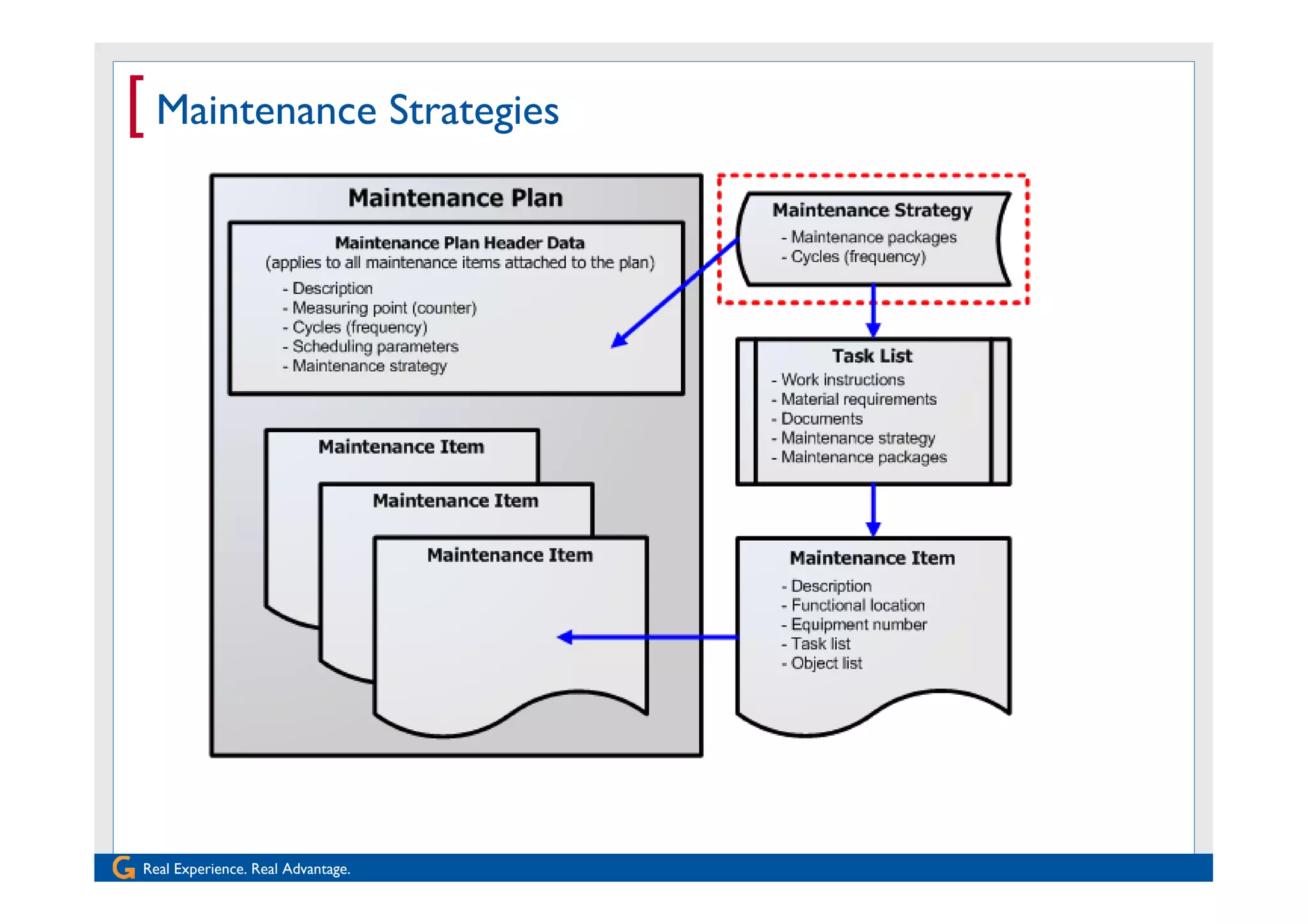
[ Maintenance Strategies
Real Experience. Real Advantage.
[ Maintenance Strategy - Definition
 A maintenance strategy defines the rules for the sequence and
frequency of maintenance activities. The strategy does not provide
any details about the activity, object or date.
 Maintenance strategies are assigned to a task list and also a
maintenance plan. Task lists built with a maintenance strategy can
only be used on maintenance plans utilizing that same strategy –
these are called strategy plans.
Real Experience. Real Advantage.
these are called strategy plans.
 You create a maintenance strategy and strategy plans when you have
to perform maintenance activities that are based on each other or
supersede each other
 Strategies contain maintenance packages which define the duration in
time (e.g. weeks) or level of performance (e.g. operating hours) at
which maintenance work is repeatedly performed. Therefore,
strategies are used in both time-based and performance-based
maintenance and represent the maintenance “cycle”.
[ Maintenance Strategy – Definition (continued)
 Each strategy that is created should have a common unit of
measure (e.g. weeks, months, hours, miles) – you should never
mix the units of measure within a given strategy.
 Maintenance packages are assigned to task list operations – and
define the frequency and sequence in which task list operations
will appear as work order operations.
Real Experience. Real Advantage.
will appear as work order operations.
 Maintenance packages are organized into a maintenance
package hierarchy that determines which maintenance
packages are performed if several maintenance packages are
due at one time. The hierarchy can either be:
 Single-level hierarchy
 Multi-level hierarchy
[ Maintenance Strategy Terms
 Strategy Code
 Description
 Scheduling Indicator (Type)
 Strategy Unit
 Call Horizon
Real Experience. Real Advantage.
 Call Horizon
 Shift Factor for Late Completion
 Tolerance for Late Completion
 Shift Factor for Early Completion
 Tolerance for Early Completion
 Factory Calendar
[
Scheduling ParametersStrategyScheduling Type
Activity TypeActivity Type
Activity TypePackages
Settings can be established at the strategy
level and they will carry over to each
individual maintenance plan when it is
created.
Maintenance Strategy vs Scheduling Parameters
Real Experience. Real Advantage.
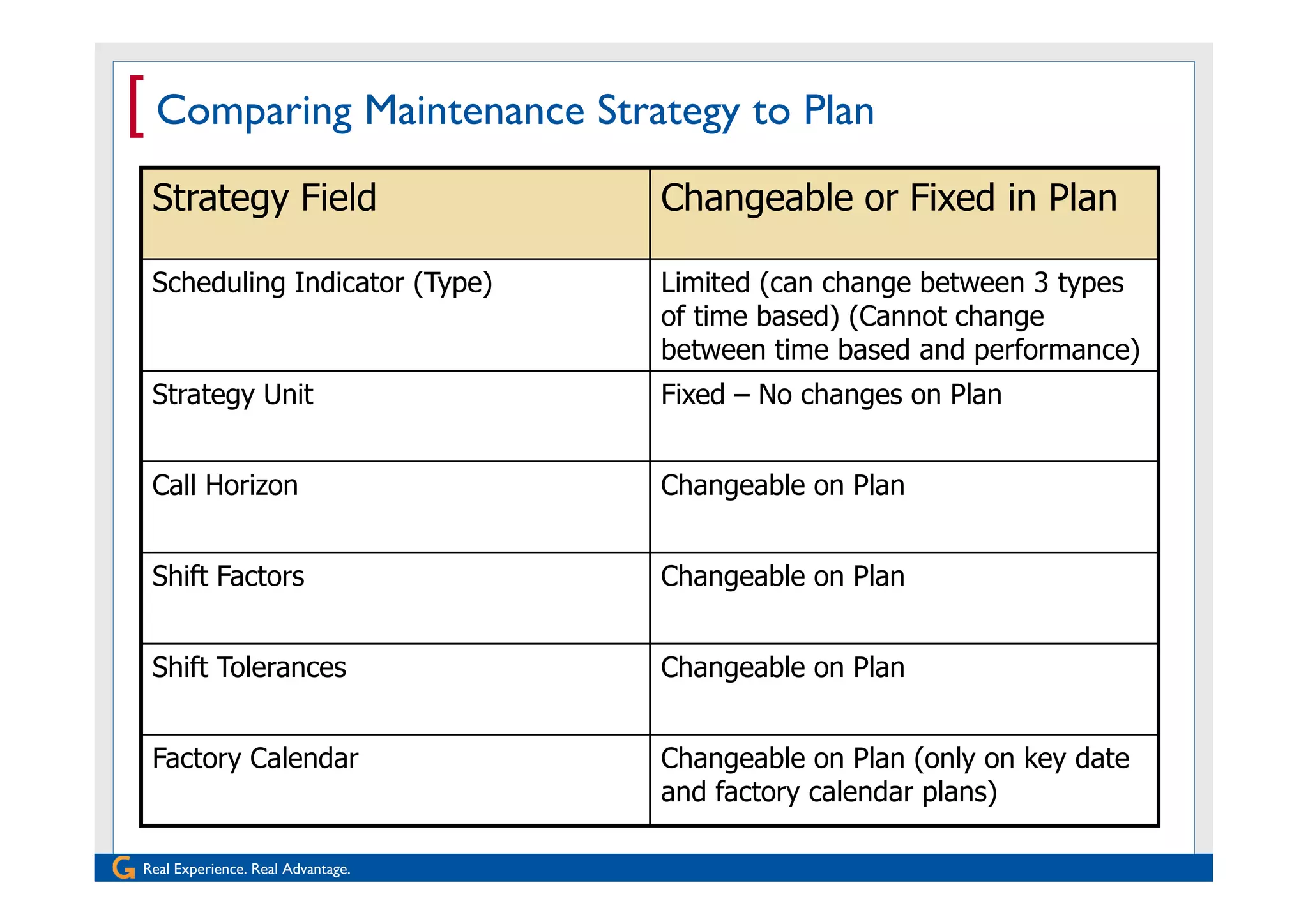
[ Comparing Maintenance Strategy to Plan
Strategy Field Changeable or Fixed in Plan
Scheduling Indicator (Type) Limited (can change between 3 types
of time based) (Cannot change
between time based and performance)
Strategy Unit Fixed – No changes on Plan
Real Experience. Real Advantage.
Call Horizon Changeable on Plan
Shift Factors Changeable on Plan
Shift Tolerances Changeable on Plan
Factory Calendar Changeable on Plan (only on key date
and factory calendar plans)
[
Scheduling ParametersStrategyScheduling Type
Activity Type
Activity Type
Activity Type
Packages
SchedulingTypes
•Time-Based
•E.g. – Every 30 calendar days
•Does NOT take into account the factory calendar
•Time-based by key date
•E.g. – Every 30 days do on the 28th of each month
Maintenance Strategy - Scheduling Type
Real Experience. Real Advantage.
•E.g. – Every 30 days do on the 28th of each month
•Time based – factory calendar
•E.g. – Every 30 working days, Option for seasonality
•Performance based
•E.g. – Every 100 Operating hours, 50,000 tons of coal
through, xxxx units made, etc.
[ Scheduling ParametersStrategyScheduling Type
Activity TypeActivity TypeActivity TypePackages
Scheduling Type
and Parameters
defined at
Strategy Level
Strategies & Packages maintained within IP11
Maintenance Strategies & Packages (Cycles)
Real Experience. Real Advantage.
Time Based Strategy Packages
Performance Based Strategy
Packages
Strategy Level
[
Scheduling ParametersStrategyScheduling Type
Activity TypeActivity TypeActivity TypePackages
Settings can be established at the strategy
level and they will carry over to each
individual maintenance plan when it is
created.
Unit defines time basis on which scheduling
calculations are made. Use same Unit
within a Strategy.
Once the strategy unit is created it can’t be
changed.
Maintenance Strategy – Unit of Measure
Real Experience. Real Advantage.
[
Scheduling ParametersStrategyScheduling Type
Activity TypeActivity TypeActivity TypePackages
Call Horizon – Percent of the next cycle the
system waits before the next call object is created
Call horizon determines when a maintenance
call object (e.g. Work Order, Notification) should
be generated. If the duration of the cycle is 360 days and the call
horizon is 0 %, 80%, or 100%, the system creates
the order after the following number of
days:
• 0% -> Immediate call (order created 360 days
Maintenance Strategy – Call Horizon
Real Experience. Real Advantage.
• 0% -> Immediate call (order created 360 days
BEFORE plan date)
•80% -> Call after 288 days, that is 80% of 360
days or creation of order 72 days before plan date.
•100% -> Call after 360 days, on the planned date
(can work well if coordinated with IP30 Call Interval)
Call horizon is defined in percentage terms
on Strategy or individual Maintenance Plan
[
Call Horizon – Example – Plan with 30 Day Cycle
100% Horizon
Call & Plan Dates are
same
50% Horizon
Call Date is 15 Days
before Plan
Scheduling ParametersStrategyScheduling Type
Activity TypeActivity TypeActivity TypePackages
SAP Maintenance Strategy – Call Horizon
Real Experience. Real Advantage.
0% Horizon
Call Date is 30 Days
before Plan
[
Shift Factors & Tolerance
Tolerance defines the period within which late or early completion impacts subsequent scheduling of Plan. (+)
Tolerance is set for late completion and (–) Tolerance for early completion.
If completion is within Tolerance period it is not considered late or early and does not impact schedule.
Cycle Cycle
Tolerance (+)(- )Tolerance
Plan
Date
Plan
Date
Plan
Date
Scheduling ParametersStrategyScheduling Type
Activity TypeActivity TypeActivity TypePackages
SAP Maintenance Strategy - Shift Factors / Tolerances
Real Experience. Real Advantage.
Tolerance (+)(- )Tolerance
30 Day
6 Day 6 Day
30 Day
If completion is out-with Tolerance period it will impact schedule taking account of Shift Factor values
Tolerance is defined as percentage of
cycle (for Strategy Plans it takes smallest
period).
As shown here a 20% tolerance results in
12 Day Tolerance window (6 Days on
either side of Planned Date).
[
Shift Factors & Tolerance
The Shift Factor applies in event of late or early completion of Maintenance Task (Call Object).
It defines how much subsequent schedule dates will be changes as result of later or early completion.
Cycle Cycle
Plan
Date
Plan
Date
Plan
Date
Early Actual
Completion
Late Actual
Completion
Scheduling ParametersStrategyScheduling Type
Activity TypeActivity TypeActivity TypePackages
SAP Maintenance Strategy/Plan - Shift Factors/Tolerances
Real Experience. Real Advantage.
30 Day Cycle
8/1/2007
Actual
Completion
8/24/2007
8/31/2007 9/30/2007
- 7 D
9/23/2007
- 7 D
Original
Plan
Date
New
Plan
Date
100% Shift Factor, 20%
Tolerance (6 days)
30 Day Cycle
8/1/2007
Actual
Completion
8/25/2007
8/31/2007 9/30/2007
-6 D
Original
Plan
Date
0% Shift Factor, 20%
Tolerance (6 days)
No Change
To Plan Date
[
Shift Factors & Tolerance
Scheduling ParametersStrategyScheduling Type
Activity Type
Activity Type
Activity Type
Packages
SAP Maintenance Strategy/Plan - Shift Factors/Tolerances
Real Experience. Real Advantage.
30 Day Cycle
8/1/2007
Actual
Completion
8/24/2007
8/31/2007 9/30/2007
- 7 D
9/27/2007
- 3 D
Original
Plan
Date
New
Plan
Date
50% Shift Factor, 20%
Tolerance (6 days)
[
Scheduling ParametersStrategyScheduling Type
Activity TypeActivity TypeActivity TypePackages
• Cycle length
• Unit of Measure – same as strategy unit
•Cycle abbreviation
SAP Maintenance Strategy – Packages
Real Experience. Real Advantage.
[
Scheduling ParametersStrategyScheduling Type
Activity TypeActivity TypeActivity TypePackages
Lead and Follow up Float
• Can only set on Strategy and not on individual Plans (not applicable to Single Cycle Plans).
• If change is made to float within Strategy you need to reassign Task List to Plan and Restart
Plan schedule.
SAP Maintenance Strategy – Package Lead/Follow up Float
Real Experience. Real Advantage.
• The Initial (Lead) Float, defined in days, adjusts the Basic Start Date on Work Order.
• The Subsequent (Follow up) Float, defined in days, adjusts the Basic End Date on Work Order.
[
Lead and Follow up Float - Example
Basic Start and End Dates on
called Work Order reflect the Float
periods
Scheduling ParametersStrategyScheduling Type
Activity TypeActivity TypeActivity TypePackages
SAP Maintenance Plan - Package Lead / Follow up Float
Real Experience. Real Advantage.
-10
+1
-10
+2
[
Multi-Level Hierarchy
Package Hierarchy value determines
place in hierarchy and is used to control
priority of packages with the same due
(planned) date.
If packages with same due date are to
Scheduling ParametersStrategyScheduling Type
Activity TypeActivity TypeActivity TypePackages
SAP Maintenance Plan – Package Hierarchies
Real Experience. Real Advantage.
If packages with same due date are to
be called then they must have same
hierarchy number.
If packages have different hierarchy
numbers then only the package with
highest number is called.
[
Single-Level Hierarchy
Scheduling ParametersStrategyScheduling Type
Activity TypeActivity TypeActivity TypePackages
SAP Maintenance Plan - Package Hierarchies
Real Experience. Real Advantage.
In this case 3M and 1Y are
called with 1M.
[ Maintenance Strategy – Time w/Hierarchy Monthly Units
Hierarchies
Real Experience. Real Advantage.
Hierarchies
Advantages: Can coordinate single operation orders simplifying scheduling and time entry
Disadvantages: More text and duplicate text per operation
[ Maintenance Strategy – Time w/out /Hierarchy Monthly
Units
Real Experience. Real Advantage.
[ Task List – Strategy Options with Same Results
Strategy w/Hierarchy Packages Only – Single package allocation
Strategy w/Hierarchy Packages Only - >1 package allocation
Above Model results in duplication of text
Real Experience. Real Advantage.
Strategy w/Hierarchy Packages Only - >1 package allocation
Strategy w/no hierarchies - >1 Package allocation
[ Strategies with and without Package Hierarchies
Packages without Hierarchy Packages with Hierarchy
It is possible to have strategies with packages that contain hierarchies and no
hierarchies – This can be confusing.
Real Experience. Real Advantage.
Packages with and without Hierarchy
[
With this Offset both 3 Monthly
and Yearly packages will be
Scheduling ParametersStrategyScheduling Type
Activity TypeActivity TypeActivity TypePackages
SAP Maintenance Plan – Packages – Package Offset
Real Experience. Real Advantage.
and Yearly packages will be
called 1st Cycle (Month)
With this Offset both Yearly
package will be called 3rd Cycle
(Month)
[
Package Offset
Scheduling ParametersStrategyScheduling Type
Activity TypeActivity TypeActivity TypePackages
SAP Maintenance Plan – Package Offset
Real Experience. Real Advantage.
With this Offset 3Monthly will be
called 2nd Cycle and Yearly will
be called 3rd Cycle (Month)
[ Task List – Use in Preventive Maintenance
Real Experience. Real Advantage.
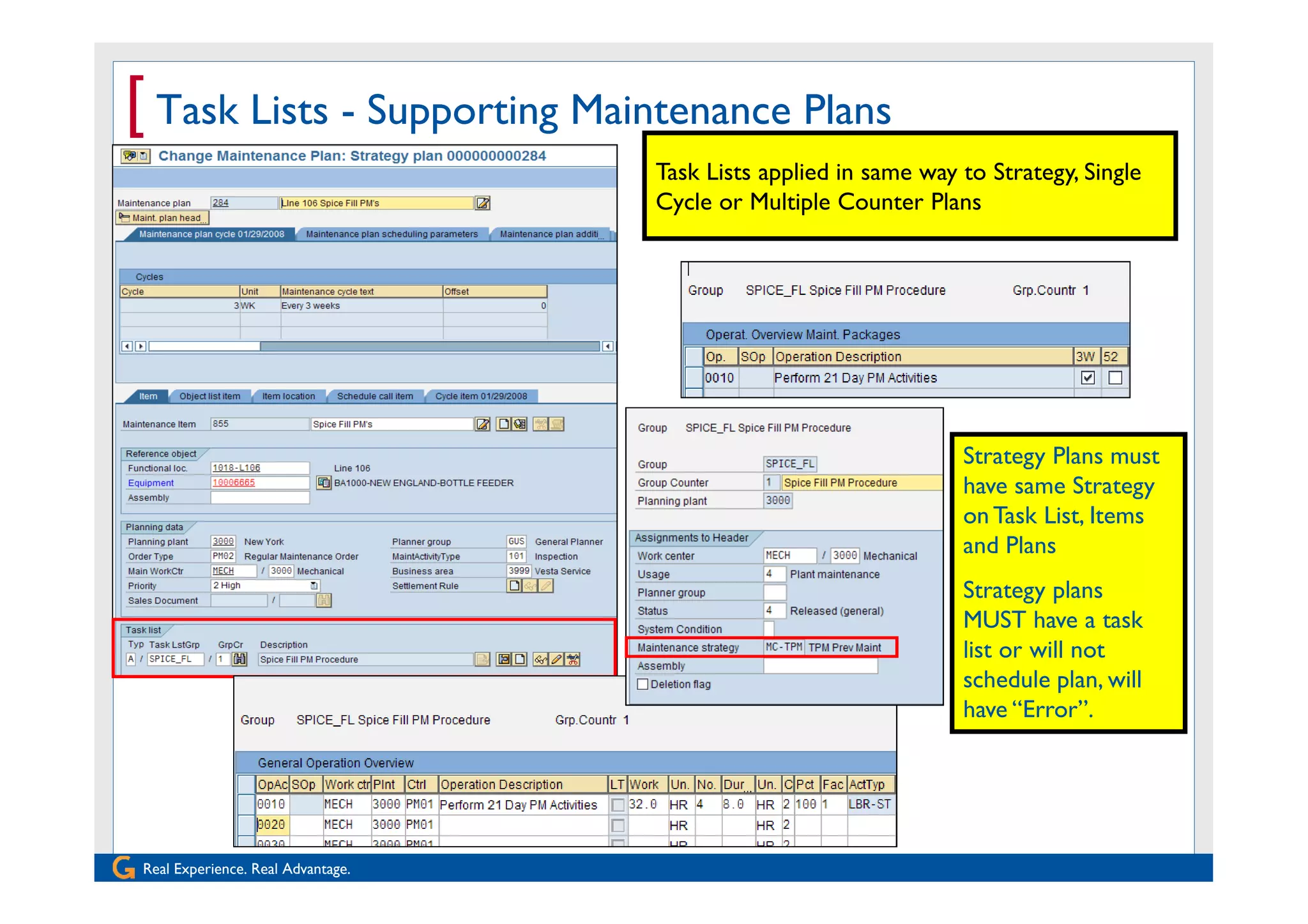
[ Task Lists - Supporting Maintenance Plans
Strategy Plans must
Task Lists applied in same way to Strategy, Single
Cycle or Multiple Counter Plans
Real Experience. Real Advantage.
Strategy Plans must
have same Strategy
on Task List, Items
and Plans
Strategy plans
MUST have a task
list or will not
schedule plan, will
have “Error”.
[ Task List – Assigning Packages
Strategy w/Hierarchy Packages Only – Single package allocation
Strategy w/Hierarchy Packages Only - >1 package allocation
Real Experience. Real Advantage.
Strategy w/no hierarchies - >1 Package allocation
[ Maintenance Strategy w/no Hierarchy
Real Experience. Real Advantage.
 When work orders are then generated from the maintenance plans that use the task lists.
The task list operations then become the work order operations. Because they are organized
in a single-level hierarchy, the operations will not supersede each other. In other words:
 Operation 10 (check fluids) will come out every 2000 miles – even when Operation 20 (change oil)
and Operation 30 (rotate tires) are also due
 Operation 20 (change oil) will come out every 4000 miles – even when Operation 30 (rotate tires) is
also due
 Operation 30 (rotate tires) will come out every 6000 miles – regardless of
other operations that are also due
[ Maintenance Strategy – w/Hierarchy
Real Experience. Real Advantage.
 When work orders are then generated from the maintenance plans that use the task lists.
The task list operations then become the work order operations. Because they are organized
in a multi-level hierarchy, the operations with a higher hierarchy number will always
supersede operations with a lower hierarchy number. In other words:
 Operation 10 (check fluids) is due every 2000 miles, but it will only come out on the work order
when package 2 is the only one due
 Operation 20 (check fluids, change oil) is due every 4000 miles. It will always supersede Operation
10 because it has a higher hierarchy number.
 Operation 30 (check fluids, change oil, rotate tires) is due every 6000 miles. It will always supersede
Operation 10 and Operation 20 because it has a higher hierarchy number.
[ Maintenance Plan – Types of Plans
Real Experience. Real Advantage.
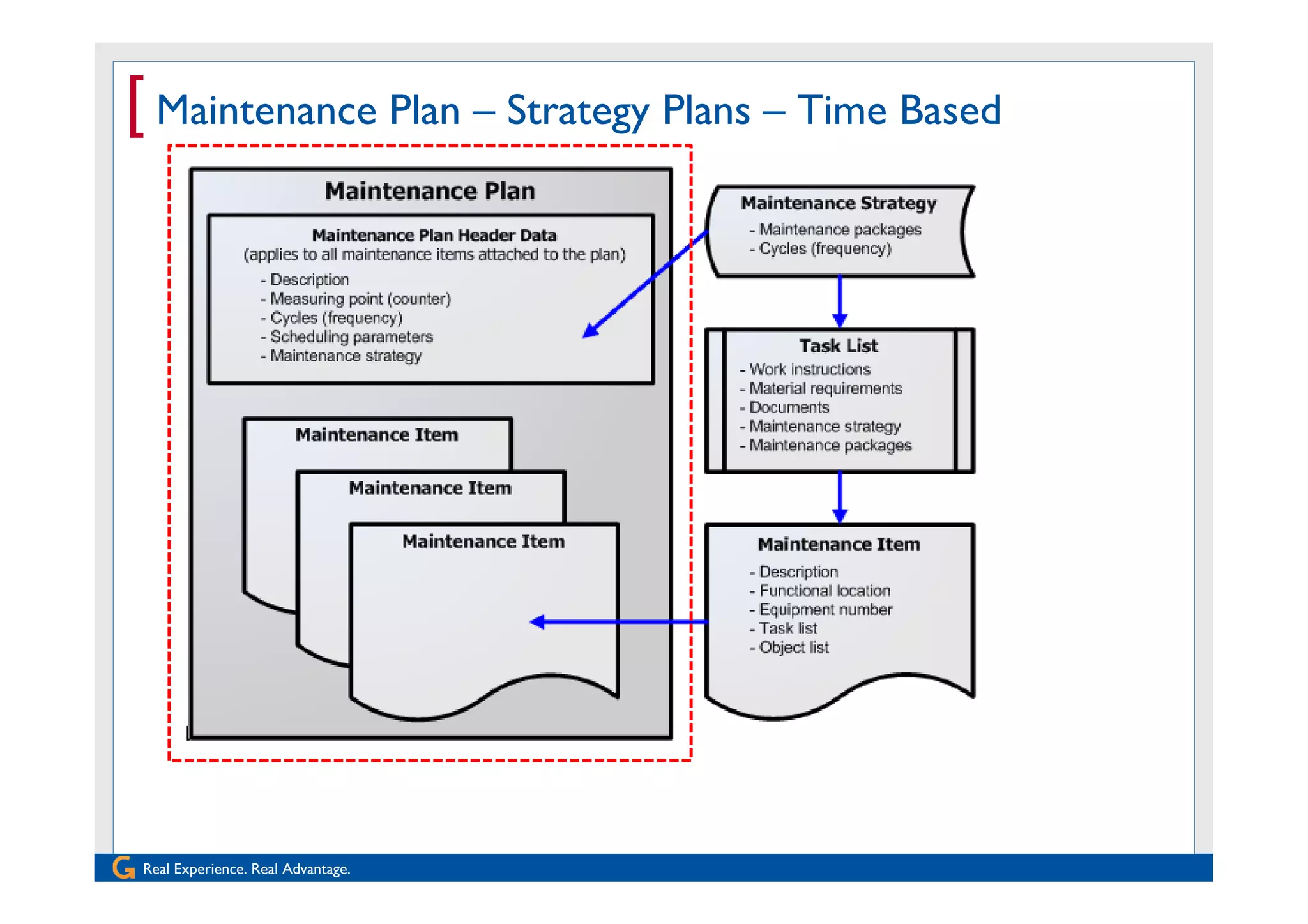
[ Maintenance Plan – Strategy Plans – Time Based
Real Experience. Real Advantage.
[ Maintenance Plan – Strategy Plans – Time Based
 A time-based strategy plan should be used when:
 Preventive maintenance activities are triggered when a certain time limit
is reached
 Maintenance activities (task list operations) change depending on the
frequency that is due – in other words, the maintenance activities are
based on each other or supersede each other
 The time-based strategy plan consists of:
 Maintenance plan
Real Experience. Real Advantage.
 Maintenance plan
 Maintenance items (one or more)
 Task list
 Maintenance strategy
 Task lists are required for time-based strategy plans
 The strategy referenced on the maintenance plan must match
the strategy used to build the task list attached to the
maintenance items.
[ Maintenance Plan – Strategy Plans – Performance Based
Real Experience. Real Advantage.
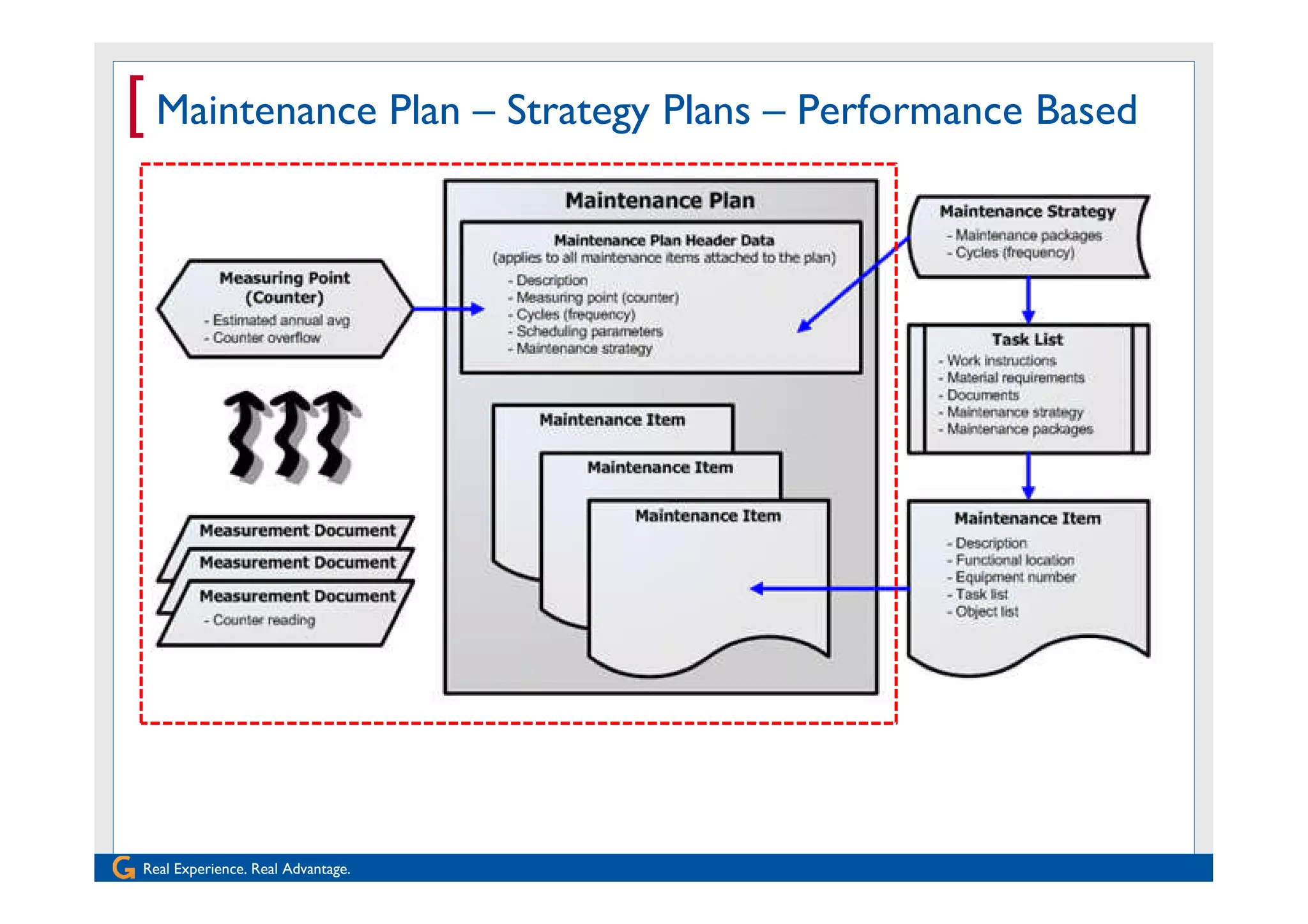
[ Maintenance Plan – Strategy Plans – Performance Based
 A performance-based strategy plan should be used when:
 Preventive maintenance activities are triggered by a counter reading
 Maintenance activities (task list operations) change depending on the frequency
that is due – in other words, the maintenance activities are based on each other
or supersede each other
 The time-based strategy plan consists of:
 Maintenance plan
 Maintenance items (one or more)
 Task list
Real Experience. Real Advantage.
 Task list
 Maintenance strategy
 Measuring point (counter)
 Measurement documents (on-going transactional data)
 Task lists are required for performance-based strategy plans
 The strategy referenced on the maintenance plan must match the strategy
used to build the task list attached to the maintenance items.
 Readings must be taken on a consistent basis for the plan to function
correctly.
[ Preventive Maintenance – Performance Strategy no Hierarchy
Net operation count result:
Multiple operations per order
for certain cycles.
Real Experience. Real Advantage.
 When work orders are then generated from the maintenance plans that use the task lists.
The task list operations then become the work order operations. Because they are organized
in a single-level hierarchy, the operations will not supersede each other. In other words:
 Operation 10 (check fluids) will come out every 2000 miles – even when Operation 20 (change oil)
and Operation 30 (rotate tires) are also due
 Operation 20 (change oil) will come out every 4000 miles – even when Operation 30 (rotate tires) is
also due
 Operation 30 (rotate tires) will come out every 6000 miles – regardless of other operations
that are also due
[Preventive Maintenance – Performance Strategy with Hierarchy
Net operation count result:
Always single operation for all
work orders
Real Experience. Real Advantage.
 When work orders are then generated from the maintenance plans that use the task lists. The task list
operations then become the work order operations. Because they are organized in a multi-level
hierarchy, the operations with a higher hierarchy number will always supersede operations with a lower
hierarchy number. In other words:
 Operation 10 (check fluids) is due every 2000 miles, but it will only come out on the work order when package 2
is the only one due
 Operation 20 (check fluids, change oil) is due every 4000 miles. It will always supersede Operation 10 because it
has a higher hierarchy number.
 Operation 30 (check fluids, change oil, rotate tires) is due every 6000 miles. It will always supersede Operation 10
and Operation 20 because it has a higher hierarchy number.
[ Key Learnings
 Creating maintenance Strategies and Packages
 Using maintenance strategies in Task Lists
 How maintenance strategies are used in Maintenance Plans
Real Experience. Real Advantage. 40
[
[
 Thank you for participating.
SESSION CODE:
Please remember to complete and return your
evaluation form following this session.
For ongoing education on this area of focus, visit the
Year-Round Community page at www.asug.com/yrc
Mark W. Scott
mscott @vestapartners.com
Real Experience. Real Advantage. 41
[SESSION CODE:
2612

using maintenance_strategy_plans

  • 1.
    Using Maintenance StrategyPlans Mark W. Scott Vesta Partners LLC
  • 2.
    [ Learning Points Creating maintenance Strategies and Packages  Using maintenance strategies in Task Lists  How maintenance strategies are used in Maintenance Plans Real Experience. Real Advantage. 2
  • 3.
    [ Maintenance Strategies RealExperience. Real Advantage.
  • 4.
    [ Maintenance Strategy- Definition  A maintenance strategy defines the rules for the sequence and frequency of maintenance activities. The strategy does not provide any details about the activity, object or date.  Maintenance strategies are assigned to a task list and also a maintenance plan. Task lists built with a maintenance strategy can only be used on maintenance plans utilizing that same strategy – these are called strategy plans. Real Experience. Real Advantage. these are called strategy plans.  You create a maintenance strategy and strategy plans when you have to perform maintenance activities that are based on each other or supersede each other  Strategies contain maintenance packages which define the duration in time (e.g. weeks) or level of performance (e.g. operating hours) at which maintenance work is repeatedly performed. Therefore, strategies are used in both time-based and performance-based maintenance and represent the maintenance “cycle”.
  • 5.
    [ Maintenance Strategy– Definition (continued)  Each strategy that is created should have a common unit of measure (e.g. weeks, months, hours, miles) – you should never mix the units of measure within a given strategy.  Maintenance packages are assigned to task list operations – and define the frequency and sequence in which task list operations will appear as work order operations. Real Experience. Real Advantage. will appear as work order operations.  Maintenance packages are organized into a maintenance package hierarchy that determines which maintenance packages are performed if several maintenance packages are due at one time. The hierarchy can either be:  Single-level hierarchy  Multi-level hierarchy
  • 6.
    [ Maintenance StrategyTerms  Strategy Code  Description  Scheduling Indicator (Type)  Strategy Unit  Call Horizon Real Experience. Real Advantage.  Call Horizon  Shift Factor for Late Completion  Tolerance for Late Completion  Shift Factor for Early Completion  Tolerance for Early Completion  Factory Calendar
  • 7.
    [ Scheduling ParametersStrategyScheduling Type ActivityTypeActivity Type Activity TypePackages Settings can be established at the strategy level and they will carry over to each individual maintenance plan when it is created. Maintenance Strategy vs Scheduling Parameters Real Experience. Real Advantage.
  • 8.
    [ Comparing MaintenanceStrategy to Plan Strategy Field Changeable or Fixed in Plan Scheduling Indicator (Type) Limited (can change between 3 types of time based) (Cannot change between time based and performance) Strategy Unit Fixed – No changes on Plan Real Experience. Real Advantage. Call Horizon Changeable on Plan Shift Factors Changeable on Plan Shift Tolerances Changeable on Plan Factory Calendar Changeable on Plan (only on key date and factory calendar plans)
  • 9.
    [ Scheduling ParametersStrategyScheduling Type ActivityType Activity Type Activity Type Packages SchedulingTypes •Time-Based •E.g. – Every 30 calendar days •Does NOT take into account the factory calendar •Time-based by key date •E.g. – Every 30 days do on the 28th of each month Maintenance Strategy - Scheduling Type Real Experience. Real Advantage. •E.g. – Every 30 days do on the 28th of each month •Time based – factory calendar •E.g. – Every 30 working days, Option for seasonality •Performance based •E.g. – Every 100 Operating hours, 50,000 tons of coal through, xxxx units made, etc.
  • 10.
    [ Scheduling ParametersStrategySchedulingType Activity TypeActivity TypeActivity TypePackages Scheduling Type and Parameters defined at Strategy Level Strategies & Packages maintained within IP11 Maintenance Strategies & Packages (Cycles) Real Experience. Real Advantage. Time Based Strategy Packages Performance Based Strategy Packages Strategy Level
  • 11.
    [ Scheduling ParametersStrategyScheduling Type ActivityTypeActivity TypeActivity TypePackages Settings can be established at the strategy level and they will carry over to each individual maintenance plan when it is created. Unit defines time basis on which scheduling calculations are made. Use same Unit within a Strategy. Once the strategy unit is created it can’t be changed. Maintenance Strategy – Unit of Measure Real Experience. Real Advantage.
  • 12.
    [ Scheduling ParametersStrategyScheduling Type ActivityTypeActivity TypeActivity TypePackages Call Horizon – Percent of the next cycle the system waits before the next call object is created Call horizon determines when a maintenance call object (e.g. Work Order, Notification) should be generated. If the duration of the cycle is 360 days and the call horizon is 0 %, 80%, or 100%, the system creates the order after the following number of days: • 0% -> Immediate call (order created 360 days Maintenance Strategy – Call Horizon Real Experience. Real Advantage. • 0% -> Immediate call (order created 360 days BEFORE plan date) •80% -> Call after 288 days, that is 80% of 360 days or creation of order 72 days before plan date. •100% -> Call after 360 days, on the planned date (can work well if coordinated with IP30 Call Interval) Call horizon is defined in percentage terms on Strategy or individual Maintenance Plan
  • 13.
    [ Call Horizon –Example – Plan with 30 Day Cycle 100% Horizon Call & Plan Dates are same 50% Horizon Call Date is 15 Days before Plan Scheduling ParametersStrategyScheduling Type Activity TypeActivity TypeActivity TypePackages SAP Maintenance Strategy – Call Horizon Real Experience. Real Advantage. 0% Horizon Call Date is 30 Days before Plan
  • 14.
    [ Shift Factors &Tolerance Tolerance defines the period within which late or early completion impacts subsequent scheduling of Plan. (+) Tolerance is set for late completion and (–) Tolerance for early completion. If completion is within Tolerance period it is not considered late or early and does not impact schedule. Cycle Cycle Tolerance (+)(- )Tolerance Plan Date Plan Date Plan Date Scheduling ParametersStrategyScheduling Type Activity TypeActivity TypeActivity TypePackages SAP Maintenance Strategy - Shift Factors / Tolerances Real Experience. Real Advantage. Tolerance (+)(- )Tolerance 30 Day 6 Day 6 Day 30 Day If completion is out-with Tolerance period it will impact schedule taking account of Shift Factor values Tolerance is defined as percentage of cycle (for Strategy Plans it takes smallest period). As shown here a 20% tolerance results in 12 Day Tolerance window (6 Days on either side of Planned Date).
  • 15.
    [ Shift Factors &Tolerance The Shift Factor applies in event of late or early completion of Maintenance Task (Call Object). It defines how much subsequent schedule dates will be changes as result of later or early completion. Cycle Cycle Plan Date Plan Date Plan Date Early Actual Completion Late Actual Completion Scheduling ParametersStrategyScheduling Type Activity TypeActivity TypeActivity TypePackages SAP Maintenance Strategy/Plan - Shift Factors/Tolerances Real Experience. Real Advantage. 30 Day Cycle 8/1/2007 Actual Completion 8/24/2007 8/31/2007 9/30/2007 - 7 D 9/23/2007 - 7 D Original Plan Date New Plan Date 100% Shift Factor, 20% Tolerance (6 days) 30 Day Cycle 8/1/2007 Actual Completion 8/25/2007 8/31/2007 9/30/2007 -6 D Original Plan Date 0% Shift Factor, 20% Tolerance (6 days) No Change To Plan Date
  • 16.
    [ Shift Factors &Tolerance Scheduling ParametersStrategyScheduling Type Activity Type Activity Type Activity Type Packages SAP Maintenance Strategy/Plan - Shift Factors/Tolerances Real Experience. Real Advantage. 30 Day Cycle 8/1/2007 Actual Completion 8/24/2007 8/31/2007 9/30/2007 - 7 D 9/27/2007 - 3 D Original Plan Date New Plan Date 50% Shift Factor, 20% Tolerance (6 days)
  • 17.
    [ Scheduling ParametersStrategyScheduling Type ActivityTypeActivity TypeActivity TypePackages • Cycle length • Unit of Measure – same as strategy unit •Cycle abbreviation SAP Maintenance Strategy – Packages Real Experience. Real Advantage.
  • 18.
    [ Scheduling ParametersStrategyScheduling Type ActivityTypeActivity TypeActivity TypePackages Lead and Follow up Float • Can only set on Strategy and not on individual Plans (not applicable to Single Cycle Plans). • If change is made to float within Strategy you need to reassign Task List to Plan and Restart Plan schedule. SAP Maintenance Strategy – Package Lead/Follow up Float Real Experience. Real Advantage. • The Initial (Lead) Float, defined in days, adjusts the Basic Start Date on Work Order. • The Subsequent (Follow up) Float, defined in days, adjusts the Basic End Date on Work Order.
  • 19.
    [ Lead and Followup Float - Example Basic Start and End Dates on called Work Order reflect the Float periods Scheduling ParametersStrategyScheduling Type Activity TypeActivity TypeActivity TypePackages SAP Maintenance Plan - Package Lead / Follow up Float Real Experience. Real Advantage. -10 +1 -10 +2
  • 20.
    [ Multi-Level Hierarchy Package Hierarchyvalue determines place in hierarchy and is used to control priority of packages with the same due (planned) date. If packages with same due date are to Scheduling ParametersStrategyScheduling Type Activity TypeActivity TypeActivity TypePackages SAP Maintenance Plan – Package Hierarchies Real Experience. Real Advantage. If packages with same due date are to be called then they must have same hierarchy number. If packages have different hierarchy numbers then only the package with highest number is called.
  • 21.
    [ Single-Level Hierarchy Scheduling ParametersStrategySchedulingType Activity TypeActivity TypeActivity TypePackages SAP Maintenance Plan - Package Hierarchies Real Experience. Real Advantage. In this case 3M and 1Y are called with 1M.
  • 22.
    [ Maintenance Strategy– Time w/Hierarchy Monthly Units Hierarchies Real Experience. Real Advantage. Hierarchies Advantages: Can coordinate single operation orders simplifying scheduling and time entry Disadvantages: More text and duplicate text per operation
  • 23.
    [ Maintenance Strategy– Time w/out /Hierarchy Monthly Units Real Experience. Real Advantage.
  • 24.
    [ Task List– Strategy Options with Same Results Strategy w/Hierarchy Packages Only – Single package allocation Strategy w/Hierarchy Packages Only - >1 package allocation Above Model results in duplication of text Real Experience. Real Advantage. Strategy w/Hierarchy Packages Only - >1 package allocation Strategy w/no hierarchies - >1 Package allocation
  • 25.
    [ Strategies withand without Package Hierarchies Packages without Hierarchy Packages with Hierarchy It is possible to have strategies with packages that contain hierarchies and no hierarchies – This can be confusing. Real Experience. Real Advantage. Packages with and without Hierarchy
  • 26.
    [ With this Offsetboth 3 Monthly and Yearly packages will be Scheduling ParametersStrategyScheduling Type Activity TypeActivity TypeActivity TypePackages SAP Maintenance Plan – Packages – Package Offset Real Experience. Real Advantage. and Yearly packages will be called 1st Cycle (Month) With this Offset both Yearly package will be called 3rd Cycle (Month)
  • 27.
    [ Package Offset Scheduling ParametersStrategySchedulingType Activity TypeActivity TypeActivity TypePackages SAP Maintenance Plan – Package Offset Real Experience. Real Advantage. With this Offset 3Monthly will be called 2nd Cycle and Yearly will be called 3rd Cycle (Month)
  • 28.
    [ Task List– Use in Preventive Maintenance Real Experience. Real Advantage.
  • 29.
    [ Task Lists- Supporting Maintenance Plans Strategy Plans must Task Lists applied in same way to Strategy, Single Cycle or Multiple Counter Plans Real Experience. Real Advantage. Strategy Plans must have same Strategy on Task List, Items and Plans Strategy plans MUST have a task list or will not schedule plan, will have “Error”.
  • 30.
    [ Task List– Assigning Packages Strategy w/Hierarchy Packages Only – Single package allocation Strategy w/Hierarchy Packages Only - >1 package allocation Real Experience. Real Advantage. Strategy w/no hierarchies - >1 Package allocation
  • 31.
    [ Maintenance Strategyw/no Hierarchy Real Experience. Real Advantage.  When work orders are then generated from the maintenance plans that use the task lists. The task list operations then become the work order operations. Because they are organized in a single-level hierarchy, the operations will not supersede each other. In other words:  Operation 10 (check fluids) will come out every 2000 miles – even when Operation 20 (change oil) and Operation 30 (rotate tires) are also due  Operation 20 (change oil) will come out every 4000 miles – even when Operation 30 (rotate tires) is also due  Operation 30 (rotate tires) will come out every 6000 miles – regardless of other operations that are also due
  • 32.
    [ Maintenance Strategy– w/Hierarchy Real Experience. Real Advantage.  When work orders are then generated from the maintenance plans that use the task lists. The task list operations then become the work order operations. Because they are organized in a multi-level hierarchy, the operations with a higher hierarchy number will always supersede operations with a lower hierarchy number. In other words:  Operation 10 (check fluids) is due every 2000 miles, but it will only come out on the work order when package 2 is the only one due  Operation 20 (check fluids, change oil) is due every 4000 miles. It will always supersede Operation 10 because it has a higher hierarchy number.  Operation 30 (check fluids, change oil, rotate tires) is due every 6000 miles. It will always supersede Operation 10 and Operation 20 because it has a higher hierarchy number.
  • 33.
    [ Maintenance Plan– Types of Plans Real Experience. Real Advantage.
  • 34.
    [ Maintenance Plan– Strategy Plans – Time Based Real Experience. Real Advantage.
  • 35.
    [ Maintenance Plan– Strategy Plans – Time Based  A time-based strategy plan should be used when:  Preventive maintenance activities are triggered when a certain time limit is reached  Maintenance activities (task list operations) change depending on the frequency that is due – in other words, the maintenance activities are based on each other or supersede each other  The time-based strategy plan consists of:  Maintenance plan Real Experience. Real Advantage.  Maintenance plan  Maintenance items (one or more)  Task list  Maintenance strategy  Task lists are required for time-based strategy plans  The strategy referenced on the maintenance plan must match the strategy used to build the task list attached to the maintenance items.
  • 36.
    [ Maintenance Plan– Strategy Plans – Performance Based Real Experience. Real Advantage.
  • 37.
    [ Maintenance Plan– Strategy Plans – Performance Based  A performance-based strategy plan should be used when:  Preventive maintenance activities are triggered by a counter reading  Maintenance activities (task list operations) change depending on the frequency that is due – in other words, the maintenance activities are based on each other or supersede each other  The time-based strategy plan consists of:  Maintenance plan  Maintenance items (one or more)  Task list Real Experience. Real Advantage.  Task list  Maintenance strategy  Measuring point (counter)  Measurement documents (on-going transactional data)  Task lists are required for performance-based strategy plans  The strategy referenced on the maintenance plan must match the strategy used to build the task list attached to the maintenance items.  Readings must be taken on a consistent basis for the plan to function correctly.
  • 38.
    [ Preventive Maintenance– Performance Strategy no Hierarchy Net operation count result: Multiple operations per order for certain cycles. Real Experience. Real Advantage.  When work orders are then generated from the maintenance plans that use the task lists. The task list operations then become the work order operations. Because they are organized in a single-level hierarchy, the operations will not supersede each other. In other words:  Operation 10 (check fluids) will come out every 2000 miles – even when Operation 20 (change oil) and Operation 30 (rotate tires) are also due  Operation 20 (change oil) will come out every 4000 miles – even when Operation 30 (rotate tires) is also due  Operation 30 (rotate tires) will come out every 6000 miles – regardless of other operations that are also due
  • 39.
    [Preventive Maintenance –Performance Strategy with Hierarchy Net operation count result: Always single operation for all work orders Real Experience. Real Advantage.  When work orders are then generated from the maintenance plans that use the task lists. The task list operations then become the work order operations. Because they are organized in a multi-level hierarchy, the operations with a higher hierarchy number will always supersede operations with a lower hierarchy number. In other words:  Operation 10 (check fluids) is due every 2000 miles, but it will only come out on the work order when package 2 is the only one due  Operation 20 (check fluids, change oil) is due every 4000 miles. It will always supersede Operation 10 because it has a higher hierarchy number.  Operation 30 (check fluids, change oil, rotate tires) is due every 6000 miles. It will always supersede Operation 10 and Operation 20 because it has a higher hierarchy number.
  • 40.
    [ Key Learnings Creating maintenance Strategies and Packages  Using maintenance strategies in Task Lists  How maintenance strategies are used in Maintenance Plans Real Experience. Real Advantage. 40
  • 41.
    [ [  Thank youfor participating. SESSION CODE: Please remember to complete and return your evaluation form following this session. For ongoing education on this area of focus, visit the Year-Round Community page at www.asug.com/yrc Mark W. Scott mscott @vestapartners.com Real Experience. Real Advantage. 41 [SESSION CODE: 2612