CGIAR Research
  Program on
Water, Land and
  Ecosystems


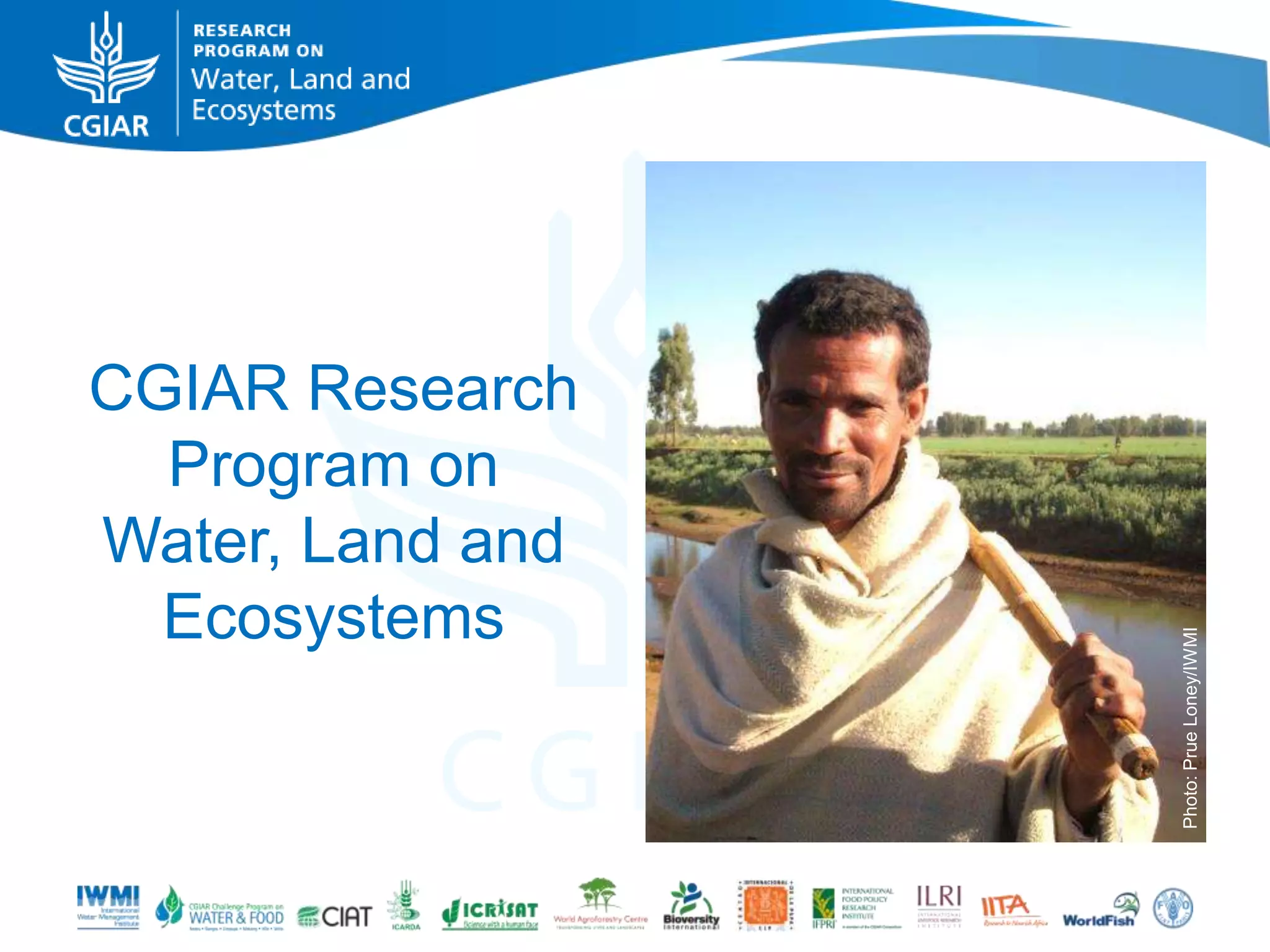
                  Photo: Prue Loney/IWMI
Contents
• Issues and opportunities
• The Water, Land and Ecosystems
  Program: the basics
• The Strategic Research Portfolios (SRPs)
• How the program operates
• Examples of what it will do
Humanity’s greatest challenge
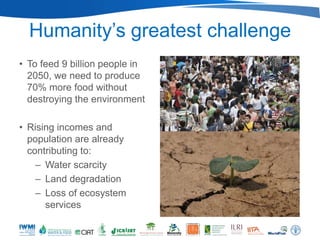
• To feed 9 billion people in
  2050, we need to produce
  70% more food without
  destroying the environment

• Rising incomes and
  population are already
  contributing to:
    – Water scarcity
    – Land degradation
    – Loss of ecosystem
      services
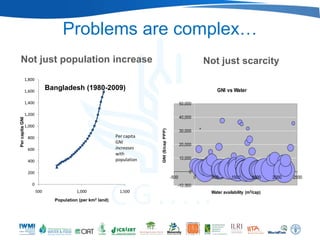
Problems are complex…
  Not just population increase                                                                                  Not just scarcity
                 1,800

                 1,600
                               Bangladesh (1980-2009)                                                               GNI vs Water

                 1,400                                                                             50,000

                 1,200
                                                                                                   40,000
Per capita GNI


                 1,000


                                                                          GNI ($/cap PPP)
                                                                                                   30,000
                  800                                        Per capita
                                                             GNI
                                                                                                   20,000
                  600                                        increases
                                                             with
                                                             population                            10,000
                  400

                  200                                                                                  0
                                                                                            -500            0    500       1000        1500    2000   2500
                    0                                                                          -10,000
                         500               1,000              1,500                                              Water availability (m3/cap)
                                 Population (per km2 land)
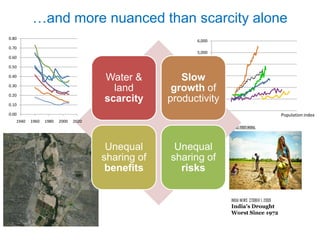
…and more nuanced than scarcity alone
0.80
                                                         6,000
0.70
                                                         5,000
0.60
                                                         4,000
0.50

0.40
                                      Water &         Slow
                                                         3,000

0.30
                                        land        growth of
                                                         2,000
0.20

0.10
                                      scarcity     productivity
                                                         1,000

                                                            0
0.00                                                                                          Population index
   1940   1960   1980   2000   2020


                                       Unequal      Unequal
                                      sharing of   sharing of
                                       benefits      risks


                                                                  INDIA NEWS CTOBER 1, 2009
                                                                  India's Drought
                                                                  Worst Since 1972
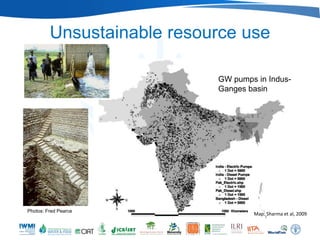
Unsustainable resource use

                            GW pumps in Indus-
                            Ganges basin


Photos: Fred Pearce
                                    Map: Sharma et al, 2009
The Opportunity


It is not only that
water is scarce
but more about
how it is managed
and accessed by
the most vulnerable
Opportunity 1: Awakening the slumbering
   giant- small-scale irrigation in Africa
The challenge:
70% of the 400 million poor in sub-Saharan Africa earn their living from
agriculture, but less than 5% of land is irrigated, leaving most farming
enterprises at risk due to short-term drought.

The opportunity:
We believe it is financially viable and ecologically sustainable to
promote the role of small-scale pump set irrigation systems that will
reduce risk and increase yields.

  It requires novel technologies, innovative business and investment
      models and the right policies to awaken this slumbering giant.
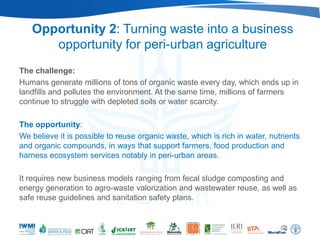
Opportunity 2: Turning waste into a business
      opportunity for peri-urban agriculture
The challenge:
Humans generate millions of tons of organic waste every day, which ends up in
landfills and pollutes the environment. At the same time, millions of farmers
continue to struggle with depleted soils or water scarcity.

The opportunity:
We believe it is possible to reuse organic waste, which is rich in water, nutrients
and organic compounds, in ways that support farmers, food production and
harness ecosystem services notably in peri-urban areas.

It requires new business models ranging from fecal sludge composting and
energy generation to agro-waste valorization and wastewater reuse, as well as
safe reuse guidelines and sanitation safety plans.
CGIAR Research Program on
Water, Land and Ecosystems:
         The basics
CGIAR Research Programs
• CGIAR centers and their network of partners work together in
  collaborative research programs that draw on the strengths of
  each to address complex global development issues, by
  calling on diverse skills and knowledge beyond the ability of
  any one organization to amass on its own.

• This ensures that our research is focused firmly on making a
  difference to poverty, food security, nutrition and health, and
  the way we manage natural resources.
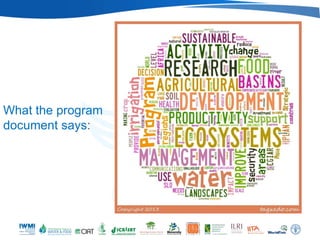
What the program
document says:
CGIAR Research Program on Water, Land and
                                       Ecosystems (WLE)

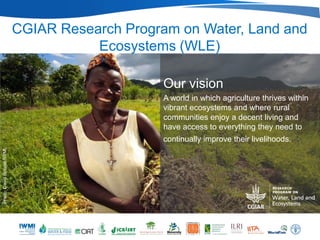
                                                 Our vision
                                                 A world in which agriculture thrives within
                                                 vibrant ecosystems and where rural
                                                 communities enjoy a decent living and
                                                 have access to everything they need to
                                                 continually improve their livelihoods..
Photo: David Brazier/IWMI
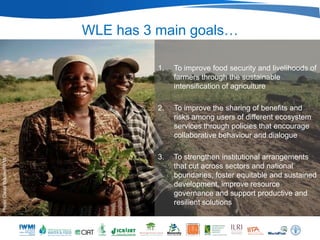
WLE has 3 main goals…

                                      1.   To improve food security and livelihoods of
                                           farmers through the sustainable
                                           intensification of agriculture

                                      2.   To improve the sharing of benefits and
                                           risks among users of different ecosystem
                                           services through policies that encourage
                                           collaborative behaviour and dialogue

                                      3.   To strengthen institutional arrangements
Photo: David Brazier/IWMI


                                           that cut across sectors and national
                                           boundaries, foster equitable and sustained
                                           development, improve resource
                                           governance and support productive and
                                           resilient solutions
What does WLE bring?
• The research power of 11 CGIAR centres and hundreds of
  regional and local partners
       • looking beyond the farm-level to sustainable development
         within global ecosystems and at diferent scales

• Innovative thinking on agriculture, natural resources
  management and poverty alleviation
• Big, bold solutions to difficult problems
   • can only be solved by working with multiple partners
Programmatic Shift
The ―new‖ is not in anyone aspect but in how all these
work together:
• Working at different scales
  (landscape, basin, global, information)
• Integration (across sectors, disciplines, scales),
• Partnerships (co-design and co-production of
  knowledge and delivery of outcomes),
• Leveraging and marshalling the unique capacities and
  purposes of partners along the delivery pathway to
  maximize for impact and
• Learning and communication as integral parts of the
  research process.
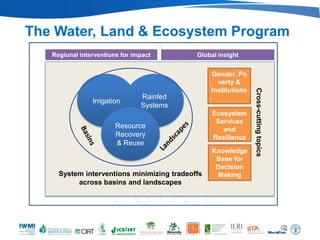
The Water, Land & Ecosystem Program
   Regional interventions for impact        Global insight


                                                 Gender, Po
                                                   verty &
                                                 Institutions


                                                                Cross-cutting topics
                                Rainfed
                Irrigation
                                Systems
                                                 Ecosystem
                                                  Services
                        Resource                    and
                        Recovery                 Resilience
                        & Reuse
                                                 Knowledge
                                                  Base for
                                                  Decision
     System interventions minimizing tradeoffs     Making
          across basins and landscapes
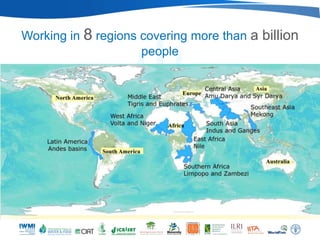
Working in 8 regions covering more than a billion
                     people
Organised under the Strategic Research Programs
   are 17 ‘Solution oriented activity clusters’
Each activity cluster:

• Addresses difficult problems of sustainably managing
  water, land and ecosystems
• Includes activities in several countries/regions and landscapes
  which are implemented at different levels
  (national, regional, global)
• Generates research outputs which contribute to WLE’s overall
  development goals and impacts
• Is implemented by several CGIAR centres and partners on the
  ground.
Strategic Research Programs
           (SRPs)
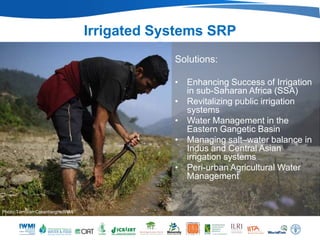
Irrigated Systems SRP
                                              Solutions:

                                              • Enhancing Success of Irrigation
                                                in sub-Saharan Africa (SSA)
                                              • Revitalizing public irrigation
                                                systems
                                              • Water Management in the
                                                Eastern Gangetic Basin
                                              • Managing salt–water balance in
                                                Indus and Central Asian
                                                irrigation systems
                                              • Peri-urban Agricultural Water
                                                Management


Photo: Tom Van Cakenberghe/IWMI
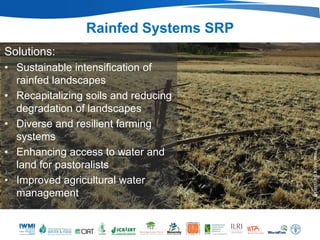
Rainfed Systems SRP
Solutions:
• Sustainable intensification of
  rainfed landscapes
• Recapitalizing soils and reducing
  degradation of landscapes
• Diverse and resilient farming
  systems
• Enhancing access to water and


                                       Photo :Akica Bahri/IWMI
  land for pastoralists
• Improved agricultural water
  management
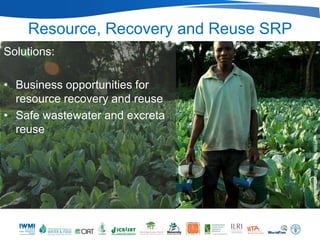
Resource, Recovery and Reuse SRP
Solutions:

• Business opportunities for
  resource recovery and reuse
• Safe wastewater and excreta
  reuse


                                       Photo: Andrea Silverman/IWMI
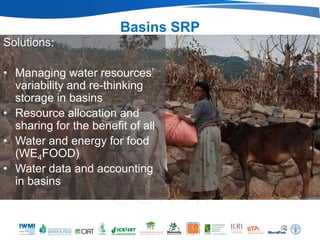
Basins SRP
Solutions:


                                              Photo: Bioversity International
                                     (IWMI)


• Managing water resources’
  variability and re-thinking
  storage in basins
• Resource allocation and
  sharing for the benefit of all
• Water and energy for food
  (WE4FOOD)
• Water data and accounting
  in basins
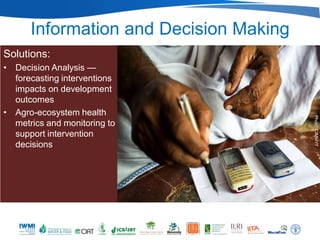
Information and Decision Making
Solutions:
• Decision Analysis —
  forecasting interventions
  impacts on development
  outcomes
• Agro-ecosystem health


                                        Photo: CIMMYT
  metrics and monitoring to
  support intervention
  decisions
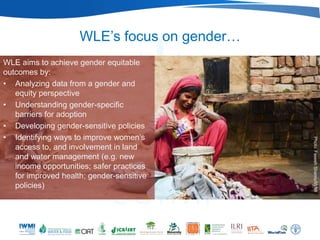
WLE’s focus on gender…
WLE aims to achieve gender equitable
outcomes by:
• Analyzing data from a gender and
   equity perspective
• Understanding gender-specific
   barriers for adoption
• Developing gender-sensitive policies
• Identifying ways to improve women’s


                                              Photo: Faseeh Shams/IWMI
   access to, and involvement in land
   and water management (e.g. new
   income opportunities; safer practices
   for improved health; gender-sensitive
   policies)
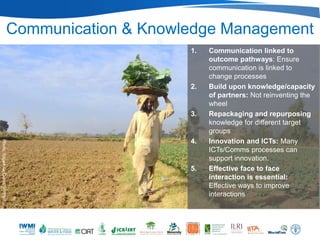
Communication & Knowledge Management
                                                      1.   Communication linked to
                                                           outcome pathways: Ensure
                                                           communication is linked to
                                                           change processes
                                                      2.   Build upon knowledge/capacity
                                                           of partners: Not reinventing the
                                                           wheel
                                                      3.   Repackaging and repurposing
                                                           knowledge for different target
                                                           groups
                                                      4.   Innovation and ICTs: Many
Photo: Sajjad Ali Qureshi/IWMI


                                                           ICTs/Comms processes can
                                                           support innovation.
                                                      5.   Effective face to face
                                                           interaction is essential:
                                                           Effective ways to improve
                                                           interactions
EXPECTED OUTCOMES by 2020
Improve sustained food security for about 15 million smallholder
farmers in sub-Saharan Africa by reducing yield gaps while
maintaining ecosystem functions in rainfed landscapes

Enhance food security and household income for about 20 million
rural people in the Eastern Gangetic Plains by improving access to
irrigation

Minimize the health risks associated with the use of wastewater and
excreta in agriculture which can benefit an estimated 21 million
vegetable farmers and 175 million consumers currently exposed
to contaminated food in South Asia and sub-Saharan Africa
Success Story #1:
       Ground Water Policy change
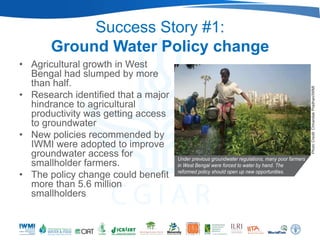
• Agricultural growth in West
  Bengal had slumped by more
  than half.
• Research identified that a major
  hindrance to agricultural
  productivity was getting access
  to groundwater
• New policies recommended by
  IWMI were adopted to improve
  groundwater access for
  smallholder farmers.
• The policy change could benefit
  more than 5.6 million
  smallholders
Success Story #2: Ethiopia establishes a soil
     information service based on CGIAR-
              developed methods
• Land degradation in Ethiopia is one of the main limiting
  factors to improving sustainable intensification and
  maintaining ecosystems.
• The Agricultural Transformation Agency (ATA) launched the
  Soil Health and Fertility Ethiopian Soil Information System
  (EthioSIS) using CGIAR methods
• Samples from 97 sentinel sites will be collected and analyzed
• Resultant high quality soil information will inform
  policies, interventions, and recommendations developed
  across Ethiopia
Success story #3: Policy influence - the example of
Urban Agriculture and Safe Wastewater Use in Ghana

IWMI research results were directly (by us) or indirectly (by
partners citing us) mapped in these strategies and policies:
• Food & Agriculture Sector Development Policy II (2007)
• Strategic Agenda for Urban & Peri-urban Agriculture (2008)
• Ghana Buffer Zone Policy (2008)
• Agriculture Sector Investment Plan 2009-2015
• Ministry of Food and Agriculture MTP 2009-2013
• Vision statement on Urban and Peri-urban Agriculture (Accra)
• National Environmental Sanitation Strategy and Action Plan
  (NESSAP) (2010) -input provided-
• Accra Agricultural Bye-law revision (still in work)
• National Irrigation Policy, Strategy, and Regulations (2011)
Success story #4: Smallholder irrigation is
           back on the agenda
A Bill and Melinda Gates Foundation (BMGF) sponsored project
assessed the potential of smallholder irrigation across Sub-Saharan
Africa and South Asia
A first set of impacts:
     – on the ground policy and investment changes in
        Ghana, Tanzania, Zambia, West Bengal and Madhya Pradesh
     – online tools for policymakers and investors (investment
        visualizer, gender mapper, technology database)
     – data and products for development agencies and national
        policymakers (livelihood maps, participatory watershed
        mapping, multi-stakeholder policy dialogues)

                                             www.awm-solutions.iwmi.org
Success story #5: India is moving towards
  environmentally sustainable water resources
    management using IWMI-developed tools
IWMI results from research on environmental water management directly or
indirectly influenced the following
• Informing the Indian High Court case on the dispute on required environmental
    releases into river basins between the state of Himachal Pradesh (HP) and National
    Hydroelectric Power Corporation,
• use of IWMI’s methodologies by a High Level Group formed by the Government of
    India, to calculate the environmental flow requirements for the Bhagirathi River (a
    source of the Ganges) in the State of Uttarakhand in response to the proposal of
    several controversial dam sites,
• In 2008-2011, IWMI joined forces with WWF-India (through WWF-International/HSBC
    partnership) in a 3-year program: ―For a Living Ganga‖ that aims to determine
    environmental needs for the upper Ganga—an iconic but rapidly developing river—to
    assist future basin development plans. Important outcomes of this project are:
      – the newly formed National Ganga River Basin Authority (NGRBA) has endorsed
         the methodology of this project and a formal process has been initiated by the
         Ministry of Environment and Forests (MoEF), through the NGRBA to develop a
         Ganga River Basin Management Plan (GRBMP).
      – The Indian experts who were trained in this project are now a part of the action
         group which will contribute to the GRBMP.

                                                         www.awm-solutions.iwmi.org
Visit our website
           wle.cgiar.org
                and
the Agriculture & Ecosystem Blog
       wle.cgiar.org/blogs

CGIAR Research Program on Water, Land and Ecosystems

  • 1.
    CGIAR Research Program on Water, Land and Ecosystems Photo: Prue Loney/IWMI
  • 2.
    Contents • Issues andopportunities • The Water, Land and Ecosystems Program: the basics • The Strategic Research Portfolios (SRPs) • How the program operates • Examples of what it will do
  • 3.
    Humanity’s greatest challenge •To feed 9 billion people in 2050, we need to produce 70% more food without destroying the environment • Rising incomes and population are already contributing to: – Water scarcity – Land degradation – Loss of ecosystem services
  • 4.
    Problems are complex… Not just population increase Not just scarcity 1,800 1,600 Bangladesh (1980-2009) GNI vs Water 1,400 50,000 1,200 40,000 Per capita GNI 1,000 GNI ($/cap PPP) 30,000 800 Per capita GNI 20,000 600 increases with population 10,000 400 200 0 -500 0 500 1000 1500 2000 2500 0 -10,000 500 1,000 1,500 Water availability (m3/cap) Population (per km2 land)
  • 5.
    …and more nuancedthan scarcity alone 0.80 6,000 0.70 5,000 0.60 4,000 0.50 0.40 Water & Slow 3,000 0.30 land growth of 2,000 0.20 0.10 scarcity productivity 1,000 0 0.00 Population index 1940 1960 1980 2000 2020 Unequal Unequal sharing of sharing of benefits risks INDIA NEWS CTOBER 1, 2009 India's Drought Worst Since 1972
  • 6.
    Unsustainable resource use GW pumps in Indus- Ganges basin Photos: Fred Pearce Map: Sharma et al, 2009
  • 7.
    The Opportunity It isnot only that water is scarce but more about how it is managed and accessed by the most vulnerable
  • 8.
    Opportunity 1: Awakeningthe slumbering giant- small-scale irrigation in Africa The challenge: 70% of the 400 million poor in sub-Saharan Africa earn their living from agriculture, but less than 5% of land is irrigated, leaving most farming enterprises at risk due to short-term drought. The opportunity: We believe it is financially viable and ecologically sustainable to promote the role of small-scale pump set irrigation systems that will reduce risk and increase yields. It requires novel technologies, innovative business and investment models and the right policies to awaken this slumbering giant.
  • 9.
    Opportunity 2: Turningwaste into a business opportunity for peri-urban agriculture The challenge: Humans generate millions of tons of organic waste every day, which ends up in landfills and pollutes the environment. At the same time, millions of farmers continue to struggle with depleted soils or water scarcity. The opportunity: We believe it is possible to reuse organic waste, which is rich in water, nutrients and organic compounds, in ways that support farmers, food production and harness ecosystem services notably in peri-urban areas. It requires new business models ranging from fecal sludge composting and energy generation to agro-waste valorization and wastewater reuse, as well as safe reuse guidelines and sanitation safety plans.
  • 10.
    CGIAR Research Programon Water, Land and Ecosystems: The basics
  • 11.
    CGIAR Research Programs •CGIAR centers and their network of partners work together in collaborative research programs that draw on the strengths of each to address complex global development issues, by calling on diverse skills and knowledge beyond the ability of any one organization to amass on its own. • This ensures that our research is focused firmly on making a difference to poverty, food security, nutrition and health, and the way we manage natural resources.
  • 12.
  • 13.
    CGIAR Research Programon Water, Land and Ecosystems (WLE) Our vision A world in which agriculture thrives within vibrant ecosystems and where rural communities enjoy a decent living and have access to everything they need to continually improve their livelihoods.. Photo: David Brazier/IWMI
  • 14.
    WLE has 3main goals… 1. To improve food security and livelihoods of farmers through the sustainable intensification of agriculture 2. To improve the sharing of benefits and risks among users of different ecosystem services through policies that encourage collaborative behaviour and dialogue 3. To strengthen institutional arrangements Photo: David Brazier/IWMI that cut across sectors and national boundaries, foster equitable and sustained development, improve resource governance and support productive and resilient solutions
  • 15.
    What does WLEbring? • The research power of 11 CGIAR centres and hundreds of regional and local partners • looking beyond the farm-level to sustainable development within global ecosystems and at diferent scales • Innovative thinking on agriculture, natural resources management and poverty alleviation • Big, bold solutions to difficult problems • can only be solved by working with multiple partners
  • 16.
    Programmatic Shift The ―new‖is not in anyone aspect but in how all these work together: • Working at different scales (landscape, basin, global, information) • Integration (across sectors, disciplines, scales), • Partnerships (co-design and co-production of knowledge and delivery of outcomes), • Leveraging and marshalling the unique capacities and purposes of partners along the delivery pathway to maximize for impact and • Learning and communication as integral parts of the research process.
  • 17.
    The Water, Land& Ecosystem Program Regional interventions for impact Global insight Gender, Po verty & Institutions Cross-cutting topics Rainfed Irrigation Systems Ecosystem Services Resource and Recovery Resilience & Reuse Knowledge Base for Decision System interventions minimizing tradeoffs Making across basins and landscapes
  • 18.
    Working in 8regions covering more than a billion people
  • 19.
    Organised under theStrategic Research Programs are 17 ‘Solution oriented activity clusters’ Each activity cluster: • Addresses difficult problems of sustainably managing water, land and ecosystems • Includes activities in several countries/regions and landscapes which are implemented at different levels (national, regional, global) • Generates research outputs which contribute to WLE’s overall development goals and impacts • Is implemented by several CGIAR centres and partners on the ground.
  • 20.
  • 21.
    Irrigated Systems SRP Solutions: • Enhancing Success of Irrigation in sub-Saharan Africa (SSA) • Revitalizing public irrigation systems • Water Management in the Eastern Gangetic Basin • Managing salt–water balance in Indus and Central Asian irrigation systems • Peri-urban Agricultural Water Management Photo: Tom Van Cakenberghe/IWMI
  • 22.
    Rainfed Systems SRP Solutions: •Sustainable intensification of rainfed landscapes • Recapitalizing soils and reducing degradation of landscapes • Diverse and resilient farming systems • Enhancing access to water and Photo :Akica Bahri/IWMI land for pastoralists • Improved agricultural water management
  • 23.
    Resource, Recovery andReuse SRP Solutions: • Business opportunities for resource recovery and reuse • Safe wastewater and excreta reuse Photo: Andrea Silverman/IWMI
  • 24.
    Basins SRP Solutions: Photo: Bioversity International (IWMI) • Managing water resources’ variability and re-thinking storage in basins • Resource allocation and sharing for the benefit of all • Water and energy for food (WE4FOOD) • Water data and accounting in basins
  • 25.
    Information and DecisionMaking Solutions: • Decision Analysis — forecasting interventions impacts on development outcomes • Agro-ecosystem health Photo: CIMMYT metrics and monitoring to support intervention decisions
  • 26.
    WLE’s focus ongender… WLE aims to achieve gender equitable outcomes by: • Analyzing data from a gender and equity perspective • Understanding gender-specific barriers for adoption • Developing gender-sensitive policies • Identifying ways to improve women’s Photo: Faseeh Shams/IWMI access to, and involvement in land and water management (e.g. new income opportunities; safer practices for improved health; gender-sensitive policies)
  • 27.
    Communication & KnowledgeManagement 1. Communication linked to outcome pathways: Ensure communication is linked to change processes 2. Build upon knowledge/capacity of partners: Not reinventing the wheel 3. Repackaging and repurposing knowledge for different target groups 4. Innovation and ICTs: Many Photo: Sajjad Ali Qureshi/IWMI ICTs/Comms processes can support innovation. 5. Effective face to face interaction is essential: Effective ways to improve interactions
  • 28.
    EXPECTED OUTCOMES by2020 Improve sustained food security for about 15 million smallholder farmers in sub-Saharan Africa by reducing yield gaps while maintaining ecosystem functions in rainfed landscapes Enhance food security and household income for about 20 million rural people in the Eastern Gangetic Plains by improving access to irrigation Minimize the health risks associated with the use of wastewater and excreta in agriculture which can benefit an estimated 21 million vegetable farmers and 175 million consumers currently exposed to contaminated food in South Asia and sub-Saharan Africa
  • 29.
    Success Story #1: Ground Water Policy change • Agricultural growth in West Bengal had slumped by more than half. • Research identified that a major hindrance to agricultural productivity was getting access to groundwater • New policies recommended by IWMI were adopted to improve groundwater access for smallholder farmers. • The policy change could benefit more than 5.6 million smallholders
  • 30.
    Success Story #2:Ethiopia establishes a soil information service based on CGIAR- developed methods • Land degradation in Ethiopia is one of the main limiting factors to improving sustainable intensification and maintaining ecosystems. • The Agricultural Transformation Agency (ATA) launched the Soil Health and Fertility Ethiopian Soil Information System (EthioSIS) using CGIAR methods • Samples from 97 sentinel sites will be collected and analyzed • Resultant high quality soil information will inform policies, interventions, and recommendations developed across Ethiopia
  • 31.
    Success story #3:Policy influence - the example of Urban Agriculture and Safe Wastewater Use in Ghana IWMI research results were directly (by us) or indirectly (by partners citing us) mapped in these strategies and policies: • Food & Agriculture Sector Development Policy II (2007) • Strategic Agenda for Urban & Peri-urban Agriculture (2008) • Ghana Buffer Zone Policy (2008) • Agriculture Sector Investment Plan 2009-2015 • Ministry of Food and Agriculture MTP 2009-2013 • Vision statement on Urban and Peri-urban Agriculture (Accra) • National Environmental Sanitation Strategy and Action Plan (NESSAP) (2010) -input provided- • Accra Agricultural Bye-law revision (still in work) • National Irrigation Policy, Strategy, and Regulations (2011)
  • 32.
    Success story #4:Smallholder irrigation is back on the agenda A Bill and Melinda Gates Foundation (BMGF) sponsored project assessed the potential of smallholder irrigation across Sub-Saharan Africa and South Asia A first set of impacts: – on the ground policy and investment changes in Ghana, Tanzania, Zambia, West Bengal and Madhya Pradesh – online tools for policymakers and investors (investment visualizer, gender mapper, technology database) – data and products for development agencies and national policymakers (livelihood maps, participatory watershed mapping, multi-stakeholder policy dialogues) www.awm-solutions.iwmi.org
  • 33.
    Success story #5:India is moving towards environmentally sustainable water resources management using IWMI-developed tools IWMI results from research on environmental water management directly or indirectly influenced the following • Informing the Indian High Court case on the dispute on required environmental releases into river basins between the state of Himachal Pradesh (HP) and National Hydroelectric Power Corporation, • use of IWMI’s methodologies by a High Level Group formed by the Government of India, to calculate the environmental flow requirements for the Bhagirathi River (a source of the Ganges) in the State of Uttarakhand in response to the proposal of several controversial dam sites, • In 2008-2011, IWMI joined forces with WWF-India (through WWF-International/HSBC partnership) in a 3-year program: ―For a Living Ganga‖ that aims to determine environmental needs for the upper Ganga—an iconic but rapidly developing river—to assist future basin development plans. Important outcomes of this project are: – the newly formed National Ganga River Basin Authority (NGRBA) has endorsed the methodology of this project and a formal process has been initiated by the Ministry of Environment and Forests (MoEF), through the NGRBA to develop a Ganga River Basin Management Plan (GRBMP). – The Indian experts who were trained in this project are now a part of the action group which will contribute to the GRBMP. www.awm-solutions.iwmi.org
  • 34.
    Visit our website wle.cgiar.org and the Agriculture & Ecosystem Blog wle.cgiar.org/blogs

Editor's Notes

  • #3 Notes:This section aims to set the context and background for WLE. It focuses on the opportunities that WLE will address and which define its value-proposition, i.e. what is unique about WLE?
  • #9 Notes:Today, an estimated 70% of the 400 million poor inhabitants of sub-Saharan Africa live in rural areas and earn their livelihoods by raising crops and livestock. Yet less than 5% of land in Africa is irrigated and this mostly occurs in just three countries (Madagascar, South Africa and Sudan) and on commercial farms. This large community of poor smallholder farmers are characterized by low productivity and investment due in part to the high risk of crop failure due to short-term droughts.A switch to irrigated agriculture could have huge implications for smallholder farmers, who would have the potential to triple their food production by pumping their own water. This would introduce the stability they need to maintain a sedentary lifestyle, allowing them to earn a reliable income, feed their families and educate their children.We have the technological innovation to achieve this and through the development of innovativeinvestment and business models that ensure better targeting of interventions we can ensure that this slumbering giant will be awakened.
  • #10 Notes:Humans generate millions of tons of organic waste including excreta every day. This waste is rich in water, nutrients and organic compounds. Yet, waste is not being managed in a way that permits us to derive value from its reuse, whilst millions of farmers continue to struggle with depleted soils or water scarcity. Today, most waste ends in landfills or pollutes the environment. We will studybusiness cases ranging from fecal sludge composting and energy generation to agro-waste valorization and wastewater reuse, across peri-urban Africa, MENA, South America and Asia to develop viable business models and investment plans in 10 defined locations to increase RRR from organic and liquid waste in ways that support ecosystem services, system resilience and food production.We believe that such promising business models could benefit up to 15 and 25 million (m) smallholders in sub-Saharan Africa and South Asia, respectively, supporting better food security for 150 and 250m consumers in both regions, enabling a cost reduction in waste management which could help to serve additional 12 and 22m households, respectively, in both regions
  • #11 Notes:This section aims to describe the vision, goals and main impacts that WLE will have both over the short (3-5 year) and long-term (10-15 years).
  • #13 A tagcloud of the WLE straegic document in september
  • #14 Notes:We envisage a world where agriculture thrives in vibrant ecosystems and where the people engaged in agriculture live in good health, enjoy food and nutritional security and have access to everything they need to continually improve their livelihoods.
  • #15 Notes:
  • #17 The paradigm shift also includes new approaches to achieve this goal particularly;1.      integration (across sectors, disciplines, scales),2.      partnerships (co-design and co-production of knowledge and delivery of outcomes),3.      leveraging and marshalling the unique capacities and purposes of partners along the delivery pathway to maximize for impact and4.      learning and communication as integral parts of the research process.
  • #19 Notes:WLE targets research to support development in 10 priority river basins and regions. They include:The Andes basin in South AmericaThe Limpopo basin in Southern AfricaThe Zambezi basin in Southern AfricaThe Volta basin in West AfricaThe Niger basin in West AfricaThe Nile basin in East AfricaThe Indus and Ganges basins in South AsiaThe Mekong basin in Southeast AsiaThe Amu Darya and Syr Darya basins in Central AsiaThe Tigris and Euphrates basins in the Middle EastWLE is unique in that it has global scale reach and works in 8 benchmark regions
  • #20 Notes:
  • #27 Notes:In addition to the activity clusters, WLE has 2-cross cutting themes that will influence and enhance our research:(i) Gender, poverty and institutions: WLE includes gender, poverty and institutions aspects through a central research functions in order to improve understanding of these issues and enhance WLE impacts. We will ensure that all WLE interventions are pro-poor and benefit men and women equally by analysing data from a gender and equity perspective including where possible by ensuring that data are gender-disaggregated; examining the extent to which male and female farmers have different adoption rates and identifying gender-specific barriers; looking at ways to remediate gender bias in agricultural research; improving women’s access to and involvement in NRM; developing gender sensitive policies for land and water management.(ii) Ecosystem services: within each activity cluster, we will promote ecosystem resilience and seek to enhance and increase the value placed upon each ecosystem services. We will work to provide farmers and pastoralists with production systems that are better adapted to environmental change and which are more resilient to shocks
  • #28 Michael
  • #30 This work was carried out by AditiMukerji the 2012 Norman Borlaug award winnerWe found that, after showing high growth in the mid 1980s and early 1990s, West Bengal’s agricultural economy had slowed down with an adverse impact on farmers’ incomes and livelihoods. In recent years, it has barely registered 1% annual growth. The groundwater economy contracted too. For example, according to the Minor Irrigation Census, the number of groundwater wells declined by over 100,000 from 2001 to 2007 – entirely unprecedented in India. This is a paradox given that the same minor irrigation census shows that in 80% of the villages, groundwater is available within less than 10 metres and that groundwater levels recover sufficiently after the monsoon season due to high rainfall (1,500-3,000 mm per year) and the alluvial nature of the aquifer [underground layer of water-bearing rock]. Yet, farmers found it difficult to pump water from aquifers for their crops. Why was this so?We discovered that the reason was that farmers were facing high energy costs for pumping groundwater because of their dependence on diesel pumps and the fact that diesel prices have been increasing quite rapidly since the early 2000s. In West Bengal, only 17% of all pumps are electrified, compared to a national average of over 60%. The electrification of pumps would have been an easy solution, especially since West Bengal has been an electricity surplus state for a long time now. However, we found that farmers faced two difficulties in connecting their pumps to the electricity grid. First was the Groundwater Act of 2005 which required all farmers to procure a permit from the groundwater authority before they could apply for a connection. This process of getting a permit was fraught with red tape and corruption and often led to harassment of farmers by unscrupulous officials. And then, even if a farmer managed to get a permit from the groundwater authorities he then had to pay the full capital cost of electrification of tube wells which was often much beyond the capacity of small and marginal farmers owning less than half a hectare of land.We presented our research findings to DrMihir Shah, Member of the Indian Planning Commission, and with his help we took our results and recommendations to the top bureaucrats in Bengal. We suggested removing the permits system in all places where the groundwater situation is safe. We also suggested rationalising the capital costs of initial electrification. In addition, we suggested that funds from the Mahatma Gandhi National Rural Employment Guarantee Act (MGNREGA) should be used in a targeted manner for the excavation of ponds in districts with alluvial aquifers. The government accepted most of these suggestions. On 9th November, 2011, via an administrative order, the Secretary of Water Resources changed the law whereby farmers residing in safe areas and wanting to install pumps with less than 5 Horse Power would no longer require a permit from the groundwater department. Similarly, the West Bengal State Electricity Board has also come out with a circular saying that farmers will have to pay a one-time fixed cost for electrification and this cost will be around Rs. 10,000 or so. They will, of course, then continue to pay a metered tariff.  Here, let me emphasise that West Bengal has one of the best agricultural electricity governance regimes in India. Unlike other states where farmers get free and unmetered electricity, in Bengal, electric pumps are metered and farmers pay quite high electricity tariffs for pumping groundwater. This gives them an incentive to make efficient use of groundwater and electricity.With both these policy changes in place, it is expected that farmers will have easier access to groundwater, will be able to intensify their cropping systems, earn more and emerge out of poverty. Together these have the potential to drastically change the nature of agriculture in West Bengal and usher in a second Green Revolution. The state has 7 million land holdings, of which 5.6 million are less than one hectare in size and belong to small and marginal farmers. Thus the possible implications for agricultural output and poverty reduction of these two policy changes are huge. I also think that these policies are replicable in many parts of the eastern Indian states of Bihar and Assam with similar hydro-geological conditions. By providing timely, adequate and reliable irrigation, groundwater helps in reducing poverty.