Chapter 3
PROGRAM OUTCOMES AND STUDENT
LEARNING OUTCOMES
Presented by: Group 3
1
What is Program Outcomes and
Student Learning Outcomes?
Program Outcomes (POs)
-These are broad statements that describe what a
student should know, be able to do, or value by the
time they complete an entire academic program or
degree (e.g., a Bachelor's degree in Education).
Student Learning Outcomes (SLOs)
-These are more specific and measurable statements
that describe what a student should know, be able to
do, or demonstrate after completing a specific
course, lesson, or learning activity within that
program. 2
3.1 Program Outcomes and
Student Learning Outcomes
The shift of focus in education from content to
student learning outcomes has changed
teachers' instructional perspective.
In the past, teachers were often heard about
their concern to finish their subject matter
before the end of the term.
In short, teachers were more content-centered
than outcomes-centered.
3
The new educational perspective
requires teachers to visualize the
ideal graduates three or more years
after graduation and right after
completion of the program, i.c.,
graduation time (as stated in
institutional outcomes and program
outcomes.
4
The Commission on Higher Education, the body that regulates
higher education in the Philippines, in its Memorandum Order # 20, s.
2014 requires the following program outcomes for all higher
education institutions the ability to:
a) articulate and discuss the latest developments in the specific field
of practice;
b) effectively communicate orally and in writing using both English
and Filipino;
c) work effectively and independently in multi-disciplinary and multi-
cultural teams;
d) act in recognition of professional, social and ethical responsibility;
and
e) preserve and promote "Filipino historical and cultural heritage."
5
Some program outcomes are based on types of higher
education institutional (HEI) because this determines the
focus and purpose of the HEI.
For example:
Graduates of professional institutions demonstrate a service orientation in
one's profession.
Graduates of colleges participate in various types of employment,
development activities and public discourses, particularly in response to
the needs of the communities one serves.
Graduates of universities participate in the generation of new knowledge or
in research and development projects.
Graduates of State Universities and Colleges must, in addition, have the
competencies to support "national, regional and local development plans."
6
7
8
9
10
11
12
13
14
15
16
17
18
19
20
21
22
23
24
25
26
27
28
29
3TYPES OF LEARNING
1. COGNITIVE
2. AFFECTIVE
3. PSYCHOMOTOR
1. COGNITIVE- Referring to
mental skills and intellectual
processes.(remembering, understanding,
applying, analyzing, evaluating and creating)
2. AFFECTIVE- Referring to
growth in feeling, attitudes,
values and emotion.
3. PSYCHOMOTOR-
Referring to manual or
physical skills.
30
31
32
34
BLOOM'S TAXONOMY 1956 ANDERSON'S KRATHWOHL'S
TAXONOMY 2001
5. Synthesis: The ability to put parts
together to form a coherent or unique
new whole, Examples of verbs that
relate to this function are:
5. Evaluating:
Making judgments based oncriteria and
standards through checking and eritiquing.
Critiques,recommendations and reports are
some of the products that can becreated to
demonstrate the processes of evaluation. In
the newertaxonomy. evaluating
comes beforecreating as it is often a
necessarypart of the
precursory behaviorbefore one creates
compose plant invent propose
produce formulate develop
design collect set arrange
assemble app generelize construct
create document organize
prepare Combine originate
PREDICT R
modify tell
35
BLOOM'S TAXONOMY 1956 ANDERSON'S KRATHWOHL'S
TAXONOMY 2001
5. Synthesis: The ability to put parts
together to form a coherent or unique
new whole, Examples of verbs that
relate to this function are:
5. Evaluating:
Making judgments based oncriteria and
standards through checking and eritiquing.
Critiques,recommendations and reports are
some of the products that can becreated to
demonstrate the processes of evaluation. In
the newertaxonomy. evaluating
comes beforecreating as it is often a
necessarypart of the
precursory behaviorbefore one creates
REMEMBERING Produce the right information from memory
RECOGNIZING
•Identify frogs in a diagram of different kinds of amphibian.
•Find an isoscelles triangle in your neighborhood.
•Answer any true-false or multiple - choice questions.
RECALLING
•Name three 19th-century women English authors.
•Write the multiplication facts.
•Reproduce the chemical formula for carbon tetrachloride
COGNITIVE PROCESS EXAMPLES
36
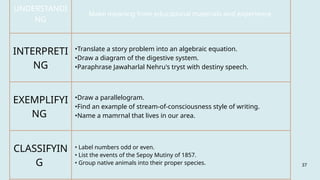
UNDERSTANDI
NG
Make meaning from educational materials and experience
INTERPRETI
NG
•Translate a story problem into an algebraic equation.
•Draw a diagram of the digestive system.
•Paraphrase Jawaharlal Nehru's tryst with destiny speech.
EXEMPLIFYI
NG
•Draw a parallelogram.
•Find an example of stream-of-consciousness style of writing.
•Name a mamrnal that lives in our area.
CLASSIFYIN
G
• Label numbers odd or even.
• List the events of the Sepoy Mutiny of 1857.
• Group native animals into their proper species. 37
COMPARING
• Explain how the heart is like a pump
• Compare Mahatma Gandhi to a present day leader.
• Use a Venn diagram to demonstrate how two books by Charles Dickens are
similar and different.
EXPLAINING
•Draw a diagram explaining how air pressure affects the weather.
• Provide details that justify why the French Revolution happened when and how it
did
• Describe how interest rates affect the economy.
APPLYING USE A PROCEDURE
EXECUTING
• Add a column of two-digit numbers.
• Orally read a passage in a foreign language
• Have a student open house discussion
IMPLEMENTING
• Design an experiment to see how plants grow in different kinds of soil.
• Proofread a piece of writing.
• Create a budget 38
ANALYZING
Break a concept down into its part and describe how the parts relate to the
whole.
Differentiati
ng
• List the important information in a mathematical word problem and
cross out the unimportant information.
• Draw a diagram showing the major and minor characters in a novel.
Organizing
• Place the books in the classroom library into categories
• Make a chart of often-used figurative devices and explain their effect.
• Make a diagram showing the ways plants and animals in your
neighborhood interact with each other
39
Checking
• Participate in a writing group, giving peers feedback on
organization and logic of arguments.
• Listen to a political speech and make a list of any
contradictions within the speech.
• Review a project plan to see if all the necessary steps are
included.
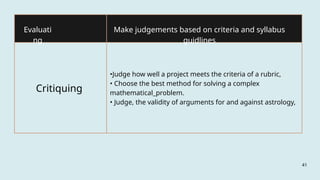
Evaluati
ng
Make judgements based on criteria and syllabus
guidlines
40
Critiquing
•Judge how well a project meets the criteria of a rubric,
• Choose the best method for solving a complex
mathematical_problem.
• Judge, the validity of arguments for and against astrology,
Evaluati
ng
Make judgements based on criteria and syllabus
guidlines
41
42
CREATI
NG
Put pieces together to form something new or recognire componenis "new
structure.
Ge
ner
atin
g
•Given a list of criteria, list some options for
improving race relations in the school.
• Generate several scientific hypotheses to explainwhy plants need
sunshine.
• Propose a set of alternatives for reducing
dependence on fossil fuels that address both
economic and environmental conçerns.
• Come up with alternative hypotheses based on criteria.
pla
nni
ng
•Make a storyboard for a multimedia presentation on insects.
• Outline a research paper on Mark Twain's views onPlanningreligion.
• Design a scientific study to test the effect of
differeat kinds of music on hens' egg production.
43
CREATI
NG
Put picces together to form something new or recognire componenis "new
structure.
Pro
duc
ing
• Write a journal from the point of view ofmountaincer.
•Build a habitat for pigeons.
•Put on a play based on a chapter from a novel you're reading.
4 LEVELS OF
KNOWLEDGE
FACTUAL KNOWLEDGE
Refers to the facts.This refers to
essential facts, terminology, details
or elements students must know
or be familiar with in order to
understand or discipline or solve a
problem in it. (knowing what/that something is true)
CONCEPTUAL KNOWLEGE
Refers to the interrelationship of
facts. It is facts put together within
a within a larger structure that
enable them to function together.
(knowing why something is true)
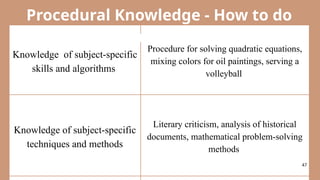
PROCEDURAL KNOWLEGE
This knowing how to do
something. Refers to information
or knowledge that helps students
to do something specific to a
discipline, subject or area of study.
( knowing how to do something)
METACOGNITIVE KNOWLEGE
This knowing that you know, this
is thinking about your own
thinking in a purposeful way.
Knowledge of one’s own
cognition. (knowing about your own
cognition/thinking about thinking)
REVISED VERSION FROM
ORIGINAL
Prepared By: Sarlie Manggos-alan
44
TABLE: 1.2
Knowledge of
terminology
Vocabulary terms,
mathematical symbols,
musical notation, alphabet
Factual Knowledge - Basic Education
45
Knowledge of classifications and
categories
Species of animals, different kinds
of arguments, geological era
Knowledge of principles and
generalizations
Types of conflict in literature,
Newton's Law of Motion,
principles of democracy
Conceptual
Knowledge
46
Knowledge of subject-specific
skills and algorithms
Procedure for solving quadratic equations,
mixing colors for oil paintings, serving a
volleyball
Knowledge of subject-specific
techniques and methods
Literary criticism, analysis of historical
documents, mathematical problem-solving
methods
Procedural Knowledge - How to do
something
47
Strategic knowledge
Ways of memorizing facts, reading
comprehension strategies, methods
of planning a Web site
Knowledge about cognitive Different reading demand of textbooks
Metacognitive
Knowledge
48
Self-knowledge
Need for a diagram or chart to
understand complex processes,
better compression in quiet
environments, needs to discuss
ideas with someone before writing
an essay
49
Taxonomies of the
Cognitive Domain
50
Bloom's Taxonomy
1956
51
1. Knowledge:
Remembering or retrieving previously
learned material.
2. Comprehension : The ability to grasp or
construct meaning from material.
3. Application : The ability to use learned
material or to implement material in new
Bloom's Taxonomy
1956
52
4. Analysis:
The ability to break down
or distinguish the parts of material into its
components so that its organizational
structure may be better understood.
1. Remembering:
Recognizing or recalling knowledge from
memory. Remembering is when memory
is used to produce or retrieve definitions,
facts, or lists, or to recite previously
learned information.
2. Understanding:
Constructing meaning from different
types of functions be they written or
graphic messages or activities like
Anderson's and
krathwohl's Taxonomy
2001
53
3.Applying:
Carrying out or using a procedure
through executing or implementing.
Applying relates to or refers to situations
where learned material is used through
products like models, presentations,
interviews or simulations.
4. Analyzing:
Breaking materials or concepts into parts,
determining how the parts relate to one
Anderson's and
krathwohl's Taxonomy
2001
54
Chapter-3-educ-8 Program outcomes & SLOs

  • 1.
    Chapter 3 PROGRAM OUTCOMESAND STUDENT LEARNING OUTCOMES Presented by: Group 3 1
  • 2.
    What is ProgramOutcomes and Student Learning Outcomes? Program Outcomes (POs) -These are broad statements that describe what a student should know, be able to do, or value by the time they complete an entire academic program or degree (e.g., a Bachelor's degree in Education). Student Learning Outcomes (SLOs) -These are more specific and measurable statements that describe what a student should know, be able to do, or demonstrate after completing a specific course, lesson, or learning activity within that program. 2
  • 3.
    3.1 Program Outcomesand Student Learning Outcomes The shift of focus in education from content to student learning outcomes has changed teachers' instructional perspective. In the past, teachers were often heard about their concern to finish their subject matter before the end of the term. In short, teachers were more content-centered than outcomes-centered. 3
  • 4.
    The new educationalperspective requires teachers to visualize the ideal graduates three or more years after graduation and right after completion of the program, i.c., graduation time (as stated in institutional outcomes and program outcomes. 4
  • 5.
    The Commission onHigher Education, the body that regulates higher education in the Philippines, in its Memorandum Order # 20, s. 2014 requires the following program outcomes for all higher education institutions the ability to: a) articulate and discuss the latest developments in the specific field of practice; b) effectively communicate orally and in writing using both English and Filipino; c) work effectively and independently in multi-disciplinary and multi- cultural teams; d) act in recognition of professional, social and ethical responsibility; and e) preserve and promote "Filipino historical and cultural heritage." 5
  • 6.
    Some program outcomesare based on types of higher education institutional (HEI) because this determines the focus and purpose of the HEI. For example: Graduates of professional institutions demonstrate a service orientation in one's profession. Graduates of colleges participate in various types of employment, development activities and public discourses, particularly in response to the needs of the communities one serves. Graduates of universities participate in the generation of new knowledge or in research and development projects. Graduates of State Universities and Colleges must, in addition, have the competencies to support "national, regional and local development plans." 6
  • 7.
  • 8.
  • 9.
  • 10.
  • 11.
  • 12.
  • 13.
  • 14.
  • 15.
  • 16.
  • 17.
  • 18.
  • 19.
  • 20.
  • 21.
  • 22.
  • 23.
  • 24.
  • 25.
  • 26.
  • 27.
  • 28.
  • 29.
  • 30.
    3TYPES OF LEARNING 1.COGNITIVE 2. AFFECTIVE 3. PSYCHOMOTOR
  • 31.
    1. COGNITIVE- Referringto mental skills and intellectual processes.(remembering, understanding, applying, analyzing, evaluating and creating) 2. AFFECTIVE- Referring to growth in feeling, attitudes, values and emotion.
  • 32.
    3. PSYCHOMOTOR- Referring tomanual or physical skills.
  • 33.
  • 34.
  • 35.
  • 36.
    34 BLOOM'S TAXONOMY 1956ANDERSON'S KRATHWOHL'S TAXONOMY 2001 5. Synthesis: The ability to put parts together to form a coherent or unique new whole, Examples of verbs that relate to this function are: 5. Evaluating: Making judgments based oncriteria and standards through checking and eritiquing. Critiques,recommendations and reports are some of the products that can becreated to demonstrate the processes of evaluation. In the newertaxonomy. evaluating comes beforecreating as it is often a necessarypart of the precursory behaviorbefore one creates compose plant invent propose produce formulate develop design collect set arrange assemble app generelize construct create document organize prepare Combine originate PREDICT R modify tell
  • 37.
    35 BLOOM'S TAXONOMY 1956ANDERSON'S KRATHWOHL'S TAXONOMY 2001 5. Synthesis: The ability to put parts together to form a coherent or unique new whole, Examples of verbs that relate to this function are: 5. Evaluating: Making judgments based oncriteria and standards through checking and eritiquing. Critiques,recommendations and reports are some of the products that can becreated to demonstrate the processes of evaluation. In the newertaxonomy. evaluating comes beforecreating as it is often a necessarypart of the precursory behaviorbefore one creates
  • 38.
    REMEMBERING Produce theright information from memory RECOGNIZING •Identify frogs in a diagram of different kinds of amphibian. •Find an isoscelles triangle in your neighborhood. •Answer any true-false or multiple - choice questions. RECALLING •Name three 19th-century women English authors. •Write the multiplication facts. •Reproduce the chemical formula for carbon tetrachloride COGNITIVE PROCESS EXAMPLES 36
  • 39.
    UNDERSTANDI NG Make meaning fromeducational materials and experience INTERPRETI NG •Translate a story problem into an algebraic equation. •Draw a diagram of the digestive system. •Paraphrase Jawaharlal Nehru's tryst with destiny speech. EXEMPLIFYI NG •Draw a parallelogram. •Find an example of stream-of-consciousness style of writing. •Name a mamrnal that lives in our area. CLASSIFYIN G • Label numbers odd or even. • List the events of the Sepoy Mutiny of 1857. • Group native animals into their proper species. 37
  • 40.
    COMPARING • Explain howthe heart is like a pump • Compare Mahatma Gandhi to a present day leader. • Use a Venn diagram to demonstrate how two books by Charles Dickens are similar and different. EXPLAINING •Draw a diagram explaining how air pressure affects the weather. • Provide details that justify why the French Revolution happened when and how it did • Describe how interest rates affect the economy. APPLYING USE A PROCEDURE EXECUTING • Add a column of two-digit numbers. • Orally read a passage in a foreign language • Have a student open house discussion IMPLEMENTING • Design an experiment to see how plants grow in different kinds of soil. • Proofread a piece of writing. • Create a budget 38
  • 41.
    ANALYZING Break a conceptdown into its part and describe how the parts relate to the whole. Differentiati ng • List the important information in a mathematical word problem and cross out the unimportant information. • Draw a diagram showing the major and minor characters in a novel. Organizing • Place the books in the classroom library into categories • Make a chart of often-used figurative devices and explain their effect. • Make a diagram showing the ways plants and animals in your neighborhood interact with each other 39
  • 42.
    Checking • Participate ina writing group, giving peers feedback on organization and logic of arguments. • Listen to a political speech and make a list of any contradictions within the speech. • Review a project plan to see if all the necessary steps are included. Evaluati ng Make judgements based on criteria and syllabus guidlines 40
  • 43.
    Critiquing •Judge how wella project meets the criteria of a rubric, • Choose the best method for solving a complex mathematical_problem. • Judge, the validity of arguments for and against astrology, Evaluati ng Make judgements based on criteria and syllabus guidlines 41
  • 44.
    42 CREATI NG Put pieces togetherto form something new or recognire componenis "new structure. Ge ner atin g •Given a list of criteria, list some options for improving race relations in the school. • Generate several scientific hypotheses to explainwhy plants need sunshine. • Propose a set of alternatives for reducing dependence on fossil fuels that address both economic and environmental conçerns. • Come up with alternative hypotheses based on criteria. pla nni ng •Make a storyboard for a multimedia presentation on insects. • Outline a research paper on Mark Twain's views onPlanningreligion. • Design a scientific study to test the effect of differeat kinds of music on hens' egg production.
  • 45.
    43 CREATI NG Put picces togetherto form something new or recognire componenis "new structure. Pro duc ing • Write a journal from the point of view ofmountaincer. •Build a habitat for pigeons. •Put on a play based on a chapter from a novel you're reading.
  • 46.
  • 47.
    FACTUAL KNOWLEDGE Refers tothe facts.This refers to essential facts, terminology, details or elements students must know or be familiar with in order to understand or discipline or solve a problem in it. (knowing what/that something is true)
  • 48.
    CONCEPTUAL KNOWLEGE Refers tothe interrelationship of facts. It is facts put together within a within a larger structure that enable them to function together. (knowing why something is true)
  • 49.
    PROCEDURAL KNOWLEGE This knowinghow to do something. Refers to information or knowledge that helps students to do something specific to a discipline, subject or area of study. ( knowing how to do something)
  • 50.
    METACOGNITIVE KNOWLEGE This knowingthat you know, this is thinking about your own thinking in a purposeful way. Knowledge of one’s own cognition. (knowing about your own cognition/thinking about thinking)
  • 51.
    REVISED VERSION FROM ORIGINAL PreparedBy: Sarlie Manggos-alan 44 TABLE: 1.2
  • 52.
    Knowledge of terminology Vocabulary terms, mathematicalsymbols, musical notation, alphabet Factual Knowledge - Basic Education 45
  • 53.
    Knowledge of classificationsand categories Species of animals, different kinds of arguments, geological era Knowledge of principles and generalizations Types of conflict in literature, Newton's Law of Motion, principles of democracy Conceptual Knowledge 46
  • 54.
    Knowledge of subject-specific skillsand algorithms Procedure for solving quadratic equations, mixing colors for oil paintings, serving a volleyball Knowledge of subject-specific techniques and methods Literary criticism, analysis of historical documents, mathematical problem-solving methods Procedural Knowledge - How to do something 47
  • 55.
    Strategic knowledge Ways ofmemorizing facts, reading comprehension strategies, methods of planning a Web site Knowledge about cognitive Different reading demand of textbooks Metacognitive Knowledge 48
  • 56.
    Self-knowledge Need for adiagram or chart to understand complex processes, better compression in quiet environments, needs to discuss ideas with someone before writing an essay 49
  • 57.
  • 58.
    Bloom's Taxonomy 1956 51 1. Knowledge: Rememberingor retrieving previously learned material. 2. Comprehension : The ability to grasp or construct meaning from material. 3. Application : The ability to use learned material or to implement material in new
  • 59.
    Bloom's Taxonomy 1956 52 4. Analysis: Theability to break down or distinguish the parts of material into its components so that its organizational structure may be better understood.
  • 60.
    1. Remembering: Recognizing orrecalling knowledge from memory. Remembering is when memory is used to produce or retrieve definitions, facts, or lists, or to recite previously learned information. 2. Understanding: Constructing meaning from different types of functions be they written or graphic messages or activities like Anderson's and krathwohl's Taxonomy 2001 53
  • 61.
    3.Applying: Carrying out orusing a procedure through executing or implementing. Applying relates to or refers to situations where learned material is used through products like models, presentations, interviews or simulations. 4. Analyzing: Breaking materials or concepts into parts, determining how the parts relate to one Anderson's and krathwohl's Taxonomy 2001 54