Using an Open Source Threat
Model for Prioritized Defense
A Practical Approach
Presented by James Tarala
Principal Consultant Enclave Security© 2015
2
Using an Open Source Threat Model for Prioritized Defense© Enclave Security 2015
Problem Statements
• In information assurance today, there are no clear taxonomies for threat
• If we cannot understand threats, how can we possibly decide how best to
defend ourselves?
• Unclear definitions of threat lead to unclear architectures for defense
• If we cannot agree what threats face our systems, how can we possibly
agree on how best to defend ourselves?
3
Using an Open Source Threat Model for Prioritized Defense© Enclave Security 2015
Threat Defined (NIST)
• NIST 800-30 (rev1):
– “A threat is any circumstance or event with the potential to adversely
impact organizational operations and assets, individuals, other
organizations, or the Nation through an information system via
unauthorized access, destruction, disclosure, or modification of
information, and/or denial of service.”
http://csrc.nist.gov/publications/nistpubs/800-30-rev1/sp800_30_r1.pdf
4
Using an Open Source Threat Model for Prioritized Defense© Enclave Security 2015
The Behavior of Threat
“Threat agents perform threat actions against
threat targets in order to cause threat
consequences.”
5
Using an Open Source Threat Model for Prioritized Defense© Enclave Security 2015
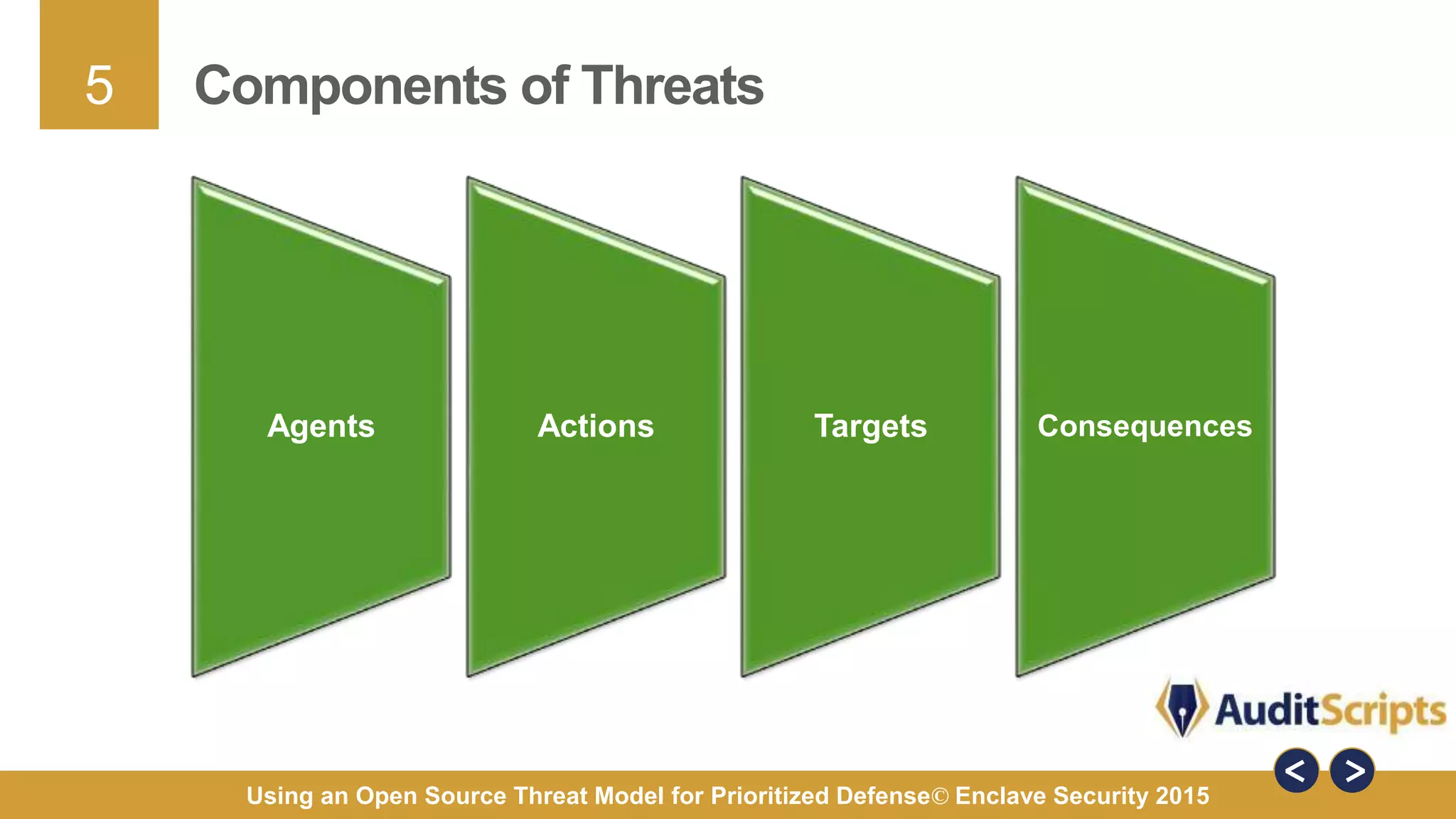
Components of Threats
Agents Actions Targets Consequences
6
Using an Open Source Threat Model for Prioritized Defense© Enclave Security 2015
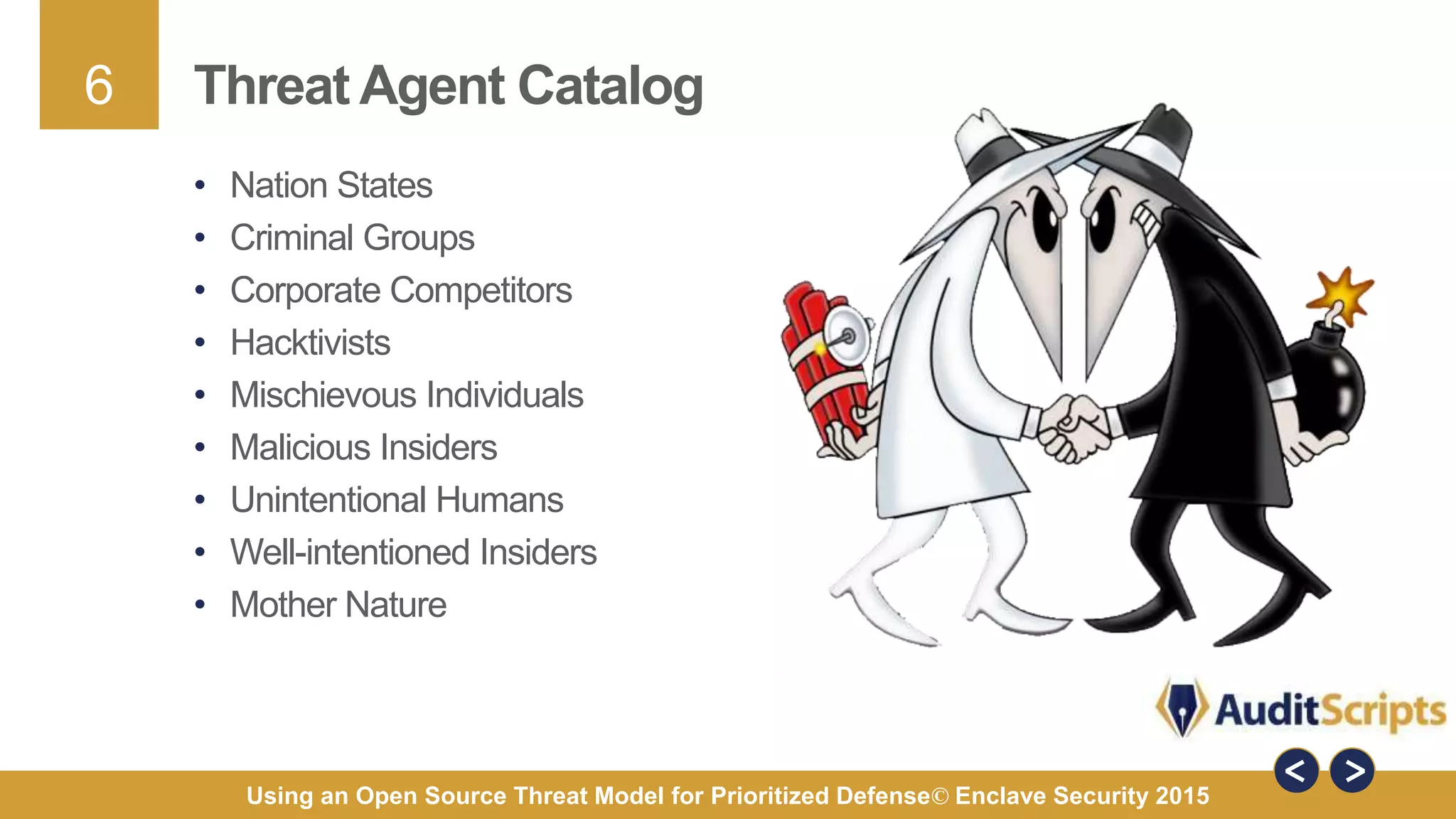
Threat Agent Catalog
• Nation States
• Criminal Groups
• Corporate Competitors
• Hacktivists
• Mischievous Individuals
• Malicious Insiders
• Unintentional Humans
• Well-intentioned Insiders
• Mother Nature
7
Using an Open Source Threat Model for Prioritized Defense© Enclave Security 2015
Threat Definition Leads to Control Definition
• By defining threats we can understand those agents with the potential to
cause harm to an organization
• By necessity, threat definition leads to control (countermeasure) definition
• If we can understand those things that can harm an organization (threats),
we can identify controls to protect the organization from those threats
becoming reality
• Therefore a better understanding of threat leads to the selection of better
defenses for our organizations
8
Using an Open Source Threat Model for Prioritized Defense© Enclave Security 2015
Control Selection Example: Whitelisting
• Sample threat: Malicious Code
• Sample control: Application Whitelisting
• Sample consequence: Data Theft
• Scenario:
– An organization is fearful that malware will execute on their
workstations and steal data from their systems
– The threat (malware) must be allowed to execute in order for the
consequence to become reality
– Therefore the organization deploys application whitelisting to block the
execution of unknown software code
9
Using an Open Source Threat Model for Prioritized Defense© Enclave Security 2015
Questions to Consider About Threat
• However, is there a point of diminishing returns when it comes to the
knowledge of specific threats?
• Is more information truly useful when defending ourselves?
• Organizations should consider therefore:
– Do up-to-date threat agents modify control selection?
– Do we need to know specific threat agents?
– Does threat intelligence change behavior?
– Is a relatively comprehensive list of threats sufficient for control
selection?
10
Using an Open Source Threat Model for Prioritized Defense© Enclave Security 2015
Case Study: Web Server Attacks
• OWASP Top Ten Web Threats 2013
– A1-Injection
– A2-Broken Authentication and Session Management
– A3-Cross-Site Scripting (XSS)
– A4-Insecure Direct Object References
– A5-Security Misconfiguration
– A6-Sensitive Data Exposure
– A7-Missing Function Level Access Control
– A8-Cross-Site Request Forgery (CSRF)
– A9-Using Components with Known Vulnerabilities
– A10-Unvalidated Redirects and Forwards
11
Using an Open Source Threat Model for Prioritized Defense© Enclave Security 2015
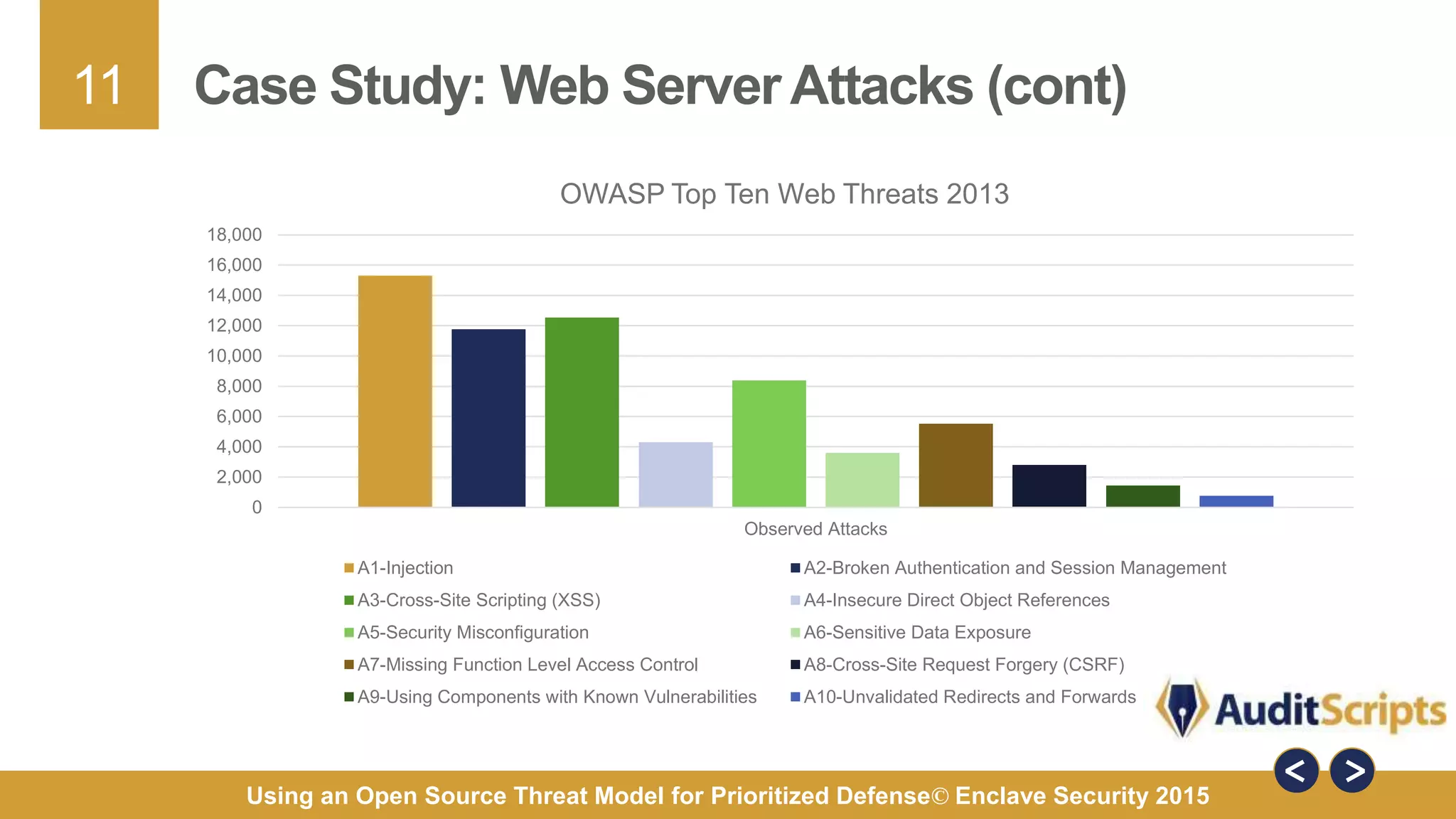
Case Study: Web Server Attacks (cont)
0
2,000
4,000
6,000
8,000
10,000
12,000
14,000
16,000
18,000
Observed Attacks
OWASP Top Ten Web Threats 2013
A1-Injection A2-Broken Authentication and Session Management
A3-Cross-Site Scripting (XSS) A4-Insecure Direct Object References
A5-Security Misconfiguration A6-Sensitive Data Exposure
A7-Missing Function Level Access Control A8-Cross-Site Request Forgery (CSRF)
A9-Using Components with Known Vulnerabilities A10-Unvalidated Redirects and Forwards
12
Using an Open Source Threat Model for Prioritized Defense© Enclave Security 2015
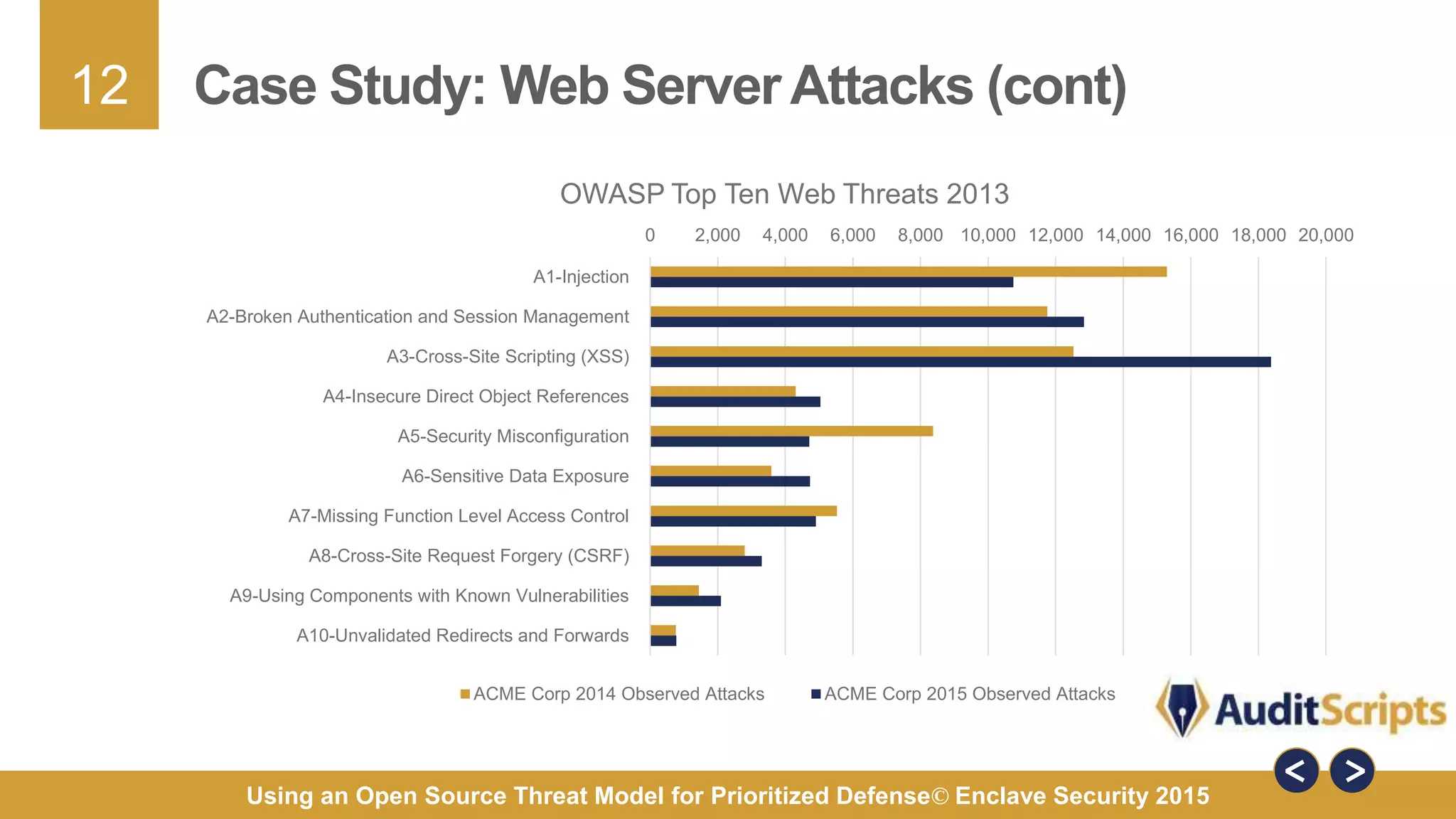
Case Study: Web Server Attacks (cont)
0 2,000 4,000 6,000 8,000 10,000 12,000 14,000 16,000 18,000 20,000
A1-Injection
A2-Broken Authentication and Session Management
A3-Cross-Site Scripting (XSS)
A4-Insecure Direct Object References
A5-Security Misconfiguration
A6-Sensitive Data Exposure
A7-Missing Function Level Access Control
A8-Cross-Site Request Forgery (CSRF)
A9-Using Components with Known Vulnerabilities
A10-Unvalidated Redirects and Forwards
OWASP Top Ten Web Threats 2013
ACME Corp 2014 Observed Attacks ACME Corp 2015 Observed Attacks
13
Using an Open Source Threat Model for Prioritized Defense© Enclave Security 2015
Case Study: Web Server Attacks (cont)
• In light of the data observed, let’s answer the following questions:
– Should this organization implement a web application firewall?
– Should this organization scan their applications for vulnerabilities?
– Do you believe the organization’s defenses should change in light of
what has been observed?
– Is the threat data useful when determining which controls to
implement?
– How heavily should an organization value likelihood scores when
measuring risk?
14
Using an Open Source Threat Model for Prioritized Defense© Enclave Security 2015
Case Study: Web Server Attacks (cont)
• So what can we learn in light of this discussion?
– Although attack frequencies may vary, if an attack exists controls
need to be considered to defend against the attack
– Not implementing controls for known threats represent risk
– Just because a risk is lower, it does not mean an organization is safe
if they choose not to implement sufficient controls
– Documented prioritizations are not a valid defense
15
Using an Open Source Threat Model for Prioritized Defense© Enclave Security 2015
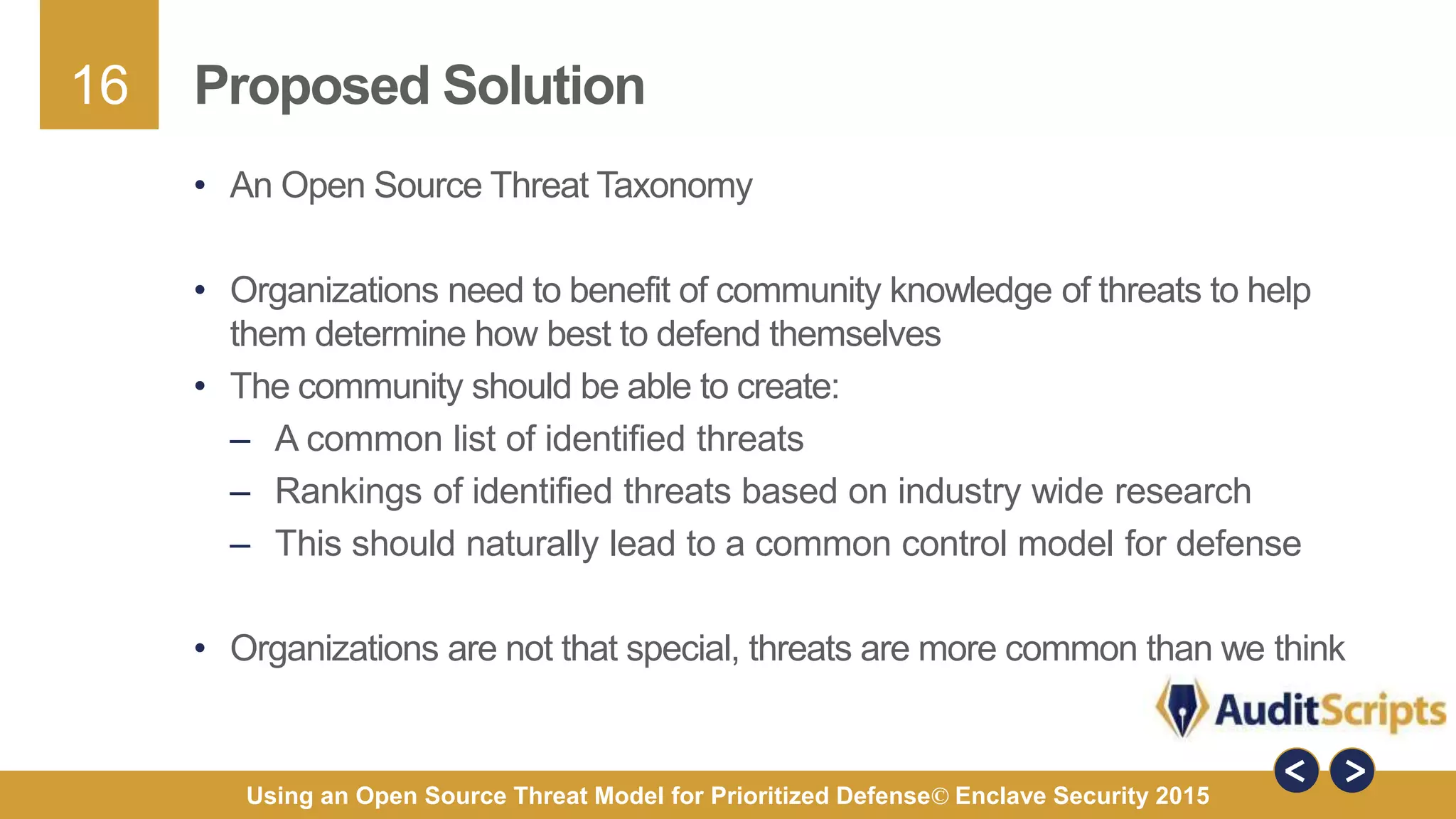
What’s Really Our Goal?
http://threatbutt.com/map
16
Using an Open Source Threat Model for Prioritized Defense© Enclave Security 2015
Proposed Solution
• An Open Source Threat Taxonomy
• Organizations need to benefit of community knowledge of threats to help
them determine how best to defend themselves
• The community should be able to create:
– A common list of identified threats
– Rankings of identified threats based on industry wide research
– This should naturally lead to a common control model for defense
• Organizations are not that special, threats are more common than we think
17
Using an Open Source Threat Model for Prioritized Defense© Enclave Security 2015
Goals of the Project
• To maintain an open-source taxonomy of threats to information systems.
• Specifically we will define:
– Categories of Threats
– A Hierarchy of Threats
– Specific Threat Inventory / Taxonomy
• Provide documentation to promote a common language
• The project will focus on threat only – not vulnerability or risk
• Practicality, not academics, is driving the effort
18
Using an Open Source Threat Model for Prioritized Defense© Enclave Security 2015
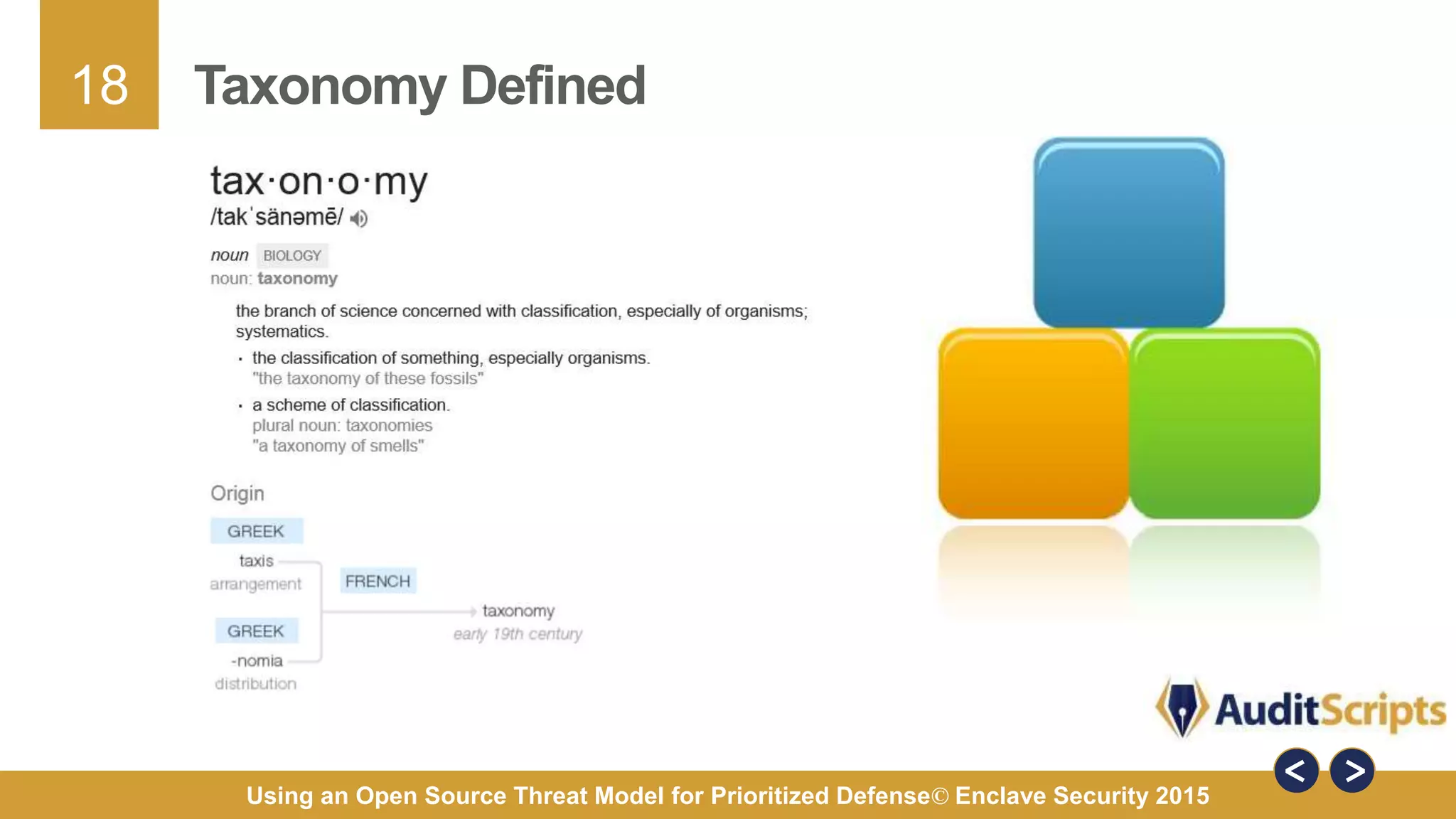
Taxonomy Defined
19
Using an Open Source Threat Model for Prioritized Defense© Enclave Security 2015
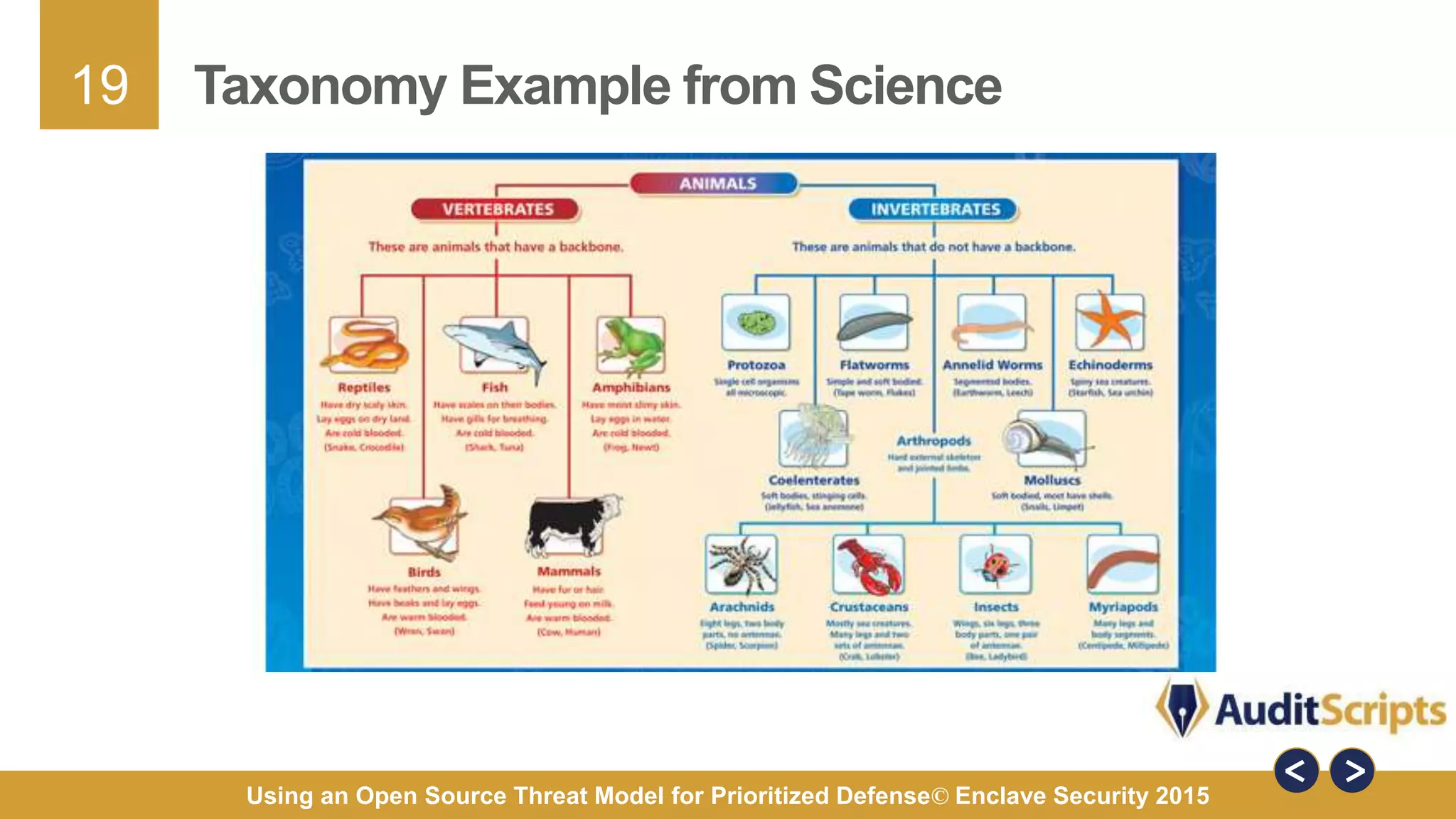
Taxonomy Example from Science
20
Using an Open Source Threat Model for Prioritized Defense© Enclave Security 2015
Who This Project Impacts
• Threat Modelers
– Provide a common taxonomy to map threat models against
• Control Definers
– Define threats in order to define appropriate controls
• Risk Managers
– Define threats so each organization can tweak priorities (not have to
create it from scratch themselves)
– Everyone is only a little unique
21
Using an Open Source Threat Model for Prioritized Defense© Enclave Security 2015
Relevant Industry Research
• Numerous Industry Threat Reports
(Verizon, Microsoft, Symantec, Sophos, etc.)
• MITRE CAPECs
• OWASP WASCs
• NIST 800-30 (rev1)
• CMUSEI Taxonomy of Operational Risk
• Cambridge Centre for Risk Studies
• General Motors Concentric Vulnerability Map
• Treasury Board of Canada - Guide to Risk Taxonomies
22
Using an Open Source Threat Model for Prioritized Defense© Enclave Security 2015
High Level Threats Defined
• At a high level the committee has identified four high
level threat categories:
– Physical (PHY)
– Resource (RES)
– Personnel (PER)
– Technical (TEC)
23
Using an Open Source Threat Model for Prioritized Defense© Enclave Security 2015
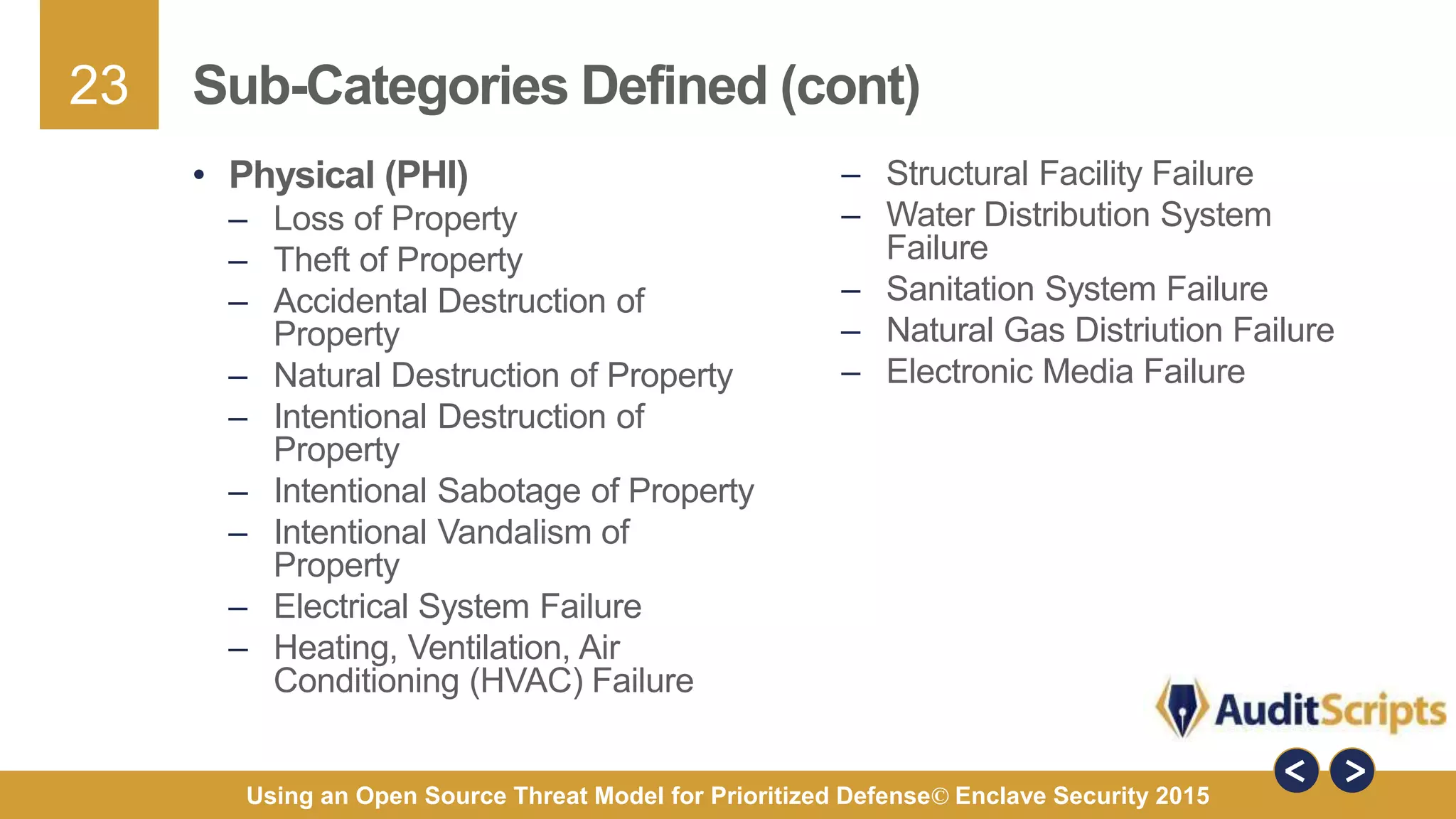
Sub-Categories Defined (cont)
– Structural Facility Failure
– Water Distribution System
Failure
– Sanitation System Failure
– Natural Gas Distriution Failure
– Electronic Media Failure
• Physical (PHI)
– Loss of Property
– Theft of Property
– Accidental Destruction of
Property
– Natural Destruction of Property
– Intentional Destruction of
Property
– Intentional Sabotage of Property
– Intentional Vandalism of
Property
– Electrical System Failure
– Heating, Ventilation, Air
Conditioning (HVAC) Failure
24
Using an Open Source Threat Model for Prioritized Defense© Enclave Security 2015
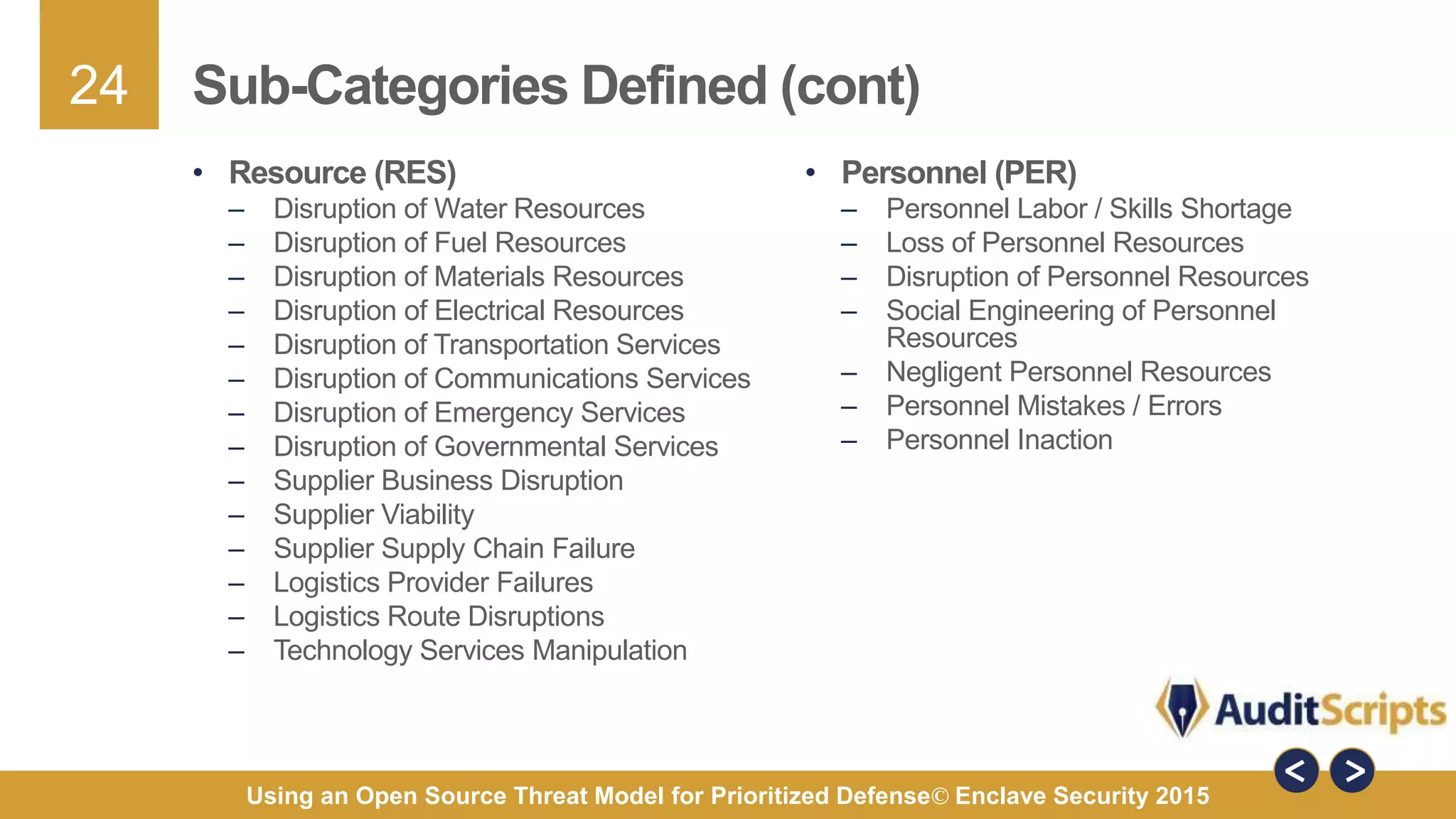
Sub-Categories Defined (cont)
• Personnel (PER)
– Personnel Labor / Skills Shortage
– Loss of Personnel Resources
– Disruption of Personnel Resources
– Social Engineering of Personnel
Resources
– Negligent Personnel Resources
– Personnel Mistakes / Errors
– Personnel Inaction
• Resource (RES)
– Disruption of Water Resources
– Disruption of Fuel Resources
– Disruption of Materials Resources
– Disruption of Electrical Resources
– Disruption of Transportation Services
– Disruption of Communications Services
– Disruption of Emergency Services
– Disruption of Governmental Services
– Supplier Business Disruption
– Supplier Viability
– Supplier Supply Chain Failure
– Logistics Provider Failures
– Logistics Route Disruptions
– Technology Services Manipulation
25
Using an Open Source Threat Model for Prioritized Defense© Enclave Security 2015
Sub-Categories Defined (cont)
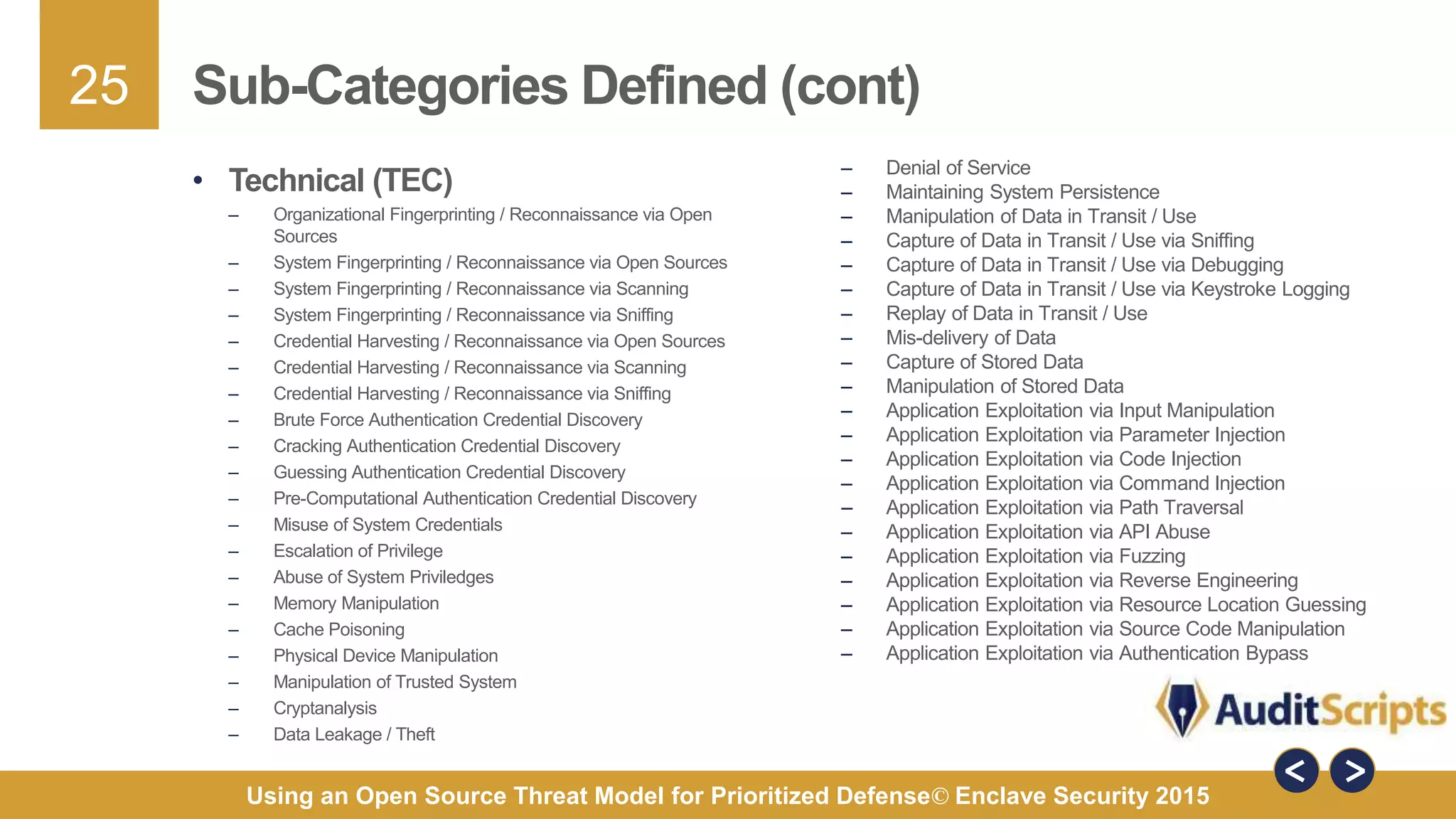
– Denial of Service
– Maintaining System Persistence
– Manipulation of Data in Transit / Use
– Capture of Data in Transit / Use via Sniffing
– Capture of Data in Transit / Use via Debugging
– Capture of Data in Transit / Use via Keystroke Logging
– Replay of Data in Transit / Use
– Mis-delivery of Data
– Capture of Stored Data
– Manipulation of Stored Data
– Application Exploitation via Input Manipulation
– Application Exploitation via Parameter Injection
– Application Exploitation via Code Injection
– Application Exploitation via Command Injection
– Application Exploitation via Path Traversal
– Application Exploitation via API Abuse
– Application Exploitation via Fuzzing
– Application Exploitation via Reverse Engineering
– Application Exploitation via Resource Location Guessing
– Application Exploitation via Source Code Manipulation
– Application Exploitation via Authentication Bypass
• Technical (TEC)
– Organizational Fingerprinting / Reconnaissance via Open
Sources
– System Fingerprinting / Reconnaissance via Open Sources
– System Fingerprinting / Reconnaissance via Scanning
– System Fingerprinting / Reconnaissance via Sniffing
– Credential Harvesting / Reconnaissance via Open Sources
– Credential Harvesting / Reconnaissance via Scanning
– Credential Harvesting / Reconnaissance via Sniffing
– Brute Force Authentication Credential Discovery
– Cracking Authentication Credential Discovery
– Guessing Authentication Credential Discovery
– Pre-Computational Authentication Credential Discovery
– Misuse of System Credentials
– Escalation of Privilege
– Abuse of System Priviledges
– Memory Manipulation
– Cache Poisoning
– Physical Device Manipulation
– Manipulation of Trusted System
– Cryptanalysis
– Data Leakage / Theft
26
Using an Open Source Threat Model for Prioritized Defense© Enclave Security 2015
Mappings to Threat Reports
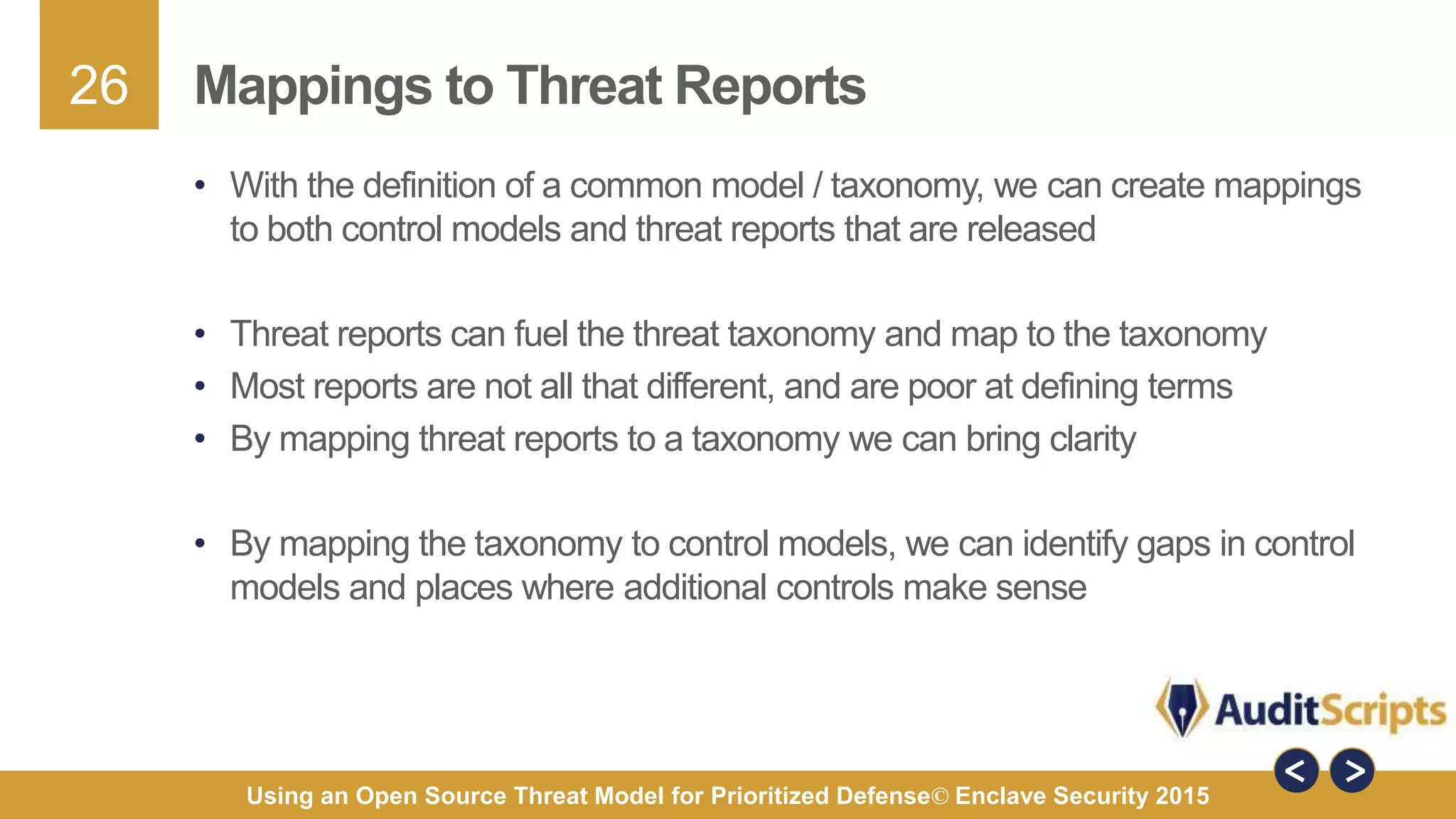
• With the definition of a common model / taxonomy, we can create mappings
to both control models and threat reports that are released
• Threat reports can fuel the threat taxonomy and map to the taxonomy
• Most reports are not all that different, and are poor at defining terms
• By mapping threat reports to a taxonomy we can bring clarity
• By mapping the taxonomy to control models, we can identify gaps in control
models and places where additional controls make sense
27
Using an Open Source Threat Model for Prioritized Defense© Enclave Security 2015
Community Based Risk Assessment
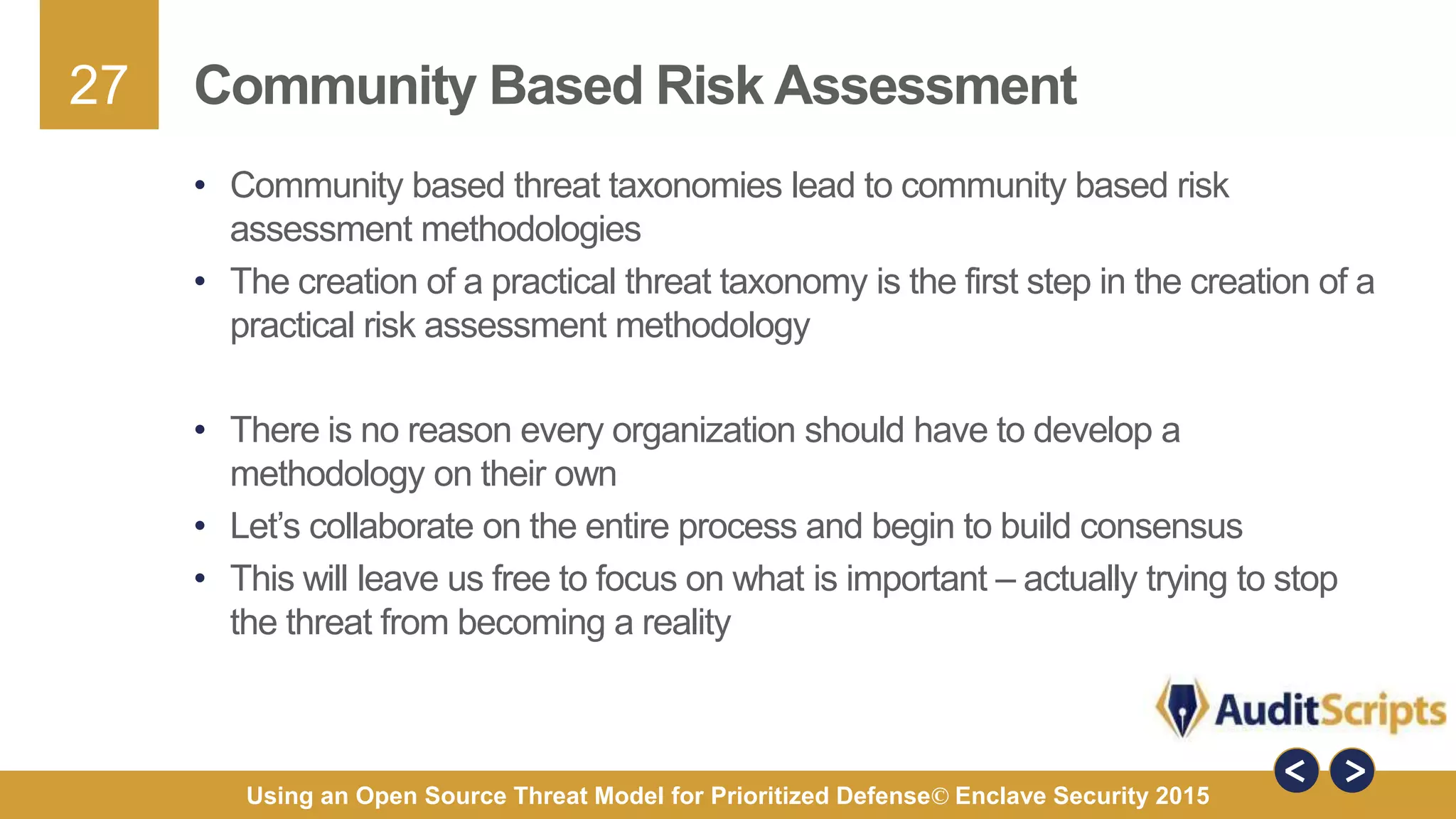
• Community based threat taxonomies lead to community based risk
assessment methodologies
• The creation of a practical threat taxonomy is the first step in the creation of a
practical risk assessment methodology
• There is no reason every organization should have to develop a
methodology on their own
• Let’s collaborate on the entire process and begin to build consensus
• This will leave us free to focus on what is important – actually trying to stop
the threat from becoming a reality
28
Using an Open Source Threat Model for Prioritized Defense© Enclave Security 2015
Future of the Critical Security Controls
• The next version of the Critical Security Controls is being collaborated on as
we speak (an upcoming 2015 release is planned)
• The Critical Security Controls (vNext) we hope will be based upon a
common threat model such as this
• By agreeing on threats we can ensure:
– We have consensus on the problem
– We have a common language for discussion
– We don’t have glaring gaps in the control model
29
Using an Open Source Threat Model for Prioritized Defense© Enclave Security 2015
Next Steps - How Can You Help?
• We are still looking for people willing to contribute to the project
• Although the skeleton has been created, this will be an ongoing effort
• The next steps for the project are to:
– Finalize categories of threat agents
– Finalize categories of threat consequences
– Create weights / likelihoods for each threat
– Continue to refine the lists of threat actions
• Interested in helping? Drop me a note.
30
Using an Open Source Threat Model for Prioritized Defense© Enclave Security 2015
Further Questions
• James Tarala
– Principal Consultant & Founder, Enclave Security
– E-mail: james.tarala@enclavesecurity.com
– Twitter: @isaudit
– Website: http://www.auditscripts.com/
• Resources for further study:
– AuditScripts.com Audit Resources
– SANS SEC 566: Implementing and Auditing the Critical Security Controls
– NIST 800-53 (rev 1)
Using an Open Source Threat Model for Prioritized Defense

Using an Open Source Threat Model for Prioritized Defense

  • 1.
    Using an OpenSource Threat Model for Prioritized Defense A Practical Approach Presented by James Tarala Principal Consultant Enclave Security© 2015
  • 2.
    2 Using an OpenSource Threat Model for Prioritized Defense© Enclave Security 2015 Problem Statements • In information assurance today, there are no clear taxonomies for threat • If we cannot understand threats, how can we possibly decide how best to defend ourselves? • Unclear definitions of threat lead to unclear architectures for defense • If we cannot agree what threats face our systems, how can we possibly agree on how best to defend ourselves?
  • 3.
    3 Using an OpenSource Threat Model for Prioritized Defense© Enclave Security 2015 Threat Defined (NIST) • NIST 800-30 (rev1): – “A threat is any circumstance or event with the potential to adversely impact organizational operations and assets, individuals, other organizations, or the Nation through an information system via unauthorized access, destruction, disclosure, or modification of information, and/or denial of service.” http://csrc.nist.gov/publications/nistpubs/800-30-rev1/sp800_30_r1.pdf
  • 4.
    4 Using an OpenSource Threat Model for Prioritized Defense© Enclave Security 2015 The Behavior of Threat “Threat agents perform threat actions against threat targets in order to cause threat consequences.”
  • 5.
    5 Using an OpenSource Threat Model for Prioritized Defense© Enclave Security 2015 Components of Threats Agents Actions Targets Consequences
  • 6.
    6 Using an OpenSource Threat Model for Prioritized Defense© Enclave Security 2015 Threat Agent Catalog • Nation States • Criminal Groups • Corporate Competitors • Hacktivists • Mischievous Individuals • Malicious Insiders • Unintentional Humans • Well-intentioned Insiders • Mother Nature
  • 7.
    7 Using an OpenSource Threat Model for Prioritized Defense© Enclave Security 2015 Threat Definition Leads to Control Definition • By defining threats we can understand those agents with the potential to cause harm to an organization • By necessity, threat definition leads to control (countermeasure) definition • If we can understand those things that can harm an organization (threats), we can identify controls to protect the organization from those threats becoming reality • Therefore a better understanding of threat leads to the selection of better defenses for our organizations
  • 8.
    8 Using an OpenSource Threat Model for Prioritized Defense© Enclave Security 2015 Control Selection Example: Whitelisting • Sample threat: Malicious Code • Sample control: Application Whitelisting • Sample consequence: Data Theft • Scenario: – An organization is fearful that malware will execute on their workstations and steal data from their systems – The threat (malware) must be allowed to execute in order for the consequence to become reality – Therefore the organization deploys application whitelisting to block the execution of unknown software code
  • 9.
    9 Using an OpenSource Threat Model for Prioritized Defense© Enclave Security 2015 Questions to Consider About Threat • However, is there a point of diminishing returns when it comes to the knowledge of specific threats? • Is more information truly useful when defending ourselves? • Organizations should consider therefore: – Do up-to-date threat agents modify control selection? – Do we need to know specific threat agents? – Does threat intelligence change behavior? – Is a relatively comprehensive list of threats sufficient for control selection?
  • 10.
    10 Using an OpenSource Threat Model for Prioritized Defense© Enclave Security 2015 Case Study: Web Server Attacks • OWASP Top Ten Web Threats 2013 – A1-Injection – A2-Broken Authentication and Session Management – A3-Cross-Site Scripting (XSS) – A4-Insecure Direct Object References – A5-Security Misconfiguration – A6-Sensitive Data Exposure – A7-Missing Function Level Access Control – A8-Cross-Site Request Forgery (CSRF) – A9-Using Components with Known Vulnerabilities – A10-Unvalidated Redirects and Forwards
  • 11.
    11 Using an OpenSource Threat Model for Prioritized Defense© Enclave Security 2015 Case Study: Web Server Attacks (cont) 0 2,000 4,000 6,000 8,000 10,000 12,000 14,000 16,000 18,000 Observed Attacks OWASP Top Ten Web Threats 2013 A1-Injection A2-Broken Authentication and Session Management A3-Cross-Site Scripting (XSS) A4-Insecure Direct Object References A5-Security Misconfiguration A6-Sensitive Data Exposure A7-Missing Function Level Access Control A8-Cross-Site Request Forgery (CSRF) A9-Using Components with Known Vulnerabilities A10-Unvalidated Redirects and Forwards
  • 12.
    12 Using an OpenSource Threat Model for Prioritized Defense© Enclave Security 2015 Case Study: Web Server Attacks (cont) 0 2,000 4,000 6,000 8,000 10,000 12,000 14,000 16,000 18,000 20,000 A1-Injection A2-Broken Authentication and Session Management A3-Cross-Site Scripting (XSS) A4-Insecure Direct Object References A5-Security Misconfiguration A6-Sensitive Data Exposure A7-Missing Function Level Access Control A8-Cross-Site Request Forgery (CSRF) A9-Using Components with Known Vulnerabilities A10-Unvalidated Redirects and Forwards OWASP Top Ten Web Threats 2013 ACME Corp 2014 Observed Attacks ACME Corp 2015 Observed Attacks
  • 13.
    13 Using an OpenSource Threat Model for Prioritized Defense© Enclave Security 2015 Case Study: Web Server Attacks (cont) • In light of the data observed, let’s answer the following questions: – Should this organization implement a web application firewall? – Should this organization scan their applications for vulnerabilities? – Do you believe the organization’s defenses should change in light of what has been observed? – Is the threat data useful when determining which controls to implement? – How heavily should an organization value likelihood scores when measuring risk?
  • 14.
    14 Using an OpenSource Threat Model for Prioritized Defense© Enclave Security 2015 Case Study: Web Server Attacks (cont) • So what can we learn in light of this discussion? – Although attack frequencies may vary, if an attack exists controls need to be considered to defend against the attack – Not implementing controls for known threats represent risk – Just because a risk is lower, it does not mean an organization is safe if they choose not to implement sufficient controls – Documented prioritizations are not a valid defense
  • 15.
    15 Using an OpenSource Threat Model for Prioritized Defense© Enclave Security 2015 What’s Really Our Goal? http://threatbutt.com/map
  • 16.
    16 Using an OpenSource Threat Model for Prioritized Defense© Enclave Security 2015 Proposed Solution • An Open Source Threat Taxonomy • Organizations need to benefit of community knowledge of threats to help them determine how best to defend themselves • The community should be able to create: – A common list of identified threats – Rankings of identified threats based on industry wide research – This should naturally lead to a common control model for defense • Organizations are not that special, threats are more common than we think
  • 17.
    17 Using an OpenSource Threat Model for Prioritized Defense© Enclave Security 2015 Goals of the Project • To maintain an open-source taxonomy of threats to information systems. • Specifically we will define: – Categories of Threats – A Hierarchy of Threats – Specific Threat Inventory / Taxonomy • Provide documentation to promote a common language • The project will focus on threat only – not vulnerability or risk • Practicality, not academics, is driving the effort
  • 18.
    18 Using an OpenSource Threat Model for Prioritized Defense© Enclave Security 2015 Taxonomy Defined
  • 19.
    19 Using an OpenSource Threat Model for Prioritized Defense© Enclave Security 2015 Taxonomy Example from Science
  • 20.
    20 Using an OpenSource Threat Model for Prioritized Defense© Enclave Security 2015 Who This Project Impacts • Threat Modelers – Provide a common taxonomy to map threat models against • Control Definers – Define threats in order to define appropriate controls • Risk Managers – Define threats so each organization can tweak priorities (not have to create it from scratch themselves) – Everyone is only a little unique
  • 21.
    21 Using an OpenSource Threat Model for Prioritized Defense© Enclave Security 2015 Relevant Industry Research • Numerous Industry Threat Reports (Verizon, Microsoft, Symantec, Sophos, etc.) • MITRE CAPECs • OWASP WASCs • NIST 800-30 (rev1) • CMUSEI Taxonomy of Operational Risk • Cambridge Centre for Risk Studies • General Motors Concentric Vulnerability Map • Treasury Board of Canada - Guide to Risk Taxonomies
  • 22.
    22 Using an OpenSource Threat Model for Prioritized Defense© Enclave Security 2015 High Level Threats Defined • At a high level the committee has identified four high level threat categories: – Physical (PHY) – Resource (RES) – Personnel (PER) – Technical (TEC)
  • 23.
    23 Using an OpenSource Threat Model for Prioritized Defense© Enclave Security 2015 Sub-Categories Defined (cont) – Structural Facility Failure – Water Distribution System Failure – Sanitation System Failure – Natural Gas Distriution Failure – Electronic Media Failure • Physical (PHI) – Loss of Property – Theft of Property – Accidental Destruction of Property – Natural Destruction of Property – Intentional Destruction of Property – Intentional Sabotage of Property – Intentional Vandalism of Property – Electrical System Failure – Heating, Ventilation, Air Conditioning (HVAC) Failure
  • 24.
    24 Using an OpenSource Threat Model for Prioritized Defense© Enclave Security 2015 Sub-Categories Defined (cont) • Personnel (PER) – Personnel Labor / Skills Shortage – Loss of Personnel Resources – Disruption of Personnel Resources – Social Engineering of Personnel Resources – Negligent Personnel Resources – Personnel Mistakes / Errors – Personnel Inaction • Resource (RES) – Disruption of Water Resources – Disruption of Fuel Resources – Disruption of Materials Resources – Disruption of Electrical Resources – Disruption of Transportation Services – Disruption of Communications Services – Disruption of Emergency Services – Disruption of Governmental Services – Supplier Business Disruption – Supplier Viability – Supplier Supply Chain Failure – Logistics Provider Failures – Logistics Route Disruptions – Technology Services Manipulation
  • 25.
    25 Using an OpenSource Threat Model for Prioritized Defense© Enclave Security 2015 Sub-Categories Defined (cont) – Denial of Service – Maintaining System Persistence – Manipulation of Data in Transit / Use – Capture of Data in Transit / Use via Sniffing – Capture of Data in Transit / Use via Debugging – Capture of Data in Transit / Use via Keystroke Logging – Replay of Data in Transit / Use – Mis-delivery of Data – Capture of Stored Data – Manipulation of Stored Data – Application Exploitation via Input Manipulation – Application Exploitation via Parameter Injection – Application Exploitation via Code Injection – Application Exploitation via Command Injection – Application Exploitation via Path Traversal – Application Exploitation via API Abuse – Application Exploitation via Fuzzing – Application Exploitation via Reverse Engineering – Application Exploitation via Resource Location Guessing – Application Exploitation via Source Code Manipulation – Application Exploitation via Authentication Bypass • Technical (TEC) – Organizational Fingerprinting / Reconnaissance via Open Sources – System Fingerprinting / Reconnaissance via Open Sources – System Fingerprinting / Reconnaissance via Scanning – System Fingerprinting / Reconnaissance via Sniffing – Credential Harvesting / Reconnaissance via Open Sources – Credential Harvesting / Reconnaissance via Scanning – Credential Harvesting / Reconnaissance via Sniffing – Brute Force Authentication Credential Discovery – Cracking Authentication Credential Discovery – Guessing Authentication Credential Discovery – Pre-Computational Authentication Credential Discovery – Misuse of System Credentials – Escalation of Privilege – Abuse of System Priviledges – Memory Manipulation – Cache Poisoning – Physical Device Manipulation – Manipulation of Trusted System – Cryptanalysis – Data Leakage / Theft
  • 26.
    26 Using an OpenSource Threat Model for Prioritized Defense© Enclave Security 2015 Mappings to Threat Reports • With the definition of a common model / taxonomy, we can create mappings to both control models and threat reports that are released • Threat reports can fuel the threat taxonomy and map to the taxonomy • Most reports are not all that different, and are poor at defining terms • By mapping threat reports to a taxonomy we can bring clarity • By mapping the taxonomy to control models, we can identify gaps in control models and places where additional controls make sense
  • 27.
    27 Using an OpenSource Threat Model for Prioritized Defense© Enclave Security 2015 Community Based Risk Assessment • Community based threat taxonomies lead to community based risk assessment methodologies • The creation of a practical threat taxonomy is the first step in the creation of a practical risk assessment methodology • There is no reason every organization should have to develop a methodology on their own • Let’s collaborate on the entire process and begin to build consensus • This will leave us free to focus on what is important – actually trying to stop the threat from becoming a reality
  • 28.
    28 Using an OpenSource Threat Model for Prioritized Defense© Enclave Security 2015 Future of the Critical Security Controls • The next version of the Critical Security Controls is being collaborated on as we speak (an upcoming 2015 release is planned) • The Critical Security Controls (vNext) we hope will be based upon a common threat model such as this • By agreeing on threats we can ensure: – We have consensus on the problem – We have a common language for discussion – We don’t have glaring gaps in the control model
  • 29.
    29 Using an OpenSource Threat Model for Prioritized Defense© Enclave Security 2015 Next Steps - How Can You Help? • We are still looking for people willing to contribute to the project • Although the skeleton has been created, this will be an ongoing effort • The next steps for the project are to: – Finalize categories of threat agents – Finalize categories of threat consequences – Create weights / likelihoods for each threat – Continue to refine the lists of threat actions • Interested in helping? Drop me a note.
  • 30.
    30 Using an OpenSource Threat Model for Prioritized Defense© Enclave Security 2015 Further Questions • James Tarala – Principal Consultant & Founder, Enclave Security – E-mail: james.tarala@enclavesecurity.com – Twitter: @isaudit – Website: http://www.auditscripts.com/ • Resources for further study: – AuditScripts.com Audit Resources – SANS SEC 566: Implementing and Auditing the Critical Security Controls – NIST 800-53 (rev 1)