PRIYANKA PRIYADARSANI NAYAK
Roll no-06
TOXICOLOGY(Pharmacology Department)
MALLA REDDY COLLEGE OF PHARMACY
• The various guidelines given by united states
Food and Drug administration are:
 For the maintenance and for conducting the
toxicological studies
 Bioequivalance studies
 Clinical traials and
 In the field of radiology
 The U.S. Food and drug administration is an
agency of the united states department of
Health and Human Services.
 USFDA is responsible for the safety regulation
of most type of foods,dietary
supplements,drugs,vaccines,biological medical
products,blood products,medical
devices,radiation emitting devices,veterinary
products.

 The agency of the U.S. Department of Health
and Human Services was established in 1927.
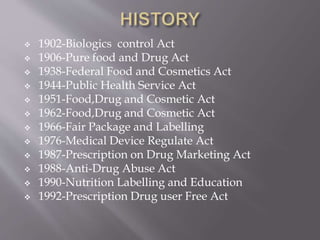
 1902-Biologics control Act
 1906-Pure food and Drug Act
 1938-Federal Food and Cosmetics Act
 1944-Public Health Service Act
 1951-Food,Drug and Cosmetic Act
 1962-Food,Drug and Cosmetic Act
 1966-Fair Package and Labelling
 1976-Medical Device Regulate Act
 1987-Prescription on Drug Marketing Act
 1988-Anti-Drug Abuse Act
 1990-Nutrition Labelling and Education
 1992-Prescription Drug user Free Act
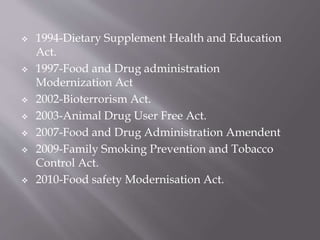
 1994-Dietary Supplement Health and Education
Act.
 1997-Food and Drug administration
Modernization Act
 2002-Bioterrorism Act.
 2003-Animal Drug User Free Act.
 2007-Food and Drug Administration Amendent
 2009-Family Smoking Prevention and Tobacco
Control Act.
 2010-Food safety Modernisation Act.
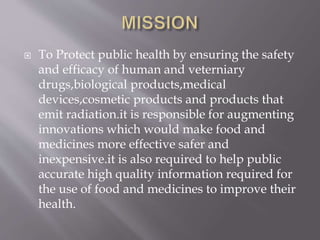
 To Protect public health by ensuring the safety
and efficacy of human and veterniary
drugs,biological products,medical
devices,cosmetic products and products that
emit radiation.it is responsible for augmenting
innovations which would make food and
medicines more effective safer and
inexpensive.it is also required to help public
accurate high quality information required for
the use of food and medicines to improve their
health.
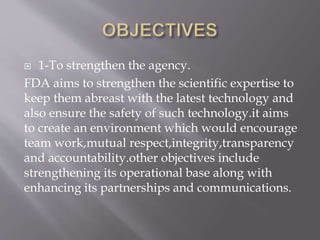
 1-To strengthen the agency.
FDA aims to strengthen the scientific expertise to
keep them abreast with the latest technology and
also ensure the safety of such technology.it aims
to create an environment which would encourage
team work,mutual respect,integrity,transparency
and accountability.other objectives include
strengthening its operational base along with
enhancing its partnerships and communications.
 2-To improve patient and consumer saftey.FDA
constantly strives to improve patient and
consumer safety.
 3-To enhance access to new food and medicinal
products.FDA aims to increase the availability of
new,safe and effective medicines to the general
public.
 4-To improve manufactured products and supply
chain.The agency aims to achieve high quality
manufacturing processing and distribution of
products by modernising the standards and tools
and by stimulating the development of new and
improved continuous manufacturing technologies.
 USFDA employs about 9000 multidisciplinary
staff comprising of
pharmacists,physcians,pharmacologists,chemis
ts,statisticians,attorneys,other sccientists and
administrative staff.allof them strive to achieve
the most important goal of the organisation
i.e,to protect and promote the health of its
citizens.the organisation consists of several
centres and offices each of whom are
designated with certain responsibilities.some of
those centres and offices have been outlined
below:
1.OFFICE OF THE COMMISSIONER(OC) :-
Office of the commissioner oversees the
functioning of the following:
(a)Office of the chief counsel.
(b)Office of the executive secretariat.
(c)Office of chief scientist.
(d)Office the counsellor of the commissioner.
(e)Office of legislation
(f)Office of minority health.
(g)Office of external affairs.
(h)Office of special health issues.
(i)Office of women’s health.
2-OFFICE OF THE REGULATORY AFFAIRS (ORA):-
 ORA of the FDA ensure that the product under the
purvieew of FDA complies with the necessary
laws and regulations. It achieves this objective by
providing the necessary information to the
industry. Highlighting areas susceptible to
rampant violations and their impact on public
health.coopearting with the public health
authorities at local and state levels.
3-NATIONAL CENTRE FOR TOXICOLOGICAL
RESEARCH(NCTR):-
 Its related to OECD.
 It regulates the dose.
4.CENTRE FOR BIOLOGICS EVALUATION AND
RESEARCH(CBER):-
 The centre regulates and supervises biological
products like
blood,vaccines,tissues,sera,allergenic,immunologic
and biological therapeutics.
5.CENTRE FOR DEVICES AND RADIOLOGICAL
HEALTH(CDRH):-
 It regulates and supervises the safety and efficacy
of medical devices as well as radiation emitting
devices such as microwave ovens ,lasers,X ray
systems,cellular telephones etc.
 CDRH is responsible for overseeing the
manufacturing performance,safety as well as pre
market approval of all medical devices.
6.CENTRE FOR DRUG EVALUATION AND
RESEARCH:-
 Its function is to review the safety and efficacy of
all prescription and OTC drugs prior to their
commercial use.in addition,it also monitors the
safety profile of the drugs which have been
approved for marketing.
 It also provides drug related information to
consumers and health care proffesionals.
7.CENTRE FOR FOOD SAFTEY AND APPLIED
NUTRITION(CFSAN):-
 It is concerned with regulating the safety of food
and cosmetics.it helps to ensure that
safe,clean,nutritious and properly labelled food is
being supplied to its citizens and also that the
cosmetics products are safe and properly labelled.
8.CENTRE FOR VETERINARY MEDICINE(CVM):-
 It oversees the safety of animal food,excipients and
medicines given to animals.However,it does not
regulate vaccines for animals.The basic aim of
CVM is to regulate the veterinary medicines is that
they do not enter the human food chain.
9.SCIENCE AND RESEARCH PROGRAMS:-
 FDA also undertakes R&D programs in the field of
drugs,women’s health,food safety,veterniary
medicine,biologics etc.in order to overcome any
scientific or challenges before they become a
hindrance.
USFDA performs the following functions in order to
achieve its objectives.
1-USFDA plays an active role in approving new drugs for
commercial use.in such cases,FDA itself does not carry out
any research but examines the test results of studies
carried out by the manufacture to ensure that the benefits
produced by the new drug outweigh the side effects
caused by it.
2-FDA conducts tests on food samples for the presence of
contaminants or other substances like pesticides.
3-It functions to ensure the effectiveness and purity of
biologicals like insulin and vaccines.
4-It examines the operations of blood banks,ranging from
record keeping to testing of contaminants.
5-It ensure the safety of medical devices by classifying
them based on their degree of risk to the public.
6-The device like pacemakers that are life supporting,life
sustaining,and implantable are required to be marketed
only after obtaining FDA approval.
7-It inspects the dyes and additives used in
cosmetics,drugs and foods and approves the same prior to
their usage.
8-FDA lays down the standards for medicated feed and
drugs used for pets and faem animals so that they do not
pose any life threatening risk for the animal health.
9-FDA is associated with inspection and the grant of legal
sanctions.the domestic and international product samples
are collected by the FDA inspectors and investigators for
scientific examination and label checks.
10-FDA prescribes radiation safety perforamnce standards
for radiation emitting electronic products such as X ray
equipments,microwave ovens,cabinet X ray
systems,television recivers,mercury vapour lamps,sun
lamps,ultrasonic therapy equipments and laser products.
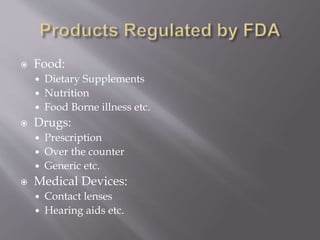
 Food:
 Dietary Supplements
 Nutrition
 Food Borne illness etc.
 Drugs:
 Prescription
 Over the counter
 Generic etc.
 Medical Devices:
 Contact lenses
 Hearing aids etc.
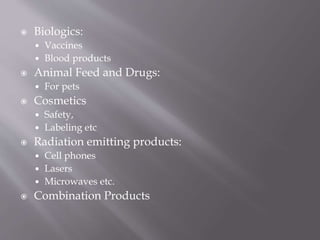
 Biologics:
 Vaccines
 Blood products
 Animal Feed and Drugs:
 For pets
 Cosmetics
 Safety,
 Labeling etc
 Radiation emitting products:
 Cell phones
 Lasers
 Microwaves etc.
 Combination Products
 The assurance of product quality depends
more on the responsibility of maintaining
product quality during production than
thus proper sampling and adequate
testings of various components and
finished goods.
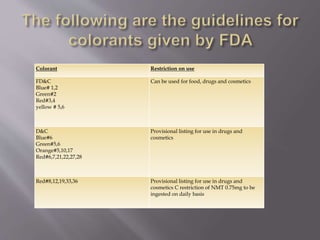
Colorant Restriction on use
FD&C
Blue# 1,2
Green#2
Red#3,4
yellow # 5,6
Can be used for food, drugs and cosmetics
D&C
Blue#6
Green#5,6
Orange#5,10,17
Red#6,7,21,22,27,28
Provisional listing for use in drugs and
cosmetics
Red#8,12,19,33,36 Provisional listing for use in drugs and
cosmetics C restriction of NMT 0.75mg to be
ingested on daily basis
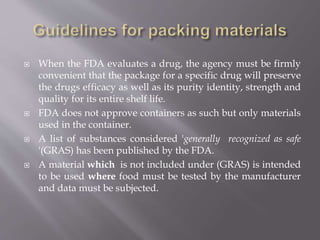
 When the FDA evaluates a drug, the agency must be firmly
convenient that the package for a specific drug will preserve
the drugs efficacy as well as its purity identity, strength and
quality for its entire shelf life.
 FDA does not approve containers as such but only materials
used in the container.
 A list of substances considered 'generally recognized as safe
'(GRAS) has been published by the FDA.
 A material which is not included under (GRAS) is intended
to be used where food must be tested by the manufacturer
and data must be subjected.
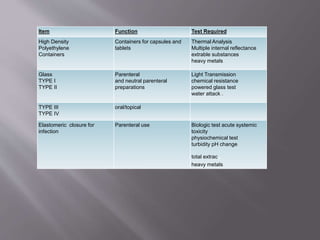
Item Function Test Required
High Density
Polyethylene
Containers
Containers for capsules and
tablets
Thermal Analysis
Multiple internal reflectance
extrable substances
heavy metals
Glass
TYPE I
TYPE II
Parenteral
and neutral parenteral
preparations
Light Transmission
chemical resistance
powered glass test
water attack .
TYPE III
TYPE IV
oral/topical
Elastomeric closure for
infection
Parenteral use Biologic test acute systemic
toxicity
physiochemical test
turbidity pH change
total extrac.
heavy metals
 The FDA is responsible for protecting the public
health by assuring the safety, efficacy, and
security of human and veterinary drugs,
biological products, medical devices, our
Nations’s food supply, cosmetics, and products
that emit radiation.
 The FDA is also responsible for advancing the
public health by helping to speed innovations
that make medicines and foods more effective,
safer, and more affordable.
 Safe manufacturing and handling of drugs and
food.
 Agency scientists evaluate applications for new human
drugs and biologics, complex medical devices, food and
colour additives, infant formulas, and animal drugs.
 Also, the FDA monitors the manufacture, import,
transport, storage, sale of products.
 Inspection of samples and quality of samples is assured.
 Better consumer information.
 Labelling requirements.
* * *
Usfda ppn

Usfda ppn

  • 1.
    PRIYANKA PRIYADARSANI NAYAK Rollno-06 TOXICOLOGY(Pharmacology Department) MALLA REDDY COLLEGE OF PHARMACY
  • 2.
    • The variousguidelines given by united states Food and Drug administration are:  For the maintenance and for conducting the toxicological studies  Bioequivalance studies  Clinical traials and  In the field of radiology
  • 3.
     The U.S.Food and drug administration is an agency of the united states department of Health and Human Services.  USFDA is responsible for the safety regulation of most type of foods,dietary supplements,drugs,vaccines,biological medical products,blood products,medical devices,radiation emitting devices,veterinary products.  The agency of the U.S. Department of Health and Human Services was established in 1927.
  • 4.
     1902-Biologics controlAct  1906-Pure food and Drug Act  1938-Federal Food and Cosmetics Act  1944-Public Health Service Act  1951-Food,Drug and Cosmetic Act  1962-Food,Drug and Cosmetic Act  1966-Fair Package and Labelling  1976-Medical Device Regulate Act  1987-Prescription on Drug Marketing Act  1988-Anti-Drug Abuse Act  1990-Nutrition Labelling and Education  1992-Prescription Drug user Free Act
  • 5.
     1994-Dietary SupplementHealth and Education Act.  1997-Food and Drug administration Modernization Act  2002-Bioterrorism Act.  2003-Animal Drug User Free Act.  2007-Food and Drug Administration Amendent  2009-Family Smoking Prevention and Tobacco Control Act.  2010-Food safety Modernisation Act.
  • 6.
     To Protectpublic health by ensuring the safety and efficacy of human and veterniary drugs,biological products,medical devices,cosmetic products and products that emit radiation.it is responsible for augmenting innovations which would make food and medicines more effective safer and inexpensive.it is also required to help public accurate high quality information required for the use of food and medicines to improve their health.
  • 7.
     1-To strengthenthe agency. FDA aims to strengthen the scientific expertise to keep them abreast with the latest technology and also ensure the safety of such technology.it aims to create an environment which would encourage team work,mutual respect,integrity,transparency and accountability.other objectives include strengthening its operational base along with enhancing its partnerships and communications.
  • 8.
     2-To improvepatient and consumer saftey.FDA constantly strives to improve patient and consumer safety.  3-To enhance access to new food and medicinal products.FDA aims to increase the availability of new,safe and effective medicines to the general public.  4-To improve manufactured products and supply chain.The agency aims to achieve high quality manufacturing processing and distribution of products by modernising the standards and tools and by stimulating the development of new and improved continuous manufacturing technologies.
  • 9.
     USFDA employsabout 9000 multidisciplinary staff comprising of pharmacists,physcians,pharmacologists,chemis ts,statisticians,attorneys,other sccientists and administrative staff.allof them strive to achieve the most important goal of the organisation i.e,to protect and promote the health of its citizens.the organisation consists of several centres and offices each of whom are designated with certain responsibilities.some of those centres and offices have been outlined below:
  • 10.
    1.OFFICE OF THECOMMISSIONER(OC) :- Office of the commissioner oversees the functioning of the following: (a)Office of the chief counsel. (b)Office of the executive secretariat. (c)Office of chief scientist. (d)Office the counsellor of the commissioner. (e)Office of legislation (f)Office of minority health. (g)Office of external affairs. (h)Office of special health issues. (i)Office of women’s health.
  • 11.
    2-OFFICE OF THEREGULATORY AFFAIRS (ORA):-  ORA of the FDA ensure that the product under the purvieew of FDA complies with the necessary laws and regulations. It achieves this objective by providing the necessary information to the industry. Highlighting areas susceptible to rampant violations and their impact on public health.coopearting with the public health authorities at local and state levels. 3-NATIONAL CENTRE FOR TOXICOLOGICAL RESEARCH(NCTR):-  Its related to OECD.  It regulates the dose.
  • 12.
    4.CENTRE FOR BIOLOGICSEVALUATION AND RESEARCH(CBER):-  The centre regulates and supervises biological products like blood,vaccines,tissues,sera,allergenic,immunologic and biological therapeutics. 5.CENTRE FOR DEVICES AND RADIOLOGICAL HEALTH(CDRH):-  It regulates and supervises the safety and efficacy of medical devices as well as radiation emitting devices such as microwave ovens ,lasers,X ray systems,cellular telephones etc.  CDRH is responsible for overseeing the manufacturing performance,safety as well as pre market approval of all medical devices.
  • 13.
    6.CENTRE FOR DRUGEVALUATION AND RESEARCH:-  Its function is to review the safety and efficacy of all prescription and OTC drugs prior to their commercial use.in addition,it also monitors the safety profile of the drugs which have been approved for marketing.  It also provides drug related information to consumers and health care proffesionals. 7.CENTRE FOR FOOD SAFTEY AND APPLIED NUTRITION(CFSAN):-  It is concerned with regulating the safety of food and cosmetics.it helps to ensure that safe,clean,nutritious and properly labelled food is being supplied to its citizens and also that the cosmetics products are safe and properly labelled.
  • 14.
    8.CENTRE FOR VETERINARYMEDICINE(CVM):-  It oversees the safety of animal food,excipients and medicines given to animals.However,it does not regulate vaccines for animals.The basic aim of CVM is to regulate the veterinary medicines is that they do not enter the human food chain. 9.SCIENCE AND RESEARCH PROGRAMS:-  FDA also undertakes R&D programs in the field of drugs,women’s health,food safety,veterniary medicine,biologics etc.in order to overcome any scientific or challenges before they become a hindrance.
  • 15.
    USFDA performs thefollowing functions in order to achieve its objectives. 1-USFDA plays an active role in approving new drugs for commercial use.in such cases,FDA itself does not carry out any research but examines the test results of studies carried out by the manufacture to ensure that the benefits produced by the new drug outweigh the side effects caused by it. 2-FDA conducts tests on food samples for the presence of contaminants or other substances like pesticides. 3-It functions to ensure the effectiveness and purity of biologicals like insulin and vaccines. 4-It examines the operations of blood banks,ranging from record keeping to testing of contaminants. 5-It ensure the safety of medical devices by classifying them based on their degree of risk to the public.
  • 16.
    6-The device likepacemakers that are life supporting,life sustaining,and implantable are required to be marketed only after obtaining FDA approval. 7-It inspects the dyes and additives used in cosmetics,drugs and foods and approves the same prior to their usage. 8-FDA lays down the standards for medicated feed and drugs used for pets and faem animals so that they do not pose any life threatening risk for the animal health. 9-FDA is associated with inspection and the grant of legal sanctions.the domestic and international product samples are collected by the FDA inspectors and investigators for scientific examination and label checks. 10-FDA prescribes radiation safety perforamnce standards for radiation emitting electronic products such as X ray equipments,microwave ovens,cabinet X ray systems,television recivers,mercury vapour lamps,sun lamps,ultrasonic therapy equipments and laser products.
  • 17.
     Food:  DietarySupplements  Nutrition  Food Borne illness etc.  Drugs:  Prescription  Over the counter  Generic etc.  Medical Devices:  Contact lenses  Hearing aids etc.
  • 18.
     Biologics:  Vaccines Blood products  Animal Feed and Drugs:  For pets  Cosmetics  Safety,  Labeling etc  Radiation emitting products:  Cell phones  Lasers  Microwaves etc.  Combination Products
  • 19.
     The assuranceof product quality depends more on the responsibility of maintaining product quality during production than thus proper sampling and adequate testings of various components and finished goods.
  • 20.
    Colorant Restriction onuse FD&C Blue# 1,2 Green#2 Red#3,4 yellow # 5,6 Can be used for food, drugs and cosmetics D&C Blue#6 Green#5,6 Orange#5,10,17 Red#6,7,21,22,27,28 Provisional listing for use in drugs and cosmetics Red#8,12,19,33,36 Provisional listing for use in drugs and cosmetics C restriction of NMT 0.75mg to be ingested on daily basis
  • 21.
     When theFDA evaluates a drug, the agency must be firmly convenient that the package for a specific drug will preserve the drugs efficacy as well as its purity identity, strength and quality for its entire shelf life.  FDA does not approve containers as such but only materials used in the container.  A list of substances considered 'generally recognized as safe '(GRAS) has been published by the FDA.  A material which is not included under (GRAS) is intended to be used where food must be tested by the manufacturer and data must be subjected.
  • 22.
    Item Function TestRequired High Density Polyethylene Containers Containers for capsules and tablets Thermal Analysis Multiple internal reflectance extrable substances heavy metals Glass TYPE I TYPE II Parenteral and neutral parenteral preparations Light Transmission chemical resistance powered glass test water attack . TYPE III TYPE IV oral/topical Elastomeric closure for infection Parenteral use Biologic test acute systemic toxicity physiochemical test turbidity pH change total extrac. heavy metals
  • 23.
     The FDAis responsible for protecting the public health by assuring the safety, efficacy, and security of human and veterinary drugs, biological products, medical devices, our Nations’s food supply, cosmetics, and products that emit radiation.  The FDA is also responsible for advancing the public health by helping to speed innovations that make medicines and foods more effective, safer, and more affordable.  Safe manufacturing and handling of drugs and food.
  • 24.
     Agency scientistsevaluate applications for new human drugs and biologics, complex medical devices, food and colour additives, infant formulas, and animal drugs.  Also, the FDA monitors the manufacture, import, transport, storage, sale of products.  Inspection of samples and quality of samples is assured.  Better consumer information.  Labelling requirements. * * *