The Food and Drug Administration (FDA
or USFDA) is an agency of the United
States Department of Health and Human
Services and is responsible for regulating
and supervising the safety of foods, dietary
supplements, drugs, vaccines, biological
medical products, blood products, medical
devices, radiation-emitting devices,
veterinary products, and cosmetics.
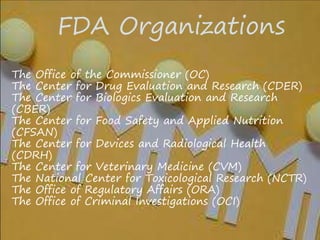
The Office of the Commissioner (OC)
The Center for Drug Evaluation and Research (CDER)
The Center for Biologics Evaluation and Research
(CBER)
The Center for Food Safety and Applied Nutrition
(CFSAN)
The Center for Devices and Radiological Health
(CDRH)
The Center for Veterinary Medicine (CVM)
The National Center for Toxicological Research (NCTR)
The Office of Regulatory Affairs (ORA)
The Office of Criminal Investigations (OCI)
FDA Organizations
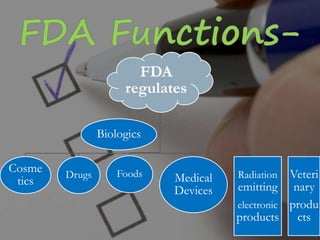
FDA
regulates
Cosme
tics
Drugs Foods Medical
Devices
Radiation
emitting
electronic
products
Veteri
nary
produ
cts
Biologics
Landmarks In Regulations
Food and Drug
Act 1906
Federal Food,
Drug and
Cosmetic Act
1938
Durham-
Humphrey
Amendments
1951
Hatch-Waxman Act
1984
Comprehensive
Drug Abuse
Prevention and
Control Act 1970
Prescription Drug
User Fee Act
1992
Drug Safety
Board 2005
Kefauver-Harris
Drug
Amendments
1962
Hatch-Waxman
Act 1984
 Acts as consumer watchdog in America’s healthcare
system.
 Oversees the research, development, manufacture and
marketing of drugs.
 Ensures safety and efficacy of available drugs.
 Regulates:
 Prescription drugs
 Generic drugs
 OTC drugs
 Also ensures truth in advertising for prescription drugs.
Center For Food Security and Applied Nutrition
Radiation
Ionizing X-ray
e.g. Dental
radiography,
Industrial X-ray etc.
Optical
(visible, UV,IR,laser
)
e.g. Surgical laser,
Germicide lamp etc.
RF, Microwave,
magnetic
e.g. MRI,
Microwave oven etc.
Acoustic
(ultrasonic)
e.g.Ultrasonography,
Hearing aids etc.
Regulates food, food additives, and drugs that
are given to animals(food animals, pets)
Primary focus –
1.on medications that are used in food animals,
and
2. assurance that they don’t affect human food
supply
Restricts the spread of bovine spongiform
encephalopathy by doing inspections of feed
manufacturers
National Center
for toxicological
Research(NCTR)
Research arm of FDA
The research at NCTR supports FDA’s goals:
1) to understand critical biological events in the
expression of toxicity,
2) to develop and characterize methods, and
incorporate new technologies to improve the
assessment of human exposure, susceptibility,
and risk, and
3) to increase the understanding of the
interaction between genetics, metabolism, and
nutrition.
ORA mission is to enhance
public health by implementing
FDA regulations and
minimizing the risks
associated with the products
Office Of
Regulatory
Affairs
FDA’s Office of Criminal Investigations (OCI) is an integral part
of FDA’s mission to protect the public’s health. Top-flight special
agents –who have investigative authority similar to other federal
law enforcement agencies – give the FDA unique fact-finding
tools and provide for strong, industry-wide deterrence. Their
work is different from, but enhances, the regulatory inspectors
and investigators that make up the bulk of FDA’s field
operations. -
Usfda

Usfda

  • 2.
    The Food andDrug Administration (FDA or USFDA) is an agency of the United States Department of Health and Human Services and is responsible for regulating and supervising the safety of foods, dietary supplements, drugs, vaccines, biological medical products, blood products, medical devices, radiation-emitting devices, veterinary products, and cosmetics.
  • 3.
    The Office ofthe Commissioner (OC) The Center for Drug Evaluation and Research (CDER) The Center for Biologics Evaluation and Research (CBER) The Center for Food Safety and Applied Nutrition (CFSAN) The Center for Devices and Radiological Health (CDRH) The Center for Veterinary Medicine (CVM) The National Center for Toxicological Research (NCTR) The Office of Regulatory Affairs (ORA) The Office of Criminal Investigations (OCI) FDA Organizations
  • 4.
  • 5.
    Landmarks In Regulations Foodand Drug Act 1906 Federal Food, Drug and Cosmetic Act 1938 Durham- Humphrey Amendments 1951 Hatch-Waxman Act 1984 Comprehensive Drug Abuse Prevention and Control Act 1970 Prescription Drug User Fee Act 1992 Drug Safety Board 2005 Kefauver-Harris Drug Amendments 1962 Hatch-Waxman Act 1984
  • 7.
     Acts asconsumer watchdog in America’s healthcare system.  Oversees the research, development, manufacture and marketing of drugs.  Ensures safety and efficacy of available drugs.  Regulates:  Prescription drugs  Generic drugs  OTC drugs  Also ensures truth in advertising for prescription drugs.
  • 9.
    Center For FoodSecurity and Applied Nutrition
  • 11.
    Radiation Ionizing X-ray e.g. Dental radiography, IndustrialX-ray etc. Optical (visible, UV,IR,laser ) e.g. Surgical laser, Germicide lamp etc. RF, Microwave, magnetic e.g. MRI, Microwave oven etc. Acoustic (ultrasonic) e.g.Ultrasonography, Hearing aids etc.
  • 12.
    Regulates food, foodadditives, and drugs that are given to animals(food animals, pets) Primary focus – 1.on medications that are used in food animals, and 2. assurance that they don’t affect human food supply Restricts the spread of bovine spongiform encephalopathy by doing inspections of feed manufacturers
  • 13.
    National Center for toxicological Research(NCTR) Researcharm of FDA The research at NCTR supports FDA’s goals: 1) to understand critical biological events in the expression of toxicity, 2) to develop and characterize methods, and incorporate new technologies to improve the assessment of human exposure, susceptibility, and risk, and 3) to increase the understanding of the interaction between genetics, metabolism, and nutrition.
  • 14.
    ORA mission isto enhance public health by implementing FDA regulations and minimizing the risks associated with the products Office Of Regulatory Affairs
  • 15.
    FDA’s Office ofCriminal Investigations (OCI) is an integral part of FDA’s mission to protect the public’s health. Top-flight special agents –who have investigative authority similar to other federal law enforcement agencies – give the FDA unique fact-finding tools and provide for strong, industry-wide deterrence. Their work is different from, but enhances, the regulatory inspectors and investigators that make up the bulk of FDA’s field operations. -