
Solutions Architect, MongoDB
Heather Kirksey
#MongoDB
User Data Management
with MongoDB
Agenda
Agenda
• High Level Overview
– MongoDB
– User Data
• Modeling & Querying User Data
– Insurance Company User Data
– User Check-Ins
• Extending the Data Model for Future Use Cases
– Tracking UserActivity
– Social Media
MongoDB is a(n) ___________
database
• Document
• Open source
• High performance
• Horizontally scalable
• Full featured
User Data
• Account Information
– Name, address, etc.
– Account status
– Notes
• Activity Streams
– Posts, tweets, likes, check-ins
– Recording user actions
• Social Networks
– Friends, connections
– Groups, tags
Data Modeling Exercise
• Insurance Company Data
• Account information
– Name, address, etc
– Account status
– Notes
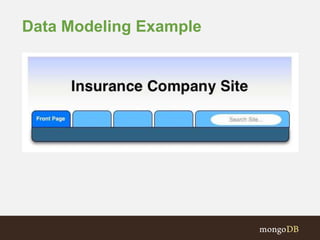
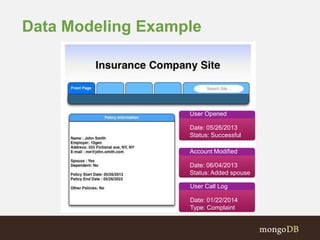
Data Modeling Example
User Opened
Date: 05/26/2013
Status: Successful
Account Modified
Date: 06/04/2013
Status: Added spouse
User Call Log
Date: 01/22/2014
Type: Complaint
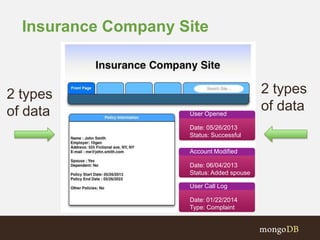
Insurance Company Site
User Opened
Date: 05/26/2013
Status: Successful
Account Modified
Date: 06/04/2013
Status: Added spouse
User Call Log
Date: 01/22/2014
Type: Complaint
2 types
of data
2 types
of data
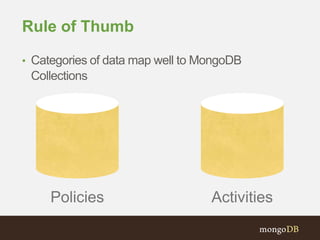
Rule of Thumb
• Categories of data map well to MongoDB
Collections
Policies Activities
Policies
policy = {
name: “John Smith”
employer: “10gen”,
address: “555 Fictional
Ave”,
e-mail:
“me@john.smith.com”,
spouse: “Yes” ,
dependents: “No”,
dates: [
{start: 5/26/2013
10:12:00},
end: 5/26/2023
10:12:00}],
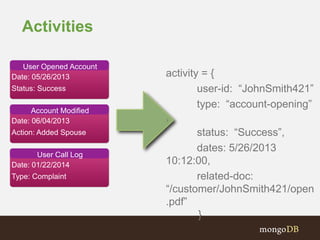
Activities
activity = {
user-id: “JohnSmith421”
type: “account-opening”
,
status: “Success”,
dates: 5/26/2013
10:12:00,
related-doc:
“/customer/JohnSmith421/open
.pdf”
}
User Opened Account
Date: 05/26/2013
Status: Success
Account Modified
Date: 06/04/2013
Action: Added Spouse
User Call Log
Date: 01/22/2014
Type: Complaint
User Check-Ins
• Activity Streams
– Posts, tweets, check-ins
– Recording user actions
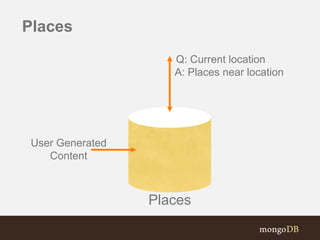
Places
Q: Current location
A: Places near location
User Generated
Content
Places
Inserting a Place
var p = { name: “MongoDB HQ”,
address:“229 W 43rd St”,
city: “NewYork”,
zip: “10036”,
tags: [“mongoDB”,“business”],
latlong: [40.0, 72.0],
tips: [{user:“John Smith”, time: “3/15/2013”,tip:“Make sure to stop by
for office hours!”}]}
> db.posts.save(p)
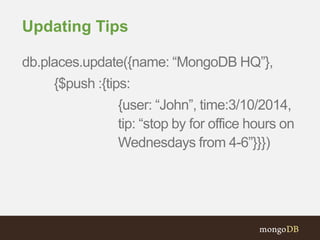
Updating Tips
db.places.update({name: “MongoDB HQ”},
{$push :{tips:
{user: “John”, time:3/10/2014,
tip: “stop by for office hours on
Wednesdays from 4-6”}}})
Querying Our Places
• Creating Indexes
• db.places.ensureIndex({tags:1})
• db.places.ensureIndex({name:1})
• db.places.ensureIndex({latlong:”2d”})
• Finding Places
• db.places.find({latlong:{$near:[40,70]}})
• Regular Expressions
• db.places.find({name: /^typeaheadstring/)
• Using Tags
• db.places.find({tags: “business”})
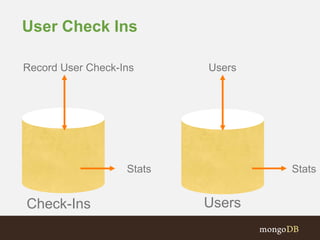
User Check Ins
Record User Check-Ins
Check-Ins
Users
Stats
Users
Stats
Users
user1 = {
name: “John Smith”
e-mail: “me@john.smith.com”,
check-ins: [4b97e62bf1d8c7152c9ccb74,
5a20e62bf1d8c736ab]
}
checkins [] = ObjectId reference to Check-Ins
Collection
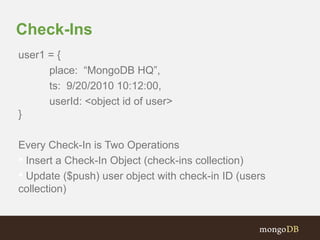
Check-Ins
user1 = {
place: “MongoDB HQ”,
ts: 9/20/2010 10:12:00,
userId: <object id of user>
}
Every Check-In is Two Operations
• Insert a Check-In Object (check-ins collection)
• Update ($push) user object with check-in ID (users
collection)
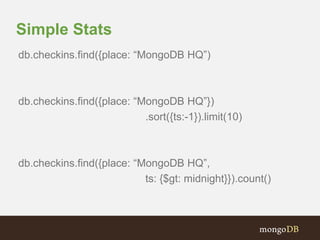
Simple Stats
db.checkins.find({place: “MongoDB HQ”)
db.checkins.find({place: “MongoDB HQ”})
.sort({ts:-1}).limit(10)
db.checkins.find({place: “MongoDB HQ”,
ts: {$gt: midnight}}).count()
Stats w/ MapReduce
mapFunc = function() {emit(this.place, 1);}
reduceFunc = function(key, values) {return
Array.sum(values);}
res = db.checkins.mapReduce(mapFunc,reduceFunc,
{query: {timestamp: {$gt:nowminus3hrs}}})
res = [{_id:”MongoDB HQ”, value: 17}, … , …]
…or try using the aggregation framework!
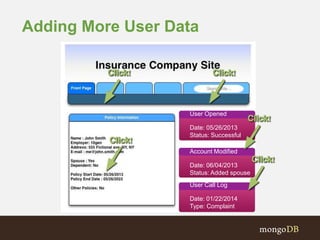
Adding More User Data
User Opened
Date: 05/26/2013
Status: Successful
Account Modified
Date: 06/04/2013
Status: Added spouse
User Call Log
Date: 01/22/2014
Type: Complaint
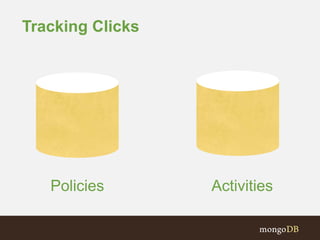
Tracking Clicks
Policies Activities
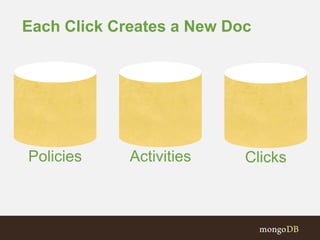
Each Click Creates a New Doc
Policies Activities Clicks
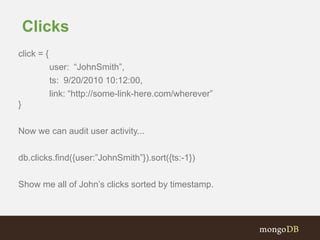
Clicks
click = {
user: “JohnSmith”,
ts: 9/20/2010 10:12:00,
link: “http://some-link-here.com/wherever”
}
Now we can audit user activity...
db.clicks.find({user:”JohnSmith”}).sort({ts:-1})
Show me all of John’s clicks sorted by timestamp.
Extending the Schema
user1 = {
name: “John Smith”
e-mail: “me@John.Smith.com”,
check-ins:
[4b97e62bf1d8c7152c9ccb74,
5a20e62bf1d8c736ab]
}
Extending the Schema
user1 = {
name: “John Smith”
e-mail: “me@John.Smith.com”,
check-ins:
[4b97e62bf1d8c7152c9ccb74, 5a20e62bf1d
8c736ab]
}
friends:
[7b47j62bk1d3c5621c1icv90, 1h11p62bf1d8
c716za]
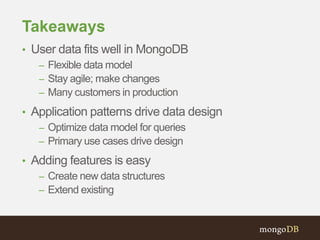
Takeaways
• User data fits well in MongoDB
– Flexible data model
– Stay agile; make changes
– Many customers in production
• Application patterns drive data design
– Optimize data model for queries
– Primary use cases drive design
• Adding features is easy
– Create new data structures
– Extend existing
Questions?
MongoDB World
New York City, June 23-25
#MongoDBWorld
See what’s next in MongoDB including
• MongoDB 2.6
• Sharding
• Replication
• Aggregation
http://world.mongodb.com
Save $200 with discount code THANKYOU
Solutions Architect, MongoDB
Heather Kirksey
#MongoDB
Thank You

User Data Management with MongoDB

  • 1.
    Solutions Architect, MongoDB HeatherKirksey #MongoDB User Data Management with MongoDB
  • 2.
  • 3.
    Agenda • High LevelOverview – MongoDB – User Data • Modeling & Querying User Data – Insurance Company User Data – User Check-Ins • Extending the Data Model for Future Use Cases – Tracking UserActivity – Social Media
  • 4.
    MongoDB is a(n)___________ database • Document • Open source • High performance • Horizontally scalable • Full featured
  • 5.
    User Data • AccountInformation – Name, address, etc. – Account status – Notes • Activity Streams – Posts, tweets, likes, check-ins – Recording user actions • Social Networks – Friends, connections – Groups, tags
  • 6.
    Data Modeling Exercise •Insurance Company Data • Account information – Name, address, etc – Account status – Notes
  • 7.
  • 8.
    Data Modeling Example UserOpened Date: 05/26/2013 Status: Successful Account Modified Date: 06/04/2013 Status: Added spouse User Call Log Date: 01/22/2014 Type: Complaint
  • 9.
    Insurance Company Site UserOpened Date: 05/26/2013 Status: Successful Account Modified Date: 06/04/2013 Status: Added spouse User Call Log Date: 01/22/2014 Type: Complaint 2 types of data 2 types of data
  • 10.
    Rule of Thumb •Categories of data map well to MongoDB Collections Policies Activities
  • 11.
    Policies policy = { name:“John Smith” employer: “10gen”, address: “555 Fictional Ave”, e-mail: “me@john.smith.com”, spouse: “Yes” , dependents: “No”, dates: [ {start: 5/26/2013 10:12:00}, end: 5/26/2023 10:12:00}],
  • 12.
    Activities activity = { user-id:“JohnSmith421” type: “account-opening” , status: “Success”, dates: 5/26/2013 10:12:00, related-doc: “/customer/JohnSmith421/open .pdf” } User Opened Account Date: 05/26/2013 Status: Success Account Modified Date: 06/04/2013 Action: Added Spouse User Call Log Date: 01/22/2014 Type: Complaint
  • 13.
    User Check-Ins • ActivityStreams – Posts, tweets, check-ins – Recording user actions
  • 14.
    Places Q: Current location A:Places near location User Generated Content Places
  • 15.
    Inserting a Place varp = { name: “MongoDB HQ”, address:“229 W 43rd St”, city: “NewYork”, zip: “10036”, tags: [“mongoDB”,“business”], latlong: [40.0, 72.0], tips: [{user:“John Smith”, time: “3/15/2013”,tip:“Make sure to stop by for office hours!”}]} > db.posts.save(p)
  • 16.
    Updating Tips db.places.update({name: “MongoDBHQ”}, {$push :{tips: {user: “John”, time:3/10/2014, tip: “stop by for office hours on Wednesdays from 4-6”}}})
  • 17.
    Querying Our Places •Creating Indexes • db.places.ensureIndex({tags:1}) • db.places.ensureIndex({name:1}) • db.places.ensureIndex({latlong:”2d”}) • Finding Places • db.places.find({latlong:{$near:[40,70]}}) • Regular Expressions • db.places.find({name: /^typeaheadstring/) • Using Tags • db.places.find({tags: “business”})
  • 18.
    User Check Ins RecordUser Check-Ins Check-Ins Users Stats Users Stats
  • 19.
    Users user1 = { name:“John Smith” e-mail: “me@john.smith.com”, check-ins: [4b97e62bf1d8c7152c9ccb74, 5a20e62bf1d8c736ab] } checkins [] = ObjectId reference to Check-Ins Collection
  • 20.
    Check-Ins user1 = { place:“MongoDB HQ”, ts: 9/20/2010 10:12:00, userId: <object id of user> } Every Check-In is Two Operations • Insert a Check-In Object (check-ins collection) • Update ($push) user object with check-in ID (users collection)
  • 21.
    Simple Stats db.checkins.find({place: “MongoDBHQ”) db.checkins.find({place: “MongoDB HQ”}) .sort({ts:-1}).limit(10) db.checkins.find({place: “MongoDB HQ”, ts: {$gt: midnight}}).count()
  • 22.
    Stats w/ MapReduce mapFunc= function() {emit(this.place, 1);} reduceFunc = function(key, values) {return Array.sum(values);} res = db.checkins.mapReduce(mapFunc,reduceFunc, {query: {timestamp: {$gt:nowminus3hrs}}}) res = [{_id:”MongoDB HQ”, value: 17}, … , …] …or try using the aggregation framework!
  • 23.
    Adding More UserData User Opened Date: 05/26/2013 Status: Successful Account Modified Date: 06/04/2013 Status: Added spouse User Call Log Date: 01/22/2014 Type: Complaint
  • 24.
  • 25.
    Each Click Createsa New Doc Policies Activities Clicks
  • 26.
    Clicks click = { user:“JohnSmith”, ts: 9/20/2010 10:12:00, link: “http://some-link-here.com/wherever” } Now we can audit user activity... db.clicks.find({user:”JohnSmith”}).sort({ts:-1}) Show me all of John’s clicks sorted by timestamp.
  • 27.
    Extending the Schema user1= { name: “John Smith” e-mail: “me@John.Smith.com”, check-ins: [4b97e62bf1d8c7152c9ccb74, 5a20e62bf1d8c736ab] }
  • 28.
    Extending the Schema user1= { name: “John Smith” e-mail: “me@John.Smith.com”, check-ins: [4b97e62bf1d8c7152c9ccb74, 5a20e62bf1d 8c736ab] } friends: [7b47j62bk1d3c5621c1icv90, 1h11p62bf1d8 c716za]
  • 29.
    Takeaways • User datafits well in MongoDB – Flexible data model – Stay agile; make changes – Many customers in production • Application patterns drive data design – Optimize data model for queries – Primary use cases drive design • Adding features is easy – Create new data structures – Extend existing
  • 30.
  • 31.
    MongoDB World New YorkCity, June 23-25 #MongoDBWorld See what’s next in MongoDB including • MongoDB 2.6 • Sharding • Replication • Aggregation http://world.mongodb.com Save $200 with discount code THANKYOU
  • 32.
    Solutions Architect, MongoDB HeatherKirksey #MongoDB Thank You