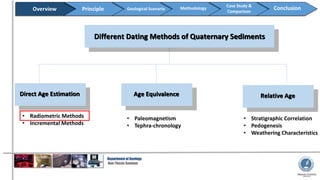
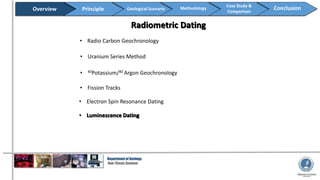
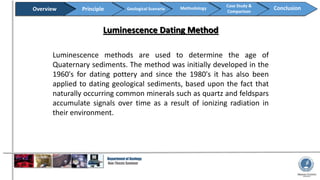
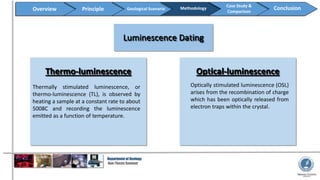
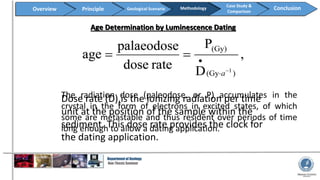
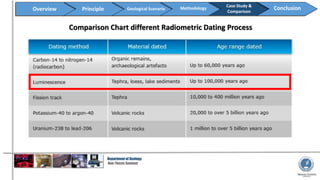
Luminescence dating methods are used to determine the age of Quaternary sediments by measuring how long ago they were last exposed to sunlight or heated. Minerals like quartz and feldspar accumulate radiation damage over time since burial due to natural ionizing radiation in the environment. This radiation damage is measured as paleodose and compared to the dose rate to calculate the burial age. The seminar discusses principles of luminescence dating, methodology, case studies applying it in places like Australia, Africa, USA, Europe and Asia to understand past environmental changes. It concludes luminescence dating provides estimates of mineral crystallization or last sunlight exposure ages and is useful for reconstructing past wind patterns from dated dune fields.