New Approaches to Training System
in a Bank
• Principles of banking
• Key Concepts of economic development
• Explanation of customer care
• Mathematics and Accounting.
• Tasks and projects designed to develop skills
• Business philosophy and history of the bank
Every
Year,
$200
billion is
spent on
Employee
Training in
Banks
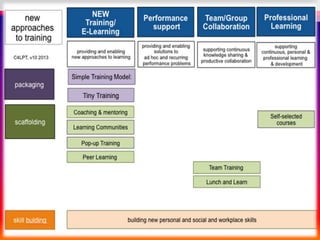
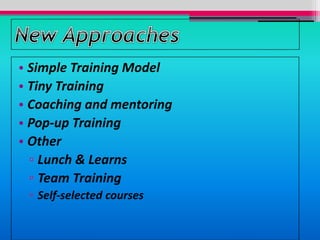
• Simple Training Model
• Tiny Training
• Coaching and mentoring
• Pop-up Training
• Other
▫ Lunch & Learns
▫ Team Training
▫ Self-selected courses

Find out employees understood and will apply it in
their job
 Provide the information in the simplest form – a
document or presentation (knowledge) ,video
(skills/Behavior)
 Individuals should also have the option to work on
the activity first, and Not to waste time on reading
stuff they know
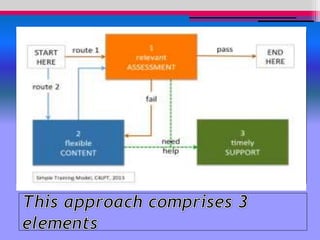
3 Elements
 Relevant Assessment
This is the key, and in fact the only required, element in the model, and is the
means by which an individual demonstrates they can apply what they have learned.
 Flexible Content
Some individuals will undoubtedly want to start with the Content and work through
it thoroughly, whilst others will only want to skim it, to refresh themselves, before
they take the Assessment. So this is why the content needs to be in as flexible a
format as possible – not a linear sequence of screens that they must work through.
If the content already exists, e.g. in the form of a Word document or PowerPoint
presentation, then there is no need to spend time and money
If the content doesn’t already exist, then it should be presented in the simplest –
and most appropriate – way possible – suitable for the target audience. It might be
a video or set of hyperlinked web pages.
 Timely support
The third element is to provide Support for those who might have difficulty
understanding any aspect of the content or the assessment, or who have failed the
assessment and cannot make out why. Setting up a useful and support mechanism
will be important. It might be the ability to email an expert, for example
 It can be used as a way of identifying those who need
training – rather than requiring everyone to spend
unnecessary time working through content they already
know.
 It provides managers with relevant “real-world”
assessment of application of knowledge.
 It is a less costly approach – which means that money can
be used for other more expensive options – where they are
really needed and where they will have the most impact.
 It offers more autonomy and choice for today’s workers,
and can be more easily fitted into their workflow.
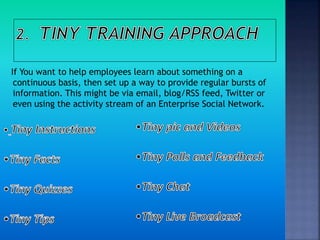
If You want to help employees learn about something on a
continuous basis, then set up a way to provide regular bursts of
information. This might be via email, blog/RSS feed, Twitter or
even using the activity stream of an Enterprise Social Network.
If you want to help employees acquire informal and
target knowledge from experts in the business, then
coordinate a coaching or mentoring scheme in your
bank.
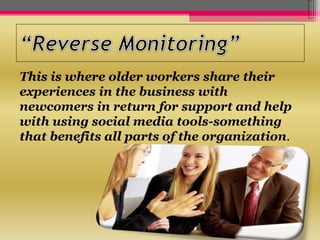
This is where older workers share their
experiences in the business with
newcomers in return for support and help
with using social media tools-something
that benefits all parts of the organization.
 Training doesn’t have to be done by
“trainers”, everyone should be encouraged
to share what they know – and even teach in
a more formal way.
 Pop-Up Training Approach= Employee-to-
Employee Training or Self-Organized
Training
Some
Training
Programs In
Banks
throughout
the World
This is a training program outside the organization which is encouraged by the
bank.
The bank usually sponsors and support their staffs for specialized training in
various fields especially in the area of the modern day technology, credit and
mortgage.
Staffs are been sent on training in different training programs such as (core
banking application) fiscal training in Indian and other European countries. Such
staffs have come back more enlighten and are able to pass done such
knowledge to subordinate and co- workers.
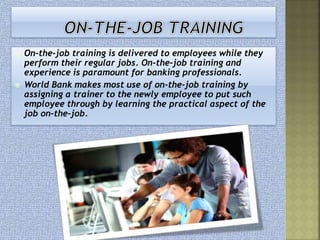
 On-the-job training is delivered to employees while they
perform their regular jobs. On-the-job training and
experience is paramount for banking professionals.
 World Bank makes most use of on-the-job training by
assigning a trainer to the newly employee to put such
employee through by learning the practical aspect of the
job on-the-job.
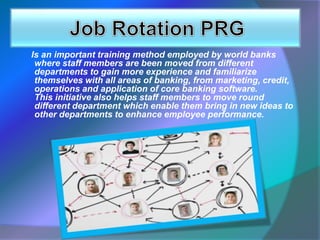
Is an important training method employed by world banks
where staff members are been moved from different
departments to gain more experience and familiarize
themselves with all areas of banking, from marketing, credit,
operations and application of core banking software.
This initiative also helps staff members to move round
different department which enable them bring in new ideas to
other departments to enhance employee performance.
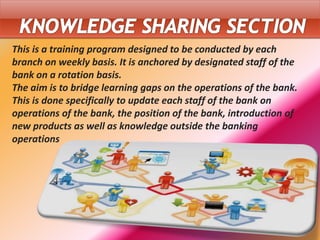
This is a training program designed to be conducted by each
branch on weekly basis. It is anchored by designated staff of the
bank on a rotation basis.
The aim is to bridge learning gaps on the operations of the bank.
This is done specifically to update each staff of the bank on
operations of the bank, the position of the bank, introduction of
new products as well as knowledge outside the banking
operations
• Banking professionals often attend
professional workshops or seminars on
topics such as commercial banking risks,
compliance issues, credit assessment
strategies and fair lending legislation
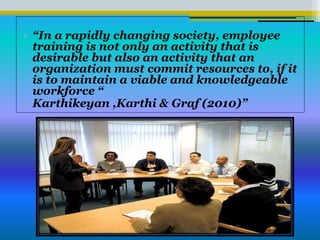
• “In a rapidly changing society, employee
training is not only an activity that is
desirable but also an activity that an
organization must commit resources to, if it
is to maintain a viable and knowledgeable
workforce “
• Karthikeyan ,Karthi & Graf (2010)”
• Investing in people demonstrates they
have a future with the organization. To
build a team of loyal, fully engaged, high
achievers, hire the right people then
invest in their development regularly.

Useful to know

  • 1.
    New Approaches toTraining System in a Bank
  • 3.
    • Principles ofbanking • Key Concepts of economic development • Explanation of customer care • Mathematics and Accounting. • Tasks and projects designed to develop skills • Business philosophy and history of the bank
  • 4.
  • 6.
    • Simple TrainingModel • Tiny Training • Coaching and mentoring • Pop-up Training • Other ▫ Lunch & Learns ▫ Team Training ▫ Self-selected courses
  • 7.
     Find out employeesunderstood and will apply it in their job  Provide the information in the simplest form – a document or presentation (knowledge) ,video (skills/Behavior)  Individuals should also have the option to work on the activity first, and Not to waste time on reading stuff they know
  • 9.
    3 Elements  RelevantAssessment This is the key, and in fact the only required, element in the model, and is the means by which an individual demonstrates they can apply what they have learned.  Flexible Content Some individuals will undoubtedly want to start with the Content and work through it thoroughly, whilst others will only want to skim it, to refresh themselves, before they take the Assessment. So this is why the content needs to be in as flexible a format as possible – not a linear sequence of screens that they must work through. If the content already exists, e.g. in the form of a Word document or PowerPoint presentation, then there is no need to spend time and money If the content doesn’t already exist, then it should be presented in the simplest – and most appropriate – way possible – suitable for the target audience. It might be a video or set of hyperlinked web pages.  Timely support The third element is to provide Support for those who might have difficulty understanding any aspect of the content or the assessment, or who have failed the assessment and cannot make out why. Setting up a useful and support mechanism will be important. It might be the ability to email an expert, for example
  • 10.
     It canbe used as a way of identifying those who need training – rather than requiring everyone to spend unnecessary time working through content they already know.  It provides managers with relevant “real-world” assessment of application of knowledge.  It is a less costly approach – which means that money can be used for other more expensive options – where they are really needed and where they will have the most impact.  It offers more autonomy and choice for today’s workers, and can be more easily fitted into their workflow.
  • 11.
    If You wantto help employees learn about something on a continuous basis, then set up a way to provide regular bursts of information. This might be via email, blog/RSS feed, Twitter or even using the activity stream of an Enterprise Social Network.
  • 12.
    If you wantto help employees acquire informal and target knowledge from experts in the business, then coordinate a coaching or mentoring scheme in your bank.
  • 14.
    This is whereolder workers share their experiences in the business with newcomers in return for support and help with using social media tools-something that benefits all parts of the organization.
  • 15.
     Training doesn’thave to be done by “trainers”, everyone should be encouraged to share what they know – and even teach in a more formal way.  Pop-Up Training Approach= Employee-to- Employee Training or Self-Organized Training
  • 17.
  • 18.
    This is atraining program outside the organization which is encouraged by the bank. The bank usually sponsors and support their staffs for specialized training in various fields especially in the area of the modern day technology, credit and mortgage. Staffs are been sent on training in different training programs such as (core banking application) fiscal training in Indian and other European countries. Such staffs have come back more enlighten and are able to pass done such knowledge to subordinate and co- workers.
  • 19.
     On-the-job trainingis delivered to employees while they perform their regular jobs. On-the-job training and experience is paramount for banking professionals.  World Bank makes most use of on-the-job training by assigning a trainer to the newly employee to put such employee through by learning the practical aspect of the job on-the-job.
  • 20.
    Is an importanttraining method employed by world banks where staff members are been moved from different departments to gain more experience and familiarize themselves with all areas of banking, from marketing, credit, operations and application of core banking software. This initiative also helps staff members to move round different department which enable them bring in new ideas to other departments to enhance employee performance.
  • 21.
    This is atraining program designed to be conducted by each branch on weekly basis. It is anchored by designated staff of the bank on a rotation basis. The aim is to bridge learning gaps on the operations of the bank. This is done specifically to update each staff of the bank on operations of the bank, the position of the bank, introduction of new products as well as knowledge outside the banking operations
  • 22.
    • Banking professionalsoften attend professional workshops or seminars on topics such as commercial banking risks, compliance issues, credit assessment strategies and fair lending legislation
  • 24.
    • “In arapidly changing society, employee training is not only an activity that is desirable but also an activity that an organization must commit resources to, if it is to maintain a viable and knowledgeable workforce “ • Karthikeyan ,Karthi & Graf (2010)”
  • 25.
    • Investing inpeople demonstrates they have a future with the organization. To build a team of loyal, fully engaged, high achievers, hire the right people then invest in their development regularly.