Use of Remote Sensing to Investigate
Striking Challenges on W R in Lebanon
NENA Regional Stakeholders Workshop
Operationalizing the Regional Collaborative Platform to address
‘water consumption’, ‘water productivity’ and ‘drought
management’ in Agriculture
Cairo, 27-29 October, 2015
A. Shaban
National Council for Scientific Research,
Beirut, Lebanon
Use of Remote Sensing to Investigate
Striking Challenges on W R in Lebanon
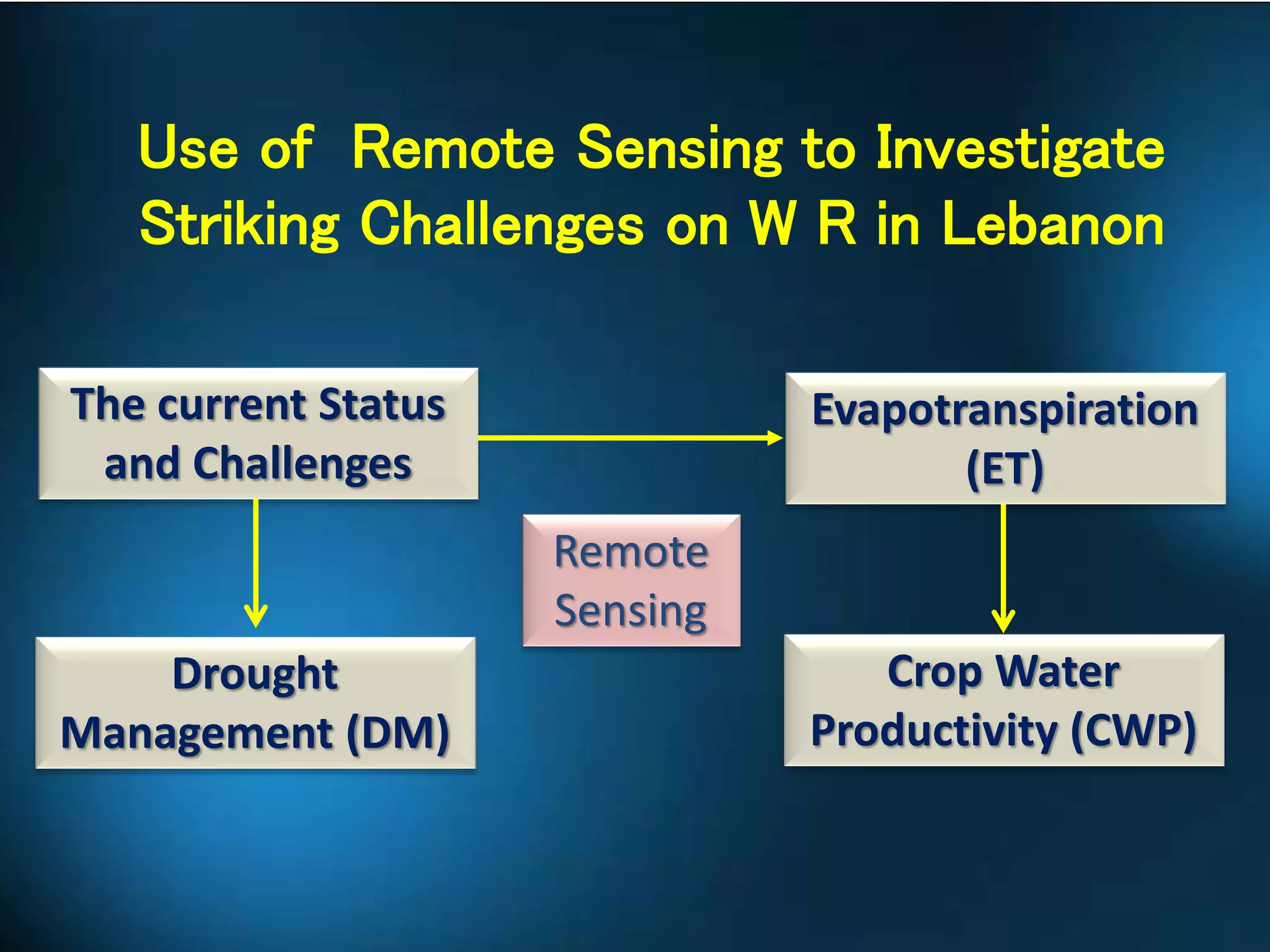
The current Status
and Challenges
Evapotranspiration
(ET)
Crop Water
Productivity (CWP)
Drought
Management (DM)
Remote
Sensing
NENA Regional Stakeholders Workshop, Cairo, 27-29 October, 2015
Water Resources in Lebanon
Surface and subsurface water resources in Lebanon are well
pronounced and can be considered as plenty resources.
1. Surface water resources (2900Mm3):
• 12 perennial watercourses
• > 2000 springs (>50l/sec)
• Snow covers 25% of Lebanon
• Several lakes and ponds (artificial and man-made)
2. Groundwater resources (1750Mm3):
• Three carbonate aquifers exist (extending over 2/3 of Lebanon)
• Tremendous water-bearing karstic galleries and conduits.
NENA Regional Stakeholders Workshop, Cairo, 27-29 October, 2015
Water Resources in Lebanon
1. Water loss to the
sea
2. Trans-boundary water
(74% shared border)
Lebanon has several groundwater reservoirs
Potential Aquifers
NENA Regional Stakeholders Workshop, Cairo, 27-29 October, 2015
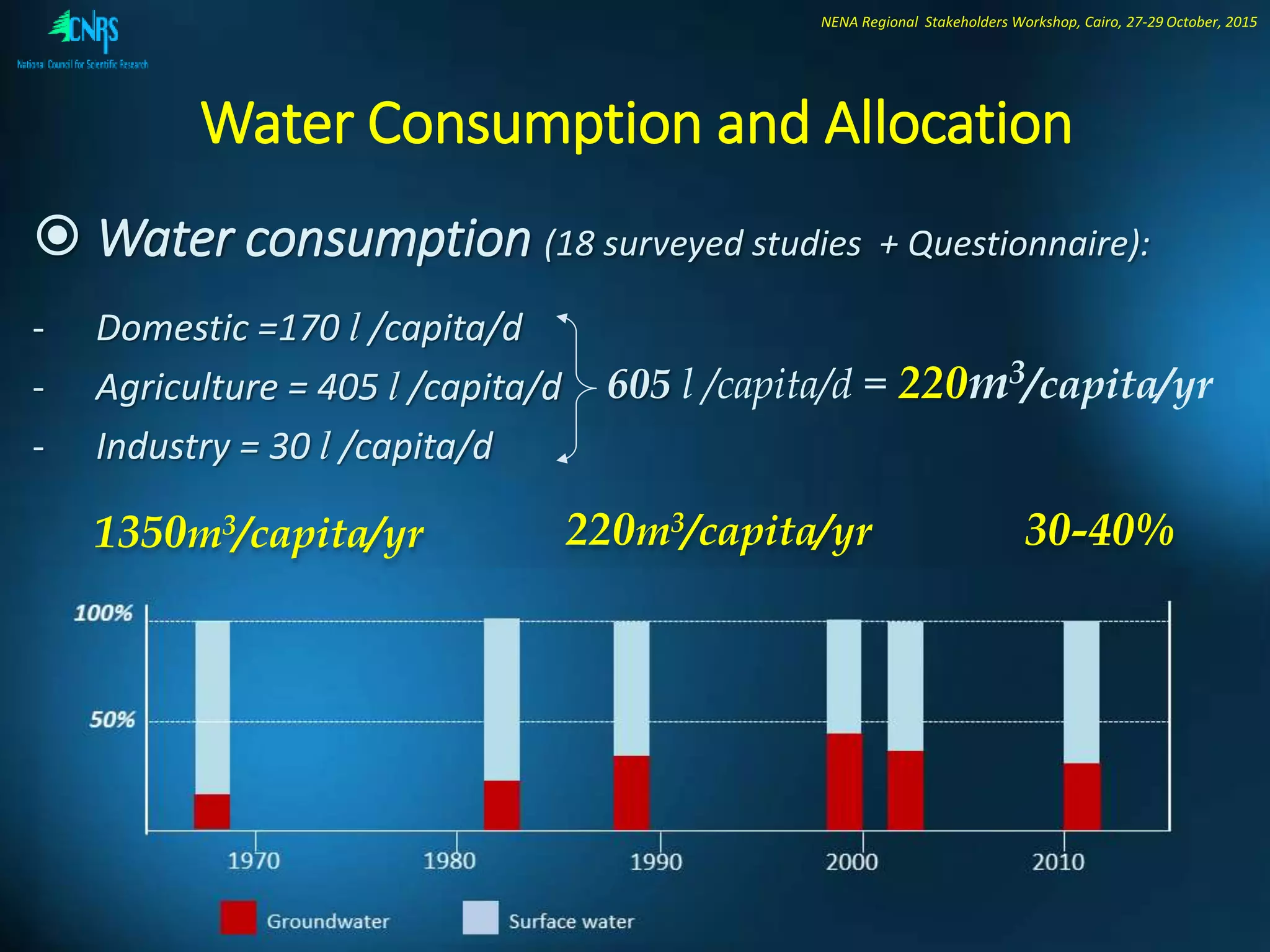
Water Consumption and Allocation
 Water consumption (18 surveyed studies + Questionnaire):
- Domestic =170 l /capita/d
- Agriculture = 405 l /capita/d
- Industry = 30 l /capita/d
605 l /capita/d = 220m3/capita/yr
1350m3/capita/yr 220m3/capita/yr 30-40%
100%
50%
Agricultural Domestic Industrial
100%
50%
Agricultural Domestic Industrial
Urban Areas Rural Areas
68%
25%
7%
66%
31%
3%
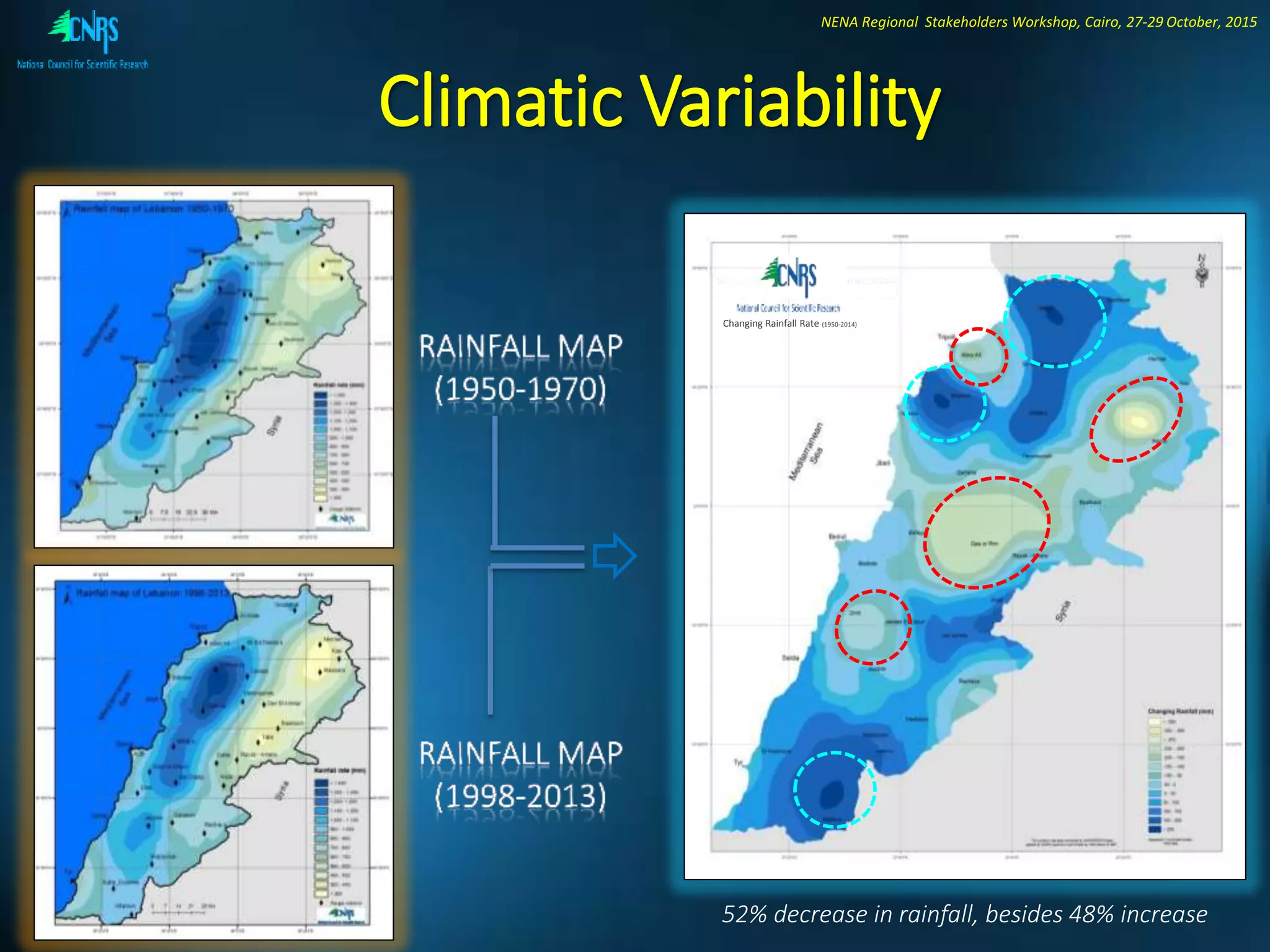
Changing Rainfall Rate (1950-2014)
Climatic Variability
52% decrease in rainfall, besides 48% increase
NENA Regional Stakeholders Workshop, Cairo, 27-29 October, 2015
Rainfall: 35-40mm decrease (6 decades)
1950 1960 1970 1980 1990 2000 2010
2014
Rainfall
NENA Regional Stakeholders Workshop, Cairo, 27-29 October, 2015
Rainfall Trends
1998
1999
1998 2000
1995
AUB
Souq Al-GharebJezzine
Majayoun
Qubayat Aytaroun
1999
NENA Regional Stakeholders Workshop, Cairo, 27-29 October, 2015
Temperature
Temperature: 1.9 C increase (over 4 decades)
2013
NENA Regional Stakeholders Workshop, Cairo, 27-29 October, 2015
25
50
75
100
(Aridity index %)
Qubayat Tripoli Cedars Qartaba AUB Souq Al-
Ghareb
Jezzine Marjayoun Sour Aytaroun
Arid Semi-arid Semi-humid Humid Very humid
Aridity/Humidity
39% are semi-humid climate & 30.6% are humid
NENA Regional Stakeholders Workshop, Cairo, 27-29 October, 2015
3. Drought Management (DM) - Continued
 Climatic-based Indices (Example)
Decreased discharge in rivers and springs: reaches up to 55% (over 5 decades)
2012
Discharge in Rivers and Springs
NENA Regional Stakeholders Workshop, Cairo, 27-29 October, 2015
Groundwater Depletion
Groundwater depletion in the major aquifers (245 boreholes)
Lowering in
water table
Decreased
discharge
NENA Regional Stakeholders Workshop, Cairo, 27-29 October, 2015
Application of Remote Sensing
ET CWP DM
NENA Regional Stakeholders Workshop, Cairo, 27-29 October, 2015
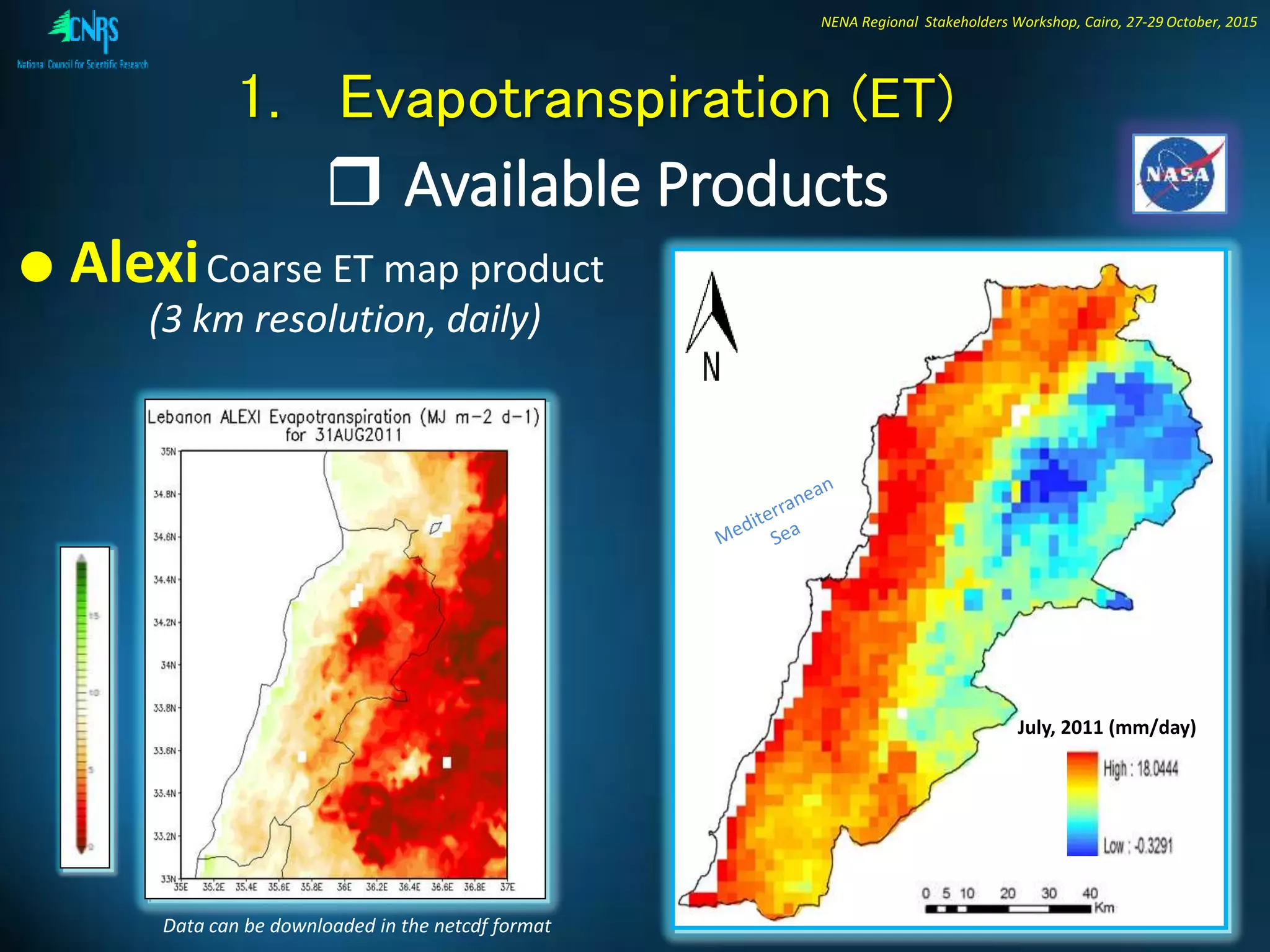
1. Evapotranspiration (ET)
 Available Products
(3 km resolution, daily)
 AlexiCoarse ET map product
July, 2011 (mm/day)
Data can be downloaded in the netcdf format
NENA Regional Stakeholders Workshop, Cairo, 27-29 October, 2015
1. Evapotranspiration (ET) - Continued
 Available Products
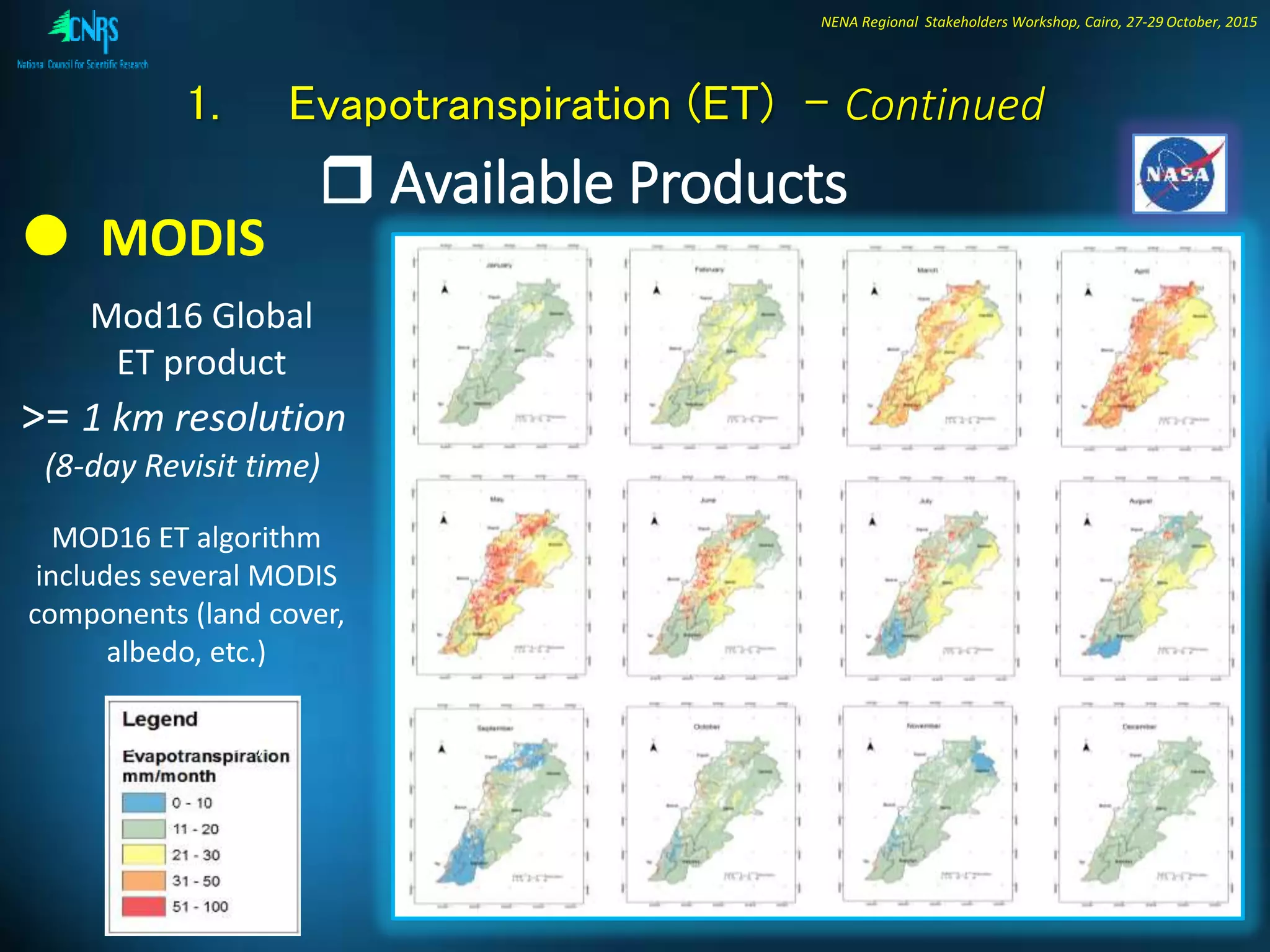
 MODIS
Mod16 Global
ET product
>= 1 km resolution
(8-day Revisit time)
MOD16 ET algorithm
includes several MODIS
components (land cover,
albedo, etc.)
(2000-2010)
NENA Regional Stakeholders Workshop, Cairo, 27-29 October, 2015
1. Evapotranspiration (ET) - Continued
 Available Products
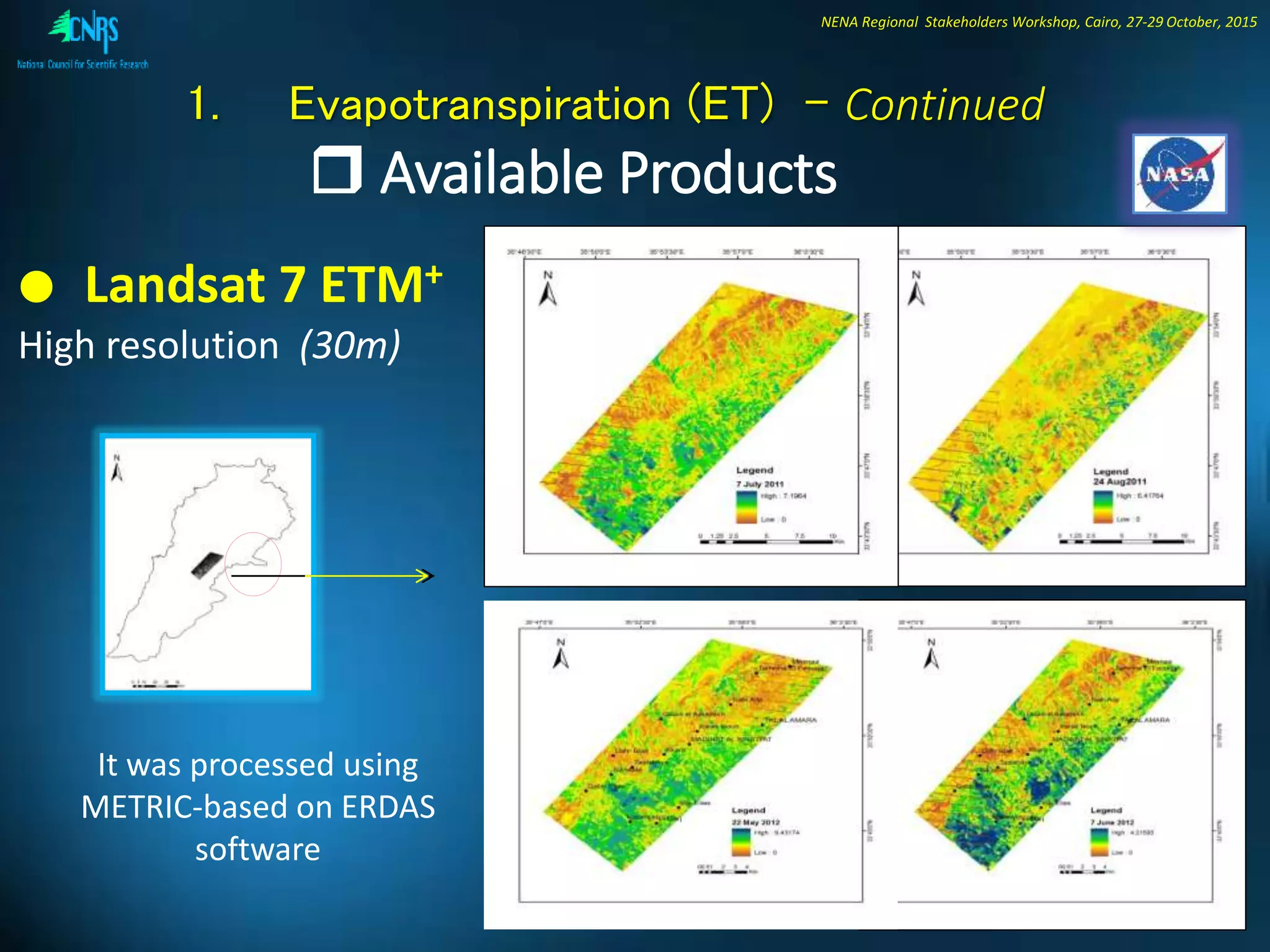
 Landsat 7 ETM+
High resolution (30m)
It was processed using
METRIC-based on ERDAS
software
NENA Regional Stakeholders Workshop, Cairo, 27-29 October, 2015
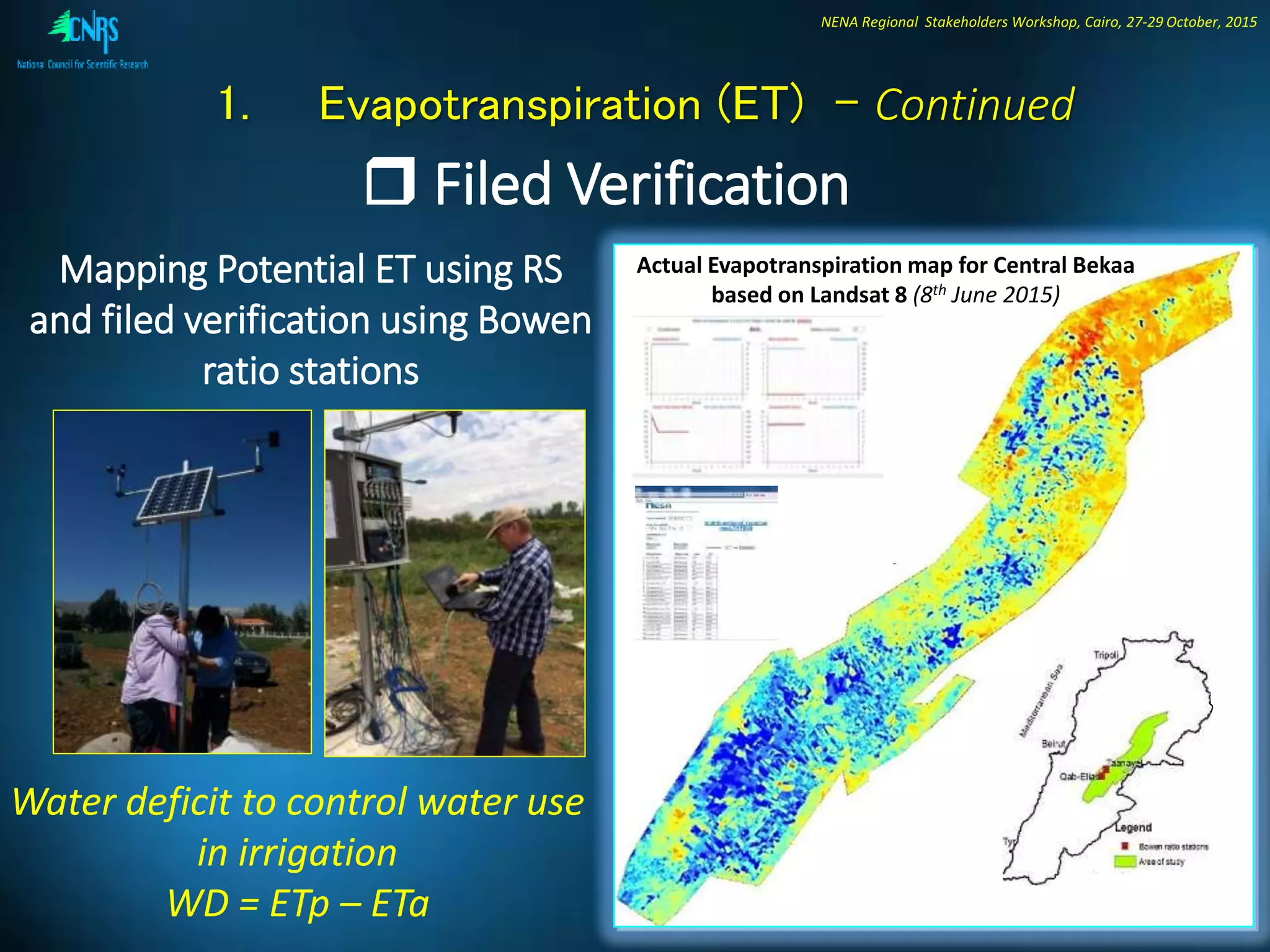
Mapping Potential ET using RS
and filed verification using Bowen
ratio stations
1. Evapotranspiration (ET) - Continued
 Filed Verification
Actual Evapotranspiration map for Central Bekaa
based on Landsat 8 (8th June 2015)
Water deficit to control water use
in irrigation
WD = ETp – ETa
NENA Regional Stakeholders Workshop, Cairo, 27-29 October, 2015
Mapping actual ET Using
RS and field verification
using Bowen ratio stations
1. Evapotranspiration (ET) - Continued
 Application
NENA Regional Stakeholders Workshop, Cairo, 27-29 October, 2015
1. Evapotranspiration (ET) - Continued
# Inquires - I
1
Is there a central processing and publication of reference for ET in place?
There is no centralized unit for publishing ET. There are some climate stations in Bekaa plain
that are managed by public and private sector which compute ET for internal use. Lately, the
RSC installed two Bowen ratio stations in two different locations in Bekaa plain and since then
we started to compute daily average ETr and hourly ETr per request or research need.
2
What are the Institutions (if any) in the Country that provides Remote Sensing (RS)
data (particularly ET and/or related parameters) to the Agencies of Agriculture,
Water Resources and Environment?
National Center for Remote Sensing
3
What are the major on-going programmes/projects for RS ET (and/or related
parameters) determination?
WB/GEF Project Phase I and Phase II.
4
What are the spatial resolutions of the RS ET maps (pixel size in meters)?
There are two source of ET one has 3km pixel resolution (ALEXI) and provided by NASA. ETa
created using METRIC model with resolution of 30 meters.
NENA Regional Stakeholders Workshop, Cairo, 27-29 October, 2015
1. Evapotranspiration (ET) - Continued
# Inquires -II
5
What are the temporal resolutions of the RS ET maps (frequency in days)?
The temporal resolution of Alexi ET is daily while ET by METRIC is every 8 days . Normally, to fill
the gaps in a complete season we fill the gap using mathematical modelling on condition that
enough ETa maps exists
6
What is the Surface Area (in ha) covered by RS (or in % of the total area)?
Alexi covers the whole country
7
What do you think is missing to have a complete operational RS ET in the Country
and how the Regional Collaborative Platform can help?
1. Financial support,
2. Daily high resolution satellite images or at least every 3 days (it should include thermal
bands) if this does not exists mathematical modelling will fill the gaps.
3. Processing hardware to speed the processing and increase the productivity.
4. Automate the processes and this is what we are working on and to automate the provision
of the product using reliable communication techniques (Internet, SMS).
5. Regional collaboration to exchanging experience and provide insight on how to improve
current procedure which can be based on workshops, consultation, or training sessions.
NENA Regional Stakeholders Workshop, Cairo, 27-29 October, 2015
2. Crop Water Productivity (CWP)
 Used Products
- Scenes of Landsat-8 images for the first six
months of year 2014 were processed.
- For each Landsat image, NDVI and albedo were
used, along with the spectral reflectance.
- The classification was made with 11 crop types.
- To verify the accuracy of yield estimation, a total
of 67 GPS ground truth points were collected
representing 18 land types.
-
NENA Regional Stakeholders Workshop, Cairo, 27-29 October, 2015
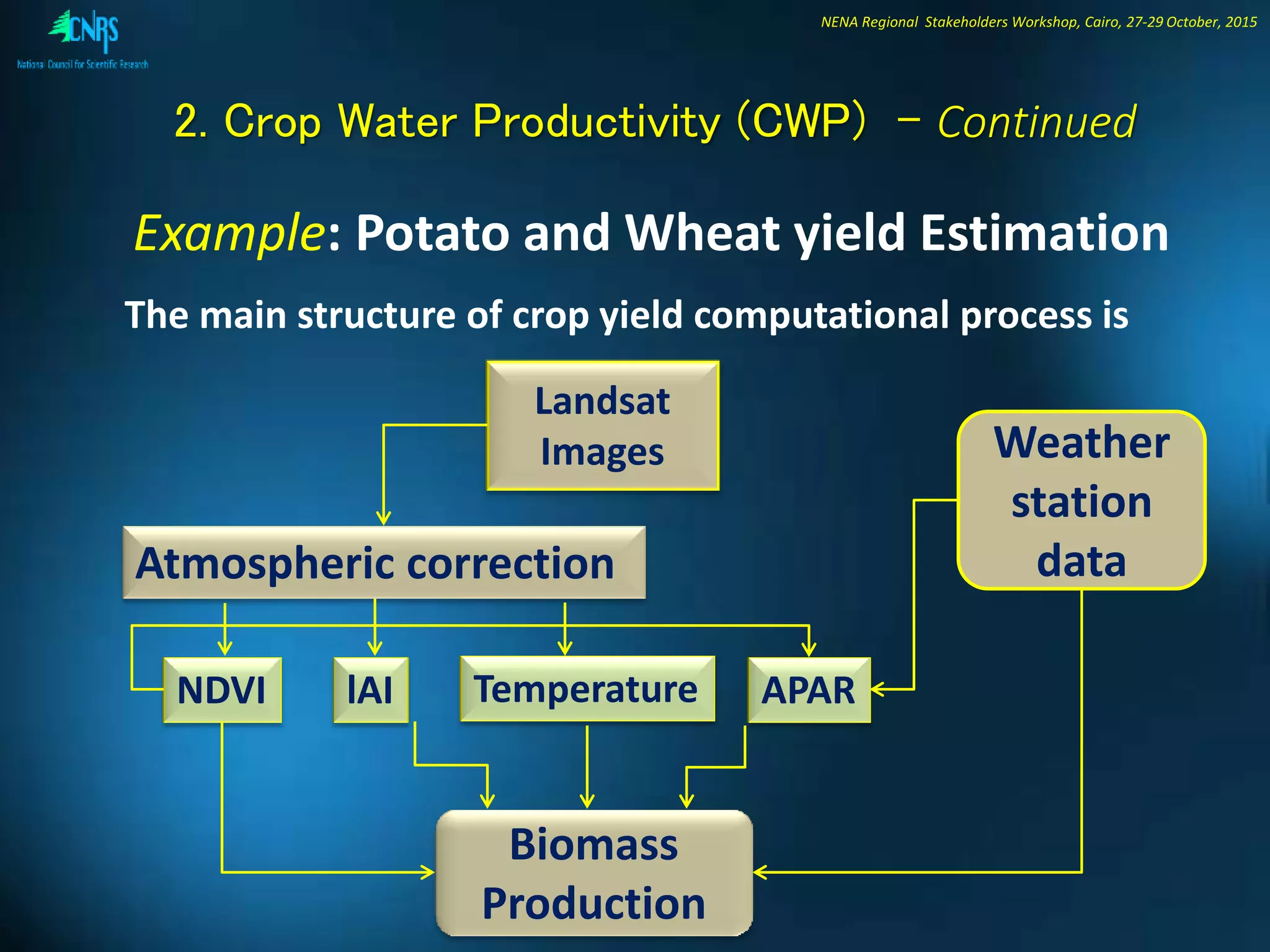
The main structure of crop yield computational process is
Example: Potato and Wheat yield Estimation
Atmospheric correction
Landsat
Images
NDVI
Weather
station
data
Biomass
Production
lAI Temperature APAR
2. Crop Water Productivity (CWP) - Continued
NENA Regional Stakeholders Workshop, Cairo, 27-29 October, 2015
2. Crop Water Productivity (CWP) - Continued
Example: Potato and Wheat yield Estimation
NDVILandsat 8 image Temperature
Absorbed
Photosynthetically
Active Radiation
(APAR)
Mean Soil
Moisture
Biomass production
May 20 2014
NENA Regional Stakeholders Workshop, Cairo, 27-29 October, 2015
2. Crop Water Productivity (CWP) - Continued
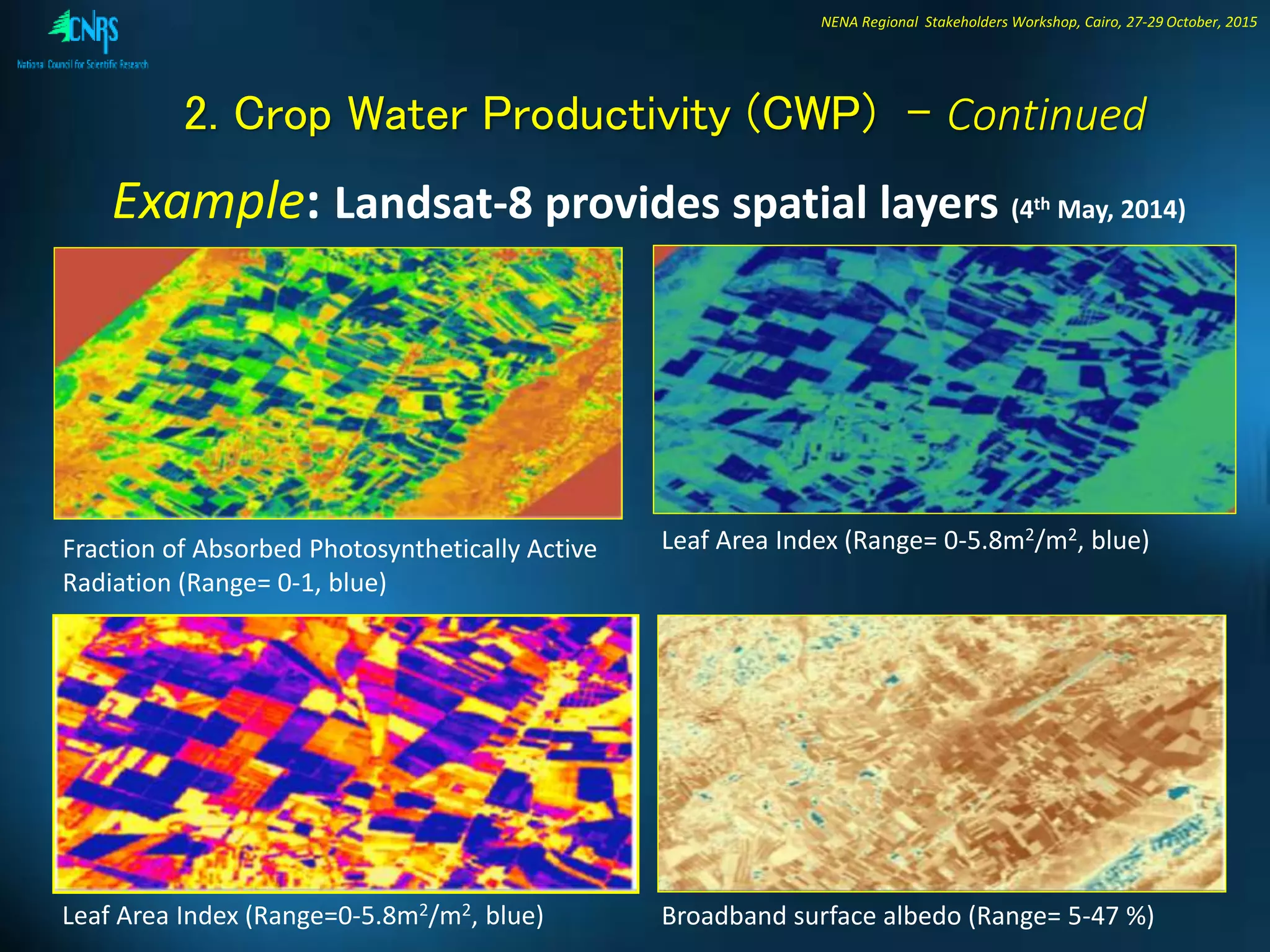
Example: Landsat-8 provides spatial layers (4th May, 2014)
Fraction of Absorbed Photosynthetically Active
Radiation (Range= 0-1, blue)
Leaf Area Index (Range= 0-5.8m2/m2, blue)
Leaf Area Index (Range=0-5.8m2/m2, blue) Broadband surface albedo (Range= 5-47 %)
NENA Regional Stakeholders Workshop, Cairo, 27-29 October, 2015
2. Crop Water Productivity (CWP) - Continued
Example: Crop Mapping and Classification
NENA Regional Stakeholders Workshop, Cairo, 27-29 October, 2015
2. Crop Water Productivity (CWP) - Continued
Example: Crop Mapping and Classification
Potato Yield:
From 8 tons/ha (yellow)
to 66 tons/ha (blue)
Predicting the yield of strategic crops allow for better preparedness regarding
the harvesting campaigns, storage capacities and marketing. The prediction is
made 5 weeks before harvest The accuracy varied between 67% and 83%.
NENA Regional Stakeholders Workshop, Cairo, 27-29 October, 2015
2. Crop Water Productivity (CWP) - Continued
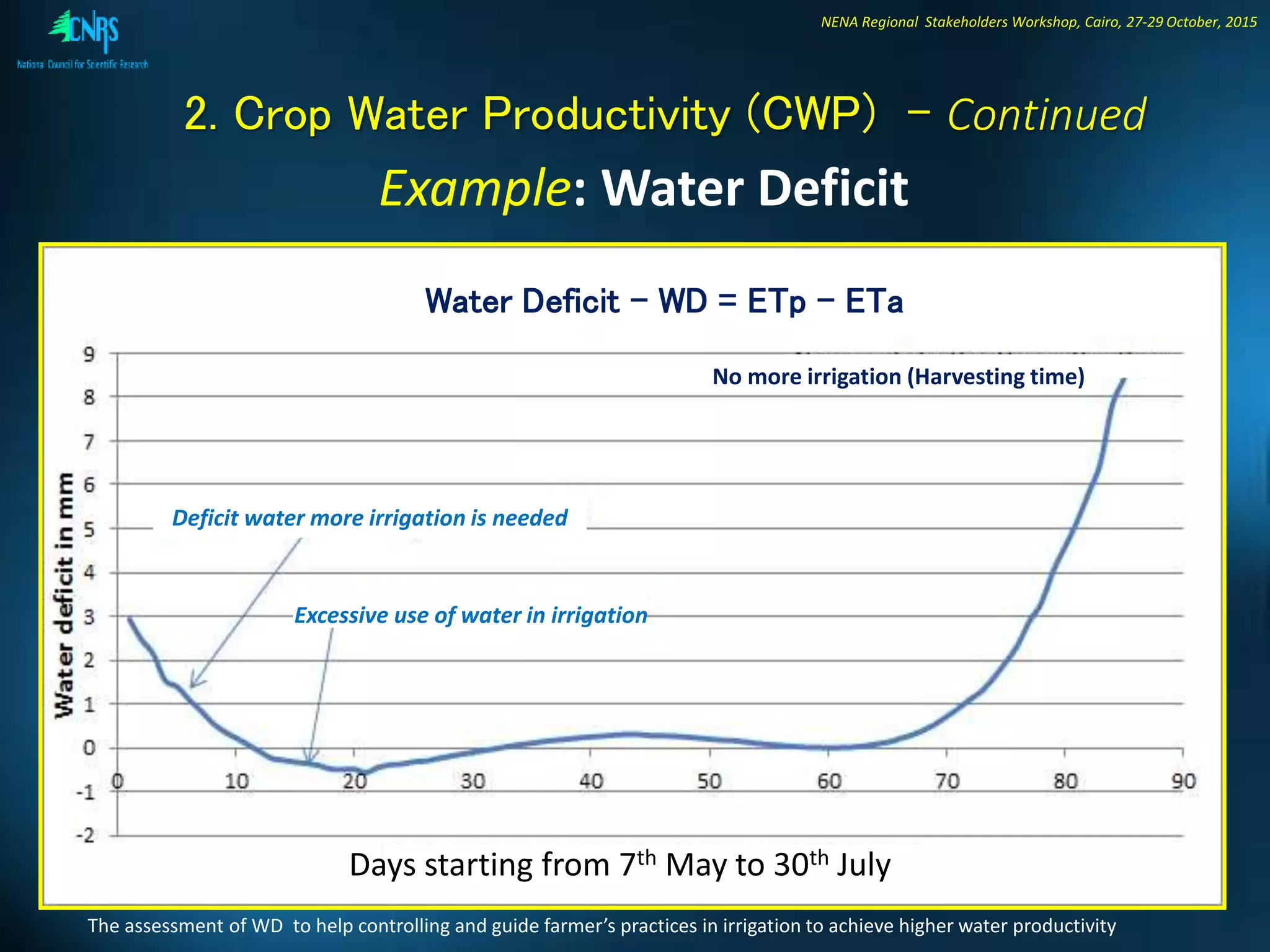
Example: Water Deficit to control water use in irrigation
Early water deficit in May due to low rainfall in 2014, and the crops had water stress. In July
water deficit was corrected.
NENA Regional Stakeholders Workshop, Cairo, 27-29 October, 2015
2. Crop Water Productivity (CWP) - Continued
Example: Water Deficit
No more irrigation (Harvesting time)
Water Deficit - WD = ETp - ETa
Deficit water more irrigation is needed
Excessive use of water in irrigation
Days starting from 7th May to 30th July
The assessment of WD to help controlling and guide farmer’s practices in irrigation to achieve higher water productivity
NENA Regional Stakeholders Workshop, Cairo, 27-29 October, 2015
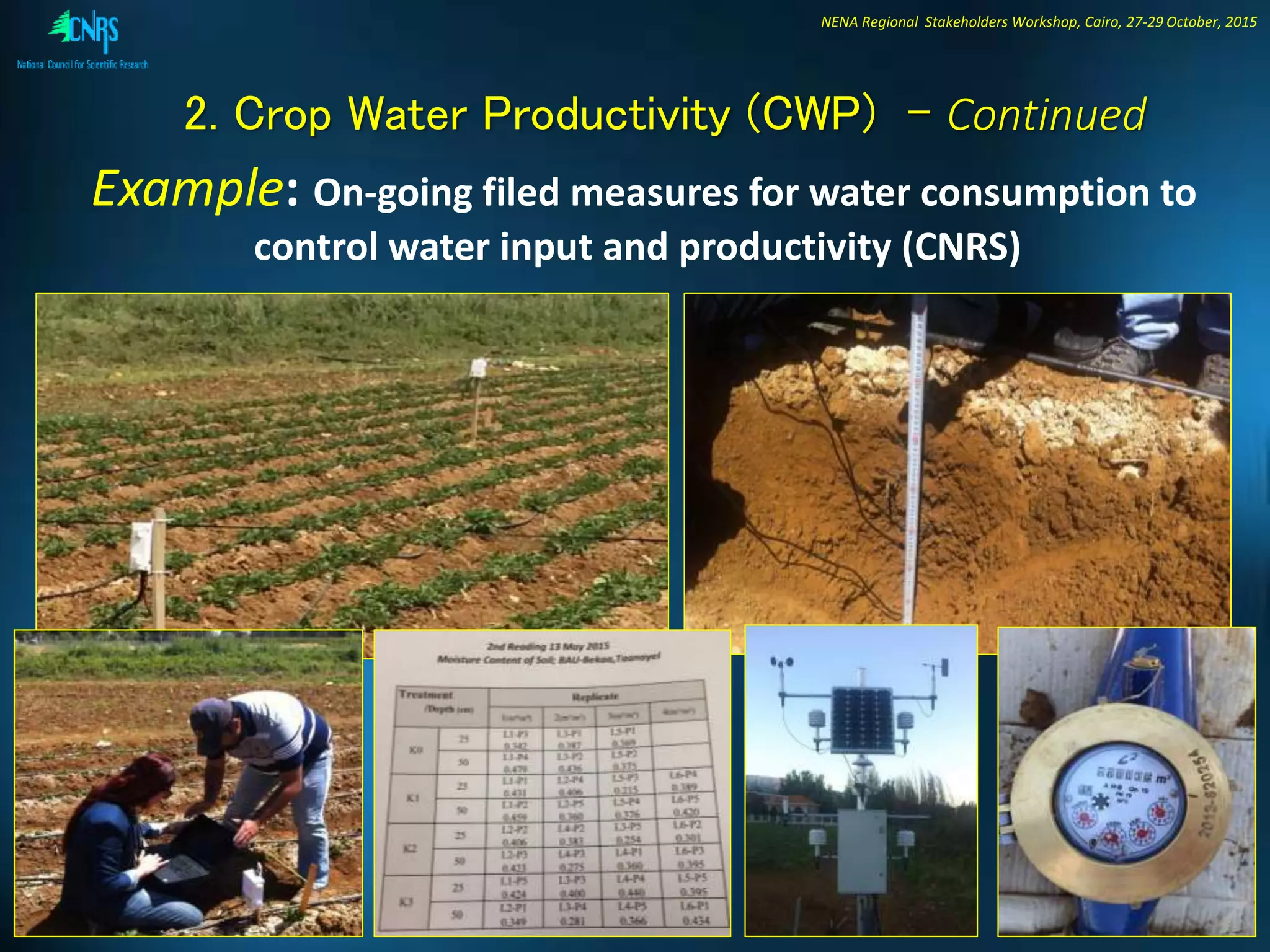
2. Crop Water Productivity (CWP) - Continued
Example: On-going filed measures for water consumption to
control water input and productivity (CNRS)
NENA Regional Stakeholders Workshop, Cairo, 27-29 October, 2015
# Inquires - I
1
Which Agencies are involved (if any) with CWP?
CNRS Center for Remote Sensing, LARI, MoE, Universities (AUB, LU)
2
What are the major on-going programmes/projects for RS CWP determination?
WB/GEF Project Phase I and Phase II.
3
What are the methods used by the CNRS to monitor crop yield?
Field sampling, statistics (CNRS by RS and MoA by farmer’s surveys), No modeling
has been developed yet
4
Do CNRS use RS for CWP determination ?
Yes
5 What are the methods used by CNRS on Water Resources to monitor crop water
use and evapotranspiration
Bowen Ratio, Soil moisture sensors (provided by WB Phase I), RS (MODIS, LANDSAT)
2. Crop Water Productivity (CWP) - Continued
NENA Regional Stakeholders Workshop, Cairo, 27-29 October, 2015
# Inquires -II
6
What is the extent of Surface Area (in ha) monitored by RS for CWP
CNRS is monitoring Central Bekaa area: 1130 Km2
7
What do you think is missing to have a complete operational RS CWP in the Country
and how the Regional Collaborative Platform can help?
- More functional online accessed climatic stations
- More Bowen ratio with online access (Previewed by WB phase II)
- Network with producers and farmers (Previewed by WB phase II)
- More people with RS and GIS Skills at the level of ministries and water
bodies/other users (Previewed by WB phase II)
- More funds (Previewed by WB phase II)
2. Crop Water Productivity (CWP) - Continued
NENA Regional Stakeholders Workshop, Cairo, 27-29 October, 2015
3. Drought Management (DM)
 Concepts
Several models are applied to investigate Clime Change and
drought. However, not all of them succeeded due to a number of
reasons. Therefore, these points must be illustrated:
Does our region witness drought event ?
Can diverse geographic units be included
in the regional drought models ?
Are there defined Drought parameters ?
Drought Vs Water Shortage
NENA Regional Stakeholders Workshop, Cairo, 27-29 October, 2015
3. Drought Management (DM) - Continued
 Concepts
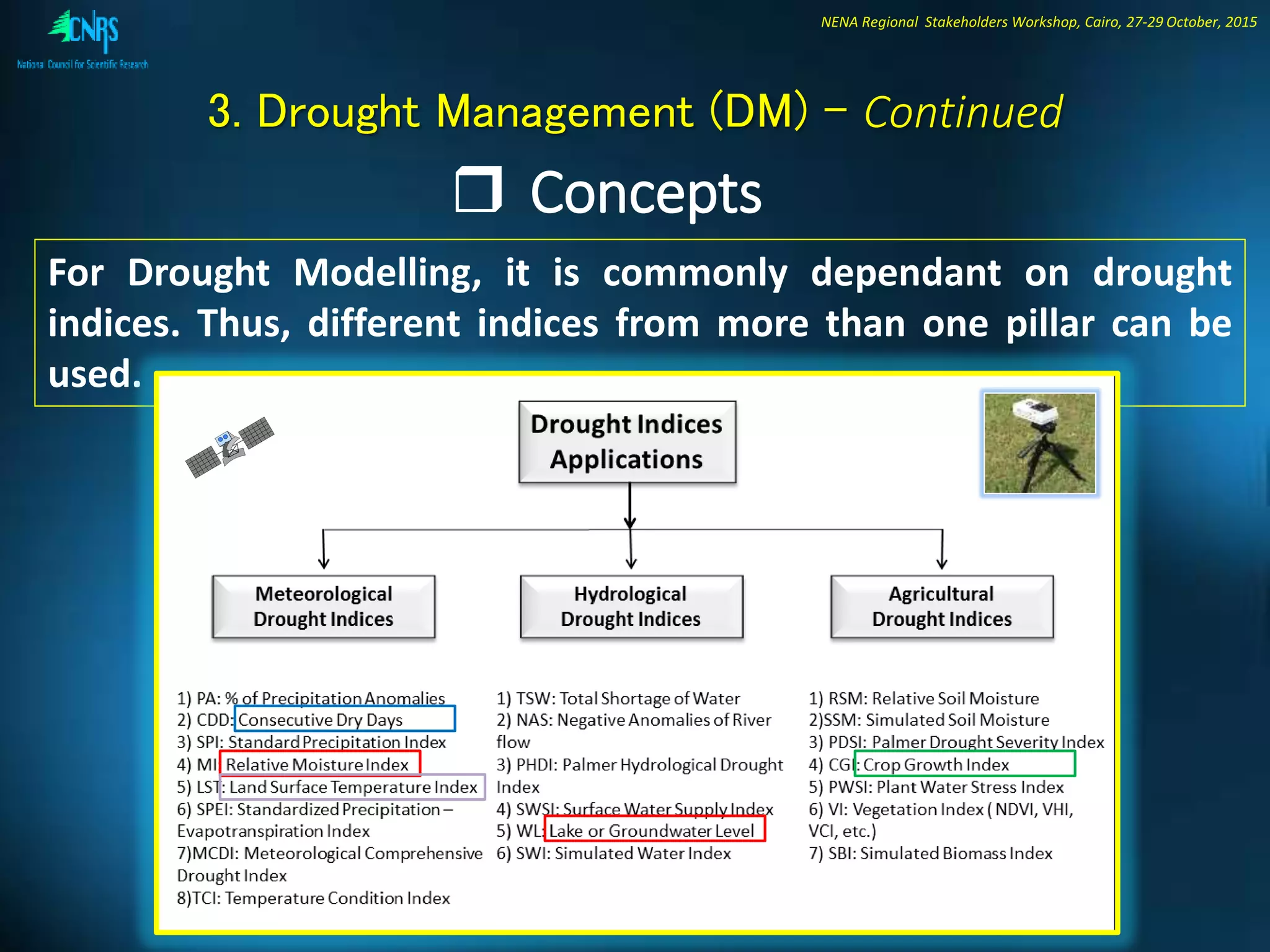
For Drought Modelling, it is commonly dependant on drought
indices. Thus, different indices from more than one pillar can be
used.
NENA Regional Stakeholders Workshop, Cairo, 27-29 October, 2015
3. Drought Management (DM) - Continued
 Concepts
Drought Monitoring can be:
 Traditional climatic based indices, such as the Standardized
precipitation Index (SPI)
 Remote sensing based indices, in particular satellite-based
indices, such as Vegetation Health Index (VHI), among others.
Input
Data
Drought
Indicators
Satellite Images
Climatic Data
Climatic Indicators
Vegetation condition
Soil Humidity
Data
Processing
Data
Modelling
Dynamic Drought
Mapping
Knowledge-based DM
NENA Regional Stakeholders Workshop, Cairo, 27-29 October, 2015
3. Drought Management (DM) - Continued
 Climatic-based Indices (Example)
De Martonne Aridity Index
This index depends mainly on rainfall and temperature rates, which
enable identifying the yearly aridity level. Hence, De Martonne
Aridity Index is expressed by the following formula:
IA = P
T + 10
IA =
P
T + 10
+ 12 p
t + 10
2
IA < 5 (Arid)
IA = 5-10 (Semi-arid)
IA = 10-20 (Semi-humid)
IA = 20-30 (Humid)
IA = >30 (Very humid).
NENA Regional Stakeholders Workshop, Cairo, 27-29 October, 2015
3. Drought Management (DM) - Continued
 Climatic-based Indices (Example)
NENA Regional Stakeholders Workshop, Cairo, 27-29 October, 2015
3. Drought Management (DM) - Continued
 Climatic-based Indices (Example)
Standardised Precipitation Index (SPI)
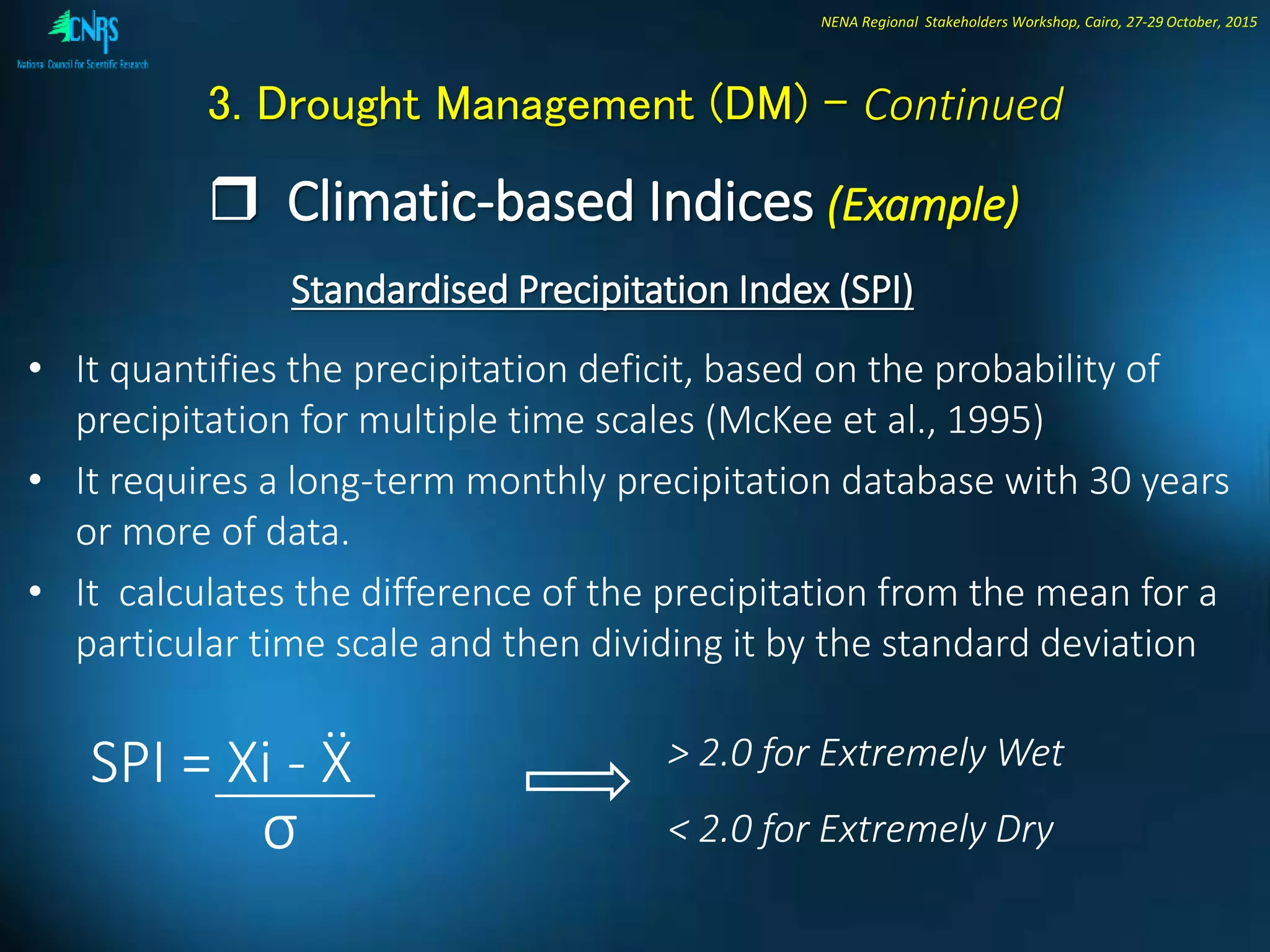
• It quantifies the precipitation deficit, based on the probability of
precipitation for multiple time scales (McKee et al., 1995)
• It requires a long-term monthly precipitation database with 30 years
or more of data.
• It calculates the difference of the precipitation from the mean for a
particular time scale and then dividing it by the standard deviation
SPI = Xi - Ẍ > 2.0 for Extremely Wet
< 2.0 for Extremely Dryσ
NENA Regional Stakeholders Workshop, Cairo, 27-29 October, 2015
3. Drought Management (DM) - Continued
 RS-based Indices (Example)
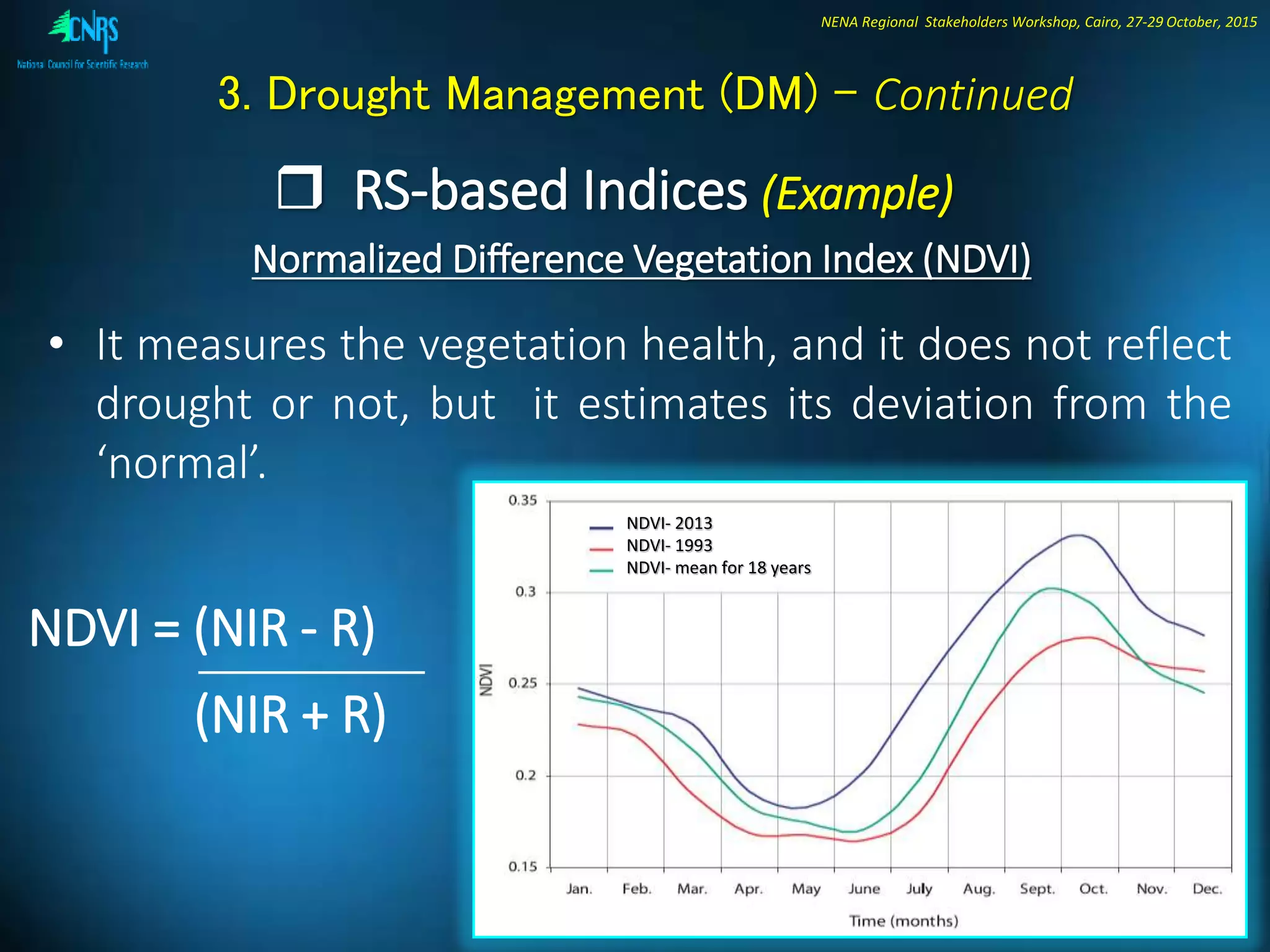
• It measures the vegetation health, and it does not reflect
drought or not, but it estimates its deviation from the
‘normal’.
Normalized Difference Vegetation Index (NDVI)
NDVI- 2013
NDVI- 1993
NDVI- mean for 18 years
NDVI = (NIR - R)
(NIR + R)
NENA Regional Stakeholders Workshop, Cairo, 27-29 October, 2015
3. Drought Management (DM) - Continued
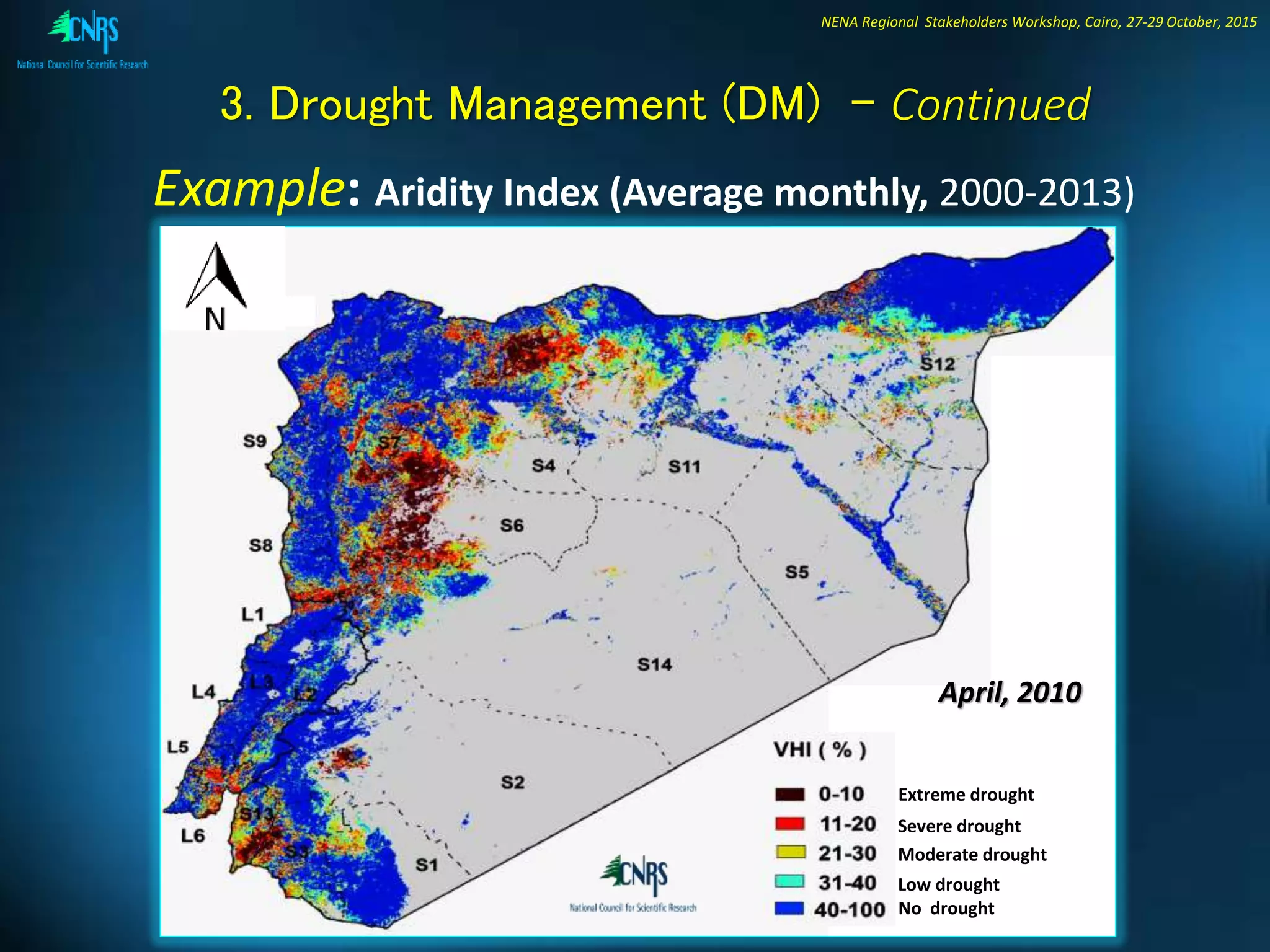
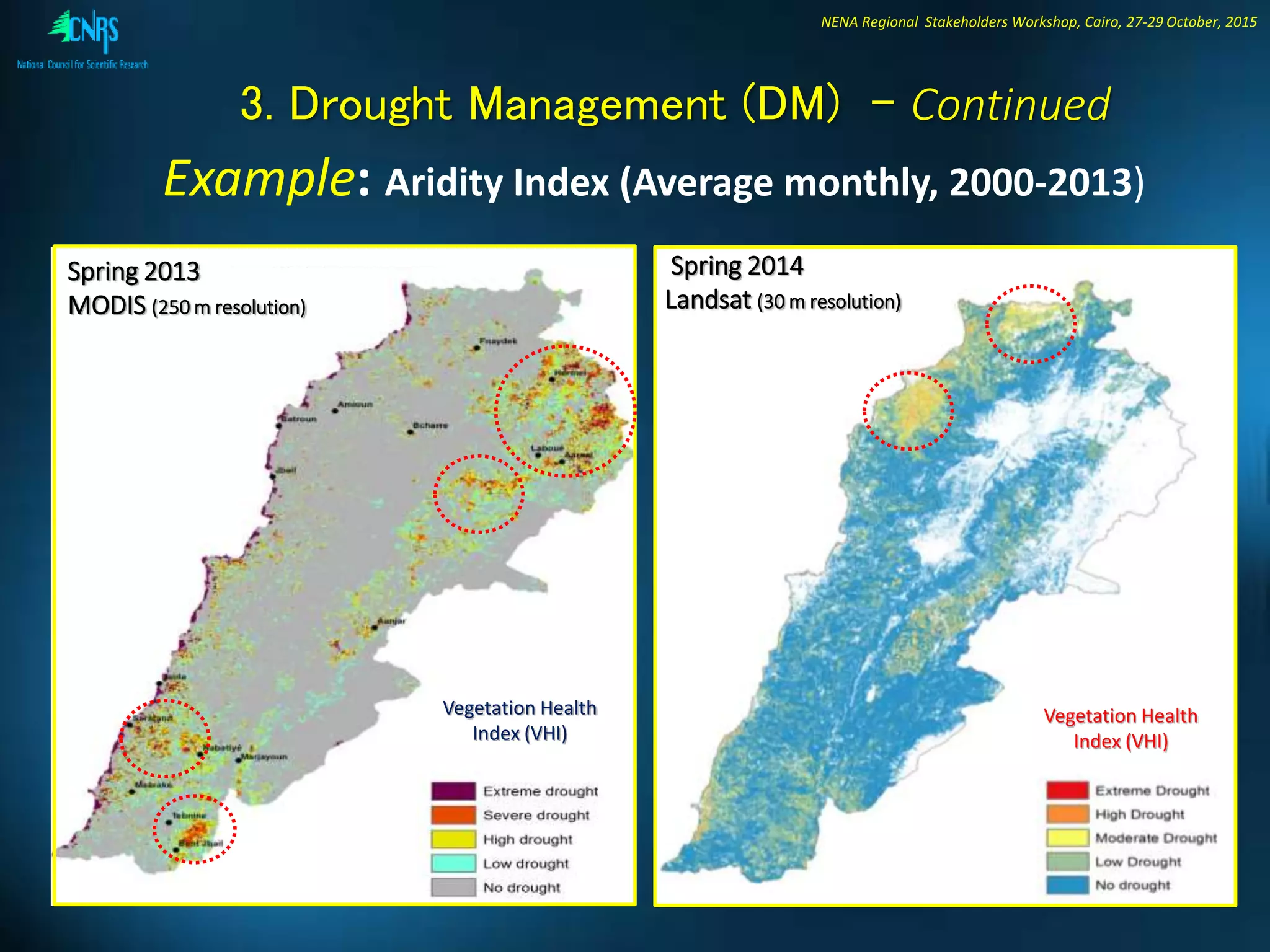
Example: Aridity Index (Average monthly, 2000-2013)
Extreme drought
Severe drought
Moderate drought
Low drought
No drought
April, 2010
NENA Regional Stakeholders Workshop, Cairo, 27-29 October, 2015
3. Drought Management (DM) - Continued
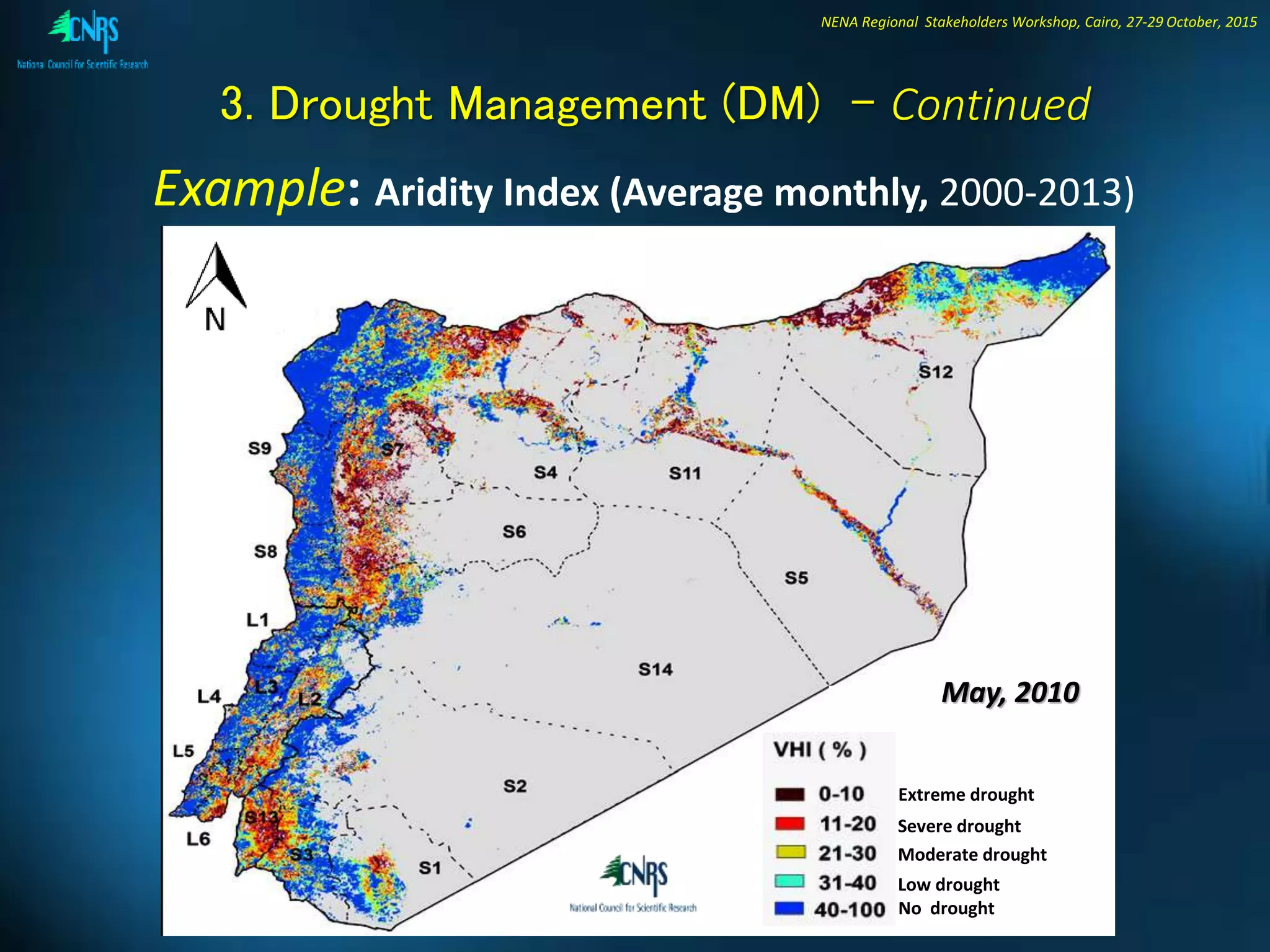
Example: Aridity Index (Average monthly, 2000-2013)
Extreme drought
Severe drought
Moderate drought
Low drought
No drought
May, 2010
NENA Regional Stakeholders Workshop, Cairo, 27-29 October, 2015
3. Drought Management (DM) - Continued
Example: Aridity Index (Average monthly, 2000-2013)
NENA Regional Stakeholders Workshop, Cairo, 27-29 October, 2015
3. Drought Management (DM) - Continued
Example: Aridity Index (Average monthly, 2000-2013)
Spring 2013
MODIS (250 m resolution)
Spring 2014
Landsat (30 m resolution)
Vegetation Health
Index (VHI)
Vegetation Health
Index (VHI)
NENA Regional Stakeholders Workshop, Cairo, 27-29 October, 2015
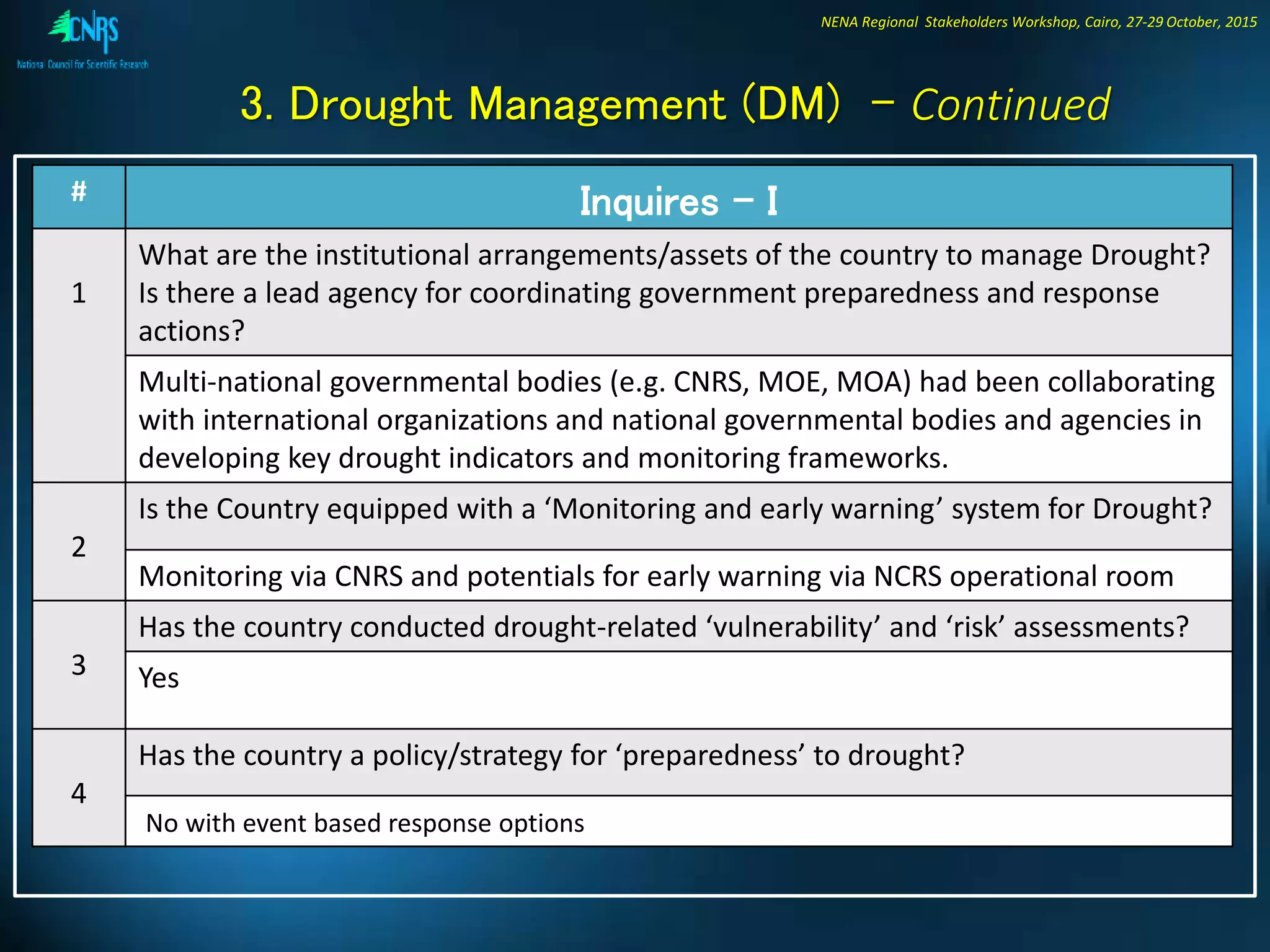
# Inquires - I
1
What are the institutional arrangements/assets of the country to manage Drought?
Is there a lead agency for coordinating government preparedness and response
actions?
Multi-national governmental bodies (e.g. CNRS, MOE, MOA) had been collaborating
with international organizations and national governmental bodies and agencies in
developing key drought indicators and monitoring frameworks.
2
Is the Country equipped with a ‘Monitoring and early warning’ system for Drought?
Monitoring via CNRS and potentials for early warning via NCRS operational room
3
Has the country conducted drought-related ‘vulnerability’ and ‘risk’ assessments?
Yes
4
Has the country a policy/strategy for ‘preparedness’ to drought?
No with event based response options
3. Drought Management (DM) - Continued
NENA Regional Stakeholders Workshop, Cairo, 27-29 October, 2015
# Inquires -II
5
What are the major on-going programmes/projects for RS (and/or related
parameters) determination?
Deriving RS drought indices (e.g. VCI, TCI, VHI, etc.)
6 What do you think is missing to have a complete operational RS-based ‘drought
management’ in the Country and how the Regional Collaborative Platform can help?
Increase the coordination between governmental bodies, national organisations and
stakeholders. Know-how from regional collaboration.
3. Drought Management (DM) - Continued
NENA Regional Stakeholders Workshop, Cairo, 27-29 October, 2015
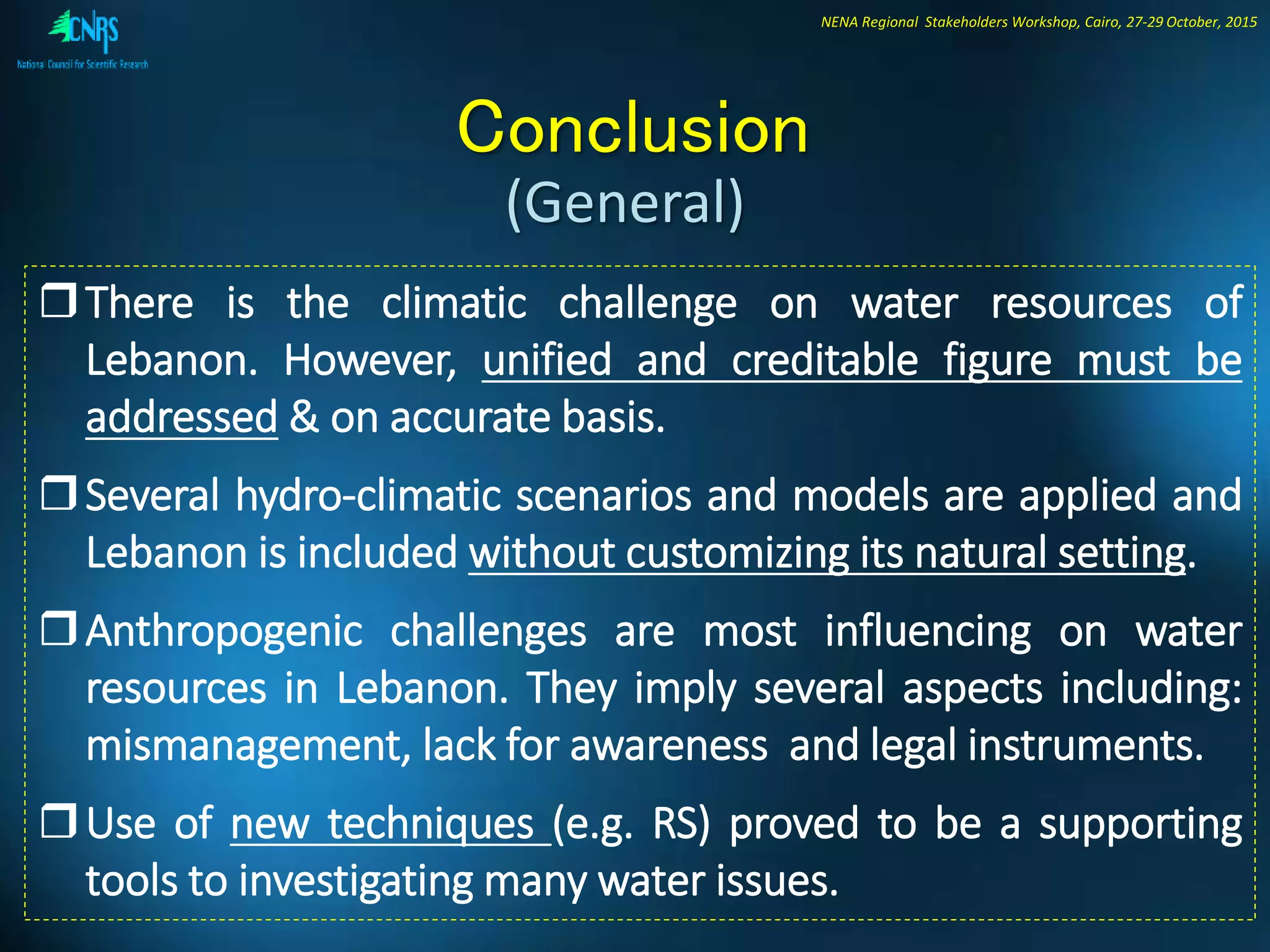
Conclusion
There is the climatic challenge on water resources of
Lebanon. However, unified and creditable figure must be
addressed & on accurate basis.
Several hydro-climatic scenarios and models are applied and
Lebanon is included without customizing its natural setting.
Anthropogenic challenges are most influencing on water
resources in Lebanon. They imply several aspects including:
mismanagement, lack for awareness and legal instruments.
Use of new techniques (e.g. RS) proved to be a supporting
tools to investigating many water issues.
(General)
NENA Regional Stakeholders Workshop, Cairo, 27-29 October, 2015
The applied daily measures of ETa recording from the two
Bowen ratio stations must be expanded.
Mapping actual ETa with high resolution Landsat images will
be linked to farmer’s plots, crop yield and published on
CNRS Geo-portal.
Predicting water deficit or excess is useful for water users
and farmers to alert them to control water productivity and
improve irrigation practices.
 Drought is assessed, but on regional basis, thus local
application is needed.
Conclusion
(Previews)
NENA Regional Stakeholders Workshop, Cairo, 27-29 October, 2015
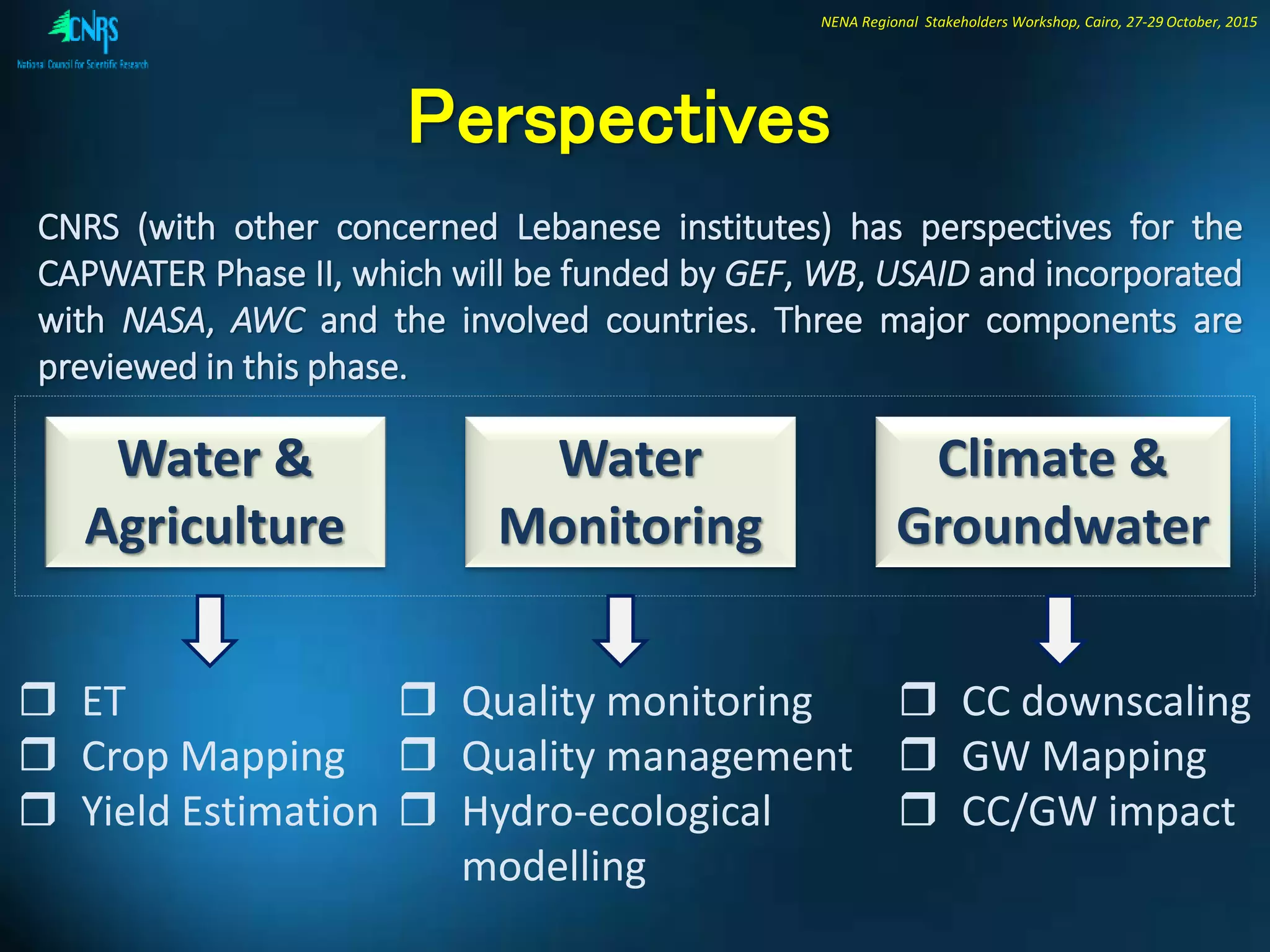
Perspectives
Water &
Agriculture
Water
Monitoring
Climate &
Groundwater
 ET
 Crop Mapping
 Yield Estimation
 Quality monitoring
 Quality management
 Hydro-ecological
modelling
 CC downscaling
 GW Mapping
 CC/GW impact
CNRS (with other concerned Lebanese institutes) has perspectives for the
CAPWATER Phase II, which will be funded by GEF, WB, USAID and incorporated
with NASA, AWC and the involved countries. Three major components are
previewed in this phase.
Thank You !

Use of Remote Sensing to Investigate Striking Challenges on W R in Lebanon, A. Shaban

  • 1.
    Use of RemoteSensing to Investigate Striking Challenges on W R in Lebanon NENA Regional Stakeholders Workshop Operationalizing the Regional Collaborative Platform to address ‘water consumption’, ‘water productivity’ and ‘drought management’ in Agriculture Cairo, 27-29 October, 2015 A. Shaban National Council for Scientific Research, Beirut, Lebanon
  • 2.
    Use of RemoteSensing to Investigate Striking Challenges on W R in Lebanon The current Status and Challenges Evapotranspiration (ET) Crop Water Productivity (CWP) Drought Management (DM) Remote Sensing
  • 3.
    NENA Regional StakeholdersWorkshop, Cairo, 27-29 October, 2015 Water Resources in Lebanon Surface and subsurface water resources in Lebanon are well pronounced and can be considered as plenty resources. 1. Surface water resources (2900Mm3): • 12 perennial watercourses • > 2000 springs (>50l/sec) • Snow covers 25% of Lebanon • Several lakes and ponds (artificial and man-made) 2. Groundwater resources (1750Mm3): • Three carbonate aquifers exist (extending over 2/3 of Lebanon) • Tremendous water-bearing karstic galleries and conduits.
  • 4.
    NENA Regional StakeholdersWorkshop, Cairo, 27-29 October, 2015 Water Resources in Lebanon 1. Water loss to the sea 2. Trans-boundary water (74% shared border)
  • 5.
    Lebanon has severalgroundwater reservoirs Potential Aquifers NENA Regional Stakeholders Workshop, Cairo, 27-29 October, 2015
  • 6.
    NENA Regional StakeholdersWorkshop, Cairo, 27-29 October, 2015 Water Consumption and Allocation  Water consumption (18 surveyed studies + Questionnaire): - Domestic =170 l /capita/d - Agriculture = 405 l /capita/d - Industry = 30 l /capita/d 605 l /capita/d = 220m3/capita/yr 1350m3/capita/yr 220m3/capita/yr 30-40% 100% 50% Agricultural Domestic Industrial 100% 50% Agricultural Domestic Industrial Urban Areas Rural Areas 68% 25% 7% 66% 31% 3%
  • 7.
    Changing Rainfall Rate(1950-2014) Climatic Variability 52% decrease in rainfall, besides 48% increase NENA Regional Stakeholders Workshop, Cairo, 27-29 October, 2015
  • 8.
    Rainfall: 35-40mm decrease(6 decades) 1950 1960 1970 1980 1990 2000 2010 2014 Rainfall NENA Regional Stakeholders Workshop, Cairo, 27-29 October, 2015
  • 9.
    Rainfall Trends 1998 1999 1998 2000 1995 AUB SouqAl-GharebJezzine Majayoun Qubayat Aytaroun 1999 NENA Regional Stakeholders Workshop, Cairo, 27-29 October, 2015
  • 10.
    Temperature Temperature: 1.9 Cincrease (over 4 decades) 2013 NENA Regional Stakeholders Workshop, Cairo, 27-29 October, 2015
  • 11.
    25 50 75 100 (Aridity index %) QubayatTripoli Cedars Qartaba AUB Souq Al- Ghareb Jezzine Marjayoun Sour Aytaroun Arid Semi-arid Semi-humid Humid Very humid Aridity/Humidity 39% are semi-humid climate & 30.6% are humid NENA Regional Stakeholders Workshop, Cairo, 27-29 October, 2015
  • 12.
    NENA Regional StakeholdersWorkshop, Cairo, 27-29 October, 2015 3. Drought Management (DM) - Continued  Climatic-based Indices (Example)
  • 13.
    Decreased discharge inrivers and springs: reaches up to 55% (over 5 decades) 2012 Discharge in Rivers and Springs NENA Regional Stakeholders Workshop, Cairo, 27-29 October, 2015
  • 14.
    Groundwater Depletion Groundwater depletionin the major aquifers (245 boreholes) Lowering in water table Decreased discharge NENA Regional Stakeholders Workshop, Cairo, 27-29 October, 2015
  • 15.
    NENA Regional StakeholdersWorkshop, Cairo, 27-29 October, 2015
  • 16.
    NENA Regional StakeholdersWorkshop, Cairo, 27-29 October, 2015 Application of Remote Sensing ET CWP DM
  • 17.
    NENA Regional StakeholdersWorkshop, Cairo, 27-29 October, 2015 1. Evapotranspiration (ET)  Available Products (3 km resolution, daily)  AlexiCoarse ET map product July, 2011 (mm/day) Data can be downloaded in the netcdf format
  • 18.
    NENA Regional StakeholdersWorkshop, Cairo, 27-29 October, 2015 1. Evapotranspiration (ET) - Continued  Available Products  MODIS Mod16 Global ET product >= 1 km resolution (8-day Revisit time) MOD16 ET algorithm includes several MODIS components (land cover, albedo, etc.) (2000-2010)
  • 19.
    NENA Regional StakeholdersWorkshop, Cairo, 27-29 October, 2015 1. Evapotranspiration (ET) - Continued  Available Products  Landsat 7 ETM+ High resolution (30m) It was processed using METRIC-based on ERDAS software
  • 20.
    NENA Regional StakeholdersWorkshop, Cairo, 27-29 October, 2015 Mapping Potential ET using RS and filed verification using Bowen ratio stations 1. Evapotranspiration (ET) - Continued  Filed Verification Actual Evapotranspiration map for Central Bekaa based on Landsat 8 (8th June 2015) Water deficit to control water use in irrigation WD = ETp – ETa
  • 21.
    NENA Regional StakeholdersWorkshop, Cairo, 27-29 October, 2015 Mapping actual ET Using RS and field verification using Bowen ratio stations 1. Evapotranspiration (ET) - Continued  Application
  • 22.
    NENA Regional StakeholdersWorkshop, Cairo, 27-29 October, 2015 1. Evapotranspiration (ET) - Continued # Inquires - I 1 Is there a central processing and publication of reference for ET in place? There is no centralized unit for publishing ET. There are some climate stations in Bekaa plain that are managed by public and private sector which compute ET for internal use. Lately, the RSC installed two Bowen ratio stations in two different locations in Bekaa plain and since then we started to compute daily average ETr and hourly ETr per request or research need. 2 What are the Institutions (if any) in the Country that provides Remote Sensing (RS) data (particularly ET and/or related parameters) to the Agencies of Agriculture, Water Resources and Environment? National Center for Remote Sensing 3 What are the major on-going programmes/projects for RS ET (and/or related parameters) determination? WB/GEF Project Phase I and Phase II. 4 What are the spatial resolutions of the RS ET maps (pixel size in meters)? There are two source of ET one has 3km pixel resolution (ALEXI) and provided by NASA. ETa created using METRIC model with resolution of 30 meters.
  • 23.
    NENA Regional StakeholdersWorkshop, Cairo, 27-29 October, 2015 1. Evapotranspiration (ET) - Continued # Inquires -II 5 What are the temporal resolutions of the RS ET maps (frequency in days)? The temporal resolution of Alexi ET is daily while ET by METRIC is every 8 days . Normally, to fill the gaps in a complete season we fill the gap using mathematical modelling on condition that enough ETa maps exists 6 What is the Surface Area (in ha) covered by RS (or in % of the total area)? Alexi covers the whole country 7 What do you think is missing to have a complete operational RS ET in the Country and how the Regional Collaborative Platform can help? 1. Financial support, 2. Daily high resolution satellite images or at least every 3 days (it should include thermal bands) if this does not exists mathematical modelling will fill the gaps. 3. Processing hardware to speed the processing and increase the productivity. 4. Automate the processes and this is what we are working on and to automate the provision of the product using reliable communication techniques (Internet, SMS). 5. Regional collaboration to exchanging experience and provide insight on how to improve current procedure which can be based on workshops, consultation, or training sessions.
  • 24.
    NENA Regional StakeholdersWorkshop, Cairo, 27-29 October, 2015 2. Crop Water Productivity (CWP)  Used Products - Scenes of Landsat-8 images for the first six months of year 2014 were processed. - For each Landsat image, NDVI and albedo were used, along with the spectral reflectance. - The classification was made with 11 crop types. - To verify the accuracy of yield estimation, a total of 67 GPS ground truth points were collected representing 18 land types. -
  • 25.
    NENA Regional StakeholdersWorkshop, Cairo, 27-29 October, 2015 The main structure of crop yield computational process is Example: Potato and Wheat yield Estimation Atmospheric correction Landsat Images NDVI Weather station data Biomass Production lAI Temperature APAR 2. Crop Water Productivity (CWP) - Continued
  • 26.
    NENA Regional StakeholdersWorkshop, Cairo, 27-29 October, 2015 2. Crop Water Productivity (CWP) - Continued Example: Potato and Wheat yield Estimation NDVILandsat 8 image Temperature Absorbed Photosynthetically Active Radiation (APAR) Mean Soil Moisture Biomass production May 20 2014
  • 27.
    NENA Regional StakeholdersWorkshop, Cairo, 27-29 October, 2015 2. Crop Water Productivity (CWP) - Continued Example: Landsat-8 provides spatial layers (4th May, 2014) Fraction of Absorbed Photosynthetically Active Radiation (Range= 0-1, blue) Leaf Area Index (Range= 0-5.8m2/m2, blue) Leaf Area Index (Range=0-5.8m2/m2, blue) Broadband surface albedo (Range= 5-47 %)
  • 28.
    NENA Regional StakeholdersWorkshop, Cairo, 27-29 October, 2015 2. Crop Water Productivity (CWP) - Continued Example: Crop Mapping and Classification
  • 29.
    NENA Regional StakeholdersWorkshop, Cairo, 27-29 October, 2015 2. Crop Water Productivity (CWP) - Continued Example: Crop Mapping and Classification Potato Yield: From 8 tons/ha (yellow) to 66 tons/ha (blue) Predicting the yield of strategic crops allow for better preparedness regarding the harvesting campaigns, storage capacities and marketing. The prediction is made 5 weeks before harvest The accuracy varied between 67% and 83%.
  • 30.
    NENA Regional StakeholdersWorkshop, Cairo, 27-29 October, 2015 2. Crop Water Productivity (CWP) - Continued Example: Water Deficit to control water use in irrigation Early water deficit in May due to low rainfall in 2014, and the crops had water stress. In July water deficit was corrected.
  • 31.
    NENA Regional StakeholdersWorkshop, Cairo, 27-29 October, 2015 2. Crop Water Productivity (CWP) - Continued Example: Water Deficit No more irrigation (Harvesting time) Water Deficit - WD = ETp - ETa Deficit water more irrigation is needed Excessive use of water in irrigation Days starting from 7th May to 30th July The assessment of WD to help controlling and guide farmer’s practices in irrigation to achieve higher water productivity
  • 32.
    NENA Regional StakeholdersWorkshop, Cairo, 27-29 October, 2015 2. Crop Water Productivity (CWP) - Continued Example: On-going filed measures for water consumption to control water input and productivity (CNRS)
  • 33.
    NENA Regional StakeholdersWorkshop, Cairo, 27-29 October, 2015 # Inquires - I 1 Which Agencies are involved (if any) with CWP? CNRS Center for Remote Sensing, LARI, MoE, Universities (AUB, LU) 2 What are the major on-going programmes/projects for RS CWP determination? WB/GEF Project Phase I and Phase II. 3 What are the methods used by the CNRS to monitor crop yield? Field sampling, statistics (CNRS by RS and MoA by farmer’s surveys), No modeling has been developed yet 4 Do CNRS use RS for CWP determination ? Yes 5 What are the methods used by CNRS on Water Resources to monitor crop water use and evapotranspiration Bowen Ratio, Soil moisture sensors (provided by WB Phase I), RS (MODIS, LANDSAT) 2. Crop Water Productivity (CWP) - Continued
  • 34.
    NENA Regional StakeholdersWorkshop, Cairo, 27-29 October, 2015 # Inquires -II 6 What is the extent of Surface Area (in ha) monitored by RS for CWP CNRS is monitoring Central Bekaa area: 1130 Km2 7 What do you think is missing to have a complete operational RS CWP in the Country and how the Regional Collaborative Platform can help? - More functional online accessed climatic stations - More Bowen ratio with online access (Previewed by WB phase II) - Network with producers and farmers (Previewed by WB phase II) - More people with RS and GIS Skills at the level of ministries and water bodies/other users (Previewed by WB phase II) - More funds (Previewed by WB phase II) 2. Crop Water Productivity (CWP) - Continued
  • 35.
    NENA Regional StakeholdersWorkshop, Cairo, 27-29 October, 2015 3. Drought Management (DM)  Concepts Several models are applied to investigate Clime Change and drought. However, not all of them succeeded due to a number of reasons. Therefore, these points must be illustrated: Does our region witness drought event ? Can diverse geographic units be included in the regional drought models ? Are there defined Drought parameters ? Drought Vs Water Shortage
  • 36.
    NENA Regional StakeholdersWorkshop, Cairo, 27-29 October, 2015 3. Drought Management (DM) - Continued  Concepts For Drought Modelling, it is commonly dependant on drought indices. Thus, different indices from more than one pillar can be used.
  • 37.
    NENA Regional StakeholdersWorkshop, Cairo, 27-29 October, 2015 3. Drought Management (DM) - Continued  Concepts Drought Monitoring can be:  Traditional climatic based indices, such as the Standardized precipitation Index (SPI)  Remote sensing based indices, in particular satellite-based indices, such as Vegetation Health Index (VHI), among others. Input Data Drought Indicators Satellite Images Climatic Data Climatic Indicators Vegetation condition Soil Humidity Data Processing Data Modelling Dynamic Drought Mapping Knowledge-based DM
  • 38.
    NENA Regional StakeholdersWorkshop, Cairo, 27-29 October, 2015 3. Drought Management (DM) - Continued  Climatic-based Indices (Example) De Martonne Aridity Index This index depends mainly on rainfall and temperature rates, which enable identifying the yearly aridity level. Hence, De Martonne Aridity Index is expressed by the following formula: IA = P T + 10 IA = P T + 10 + 12 p t + 10 2 IA < 5 (Arid) IA = 5-10 (Semi-arid) IA = 10-20 (Semi-humid) IA = 20-30 (Humid) IA = >30 (Very humid).
  • 39.
    NENA Regional StakeholdersWorkshop, Cairo, 27-29 October, 2015 3. Drought Management (DM) - Continued  Climatic-based Indices (Example)
  • 40.
    NENA Regional StakeholdersWorkshop, Cairo, 27-29 October, 2015 3. Drought Management (DM) - Continued  Climatic-based Indices (Example) Standardised Precipitation Index (SPI) • It quantifies the precipitation deficit, based on the probability of precipitation for multiple time scales (McKee et al., 1995) • It requires a long-term monthly precipitation database with 30 years or more of data. • It calculates the difference of the precipitation from the mean for a particular time scale and then dividing it by the standard deviation SPI = Xi - Ẍ > 2.0 for Extremely Wet < 2.0 for Extremely Dryσ
  • 41.
    NENA Regional StakeholdersWorkshop, Cairo, 27-29 October, 2015 3. Drought Management (DM) - Continued  RS-based Indices (Example) • It measures the vegetation health, and it does not reflect drought or not, but it estimates its deviation from the ‘normal’. Normalized Difference Vegetation Index (NDVI) NDVI- 2013 NDVI- 1993 NDVI- mean for 18 years NDVI = (NIR - R) (NIR + R)
  • 42.
    NENA Regional StakeholdersWorkshop, Cairo, 27-29 October, 2015 3. Drought Management (DM) - Continued Example: Aridity Index (Average monthly, 2000-2013) Extreme drought Severe drought Moderate drought Low drought No drought April, 2010
  • 43.
    NENA Regional StakeholdersWorkshop, Cairo, 27-29 October, 2015 3. Drought Management (DM) - Continued Example: Aridity Index (Average monthly, 2000-2013) Extreme drought Severe drought Moderate drought Low drought No drought May, 2010
  • 44.
    NENA Regional StakeholdersWorkshop, Cairo, 27-29 October, 2015 3. Drought Management (DM) - Continued Example: Aridity Index (Average monthly, 2000-2013)
  • 45.
    NENA Regional StakeholdersWorkshop, Cairo, 27-29 October, 2015 3. Drought Management (DM) - Continued Example: Aridity Index (Average monthly, 2000-2013) Spring 2013 MODIS (250 m resolution) Spring 2014 Landsat (30 m resolution) Vegetation Health Index (VHI) Vegetation Health Index (VHI)
  • 46.
    NENA Regional StakeholdersWorkshop, Cairo, 27-29 October, 2015 # Inquires - I 1 What are the institutional arrangements/assets of the country to manage Drought? Is there a lead agency for coordinating government preparedness and response actions? Multi-national governmental bodies (e.g. CNRS, MOE, MOA) had been collaborating with international organizations and national governmental bodies and agencies in developing key drought indicators and monitoring frameworks. 2 Is the Country equipped with a ‘Monitoring and early warning’ system for Drought? Monitoring via CNRS and potentials for early warning via NCRS operational room 3 Has the country conducted drought-related ‘vulnerability’ and ‘risk’ assessments? Yes 4 Has the country a policy/strategy for ‘preparedness’ to drought? No with event based response options 3. Drought Management (DM) - Continued
  • 47.
    NENA Regional StakeholdersWorkshop, Cairo, 27-29 October, 2015 # Inquires -II 5 What are the major on-going programmes/projects for RS (and/or related parameters) determination? Deriving RS drought indices (e.g. VCI, TCI, VHI, etc.) 6 What do you think is missing to have a complete operational RS-based ‘drought management’ in the Country and how the Regional Collaborative Platform can help? Increase the coordination between governmental bodies, national organisations and stakeholders. Know-how from regional collaboration. 3. Drought Management (DM) - Continued
  • 48.
    NENA Regional StakeholdersWorkshop, Cairo, 27-29 October, 2015 Conclusion There is the climatic challenge on water resources of Lebanon. However, unified and creditable figure must be addressed & on accurate basis. Several hydro-climatic scenarios and models are applied and Lebanon is included without customizing its natural setting. Anthropogenic challenges are most influencing on water resources in Lebanon. They imply several aspects including: mismanagement, lack for awareness and legal instruments. Use of new techniques (e.g. RS) proved to be a supporting tools to investigating many water issues. (General)
  • 49.
    NENA Regional StakeholdersWorkshop, Cairo, 27-29 October, 2015 The applied daily measures of ETa recording from the two Bowen ratio stations must be expanded. Mapping actual ETa with high resolution Landsat images will be linked to farmer’s plots, crop yield and published on CNRS Geo-portal. Predicting water deficit or excess is useful for water users and farmers to alert them to control water productivity and improve irrigation practices.  Drought is assessed, but on regional basis, thus local application is needed. Conclusion (Previews)
  • 50.
    NENA Regional StakeholdersWorkshop, Cairo, 27-29 October, 2015 Perspectives Water & Agriculture Water Monitoring Climate & Groundwater  ET  Crop Mapping  Yield Estimation  Quality monitoring  Quality management  Hydro-ecological modelling  CC downscaling  GW Mapping  CC/GW impact CNRS (with other concerned Lebanese institutes) has perspectives for the CAPWATER Phase II, which will be funded by GEF, WB, USAID and incorporated with NASA, AWC and the involved countries. Three major components are previewed in this phase.
  • 51.