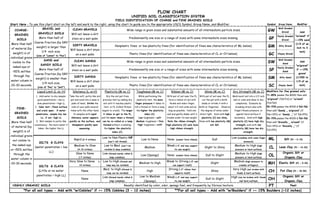
Start Here - To use this chart start on the left and work to the right, using the chart to guide you to the appropriate USCS Symbol, Group Name, and Modifier. Symbol Group Name
GW
Well Graded
Gravel
GP
Poorly Graded
Gravel
GM Silty Gravel
GC Clayey Gravel
SW
Well Graded
Sand
SP
Poorly Graded
Sand
SM Silty Sand
SC Clayey Sand
Liquid Limit (L vs. H) Dilatancy (L vs H) Plasticity (M vs. C) Toughness (M vs. C) Ribbon (M vs. C) Shine (M vs. C) Dry Strength (M vs. C)
1. Add water to dry sample:
quick penetration = low LL
slow penetration = high LL
2. Cube test--flood surface
and crack open: if water
penetrates, sample has low
LL; if not, high LL
3. Wet sample to putty-like
consistency: the more water it
takes, the higher the LL.
Take the soft, putty-like soil
pat and mold into a mass in
palm of hand. Strike the
side of your palm several
times with the other hand.
In samples with rapid
dilatancy, water appears
quickly on the surface, and
disappears quickly upon
squeezing.
Dry the soil pat from
previous test by adding dry
soil until it reaches plastic
limit, or PL (rolled thread
begins to crack). The longer
it takes to get to the PL,
and the more times a thread
can be re-rolled or a lump
formed without crumbling,
the higher the plasticity
index (C).
While performing the
plasticity test, the more
finger pressure it takes to
roll a thread or form a lump,
the higher the plasticity
index (C).
Low toughness = soft
Medium toughness = firm
High toughness = stiff
With pat of soil near the PL,
form a ribbon of soil with
thumb and index finger,
about 1/2 inch wide and as
long as possible. Hold one
end and gently shake until it
breaks under its own weight.
Rate the ribbon strength.
High plasticity (C) soils have
high ribbon strength.
With pat of soil near the PL,
cut the pat with a knife
blade or stroke it with a
knife or fingernail. Observe
the degree of shine under
direct light. Soils with high
plasticity (C) are shiny,
those with low plasticity (M)
are dull.
Mold moist soil into a 1/2 inch
ball or cube and allow to dry
completely. Evaluate by
breaking dried cube with
finger/thumb pressure, or
against hard surface if
necessary. Soils with high
plasticity (C) have high dry
strength; soils with low
plasticity (M) have low dry
strength.
Rapid (2-4 strikes)
Low to Non Plastic-NP
(can't roll thread)
Low to None None (cannot form ribbon) Dull
Low (crumbles with some finger
pressure)
ML
Medium to Slow
(4-10 strikes)
Low to Med. (can't be
rerolled & lump crumbles)
Medium
Weak (<3" and may support
its own weight)
Slight to Shiny
Medium to High (high
pressure or hard surface)
CL
Slow to None
(>7 strikes)
Low (thread barely rolled &
lump crumbles).
Low (Spongy) None (cannot form ribbon) Dull to Slight
Medium to High (high
pressure or hard surface)
OL
Very Slow to None (>
10 strikes)
Low to High (thread and
lump may be rerolled)
Medium to High
Weak to Strong (<3" and
can support itself)
Slight
Medium (high pressure to
crumble w/fingers)
MH
None
Med. to High (thread &
lump can be rerolled)
High
Strong (>3" ribbon that
supports itself)
Shiny
Very High (not broken with
thumb & hard surface)
CH
None
Low (thread barely rolled &
lump crumbles).
Low to Medium
(Spongy)
Weak (<3" and may support
its own weight)
Dull to Slight
High (can be broken with thumb
and hard surface)
OH
PT
**For all soil types - Add with "w/Boulders" if >= 15% Boulders (>12 inches)
*For all soil types - Add with "w/Cobbles" if >= 15% Cobbles (3 - 12 inches)
SILTS & CLAYS
(Little or no water
penetrates = high LL)
Plastic fines (for identification of fines see characteristics of CL or CH below).
Nonplastic fines or low-plasticity fines (for identification of fines see characteristics of ML below).
Plastic fines (for identification of fines see characteristics of CL or CH below).
SILTS & CLAYS
(water penetrates = low
LL)
Organic Silt or
Organic Clay
Lean Clay (PI = 10-30)
Peat
FLOW CHART
Elastic Silt (PI = 5-40)
UNIFIED SOIL CLASSIFICATION SYSTEM
FIELD IDENTIFICATION OF COARSE and FINE GRAINED SOILS
FINE-
GRAINED
SOILS
More than half
of material (by
weight) is of
individual grains
not visible to
the naked eye
or <50% settles
through the
water column in
20-30 seconds.
DIRTY SANDS
Will leave a dirt stain
on a wet palm
Add
"w/sand" if
>=15% sand
(1/4 of an
inch to 3
inch)
Add
"w/gravel"
if >=15%
gravel
(1/200 to
1/4 of an
inch)
Modifier
Fat Clay (PI = 30-50)
HIGHLY ORGANIC SOILS Readily identified by color, odor, spongy feel, and frequently by fibrous texture.
COARSE-
GRAINED
SOILS
More than half
of material (by
weight) is of
individual grains
visible to the
naked eye or
>50% settles
through the
water column in
20-30 seconds.
GRAVEL and
GRAVELLY SOILS
More than half of
Coarse Fraction (by DRY
weight) is larger than
1/4 inch size.
(size of "Lemon" to "Pea")
CLEAN GRAVELS
Will not leave a dirt
stain on a wet palm
SAND and
SANDY SOILS
More than half of
Coarse Fraction (by DRY
weight) is smaller than
1/4 inch size.
(size of "Pea" to "Salt")
Wide range in grain sizes and substantial amounts of all intermediate particle sizes.
DIRTY GRAVELS
Will leave a dirt stain
on a wet palm
CLEAN SANDS
Will not leave a dirt
stain on a wet palm
Wide range in grain sizes and substantial amounts of all intermediate particle sizes.
Organic Silt or
Organic Clay
Predominantly one size or a range of sizes with some intermediate sizes missing.
Silt (PI = 0-15)
Modifiers for fine grained soils:
71-85% passes the #200 then add
"w/gravel" (%G>%S) or "w/sand"
(%S>%G)
50-70% passes the #200 & %S>%G,
then add "Sandy _ w/gravel" (if
%G>=15%) or "Sandy _" (if %G<15%)
50-70% passes the #200 & %S<%G,
then add "Gravelly _ w/sand" (if
%S>=15%) or "Gravelly _" (if
%S<15%)
Predominantly one size or a range of sizes with some intermediate sizes missing.
Nonplastic fines or low-plasticity fines (for identification of fines see characteristics of ML below).
Step 2: Use Atterberg limits results and plot on plasticity chart. Step 2: Determine if a majority of the coarse fraction is sand or gravel.
Step 3: Classify the soil based on the plasticity chart.
Inorganic fines
CL- Lean Clay-LL<50 & PI > 7 and plots on or above “A” line.
ML- Silt-LL<50 & plots on or below the “A” line.
CL-ML- Clayey Silt-LL<50 & PI >4< 7 and plots on or above “A” line.
CH- Fat Clay- LL>50 & plots above the "A" line.
MH- Elastic Silt- LL>50 & plots below the "A" line.
Organic Fines - If LL oven dry / LL air dry is < 0.75
Organic Clay plots above the "A line" and can be an OL (LL<50) or an OH (LL>50)
Organic Silt plots below the "A line" and can be an OL (LL<50) or an OH (LL>50)
Step 4: Add coarse grained modifiers.
70.1-85% passes the #200 then add "w/gravel"(%G>%S) or "w/sand"(%S>%G)
Step 5: Add Coarse Grained modifier if > 15% of other component.
SM
Step 1: Use the gradation of the entire sample to determine if a majority of the sample is Fine Grained or Coarse Grained.
SW GM GC GP GW
SP
Pt - Peat is mostly Organic Matter (OM) with little or no inorganic material.
SC
Can be either Sapric (<33% OM fibers), Hemic (33-67% OM fibers), or Fibric (> 67 % OM fibers).
Step 4b: Use the grain
size distribution to
obtain the D10, D30,
and D60. Calculate the
CC and CU.
Sand with
>12% fines
that plot
below PI of
4 and
below the
A-line.
Sand with
>12% fines
that plot
above PI of
7 and
above the
A-line.
Sand with
<5% fines
and a Cu<6
and / or
(Cc<1 or Cc
>3)
Sand with
<5% fines
and a
Cu>=6 and
(Cc >= 1
and Cc <=3)
*Meets
Both*
Gravel with
> 12% fines
that plot
below PI of
4 and
below the
A-line.
Gravel with
> 12% fines
that plot
above PI of
7 and
above the
A-line.
Gravel with
<5% fines
and a Cu<4
and / or
(Cc<1 or Cc
>3)
Gravel with
<5% fines
and a
Cu>=4 and
(Cc >= 1
and Cc <=3)
*Meets
Both*
Step 4a: Use Atterberg
limits results on the
fines (<#200) and
classify based on
whether the fines are
plastic or not using the
plasticity chart to the
left.
Step 4a: Use Atterberg
limits results on the
fines (<#200) and
classify based on
whether the fines are
plastic or not using the
plasticity chart to the
left.
Step 4b: Use the grain
size distribution to
obtain the D10, D30,
and D60. Calculate the
CC and CU.
Silty Gravel
Clayey
Gravel
Poorly
Graded
Gravel
Well
Graded
Gravel
Silty Sand
Clayey
Sand
Poorly
Graded
Sand
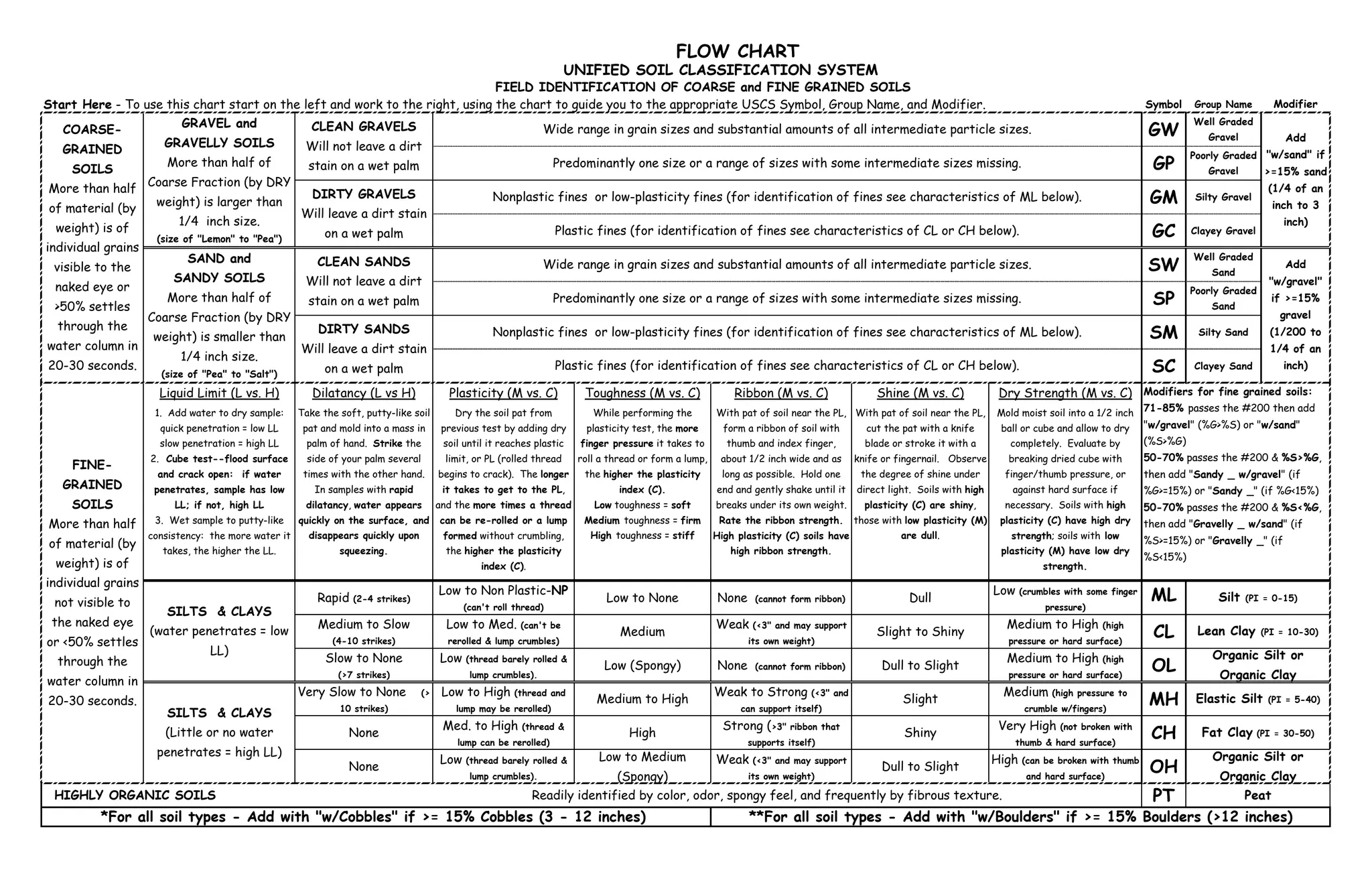
* To use this chart, start on the top and work your way down using the steps to guide you to the appropriate USCS Symbol, Group Name, and Modifier.
Determining the Unified Soil Classification System (USCS) Symbol and Group Name with Modifier using lab data (ASTM D2487)
Step 3: determine if it is Clean (<5%, <#200), Dirty (>12%, <#200), or Dual class (5%-12%, <#200).
*See PDF in SM1 Part B.ppt for Dual Class *
"Dirty" Sand with > 12%
fines
"Clean" Sand with < 5%
fines
"Dirty" Gravel with > 12%
fines
"Clean" Gravel with < 5%
fines
COARSE-GRAINED (<50% by dry weight passes the #200 sieve)
FINE-GRAINED (>50% by dry weight passes the #200 sieve)
SAND-the majority passes the #4 sieve GRAVEL- the majority doesn't pass the #4 sieve
50-70% passes the #200 & %S>%G, then add "Sandy _ w/gravel" (if %G>=15%) or "Sandy _" (if %G<15%)
50-70% passes the #200 & %S<%G, then add "Gravelly _ w/sand" (if %S>=15%) or "Gravelly _" (if %S<15%)
Add "w/gravel" if >= 15% gravel Add "w/sand" if >= 15% sand
Well
Graded
Sand
7
4
60
10
2
30
D
D
D
CC
×
=
10
60
D
D
CU =
60
10
2
30
D
D
D
CC
×
=
10
60
D
D
CU =
CH
OH-Clay
(SC, GC)
MH
OH-Silt
(SM, GM)
ML
OL- Silt
(SM, GM)
CL
OL - Clay
(SC, GC)

USCS Charts for soil classification11233

  • 1.
    Start Here -To use this chart start on the left and work to the right, using the chart to guide you to the appropriate USCS Symbol, Group Name, and Modifier. Symbol Group Name GW Well Graded Gravel GP Poorly Graded Gravel GM Silty Gravel GC Clayey Gravel SW Well Graded Sand SP Poorly Graded Sand SM Silty Sand SC Clayey Sand Liquid Limit (L vs. H) Dilatancy (L vs H) Plasticity (M vs. C) Toughness (M vs. C) Ribbon (M vs. C) Shine (M vs. C) Dry Strength (M vs. C) 1. Add water to dry sample: quick penetration = low LL slow penetration = high LL 2. Cube test--flood surface and crack open: if water penetrates, sample has low LL; if not, high LL 3. Wet sample to putty-like consistency: the more water it takes, the higher the LL. Take the soft, putty-like soil pat and mold into a mass in palm of hand. Strike the side of your palm several times with the other hand. In samples with rapid dilatancy, water appears quickly on the surface, and disappears quickly upon squeezing. Dry the soil pat from previous test by adding dry soil until it reaches plastic limit, or PL (rolled thread begins to crack). The longer it takes to get to the PL, and the more times a thread can be re-rolled or a lump formed without crumbling, the higher the plasticity index (C). While performing the plasticity test, the more finger pressure it takes to roll a thread or form a lump, the higher the plasticity index (C). Low toughness = soft Medium toughness = firm High toughness = stiff With pat of soil near the PL, form a ribbon of soil with thumb and index finger, about 1/2 inch wide and as long as possible. Hold one end and gently shake until it breaks under its own weight. Rate the ribbon strength. High plasticity (C) soils have high ribbon strength. With pat of soil near the PL, cut the pat with a knife blade or stroke it with a knife or fingernail. Observe the degree of shine under direct light. Soils with high plasticity (C) are shiny, those with low plasticity (M) are dull. Mold moist soil into a 1/2 inch ball or cube and allow to dry completely. Evaluate by breaking dried cube with finger/thumb pressure, or against hard surface if necessary. Soils with high plasticity (C) have high dry strength; soils with low plasticity (M) have low dry strength. Rapid (2-4 strikes) Low to Non Plastic-NP (can't roll thread) Low to None None (cannot form ribbon) Dull Low (crumbles with some finger pressure) ML Medium to Slow (4-10 strikes) Low to Med. (can't be rerolled & lump crumbles) Medium Weak (<3" and may support its own weight) Slight to Shiny Medium to High (high pressure or hard surface) CL Slow to None (>7 strikes) Low (thread barely rolled & lump crumbles). Low (Spongy) None (cannot form ribbon) Dull to Slight Medium to High (high pressure or hard surface) OL Very Slow to None (> 10 strikes) Low to High (thread and lump may be rerolled) Medium to High Weak to Strong (<3" and can support itself) Slight Medium (high pressure to crumble w/fingers) MH None Med. to High (thread & lump can be rerolled) High Strong (>3" ribbon that supports itself) Shiny Very High (not broken with thumb & hard surface) CH None Low (thread barely rolled & lump crumbles). Low to Medium (Spongy) Weak (<3" and may support its own weight) Dull to Slight High (can be broken with thumb and hard surface) OH PT **For all soil types - Add with "w/Boulders" if >= 15% Boulders (>12 inches) *For all soil types - Add with "w/Cobbles" if >= 15% Cobbles (3 - 12 inches) SILTS & CLAYS (Little or no water penetrates = high LL) Plastic fines (for identification of fines see characteristics of CL or CH below). Nonplastic fines or low-plasticity fines (for identification of fines see characteristics of ML below). Plastic fines (for identification of fines see characteristics of CL or CH below). SILTS & CLAYS (water penetrates = low LL) Organic Silt or Organic Clay Lean Clay (PI = 10-30) Peat FLOW CHART Elastic Silt (PI = 5-40) UNIFIED SOIL CLASSIFICATION SYSTEM FIELD IDENTIFICATION OF COARSE and FINE GRAINED SOILS FINE- GRAINED SOILS More than half of material (by weight) is of individual grains not visible to the naked eye or <50% settles through the water column in 20-30 seconds. DIRTY SANDS Will leave a dirt stain on a wet palm Add "w/sand" if >=15% sand (1/4 of an inch to 3 inch) Add "w/gravel" if >=15% gravel (1/200 to 1/4 of an inch) Modifier Fat Clay (PI = 30-50) HIGHLY ORGANIC SOILS Readily identified by color, odor, spongy feel, and frequently by fibrous texture. COARSE- GRAINED SOILS More than half of material (by weight) is of individual grains visible to the naked eye or >50% settles through the water column in 20-30 seconds. GRAVEL and GRAVELLY SOILS More than half of Coarse Fraction (by DRY weight) is larger than 1/4 inch size. (size of "Lemon" to "Pea") CLEAN GRAVELS Will not leave a dirt stain on a wet palm SAND and SANDY SOILS More than half of Coarse Fraction (by DRY weight) is smaller than 1/4 inch size. (size of "Pea" to "Salt") Wide range in grain sizes and substantial amounts of all intermediate particle sizes. DIRTY GRAVELS Will leave a dirt stain on a wet palm CLEAN SANDS Will not leave a dirt stain on a wet palm Wide range in grain sizes and substantial amounts of all intermediate particle sizes. Organic Silt or Organic Clay Predominantly one size or a range of sizes with some intermediate sizes missing. Silt (PI = 0-15) Modifiers for fine grained soils: 71-85% passes the #200 then add "w/gravel" (%G>%S) or "w/sand" (%S>%G) 50-70% passes the #200 & %S>%G, then add "Sandy _ w/gravel" (if %G>=15%) or "Sandy _" (if %G<15%) 50-70% passes the #200 & %S<%G, then add "Gravelly _ w/sand" (if %S>=15%) or "Gravelly _" (if %S<15%) Predominantly one size or a range of sizes with some intermediate sizes missing. Nonplastic fines or low-plasticity fines (for identification of fines see characteristics of ML below).
  • 2.
    Step 2: UseAtterberg limits results and plot on plasticity chart. Step 2: Determine if a majority of the coarse fraction is sand or gravel. Step 3: Classify the soil based on the plasticity chart. Inorganic fines CL- Lean Clay-LL<50 & PI > 7 and plots on or above “A” line. ML- Silt-LL<50 & plots on or below the “A” line. CL-ML- Clayey Silt-LL<50 & PI >4< 7 and plots on or above “A” line. CH- Fat Clay- LL>50 & plots above the "A" line. MH- Elastic Silt- LL>50 & plots below the "A" line. Organic Fines - If LL oven dry / LL air dry is < 0.75 Organic Clay plots above the "A line" and can be an OL (LL<50) or an OH (LL>50) Organic Silt plots below the "A line" and can be an OL (LL<50) or an OH (LL>50) Step 4: Add coarse grained modifiers. 70.1-85% passes the #200 then add "w/gravel"(%G>%S) or "w/sand"(%S>%G) Step 5: Add Coarse Grained modifier if > 15% of other component. SM Step 1: Use the gradation of the entire sample to determine if a majority of the sample is Fine Grained or Coarse Grained. SW GM GC GP GW SP Pt - Peat is mostly Organic Matter (OM) with little or no inorganic material. SC Can be either Sapric (<33% OM fibers), Hemic (33-67% OM fibers), or Fibric (> 67 % OM fibers). Step 4b: Use the grain size distribution to obtain the D10, D30, and D60. Calculate the CC and CU. Sand with >12% fines that plot below PI of 4 and below the A-line. Sand with >12% fines that plot above PI of 7 and above the A-line. Sand with <5% fines and a Cu<6 and / or (Cc<1 or Cc >3) Sand with <5% fines and a Cu>=6 and (Cc >= 1 and Cc <=3) *Meets Both* Gravel with > 12% fines that plot below PI of 4 and below the A-line. Gravel with > 12% fines that plot above PI of 7 and above the A-line. Gravel with <5% fines and a Cu<4 and / or (Cc<1 or Cc >3) Gravel with <5% fines and a Cu>=4 and (Cc >= 1 and Cc <=3) *Meets Both* Step 4a: Use Atterberg limits results on the fines (<#200) and classify based on whether the fines are plastic or not using the plasticity chart to the left. Step 4a: Use Atterberg limits results on the fines (<#200) and classify based on whether the fines are plastic or not using the plasticity chart to the left. Step 4b: Use the grain size distribution to obtain the D10, D30, and D60. Calculate the CC and CU. Silty Gravel Clayey Gravel Poorly Graded Gravel Well Graded Gravel Silty Sand Clayey Sand Poorly Graded Sand * To use this chart, start on the top and work your way down using the steps to guide you to the appropriate USCS Symbol, Group Name, and Modifier. Determining the Unified Soil Classification System (USCS) Symbol and Group Name with Modifier using lab data (ASTM D2487) Step 3: determine if it is Clean (<5%, <#200), Dirty (>12%, <#200), or Dual class (5%-12%, <#200). *See PDF in SM1 Part B.ppt for Dual Class * "Dirty" Sand with > 12% fines "Clean" Sand with < 5% fines "Dirty" Gravel with > 12% fines "Clean" Gravel with < 5% fines COARSE-GRAINED (<50% by dry weight passes the #200 sieve) FINE-GRAINED (>50% by dry weight passes the #200 sieve) SAND-the majority passes the #4 sieve GRAVEL- the majority doesn't pass the #4 sieve 50-70% passes the #200 & %S>%G, then add "Sandy _ w/gravel" (if %G>=15%) or "Sandy _" (if %G<15%) 50-70% passes the #200 & %S<%G, then add "Gravelly _ w/sand" (if %S>=15%) or "Gravelly _" (if %S<15%) Add "w/gravel" if >= 15% gravel Add "w/sand" if >= 15% sand Well Graded Sand 7 4 60 10 2 30 D D D CC × = 10 60 D D CU = 60 10 2 30 D D D CC × = 10 60 D D CU = CH OH-Clay (SC, GC) MH OH-Silt (SM, GM) ML OL- Silt (SM, GM) CL OL - Clay (SC, GC)