Organization,
note-taking and
study strategies
Summer 2018
Richard Winters
ASPSA: Learning Specialist
Organization and Technology
● Syncing email on phones
● Plan for organizing work
● Moodle
● Google Applications
○ Drive
○ Docs
○ Calendar
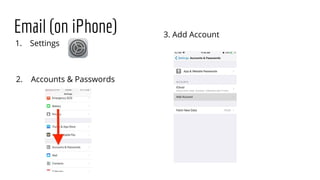
Email (on iPhone)
1. Settings
2. Accounts & Passwords
3. Add Account
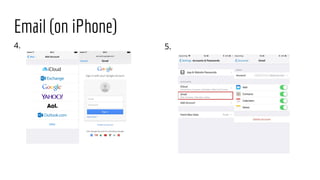
Email (on iPhone)
4. 5.
Android? https://www.youtube.com/watch?v=QTpZTydjuJ8
Moodle (Learning Management System)
● Syllabus
● Calendar of assignments
● Course resources (Readings, Videos, Links)
● Quizzes, exams, assignment submissions
● List of class roster
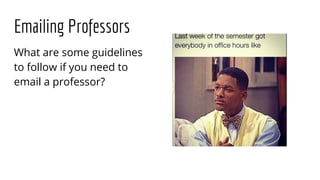
Emailing Professors
What are some guidelines
to follow if you need to
email a professor?
Emailing Professors https://www.insidehighered.com/views/2015/04/16/advice-students-so-they-dont-sound-silly-emails-essay
● Use clear subject line
● Use salutation and signature (“Professor” is always a safe bet)
● Standard punctuation, capitalization, spelling, and grammar
● Do your part in solving what you need to solve
● Be aware of concerns about entitlement
● Add a touch of humanity
how do you currently take notes in class?
why take notes?
● Helps you make sense of what is most important
● Helps with information recall
● Provides a tool for studying before an exam
● Can help you stay engaged in class
● Allows you to put the information in your own words
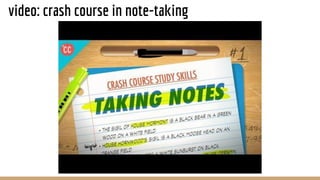
video: crash course in note-taking
note-taking options
what works best for you?
● Taking notes on the computer
● Handwritten notes
● Printing slides prior to class and
writing on the slides
● Outlines
● Bulleted notes
● Recording lectures (with permission)
and re-watching or listening to them
again
● Diagrams/pictures
● Charts and flowcharts
● Mind maps
note-taking tips
● Keep all notes organized by class (one
notebook per class)
● Date your notes and have each class
on a fresh page
● Read before class and take notes on
the reading
● Use abbreviations to help you keep up
with the lecture
● Listen for professor’s prompts (“this
will be on the test,” etc.)
● Stay focused and minimize
distractions (no phones)
what does effective studying look like?
options for studying
On your own:
● Study groups
● Work through practice problems
● Come up with example exam questions
● Re-read/re-write notes
● Chapter review questions
● Go to professor’s office hours
● Take practice exams
● Go through lecture powerpoints
● Flashcards/Quizlet
● Reorganize information (ex. Bullets to timelines,
graphic organizer)
study tips
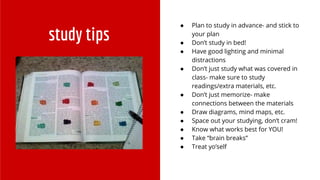
● Plan to study in advance- and stick to
your plan
● Don’t study in bed!
● Have good lighting and minimal
distractions
● Don’t just study what was covered in
class- make sure to study
readings/extra materials, etc.
● Don’t just memorize- make
connections between the materials
● Draw diagrams, mind maps, etc.
● Space out your studying, don’t cram!
● Know what works best for YOU!
● Take “brain breaks”
● Treat yo’self
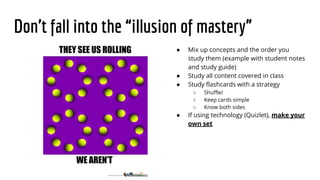
Don’t fall into the “illusion of mastery”
● Mix up concepts and the order you
study them (example with student notes
and study guide)
● Study all content covered in class
● Study flashcards with a strategy
○ Shuffle!
○ Keep cards simple
○ Know both sides
● If using technology (Quizlet), make your
own set
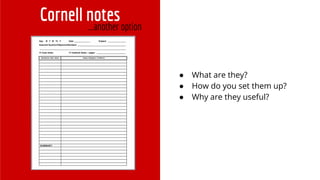
Cornell notes...another option
● What are they?
● How do you set them up?
● Why are they useful?
questions?
test-taking and
paper writing
USC- Summer 2018
what does it take to do well on tests?
test-taking strategies for success
before the exam...
● DO NOT CRAM!
○ Use thoughtful study strategies, including planning using the Cornell 5-day plan!
● Get a good night’s rest before the test
● Eat a good meal before the test, but not too much!
● Get to your test site early to get in the zone
test-taking strategies for success
during the exam...
● Read all instructions (front to back) for the exam before starting
● Skim all questions before beginning to answer them
● Do the questions you know first!
● Use other questions to help you with more difficult questions
● Reread questions that are confusing/long
● Never spend too much time on one question- come back to it
multiple choice exams
● Remember to select the “best” answer
● Read all the questions, instructions, and answers very carefully
● Try to answer the questions without the choices
○ Cover them with your hand or a piece of paper
● Eliminate as many incorrect choices as soon as you can
essay/short-answer exams
● Find directive words in the questions
○ Compare, contrast, critique, identify, suggest, etc.
● Write a brief outline of your answer
● Make sure to support your answers with evidence
● Answer the question fully, but be concise
● Reread, reread, reread!
take-home/open-book exams
● Know EXACTLY what materials you are allowed to use
● Organize your notes prior to the exam
○ Use highlighters, sticky notes, and other tools to help you
● Study and prepare!
● Do not spend too much time looking for information
● Double-check answers
how do I write a strong paper?
pre-writing
● Read assignment carefully
○ Topic? Purpose? Audience?
○ What are the requirements?
■ Page limit, # of sources
○ Ask professor if you have any questions
● Brain Dump
○ Jot down all of your ideas
● Gather sources
○ This can be time consuming
○ Take the time to find the right sources (read more than the abstract)
Outline
○ Read through each source and highlight and annotate them
outlining
● Develop thesis
● Main points
● Supporting ideas
● Take your highlighted/annotated sources and incorporate into outline
● Create a plan for when you will write each section
○ Assignment Calculator
○ Stick with your plan!
the writing process
● You don’t always have to start
with introduction
● Manage your time
● Create attainable writing
goals
○ 1 page tonight
○ 3 pages by Friday
● Include in-text citations now
(if needed) to avoid
plagiarism
● Follow your outline
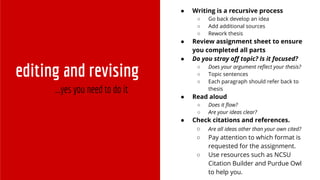
editing and revising
...yes you need to do it
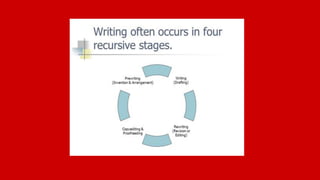
● Writing is a recursive process
○ Go back develop an idea
○ Add additional sources
○ Rework thesis
● Review assignment sheet to ensure
you completed all parts
● Do you stray off topic? Is it focused?
○ Does your argument reflect your thesis?
○ Topic sentences
○ Each paragraph should refer back to
thesis
● Read aloud
○ Does it flow?
○ Are your ideas clear?
● Check citations and references.
○ Are all ideas other than your own cited?
○ Pay attention to which format is
requested for the assignment.
○ Use resources such as NCSU
Citation Builder and Purdue Owl
to help you.
Types of Papers: MLA vs. APA
MLA
“Modern Language Association”
-Mostly in English/Writing specific courses
APA
“American Psychological Association”
-Most everything else, especially research
papers
-May require title page, abstract
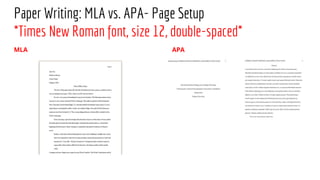
Paper Writing: MLA vs. APA- Page Setup
*Times New Roman font, size 12, double-spaced*
MLA APA
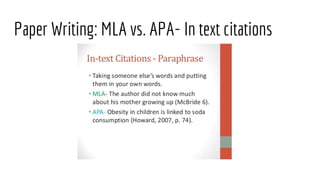
Paper Writing: MLA vs. APA- In text citations
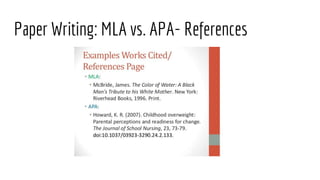
Paper Writing: MLA vs. APA- References
Organization
USC- Summer 2018
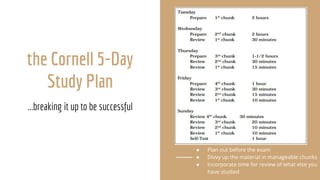
the Cornell 5-Day
Study Plan
...breaking it up to be successful
● Plan out before the exam
● Divvy up the material in manageable chunks
● Incorporate time for review of what else you
have studied
Major takeaways
● Tech- Check email frequently, use Google applications, and learn how to
use Moodle
● Come up with organizational plan for notes and assignments
● Attend office hours, stay after class to communicate with professors. Use
proper email etiquette!
● Introduce yourself to classmates and get their contact info

USC 100: Summer Presentation

  • 1.
    Organization, note-taking and study strategies Summer2018 Richard Winters ASPSA: Learning Specialist
  • 2.
    Organization and Technology ●Syncing email on phones ● Plan for organizing work ● Moodle ● Google Applications ○ Drive ○ Docs ○ Calendar
  • 3.
    Email (on iPhone) 1.Settings 2. Accounts & Passwords 3. Add Account
  • 4.
  • 5.
  • 6.
    Moodle (Learning ManagementSystem) ● Syllabus ● Calendar of assignments ● Course resources (Readings, Videos, Links) ● Quizzes, exams, assignment submissions ● List of class roster
  • 7.
    Emailing Professors What aresome guidelines to follow if you need to email a professor?
  • 8.
    Emailing Professors https://www.insidehighered.com/views/2015/04/16/advice-students-so-they-dont-sound-silly-emails-essay ●Use clear subject line ● Use salutation and signature (“Professor” is always a safe bet) ● Standard punctuation, capitalization, spelling, and grammar ● Do your part in solving what you need to solve ● Be aware of concerns about entitlement ● Add a touch of humanity
  • 9.
    how do youcurrently take notes in class?
  • 10.
    why take notes? ●Helps you make sense of what is most important ● Helps with information recall ● Provides a tool for studying before an exam ● Can help you stay engaged in class ● Allows you to put the information in your own words
  • 11.
    video: crash coursein note-taking
  • 12.
    note-taking options what worksbest for you? ● Taking notes on the computer ● Handwritten notes ● Printing slides prior to class and writing on the slides ● Outlines ● Bulleted notes ● Recording lectures (with permission) and re-watching or listening to them again ● Diagrams/pictures ● Charts and flowcharts ● Mind maps
  • 13.
    note-taking tips ● Keepall notes organized by class (one notebook per class) ● Date your notes and have each class on a fresh page ● Read before class and take notes on the reading ● Use abbreviations to help you keep up with the lecture ● Listen for professor’s prompts (“this will be on the test,” etc.) ● Stay focused and minimize distractions (no phones)
  • 14.
    what does effectivestudying look like?
  • 15.
    options for studying Onyour own: ● Study groups ● Work through practice problems ● Come up with example exam questions ● Re-read/re-write notes ● Chapter review questions ● Go to professor’s office hours ● Take practice exams ● Go through lecture powerpoints ● Flashcards/Quizlet ● Reorganize information (ex. Bullets to timelines, graphic organizer)
  • 16.
    study tips ● Planto study in advance- and stick to your plan ● Don’t study in bed! ● Have good lighting and minimal distractions ● Don’t just study what was covered in class- make sure to study readings/extra materials, etc. ● Don’t just memorize- make connections between the materials ● Draw diagrams, mind maps, etc. ● Space out your studying, don’t cram! ● Know what works best for YOU! ● Take “brain breaks” ● Treat yo’self
  • 17.
    Don’t fall intothe “illusion of mastery” ● Mix up concepts and the order you study them (example with student notes and study guide) ● Study all content covered in class ● Study flashcards with a strategy ○ Shuffle! ○ Keep cards simple ○ Know both sides ● If using technology (Quizlet), make your own set
  • 18.
    Cornell notes...another option ●What are they? ● How do you set them up? ● Why are they useful?
  • 19.
  • 20.
  • 21.
    what does ittake to do well on tests?
  • 22.
    test-taking strategies forsuccess before the exam... ● DO NOT CRAM! ○ Use thoughtful study strategies, including planning using the Cornell 5-day plan! ● Get a good night’s rest before the test ● Eat a good meal before the test, but not too much! ● Get to your test site early to get in the zone
  • 23.
    test-taking strategies forsuccess during the exam... ● Read all instructions (front to back) for the exam before starting ● Skim all questions before beginning to answer them ● Do the questions you know first! ● Use other questions to help you with more difficult questions ● Reread questions that are confusing/long ● Never spend too much time on one question- come back to it
  • 24.
    multiple choice exams ●Remember to select the “best” answer ● Read all the questions, instructions, and answers very carefully ● Try to answer the questions without the choices ○ Cover them with your hand or a piece of paper ● Eliminate as many incorrect choices as soon as you can
  • 25.
    essay/short-answer exams ● Finddirective words in the questions ○ Compare, contrast, critique, identify, suggest, etc. ● Write a brief outline of your answer ● Make sure to support your answers with evidence ● Answer the question fully, but be concise ● Reread, reread, reread!
  • 26.
    take-home/open-book exams ● KnowEXACTLY what materials you are allowed to use ● Organize your notes prior to the exam ○ Use highlighters, sticky notes, and other tools to help you ● Study and prepare! ● Do not spend too much time looking for information ● Double-check answers
  • 27.
    how do Iwrite a strong paper?
  • 29.
    pre-writing ● Read assignmentcarefully ○ Topic? Purpose? Audience? ○ What are the requirements? ■ Page limit, # of sources ○ Ask professor if you have any questions ● Brain Dump ○ Jot down all of your ideas ● Gather sources ○ This can be time consuming ○ Take the time to find the right sources (read more than the abstract) Outline ○ Read through each source and highlight and annotate them
  • 30.
    outlining ● Develop thesis ●Main points ● Supporting ideas ● Take your highlighted/annotated sources and incorporate into outline ● Create a plan for when you will write each section ○ Assignment Calculator ○ Stick with your plan!
  • 31.
    the writing process ●You don’t always have to start with introduction ● Manage your time ● Create attainable writing goals ○ 1 page tonight ○ 3 pages by Friday ● Include in-text citations now (if needed) to avoid plagiarism ● Follow your outline
  • 32.
    editing and revising ...yesyou need to do it ● Writing is a recursive process ○ Go back develop an idea ○ Add additional sources ○ Rework thesis ● Review assignment sheet to ensure you completed all parts ● Do you stray off topic? Is it focused? ○ Does your argument reflect your thesis? ○ Topic sentences ○ Each paragraph should refer back to thesis ● Read aloud ○ Does it flow? ○ Are your ideas clear? ● Check citations and references. ○ Are all ideas other than your own cited? ○ Pay attention to which format is requested for the assignment. ○ Use resources such as NCSU Citation Builder and Purdue Owl to help you.
  • 33.
    Types of Papers:MLA vs. APA MLA “Modern Language Association” -Mostly in English/Writing specific courses APA “American Psychological Association” -Most everything else, especially research papers -May require title page, abstract
  • 34.
    Paper Writing: MLAvs. APA- Page Setup *Times New Roman font, size 12, double-spaced* MLA APA
  • 35.
    Paper Writing: MLAvs. APA- In text citations
  • 36.
    Paper Writing: MLAvs. APA- References
  • 37.
  • 38.
    the Cornell 5-Day StudyPlan ...breaking it up to be successful ● Plan out before the exam ● Divvy up the material in manageable chunks ● Incorporate time for review of what else you have studied
  • 39.
    Major takeaways ● Tech-Check email frequently, use Google applications, and learn how to use Moodle ● Come up with organizational plan for notes and assignments ● Attend office hours, stay after class to communicate with professors. Use proper email etiquette! ● Introduce yourself to classmates and get their contact info