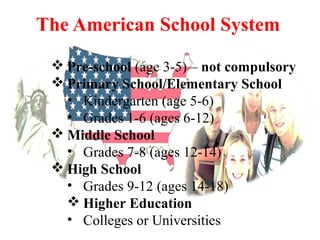
The American School System
 Pre-school (age 3-5) – not compulsory
 Primary School/Elementary School
• Kindergarten (age 5-6)
• Grades 1-6 (ages 6-12)
 Middle School
• Grades 7-8 (ages 12-14)
 High School
• Grades 9-12 (ages 14-18)
 Higher Education
• Colleges or Universities
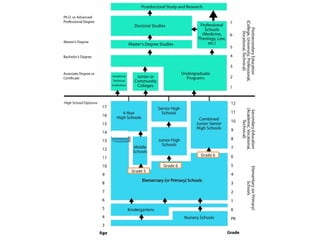
Grade 5
Grade 6
Grade 6
Education System
in America and Vietnam
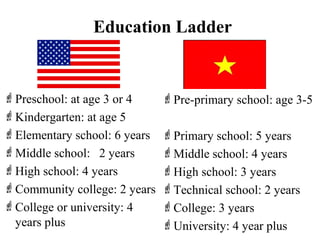
Education Ladder
Preschool: at age 3 or 4
Kindergarten: at age 5
Elementary school: 6 years
Middle school: 2 years
High school: 4 years
Community college: 2 years
College or university: 4
years plus
Pre-primary school: age 3-5
Primary school: 5 years
Middle school: 4 years
High school: 3 years
Technical school: 2 years
College: 3 years
University: 4 year plus
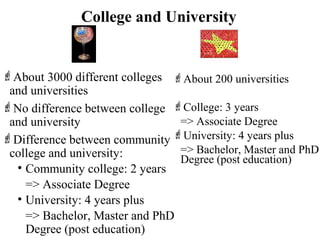
College and University
About 3000 different colleges
and universities
No difference between college
and university
Difference between community
college and university:
• Community college: 2 years
=> Associate Degree
• University: 4 years plus
=> Bachelor, Master and PhD
Degree (post education)
About 200 universities
College: 3 years
=> Associate Degree
University: 4 years plus
=> Bachelor, Master and PhD
Degree (post education)
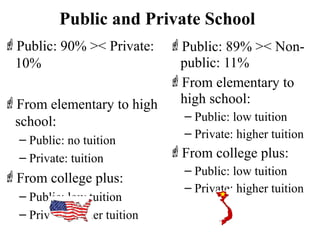
Public and Private School
Public: 90% >< Private:
10%
From elementary to high
school:
– Public: no tuition
– Private: tuition
From college plus:
– Public: low tuition
– Private: higher tuition
Public: 89% >< Non-
public: 11%
From elementary to
high school:
– Public: low tuition
– Private: higher tuition
From college plus:
– Public: low tuition
– Private: higher tuition
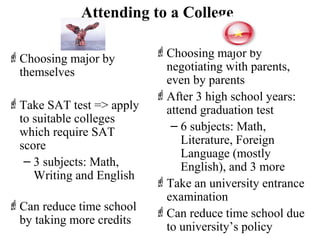
Attending to a College
Choosing major by
themselves
Take SAT test => apply
to suitable colleges
which require SAT
score
– 3 subjects: Math,
Writing and English
Can reduce time school
by taking more credits
Choosing major by
negotiating with parents,
even by parents
After 3 high school years:
attend graduation test
– 6 subjects: Math,
Literature, Foreign
Language (mostly
English), and 3 more
Take an university entrance
examination
Can reduce time school due
to university’s policy
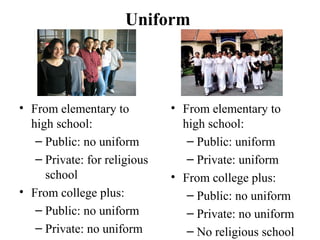
Uniform
• From elementary to
high school:
– Public: no uniform
– Private: for religious
school
• From college plus:
– Public: no uniform
– Private: no uniform
• From elementary to
high school:
– Public: uniform
– Private: uniform
• From college plus:
– Public: no uniform
– Private: no uniform
– No religious school
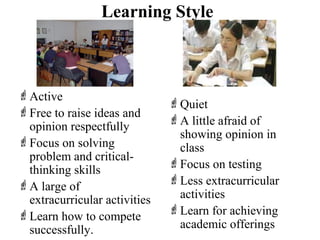
Learning Style
Active
Free to raise ideas and
opinion respectfully
Focus on solving
problem and critical-
thinking skills
A large of
extracurricular activities
Learn how to compete
successfully.
Quiet
A little afraid of
showing opinion in
class
Focus on testing
Less extracurricular
activities
Learn for achieving
academic offerings
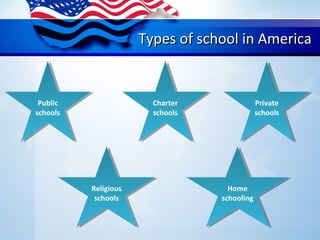
Types of school in AmericaTypes of school in America
Public
schools
Public
schools
Charter
schools
Charter
schools
Religious
schools
Religious
schools
Private
schools
Private
schools
Home
schooling
Home
schooling
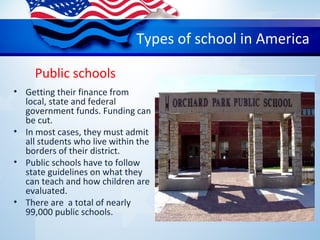
Public schools
• Getting their finance from
local, state and federal
government funds. Funding can
be cut.
• In most cases, they must admit
all students who live within the
borders of their district.
• Public schools have to follow
state guidelines on what they
can teach and how children are
evaluated.
• There are a total of nearly
99,000 public schools.
Types of school in America
Types of school in AmericaTypes of school in America
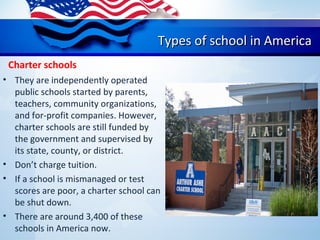
• They are independently operated
public schools started by parents,
teachers, community organizations,
and for-profit companies. However,
charter schools are still funded by
the government and supervised by
its state, county, or district.
• Don’t charge tuition.
• If a school is mismanaged or test
scores are poor, a charter school can
be shut down.
• There are around 3,400 of these
schools in America now.
Charter schools
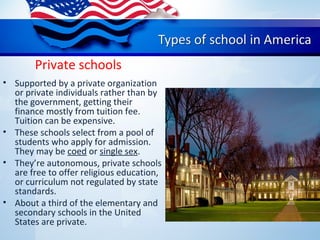
Private schools
• Supported by a private organization
or private individuals rather than by
the government, getting their
finance mostly from tuition fee.
Tuition can be expensive.
• These schools select from a pool of
students who apply for admission.
They may be coed or single sex.
• They’re autonomous, private schools
are free to offer religious education,
or curriculum not regulated by state
standards.
• About a third of the elementary and
secondary schools in the United
States are private.
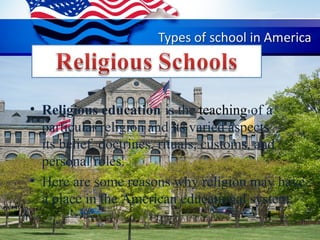
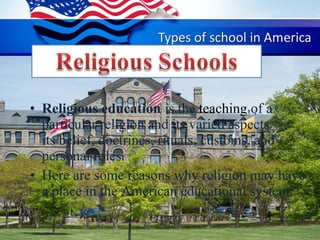
• Religious education is the teaching of a
particular religion and its varied aspects —
its belief, doctrines, rituals, customs, and
personal roles.
• Here are some reasons why religion may have
a place in the American educational system:
The recent study found that religious children are more likely
to believe fictional tales . Believing in fiction and having a
creative mind can be beneficial in brain development.
It improves brain development
• Religious education is the teaching of a 
particular religion and its varied aspects —
its belief, doctrines, rituals, customs, and 
personal roles. 
• Here are some reasons why religion may have 
a place in the American educational system:
The recent study found that religious children are more likely 
to believe fictional tales . Believing in fiction and having a 
creative mind can be beneficial in brain development.
It improves brain development
Religious classes have a significant amount of benefits, 
including that they help kids learn more internally about 
themselves and how they feel about God and religion. 
It helps students learn a bit more
about themselves.
One expert said learning about religion is extremely 
important. Kids need to believe in something greater to fully 
push themselves to excel.
It helps kids develop psychologically.
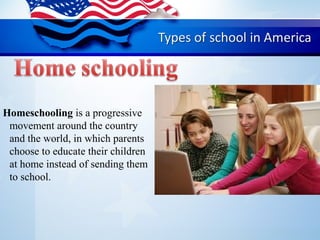
Homeschooling is a progressive 
movement around the country 
and the world, in which parents 
choose to educate their children 
at home instead of sending them 
to school. 
AdvantagesAdvantages
* Educational Freedom
 
* Physical Freedom
      
Home schooling
*Religious Freedom
*Emotional Freedom
   
Disadvantages
Home schooling
* Miss out on the opportunity to interact
with other children.
* Miss out on school experiences.
   
PromProm
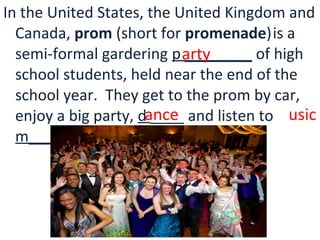
In the United States, the United Kingdom and
Canada, prom (short for promenade)is a
semi-formal gardering p ________ of high
school students, held near the end of the
school year. They get to the prom by car,
enjoy a big party, d ____ and listen to
m____.
arty
ance usic
A boy can give the girl he likes some flowers
and invite her to the prom with him. In the
prom, girls wear beautiful d________with
the flowers on her wrist, boys wear
f_______ clothes, usually black suits with
black ties.
resses
ormal
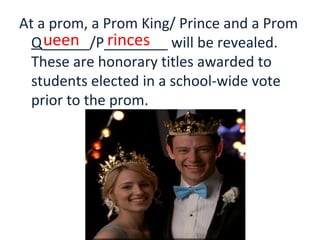
At a prom, a Prom King/ Prince and a Prom
Q______/P________ will be revealed.
These are honorary titles awarded to
students elected in a school-wide vote
prior to the prom.
ueen rinces
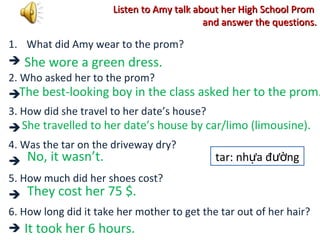
Listen to Amy talk about her High School PromListen to Amy talk about her High School Prom
and answer the questions.and answer the questions.
1. What did Amy wear to the prom?

2. Who asked her to the prom?

3. How did she travel to her date’s house?

4. Was the tar on the driveway dry?

5. How much did her shoes cost?

6. How long did it take her mother to get the tar out of her hair?

She wore a green dress.
The best-looking boy in the class asked her to the prom.
She travelled to her date’s house by car/limo (limousine).
No, it wasn’t.
They cost her 75 $.
It took her 6 hours.
tar: nh a đ ngự ườ
Thank you !

Usa School

  • 2.
    The American SchoolSystem  Pre-school (age 3-5) – not compulsory  Primary School/Elementary School • Kindergarten (age 5-6) • Grades 1-6 (ages 6-12)  Middle School • Grades 7-8 (ages 12-14)  High School • Grades 9-12 (ages 14-18)  Higher Education • Colleges or Universities
  • 3.
  • 4.
  • 5.
    Education Ladder Preschool: atage 3 or 4 Kindergarten: at age 5 Elementary school: 6 years Middle school: 2 years High school: 4 years Community college: 2 years College or university: 4 years plus Pre-primary school: age 3-5 Primary school: 5 years Middle school: 4 years High school: 3 years Technical school: 2 years College: 3 years University: 4 year plus
  • 6.
    College and University About3000 different colleges and universities No difference between college and university Difference between community college and university: • Community college: 2 years => Associate Degree • University: 4 years plus => Bachelor, Master and PhD Degree (post education) About 200 universities College: 3 years => Associate Degree University: 4 years plus => Bachelor, Master and PhD Degree (post education)
  • 7.
    Public and PrivateSchool Public: 90% >< Private: 10% From elementary to high school: – Public: no tuition – Private: tuition From college plus: – Public: low tuition – Private: higher tuition Public: 89% >< Non- public: 11% From elementary to high school: – Public: low tuition – Private: higher tuition From college plus: – Public: low tuition – Private: higher tuition
  • 8.
    Attending to aCollege Choosing major by themselves Take SAT test => apply to suitable colleges which require SAT score – 3 subjects: Math, Writing and English Can reduce time school by taking more credits Choosing major by negotiating with parents, even by parents After 3 high school years: attend graduation test – 6 subjects: Math, Literature, Foreign Language (mostly English), and 3 more Take an university entrance examination Can reduce time school due to university’s policy
  • 9.
    Uniform • From elementaryto high school: – Public: no uniform – Private: for religious school • From college plus: – Public: no uniform – Private: no uniform • From elementary to high school: – Public: uniform – Private: uniform • From college plus: – Public: no uniform – Private: no uniform – No religious school
  • 10.
    Learning Style Active Free toraise ideas and opinion respectfully Focus on solving problem and critical- thinking skills A large of extracurricular activities Learn how to compete successfully. Quiet A little afraid of showing opinion in class Focus on testing Less extracurricular activities Learn for achieving academic offerings
  • 11.
    Types of schoolin AmericaTypes of school in America Public schools Public schools Charter schools Charter schools Religious schools Religious schools Private schools Private schools Home schooling Home schooling
  • 12.
    Public schools • Gettingtheir finance from local, state and federal government funds. Funding can be cut. • In most cases, they must admit all students who live within the borders of their district. • Public schools have to follow state guidelines on what they can teach and how children are evaluated. • There are a total of nearly 99,000 public schools. Types of school in America
  • 13.
    Types of schoolin AmericaTypes of school in America • They are independently operated public schools started by parents, teachers, community organizations, and for-profit companies. However, charter schools are still funded by the government and supervised by its state, county, or district. • Don’t charge tuition. • If a school is mismanaged or test scores are poor, a charter school can be shut down. • There are around 3,400 of these schools in America now. Charter schools
  • 14.
    Private schools • Supportedby a private organization or private individuals rather than by the government, getting their finance mostly from tuition fee. Tuition can be expensive. • These schools select from a pool of students who apply for admission. They may be coed or single sex. • They’re autonomous, private schools are free to offer religious education, or curriculum not regulated by state standards. • About a third of the elementary and secondary schools in the United States are private.
  • 15.
    • Religious educationis the teaching of a particular religion and its varied aspects — its belief, doctrines, rituals, customs, and personal roles. • Here are some reasons why religion may have a place in the American educational system:
  • 16.
    The recent studyfound that religious children are more likely to believe fictional tales . Believing in fiction and having a creative mind can be beneficial in brain development. It improves brain development
  • 17.
  • 18.
  • 19.
  • 20.
  • 21.
  • 22.
    AdvantagesAdvantages * Educational Freedom   *Physical Freedom        Home schooling *Religious Freedom *Emotional Freedom    
  • 23.
    Disadvantages Home schooling * Missout on the opportunity to interact with other children. * Miss out on school experiences.    
  • 24.
  • 25.
    In the UnitedStates, the United Kingdom and Canada, prom (short for promenade)is a semi-formal gardering p ________ of high school students, held near the end of the school year. They get to the prom by car, enjoy a big party, d ____ and listen to m____. arty ance usic
  • 26.
    A boy cangive the girl he likes some flowers and invite her to the prom with him. In the prom, girls wear beautiful d________with the flowers on her wrist, boys wear f_______ clothes, usually black suits with black ties. resses ormal
  • 27.
    At a prom,a Prom King/ Prince and a Prom Q______/P________ will be revealed. These are honorary titles awarded to students elected in a school-wide vote prior to the prom. ueen rinces
  • 28.
    Listen to Amytalk about her High School PromListen to Amy talk about her High School Prom and answer the questions.and answer the questions. 1. What did Amy wear to the prom?  2. Who asked her to the prom?  3. How did she travel to her date’s house?  4. Was the tar on the driveway dry?  5. How much did her shoes cost?  6. How long did it take her mother to get the tar out of her hair?  She wore a green dress. The best-looking boy in the class asked her to the prom. She travelled to her date’s house by car/limo (limousine). No, it wasn’t. They cost her 75 $. It took her 6 hours. tar: nh a đ ngự ườ
  • 29.