 United States of America
 United Mexican States
 United Kingdom
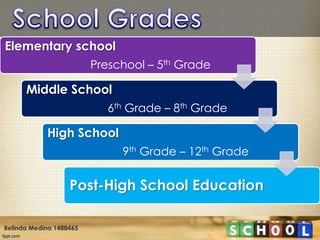
Elementary school
             Preschool – 5th Grade

   Middle School
                6th Grade – 8th Grade

      High School
                    9th Grade – 12th Grade


         Post-High School Education
Elementary school
       Preschool                        4–5
     Kindergarten                       5–6
       1st Grade                        6–7
      2nd Grade                         7–8
      3rd Grade                         8–9
      4th Grade                        9–10
      5th Grade                        10–11
                    Middle school
       6th Grade                       11–12
       7th Grade                       12–13
       8th Grade                       13–14
                    High school
 9th Grade (Freshman)                  14–15
10th Grade (Sophomore)                 15–16
   11th Grade (Junior)                 16–17
   12th Grade (Senior)                 17–18
• American children start school at the age of
  five years. It is required of all American
  children enrolled in the American education
  system.
                            Preschool – 5th Grade
• Middle School (a.k.a Secondary school) most
  commonly consists of a total of seven years, referred to
  as sixth through ninth grades. At this time, students are
  given more independence.
• The ninth through twelfth grades are most commonly
  referred to as high school. Upon completion of twelfth
  grade, American students are awarded a certificate
  called the high school diploma.
After achieving high school diploma, students will join
colleges or universities to pursue their undergraduate course
           of study. They offer two types of degrees:


Associate Degree                Bachelors Degree

                                 This is a four-year program at the
This is a two-year program      undergraduate level. This is the first
 offered. The program is       degree with which most students plan
      mostly offered by               their career or profession.
 Community, Vocational         First year -> Freshman Year , Second ->
                                Sophomore Year, Third -> Junior Year
  and Junior Colleges.                 and Fourth ->Senior Year.
• These degrees are called the „Master of Arts (M.A),
  Master of Sciences (M.S), and Doctor of Philosophy
  (PhD). Duration of these programs range from one
  to five years, depending upon the course and level
  of study.
• Most of the Master‟s level programs are of two years
  and Doctoral level are of four years duration.
• Admission into Doctoral level programs is possible
  normally after completion of Master‟s. However, US
  universities are flexible in admitting even those with
  a Bachelor‟s degree.
• Typically, the duration of Doctoral level programs is
  between 3 and 6 years, depending on the field of
  research and university.
• Education in the US universities is on a
  semester system, the main one being
  the Fall semester, which starts in
  August/September.
A              B              C              D          F
+          –    +         –    +         –    +         –

100   96   92   89   86   82   79   76   72   69   66   62   Belo
 97   93   90   87   83   80   77   73   70   67   63   60   w 60
• The mean annual Total Cost (including all costs
  associated with a full-time post-secondary
  schooling, such as tuition and fees, books and
  supplies, room and board), as reported by
  collegeboard.com for 2010:
• Public University (4 years): $27,967 (per year)
• Private University (4 years): $40,476 (per year)

Total, four year schooling:
• Public University: $81,356
• Private University: $161,904
Harvard University
• Cambridge, MA
• Harvard University is a private institution in Cambridge, Mass., just
  outside of Boston. This Ivy League school is the oldest higher
  education institution in the country and has the largest endowment
  of any school in the world.

Princeton University
• Princeton, NJ
• Princeton was the first university to offer a “no loan” policy to
  financially needy students, giving grants instead of loans to
  accepted students who need help paying tuition.


Yale University
• New Haven, CT
•Yale University Offers a small college life with the resources of a major
 research institution. Yale students are divided into 12 residential colleges
 that foster a supportive environment for living, learning, and socializing.
• Homeschooling in the United States constitutes
  the education for about 2.9% of U.S.
• United States Supreme Court precedent appears to
  favor educational choice, so long as states may set
  standards for educational accomplishment.
• A survey in 2007 came to the result that the main
  motivations selected by parents in the United States
  who were homeschooling their children were:
                                                    Percentage
                   Motivation
                                                     of parents
      A concern about the school environment            85%
        A desire to provide religious or moral
                                                        72%
                      instruction

          A dissatisfaction with academic
                                                        68%
            instruction at other schools

              Child has special needs                   21%
    Child has a physical or mental health problem       16%
                   Other reasons                        20%
• Most children are educated
  in schools in the state sector, only a
  small portion of studies in special
  schools, primarily for academic skills.
• Today, education is
  compulsory from age five to
  sixteen years of age.

• In the UK there are
  four parallel education
  systems.
  Based in England, Wales and
  Northern Ireland we can
  conclude the following.
• Different stages within the school
  education
  Age 2-5 pre-school
  Age 5-11 primary education
  Age 11-16/18 Secondary education

• In some cases there is an intermediate
  stage (middle school)
  between primary and secondary.

• In every school is required to respect
  the national curriculum.
• By law, it also includes religion classes,
  and for high school students, sex
  education.
  However, parents have the right to
  withdraw their children from these
  classes.
• After completing compulsory
  education can continue their
  education.

• Those who choose the
  academic path will yield
  a number of advanced tests at
  eighteen, which are
  the traditional requirements to
  access university education.
• The second way is
  the vocation. This
  option includes subjects more
  directly oriented
  toward immediate job
  prospects. However, if
  given the highest level of the
  tests, also allow them
  to apply for admission to
  college.
• England has some of
  the best international universities, the
  University of Cambridge,
  Oxford University,
  Imperial College London and University
  College London are rankedamong the
  ten best in the world.
• According to the TIMSS (Trends
  in International Mathematics and
  Science), students in England are
  the seventh best in
  math and science sixth
• In the UK, according to
  the Education Reform Act of
  1988, religious education is part of
  the core curriculum, although not
  developed specifically. This is
  non-denominational
  education (with a multi-
  religious but emphasizes Christiani
  ty), and differs according to the
  locality in which the school is.
• The home education is a
  phenomenon that has always
  existed in the past being the
  only form of intellectual
  instruction.
  A supporter of education at
  home is the United Kingdom.
• In 1995 it was estimated that
  15,000 families used in the
  home education in Britain
  constituted a 50 percent
  increase over the previous
  year.
Roberto Doñez Garza 1511605
In Mexico, basic education is normally divided in three steps: primary
school (primaria), comprising ages 6-12; junior high school (secundaria),
comprising ages 12-15; and high school (preparatoria), comprising ages
15-18. (because in the major parts of mexico the high school is until 18
years)

Primary School
The terms "Primary School" or "Elementary School" usually corresponds
to primaria, comprising grades 1-6, when the student's age is 6 to 12
years old. It starts the basic compulsory education system.
Depending on the school, a bilingual education may be offered from
the beginning, where half the day instruction is in Spanish, and the rest is
in a second language, for example, English or French.


Roberto Doñez 1511605
• Junior High School
   – The terms "Junior High School" or "Middle School" usually correspond
     to secundaria, since when the students age are 12 to 15 years old. It is part
     of the basic compulsory education system, it follows primary school, and
     comes before proper "high school" (preparatoria).
   – At this level, more specialized subjects may be taught such as Physics and
     Chemistry, and World History.


• High School
   – The term "High School" (United States) or gymnasium (German, Dutch
     systems) usually corresponds to preparatoria or bachillerato, comprising
     grades 10-12, when the student's age is 15 to 18 years old.
     Preparatoria traditionally consists of three years of education, divided into
     six semesters, with the first semesters having a common curriculum, and the
     latter ones allowing some degree of specialization, either in physical
     sciences (electricity, chemistry, biology, etc.) or social sciences
     (commerce, philosophy, law, etc.).
Roberto Doñez 1511605
• Higher education
    – Higher education usually follows the US education
      model with an at least 4-year Bachelor's
      degreeundergraduate level (Licenciatura), and two
      degrees at the postgraduate level, a 2-year Master's
      degree (Maestría), and a 3-year Doctoral
      degree (Doctorado). This structure of education very
      closely conforms to the Bologna Process started
      in Europe in 1999, allowing Mexican students to study
      abroad and pursue a Master's degree
      after Licenciatura, or a Doctoral degree after Maestría.


Roberto Doñez 1511605
• National Autonomous University of Mexico

                                         The main campus in Mexico City.


                        The Central Library.


Roberto Doñez 1511605
The Rectorate (left) and the CETEC
                                    towers at the Monterrey Campus.


 The Old Library Building,
 current Rectorate, was designed
 by Enrique de la Mora, displays abas
 relief by Jorge González Camarena and
 holds one of the largest collections
 of Don Quixote incunabula, an original
 edition of L'Encyclopédie and other
 bibliographical treasures.

Roberto Doñez 1511605
The rectorate tower at the main campus.


Roberto Doñez 1511605
Educational systems

Educational systems

  • 1.
     United Statesof America  United Mexican States  United Kingdom
  • 3.
    Elementary school Preschool – 5th Grade Middle School 6th Grade – 8th Grade High School 9th Grade – 12th Grade Post-High School Education
  • 4.
    Elementary school Preschool 4–5 Kindergarten 5–6 1st Grade 6–7 2nd Grade 7–8 3rd Grade 8–9 4th Grade 9–10 5th Grade 10–11 Middle school 6th Grade 11–12 7th Grade 12–13 8th Grade 13–14 High school 9th Grade (Freshman) 14–15 10th Grade (Sophomore) 15–16 11th Grade (Junior) 16–17 12th Grade (Senior) 17–18
  • 5.
    • American childrenstart school at the age of five years. It is required of all American children enrolled in the American education system. Preschool – 5th Grade
  • 6.
    • Middle School(a.k.a Secondary school) most commonly consists of a total of seven years, referred to as sixth through ninth grades. At this time, students are given more independence. • The ninth through twelfth grades are most commonly referred to as high school. Upon completion of twelfth grade, American students are awarded a certificate called the high school diploma.
  • 7.
    After achieving highschool diploma, students will join colleges or universities to pursue their undergraduate course of study. They offer two types of degrees: Associate Degree Bachelors Degree This is a four-year program at the This is a two-year program undergraduate level. This is the first offered. The program is degree with which most students plan mostly offered by their career or profession. Community, Vocational First year -> Freshman Year , Second -> Sophomore Year, Third -> Junior Year and Junior Colleges. and Fourth ->Senior Year.
  • 8.
    • These degreesare called the „Master of Arts (M.A), Master of Sciences (M.S), and Doctor of Philosophy (PhD). Duration of these programs range from one to five years, depending upon the course and level of study. • Most of the Master‟s level programs are of two years and Doctoral level are of four years duration.
  • 9.
    • Admission intoDoctoral level programs is possible normally after completion of Master‟s. However, US universities are flexible in admitting even those with a Bachelor‟s degree. • Typically, the duration of Doctoral level programs is between 3 and 6 years, depending on the field of research and university.
  • 10.
    • Education inthe US universities is on a semester system, the main one being the Fall semester, which starts in August/September.
  • 11.
    A B C D F + – + – + – + – 100 96 92 89 86 82 79 76 72 69 66 62 Belo 97 93 90 87 83 80 77 73 70 67 63 60 w 60
  • 12.
    • The meanannual Total Cost (including all costs associated with a full-time post-secondary schooling, such as tuition and fees, books and supplies, room and board), as reported by collegeboard.com for 2010: • Public University (4 years): $27,967 (per year) • Private University (4 years): $40,476 (per year) Total, four year schooling: • Public University: $81,356 • Private University: $161,904
  • 13.
    Harvard University • Cambridge,MA • Harvard University is a private institution in Cambridge, Mass., just outside of Boston. This Ivy League school is the oldest higher education institution in the country and has the largest endowment of any school in the world. Princeton University • Princeton, NJ • Princeton was the first university to offer a “no loan” policy to financially needy students, giving grants instead of loans to accepted students who need help paying tuition. Yale University • New Haven, CT •Yale University Offers a small college life with the resources of a major research institution. Yale students are divided into 12 residential colleges that foster a supportive environment for living, learning, and socializing.
  • 14.
    • Homeschooling inthe United States constitutes the education for about 2.9% of U.S. • United States Supreme Court precedent appears to favor educational choice, so long as states may set standards for educational accomplishment.
  • 15.
    • A surveyin 2007 came to the result that the main motivations selected by parents in the United States who were homeschooling their children were: Percentage Motivation of parents A concern about the school environment 85% A desire to provide religious or moral 72% instruction A dissatisfaction with academic 68% instruction at other schools Child has special needs 21% Child has a physical or mental health problem 16% Other reasons 20%
  • 17.
    • Most childrenare educated in schools in the state sector, only a small portion of studies in special schools, primarily for academic skills.
  • 18.
    • Today, educationis compulsory from age five to sixteen years of age. • In the UK there are four parallel education systems. Based in England, Wales and Northern Ireland we can conclude the following.
  • 19.
    • Different stageswithin the school education Age 2-5 pre-school Age 5-11 primary education Age 11-16/18 Secondary education • In some cases there is an intermediate stage (middle school) between primary and secondary. • In every school is required to respect the national curriculum.
  • 20.
    • By law,it also includes religion classes, and for high school students, sex education. However, parents have the right to withdraw their children from these classes.
  • 21.
    • After completingcompulsory education can continue their education. • Those who choose the academic path will yield a number of advanced tests at eighteen, which are the traditional requirements to access university education.
  • 22.
    • The secondway is the vocation. This option includes subjects more directly oriented toward immediate job prospects. However, if given the highest level of the tests, also allow them to apply for admission to college.
  • 23.
    • England hassome of the best international universities, the University of Cambridge, Oxford University, Imperial College London and University College London are rankedamong the ten best in the world. • According to the TIMSS (Trends in International Mathematics and Science), students in England are the seventh best in math and science sixth
  • 24.
    • In theUK, according to the Education Reform Act of 1988, religious education is part of the core curriculum, although not developed specifically. This is non-denominational education (with a multi- religious but emphasizes Christiani ty), and differs according to the locality in which the school is.
  • 25.
    • The homeeducation is a phenomenon that has always existed in the past being the only form of intellectual instruction. A supporter of education at home is the United Kingdom.
  • 26.
    • In 1995it was estimated that 15,000 families used in the home education in Britain constituted a 50 percent increase over the previous year.
  • 27.
  • 28.
    In Mexico, basiceducation is normally divided in three steps: primary school (primaria), comprising ages 6-12; junior high school (secundaria), comprising ages 12-15; and high school (preparatoria), comprising ages 15-18. (because in the major parts of mexico the high school is until 18 years) Primary School The terms "Primary School" or "Elementary School" usually corresponds to primaria, comprising grades 1-6, when the student's age is 6 to 12 years old. It starts the basic compulsory education system. Depending on the school, a bilingual education may be offered from the beginning, where half the day instruction is in Spanish, and the rest is in a second language, for example, English or French. Roberto Doñez 1511605
  • 29.
    • Junior HighSchool – The terms "Junior High School" or "Middle School" usually correspond to secundaria, since when the students age are 12 to 15 years old. It is part of the basic compulsory education system, it follows primary school, and comes before proper "high school" (preparatoria). – At this level, more specialized subjects may be taught such as Physics and Chemistry, and World History. • High School – The term "High School" (United States) or gymnasium (German, Dutch systems) usually corresponds to preparatoria or bachillerato, comprising grades 10-12, when the student's age is 15 to 18 years old. Preparatoria traditionally consists of three years of education, divided into six semesters, with the first semesters having a common curriculum, and the latter ones allowing some degree of specialization, either in physical sciences (electricity, chemistry, biology, etc.) or social sciences (commerce, philosophy, law, etc.). Roberto Doñez 1511605
  • 30.
    • Higher education – Higher education usually follows the US education model with an at least 4-year Bachelor's degreeundergraduate level (Licenciatura), and two degrees at the postgraduate level, a 2-year Master's degree (Maestría), and a 3-year Doctoral degree (Doctorado). This structure of education very closely conforms to the Bologna Process started in Europe in 1999, allowing Mexican students to study abroad and pursue a Master's degree after Licenciatura, or a Doctoral degree after Maestría. Roberto Doñez 1511605
  • 31.
    • National AutonomousUniversity of Mexico The main campus in Mexico City. The Central Library. Roberto Doñez 1511605
  • 32.
    The Rectorate (left)and the CETEC towers at the Monterrey Campus. The Old Library Building, current Rectorate, was designed by Enrique de la Mora, displays abas relief by Jorge González Camarena and holds one of the largest collections of Don Quixote incunabula, an original edition of L'Encyclopédie and other bibliographical treasures. Roberto Doñez 1511605
  • 33.
    The rectorate towerat the main campus. Roberto Doñez 1511605