Caribbean Islands Blair, Carroll, Evon, and Kelsey
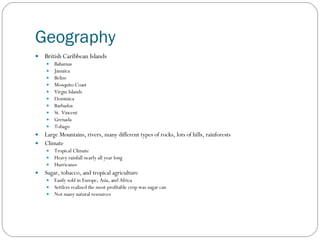
Geography British Caribbean Islands Bahamas Jamaica Belize Mosquito Coast Virgin Islands Dominica Barbados St. Vincent Grenada Tobago Large Mountains, rivers, many different types of rocks, lots of hills, rainforests Climate Tropical Climate Heavy rainfall nearly all year long Hurricanes Sugar, tobacco, and tropical agriculture Easily sold in Europe, Asia, and Africa Settlers realized the most profitable crop was sugar can Not many natural resources
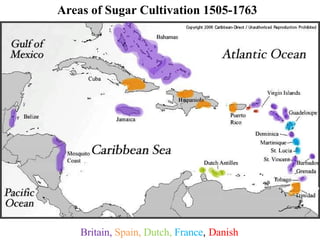
Areas of Sugar Cultivation 1505-1763 Britain,  Spain,  Dutch,  France ,  Danish
Founding First, the British colonists were looking gold and land to grow tobacco Competing with other Empires for island territory: Spain, Dutch, and France England struggle to colonize between 1529-1620 First developed colonies – all large sugar producers (Seventeenth Century ) Windward Islands Constantly competing with France for the islands Barbados Obtained by England in 1625 Leeward Islands United islands under British rule during 1671 when the Leeward Caribee Island Government was established Bahamas Britain claimed the islands in 1670 Jamaica  In 1625 England seized Jamaica
Political Structure THE BAHAMAS 1700 ruled by pirates, Edward Teach (Blackbeard) took over Fort Nassau, terrorizing the British Royal Navy 1718: Woodes Rogers conquers the area and it is recognized as a colony 1728: representative assembly established JAMAICA May 1655: English take control from the Spanish under Oliver Cromwell 1661: Stuart Monarchy puts a civil governor into effect 1662: the king allows the colonists to have the rights of English citizens (able to make their own laws) proclamation given to them by their second governor, Lord Windsor Windsor helps to start a new governing system that ends up lasting for two centuries led by a crown-appointed governor who is advised by a nominated legislative body The governor and an the elected House of Assembly was the legislature, unfortunately the House of Assembly wasn’t really representative of its people VIRGIN ISLAND 1773: a civil government is established with constitutional courts, a House of Assembly consisting of twelve elected members, and a Legislative Council that had a mixture of appointed and elected members meet for the first time in 1774 BARBADOS 1639: House of Assembly established (representative legislature)
Economy Slavery Atlantic Slave Trade Sugar Largest sugar producer in the West Indies was Jamaica Trade Exported  Sugar and coffee to Europe Molasses to British Colonies Slaves to British Colonies Imported Cloth, glass, and weapons from Europe Slaves and gold from Africa Triangular Trade First starts at Britain with manufactured goods Then Africa, where guns and cloth from Britain is traded for slaves Slave are brought to the colonies and sell them fro raw goods (sugar) Bring raw goods back to Europe Sugar Revolution  Use to be small farms that produced cash crops such as tobacco and cotton Caribbean tobacco could not compete with mid-Atlantic tobacco They changed and became large sugar plantations
Religion LEEWARDS (Montserrat, Antigua, Barbuda, St. Christopher, St. Kitts, Nevis, Anguilla, Virgin Islands) Remained Roman Catholic, although English were Protestants VIRGIN ISLANDS Quaker colony came about in the early 1700s, who tried to make their own government GRENADA the citizens kept their Roman Catholic religion from earlier French influence ST. VINCENT citizens learned the language and took in the Protestant religion from the English Natives  Native Indian religions were big factors on the islands because of the Indian natives Native African religions were big factors on the islands because of the African slaves
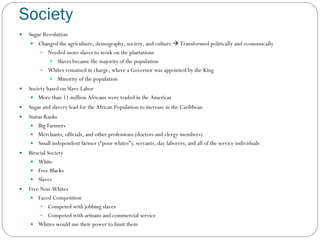
Society Sugar Revolution  Changed the agriculture, demography, society, and culture    Transformed politically and economically Needed more slaves to work on the plantations  Slaves became the majority of the population Whites remained in charge, where a Governor was appointed by the King Minority of the population Society based on Slave Labor More than 11 million Africans were traded in the Americas Sugar and slavery lead for the African Population to increase in the Caribbean Status Ranks Big Farmers Merchants, officials, and other professions (doctors and clergy members) Small independent farmer (“poor whites”), servants, day laborers, and all of the service individuals Biracial Society White Free Blacks Slaves Free Non-Whites Faced Competition Competed with jobbing slaves Competed with artisans and commercial service Whites would use their power to limit them
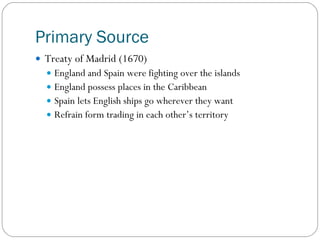
Primary Source Treaty of Madrid (1670) England and Spain were fighting over the islands England possess places in the Caribbean Spain lets English ships go wherever they want Refrain form trading in each other’s territory
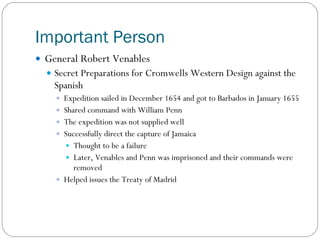
Important Person General Robert Venables Secret Preparations for Cromwells Western Design against the Spanish Expedition sailed in December 1654 and got to Barbados in January 1655 Shared command with William Penn The expedition was not supplied well Successfully direct the capture of Jamaica Thought to be a failure Later, Venables and Penn was imprisoned and their commands were removed Helped issues the Treaty of Madrid
Works Cited “ History of the West Indies.”  History World .  Bamber Gascoigne. Diditon. 2 October 2008. < http://www.historyworld.net/wrldhis/PlainTextHistories.asp?groupid=235&HistoryID=aa23 >. “ Nation Master – Encyclopedia: Treaty of Madrid (1670).”   NationMaster . 2 October 2008.   <  http://www.nationmaster.com/encyclopedia/Treaty-of-Madrid-(1670) >. “ The Caribbean: 1600s, 1700s, 1800s.”   Made in Atlantis . 2006. Atlantis International.  2 October 2008.  <  http://madeinatlantis.com/caribbean_travel/caribbean.htm >. “ Caribbean Islands - History.”  Tropical Rainforest Conservation- mongabay.com . Rhett A. Butler. USPTO.  2 October 2008.  <  http://www.mongabay.com/reference/country_studies/caribbeanislands/HISTORY.html >. “ Barbados.”   Country Studies.  Federal Research Division of the Library of Congress. 2 October 2008.  < http://www.country-studies.com/caribbean - islands/barbados.html >. “ British Virgin Islands, Anguilla, and Montserrat.”   Country Studies.  Federal Research Division of the Library of Congress. 2 October 2008.   < http://www.country studies.com/caribbean-islands/british-virgin-islands,-anguilla-and-montserrat.html>. “ History of the Bahamas.”   BahamasGateway.com.  2000.  BahamasGateway.com.  2  October 2008.  < http://www.bahamasgateway.com/bahamas_History.htm >.  “ History of the Bahamas.”  The Islands of the Bahamas.   2008.  Geographia.  2 October 2008. < http://www.geographyia.com/bahamas/bahistory.htm >. “ Jamaica – History.”   Country Studies.  Federal Research Division of the Library of Congress.  2 October 2008.  <http://www.country- studies.com/caribbean-islands/jamaica        history.html>. “ Political Traditions.”   Country Studies.   Federal Research Division of the Library of Congress.  2 October 2008.  <http://www.country- studies.com/caribbean-islands/political traditions.html>.    “ The European Settlements.”  Country Studies.  Federal Research Division of the Library of Congress.  2 October 2008.  <http://country- studies.com/caribbean-islands/the european-settlements.html>. “ The Leeward Islands.”   Country Studies.  Federal Research Division of the Library of Congress.  2 October 2008.  < http://www.country- studies.com/caribbean-islands/the-leeward   islands.html>. “ The Windward Islands and Barbados.”   Country Studies.  Federal Research Division of the Library of Congress.  2 October 2008.  < http://www.country- studies.com/caribbean islands/the-windward-islands-and-barbados.html>. David Plane. “Biography of Robert Venables.”  British Civil Wars and Commonwealth . 25 June 2008. Creative Commons License. 6 October 2008.  < http://www.british-civil-wars.co.uk/biog/venables.htm >  Lapsansly-Werner, Emma, Peter Levy, Randy Roberts, Alan Taylor.  United States History . Boston, MA: Pearson Prentice Hall, 2008.  Wilkinson, Jerry.  “History of the Bahamas.”   Keys Historeum.   Jerry Wilkinson.  Keys History.  2  October  2008.  < http://www.keyshistory.org/bahamas.html >. The Nystrom Atlas of United States History . Chicago, Illinois: Nystrom Herff Jones Education Division, 2000.   

Us.2.Caribbean

  • 1.
    Caribbean Islands Blair,Carroll, Evon, and Kelsey
  • 2.
    Geography British CaribbeanIslands Bahamas Jamaica Belize Mosquito Coast Virgin Islands Dominica Barbados St. Vincent Grenada Tobago Large Mountains, rivers, many different types of rocks, lots of hills, rainforests Climate Tropical Climate Heavy rainfall nearly all year long Hurricanes Sugar, tobacco, and tropical agriculture Easily sold in Europe, Asia, and Africa Settlers realized the most profitable crop was sugar can Not many natural resources
  • 3.
    Areas of SugarCultivation 1505-1763 Britain, Spain, Dutch, France , Danish
  • 4.
    Founding First, theBritish colonists were looking gold and land to grow tobacco Competing with other Empires for island territory: Spain, Dutch, and France England struggle to colonize between 1529-1620 First developed colonies – all large sugar producers (Seventeenth Century ) Windward Islands Constantly competing with France for the islands Barbados Obtained by England in 1625 Leeward Islands United islands under British rule during 1671 when the Leeward Caribee Island Government was established Bahamas Britain claimed the islands in 1670 Jamaica In 1625 England seized Jamaica
  • 5.
    Political Structure THEBAHAMAS 1700 ruled by pirates, Edward Teach (Blackbeard) took over Fort Nassau, terrorizing the British Royal Navy 1718: Woodes Rogers conquers the area and it is recognized as a colony 1728: representative assembly established JAMAICA May 1655: English take control from the Spanish under Oliver Cromwell 1661: Stuart Monarchy puts a civil governor into effect 1662: the king allows the colonists to have the rights of English citizens (able to make their own laws) proclamation given to them by their second governor, Lord Windsor Windsor helps to start a new governing system that ends up lasting for two centuries led by a crown-appointed governor who is advised by a nominated legislative body The governor and an the elected House of Assembly was the legislature, unfortunately the House of Assembly wasn’t really representative of its people VIRGIN ISLAND 1773: a civil government is established with constitutional courts, a House of Assembly consisting of twelve elected members, and a Legislative Council that had a mixture of appointed and elected members meet for the first time in 1774 BARBADOS 1639: House of Assembly established (representative legislature)
  • 6.
    Economy Slavery AtlanticSlave Trade Sugar Largest sugar producer in the West Indies was Jamaica Trade Exported Sugar and coffee to Europe Molasses to British Colonies Slaves to British Colonies Imported Cloth, glass, and weapons from Europe Slaves and gold from Africa Triangular Trade First starts at Britain with manufactured goods Then Africa, where guns and cloth from Britain is traded for slaves Slave are brought to the colonies and sell them fro raw goods (sugar) Bring raw goods back to Europe Sugar Revolution Use to be small farms that produced cash crops such as tobacco and cotton Caribbean tobacco could not compete with mid-Atlantic tobacco They changed and became large sugar plantations
  • 7.
    Religion LEEWARDS (Montserrat,Antigua, Barbuda, St. Christopher, St. Kitts, Nevis, Anguilla, Virgin Islands) Remained Roman Catholic, although English were Protestants VIRGIN ISLANDS Quaker colony came about in the early 1700s, who tried to make their own government GRENADA the citizens kept their Roman Catholic religion from earlier French influence ST. VINCENT citizens learned the language and took in the Protestant religion from the English Natives Native Indian religions were big factors on the islands because of the Indian natives Native African religions were big factors on the islands because of the African slaves
  • 8.
    Society Sugar Revolution Changed the agriculture, demography, society, and culture  Transformed politically and economically Needed more slaves to work on the plantations Slaves became the majority of the population Whites remained in charge, where a Governor was appointed by the King Minority of the population Society based on Slave Labor More than 11 million Africans were traded in the Americas Sugar and slavery lead for the African Population to increase in the Caribbean Status Ranks Big Farmers Merchants, officials, and other professions (doctors and clergy members) Small independent farmer (“poor whites”), servants, day laborers, and all of the service individuals Biracial Society White Free Blacks Slaves Free Non-Whites Faced Competition Competed with jobbing slaves Competed with artisans and commercial service Whites would use their power to limit them
  • 9.
    Primary Source Treatyof Madrid (1670) England and Spain were fighting over the islands England possess places in the Caribbean Spain lets English ships go wherever they want Refrain form trading in each other’s territory
  • 10.
    Important Person GeneralRobert Venables Secret Preparations for Cromwells Western Design against the Spanish Expedition sailed in December 1654 and got to Barbados in January 1655 Shared command with William Penn The expedition was not supplied well Successfully direct the capture of Jamaica Thought to be a failure Later, Venables and Penn was imprisoned and their commands were removed Helped issues the Treaty of Madrid
  • 11.
    Works Cited “History of the West Indies.”  History World .  Bamber Gascoigne. Diditon. 2 October 2008. < http://www.historyworld.net/wrldhis/PlainTextHistories.asp?groupid=235&HistoryID=aa23 >. “ Nation Master – Encyclopedia: Treaty of Madrid (1670).”  NationMaster . 2 October 2008.  < http://www.nationmaster.com/encyclopedia/Treaty-of-Madrid-(1670) >. “ The Caribbean: 1600s, 1700s, 1800s.”  Made in Atlantis . 2006. Atlantis International.  2 October 2008.  < http://madeinatlantis.com/caribbean_travel/caribbean.htm >. “ Caribbean Islands - History.”  Tropical Rainforest Conservation- mongabay.com . Rhett A. Butler. USPTO.  2 October 2008.  < http://www.mongabay.com/reference/country_studies/caribbeanislands/HISTORY.html >. “ Barbados.”  Country Studies. Federal Research Division of the Library of Congress. 2 October 2008.  < http://www.country-studies.com/caribbean - islands/barbados.html >. “ British Virgin Islands, Anguilla, and Montserrat.”  Country Studies. Federal Research Division of the Library of Congress. 2 October 2008.  < http://www.country studies.com/caribbean-islands/british-virgin-islands,-anguilla-and-montserrat.html>. “ History of the Bahamas.”  BahamasGateway.com. 2000.  BahamasGateway.com.  2 October 2008. < http://www.bahamasgateway.com/bahamas_History.htm >. “ History of the Bahamas.” The Islands of the Bahamas.   2008.  Geographia.  2 October 2008. < http://www.geographyia.com/bahamas/bahistory.htm >. “ Jamaica – History.”  Country Studies. Federal Research Division of the Library of Congress.  2 October 2008.  <http://www.country- studies.com/caribbean-islands/jamaica        history.html>. “ Political Traditions.”  Country Studies.   Federal Research Division of the Library of Congress.  2 October 2008.  <http://www.country- studies.com/caribbean-islands/political traditions.html>.   “ The European Settlements.” Country Studies. Federal Research Division of the Library of Congress.  2 October 2008.  <http://country- studies.com/caribbean-islands/the european-settlements.html>. “ The Leeward Islands.”  Country Studies. Federal Research Division of the Library of Congress.  2 October 2008.  < http://www.country- studies.com/caribbean-islands/the-leeward   islands.html>. “ The Windward Islands and Barbados.”  Country Studies. Federal Research Division of the Library of Congress.  2 October 2008.  < http://www.country- studies.com/caribbean islands/the-windward-islands-and-barbados.html>. David Plane. “Biography of Robert Venables.” British Civil Wars and Commonwealth . 25 June 2008. Creative Commons License. 6 October 2008. < http://www.british-civil-wars.co.uk/biog/venables.htm > Lapsansly-Werner, Emma, Peter Levy, Randy Roberts, Alan Taylor. United States History . Boston, MA: Pearson Prentice Hall, 2008. Wilkinson, Jerry.  “History of the Bahamas.”  Keys Historeum.   Jerry Wilkinson.  Keys History.  2  October 2008.  < http://www.keyshistory.org/bahamas.html >. The Nystrom Atlas of United States History . Chicago, Illinois: Nystrom Herff Jones Education Division, 2000.