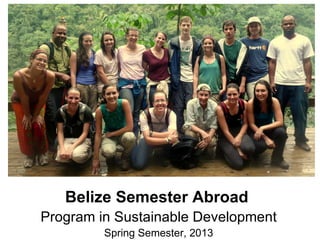
Belize Semester Abroad
Program in Sustainable Development
         Spring Semester, 2013
2013 Program Features
--18 credits
--Three field-based courses
--Six credits of service-learning
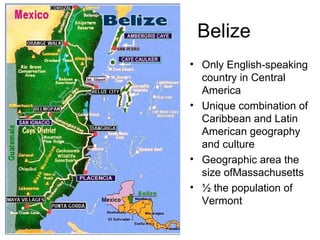
Belize
• Only English-speaking
  country in Central
  America
• Unique combination of
  Caribbean and Latin
  American geography
  and culture
• Geographic area the
  size ofMassachusetts
• ½ the population of
  Vermont
Why Belize?
 Ideal location to study
sustainable development
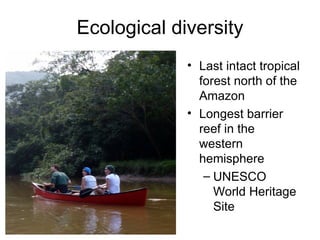
Ecological diversity
             • Last intact tropical
               forest north of the
               Amazon
             • Longest barrier
               reef in the
               western
               hemisphere
                – UNESCO
                  World Heritage
                  Site
Biological diversity
Cockscomb Wildlife Reserve
     World’s only jaguar preserve
Largest cave system
  in the Western
  Hemisphere--many
  sacred to the Maya
Community co-management
  Unique approach to managing
        protected areas
Pioneer in Ecotourism
Belize’s Cultural
Diversity
  – Mestizo
  – Creole
  – Garifuna
  – Maya
  – East Indian
  – Mennonite
  – Chinese
“When it comes to rich cultural heritage, incredible nature on land
and sea, spectacular beauty and a truly warm and friendly
people, Belize makes my own top five list of the world’s best
places to see and experience.”
   --Costas Christ, senior editor, National Geographic Traveler
Development Pressures
Mass (Cruise Ship) Tourism
Solid Waste Management
Population Increase

• At the current
  rate, population of
  Belize will double
  in 20 years
Six courses: 18 credits
• Development & Indigenous
  Peoples
• Linking Ridges to Reef:
  An Ecosystem Approach to
  Biodiversity Conservation &
  Development
• Wildlife Conservation and
  Communities: Issues &
  Approaches
• Intercultural Competence
• Applications of Sustainable
  Development
   – Service learning (6 credits)
Weeks 1 to 3: Discover Belize “Unplugged”
             Macal River Camp
       Orientation and introductory classes
Laguna Village
Development and Indigenous Peoples: The Maya
Hopkins Village
Development and Indigenous Peoples: The Garifuna
Cockscomb Basin Wildlife Sanctuary
        Wildlife Conservation
IZE Marine Biology Station: South Water Caye
            Linking Ridges to Reef
Weeks 4-6: Settle into Cayo
Complete work for Development and Indigenous Peoples,
   Linking Ridges to Reef, and Wildlife Conservation
Weeks 7-12
                    Intercultural Competence and
              Applications of Sustainable Development


Intercultural
Competence
•Analyze what constitutes a
"culture“
•Experience arts, foods,
religions, Maya archeology,
Kriol language
•Compare subcultures in
Belize
•Consider what it means to be
a “global citizen”
Applications of Sustainable Development: Part I
                        (Service Learning)
2012 Projects:
• environmental education
  at a rural primary school
• nutrition education and
  gardening at an urban
  primary school
• planning/building a
  sustainable community
  for abandoned children
• Developing educational
  materials on HIV/AIDS
  for a battered women’s
  shelter
Environmental Education
Nutrition Education and Gardening
Sustainable Community for
  Abandoned Children
Educational Materials on
Domestic Abuse and HIV/AIDS
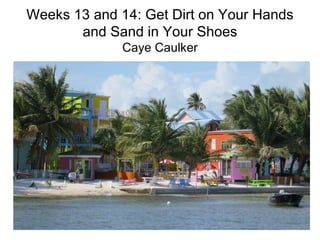
Weeks 13 and 14: Get Dirt on Your Hands
       and Sand in Your Shoes
              Caye Caulker
Applications of Sustainable Development—Part II

• Partner with Ocean
  Academy, a
  community high
  school
• Projects include:
  – Easter vacation
    enrichment camp
  – Tutoring
  – Classroom
    construction
Volunteer Activities
CDAE Majors
• CID Major: Receive credit for
  – CDAE 102
  – five of “choose 7” electives
• PCOM Major: Receive credit for
  – CDAE 102
  – up to two of “choose 5+” electives
    (depending on nature of service learning projects)
• CENT Major
  – CDAE 102
Minor in
Community & International Development
                (CID)


• Fulfill three of five required courses
• Take CDAE 061 and CDAE 002
  (preferably fall semester)
Financial Details
Tuition
  – Pay tuition to UVM (instate/out-of-state)
Program Fee
  – Approximately $6,000
  – Includes
     • All lodging
     • Meals or meal allowance in all locations
     • All program-related in-country transportation and
       admissions
     • Service learning project expenses
     • Use of personal cell phone provided by program
Financial Aid

UVM financial aid applies

Additional aid may be
  available
  – Belize Program
      financial aid
  – Service-learning
      Teaching Assistant
Additional Expenses

• Airfare
  – ($500-$1,000)
• Personal
  expenses
  – (souvenirs, gifts)
• Personal travel
Program Dates
Thursday, Jan. 10
  – Students are met at
    the Belize Int’l.
    Airport and
    transported to the
    Macal River Camp
Thursday, Apr. 18
  – Students are
    transported from
    Caye Caulker to the
    Belize Int’l. Airport
Key Points
• UVM financial aid
  applies
• Additional program
  scholarships may be
  available
• All courses in English
• UVM courses; no
  transfer credit issues
Information Sessions
Wednesday, Apr. 25
5:30 p.m.
Lafayette L308

Thursday., Apr. 26
7:00 p.m.
Davis Ctr. room 402
Application Process
1. Application
  –   Complete and return to Jay Ashman no later than
      Monday, April 30, 2012
2. Interview
  –   May 1 - 9
3. Admission
  –   Notice sent by e-mail in early June
4. Deposit
  –   Non-refundable $500 due with acceptance of offer
      of admission
Selection Criteria
•   Year and major
•   Recommendations
•   Academic performance
•   Community service
•   Our perception of
    – your commitment to
      maximizing the
      benefits of this
      experience, personally
      and for others
    – “intangibles”
        • flexibility
        • sense of adventure
        • ability to “roll with
          the punches”
For more information:
  jay.ashman@uvm.edu
learn.uvm.edu/travel/belize

Belize 2013 slideshow

  • 1.
    Belize Semester Abroad Programin Sustainable Development Spring Semester, 2013
  • 2.
    2013 Program Features --18credits --Three field-based courses --Six credits of service-learning
  • 3.
    Belize • Only English-speaking country in Central America • Unique combination of Caribbean and Latin American geography and culture • Geographic area the size ofMassachusetts • ½ the population of Vermont
  • 4.
    Why Belize? Ideallocation to study sustainable development
  • 5.
    Ecological diversity • Last intact tropical forest north of the Amazon • Longest barrier reef in the western hemisphere – UNESCO World Heritage Site
  • 6.
  • 7.
    Cockscomb Wildlife Reserve World’s only jaguar preserve
  • 8.
    Largest cave system in the Western Hemisphere--many sacred to the Maya
  • 9.
    Community co-management Unique approach to managing protected areas
  • 10.
  • 11.
    Belize’s Cultural Diversity – Mestizo – Creole – Garifuna – Maya – East Indian – Mennonite – Chinese
  • 12.
    “When it comesto rich cultural heritage, incredible nature on land and sea, spectacular beauty and a truly warm and friendly people, Belize makes my own top five list of the world’s best places to see and experience.” --Costas Christ, senior editor, National Geographic Traveler
  • 13.
  • 14.
  • 15.
  • 16.
    Population Increase • Atthe current rate, population of Belize will double in 20 years
  • 17.
    Six courses: 18credits • Development & Indigenous Peoples • Linking Ridges to Reef: An Ecosystem Approach to Biodiversity Conservation & Development • Wildlife Conservation and Communities: Issues & Approaches • Intercultural Competence • Applications of Sustainable Development – Service learning (6 credits)
  • 18.
    Weeks 1 to3: Discover Belize “Unplugged” Macal River Camp Orientation and introductory classes
  • 19.
    Laguna Village Development andIndigenous Peoples: The Maya
  • 20.
    Hopkins Village Development andIndigenous Peoples: The Garifuna
  • 21.
    Cockscomb Basin WildlifeSanctuary Wildlife Conservation
  • 22.
    IZE Marine BiologyStation: South Water Caye Linking Ridges to Reef
  • 23.
    Weeks 4-6: Settleinto Cayo Complete work for Development and Indigenous Peoples, Linking Ridges to Reef, and Wildlife Conservation
  • 24.
    Weeks 7-12 Intercultural Competence and Applications of Sustainable Development Intercultural Competence •Analyze what constitutes a "culture“ •Experience arts, foods, religions, Maya archeology, Kriol language •Compare subcultures in Belize •Consider what it means to be a “global citizen”
  • 25.
    Applications of SustainableDevelopment: Part I (Service Learning) 2012 Projects: • environmental education at a rural primary school • nutrition education and gardening at an urban primary school • planning/building a sustainable community for abandoned children • Developing educational materials on HIV/AIDS for a battered women’s shelter
  • 26.
  • 27.
  • 28.
    Sustainable Community for Abandoned Children
  • 29.
  • 30.
    Weeks 13 and14: Get Dirt on Your Hands and Sand in Your Shoes Caye Caulker
  • 31.
    Applications of SustainableDevelopment—Part II • Partner with Ocean Academy, a community high school • Projects include: – Easter vacation enrichment camp – Tutoring – Classroom construction
  • 32.
  • 33.
    CDAE Majors • CIDMajor: Receive credit for – CDAE 102 – five of “choose 7” electives • PCOM Major: Receive credit for – CDAE 102 – up to two of “choose 5+” electives (depending on nature of service learning projects) • CENT Major – CDAE 102
  • 34.
    Minor in Community &International Development (CID) • Fulfill three of five required courses • Take CDAE 061 and CDAE 002 (preferably fall semester)
  • 35.
    Financial Details Tuition – Pay tuition to UVM (instate/out-of-state) Program Fee – Approximately $6,000 – Includes • All lodging • Meals or meal allowance in all locations • All program-related in-country transportation and admissions • Service learning project expenses • Use of personal cell phone provided by program
  • 36.
    Financial Aid UVM financialaid applies Additional aid may be available – Belize Program financial aid – Service-learning Teaching Assistant
  • 37.
    Additional Expenses • Airfare – ($500-$1,000) • Personal expenses – (souvenirs, gifts) • Personal travel
  • 38.
    Program Dates Thursday, Jan.10 – Students are met at the Belize Int’l. Airport and transported to the Macal River Camp Thursday, Apr. 18 – Students are transported from Caye Caulker to the Belize Int’l. Airport
  • 39.
    Key Points • UVMfinancial aid applies • Additional program scholarships may be available • All courses in English • UVM courses; no transfer credit issues
  • 40.
    Information Sessions Wednesday, Apr.25 5:30 p.m. Lafayette L308 Thursday., Apr. 26 7:00 p.m. Davis Ctr. room 402
  • 41.
    Application Process 1. Application – Complete and return to Jay Ashman no later than Monday, April 30, 2012 2. Interview – May 1 - 9 3. Admission – Notice sent by e-mail in early June 4. Deposit – Non-refundable $500 due with acceptance of offer of admission
  • 42.
    Selection Criteria • Year and major • Recommendations • Academic performance • Community service • Our perception of – your commitment to maximizing the benefits of this experience, personally and for others – “intangibles” • flexibility • sense of adventure • ability to “roll with the punches”
  • 43.
    For more information: jay.ashman@uvm.edu learn.uvm.edu/travel/belize