
PR Planning 2010 Survey Results


         PR Planning 2010 Survey Results
PR Planning 2010 Survey Results


    Summary

    From October 21, 2009 to November 3, 2009, Vocus surveyed approximately 1,800 public
    relations professionals about their perceptions of PR planning for 2010 amid a changing and
    dynamic landscape.

    Key findings include the following:


           Trying times. 64 percent of respondents either agreed or strongly agreed that PR
           planning will be more difficult in 2010.

           Cautious optimism. 42 percent indicated PR budgets will remain flat in 2010, though
           one-third said they anticipated their budgets increasing slightly (24 percent) or
           significantly (5 percent).

           Innovate and invest in technology. 63 percent are planning to refine processes in
           2010 while 51 percent will invest in new technology in order to do more with less.

           Social media to be a key focus in 2010. 80 percent of respondents say they will focus
           on social media in 2010; multimedia is not far behind with 63 percent, while measuring
           results, SEO (search engine optimization) and viral campaigns trail with 58, 57 and 56
           percent, respectively.

           PR increasingly important to marketing. 64 percent believe that PR will become
           increasingly important in the overall marketing mix in 2010.


2
PR Planning 2010 Survey Results


    Introduction

    The public relations industry has experienced tremendous change in 2009 and social media is
    often cited as a major catalyst behind this change. The impact has been nothing short of
    substantial. Social media is changing how PR professionals think about its role in every aspect
    from influence to communication and it certainly will have an impact on PR planning in 2010.

    To gain better insight into the perceptions and concerns of the PR practitioner, Vocus surveyed
    US-based marketing PR professionals and analyzed the results with help from Deirdre
    Breakenridge, president of PFS Marketwyse and co-author of “Putting the Public Back in Public
    Relations: How Social Media is Reinventing the Aging Business of PR.”

    A total of 1,836 marketing and public relations professionals responded to the survey, though
    it’s important to note that every respondent did not fully answer every question. Still, each
    question had about 1,800 respondents and we believe the results are as compelling as they are
    insightful. This white paper is focused on analyzing those results.


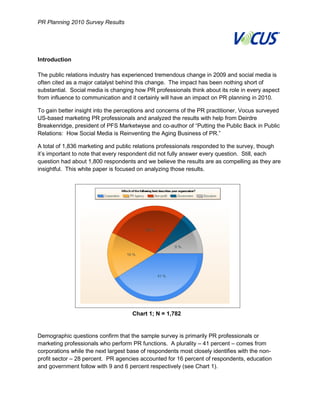
                                         Chart 1; N = 1,782


    Demographic questions confirm that the sample survey is primarily PR professionals or
    marketing professionals who perform PR functions. A plurality – 41 percent – comes from
    corporations while the next largest base of respondents most closely identifies with the non-
    profit sector – 28 percent. PR agencies accounted for 16 percent of respondents, education
    and government follow with 9 and 6 percent respectively (see Chart 1).


3
PR Planning 2010 Survey Results


    This survey was sent to both marketing and public relations professionals and the next
    demographic question indicated how closely respondents identify with specific functions that are
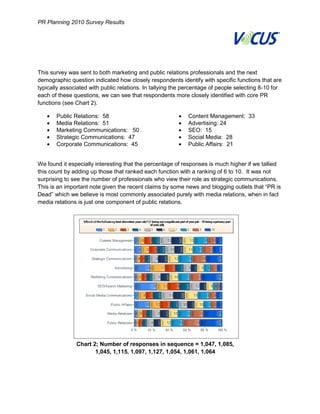
    typically associated with public relations. In tallying the percentage of people selecting 8-10 for
    each of these questions, we can see that respondents more closely identified with core PR
    functions (see Chart 2).

           Public Relations: 58                                  Content Management: 33
           Media Relations: 51                                   Advertising: 24
           Marketing Communications: 50                          SEO: 15
           Strategic Communications: 47                          Social Media: 28
           Corporate Communications: 45                          Public Affairs: 21


    We found it especially interesting that the percentage of responses is much higher if we tallied
    this count by adding up those that ranked each function with a ranking of 6 to 10. It was not
    surprising to see the number of professionals who view their role as strategic communications.
    This is an important note given the recent claims by some news and blogging outlets that “PR is
    Dead” which we believe is most commonly associated purely with media relations, when in fact
    media relations is just one component of public relations.


                   Chart 2; Number of responses in sequence = 1,047, 1,085,
                          1,045, 1,115, 1,097, 1,127, 1,054, 1,061, 1,064


4
PR Planning 2010 Survey Results


Planning more difficult in 2010?

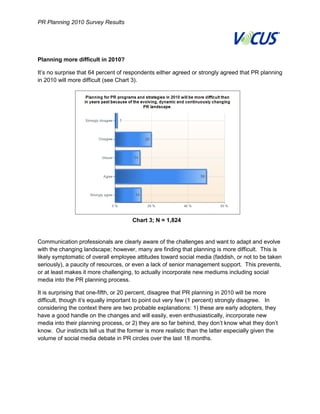
It’s no surprise that 64 percent of respondents either agreed or strongly agreed that PR planning
in 2010 will more difficult (see Chart 3).


                                      Chart 3; N = 1,824


Communication professionals are clearly aware of the challenges and want to adapt and evolve
with the changing landscape; however, many are finding that planning is more difficult. This is
likely symptomatic of overall employee attitudes toward social media (faddish, or not to be taken
seriously), a paucity of resources, or even a lack of senior management support. This prevents,
or at least makes it more challenging, to actually incorporate new mediums including social
media into the PR planning process.

It is surprising that one-fifth, or 20 percent, disagree that PR planning in 2010 will be more
difficult, though it’s equally important to point out very few (1 percent) strongly disagree. In
considering the context there are two probable explanations: 1) these are early adopters, they
have a good handle on the changes and will easily, even enthusiastically, incorporate new
media into their planning process, or 2) they are so far behind, they don’t know what they don’t
know. Our instincts tell us that the former is more realistic than the latter especially given the
volume of social media debate in PR circles over the last 18 months.


5
PR Planning 2010 Survey Results


    Budgets: cautiously optimistic

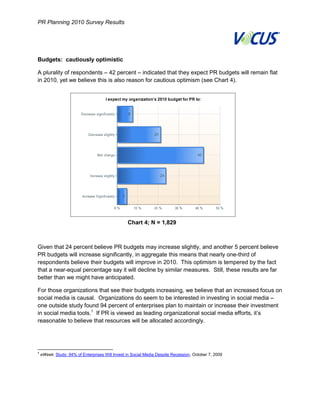
    A plurality of respondents – 42 percent – indicated that they expect PR budgets will remain flat
    in 2010, yet we believe this is also reason for cautious optimism (see Chart 4).


                                                     Chart 4; N = 1,829


    Given that 24 percent believe PR budgets may increase slightly, and another 5 percent believe
    PR budgets will increase significantly, in aggregate this means that nearly one-third of
    respondents believe their budgets will improve in 2010. This optimism is tempered by the fact
    that a near-equal percentage say it will decline by similar measures. Still, these results are far
    better than we might have anticipated.

    For those organizations that see their budgets increasing, we believe that an increased focus on
    social media is causal. Organizations do seem to be interested in investing in social media –
    one outside study found 94 percent of enterprises plan to maintain or increase their investment
    in social media tools.1 If PR is viewed as leading organizational social media efforts, it’s
    reasonable to believe that resources will be allocated accordingly.


    1
        eWeek: Study: 94% of Enterprises Will Invest in Social Media Despite Recession, October 7, 2009


6
PR Planning 2010 Survey Results


Investing in process innovation & technology

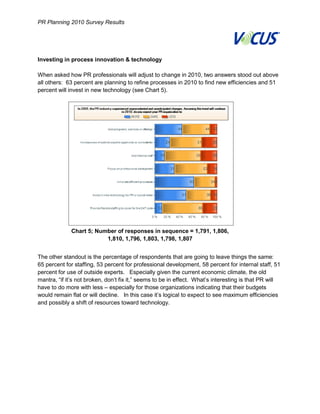
When asked how PR professionals will adjust to change in 2010, two answers stood out above
all others: 63 percent are planning to refine processes in 2010 to find new efficiencies and 51
percent will invest in new technology (see Chart 5).


             Chart 5; Number of responses in sequence = 1,791, 1,806,
                         1,810, 1,796, 1,803, 1,798, 1,807


The other standout is the percentage of respondents that are going to leave things the same:
65 percent for staffing, 53 percent for professional development, 58 percent for internal staff, 51
percent for use of outside experts. Especially given the current economic climate, the old
mantra, “if it’s not broken, don’t fix it,” seems to be in effect. What’s interesting is that PR will
have to do more with less – especially for those organizations indicating that their budgets
would remain flat or will decline. In this case it’s logical to expect to see maximum efficiencies
and possibly a shift of resources toward technology.


7
PR Planning 2010 Survey Results


PR to focus on social media, multimedia and search engine optimization (SEO) in 2010

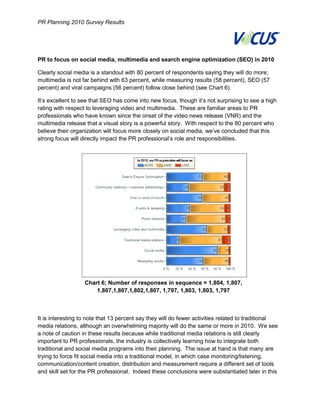
Clearly social media is a standout with 80 percent of respondents saying they will do more;
multimedia is not far behind with 63 percent, while measuring results (58 percent), SEO (57
percent) and viral campaigns (56 percent) follow close behind (see Chart 6).

It’s excellent to see that SEO has come into new focus, though it’s not surprising to see a high
rating with respect to leveraging video and multimedia. These are familiar areas to PR
professionals who have known since the onset of the video news release (VNR) and the
multimedia release that a visual story is a powerful story. With respect to the 80 percent who
believe their organization will focus more closely on social media, we’ve concluded that this
strong focus will directly impact the PR professional’s role and responsibilities.


                   Chart 6; Number of responses in sequence = 1,804, 1,807,
                       1,807,1,807,1,802,1,807, 1,797, 1,803, 1,803, 1,797


It is interesting to note that 13 percent say they will do fewer activities related to traditional
media relations, although an overwhelming majority will do the same or more in 2010. We see
a note of caution in these results because while traditional media relations is still clearly
important to PR professionals, the industry is collectively learning how to integrate both
traditional and social media programs into their planning. The issue at hand is that many are
trying to force fit social media into a traditional model, in which case monitoring/listening,
communication/content creation, distribution and measurement require a different set of tools
and skill set for the PR professional. Indeed these conclusions were substantiated later in this


 8
PR Planning 2010 Survey Results


    survey when we asked an open-ended question, “What is the SINGLE most important thing you,
    as a PR professional, will do differently in 2010 than you did in 2009?” Social media was
    referenced nearly 600 times of the 1,571 responses we received.

    A sample of these responses follows:

           Produce more multimedia/rich content appropriate for a wide variety of platforms and
           uses, from events to web content.

           Measure my social media timing against news cycles.

           More cross-marketing collaboration.

           Incorporate social networking into marketing plan.

           More time on social media efforts.

           Work smarter and make dollar go farther.

           Develop compelling multi-media content for distribution.

           Combine the use of traditional media with social media, which we're just starting to do.

           Rethink social media strategies. The social media fire hose is too big with too much
           spam. Pinpoint messaging and much greater efforts need to be spent in the area to
           target market demographics and understanding.

           Do more with less. That is, I will continue to provide a high level of media relations and
           related expertise as the technology I must work with continues to fall behind.

           Coordinate more efficiently with the marketing departments in order to fully utilize the
           limited resources of both areas.

           Further integrate social marketing techniques and tools into our overall PR mix.

           Sell social media marketing services in conjunction with traditional PR services in order
           to maximize results.

           Train others to know what I know about integrating traditional and new media.

           Learn to leverage the social media "spread" to our advantage for increasing awareness,
           donations and clients.

           Focus much more on social media and experiment with ways it can help meet our PR
           goals.


9
PR Planning 2010 Survey Results


            Learn more about social media and explore options to increase communication with
            targeted audiences and measure results.


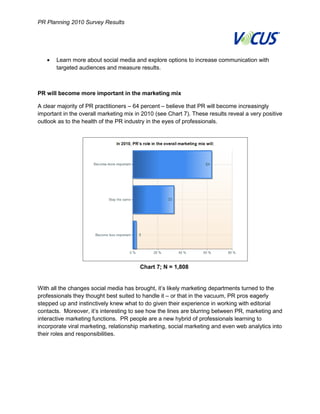
     PR will become more important in the marketing mix

     A clear majority of PR practitioners – 64 percent – believe that PR will become increasingly
     important in the overall marketing mix in 2010 (see Chart 7). These results reveal a very positive
     outlook as to the health of the PR industry in the eyes of professionals.


                                              Chart 7; N = 1,808


     With all the changes social media has brought, it’s likely marketing departments turned to the
     professionals they thought best suited to handle it – or that in the vacuum, PR pros eagerly
     stepped up and instinctively knew what to do given their experience in working with editorial
     contacts. Moreover, it’s interesting to see how the lines are blurring between PR, marketing and
     interactive marketing functions. PR people are a new hybrid of professionals learning to
     incorporate viral marketing, relationship marketing, social marketing and even web analytics into
     their roles and responsibilities.


10
PR Planning 2010 Survey Results


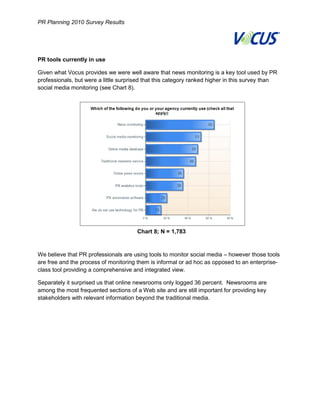
 PR tools currently in use

 Given what Vocus provides we were well aware that news monitoring is a key tool used by PR
 professionals, but were a little surprised that this category ranked higher in this survey than
 social media monitoring (see Chart 8).


                                        Chart 8; N = 1,783


 We believe that PR professionals are using tools to monitor social media – however those tools
 are free and the process of monitoring them is informal or ad hoc as opposed to an enterprise-
 class tool providing a comprehensive and integrated view.

 Separately it surprised us that online newsrooms only logged 36 percent. Newsrooms are
 among the most frequented sections of a Web site and are still important for providing key
 stakeholders with relevant information beyond the traditional media.


11
PR Planning 2010 Survey Results


About this survey

The results of this survey were presented to an audience during a live Webinar on November
12, 2009 titled, “PR Planning Considerations for 2010,” featuring guest speaker Deirdre
Breakenridge. All respondents to this survey and Webinar registrants were provided with a
copy of the results in the form of this white paper.


Find Vocus on these Social Media sites:


Twitter: @Vocus

Facebook: http://www.facebook.com/Vocus

LinkedIn: http://www.linkedin.com/groups?gid=1928001


About Vocus

Vocus, Inc. (NASDAQ: VOCS) is a leading provider of on-demand software for public relations
management. Our web-based software suite helps organizations of all sizes to fundamentally
change the way they communicate with both the media and the public, optimizing their public
relations and increasing their ability to measure its impact. Our on-demand software addresses
the critical functions of public relations including media relations, news distribution and news
monitoring. We deliver our solutions over the Internet using a secure, scalable application and
system architecture, which allows our customers to eliminate expensive up-front hardware and
software costs and to quickly deploy and adopt our on-demand software. Vocus is used by more
than 4,000 organizations worldwide and is available in seven languages. Vocus is based in
Lanham, MD with offices in North America, Europe, and Asia. For more information please visit
http://www.vocus.com or call 800.345.5572.


     12

PR Planning in 2010 Survey Results

  • 1.
    PR Planning 2010Survey Results PR Planning 2010 Survey Results
  • 2.
    PR Planning 2010Survey Results Summary From October 21, 2009 to November 3, 2009, Vocus surveyed approximately 1,800 public relations professionals about their perceptions of PR planning for 2010 amid a changing and dynamic landscape. Key findings include the following: Trying times. 64 percent of respondents either agreed or strongly agreed that PR planning will be more difficult in 2010. Cautious optimism. 42 percent indicated PR budgets will remain flat in 2010, though one-third said they anticipated their budgets increasing slightly (24 percent) or significantly (5 percent). Innovate and invest in technology. 63 percent are planning to refine processes in 2010 while 51 percent will invest in new technology in order to do more with less. Social media to be a key focus in 2010. 80 percent of respondents say they will focus on social media in 2010; multimedia is not far behind with 63 percent, while measuring results, SEO (search engine optimization) and viral campaigns trail with 58, 57 and 56 percent, respectively. PR increasingly important to marketing. 64 percent believe that PR will become increasingly important in the overall marketing mix in 2010. 2
  • 3.
    PR Planning 2010Survey Results Introduction The public relations industry has experienced tremendous change in 2009 and social media is often cited as a major catalyst behind this change. The impact has been nothing short of substantial. Social media is changing how PR professionals think about its role in every aspect from influence to communication and it certainly will have an impact on PR planning in 2010. To gain better insight into the perceptions and concerns of the PR practitioner, Vocus surveyed US-based marketing PR professionals and analyzed the results with help from Deirdre Breakenridge, president of PFS Marketwyse and co-author of “Putting the Public Back in Public Relations: How Social Media is Reinventing the Aging Business of PR.” A total of 1,836 marketing and public relations professionals responded to the survey, though it’s important to note that every respondent did not fully answer every question. Still, each question had about 1,800 respondents and we believe the results are as compelling as they are insightful. This white paper is focused on analyzing those results. Chart 1; N = 1,782 Demographic questions confirm that the sample survey is primarily PR professionals or marketing professionals who perform PR functions. A plurality – 41 percent – comes from corporations while the next largest base of respondents most closely identifies with the non- profit sector – 28 percent. PR agencies accounted for 16 percent of respondents, education and government follow with 9 and 6 percent respectively (see Chart 1). 3
  • 4.
    PR Planning 2010Survey Results This survey was sent to both marketing and public relations professionals and the next demographic question indicated how closely respondents identify with specific functions that are typically associated with public relations. In tallying the percentage of people selecting 8-10 for each of these questions, we can see that respondents more closely identified with core PR functions (see Chart 2). Public Relations: 58 Content Management: 33 Media Relations: 51 Advertising: 24 Marketing Communications: 50 SEO: 15 Strategic Communications: 47 Social Media: 28 Corporate Communications: 45 Public Affairs: 21 We found it especially interesting that the percentage of responses is much higher if we tallied this count by adding up those that ranked each function with a ranking of 6 to 10. It was not surprising to see the number of professionals who view their role as strategic communications. This is an important note given the recent claims by some news and blogging outlets that “PR is Dead” which we believe is most commonly associated purely with media relations, when in fact media relations is just one component of public relations. Chart 2; Number of responses in sequence = 1,047, 1,085, 1,045, 1,115, 1,097, 1,127, 1,054, 1,061, 1,064 4
  • 5.
    PR Planning 2010Survey Results Planning more difficult in 2010? It’s no surprise that 64 percent of respondents either agreed or strongly agreed that PR planning in 2010 will more difficult (see Chart 3). Chart 3; N = 1,824 Communication professionals are clearly aware of the challenges and want to adapt and evolve with the changing landscape; however, many are finding that planning is more difficult. This is likely symptomatic of overall employee attitudes toward social media (faddish, or not to be taken seriously), a paucity of resources, or even a lack of senior management support. This prevents, or at least makes it more challenging, to actually incorporate new mediums including social media into the PR planning process. It is surprising that one-fifth, or 20 percent, disagree that PR planning in 2010 will be more difficult, though it’s equally important to point out very few (1 percent) strongly disagree. In considering the context there are two probable explanations: 1) these are early adopters, they have a good handle on the changes and will easily, even enthusiastically, incorporate new media into their planning process, or 2) they are so far behind, they don’t know what they don’t know. Our instincts tell us that the former is more realistic than the latter especially given the volume of social media debate in PR circles over the last 18 months. 5
  • 6.
    PR Planning 2010Survey Results Budgets: cautiously optimistic A plurality of respondents – 42 percent – indicated that they expect PR budgets will remain flat in 2010, yet we believe this is also reason for cautious optimism (see Chart 4). Chart 4; N = 1,829 Given that 24 percent believe PR budgets may increase slightly, and another 5 percent believe PR budgets will increase significantly, in aggregate this means that nearly one-third of respondents believe their budgets will improve in 2010. This optimism is tempered by the fact that a near-equal percentage say it will decline by similar measures. Still, these results are far better than we might have anticipated. For those organizations that see their budgets increasing, we believe that an increased focus on social media is causal. Organizations do seem to be interested in investing in social media – one outside study found 94 percent of enterprises plan to maintain or increase their investment in social media tools.1 If PR is viewed as leading organizational social media efforts, it’s reasonable to believe that resources will be allocated accordingly. 1 eWeek: Study: 94% of Enterprises Will Invest in Social Media Despite Recession, October 7, 2009 6
  • 7.
    PR Planning 2010Survey Results Investing in process innovation & technology When asked how PR professionals will adjust to change in 2010, two answers stood out above all others: 63 percent are planning to refine processes in 2010 to find new efficiencies and 51 percent will invest in new technology (see Chart 5). Chart 5; Number of responses in sequence = 1,791, 1,806, 1,810, 1,796, 1,803, 1,798, 1,807 The other standout is the percentage of respondents that are going to leave things the same: 65 percent for staffing, 53 percent for professional development, 58 percent for internal staff, 51 percent for use of outside experts. Especially given the current economic climate, the old mantra, “if it’s not broken, don’t fix it,” seems to be in effect. What’s interesting is that PR will have to do more with less – especially for those organizations indicating that their budgets would remain flat or will decline. In this case it’s logical to expect to see maximum efficiencies and possibly a shift of resources toward technology. 7
  • 8.
    PR Planning 2010Survey Results PR to focus on social media, multimedia and search engine optimization (SEO) in 2010 Clearly social media is a standout with 80 percent of respondents saying they will do more; multimedia is not far behind with 63 percent, while measuring results (58 percent), SEO (57 percent) and viral campaigns (56 percent) follow close behind (see Chart 6). It’s excellent to see that SEO has come into new focus, though it’s not surprising to see a high rating with respect to leveraging video and multimedia. These are familiar areas to PR professionals who have known since the onset of the video news release (VNR) and the multimedia release that a visual story is a powerful story. With respect to the 80 percent who believe their organization will focus more closely on social media, we’ve concluded that this strong focus will directly impact the PR professional’s role and responsibilities. Chart 6; Number of responses in sequence = 1,804, 1,807, 1,807,1,807,1,802,1,807, 1,797, 1,803, 1,803, 1,797 It is interesting to note that 13 percent say they will do fewer activities related to traditional media relations, although an overwhelming majority will do the same or more in 2010. We see a note of caution in these results because while traditional media relations is still clearly important to PR professionals, the industry is collectively learning how to integrate both traditional and social media programs into their planning. The issue at hand is that many are trying to force fit social media into a traditional model, in which case monitoring/listening, communication/content creation, distribution and measurement require a different set of tools and skill set for the PR professional. Indeed these conclusions were substantiated later in this 8
  • 9.
    PR Planning 2010Survey Results survey when we asked an open-ended question, “What is the SINGLE most important thing you, as a PR professional, will do differently in 2010 than you did in 2009?” Social media was referenced nearly 600 times of the 1,571 responses we received. A sample of these responses follows: Produce more multimedia/rich content appropriate for a wide variety of platforms and uses, from events to web content. Measure my social media timing against news cycles. More cross-marketing collaboration. Incorporate social networking into marketing plan. More time on social media efforts. Work smarter and make dollar go farther. Develop compelling multi-media content for distribution. Combine the use of traditional media with social media, which we're just starting to do. Rethink social media strategies. The social media fire hose is too big with too much spam. Pinpoint messaging and much greater efforts need to be spent in the area to target market demographics and understanding. Do more with less. That is, I will continue to provide a high level of media relations and related expertise as the technology I must work with continues to fall behind. Coordinate more efficiently with the marketing departments in order to fully utilize the limited resources of both areas. Further integrate social marketing techniques and tools into our overall PR mix. Sell social media marketing services in conjunction with traditional PR services in order to maximize results. Train others to know what I know about integrating traditional and new media. Learn to leverage the social media "spread" to our advantage for increasing awareness, donations and clients. Focus much more on social media and experiment with ways it can help meet our PR goals. 9
  • 10.
    PR Planning 2010Survey Results Learn more about social media and explore options to increase communication with targeted audiences and measure results. PR will become more important in the marketing mix A clear majority of PR practitioners – 64 percent – believe that PR will become increasingly important in the overall marketing mix in 2010 (see Chart 7). These results reveal a very positive outlook as to the health of the PR industry in the eyes of professionals. Chart 7; N = 1,808 With all the changes social media has brought, it’s likely marketing departments turned to the professionals they thought best suited to handle it – or that in the vacuum, PR pros eagerly stepped up and instinctively knew what to do given their experience in working with editorial contacts. Moreover, it’s interesting to see how the lines are blurring between PR, marketing and interactive marketing functions. PR people are a new hybrid of professionals learning to incorporate viral marketing, relationship marketing, social marketing and even web analytics into their roles and responsibilities. 10
  • 11.
    PR Planning 2010Survey Results PR tools currently in use Given what Vocus provides we were well aware that news monitoring is a key tool used by PR professionals, but were a little surprised that this category ranked higher in this survey than social media monitoring (see Chart 8). Chart 8; N = 1,783 We believe that PR professionals are using tools to monitor social media – however those tools are free and the process of monitoring them is informal or ad hoc as opposed to an enterprise- class tool providing a comprehensive and integrated view. Separately it surprised us that online newsrooms only logged 36 percent. Newsrooms are among the most frequented sections of a Web site and are still important for providing key stakeholders with relevant information beyond the traditional media. 11
  • 12.
    PR Planning 2010Survey Results About this survey The results of this survey were presented to an audience during a live Webinar on November 12, 2009 titled, “PR Planning Considerations for 2010,” featuring guest speaker Deirdre Breakenridge. All respondents to this survey and Webinar registrants were provided with a copy of the results in the form of this white paper. Find Vocus on these Social Media sites: Twitter: @Vocus Facebook: http://www.facebook.com/Vocus LinkedIn: http://www.linkedin.com/groups?gid=1928001 About Vocus Vocus, Inc. (NASDAQ: VOCS) is a leading provider of on-demand software for public relations management. Our web-based software suite helps organizations of all sizes to fundamentally change the way they communicate with both the media and the public, optimizing their public relations and increasing their ability to measure its impact. Our on-demand software addresses the critical functions of public relations including media relations, news distribution and news monitoring. We deliver our solutions over the Internet using a secure, scalable application and system architecture, which allows our customers to eliminate expensive up-front hardware and software costs and to quickly deploy and adopt our on-demand software. Vocus is used by more than 4,000 organizations worldwide and is available in seven languages. Vocus is based in Lanham, MD with offices in North America, Europe, and Asia. For more information please visit http://www.vocus.com or call 800.345.5572. 12