A study aimed at elaborating understanding
of the nature and drivers of excellence
of Chief Communications Officers (CCO)
Executive Summary
What makes a
Chief Communications
Officer Excellent?
What determines the success of the function
of Chief Communications Officer (CCO)?
To what degree do personal skills play a role in the
success? What are those skills? To what extent
does the business in which the organization operates
play a role? Is it more operational, tactical,
strategic or a combination?
The key roles of a successful CCO
To succeed, CCOs have to be able
to build and maintain a crucial role
in external and internal dominant
coalition. They also should have a set
of personal skills enabling them to
perform at a top level. Excellence in
these three characteristics will enable
CCOs to implement the CCO role
1. Being the “eyes and ears” of the
organization.
2. Spending most of their time
on building and maintaining
relationships with key opinion
leaders.
3. Awareness of developments in the
relevant political environment.
4. Speaking the language of
politicians and civil servants.
5. Analyzing and monitoring
reputation risks and opportunities.
6. Spending most of their time on
building and maintaining media
relations.
effectively resulting in an individual
perceived by the top of the firm as an
excellent CCO. Successful CCOs are
characterized by a master combination
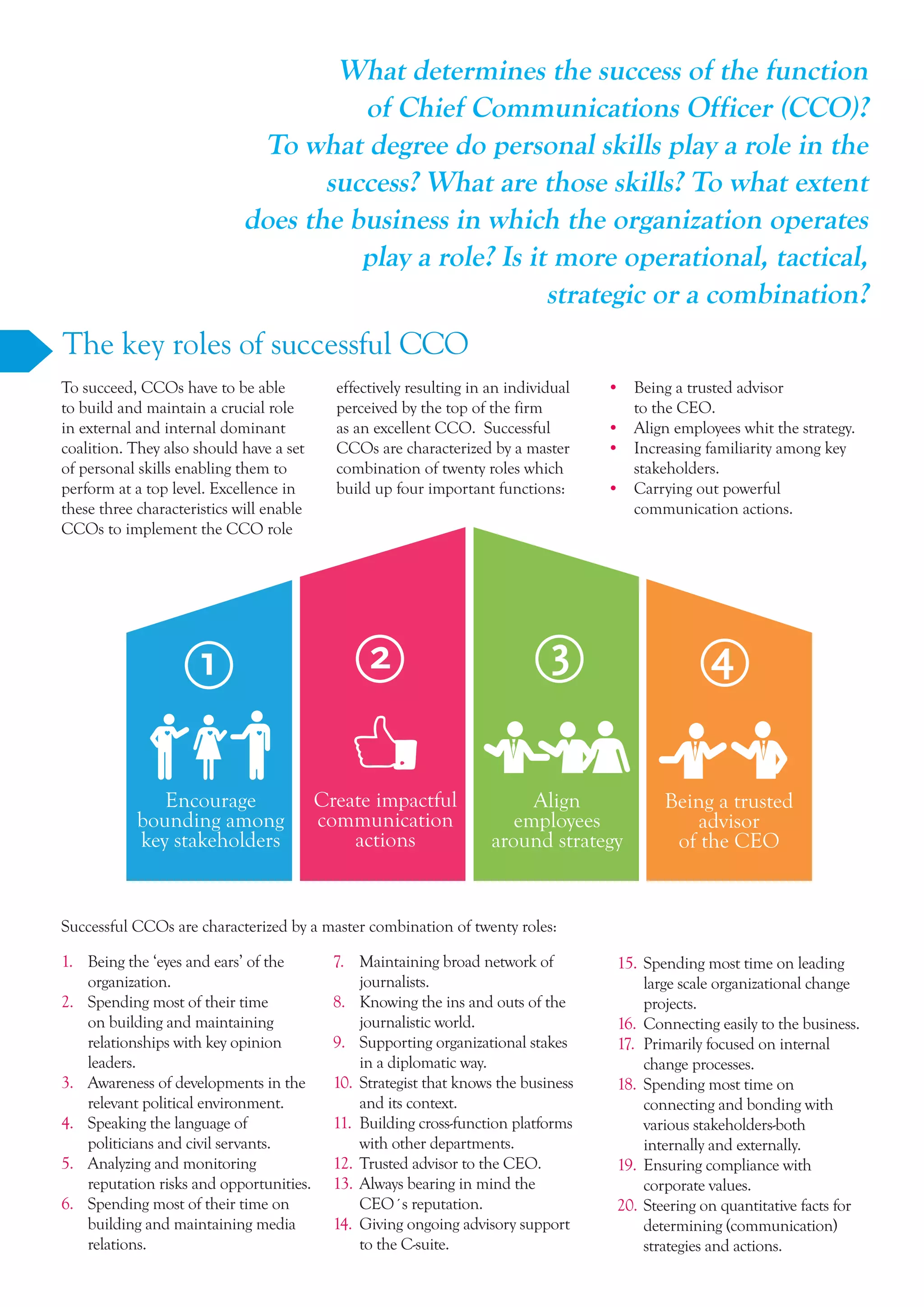
of twenty roles which build up four
important functions:
• Being a trusted advisor
to the CEO.
• Align employees whit the strategy.
• Increasing familiarity among key
stakeholders.
• Carrying out powerful
communication actions.
Successful CCOs are characterized by a master combination of twenty roles:
7. Maintaining broad network of
journalists.
8. Knowing the ins and outs of the
journalistic world.
9. Supporting organizational stakes
in a diplomatic way.
10. Strategist that knows the business
and its context.
11. Building cross-function platforms
with other departments.
12. Trusted advisor to the CEO.
13. Always bearing in mind the
CEO´s reputation.
14. Giving ongoing advisory support
to the C-suite.
15. Spending most time on leading
large scale organizational change
projects.
16. Connecting easily to the business.
17. Primarily focused on internal
change processes.
18. Spending most time on
connecting and bonding with
various stakeholders-both
internally and externally.
19. Ensuring compliance with
corporate values.
20. Steering on quantitative facts for
determining (communication)
strategies and actions.
1 4
Encourage
bounding among
key stakeholders
2
Being a trusted
advisor
of the CEO
Align
employees
around strategy
3
Create impactful
communication
actions
Internal roles of the CCO
Interactions with key internal stakeholders
Responsibilities & tasks
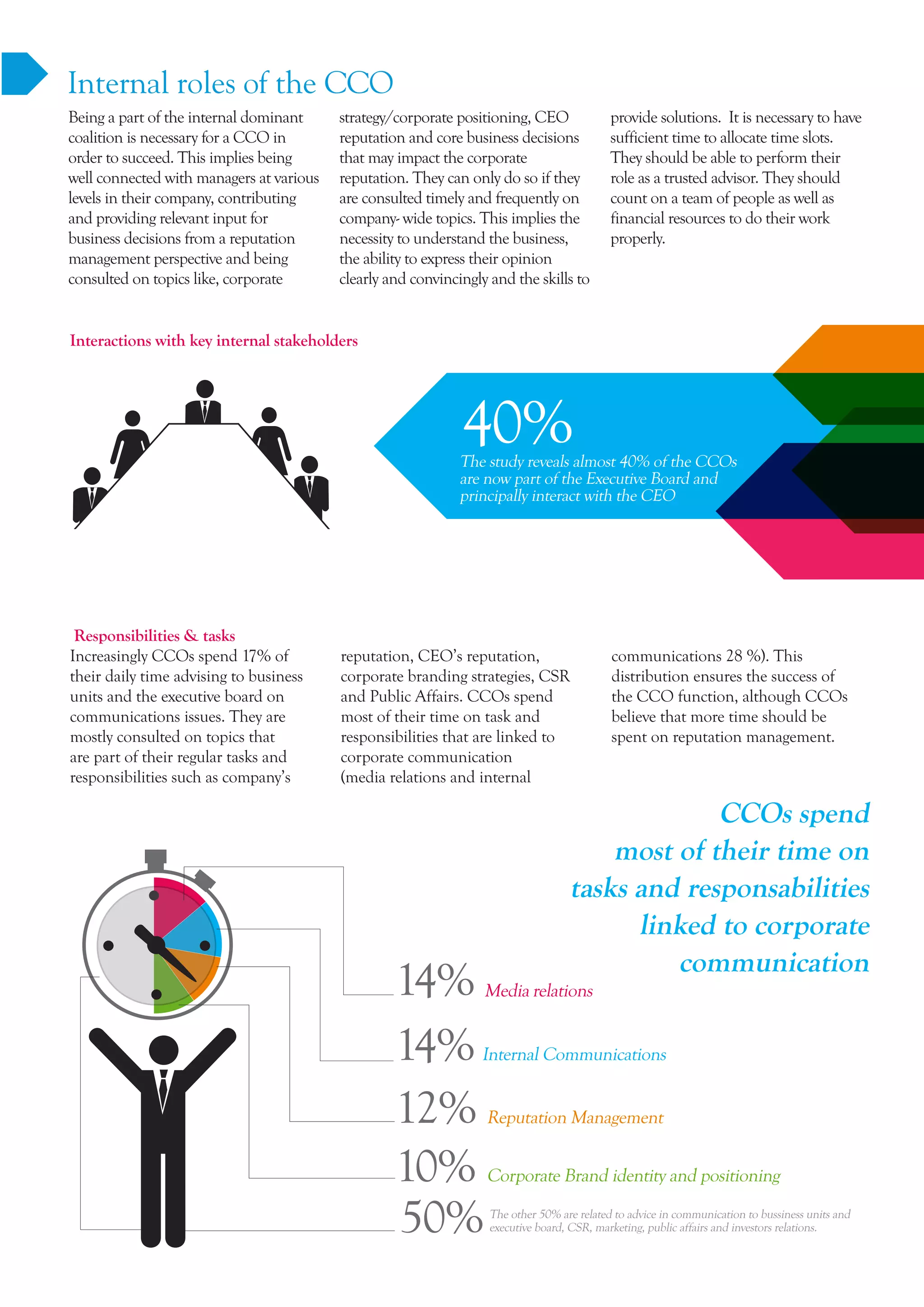
Increasingly CCOs spend 17 % of
their daily time advising to business
units and the executive board on
communications issues. They are
mostly consulted on topics that
are part of their regular tasks and
responsibilities such as company’s
reputation, CEO’s reputation,
corporate branding strategies,
CSR and Public Affairs. CCOs
spend most of their time on task
and responsibilities that are linked
to corporate communication
(media relations and internal
communications 28 %).
This distribution ensures the
success of the CCO function,
although CCOs believe that more
time should be spent on reputation
management.
40 %The study reveals almost 40 % of the
CCOs are now part of the Executive Board
and principally interact with the CEO
Being a part of the internal dominant
coalition is necessary for a CCO in
order to succeed. This implies being
well connected with managers at various
levels in their company, contributing and
providing relevant input for business
decisionsfromareputationmanagement
perspective and being consulted on
topics like, corporate strategy/corporate
positioning, CEO reputation and core
business decisions that may impact the
corporate reputation. They can only
do so if they are consulted timely and
frequently on company- wide topics.
This implies the necessity to understand
the business, the ability to express their
opinion clearly and convincingly and the
skills to provide solutions. It is necessary
to have sufficient time to allocate time
slots. They should be able to perform
their role as a trusted advisor. They
should count on a team of people as well
as on financial resources to do their work
properly.
CCOs spend
most of their time on
tasks and responsabilities
linked to corporate
communication
14 %
12 %
14 %
10 %
The other 50 % are related to advice in communication to bussiness units and
executive board, CSR, marketing, public affairs and investors relations.
Media relations
Internal Communications
Reputation Management
Corporate Brand identity and positioning
50 %
External roles of the CCO
Personal skills & the future and challenges of CCOs
Interactions with key external stakeholders
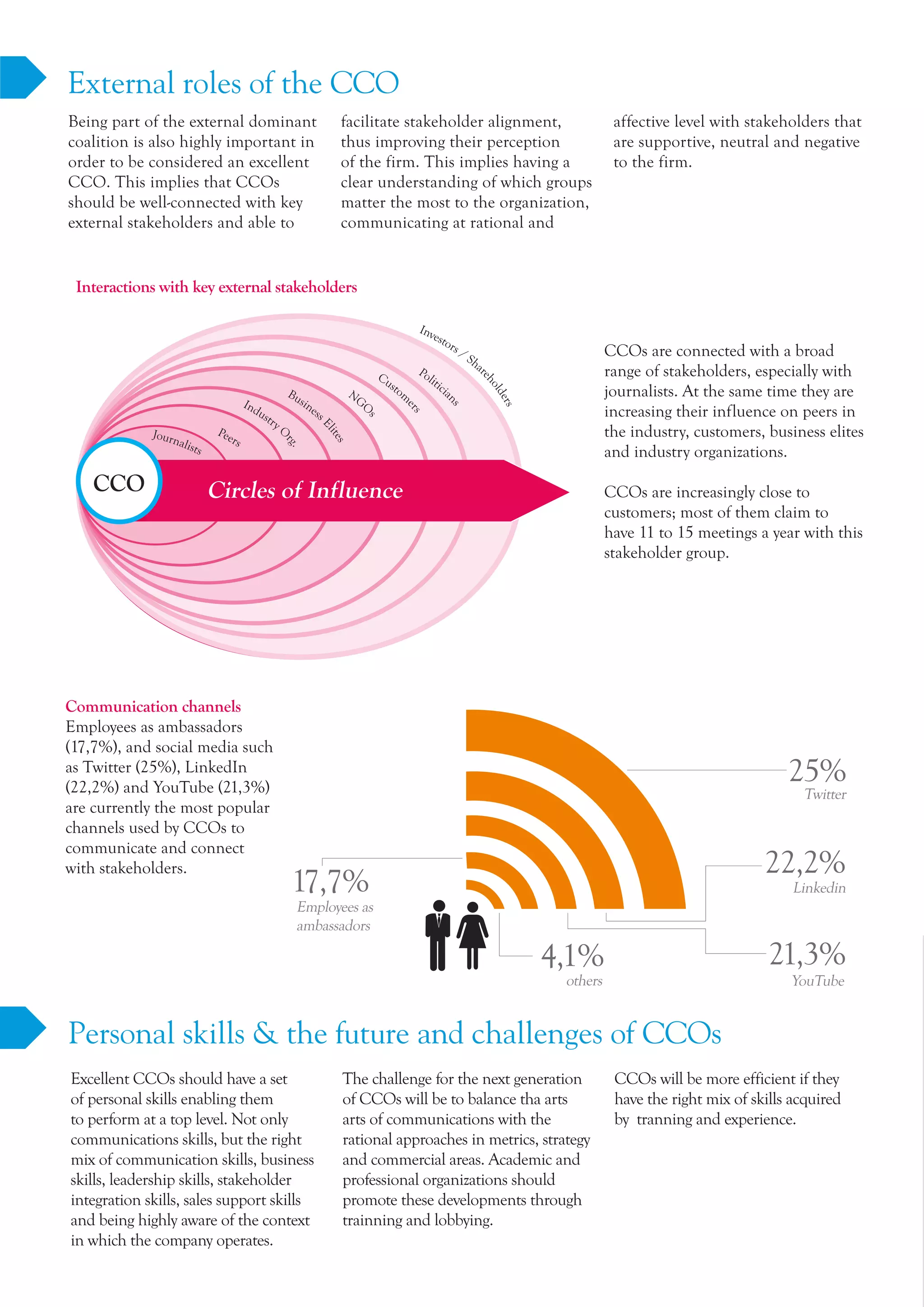
CCOs are connected with a broad
range of stakeholders, especially with
journalists. At the same time they are
increasing their influence on peers in
the industry, customers, business elites
and industry organizations.
CCOs are increasingly close to
customers; most of them claim to
have 11 to 15 meetings a year with this
stakeholder group.
Being part of the external dominant
coalition is also highly important in
order to be considered an excellent
CCO. This implies that CCOs
should be well-connected with key
external stakeholders and able to
facilitate stakeholder alignment,
thus improving their perception
of the firm. This implies having a
clear understanding of which groups
matter the most to the organization,
communicating at rational and
affective level with stakeholders that
are supportive, neutral and negative
to the firm.
Communication channels
Employees as ambassadors
(17,7 %), and social media such
as Twitter (25 %), LinkedIn
(22,2 %) and YouTube
(21,3 %) are currently the
most popular channels used
by CCOs to communicate and
connect with stakeholders.
17,7 %
Employees as
ambassadors
25 %
Twitter
22,2 %
Linkedin
21,3 %
YouTube
4,1 %
others
Investors / Shar
eholders
Politicia
ns
Custom
ers
NGO
s
Business
Elites
Industry O
rg.
Journalists
Peers
CCO Circles of Influence
Excellent CCOs should have a set
of personal skills enabling them
to perform at a top level. Not only
communications skills, but the right
mix of communication skills, business
skills, leadership skills, stakeholder
integration skills, sales support skills
and being highly aware of the context
in which the company operates.
The challenge for the next generation
of CCOs will be to balance tha
arts arts of communications
with the rational approaches in
metrics, strategy and commercial
areas. Academic and professional
organizations should promote these
developments through trainning
and lobbying.
CCOs will be more efficient if they
have the right mix of skills acquired
by tranning and experience.
Levels of excellence of Chief Communications Officers
Four levels of CCO excellence can be
distinguished from a “one-star” CCO to a
“four-star” CCO. The more stars a CCO
role has, the higher the impact on CCO
success will be. Not all companies need
“four-star CCOs”. The top performers
will be searched for by companies in
specific industries where the reputational
Stakeholder
alignment manager
Roles:
–Connecting and bonding
with stakeholders- both
internally and externally.
–Ensuring compliance
with corporate values
–Steering on quantitative
facts for determining
communication
strategies and actions.
Skills
– Communications skills.
– Business skills.
– Leadership.
Relationship–builder
Roles
– Being the ‘eyes and ears’ of
the organization, spending
most time on building and
maintaining relationships
with key opinion leaders.
– Awareness of developments
in the relevant political
environment.
– Analyzing and monitoring
reputation risks and
opportunities.
– Building and maintaining
media relations.
– Maintaining broad network
of journalists, knowing
the ins and outs of the
journalistic world.
Skills
– Communication skills.
– Context awareness skills.
– Stakeholder integration skills.
Internal
Change Master
Roles
–Leading large scale
organizational change
projects.
–Primarily focused on
internal change processes.
–Connecting easily to the
business.
Skills
– Leadership skills.
– Context awareness.
– Stakeholder
integration skills.
– Sales Support skills.
– Business skills.
C-suite, Business & Stakeholder
Integrator
Roles
– Trusted advisor to the CEO.
–Supporting organizational
stakes in a diplomatic way.
–Strategist that knows the
business and its context.
–Building cross-function
platforms with other
departments.
–Always bearing on mind
CEO´s reputation.
–Advising the C-suite.
Skills
– Communication skills.
– Business skills.
– Leadership skills.
– Context awareness skills.
– Stakeholder integration skills.
– Sales Support skills.
Marijke Baumann
Senior consultant, Reputation
Institute in The Netherlands.
Cees B.M.van Riel
Professor of Corporate
Communication,
Rotterdam School of
Management/Erasmus
University. Co-founder,
Reputation Institute.
Ángel Alloza
CEO
Corporate Excellence –
Centre for Reputation
Leadership
Study Research Authors: Study Research Director:
This study aims to determine the drivers of the CCO function and the success conditions of the defined drivers. This document outlines the approach
to study the critical success factors of the CCO function, the timeline and the budget.This is an international research involving 117 Communication
Directors of the most reputable companies in the U.S.A, UK, Germany, France, Spain, Italy, the Netherlands, Brazil, Mexico, and Chile.
Collaborators:
Majorie Dijkstra, Director of Applied Research, Corporate Communication Centre Erasmus University Rotterdam; Saida García, Senior Project
Manager, Corporate Excellence – Centre for Reputation Leadership; Magdalena Mut, PhD & Lecturer, Universitat Jaume I of Castellón;
Nuria Villagra García, Lecturer, Complutense University of Madrid, and Ana Casado, PhD in Communications, University of Malaga, &
Lecturer at the University of Sevilla.
risk is high. They will surely be needed in
companies that rapidly grow and already
reached a mature stage of development
in reputation management. However,
some organizations will need CCOs with
fewer stars too. Having fewer stars does
not mean at all that these CCOs are less
qualified. On the contrary, their skills can
match perfectly well the demands of the
organization at that specific moment.
Leading by
reputation
www.corporateexcellence.org
#globalCCO
©2013, Corporate Excellence – Centre for Reputation Leadership
A foudation established by major companies aiming to excel in the management of intangible assets and facilitate promotion of strong brands
with a good reputation and a capacity to compete on the global markets. Our objective is to become the driving force, which would lead and
consolidate professional reputation management as a strategic asset, fundamental for building value of companies around the world.
Disclaimer
This document is a property of Corporate Excellence – Centre for Reputation Leadership developed with an objective to share business
knowledge about management of reputation, brand, communication and public affairs.
Corporate Excellence – Centre for Reputation Leadership is the owner of all rights to the intellectual property related to images, texts, drawings
or any other content or elements of this product. Corporate Excellence e – Centre for Reputation Leadership is the holder of all necessary
permissions for the use of the document and therefore any reproduction, distribution, publishing or modification of the document without its
express permission is prohibited

What Makes a Chief Communications Officer Excellent?

  • 1.
    A study aimedat elaborating understanding of the nature and drivers of excellence of Chief Communications Officers (CCO) Executive Summary What makes a Chief Communications Officer Excellent?
  • 2.
    What determines thesuccess of the function of Chief Communications Officer (CCO)? To what degree do personal skills play a role in the success? What are those skills? To what extent does the business in which the organization operates play a role? Is it more operational, tactical, strategic or a combination? The key roles of a successful CCO To succeed, CCOs have to be able to build and maintain a crucial role in external and internal dominant coalition. They also should have a set of personal skills enabling them to perform at a top level. Excellence in these three characteristics will enable CCOs to implement the CCO role 1. Being the “eyes and ears” of the organization. 2. Spending most of their time on building and maintaining relationships with key opinion leaders. 3. Awareness of developments in the relevant political environment. 4. Speaking the language of politicians and civil servants. 5. Analyzing and monitoring reputation risks and opportunities. 6. Spending most of their time on building and maintaining media relations. effectively resulting in an individual perceived by the top of the firm as an excellent CCO. Successful CCOs are characterized by a master combination of twenty roles which build up four important functions: • Being a trusted advisor to the CEO. • Align employees whit the strategy. • Increasing familiarity among key stakeholders. • Carrying out powerful communication actions. Successful CCOs are characterized by a master combination of twenty roles: 7. Maintaining broad network of journalists. 8. Knowing the ins and outs of the journalistic world. 9. Supporting organizational stakes in a diplomatic way. 10. Strategist that knows the business and its context. 11. Building cross-function platforms with other departments. 12. Trusted advisor to the CEO. 13. Always bearing in mind the CEO´s reputation. 14. Giving ongoing advisory support to the C-suite. 15. Spending most time on leading large scale organizational change projects. 16. Connecting easily to the business. 17. Primarily focused on internal change processes. 18. Spending most time on connecting and bonding with various stakeholders-both internally and externally. 19. Ensuring compliance with corporate values. 20. Steering on quantitative facts for determining (communication) strategies and actions. 1 4 Encourage bounding among key stakeholders 2 Being a trusted advisor of the CEO Align employees around strategy 3 Create impactful communication actions
  • 3.
    Internal roles ofthe CCO Interactions with key internal stakeholders Responsibilities & tasks Increasingly CCOs spend 17 % of their daily time advising to business units and the executive board on communications issues. They are mostly consulted on topics that are part of their regular tasks and responsibilities such as company’s reputation, CEO’s reputation, corporate branding strategies, CSR and Public Affairs. CCOs spend most of their time on task and responsibilities that are linked to corporate communication (media relations and internal communications 28 %). This distribution ensures the success of the CCO function, although CCOs believe that more time should be spent on reputation management. 40 %The study reveals almost 40 % of the CCOs are now part of the Executive Board and principally interact with the CEO Being a part of the internal dominant coalition is necessary for a CCO in order to succeed. This implies being well connected with managers at various levels in their company, contributing and providing relevant input for business decisionsfromareputationmanagement perspective and being consulted on topics like, corporate strategy/corporate positioning, CEO reputation and core business decisions that may impact the corporate reputation. They can only do so if they are consulted timely and frequently on company- wide topics. This implies the necessity to understand the business, the ability to express their opinion clearly and convincingly and the skills to provide solutions. It is necessary to have sufficient time to allocate time slots. They should be able to perform their role as a trusted advisor. They should count on a team of people as well as on financial resources to do their work properly. CCOs spend most of their time on tasks and responsabilities linked to corporate communication 14 % 12 % 14 % 10 % The other 50 % are related to advice in communication to bussiness units and executive board, CSR, marketing, public affairs and investors relations. Media relations Internal Communications Reputation Management Corporate Brand identity and positioning 50 %
  • 4.
    External roles ofthe CCO Personal skills & the future and challenges of CCOs Interactions with key external stakeholders CCOs are connected with a broad range of stakeholders, especially with journalists. At the same time they are increasing their influence on peers in the industry, customers, business elites and industry organizations. CCOs are increasingly close to customers; most of them claim to have 11 to 15 meetings a year with this stakeholder group. Being part of the external dominant coalition is also highly important in order to be considered an excellent CCO. This implies that CCOs should be well-connected with key external stakeholders and able to facilitate stakeholder alignment, thus improving their perception of the firm. This implies having a clear understanding of which groups matter the most to the organization, communicating at rational and affective level with stakeholders that are supportive, neutral and negative to the firm. Communication channels Employees as ambassadors (17,7 %), and social media such as Twitter (25 %), LinkedIn (22,2 %) and YouTube (21,3 %) are currently the most popular channels used by CCOs to communicate and connect with stakeholders. 17,7 % Employees as ambassadors 25 % Twitter 22,2 % Linkedin 21,3 % YouTube 4,1 % others Investors / Shar eholders Politicia ns Custom ers NGO s Business Elites Industry O rg. Journalists Peers CCO Circles of Influence Excellent CCOs should have a set of personal skills enabling them to perform at a top level. Not only communications skills, but the right mix of communication skills, business skills, leadership skills, stakeholder integration skills, sales support skills and being highly aware of the context in which the company operates. The challenge for the next generation of CCOs will be to balance tha arts arts of communications with the rational approaches in metrics, strategy and commercial areas. Academic and professional organizations should promote these developments through trainning and lobbying. CCOs will be more efficient if they have the right mix of skills acquired by tranning and experience.
  • 5.
    Levels of excellenceof Chief Communications Officers Four levels of CCO excellence can be distinguished from a “one-star” CCO to a “four-star” CCO. The more stars a CCO role has, the higher the impact on CCO success will be. Not all companies need “four-star CCOs”. The top performers will be searched for by companies in specific industries where the reputational Stakeholder alignment manager Roles: –Connecting and bonding with stakeholders- both internally and externally. –Ensuring compliance with corporate values –Steering on quantitative facts for determining communication strategies and actions. Skills – Communications skills. – Business skills. – Leadership. Relationship–builder Roles – Being the ‘eyes and ears’ of the organization, spending most time on building and maintaining relationships with key opinion leaders. – Awareness of developments in the relevant political environment. – Analyzing and monitoring reputation risks and opportunities. – Building and maintaining media relations. – Maintaining broad network of journalists, knowing the ins and outs of the journalistic world. Skills – Communication skills. – Context awareness skills. – Stakeholder integration skills. Internal Change Master Roles –Leading large scale organizational change projects. –Primarily focused on internal change processes. –Connecting easily to the business. Skills – Leadership skills. – Context awareness. – Stakeholder integration skills. – Sales Support skills. – Business skills. C-suite, Business & Stakeholder Integrator Roles – Trusted advisor to the CEO. –Supporting organizational stakes in a diplomatic way. –Strategist that knows the business and its context. –Building cross-function platforms with other departments. –Always bearing on mind CEO´s reputation. –Advising the C-suite. Skills – Communication skills. – Business skills. – Leadership skills. – Context awareness skills. – Stakeholder integration skills. – Sales Support skills. Marijke Baumann Senior consultant, Reputation Institute in The Netherlands. Cees B.M.van Riel Professor of Corporate Communication, Rotterdam School of Management/Erasmus University. Co-founder, Reputation Institute. Ángel Alloza CEO Corporate Excellence – Centre for Reputation Leadership Study Research Authors: Study Research Director: This study aims to determine the drivers of the CCO function and the success conditions of the defined drivers. This document outlines the approach to study the critical success factors of the CCO function, the timeline and the budget.This is an international research involving 117 Communication Directors of the most reputable companies in the U.S.A, UK, Germany, France, Spain, Italy, the Netherlands, Brazil, Mexico, and Chile. Collaborators: Majorie Dijkstra, Director of Applied Research, Corporate Communication Centre Erasmus University Rotterdam; Saida García, Senior Project Manager, Corporate Excellence – Centre for Reputation Leadership; Magdalena Mut, PhD & Lecturer, Universitat Jaume I of Castellón; Nuria Villagra García, Lecturer, Complutense University of Madrid, and Ana Casado, PhD in Communications, University of Malaga, & Lecturer at the University of Sevilla. risk is high. They will surely be needed in companies that rapidly grow and already reached a mature stage of development in reputation management. However, some organizations will need CCOs with fewer stars too. Having fewer stars does not mean at all that these CCOs are less qualified. On the contrary, their skills can match perfectly well the demands of the organization at that specific moment.
  • 6.
    Leading by reputation www.corporateexcellence.org #globalCCO ©2013, CorporateExcellence – Centre for Reputation Leadership A foudation established by major companies aiming to excel in the management of intangible assets and facilitate promotion of strong brands with a good reputation and a capacity to compete on the global markets. Our objective is to become the driving force, which would lead and consolidate professional reputation management as a strategic asset, fundamental for building value of companies around the world. Disclaimer This document is a property of Corporate Excellence – Centre for Reputation Leadership developed with an objective to share business knowledge about management of reputation, brand, communication and public affairs. Corporate Excellence – Centre for Reputation Leadership is the owner of all rights to the intellectual property related to images, texts, drawings or any other content or elements of this product. Corporate Excellence e – Centre for Reputation Leadership is the holder of all necessary permissions for the use of the document and therefore any reproduction, distribution, publishing or modification of the document without its express permission is prohibited