Future proofing
in-house PR teams
July 2017
Contents:
1 Executive Summary and Methodology
2 The rise and rise of public relations
4 The growth and evolution of in-house PR and comms teams
8 Internal collaboration – The communications flows of PR teams
10 The size of in-house PR teams and the role of agencies
12 PR’s talent crisis
13 The rise of the employer brand
13 The known unknown: measurement
16 The current media environment
16 Conclusion: the future of in-house communications teams
17 Who responded
18 Interview with 3 Monkeys Zeno’s Sarah Ogden
2 3
Methodology
Three years ago 3 Monkeys Zeno (3MZ) partnered with PRmoment to conduct qualitative and quantitative research
across senior in-house communications leaders. Our aim was to gain intel and insight into how these sector
leaders were adapting to the ever changing world of PR and comms. What new demands were being made of
them? How were they partnering with consultancies and agencies to support them? In terms of their recruitment,
what new skills were they seeking? Was their scope of work increasing or decreasing? How were they regarded
internally - did they have a seat at the boardroom table or were they still perceived as the poor cousin of other
marketing disciplines?
The findings were significant enough for us to want to revisit this research in 2017 and are discussed in this report.
The quantitative part of this research was an online survey conducted amongst 73 senior client-side
communications professionals between June and July 2017. The research was carried out by:
About the author:
Ben Smith is the founder of PRmoment. Ben is a passionate supporter
of the public relations sector. He believes that the importance of public
relations to the world’s organisations has never been so great, and that
this importance will only increase. We are living in a golden age of PR:
publishers have an almost insatiable appetite for content, PR people
can help brands tell their stories and organisations have never been so
concerned about trust.
The rise and rise of
public relations
Public relations longs to be accepted as a boardroom
discipline. For many companies it already is. The
suspicion is that, simply, if senior communications
executives continue to do a good job and show return
on investment, then they will gain the trust of the
C-suite and communications will become a business-
attribution, revenue-generation tool, rather than an
operational expense.
Oracle’s Chris Talago, VP PR and communications
JAPAC and EMEA, believes: “Overall, public relations
is becoming more valued. One of the challenges
for the profession at large has been demonstrating
commercial impact. With a move to more digital
environments and greater applications of technology
to measurement, we’re moving into a phase in the
profession that’s going to allow us not just how to shape
campaigns, but also prove our value to the board.“
Talago adds, “in an ever-more connected world, reputational issues are more important, and I think that’s broadly
understood by the boardroom, but they also want to understand the impact of what you’re doing.”
Peter Cross, director, customer experience at John Lewis argues “that reputation is as important as ever and the
change in the media has put an even greater value on credible editorial endorsed content.”
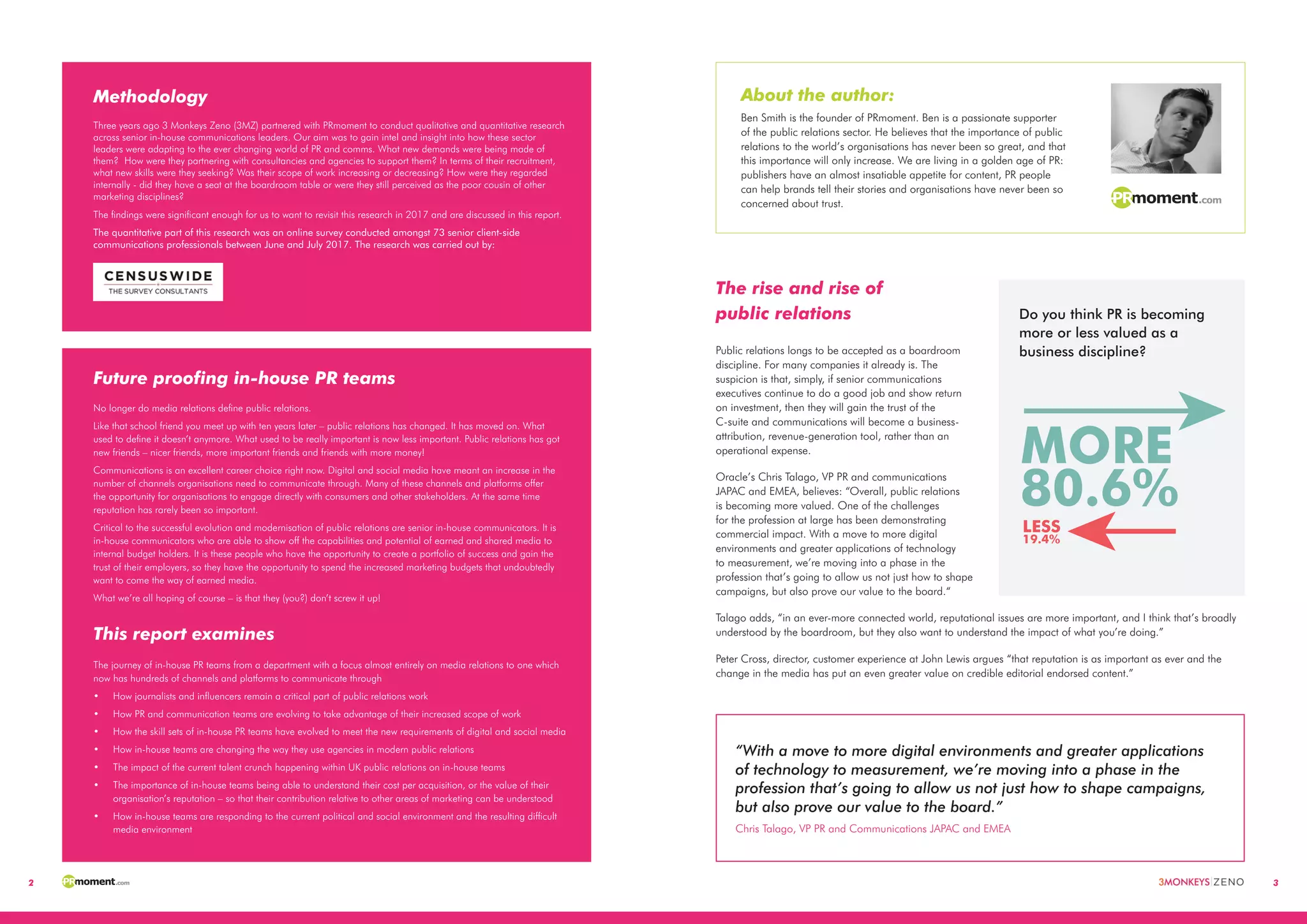
MORE
80.6%
LESS
19.4%
“With a move to more digital environments and greater applications
of technology to measurement, we’re moving into a phase in the
profession that’s going to allow us not just how to shape campaigns,
but also prove our value to the board.”
Chris Talago, VP PR and Communications JAPAC and EMEA
Do you think PR is becoming
more or less valued as a
business discipline?
Future proofing in-house PR teams
No longer do media relations define public relations.
Like that school friend you meet up with ten years later – public relations has changed. It has moved on. What
used to define it doesn’t anymore. What used to be really important is now less important. Public relations has got
new friends – nicer friends, more important friends and friends with more money!
Communications is an excellent career choice right now. Digital and social media have meant an increase in the
number of channels organisations need to communicate through. Many of these channels and platforms offer
the opportunity for organisations to engage directly with consumers and other stakeholders. At the same time
reputation has rarely been so important.
Critical to the successful evolution and modernisation of public relations are senior in-house communicators. It is
in-house communicators who are able to show off the capabilities and potential of earned and shared media to
internal budget holders. It is these people who have the opportunity to create a portfolio of success and gain the
trust of their employers, so they have the opportunity to spend the increased marketing budgets that undoubtedly
want to come the way of earned media.
What we’re all hoping of course – is that they (you?) don’t screw it up!
This report examines
The journey of in-house PR teams from a department with a focus almost entirely on media relations to one which
now has hundreds of channels and platforms to communicate through
•	 How journalists and influencers remain a critical part of public relations work
•	 How PR and communication teams are evolving to take advantage of their increased scope of work
•	 How the skill sets of in-house PR teams have evolved to meet the new requirements of digital and social media
•	 How in-house teams are changing the way they use agencies in modern public relations
•	 The impact of the current talent crunch happening within UK public relations on in-house teams
•	 The importance of in-house teams being able to understand their cost per acquisition, or the value of their
organisation’s reputation – so that their contribution relative to other areas of marketing can be understood
•	 How in-house teams are responding to the current political and social environment and the resulting difficult
media environment
4 5
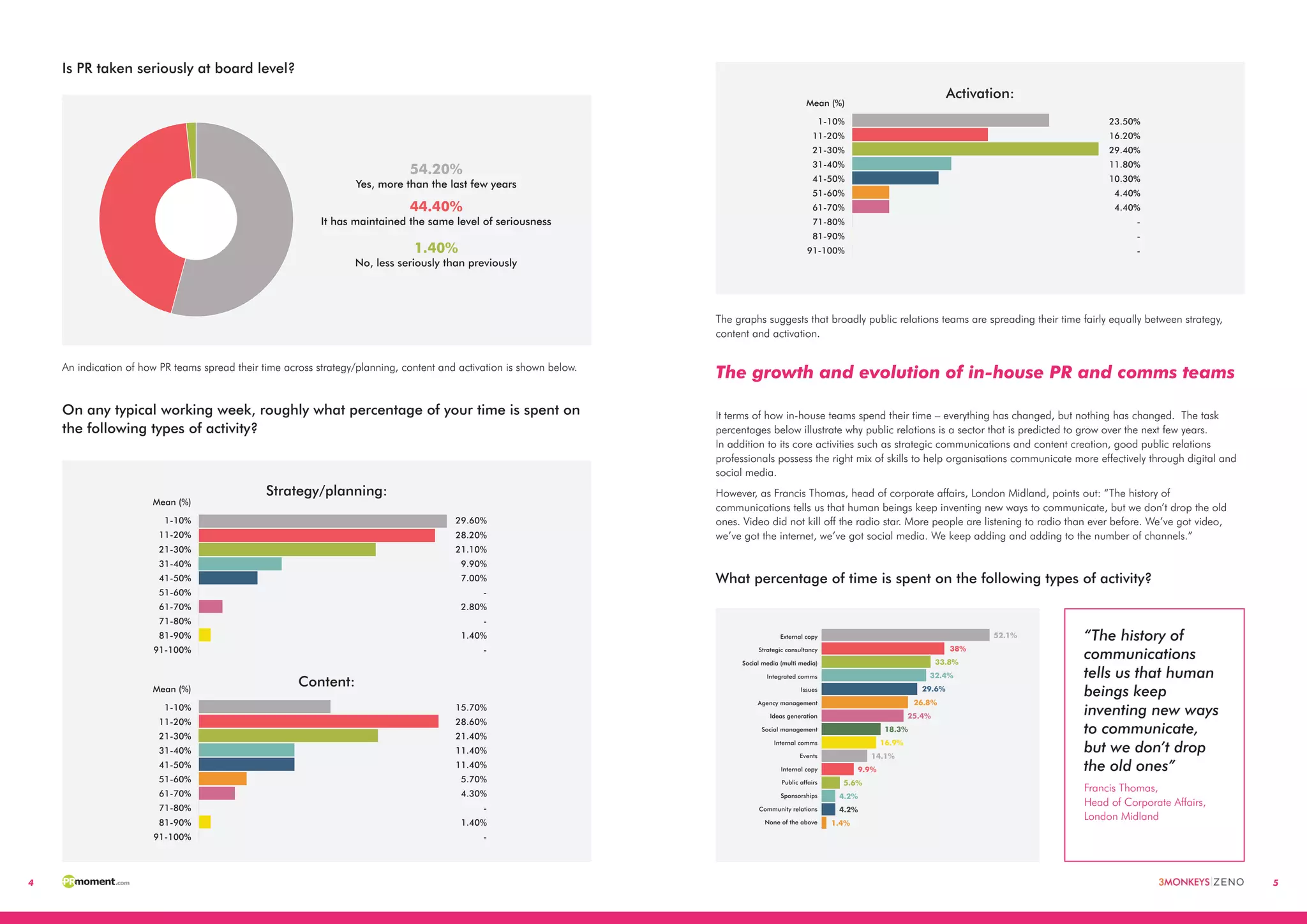
Is PR taken seriously at board level?
An indication of how PR teams spread their time across strategy/planning, content and activation is shown below.
On any typical working week, roughly what percentage of your time is spent on
the following types of activity?
54.20%
Yes, more than the last few years
44.40%
It has maintained the same level of seriousness
1.40%
No, less seriously than previously
54.20%
Yes, more than the last few years
44.40%
It has maintained the same level of seriousness
1.40%
No, less seriously than previously
Strategy/planning:
1-10%
11-20%
21-30%
31-40%
41-50%
51-60%
61-70%
71-80%
81-90%
91-100%
29.60%
28.20%
21.10%
9.90%
7.00%
-
2.80%
-
1.40%
-
Mean (%)
1-10%
11-20%
21-30%
31-40%
41-50%
51-60%
61-70%
71-80%
81-90%
91-100%
15.70%
28.60%
21.40%
11.40%
11.40%
5.70%
4.30%
-
1.40%
-
Mean (%)
1-10%
11-20%
23.50%
16.20%
Mean (%)
Content:
1-10%
11-20%
21-30%
31-40%
41-50%
51-60%
61-70%
71-80%
81-90%
91-100%
29.60%
28.20%
21.10%
9.90%
7.00%
-
2.80%
-
1.40%
-
Mean (%)
1-10%
11-20%
21-30%
31-40%
41-50%
51-60%
61-70%
71-80%
81-90%
91-100%
15.70%
28.60%
21.40%
11.40%
11.40%
5.70%
4.30%
-
1.40%
-
Mean (%)
1-10%
11-20%
23.50%
16.20%
Mean (%)
The graphs suggests that broadly public relations teams are spreading their time fairly equally between strategy,
content and activation.
The growth and evolution of in-house PR and comms teams
It terms of how in-house teams spend their time – everything has changed, but nothing has changed. The task
percentages below illustrate why public relations is a sector that is predicted to grow over the next few years.
In addition to its core activities such as strategic communications and content creation, good public relations
professionals possess the right mix of skills to help organisations communicate more effectively through digital and
social media.
However, as Francis Thomas, head of corporate affairs, London Midland, points out: “The history of
communications tells us that human beings keep inventing new ways to communicate, but we don’t drop the old
ones. Video did not kill off the radio star. More people are listening to radio than ever before. We’ve got video,
we’ve got the internet, we’ve got social media. We keep adding and adding to the number of channels.”
What percentage of time is spent on the following types of activity?
Activation:
51-60%
61-70%
71-80%
81-90%
91-100%
5.70%
4.30%
-
1.40%
-
0
1-10%
11-20%
21-30%
31-40%
41-50%
51-60%
61-70%
71-80%
81-90%
91-100%
23.50%
16.20%
29.40%
11.80%
10.30%
4.40%
4.40%
-
-
-
Mean (%)
52.1%
38%
33.8%
32.4%
29.6%
26.8%
25.4%
18.3%
16.9%
14.1%
5.6%
9.9%
4.2%
4.2%
1.4%
External copy
Strategic consultancy
Social media (multi media)
Integrated comms
Issues
Agency management
Ideas generation
Social management
Internal comms
Events
Internal copy
Public affairs
Sponsorships
Community relations
None of the above
“The history of
communications
tells us that human
beings keep
inventing new ways
to communicate,
but we don’t drop
the old ones”
Francis Thomas,
Head of Corporate Affairs,
London Midland
6 7
The increased scope and responsibility of public relations has changed the profile and contribution of
communications leaders. Lewis Marshall, UK and Ireland country communications manager, IKEA Group, points out
that “my role as the communications manager has become a lot more inward facing into the business. My role now
sits within the management team of the company. Trying to balance the day-to-day operational function alongside
helping steer and advise the business is probably the biggest challenge that I have. We’ve recently introduced a
deputy role and that will focus on leading the comms team and its output, and my role will centre on supporting
and guiding decisions made within the business and what the communication needs for those are.”
When asked about the increasing number of channels that need to be prioritised Oracle’s Chris Talago states:
“It starts with the ability to understand where your audiences go and what they want when they get there. For us
(Oracle) it starts with primary and secondary research that allows us to make that prioritisation.
“That’s really important because it’s not just about the increasing numbers of channels and platforms, it’s also
about the increasing number of products and services that we have to push. The prioritisation comes down to where
we can get most impact for the dollars available – and that comes back to research and analysis of programmes.
Specifically where do we put our money? A lot of it is into media, analysts and social media.”
The need to be able to see the wood as well as the trees is echoed by Francis Thomas, head of corporate affairs
at London Midland. “My job is to protect the reputation of London Midland. And if you think about who influences
your organisation’s reputation, then you focus on working with those audiences. So I have a hierarchy of how
different stakeholders influence and can raise or lower the pressure on the company, depending on what we’re
doing. So right at the top are customers. They have to come first. A great pressure would come if we have a bad
relationship with the secretary of state for Transport. And in between you’ve got rail-user groups, you’ve got local
politicians, you’ve got local and national media, the Department for Transport, MPs and you need be mindful of
how all of those relationships relate to each other and how you relate to them.”
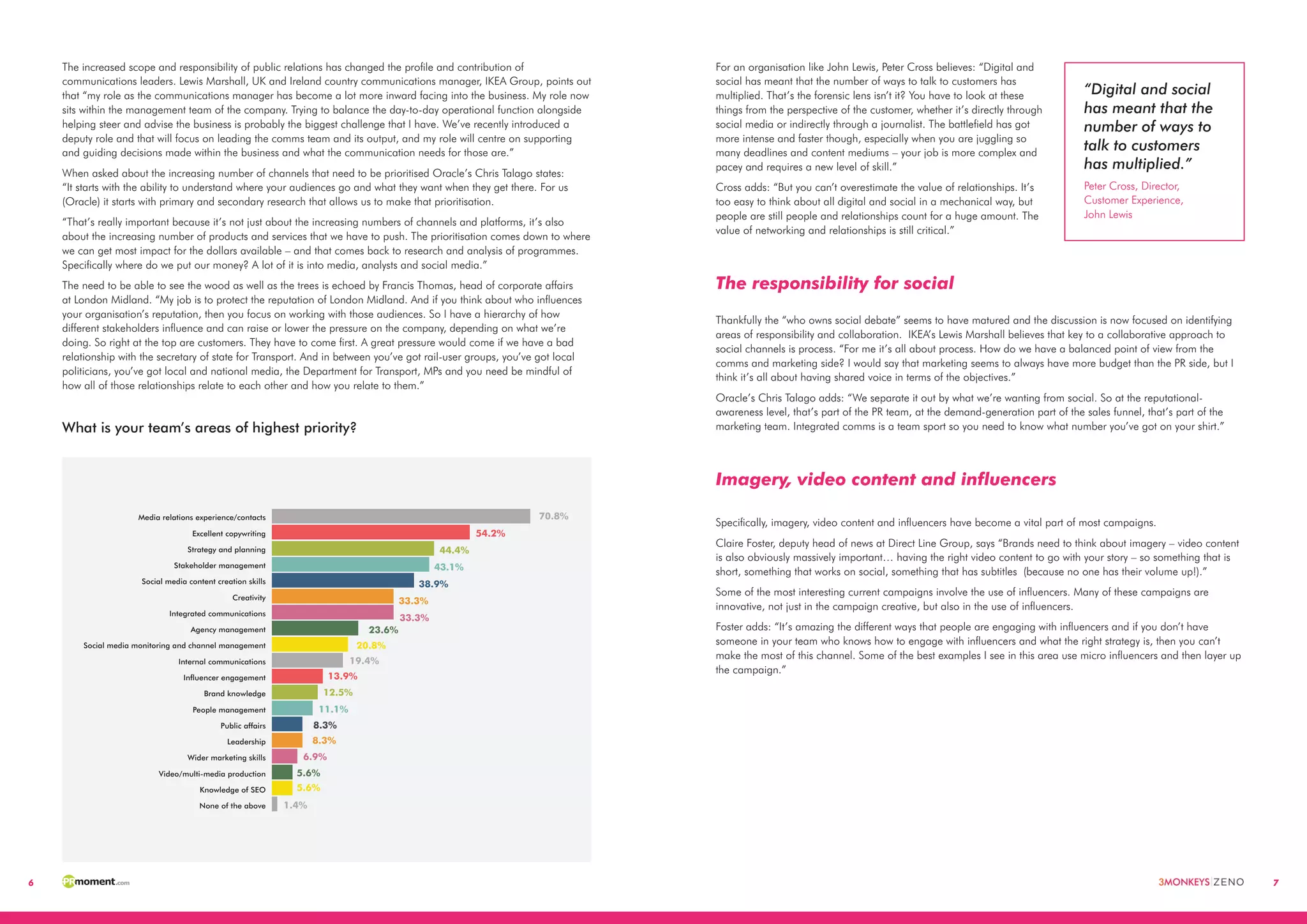
What is your team’s areas of highest priority?
70.8%
54.2%
44.4%
43.1%
38.9%
33.3%
33.3%
23.6%
20.8%
5.6%
5.6%
1.4%
19.4%
12.5%
13.9%
11.1%
8.3%
8.3%
6.9%
Media relations experience/contacts
Excellent copywriting
Strategy and planning
Stakeholder management
Social media content creation skills
Creativity
Integrated communications
Agency management
Social media monitoring and channel management
Internal communications
Influencer engagement
Brand knowledge
People management
Public affairs
Leadership
Wider marketing skills
Video/multi-media production
Knowledge of SEO
None of the above
For an organisation like John Lewis, Peter Cross believes: “Digital and
social has meant that the number of ways to talk to customers has
multiplied. That’s the forensic lens isn’t it? You have to look at these
things from the perspective of the customer, whether it’s directly through
social media or indirectly through a journalist. The battlefield has got
more intense and faster though, especially when you are juggling so
many deadlines and content mediums – your job is more complex and
pacey and requires a new level of skill.”
Cross adds: “But you can’t overestimate the value of relationships. It’s
too easy to think about all digital and social in a mechanical way, but
people are still people and relationships count for a huge amount. The
value of networking and relationships is still critical.”
The responsibility for social
Thankfully the “who owns social debate” seems to have matured and the discussion is now focused on identifying
areas of responsibility and collaboration. IKEA’s Lewis Marshall believes that key to a collaborative approach to
social channels is process. “For me it’s all about process. How do we have a balanced point of view from the
comms and marketing side? I would say that marketing seems to always have more budget than the PR side, but I
think it’s all about having shared voice in terms of the objectives.”
Oracle’s Chris Talago adds: “We separate it out by what we’re wanting from social. So at the reputational-
awareness level, that’s part of the PR team, at the demand-generation part of the sales funnel, that’s part of the
marketing team. Integrated comms is a team sport so you need to know what number you’ve got on your shirt.”
Imagery, video content and influencers
Specifically, imagery, video content and influencers have become a vital part of most campaigns.
Claire Foster, deputy head of news at Direct Line Group, says “Brands need to think about imagery – video content
is also obviously massively important… having the right video content to go with your story – so something that is
short, something that works on social, something that has subtitles (because no one has their volume up!).”
Some of the most interesting current campaigns involve the use of influencers. Many of these campaigns are
innovative, not just in the campaign creative, but also in the use of influencers.
Foster adds: “It’s amazing the different ways that people are engaging with influencers and if you don’t have
someone in your team who knows how to engage with influencers and what the right strategy is, then you can’t
make the most of this channel. Some of the best examples I see in this area use micro influencers and then layer up
the campaign.”
“Digital and social
has meant that the
number of ways to
talk to customers
has multiplied.”
Peter Cross, Director,
Customer Experience,
John Lewis
8 9
What type of skills are most useful in an in-house team?
Overall, there seems to be a trend of in-house teams building up the skills of their teams in both consumer-facing
companies and business-to-business companies.
John Lewis’s Peter Cross says: “We have built creative expertise internally. Not just within the comms team, but as
a broader customer-facing team. Be that for creative events, creative writing, etc. I think the days of PR sitting on
its own may be limited because whilst the comms team can bring a huge amount to other teams, it is equally very
dependent on other teams. We work in a matrix way, and the interdependencies are even more critical. So, for
example, internal communications is close to HR, brand experience is close to customer data and CRM and the
external comms team is close to traditional marketing. So there are a lot more touch points and you are constantly
trying to make those relationships closer and closer.”
Wendy Watherston, head of PR, national communications at Grant Thornton UK LLP, discusses this example
of increased collaboration in a B2B market: “Grant Thornton has increased the size of our in-house PR team
because for a business like us, we’re trying to communicate, often
quite complicated, issues across lots of markets and having people on
the ground is really important. The other element we’ve added is in
having a dedicated resource on the content. It’s something we all get
involved with, but having someone who is focused on that content asset
internally has helped us.”
It would be wrong to suggest that the size of in-house communication
teams are increasing across the board though. In most cases, although
a small increase in head count is common, it is the skill set of the PR/
communications team that is seeing the most significant change. As
London Midland’s Francis Thomas says “The size (or our team) hasn’t
changed for three years. The skill set has changed because we keep
evolving. The biggest challenge we face as communicators today is
pace. You’ve got to be thinking all the time about how to respond in
real time. That means immediate photography, that means having copy
prepared so it can be sent immediately when events start to happen,
thinking about video content and making sure that other stakeholders
who may be party to the event are equally prepared and get their
message out – it’s all about creating a crescendo of news in what is an
increasingly crowded market place.”
20.80%
Strategy/planning
consultancy
20.80%
Content creation
9.70%
Activation
2.80%
Other please specify
45.80%
All skills are equally
as useful in an
inhouse team
20.80%
Strategy/planning
consultancy
20.80%
Content creation
9.70%
Activation
2.80%
Other please specify
45.80%
All skills are equally
as useful in an
inhouse team
“ The days of PR
sitting on its own
may be limited
because whilst
the comms team
can bring a huge
amount to other
teams, it is equally
very dependent on
other teams”
Peter Cross, Director,
Customer Experience,
John Lewis
Internal collaboration – The communications flows of PR
teams
Any successful organisation is a series of inter-related parts which co-ordinate their efforts towards a united goal.
No one department can work, or should work, in isolation and this is especially true for modern public relations.
The touchpoints within an organisation for the communications team are varied, but in an increasing integrated
communications environment, the co-ordination is vital. One of the themes of this report is that in-house
communications teams and marketing teams are structured more closely than ever. As Oracle’s Chris Talago says
“There is barely a day that goes by when we’re not talking with marketing, planning with them, or working out how
we work closer together.”
What other departments do you work most closely with and how often are you
in contact?
Hourly
Daily
Couple of times a week
Weekly
Fortnightly
Monthly
We don't communicate
They are part of our team
23.60%
29.20%
13.90%
5.60%
2.80%
4.20%
1.40%
19.40%
Mean (times per week)
Marketing
Marketing:
Hourly
Daily
Couple of times a week
Weekly
Fortnightly
Monthly
We don't communicate
They are part of our team
1.40%
11.10%
16.70%
16.70%
12.50%
20.80%
19.40%
1.40%
Mean (times per week)
Human Resource
Human Resource:
Hourly
Daily
Couple of times a week
Weekly
Fortnightly
Monthly
They are part of our team
16.70%
29.20%
11.10%
2.80%
4.20%
2.80%
33.30%
Mean (times per week)
Digital/Social Media
Digital/Social Media:
10 11
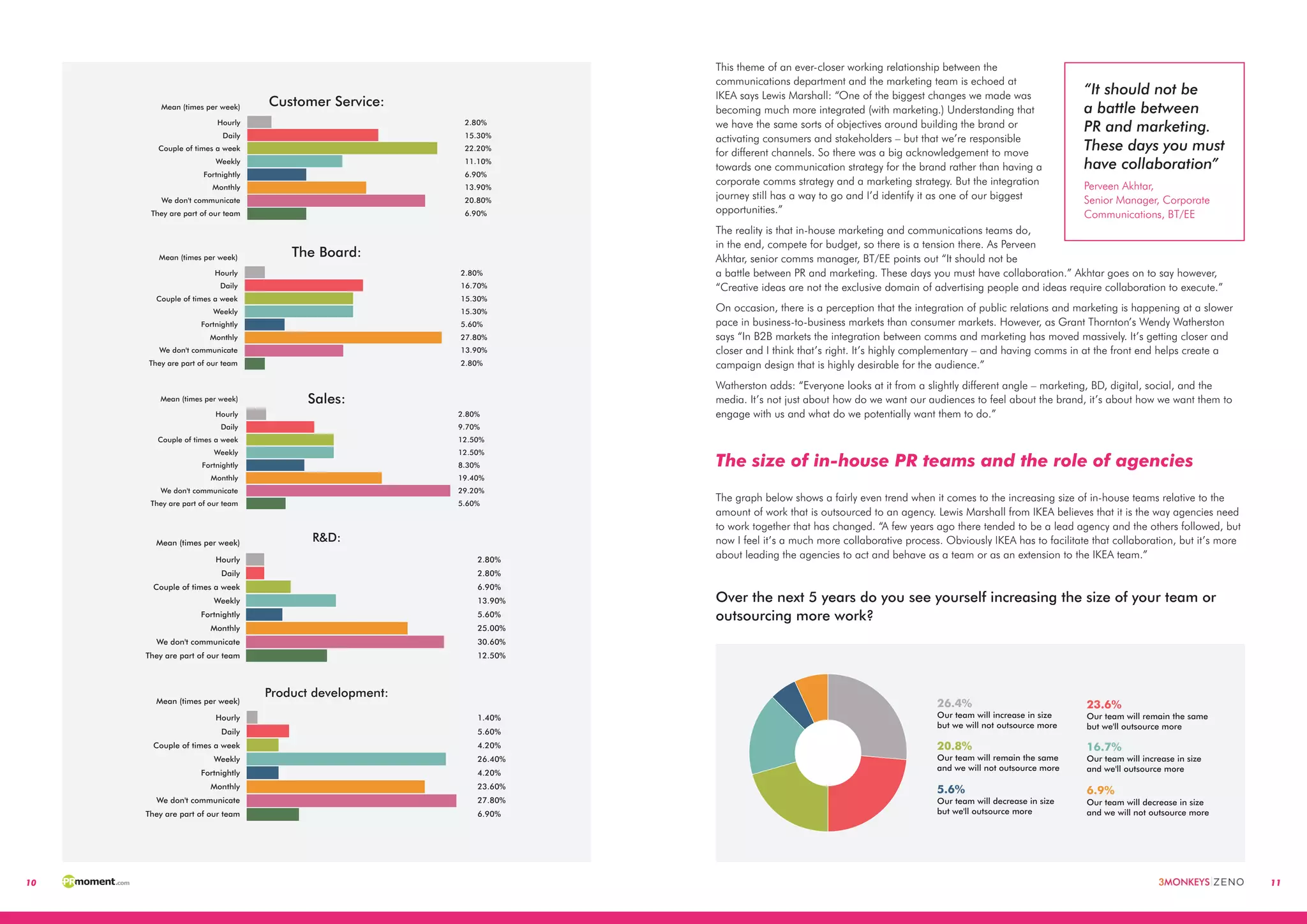
Customer Service:
0 5 10 15 20 25
Hourly
Daily
Couple of times a week
Weekly
Fortnightly
Monthly
We don't communicate
They are part of our team
2.80%
15.30%
22.20%
11.10%
6.90%
13.90%
20.80%
6.90%
Mean (times per week)
Customer Service
0 5 10 15 20 25 30
Hourly
Daily
Couple of times a week
Weekly
Fortnightly
Monthly
We don't communicate
They are part of our team
2.80%
16.70%
15.30%
15.30%
5.60%
27.80%
13.90%
2.80%
Mean (times per week)
The Board
The Board:
Hourly
Daily
Couple of times a week
Weekly
Fortnightly
Monthly
We don't communicate
They are part of our team
2.80%
9.70%
12.50%
12.50%
8.30%
19.40%
29.20%
5.60%
Mean (times per week)
Sales
Sales:
R&D:
Hourly
Daily
Couple of times a week
Weekly
Fortnightly
Monthly
We don't communicate
They are part of our team
2.80%
2.80%
6.90%
13.90%
5.60%
25.00%
30.60%
12.50%
Mean (times per week)
R&D
Hourly
Daily
Couple of times a week
Weekly
Fortnightly
Monthly
We don't communicate
They are part of our team
1.40%
5.60%
4.20%
26.40%
4.20%
23.60%
27.80%
6.90%
Mean (times per week)
Product development
Product development:
This theme of an ever-closer working relationship between the
communications department and the marketing team is echoed at
IKEA says Lewis Marshall: “One of the biggest changes we made was
becoming much more integrated (with marketing.) Understanding that
we have the same sorts of objectives around building the brand or
activating consumers and stakeholders – but that we’re responsible
for different channels. So there was a big acknowledgement to move
towards one communication strategy for the brand rather than having a
corporate comms strategy and a marketing strategy. But the integration
journey still has a way to go and I’d identify it as one of our biggest
opportunities.”
The reality is that in-house marketing and communications teams do,
in the end, compete for budget, so there is a tension there. As Perveen
Akhtar, senior comms manager, BT/EE points out “It should not be
a battle between PR and marketing. These days you must have collaboration.” Akhtar goes on to say however,
“Creative ideas are not the exclusive domain of advertising people and ideas require collaboration to execute.”
On occasion, there is a perception that the integration of public relations and marketing is happening at a slower
pace in business-to-business markets than consumer markets. However, as Grant Thornton’s Wendy Watherston
says “In B2B markets the integration between comms and marketing has moved massively. It’s getting closer and
closer and I think that’s right. It’s highly complementary – and having comms in at the front end helps create a
campaign design that is highly desirable for the audience.”
Watherston adds: “Everyone looks at it from a slightly different angle – marketing, BD, digital, social, and the
media. It’s not just about how do we want our audiences to feel about the brand, it’s about how we want them to
engage with us and what do we potentially want them to do.”
The size of in-house PR teams and the role of agencies
The graph below shows a fairly even trend when it comes to the increasing size of in-house teams relative to the
amount of work that is outsourced to an agency. Lewis Marshall from IKEA believes that it is the way agencies need
to work together that has changed. “A few years ago there tended to be a lead agency and the others followed, but
now I feel it’s a much more collaborative process. Obviously IKEA has to facilitate that collaboration, but it’s more
about leading the agencies to act and behave as a team or as an extension to the IKEA team.”
Over the next 5 years do you see yourself increasing the size of your team or
outsourcing more work?
“It should not be
a battle between
PR and marketing.
These days you must
have collaboration”
Perveen Akhtar,
Senior Manager, Corporate
Communications, BT/EE
26.4%
Our team will increase in size
but we will not outsource more
23.6%
Our team will remain the same
but we'll outsource more
20.8%
Our team will remain the same
and we will not outsource more
16.7%
Our team will increase in size
and we'll outsource more
5.6%
Our team will decrease in size
but we'll outsource more
6.9%
Our team will decrease in size
and we will not outsource more
26.4%
Our team will increase in size
but we will not outsource more
23.6%
Our team will remain the same
but we'll outsource more
20.8%
Our team will remain the same
and we will not outsource more
16.7%
Our team will increase in size
and we'll outsource more
5.6%
Our team will decrease in size
but we'll outsource more
6.9%
Our team will decrease in size
and we will not outsource more
26.4%
Our team will increase in size
but we will not outsource more
23.6%
Our team will remain the same
but we'll outsource more
20.8%
Our team will remain the same
and we will not outsource more
16.7%
Our team will increase in size
and we'll outsource more
5.6%
Our team will decrease in size
but we'll outsource more
6.9%
Our team will decrease in size
and we will not outsource more
12 13
Chris Talago discusses why Oracle uses agency support: “The reasons for using an agency have become more
pronounced. At the macro level you’ve got scale, risk and skills. In terms of scale, a lot more of what we do as a
brand involves turning activity on and then turning it off and that brings with it a difficulty in scaling quickly enough
and scaling in an orderly enough fashion in a way that’s meaningful.
“Second is risk. Fifty% of what we do is delivered through the in-house team and fifty percent is delivered through
the agency. The variety of skills that are required mean that it’s incredibly difficult for an in-house team to recreate
all of the skills that you need and to do that is incredibly risky – to have that many people on staff.
“For the agency the difficulty is the number of skills that are now required. Those have always been the reason
for engaging with agencies – digital and the variety of content we are now expected to produce has given those
requirements an even greater focus.”
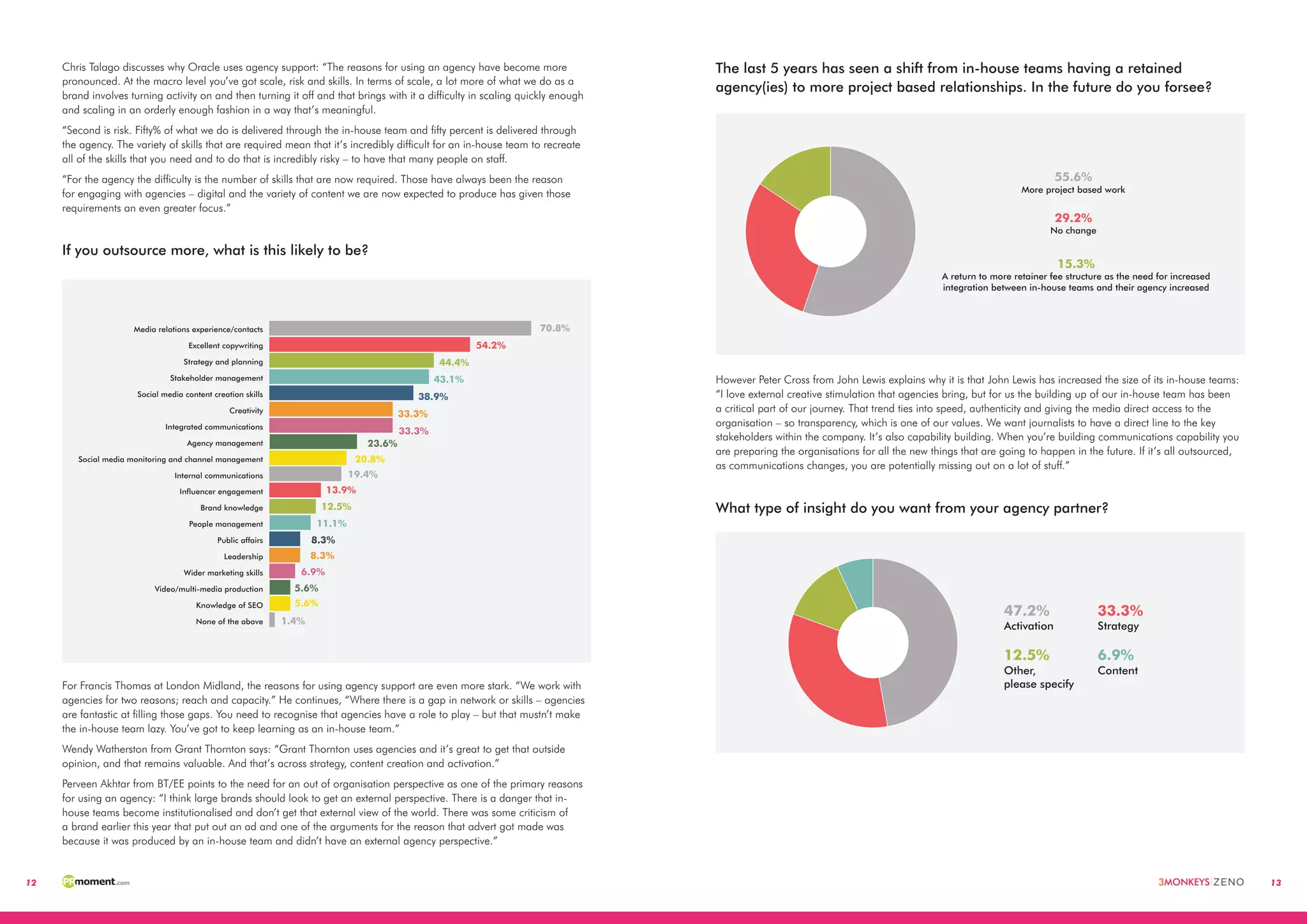
If you outsource more, what is this likely to be?
For Francis Thomas at London Midland, the reasons for using agency support are even more stark. “We work with
agencies for two reasons; reach and capacity.” He continues, “Where there is a gap in network or skills – agencies
are fantastic at filling those gaps. You need to recognise that agencies have a role to play – but that mustn’t make
the in-house team lazy. You’ve got to keep learning as an in-house team.”
Wendy Watherston from Grant Thornton says: “Grant Thornton uses agencies and it’s great to get that outside
opinion, and that remains valuable. And that’s across strategy, content creation and activation.”
Perveen Akhtar from BT/EE points to the need for an out of organisation perspective as one of the primary reasons
for using an agency: “I think large brands should look to get an external perspective. There is a danger that in-
house teams become institutionalised and don’t get that external view of the world. There was some criticism of
a brand earlier this year that put out an ad and one of the arguments for the reason that advert got made was
because it was produced by an in-house team and didn’t have an external agency perspective.”
70.8%
54.2%
44.4%
43.1%
38.9%
33.3%
33.3%
23.6%
20.8%
5.6%
5.6%
1.4%
19.4%
12.5%
13.9%
11.1%
8.3%
8.3%
6.9%
Media relations experience/contacts
Excellent copywriting
Strategy and planning
Stakeholder management
Social media content creation skills
Creativity
Integrated communications
Agency management
Social media monitoring and channel management
Internal communications
Influencer engagement
Brand knowledge
People management
Public affairs
Leadership
Wider marketing skills
Video/multi-media production
Knowledge of SEO
None of the above
0 10 20 30 40 50 60 70 80
The last 5 years has seen a shift from in-house teams having a retained
agency(ies) to more project based relationships. In the future do you forsee?
However Peter Cross from John Lewis explains why it is that John Lewis has increased the size of its in-house teams:
“I love external creative stimulation that agencies bring, but for us the building up of our in-house team has been
a critical part of our journey. That trend ties into speed, authenticity and giving the media direct access to the
organisation – so transparency, which is one of our values. We want journalists to have a direct line to the key
stakeholders within the company. It’s also capability building. When you’re building communications capability you
are preparing the organisations for all the new things that are going to happen in the future. If it’s all outsourced,
as communications changes, you are potentially missing out on a lot of stuff.”
What type of insight do you want from your agency partner?
55.6%
More project based work
29.2%
No change
15.3%
A return to more retainer fee structure as the need for increased
integration between in-house teams and their agency increased
55.6%
More project based work
29.2%
No change
15.3%
A return to more retainer fee structure as the need for increased
integration between in-house teams and their agency increased
47.2%
Activation
33.3%
Strategy
12.5%
Other,
please specify
6.9%
Content
47.2%
Activation
33.3%
Strategy
12.5%
Other,
please specify
6.9%
Content
14 15
PR’s talent crisis
Public relations is a difficult sector to recruit in. There is no shortage of jobs, but there is a lack of available and
suitably skilled talent within the sector.
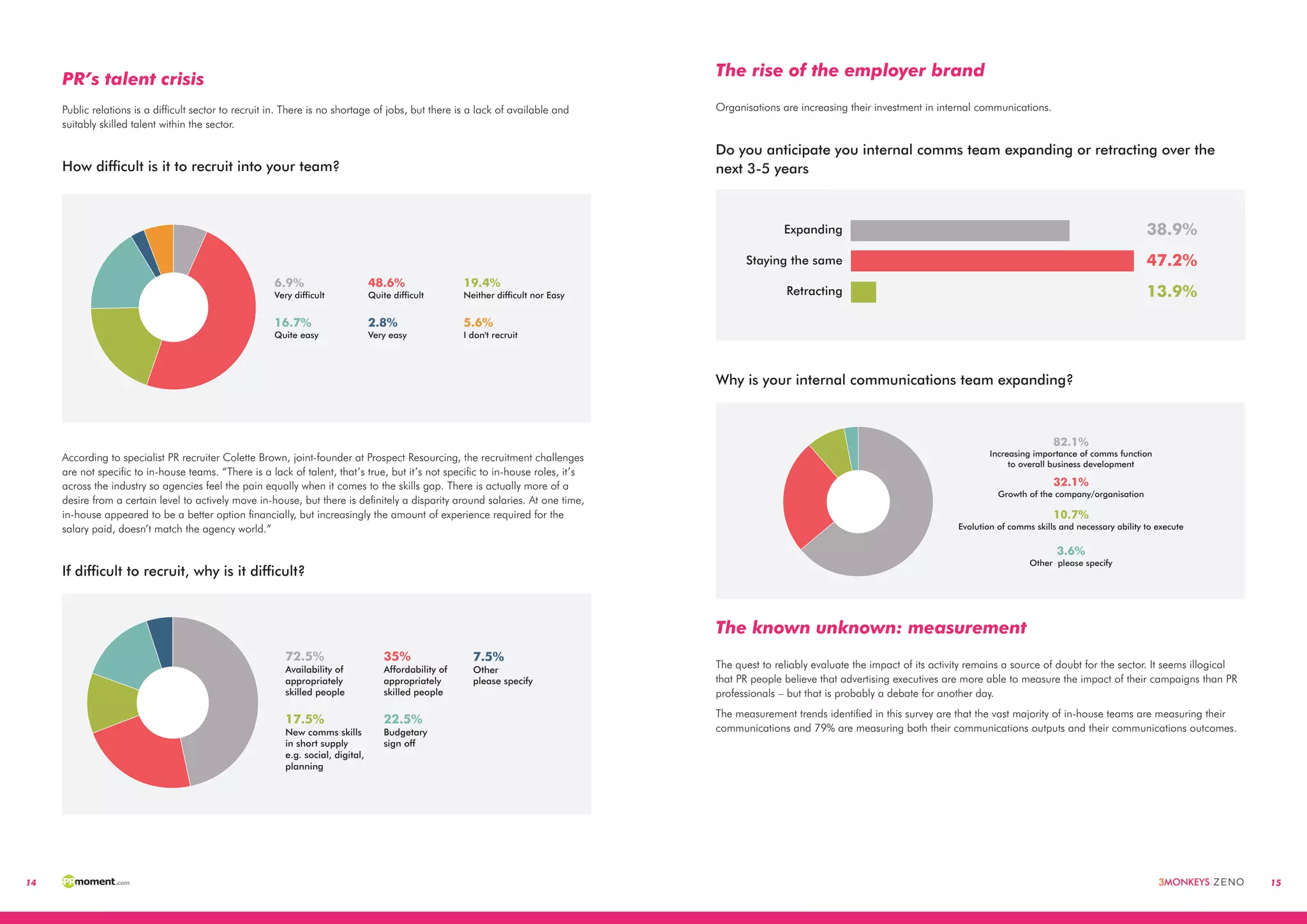
How difficult is it to recruit into your team?
According to specialist PR recruiter Colette Brown, joint-founder at Prospect Resourcing, the recruitment challenges
are not specific to in-house teams. “There is a lack of talent, that’s true, but it’s not specific to in-house roles, it’s
across the industry so agencies feel the pain equally when it comes to the skills gap. There is actually more of a
desire from a certain level to actively move in-house, but there is definitely a disparity around salaries. At one time,
in-house appeared to be a better option financially, but increasingly the amount of experience required for the
salary paid, doesn’t match the agency world.”
If difficult to recruit, why is it difficult?
6.9%
Very difficult
48.6%
Quite difficult
19.4%
Neither difficult nor Easy
16.7%
Quite easy
5.6%
I don't recruit
2.8%
Very easy
6.9%
Very difficult
48.6%
Quite difficult
19.4%
Neither difficult nor Easy
16.7%
Quite easy
5.6%
I don't recruit
2.8%
Very easy
72.5%
Availability of
appropriately
skilled people
7.5%
Other
please specify
35%
Affordability of
appropriately
skilled people
17.5%
New comms skills
in short supply
e.g. social, digital,
planning
22.5%
Budgetary
sign off
72.5%
Availability of
appropriately
skilled people
7.5%
Other
please specify
35%
Affordability of
appropriately
skilled people
17.5%
New comms skills
in short supply
e.g. social, digital,
planning
22.5%
Budgetary
sign off
72.5%
Availability of
appropriately
skilled people
7.5%
Other
please specify
35%
Affordability of
appropriately
skilled people
17.5%
New comms skills
in short supply
e.g. social, digital,
planning
22.5%
Budgetary
sign off
The rise of the employer brand
Organisations are increasing their investment in internal communications.
Do you anticipate you internal comms team expanding or retracting over the
next 3-5 years
Why is your internal communications team expanding?
The known unknown: measurement
The quest to reliably evaluate the impact of its activity remains a source of doubt for the sector. It seems illogical
that PR people believe that advertising executives are more able to measure the impact of their campaigns than PR
professionals – but that is probably a debate for another day.
The measurement trends identified in this survey are that the vast majority of in-house teams are measuring their
communications and 79% are measuring both their communications outputs and their communications outcomes.
38.9%
47.2%
13.9%
Expanding
Staying the same
Retracting
0 10 20 30 40 50
82.1%
Increasing importance of comms function
to overall business development
32.1%
Growth of the company/organisation
10.7%
Evolution of comms skills and necessary ability to execute
3.6%
Other please specify
82.1%
Increasing importance of comms function
to overall business development
32.1%
Growth of the company/organisation
10.7%
Evolution of comms skills and necessary ability to execute
3.6%
Other please specify
16 17
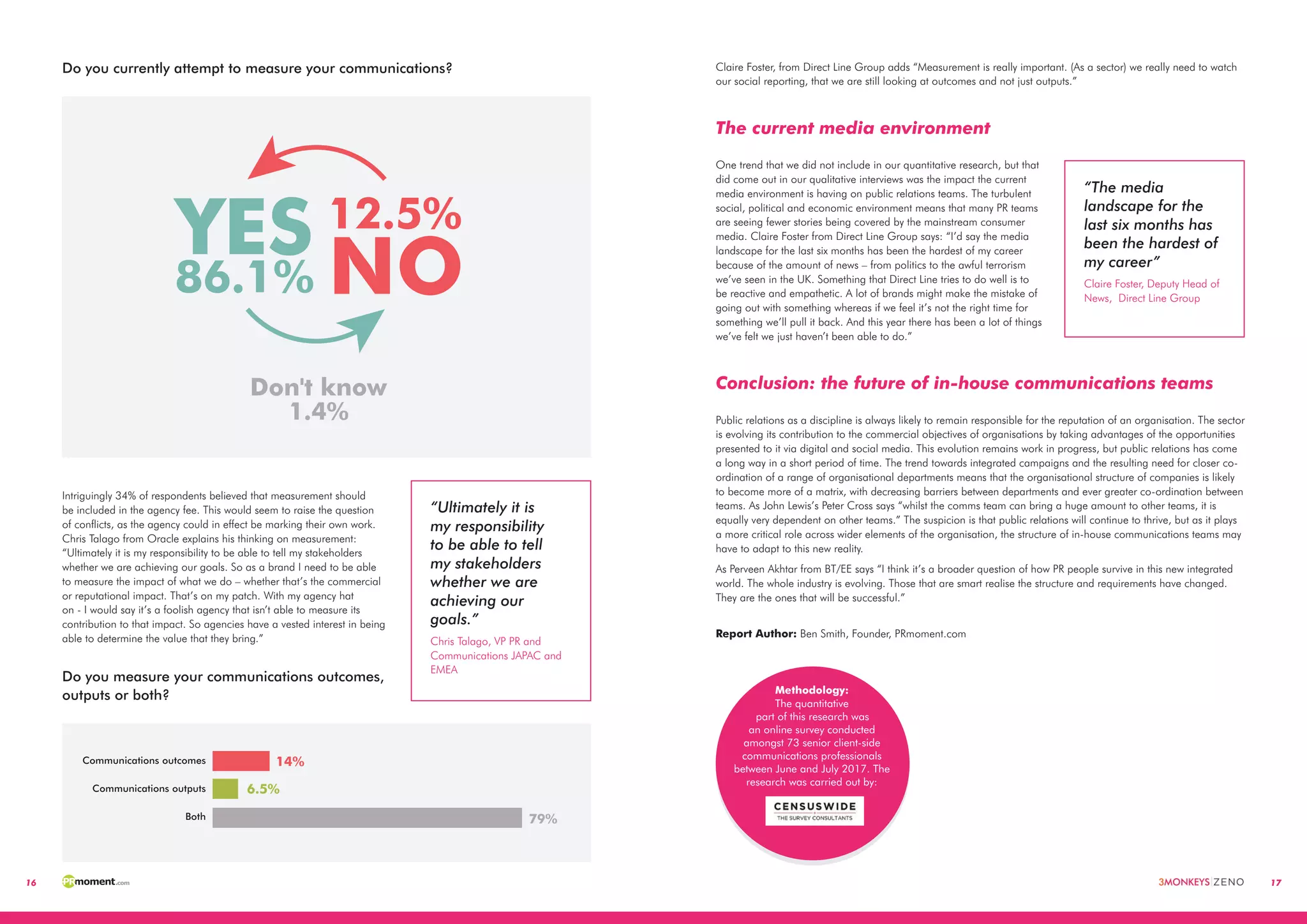
Do you currently attempt to measure your communications?
Intriguingly 34% of respondents believed that measurement should
be included in the agency fee. This would seem to raise the question
of conflicts, as the agency could in effect be marking their own work.
Chris Talago from Oracle explains his thinking on measurement:
“Ultimately it is my responsibility to be able to tell my stakeholders
whether we are achieving our goals. So as a brand I need to be able
to measure the impact of what we do – whether that’s the commercial
or reputational impact. That’s on my patch. With my agency hat
on - I would say it’s a foolish agency that isn’t able to measure its
contribution to that impact. So agencies have a vested interest in being
able to determine the value that they bring.”
Do you measure your communications outcomes,
outputs or both?
Don't know
1.4%
YES86.1% NO
12.5%
14%
6.5%
Communications outcomes
Communications outputs
Both 79%
“Ultimately it is
my responsibility
to be able to tell
my stakeholders
whether we are
achieving our
goals.”
Chris Talago, VP PR and
Communications JAPAC and
EMEA
Claire Foster, from Direct Line Group adds “Measurement is really important. (As a sector) we really need to watch
our social reporting, that we are still looking at outcomes and not just outputs.”
The current media environment
One trend that we did not include in our quantitative research, but that
did come out in our qualitative interviews was the impact the current
media environment is having on public relations teams. The turbulent
social, political and economic environment means that many PR teams
are seeing fewer stories being covered by the mainstream consumer
media. Claire Foster from Direct Line Group says: “I’d say the media
landscape for the last six months has been the hardest of my career
because of the amount of news – from politics to the awful terrorism
we’ve seen in the UK. Something that Direct Line tries to do well is to
be reactive and empathetic. A lot of brands might make the mistake of
going out with something whereas if we feel it’s not the right time for
something we’ll pull it back. And this year there has been a lot of things
we’ve felt we just haven’t been able to do.”
Conclusion: the future of in-house communications teams
Public relations as a discipline is always likely to remain responsible for the reputation of an organisation. The sector
is evolving its contribution to the commercial objectives of organisations by taking advantages of the opportunities
presented to it via digital and social media. This evolution remains work in progress, but public relations has come
a long way in a short period of time. The trend towards integrated campaigns and the resulting need for closer co-
ordination of a range of organisational departments means that the organisational structure of companies is likely
to become more of a matrix, with decreasing barriers between departments and ever greater co-ordination between
teams. As John Lewis’s Peter Cross says “whilst the comms team can bring a huge amount to other teams, it is
equally very dependent on other teams.” The suspicion is that public relations will continue to thrive, but as it plays
a more critical role across wider elements of the organisation, the structure of in-house communications teams may
have to adapt to this new reality.
As Perveen Akhtar from BT/EE says “I think it’s a broader question of how PR people survive in this new integrated
world. The whole industry is evolving. Those that are smart realise the structure and requirements have changed.
They are the ones that will be successful.”
“The media
landscape for the
last six months has
been the hardest of
my career”
Claire Foster, Deputy Head of
News,  Direct Line Group
Report Author: Ben Smith, Founder, PRmoment.com
Methodology:
The quantitative
part of this research was
an online survey conducted
amongst 77 client-side
communications professionals
between 14 December 2016 and
28 January 2017. The research was
carried out by:
Methodology:
The quantitative
part of this research was
an online survey conducted
amongst 73 senior client-side
communications professionals
between June and July 2017. The
research was carried out by:
18 19
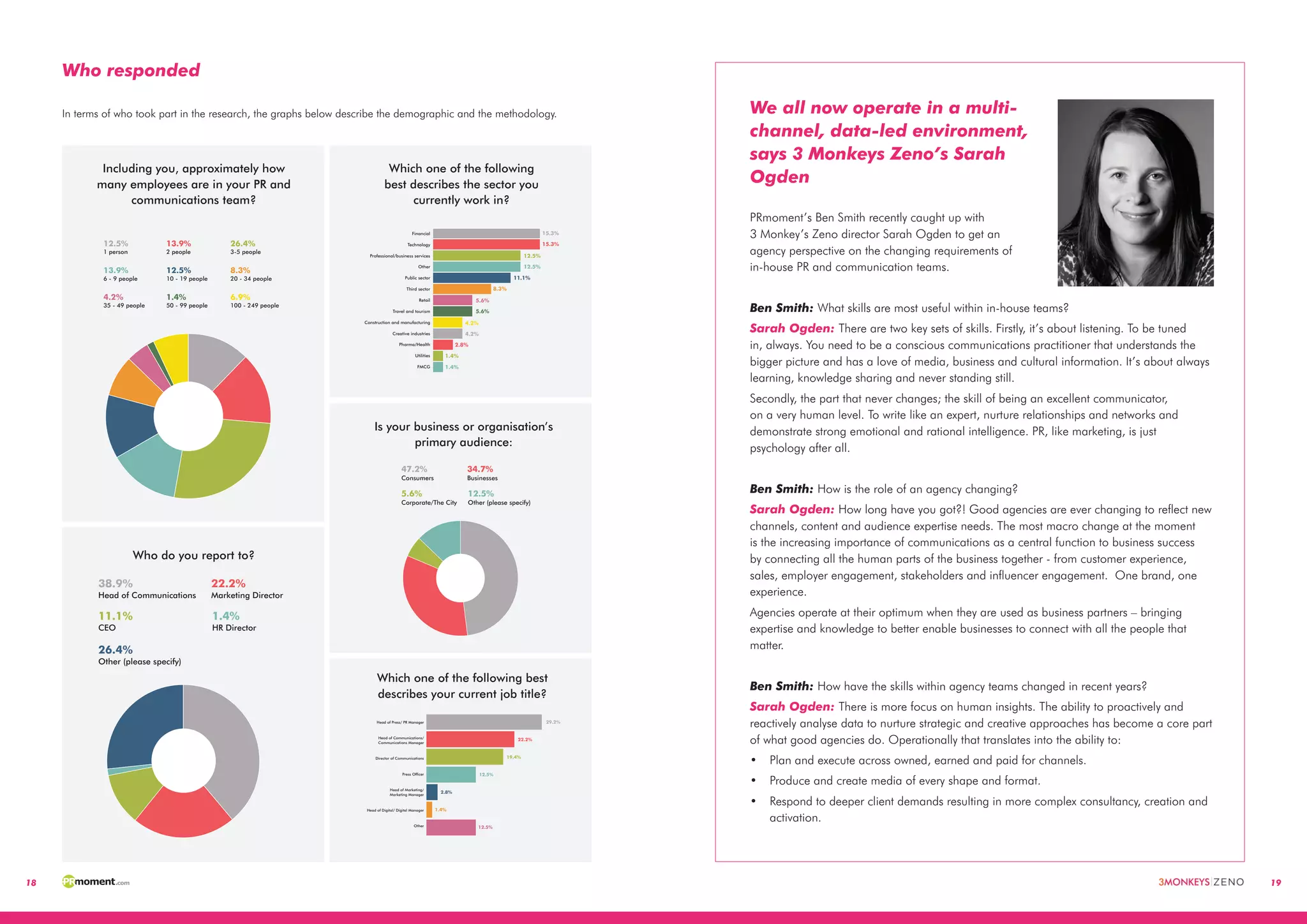
Including you, approximately how
many employees are in your PR and
communications team?
Which one of the following
best describes the sector you
currently work in?
Is your business or organisation’s
primary audience:
12.5%
1 person
13.9%
2 people
26.4%
3-5 people
13.9%
6 - 9 people
6.9%
100 - 249 people
1.4%
50 - 99 people
4.2%
35 - 49 people
8.3%
20 - 34 people
12.5%
10 - 19 people
15.3%Financial
Technology
Professional/business services
Other
Public sector
Third sector
Retail
Travel and tourism
Construction and manufacturing
Creative industries
Pharma/Health
Utilities
FMCG
15.3%
12.5%
12.5%
11.1%
8.3%
5.6%
5.6%
4.2%
4.2%
2.8%
1.4%
1.4%
0 5 10 15 20
47.2%
Consumers
34.7%
Businesses
5.6%
Corporate/The City
12.5%
Other (please specify)
Who do you report to?
38.9%
Head of Communications
22.2%
Marketing Director
11.1%
CEO
26.4%
Other (please specify)
1.4%
HR Director
Which one of the following best
describes your current job title?
29.2%Head of Press/ PR Manager
Head of Communications/
Communications Manager
Director of Communications
Press Officer
Head of Marketing/
Marketing Manager
Head of Digital/ Digital Manager
Other
22.2%
19.4%
12.5%
2.8%
1.4%
12.5%
0 5 10 15 20 25 30
Who responded
In terms of who took part in the research, the graphs below describe the demographic and the methodology. We all now operate in a multi-
channel, data-led environment,
says 3 Monkeys Zeno’s Sarah
Ogden
PRmoment’s Ben Smith recently caught up with
3 Monkey’s Zeno director Sarah Ogden to get an
agency perspective on the changing requirements of
in-house PR and communication teams.
Ben Smith: What skills are most useful within in-house teams?
Sarah Ogden: There are two key sets of skills. Firstly, it’s about listening. To be tuned
in, always. You need to be a conscious communications practitioner that understands the
bigger picture and has a love of media, business and cultural information. It’s about always
learning, knowledge sharing and never standing still.
Secondly, the part that never changes; the skill of being an excellent communicator,
on a very human level. To write like an expert, nurture relationships and networks and
demonstrate strong emotional and rational intelligence. PR, like marketing, is just
psychology after all.
Ben Smith: How is the role of an agency changing?
Sarah Ogden: How long have you got?! Good agencies are ever changing to reflect new
channels, content and audience expertise needs. The most macro change at the moment
is the increasing importance of communications as a central function to business success
by connecting all the human parts of the business together - from customer experience,
sales, employer engagement, stakeholders and influencer engagement.  One brand, one
experience.
Agencies operate at their optimum when they are used as business partners – bringing
expertise and knowledge to better enable businesses to connect with all the people that
matter.
Ben Smith: How have the skills within agency teams changed in recent years?
Sarah Ogden: There is more focus on human insights. The ability to proactively and
reactively analyse data to nurture strategic and creative approaches has become a core part
of what good agencies do. Operationally that translates into the ability to:
•	 Plan and execute across owned, earned and paid for channels.
•	 Produce and create media of every shape and format. 
•	 Respond to deeper client demands resulting in more complex consultancy, creation and
activation.
Ben Smith: How have the demands of your clients changed in the last 5 years?
Sarah Ogden: See all of the above! I would add everyone wants more for less. The
constraints of money, time and resource means greater focus on integration, smarter
working etc. which has its pros and cons.
Ben Smith: Tell me about 3 Monkey Zeno’s evaluation system ROAR
Sarah Ogden: Having a data-led, prove everything mind-set and a desire to correlate
communications outputs with business outcomes is why we created our R.O.A.R (real
outcomes and results) evaluation and planning scorecard system. Comms people can
now harness data and human insights to drive better, more impactful communications.
Storytelling remains fundamental, but that alone is no longer enough. Communications
must prove ROI every step of the way. The story told needs to land with the right audience,
in the right channel, at the right time. The questions we must address are not just how
we measure, but also how do we optimise?  We call this Performance Communications.
Measuring not just output, but actual outcomes. Driving audiences to take action, engage,
purchase, shift behaviour - and deliver quantifiable business impact. 
The competition for internal and external audience attention is growing. It has never been
more important to measure the efficacy of our communications beyond just outputs such
as coverage volume and reach, to include a detailed, qualitative analysis.  We need
to know where and how our message is landing, and the behavioural/attitudinal shifts
that occur as a direct result of our campaigns. What’s more, the exponential growth in
the volume and variety of channels available across paid, owned, shared, and earned
media has introduced a wealth of additional metrics to the already complex world of
measurement, making accurate and accountable reporting ever more challenging but
important.
Enter ROAR, 3 Monkeys Zeno’s proprietary effectiveness framework.
The Lightbox
127-133 Charing Cross Road, London, WC2H 0EW
020 7009 3100
hello@3monkeyszeno.com
Future proofing in-house PR teams - 3 monkeys | ZENO

Future proofing in-house PR teams - 3 monkeys | ZENO

  • 1.
    Future proofing in-house PRteams July 2017 Contents: 1 Executive Summary and Methodology 2 The rise and rise of public relations 4 The growth and evolution of in-house PR and comms teams 8 Internal collaboration – The communications flows of PR teams 10 The size of in-house PR teams and the role of agencies 12 PR’s talent crisis 13 The rise of the employer brand 13 The known unknown: measurement 16 The current media environment 16 Conclusion: the future of in-house communications teams 17 Who responded 18 Interview with 3 Monkeys Zeno’s Sarah Ogden
  • 2.
    2 3 Methodology Three yearsago 3 Monkeys Zeno (3MZ) partnered with PRmoment to conduct qualitative and quantitative research across senior in-house communications leaders. Our aim was to gain intel and insight into how these sector leaders were adapting to the ever changing world of PR and comms. What new demands were being made of them? How were they partnering with consultancies and agencies to support them? In terms of their recruitment, what new skills were they seeking? Was their scope of work increasing or decreasing? How were they regarded internally - did they have a seat at the boardroom table or were they still perceived as the poor cousin of other marketing disciplines? The findings were significant enough for us to want to revisit this research in 2017 and are discussed in this report. The quantitative part of this research was an online survey conducted amongst 73 senior client-side communications professionals between June and July 2017. The research was carried out by: About the author: Ben Smith is the founder of PRmoment. Ben is a passionate supporter of the public relations sector. He believes that the importance of public relations to the world’s organisations has never been so great, and that this importance will only increase. We are living in a golden age of PR: publishers have an almost insatiable appetite for content, PR people can help brands tell their stories and organisations have never been so concerned about trust. The rise and rise of public relations Public relations longs to be accepted as a boardroom discipline. For many companies it already is. The suspicion is that, simply, if senior communications executives continue to do a good job and show return on investment, then they will gain the trust of the C-suite and communications will become a business- attribution, revenue-generation tool, rather than an operational expense. Oracle’s Chris Talago, VP PR and communications JAPAC and EMEA, believes: “Overall, public relations is becoming more valued. One of the challenges for the profession at large has been demonstrating commercial impact. With a move to more digital environments and greater applications of technology to measurement, we’re moving into a phase in the profession that’s going to allow us not just how to shape campaigns, but also prove our value to the board.“ Talago adds, “in an ever-more connected world, reputational issues are more important, and I think that’s broadly understood by the boardroom, but they also want to understand the impact of what you’re doing.” Peter Cross, director, customer experience at John Lewis argues “that reputation is as important as ever and the change in the media has put an even greater value on credible editorial endorsed content.” MORE 80.6% LESS 19.4% “With a move to more digital environments and greater applications of technology to measurement, we’re moving into a phase in the profession that’s going to allow us not just how to shape campaigns, but also prove our value to the board.” Chris Talago, VP PR and Communications JAPAC and EMEA Do you think PR is becoming more or less valued as a business discipline? Future proofing in-house PR teams No longer do media relations define public relations. Like that school friend you meet up with ten years later – public relations has changed. It has moved on. What used to define it doesn’t anymore. What used to be really important is now less important. Public relations has got new friends – nicer friends, more important friends and friends with more money! Communications is an excellent career choice right now. Digital and social media have meant an increase in the number of channels organisations need to communicate through. Many of these channels and platforms offer the opportunity for organisations to engage directly with consumers and other stakeholders. At the same time reputation has rarely been so important. Critical to the successful evolution and modernisation of public relations are senior in-house communicators. It is in-house communicators who are able to show off the capabilities and potential of earned and shared media to internal budget holders. It is these people who have the opportunity to create a portfolio of success and gain the trust of their employers, so they have the opportunity to spend the increased marketing budgets that undoubtedly want to come the way of earned media. What we’re all hoping of course – is that they (you?) don’t screw it up! This report examines The journey of in-house PR teams from a department with a focus almost entirely on media relations to one which now has hundreds of channels and platforms to communicate through • How journalists and influencers remain a critical part of public relations work • How PR and communication teams are evolving to take advantage of their increased scope of work • How the skill sets of in-house PR teams have evolved to meet the new requirements of digital and social media • How in-house teams are changing the way they use agencies in modern public relations • The impact of the current talent crunch happening within UK public relations on in-house teams • The importance of in-house teams being able to understand their cost per acquisition, or the value of their organisation’s reputation – so that their contribution relative to other areas of marketing can be understood • How in-house teams are responding to the current political and social environment and the resulting difficult media environment
  • 3.
    4 5 Is PRtaken seriously at board level? An indication of how PR teams spread their time across strategy/planning, content and activation is shown below. On any typical working week, roughly what percentage of your time is spent on the following types of activity? 54.20% Yes, more than the last few years 44.40% It has maintained the same level of seriousness 1.40% No, less seriously than previously 54.20% Yes, more than the last few years 44.40% It has maintained the same level of seriousness 1.40% No, less seriously than previously Strategy/planning: 1-10% 11-20% 21-30% 31-40% 41-50% 51-60% 61-70% 71-80% 81-90% 91-100% 29.60% 28.20% 21.10% 9.90% 7.00% - 2.80% - 1.40% - Mean (%) 1-10% 11-20% 21-30% 31-40% 41-50% 51-60% 61-70% 71-80% 81-90% 91-100% 15.70% 28.60% 21.40% 11.40% 11.40% 5.70% 4.30% - 1.40% - Mean (%) 1-10% 11-20% 23.50% 16.20% Mean (%) Content: 1-10% 11-20% 21-30% 31-40% 41-50% 51-60% 61-70% 71-80% 81-90% 91-100% 29.60% 28.20% 21.10% 9.90% 7.00% - 2.80% - 1.40% - Mean (%) 1-10% 11-20% 21-30% 31-40% 41-50% 51-60% 61-70% 71-80% 81-90% 91-100% 15.70% 28.60% 21.40% 11.40% 11.40% 5.70% 4.30% - 1.40% - Mean (%) 1-10% 11-20% 23.50% 16.20% Mean (%) The graphs suggests that broadly public relations teams are spreading their time fairly equally between strategy, content and activation. The growth and evolution of in-house PR and comms teams It terms of how in-house teams spend their time – everything has changed, but nothing has changed. The task percentages below illustrate why public relations is a sector that is predicted to grow over the next few years. In addition to its core activities such as strategic communications and content creation, good public relations professionals possess the right mix of skills to help organisations communicate more effectively through digital and social media. However, as Francis Thomas, head of corporate affairs, London Midland, points out: “The history of communications tells us that human beings keep inventing new ways to communicate, but we don’t drop the old ones. Video did not kill off the radio star. More people are listening to radio than ever before. We’ve got video, we’ve got the internet, we’ve got social media. We keep adding and adding to the number of channels.” What percentage of time is spent on the following types of activity? Activation: 51-60% 61-70% 71-80% 81-90% 91-100% 5.70% 4.30% - 1.40% - 0 1-10% 11-20% 21-30% 31-40% 41-50% 51-60% 61-70% 71-80% 81-90% 91-100% 23.50% 16.20% 29.40% 11.80% 10.30% 4.40% 4.40% - - - Mean (%) 52.1% 38% 33.8% 32.4% 29.6% 26.8% 25.4% 18.3% 16.9% 14.1% 5.6% 9.9% 4.2% 4.2% 1.4% External copy Strategic consultancy Social media (multi media) Integrated comms Issues Agency management Ideas generation Social management Internal comms Events Internal copy Public affairs Sponsorships Community relations None of the above “The history of communications tells us that human beings keep inventing new ways to communicate, but we don’t drop the old ones” Francis Thomas, Head of Corporate Affairs, London Midland
  • 4.
    6 7 The increasedscope and responsibility of public relations has changed the profile and contribution of communications leaders. Lewis Marshall, UK and Ireland country communications manager, IKEA Group, points out that “my role as the communications manager has become a lot more inward facing into the business. My role now sits within the management team of the company. Trying to balance the day-to-day operational function alongside helping steer and advise the business is probably the biggest challenge that I have. We’ve recently introduced a deputy role and that will focus on leading the comms team and its output, and my role will centre on supporting and guiding decisions made within the business and what the communication needs for those are.” When asked about the increasing number of channels that need to be prioritised Oracle’s Chris Talago states: “It starts with the ability to understand where your audiences go and what they want when they get there. For us (Oracle) it starts with primary and secondary research that allows us to make that prioritisation. “That’s really important because it’s not just about the increasing numbers of channels and platforms, it’s also about the increasing number of products and services that we have to push. The prioritisation comes down to where we can get most impact for the dollars available – and that comes back to research and analysis of programmes. Specifically where do we put our money? A lot of it is into media, analysts and social media.” The need to be able to see the wood as well as the trees is echoed by Francis Thomas, head of corporate affairs at London Midland. “My job is to protect the reputation of London Midland. And if you think about who influences your organisation’s reputation, then you focus on working with those audiences. So I have a hierarchy of how different stakeholders influence and can raise or lower the pressure on the company, depending on what we’re doing. So right at the top are customers. They have to come first. A great pressure would come if we have a bad relationship with the secretary of state for Transport. And in between you’ve got rail-user groups, you’ve got local politicians, you’ve got local and national media, the Department for Transport, MPs and you need be mindful of how all of those relationships relate to each other and how you relate to them.” What is your team’s areas of highest priority? 70.8% 54.2% 44.4% 43.1% 38.9% 33.3% 33.3% 23.6% 20.8% 5.6% 5.6% 1.4% 19.4% 12.5% 13.9% 11.1% 8.3% 8.3% 6.9% Media relations experience/contacts Excellent copywriting Strategy and planning Stakeholder management Social media content creation skills Creativity Integrated communications Agency management Social media monitoring and channel management Internal communications Influencer engagement Brand knowledge People management Public affairs Leadership Wider marketing skills Video/multi-media production Knowledge of SEO None of the above For an organisation like John Lewis, Peter Cross believes: “Digital and social has meant that the number of ways to talk to customers has multiplied. That’s the forensic lens isn’t it? You have to look at these things from the perspective of the customer, whether it’s directly through social media or indirectly through a journalist. The battlefield has got more intense and faster though, especially when you are juggling so many deadlines and content mediums – your job is more complex and pacey and requires a new level of skill.” Cross adds: “But you can’t overestimate the value of relationships. It’s too easy to think about all digital and social in a mechanical way, but people are still people and relationships count for a huge amount. The value of networking and relationships is still critical.” The responsibility for social Thankfully the “who owns social debate” seems to have matured and the discussion is now focused on identifying areas of responsibility and collaboration. IKEA’s Lewis Marshall believes that key to a collaborative approach to social channels is process. “For me it’s all about process. How do we have a balanced point of view from the comms and marketing side? I would say that marketing seems to always have more budget than the PR side, but I think it’s all about having shared voice in terms of the objectives.” Oracle’s Chris Talago adds: “We separate it out by what we’re wanting from social. So at the reputational- awareness level, that’s part of the PR team, at the demand-generation part of the sales funnel, that’s part of the marketing team. Integrated comms is a team sport so you need to know what number you’ve got on your shirt.” Imagery, video content and influencers Specifically, imagery, video content and influencers have become a vital part of most campaigns. Claire Foster, deputy head of news at Direct Line Group, says “Brands need to think about imagery – video content is also obviously massively important… having the right video content to go with your story – so something that is short, something that works on social, something that has subtitles (because no one has their volume up!).” Some of the most interesting current campaigns involve the use of influencers. Many of these campaigns are innovative, not just in the campaign creative, but also in the use of influencers. Foster adds: “It’s amazing the different ways that people are engaging with influencers and if you don’t have someone in your team who knows how to engage with influencers and what the right strategy is, then you can’t make the most of this channel. Some of the best examples I see in this area use micro influencers and then layer up the campaign.” “Digital and social has meant that the number of ways to talk to customers has multiplied.” Peter Cross, Director, Customer Experience, John Lewis
  • 5.
    8 9 What typeof skills are most useful in an in-house team? Overall, there seems to be a trend of in-house teams building up the skills of their teams in both consumer-facing companies and business-to-business companies. John Lewis’s Peter Cross says: “We have built creative expertise internally. Not just within the comms team, but as a broader customer-facing team. Be that for creative events, creative writing, etc. I think the days of PR sitting on its own may be limited because whilst the comms team can bring a huge amount to other teams, it is equally very dependent on other teams. We work in a matrix way, and the interdependencies are even more critical. So, for example, internal communications is close to HR, brand experience is close to customer data and CRM and the external comms team is close to traditional marketing. So there are a lot more touch points and you are constantly trying to make those relationships closer and closer.” Wendy Watherston, head of PR, national communications at Grant Thornton UK LLP, discusses this example of increased collaboration in a B2B market: “Grant Thornton has increased the size of our in-house PR team because for a business like us, we’re trying to communicate, often quite complicated, issues across lots of markets and having people on the ground is really important. The other element we’ve added is in having a dedicated resource on the content. It’s something we all get involved with, but having someone who is focused on that content asset internally has helped us.” It would be wrong to suggest that the size of in-house communication teams are increasing across the board though. In most cases, although a small increase in head count is common, it is the skill set of the PR/ communications team that is seeing the most significant change. As London Midland’s Francis Thomas says “The size (or our team) hasn’t changed for three years. The skill set has changed because we keep evolving. The biggest challenge we face as communicators today is pace. You’ve got to be thinking all the time about how to respond in real time. That means immediate photography, that means having copy prepared so it can be sent immediately when events start to happen, thinking about video content and making sure that other stakeholders who may be party to the event are equally prepared and get their message out – it’s all about creating a crescendo of news in what is an increasingly crowded market place.” 20.80% Strategy/planning consultancy 20.80% Content creation 9.70% Activation 2.80% Other please specify 45.80% All skills are equally as useful in an inhouse team 20.80% Strategy/planning consultancy 20.80% Content creation 9.70% Activation 2.80% Other please specify 45.80% All skills are equally as useful in an inhouse team “ The days of PR sitting on its own may be limited because whilst the comms team can bring a huge amount to other teams, it is equally very dependent on other teams” Peter Cross, Director, Customer Experience, John Lewis Internal collaboration – The communications flows of PR teams Any successful organisation is a series of inter-related parts which co-ordinate their efforts towards a united goal. No one department can work, or should work, in isolation and this is especially true for modern public relations. The touchpoints within an organisation for the communications team are varied, but in an increasing integrated communications environment, the co-ordination is vital. One of the themes of this report is that in-house communications teams and marketing teams are structured more closely than ever. As Oracle’s Chris Talago says “There is barely a day that goes by when we’re not talking with marketing, planning with them, or working out how we work closer together.” What other departments do you work most closely with and how often are you in contact? Hourly Daily Couple of times a week Weekly Fortnightly Monthly We don't communicate They are part of our team 23.60% 29.20% 13.90% 5.60% 2.80% 4.20% 1.40% 19.40% Mean (times per week) Marketing Marketing: Hourly Daily Couple of times a week Weekly Fortnightly Monthly We don't communicate They are part of our team 1.40% 11.10% 16.70% 16.70% 12.50% 20.80% 19.40% 1.40% Mean (times per week) Human Resource Human Resource: Hourly Daily Couple of times a week Weekly Fortnightly Monthly They are part of our team 16.70% 29.20% 11.10% 2.80% 4.20% 2.80% 33.30% Mean (times per week) Digital/Social Media Digital/Social Media:
  • 6.
    10 11 Customer Service: 05 10 15 20 25 Hourly Daily Couple of times a week Weekly Fortnightly Monthly We don't communicate They are part of our team 2.80% 15.30% 22.20% 11.10% 6.90% 13.90% 20.80% 6.90% Mean (times per week) Customer Service 0 5 10 15 20 25 30 Hourly Daily Couple of times a week Weekly Fortnightly Monthly We don't communicate They are part of our team 2.80% 16.70% 15.30% 15.30% 5.60% 27.80% 13.90% 2.80% Mean (times per week) The Board The Board: Hourly Daily Couple of times a week Weekly Fortnightly Monthly We don't communicate They are part of our team 2.80% 9.70% 12.50% 12.50% 8.30% 19.40% 29.20% 5.60% Mean (times per week) Sales Sales: R&D: Hourly Daily Couple of times a week Weekly Fortnightly Monthly We don't communicate They are part of our team 2.80% 2.80% 6.90% 13.90% 5.60% 25.00% 30.60% 12.50% Mean (times per week) R&D Hourly Daily Couple of times a week Weekly Fortnightly Monthly We don't communicate They are part of our team 1.40% 5.60% 4.20% 26.40% 4.20% 23.60% 27.80% 6.90% Mean (times per week) Product development Product development: This theme of an ever-closer working relationship between the communications department and the marketing team is echoed at IKEA says Lewis Marshall: “One of the biggest changes we made was becoming much more integrated (with marketing.) Understanding that we have the same sorts of objectives around building the brand or activating consumers and stakeholders – but that we’re responsible for different channels. So there was a big acknowledgement to move towards one communication strategy for the brand rather than having a corporate comms strategy and a marketing strategy. But the integration journey still has a way to go and I’d identify it as one of our biggest opportunities.” The reality is that in-house marketing and communications teams do, in the end, compete for budget, so there is a tension there. As Perveen Akhtar, senior comms manager, BT/EE points out “It should not be a battle between PR and marketing. These days you must have collaboration.” Akhtar goes on to say however, “Creative ideas are not the exclusive domain of advertising people and ideas require collaboration to execute.” On occasion, there is a perception that the integration of public relations and marketing is happening at a slower pace in business-to-business markets than consumer markets. However, as Grant Thornton’s Wendy Watherston says “In B2B markets the integration between comms and marketing has moved massively. It’s getting closer and closer and I think that’s right. It’s highly complementary – and having comms in at the front end helps create a campaign design that is highly desirable for the audience.” Watherston adds: “Everyone looks at it from a slightly different angle – marketing, BD, digital, social, and the media. It’s not just about how do we want our audiences to feel about the brand, it’s about how we want them to engage with us and what do we potentially want them to do.” The size of in-house PR teams and the role of agencies The graph below shows a fairly even trend when it comes to the increasing size of in-house teams relative to the amount of work that is outsourced to an agency. Lewis Marshall from IKEA believes that it is the way agencies need to work together that has changed. “A few years ago there tended to be a lead agency and the others followed, but now I feel it’s a much more collaborative process. Obviously IKEA has to facilitate that collaboration, but it’s more about leading the agencies to act and behave as a team or as an extension to the IKEA team.” Over the next 5 years do you see yourself increasing the size of your team or outsourcing more work? “It should not be a battle between PR and marketing. These days you must have collaboration” Perveen Akhtar, Senior Manager, Corporate Communications, BT/EE 26.4% Our team will increase in size but we will not outsource more 23.6% Our team will remain the same but we'll outsource more 20.8% Our team will remain the same and we will not outsource more 16.7% Our team will increase in size and we'll outsource more 5.6% Our team will decrease in size but we'll outsource more 6.9% Our team will decrease in size and we will not outsource more 26.4% Our team will increase in size but we will not outsource more 23.6% Our team will remain the same but we'll outsource more 20.8% Our team will remain the same and we will not outsource more 16.7% Our team will increase in size and we'll outsource more 5.6% Our team will decrease in size but we'll outsource more 6.9% Our team will decrease in size and we will not outsource more 26.4% Our team will increase in size but we will not outsource more 23.6% Our team will remain the same but we'll outsource more 20.8% Our team will remain the same and we will not outsource more 16.7% Our team will increase in size and we'll outsource more 5.6% Our team will decrease in size but we'll outsource more 6.9% Our team will decrease in size and we will not outsource more
  • 7.
    12 13 Chris Talagodiscusses why Oracle uses agency support: “The reasons for using an agency have become more pronounced. At the macro level you’ve got scale, risk and skills. In terms of scale, a lot more of what we do as a brand involves turning activity on and then turning it off and that brings with it a difficulty in scaling quickly enough and scaling in an orderly enough fashion in a way that’s meaningful. “Second is risk. Fifty% of what we do is delivered through the in-house team and fifty percent is delivered through the agency. The variety of skills that are required mean that it’s incredibly difficult for an in-house team to recreate all of the skills that you need and to do that is incredibly risky – to have that many people on staff. “For the agency the difficulty is the number of skills that are now required. Those have always been the reason for engaging with agencies – digital and the variety of content we are now expected to produce has given those requirements an even greater focus.” If you outsource more, what is this likely to be? For Francis Thomas at London Midland, the reasons for using agency support are even more stark. “We work with agencies for two reasons; reach and capacity.” He continues, “Where there is a gap in network or skills – agencies are fantastic at filling those gaps. You need to recognise that agencies have a role to play – but that mustn’t make the in-house team lazy. You’ve got to keep learning as an in-house team.” Wendy Watherston from Grant Thornton says: “Grant Thornton uses agencies and it’s great to get that outside opinion, and that remains valuable. And that’s across strategy, content creation and activation.” Perveen Akhtar from BT/EE points to the need for an out of organisation perspective as one of the primary reasons for using an agency: “I think large brands should look to get an external perspective. There is a danger that in- house teams become institutionalised and don’t get that external view of the world. There was some criticism of a brand earlier this year that put out an ad and one of the arguments for the reason that advert got made was because it was produced by an in-house team and didn’t have an external agency perspective.” 70.8% 54.2% 44.4% 43.1% 38.9% 33.3% 33.3% 23.6% 20.8% 5.6% 5.6% 1.4% 19.4% 12.5% 13.9% 11.1% 8.3% 8.3% 6.9% Media relations experience/contacts Excellent copywriting Strategy and planning Stakeholder management Social media content creation skills Creativity Integrated communications Agency management Social media monitoring and channel management Internal communications Influencer engagement Brand knowledge People management Public affairs Leadership Wider marketing skills Video/multi-media production Knowledge of SEO None of the above 0 10 20 30 40 50 60 70 80 The last 5 years has seen a shift from in-house teams having a retained agency(ies) to more project based relationships. In the future do you forsee? However Peter Cross from John Lewis explains why it is that John Lewis has increased the size of its in-house teams: “I love external creative stimulation that agencies bring, but for us the building up of our in-house team has been a critical part of our journey. That trend ties into speed, authenticity and giving the media direct access to the organisation – so transparency, which is one of our values. We want journalists to have a direct line to the key stakeholders within the company. It’s also capability building. When you’re building communications capability you are preparing the organisations for all the new things that are going to happen in the future. If it’s all outsourced, as communications changes, you are potentially missing out on a lot of stuff.” What type of insight do you want from your agency partner? 55.6% More project based work 29.2% No change 15.3% A return to more retainer fee structure as the need for increased integration between in-house teams and their agency increased 55.6% More project based work 29.2% No change 15.3% A return to more retainer fee structure as the need for increased integration between in-house teams and their agency increased 47.2% Activation 33.3% Strategy 12.5% Other, please specify 6.9% Content 47.2% Activation 33.3% Strategy 12.5% Other, please specify 6.9% Content
  • 8.
    14 15 PR’s talentcrisis Public relations is a difficult sector to recruit in. There is no shortage of jobs, but there is a lack of available and suitably skilled talent within the sector. How difficult is it to recruit into your team? According to specialist PR recruiter Colette Brown, joint-founder at Prospect Resourcing, the recruitment challenges are not specific to in-house teams. “There is a lack of talent, that’s true, but it’s not specific to in-house roles, it’s across the industry so agencies feel the pain equally when it comes to the skills gap. There is actually more of a desire from a certain level to actively move in-house, but there is definitely a disparity around salaries. At one time, in-house appeared to be a better option financially, but increasingly the amount of experience required for the salary paid, doesn’t match the agency world.” If difficult to recruit, why is it difficult? 6.9% Very difficult 48.6% Quite difficult 19.4% Neither difficult nor Easy 16.7% Quite easy 5.6% I don't recruit 2.8% Very easy 6.9% Very difficult 48.6% Quite difficult 19.4% Neither difficult nor Easy 16.7% Quite easy 5.6% I don't recruit 2.8% Very easy 72.5% Availability of appropriately skilled people 7.5% Other please specify 35% Affordability of appropriately skilled people 17.5% New comms skills in short supply e.g. social, digital, planning 22.5% Budgetary sign off 72.5% Availability of appropriately skilled people 7.5% Other please specify 35% Affordability of appropriately skilled people 17.5% New comms skills in short supply e.g. social, digital, planning 22.5% Budgetary sign off 72.5% Availability of appropriately skilled people 7.5% Other please specify 35% Affordability of appropriately skilled people 17.5% New comms skills in short supply e.g. social, digital, planning 22.5% Budgetary sign off The rise of the employer brand Organisations are increasing their investment in internal communications. Do you anticipate you internal comms team expanding or retracting over the next 3-5 years Why is your internal communications team expanding? The known unknown: measurement The quest to reliably evaluate the impact of its activity remains a source of doubt for the sector. It seems illogical that PR people believe that advertising executives are more able to measure the impact of their campaigns than PR professionals – but that is probably a debate for another day. The measurement trends identified in this survey are that the vast majority of in-house teams are measuring their communications and 79% are measuring both their communications outputs and their communications outcomes. 38.9% 47.2% 13.9% Expanding Staying the same Retracting 0 10 20 30 40 50 82.1% Increasing importance of comms function to overall business development 32.1% Growth of the company/organisation 10.7% Evolution of comms skills and necessary ability to execute 3.6% Other please specify 82.1% Increasing importance of comms function to overall business development 32.1% Growth of the company/organisation 10.7% Evolution of comms skills and necessary ability to execute 3.6% Other please specify
  • 9.
    16 17 Do youcurrently attempt to measure your communications? Intriguingly 34% of respondents believed that measurement should be included in the agency fee. This would seem to raise the question of conflicts, as the agency could in effect be marking their own work. Chris Talago from Oracle explains his thinking on measurement: “Ultimately it is my responsibility to be able to tell my stakeholders whether we are achieving our goals. So as a brand I need to be able to measure the impact of what we do – whether that’s the commercial or reputational impact. That’s on my patch. With my agency hat on - I would say it’s a foolish agency that isn’t able to measure its contribution to that impact. So agencies have a vested interest in being able to determine the value that they bring.” Do you measure your communications outcomes, outputs or both? Don't know 1.4% YES86.1% NO 12.5% 14% 6.5% Communications outcomes Communications outputs Both 79% “Ultimately it is my responsibility to be able to tell my stakeholders whether we are achieving our goals.” Chris Talago, VP PR and Communications JAPAC and EMEA Claire Foster, from Direct Line Group adds “Measurement is really important. (As a sector) we really need to watch our social reporting, that we are still looking at outcomes and not just outputs.” The current media environment One trend that we did not include in our quantitative research, but that did come out in our qualitative interviews was the impact the current media environment is having on public relations teams. The turbulent social, political and economic environment means that many PR teams are seeing fewer stories being covered by the mainstream consumer media. Claire Foster from Direct Line Group says: “I’d say the media landscape for the last six months has been the hardest of my career because of the amount of news – from politics to the awful terrorism we’ve seen in the UK. Something that Direct Line tries to do well is to be reactive and empathetic. A lot of brands might make the mistake of going out with something whereas if we feel it’s not the right time for something we’ll pull it back. And this year there has been a lot of things we’ve felt we just haven’t been able to do.” Conclusion: the future of in-house communications teams Public relations as a discipline is always likely to remain responsible for the reputation of an organisation. The sector is evolving its contribution to the commercial objectives of organisations by taking advantages of the opportunities presented to it via digital and social media. This evolution remains work in progress, but public relations has come a long way in a short period of time. The trend towards integrated campaigns and the resulting need for closer co- ordination of a range of organisational departments means that the organisational structure of companies is likely to become more of a matrix, with decreasing barriers between departments and ever greater co-ordination between teams. As John Lewis’s Peter Cross says “whilst the comms team can bring a huge amount to other teams, it is equally very dependent on other teams.” The suspicion is that public relations will continue to thrive, but as it plays a more critical role across wider elements of the organisation, the structure of in-house communications teams may have to adapt to this new reality. As Perveen Akhtar from BT/EE says “I think it’s a broader question of how PR people survive in this new integrated world. The whole industry is evolving. Those that are smart realise the structure and requirements have changed. They are the ones that will be successful.” “The media landscape for the last six months has been the hardest of my career” Claire Foster, Deputy Head of News,  Direct Line Group Report Author: Ben Smith, Founder, PRmoment.com Methodology: The quantitative part of this research was an online survey conducted amongst 77 client-side communications professionals between 14 December 2016 and 28 January 2017. The research was carried out by: Methodology: The quantitative part of this research was an online survey conducted amongst 73 senior client-side communications professionals between June and July 2017. The research was carried out by:
  • 10.
    18 19 Including you,approximately how many employees are in your PR and communications team? Which one of the following best describes the sector you currently work in? Is your business or organisation’s primary audience: 12.5% 1 person 13.9% 2 people 26.4% 3-5 people 13.9% 6 - 9 people 6.9% 100 - 249 people 1.4% 50 - 99 people 4.2% 35 - 49 people 8.3% 20 - 34 people 12.5% 10 - 19 people 15.3%Financial Technology Professional/business services Other Public sector Third sector Retail Travel and tourism Construction and manufacturing Creative industries Pharma/Health Utilities FMCG 15.3% 12.5% 12.5% 11.1% 8.3% 5.6% 5.6% 4.2% 4.2% 2.8% 1.4% 1.4% 0 5 10 15 20 47.2% Consumers 34.7% Businesses 5.6% Corporate/The City 12.5% Other (please specify) Who do you report to? 38.9% Head of Communications 22.2% Marketing Director 11.1% CEO 26.4% Other (please specify) 1.4% HR Director Which one of the following best describes your current job title? 29.2%Head of Press/ PR Manager Head of Communications/ Communications Manager Director of Communications Press Officer Head of Marketing/ Marketing Manager Head of Digital/ Digital Manager Other 22.2% 19.4% 12.5% 2.8% 1.4% 12.5% 0 5 10 15 20 25 30 Who responded In terms of who took part in the research, the graphs below describe the demographic and the methodology. We all now operate in a multi- channel, data-led environment, says 3 Monkeys Zeno’s Sarah Ogden PRmoment’s Ben Smith recently caught up with 3 Monkey’s Zeno director Sarah Ogden to get an agency perspective on the changing requirements of in-house PR and communication teams. Ben Smith: What skills are most useful within in-house teams? Sarah Ogden: There are two key sets of skills. Firstly, it’s about listening. To be tuned in, always. You need to be a conscious communications practitioner that understands the bigger picture and has a love of media, business and cultural information. It’s about always learning, knowledge sharing and never standing still. Secondly, the part that never changes; the skill of being an excellent communicator, on a very human level. To write like an expert, nurture relationships and networks and demonstrate strong emotional and rational intelligence. PR, like marketing, is just psychology after all. Ben Smith: How is the role of an agency changing? Sarah Ogden: How long have you got?! Good agencies are ever changing to reflect new channels, content and audience expertise needs. The most macro change at the moment is the increasing importance of communications as a central function to business success by connecting all the human parts of the business together - from customer experience, sales, employer engagement, stakeholders and influencer engagement.  One brand, one experience. Agencies operate at their optimum when they are used as business partners – bringing expertise and knowledge to better enable businesses to connect with all the people that matter. Ben Smith: How have the skills within agency teams changed in recent years? Sarah Ogden: There is more focus on human insights. The ability to proactively and reactively analyse data to nurture strategic and creative approaches has become a core part of what good agencies do. Operationally that translates into the ability to: • Plan and execute across owned, earned and paid for channels. • Produce and create media of every shape and format.  • Respond to deeper client demands resulting in more complex consultancy, creation and activation.
  • 11.
    Ben Smith: Howhave the demands of your clients changed in the last 5 years? Sarah Ogden: See all of the above! I would add everyone wants more for less. The constraints of money, time and resource means greater focus on integration, smarter working etc. which has its pros and cons. Ben Smith: Tell me about 3 Monkey Zeno’s evaluation system ROAR Sarah Ogden: Having a data-led, prove everything mind-set and a desire to correlate communications outputs with business outcomes is why we created our R.O.A.R (real outcomes and results) evaluation and planning scorecard system. Comms people can now harness data and human insights to drive better, more impactful communications. Storytelling remains fundamental, but that alone is no longer enough. Communications must prove ROI every step of the way. The story told needs to land with the right audience, in the right channel, at the right time. The questions we must address are not just how we measure, but also how do we optimise?  We call this Performance Communications. Measuring not just output, but actual outcomes. Driving audiences to take action, engage, purchase, shift behaviour - and deliver quantifiable business impact.  The competition for internal and external audience attention is growing. It has never been more important to measure the efficacy of our communications beyond just outputs such as coverage volume and reach, to include a detailed, qualitative analysis.  We need to know where and how our message is landing, and the behavioural/attitudinal shifts that occur as a direct result of our campaigns. What’s more, the exponential growth in the volume and variety of channels available across paid, owned, shared, and earned media has introduced a wealth of additional metrics to the already complex world of measurement, making accurate and accountable reporting ever more challenging but important. Enter ROAR, 3 Monkeys Zeno’s proprietary effectiveness framework. The Lightbox 127-133 Charing Cross Road, London, WC2H 0EW 020 7009 3100 hello@3monkeyszeno.com