U.S. Energy Information Administration Independent Statistics & Analysis www.eia.gov 
Oil and Gas Outlook 
For 
Independent Petroleum Association of America 
November 13, 2014 | Palm Beach, FL 
By 
Adam Sieminski, Administrator 
U.S. Energy Information Administration
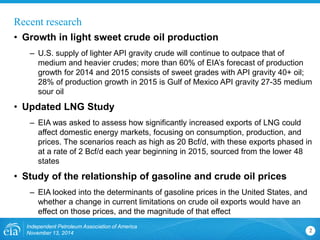
Recent research 
• 
Growth in light sweet crude oil production 
– 
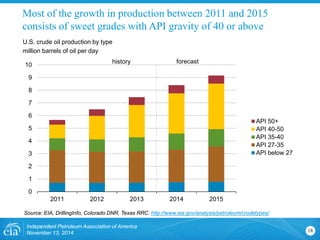
U.S. supply of lighter API gravity crude will continue to outpace that of medium and heavier crudes; more than 60% of EIA’s forecast of production growth for 2014 and 2015 consists of sweet grades with API gravity 40+ oil; 28% of production growth in 2015 is Gulf of Mexico API gravity 27-35 medium sour oil 
• 
Updated LNG Study 
– 
EIA was asked to assess how significantly increased exports of LNG could affect domestic energy markets, focusing on consumption, production, and prices. The scenarios reach as high as 20 Bcf/d, with these exports phased in at a rate of 2 Bcf/d each year beginning in 2015, sourced from the lower 48 states 
• 
Study of the relationship of gasoline and crude oil prices 
– 
EIA looked into the determinants of gasoline prices in the United States, and whether a change in current limitations on crude oil exports would have an effect on those prices, and the magnitude of that effect 
Independent Petroleum Association of America 
November 13, 2014 2
3 
Independent Petroleum Association of America 
November 13, 2014 
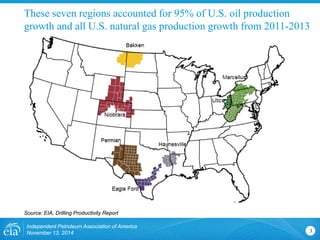
These seven regions accounted for 95% of U.S. oil production growth and all U.S. natural gas production growth from 2011-2013 
Source: EIA, Drilling Productivity Report
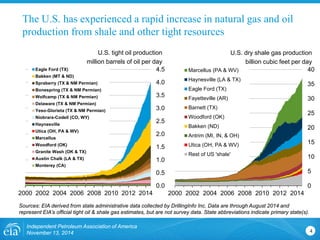
The U.S. has experienced a rapid increase in natural gas and oil production from shale and other tight resources 
4 
0.0 
0.5 
1.0 
1.5 
2.0 
2.5 
3.0 
3.5 
4.0 
4.5 
2000 
2002 
2004 
2006 
2008 
2010 
2012 
2014 
Eagle Ford (TX) 
Bakken (MT & ND) 
Spraberry (TX & NM Permian) 
Bonespring (TX & NM Permian) 
Wolfcamp (TX & NM Permian) 
Delaware (TX & NM Permian) 
Yeso-Glorieta (TX & NM Permian) 
Niobrara-Codell (CO, WY) 
Haynesville 
Utica (OH, PA & WV) 
Marcellus 
Woodford (OK) 
Granite Wash (OK & TX) 
Austin Chalk (LA & TX) 
Monterey (CA) 
U.S. tight oil production 
million barrels of oil per day 
0 
5 
10 
15 
20 
25 
30 
35 
40 
2000 
2002 
2004 
2006 
2008 
2010 
2012 
2014 
Marcellus (PA & WV) 
Haynesville (LA & TX) 
Eagle Ford (TX) 
Fayetteville (AR) 
Barnett (TX) 
Woodford (OK) 
Bakken (ND) 
Antrim (MI, IN, & OH) 
Utica (OH, PA & WV) 
Rest of US 'shale' 
U.S. dry shale gas production 
billion cubic feet per day 
Sources: EIA derived from state administrative data collected by DrillingInfo Inc. Data are through August 2014 and represent EIA’s official tight oil & shale gas estimates, but are not survey data. State abbreviations indicate primary state(s). 
Independent Petroleum Association of America 
November 13, 2014
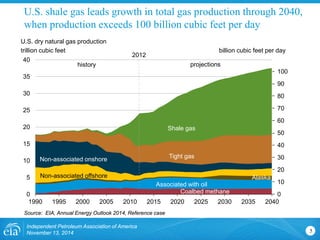
U.S. shale gas leads growth in total gas production through 2040, when production exceeds 100 billion cubic feet per day 
5 
U.S. dry natural gas production 
trillion cubic feet 
Source: EIA, Annual Energy Outlook 2014, Reference case 
0 
10 
20 
30 
40 
50 
60 
70 
80 
90 
100 
0 
5 
10 
15 
20 
25 
30 
35 
40 
1990 
1995 
2000 
2005 
2010 
2015 
2020 
2025 
2030 
2035 
2040 
Associated with oil 
Coalbed methane 
Tight gas 
Shale gas 
Alaska 
Non-associated offshore 
Non-associated onshore 
projections 
history 
2012 
Independent Petroleum Association of America 
November 13, 2014 
billion cubic feet per day
6 
0.0 
5.0 
10.0 
15.0 
20.0 
25.0 
30.0 
35.0 
2005 
2012 
2020 
2025 
2030 
2035 
2040 
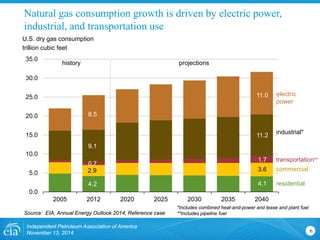
U.S. dry gas consumption 
trillion cubic feet 
Source: EIA, Annual Energy Outlook 2014, Reference case 
projections 
history 
industrial* 
electric 
power 
commercial 
residential 
transportation** 
11.2 
4.1 
1.7 
11.0 
3.6 
9.1 
4.2 
0.7 
8.5 
2.9 
*Includes combined heat-and-power and lease and plant fuel 
**Includes pipeline fuel 
Natural gas consumption growth is driven by electric power, industrial, and transportation use 
Independent Petroleum Association of America 
November 13, 2014
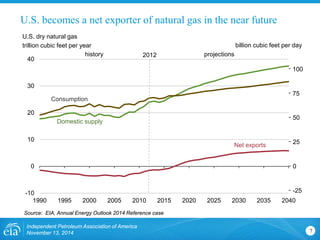
U.S. becomes a net exporter of natural gas in the near future 
7 
U.S. dry natural gas 
trillion cubic feet per year 
Source: EIA, Annual Energy Outlook 2014 Reference case 
Independent Petroleum Association of America 
November 13, 2014 
-10 
0 
10 
20 
30 
40 
1990 
1995 
2000 
2005 
2010 
2015 
2020 
2025 
2030 
2035 
2040 
projections 
history 
2012 
Consumption 
Domestic supply 
Net exports 
100 
75 
50 
25 
0 
-25 
billion cubic feet per day
Source: EIA, Annual Energy Outlook 2014, Reference case and High Oil and Gas Resource case 
8 
Independent Petroleum Association of America 
November 13, 2014 
-4 
-2 
0 
2 
4 
6 
8 
2010 
2015 
2020 
2025 
-4 
-2 
0 
2 
4 
6 
8 
2010 
2015 
2020 
2025 
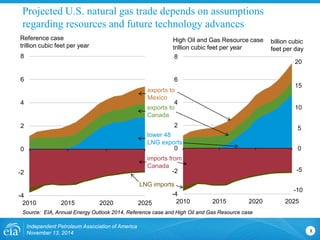
Projected U.S. natural gas trade depends on assumptions regarding resources and future technology advances 
Reference case 
trillion cubic feet per year 
exports to Mexico 
exports to Canada 
lower 48 
LNG exports 
imports from Canada 
LNG imports 
High Oil and Gas Resource case 
trillion cubic feet per year 
billion cubic 
feet per day 
0 
5 
20 
15 
10 
-5 
-10
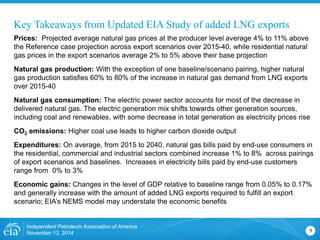
Key Takeaways from Updated EIA Study of added LNG exports 
Prices: Projected average natural gas prices at the producer level average 4% to 11% above the Reference case projection across export scenarios over 2015-40, while residential natural gas prices in the export scenarios average 2% to 5% above their base projection 
Natural gas production: With the exception of one baseline/scenario pairing, higher natural gas production satisfies 60% to 80% of the increase in natural gas demand from LNG exports over 2015-40 
Natural gas consumption: The electric power sector accounts for most of the decrease in delivered natural gas. The electric generation mix shifts towards other generation sources, including coal and renewables, with some decrease in total generation as electricity prices rise 
CO2 emissions: Higher coal use leads to higher carbon dioxide output 
Expenditures: On average, from 2015 to 2040, natural gas bills paid by end-use consumers in the residential, commercial and industrial sectors combined increase 1% to 8% across pairings of export scenarios and baselines. Increases in electricity bills paid by end-use customers range from 0% to 3% 
Economic gains: Changes in the level of GDP relative to baseline range from 0.05% to 0.17% and generally increase with the amount of added LNG exports required to fulfill an export scenario; EIA’s NEMS model may understate the economic benefits 
Independent Petroleum Association of America 
November 13, 2014 9
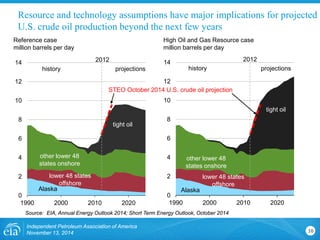
Resource and technology assumptions have major implications for projected U.S. crude oil production beyond the next few years 
0 
2 
4 
6 
8 
10 
12 
14 
1990 
2000 
2010 
2020 
0 
2 
4 
6 
8 
10 
12 
14 
1990 
2000 
2010 
2020 
10 
Source: EIA, Annual Energy Outlook 2014; Short Term Energy Outlook, October 2014 
Alaska 
tight oil 
other lower 48 states onshore 
lower 48 states offshore 
STEO October 2014 U.S. crude oil projection 
2012 
projections 
history 
projections 
history 
2012 
Alaska 
tight oil 
other lower 48 states onshore 
Reference case 
million barrels per day 
High Oil and Gas Resource case 
million barrels per day 
lower 48 states offshore 
Independent Petroleum Association of America 
November 13, 2014
0.0 
0.5 
1.0 
1.5 
2.0 
2.5 
3.0 
3.5 
4.0 
Jan-2012 
Jul-2012 
Jan-2013 
Jul-2013 
Jan-2014 
Jul-2014 
Other Non-OPEC 
Syria 
Sudan / S. Sudan 
Iraq 
Nigeria 
Libya 
Iran 
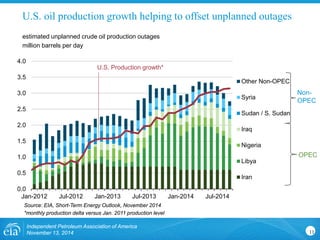
U.S. oil production growth helping to offset unplanned outages 
11 
estimated unplanned crude oil production outages 
million barrels per day 
Source: EIA, Short-Term Energy Outlook, November 2014 
*monthly production delta versus Jan. 2011 production level 
Non- 
OPEC 
OPEC 
Independent Petroleum Association of America 
November 13, 2014 
U.S. Production growth*
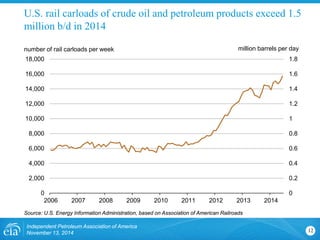
U.S. rail carloads of crude oil and petroleum products exceed 1.5 million b/d in 2014 
Independent Petroleum Association of America 
November 13, 2014 12 
0 
0.2 
0.4 
0.6 
0.8 
1 
1.2 
1.4 
1.6 
1.8 
0 
2,000 
4,000 
6,000 
8,000 
10,000 
12,000 
14,000 
16,000 
18,000 
2006 
2007 
2008 
2009 
2010 
2011 
2012 
2013 
2014 
number of rail carloads per week 
Source: U.S. Energy Information Administration, based on Association of American Railroads 
million barrels per day
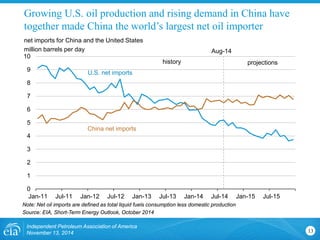
Growing U.S. oil production and rising demand in China have together made China the world’s largest net oil importer 
Independent Petroleum Association of America 
November 13, 2014 13 
0 
1 
2 
3 
4 
5 
6 
7 
8 
9 
10 
Jan-11 
Jul-11 
Jan-12 
Jul-12 
Jan-13 
Jul-13 
Jan-14 
Jul-14 
Jan-15 
Jul-15 
U.S. net imports 
China net imports 
net imports for China and the United States 
million barrels per day 
Note: Net oil imports are defined as total liquid fuels consumption less domestic production 
Source: EIA, Short-Term Energy Outlook, October 2014 
projections 
history 
Aug-14
0 
5 
10 
15 
20 
25 
30 
0.0 
10.0 
20.0 
30.0 
40.0 
50.0 
60.0 
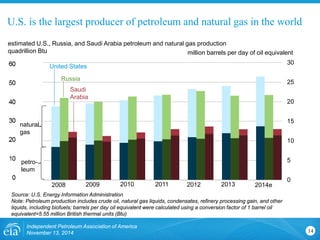
U.S. is the largest producer of petroleum and natural gas in the world 
Independent Petroleum Association of America 
November 13, 2014 14 
estimated U.S., Russia, and Saudi Arabia petroleum and natural gas production 
quadrillion Btu 
million barrels per day of oil equivalent 
United States 
Russia 
Saudi Arabia 
petro- leum 
natural 
gas 
2008 
2009 
2010 
2011 
2012 
2013 
2014e 
Source: U.S. Energy Information Administration 
Note: Petroleum production includes crude oil, natural gas liquids, condensates, refinery processing gain, and other liquids, including biofuels; barrels per day oil equivalent were calculated using a conversion factor of 1 barrel oil equivalent=5.55 million British thermal units (Btu)
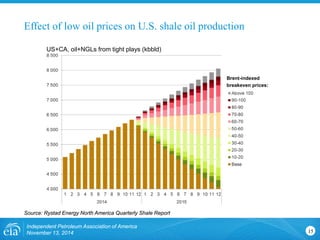
Effect of low oil prices on U.S. shale oil production 
Independent Petroleum Association of America 
November 13, 2014 15 
Source: Rystad Energy North America Quarterly Shale Report 
US+CA, oil+NGLs from tight plays (kbbld) 
Brent-indexed 
breakeven prices:
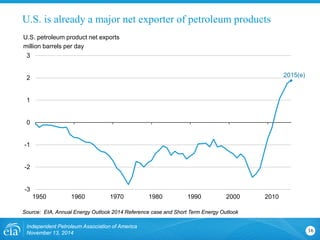
U.S. petroleum product net exports 
million barrels per day 
-3 
-2 
-1 
0 
1 
2 
3 
1950 
1960 
1970 
1980 
1990 
2000 
2010 
Source: EIA, Annual Energy Outlook 2014 Reference case and Short Term Energy Outlook 
Independent Petroleum Association of America 
November 13, 2014 16 
U.S. is already a major net exporter of petroleum products 
2015(e)
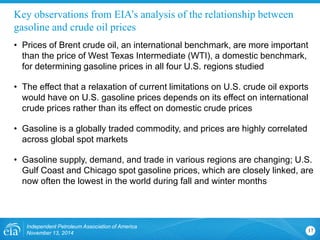
Key observations from EIA’s analysis of the relationship between gasoline and crude oil prices 
• 
Prices of Brent crude oil, an international benchmark, are more important than the price of West Texas Intermediate (WTI), a domestic benchmark, for determining gasoline prices in all four U.S. regions studied 
• 
The effect that a relaxation of current limitations on U.S. crude oil exports would have on U.S. gasoline prices depends on its effect on international crude prices rather than its effect on domestic crude prices 
• 
Gasoline is a globally traded commodity, and prices are highly correlated across global spot markets 
• 
Gasoline supply, demand, and trade in various regions are changing; U.S. Gulf Coast and Chicago spot gasoline prices, which are closely linked, are now often the lowest in the world during fall and winter months 
Independent Petroleum Association of America 
November 13, 2014 17
Most of the growth in production between 2011 and 2015 consists of sweet grades with API gravity of 40 or above 
0 
1 
2 
3 
4 
5 
6 
7 
8 
9 
10 
2011 
2012 
2013 
2014 
2015 
API 50+ 
API 40-50 
API 35-40 
API 27-35 
API below 27 
U.S. crude oil production by type 
million barrels of oil per day 
Source: EIA, DrillingInfo, Colorado DNR, Texas RRC. http://www.eia.gov/analysis/petroleum/crudetypes/ 
Independent Petroleum Association of America 
November 13, 2014 18 
forecast 
history
19 
Independent Petroleum Association of America 
November 13, 2014 
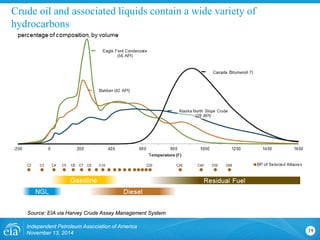
Crude oil and associated liquids contain a wide variety of hydrocarbons 
Source: EIA via Harvey Crude Assay Management System
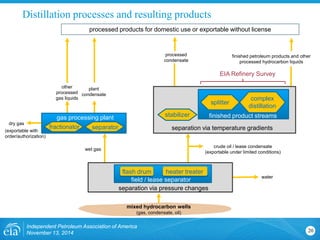
mixed hydrocarbon wells 
(gas, condensate, oil) 
dry gas 
(exportable with 
order/authorization) 
crude oil / lease condensate 
(exportable under limited conditions) 
wet gas 
EIA Refinery Survey 
plant 
condensate 
splitter 
complex 
distillation 
stabilizer 
finished product streams 
processed products for domestic use or exportable without license 
finished petroleum products and other processed hydrocarbon liquids 
separation via temperature gradients 
water 
separation via pressure changes 
field / lease separator 
flash drum 
heater treater 
Distillation processes and resulting products 
Independent Petroleum Association of America November 13, 2014 
20 
other 
processed 
gas liquids 
fractionator separator 
gas processing plant 
processed 
condensate
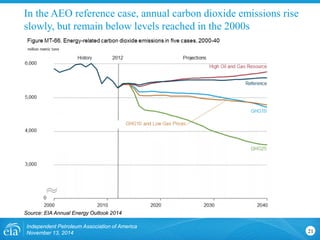
In the AEO reference case, annual carbon dioxide emissions rise slowly, but remain below levels reached in the 2000s 
Independent Petroleum Association of America 
November 13, 2014 21 
Source: EIA Annual Energy Outlook 2014
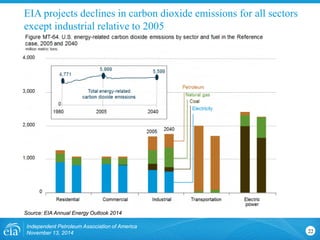
EIA projects declines in carbon dioxide emissions for all sectors except industrial relative to 2005 
Independent Petroleum Association of America 
November 13, 2014 22 
Source: EIA Annual Energy Outlook 2014
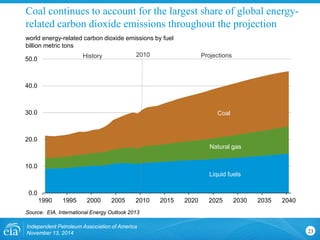
Coal continues to account for the largest share of global energy- related carbon dioxide emissions throughout the projection 
23 
0.0 
10.0 
20.0 
30.0 
40.0 
50.0 
1990 
1995 
2000 
2005 
2010 
2015 
2020 
2025 
2030 
2035 
2040 
world energy-related carbon dioxide emissions by fuel 
billion metric tons 
Coal 
Natural gas 
Liquid fuels 
2010 
History 
Projections 
Independent Petroleum Association of America 
November 13, 2014 
Source: EIA, International Energy Outlook 2013
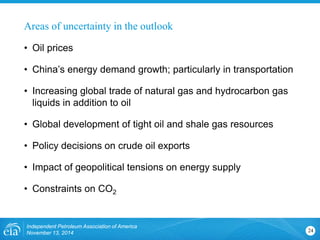
Areas of uncertainty in the outlook 
• 
Oil prices 
• 
China’s energy demand growth; particularly in transportation 
• 
Increasing global trade of natural gas and hydrocarbon gas liquids in addition to oil 
• 
Global development of tight oil and shale gas resources 
• 
Policy decisions on crude oil exports 
• 
Impact of geopolitical tensions on energy supply 
• 
Constraints on CO2 
Independent Petroleum Association of America 
November 13, 2014 24
For more information 
Independent Petroleum Association of America 
November 13, 2014 25 
U.S. Energy Information Administration home page | www.eia.gov 
Annual Energy Outlook | www.eia.gov/aeo 
Short-Term Energy Outlook | www.eia.gov/steo 
International Energy Outlook | www.eia.gov/ieo 
Monthly Energy Review | www.eia.gov/mer 
Today in Energy | www.eia.gov/todayinenergy 
State Energy Portal | www.eia.gov/state 
Drilling Productivity Report | www.eia.gov/petroleum/drilling/

US OIL & GAS OUTLOOK

  • 1.
    U.S. Energy InformationAdministration Independent Statistics & Analysis www.eia.gov Oil and Gas Outlook For Independent Petroleum Association of America November 13, 2014 | Palm Beach, FL By Adam Sieminski, Administrator U.S. Energy Information Administration
  • 2.
    Recent research • Growth in light sweet crude oil production – U.S. supply of lighter API gravity crude will continue to outpace that of medium and heavier crudes; more than 60% of EIA’s forecast of production growth for 2014 and 2015 consists of sweet grades with API gravity 40+ oil; 28% of production growth in 2015 is Gulf of Mexico API gravity 27-35 medium sour oil • Updated LNG Study – EIA was asked to assess how significantly increased exports of LNG could affect domestic energy markets, focusing on consumption, production, and prices. The scenarios reach as high as 20 Bcf/d, with these exports phased in at a rate of 2 Bcf/d each year beginning in 2015, sourced from the lower 48 states • Study of the relationship of gasoline and crude oil prices – EIA looked into the determinants of gasoline prices in the United States, and whether a change in current limitations on crude oil exports would have an effect on those prices, and the magnitude of that effect Independent Petroleum Association of America November 13, 2014 2
  • 3.
    3 Independent PetroleumAssociation of America November 13, 2014 These seven regions accounted for 95% of U.S. oil production growth and all U.S. natural gas production growth from 2011-2013 Source: EIA, Drilling Productivity Report
  • 4.
    The U.S. hasexperienced a rapid increase in natural gas and oil production from shale and other tight resources 4 0.0 0.5 1.0 1.5 2.0 2.5 3.0 3.5 4.0 4.5 2000 2002 2004 2006 2008 2010 2012 2014 Eagle Ford (TX) Bakken (MT & ND) Spraberry (TX & NM Permian) Bonespring (TX & NM Permian) Wolfcamp (TX & NM Permian) Delaware (TX & NM Permian) Yeso-Glorieta (TX & NM Permian) Niobrara-Codell (CO, WY) Haynesville Utica (OH, PA & WV) Marcellus Woodford (OK) Granite Wash (OK & TX) Austin Chalk (LA & TX) Monterey (CA) U.S. tight oil production million barrels of oil per day 0 5 10 15 20 25 30 35 40 2000 2002 2004 2006 2008 2010 2012 2014 Marcellus (PA & WV) Haynesville (LA & TX) Eagle Ford (TX) Fayetteville (AR) Barnett (TX) Woodford (OK) Bakken (ND) Antrim (MI, IN, & OH) Utica (OH, PA & WV) Rest of US 'shale' U.S. dry shale gas production billion cubic feet per day Sources: EIA derived from state administrative data collected by DrillingInfo Inc. Data are through August 2014 and represent EIA’s official tight oil & shale gas estimates, but are not survey data. State abbreviations indicate primary state(s). Independent Petroleum Association of America November 13, 2014
  • 5.
    U.S. shale gasleads growth in total gas production through 2040, when production exceeds 100 billion cubic feet per day 5 U.S. dry natural gas production trillion cubic feet Source: EIA, Annual Energy Outlook 2014, Reference case 0 10 20 30 40 50 60 70 80 90 100 0 5 10 15 20 25 30 35 40 1990 1995 2000 2005 2010 2015 2020 2025 2030 2035 2040 Associated with oil Coalbed methane Tight gas Shale gas Alaska Non-associated offshore Non-associated onshore projections history 2012 Independent Petroleum Association of America November 13, 2014 billion cubic feet per day
  • 6.
    6 0.0 5.0 10.0 15.0 20.0 25.0 30.0 35.0 2005 2012 2020 2025 2030 2035 2040 U.S. dry gas consumption trillion cubic feet Source: EIA, Annual Energy Outlook 2014, Reference case projections history industrial* electric power commercial residential transportation** 11.2 4.1 1.7 11.0 3.6 9.1 4.2 0.7 8.5 2.9 *Includes combined heat-and-power and lease and plant fuel **Includes pipeline fuel Natural gas consumption growth is driven by electric power, industrial, and transportation use Independent Petroleum Association of America November 13, 2014
  • 7.
    U.S. becomes anet exporter of natural gas in the near future 7 U.S. dry natural gas trillion cubic feet per year Source: EIA, Annual Energy Outlook 2014 Reference case Independent Petroleum Association of America November 13, 2014 -10 0 10 20 30 40 1990 1995 2000 2005 2010 2015 2020 2025 2030 2035 2040 projections history 2012 Consumption Domestic supply Net exports 100 75 50 25 0 -25 billion cubic feet per day
  • 8.
    Source: EIA, AnnualEnergy Outlook 2014, Reference case and High Oil and Gas Resource case 8 Independent Petroleum Association of America November 13, 2014 -4 -2 0 2 4 6 8 2010 2015 2020 2025 -4 -2 0 2 4 6 8 2010 2015 2020 2025 Projected U.S. natural gas trade depends on assumptions regarding resources and future technology advances Reference case trillion cubic feet per year exports to Mexico exports to Canada lower 48 LNG exports imports from Canada LNG imports High Oil and Gas Resource case trillion cubic feet per year billion cubic feet per day 0 5 20 15 10 -5 -10
  • 9.
    Key Takeaways fromUpdated EIA Study of added LNG exports Prices: Projected average natural gas prices at the producer level average 4% to 11% above the Reference case projection across export scenarios over 2015-40, while residential natural gas prices in the export scenarios average 2% to 5% above their base projection Natural gas production: With the exception of one baseline/scenario pairing, higher natural gas production satisfies 60% to 80% of the increase in natural gas demand from LNG exports over 2015-40 Natural gas consumption: The electric power sector accounts for most of the decrease in delivered natural gas. The electric generation mix shifts towards other generation sources, including coal and renewables, with some decrease in total generation as electricity prices rise CO2 emissions: Higher coal use leads to higher carbon dioxide output Expenditures: On average, from 2015 to 2040, natural gas bills paid by end-use consumers in the residential, commercial and industrial sectors combined increase 1% to 8% across pairings of export scenarios and baselines. Increases in electricity bills paid by end-use customers range from 0% to 3% Economic gains: Changes in the level of GDP relative to baseline range from 0.05% to 0.17% and generally increase with the amount of added LNG exports required to fulfill an export scenario; EIA’s NEMS model may understate the economic benefits Independent Petroleum Association of America November 13, 2014 9
  • 10.
    Resource and technologyassumptions have major implications for projected U.S. crude oil production beyond the next few years 0 2 4 6 8 10 12 14 1990 2000 2010 2020 0 2 4 6 8 10 12 14 1990 2000 2010 2020 10 Source: EIA, Annual Energy Outlook 2014; Short Term Energy Outlook, October 2014 Alaska tight oil other lower 48 states onshore lower 48 states offshore STEO October 2014 U.S. crude oil projection 2012 projections history projections history 2012 Alaska tight oil other lower 48 states onshore Reference case million barrels per day High Oil and Gas Resource case million barrels per day lower 48 states offshore Independent Petroleum Association of America November 13, 2014
  • 11.
    0.0 0.5 1.0 1.5 2.0 2.5 3.0 3.5 4.0 Jan-2012 Jul-2012 Jan-2013 Jul-2013 Jan-2014 Jul-2014 Other Non-OPEC Syria Sudan / S. Sudan Iraq Nigeria Libya Iran U.S. oil production growth helping to offset unplanned outages 11 estimated unplanned crude oil production outages million barrels per day Source: EIA, Short-Term Energy Outlook, November 2014 *monthly production delta versus Jan. 2011 production level Non- OPEC OPEC Independent Petroleum Association of America November 13, 2014 U.S. Production growth*
  • 12.
    U.S. rail carloadsof crude oil and petroleum products exceed 1.5 million b/d in 2014 Independent Petroleum Association of America November 13, 2014 12 0 0.2 0.4 0.6 0.8 1 1.2 1.4 1.6 1.8 0 2,000 4,000 6,000 8,000 10,000 12,000 14,000 16,000 18,000 2006 2007 2008 2009 2010 2011 2012 2013 2014 number of rail carloads per week Source: U.S. Energy Information Administration, based on Association of American Railroads million barrels per day
  • 13.
    Growing U.S. oilproduction and rising demand in China have together made China the world’s largest net oil importer Independent Petroleum Association of America November 13, 2014 13 0 1 2 3 4 5 6 7 8 9 10 Jan-11 Jul-11 Jan-12 Jul-12 Jan-13 Jul-13 Jan-14 Jul-14 Jan-15 Jul-15 U.S. net imports China net imports net imports for China and the United States million barrels per day Note: Net oil imports are defined as total liquid fuels consumption less domestic production Source: EIA, Short-Term Energy Outlook, October 2014 projections history Aug-14
  • 14.
    0 5 10 15 20 25 30 0.0 10.0 20.0 30.0 40.0 50.0 60.0 U.S. is the largest producer of petroleum and natural gas in the world Independent Petroleum Association of America November 13, 2014 14 estimated U.S., Russia, and Saudi Arabia petroleum and natural gas production quadrillion Btu million barrels per day of oil equivalent United States Russia Saudi Arabia petro- leum natural gas 2008 2009 2010 2011 2012 2013 2014e Source: U.S. Energy Information Administration Note: Petroleum production includes crude oil, natural gas liquids, condensates, refinery processing gain, and other liquids, including biofuels; barrels per day oil equivalent were calculated using a conversion factor of 1 barrel oil equivalent=5.55 million British thermal units (Btu)
  • 15.
    Effect of lowoil prices on U.S. shale oil production Independent Petroleum Association of America November 13, 2014 15 Source: Rystad Energy North America Quarterly Shale Report US+CA, oil+NGLs from tight plays (kbbld) Brent-indexed breakeven prices:
  • 16.
    U.S. petroleum productnet exports million barrels per day -3 -2 -1 0 1 2 3 1950 1960 1970 1980 1990 2000 2010 Source: EIA, Annual Energy Outlook 2014 Reference case and Short Term Energy Outlook Independent Petroleum Association of America November 13, 2014 16 U.S. is already a major net exporter of petroleum products 2015(e)
  • 17.
    Key observations fromEIA’s analysis of the relationship between gasoline and crude oil prices • Prices of Brent crude oil, an international benchmark, are more important than the price of West Texas Intermediate (WTI), a domestic benchmark, for determining gasoline prices in all four U.S. regions studied • The effect that a relaxation of current limitations on U.S. crude oil exports would have on U.S. gasoline prices depends on its effect on international crude prices rather than its effect on domestic crude prices • Gasoline is a globally traded commodity, and prices are highly correlated across global spot markets • Gasoline supply, demand, and trade in various regions are changing; U.S. Gulf Coast and Chicago spot gasoline prices, which are closely linked, are now often the lowest in the world during fall and winter months Independent Petroleum Association of America November 13, 2014 17
  • 18.
    Most of thegrowth in production between 2011 and 2015 consists of sweet grades with API gravity of 40 or above 0 1 2 3 4 5 6 7 8 9 10 2011 2012 2013 2014 2015 API 50+ API 40-50 API 35-40 API 27-35 API below 27 U.S. crude oil production by type million barrels of oil per day Source: EIA, DrillingInfo, Colorado DNR, Texas RRC. http://www.eia.gov/analysis/petroleum/crudetypes/ Independent Petroleum Association of America November 13, 2014 18 forecast history
  • 19.
    19 Independent PetroleumAssociation of America November 13, 2014 Crude oil and associated liquids contain a wide variety of hydrocarbons Source: EIA via Harvey Crude Assay Management System
  • 20.
    mixed hydrocarbon wells (gas, condensate, oil) dry gas (exportable with order/authorization) crude oil / lease condensate (exportable under limited conditions) wet gas EIA Refinery Survey plant condensate splitter complex distillation stabilizer finished product streams processed products for domestic use or exportable without license finished petroleum products and other processed hydrocarbon liquids separation via temperature gradients water separation via pressure changes field / lease separator flash drum heater treater Distillation processes and resulting products Independent Petroleum Association of America November 13, 2014 20 other processed gas liquids fractionator separator gas processing plant processed condensate
  • 21.
    In the AEOreference case, annual carbon dioxide emissions rise slowly, but remain below levels reached in the 2000s Independent Petroleum Association of America November 13, 2014 21 Source: EIA Annual Energy Outlook 2014
  • 22.
    EIA projects declinesin carbon dioxide emissions for all sectors except industrial relative to 2005 Independent Petroleum Association of America November 13, 2014 22 Source: EIA Annual Energy Outlook 2014
  • 23.
    Coal continues toaccount for the largest share of global energy- related carbon dioxide emissions throughout the projection 23 0.0 10.0 20.0 30.0 40.0 50.0 1990 1995 2000 2005 2010 2015 2020 2025 2030 2035 2040 world energy-related carbon dioxide emissions by fuel billion metric tons Coal Natural gas Liquid fuels 2010 History Projections Independent Petroleum Association of America November 13, 2014 Source: EIA, International Energy Outlook 2013
  • 24.
    Areas of uncertaintyin the outlook • Oil prices • China’s energy demand growth; particularly in transportation • Increasing global trade of natural gas and hydrocarbon gas liquids in addition to oil • Global development of tight oil and shale gas resources • Policy decisions on crude oil exports • Impact of geopolitical tensions on energy supply • Constraints on CO2 Independent Petroleum Association of America November 13, 2014 24
  • 25.
    For more information Independent Petroleum Association of America November 13, 2014 25 U.S. Energy Information Administration home page | www.eia.gov Annual Energy Outlook | www.eia.gov/aeo Short-Term Energy Outlook | www.eia.gov/steo International Energy Outlook | www.eia.gov/ieo Monthly Energy Review | www.eia.gov/mer Today in Energy | www.eia.gov/todayinenergy State Energy Portal | www.eia.gov/state Drilling Productivity Report | www.eia.gov/petroleum/drilling/