Energy: power shift under way
A general outlook on the energy industry and the
changes shaping the future. The session describes the
shifting trends in Oil, Gas, Power (incl. Renewables),
Climate Change and Business Models
Vasilis Rallis
MBA 2001
Current Role
Senior Advisor, Energy Markets (8 years in the Regulator)
Experience
Intl Business Development, Finance, Government.
Industries
Energy, Automotive, Manufacturing, Finance,
Management Consulting
Agenda
1. Global Outlook
2. Oil & Gas
3. Power (+RES)
4. Climate Change
5. Energy in Europe
6. Energy: power shift underway
7. Careers in Energy
Agenda
1. Global Outlook
2. Oil
3. Gas
4. Power (+RES)
5. Climate Change
6. The New Business Mode
7. Energy: power shift underway
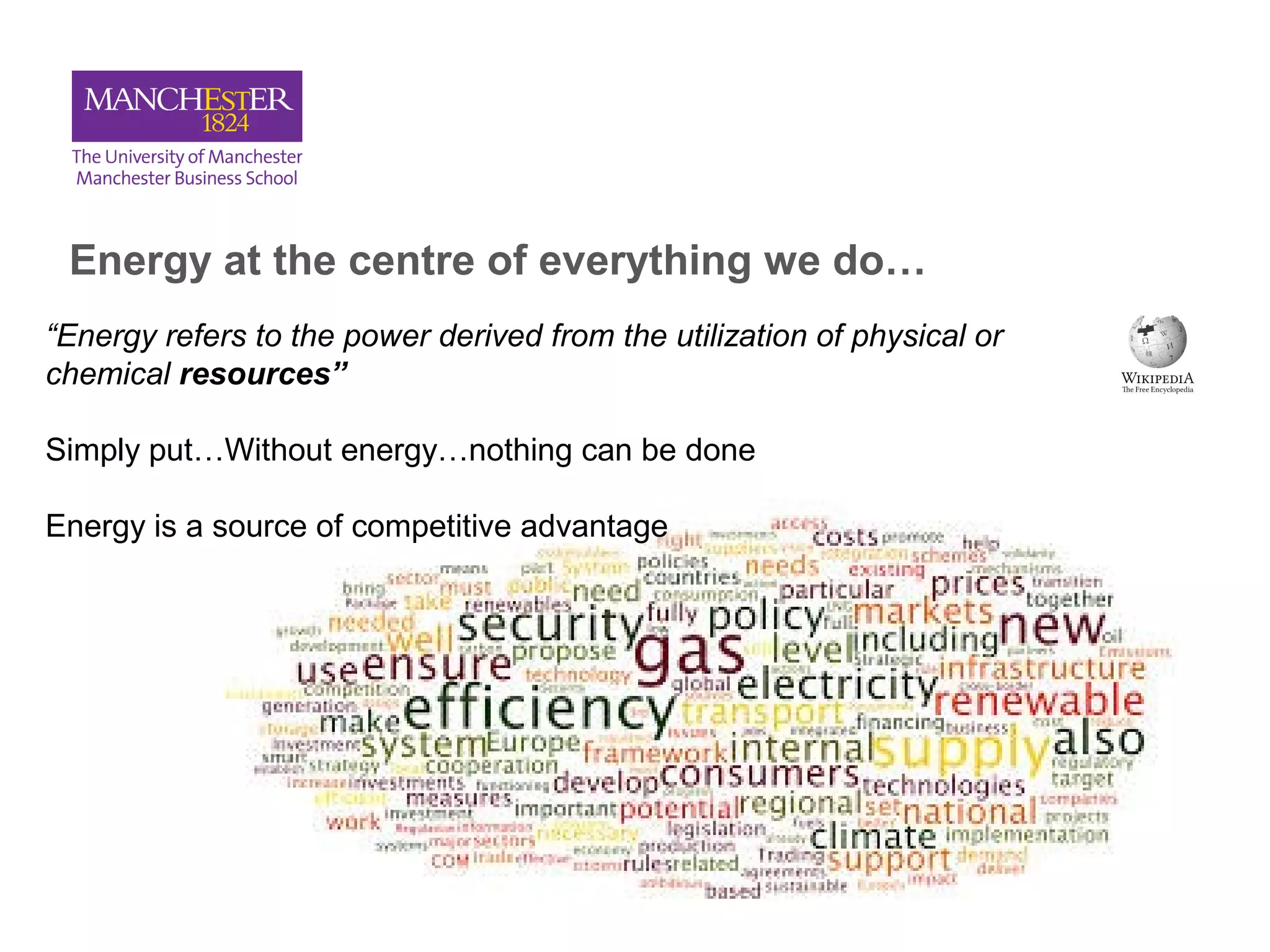
Energy at the centre of everything we do…
“Energy refers to the power derived from the utilization of physical or
chemical resources”
Simply put…Without energy…nothing can be done
Energy is a source of competitive advantage
Russia – Georgia conflict
www.geni.org
5 Global Megatrends to watch for…
Demographic and social change
Within the next minute the global population will rise by
145 people. By 2030 global population will reach 8.7bn
Shift in economic power
On current trends, the aggregate purchasing power of
the ‘E7’ emerging economies – China, India, Russia,
Brazil, Mexico, Turkey and Indonesia – will overtake
that of the G7 by 2030.
Rapid urbanisation
In 1800, 2% of the world’s population lived in cities.
Now it’s 50%. Every week, some 1.5 million people join
the urban population, through a combination of
migration and childbirth.
Climate change and resource scarcity
At current rates of consumption we may
have just half a century’s worth of oil & gas
left. Yet to meet our development needs
we’re highly dependent on fossil fuels,
which drive carbon emissions.
Technological breakthroughs
The impacts of digital disruption are now so
pervasive that no business in any sector –
from the smallest family business to largest
multinational – is immune from them..
6 Energy Megatrends to watch for…
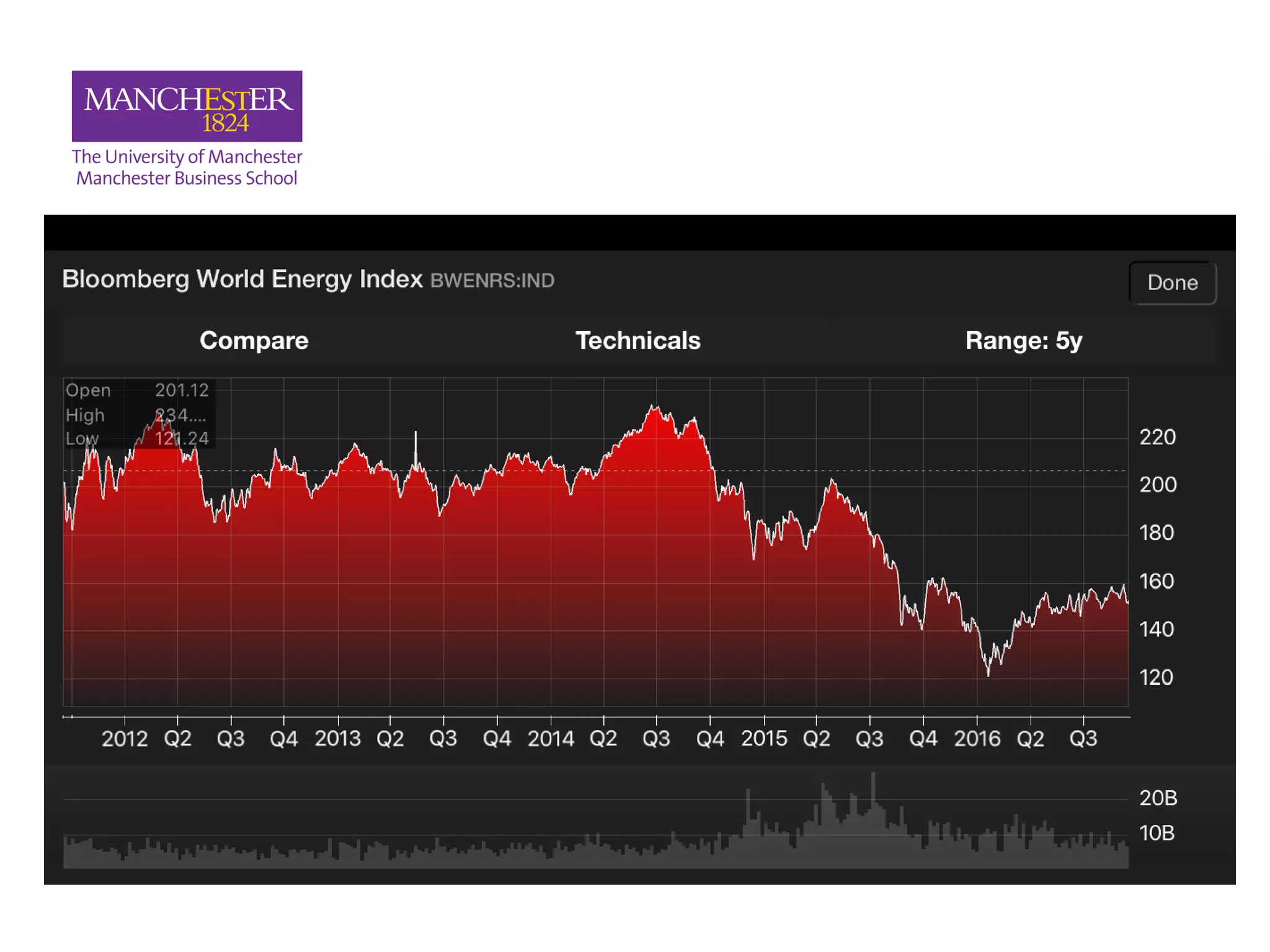
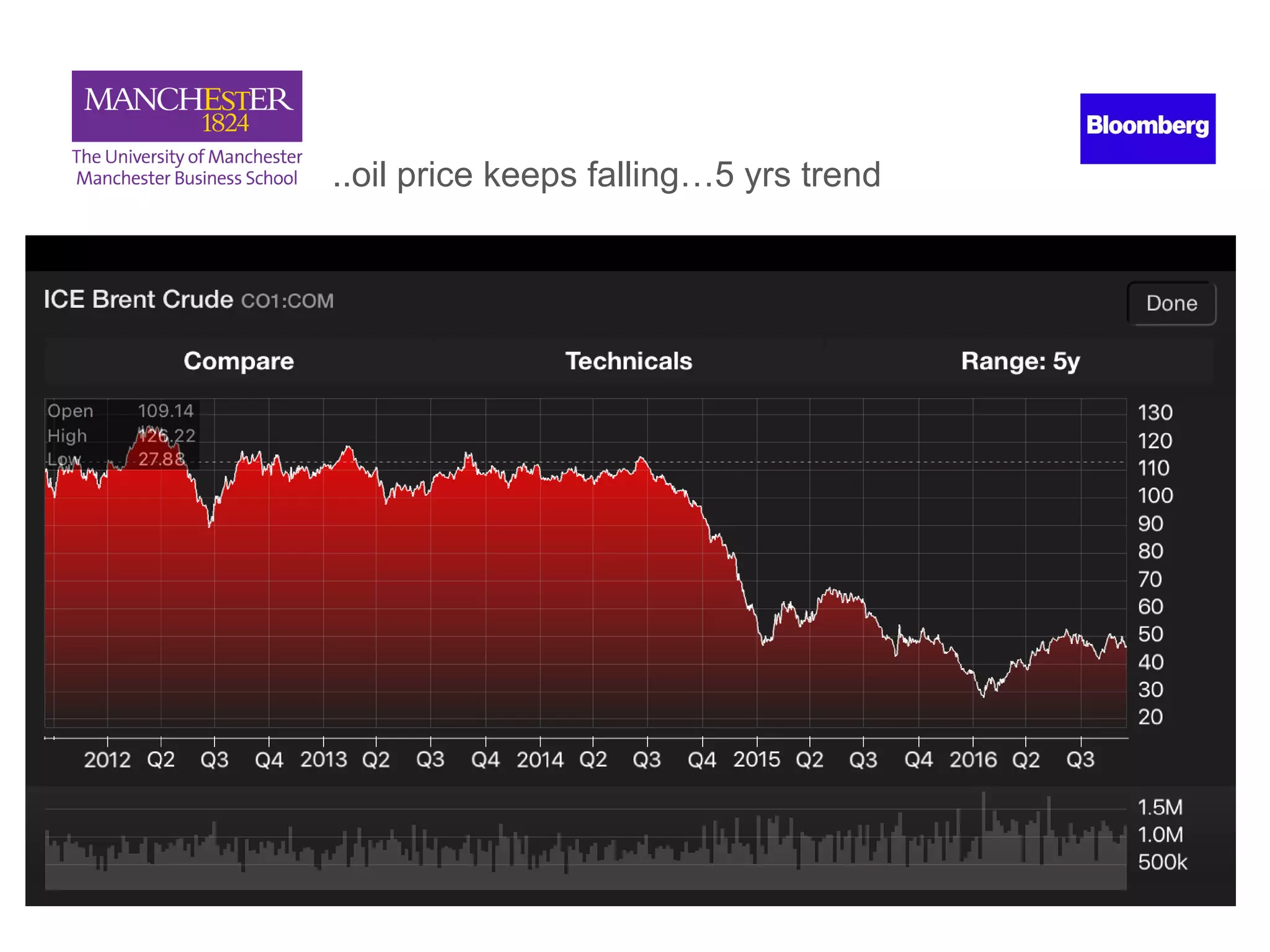
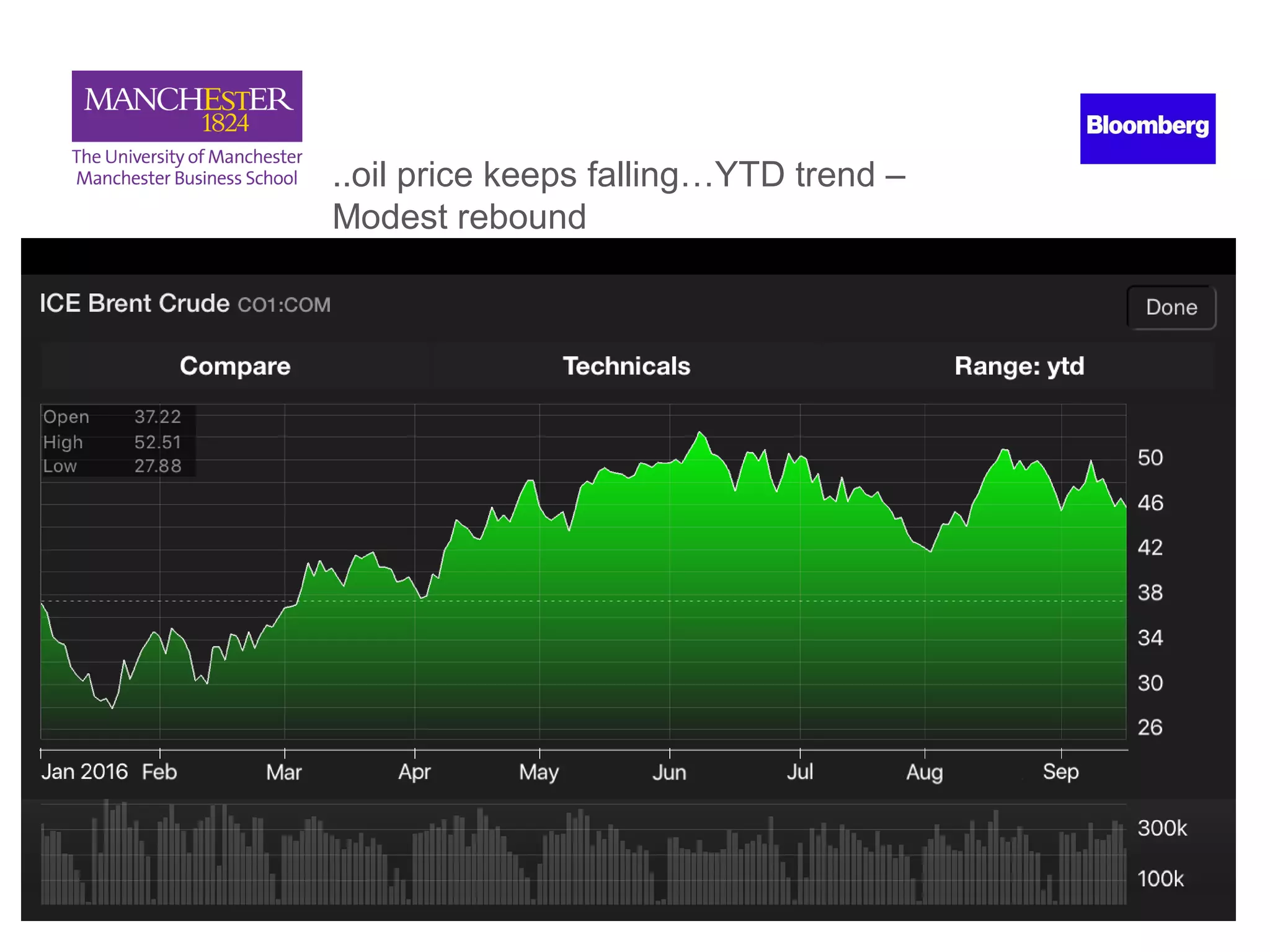
Oil price
OPEC’s decision to keep supply constant has caused
the oil price to collapse – and has created a new
industry outlook. A modest rebound is observed in
2016.
Energy Demand is falling in Europe…
Based on 2013 data (Eurostat) energy demand in EU-
28 has fallen 9.1% vs 2006 (approaching 1990-1995
pattern).
..but is increasing in emerging countries
With China, India, Brazil exhibiting year-on-year
energy demand growth.
Gas (r)evolution
Shale gas technology (fracking) has
enabled the US to become energy efficient
and contemplate about exporting it –
forcing OPEC to retaliate.
The bigger game: efficiency
The biggest disruptive technology in energy
is to go without it.
RES are here to stay
Solar is bound to get cheaper due to
technology innovation and available
financing. Biomass and Wind will benefit as
well. They have already begun changing
the industry value chain.
Agenda
1. Global Outlook
2. Oil & Gas
3. Power (+RES)
4. Climate Change
5. Energy in Europe
6. Energy: power shift underway
7. Careers in Energy
8.2%
1.4%
3.2%
Oil
Gas
Upstream Midstream Downstream
Global Oil & Gas Value Chain
Big Oil
Big oil is a name used to describe the world's five (or six) largest
publicly owned oil and gas companies, also known as supermajors.
The supermajors are considered to be:
BP plc, Chevron Corporation, ExxonMobil Corporation, Royal Dutch
Shell plc and Total SA.
8.2%
1.4%
3.2%
8.2%
1.4%
3.2%
Big Oil…
..is mostly State Controlled in terms of
reserves but…
8.2%
1.4%
3.2%
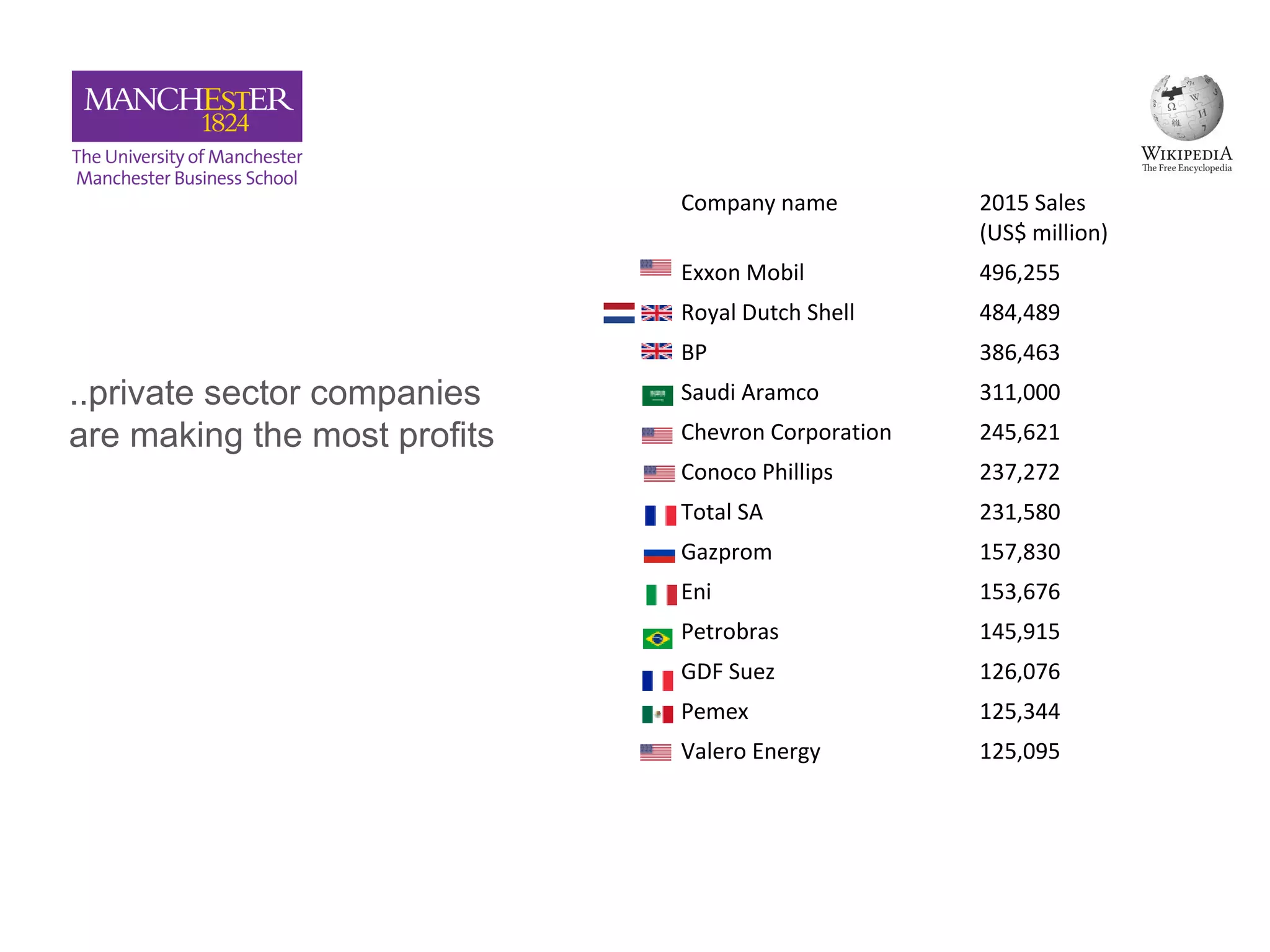
..private sector companies
are making the most profits
Company name 2015 Sales
(US$ million)
Exxon Mobil 496,255
Royal Dutch Shell 484,489
BP 386,463
Saudi Aramco 311,000
Chevron Corporation 245,621
Conoco Phillips 237,272
Total SA 231,580
Gazprom 157,830
Eni 153,676
Petrobras 145,915
GDF Suez 126,076
Pemex 125,344
Valero Energy 125,095
8.2%
1.4%
3.2%
..oil price keeps falling…5 yrs trend
8.2%
1.4%
3.2%
..oil price keeps falling…YTD trend –
Modest rebound
8.2%
1.4%
3.2%
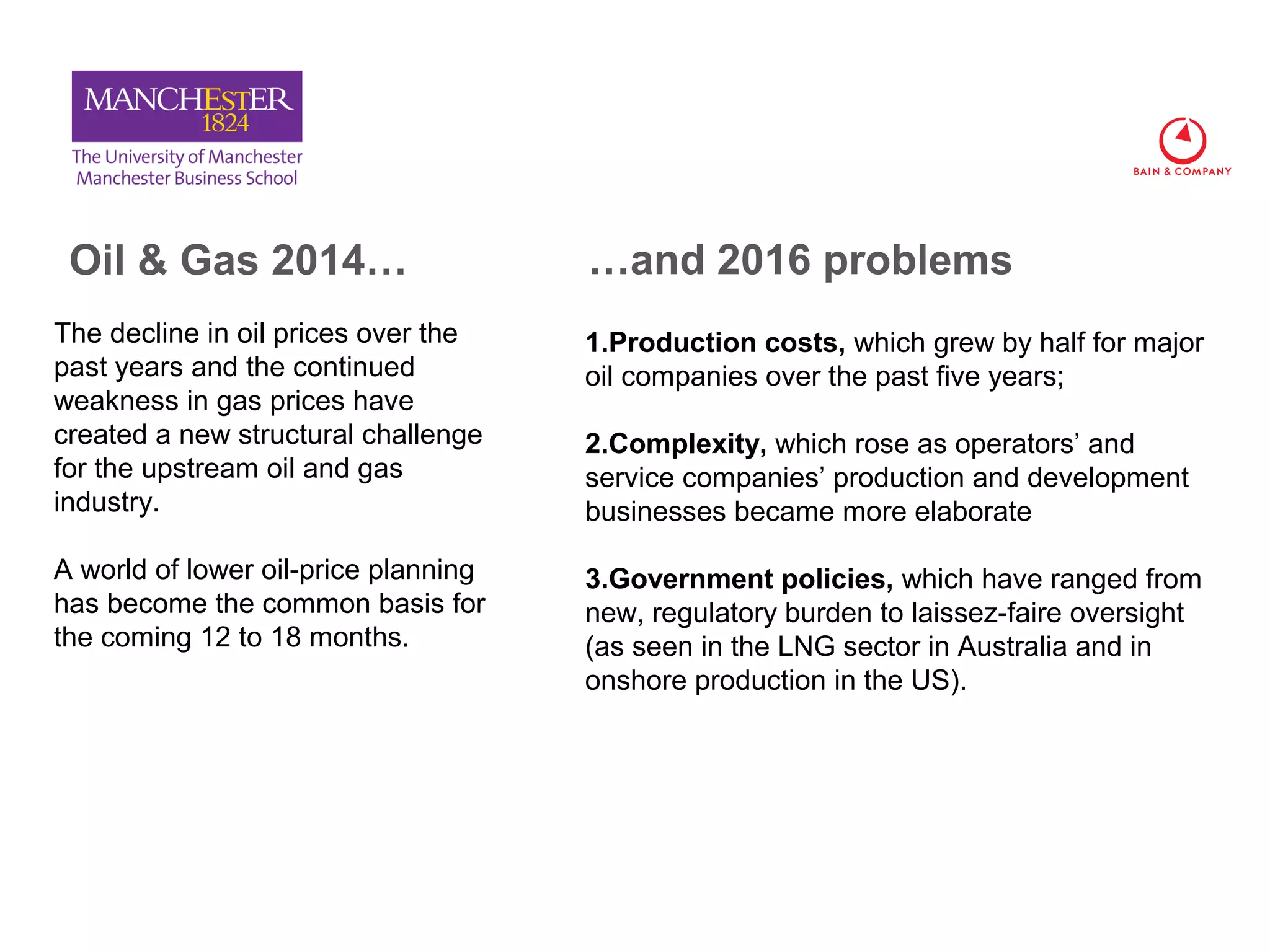
Oil & Gas 2014…
The decline in oil prices over the
past years and the continued
weakness in gas prices have
created a new structural challenge
for the upstream oil and gas
industry.
A world of lower oil-price planning
has become the common basis for
the coming 12 to 18 months.
1.Production costs, which grew by half for major
oil companies over the past five years;
2.Complexity, which rose as operators’ and
service companies’ production and development
businesses became more elaborate
3.Government policies, which have ranged from
new, regulatory burden to laissez-faire oversight
(as seen in the LNG sector in Australia and in
onshore production in the US).
…and 2016 problems
8.2%
1.4%
3.2%
Oil & Gas trends – Take away thought…
• Competition, slumping oil prices, and
glutted energy demand
• The O&G landscape is being
significantly reshaped by a potent
emerging trend: the fear of climate
change and a powerful, concerted effort
to reduce CO2 emissions and minimize
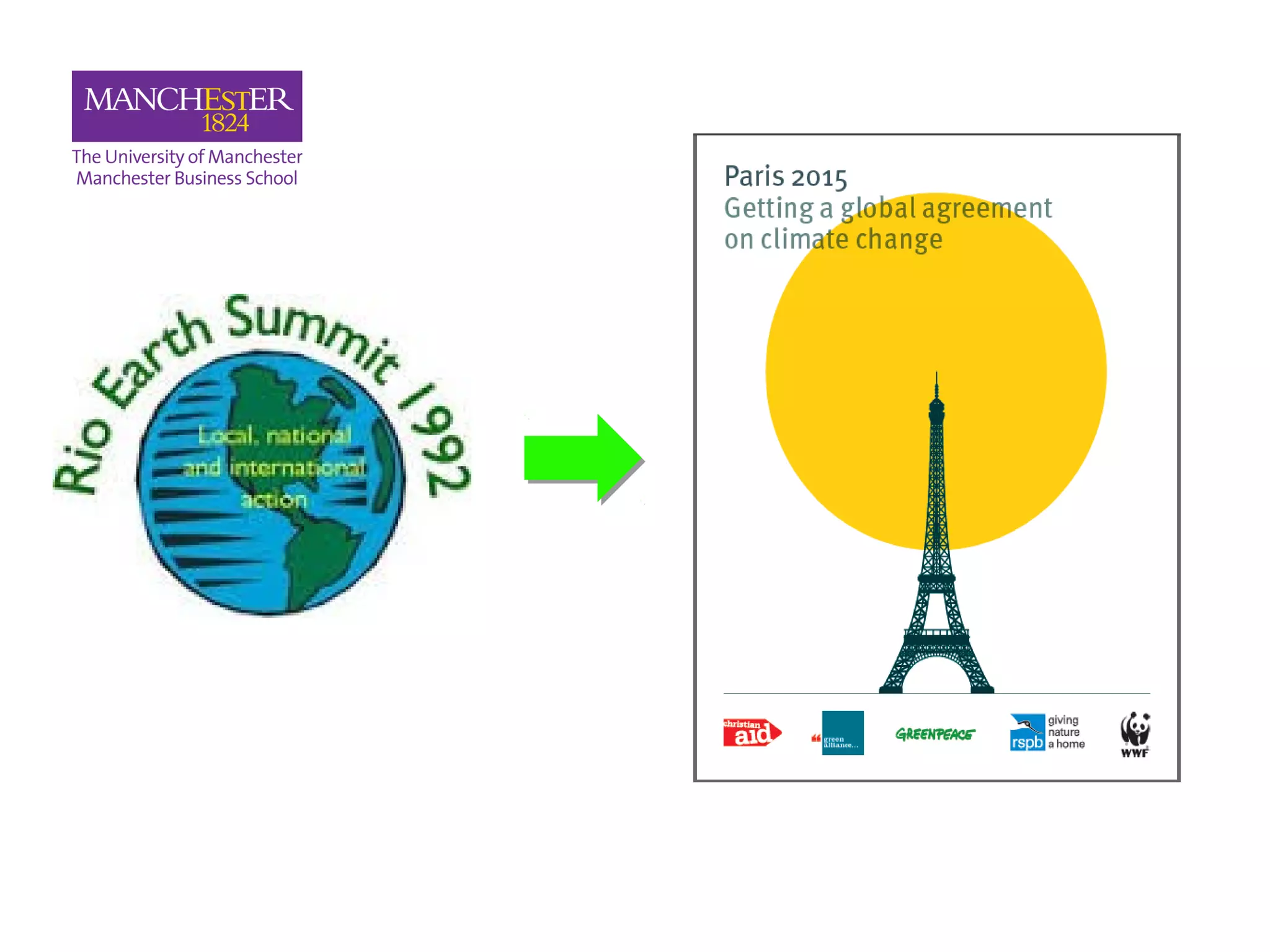
fossil fuels (Rio 1992 to Paris 2015)
Oil & Gas executives must
address a vital existential
issue:
How to successfully do
business in an
increasingly carbon-
constrained world
Agenda
1. Global Outlook
2. Oil & Gas
3. Power (+RES)
4. Climate Change
5. Energy in Europe
6. Energy: power shift underway
7. Careers in Energy
8.2%
1.4%
3.2%
Electricity Value Chain
Upstream Midstream Downstream
Utilities
Oil
Coal
Gas
Nuclear
RES
1.4%
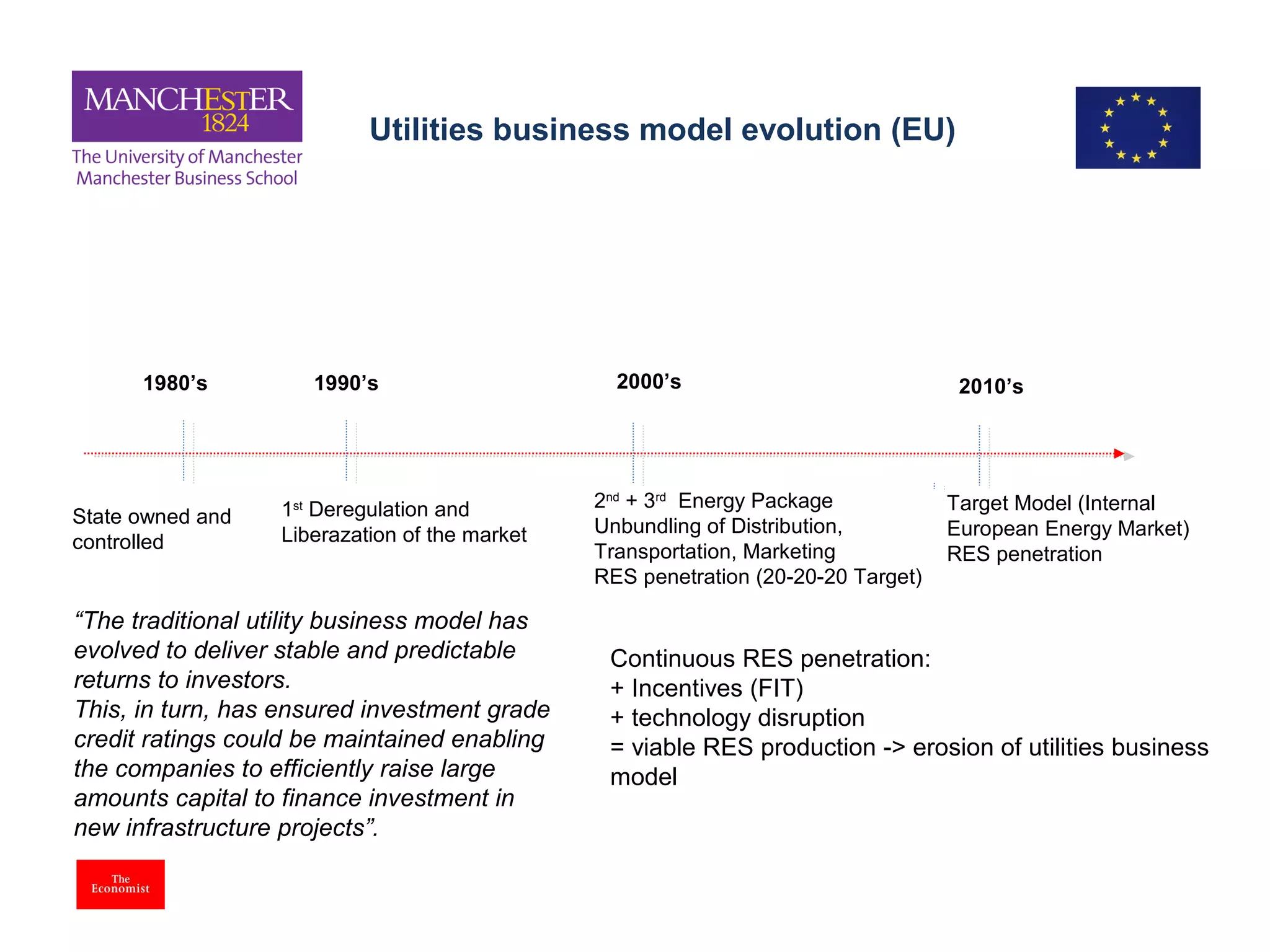
Utilities business model evolution (EU)
8.2%
3.2%
“The traditional utility business model has
evolved to deliver stable and predictable
returns to investors.
This, in turn, has ensured investment grade
credit ratings could be maintained enabling
the companies to efficiently raise large
amounts capital to finance investment in
new infrastructure projects”.
1980’s
State owned and
controlled
1990’s 2000’s
1st
Deregulation and
Liberazation of the market
2010’s
2nd
+ 3rd
Energy Package
Unbundling of Distribution,
Transportation, Marketing
RES penetration (20-20-20 Target)
Target Model (Internal
European Energy Market)
RES penetration
Continuous RES penetration:
+ Incentives (FIT)
+ technology disruption
= viable RES production -> erosion of utilities business
model
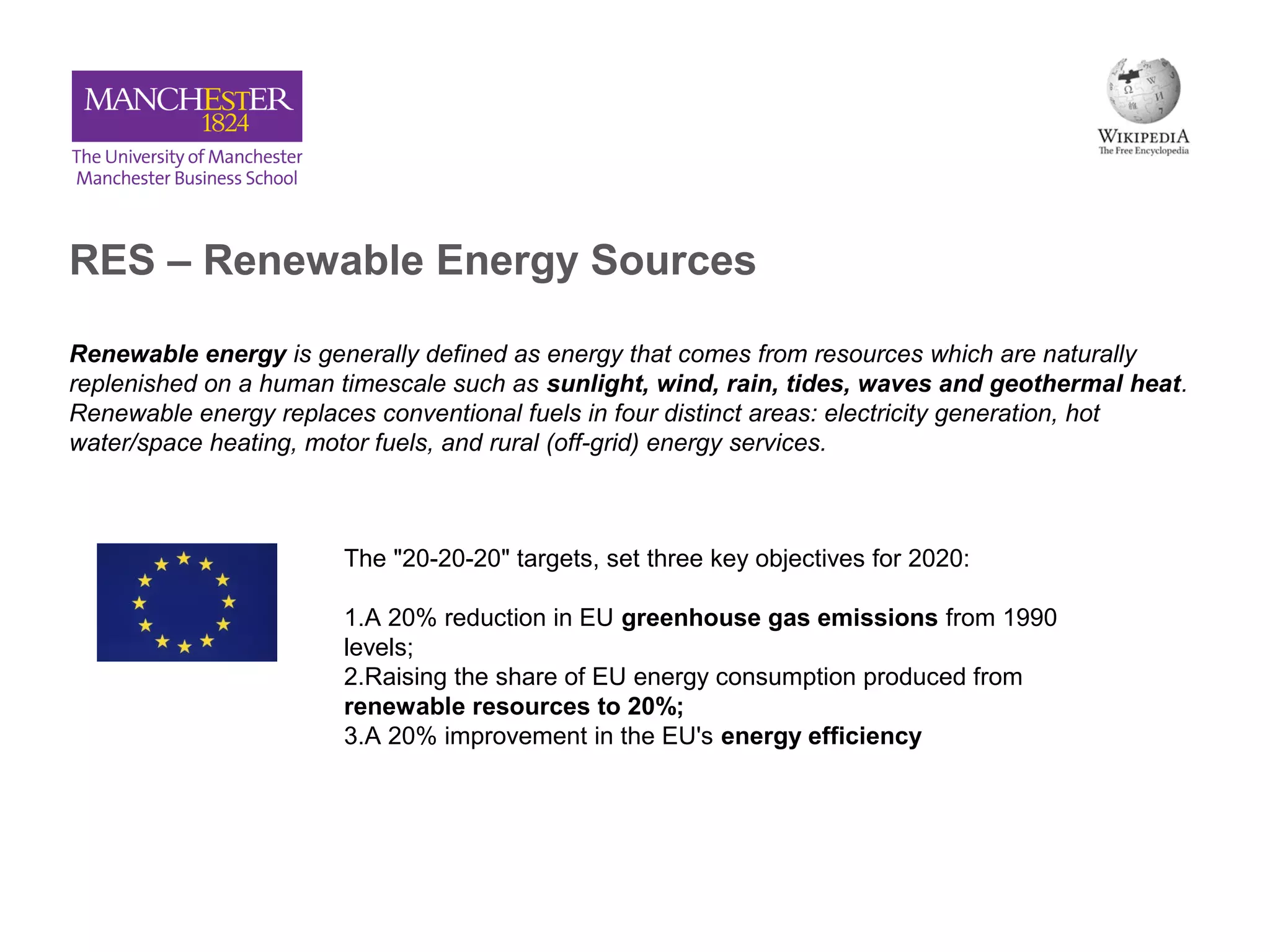
RES – Renewable Energy Sources
Renewable energy is generally defined as energy that comes from resources which are naturally
replenished on a human timescale such as sunlight, wind, rain, tides, waves and geothermal heat.
Renewable energy replaces conventional fuels in four distinct areas: electricity generation, hot
water/space heating, motor fuels, and rural (off-grid) energy services.
The "20-20-20" targets, set three key objectives for 2020:
1.A 20% reduction in EU greenhouse gas emissions from 1990
levels;
2.Raising the share of EU energy consumption produced from
renewable resources to 20%;
3.A 20% improvement in the EU's energy efficiency
RES – Renewable Energy Sources
"Total World Energy Consumption by Source 2010" by Delphi234 - Own work.
Licensed under CC0 via Wikimedia Commons -
8.2%
1.4%
3.2%
Title for text slide 24 point
with 1 line spacing after
Sub-title 18pt with 1 line spacing
after
Main copy size 14 point
Line spacing 1.2 for all text
•Bullet 1 use standard bullet
- Bullet 2 use for secondary bullet
"Total World Energy Consumption by Source 2010" by Delphi234 - Own work.
Licensed under CC0 via Wikimedia Commons -
Agenda
1. Global Outlook
2. Oil & Gas
3. Power (+RES)
4. Climate Change
5. Energy in Europe
6. Energy: power shift underway
7. Careers in Energy
8.2%
1.4%
3.2%
Seven of these indicators would be expected to increase in a
warming world and observations show that they are, in fact,
increasing.
Begin second column of text here. Delete
as necessary.
8.2%
1.4%
3.2%
Climate Change: already occurring
8.2%
1.4%
3.2%
Temperature increase…?
The critical question is:
How much of temperature
increase will not create a non
reversible outcome?
WEF+UN = +2%
Evidence (IEA) = +4%
In a +4% scenario, the
consequences could be extremely
difficult to handle
The answer given in Paris 2015 =
1.5%
zero emissions sometime between
2030 and 2050
8.2%
1.4%
3.2%
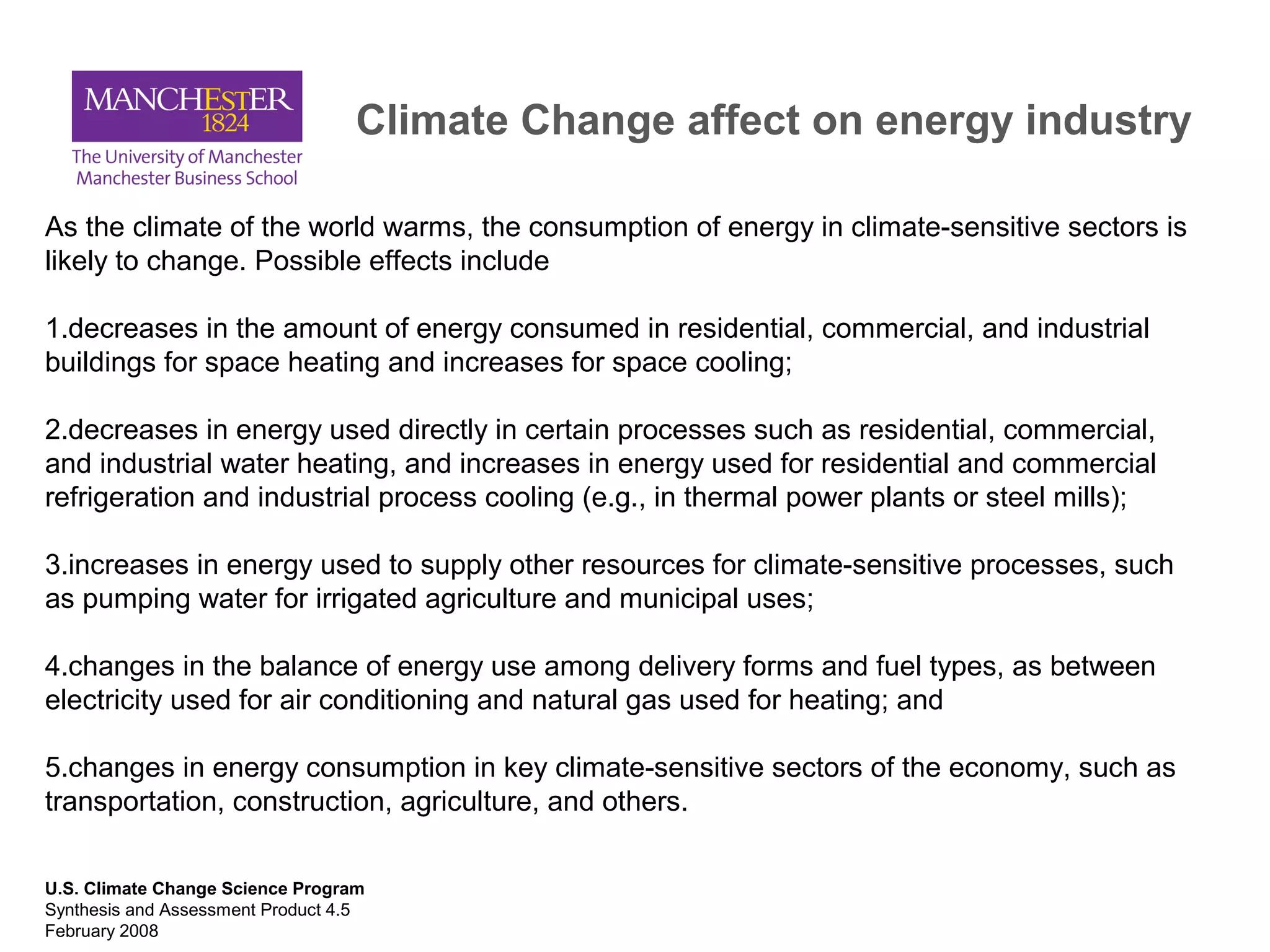
Climate Change affect on energy industry
As the climate of the world warms, the consumption of energy in climate-sensitive sectors is
likely to change. Possible effects include
1.decreases in the amount of energy consumed in residential, commercial, and industrial
buildings for space heating and increases for space cooling;
2.decreases in energy used directly in certain processes such as residential, commercial,
and industrial water heating, and increases in energy used for residential and commercial
refrigeration and industrial process cooling (e.g., in thermal power plants or steel mills);
3.increases in energy used to supply other resources for climate-sensitive processes, such
as pumping water for irrigated agriculture and municipal uses;
4.changes in the balance of energy use among delivery forms and fuel types, as between
electricity used for air conditioning and natural gas used for heating; and
5.changes in energy consumption in key climate-sensitive sectors of the economy, such as
transportation, construction, agriculture, and others.
U.S. Climate Change Science Program
Synthesis and Assessment Product 4.5
February 2008
Agenda
1. Global Outlook
2. Oil & Gas
3. Power (+RES)
4. Climate Change
5. Energy in Europe
6. Energy: power shift underway
7. Careers in Energy
8.2%
1.4%
3.2%
Policy Framework
At any given time, you
can accomplish
2 out of 3 options
1.4%
EU Energy Policy Timeline
8.2%
3.2%
2004
Internal Market
20-20-20 Target
Lisbon Treaty
Russia – Ukraine
crisis
2013-2014 2015
Energiewende
…->2030
3rd
Energy Package: full EU harmonization of “market
design & operation rules” -> Split vertically integrated utilities
by spinning off transmission, common set of access rules
Target Model (Power and Gas)
2012 - Fukushima
2rd
Energy Package + full retail eligibility; transparent & market
friendly cross-border operation; regulators supporting market building;
but cannot get open wholesale pricing & sequence of markets (Day-
Ahead to real time)
Energy UnionEvaluation of
policy
1996 2007
1st
Package
Free Entry in Generation, B2B
Consumer eligibility,
Free movement of goods at borders)
8.2%
1.4%
3.2%
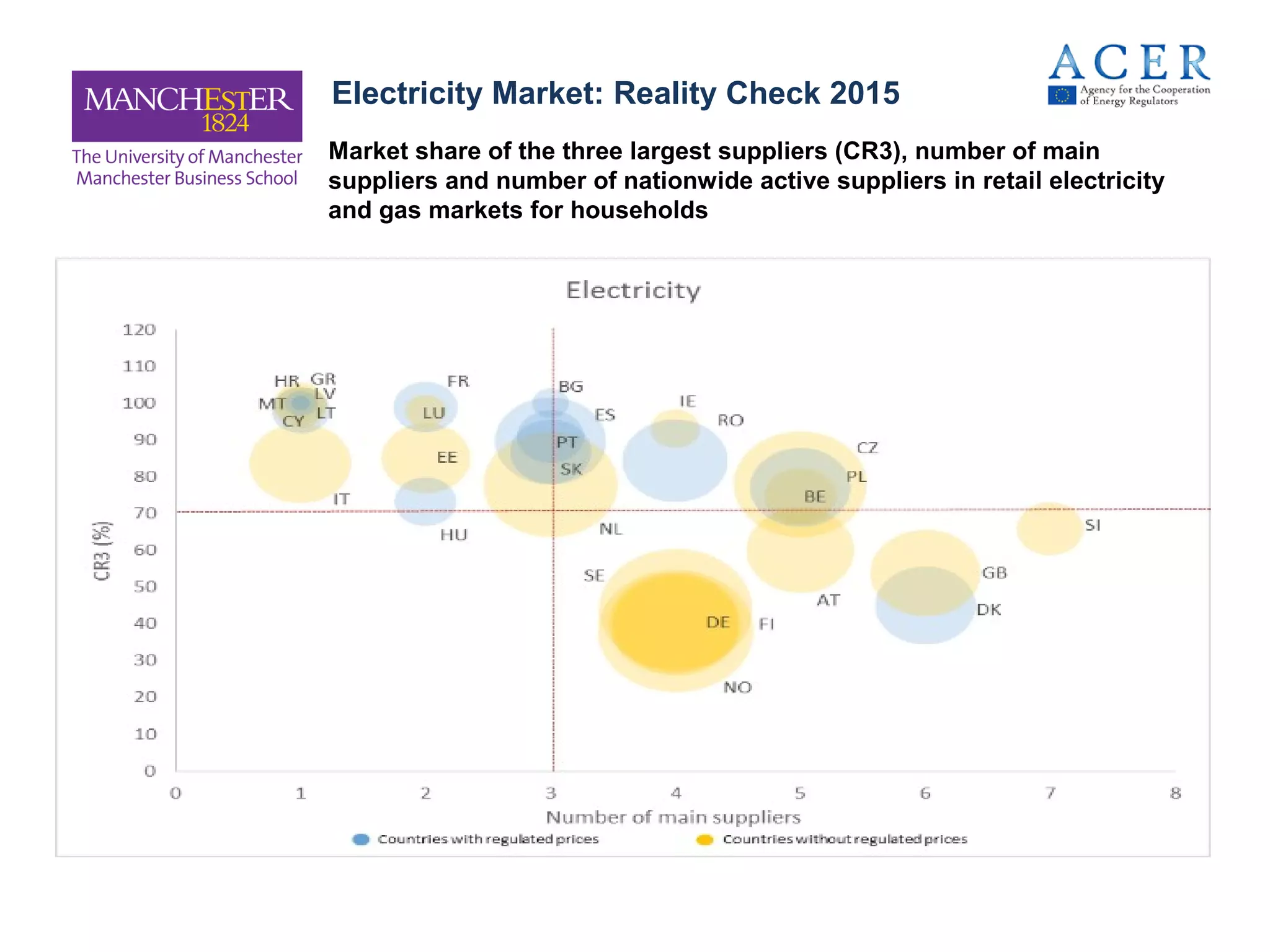
Market share of the three largest suppliers (CR3), number of main
suppliers and number of nationwide active suppliers in retail electricity
and gas markets for households
Electricity Market: Reality Check 2015
1.4%
EU Energy Policy Timeline
8.2%
3.2%
2004-2009 2013-2014 2015
Energy UnionEvaluation of
Policy
Assumptions 3rd
Energy package Reality check 2014
Fossil fuels are scarce and pricey Tough oil and new fields
EU security of supply Russian, Libya, OPEC
Nuclear power Fukushima
CO2 Collapse of ETS
RES complement Utilities RES promoted by subsidies
rendered utilities business model
obsolete and not complimentaryEU Internal Market cost advantage
on fuel
Green revolution ..not anytime soon
The 3rd
Energy
Package was
designed around a
very different energy
system
Energy Union
The 5 Key Dimensions
1. Stronger emphasis on security of supply
2. Completed energy market to connect the
whole Europe
3. Moderation of Demand
4. Decarbonising the energy mix making
Europe the global leader in RES and other
low carbon technologies
5. Research & Innovation in Green Growth
Strategy
Energy Union Strategy is aimed at overcoming the
energy policy vulnerability and achieving the EU energy
and climate goals
Europe relies too heavily on fuel and gas imports
->Europe needs to reduce this dependency while
keeping the energy market open to countries outside
EU
Europe needs more regional co-operation to be
competitive and efficient in developing the
infrastructure and energy markets.
The EU Leadership in developing RES Sector must be
linked with the aim of regaining the industrial
competitiveness through innovation and benefits from
the learning curve
Share and value of investments in energy projects per sub-sector Share and value of the expected triggered investments per sub-
sector
Agenda
1. Global Outlook
2. Oil & Gas
3. Power (+RES)
4. Climate Change
5. Energy in Europe
6. Energy: power shift underway
7. Careers in Energy
8.2%
1.4%
3.2%
8.2%
1.4%
3.2%
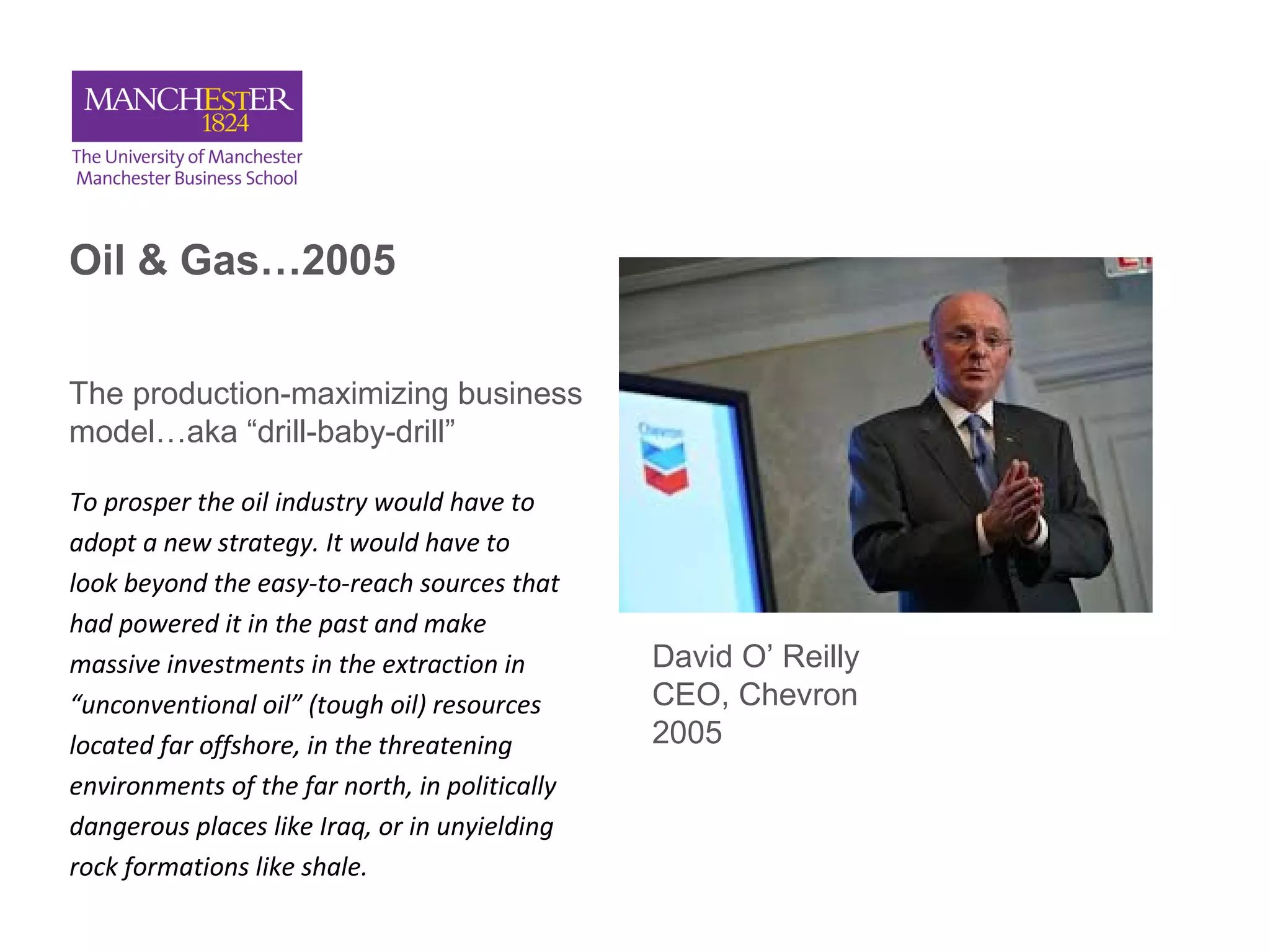
Oil & Gas…2005
The production-maximizing business
model…aka “drill-baby-drill”
To prosper the oil industry would have to
adopt a new strategy. It would have to
look beyond the easy-to-reach sources that
had powered it in the past and make
massive investments in the extraction in
“unconventional oil” (tough oil) resources
located far offshore, in the threatening
environments of the far north, in politically
dangerous places like Iraq, or in unyielding
rock formations like shale.
David O’ Reilly
CEO, Chevron
2005
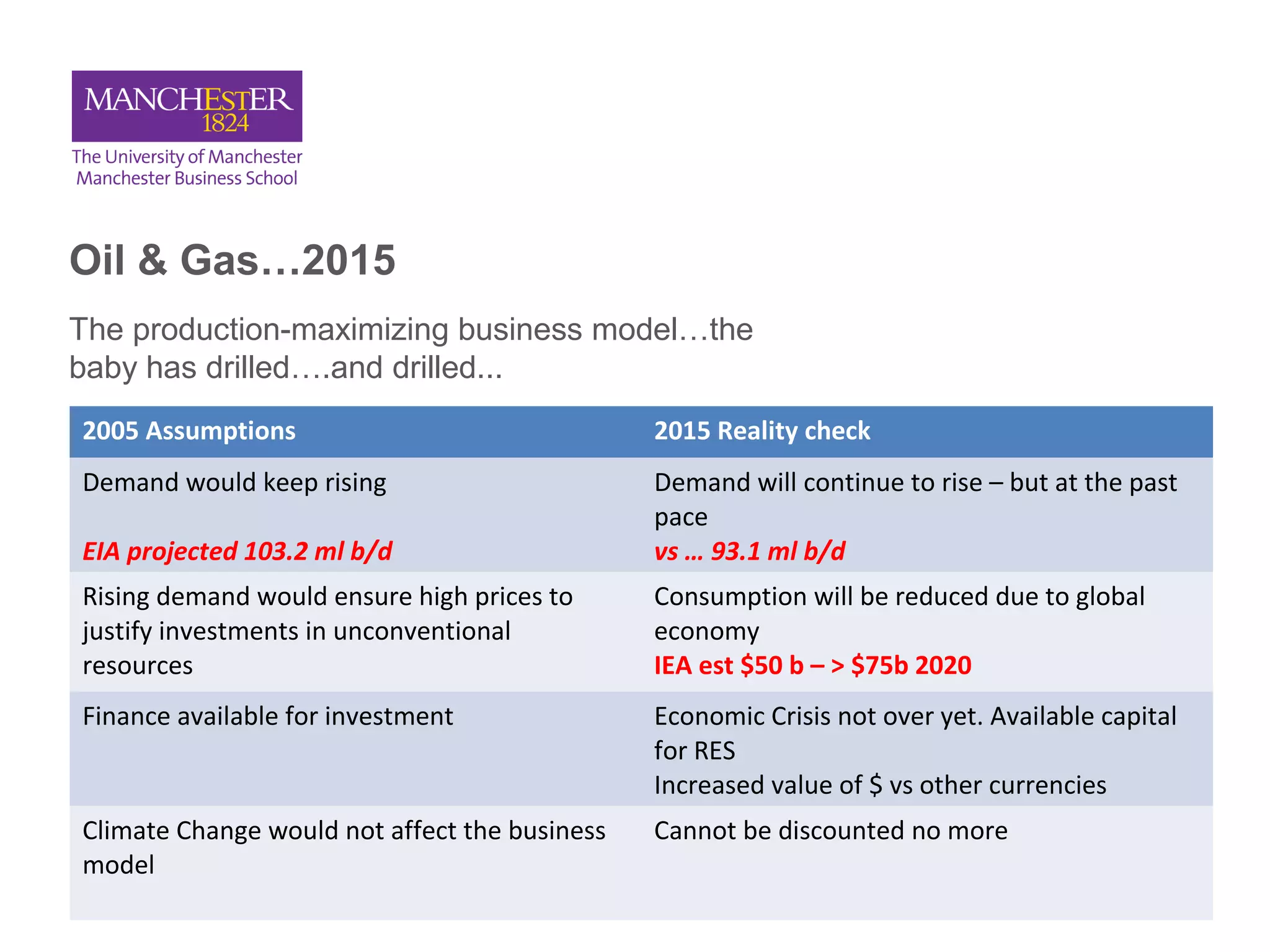
Oil & Gas…2015
The production-maximizing business model…the
baby has drilled….and drilled...
2005 Assumptions 2015 Reality check
Demand would keep rising
EIA projected 103.2 ml b/d
Demand will continue to rise – but at the past
pace
vs … 93.1 ml b/d
Rising demand would ensure high prices to
justify investments in unconventional
resources
Consumption will be reduced due to global
economy
IEA est $50 b – > $75b 2020
Finance available for investment Economic Crisis not over yet. Available capital
for RES
Increased value of $ vs other currencies
Climate Change would not affect the business
model
Cannot be discounted no more
8.2%
1.4%
3.2%
8.2%
1.4%
3.2%
Electricity Value Chain
Upstream Midstream Downstream
Utilities
Oil
Coal
Gas
Nuclear
RES
8.2%
1.4%
3.2%
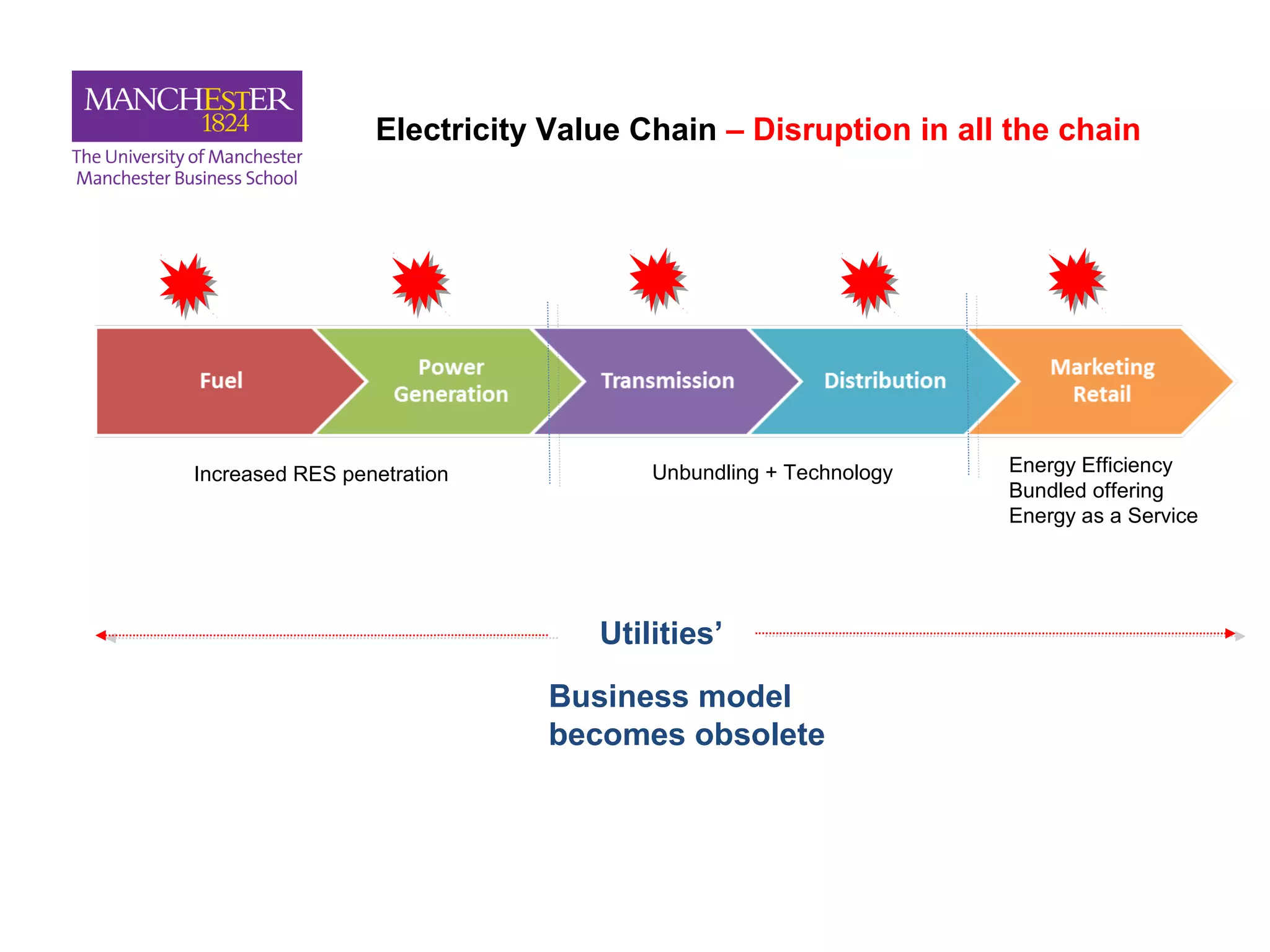
Electricity Value Chain – Disruption in all the chain
Business model
becomes obsolete
Utilities’
Increased RES penetration Unbundling + Technology Energy Efficiency
Bundled offering
Energy as a Service
8.2%
1.4%
3.2%
When we think about a value chain, we tend to
visualize a linear flow of physical activities.
But the value chain also includes all the
information that flows within a company and
between a company and its suppliers, its
distributors, and its existing or potential
customers.
The informational components of value are so
deeply embedded in the physical value chain
that, in some cases, we are just beginning to
acknowledge their separate existence.
When information is carried by things — by a
salesperson or by a piece of direct mail, for
example — it goes where the things go and no
further. It is constrained to follow the linear flow of
the physical value chain. But once everyone is
connected electronically, information can travel by
itself.
Electricity Value Chain – Information Disruption
8.2%
1.4%
3.2%
The changing economics of information
threaten to undermine established value
chains in many sectors of the economy,
requiring virtually every company to rethink
its strategy—not incrementally, but
fundamentally.
Bargaining power will shift as a result of
a radical reduction in the ability to
monopolize the control of information.
Market power often comes from
controlling a choke point in an
information channel and extracting tolls
from those dependent on the flow of
information through it.
8.2%
1.4%
3.2%
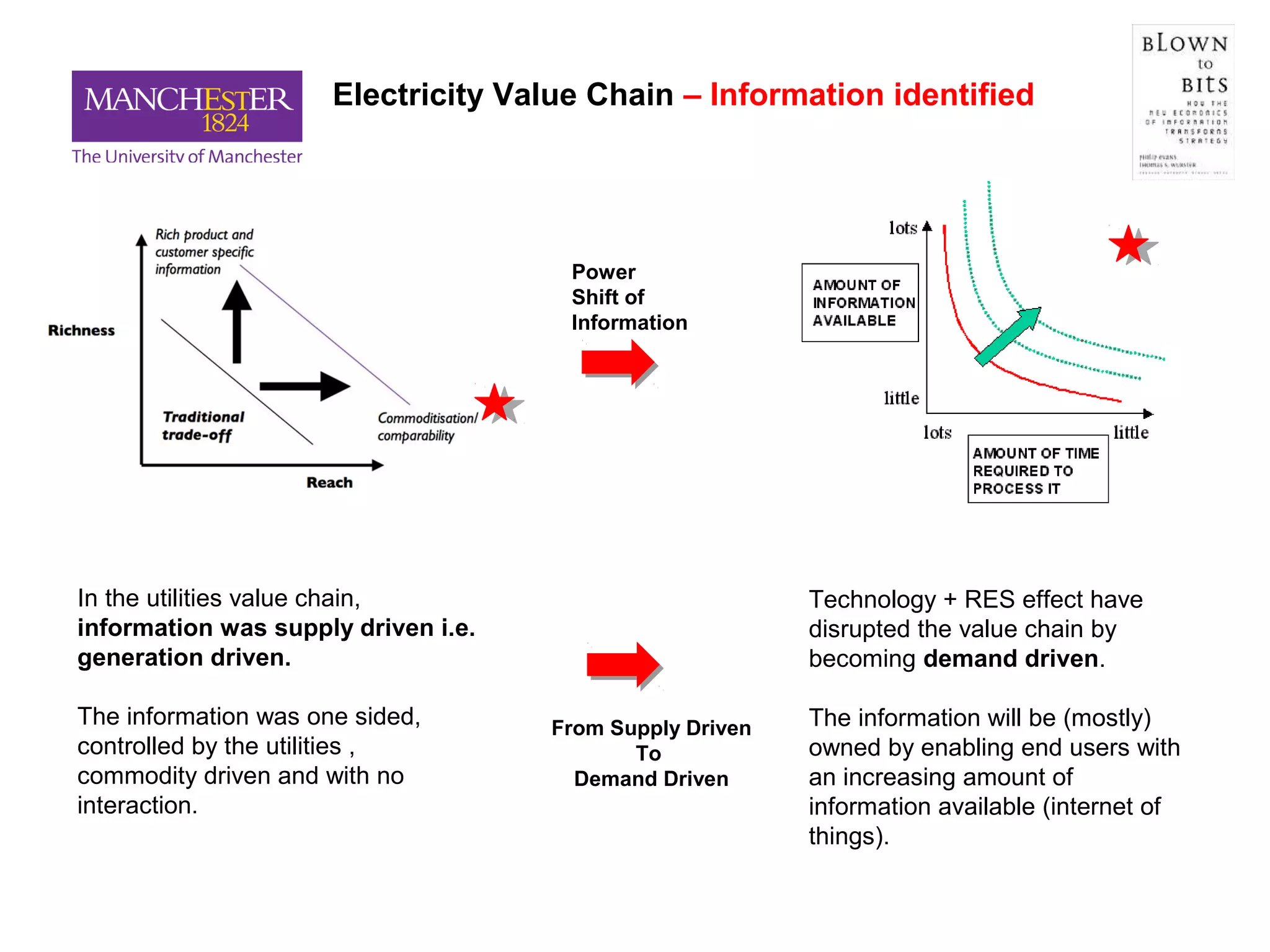
In the utilities value chain,
information was supply driven i.e.
generation driven.
The information was one sided,
controlled by the utilities ,
commodity driven and with no
interaction.
Technology + RES effect have
disrupted the value chain by
becoming demand driven.
The information will be (mostly)
owned by enabling end users with
an increasing amount of
information available (internet of
things).
Power
Shift of
Information
From Supply Driven
To
Demand Driven
Electricity Value Chain – Information identified
8.2%
1.4%
3.2%
Electricity Value Chain – legacy version
Utilities
Supply side driven – “pre arranged” generation
InformationInformation
8.2%
1.4%
3.2%
Electricity Value Chain – emerging version
Utilities
Demand side driven – information flows from end consumer to generation
InformationInformation
8.2%
1.4%
3.2%
The RES Effect: the duck curve
8.2%
1.4%
3.2%
Power shift to the Demand Side
End Consumers
now manage the
Information
8.2%
1.4%
3.2%
Europe’s electricity providers face an existential threat
The traditional utility business model has evolved to deliver stable
and predictable returns to investors. This, in turn, has ensured
investment grade credit ratings could be maintained enabling the
companies to efficiently raise large amounts capital to finance
investment in new infrastructure projects.
However, this business model has significant drawbacks. It
demands that the organisation is managed to deliver steadily
increasing profits and this creates a difficult environment in which
to grow new businesses and develop new markets – particularly if
those new businesses cannibalise the core markets that generate
the cash.
It is not possible to optimally run an organisation which
comprises two businesses pointing in fundamentally opposite
directions.
How to lose half a trillion euro
8.2%
1.4%
3.2%
Alternate Energy Sources
(RES)
Interconnected System
Demand side Generation
Management
Alternate Energy Sources
(RES)
Interconnected System
Demand side Generation
Management
Energy Management &
Efficiency (Smart Buildings)
Load Optimization
Energy Management &
Efficiency (Smart Buildings)
Load Optimization
Transmission and Distribution are upgraded to support a
distributed generation world based on intelligent use of
Big Data
Smart GridSmart Grid
The power industry’s main concern has always been supply. Now it is
learning to manage demand
8.2%
1.4%
3.2%
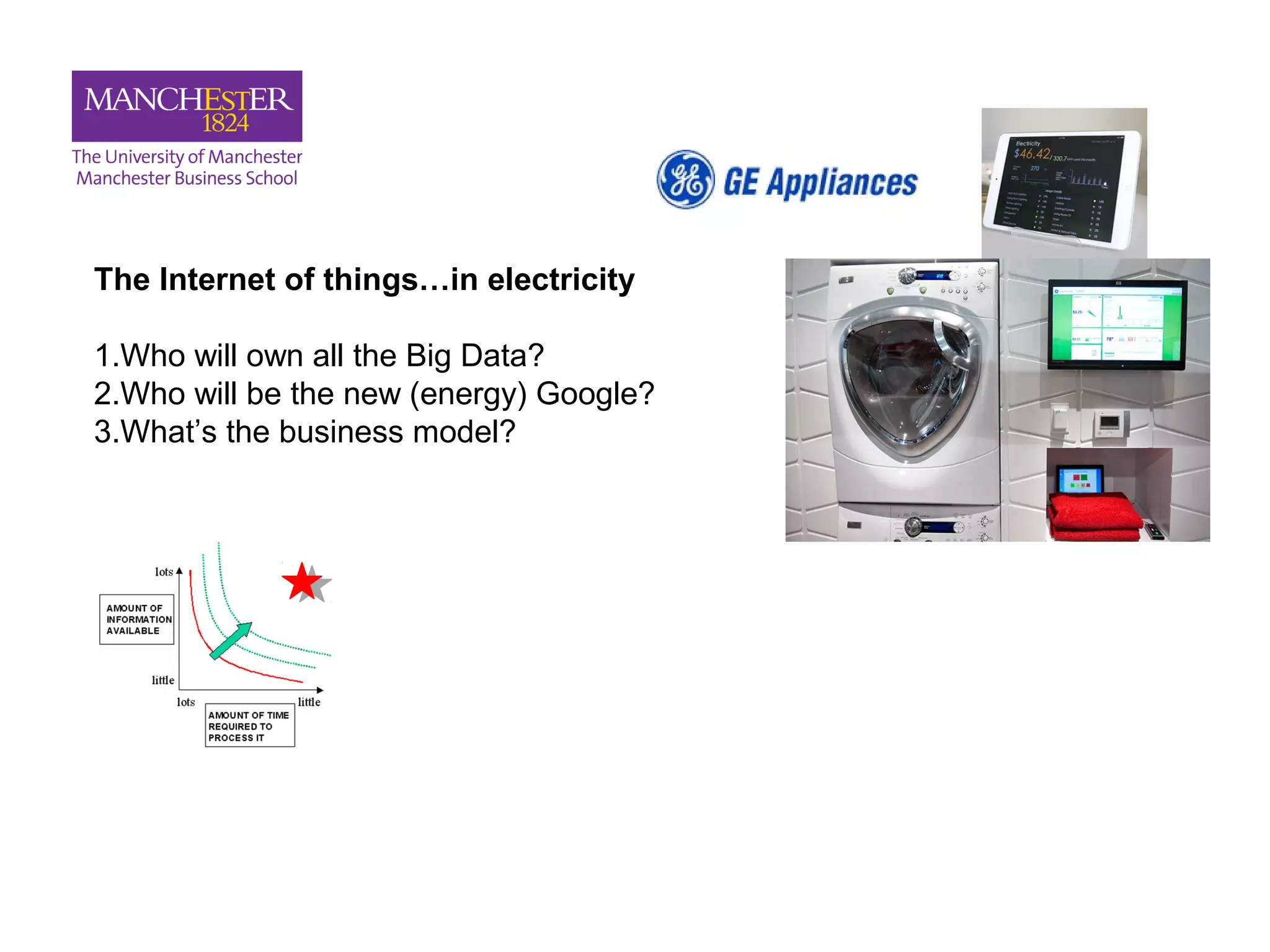
The Internet of things…in electricity
1.Who will own all the Big Data?
2.Who will be the new (energy) Google?
3.What’s the business model?
8.2%
1.4%
3.2%
The reactions…
2 Case studies
1.e.on
2.Statoil
8.2%
1.4%
3.2%
Energiewende: Germany’s Energy Transition
8.2%
1.4%
3.2%
8.2%
1.4%
3.2%
The background
8.2%
1.4%
3.2%
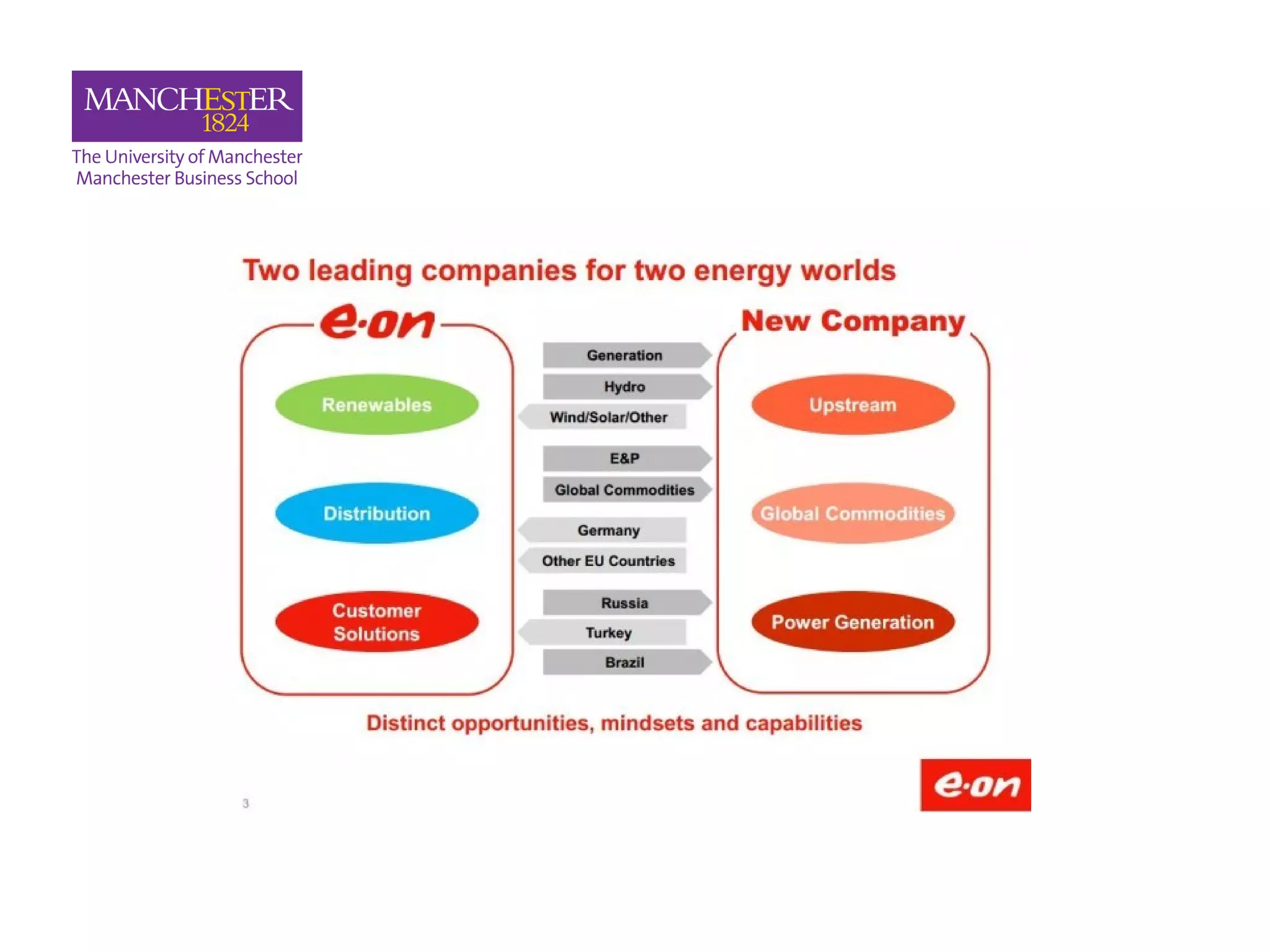
The Solution: split in 2
8.2%
1.4%
3.2%
8.2%
1.4%
3.2%
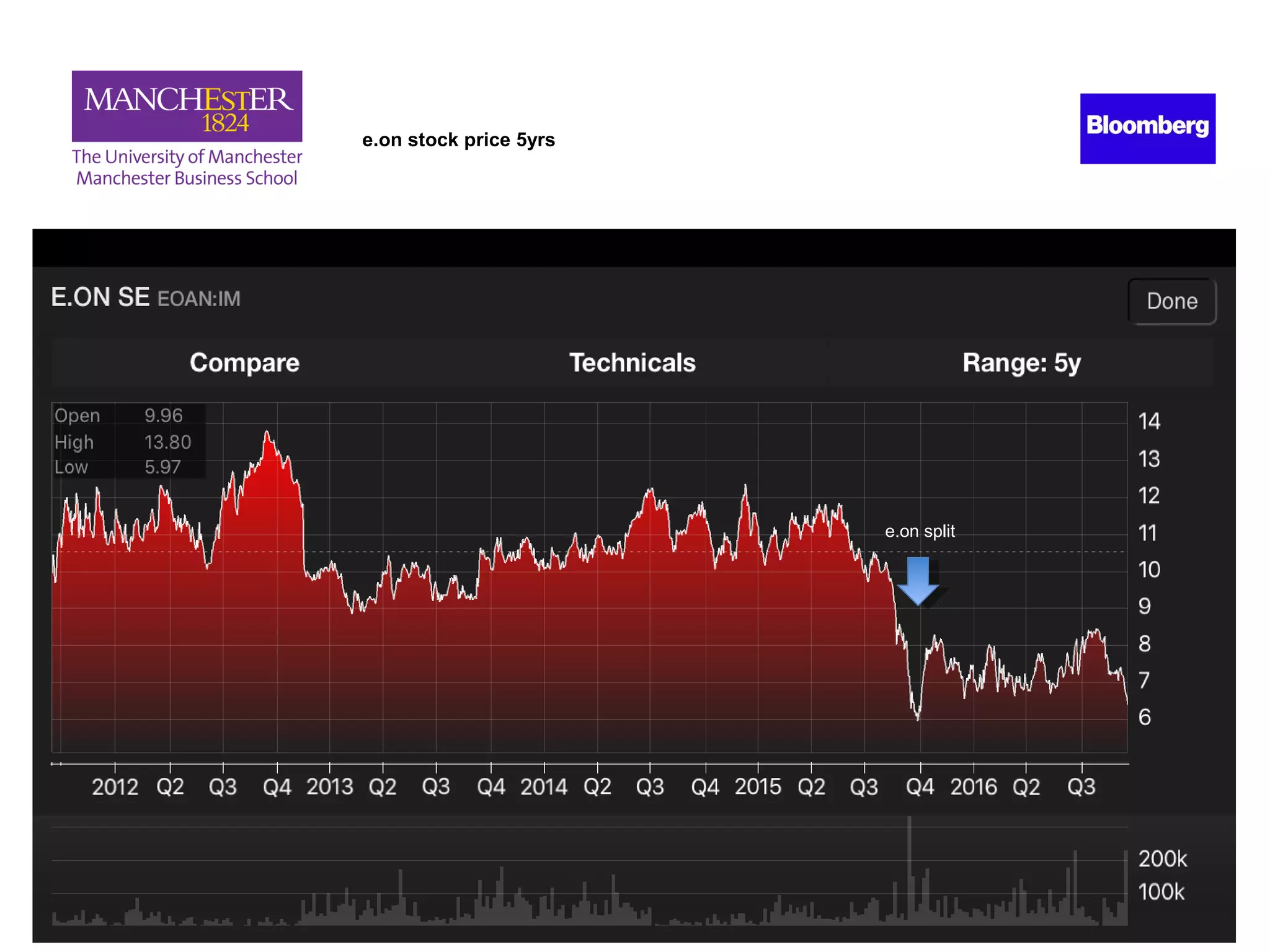
e.on split
e.on stock price 5yrs
e.on split
8.2%
1.4%
3.2%
e.on stock price vs Deutche Borse 1yr
e.on split
8.2%
1.4%
3.2%
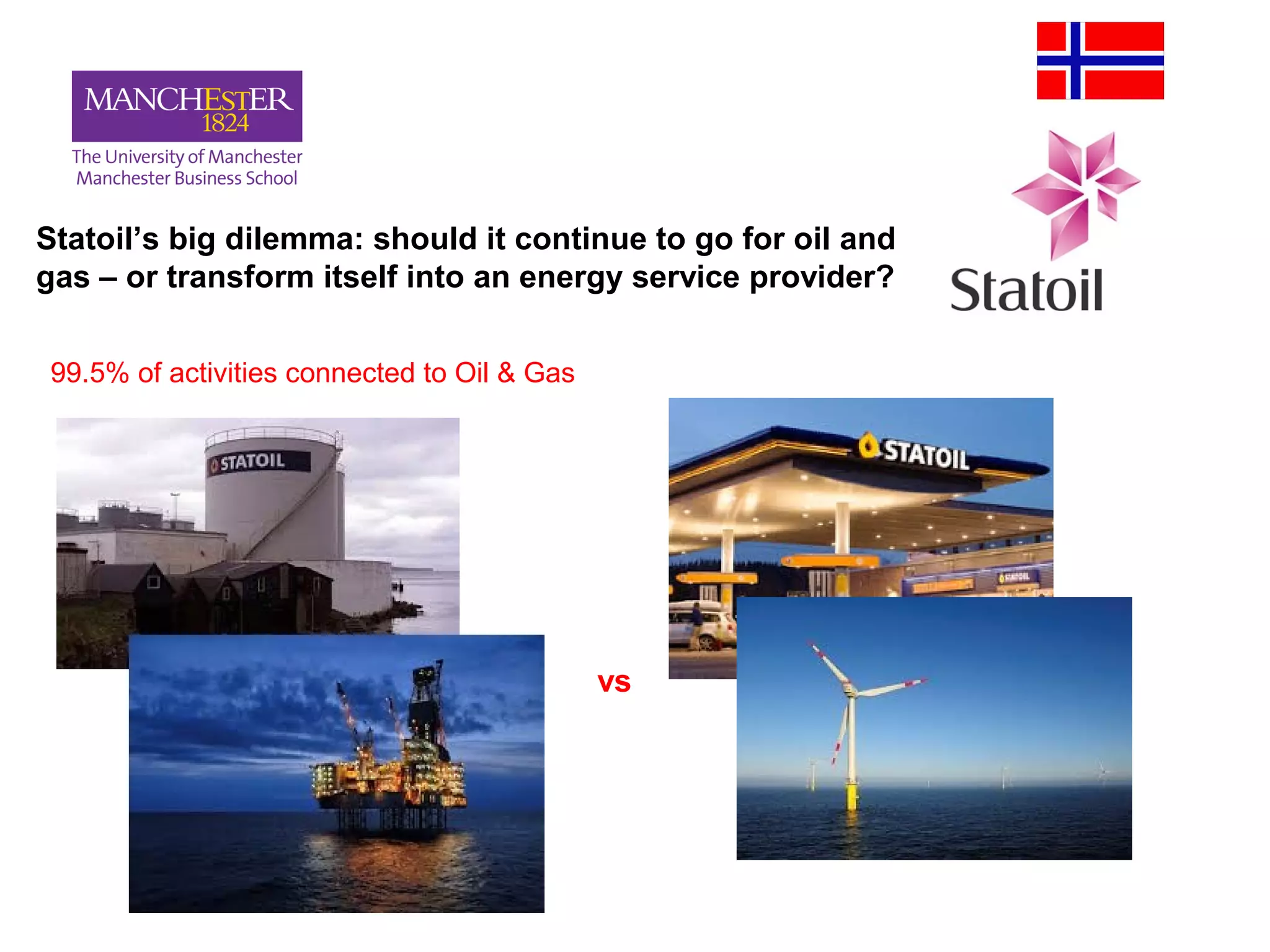
Statoil’s big dilemma: should it continue to go for oil and
gas – or transform itself into an energy service provider?
vs
99.5% of activities connected to Oil & Gas
8.2%
1.4%
3.2%
Statoil’s big dilemma: should it continue to go for oil and
gas – or transform itself into an energy service provider?
The business idea for a restructured Statoil will no longer be to pump oil and gas, but
to supply society with energy services it needs and is asking for.
This would be a long-term sustainable business model which also allows for oil and
gas production…. The goal will be to deliver energy services people need, which
bring the world forward, and which are compatible with a two-degree target.
Financially, the upside will be that the road is much shorter from investment to cash
flow than in upstream oil and gas. Large solar power stations can be planned and
built in the space of a few months. Supplementary gas power plants also have fairly
short construction times. These are markets in growth. It will happen whether the oil
industry likes it or not.
8.2%
1.4%
3.2%
Stat oil stock price Oslo Stock Exchange 1yr
8.2%
1.4%
3.2%
1.4%
3.2%
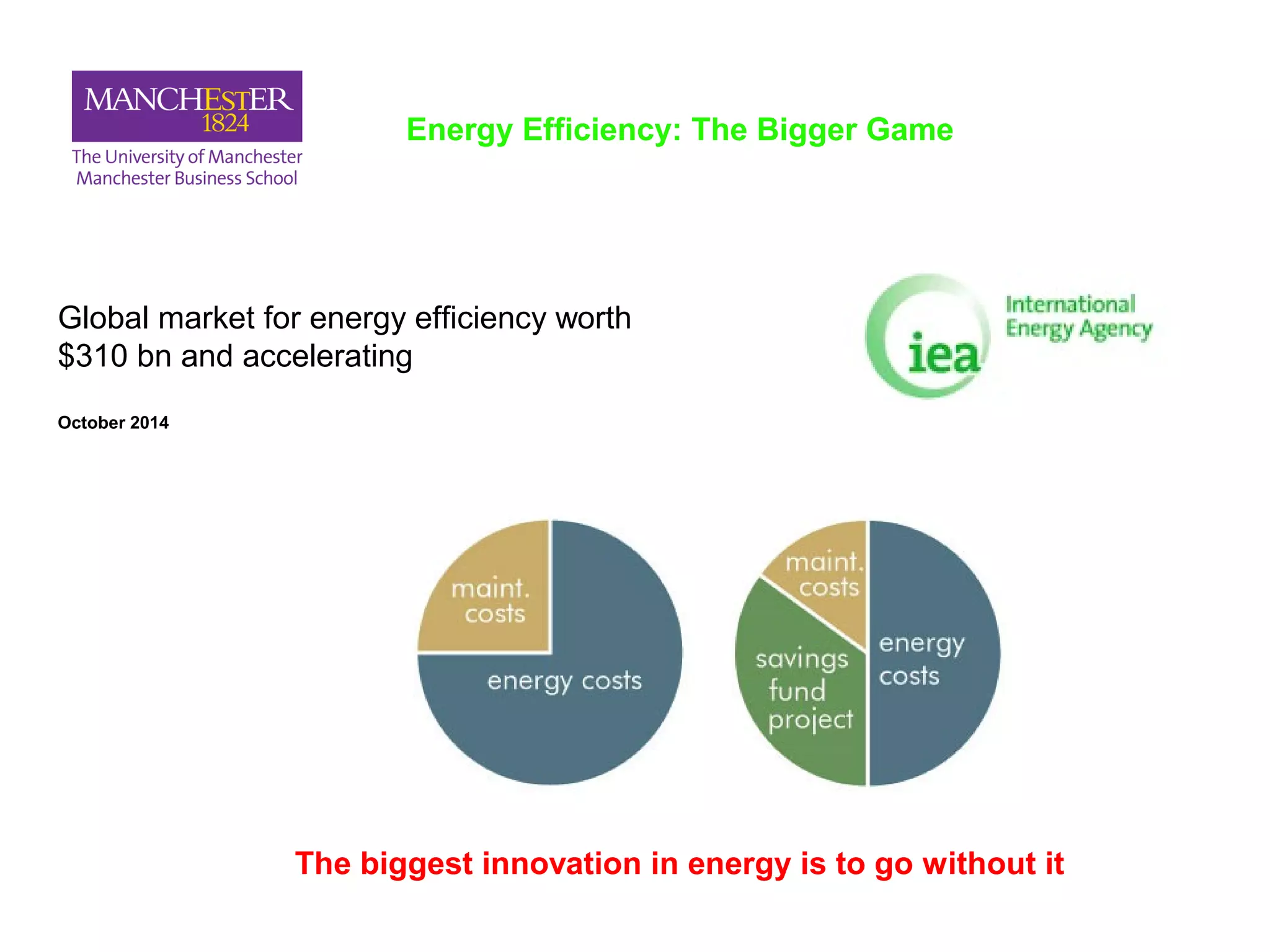
Energy Efficiency: The Bigger Game
Global market for energy efficiency worth
$310 bn and accelerating
October 2014
The biggest innovation in energy is to go without it
8.2%
1.4%
3.2%
Energy Efficiency: The Bigger Game
8.2%
1.4%
3.2%
8.2%
1.4%
3.2%
The basic problem is that energy is treated as a commodity, which
means that suppliers sell it by volume – and of course they then want
to increase their sales.
But energy should be regarded as a service – a “process-in-
infrastructure”.
By treating energy as a process, by selling it in the form of
infrastructure, it becomes in the interest of the supplier to save
energy rather than to maximize sales. This is where we should be
taking our energy system. In fact, this is already happening in many
places.
The role of government in all this is not merely to develop appropriate
legislation or regulation. Governments can do even more as consumers
of energy. They are the biggest users of energy in the world after all.
Walt Patterson, physicist and Associate Fellow at Chatham House
8.2%
1.4%
3.2%
8.2%
1.4%
3.2%
8.2%
1.4%
3.2%
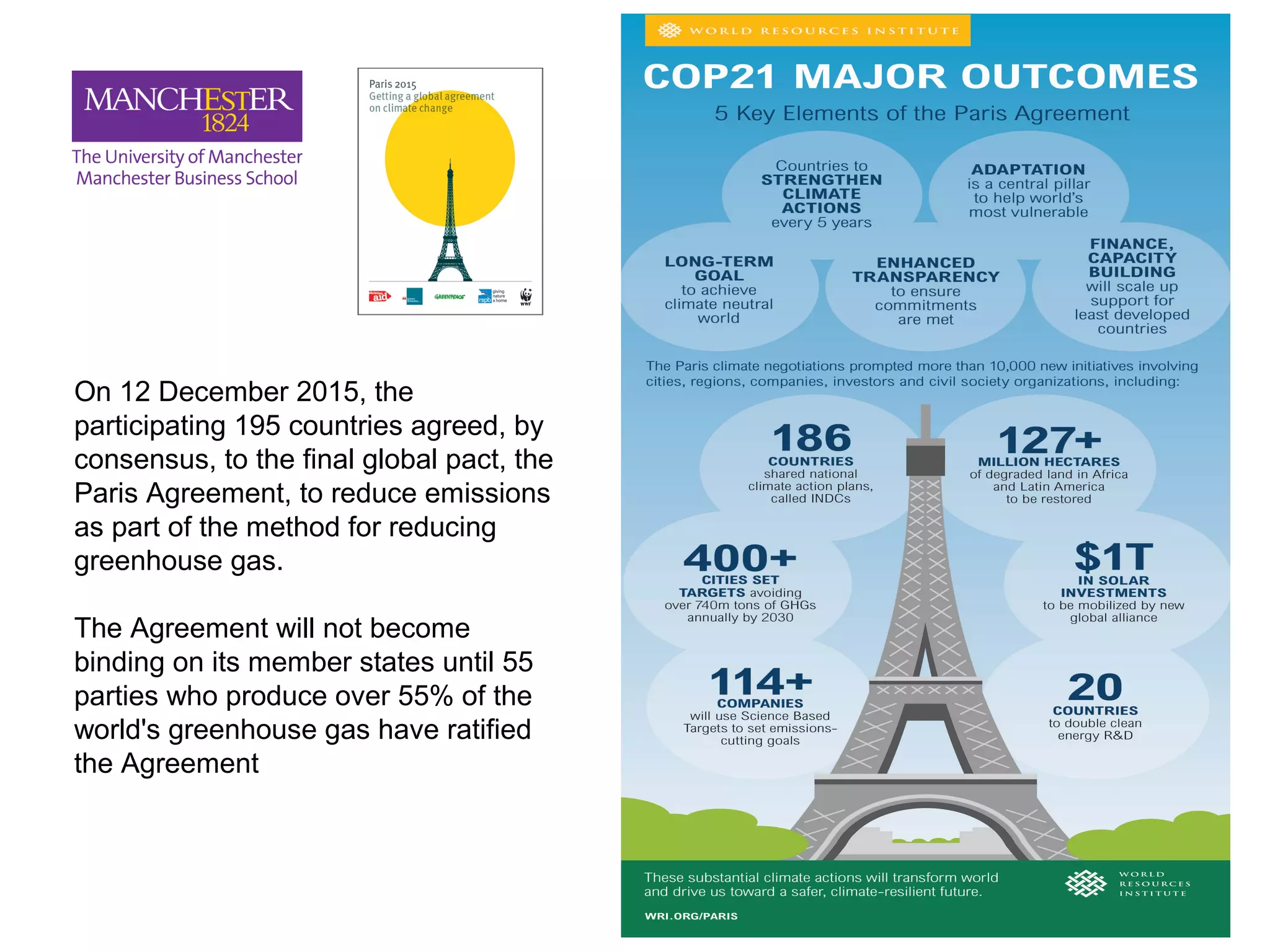
On 12 December 2015, the
participating 195 countries agreed, by
consensus, to the final global pact, the
Paris Agreement, to reduce emissions
as part of the method for reducing
greenhouse gas.
The Agreement will not become
binding on its member states until 55
parties who produce over 55% of the
world's greenhouse gas have ratified
the Agreement
Agenda
1. Global Outlook
2. Oil & Gas
3. Power (+RES)
4. Climate Change
5. Energy in Europe
6. Energy: power shift underway
7. Careers in Energy
8.2%
1.4%
3.2%
Career Mapping
8.2%
1.4%
3.2%
Career Mapping -> Functions
Finance
Manufacturing
Marketing
BizDev
Sales
Logistics
HR
Regulation
Finance
Manufacturing
Marketing
BizDev
Sales
Logistics
HR
Regulation
FinanceFinance
Finance
Manufacturing
Marketing
BizDev
Sales
Logistics
HR
Policy
Regulation
Finance
Manufacturing
Marketing
BizDev
Sales
Logistics
HR
Policy
Regulation
Finance
Policy
Regulation
Compliance
Legal
Finance
Policy
Regulation
Compliance
Legal
8.2%
1.4%
3.2%
Thank you for your attention

Energy power shift 09_2016

  • 1.
    Energy: power shiftunder way A general outlook on the energy industry and the changes shaping the future. The session describes the shifting trends in Oil, Gas, Power (incl. Renewables), Climate Change and Business Models
  • 2.
    Vasilis Rallis MBA 2001 CurrentRole Senior Advisor, Energy Markets (8 years in the Regulator) Experience Intl Business Development, Finance, Government. Industries Energy, Automotive, Manufacturing, Finance, Management Consulting
  • 3.
    Agenda 1. Global Outlook 2.Oil & Gas 3. Power (+RES) 4. Climate Change 5. Energy in Europe 6. Energy: power shift underway 7. Careers in Energy
  • 4.
    Agenda 1. Global Outlook 2.Oil 3. Gas 4. Power (+RES) 5. Climate Change 6. The New Business Mode 7. Energy: power shift underway
  • 5.
    Energy at thecentre of everything we do… “Energy refers to the power derived from the utilization of physical or chemical resources” Simply put…Without energy…nothing can be done Energy is a source of competitive advantage
  • 6.
  • 7.
  • 8.
    5 Global Megatrendsto watch for… Demographic and social change Within the next minute the global population will rise by 145 people. By 2030 global population will reach 8.7bn Shift in economic power On current trends, the aggregate purchasing power of the ‘E7’ emerging economies – China, India, Russia, Brazil, Mexico, Turkey and Indonesia – will overtake that of the G7 by 2030. Rapid urbanisation In 1800, 2% of the world’s population lived in cities. Now it’s 50%. Every week, some 1.5 million people join the urban population, through a combination of migration and childbirth. Climate change and resource scarcity At current rates of consumption we may have just half a century’s worth of oil & gas left. Yet to meet our development needs we’re highly dependent on fossil fuels, which drive carbon emissions. Technological breakthroughs The impacts of digital disruption are now so pervasive that no business in any sector – from the smallest family business to largest multinational – is immune from them..
  • 9.
    6 Energy Megatrendsto watch for… Oil price OPEC’s decision to keep supply constant has caused the oil price to collapse – and has created a new industry outlook. A modest rebound is observed in 2016. Energy Demand is falling in Europe… Based on 2013 data (Eurostat) energy demand in EU- 28 has fallen 9.1% vs 2006 (approaching 1990-1995 pattern). ..but is increasing in emerging countries With China, India, Brazil exhibiting year-on-year energy demand growth. Gas (r)evolution Shale gas technology (fracking) has enabled the US to become energy efficient and contemplate about exporting it – forcing OPEC to retaliate. The bigger game: efficiency The biggest disruptive technology in energy is to go without it. RES are here to stay Solar is bound to get cheaper due to technology innovation and available financing. Biomass and Wind will benefit as well. They have already begun changing the industry value chain.
  • 10.
    Agenda 1. Global Outlook 2.Oil & Gas 3. Power (+RES) 4. Climate Change 5. Energy in Europe 6. Energy: power shift underway 7. Careers in Energy
  • 11.
  • 12.
    Big Oil Big oilis a name used to describe the world's five (or six) largest publicly owned oil and gas companies, also known as supermajors. The supermajors are considered to be: BP plc, Chevron Corporation, ExxonMobil Corporation, Royal Dutch Shell plc and Total SA.
  • 13.
  • 14.
    8.2% 1.4% 3.2% Big Oil… ..is mostlyState Controlled in terms of reserves but…
  • 15.
    8.2% 1.4% 3.2% ..private sector companies aremaking the most profits Company name 2015 Sales (US$ million) Exxon Mobil 496,255 Royal Dutch Shell 484,489 BP 386,463 Saudi Aramco 311,000 Chevron Corporation 245,621 Conoco Phillips 237,272 Total SA 231,580 Gazprom 157,830 Eni 153,676 Petrobras 145,915 GDF Suez 126,076 Pemex 125,344 Valero Energy 125,095
  • 16.
    8.2% 1.4% 3.2% ..oil price keepsfalling…5 yrs trend
  • 17.
    8.2% 1.4% 3.2% ..oil price keepsfalling…YTD trend – Modest rebound
  • 18.
    8.2% 1.4% 3.2% Oil & Gas2014… The decline in oil prices over the past years and the continued weakness in gas prices have created a new structural challenge for the upstream oil and gas industry. A world of lower oil-price planning has become the common basis for the coming 12 to 18 months. 1.Production costs, which grew by half for major oil companies over the past five years; 2.Complexity, which rose as operators’ and service companies’ production and development businesses became more elaborate 3.Government policies, which have ranged from new, regulatory burden to laissez-faire oversight (as seen in the LNG sector in Australia and in onshore production in the US). …and 2016 problems
  • 19.
    8.2% 1.4% 3.2% Oil & Gastrends – Take away thought… • Competition, slumping oil prices, and glutted energy demand • The O&G landscape is being significantly reshaped by a potent emerging trend: the fear of climate change and a powerful, concerted effort to reduce CO2 emissions and minimize fossil fuels (Rio 1992 to Paris 2015) Oil & Gas executives must address a vital existential issue: How to successfully do business in an increasingly carbon- constrained world
  • 20.
    Agenda 1. Global Outlook 2.Oil & Gas 3. Power (+RES) 4. Climate Change 5. Energy in Europe 6. Energy: power shift underway 7. Careers in Energy
  • 21.
    8.2% 1.4% 3.2% Electricity Value Chain UpstreamMidstream Downstream Utilities Oil Coal Gas Nuclear RES
  • 22.
    1.4% Utilities business modelevolution (EU) 8.2% 3.2% “The traditional utility business model has evolved to deliver stable and predictable returns to investors. This, in turn, has ensured investment grade credit ratings could be maintained enabling the companies to efficiently raise large amounts capital to finance investment in new infrastructure projects”. 1980’s State owned and controlled 1990’s 2000’s 1st Deregulation and Liberazation of the market 2010’s 2nd + 3rd Energy Package Unbundling of Distribution, Transportation, Marketing RES penetration (20-20-20 Target) Target Model (Internal European Energy Market) RES penetration Continuous RES penetration: + Incentives (FIT) + technology disruption = viable RES production -> erosion of utilities business model
  • 23.
    RES – RenewableEnergy Sources Renewable energy is generally defined as energy that comes from resources which are naturally replenished on a human timescale such as sunlight, wind, rain, tides, waves and geothermal heat. Renewable energy replaces conventional fuels in four distinct areas: electricity generation, hot water/space heating, motor fuels, and rural (off-grid) energy services. The "20-20-20" targets, set three key objectives for 2020: 1.A 20% reduction in EU greenhouse gas emissions from 1990 levels; 2.Raising the share of EU energy consumption produced from renewable resources to 20%; 3.A 20% improvement in the EU's energy efficiency
  • 24.
    RES – RenewableEnergy Sources
  • 25.
    "Total World EnergyConsumption by Source 2010" by Delphi234 - Own work. Licensed under CC0 via Wikimedia Commons -
  • 26.
    8.2% 1.4% 3.2% Title for textslide 24 point with 1 line spacing after Sub-title 18pt with 1 line spacing after Main copy size 14 point Line spacing 1.2 for all text •Bullet 1 use standard bullet - Bullet 2 use for secondary bullet "Total World Energy Consumption by Source 2010" by Delphi234 - Own work. Licensed under CC0 via Wikimedia Commons -
  • 27.
    Agenda 1. Global Outlook 2.Oil & Gas 3. Power (+RES) 4. Climate Change 5. Energy in Europe 6. Energy: power shift underway 7. Careers in Energy
  • 28.
  • 29.
    Seven of theseindicators would be expected to increase in a warming world and observations show that they are, in fact, increasing. Begin second column of text here. Delete as necessary.
  • 30.
  • 31.
    8.2% 1.4% 3.2% Temperature increase…? The criticalquestion is: How much of temperature increase will not create a non reversible outcome? WEF+UN = +2% Evidence (IEA) = +4% In a +4% scenario, the consequences could be extremely difficult to handle The answer given in Paris 2015 = 1.5% zero emissions sometime between 2030 and 2050
  • 32.
    8.2% 1.4% 3.2% Climate Change affecton energy industry As the climate of the world warms, the consumption of energy in climate-sensitive sectors is likely to change. Possible effects include 1.decreases in the amount of energy consumed in residential, commercial, and industrial buildings for space heating and increases for space cooling; 2.decreases in energy used directly in certain processes such as residential, commercial, and industrial water heating, and increases in energy used for residential and commercial refrigeration and industrial process cooling (e.g., in thermal power plants or steel mills); 3.increases in energy used to supply other resources for climate-sensitive processes, such as pumping water for irrigated agriculture and municipal uses; 4.changes in the balance of energy use among delivery forms and fuel types, as between electricity used for air conditioning and natural gas used for heating; and 5.changes in energy consumption in key climate-sensitive sectors of the economy, such as transportation, construction, agriculture, and others. U.S. Climate Change Science Program Synthesis and Assessment Product 4.5 February 2008
  • 33.
    Agenda 1. Global Outlook 2.Oil & Gas 3. Power (+RES) 4. Climate Change 5. Energy in Europe 6. Energy: power shift underway 7. Careers in Energy
  • 34.
    8.2% 1.4% 3.2% Policy Framework At anygiven time, you can accomplish 2 out of 3 options
  • 35.
    1.4% EU Energy PolicyTimeline 8.2% 3.2% 2004 Internal Market 20-20-20 Target Lisbon Treaty Russia – Ukraine crisis 2013-2014 2015 Energiewende …->2030 3rd Energy Package: full EU harmonization of “market design & operation rules” -> Split vertically integrated utilities by spinning off transmission, common set of access rules Target Model (Power and Gas) 2012 - Fukushima 2rd Energy Package + full retail eligibility; transparent & market friendly cross-border operation; regulators supporting market building; but cannot get open wholesale pricing & sequence of markets (Day- Ahead to real time) Energy UnionEvaluation of policy 1996 2007 1st Package Free Entry in Generation, B2B Consumer eligibility, Free movement of goods at borders)
  • 36.
    8.2% 1.4% 3.2% Market share ofthe three largest suppliers (CR3), number of main suppliers and number of nationwide active suppliers in retail electricity and gas markets for households Electricity Market: Reality Check 2015
  • 37.
    1.4% EU Energy PolicyTimeline 8.2% 3.2% 2004-2009 2013-2014 2015 Energy UnionEvaluation of Policy Assumptions 3rd Energy package Reality check 2014 Fossil fuels are scarce and pricey Tough oil and new fields EU security of supply Russian, Libya, OPEC Nuclear power Fukushima CO2 Collapse of ETS RES complement Utilities RES promoted by subsidies rendered utilities business model obsolete and not complimentaryEU Internal Market cost advantage on fuel Green revolution ..not anytime soon The 3rd Energy Package was designed around a very different energy system
  • 38.
    Energy Union The 5Key Dimensions 1. Stronger emphasis on security of supply 2. Completed energy market to connect the whole Europe 3. Moderation of Demand 4. Decarbonising the energy mix making Europe the global leader in RES and other low carbon technologies 5. Research & Innovation in Green Growth Strategy Energy Union Strategy is aimed at overcoming the energy policy vulnerability and achieving the EU energy and climate goals Europe relies too heavily on fuel and gas imports ->Europe needs to reduce this dependency while keeping the energy market open to countries outside EU Europe needs more regional co-operation to be competitive and efficient in developing the infrastructure and energy markets. The EU Leadership in developing RES Sector must be linked with the aim of regaining the industrial competitiveness through innovation and benefits from the learning curve
  • 39.
    Share and valueof investments in energy projects per sub-sector Share and value of the expected triggered investments per sub- sector
  • 40.
    Agenda 1. Global Outlook 2.Oil & Gas 3. Power (+RES) 4. Climate Change 5. Energy in Europe 6. Energy: power shift underway 7. Careers in Energy
  • 41.
  • 42.
  • 43.
    Oil & Gas…2005 Theproduction-maximizing business model…aka “drill-baby-drill” To prosper the oil industry would have to adopt a new strategy. It would have to look beyond the easy-to-reach sources that had powered it in the past and make massive investments in the extraction in “unconventional oil” (tough oil) resources located far offshore, in the threatening environments of the far north, in politically dangerous places like Iraq, or in unyielding rock formations like shale. David O’ Reilly CEO, Chevron 2005
  • 44.
    Oil & Gas…2015 Theproduction-maximizing business model…the baby has drilled….and drilled... 2005 Assumptions 2015 Reality check Demand would keep rising EIA projected 103.2 ml b/d Demand will continue to rise – but at the past pace vs … 93.1 ml b/d Rising demand would ensure high prices to justify investments in unconventional resources Consumption will be reduced due to global economy IEA est $50 b – > $75b 2020 Finance available for investment Economic Crisis not over yet. Available capital for RES Increased value of $ vs other currencies Climate Change would not affect the business model Cannot be discounted no more
  • 45.
  • 46.
    8.2% 1.4% 3.2% Electricity Value Chain UpstreamMidstream Downstream Utilities Oil Coal Gas Nuclear RES
  • 47.
    8.2% 1.4% 3.2% Electricity Value Chain– Disruption in all the chain Business model becomes obsolete Utilities’ Increased RES penetration Unbundling + Technology Energy Efficiency Bundled offering Energy as a Service
  • 48.
    8.2% 1.4% 3.2% When we thinkabout a value chain, we tend to visualize a linear flow of physical activities. But the value chain also includes all the information that flows within a company and between a company and its suppliers, its distributors, and its existing or potential customers. The informational components of value are so deeply embedded in the physical value chain that, in some cases, we are just beginning to acknowledge their separate existence. When information is carried by things — by a salesperson or by a piece of direct mail, for example — it goes where the things go and no further. It is constrained to follow the linear flow of the physical value chain. But once everyone is connected electronically, information can travel by itself. Electricity Value Chain – Information Disruption
  • 49.
    8.2% 1.4% 3.2% The changing economicsof information threaten to undermine established value chains in many sectors of the economy, requiring virtually every company to rethink its strategy—not incrementally, but fundamentally. Bargaining power will shift as a result of a radical reduction in the ability to monopolize the control of information. Market power often comes from controlling a choke point in an information channel and extracting tolls from those dependent on the flow of information through it.
  • 50.
    8.2% 1.4% 3.2% In the utilitiesvalue chain, information was supply driven i.e. generation driven. The information was one sided, controlled by the utilities , commodity driven and with no interaction. Technology + RES effect have disrupted the value chain by becoming demand driven. The information will be (mostly) owned by enabling end users with an increasing amount of information available (internet of things). Power Shift of Information From Supply Driven To Demand Driven Electricity Value Chain – Information identified
  • 51.
    8.2% 1.4% 3.2% Electricity Value Chain– legacy version Utilities Supply side driven – “pre arranged” generation InformationInformation
  • 52.
    8.2% 1.4% 3.2% Electricity Value Chain– emerging version Utilities Demand side driven – information flows from end consumer to generation InformationInformation
  • 53.
  • 54.
    8.2% 1.4% 3.2% Power shift tothe Demand Side End Consumers now manage the Information
  • 55.
    8.2% 1.4% 3.2% Europe’s electricity providersface an existential threat The traditional utility business model has evolved to deliver stable and predictable returns to investors. This, in turn, has ensured investment grade credit ratings could be maintained enabling the companies to efficiently raise large amounts capital to finance investment in new infrastructure projects. However, this business model has significant drawbacks. It demands that the organisation is managed to deliver steadily increasing profits and this creates a difficult environment in which to grow new businesses and develop new markets – particularly if those new businesses cannibalise the core markets that generate the cash. It is not possible to optimally run an organisation which comprises two businesses pointing in fundamentally opposite directions. How to lose half a trillion euro
  • 56.
    8.2% 1.4% 3.2% Alternate Energy Sources (RES) InterconnectedSystem Demand side Generation Management Alternate Energy Sources (RES) Interconnected System Demand side Generation Management Energy Management & Efficiency (Smart Buildings) Load Optimization Energy Management & Efficiency (Smart Buildings) Load Optimization Transmission and Distribution are upgraded to support a distributed generation world based on intelligent use of Big Data Smart GridSmart Grid The power industry’s main concern has always been supply. Now it is learning to manage demand
  • 57.
    8.2% 1.4% 3.2% The Internet ofthings…in electricity 1.Who will own all the Big Data? 2.Who will be the new (energy) Google? 3.What’s the business model?
  • 58.
  • 59.
  • 60.
  • 61.
  • 62.
  • 63.
  • 64.
  • 65.
    8.2% 1.4% 3.2% e.on stock pricevs Deutche Borse 1yr e.on split
  • 66.
    8.2% 1.4% 3.2% Statoil’s big dilemma:should it continue to go for oil and gas – or transform itself into an energy service provider? vs 99.5% of activities connected to Oil & Gas
  • 67.
    8.2% 1.4% 3.2% Statoil’s big dilemma:should it continue to go for oil and gas – or transform itself into an energy service provider? The business idea for a restructured Statoil will no longer be to pump oil and gas, but to supply society with energy services it needs and is asking for. This would be a long-term sustainable business model which also allows for oil and gas production…. The goal will be to deliver energy services people need, which bring the world forward, and which are compatible with a two-degree target. Financially, the upside will be that the road is much shorter from investment to cash flow than in upstream oil and gas. Large solar power stations can be planned and built in the space of a few months. Supplementary gas power plants also have fairly short construction times. These are markets in growth. It will happen whether the oil industry likes it or not.
  • 68.
    8.2% 1.4% 3.2% Stat oil stockprice Oslo Stock Exchange 1yr
  • 69.
  • 70.
    1.4% 3.2% Energy Efficiency: TheBigger Game Global market for energy efficiency worth $310 bn and accelerating October 2014 The biggest innovation in energy is to go without it
  • 71.
  • 72.
  • 73.
    8.2% 1.4% 3.2% The basic problemis that energy is treated as a commodity, which means that suppliers sell it by volume – and of course they then want to increase their sales. But energy should be regarded as a service – a “process-in- infrastructure”. By treating energy as a process, by selling it in the form of infrastructure, it becomes in the interest of the supplier to save energy rather than to maximize sales. This is where we should be taking our energy system. In fact, this is already happening in many places. The role of government in all this is not merely to develop appropriate legislation or regulation. Governments can do even more as consumers of energy. They are the biggest users of energy in the world after all. Walt Patterson, physicist and Associate Fellow at Chatham House
  • 74.
  • 75.
  • 76.
    8.2% 1.4% 3.2% On 12 December2015, the participating 195 countries agreed, by consensus, to the final global pact, the Paris Agreement, to reduce emissions as part of the method for reducing greenhouse gas. The Agreement will not become binding on its member states until 55 parties who produce over 55% of the world's greenhouse gas have ratified the Agreement
  • 77.
    Agenda 1. Global Outlook 2.Oil & Gas 3. Power (+RES) 4. Climate Change 5. Energy in Europe 6. Energy: power shift underway 7. Careers in Energy
  • 78.
  • 79.
    8.2% 1.4% 3.2% Career Mapping ->Functions Finance Manufacturing Marketing BizDev Sales Logistics HR Regulation Finance Manufacturing Marketing BizDev Sales Logistics HR Regulation FinanceFinance Finance Manufacturing Marketing BizDev Sales Logistics HR Policy Regulation Finance Manufacturing Marketing BizDev Sales Logistics HR Policy Regulation Finance Policy Regulation Compliance Legal Finance Policy Regulation Compliance Legal
  • 80.

Editor's Notes

  • #16 As a group, the supermajors control around 6% of global oil and gas reserves. Conversely, 88% of global oil and gas reserves are controlled by the OPEC cartel and state-owned oil companies, primarily located in the Middle East.[19] A trend of increasing influence of the OPEC cartel, state-owned oil companies[13][20] in emerging-market economies is shown and the Financial Times has used the label "The New Seven Sisters" to refer to a group of what it argues are the most influential national oil and gas companies based in countries outside of the OECD, namely CNPC (China), Gazprom (Russia), National Iranian Oil Company (Iran), Petrobras (Brazil), PDVSA (Venezuela), Petronas (Malaysia), Saudi Aramco (Saudi Arabia).[21][22]