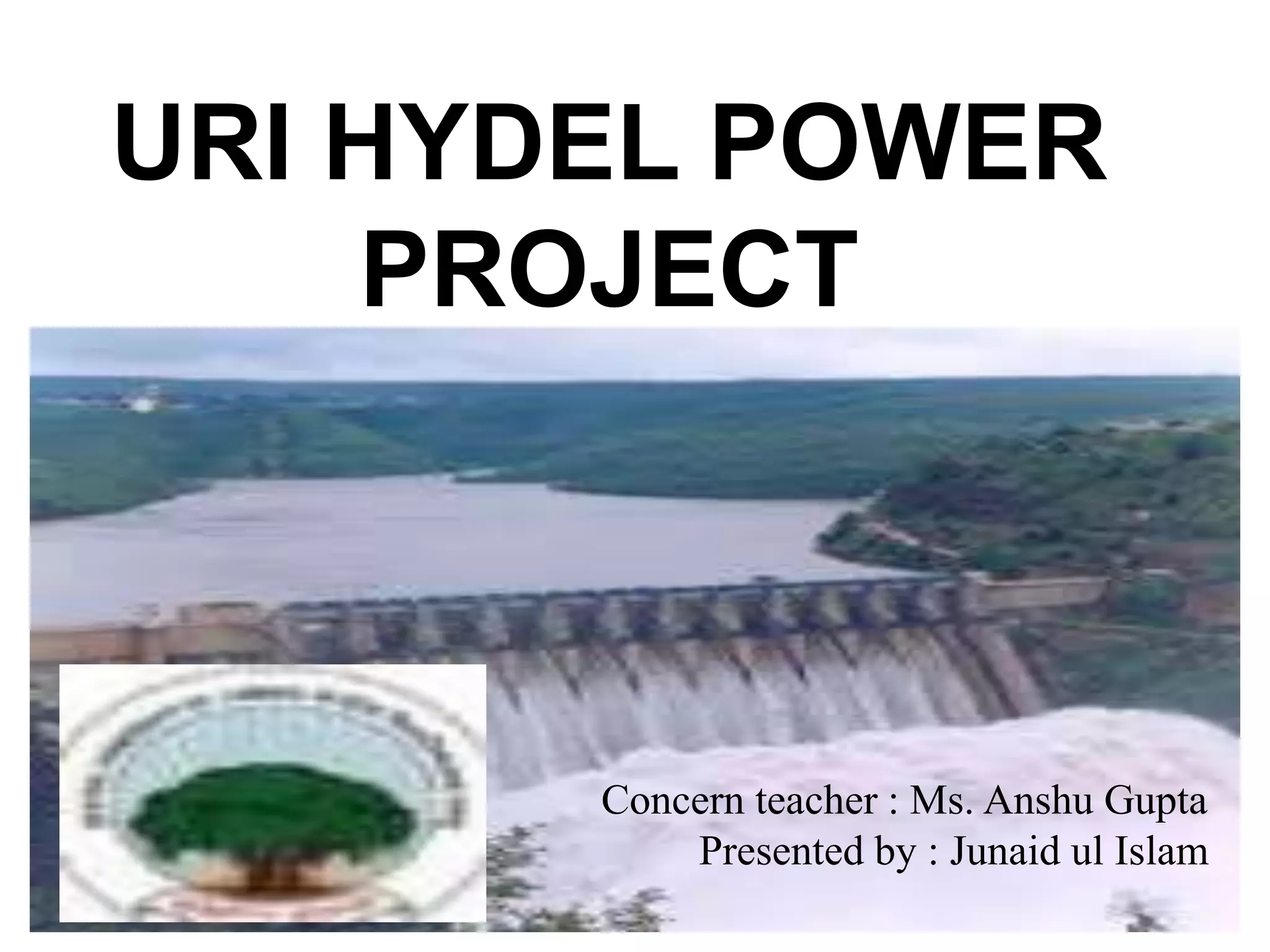
URI HYDEL POWER
PROJECT
Concern teacher : Ms. Anshu Gupta
Presented by : Junaid ul Islam
Hydroelectricity
Hydroelectricity is the term referring
to electricity generated by hydropower; the
production of electrical power through the use of
the gravitational force of falling or flowing water.
It is the most widely used form of renewable
energy, accounting for 16 percent of global
electricity generation.
URI DAM
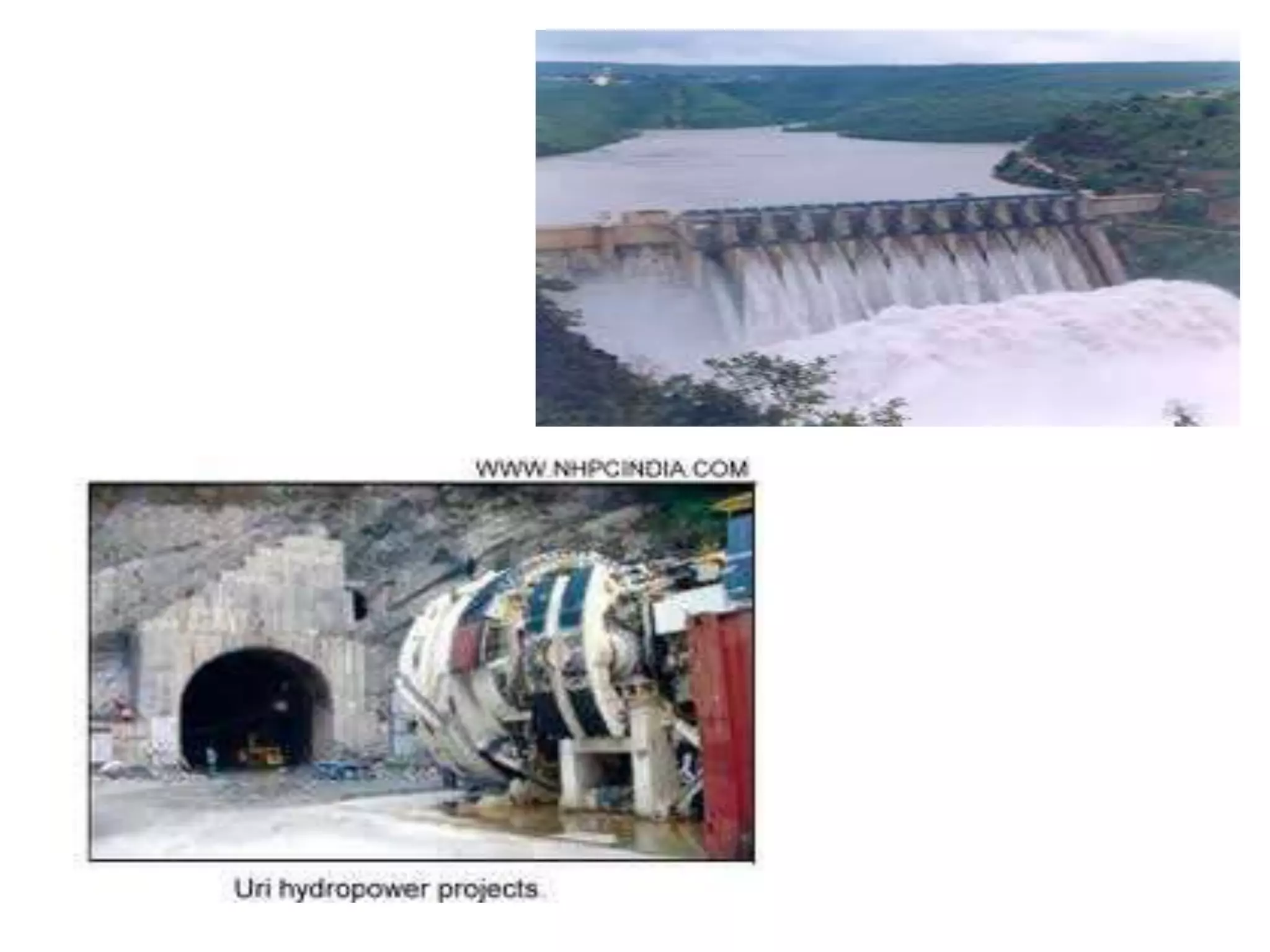
• Uri Dam is a 480 MW hydroelectric power
station on the Jhelum River near Uri in Baramulla
district of Jammu and Kashmir, India. It is located
very near to the Line of Control, the de
facto border between India and Pakistan . The
station is largely built under a hill with a 10 km
tunnel. It is of the run-of-the-river type without a
large dam, since the Indus Waters Treaty gives
Pakistan the exclusive right to regulate the Jhelum
River.
CONSTRUCTION
• The project was awarded by the National
Hydroelectric Power Corporation in October 1989
to a European consortium called Uri Civil led by
Swedish Skanska and including
Swedish NCC and ABB and British Kvaerner
Boving .It was partially funded by the Swedish
and British governments.
• The project cost about Rs. 3,300 crore (about 450
million EUR or 660 million USD) and was
completed in 1997.
• The workforce included about 200 foreigners
and 4,000 Indians, many from the local
area. On March 31, 1991, the two Swedish
engineers Jan Ole Loman and Johan Jansson
were kidnapped by members of the Muslim
Janbaaz Force, but managed to escape 97
days later. This together with shelling across
the border and unrest related to the burning
of Charari Sharief and the siege of Hazratbal
Shrine led to an 18 month delay.
SAILENT FEATURES OF THE URI
PROJECT
• Workforce.
• Most Modern and Impenetrable.
• NHPC envisages a Power share (tariff) of Rs. 2.58
per unit.
• Annual generation of power is 2663 million units
• Project cost --- Rs. 33000 million.
• Beneficiary states ------- Jammu and Kashmir,
Punjab, Haryana, Delhi, Himachal Pradesh,
Rajasthan and Chandigarh.
TECHNICAL FEATURES
• 93.5 m long barrage.
• 10.64 km long head race tunnel.
• 2 km long tail race tunnel.
• Under ground power hose containing 4 units of
120 MW each.
• Constructed in record time of 7 years(1989- 1997)
• Height of water head at maximum is 25 m.
• Water flow rate through turbines is 240 cum/ sec.
OPERATION
• The station is operated by the NHPC.
Plans to expand it with a 250 MW Uri-II
plant were announced in 1998. The
government of Pakistan has objected to
this, saying it violates the Indus Waters
Treaty.
INDUS WATER TREATY
• The Indus Waters Treaty is a water-
sharing treaty between the Republic of
India and Islamic Republic of Pakistan
brokered by the World Bank. The treaty was
signed in Karachi on September 19, 1960
by Indian Prime Minister Jawaharlal
Nehru and President of
Pakistan Mohammad Ayub Khan.
• Both the mainstream political parties
viz., National Conference (NC) and
Peoples Democratic Party (PDP)
have many times demanded repeal
of the treaty as it is anti – state
policy and was not signed taking the
state government into confidence .
• In 1985 NHPC obtained IWT
clearance for the project.
Main Objectives of Uri Project
• To supply electricity to Northern Grid of India.
• To improve electricity supply in the Kashmir
region .
• To obtain environmental benefits from
displacement of alternative thermal power
generation.
• To assist with capacity building in the electricity
sector in India.
• To develop a sustainable hydroelectric resource.
Outside Comments
• The project was awarded with “Indo – German
GREENTECH Environment Excellence
Award” in year 2001 by GREENTECH
Foundations , New Delhi.
• Study conducted in association with the
Institute of Freshwater Research (FWRI),
Sweden and Department of Zoology,
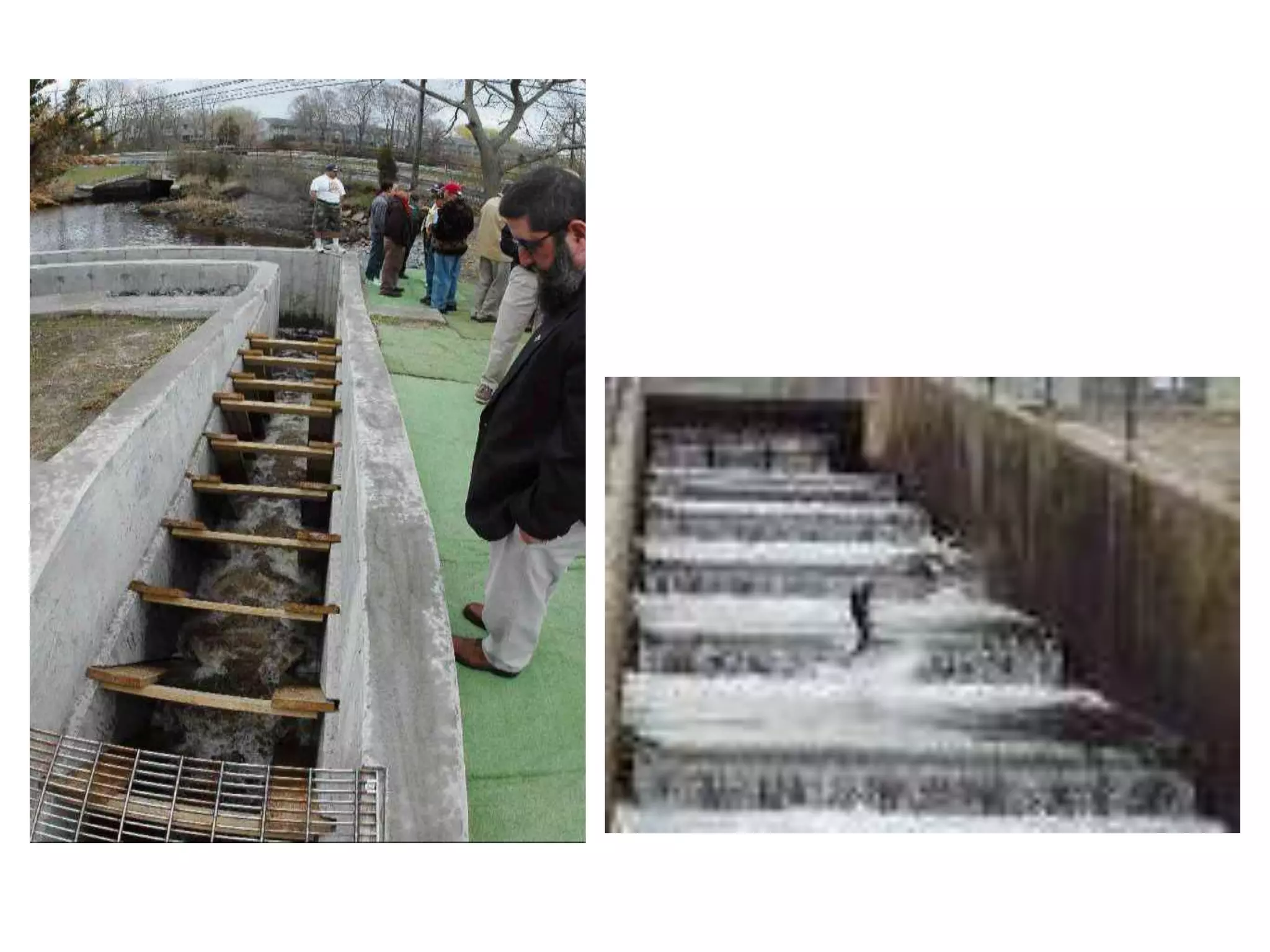
University of Kashmir to design fish ladder.
Beneficial Environmental Impacts Of
Hydroelectric Projects
Catchment benefits:
• Treatment of the catchment area resulting in the
regeneration of natural forests and other ecosystems
in the catchment area.
Impacts of the reservoir: The creation of a
reservoir provides :
• Habitat for wetland species, especially water birds.
• Source of water to animals and plants in the
adjoining area.
• Significant environmental benefit for unnaturally
dry areas.
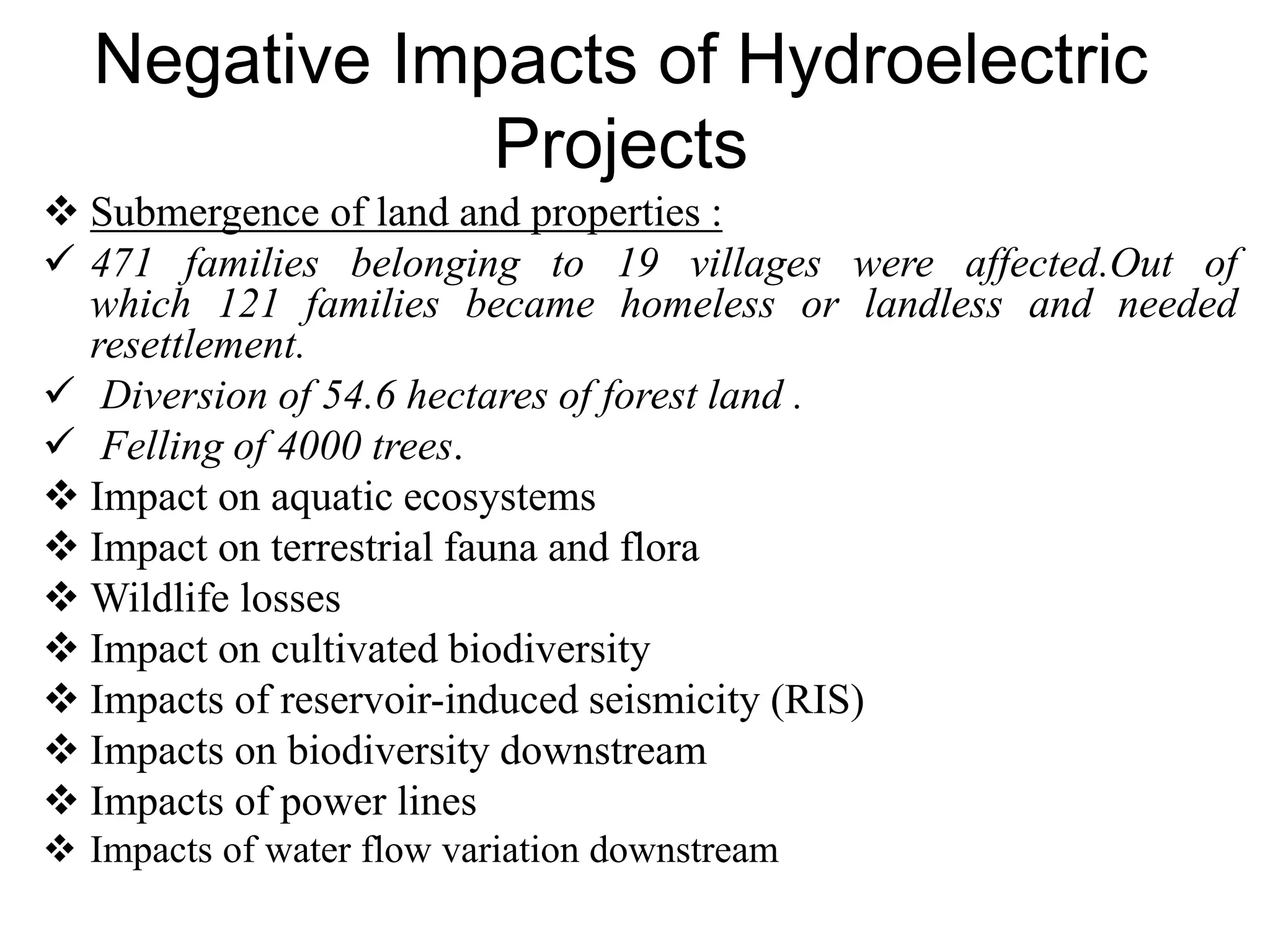
Negative Impacts of Hydroelectric
Projects
 Submergence of land and properties :
 471 families belonging to 19 villages were affected.Out of
which 121 families became homeless or landless and needed
resettlement.
 Diversion of 54.6 hectares of forest land .
 Felling of 4000 trees.
 Impact on aquatic ecosystems
 Impact on terrestrial fauna and flora
 Wildlife losses
 Impact on cultivated biodiversity
 Impacts of reservoir-induced seismicity (RIS)
 Impacts on biodiversity downstream
 Impacts of power lines
 Impacts of water flow variation downstream
Mitigation Measures
NHPC established an environmental team and contracted
various agencies, including the principal contractor Uri
Civil, to implement mitigation measures:
SOCIAL MEASURES ;
• Resettlement and construction of primary schools.
• Reconstruction and safeguard of religious places.
• Training and self employment.
• Commission of drinking water supply scheme.
• Communication facility and maintenance of roads.
• Pasture development of the area.
ENVIRONMENTAL MEASURES ;
A comprehensive “Catchment Area Treatment”
(CAT) plan was prepared . The objective of CAT
was achieved at an estimated cost of Rs. 38.205
million. The plan envisaged:
Massive Afforestation programme:
• More than 7 lac plants were planted.
• Afforestation of an area of 62.7 hectares of
degraded forest land .
• Besides the CAT scheme, voluntary afforestation
of 50,000 shade providing and fruit bearing
species were planted.
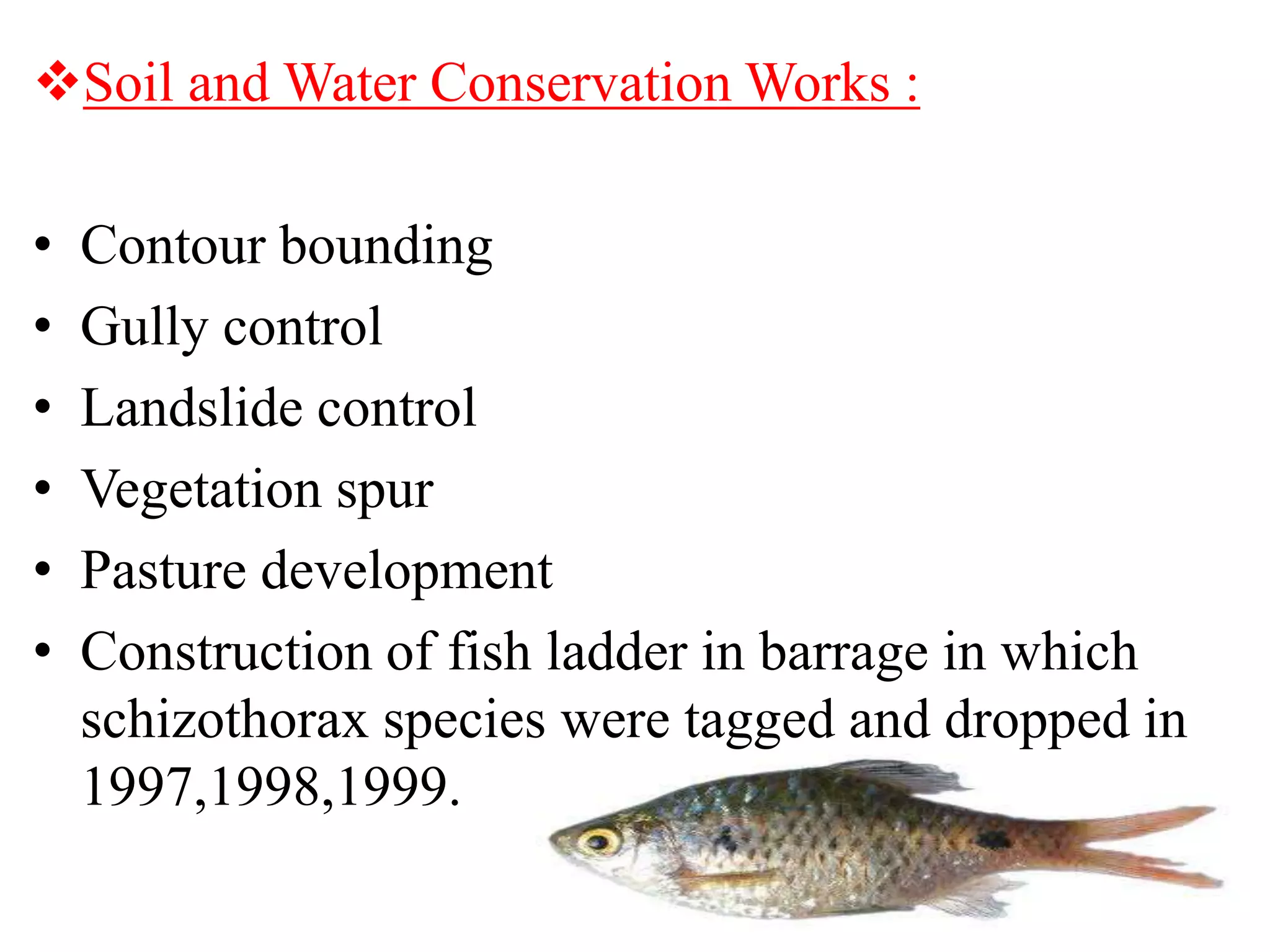
Soil and Water Conservation Works :
• Contour bounding
• Gully control
• Landslide control
• Vegetation spur
• Pasture development
• Construction of fish ladder in barrage in which
schizothorax species were tagged and dropped in
1997,1998,1999.
The environmental clearance
(1980)
Environmental clearance was granted by World
Bank subject to safeguards :
• Avoid indiscriminate felling of trees.
• Restoration of land damaged during
construction.
• Implementation of soil conservation during
construction of roads.
URI- II PROJECT
• 240 MW project.
• Estimated cost 1800 crore.
• First 60 MW unit of project
commissioned in January, 2013, while
remaining 3 units of equal capacity will
be commissioned at monthly intervals
thereafter.
Dispute Between NHPC and State
of Jammu and Kashmir
• NHPC shares only 12% of the total power
generated from the roar of J&Ks rivers.
• Cabinet decision 537 taken on 15 December
1980 :- 50% share of power generation and
half of the profit to state.
• NHPC is like East India Company --- Taj
Mohi-u-din.
• Land Titles and misplacement of records.
NHPC & URI PROJECT
• Royalty of 984 crore from NHPC for usage
resources as stated by appointed committee.
• Present value of project has been estimated
2100 crore.
• Taking back of Uri-I Project will generate
annual revenue of 1000-1500 crore .
Economic Edifice of State
• Total annual income --- Rs.6500 crore.
i. Rs. 13500 crore salary to employees
annually.
ii. Rs. 1500 crore pension to pensioners
annually.
• Debit of Rs. 8500 crore.
• So to stand on its own economic edifice,
State has to harness rich hydroelectric
potential.
BIBLIOGRAPHY
• Uri Booklet by NHPC ltd.
• Detailed Project Report – Uri hydroelectric
project.
• Uri hydro electric project India : Evaluation of
the Swedish report – Sida evaluation 2008.
• Annex VIII Case Study Uri India.
• wikipedia
Uri hydel power project

Uri hydel power project

  • 1.
    URI HYDEL POWER PROJECT Concernteacher : Ms. Anshu Gupta Presented by : Junaid ul Islam
  • 2.
    Hydroelectricity Hydroelectricity is theterm referring to electricity generated by hydropower; the production of electrical power through the use of the gravitational force of falling or flowing water. It is the most widely used form of renewable energy, accounting for 16 percent of global electricity generation.
  • 3.
    URI DAM • UriDam is a 480 MW hydroelectric power station on the Jhelum River near Uri in Baramulla district of Jammu and Kashmir, India. It is located very near to the Line of Control, the de facto border between India and Pakistan . The station is largely built under a hill with a 10 km tunnel. It is of the run-of-the-river type without a large dam, since the Indus Waters Treaty gives Pakistan the exclusive right to regulate the Jhelum River.
  • 4.
    CONSTRUCTION • The projectwas awarded by the National Hydroelectric Power Corporation in October 1989 to a European consortium called Uri Civil led by Swedish Skanska and including Swedish NCC and ABB and British Kvaerner Boving .It was partially funded by the Swedish and British governments. • The project cost about Rs. 3,300 crore (about 450 million EUR or 660 million USD) and was completed in 1997.
  • 5.
    • The workforceincluded about 200 foreigners and 4,000 Indians, many from the local area. On March 31, 1991, the two Swedish engineers Jan Ole Loman and Johan Jansson were kidnapped by members of the Muslim Janbaaz Force, but managed to escape 97 days later. This together with shelling across the border and unrest related to the burning of Charari Sharief and the siege of Hazratbal Shrine led to an 18 month delay.
  • 6.
    SAILENT FEATURES OFTHE URI PROJECT • Workforce. • Most Modern and Impenetrable. • NHPC envisages a Power share (tariff) of Rs. 2.58 per unit. • Annual generation of power is 2663 million units • Project cost --- Rs. 33000 million. • Beneficiary states ------- Jammu and Kashmir, Punjab, Haryana, Delhi, Himachal Pradesh, Rajasthan and Chandigarh.
  • 7.
    TECHNICAL FEATURES • 93.5m long barrage. • 10.64 km long head race tunnel. • 2 km long tail race tunnel. • Under ground power hose containing 4 units of 120 MW each. • Constructed in record time of 7 years(1989- 1997) • Height of water head at maximum is 25 m. • Water flow rate through turbines is 240 cum/ sec.
  • 9.
    OPERATION • The stationis operated by the NHPC. Plans to expand it with a 250 MW Uri-II plant were announced in 1998. The government of Pakistan has objected to this, saying it violates the Indus Waters Treaty.
  • 10.
    INDUS WATER TREATY •The Indus Waters Treaty is a water- sharing treaty between the Republic of India and Islamic Republic of Pakistan brokered by the World Bank. The treaty was signed in Karachi on September 19, 1960 by Indian Prime Minister Jawaharlal Nehru and President of Pakistan Mohammad Ayub Khan.
  • 12.
    • Both themainstream political parties viz., National Conference (NC) and Peoples Democratic Party (PDP) have many times demanded repeal of the treaty as it is anti – state policy and was not signed taking the state government into confidence . • In 1985 NHPC obtained IWT clearance for the project.
  • 13.
    Main Objectives ofUri Project • To supply electricity to Northern Grid of India. • To improve electricity supply in the Kashmir region . • To obtain environmental benefits from displacement of alternative thermal power generation. • To assist with capacity building in the electricity sector in India. • To develop a sustainable hydroelectric resource.
  • 14.
    Outside Comments • Theproject was awarded with “Indo – German GREENTECH Environment Excellence Award” in year 2001 by GREENTECH Foundations , New Delhi. • Study conducted in association with the Institute of Freshwater Research (FWRI), Sweden and Department of Zoology, University of Kashmir to design fish ladder.
  • 16.
    Beneficial Environmental ImpactsOf Hydroelectric Projects Catchment benefits: • Treatment of the catchment area resulting in the regeneration of natural forests and other ecosystems in the catchment area. Impacts of the reservoir: The creation of a reservoir provides : • Habitat for wetland species, especially water birds. • Source of water to animals and plants in the adjoining area. • Significant environmental benefit for unnaturally dry areas.
  • 17.
    Negative Impacts ofHydroelectric Projects  Submergence of land and properties :  471 families belonging to 19 villages were affected.Out of which 121 families became homeless or landless and needed resettlement.  Diversion of 54.6 hectares of forest land .  Felling of 4000 trees.  Impact on aquatic ecosystems  Impact on terrestrial fauna and flora  Wildlife losses  Impact on cultivated biodiversity  Impacts of reservoir-induced seismicity (RIS)  Impacts on biodiversity downstream  Impacts of power lines  Impacts of water flow variation downstream
  • 18.
    Mitigation Measures NHPC establishedan environmental team and contracted various agencies, including the principal contractor Uri Civil, to implement mitigation measures: SOCIAL MEASURES ; • Resettlement and construction of primary schools. • Reconstruction and safeguard of religious places. • Training and self employment. • Commission of drinking water supply scheme. • Communication facility and maintenance of roads. • Pasture development of the area.
  • 19.
    ENVIRONMENTAL MEASURES ; Acomprehensive “Catchment Area Treatment” (CAT) plan was prepared . The objective of CAT was achieved at an estimated cost of Rs. 38.205 million. The plan envisaged: Massive Afforestation programme: • More than 7 lac plants were planted. • Afforestation of an area of 62.7 hectares of degraded forest land . • Besides the CAT scheme, voluntary afforestation of 50,000 shade providing and fruit bearing species were planted.
  • 20.
    Soil and WaterConservation Works : • Contour bounding • Gully control • Landslide control • Vegetation spur • Pasture development • Construction of fish ladder in barrage in which schizothorax species were tagged and dropped in 1997,1998,1999.
  • 21.
    The environmental clearance (1980) Environmentalclearance was granted by World Bank subject to safeguards : • Avoid indiscriminate felling of trees. • Restoration of land damaged during construction. • Implementation of soil conservation during construction of roads.
  • 23.
    URI- II PROJECT •240 MW project. • Estimated cost 1800 crore. • First 60 MW unit of project commissioned in January, 2013, while remaining 3 units of equal capacity will be commissioned at monthly intervals thereafter.
  • 24.
    Dispute Between NHPCand State of Jammu and Kashmir • NHPC shares only 12% of the total power generated from the roar of J&Ks rivers. • Cabinet decision 537 taken on 15 December 1980 :- 50% share of power generation and half of the profit to state. • NHPC is like East India Company --- Taj Mohi-u-din. • Land Titles and misplacement of records.
  • 25.
    NHPC & URIPROJECT • Royalty of 984 crore from NHPC for usage resources as stated by appointed committee. • Present value of project has been estimated 2100 crore. • Taking back of Uri-I Project will generate annual revenue of 1000-1500 crore .
  • 26.
    Economic Edifice ofState • Total annual income --- Rs.6500 crore. i. Rs. 13500 crore salary to employees annually. ii. Rs. 1500 crore pension to pensioners annually. • Debit of Rs. 8500 crore. • So to stand on its own economic edifice, State has to harness rich hydroelectric potential.
  • 27.
    BIBLIOGRAPHY • Uri Bookletby NHPC ltd. • Detailed Project Report – Uri hydroelectric project. • Uri hydro electric project India : Evaluation of the Swedish report – Sida evaluation 2008. • Annex VIII Case Study Uri India. • wikipedia