1
Submitted by:-
ATISH KUMAR
Roll No. – 1706595
5th
Semester(3rd
year),
Guru Nanak Dev Engineering College, Ludhiana, Punjab
2
DECLARATION
I Atish kumar hereby declare that the work, which is being presented
in the project report, titled “Report on Practical Training at NTPC Ltd.
Barh, Bihar ” in partial
fulfillment for the award of Degree of “Bachelor of Technology” in
Electrical Engineering
and submitted to the Department of Electrical Engineering, Guru
Nanak Dev Engineering College Ludhiana, affiliated to I. K. Gujral
Punjab Technical University (IKGPTU), formerly Punjab Technical
University (PTU) is a record of my own work carried out during the 4
weeks summer training under the supervision of Mr. Anurag Sinha
Manager (HR - EDC) NTPC Ltd. Barh, Bihar.
3
ACKNOWLEDGEMENT
I have taken efforts in this project. A part form the efforts of mine, the
success of any project depends largely on the encouragement &
guidelines of many others. However, it wouldn’t have been possible
without the kind support & help of many individuals & organization. I
take this opportunity to express my gratitude to the people who have
been instrumental in the successful completion of this project. I would
like to extend my sincere thanks to all of them.
I sincerely thanks to honorable DIRECTOR, Dr. S.B. Batra for providing
this constant moral support and motivation.
I’m highly indebted to H.O.D, Mr. Satish who technically helped me in
completing my project with ease and for his continue motivation,
encouragement and timely guidance.
I’m highly grateful to Mr. Anurag Sinha (Manager HR-EDC, NTPC Ltd.
Barh) for their guidance & constant supervision as well as for providing
necessary information regarding the projects & also for their support in
completing the project.
4
PREFACE
Practical Knowledge means the visualization of the knowledge which we
reading in books. For this, we perform experiments and get observation.
Practical knowledge is very important in every field. One must be familiar
with the problems related to that field so that he may solve them &
become a successful person or professional.
After achieving the DEGREE, an engineer has to enter in professional life.
According to this life, he has to serve an industry, may be public or private
sector or self-one. For the efficient work in the field, he must be well aware
with the practical knowledge as well as theoretical knowledge to be a good
Engineer. One must be aware of the industrial environment and must know
about management, working in the industry, labour handling etc. so he can
tackle them successfully.
Due to all the above reasons and to bridge the gap between theory and
practical, our Engineering curriculum provides a practical training. During
this period a student works in the industry and gets all types of experience
and knowledge about the working and maintenance various types of
machinery.
I have undergone my practical training at NTPC Ltd. Barh, Bihar. This report
is based on the knowledge, I acquired my training period at the
organization.
5
TABLE OF CONTENTS
PARTICULARS Page No.
I. Project Info. 01
II. Declaration 02
III. Acknowledgement 03
IV. Preface 04
1. Company Profile 07
1.1 Synopsis 07
1.2 Project Cost 08
1.3 Capacity 08
2. Project (SAFE WATER TECHNOLOGY) 10
2.1 Abstract 10
2.2 Keywords 10
3. Introduction 11
3.1 Rain Water 13
3.2 Ground Water 15
3.3 Surface Water 16
4. Materials & Methods 17
4.1 Residential Specialty Water Treatment Systems 17
4.2 Commercial / Industrial Equipment 18
6
5. Water Filtration Components 19
5.1 Residential, Commercial, and Industrial Components 19
5.2 Filtration Media and Ion Exchange Resins 20
5.3 Filter Housings and Cartridges 21
5.4 Filter Housings 21
5.5 Filter Cartridges 21
7. References 22
8. External Links 27
7
COMPANY PROFILE
1.1 Synopsis:
Barh Super Thermal Power
Station or NTPC Barh is located in
Barh in the Indian state of Bihar.
NTPC Barh is located barely four
kilometer east of the Barh
subdivision on National Highway31
in Patna district. The project has
been named a mega power project,
and is owned by Indian energy
company National Thermal Power
Corporation.
The 1,980MW (3x660 MW) Barh
Stage1 is being built by Russian
Firm Technopromexport (TPE),
and 1,320MW (2x660 MW) Barh Stage2 extension is being
built by BHEL. Bihar's share is 1183 MW from NTPC Barh (26% from stage
1 and 50% from stage 2).
The main power plant and the township is spread over an area of 1,186
acres. The legal possession of 1,186acres of land has been acquired for
setting up the main power plant and its township which includes
12villages.
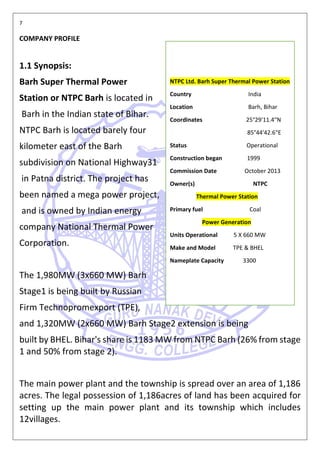
NTPC Ltd. Barh Super Thermal Power Station
Country India
Location Barh, Bihar
Coordinates 25°29′11.4″N
85°44′42.6″E
Status Operational
Construction began 1999
Commission Date October 2013
Owner(s) NTPC
Thermal Power Station
Primary fuel Coal
Power Generation
Units Operational 5 X 660 MW
Make and Model TPE & BHEL
Nameplate Capacity 3300
8
The then PM, Atal Bihari Vajpayee, had laid the foundation stone of the
main plant of stage1of NTPC Barh on March 6, 1999. The formal
inauguration of its site office and laying of the foundation stone of the
training center at the plant site was done in September 2003.Former
Union power minister Sushil Kumar Shinde had inaugurated the main
plant house of stage2 of NTPC Barh on May 29, 2006.
1.2 Project Cost:
The plant is to produce 3,300MW of power at a cost of over Rs
26,000 crore. The total approved cost of stage1 (660MWx3) has Rs.
8,692.97 crore. The total approved cost of stage2 (unit 1) plant is Rs7,
688.12 crore.
1.3 Capacity:
Unit1 of stage2 commissioned in November 2013. Sikkim and West
Bengal were allocated some share of power from NTPC Barh units.
Inland Waterways Authority of India received bids in 2013 September
9
for coal movement on 1620 km National Waterway 1 (India) from Haldia
to NTPC's Barh which is about 1000 km away.
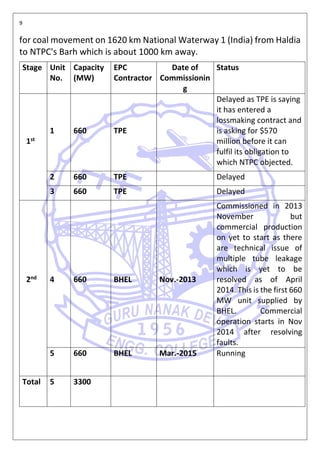
Stage Unit
No.
Capacity
(MW)
EPC
Contractor
Date of
Commissionin
g
Status
1st
1 660 TPE
Delayed as TPE is saying
it has entered a
lossmaking contract and
is asking for $570
million before it can
fulfil its obligation to
which NTPC objected.
2 660 TPE Delayed
3 660 TPE Delayed
2nd 4 660 BHEL Nov.-2013
Commissioned in 2013
November but
commercial production
on yet to start as there
are technical issue of
multiple tube leakage
which is yet to be
resolved as of April
2014. This is the first 660
MW unit supplied by
BHEL. Commercial
operation starts in Nov
2014 after resolving
faults.
5 660 BHEL Mar.-2015 Running
Total 5 3300
10
Safe Water Technologies
2.1 Abstract:
Water everywhere is increasingly being contaminated from numerous
sources and this, especially in drinking waters is a major concern, due to
the associated health hazards. The most common contaminants being
suspended matter, mud, silt, algae, bacteria and other pathogens. Besides
large bulk processing systems for industry, Safe Water in India also has
special focus on small and medium water supply needs. Solutions are
offered for treatment of Municipal Waters, Surface Waters, Open and Tube
Well Waters including source waters from streams, rivers, ponds and lakes
for drinking water for Residences, Housing Colonies, Resorts, Villages, and
Small Towns. Today, more than 1.1 billion people lack access to safe
drinking water and 2.6 billion people have no access to basic sanitation. In
most industrialized countries, access to safe drinking water is nearly
universal, and is often taken for granted. This access has come as the result
of massive public expenditures, though now more and more water supply
agencies are being privatized. In contrast, access is typically lower in
developing countries, where economies are weaker, and infrastructure is
not as developed. The situation is the worst for the poorest people in
developing countries, who often have no access to piped water supply.
These families typically spend one fifth of their income on pure water. In
this paper I want to emphasize some Safe Water Treatment Technologies
which is used in various house hold and Industries viz. Ultraviolet Water
Treatment Systems, Specialty Potable and Non-Potable Water Treatment
Systems , Commercial Water Treatment Equipment and Components etc.
are some of the Technologies to be covered in this paper .
2.2 Keywords:
Water
Safe
Technology
11
3. Introduction:
Three main sources of water can be considered as substitutes for
contaminated water: groundwater, rainwater, and surface water. Much has
been written about these sources, so this chapter offers only a brief review,
with key references.· Groundwater is largely free from harmful bacteria and
fecal contamination, though a poorly designed or constructed well can
become contaminated from surface water. To prevent this, wells should be
grouted around the borehole, and finished at the surface with a concrete
platform, with good drainage away from the well. Most commonly,
groundwater is reached through boreholes, drilled either by hand or
machine. When drilling in arsenic-affected areas, precautions should be
taken to make sure that safe aquifers do not become contaminated. If a
borehole must penetrate a contaminated aquifer to reach safe water below,
the borehole should be grouted after drilling is completed. In some areas,
groundwater can have naturally occurring water quality problems aside from
arsenic, such as high levels of iron, manganese, nitrate, chloride, or fluoride.
Before promoting new sources of groundwater, the chemical quality should
be tested in laboratories. · Rainwater is free from arsenic, and if properly
collected, can provide a safe drinking water source. Bacterial contamination
is a concern, but this can be minimized by collecting rain from a roof
(galvanized metal makes a good collection surface). Tree branches should
not overhang the roof, and the roof should periodically be cleaned. Water
can be collected through gutters, and piped into a storage tank. Tanks can
be built of many materials, but Ferro cement (cement with wire
reinforcement) is strong and inexpensive, and also can keep the water pH
near neutral. When rain first begins to fall, especially at the end of a dry
season, roof water should be allowed to run off for 10-15 minutes before
collection, to clean the roof. Close to urban areas, and when metal roofs are
used, collected rainwater can contain unsafe levels of lead and zinc, and
possibly other metals. Typically, collected rainwater contains low levels of
bacteria (fecal and total coliform counts average 5-15 and 25-75 per 100 ml,
respectively). Water quality testing should be done to ensure that collected
water meets relevant standards. In some cases, rainwater may be the safest
source of drinking water available, even if low levels of bacteria are present.
12
Often, rainfall is seasonal, and large storage tanks would be required to
bridge the dry season. While water can be safely stored for long periods, the
large tanks may be too expensive. In such cases, small storage tanks provide
an inexpensive and convenient water source during the rainy season, and
other sources should be found for the dry season. · Surface water requires
more treatment than groundwater or rainwater, since it usually has very
high bacterial contamination. In order to ensure that treatment is always
effective, important to include multiple barriers to contamination. The most
effective treatment appropriate at the rural, community level, is slow sand
filtration, followed by a safety dose of chlorine. In slow sand filtration,
surface water passes through prefilters, and is then filtered through 80-100
cm of sand. A bio-layer develops near the surface of the sand, which can
effectively destroy most pathogens. Operation of the slow sand filter may be
improved through pretreatment with bank infiltration, sedimentation or
roughing filtration. The use of roughing filters, in particular, permits effective
treatment of water containing higher levels of turbidity, color, and
pathogens. This ‘multi-stage filtration’ is a robust and reliable treatment
method in rural communities, and for small and medium size municipalities.
Slow sand filtration will not efficiently remove arsenic or agricultural
chemicals such as pesticides. It is important to test the water quality of the
unfiltered water to make sure that arsenic and pesticides are not present.
Likewise, for bacteria, the cleaner the source water, the cleaner the treated
water will be. Ponds and other surface water sources used for slow sand
filtration should be protected: latrines should not be located near the water,
and people and animals should not bathe nearby. Slow sand filters must be
regularly cleaned, and the top few centimeters of sand in the filter should be
scraped off. After cleaning, the filter will need several days to ‘ripen’, and
treat water effectively. During this ripening period, filtered water
should be disinfected before drinking.
13
3.1 Rainwater:
Rainwater collection can provide a safe, arsenic-free
source of drinking water if weather conditions are
appropriate. When properly collected and stored,
rainwater can keep a fairly constant water quality for
months. In areas with low population density and hard
rocks surfaces (rock outcrops or cement), rainwater can be
collected from the ground surface by constructing micro
dams to channel surface runoff into underground storage
tanks. In more densely populated areas, rooftop collection
is more common. Corrugated iron roofs are ideally suited
for this purpose, though terra cotta or wood tiles, or
concrete roofs are also acceptable. Thatched roofs are not
appropriate for rainwater collection, as the collected water
is high in organic matter. These roofs, however, can be
made suitable with the simple use of inexpensive plastic
sheeting. Roofs should be cleaned thoroughly at the
beginning of every rainy season, regular maintenance is
also crucial. Water is collected from the roof surface in
gutters, which are connected to a storage tank with a
downpipe. In order to minimize the amount of
contamination and organic matter in collected water, a fine
mesh netting or coarse sand filter should be placed
between the downpipe and the storage tank. This will also
help to keep insects and small animals out of the tank, and
has been shown to improve water quality, and reduce the
14
risk of mosquito breeding. When rain falls after a dry
period, water should not be collected for the first ten to
fifteen minutes, in order to clean the collection surface.
This ‘first flush’ can be achieved through use of a bypass
valve, or through a variety of simple designs. A rainwater
storage tank should be completely covered, and have a tap
or pump for withdrawing water, to prevent contamination
from users. If water is stored in open containers, or users
dip cups or pitchers in a tank to retrieve water, the stored
water can easily become contaminated with fecal
pathogens. The amount of storage required will depend on
local rainfall patterns, especially on the extent of dry
seasons. If rainfall is scarce or absent for several months,
large tanks will be required, or alternate sources of drinking
water used during the dry season. In rainy
periods, small, inexpensive tanks are able to provide
adequate storage for most household needs.
15
3.2 Groundwater:
Where available and of good quality, groundwater is usually the most
acceptable source for drinking water supply. Due to the natural filtering
of aquifer materials, and long underground retention times,
groundwater typically has very little pathogenic contamination, and
requires little or no disinfection. In contrast, surface water is often
heavily polluted with fecal material as a result of poor sanitation and
hygiene practices. Surface water is also more susceptible to chemical
contamination from industrial or agricultural runoff, such as heavy
metals, pesticides, or nitrate. However, groundwater quality should not
be taken for granted. In very shallow aquifers, bacterial contamination
is possible, and even likely if the wellhead is poorly protected. In addition
to arsenic, other inorganic constituents in groundwater can cause health
or aesthetic problem s, notably iron, manganese, nitrate, chloride, and
fluoride. Other contaminants listed in the WHO Guideline Values should
be tested for if their presence is suspected, either from human activity
or from naturally occurring sources (WHO, 1993). If some existing
groundwater supplies are found to be arsenic-free, these will usually be
the most preferred water source, at least in the short term. The simple
act of testing all of a community’s wells for arsenic is valuable in that it
will identify safe, as well as unsafe, wells. People can be encouraged to
share safe water resources, though if safe wells are scarce or absent, this
may not be feasible. If safe wells are privately owned, the owners may
be reluctant to allow others access to the wells, out of concern for
privacy or a fear that increased use will result in increased maintenance
and replacement costs. In some cultures, women are the main water
collectors, but also have limited social mobility, and privacy concerns
can make sharing of a household well uncomfortable or unacceptable.
Arsenic-free wells might become contaminated over time through a
third mechanism: arsenic could initially be present in a stable, solid form
in aquifer sediments. If the geochemistry of the pore water, especially
16
the pH and redox potential, should change, arsenic could become
mobilized, and make its way into the abstracted groundwater.
3.3 Surface Water:
Surface water presents more of a challenge than
groundwater or rainwater in that it is usually heavily
contaminated with fecal bacteria. Other contaminants may
be contributed from agricultural sources, such as nitrates,
phosphates, and pesticides. Finally, surface water is more
vulnerable to industrial contamination. In urban and pre-
urban areas, surface water often receives untreated wastes
from industrial factories, untreated solid wastes, and urban
runoff. As a result surface waters can have very high
biochemical oxygen demands (BOD), and be seriously
contaminated with organic compounds and trace metals.
Surface water can also have naturally high levels of
inorganic compounds, eroded from source rocks upstream,
that can cause human health problems.
17
4. Materials and Methods:
4.1 Residential Specialty Water Treatment Systems:
• Softener/Filters — available with computer metered or clock timer
controllers
o Hard Water Systems
o Hard Water and Nitrate Systems
o Hard Water and Tannin Systems
o Hard Water and Carbon Added Systems
• Soften` Pure— water purification system with a softener and a
chemical / bacteria filter
• Better Life Series — patented filters and softeners with integrated
UV
• Nitrate Removal Systems
• Tannin & Organic Removal Systems
• Iron & Hydrogen Sulfide Removal Systems
• Sediment Removal Systems — with automatic or manual
backwashing
• Carbon Filter Systems — with automatic or manual backwashing
• Radon Removal Systems
• Arsenic Removal Systems
• VOC Reduction Systems
• MTBE Reduction Systems
• Hydrogen Peroxide Dosing Systems
18
4.2 Commercial / Industrial Equipment:
• Commercial Sediment Filters — with
automatic backwashing
• Commercial Carbon Filters — inline and
automatic backwashing
• Specialty Carbon Systems — for arsenic,
chloramines, radon, VOC,
• BOD, & MTBE reduction
• Commercial Metal-Ease™ Filters — iron,
hydrogen sulfide, and heavy
• metal filters with automatic backwashing
• Industrial Water Softeners and Filters
• Commercial UV Systems — 15 to 50 GPM
• Commercial / Industrial UV Systems — 40 to
1,345 GPM
• Commercial RO Systems — 400 to 18,000
GPD
• Commercial RO Systems — for very high TDS,
brackish water, river
• intake, seawater intrusion, & seawater
desalination.
19
5. WATER FILTRATION COMPONENTS:
5.1 Residential, Commercial, and Industrial
Components:
• Tank Heads and Manual Backwashing Valves
• Custom Machined Plastic Tank Heads and
Manifolds
• Residential and Light Commercial Filter and
Softener Control Valves
• Commercial Filter and Softener Control Valves
• Commercial Deionizer Control Valves
• Industrial Filter and Softener Stagers and
Controllers
• Industrial Diaphragm Valve Kits - pre-designed for
all types of
• systems
• Fiberglass Wrapped Pressure Tanks with ABS Liners
— 5 to 24 inch diameter
• Fiberglass Wrapped Pressure Tanks with Polypro
Liners — 7 to 13 inch diameter
• Fiberglass Wrapped Pressure Tanks with Vinyl ester
Liners — 24 to 48 inch diameter
• Fiberglass Wound Pressure Tanks with
Polyethylene Liners — 6 to 48 inch diameter
• FRP Molded Pressure Tanks - 6 to 16 inch diameter
• Steel Pressure Tanks — lined and primed
20
5.2 Filtration Media and Ion Exchange Resins:
• Filter Ease and Filter Ease-HD — sediment
filtration, lighter than sand, 20 micron
particulate filtration
• Metal Ease , Metal Ease-AS and MetalEase-
61 — removes iron, hydrogen sulfide,
arsenic, radium, & other heavy metals
without
• chemicals — simple backwashing cleans the
bed
• Proactive Coal-Based Carbon — proprietary
brand of non-viscous, coal-based carbon —
acid washed available
• Proactive Coconut Shell Carbon — standard
20 x 50 mesh and catalytic 12 x 40 mesh
• Anthracite — sized to any specification
• KDF — for low level chlorine treatment
• pH Neutralizer — to raise the potential
hydrogen in water
• Manganese Greensand Equivalent (MTM) —
oxidizing agent carrier
21
5.3 Filter Housings and Cartridges:
• Pentair / Plymouth Products Housings and Filter
Cartridges (Pentek)
• Bag Filters and Multi-Cartridge Filter Housings
• Fiberglass RO Housings
5.4 Filter Housings:
• 5 and 10 inch Plastic Filter Housings
• 20 inch and Jumbo Plastic Filter Housings
• Stainless Steel Filter Housings
• Valve-In-Head Filter Housings
• Mounting Brackets and Wrenches
5.5 Filter Cartridges:
• Sediment
• Carbon
• Specialty
• Inline Filter Cartridges
• Absolute Rated Filter Cartridges
22
7. REFERENCES:
1. Chaudhary, Pranava K. (20080809). "Barh thermal power
plant in a limbo". The Times of India. Retrieved 20131129.
2. Chaudhary, Pranava K. (30 January 2014). "Bihar to get
5k MW by 2015". The Times of India. Retrieved 20140820.
3. Bhaskar, Uptal (20140106)."TPE, Power Machines delay
Barh project in Bihar". The Wall Street Journal. Live Mint (H
T Media). Retrieved 20140820. 11/21/2015 Barh Super
Thermal Power Station Wikipedia, the
freeencyclopediahttps://en.wikipedia.org/wiki/Barh_Supe
r_Thermal_Power_Station 3/3
4. Roshan, Rakesh (20121125). "50% allocation from Barh
NTPC phaseII project". The Times of India. TNN. Retrieved
20131109.
5. "Power generation to be doubled to 4,000MW by next
year: Nitish Kumar". Economic Times. Bennett, Coleman &
Co. Ltd. PTI. 20131009. Retrieved 20131129.
23
6. Jayanta Gupta (20131005). "Haldia back in business,
records 26% growth". The Times of India. TNN. Retrieved
20131129.
7. Chaudhary, Pranava K. (20080809). "Barh thermal power
project finally gets underway". The Times of India.
Retrieved 20131129.
8. Our Special Correspondent (20120522). "CM sets off
Barh countdown". The Telegraph, Calcutta. Retrieved
20131129.
9.http://www.moneycontrol.com/news/announcements/
ntpcstartsitsoperationsatuniti660mwbarhsuperthermalpo
werprojectstageil_ 1000355.html
10.http://timesofindia.indiatimes.com/city/patna/Sikkims
urrenderspowerallocationfromNTPCsplant/articleshow/47
409450.cms
11. Santanu Sanyal (20130912)."IWAI receives bids for coal
movement for NTPC's Barh project". The Hindu Business
Line. Retrieved 20131129.
24
12.http://www.livemint.com/Industry/9jB1oseNZzEGfx7U
xC8bRO/BarhprojectNTPCallegesmismanagementatRussia
nstateow.html
13. "Digha grid goes kaput, west Patna 'power' less". The
Times of India. 20140401.
14.http://www.projectsmonitor.com/dailywire/barhiiipo
werprojectsinperpetualproblems/
15.http://www.businessstandard.com/article/governmen
tpressrelease/commercialgenerationcommencesfrommuz
zafarpur110mwntpcbarh660mw114111501275_1.html
16.http://economictimes.indiatimes.com/industry/energy
/power/ntpccommissionsfifthunitofbarhthermalprojectin
bihar/articleshow/46465706.cms
17. 18-DTP 1999 Arsenic in 18-DTP, 18 District Town
Project, Dhaka, December 1999.
18. Ahmed, M. and Rahman, M.M. 2000 Water Supply and
Sanitation - Rural and Low-Income Urban Communities,
ITB-Bangladesh Centre for Water Supply And Waste
Management, Dhaka, Bangladesh.
25
19. Bajpai, S. and Chaudhuri, M. 1999 “Removal of arsenic
from ground water by Manganese dioxide-coated sand.”
Journal of Environmental Engineering, 125(8), 782-784.
20. Bellack, E. 1971 “Arsenic removal from potable water.”
Journal of the American Water Works Association, 63(7),
454.
21. Bonnin, D. 1997 Arsenic removal from water utilizing
natural zeolites. Proceedings, AWWA Annual Conference.
American Water Works Association, Denver, CO.
22. Buswell, A.M. 1943 “War problems in analysis and
treatment.” Journal American Water Works Association,
35(10), 1303.
23. Chen, H.-W., Frey, M.M., Clifford, D., McNeill, L.S. and
Edwards, M. 1999“Arsenic treatment considerations.”
Journal of the American Water Works Association, 91(3),
74-85.
24. Cheng, R.C., Liang, S., Wang, H.C. and Beuhler, M.D.
1994 “Enhanced Coagulation for arsenic removal.” Journal
of the American Water Works Association, 86(9), 79-90.
25. Clifford, D. 1986 “Removing dissolved inorganic
contaminants from water.” Environmental Science and
Technology, 20, 1072-1080.
26. Clifford, D. 1999 Ion exchange and inorganic
adsorption. In: A. Letterman [Ed.] Water Quality.
26
27. Gupta, S. and Chen, K. 1978 “Arsenic removal by
adsorption.” J. Water Poll. Johnston and Heijnen: Safe
Water Technology for Arsenic Removal 21Contr. Fed., 50,
493-506.
28. Ramaswami, A., Isleyen, M. and Tawachsupa, S. 2000
Zero-valet iron for Treatment of high arsenic water.
Proceedings, 4th International Conference on Arsenic
Exposure and Health Effects. SEGH, San Diego, CA.
29. Subramanian, K.S., Viraraghavan, T., Phommavong, T.
and Tandoor, S. 1997“Manganese greensand for removal
of arsenic in drinking water.” Water Quality Research
Journal of Canada, 32(3), 551561.
27
8. External Links:
• NTPC Barh website
(http://www.ntpc.co.in/index.php?option=com_conte
nt&view=at
icle&id=27%3Afutureplans&catid=30%3Athecommuni
ty&Itemi d=76&lang=en)
• BSTPP Video
(http://www.youtube.com/watch?v=f4L10JXWL3g)
• Retrieved from
"https://en.wikipedia.org/w/index.php?title=Barh_Su
per_Therma l_Power_Station&oldid=683200668"
• Categories: Coal fired power stations in Bihar Patna
district Indian power station stubs

Report on practical training NTPC BARH

  • 1.
    1 Submitted by:- ATISH KUMAR RollNo. – 1706595 5th Semester(3rd year), Guru Nanak Dev Engineering College, Ludhiana, Punjab
  • 2.
    2 DECLARATION I Atish kumarhereby declare that the work, which is being presented in the project report, titled “Report on Practical Training at NTPC Ltd. Barh, Bihar ” in partial fulfillment for the award of Degree of “Bachelor of Technology” in Electrical Engineering and submitted to the Department of Electrical Engineering, Guru Nanak Dev Engineering College Ludhiana, affiliated to I. K. Gujral Punjab Technical University (IKGPTU), formerly Punjab Technical University (PTU) is a record of my own work carried out during the 4 weeks summer training under the supervision of Mr. Anurag Sinha Manager (HR - EDC) NTPC Ltd. Barh, Bihar.
  • 3.
    3 ACKNOWLEDGEMENT I have takenefforts in this project. A part form the efforts of mine, the success of any project depends largely on the encouragement & guidelines of many others. However, it wouldn’t have been possible without the kind support & help of many individuals & organization. I take this opportunity to express my gratitude to the people who have been instrumental in the successful completion of this project. I would like to extend my sincere thanks to all of them. I sincerely thanks to honorable DIRECTOR, Dr. S.B. Batra for providing this constant moral support and motivation. I’m highly indebted to H.O.D, Mr. Satish who technically helped me in completing my project with ease and for his continue motivation, encouragement and timely guidance. I’m highly grateful to Mr. Anurag Sinha (Manager HR-EDC, NTPC Ltd. Barh) for their guidance & constant supervision as well as for providing necessary information regarding the projects & also for their support in completing the project.
  • 4.
    4 PREFACE Practical Knowledge meansthe visualization of the knowledge which we reading in books. For this, we perform experiments and get observation. Practical knowledge is very important in every field. One must be familiar with the problems related to that field so that he may solve them & become a successful person or professional. After achieving the DEGREE, an engineer has to enter in professional life. According to this life, he has to serve an industry, may be public or private sector or self-one. For the efficient work in the field, he must be well aware with the practical knowledge as well as theoretical knowledge to be a good Engineer. One must be aware of the industrial environment and must know about management, working in the industry, labour handling etc. so he can tackle them successfully. Due to all the above reasons and to bridge the gap between theory and practical, our Engineering curriculum provides a practical training. During this period a student works in the industry and gets all types of experience and knowledge about the working and maintenance various types of machinery. I have undergone my practical training at NTPC Ltd. Barh, Bihar. This report is based on the knowledge, I acquired my training period at the organization.
  • 5.
    5 TABLE OF CONTENTS PARTICULARSPage No. I. Project Info. 01 II. Declaration 02 III. Acknowledgement 03 IV. Preface 04 1. Company Profile 07 1.1 Synopsis 07 1.2 Project Cost 08 1.3 Capacity 08 2. Project (SAFE WATER TECHNOLOGY) 10 2.1 Abstract 10 2.2 Keywords 10 3. Introduction 11 3.1 Rain Water 13 3.2 Ground Water 15 3.3 Surface Water 16 4. Materials & Methods 17 4.1 Residential Specialty Water Treatment Systems 17 4.2 Commercial / Industrial Equipment 18
  • 6.
    6 5. Water FiltrationComponents 19 5.1 Residential, Commercial, and Industrial Components 19 5.2 Filtration Media and Ion Exchange Resins 20 5.3 Filter Housings and Cartridges 21 5.4 Filter Housings 21 5.5 Filter Cartridges 21 7. References 22 8. External Links 27
  • 7.
    7 COMPANY PROFILE 1.1 Synopsis: BarhSuper Thermal Power Station or NTPC Barh is located in Barh in the Indian state of Bihar. NTPC Barh is located barely four kilometer east of the Barh subdivision on National Highway31 in Patna district. The project has been named a mega power project, and is owned by Indian energy company National Thermal Power Corporation. The 1,980MW (3x660 MW) Barh Stage1 is being built by Russian Firm Technopromexport (TPE), and 1,320MW (2x660 MW) Barh Stage2 extension is being built by BHEL. Bihar's share is 1183 MW from NTPC Barh (26% from stage 1 and 50% from stage 2). The main power plant and the township is spread over an area of 1,186 acres. The legal possession of 1,186acres of land has been acquired for setting up the main power plant and its township which includes 12villages. NTPC Ltd. Barh Super Thermal Power Station Country India Location Barh, Bihar Coordinates 25°29′11.4″N 85°44′42.6″E Status Operational Construction began 1999 Commission Date October 2013 Owner(s) NTPC Thermal Power Station Primary fuel Coal Power Generation Units Operational 5 X 660 MW Make and Model TPE & BHEL Nameplate Capacity 3300
  • 8.
    8 The then PM,Atal Bihari Vajpayee, had laid the foundation stone of the main plant of stage1of NTPC Barh on March 6, 1999. The formal inauguration of its site office and laying of the foundation stone of the training center at the plant site was done in September 2003.Former Union power minister Sushil Kumar Shinde had inaugurated the main plant house of stage2 of NTPC Barh on May 29, 2006. 1.2 Project Cost: The plant is to produce 3,300MW of power at a cost of over Rs 26,000 crore. The total approved cost of stage1 (660MWx3) has Rs. 8,692.97 crore. The total approved cost of stage2 (unit 1) plant is Rs7, 688.12 crore. 1.3 Capacity: Unit1 of stage2 commissioned in November 2013. Sikkim and West Bengal were allocated some share of power from NTPC Barh units. Inland Waterways Authority of India received bids in 2013 September
  • 9.
    9 for coal movementon 1620 km National Waterway 1 (India) from Haldia to NTPC's Barh which is about 1000 km away. Stage Unit No. Capacity (MW) EPC Contractor Date of Commissionin g Status 1st 1 660 TPE Delayed as TPE is saying it has entered a lossmaking contract and is asking for $570 million before it can fulfil its obligation to which NTPC objected. 2 660 TPE Delayed 3 660 TPE Delayed 2nd 4 660 BHEL Nov.-2013 Commissioned in 2013 November but commercial production on yet to start as there are technical issue of multiple tube leakage which is yet to be resolved as of April 2014. This is the first 660 MW unit supplied by BHEL. Commercial operation starts in Nov 2014 after resolving faults. 5 660 BHEL Mar.-2015 Running Total 5 3300
  • 10.
    10 Safe Water Technologies 2.1Abstract: Water everywhere is increasingly being contaminated from numerous sources and this, especially in drinking waters is a major concern, due to the associated health hazards. The most common contaminants being suspended matter, mud, silt, algae, bacteria and other pathogens. Besides large bulk processing systems for industry, Safe Water in India also has special focus on small and medium water supply needs. Solutions are offered for treatment of Municipal Waters, Surface Waters, Open and Tube Well Waters including source waters from streams, rivers, ponds and lakes for drinking water for Residences, Housing Colonies, Resorts, Villages, and Small Towns. Today, more than 1.1 billion people lack access to safe drinking water and 2.6 billion people have no access to basic sanitation. In most industrialized countries, access to safe drinking water is nearly universal, and is often taken for granted. This access has come as the result of massive public expenditures, though now more and more water supply agencies are being privatized. In contrast, access is typically lower in developing countries, where economies are weaker, and infrastructure is not as developed. The situation is the worst for the poorest people in developing countries, who often have no access to piped water supply. These families typically spend one fifth of their income on pure water. In this paper I want to emphasize some Safe Water Treatment Technologies which is used in various house hold and Industries viz. Ultraviolet Water Treatment Systems, Specialty Potable and Non-Potable Water Treatment Systems , Commercial Water Treatment Equipment and Components etc. are some of the Technologies to be covered in this paper . 2.2 Keywords: Water Safe Technology
  • 11.
    11 3. Introduction: Three mainsources of water can be considered as substitutes for contaminated water: groundwater, rainwater, and surface water. Much has been written about these sources, so this chapter offers only a brief review, with key references.· Groundwater is largely free from harmful bacteria and fecal contamination, though a poorly designed or constructed well can become contaminated from surface water. To prevent this, wells should be grouted around the borehole, and finished at the surface with a concrete platform, with good drainage away from the well. Most commonly, groundwater is reached through boreholes, drilled either by hand or machine. When drilling in arsenic-affected areas, precautions should be taken to make sure that safe aquifers do not become contaminated. If a borehole must penetrate a contaminated aquifer to reach safe water below, the borehole should be grouted after drilling is completed. In some areas, groundwater can have naturally occurring water quality problems aside from arsenic, such as high levels of iron, manganese, nitrate, chloride, or fluoride. Before promoting new sources of groundwater, the chemical quality should be tested in laboratories. · Rainwater is free from arsenic, and if properly collected, can provide a safe drinking water source. Bacterial contamination is a concern, but this can be minimized by collecting rain from a roof (galvanized metal makes a good collection surface). Tree branches should not overhang the roof, and the roof should periodically be cleaned. Water can be collected through gutters, and piped into a storage tank. Tanks can be built of many materials, but Ferro cement (cement with wire reinforcement) is strong and inexpensive, and also can keep the water pH near neutral. When rain first begins to fall, especially at the end of a dry season, roof water should be allowed to run off for 10-15 minutes before collection, to clean the roof. Close to urban areas, and when metal roofs are used, collected rainwater can contain unsafe levels of lead and zinc, and possibly other metals. Typically, collected rainwater contains low levels of bacteria (fecal and total coliform counts average 5-15 and 25-75 per 100 ml, respectively). Water quality testing should be done to ensure that collected water meets relevant standards. In some cases, rainwater may be the safest source of drinking water available, even if low levels of bacteria are present.
  • 12.
    12 Often, rainfall isseasonal, and large storage tanks would be required to bridge the dry season. While water can be safely stored for long periods, the large tanks may be too expensive. In such cases, small storage tanks provide an inexpensive and convenient water source during the rainy season, and other sources should be found for the dry season. · Surface water requires more treatment than groundwater or rainwater, since it usually has very high bacterial contamination. In order to ensure that treatment is always effective, important to include multiple barriers to contamination. The most effective treatment appropriate at the rural, community level, is slow sand filtration, followed by a safety dose of chlorine. In slow sand filtration, surface water passes through prefilters, and is then filtered through 80-100 cm of sand. A bio-layer develops near the surface of the sand, which can effectively destroy most pathogens. Operation of the slow sand filter may be improved through pretreatment with bank infiltration, sedimentation or roughing filtration. The use of roughing filters, in particular, permits effective treatment of water containing higher levels of turbidity, color, and pathogens. This ‘multi-stage filtration’ is a robust and reliable treatment method in rural communities, and for small and medium size municipalities. Slow sand filtration will not efficiently remove arsenic or agricultural chemicals such as pesticides. It is important to test the water quality of the unfiltered water to make sure that arsenic and pesticides are not present. Likewise, for bacteria, the cleaner the source water, the cleaner the treated water will be. Ponds and other surface water sources used for slow sand filtration should be protected: latrines should not be located near the water, and people and animals should not bathe nearby. Slow sand filters must be regularly cleaned, and the top few centimeters of sand in the filter should be scraped off. After cleaning, the filter will need several days to ‘ripen’, and treat water effectively. During this ripening period, filtered water should be disinfected before drinking.
  • 13.
    13 3.1 Rainwater: Rainwater collectioncan provide a safe, arsenic-free source of drinking water if weather conditions are appropriate. When properly collected and stored, rainwater can keep a fairly constant water quality for months. In areas with low population density and hard rocks surfaces (rock outcrops or cement), rainwater can be collected from the ground surface by constructing micro dams to channel surface runoff into underground storage tanks. In more densely populated areas, rooftop collection is more common. Corrugated iron roofs are ideally suited for this purpose, though terra cotta or wood tiles, or concrete roofs are also acceptable. Thatched roofs are not appropriate for rainwater collection, as the collected water is high in organic matter. These roofs, however, can be made suitable with the simple use of inexpensive plastic sheeting. Roofs should be cleaned thoroughly at the beginning of every rainy season, regular maintenance is also crucial. Water is collected from the roof surface in gutters, which are connected to a storage tank with a downpipe. In order to minimize the amount of contamination and organic matter in collected water, a fine mesh netting or coarse sand filter should be placed between the downpipe and the storage tank. This will also help to keep insects and small animals out of the tank, and has been shown to improve water quality, and reduce the
  • 14.
    14 risk of mosquitobreeding. When rain falls after a dry period, water should not be collected for the first ten to fifteen minutes, in order to clean the collection surface. This ‘first flush’ can be achieved through use of a bypass valve, or through a variety of simple designs. A rainwater storage tank should be completely covered, and have a tap or pump for withdrawing water, to prevent contamination from users. If water is stored in open containers, or users dip cups or pitchers in a tank to retrieve water, the stored water can easily become contaminated with fecal pathogens. The amount of storage required will depend on local rainfall patterns, especially on the extent of dry seasons. If rainfall is scarce or absent for several months, large tanks will be required, or alternate sources of drinking water used during the dry season. In rainy periods, small, inexpensive tanks are able to provide adequate storage for most household needs.
  • 15.
    15 3.2 Groundwater: Where availableand of good quality, groundwater is usually the most acceptable source for drinking water supply. Due to the natural filtering of aquifer materials, and long underground retention times, groundwater typically has very little pathogenic contamination, and requires little or no disinfection. In contrast, surface water is often heavily polluted with fecal material as a result of poor sanitation and hygiene practices. Surface water is also more susceptible to chemical contamination from industrial or agricultural runoff, such as heavy metals, pesticides, or nitrate. However, groundwater quality should not be taken for granted. In very shallow aquifers, bacterial contamination is possible, and even likely if the wellhead is poorly protected. In addition to arsenic, other inorganic constituents in groundwater can cause health or aesthetic problem s, notably iron, manganese, nitrate, chloride, and fluoride. Other contaminants listed in the WHO Guideline Values should be tested for if their presence is suspected, either from human activity or from naturally occurring sources (WHO, 1993). If some existing groundwater supplies are found to be arsenic-free, these will usually be the most preferred water source, at least in the short term. The simple act of testing all of a community’s wells for arsenic is valuable in that it will identify safe, as well as unsafe, wells. People can be encouraged to share safe water resources, though if safe wells are scarce or absent, this may not be feasible. If safe wells are privately owned, the owners may be reluctant to allow others access to the wells, out of concern for privacy or a fear that increased use will result in increased maintenance and replacement costs. In some cultures, women are the main water collectors, but also have limited social mobility, and privacy concerns can make sharing of a household well uncomfortable or unacceptable. Arsenic-free wells might become contaminated over time through a third mechanism: arsenic could initially be present in a stable, solid form in aquifer sediments. If the geochemistry of the pore water, especially
  • 16.
    16 the pH andredox potential, should change, arsenic could become mobilized, and make its way into the abstracted groundwater. 3.3 Surface Water: Surface water presents more of a challenge than groundwater or rainwater in that it is usually heavily contaminated with fecal bacteria. Other contaminants may be contributed from agricultural sources, such as nitrates, phosphates, and pesticides. Finally, surface water is more vulnerable to industrial contamination. In urban and pre- urban areas, surface water often receives untreated wastes from industrial factories, untreated solid wastes, and urban runoff. As a result surface waters can have very high biochemical oxygen demands (BOD), and be seriously contaminated with organic compounds and trace metals. Surface water can also have naturally high levels of inorganic compounds, eroded from source rocks upstream, that can cause human health problems.
  • 17.
    17 4. Materials andMethods: 4.1 Residential Specialty Water Treatment Systems: • Softener/Filters — available with computer metered or clock timer controllers o Hard Water Systems o Hard Water and Nitrate Systems o Hard Water and Tannin Systems o Hard Water and Carbon Added Systems • Soften` Pure— water purification system with a softener and a chemical / bacteria filter • Better Life Series — patented filters and softeners with integrated UV • Nitrate Removal Systems • Tannin & Organic Removal Systems • Iron & Hydrogen Sulfide Removal Systems • Sediment Removal Systems — with automatic or manual backwashing • Carbon Filter Systems — with automatic or manual backwashing • Radon Removal Systems • Arsenic Removal Systems • VOC Reduction Systems • MTBE Reduction Systems • Hydrogen Peroxide Dosing Systems
  • 18.
    18 4.2 Commercial /Industrial Equipment: • Commercial Sediment Filters — with automatic backwashing • Commercial Carbon Filters — inline and automatic backwashing • Specialty Carbon Systems — for arsenic, chloramines, radon, VOC, • BOD, & MTBE reduction • Commercial Metal-Ease™ Filters — iron, hydrogen sulfide, and heavy • metal filters with automatic backwashing • Industrial Water Softeners and Filters • Commercial UV Systems — 15 to 50 GPM • Commercial / Industrial UV Systems — 40 to 1,345 GPM • Commercial RO Systems — 400 to 18,000 GPD • Commercial RO Systems — for very high TDS, brackish water, river • intake, seawater intrusion, & seawater desalination.
  • 19.
    19 5. WATER FILTRATIONCOMPONENTS: 5.1 Residential, Commercial, and Industrial Components: • Tank Heads and Manual Backwashing Valves • Custom Machined Plastic Tank Heads and Manifolds • Residential and Light Commercial Filter and Softener Control Valves • Commercial Filter and Softener Control Valves • Commercial Deionizer Control Valves • Industrial Filter and Softener Stagers and Controllers • Industrial Diaphragm Valve Kits - pre-designed for all types of • systems • Fiberglass Wrapped Pressure Tanks with ABS Liners — 5 to 24 inch diameter • Fiberglass Wrapped Pressure Tanks with Polypro Liners — 7 to 13 inch diameter • Fiberglass Wrapped Pressure Tanks with Vinyl ester Liners — 24 to 48 inch diameter • Fiberglass Wound Pressure Tanks with Polyethylene Liners — 6 to 48 inch diameter • FRP Molded Pressure Tanks - 6 to 16 inch diameter • Steel Pressure Tanks — lined and primed
  • 20.
    20 5.2 Filtration Mediaand Ion Exchange Resins: • Filter Ease and Filter Ease-HD — sediment filtration, lighter than sand, 20 micron particulate filtration • Metal Ease , Metal Ease-AS and MetalEase- 61 — removes iron, hydrogen sulfide, arsenic, radium, & other heavy metals without • chemicals — simple backwashing cleans the bed • Proactive Coal-Based Carbon — proprietary brand of non-viscous, coal-based carbon — acid washed available • Proactive Coconut Shell Carbon — standard 20 x 50 mesh and catalytic 12 x 40 mesh • Anthracite — sized to any specification • KDF — for low level chlorine treatment • pH Neutralizer — to raise the potential hydrogen in water • Manganese Greensand Equivalent (MTM) — oxidizing agent carrier
  • 21.
    21 5.3 Filter Housingsand Cartridges: • Pentair / Plymouth Products Housings and Filter Cartridges (Pentek) • Bag Filters and Multi-Cartridge Filter Housings • Fiberglass RO Housings 5.4 Filter Housings: • 5 and 10 inch Plastic Filter Housings • 20 inch and Jumbo Plastic Filter Housings • Stainless Steel Filter Housings • Valve-In-Head Filter Housings • Mounting Brackets and Wrenches 5.5 Filter Cartridges: • Sediment • Carbon • Specialty • Inline Filter Cartridges • Absolute Rated Filter Cartridges
  • 22.
    22 7. REFERENCES: 1. Chaudhary,Pranava K. (20080809). "Barh thermal power plant in a limbo". The Times of India. Retrieved 20131129. 2. Chaudhary, Pranava K. (30 January 2014). "Bihar to get 5k MW by 2015". The Times of India. Retrieved 20140820. 3. Bhaskar, Uptal (20140106)."TPE, Power Machines delay Barh project in Bihar". The Wall Street Journal. Live Mint (H T Media). Retrieved 20140820. 11/21/2015 Barh Super Thermal Power Station Wikipedia, the freeencyclopediahttps://en.wikipedia.org/wiki/Barh_Supe r_Thermal_Power_Station 3/3 4. Roshan, Rakesh (20121125). "50% allocation from Barh NTPC phaseII project". The Times of India. TNN. Retrieved 20131109. 5. "Power generation to be doubled to 4,000MW by next year: Nitish Kumar". Economic Times. Bennett, Coleman & Co. Ltd. PTI. 20131009. Retrieved 20131129.
  • 23.
    23 6. Jayanta Gupta(20131005). "Haldia back in business, records 26% growth". The Times of India. TNN. Retrieved 20131129. 7. Chaudhary, Pranava K. (20080809). "Barh thermal power project finally gets underway". The Times of India. Retrieved 20131129. 8. Our Special Correspondent (20120522). "CM sets off Barh countdown". The Telegraph, Calcutta. Retrieved 20131129. 9.http://www.moneycontrol.com/news/announcements/ ntpcstartsitsoperationsatuniti660mwbarhsuperthermalpo werprojectstageil_ 1000355.html 10.http://timesofindia.indiatimes.com/city/patna/Sikkims urrenderspowerallocationfromNTPCsplant/articleshow/47 409450.cms 11. Santanu Sanyal (20130912)."IWAI receives bids for coal movement for NTPC's Barh project". The Hindu Business Line. Retrieved 20131129.
  • 24.
    24 12.http://www.livemint.com/Industry/9jB1oseNZzEGfx7U xC8bRO/BarhprojectNTPCallegesmismanagementatRussia nstateow.html 13. "Digha gridgoes kaput, west Patna 'power' less". The Times of India. 20140401. 14.http://www.projectsmonitor.com/dailywire/barhiiipo werprojectsinperpetualproblems/ 15.http://www.businessstandard.com/article/governmen tpressrelease/commercialgenerationcommencesfrommuz zafarpur110mwntpcbarh660mw114111501275_1.html 16.http://economictimes.indiatimes.com/industry/energy /power/ntpccommissionsfifthunitofbarhthermalprojectin bihar/articleshow/46465706.cms 17. 18-DTP 1999 Arsenic in 18-DTP, 18 District Town Project, Dhaka, December 1999. 18. Ahmed, M. and Rahman, M.M. 2000 Water Supply and Sanitation - Rural and Low-Income Urban Communities, ITB-Bangladesh Centre for Water Supply And Waste Management, Dhaka, Bangladesh.
  • 25.
    25 19. Bajpai, S.and Chaudhuri, M. 1999 “Removal of arsenic from ground water by Manganese dioxide-coated sand.” Journal of Environmental Engineering, 125(8), 782-784. 20. Bellack, E. 1971 “Arsenic removal from potable water.” Journal of the American Water Works Association, 63(7), 454. 21. Bonnin, D. 1997 Arsenic removal from water utilizing natural zeolites. Proceedings, AWWA Annual Conference. American Water Works Association, Denver, CO. 22. Buswell, A.M. 1943 “War problems in analysis and treatment.” Journal American Water Works Association, 35(10), 1303. 23. Chen, H.-W., Frey, M.M., Clifford, D., McNeill, L.S. and Edwards, M. 1999“Arsenic treatment considerations.” Journal of the American Water Works Association, 91(3), 74-85. 24. Cheng, R.C., Liang, S., Wang, H.C. and Beuhler, M.D. 1994 “Enhanced Coagulation for arsenic removal.” Journal of the American Water Works Association, 86(9), 79-90. 25. Clifford, D. 1986 “Removing dissolved inorganic contaminants from water.” Environmental Science and Technology, 20, 1072-1080. 26. Clifford, D. 1999 Ion exchange and inorganic adsorption. In: A. Letterman [Ed.] Water Quality.
  • 26.
    26 27. Gupta, S.and Chen, K. 1978 “Arsenic removal by adsorption.” J. Water Poll. Johnston and Heijnen: Safe Water Technology for Arsenic Removal 21Contr. Fed., 50, 493-506. 28. Ramaswami, A., Isleyen, M. and Tawachsupa, S. 2000 Zero-valet iron for Treatment of high arsenic water. Proceedings, 4th International Conference on Arsenic Exposure and Health Effects. SEGH, San Diego, CA. 29. Subramanian, K.S., Viraraghavan, T., Phommavong, T. and Tandoor, S. 1997“Manganese greensand for removal of arsenic in drinking water.” Water Quality Research Journal of Canada, 32(3), 551561.
  • 27.
    27 8. External Links: •NTPC Barh website (http://www.ntpc.co.in/index.php?option=com_conte nt&view=at icle&id=27%3Afutureplans&catid=30%3Athecommuni ty&Itemi d=76&lang=en) • BSTPP Video (http://www.youtube.com/watch?v=f4L10JXWL3g) • Retrieved from "https://en.wikipedia.org/w/index.php?title=Barh_Su per_Therma l_Power_Station&oldid=683200668" • Categories: Coal fired power stations in Bihar Patna district Indian power station stubs