Urban Agriculture and Bioresource Management
in Asian low-lying cities
August 16, 2011 at Manila
International Workshop on Sustainable City Region
Yuji HARA and Kazuaki TSUCHIYA
Akinobu MURAKAMI, Armando M. PALIJON and Makoto YOKOHARI
1/35
Purchasing vegetables at…
Shopping center (mass) Local food station (trend)
Mono function under market economy Multi functions ?
2/35Introduction
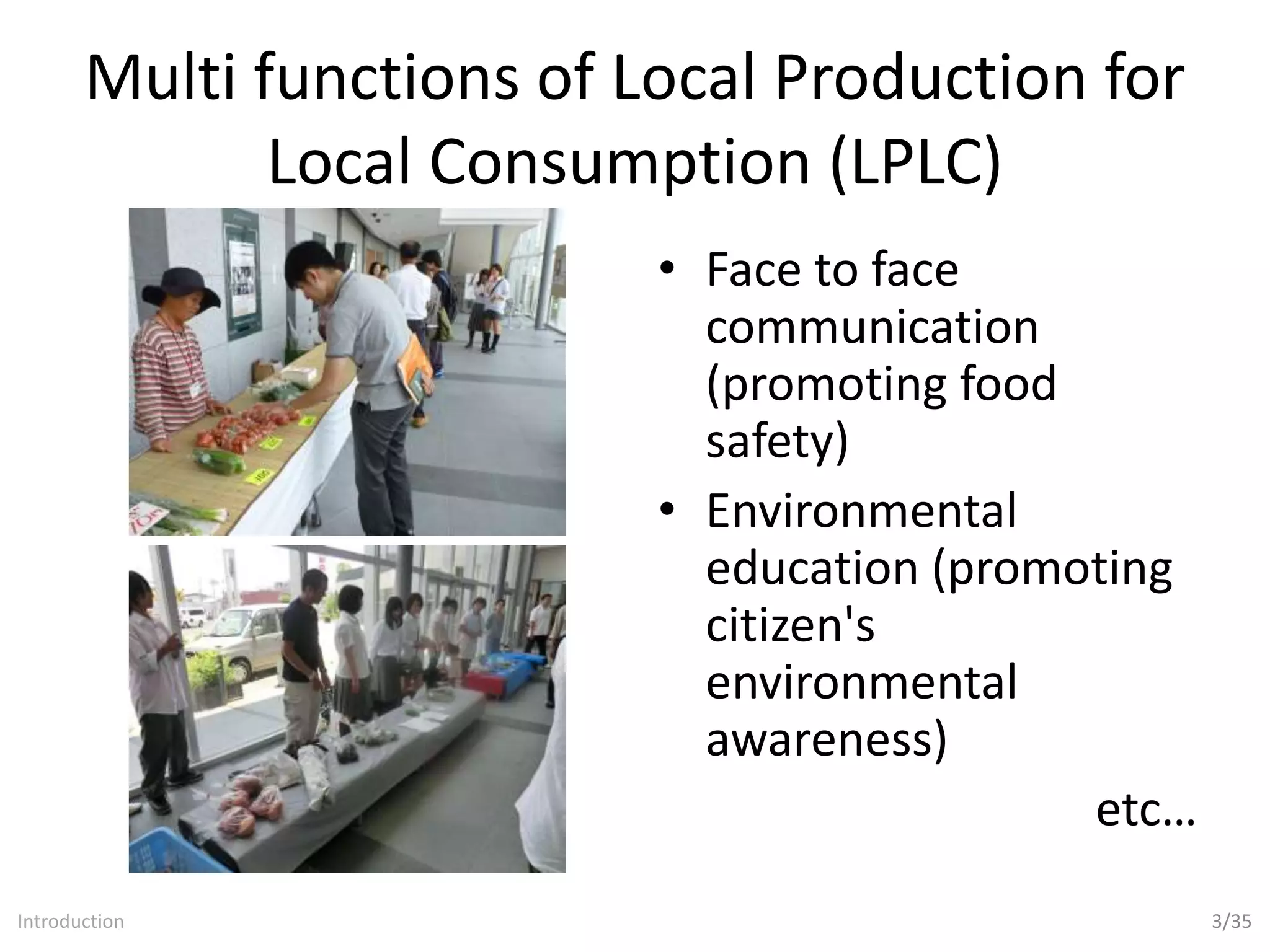
Multi functions of Local Production for
Local Consumption (LPLC)
• Face to face
communication
(promoting food
safety)
• Environmental
education (promoting
citizen's
environmental
awareness)
etc…
3/35Introduction
Examples of bioresource recycling
activities in city-regions
4/35
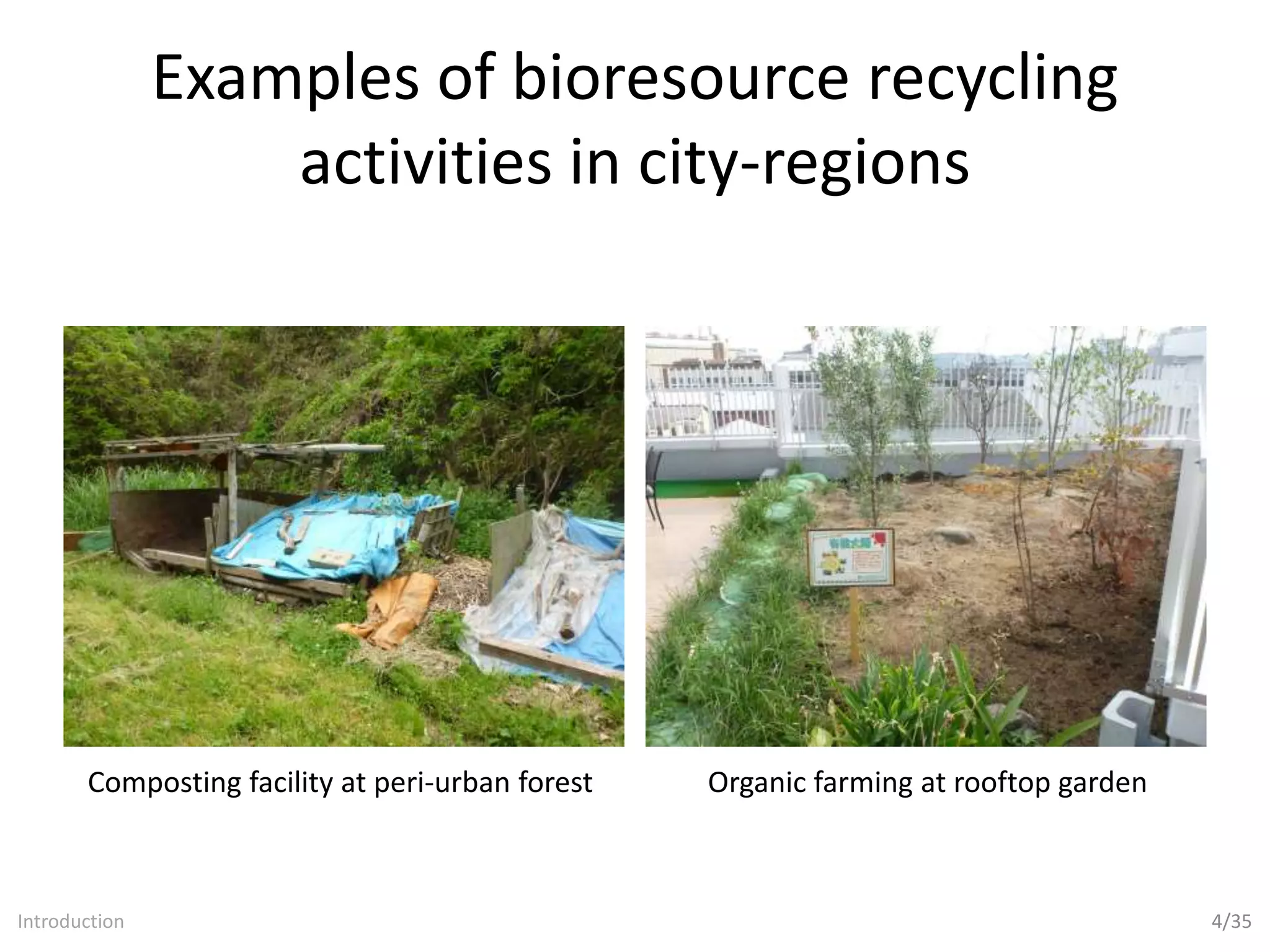
Composting facility at peri-urban forest Organic farming at rooftop garden
Introduction
Need to link local vegetable and bioresource
flows in consideration of land-use patterns
5/35Introduction
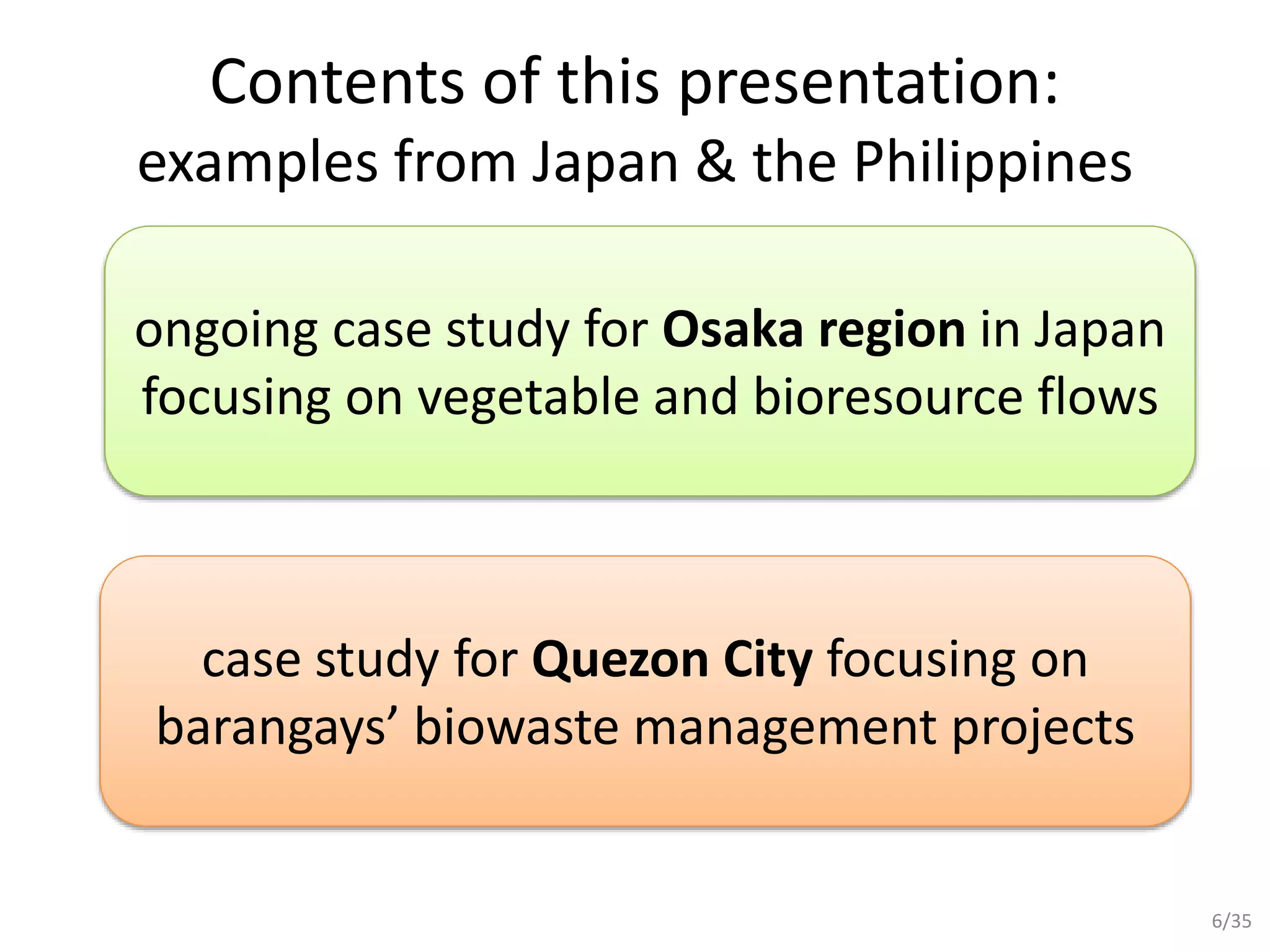
ongoing case study for Osaka region in Japan
focusing on vegetable and bioresource flows
case study for Quezon City focusing on
barangays’ biowaste management projects
Contents of this presentation:
examples from Japan & the Philippines
6/35
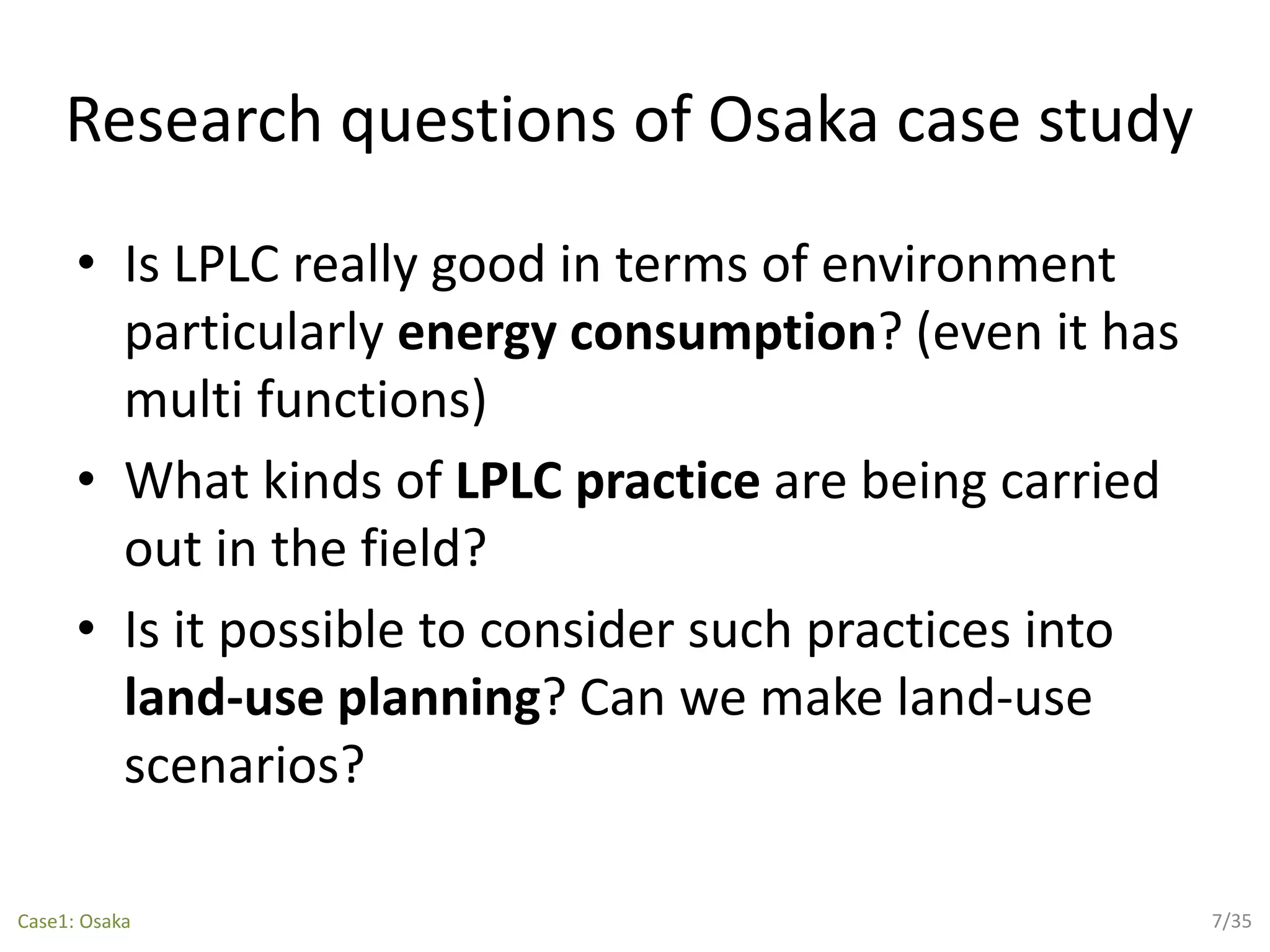
Research questions of Osaka case study
• Is LPLC really good in terms of environment
particularly energy consumption? (even it has
multi functions)
• What kinds of LPLC practice are being carried
out in the field?
• Is it possible to consider such practices into
land-use planning? Can we make land-use
scenarios?
7/35Case1: Osaka
Vegetable flows in Osaka city region
- Analysis at three scales -
1. Market basis vegetable flow at national scale
Estimating the amount of vegetables that flows
into Osaka city region
• Using vegetable marketing, agricultural land use
and energy consumption statistics
• Minimum spatial unit is a Prefecture
• 2 categories: Leaf vegetables and Root vegetables
• Quantifying environmental impact (energy
consumption) of these non-local vegetable flows
8/35Case1: Osaka
Weight (t)
97,000
Leaf and fruit vegetables
Root vegetables
Amount of vegetables flowing into Osaka region
(in 2003)
´
500
km
9/35Case1: Osaka
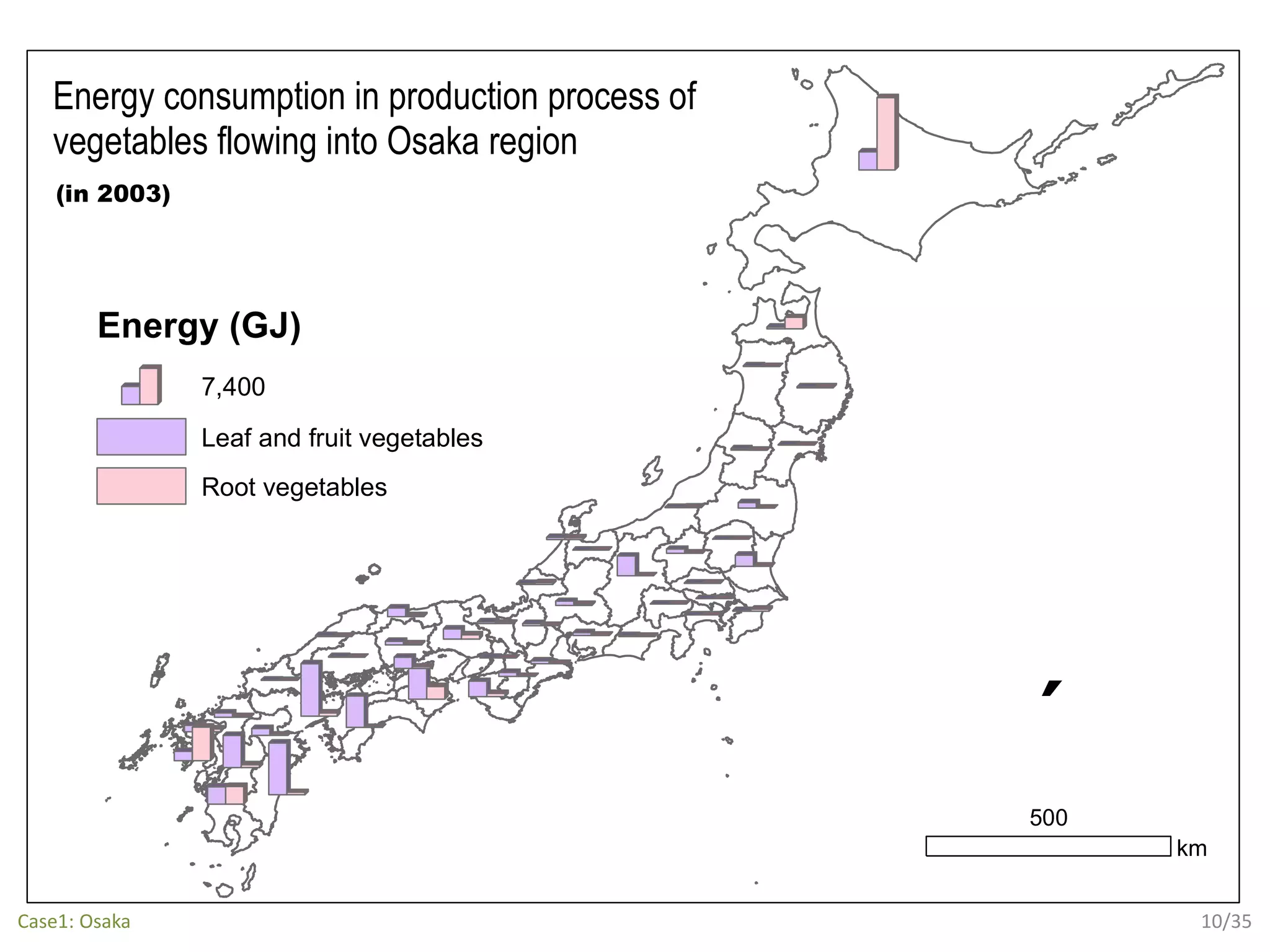
Energy (GJ)
7,400
Leaf and fruit vegetables
Root vegetables
Energy consumption in production process of
vegetables flowing into Osaka region
(in 2003)
´
500
km
10/35Case1: Osaka
Depending on remote prefectures
with high energy inputs
11/35
Farmlands on steep hillside Greenhouses
Case1: Osaka
Vegetable flows in Osaka city region
- Analysis at three scales -
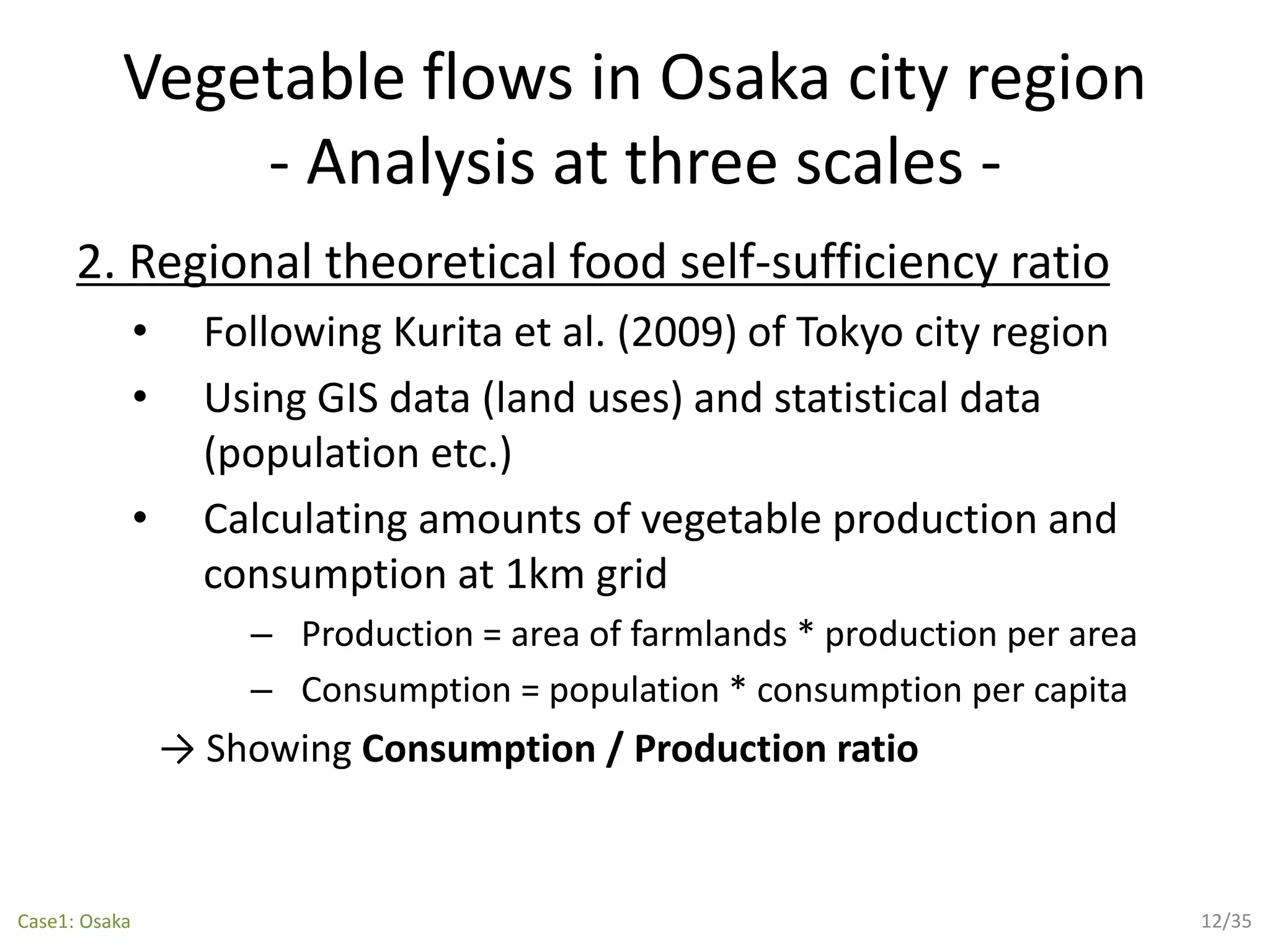
2. Regional theoretical food self-sufficiency ratio
• Following Kurita et al. (2009) of Tokyo city region
• Using GIS data (land uses) and statistical data
(population etc.)
• Calculating amounts of vegetable production and
consumption at 1km grid
– Production = area of farmlands * production per area
– Consumption = population * consumption per capita
→ Showing Consumption / Production ratio
12/35Case1: Osaka
Consumption /
Production ratio
of vegetables
Weight (t)
97,000
Leaf and fruit vegetables
Root vegetables
Amount of vegetables flowing into Osaka region
(in 2003)
´
500
km
13/35Case1: Osaka
Vegetable flows in Osaka city region
- Analysis at three scales -
3. Identifying LPLC practices in Sakai
City and analyzing potential for local
bioresource recycling
• Mapping local food stations and
amounts of local vegetable sale
• Calculating agricultural land use and
local vegetable productions
• Analyzing the balance between
fertilizer needs and biowaste-origin
compost amounts (ongoing)
14/35Case1: Osaka
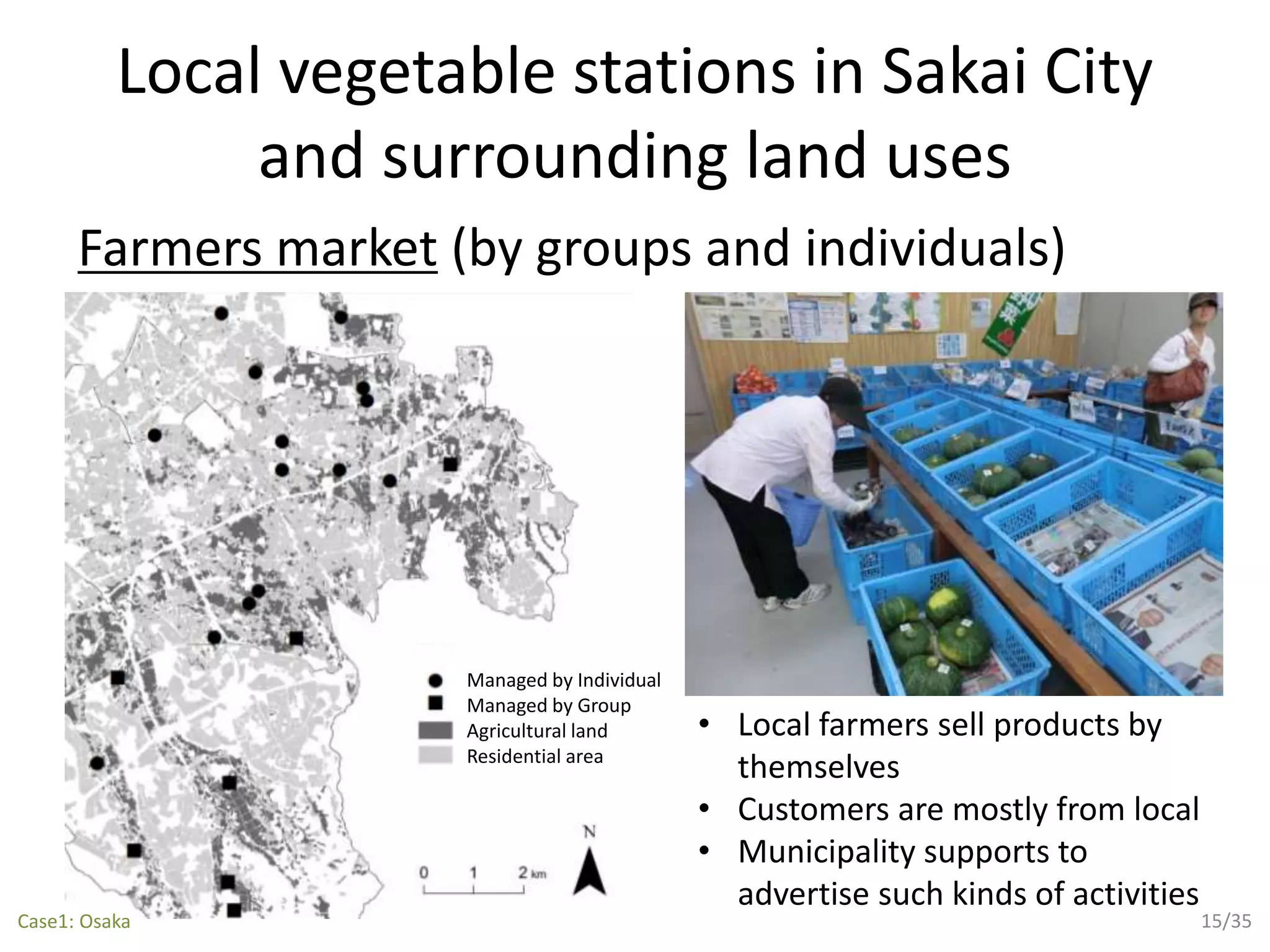
Local vegetable stations in Sakai City
and surrounding land uses
Farmers market (by groups and individuals)
Managed by Individual
Managed by Group
Agricultural land
Residential area
• Local farmers sell products by
themselves
• Customers are mostly from local
• Municipality supports to
advertise such kinds of activities
15/35Case1: Osaka
Bioresource utilization projects (under research)
16/35Case1: Osaka
Emerging community-based organic farming groups
involving urbanites in order to avoid farmland abandonments
Investigating organic waste flows in
Quezon City
17/35Case2: Quezon
Institutional framework
 Setting of National Solid Waste
Management Commission
 Publishing national guideline for waste
management
 Establishing and implementing Solid
Waste Management Plan (SWMP)
 Monitoring barangays’ activities and
programs under SWMP
DENR
(National
Government)
EPWMD
(Quezon City)
Barangays
 Constructing and operating Material
Recovery Facility (MRF)
 Waste segregation at source for
collecting recyclable materials
 Composting program
RA9003
Order
Incentives
18/35Case2: Quezon
Field survey in three barangays
Selection of three advanced barangays in waste
management practices according to building-to-land ratio
①Barangay Holy Spirit
• 102,194 inhabitants (2007)
• 3.28 km2
②Barangay Phil-Am
• 3,652 inhabitants (2007)
• 0.46 km2
③Barangay Bagumbuhay
• 7,895 inhabitants (2007)
• 0.26 km2
①
②
③
19/35Case2: Quezon
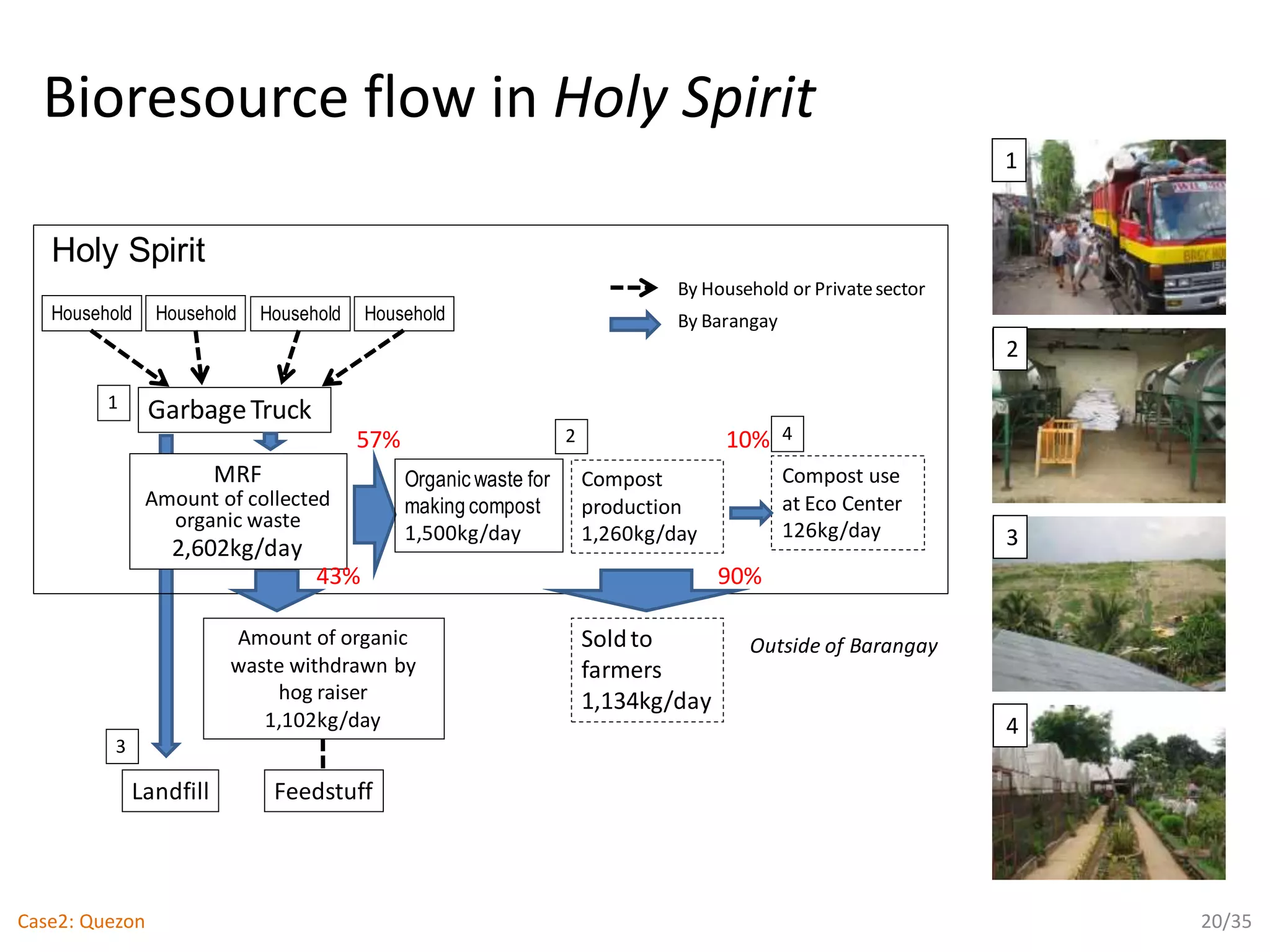
Bioresource flow in Holy Spirit
Household Household
GarbageTruck
Compost
production
1,260kg/day
Amount of organic
waste withdrawn by
hog raiser
1,102kg/day
Feedstuff
Soldto
farmers
1,134kg/day
Outside of Barangay
By Household or Privatesector
By Barangay
Landfill
Compost use
at Eco Center
126kg/day
MRF
Amount of collected
organic waste
2,602kg/day
1
2
3
4
Holy Spirit
Organic waste for
making compost
1,500kg/day
43%
57% 10%
90%
Household Household
1
2
3
4
20/35Case2: Quezon
Bioresource flow in Phil-Am
Household Household Household Household Compostingor feeding?
Dumping?
Organicwaste
carried into MRF
by residents
(housekeepers)
489.7kg/day
Compost production
540kg/day
(16,200kg/month)
LACTO Ltd.
Compost amount
1,000kg/month
Farmers
Compost amount
15,200kg/month
Bought by
100%
100%
Phil-Am
1
2
By Household or
Privatesector
By Barangay
Outside of Barangay
1
2
21/35Case2: Quezon
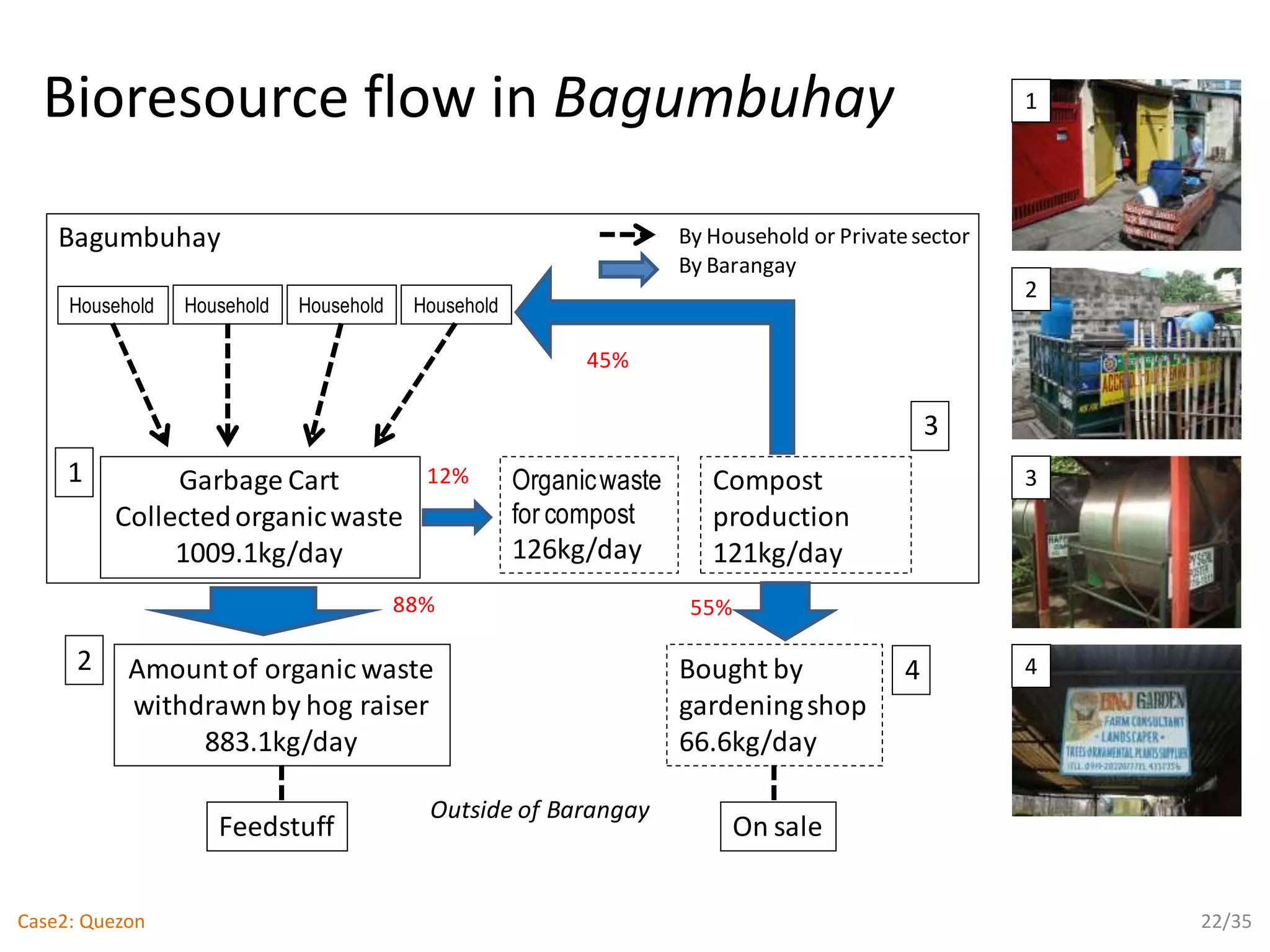
Bioresource flow in Bagumbuhay
Bagumbuhay
Household Household Household Household
Garbage Cart
Collectedorganicwaste
1009.1kg/day
Compost
production
121kg/day
Amountof organic waste
withdrawnby hog raiser
883.1kg/day
Feedstuff
Bought by
gardeningshop
66.6kg/day
On sale
Organicwaste
for compost
126kg/day
12%
88% 55%
45%
1
2
3
4
By Household or Privatesector
By Barangay
Outside of Barangay
1
2
3
4
22/35Case2: Quezon
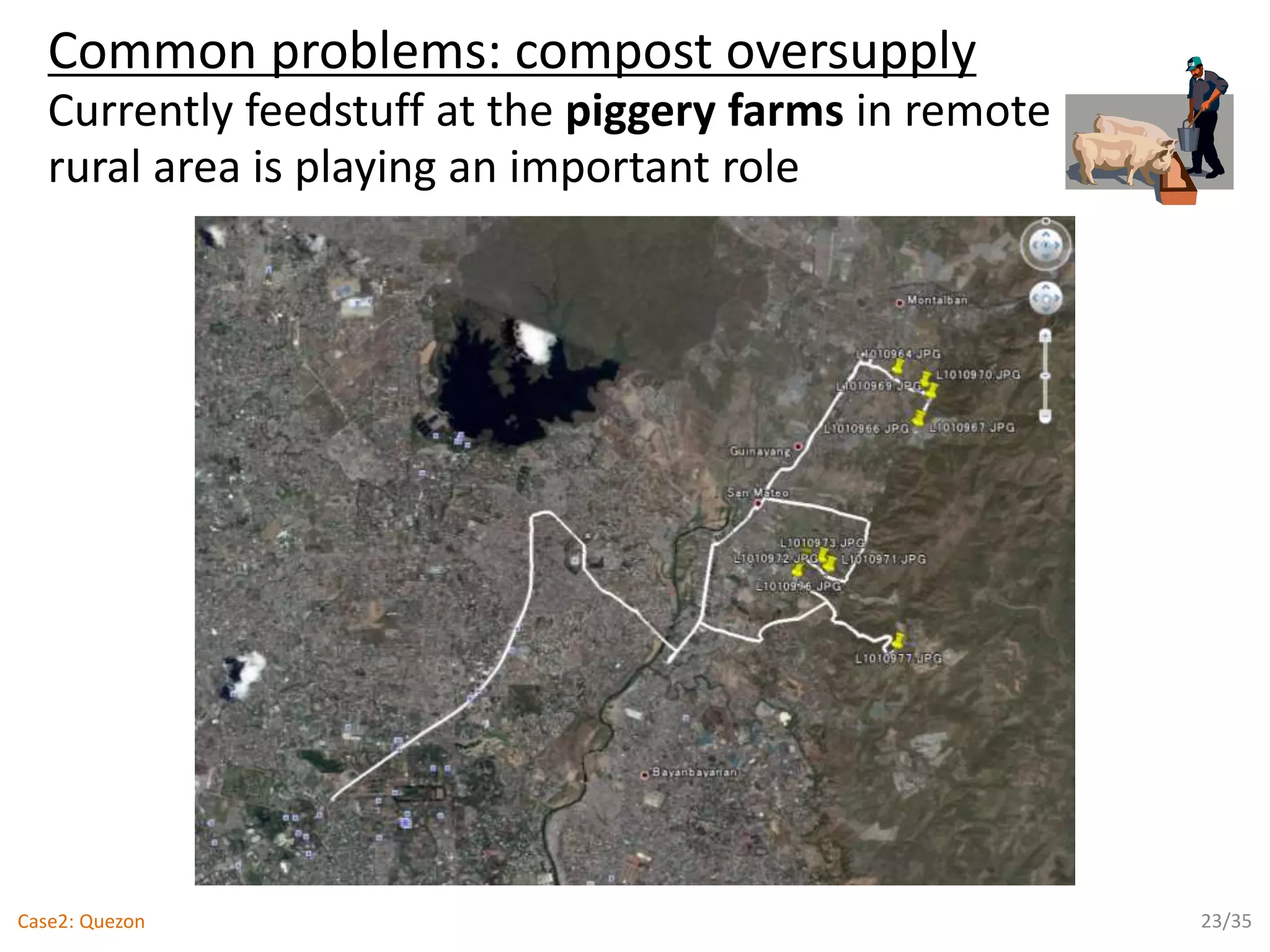
Common problems: compost oversupply
Currently feedstuff at the piggery farms in remote
rural area is playing an important role
23/35Case2: Quezon
Promotion of agricultural activities is one of the
possible options to consume compost
Operated barangay farm Well-observed individual agricultural
activities in the vacant lands
Can be systemized?
24/35Case2: Quezon
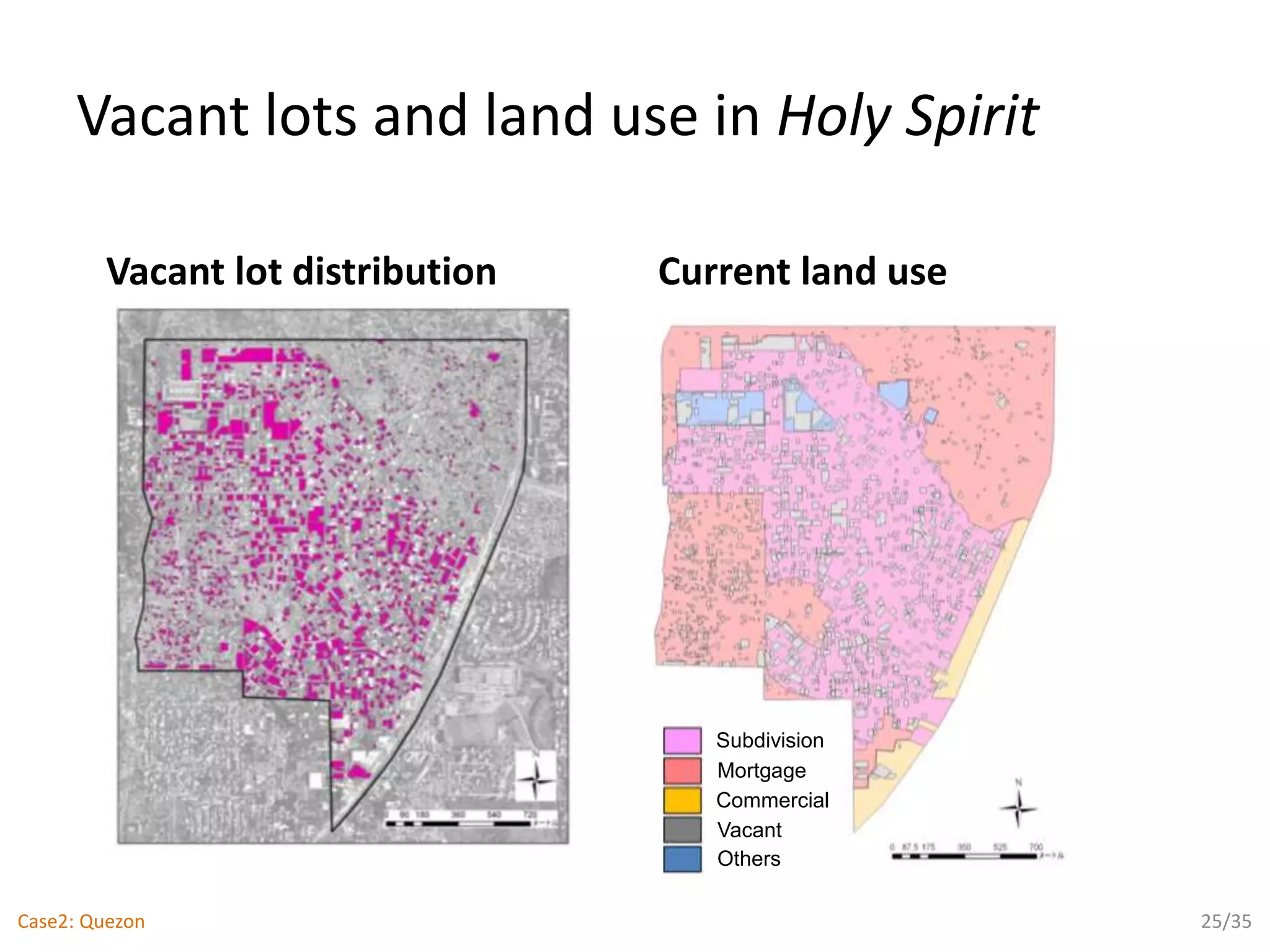
Vacant lots and land use in Holy Spirit
Vacant lot distribution Current land use
Vacant
Commercial
Mortgage
Subdivision
Others
25/35Case2: Quezon
Vacant lots and land use in Phil-Am
Vacant lot distribution Current land use
Commercial
Subdivision
Vacant
Others
26/35Case2: Quezon
Vacant lots and land use in Bagumbuhay
Vacant lot distribution Current land use
Commercial
Subdivision
Vacant
Others
27/35Case2: Quezon
Potential of vacant lots for utilizing compost
made from organic waste
Barangay Current compost
production (t/year)
Potential amount of
compost use in all
vacant lots (t/year)
Holy Spirit 460 1876
Phil-Am 194 126.2
Bagumbuhay 44 70.3
High potential of vacant lots; however, will it be materialized?
28/35Case2: Quezon
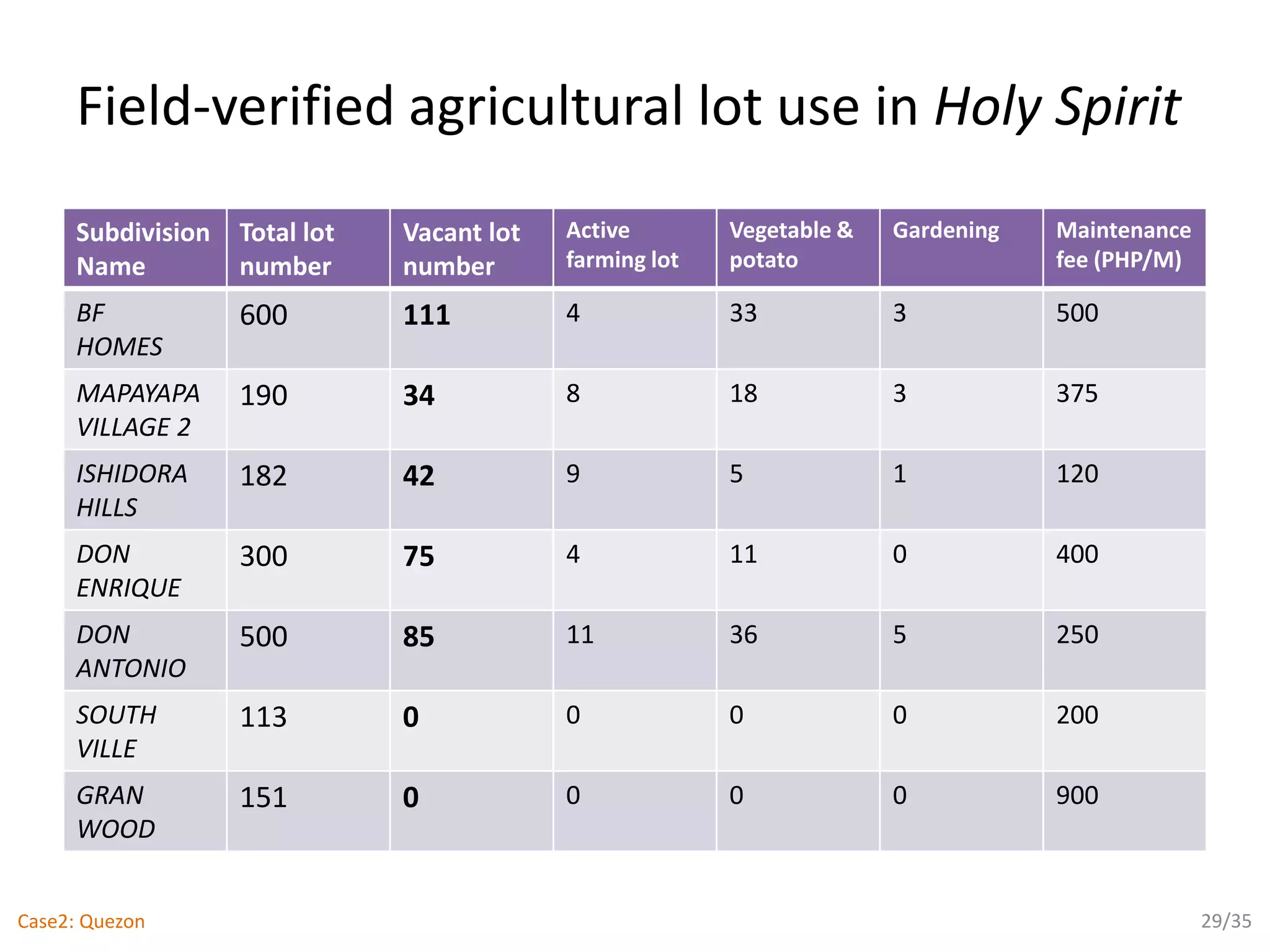
Field-verified agricultural lot use in Holy Spirit
Subdivision
Name
Total lot
number
Vacant lot
number
Active
farming lot
Vegetable &
potato
Gardening Maintenance
fee (PHP/M)
BF
HOMES
600 111 4 33 3 500
MAPAYAPA
VILLAGE 2
190 34 8 18 3 375
ISHIDORA
HILLS
182 42 9 5 1 120
DON
ENRIQUE
300 75 4 11 0 400
DON
ANTONIO
500 85 11 36 5 250
SOUTH
VILLE
113 0 0 0 0 200
GRAN
WOOD
151 0 0 0 0 900
29/35Case2: Quezon
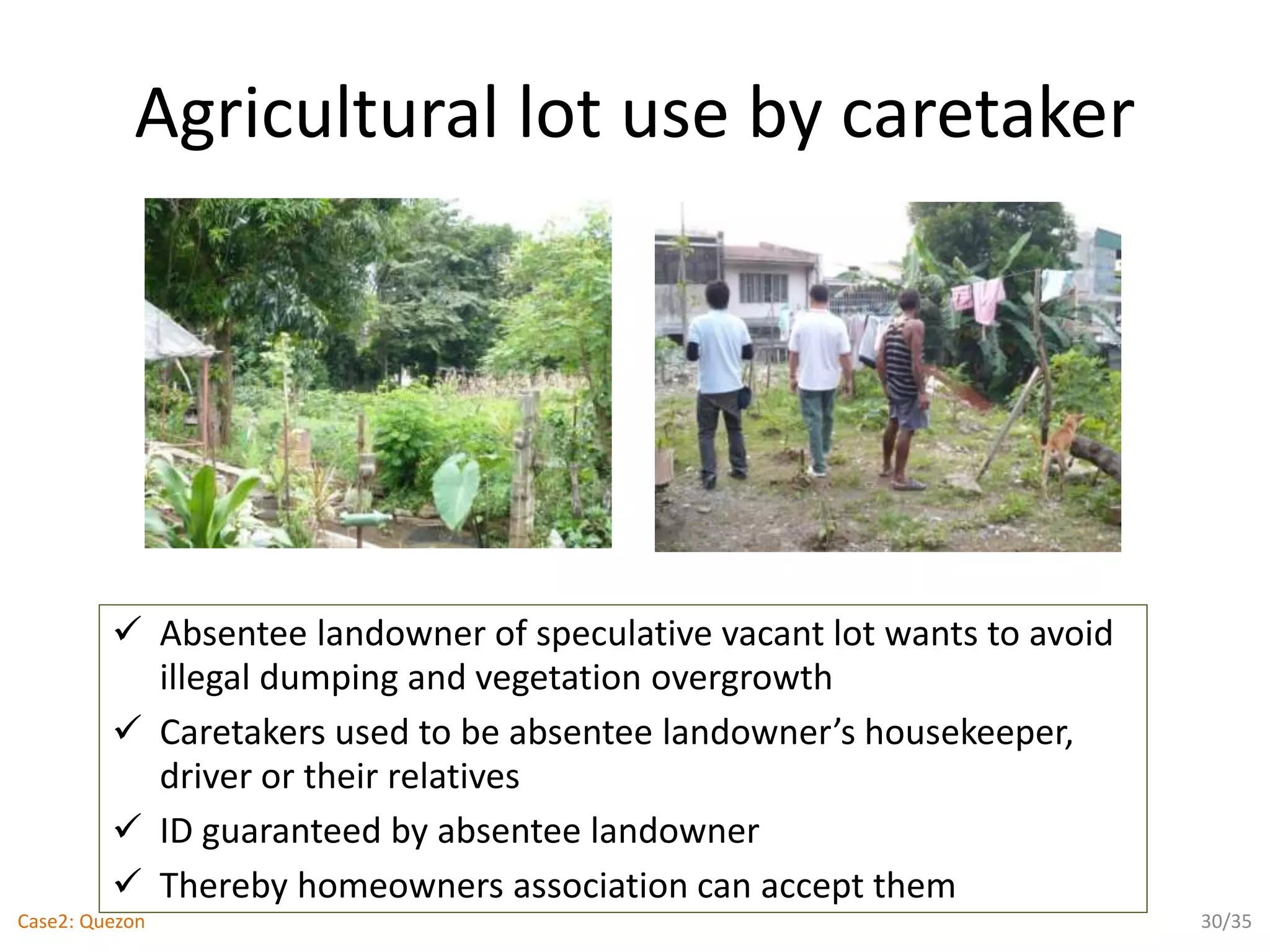
Agricultural lot use by caretaker
 Absentee landowner of speculative vacant lot wants to avoid
illegal dumping and vegetation overgrowth
 Caretakers used to be absentee landowner’s housekeeper,
driver or their relatives
 ID guaranteed by absentee landowner
 Thereby homeowners association can accept them
30/35Case2: Quezon
Installation of new ID-clarify systems by public agencies can
be discussed for promoting agricultural lot use
Quezon City
Holy Spirit
Philam Bagumbuhay
City boundary
Barangay
boundary
HOA
boundary
In-subdivision
house
Individual
house
Squatters
Open space
Vacantlot
31/35Case2: Quezon
Future research
• Investigating actual vegetable
• Experimental practice to use barangay-produced
compost in those temporal vegetable plots
32/35
Your cooperation is highly appreciated…
Case2: Quezon
Summary
Different phases of multi-functionality of urban agriculture and
bioresource management in Osaka and Quezon
Osaka
• Less urbanization pressure
• Need for managing
abandoned farmlands
• Need for reducing energy
consumption
• Thereby promoting
community-based LPLC
activities
→ Need to consider balances
of local, national and global
vegetable flows
Quezon
• Limited space
• Need for waste reduction
• Thereby promoting
biowaste recycling
• Need for managing vacant
lots
• Thereby temporal farming
activities are distributed
→ Need to connect them
toward biomass recycling loop
33/35
Rerated major publications
Hara, Y., Furutani, T., Murakami, A., Palijon, A.M. and Yokohari, M. (2011):
Current organic waste recycling and the potential for local recycling
through urban agriculture in Metro Manila. Waste Management &
Research (In Press).
Hara, Y., Hiramatsu, A., Honda, R., Sekiyama, M. and Matsuda, H. (2010): Mixed
land-use planning on the periphery of large Asian Cities: The case of
Nonthaburi Province, Thailand. Sustainability Science 5, 237-248.
Honda, R., Hara, Y., Sekiyama, M. and Hiramatsu, A. (2010): Impacts of housing
development on nutrients flow along canals in a peri-urban area of
Bangkok, Thailand. Water Science and Technology 61, 1073-1080.
Hiramatsu, A., Hara, Y., Sekiyama, M., Honda, R. and Chiemchaisri, C. (2009):
Municipal solid waste flow and waste generation characteristics in an
urban-rural fringe area in Thailand. Waste Management & Research 27,
951-960.
(If you are interested in having offprints, let me know)
34/35
Thank you!
35/35

Urban Agriculture and Bioresource Management in Asian low-lying cities

  • 1.
    Urban Agriculture andBioresource Management in Asian low-lying cities August 16, 2011 at Manila International Workshop on Sustainable City Region Yuji HARA and Kazuaki TSUCHIYA Akinobu MURAKAMI, Armando M. PALIJON and Makoto YOKOHARI 1/35
  • 2.
    Purchasing vegetables at… Shoppingcenter (mass) Local food station (trend) Mono function under market economy Multi functions ? 2/35Introduction
  • 3.
    Multi functions ofLocal Production for Local Consumption (LPLC) • Face to face communication (promoting food safety) • Environmental education (promoting citizen's environmental awareness) etc… 3/35Introduction
  • 4.
    Examples of bioresourcerecycling activities in city-regions 4/35 Composting facility at peri-urban forest Organic farming at rooftop garden Introduction
  • 5.
    Need to linklocal vegetable and bioresource flows in consideration of land-use patterns 5/35Introduction
  • 6.
    ongoing case studyfor Osaka region in Japan focusing on vegetable and bioresource flows case study for Quezon City focusing on barangays’ biowaste management projects Contents of this presentation: examples from Japan & the Philippines 6/35
  • 7.
    Research questions ofOsaka case study • Is LPLC really good in terms of environment particularly energy consumption? (even it has multi functions) • What kinds of LPLC practice are being carried out in the field? • Is it possible to consider such practices into land-use planning? Can we make land-use scenarios? 7/35Case1: Osaka
  • 8.
    Vegetable flows inOsaka city region - Analysis at three scales - 1. Market basis vegetable flow at national scale Estimating the amount of vegetables that flows into Osaka city region • Using vegetable marketing, agricultural land use and energy consumption statistics • Minimum spatial unit is a Prefecture • 2 categories: Leaf vegetables and Root vegetables • Quantifying environmental impact (energy consumption) of these non-local vegetable flows 8/35Case1: Osaka
  • 9.
    Weight (t) 97,000 Leaf andfruit vegetables Root vegetables Amount of vegetables flowing into Osaka region (in 2003) ´ 500 km 9/35Case1: Osaka
  • 10.
    Energy (GJ) 7,400 Leaf andfruit vegetables Root vegetables Energy consumption in production process of vegetables flowing into Osaka region (in 2003) ´ 500 km 10/35Case1: Osaka
  • 11.
    Depending on remoteprefectures with high energy inputs 11/35 Farmlands on steep hillside Greenhouses Case1: Osaka
  • 12.
    Vegetable flows inOsaka city region - Analysis at three scales - 2. Regional theoretical food self-sufficiency ratio • Following Kurita et al. (2009) of Tokyo city region • Using GIS data (land uses) and statistical data (population etc.) • Calculating amounts of vegetable production and consumption at 1km grid – Production = area of farmlands * production per area – Consumption = population * consumption per capita → Showing Consumption / Production ratio 12/35Case1: Osaka
  • 13.
    Consumption / Production ratio ofvegetables Weight (t) 97,000 Leaf and fruit vegetables Root vegetables Amount of vegetables flowing into Osaka region (in 2003) ´ 500 km 13/35Case1: Osaka
  • 14.
    Vegetable flows inOsaka city region - Analysis at three scales - 3. Identifying LPLC practices in Sakai City and analyzing potential for local bioresource recycling • Mapping local food stations and amounts of local vegetable sale • Calculating agricultural land use and local vegetable productions • Analyzing the balance between fertilizer needs and biowaste-origin compost amounts (ongoing) 14/35Case1: Osaka
  • 15.
    Local vegetable stationsin Sakai City and surrounding land uses Farmers market (by groups and individuals) Managed by Individual Managed by Group Agricultural land Residential area • Local farmers sell products by themselves • Customers are mostly from local • Municipality supports to advertise such kinds of activities 15/35Case1: Osaka
  • 16.
    Bioresource utilization projects(under research) 16/35Case1: Osaka Emerging community-based organic farming groups involving urbanites in order to avoid farmland abandonments
  • 17.
    Investigating organic wasteflows in Quezon City 17/35Case2: Quezon
  • 18.
    Institutional framework  Settingof National Solid Waste Management Commission  Publishing national guideline for waste management  Establishing and implementing Solid Waste Management Plan (SWMP)  Monitoring barangays’ activities and programs under SWMP DENR (National Government) EPWMD (Quezon City) Barangays  Constructing and operating Material Recovery Facility (MRF)  Waste segregation at source for collecting recyclable materials  Composting program RA9003 Order Incentives 18/35Case2: Quezon
  • 19.
    Field survey inthree barangays Selection of three advanced barangays in waste management practices according to building-to-land ratio ①Barangay Holy Spirit • 102,194 inhabitants (2007) • 3.28 km2 ②Barangay Phil-Am • 3,652 inhabitants (2007) • 0.46 km2 ③Barangay Bagumbuhay • 7,895 inhabitants (2007) • 0.26 km2 ① ② ③ 19/35Case2: Quezon
  • 20.
    Bioresource flow inHoly Spirit Household Household GarbageTruck Compost production 1,260kg/day Amount of organic waste withdrawn by hog raiser 1,102kg/day Feedstuff Soldto farmers 1,134kg/day Outside of Barangay By Household or Privatesector By Barangay Landfill Compost use at Eco Center 126kg/day MRF Amount of collected organic waste 2,602kg/day 1 2 3 4 Holy Spirit Organic waste for making compost 1,500kg/day 43% 57% 10% 90% Household Household 1 2 3 4 20/35Case2: Quezon
  • 21.
    Bioresource flow inPhil-Am Household Household Household Household Compostingor feeding? Dumping? Organicwaste carried into MRF by residents (housekeepers) 489.7kg/day Compost production 540kg/day (16,200kg/month) LACTO Ltd. Compost amount 1,000kg/month Farmers Compost amount 15,200kg/month Bought by 100% 100% Phil-Am 1 2 By Household or Privatesector By Barangay Outside of Barangay 1 2 21/35Case2: Quezon
  • 22.
    Bioresource flow inBagumbuhay Bagumbuhay Household Household Household Household Garbage Cart Collectedorganicwaste 1009.1kg/day Compost production 121kg/day Amountof organic waste withdrawnby hog raiser 883.1kg/day Feedstuff Bought by gardeningshop 66.6kg/day On sale Organicwaste for compost 126kg/day 12% 88% 55% 45% 1 2 3 4 By Household or Privatesector By Barangay Outside of Barangay 1 2 3 4 22/35Case2: Quezon
  • 23.
    Common problems: compostoversupply Currently feedstuff at the piggery farms in remote rural area is playing an important role 23/35Case2: Quezon
  • 24.
    Promotion of agriculturalactivities is one of the possible options to consume compost Operated barangay farm Well-observed individual agricultural activities in the vacant lands Can be systemized? 24/35Case2: Quezon
  • 25.
    Vacant lots andland use in Holy Spirit Vacant lot distribution Current land use Vacant Commercial Mortgage Subdivision Others 25/35Case2: Quezon
  • 26.
    Vacant lots andland use in Phil-Am Vacant lot distribution Current land use Commercial Subdivision Vacant Others 26/35Case2: Quezon
  • 27.
    Vacant lots andland use in Bagumbuhay Vacant lot distribution Current land use Commercial Subdivision Vacant Others 27/35Case2: Quezon
  • 28.
    Potential of vacantlots for utilizing compost made from organic waste Barangay Current compost production (t/year) Potential amount of compost use in all vacant lots (t/year) Holy Spirit 460 1876 Phil-Am 194 126.2 Bagumbuhay 44 70.3 High potential of vacant lots; however, will it be materialized? 28/35Case2: Quezon
  • 29.
    Field-verified agricultural lotuse in Holy Spirit Subdivision Name Total lot number Vacant lot number Active farming lot Vegetable & potato Gardening Maintenance fee (PHP/M) BF HOMES 600 111 4 33 3 500 MAPAYAPA VILLAGE 2 190 34 8 18 3 375 ISHIDORA HILLS 182 42 9 5 1 120 DON ENRIQUE 300 75 4 11 0 400 DON ANTONIO 500 85 11 36 5 250 SOUTH VILLE 113 0 0 0 0 200 GRAN WOOD 151 0 0 0 0 900 29/35Case2: Quezon
  • 30.
    Agricultural lot useby caretaker  Absentee landowner of speculative vacant lot wants to avoid illegal dumping and vegetation overgrowth  Caretakers used to be absentee landowner’s housekeeper, driver or their relatives  ID guaranteed by absentee landowner  Thereby homeowners association can accept them 30/35Case2: Quezon
  • 31.
    Installation of newID-clarify systems by public agencies can be discussed for promoting agricultural lot use Quezon City Holy Spirit Philam Bagumbuhay City boundary Barangay boundary HOA boundary In-subdivision house Individual house Squatters Open space Vacantlot 31/35Case2: Quezon
  • 32.
    Future research • Investigatingactual vegetable • Experimental practice to use barangay-produced compost in those temporal vegetable plots 32/35 Your cooperation is highly appreciated… Case2: Quezon
  • 33.
    Summary Different phases ofmulti-functionality of urban agriculture and bioresource management in Osaka and Quezon Osaka • Less urbanization pressure • Need for managing abandoned farmlands • Need for reducing energy consumption • Thereby promoting community-based LPLC activities → Need to consider balances of local, national and global vegetable flows Quezon • Limited space • Need for waste reduction • Thereby promoting biowaste recycling • Need for managing vacant lots • Thereby temporal farming activities are distributed → Need to connect them toward biomass recycling loop 33/35
  • 34.
    Rerated major publications Hara,Y., Furutani, T., Murakami, A., Palijon, A.M. and Yokohari, M. (2011): Current organic waste recycling and the potential for local recycling through urban agriculture in Metro Manila. Waste Management & Research (In Press). Hara, Y., Hiramatsu, A., Honda, R., Sekiyama, M. and Matsuda, H. (2010): Mixed land-use planning on the periphery of large Asian Cities: The case of Nonthaburi Province, Thailand. Sustainability Science 5, 237-248. Honda, R., Hara, Y., Sekiyama, M. and Hiramatsu, A. (2010): Impacts of housing development on nutrients flow along canals in a peri-urban area of Bangkok, Thailand. Water Science and Technology 61, 1073-1080. Hiramatsu, A., Hara, Y., Sekiyama, M., Honda, R. and Chiemchaisri, C. (2009): Municipal solid waste flow and waste generation characteristics in an urban-rural fringe area in Thailand. Waste Management & Research 27, 951-960. (If you are interested in having offprints, let me know) 34/35
  • 35.

Editor's Notes

  • #2 タイトル 共著者紹介
  • #21 コンポスト供給過剰 初期目標との乖離 人口規模に比して生ごみ収集量が少ない→最終処分場へ
  • #26 スラムが多い
  • #31 主要な空地利用としてのCaretaker