
Maximizing
Resource Recovery
from Biosolids
Andrew Carpenter
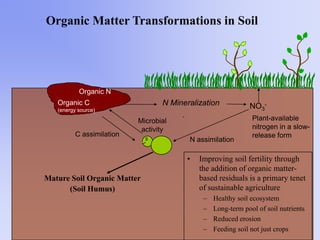
Organic N
Organic C
(energy source)
Microbial
activity
NO3
-
N assimilation
N Mineralization
Organic Matter Transformations in Soil
Mature Soil Organic Matter
(Soil Humus)
C assimilation
Plant-available
nitrogen in a slow-
release form
• Improving soil fertility through
the addition of organic matter-
based residuals is a primary tenet
of sustainable agriculture
– Healthy soil ecosystem
– Long-term pool of soil nutrients
– Reduced erosion
– Feeding soil not just crops
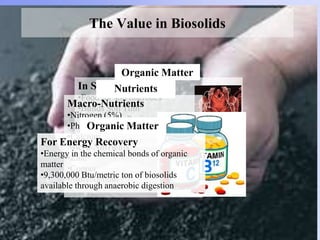
The Value in Biosolids
Organic Matter
In Soil
•Food for soil microbes
•Builds Soil Tilth
•Erosion Resistance
•Water-holding capacity
•Ability to retain nutrients
Macro-Nutrients
•Nitrogen (5%)
•Phosphorus (2%)
•Calcium
Micro-Nutrients
•Zinc
•Copper
•Molybdenum
Nutrients
For Energy Recovery
•Energy in the chemical bonds of organic
matter
•9,300,000 Btu/metric ton of biosolids
available through anaerobic digestion
Organic Matter
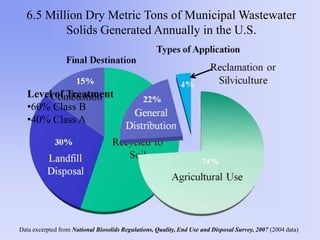
6.5 Million Dry Metric Tons of Municipal Wastewater
Solids Generated Annually in the U.S.
Level of Treatment
•60% Class B
•40% Class A
Data excerpted from National Biosolids Regulations, Quality, End Use and Disposal Survey, 2007 (2004 data)
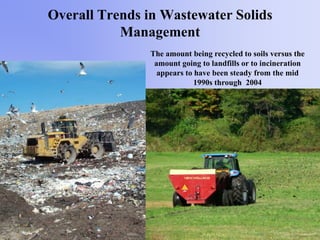
Overall Trends in Wastewater Solids
Management
The amount being recycled to soils versus the
amount going to landfills or to incineration
appears to have been steady from the mid
1990s through 2004
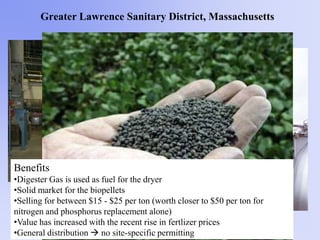
Greater Lawrence Sanitary District, Massachusetts
Benefits
•Digester Gas is used as fuel for the dryer
•Solid market for the biopellets
•Selling for between $15 - $25 per ton (worth closer to $50 per ton for
nitrogen and phosphorus replacement alone)
•Value has increased with the recent rise in fertlizer prices
•General distribution  no site-specific permitting
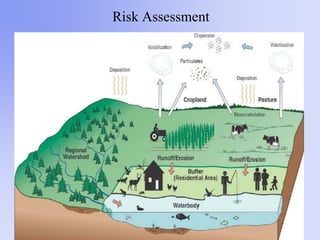
Risk Assessment
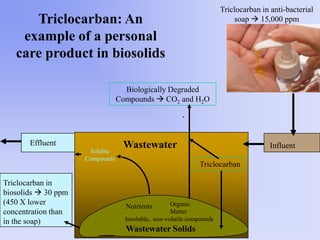
Triclocarban: An
example of a personal
care product in biosolids
InfluentEffluent
Biologically Degraded
Compounds  CO2 and H2O
Wastewater
Wastewater Solids
Soluble
Compounds
Nutrients Organic
Matter
Insoluble, non-volatile compounds
Triclocarban in anti-bacterial
soap  15,000 ppm
Triclocarban
Triclocarban in
biosolids  30 ppm
(450 X lower
concentration than
in the soap)
Opportunities in the Future
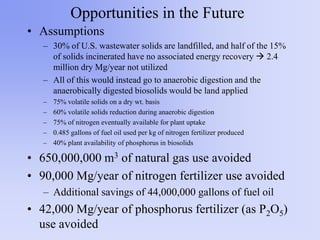
• Assumptions
– 30% of U.S. wastewater solids are landfilled, and half of the 15%
of solids incinerated have no associated energy recovery  2.4
million dry Mg/year not utilized
– All of this would instead go to anaerobic digestion and the
anaerobically digested biosolids would be land applied
– 75% volatile solids on a dry wt. basis
– 60% volatile solids reduction during anaerobic digestion
– 75% of nitrogen eventually available for plant uptake
– 0.485 gallons of fuel oil used per kg of nitrogen fertilizer produced
– 40% plant availability of phosphorus in biosolids
• 650,000,000 m3 of natural gas use avoided
• 90,000 Mg/year of nitrogen fertilizer use avoided
– Additional savings of 44,000,000 gallons of fuel oil
• 42,000 Mg/year of phosphorus fertilizer (as P2O5)
use avoided
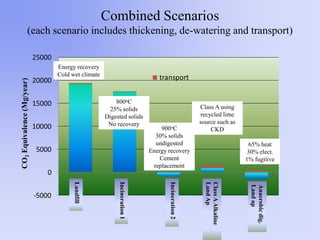
Combined Scenarios
(each scenario includes thickening, de-watering and transport)
-5000
0
5000
10000
15000
20000
25000
CO2Equivalence(Mg/year)
transport
Energy recovery
Cold wet climate
800oC
25% solids
Digested solids
No recovery
65% heat
30% elect.
1% fugitive
Landfill
Incineration1
Incineration2
900oC
30% solids
undigested
Energy recovery
Cement
replacement
ClassAAlkaline
LandAp
Class A using
recycled lime
source such as
CKD
Anaerobicdig.
Landap
Concluding Remarks
andrew@northerntilth.com
• Use It or Lose It!

Maximizing Resource Recovery From Biosolids

  • 1.
  • 2.
    Organic N Organic C (energysource) Microbial activity NO3 - N assimilation N Mineralization Organic Matter Transformations in Soil Mature Soil Organic Matter (Soil Humus) C assimilation Plant-available nitrogen in a slow- release form • Improving soil fertility through the addition of organic matter- based residuals is a primary tenet of sustainable agriculture – Healthy soil ecosystem – Long-term pool of soil nutrients – Reduced erosion – Feeding soil not just crops
  • 3.
    The Value inBiosolids Organic Matter In Soil •Food for soil microbes •Builds Soil Tilth •Erosion Resistance •Water-holding capacity •Ability to retain nutrients Macro-Nutrients •Nitrogen (5%) •Phosphorus (2%) •Calcium Micro-Nutrients •Zinc •Copper •Molybdenum Nutrients For Energy Recovery •Energy in the chemical bonds of organic matter •9,300,000 Btu/metric ton of biosolids available through anaerobic digestion Organic Matter
  • 4.
    6.5 Million DryMetric Tons of Municipal Wastewater Solids Generated Annually in the U.S. Level of Treatment •60% Class B •40% Class A Data excerpted from National Biosolids Regulations, Quality, End Use and Disposal Survey, 2007 (2004 data)
  • 5.
    Overall Trends inWastewater Solids Management The amount being recycled to soils versus the amount going to landfills or to incineration appears to have been steady from the mid 1990s through 2004
  • 6.
    Greater Lawrence SanitaryDistrict, Massachusetts Benefits •Digester Gas is used as fuel for the dryer •Solid market for the biopellets •Selling for between $15 - $25 per ton (worth closer to $50 per ton for nitrogen and phosphorus replacement alone) •Value has increased with the recent rise in fertlizer prices •General distribution  no site-specific permitting
  • 7.
  • 8.
    Triclocarban: An example ofa personal care product in biosolids InfluentEffluent Biologically Degraded Compounds  CO2 and H2O Wastewater Wastewater Solids Soluble Compounds Nutrients Organic Matter Insoluble, non-volatile compounds Triclocarban in anti-bacterial soap  15,000 ppm Triclocarban Triclocarban in biosolids  30 ppm (450 X lower concentration than in the soap)
  • 9.
    Opportunities in theFuture • Assumptions – 30% of U.S. wastewater solids are landfilled, and half of the 15% of solids incinerated have no associated energy recovery  2.4 million dry Mg/year not utilized – All of this would instead go to anaerobic digestion and the anaerobically digested biosolids would be land applied – 75% volatile solids on a dry wt. basis – 60% volatile solids reduction during anaerobic digestion – 75% of nitrogen eventually available for plant uptake – 0.485 gallons of fuel oil used per kg of nitrogen fertilizer produced – 40% plant availability of phosphorus in biosolids • 650,000,000 m3 of natural gas use avoided • 90,000 Mg/year of nitrogen fertilizer use avoided – Additional savings of 44,000,000 gallons of fuel oil • 42,000 Mg/year of phosphorus fertilizer (as P2O5) use avoided
  • 10.
    Combined Scenarios (each scenarioincludes thickening, de-watering and transport) -5000 0 5000 10000 15000 20000 25000 CO2Equivalence(Mg/year) transport Energy recovery Cold wet climate 800oC 25% solids Digested solids No recovery 65% heat 30% elect. 1% fugitive Landfill Incineration1 Incineration2 900oC 30% solids undigested Energy recovery Cement replacement ClassAAlkaline LandAp Class A using recycled lime source such as CKD Anaerobicdig. Landap
  • 11.