Vidradhi (Abscess)
DR. ALOK KUMAR
PhD SHALYA TANTRA
NEIAH, SHILLONG
overview
• References
• Definition
• Type
• Clinical feature
• Principle of management
• Complications
References
• Vidradhi nidan ………………Su.Ni. Chapter 9
• Vidradhi chikitsa……………..Su. Chi. Chapter 16
Definition
“स वै शीघ्रववदाहित्वाद्ववद्रधीति तिरुच्यिे”- (च. सू. १७)
• त्वग्रक्िमाांसमेदाांसस प्रदूष्यास्थिसमाश्रििााः | दोषााः शोफां शिैर्घोरां जियन्तत्युस्च्ििा
भृशम् ||
मिामूलां रुजावन्तिां वृत्तां चा(वाऽ)प्यिवाऽऽयिम् | िमािुवविद्रश्रधां धीरा, ववज्ञेयाः स च
षड्ववधाः ||
• Due to various factors, when vitiated doshas goes in to dhatus like twak, rakta,
mansa, meda and Asthi and slowly-slowly produces, pain and severe swelling
(sotha). When this sotha became deep, painful, oval, large, broad base and reach to
pakwavastha then it called vidradhi. This is of 6 types.
Types
पृिग्दोषैाः समथिैश्च क्षिेिाप्यसृजा ििा | षण्णामवप हि िेषाां िु लक्षणां
सम्प्प्रवक्ष्यिे ||
Three from different doshas, one Sannipataj, one Kshataj (traumatic) and
one raktaj these are six types of vidradhi.
As per Acharya charak vidradhi are two types Bahya (External) and
Abhyantar (Internal).
Clinical features
• Vataj
कृ ष्णोऽरुणो वा परुषो भृशमत्यर्थवेदनः | चित्रोत्र्ानप्रपाकश्ि
ववद्रचिवाथतसम्भवः ||
• Pittaj
पक्वोदुम्बरसङ्काशः श्यावो वा ज्वरदाहवान् | क्षिप्रोत्र्ानप्रपाकश्ि ववद्रचिः
वपत्तसम्भवः ||
• Kaphaj
शरावसदृशः पाण्ुः शीतः स्तब्िोऽल्पवेदनः | चिरोत्र्ानप्रपाकश्ि सकण्ुश्ि
कफोत्त्र्तः ||
• Sannipataj
िािावणिरुजास्रावो र्घाटालो ववषमो मिाि् ||१०|| ववषमां पच्यिे चावप ववद्रश्रधाः
सास्न्तिपातिकाः |
• Kshataj
िैथिैभािवैरसभििे क्षिे वाऽपथ्यसेवविाः ||११|| क्षिोष्मा वायुववसृिाः सरक्िां
वपत्तमीरयेि्
ज्वरथिृष्णा च दािश्च जायिे िथय देहििाः ||१२|| एष ववद्रश्रधरागन्तिुाः
वपत्तववद्रश्रधलक्षणाः
• Raktaj
कृ ष्णथफोटावृिाः श्यावथिीव्रदािरुजाज्वराः [१] ||१३|| वपत्तववद्रश्रधसलङ्गथिु
रक्िववद्रश्रधरुच्यिे
Site of Abhyantar vidradhi
“गुदे बस्थिमुखे िाभयाां कु क्षौ वङ्क्षणयोथििा |वृक्कयोयिकृ ति प्लीस्नि हृदये क्लोस्म्प्ि वा ििा
|”
These are site of abhayntar vidradhi
1. Guda
2. Vast
3. Nabhi
4. Kukshi
5. Vankshana
6. Vrikka
7. Ykruta
8. Pleeha
9. Hrudya
10. Klome
Clinical features
• अचिष्ठानववशेषेण लिङ्गं शृणु ववशेषतः ||
• गुदे वातननरोिस्तु बस्तौ कृ च्छ्राल्पमूत्रता | नाभयां हहक्का तर्ाऽऽोोपः कु िौ मारुतकोपनम् ||
• कोीपृष्ठग्रहस्तीव्रो वङ्िणोत्र्े तु ववद्रिौ | वृक्कयोः पाश्वथसङ्कोिः प्िीह्न्युच्छ््वासावरोिनम ्
||
• सवाथङ्गप्रग्रहस्तीव्रो हृहद शूिश्ि दारुणः | श्वासो यकृ नत तृष्णा ि वपपासाक्िोमजेऽचिका ||
Clinical features
1. Guda- obstruction of flatus/stool
2. Vasti- oligouria and dysuria
3. Nabhi- hiccough, aatop(distension in abdomen)
4. Kukshi- marutkopanam (Vitiation of Vata)(excessive flatus)
5. Vankshana- spasm in back (lumbar and thoracic)
6. Vrikka - pain in renal angle (lateral bending)
7. Ykruta- dyspnea, thirst
8. Pleeha- dyspnea
9. Hrudya- severe pain and spasm in body
10.Klome- excessive thirst
Differences between gulma and vidradhi
• ववशेषमि वक्ष्यासम थपष्टां ववद्रश्रधगुल्मयोाः ||२८|| गुल्मदोषसमुत्िािाद्ववद्रधेगुिल्मकथय च
|
• कथमान्ति पच्यिे गुल्मो ववद्रश्रधाः पाकमेति च || २९||
• Both vidradhi and gulma are originated from same dosha, but vidhardi became pakwa
gulma doesn’t ,,,,,,,,,,,,,,,,,,,,,,,,,,,,,,,,,,,,,,,,,,,,,the possible reseaon behind this are….
• ि तिबन्तधोऽस्थि गुल्मािाां ववद्रश्रधाः सतिबन्तधिाः | गुल्माकारााः थवयां दोषा
ववद्रश्रधमाांसशोणणिे ||३०|| वववरािुचरो ग्रस्न्तिरप्सु बुद्बुदको यिा | एवम्प्प्रकारो गुल्मथिु
िथमाि् पाकां ि गच्छति ||३१|| माांसशोणणिबािुल्याि् पाकां गच्छति ववद्रश्रधाः |
माांसशोणणििीित्वाद्गुल्माः पाकां ि गच्छति ||३२|| गुल्मस्थिष्ठति दोषे थवे
ववद्रश्रधमाांसशोणणिे | ववद्रश्रधाः पच्यिे िथमाद्गल्मश्चावप ि पच्यिे ||३३||
Principle of management
• उक्िा ववद्रधयाः षड्ये िेष्वसाध्यथिु सविजाः | शेषेष्वामेषु कििव्या त्वररिां शोफवि् क्रिया
Su.Chi 16/3
• Sannipataj vidradhi is considered as asadhya rest apakva vidradhi should be
treated as treatment of sopha (Apkwa) (upakrama 1-11)
• िोपगच्छेद्यिापाकां प्रयिेि ििा सभषक् || Su.Chi 16/ 38
• Surgeon should try first with conservative approach to avoid suppuration
(Pak) in vidradhi by various medicine and parasurgical procedure.
• स चेदेवमुपिान्तिाः पाकायासभमुखो यहद | िां पाचतयत्वा शथरेण सभन्तद्याद्सभन्तिां च
शोधयेि्
Su. Chi 16/7
• Even after trying upakrama if vidradhi shows lakshana of pakwa then it must be
explored and treat like wound.
Conservative measures
1. Aptarpana
2. Aalepa
3. Upnaaha
4. Parisheka
5. Abhyanga
6. Swedana
7. Raktamokshana
8. Jalukavcharana
9. Siravedha
10. Virechana
11. Vamana
Shalya Karma
• ममिससराथिायुसन्तध्यस्थिधमिीाः पररिरि्, अिुलोमां शथरां तिदध्यादापूयदशििाि्, सकृ देवापिरेच्छथरमाशु च;
मित्थववप च पाके षु द्व्यङ्गुलान्तिरां त्र्यङ्गुलान्तिरां वा शथरपदमुक्िम ्
Su .Su. 5/7
• िरायिो ववशालाः समाः सुववभक्िो तिरािय इति व्रणगुणा: Su .Su. 5/8
• Every incision must be have the properties like it must be enough long, wide with equal
clean margin and no pockets left.
• आयिश्च ववशालश्च सुववभक्िो तिराियाः | प्राप्िकालकृ िश्चावप व्रणाः कमिणण शथयिे
Su .Su. 5/9
• The ideal incision is that which have, Enough length, wide, clean margins, brakes all the
pus pockets and made on correct time.
Principle of counter incision
• एके ि वा व्रणेिाशुध्यमािे िाऽन्तिरा बुद्ध्याऽवेक्ष्यापराि ् व्रणाि ् कु यािि ्
भवति चार- Su. Su.
5/11
• If the one incision is not enough to drain the complete cavity ,
surgeon should examine and wisely made other incision to drain the
pus completely.
•
यिो यिो गतिां ववद्यादुत्सङ्गो यर यर च | िर िर व्रणां कु यािद्यिा
दोषो ि तिष्ठति
Su. Su 5/12
“If there is swelling due to collection of pus, make the incision to drain
it”.
Incision
1. Straight (Tiryak)
िर भ्रूगण्डशङ्खललाटाक्षक्षपुटौष्ठदन्तिवेष्टकक्षाकु क्षक्षवङ्क्षणेषु तियिक् छेद
उक्िाः
Su. Su 5/13
2. Circular (Chandrakaar)
चन्तद्रमण्डलवच्छेदाि ् पाणणपादेषु कारयेि ्
3. Semicircular (Ardh-chandrakaar)
अधिचन्तद्राकृ िीांश्चावप गुदे मेढ्रे च बुद्श्रधमाि ् Su. Su 5/14
Drugs
• Pakwa vidradhi should be treated as like pakwa sopha. That include
vrana patana, sodhana and Ropana karma.
• In sodhana and Ropana various drug/yog should be used keep in mind
the doshaghntwa of drug.
• Vrihatpanchmool, bhadradarvadi gana, kakolyadi gana----Vata
• Mulethi, sariva, ksheerkakoli, jeevniya gana, karanjjadi ghrita---Pitta
• Danti ,Drvanti, Nishotha , tilvaka, sendhanamak----kapha
Varukadi gana, uskadi gana – Apkwa Antravidradhi
Special treatment
• Siravedhan in kaphaj vidradhi
• Majjagatvidradhi.—considered as ashadya but treat with sodhana and
Shalya karma after paak.
ABSCESS
• An abscess is
circumscribed
area of
inflammation
or Collection
of pus in an
abnormal
cavity in body
(after
suppuration).
Classification
• There are two types of classification for abscess are found:-
A- 1. Pyogenic abscess 2. Pyaemic abscess 3. Cold abscess
B- 1. Acute or hot abscess 2.Chronic or cold abscess 3.Superficial
abscess 4.Deep abscess 5.Embolic abscess 6.Pyaemic or metastatic
abscess
Pyogenic abscess
• This is commonest variety.
• The causative organism( bacteria) are mostly-
• Sterptococcus spp
• Staphylococcus spp
• Pseudomonas aeruginosa
• Actinomyces bovis
• Actinobacillus lignieresi
• Retained foreign body (RFB) and parasite also may develops abscess.
• Organism may spread by direct due to penetrating trauma, local
extension of adjacent focus, via lymphatic or via Blood stream.
PATHOGENISIS
Any breach in skin and mucous membrane
Invasion of Pyogenic organism
Formation of pyogenic membrane
Body immunity fails to fight (suppuration)
Finally formation of pus (abscess develops)
Pus
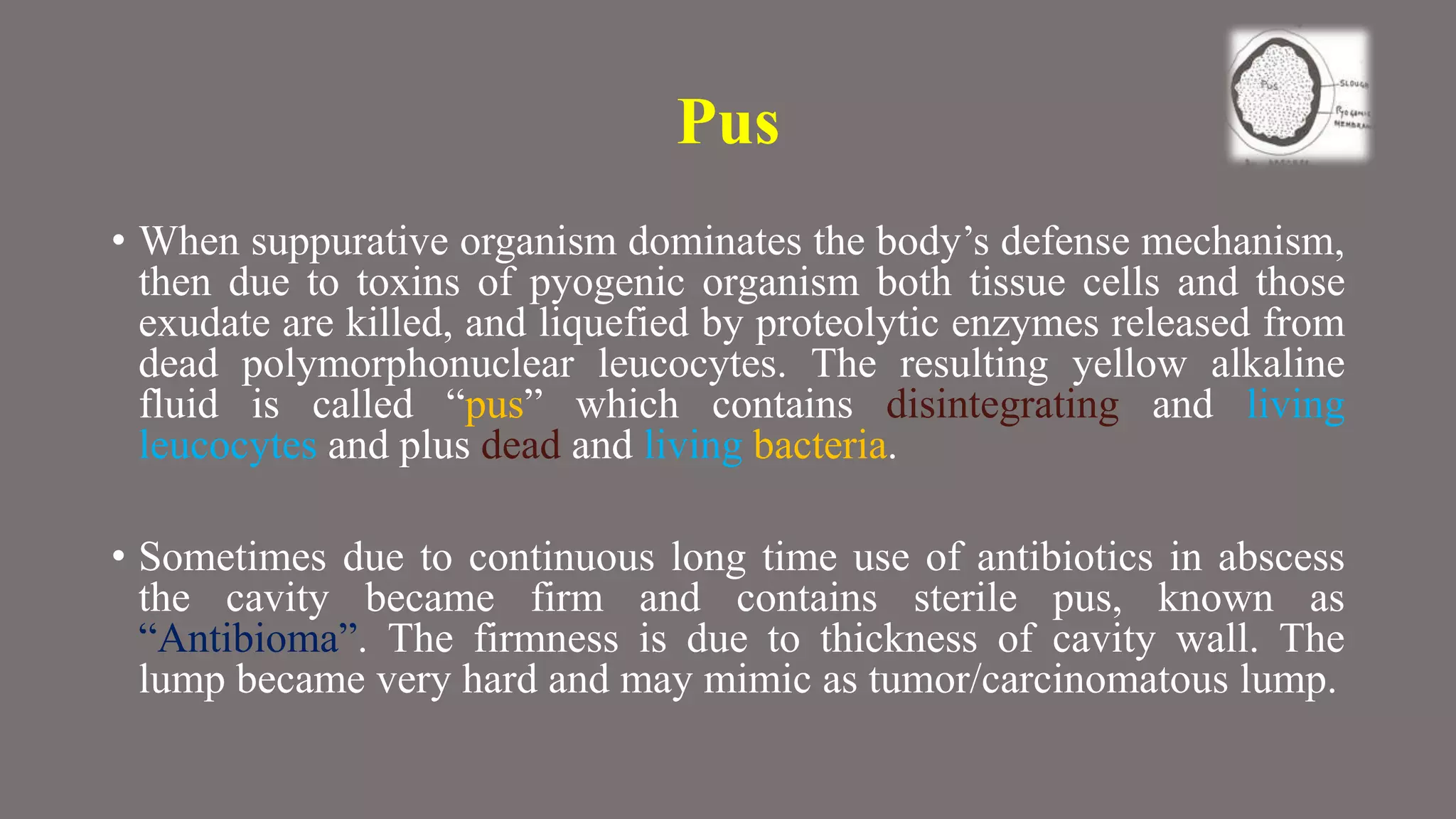
• When suppurative organism dominates the body’s defense mechanism,
then due to toxins of pyogenic organism both tissue cells and those
exudate are killed, and liquefied by proteolytic enzymes released from
dead polymorphonuclear leucocytes. The resulting yellow alkaline
fluid is called “pus” which contains disintegrating and living
leucocytes and plus dead and living bacteria.
• Sometimes due to continuous long time use of antibiotics in abscess
the cavity became firm and contains sterile pus, known as
“Antibioma”. The firmness is due to thickness of cavity wall. The
lump became very hard and may mimic as tumor/carcinomatous lump.
Clinical features
• All the five features of inflammation.
• (R,C,D,T, LOF)
• Collection of pus can be detected by-
• Brawny pitting oedema and induration
• Fluctuation test positive
INVESTIGATION
Clinical diagnosis is most important.
In superficial abscess physical examination may reveals the depth of
cavity but in internal abscess special diagnostic tools may required for
eg.
1. X-Ray ( Lung Abscess, subphrenic Abscess)
2. Ultrasound (Abscess of liver, spleen, gall bladder empyema)
3. CT ( to differentiate Abscess to tumor)
Other investigation.
Treatment
• 1. In initial stage before suppuration conservative approach should be
taken. It includes anti-inflammatory, antibiotics and rest/elevation of
affected part.
• 2. when the pus has been localized it should be drained. “where there
is pus, let it out”
• Basic principle:
• 1. Drain the pus 2. Send the sample for C/S 3. Antibiotic
• Drainage of pus can be obtained by Incision:
• 1. Free incision
• 2. Hilton’s method
• Exploration
• Counter-Incision
• Drainage
• Follow-up
Different approaches of I&D
• The approaches depends on the site of abscess cavity, so involved
nearby structure.
• As abscess present in neck, axilla, inguinal region or location with
involvement of major nerves and vessels or vital part should be
drained cautiously.
• The abscess without involvement of these above vital structure should
be open liberally.
Procedure of incision and drainage
• After completing pre-operative preparation patient
taken in suitable position.
• Anaesthetize patient accordingly
• After draping choose the site of incision, incision
site should be most prominent as well as most
dependent part. If prominent part is different from
dependent part then you may require counter
incision.
• After choosing the site take a stab incision i.e. insert
the 11no. Blade vertically till the pus comes out,
once pus comes out the stop going vertically. Now
extend the incision line to horizontally. Again take
one incision perpendicular to first one to make it
cruciate for complete exposure of cavity.
• Now debride the cavity and brake all the pus
pockets, if any pus pockets remains then it may leads
to recurrence.
Poriment
part
Depende
nt part
• Avoid using sharp instruments inside cavity.
• When the site of abscess is near vital area then be careful in taking
incision and use finger to brake all the loculi instead instruments.
• Careful look for nerve and vessels in cavity
• After surgical debridement wash the cavity with hydrogen peroxide for
chemical debridement followed by antiseptic solution and then tight
packing with antiseptic dressings.
• If cavity is large it may require placing a corrugated drain. Keep the
gauze dressing through if you make the counter incision, this felicitate
draining of cavity.
• From 2nd to tried day loos packing is helpful in starting the healing
process.
Steps in I&D
Pre-operative preparation
Anesthesia
Draping
Incision
Surgical debridement
Chemical debridement
Wash the cavity
Pack with ASD
Operations in different abscess
• Abscess of Neck
• Abscess of axilla
• Abscess of groin
• Abscess of breast
• Abscess of Popliteal fossa
• Abscess of Iliac
• Gluteal Abscess
• Deltoid Abscess
• Abscess sole and heal
Pyaemic abscess
• Pyaemia is a condition characterized by formation of secondary foci of
suppuration/infection in the various parts of body.
• These foci are made by lodgment of septic emboli, consisting of a
clumps of organism, infected clots etc.
• This condition is usually associated with acute osteomyelitis, acute
inflammation of intra cranial sinus and acute bacterial endocarditis.
• In the condition of Pyaemia multiple abscess may develop in different
part of body.
•Bacteremia
•Septicemia
•Toxemia
Clinical feature
• Generally multiple in numbers
• Abscess commonly in sub-fascial plan.
• Abscess are usually non acute i.e. no feature of acute inflammation.
• May have high grade fever, rigor and other feature of toxemia
• Such abscess may occurs in viscera like liver, spleen, kidney may be
fatal if present in brain or heart.
Treatment
• Early diagnosis key to success.
• Search for source of infection.
• Suitable antibiotic as early as possible with parenteral route.
• Superficial may be drain.
Cold abscess
• As the name suggest , this abscess in non reacting i.e. Absence of sign of
acute inflammation.
• Usually painless.
• No symptoms except lump, may be reacting after getting secondary
infection.
• Cold abscess is almost always a sequel of tuberculosis infection.
• Commonly present in lymph nodes, bone and joint.
• Commonest site is neck and axilla, side of chest wall due to TB of ribs, loin
from spinal TB, near end of long bones and joints due to TB of bone & joint.
Clinical feature
• On palpation non-tendor, soft and matted node.
• Common site neck, axilla, side of chest wall with Tuberculosis of Ribs.
• May lead to sinus formation
Treatment :
ATT regimen.
Aspiration (In some case)
If the local abscess still persist affected lymph node should be excised.
An incision should bee never made for I&D for cold abcess.
Complications of Abscess
•Septicemia in acute condition
•Chronic ulcer
•Sinus formation
•Infection may spread to adjacent organ
Vidradhi (Abscess)

Vidradhi (Abscess)

  • 1.
    Vidradhi (Abscess) DR. ALOKKUMAR PhD SHALYA TANTRA NEIAH, SHILLONG
  • 2.
    overview • References • Definition •Type • Clinical feature • Principle of management • Complications
  • 3.
    References • Vidradhi nidan………………Su.Ni. Chapter 9 • Vidradhi chikitsa……………..Su. Chi. Chapter 16
  • 4.
    Definition “स वै शीघ्रववदाहित्वाद्ववद्रधीतितिरुच्यिे”- (च. सू. १७) • त्वग्रक्िमाांसमेदाांसस प्रदूष्यास्थिसमाश्रििााः | दोषााः शोफां शिैर्घोरां जियन्तत्युस्च्ििा भृशम् || मिामूलां रुजावन्तिां वृत्तां चा(वाऽ)प्यिवाऽऽयिम् | िमािुवविद्रश्रधां धीरा, ववज्ञेयाः स च षड्ववधाः || • Due to various factors, when vitiated doshas goes in to dhatus like twak, rakta, mansa, meda and Asthi and slowly-slowly produces, pain and severe swelling (sotha). When this sotha became deep, painful, oval, large, broad base and reach to pakwavastha then it called vidradhi. This is of 6 types.
  • 5.
    Types पृिग्दोषैाः समथिैश्च क्षिेिाप्यसृजाििा | षण्णामवप हि िेषाां िु लक्षणां सम्प्प्रवक्ष्यिे || Three from different doshas, one Sannipataj, one Kshataj (traumatic) and one raktaj these are six types of vidradhi. As per Acharya charak vidradhi are two types Bahya (External) and Abhyantar (Internal).
  • 6.
    Clinical features • Vataj कृष्णोऽरुणो वा परुषो भृशमत्यर्थवेदनः | चित्रोत्र्ानप्रपाकश्ि ववद्रचिवाथतसम्भवः || • Pittaj पक्वोदुम्बरसङ्काशः श्यावो वा ज्वरदाहवान् | क्षिप्रोत्र्ानप्रपाकश्ि ववद्रचिः वपत्तसम्भवः || • Kaphaj शरावसदृशः पाण्ुः शीतः स्तब्िोऽल्पवेदनः | चिरोत्र्ानप्रपाकश्ि सकण्ुश्ि कफोत्त्र्तः ||
  • 7.
    • Sannipataj िािावणिरुजास्रावो र्घाटालोववषमो मिाि् ||१०|| ववषमां पच्यिे चावप ववद्रश्रधाः सास्न्तिपातिकाः | • Kshataj िैथिैभािवैरसभििे क्षिे वाऽपथ्यसेवविाः ||११|| क्षिोष्मा वायुववसृिाः सरक्िां वपत्तमीरयेि् ज्वरथिृष्णा च दािश्च जायिे िथय देहििाः ||१२|| एष ववद्रश्रधरागन्तिुाः वपत्तववद्रश्रधलक्षणाः • Raktaj कृ ष्णथफोटावृिाः श्यावथिीव्रदािरुजाज्वराः [१] ||१३|| वपत्तववद्रश्रधसलङ्गथिु रक्िववद्रश्रधरुच्यिे
  • 8.
    Site of Abhyantarvidradhi “गुदे बस्थिमुखे िाभयाां कु क्षौ वङ्क्षणयोथििा |वृक्कयोयिकृ ति प्लीस्नि हृदये क्लोस्म्प्ि वा ििा |” These are site of abhayntar vidradhi 1. Guda 2. Vast 3. Nabhi 4. Kukshi 5. Vankshana 6. Vrikka 7. Ykruta 8. Pleeha 9. Hrudya 10. Klome
  • 9.
    Clinical features • अचिष्ठानववशेषेणलिङ्गं शृणु ववशेषतः || • गुदे वातननरोिस्तु बस्तौ कृ च्छ्राल्पमूत्रता | नाभयां हहक्का तर्ाऽऽोोपः कु िौ मारुतकोपनम् || • कोीपृष्ठग्रहस्तीव्रो वङ्िणोत्र्े तु ववद्रिौ | वृक्कयोः पाश्वथसङ्कोिः प्िीह्न्युच्छ््वासावरोिनम ् || • सवाथङ्गप्रग्रहस्तीव्रो हृहद शूिश्ि दारुणः | श्वासो यकृ नत तृष्णा ि वपपासाक्िोमजेऽचिका ||
  • 10.
    Clinical features 1. Guda-obstruction of flatus/stool 2. Vasti- oligouria and dysuria 3. Nabhi- hiccough, aatop(distension in abdomen) 4. Kukshi- marutkopanam (Vitiation of Vata)(excessive flatus) 5. Vankshana- spasm in back (lumbar and thoracic) 6. Vrikka - pain in renal angle (lateral bending) 7. Ykruta- dyspnea, thirst 8. Pleeha- dyspnea 9. Hrudya- severe pain and spasm in body 10.Klome- excessive thirst
  • 11.
    Differences between gulmaand vidradhi • ववशेषमि वक्ष्यासम थपष्टां ववद्रश्रधगुल्मयोाः ||२८|| गुल्मदोषसमुत्िािाद्ववद्रधेगुिल्मकथय च | • कथमान्ति पच्यिे गुल्मो ववद्रश्रधाः पाकमेति च || २९|| • Both vidradhi and gulma are originated from same dosha, but vidhardi became pakwa gulma doesn’t ,,,,,,,,,,,,,,,,,,,,,,,,,,,,,,,,,,,,,,,,,,,,,the possible reseaon behind this are…. • ि तिबन्तधोऽस्थि गुल्मािाां ववद्रश्रधाः सतिबन्तधिाः | गुल्माकारााः थवयां दोषा ववद्रश्रधमाांसशोणणिे ||३०|| वववरािुचरो ग्रस्न्तिरप्सु बुद्बुदको यिा | एवम्प्प्रकारो गुल्मथिु िथमाि् पाकां ि गच्छति ||३१|| माांसशोणणिबािुल्याि् पाकां गच्छति ववद्रश्रधाः | माांसशोणणििीित्वाद्गुल्माः पाकां ि गच्छति ||३२|| गुल्मस्थिष्ठति दोषे थवे ववद्रश्रधमाांसशोणणिे | ववद्रश्रधाः पच्यिे िथमाद्गल्मश्चावप ि पच्यिे ||३३||
  • 12.
    Principle of management •उक्िा ववद्रधयाः षड्ये िेष्वसाध्यथिु सविजाः | शेषेष्वामेषु कििव्या त्वररिां शोफवि् क्रिया Su.Chi 16/3 • Sannipataj vidradhi is considered as asadhya rest apakva vidradhi should be treated as treatment of sopha (Apkwa) (upakrama 1-11) • िोपगच्छेद्यिापाकां प्रयिेि ििा सभषक् || Su.Chi 16/ 38 • Surgeon should try first with conservative approach to avoid suppuration (Pak) in vidradhi by various medicine and parasurgical procedure. • स चेदेवमुपिान्तिाः पाकायासभमुखो यहद | िां पाचतयत्वा शथरेण सभन्तद्याद्सभन्तिां च शोधयेि् Su. Chi 16/7 • Even after trying upakrama if vidradhi shows lakshana of pakwa then it must be explored and treat like wound.
  • 13.
    Conservative measures 1. Aptarpana 2.Aalepa 3. Upnaaha 4. Parisheka 5. Abhyanga 6. Swedana 7. Raktamokshana 8. Jalukavcharana 9. Siravedha 10. Virechana 11. Vamana
  • 14.
    Shalya Karma • ममिससराथिायुसन्तध्यस्थिधमिीाःपररिरि्, अिुलोमां शथरां तिदध्यादापूयदशििाि्, सकृ देवापिरेच्छथरमाशु च; मित्थववप च पाके षु द्व्यङ्गुलान्तिरां त्र्यङ्गुलान्तिरां वा शथरपदमुक्िम ् Su .Su. 5/7 • िरायिो ववशालाः समाः सुववभक्िो तिरािय इति व्रणगुणा: Su .Su. 5/8 • Every incision must be have the properties like it must be enough long, wide with equal clean margin and no pockets left. • आयिश्च ववशालश्च सुववभक्िो तिराियाः | प्राप्िकालकृ िश्चावप व्रणाः कमिणण शथयिे Su .Su. 5/9 • The ideal incision is that which have, Enough length, wide, clean margins, brakes all the pus pockets and made on correct time.
  • 15.
    Principle of counterincision • एके ि वा व्रणेिाशुध्यमािे िाऽन्तिरा बुद्ध्याऽवेक्ष्यापराि ् व्रणाि ् कु यािि ् भवति चार- Su. Su. 5/11 • If the one incision is not enough to drain the complete cavity , surgeon should examine and wisely made other incision to drain the pus completely. • यिो यिो गतिां ववद्यादुत्सङ्गो यर यर च | िर िर व्रणां कु यािद्यिा दोषो ि तिष्ठति Su. Su 5/12 “If there is swelling due to collection of pus, make the incision to drain it”.
  • 17.
    Incision 1. Straight (Tiryak) िरभ्रूगण्डशङ्खललाटाक्षक्षपुटौष्ठदन्तिवेष्टकक्षाकु क्षक्षवङ्क्षणेषु तियिक् छेद उक्िाः Su. Su 5/13 2. Circular (Chandrakaar) चन्तद्रमण्डलवच्छेदाि ् पाणणपादेषु कारयेि ् 3. Semicircular (Ardh-chandrakaar) अधिचन्तद्राकृ िीांश्चावप गुदे मेढ्रे च बुद्श्रधमाि ् Su. Su 5/14
  • 18.
    Drugs • Pakwa vidradhishould be treated as like pakwa sopha. That include vrana patana, sodhana and Ropana karma. • In sodhana and Ropana various drug/yog should be used keep in mind the doshaghntwa of drug. • Vrihatpanchmool, bhadradarvadi gana, kakolyadi gana----Vata • Mulethi, sariva, ksheerkakoli, jeevniya gana, karanjjadi ghrita---Pitta • Danti ,Drvanti, Nishotha , tilvaka, sendhanamak----kapha Varukadi gana, uskadi gana – Apkwa Antravidradhi
  • 19.
    Special treatment • Siravedhanin kaphaj vidradhi • Majjagatvidradhi.—considered as ashadya but treat with sodhana and Shalya karma after paak.
  • 20.
    ABSCESS • An abscessis circumscribed area of inflammation or Collection of pus in an abnormal cavity in body (after suppuration).
  • 21.
    Classification • There aretwo types of classification for abscess are found:- A- 1. Pyogenic abscess 2. Pyaemic abscess 3. Cold abscess B- 1. Acute or hot abscess 2.Chronic or cold abscess 3.Superficial abscess 4.Deep abscess 5.Embolic abscess 6.Pyaemic or metastatic abscess
  • 22.
    Pyogenic abscess • Thisis commonest variety. • The causative organism( bacteria) are mostly- • Sterptococcus spp • Staphylococcus spp • Pseudomonas aeruginosa • Actinomyces bovis • Actinobacillus lignieresi • Retained foreign body (RFB) and parasite also may develops abscess. • Organism may spread by direct due to penetrating trauma, local extension of adjacent focus, via lymphatic or via Blood stream.
  • 23.
    PATHOGENISIS Any breach inskin and mucous membrane Invasion of Pyogenic organism Formation of pyogenic membrane Body immunity fails to fight (suppuration) Finally formation of pus (abscess develops)
  • 24.
    Pus • When suppurativeorganism dominates the body’s defense mechanism, then due to toxins of pyogenic organism both tissue cells and those exudate are killed, and liquefied by proteolytic enzymes released from dead polymorphonuclear leucocytes. The resulting yellow alkaline fluid is called “pus” which contains disintegrating and living leucocytes and plus dead and living bacteria. • Sometimes due to continuous long time use of antibiotics in abscess the cavity became firm and contains sterile pus, known as “Antibioma”. The firmness is due to thickness of cavity wall. The lump became very hard and may mimic as tumor/carcinomatous lump.
  • 25.
    Clinical features • Allthe five features of inflammation. • (R,C,D,T, LOF) • Collection of pus can be detected by- • Brawny pitting oedema and induration • Fluctuation test positive
  • 26.
    INVESTIGATION Clinical diagnosis ismost important. In superficial abscess physical examination may reveals the depth of cavity but in internal abscess special diagnostic tools may required for eg. 1. X-Ray ( Lung Abscess, subphrenic Abscess) 2. Ultrasound (Abscess of liver, spleen, gall bladder empyema) 3. CT ( to differentiate Abscess to tumor) Other investigation.
  • 27.
    Treatment • 1. Ininitial stage before suppuration conservative approach should be taken. It includes anti-inflammatory, antibiotics and rest/elevation of affected part. • 2. when the pus has been localized it should be drained. “where there is pus, let it out” • Basic principle: • 1. Drain the pus 2. Send the sample for C/S 3. Antibiotic
  • 28.
    • Drainage ofpus can be obtained by Incision: • 1. Free incision • 2. Hilton’s method • Exploration • Counter-Incision • Drainage • Follow-up
  • 29.
    Different approaches ofI&D • The approaches depends on the site of abscess cavity, so involved nearby structure. • As abscess present in neck, axilla, inguinal region or location with involvement of major nerves and vessels or vital part should be drained cautiously. • The abscess without involvement of these above vital structure should be open liberally.
  • 30.
    Procedure of incisionand drainage • After completing pre-operative preparation patient taken in suitable position. • Anaesthetize patient accordingly • After draping choose the site of incision, incision site should be most prominent as well as most dependent part. If prominent part is different from dependent part then you may require counter incision. • After choosing the site take a stab incision i.e. insert the 11no. Blade vertically till the pus comes out, once pus comes out the stop going vertically. Now extend the incision line to horizontally. Again take one incision perpendicular to first one to make it cruciate for complete exposure of cavity. • Now debride the cavity and brake all the pus pockets, if any pus pockets remains then it may leads to recurrence. Poriment part Depende nt part
  • 31.
    • Avoid usingsharp instruments inside cavity. • When the site of abscess is near vital area then be careful in taking incision and use finger to brake all the loculi instead instruments. • Careful look for nerve and vessels in cavity • After surgical debridement wash the cavity with hydrogen peroxide for chemical debridement followed by antiseptic solution and then tight packing with antiseptic dressings. • If cavity is large it may require placing a corrugated drain. Keep the gauze dressing through if you make the counter incision, this felicitate draining of cavity. • From 2nd to tried day loos packing is helpful in starting the healing process.
  • 33.
    Steps in I&D Pre-operativepreparation Anesthesia Draping Incision Surgical debridement Chemical debridement Wash the cavity Pack with ASD
  • 34.
    Operations in differentabscess • Abscess of Neck • Abscess of axilla • Abscess of groin • Abscess of breast • Abscess of Popliteal fossa • Abscess of Iliac • Gluteal Abscess • Deltoid Abscess • Abscess sole and heal
  • 35.
    Pyaemic abscess • Pyaemiais a condition characterized by formation of secondary foci of suppuration/infection in the various parts of body. • These foci are made by lodgment of septic emboli, consisting of a clumps of organism, infected clots etc. • This condition is usually associated with acute osteomyelitis, acute inflammation of intra cranial sinus and acute bacterial endocarditis. • In the condition of Pyaemia multiple abscess may develop in different part of body.
  • 36.
  • 37.
    Clinical feature • Generallymultiple in numbers • Abscess commonly in sub-fascial plan. • Abscess are usually non acute i.e. no feature of acute inflammation. • May have high grade fever, rigor and other feature of toxemia • Such abscess may occurs in viscera like liver, spleen, kidney may be fatal if present in brain or heart.
  • 38.
    Treatment • Early diagnosiskey to success. • Search for source of infection. • Suitable antibiotic as early as possible with parenteral route. • Superficial may be drain.
  • 39.
    Cold abscess • Asthe name suggest , this abscess in non reacting i.e. Absence of sign of acute inflammation. • Usually painless. • No symptoms except lump, may be reacting after getting secondary infection. • Cold abscess is almost always a sequel of tuberculosis infection. • Commonly present in lymph nodes, bone and joint. • Commonest site is neck and axilla, side of chest wall due to TB of ribs, loin from spinal TB, near end of long bones and joints due to TB of bone & joint.
  • 40.
    Clinical feature • Onpalpation non-tendor, soft and matted node. • Common site neck, axilla, side of chest wall with Tuberculosis of Ribs. • May lead to sinus formation Treatment : ATT regimen. Aspiration (In some case) If the local abscess still persist affected lymph node should be excised. An incision should bee never made for I&D for cold abcess.
  • 41.
    Complications of Abscess •Septicemiain acute condition •Chronic ulcer •Sinus formation •Infection may spread to adjacent organ