NADAR SARASWATHI COLLEGE OF ARTS AND
SCIENCE
Constructing LALR Parsing Tables and Syntax directed translation
schemes
By
G.Keerthika
I M.Sc(CS)
COMPILER DESIGN
Introduction to LALR
Parsing
LALR parsing is a popular technique for parsing context-free grammars.
It's a bottom-up parsing method that combines features of LR parsing
with the simplicity of LL parsing. This presentation will guide you
through LALR parsing concepts, from basic grammar definitions to the
construction and use of LALR parsing tables.
Context-free Grammars
A context-free grammar (CFG) defines the syntax of a language. It's a set of production rules that
describe how to construct valid strings in the language. CFGs are essential for understanding the
structure of programming languages, natural languages, and other formal languages.
Terminals
These are the basic
symbols of the language,
like words or punctuation
marks.
Nonterminals
These represent categories of
symbols, like "expression" or
"statement." They can be
replaced by other symbols.
Production Rules
These define how nonterminals can be replaced by terminals or other nonterminals.
Parsing Techniques
Parsing techniques are methods for analyzing a string of symbols (usually code) and determining its grammatical structure.
They are crucial for compilers, interpreters, and other language processing tools.
Top-Down Parsing
Starts with the start symbol and tries to derive the input
string. Examples include LL parsing and recursive descent.
Bottom-Up Parsing
Builds the parse tree from the input string, gradually
combining symbols to reach the start symbol. Examples
include LR parsing and LALR parsing.
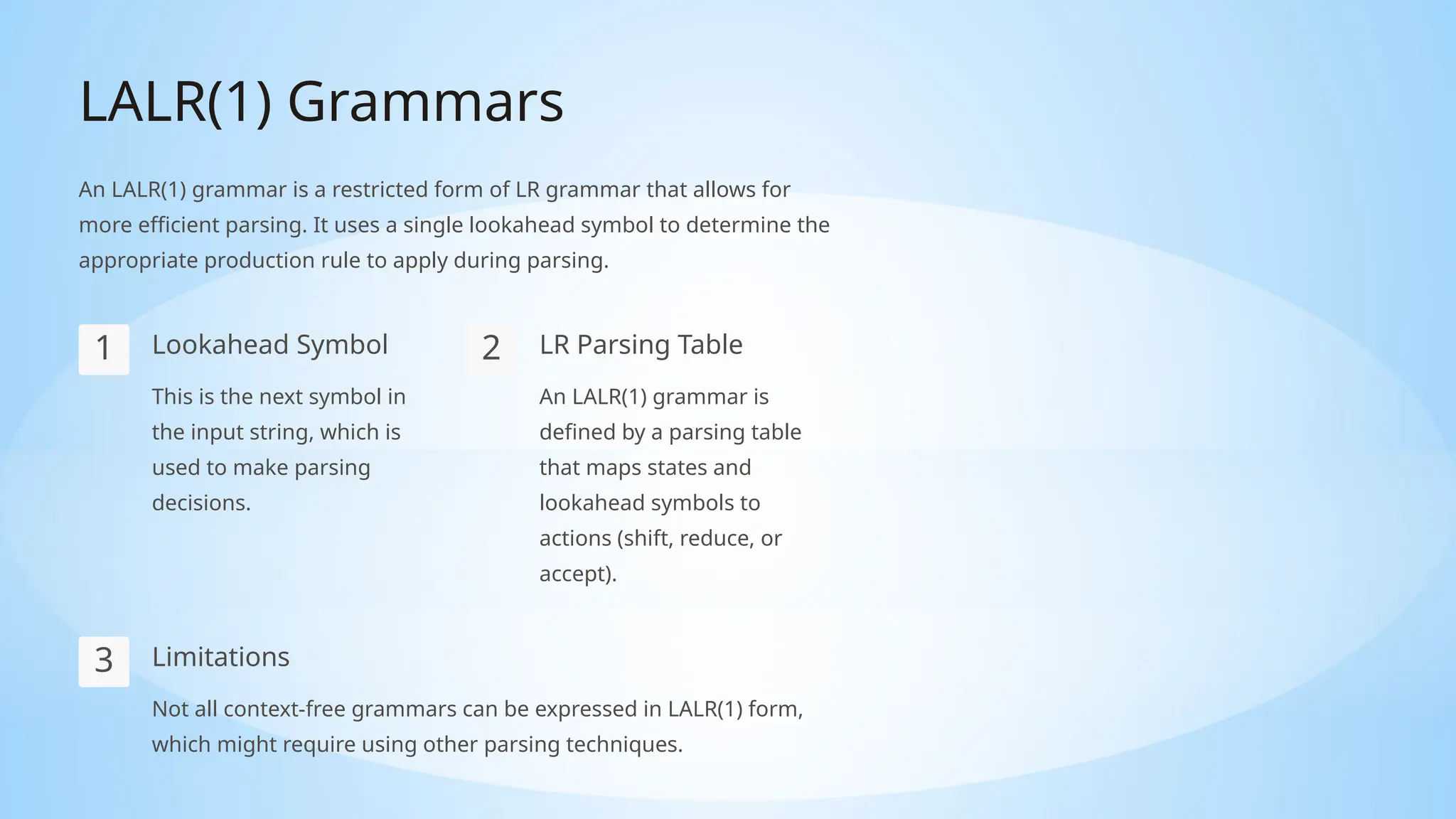
LALR(1) Grammars
An LALR(1) grammar is a restricted form of LR grammar that allows for
more efficient parsing. It uses a single lookahead symbol to determine the
appropriate production rule to apply during parsing.
1 Lookahead Symbol
This is the next symbol in
the input string, which is
used to make parsing
decisions.
2 LR Parsing Table
An LALR(1) grammar is
defined by a parsing table
that maps states and
lookahead symbols to
actions (shift, reduce, or
accept).
3 Limitations
Not all context-free grammars can be expressed in LALR(1) form,
which might require using other parsing techniques.
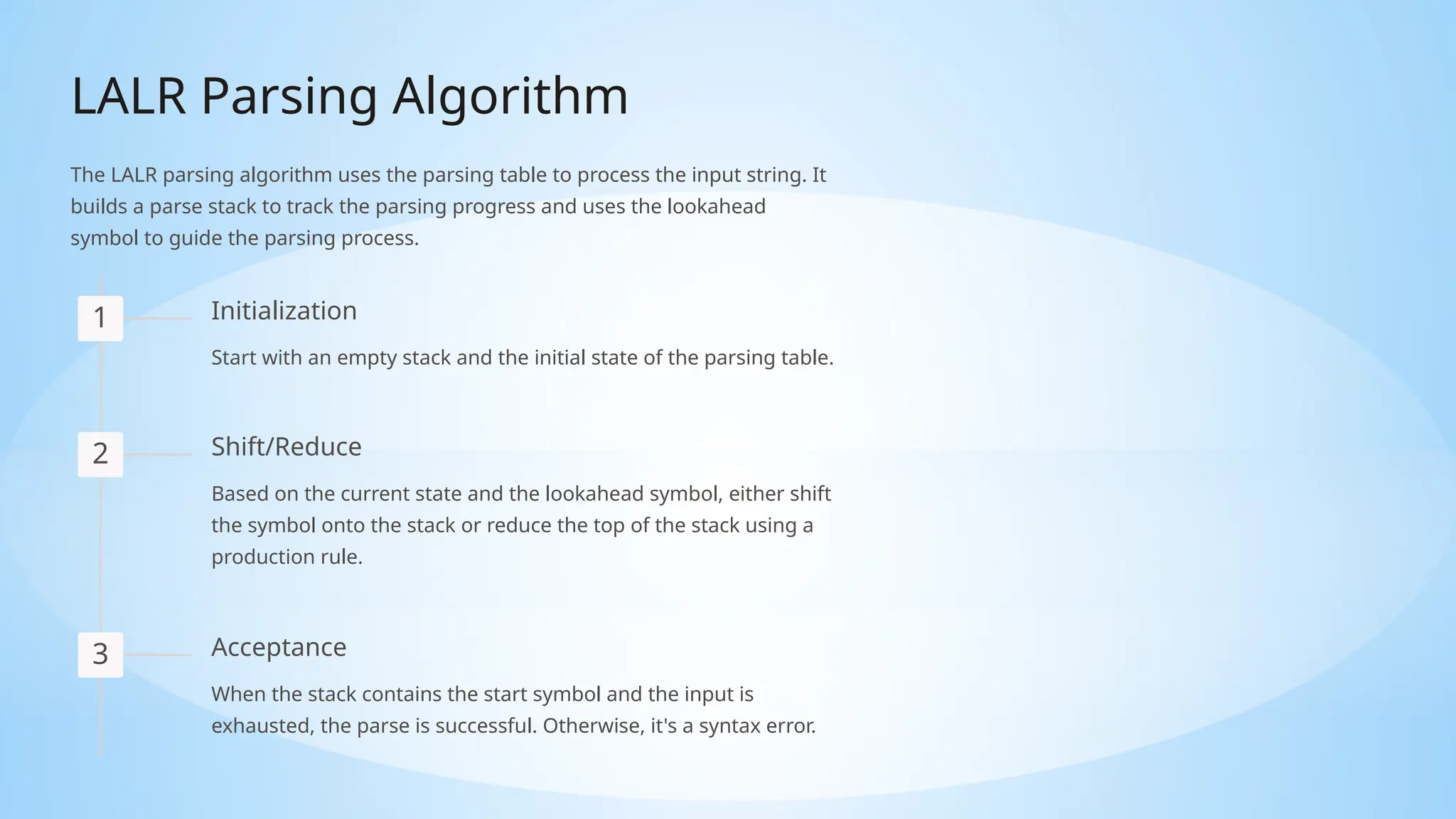
LALR Parsing Algorithm
The LALR parsing algorithm uses the parsing table to process the input string. It
builds a parse stack to track the parsing progress and uses the lookahead
symbol to guide the parsing process.
1 Initialization
Start with an empty stack and the initial state of the parsing table.
2 Shift/Reduce
Based on the current state and the lookahead symbol, either shift
the symbol onto the stack or reduce the top of the stack using a
production rule.
3 Acceptance
When the stack contains the start symbol and the input is
exhausted, the parse is successful. Otherwise, it's a syntax error.
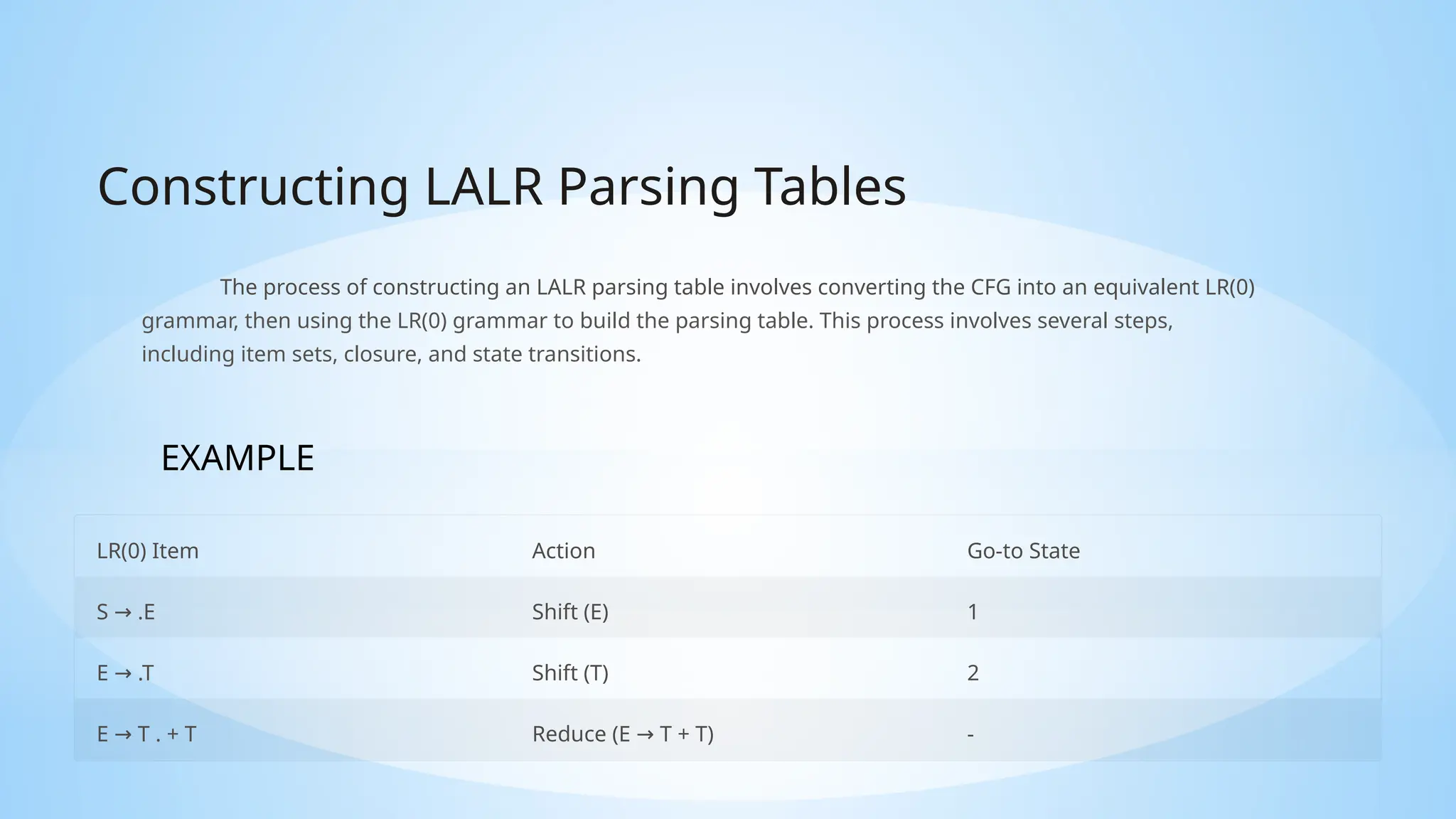
Constructing LALR Parsing Tables
The process of constructing an LALR parsing table involves converting the CFG into an equivalent LR(0)
grammar, then using the LR(0) grammar to build the parsing table. This process involves several steps,
including item sets, closure, and state transitions.
LR(0) Item Action Go-to State
S .E
→ Shift (E) 1
E .T
→ Shift (T) 2
E T . + T
→ Reduce (E T + T)
→ -
EXAMPLE
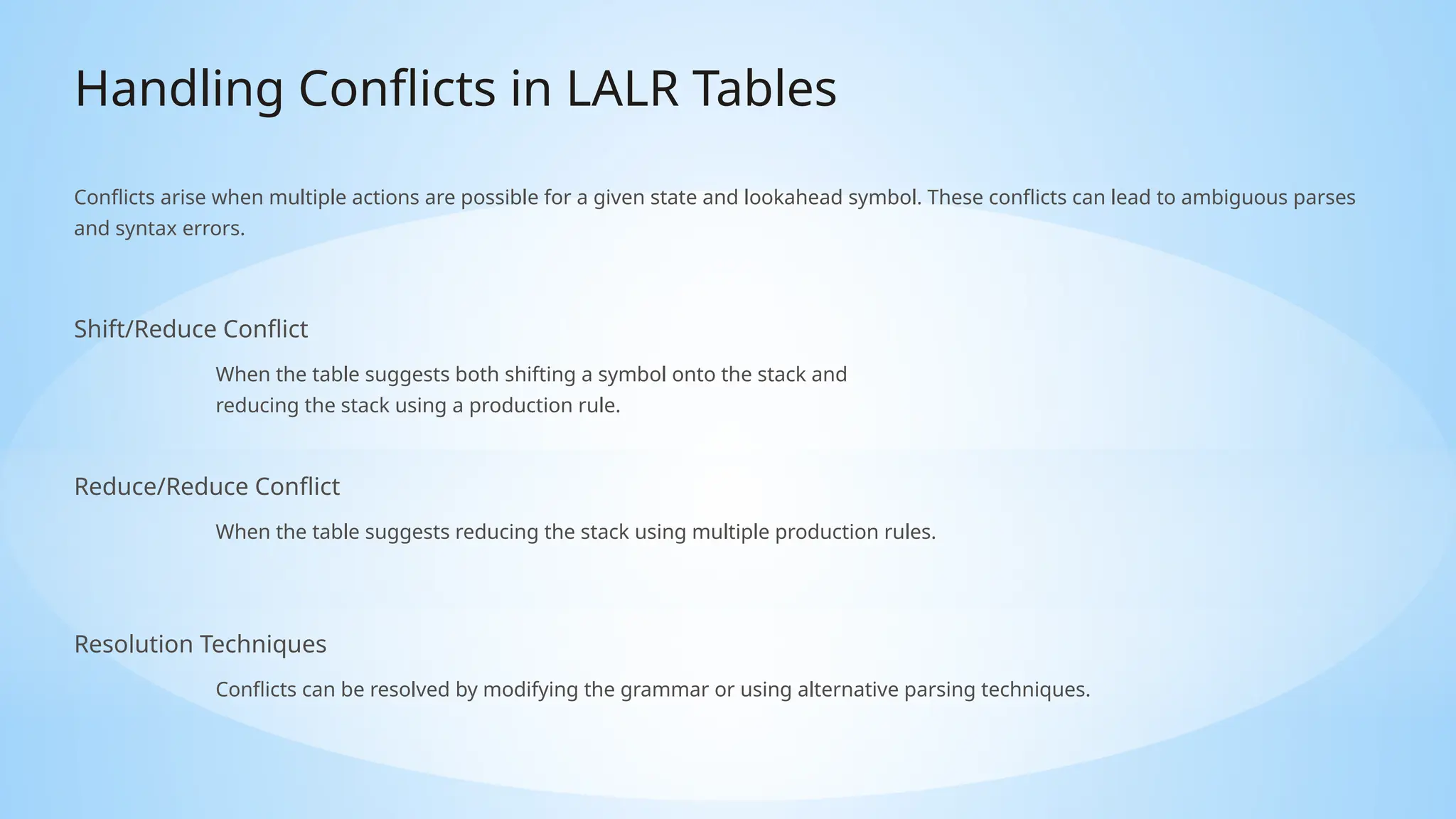
Handling Conflicts in LALR Tables
Conflicts arise when multiple actions are possible for a given state and lookahead symbol. These conflicts can lead to ambiguous parses
and syntax errors.
Shift/Reduce Conflict
When the table suggests both shifting a symbol onto the stack and
reducing the stack using a production rule.
Reduce/Reduce Conflict
When the table suggests reducing the stack using multiple production rules.
Resolution Techniques
Conflicts can be resolved by modifying the grammar or using alternative parsing techniques.
Advantages and Limitations of LALR
Parsing
LALR parsing offers a balance between efficiency and expressive power. It's a widely used technique in
compiler design due to its performance benefits, but it has limitations in handling certain types of
grammars.
Efficiency
LALR parsing is generally faster than LR parsing because it requires smaller parsing tables.
Expressiveness
LALR parsing can handle a wide range of context-free grammars, making it suitable for many
programming languages.
Limitations
Some grammars are not LALR(1), which means they cannot be parsed using this technique.
Introduction to Syntax Directed Translation Schemes
1. Syntax-directed translation schemes (SDTs) are a powerful tool
for designing compilers and interpreters.
2. They provide a structured way to translate a program written in
one language into an equivalent program in another language.
3. This process involves building a parse tree for the source code
and using the parse tree to generate the target code.
Purpose and Applications
1 Code Generation
SDTs are widely used for
generating machine code
or intermediate code from
source programs.
2 Language Translation
They can be used to
translate programs from
one high-level language to
another, such as from
Python to C++.
3 Code Optimization
SDTs can be used to
optimize the generated
code, making it faster or
more efficient.
4 Data Validation
They can be used to enforce
semantic constraints and
ensure that data is
processed correctly.
Formal Definition of Translation Schemes
Grammar
An SDT is based on a
context-free grammar that
defines the syntax of the
source language.
Attributes
Each nonterminal symbol in
the grammar has associated
attributes, which represent
information about the
corresponding subtree.
Semantic Rules
Semantic rules specify how the attributes are computed and how the target
code is generated.
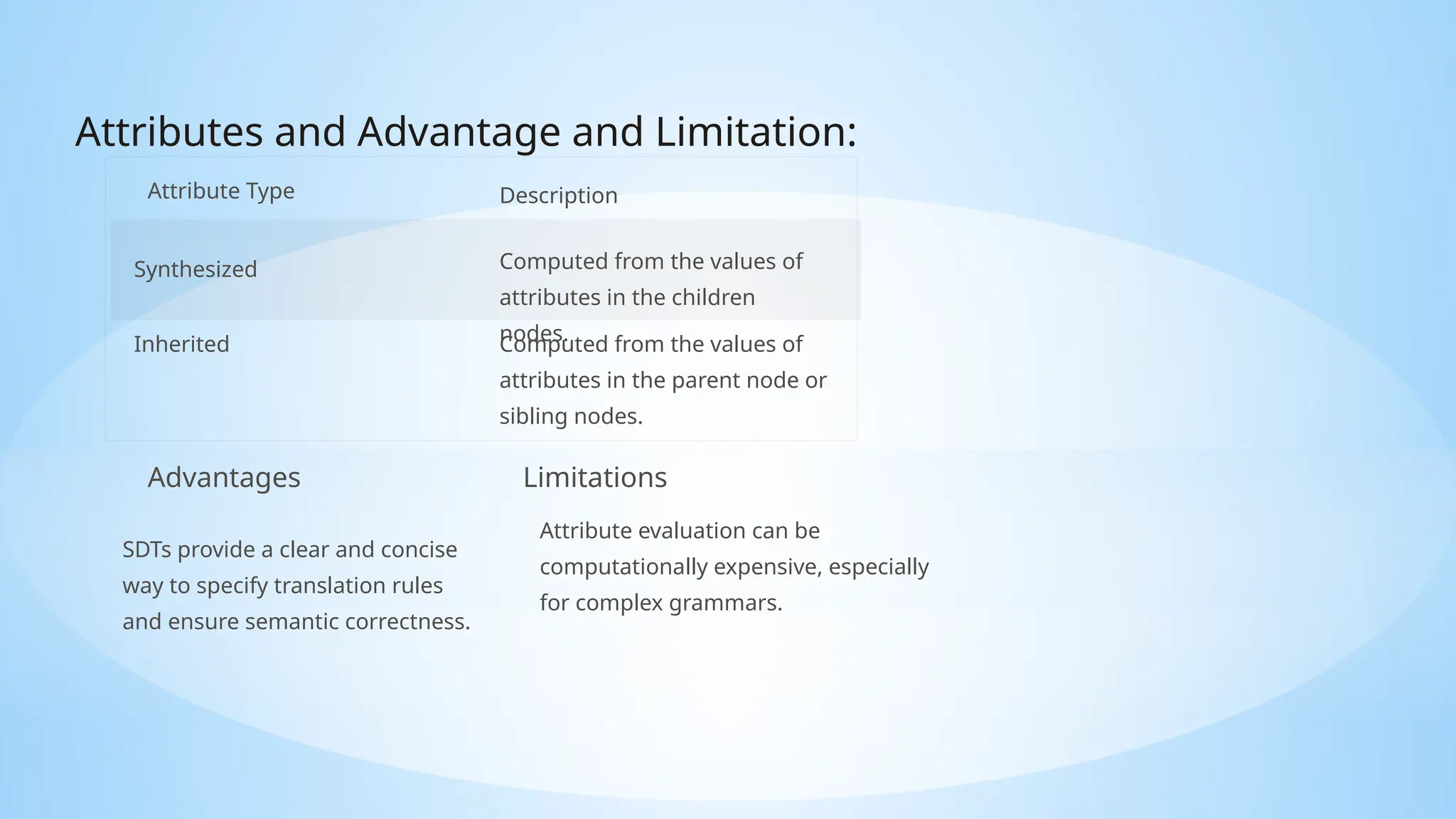
Attributes and Advantage and Limitation:
Attribute Type Description
Synthesized Computed from the values of
attributes in the children
nodes.
Inherited Computed from the values of
attributes in the parent node or
sibling nodes.
Advantages
SDTs provide a clear and concise
way to specify translation rules
and ensure semantic correctness.
Limitations
Attribute evaluation can be
computationally expensive, especially
for complex grammars.
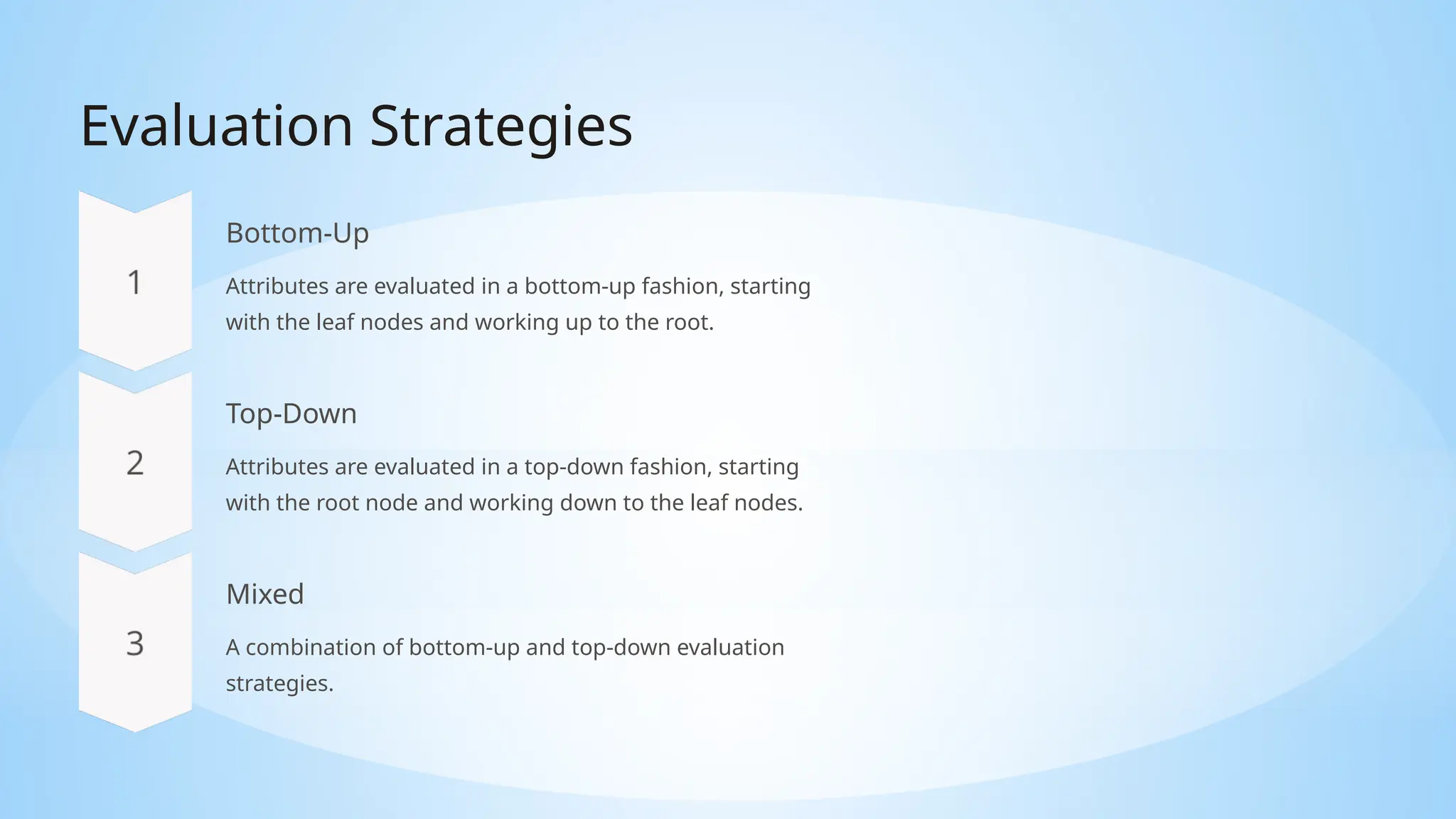
Evaluation Strategies
Bottom-Up
Attributes are evaluated in a bottom-up fashion, starting
with the leaf nodes and working up to the root.
Top-Down
Attributes are evaluated in a top-down fashion, starting
with the root node and working down to the leaf nodes.
Mixed
A combination of bottom-up and top-down evaluation
strategies.
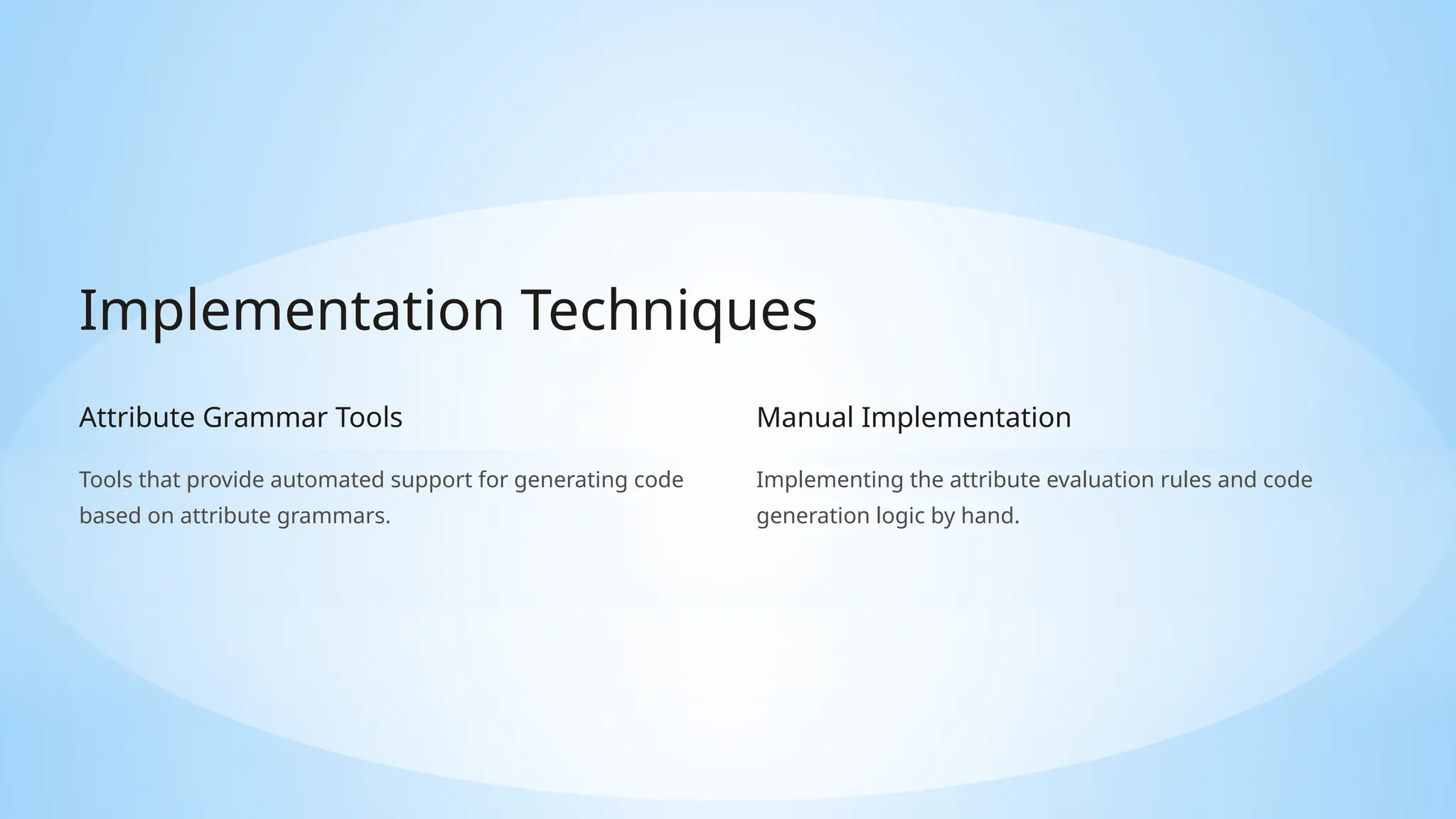
Implementation Techniques
Attribute Grammar Tools
Tools that provide automated support for generating code
based on attribute grammars.
Manual Implementation
Implementing the attribute evaluation rules and code
generation logic by hand.
THANK YOU

Constructing LALR parsing tables and syntax directed translation schemes

  • 1.
    NADAR SARASWATHI COLLEGEOF ARTS AND SCIENCE Constructing LALR Parsing Tables and Syntax directed translation schemes By G.Keerthika I M.Sc(CS) COMPILER DESIGN
  • 2.
    Introduction to LALR Parsing LALRparsing is a popular technique for parsing context-free grammars. It's a bottom-up parsing method that combines features of LR parsing with the simplicity of LL parsing. This presentation will guide you through LALR parsing concepts, from basic grammar definitions to the construction and use of LALR parsing tables.
  • 3.
    Context-free Grammars A context-freegrammar (CFG) defines the syntax of a language. It's a set of production rules that describe how to construct valid strings in the language. CFGs are essential for understanding the structure of programming languages, natural languages, and other formal languages. Terminals These are the basic symbols of the language, like words or punctuation marks. Nonterminals These represent categories of symbols, like "expression" or "statement." They can be replaced by other symbols. Production Rules These define how nonterminals can be replaced by terminals or other nonterminals.
  • 4.
    Parsing Techniques Parsing techniquesare methods for analyzing a string of symbols (usually code) and determining its grammatical structure. They are crucial for compilers, interpreters, and other language processing tools. Top-Down Parsing Starts with the start symbol and tries to derive the input string. Examples include LL parsing and recursive descent. Bottom-Up Parsing Builds the parse tree from the input string, gradually combining symbols to reach the start symbol. Examples include LR parsing and LALR parsing.
  • 5.
    LALR(1) Grammars An LALR(1)grammar is a restricted form of LR grammar that allows for more efficient parsing. It uses a single lookahead symbol to determine the appropriate production rule to apply during parsing. 1 Lookahead Symbol This is the next symbol in the input string, which is used to make parsing decisions. 2 LR Parsing Table An LALR(1) grammar is defined by a parsing table that maps states and lookahead symbols to actions (shift, reduce, or accept). 3 Limitations Not all context-free grammars can be expressed in LALR(1) form, which might require using other parsing techniques.
  • 6.
    LALR Parsing Algorithm TheLALR parsing algorithm uses the parsing table to process the input string. It builds a parse stack to track the parsing progress and uses the lookahead symbol to guide the parsing process. 1 Initialization Start with an empty stack and the initial state of the parsing table. 2 Shift/Reduce Based on the current state and the lookahead symbol, either shift the symbol onto the stack or reduce the top of the stack using a production rule. 3 Acceptance When the stack contains the start symbol and the input is exhausted, the parse is successful. Otherwise, it's a syntax error.
  • 7.
    Constructing LALR ParsingTables The process of constructing an LALR parsing table involves converting the CFG into an equivalent LR(0) grammar, then using the LR(0) grammar to build the parsing table. This process involves several steps, including item sets, closure, and state transitions. LR(0) Item Action Go-to State S .E → Shift (E) 1 E .T → Shift (T) 2 E T . + T → Reduce (E T + T) → - EXAMPLE
  • 8.
    Handling Conflicts inLALR Tables Conflicts arise when multiple actions are possible for a given state and lookahead symbol. These conflicts can lead to ambiguous parses and syntax errors. Shift/Reduce Conflict When the table suggests both shifting a symbol onto the stack and reducing the stack using a production rule. Reduce/Reduce Conflict When the table suggests reducing the stack using multiple production rules. Resolution Techniques Conflicts can be resolved by modifying the grammar or using alternative parsing techniques.
  • 9.
    Advantages and Limitationsof LALR Parsing LALR parsing offers a balance between efficiency and expressive power. It's a widely used technique in compiler design due to its performance benefits, but it has limitations in handling certain types of grammars. Efficiency LALR parsing is generally faster than LR parsing because it requires smaller parsing tables. Expressiveness LALR parsing can handle a wide range of context-free grammars, making it suitable for many programming languages. Limitations Some grammars are not LALR(1), which means they cannot be parsed using this technique.
  • 10.
    Introduction to SyntaxDirected Translation Schemes 1. Syntax-directed translation schemes (SDTs) are a powerful tool for designing compilers and interpreters. 2. They provide a structured way to translate a program written in one language into an equivalent program in another language. 3. This process involves building a parse tree for the source code and using the parse tree to generate the target code.
  • 11.
    Purpose and Applications 1Code Generation SDTs are widely used for generating machine code or intermediate code from source programs. 2 Language Translation They can be used to translate programs from one high-level language to another, such as from Python to C++. 3 Code Optimization SDTs can be used to optimize the generated code, making it faster or more efficient. 4 Data Validation They can be used to enforce semantic constraints and ensure that data is processed correctly.
  • 12.
    Formal Definition ofTranslation Schemes Grammar An SDT is based on a context-free grammar that defines the syntax of the source language. Attributes Each nonterminal symbol in the grammar has associated attributes, which represent information about the corresponding subtree. Semantic Rules Semantic rules specify how the attributes are computed and how the target code is generated.
  • 13.
    Attributes and Advantageand Limitation: Attribute Type Description Synthesized Computed from the values of attributes in the children nodes. Inherited Computed from the values of attributes in the parent node or sibling nodes. Advantages SDTs provide a clear and concise way to specify translation rules and ensure semantic correctness. Limitations Attribute evaluation can be computationally expensive, especially for complex grammars.
  • 14.
    Evaluation Strategies Bottom-Up Attributes areevaluated in a bottom-up fashion, starting with the leaf nodes and working up to the root. Top-Down Attributes are evaluated in a top-down fashion, starting with the root node and working down to the leaf nodes. Mixed A combination of bottom-up and top-down evaluation strategies.
  • 15.
    Implementation Techniques Attribute GrammarTools Tools that provide automated support for generating code based on attribute grammars. Manual Implementation Implementing the attribute evaluation rules and code generation logic by hand.
  • 16.