HOW TO TEACH
SOFT SKILLS THAT
EMPLOYERS NEED
(c)2013 TLC Workforce Solutions
TERRY CARLILE
WWW.TLCWORKFORCESOLUTIONS.COM
(c)2013 TLC Workforce Solutions
Action orientation, drive and self initiation
Assertiveness
Big picture thinking and strategic thinking
Coaching and developing people
Communication (speaking, listening, empathy, body
language, writing)
Composure and self presentation (appearance,
manners and etiquette)
Conducting meetings
Conflict management
Consensus building
Conviction
Convincing
Counseling
Creativity and innovation
Dealing with ambiguity
Decision making
Dependability and reliability
Goal setting and result orientation
Integrity
Intellectual horsepower and learning
Internal motivation and passion
Interpersonal skills
Know yourself (introspection)
Mentoring
Moral courage
Negotiation
Observation
Openness and flexibility (paradigm shifting)
Presentation
Soft Skills definition:
What is: Soft skills are personal
attributes that enhance an
individual's interactions, job
performance and career prospects.
Unlike hard skills, which are about
a person's skill set and ability to
perform a certain type of task or
activity, soft skills are interpersonal
and broadly applicable.
Soft Skills definition:
Wikipedia: is a sociological term relating to a
person's "EQ" (Emotional Intelligence), the
cluster of personality traits, social graces,
communication, language, personal habits,
friendliness, and optimism that characterize
relationships with other people.Soft skills
complement hard skills which are the
occupational requirements of a
job and many other activities.
Skills Gap: Challenges for the US
• Young workers will change careers
10-14 times during their lifetime.
• Many are unprepared for this reality.
• The concept of lifetime employment
will be replaced by lifetime
employability.
• Soft skills will be the common
denominator no matter the job title.
Where can
teaching
soft skills
intersect
these four
essentials?
SKILLS GAP
Youth
Educators
Workforce
Employers
Profiteers
5. Employer comments:
1. You may not land the highest paying job at first
and you probably won't be the CEO in a year. Be
the first to volunteer, arrive early, stay a little later
than the others, stay positive and keep
motivated.
2. Employers are seeking employees who exhibit
leadership skills, problem solving, creative
thinking, etc. People with the right attitude are
trainable.
3. Focus on attitude - we can train for skills
4. Explain how and why each and why the soft skills
are necessary.
5. Other employer comments:
5. You can teach certain tasks, but you can't
teach Character. Hire for Character, teach
for skill.
6. Make education and training as practical as
possible. Create confidence enabling the
student to skillfully compete.
7. Instill in them the ability to think outside the
box.
8. Actually all of the above would be nice.
Anne G: Looking for things that
need to be done during down time
rather than waiting to be told to do
something. Being proactive when
they see something needs to be
done. Also being responsible for
keeping their items clean (This is not
just youth) Some people have a habit
of thinking their mother works there
and will clean up after them.
Andy D: Smile and tell your
customer thank you when they buy
from you. Basic respect will go a
long way with your customers. Very
few people tell their customers thank
you!
Susan W: Show up on
time, dressed
appropriately, and be
ready to work when
you arrive. I can
probably teach them the
rest.
Patrick M: If I could find someone
who could complete a sentence
without the words "Like" and "You
know" that would be a great start.
"You guys" is another
communication winner. I feel like
the Valley Girls from the 1980's have
actually won the battle to destroy the
language... Like, uh, you know?
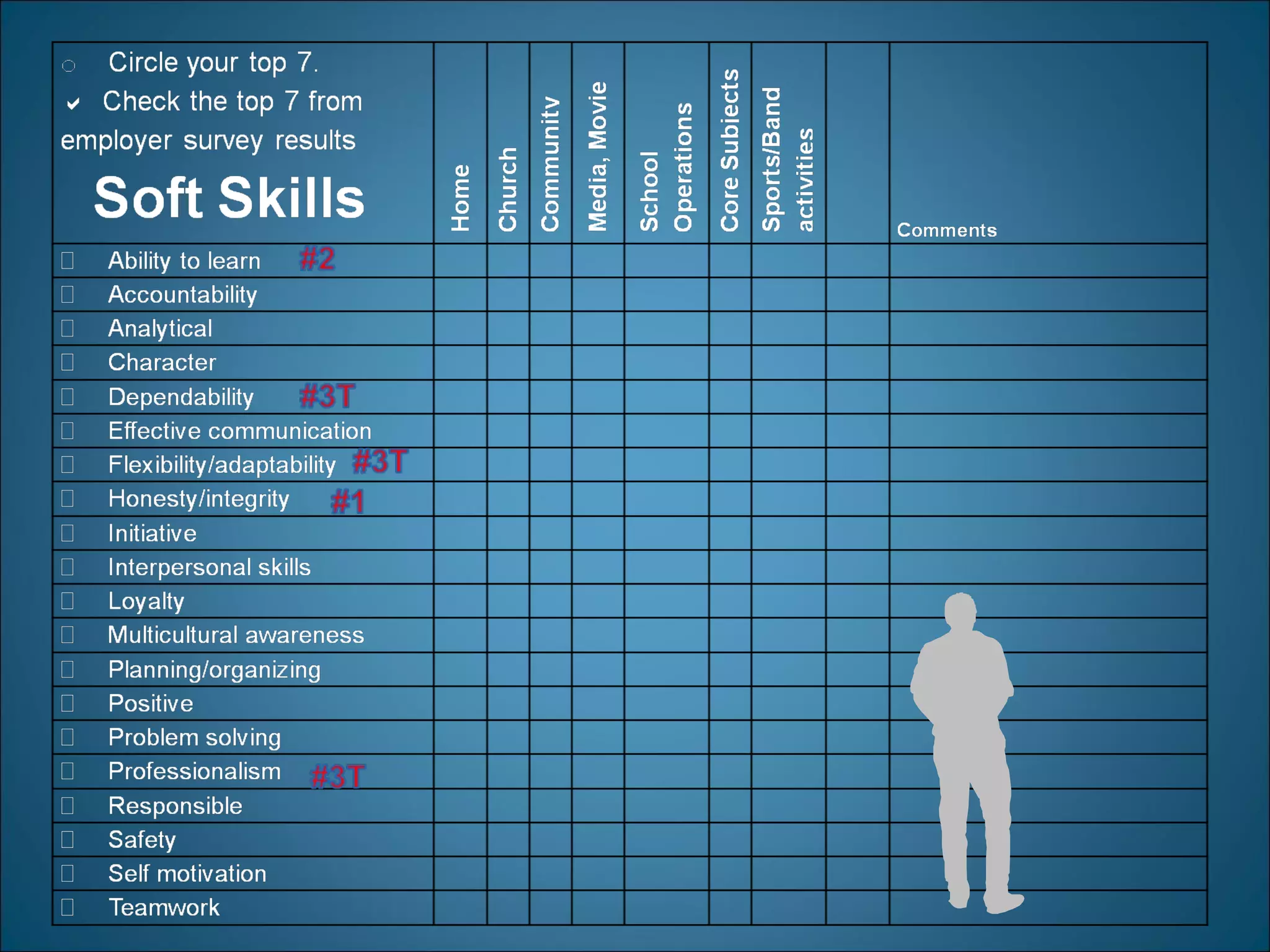
4. From the results,
what can you conclude?
Observation: “Are we
talking about VALUES?”
5. How can YOU integrate
work soft skills in your daily
agenda?
A. Design a listing of most
common soft skills.
B. Enlist other teachers in
awareness.
C. Authenticate skills by career
professional presentations.
BONUS: send simple survey
request to local Chamber of
Commerce for their input.
D. Transition class from
education setting to
workplace environment:
1) Mimic a business environment.
2) Create a business name, product,
etc.
3) Have students CEO, managers,
time sheet, workplace rules,
incentives (vs paycheck)…
4) Develop HR for job descriptions,
job postings & interview process.
5) Include budgets.
6) Day to day operations.
E. Relate
the Skills
Initiative
Teamwork
Communication
Using Tech
Problem Solving
Self manage
Learning for life
Planning/Organization
Contact:
terrycarlile@gmail.com
(903)261-3311
www.tlcyouthservices.net
Provide business card for monthly email

Soft skills

  • 1.
    HOW TO TEACH SOFTSKILLS THAT EMPLOYERS NEED (c)2013 TLC Workforce Solutions TERRY CARLILE WWW.TLCWORKFORCESOLUTIONS.COM
  • 2.
    (c)2013 TLC WorkforceSolutions Action orientation, drive and self initiation Assertiveness Big picture thinking and strategic thinking Coaching and developing people Communication (speaking, listening, empathy, body language, writing) Composure and self presentation (appearance, manners and etiquette) Conducting meetings Conflict management Consensus building Conviction Convincing Counseling Creativity and innovation Dealing with ambiguity Decision making Dependability and reliability Goal setting and result orientation Integrity Intellectual horsepower and learning Internal motivation and passion Interpersonal skills Know yourself (introspection) Mentoring Moral courage Negotiation Observation Openness and flexibility (paradigm shifting) Presentation
  • 3.
    Soft Skills definition: Whatis: Soft skills are personal attributes that enhance an individual's interactions, job performance and career prospects. Unlike hard skills, which are about a person's skill set and ability to perform a certain type of task or activity, soft skills are interpersonal and broadly applicable.
  • 4.
    Soft Skills definition: Wikipedia:is a sociological term relating to a person's "EQ" (Emotional Intelligence), the cluster of personality traits, social graces, communication, language, personal habits, friendliness, and optimism that characterize relationships with other people.Soft skills complement hard skills which are the occupational requirements of a job and many other activities.
  • 5.
    Skills Gap: Challengesfor the US • Young workers will change careers 10-14 times during their lifetime. • Many are unprepared for this reality. • The concept of lifetime employment will be replaced by lifetime employability. • Soft skills will be the common denominator no matter the job title.
  • 6.
  • 8.
  • 9.
    5. Employer comments: 1.You may not land the highest paying job at first and you probably won't be the CEO in a year. Be the first to volunteer, arrive early, stay a little later than the others, stay positive and keep motivated. 2. Employers are seeking employees who exhibit leadership skills, problem solving, creative thinking, etc. People with the right attitude are trainable. 3. Focus on attitude - we can train for skills 4. Explain how and why each and why the soft skills are necessary.
  • 10.
    5. Other employercomments: 5. You can teach certain tasks, but you can't teach Character. Hire for Character, teach for skill. 6. Make education and training as practical as possible. Create confidence enabling the student to skillfully compete. 7. Instill in them the ability to think outside the box. 8. Actually all of the above would be nice.
  • 11.
    Anne G: Lookingfor things that need to be done during down time rather than waiting to be told to do something. Being proactive when they see something needs to be done. Also being responsible for keeping their items clean (This is not just youth) Some people have a habit of thinking their mother works there and will clean up after them.
  • 12.
    Andy D: Smileand tell your customer thank you when they buy from you. Basic respect will go a long way with your customers. Very few people tell their customers thank you!
  • 13.
    Susan W: Showup on time, dressed appropriately, and be ready to work when you arrive. I can probably teach them the rest.
  • 14.
    Patrick M: IfI could find someone who could complete a sentence without the words "Like" and "You know" that would be a great start. "You guys" is another communication winner. I feel like the Valley Girls from the 1980's have actually won the battle to destroy the language... Like, uh, you know?
  • 15.
    4. From theresults, what can you conclude? Observation: “Are we talking about VALUES?”
  • 16.
    5. How canYOU integrate work soft skills in your daily agenda?
  • 17.
    A. Design alisting of most common soft skills. B. Enlist other teachers in awareness.
  • 18.
    C. Authenticate skillsby career professional presentations. BONUS: send simple survey request to local Chamber of Commerce for their input. D. Transition class from education setting to workplace environment:
  • 19.
    1) Mimic abusiness environment. 2) Create a business name, product, etc. 3) Have students CEO, managers, time sheet, workplace rules, incentives (vs paycheck)… 4) Develop HR for job descriptions, job postings & interview process. 5) Include budgets. 6) Day to day operations.
  • 20.
    E. Relate the Skills Initiative Teamwork Communication UsingTech Problem Solving Self manage Learning for life Planning/Organization
  • 22.