USER INTERFACE ENGINEERING ASSIGNMENT
TOPIC : UNIVERSAL USABILITY
By,
R.Dhanalakshmi MCA(III year),
18352021
INDEX
 Universal Usability
 Usability in User Interface Engineering
 Phases and process in User Interface Design
 Five quality components In Usability
 Universal usability differ from accessibility
 Challenges in Universal Usability
 Universal Usability Guidelines
 Current Research development
 Application in Universal Usability
 Conclusion
UNIVERSAL USABILITY
 Universal Usability means,
 How people’s are access Information and
communication technological product efficiently and
simply.
 And How it is usable and compelling to all citizens.
(Citizen who affected by Physical impairment and
Visual impairment)
 In this concept, has been commended by Professor
Ben Shneiderman, a computer scientist at the
Human Computer Interaction Lab at University of
Maryland, College Park.
UNIVERSAL USABILITY
 Ben Shneiderman, a pioneer in the field of human
computer interaction, defines universal usability as
“enabling all citizens to succeed using communication
and information technology in their tasks.”
 Notice, He does not say, “enabling all citizens to use”, but
rather, “enabling all citizens to succeed”.
 In Universal Usability, Designers who practice universal
usability strive for designs that gracefully accommodate a
diversity of user needs and circumstances.
USABILITY IN USER INTERFACE ENGINEERING
 User Interface Engineering is also know as Usability
Engineering.
 Usability Engineering ,it focuses on improving usability
interactive system.
 In The usability, Product can be used by all kinds of users
to achieve specific goal.
 Goal means -> Effectiveness, Efficiency and Satisfaction
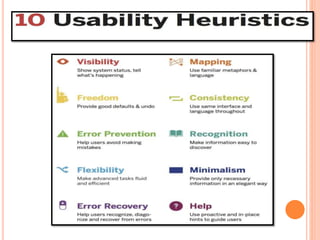
 There are many usability Heuristics to improve usability
interactive system and user friendliness with help of
computer interfaces.
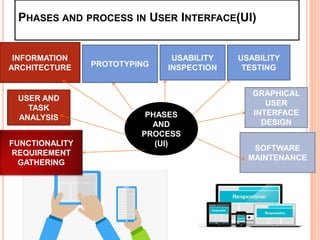
PHASES AND PROCESS IN USER INTERFACE(UI)
PHASES
AND
PROCESS
(UI)
INFORMATION
ARCHITECTURE PROTOTYPING
USER AND
TASK
ANALYSIS
USABILITY
TESTING
USABILITY
INSPECTION
GRAPHICAL
USER
INTERFACE
DESIGN
FUNCTIONALITY
REQUIREMENT
GATHERING
SOFTWARE
MAINTENANCE
FIVE QUALITY COMPONENTS IN USABILITY
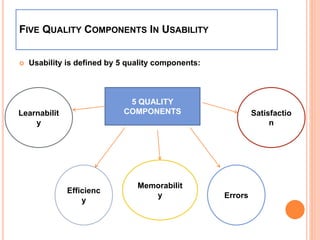
 Usability is defined by 5 quality components:
5 QUALITY
COMPONENTSLearnabilit
y
Efficienc
y
Memorabilit
y Errors
Satisfactio
n
FIVE QUALITY COMPONENTS IN USABILITY
 Learnability: How easy is it for users to accomplish
basic tasks the first time they encounter the
design?
 Efficiency: Once users have learned the design,
how quickly can they perform tasks?
 Memorability: When users return to the design
after a period of not using it, how easily can they
reestablish proficiency?
 Errors: How many errors do users make, how
severe are these errors, and how easily can they
recover from the errors?
 Satisfaction: How pleasant is it to use the design?
UNIVERSAL USABILITY DIFFER FROM ACCESSIBILITY
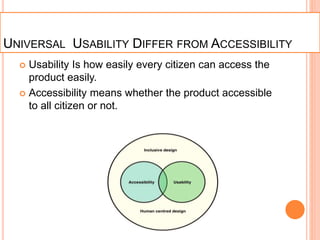
 Usability Is how easily every citizen can access the
product easily.
 Accessibility means whether the product accessible
to all citizen or not.
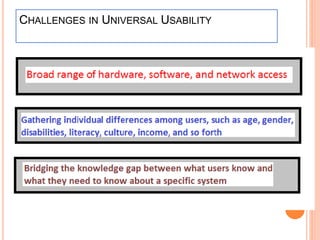
CHALLENGES IN UNIVERSAL USABILITY
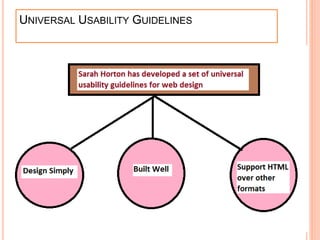
UNIVERSAL USABILITY GUIDELINES
CURRENT RESEARCH DEVELOPMENT
 Multimodal or Adaptive user interface
 Universal usability of commercial and e-
government websites
 Interface solutions for older adult users and users
with disabilities
 Contextualization of universal usability
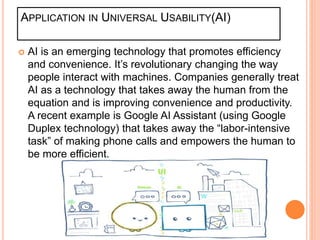
APPLICATION IN UNIVERSAL USABILITY(AI)
 AI is an emerging technology that promotes efficiency
and convenience. It’s revolutionary changing the way
people interact with machines. Companies generally treat
AI as a technology that takes away the human from the
equation and is improving convenience and productivity.
A recent example is Google AI Assistant (using Google
Duplex technology) that takes away the “labor-intensive
task” of making phone calls and empowers the human to
be more efficient.
CONCLUSION
 The goal of universal usability is to enable the
widest possible range of users to benefit from
information and communications services. This goal
is stronger than merely providing access, which
focuses on technology availability and is often tied
to access for users with disabilities.
Universal Usability ( User Interface Engineering )

Universal Usability ( User Interface Engineering )

  • 1.
    USER INTERFACE ENGINEERINGASSIGNMENT TOPIC : UNIVERSAL USABILITY By, R.Dhanalakshmi MCA(III year), 18352021
  • 2.
    INDEX  Universal Usability Usability in User Interface Engineering  Phases and process in User Interface Design  Five quality components In Usability  Universal usability differ from accessibility  Challenges in Universal Usability  Universal Usability Guidelines  Current Research development  Application in Universal Usability  Conclusion
  • 3.
    UNIVERSAL USABILITY  UniversalUsability means,  How people’s are access Information and communication technological product efficiently and simply.  And How it is usable and compelling to all citizens. (Citizen who affected by Physical impairment and Visual impairment)  In this concept, has been commended by Professor Ben Shneiderman, a computer scientist at the Human Computer Interaction Lab at University of Maryland, College Park.
  • 4.
    UNIVERSAL USABILITY  BenShneiderman, a pioneer in the field of human computer interaction, defines universal usability as “enabling all citizens to succeed using communication and information technology in their tasks.”  Notice, He does not say, “enabling all citizens to use”, but rather, “enabling all citizens to succeed”.  In Universal Usability, Designers who practice universal usability strive for designs that gracefully accommodate a diversity of user needs and circumstances.
  • 5.
    USABILITY IN USERINTERFACE ENGINEERING  User Interface Engineering is also know as Usability Engineering.  Usability Engineering ,it focuses on improving usability interactive system.  In The usability, Product can be used by all kinds of users to achieve specific goal.  Goal means -> Effectiveness, Efficiency and Satisfaction  There are many usability Heuristics to improve usability interactive system and user friendliness with help of computer interfaces.
  • 7.
    PHASES AND PROCESSIN USER INTERFACE(UI) PHASES AND PROCESS (UI) INFORMATION ARCHITECTURE PROTOTYPING USER AND TASK ANALYSIS USABILITY TESTING USABILITY INSPECTION GRAPHICAL USER INTERFACE DESIGN FUNCTIONALITY REQUIREMENT GATHERING SOFTWARE MAINTENANCE
  • 8.
    FIVE QUALITY COMPONENTSIN USABILITY  Usability is defined by 5 quality components: 5 QUALITY COMPONENTSLearnabilit y Efficienc y Memorabilit y Errors Satisfactio n
  • 9.
    FIVE QUALITY COMPONENTSIN USABILITY  Learnability: How easy is it for users to accomplish basic tasks the first time they encounter the design?  Efficiency: Once users have learned the design, how quickly can they perform tasks?  Memorability: When users return to the design after a period of not using it, how easily can they reestablish proficiency?  Errors: How many errors do users make, how severe are these errors, and how easily can they recover from the errors?  Satisfaction: How pleasant is it to use the design?
  • 10.
    UNIVERSAL USABILITY DIFFERFROM ACCESSIBILITY  Usability Is how easily every citizen can access the product easily.  Accessibility means whether the product accessible to all citizen or not.
  • 11.
  • 12.
  • 13.
    CURRENT RESEARCH DEVELOPMENT Multimodal or Adaptive user interface  Universal usability of commercial and e- government websites  Interface solutions for older adult users and users with disabilities  Contextualization of universal usability
  • 14.
    APPLICATION IN UNIVERSALUSABILITY(AI)  AI is an emerging technology that promotes efficiency and convenience. It’s revolutionary changing the way people interact with machines. Companies generally treat AI as a technology that takes away the human from the equation and is improving convenience and productivity. A recent example is Google AI Assistant (using Google Duplex technology) that takes away the “labor-intensive task” of making phone calls and empowers the human to be more efficient.
  • 15.
    CONCLUSION  The goalof universal usability is to enable the widest possible range of users to benefit from information and communications services. This goal is stronger than merely providing access, which focuses on technology availability and is often tied to access for users with disabilities.