Allison Korson
EDP 279
Assignment 2.3
September 25, 2013
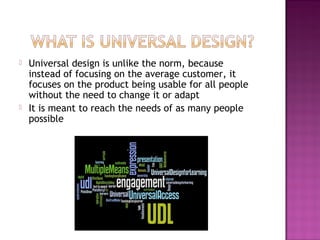
 Universal design is unlike the norm, because
instead of focusing on the average customer, it
focuses on the product being usable for all people
without the need to change it or adapt
 It is meant to reach the needs of as many people
possible
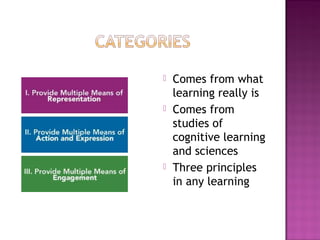
 Comes from what
learning really is
 Comes from
studies of
cognitive learning
and sciences
 Three principles
in any learning
There are 9 steps to UDL that can be
broken up into three sections
1. Representation
Provide options for:
1. Multiple means of
representation
2. Language and symbols
3. Comprehension
2. Expression
Provide options for:
1. Physical action
2. Expressive skills and fluency
3. Executive functions
3. Engagement
Provide options for:
1. Recruiting interest
2. Sustaining effort and persistence
3. Self-regulation
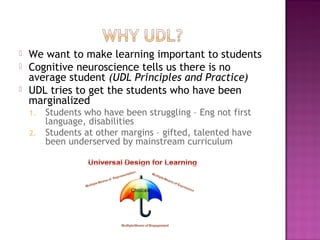
 We want to make learning important to students
 Cognitive neuroscience tells us there is no
average student (UDL Principles and Practice)
 UDL tries to get the students who have been
marginalized
1. Students who have been struggling – Eng not first
language, disabilities
2. Students at other margins – gifted, talented have
been underserved by mainstream curriculum
 Framework based in cognitive neurosciences to provide
lessons that work across a wide variety
 Wants every student is an expert learner – love learning
and want to learn – based on power to be flexible in
allowing choices, different paths
 UDL is designed so
 1. It is universal
 2. Everybody learns
"About UDL | National Center On Universal Design for Learning." About
UDL | National Center On Universal Design for Learning. N.p., n.d.
Web. 20 Sept. 2013.
"CONTENTS." Udl4all /. N.p., n.d. Web. 25 Sept. 2013.
"UDL: Principles and Practice." YouTube. YouTube, 17 Mar. 2010. Web.
20 Sept. 2013.
"Universal Design for Learning in Preschool." The Sandbox Series
[licensed for Non-commercial Use Only] /. N.p., n.d. Web. 20 Sept.
2013.
“Universal Design for Learning." Universal Design for Learning. N.p.,
n.d. Web. 25 Sept. 2013.

Korson EDP assignment 2.3

  • 1.
    Allison Korson EDP 279 Assignment2.3 September 25, 2013
  • 2.
     Universal designis unlike the norm, because instead of focusing on the average customer, it focuses on the product being usable for all people without the need to change it or adapt  It is meant to reach the needs of as many people possible
  • 3.
     Comes fromwhat learning really is  Comes from studies of cognitive learning and sciences  Three principles in any learning
  • 4.
    There are 9steps to UDL that can be broken up into three sections 1. Representation Provide options for: 1. Multiple means of representation 2. Language and symbols 3. Comprehension 2. Expression Provide options for: 1. Physical action 2. Expressive skills and fluency 3. Executive functions 3. Engagement Provide options for: 1. Recruiting interest 2. Sustaining effort and persistence 3. Self-regulation
  • 5.
     We wantto make learning important to students  Cognitive neuroscience tells us there is no average student (UDL Principles and Practice)  UDL tries to get the students who have been marginalized 1. Students who have been struggling – Eng not first language, disabilities 2. Students at other margins – gifted, talented have been underserved by mainstream curriculum
  • 6.
     Framework basedin cognitive neurosciences to provide lessons that work across a wide variety  Wants every student is an expert learner – love learning and want to learn – based on power to be flexible in allowing choices, different paths  UDL is designed so  1. It is universal  2. Everybody learns
  • 7.
    "About UDL |National Center On Universal Design for Learning." About UDL | National Center On Universal Design for Learning. N.p., n.d. Web. 20 Sept. 2013. "CONTENTS." Udl4all /. N.p., n.d. Web. 25 Sept. 2013. "UDL: Principles and Practice." YouTube. YouTube, 17 Mar. 2010. Web. 20 Sept. 2013. "Universal Design for Learning in Preschool." The Sandbox Series [licensed for Non-commercial Use Only] /. N.p., n.d. Web. 20 Sept. 2013. “Universal Design for Learning." Universal Design for Learning. N.p., n.d. Web. 25 Sept. 2013.