This project has received funding from the European Union’s Horizon 2020
research and innovation programme under grant agreement No 869993.
Units and
variables
International system of units
• The principal unit system in this course is the
International System of Units, SI System (Systeme
Internationale d’Unites). Some other units are also
used and it is crucial to know how to convert other
units into SI system units.
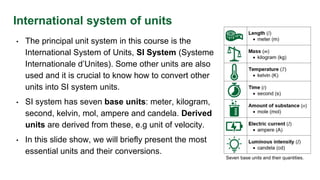
• SI system has seven base units: meter, kilogram,
second, kelvin, mol, ampere and candela. Derived
units are derived from these, e.g unit of velocity.
• In this slide show, we will briefly present the most
essential units and their conversions.
Seven base units and their quantities.
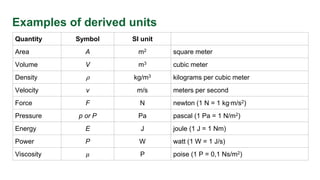
Examples of derived units
Quantity Symbol SI unit
Area A m2 square meter
Volume V m3 cubic meter
Density ⍴ kg/m3 kilograms per cubic meter
Velocity v m/s meters per second
Force F N newton (1 N = 1 kgᐧm/s2)
Pressure p or P Pa pascal (1 Pa = 1 N/m2)
Energy E J joule (1 J = 1 Nm)
Power P W watt (1 W = 1 J/s)
Viscosity 𝜇 P poise (1 P = 0,1 Ns/m2)
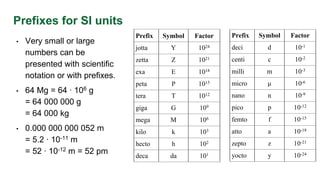
Prefixes for SI units
Prefix Symbol Factor
jotta Y 1024
zetta Z 1021
exa E 1018
peta P 1015
tera T 1012
giga G 109
mega M 106
kilo k 103
hecto h 102
deca da 101
Prefix Symbol Factor
deci d 10-1
centi c 10-2
milli m 10-3
micro µ 10-6
nano n 10-9
pico p 10-12
femto f 10-15
atto a 10-18
zepto z 10-21
yocto y 10-24
• Very small or large
numbers can be
presented with scientific
notation or with prefixes.
• 64 Mg = 64 ∙ 106 g
= 64 000 000 g
= 64 000 kg
• 0.000 000 000 052 m
= 5.2 ∙ 10-11 m
= 52 ∙ 10-12 m = 52 pm
Temperature
• Common symbol for temperature is T. SI unit is
kelvin (K). Kelvin scale is based on the absolute zero.
Other scales are the Celsius scale (°C) and the
Fahrenheit scale (°F).
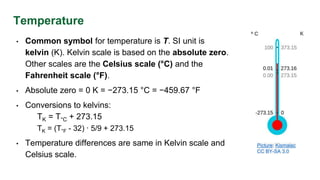
• Absolute zero = 0 K = −273.15 °C = −459.67 °F
• Conversions to kelvins:
TK = T°C + 273.15
TK = (T°F - 32) ∙ 5/9 + 273.15
• Temperature differences are same in Kelvin scale and
Celsius scale.
Picture: Kismalac
CC BY-SA 3.0
Pressure
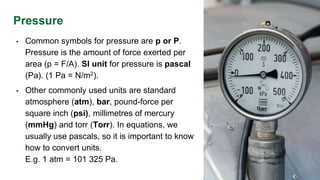
• Common symbols for pressure are p or P.
Pressure is the amount of force exerted per
area (p = F/A). SI unit for pressure is pascal
(Pa). (1 Pa = N/m2).
• Other commonly used units are standard
atmosphere (atm), bar, pound-force per
square inch (psi), millimetres of mercury
(mmHg) and torr (Torr). In equations, we
usually use pascals, so it is important to know
how to convert units.
E.g. 1 atm = 101 325 Pa.
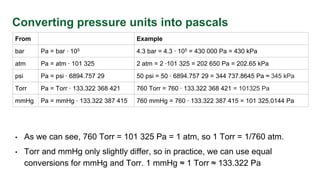
Converting pressure units into pascals
From Example
bar Pa = bar ∙ 105 4.3 bar = 4.3 ∙ 105 = 430 000 Pa = 430 kPa
atm Pa = atm ∙ 101 325 2 atm = 2 ∙101 325 = 202 650 Pa = 202.65 kPa
psi Pa = psi ∙ 6894.757 29 50 psi = 50 ∙ 6894.757 29 = 344 737.8645 Pa ≈ 345 kPa
Torr Pa = Torr ∙ 133.322 368 421 760 Torr = 760 ∙ 133.322 368 421 = 101325 Pa
mmHg Pa = mmHg ∙ 133.322 387 415 760 mmHg = 760 ∙ 133.322 387 415 = 101 325.0144 Pa
• As we can see, 760 Torr = 101 325 Pa = 1 atm, so 1 Torr = 1/760 atm.
• Torr and mmHg only slightly differ, so in practice, we can use equal
conversions for mmHg and Torr. 1 mmHg ≈ 1 Torr ≈ 133.322 Pa
Pressure measurement
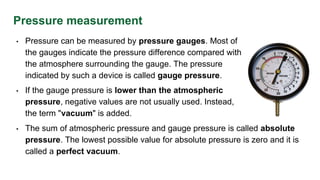
• Pressure can be measured by pressure gauges. Most of
the gauges indicate the pressure difference compared with
the atmosphere surrounding the gauge. The pressure
indicated by such a device is called gauge pressure.
• If the gauge pressure is lower than the atmospheric
pressure, negative values are not usually used. Instead,
the term "vacuum" is added.
• The sum of atmospheric pressure and gauge pressure is called absolute
pressure. The lowest possible value for absolute pressure is zero and it is
called a perfect vacuum.
Vapor pressure
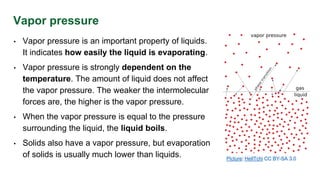
• Vapor pressure is an important property of liquids.
It indicates how easily the liquid is evaporating.
• Vapor pressure is strongly dependent on the
temperature. The amount of liquid does not affect
the vapor pressure. The weaker the intermolecular
forces are, the higher is the vapor pressure.
• When the vapor pressure is equal to the pressure
surrounding the liquid, the liquid boils.
• Solids also have a vapor pressure, but evaporation
of solids is usually much lower than liquids. Picture: HellTchi CC BY-SA 3.0
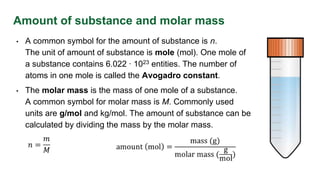
Amount of substance and molar mass
• A common symbol for the amount of substance is n.
The unit of amount of substance is mole (mol). One mole of
a substance contains 6.022 ∙ 1023 entities. The number of
atoms in one mole is called the Avogadro constant.
• The molar mass is the mass of one mole of a substance.
A common symbol for molar mass is M. Commonly used
units are g/mol and kg/mol. The amount of substance can be
calculated by dividing the mass by the molar mass.
Viscosity
• Viscosity is a property fluid. It presents the fluid's
resistance to flow. E.g. syrup has higher viscosity
than water.
• The symbol of absolute viscosity is μ and the unit
is poise (P). 1 P = 0,1 N∙s/m2 = 1 g/cm∙s
• Poise is inconveniently large for many purposes
and so centipoises (cP) are frequently used.
• Kinematic viscosity (v) is the absolute viscosity
devided by density. It is suitable for many fluid flow
problems. The unit is stoke (S). 1 S = 1 cm2/s
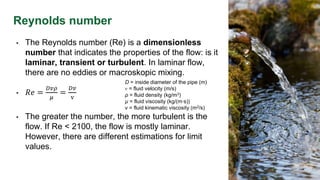
Reynolds number
D = inside diameter of the pipe (m)
v = fluid velocity (m/s)
ρ = fluid density (kg/m3)
µ = fluid viscosity (kg/(m∙s))
v = fluid kinematic viscosity (m2/s)
• The Reynolds number (Re) is a dimensionless
number that indicates the properties of the flow: is it
laminar, transient or turbulent. In laminar flow,
there are no eddies or macroskopic mixing.
• 𝑅𝑒 =
𝐷𝑣𝜌
𝜇
=
𝐷𝑣
v
• The greater the number, the more turbulent is the
flow. If Re < 2100, the flow is mostly laminar.
However, there are different estimations for limit
values.
This project has received funding from the European Union’s Horizon 2020
research and innovation programme under grant agreement No 869993.
References
• Burrows, A., Parsons, A. & Price, G. 2017. Chemistry3: Introducing Inorganic, Organic and
Physical Chemistry. 3rd ed. Oxford: Oxford U.P, pp. 18-19.
• Seader, J. D., Roper, D. K. & Henley, E. J. 2011. Separation process principles: Chemical
and biochemical operations. 3rd ed. Hoboken, NJ: Wiley, pp. xxiii-xxvi.
• Theodore, L. & Ricci, F. 2010. Mass Transfer Operations for the Practicing Engineer. John
Wiley & Sons, Inc, pp. 19-35.
• Treybal, R. E. 1980. Mass-transfer operations. 3rd ed. Auckland: McGraw-Hill, pp. 12-18.
Videos:
• Reynolds number Equation explained: https://youtu.be/Wo63dvz71xI
• Boiling, Atmospheric Pressure, and Vapor Pressure: https://youtu.be/Ag4lLUXKuSM
• Metric Unit Prefix Conversions: https://youtu.be/5EcNAxweb44

Units and variables

  • 1.
    This project hasreceived funding from the European Union’s Horizon 2020 research and innovation programme under grant agreement No 869993. Units and variables
  • 2.
    International system ofunits • The principal unit system in this course is the International System of Units, SI System (Systeme Internationale d’Unites). Some other units are also used and it is crucial to know how to convert other units into SI system units. • SI system has seven base units: meter, kilogram, second, kelvin, mol, ampere and candela. Derived units are derived from these, e.g unit of velocity. • In this slide show, we will briefly present the most essential units and their conversions. Seven base units and their quantities.
  • 3.
    Examples of derivedunits Quantity Symbol SI unit Area A m2 square meter Volume V m3 cubic meter Density ⍴ kg/m3 kilograms per cubic meter Velocity v m/s meters per second Force F N newton (1 N = 1 kgᐧm/s2) Pressure p or P Pa pascal (1 Pa = 1 N/m2) Energy E J joule (1 J = 1 Nm) Power P W watt (1 W = 1 J/s) Viscosity 𝜇 P poise (1 P = 0,1 Ns/m2)
  • 4.
    Prefixes for SIunits Prefix Symbol Factor jotta Y 1024 zetta Z 1021 exa E 1018 peta P 1015 tera T 1012 giga G 109 mega M 106 kilo k 103 hecto h 102 deca da 101 Prefix Symbol Factor deci d 10-1 centi c 10-2 milli m 10-3 micro µ 10-6 nano n 10-9 pico p 10-12 femto f 10-15 atto a 10-18 zepto z 10-21 yocto y 10-24 • Very small or large numbers can be presented with scientific notation or with prefixes. • 64 Mg = 64 ∙ 106 g = 64 000 000 g = 64 000 kg • 0.000 000 000 052 m = 5.2 ∙ 10-11 m = 52 ∙ 10-12 m = 52 pm
  • 5.
    Temperature • Common symbolfor temperature is T. SI unit is kelvin (K). Kelvin scale is based on the absolute zero. Other scales are the Celsius scale (°C) and the Fahrenheit scale (°F). • Absolute zero = 0 K = −273.15 °C = −459.67 °F • Conversions to kelvins: TK = T°C + 273.15 TK = (T°F - 32) ∙ 5/9 + 273.15 • Temperature differences are same in Kelvin scale and Celsius scale. Picture: Kismalac CC BY-SA 3.0
  • 6.
    Pressure • Common symbolsfor pressure are p or P. Pressure is the amount of force exerted per area (p = F/A). SI unit for pressure is pascal (Pa). (1 Pa = N/m2). • Other commonly used units are standard atmosphere (atm), bar, pound-force per square inch (psi), millimetres of mercury (mmHg) and torr (Torr). In equations, we usually use pascals, so it is important to know how to convert units. E.g. 1 atm = 101 325 Pa.
  • 7.
    Converting pressure unitsinto pascals From Example bar Pa = bar ∙ 105 4.3 bar = 4.3 ∙ 105 = 430 000 Pa = 430 kPa atm Pa = atm ∙ 101 325 2 atm = 2 ∙101 325 = 202 650 Pa = 202.65 kPa psi Pa = psi ∙ 6894.757 29 50 psi = 50 ∙ 6894.757 29 = 344 737.8645 Pa ≈ 345 kPa Torr Pa = Torr ∙ 133.322 368 421 760 Torr = 760 ∙ 133.322 368 421 = 101325 Pa mmHg Pa = mmHg ∙ 133.322 387 415 760 mmHg = 760 ∙ 133.322 387 415 = 101 325.0144 Pa • As we can see, 760 Torr = 101 325 Pa = 1 atm, so 1 Torr = 1/760 atm. • Torr and mmHg only slightly differ, so in practice, we can use equal conversions for mmHg and Torr. 1 mmHg ≈ 1 Torr ≈ 133.322 Pa
  • 8.
    Pressure measurement • Pressurecan be measured by pressure gauges. Most of the gauges indicate the pressure difference compared with the atmosphere surrounding the gauge. The pressure indicated by such a device is called gauge pressure. • If the gauge pressure is lower than the atmospheric pressure, negative values are not usually used. Instead, the term "vacuum" is added. • The sum of atmospheric pressure and gauge pressure is called absolute pressure. The lowest possible value for absolute pressure is zero and it is called a perfect vacuum.
  • 9.
    Vapor pressure • Vaporpressure is an important property of liquids. It indicates how easily the liquid is evaporating. • Vapor pressure is strongly dependent on the temperature. The amount of liquid does not affect the vapor pressure. The weaker the intermolecular forces are, the higher is the vapor pressure. • When the vapor pressure is equal to the pressure surrounding the liquid, the liquid boils. • Solids also have a vapor pressure, but evaporation of solids is usually much lower than liquids. Picture: HellTchi CC BY-SA 3.0
  • 10.
    Amount of substanceand molar mass • A common symbol for the amount of substance is n. The unit of amount of substance is mole (mol). One mole of a substance contains 6.022 ∙ 1023 entities. The number of atoms in one mole is called the Avogadro constant. • The molar mass is the mass of one mole of a substance. A common symbol for molar mass is M. Commonly used units are g/mol and kg/mol. The amount of substance can be calculated by dividing the mass by the molar mass.
  • 11.
    Viscosity • Viscosity isa property fluid. It presents the fluid's resistance to flow. E.g. syrup has higher viscosity than water. • The symbol of absolute viscosity is μ and the unit is poise (P). 1 P = 0,1 N∙s/m2 = 1 g/cm∙s • Poise is inconveniently large for many purposes and so centipoises (cP) are frequently used. • Kinematic viscosity (v) is the absolute viscosity devided by density. It is suitable for many fluid flow problems. The unit is stoke (S). 1 S = 1 cm2/s
  • 12.
    Reynolds number D =inside diameter of the pipe (m) v = fluid velocity (m/s) ρ = fluid density (kg/m3) µ = fluid viscosity (kg/(m∙s)) v = fluid kinematic viscosity (m2/s) • The Reynolds number (Re) is a dimensionless number that indicates the properties of the flow: is it laminar, transient or turbulent. In laminar flow, there are no eddies or macroskopic mixing. • 𝑅𝑒 = 𝐷𝑣𝜌 𝜇 = 𝐷𝑣 v • The greater the number, the more turbulent is the flow. If Re < 2100, the flow is mostly laminar. However, there are different estimations for limit values.
  • 13.
    This project hasreceived funding from the European Union’s Horizon 2020 research and innovation programme under grant agreement No 869993. References • Burrows, A., Parsons, A. & Price, G. 2017. Chemistry3: Introducing Inorganic, Organic and Physical Chemistry. 3rd ed. Oxford: Oxford U.P, pp. 18-19. • Seader, J. D., Roper, D. K. & Henley, E. J. 2011. Separation process principles: Chemical and biochemical operations. 3rd ed. Hoboken, NJ: Wiley, pp. xxiii-xxvi. • Theodore, L. & Ricci, F. 2010. Mass Transfer Operations for the Practicing Engineer. John Wiley & Sons, Inc, pp. 19-35. • Treybal, R. E. 1980. Mass-transfer operations. 3rd ed. Auckland: McGraw-Hill, pp. 12-18. Videos: • Reynolds number Equation explained: https://youtu.be/Wo63dvz71xI • Boiling, Atmospheric Pressure, and Vapor Pressure: https://youtu.be/Ag4lLUXKuSM • Metric Unit Prefix Conversions: https://youtu.be/5EcNAxweb44