CS – 8591
COMPUTER NETWORKS
Unit - I
INTRODUCTION AND
PHYSICAL LAYER
Ms. Angayarkanni S A
Assistant Professor, IT, RMKEC
Performance
 How GOOD the network is?
Performance metrics
Bandwidth
Throughput
Latency (Delay)
Bandwidth-Delay Product
Jitter
Bandwidth
 two contexts
 Bandwidth in hertz,
 the range of frequencies in a composite
signal or the range of frequencies that a
channel can pass.
 Bandwidth in bits per second,
 the speed of bit transmission in a
channel or link.
Example 1
 ABC Telephone
 The bandwidth of a subscriber line is 4
kHz for voice or data.
 The bandwidth of this line for data
transmission can be up to 56,000 bps
using a sophisticated modem to
change the digital signal to analog.
 BHz=4 KHz
 Bbps=56 Kbps
Bandwidth
 BHz Increases
 Bbps increases
Example 2
 ABC Telephone
 The bandwidth of a subscriber line is 4
kHz for voice or data.
◦ (8 KHz)
 The bandwidth of this line for data
transmission can be up to 112,000 bps
using a sophisticated modem to change
the digital signal to analog.
 BHz=8 KHz
 Bbps=112 Kbps
Throughput
 a measure of how fast we send data
through a network
 Bandwidth Bbps
◦ Potential measurement of a link
 Throughput Tbps
◦ Actual measurement of a data transfer
through a link
Example 3
 A network with bandwidth of 10 Mbps
can pass only an average of 12,000
frames per minute with each frame
carrying an average of 10,000 bits.
What is the throughput of this
network?
 Bbps= 10 Mbps
 No of frames = 12000 frames/minute
 1 frame = 10000bits
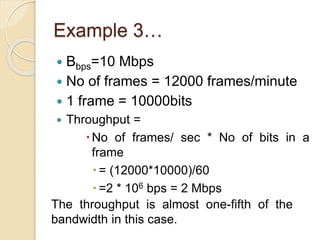
Example 3…
 Bbps=10 Mbps
 No of frames = 12000 frames/minute
 1 frame = 10000bits
 Throughput =
No of frames/ sec * No of bits in a
frame
 = (12000*10000)/60
 =2 * 106 bps = 2 Mbps
The throughput is almost one-fifth of the
bandwidth in this case.
Latency (Delay)
 How long it takes for an entire message
to completely arrive at the destination
from the time the first bit is sent out from
the source
 Latency = Propagation time +
transmission time + Queuing time +
Processing delay
Propagation time
 Measures the time required for a bit to
travel from source to destination
 Propagation speed  speed at which
a bit travels though the medium from
source to destination.
 Propagation time = distance/
propagation speed
Propagation time
 Depends on nature of signal and
medium
 Light
 Vacuum – 3 * 108 m/s
 Air – get reduced
Example 4
 What is the propagation time if the
distance between the two points is
12,000 km? Assume the propagation
speed to be 2.4 × 10⁸ m/s in cable?
 Distance = 12000 km
 Propagation speed = 2.4 × 10⁸ m/s
Example 4
 Distance = 12000 km
 Propagation speed = 2.4 × 10⁸ m/s
 Propagation Delay =
Distance/Propagation speed
a bit can go over the Atlantic Ocean in only
50 ms if there is a direct cable between the
source and the destination.
Transmission time
 Time taken to put the data packet on
the transmission link is called
as transmission delay.
 Transmission speed the speed at
which all the bits in a message arrive
at the destination. (difference in arrival
time of first and last bit)
 Transmission = Message-size/
Bandwidth
Example
 What are the propagation time and the
transmission time for a 2.5-kbyte
message (an e-mail) if the bandwidth
of the network is 1 Gbps? Assume that
the distance between the sender and
the receiver is 12,000 km and that
light travels at 2.4 × 10⁸ m/s?
Example …
 Message size =2.5 KB
 Bbps = 1 Gbps
 Distance = 12000km
 Speed = 2.4 * 10 8 m/s
 Propagation Delay = Distance/Propagation
speed
 = (12000*10000)/(2.4*108)
 = 0.05 s = 50 ms
Example …
 Message size =2.5 KB
 Bbps = 1 Gbps
 Distance = 12000km
 Speed = 2.4 * 10 8 m/s
 Transmission = Message-size/ Bandwidth
 = (2.5*1000 * 8)/(1*109)
 = 20* 10 -6
 = 0.020 ms
Example
 What are the propagation time and the
transmission time for a 5MB message
(an image) if the bandwidth of the
network is 1 Mbps? Assume that the
distance between the sender and the
receiver is 12,000 km and that light
travels at 2.4 × 10⁸ m/s?
Example …
 Message size =2.5 KB
 Bbps = 1 Gbps
 Distance = 12000km
 Speed = 2.4 * 10 8 m/s
 Propagation Delay = Distance/Propagation
speed
 = (12000*10000)/(2.4*108)
 = 0.05 s = 50 ms
Example …
 Message size =2.5 KB
 Bbps = 1 Gbps
 Distance = 12000km
 Speed = 2.4 * 10 8 m/s
 Transmission = Message-size/ Bandwidth
 = (5*106 * 8)/(1*106)
 = 40 s
Inference
 Message small
 Tx time << Propagation time
 Message large
 Tx time >> Propagation time
 Msg size increases & BW is not
enough  Tx time is more dominant
then propagation time
Queuing time
 Time needed for each intermediate or
end device to hold the message
before it is processes
 Time spent by the data packet waiting
in the queue before it is taken for
execution
 Not a fixed factor
 Changes with network load
(congestion)
Processing delay
 Time taken by the processor to
process the data packet is called
as processing delay.
 It depends on the speed of the
processor.
 Processing of the data packet helps in
detecting bit level errors that occurs
during transmission.
Jitter
 refers to small intermittent delays
during data transfers.
 It can be caused by a number of
factors including network congestion,
collisions, and signal interference.
 Technically, jitter is the variation in
latency — the delay between when a
signal is transmitted and when it is
received
Jitter
Bandwidth delay product
No of bits in the line = 5 bits
Bandwidth delay product
No of bits in the line = 25 bits
Pipe
Performance metrics
 Bandwidth - capacity of the system
 Throughput - no. of bits that can be
pushed through
 Latency (Delay) - delay incurred by a
bit from start to finish
 Bandwidth-Delay Product- no of bits
in line
 Which of the following delay is faced
by the packet in travelling from one
end system to another?
a) Propagation delay
b) Queuing delay
c) Transmission delay
d) All of the mentioned
1.35
Q-A
 For a 10Mbps Ethernet link, if the
length of the packet is 32bits, the
transmission delay is ____________
(in microseconds)
a) 3.2
b) 32
c) 0.32
d) 320
1.36
Q-A
 For a 10Mbps Ethernet link, if the
length of the packet is 32bits, the
transmission delay is ____________
(in microseconds)
a) 3.2
b) 32
c) 0.32
d) 320
1.37
Q-A
 In the transfer of file between server
and client, if the transmission rates
along the path is 10Mbps, 20Mbps,
30Mbps, 40Mbps. The throughput is
usually ___________
a) 20Mbps
b) 10Mbps
c) 40Mbps
d) 50Mbps
1.38
Q-A
 In the transfer of file between server
and client, if the transmission rates
along the path is 10Mbps, 20Mbps,
30Mbps, 40Mbps. The throughput is
usually ___________
a) 20Mbps
b) 10Mbps
c) 40Mbps
d) 50Mbps
1.39
Q-A
The throughput
is generally the
transmission
rate of
bottleneck link.
 Propagation delay depends on
___________
a) Packet length
b) Transmission rate
c) Distance between the routers
d) Speed of the CPU
1.40
Q-A
 Propagation delay depends on
___________
a) Packet length
b) Transmission rate
c) Distance between the routers
d) Speed of the CPU
1.41
Q-A
 Propagation delay depends on
___________
a) Packet length
b) Transmission rate
c) Distance between the routers
d) Speed of the CPU
1.42
Q-A

Unit_I - 3

  • 1.
    CS – 8591 COMPUTERNETWORKS Unit - I INTRODUCTION AND PHYSICAL LAYER Ms. Angayarkanni S A Assistant Professor, IT, RMKEC
  • 2.
    Performance  How GOODthe network is?
  • 3.
  • 4.
    Bandwidth  two contexts Bandwidth in hertz,  the range of frequencies in a composite signal or the range of frequencies that a channel can pass.  Bandwidth in bits per second,  the speed of bit transmission in a channel or link.
  • 5.
    Example 1  ABCTelephone  The bandwidth of a subscriber line is 4 kHz for voice or data.  The bandwidth of this line for data transmission can be up to 56,000 bps using a sophisticated modem to change the digital signal to analog.  BHz=4 KHz  Bbps=56 Kbps
  • 6.
  • 7.
    Example 2  ABCTelephone  The bandwidth of a subscriber line is 4 kHz for voice or data. ◦ (8 KHz)  The bandwidth of this line for data transmission can be up to 112,000 bps using a sophisticated modem to change the digital signal to analog.  BHz=8 KHz  Bbps=112 Kbps
  • 8.
    Throughput  a measureof how fast we send data through a network
  • 10.
     Bandwidth Bbps ◦Potential measurement of a link  Throughput Tbps ◦ Actual measurement of a data transfer through a link
  • 11.
    Example 3  Anetwork with bandwidth of 10 Mbps can pass only an average of 12,000 frames per minute with each frame carrying an average of 10,000 bits. What is the throughput of this network?  Bbps= 10 Mbps  No of frames = 12000 frames/minute  1 frame = 10000bits
  • 12.
    Example 3…  Bbps=10Mbps  No of frames = 12000 frames/minute  1 frame = 10000bits  Throughput = No of frames/ sec * No of bits in a frame  = (12000*10000)/60  =2 * 106 bps = 2 Mbps The throughput is almost one-fifth of the bandwidth in this case.
  • 13.
    Latency (Delay)  Howlong it takes for an entire message to completely arrive at the destination from the time the first bit is sent out from the source  Latency = Propagation time + transmission time + Queuing time + Processing delay
  • 14.
    Propagation time  Measuresthe time required for a bit to travel from source to destination  Propagation speed  speed at which a bit travels though the medium from source to destination.  Propagation time = distance/ propagation speed
  • 15.
    Propagation time  Dependson nature of signal and medium  Light  Vacuum – 3 * 108 m/s  Air – get reduced
  • 16.
    Example 4  Whatis the propagation time if the distance between the two points is 12,000 km? Assume the propagation speed to be 2.4 × 10⁸ m/s in cable?  Distance = 12000 km  Propagation speed = 2.4 × 10⁸ m/s
  • 17.
    Example 4  Distance= 12000 km  Propagation speed = 2.4 × 10⁸ m/s  Propagation Delay = Distance/Propagation speed a bit can go over the Atlantic Ocean in only 50 ms if there is a direct cable between the source and the destination.
  • 18.
    Transmission time  Timetaken to put the data packet on the transmission link is called as transmission delay.  Transmission speed the speed at which all the bits in a message arrive at the destination. (difference in arrival time of first and last bit)  Transmission = Message-size/ Bandwidth
  • 19.
    Example  What arethe propagation time and the transmission time for a 2.5-kbyte message (an e-mail) if the bandwidth of the network is 1 Gbps? Assume that the distance between the sender and the receiver is 12,000 km and that light travels at 2.4 × 10⁸ m/s?
  • 20.
    Example …  Messagesize =2.5 KB  Bbps = 1 Gbps  Distance = 12000km  Speed = 2.4 * 10 8 m/s  Propagation Delay = Distance/Propagation speed  = (12000*10000)/(2.4*108)  = 0.05 s = 50 ms
  • 21.
    Example …  Messagesize =2.5 KB  Bbps = 1 Gbps  Distance = 12000km  Speed = 2.4 * 10 8 m/s  Transmission = Message-size/ Bandwidth  = (2.5*1000 * 8)/(1*109)  = 20* 10 -6  = 0.020 ms
  • 22.
    Example  What arethe propagation time and the transmission time for a 5MB message (an image) if the bandwidth of the network is 1 Mbps? Assume that the distance between the sender and the receiver is 12,000 km and that light travels at 2.4 × 10⁸ m/s?
  • 23.
    Example …  Messagesize =2.5 KB  Bbps = 1 Gbps  Distance = 12000km  Speed = 2.4 * 10 8 m/s  Propagation Delay = Distance/Propagation speed  = (12000*10000)/(2.4*108)  = 0.05 s = 50 ms
  • 24.
    Example …  Messagesize =2.5 KB  Bbps = 1 Gbps  Distance = 12000km  Speed = 2.4 * 10 8 m/s  Transmission = Message-size/ Bandwidth  = (5*106 * 8)/(1*106)  = 40 s
  • 25.
    Inference  Message small Tx time << Propagation time  Message large  Tx time >> Propagation time  Msg size increases & BW is not enough  Tx time is more dominant then propagation time
  • 26.
    Queuing time  Timeneeded for each intermediate or end device to hold the message before it is processes  Time spent by the data packet waiting in the queue before it is taken for execution  Not a fixed factor  Changes with network load (congestion)
  • 27.
    Processing delay  Timetaken by the processor to process the data packet is called as processing delay.  It depends on the speed of the processor.  Processing of the data packet helps in detecting bit level errors that occurs during transmission.
  • 28.
    Jitter  refers tosmall intermittent delays during data transfers.  It can be caused by a number of factors including network congestion, collisions, and signal interference.  Technically, jitter is the variation in latency — the delay between when a signal is transmitted and when it is received
  • 29.
  • 30.
    Bandwidth delay product Noof bits in the line = 5 bits
  • 31.
    Bandwidth delay product Noof bits in the line = 25 bits
  • 32.
  • 34.
    Performance metrics  Bandwidth- capacity of the system  Throughput - no. of bits that can be pushed through  Latency (Delay) - delay incurred by a bit from start to finish  Bandwidth-Delay Product- no of bits in line
  • 35.
     Which ofthe following delay is faced by the packet in travelling from one end system to another? a) Propagation delay b) Queuing delay c) Transmission delay d) All of the mentioned 1.35 Q-A
  • 36.
     For a10Mbps Ethernet link, if the length of the packet is 32bits, the transmission delay is ____________ (in microseconds) a) 3.2 b) 32 c) 0.32 d) 320 1.36 Q-A
  • 37.
     For a10Mbps Ethernet link, if the length of the packet is 32bits, the transmission delay is ____________ (in microseconds) a) 3.2 b) 32 c) 0.32 d) 320 1.37 Q-A
  • 38.
     In thetransfer of file between server and client, if the transmission rates along the path is 10Mbps, 20Mbps, 30Mbps, 40Mbps. The throughput is usually ___________ a) 20Mbps b) 10Mbps c) 40Mbps d) 50Mbps 1.38 Q-A
  • 39.
     In thetransfer of file between server and client, if the transmission rates along the path is 10Mbps, 20Mbps, 30Mbps, 40Mbps. The throughput is usually ___________ a) 20Mbps b) 10Mbps c) 40Mbps d) 50Mbps 1.39 Q-A The throughput is generally the transmission rate of bottleneck link.
  • 40.
     Propagation delaydepends on ___________ a) Packet length b) Transmission rate c) Distance between the routers d) Speed of the CPU 1.40 Q-A
  • 41.
     Propagation delaydepends on ___________ a) Packet length b) Transmission rate c) Distance between the routers d) Speed of the CPU 1.41 Q-A
  • 42.
     Propagation delaydepends on ___________ a) Packet length b) Transmission rate c) Distance between the routers d) Speed of the CPU 1.42 Q-A