CLASS 1 - GROUP 2 
Nguyen Hai Phuong Hanh 295034 
Do Thi Phuong Dung 295022 
Le Thi Thanh Tam 295897 
UNITED WAY WORLDWIDE 
STRATEGIC MANAGEMENT 
Lecturer: Prof. Thomas Bradley
1 
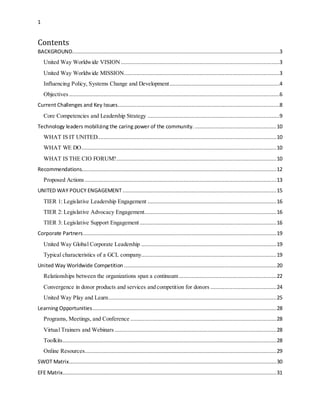
Contents 
BACKGROUND ....................................................................................................................................3 
United Way Worldwide VISION .....................................................................................................3 
United Way Worldwide MISSION...................................................................................................3 
Influencing Policy, Systems Change and Development ......................................................................4 
Objectives ......................................................................................................................................6 
Current Challenges and Key Issues .......................................................................................................8 
Core Competencies and Leadership Strategy ....................................................................................9 
Technology leaders mobilizing the caring power of the community. .................................................... 10 
WHAT IS IT UNITED.................................................................................................................. 10 
WHAT WE DO ............................................................................................................................ 10 
WHAT IS THE CIO FORUM? ...................................................................................................... 10 
Recommendations............................................................................................................................ 12 
Proposed Actions .......................................................................................................................... 13 
UNITED WAY POLICY ENGAGEMENT .................................................................................................. 15 
TIER 1: Legislative Leadership Engagement .................................................................................. 16 
TIER 2: Legislative Advocacy Engagement.................................................................................... 16 
TIER 3: Legislative Support Engagement ....................................................................................... 16 
Corporate Partners ........................................................................................................................... 19 
United Way Global Corporate Leadership ...................................................................................... 19 
Typical characteristics of a GCL company...................................................................................... 19 
United Way Worldwide Competition ................................................................................................. 20 
Relationships between the organizations span a continuum .............................................................. 22 
Convergence in donor products and services and competition for donors .......................................... 24 
United Way Play and Learn ........................................................................................................... 25 
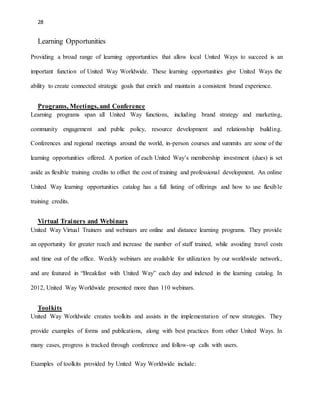
Learning Opportunities ..................................................................................................................... 28 
Programs, Meetings, and Conference ............................................................................................. 28 
Virtual Trainers and Webinars ....................................................................................................... 28 
Toolkits........................................................................................................................................ 28 
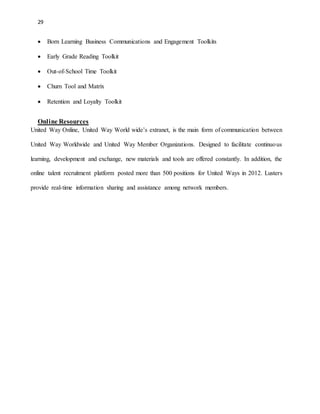
Online Resources .......................................................................................................................... 29 
SWOT Matrix .................................................................................................................................... 30 
EFE Matrix........................................................................................................................................ 31
2 
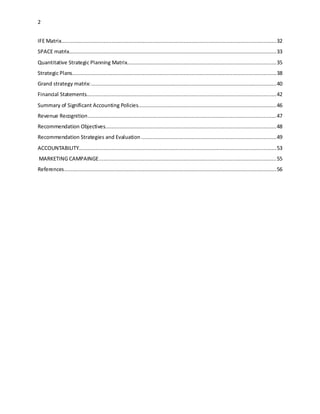
IFE Matrix......................................................................................................................................... 32 
SPACE matrix.................................................................................................................................... 33 
Quantitative Strategic Planning Matrix............................................................................................... 35 
Strategic Plans .................................................................................................................................. 38 
Grand strategy matrix: ...................................................................................................................... 40 
Financial Statements......................................................................................................................... 42 
Summary of Significant Accounting Policies........................................................................................ 46 
Revenue Recognition ........................................................................................................................ 47 
Recommendation Objectives............................................................................................................. 48 
Recommendation Strategies and Evaluation ...................................................................................... 49 
ACCOUNTABILITY.............................................................................................................................. 53 
MARKETING CAMPAINGE ................................................................................................................. 55 
References ....................................................................................................................................... 56
3 
BACKGROUND 
United Way Worldwide is the leadership and support organization for the network of nearly 1,800 
community-based United Ways in 45 countries and territories. We advance the common good by 
focusing on improving education, helping people achieve financial stability, and promoting 
healthy lives, and by mobilizing millions of people to give, advocate, and volunteer to improve the 
conditions in which they live. 
United Way Worldwide VISION 
United Way envisions a world where all individuals and families achieve their human potential 
through education, income stability and healthy lives. 
Imagine a world that fosters hope and opportunity for everyone… 
 Where all children receive a quality education that offers a pathway to a brighter tomorrow 
 Where the cycle of poverty and financial dependence ends, and productive livelihoods begin for 
even the most disadvantaged 
 Where everyone receives effective health care that improves quality of life 
 Where communities not only set significant and measurable goals to advance these fundamenta l 
elements of human development, but achieve them 
United Way Worldwide MISSION 
To improve lives by mobilizing the caring power of communities around the world to advance the 
common good. 
To do this we will:33
4 
 Ignite a worldwide social movement, and thereby mobilize millions to action – to give, advocate 
and volunteer to improve the conditions in which they live 
 Galvanize and connect all sector of society – individuals, businesses, non-profit organizations and 
governments – to create long-term social change that produces healthy, well-educated and 
financially-stable individuals and families 
 Raise, invest and leverage billions of funds annually in philanthropic contributions to create and 
support innovative programs and approaches to generate sustained impact in local communities 
 Hold ourselves accountable to this cause through our steadfast commitment to continua ll y 
measure – in real terms – improvement in education, income and health. 
Influencing Policy, Systems Change and Development 
Public policy and systems change is integral to achieving our Community Impact Priorities and 
maintaining a strong human services system. We believe that we can bring about positive 
changes in governmental policies and funding and improve the human services system by 
identifying problems and system barriers, proposing solutions, aligning our approaches and 
messaging with partners, educating individuals and policymakers and offering opportunities for 
United Way stakeholders to advocate. In fiscal year 2015, we will foster greater collaboration 
between policy and program impact areas around new initiatives resulting in early identification 
of beneficial policy and system changes and the ability to act as a “broker” in facilitating the 
identified changes.
5 
Brand Management 
United Way Worldwide creates and delivers the tools and resources that allow United Ways to 
provide a consistent brand experience around the world. Along with offering creative guidance and 
message research and communications strategies, an internal brand management website is available 
– providing guidelines, logos, templates and many other marketing, advertising and communications 
assets including radio, TV and out-of-home collateral to facilitate easy local implementation of LIVE 
UNITED, United Way’s call-to-action and experience. 
Live United 
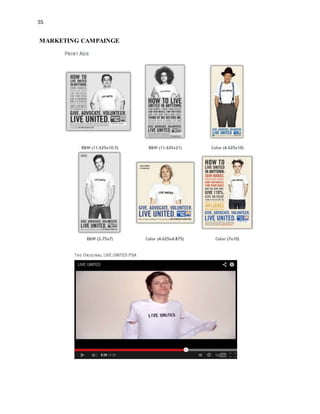
LIVE UNITED is an invitation to advance the common good by focusing on education, income and 
health. More than 90 percent of United Ways use LIVE UNITED tools and resources, and the Ad 
Council and the NFL have donated more than USD 135 million in media value since the launch of 
the LIVE UNITED campaign in 2008. 
Online Engagement 
United Way Worldwide deepens relationships with supporters, stakeholders and partners worldwide 
by cultivating a rapidly growing network of social communities, email and mobile contacts and online 
donors. The web allows for the creation of stronger communities with greater opportunities for all. 
Online engagement encompasses: direct donor outreach – calling on them to give, advocate or 
volunteer; thanking and recognizing partners for their outstanding commitment to advancing the 
common good; and providing updates on how individuals and companies are joining with United 
Way to improve the condition of all.
6 
Objectives 
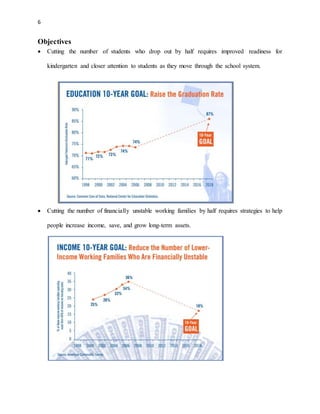
 Cutting the number of students who drop out by half requires improved readiness for 
kindergarten and closer attention to students as they move through the school system. 
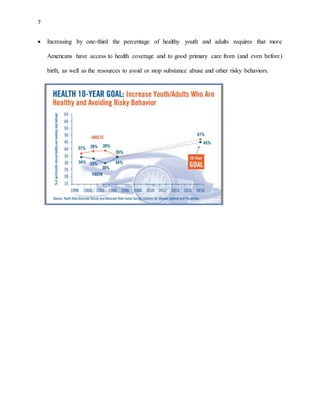
 Cutting the number of financially unstable working families by half requires strategies to help 
people increase income, save, and grow long-term assets.
7 
 Increasing by one-third the percentage of healthy youth and adults requires that more 
Americans have access to health coverage and to good primary care from (and even before) 
birth, as well as the resources to avoid or stop substance abuse and other risky behaviors.
8 
Current Challenges and Key Issues 
As a large organization with an intricate history, United Way is and has been for some time 
facing the challenge of picking and retaining the right people to lead their organization. 
Furthermore, establishing strategic and effective leadership within the individual, regional, and 
international United Way chapters has proved to be equally if not more difficult to control. One 
of the biggest issues with United Way and nonprofit charities overall is their organizational 
capabilities particularly in regards to hiring, motivating, and retaining human capital. Because 
human capital is the ultimate foundation of charitable giving companies, and because their 
business is conducted by asking for donations from others, United Way and other non9profit 
organizations must be able to recruit driven people who are able to ethically lead their 
organization to success. By first attaining the right employees who identify with the company’s 
mission and values, and second, successfully training them and developing them for leadership 
positions, United Way can avoid scandals such as having their president and CEO (as well as 
several other company executives) be convicted of “fraud, conspiracy, and money laundering” 
resulting in million dollar losses 
Another major challenge that United Way is facing now is the rising competition between 
nonprofit charities. In the wake of disastrous events such as 9/11 and Hurricane Katrina, “over 
40 percent of new nonprofits” have appeared since 2000, and more and more single9focus 
agencies continue to emerge. These new companies attract donors who believe that United Way 
has “support targets that were too broad, preferring, instead, to specify exactly where donations 
should go” Additionally, the company lost twenty9one nonprofit group memberships in the D.C. 
area to competitor Community1st, having been “lured away from United Way by a promise of 
lower overhead costs, easily customized fund9raising campaigns, and fewer restrictions on
9 
where donors money is directed ” Because of this, and because of their history of fraudulent 
cases, United Way must work harder than ever to achieve greater accountability in their financial 
operations. This challenge can be matched by effectively utilizing the people lever. Because 
people are United Way’s greatest resource, it is extremely important that they be able to 
collaborate across the different chapters and regions. Since the majority of the people who drive 
the individual chapters are unpaid volunteers, being able to motivate and excite them by 
matching them with the right projects is vital. Using social capital to leverage human capital 
between the parent organization and various local chapters will prove to be an important factor in 
United Way’s future success or continued demise. 
Core Competencies and Leadership Strategy 
United Way’s core competencies are its network of local chapters, partnership with the National 
Football League, and a strong brand name and organizational identity. There are few other 
nonprofit organizations that can replicate the UWW network of over 1,800 local affiliates (C18). 
As a federation the chapters all strive to meet the same mission, “to advance the common good 
by focusing on improving education, helping people achieve financial stability, and promoting 
healthy lives” .In order to inspire donors to give, advocate, and volunteer, United Way has 
partnered with the NFL since 1974 to “increase public awareness of social9service issues facing 
the country” . In the year following the initial United Way - NFL partnership, United Way 
became the first organization in history to raise over $1 billion dollars for its annual campaign. 
The 1974 campaign is only an episode of “120 years of solid financial performance and steady 
growth”. From such partnerships and a substantial network of local affiliates United Way has 
established a well9respected and well-known brand name for a nonprofit organization.
10 
Technology leaders mobilizing the caring power of the community. 
United Way is committed to insuring that our donors and key stakeholders have access to information 
about our organization in a timely and cost-effective manner. Technology is a great tool to help share 
this information, connect individuals to what they truly care about while building a community that’s 
more engaged and involved than ever. 
WHAT IS IT UNITED 
IT United is designed to deepen the understanding, commitment and support of technology 
leaders to United Way and to recognize their deep commitment to service. A team of prominent 
Chief Information Officers (CIOs) and technology leaders formed IT United in 2007. 
WHAT WE DO 
We bring together leaders in the technology industry in greater Atlanta and provide numerous 
benefits to our member companies, including: 
 Increased visibility of your organization in your local community. 
 Further business growth of your company. 
 A forum to interact with your customers and build stronger relationships. 
 A synergy for you to work with other technology leaders around a central cause, and through the 
annual CEO calls allows for individual time with top CIOs in greater Atlanta. 
WHAT IS THE CIO FORUM? 
This is an invitation only annual IT United Event that provides attendees a discussion panel of 
leading CIOs who will address key projects and technology efforts. Two Technology companies 
are also recognized for their leadership efforts and given awards from United Way of Greater 
Atlanta. 
Use technology to EDUCATE your employees and co-workers
11 
• Use electronic postcards tosend a daily or weekly message about United Way during the 
campaign 
• Provide LIVE UNITED video clips provided in the United Way Campaign Toolbox on your 
workplace intranet site or include them in newsletters. 
• Share links to key community reports that can be found in the United Way Campaign Toolbox 
to provide a backdrop of what is going on in the community 
• Provide a link to United Way on your company Web site. Use a variety of links to highlight 
different areas of United Way’s work. 
Use technology to CELEBRATE and SHARE RESULTS 
Use the electronic thermometer from the United Way’s Campaign Toolbox on your company 
intranet or via e-mail to track and share your results on a daily or weekly basis 
• Utilize an online auction forum to gain participation from across your workplace 
• Encourage employees to become fans of the United Way Facebook page. Feel free to post 
pictures of your fun company events on page to share
12 
Recommendations 
Upon becoming CEO, Brian Gallagher revised United Way’s mission statement and 
recommended Standards of Excellence. With these new requirements set in place, the local 
affiliates could serve their communities in a more effective way because they could follow the 
same goals to achieve success in their different communities. United Way Worldwide hoped 
“that by adopting these guidelines, the chapters would be able to provide tangible proof to 
donors, especially wealthy contributors, that United Way chapters and the charities they support 
were making a difference”. Donors in the different communities wanted to see that their 
donations were actually making a difference in their areas; with these new requirements for 
providing financial statements, donors are seeing where their donations are helping in their 
communities. Additionally, this will help headquarters watch over the different board members 
and make sure all chapters are financially accountable. These new guidelines help United Way 
Worldwide to leverage all of their existing resources and put them to use in desirable locations. 
The local communities will be able to achieve greater success when they have goals and 
resources that will help improve their communities over time. Moreover, we recommend making 
the Standards of Excellence mandatory among all affiliates. Through this, United Way will be 
able to establish commonality and unification. This standardization can be maximized with two 
new company9wide strategies: an online network to connect affiliates and annual conferences for 
volunteers and executive leaders. These strategies will generate greater social capital to 
ultimately leverage United Way’s most valuable resource – its people. These practices will 
solidify United Way’s competitive advantage in the increasingly competitive non9profit sector.
13 
Proposed Actions 
To help children and the youth achieve their potential, 
 Readiness to succeed in school means that children enter kindergarten developmentally on 
track. 
 Academic achievement means elementary-age students are prepared to succeed in later grades 
and to graduate from high school. 
 Academic achievement means elementary-age students are prepared to succeed in later grades 
and to graduate from high school. 
 Young adults, age 18 to 24, are making a successful transition from high school to the working 
world. 
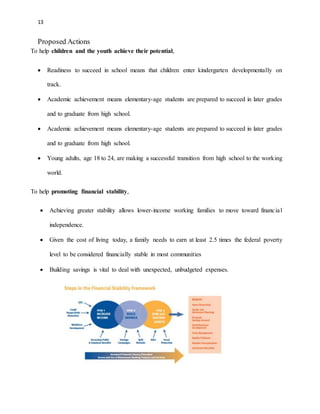
To help promoting financial stability, 
 Achieving greater stability allows lower-income working families to move toward financ ia l 
independence. 
 Given the cost of living today, a family needs to earn at least 2.5 times the federal poverty 
level to be considered financially stable in most communities 
 Building savings is vital to deal with unexpected, unbudgeted expenses.
14 
To help improving the health of children and adults, 
 Maternal health and infant well-being start children off in the right direction 
 Health care coverage for children more likely to receive preventive health care 
 The health of America s youth and adults is also a serious concern.
15 
UNITED WAY POLICY ENGAGEMENT 
United Way is a policy leader in the non-profit community because it helps to craft practical long-term 
solutions to human needs. It remains non-ideological and non-partisan in its advocacy, urging 
lawmakers to set aside partisanship and to work together. United Way uses its convening 
Power – bringing together all our partners: business, labor, non-profits, and advocates – to help 
find policy common ground to Advance the Common Good. 
United Way World wide’s Policy Agenda for the 113th Congress helps fulfill our obligation to 
assist policy-makers in crafting the best possible governmental policies in the areas of Education, 
Income and Health, and is an important component in United Way’s work to meet its 10-year 
national goals in these critical areas.
16 
United Way World wide’s policy agenda reflects the work and strategic direction of United Ways 
across the country in the areas of education, income, and health. Additionally, United Way 
Worldwide advocates for policies that will strengthen our communities’ capacity to advance the 
common good. Within each of these areas, based on United Way’s 10-year goals, United Way 
Worldwide has established its engagement strategies for each issue for the 113th Congress. The 
strategies fall into the following tier categories: 
TIER 1: Legislative Leadership Engagement 
United Way will assume a leadership role in advocacy on Capitol Hill, before the Administrat ion, 
and with the human services sector, proactively lobbying and bringing visibility to our issues. 
United Way will devote resources to research, policy development, grass-roots organization, and 
advocacy on these issues. 
TIER 2: Legislative Advocacy Engagement 
United Way will proactively develop positions, advocate, and generate grassroots support among 
local United Ways on an as-needed basis. 
TIER 3: Legislative Support Engagement 
United Way will monitor and respond to requests for support through such vehicles as “sign-on 
letters.” United Way will support the work of coalition partners who are the thought leaders on 
Tier 3 issues. 
In Education, The United Way system’s 10-year education goal is to cut the nation’s high school 
dropout rate in half; by 2018, 87% of high school seniors will graduate on time, up from 74% in 
2006.To accomplish this goal, United Way will focus on the following policy priorities: 
 Access to Quality Early Learning Opportunities Beginning at Birth 
 Middle and High School Retention and Re-enrollment
17 
 Parent and Community Engagement in Education 
In Income, the United Way system’s 10-year income goal is to cut in half the number of lower-income 
families who are financially unstable. By 2018, 82% of families with one or two parents 
working 50 or more weeks (combined) during the previous year and incomes less than 250% of 
the federal poverty level will spend less than 40%of their income on housing, down from 64% in 
2006. To accomplish this goal, United Way will focus on the following policy priorities: 
 Volunteer Income Tax Assistance (VITA) 
 Emergency Food and Shelter Program 
 Earned Income Tax Credit (EITC) 
 Affordable Housing 
In Health, the United Way system’s 10-year health goal is to increase by one-third the number 
of youth and adults who are healthy and avoid risky behavior. By 2018, 45% of youth and 47% 
of adults will be healthy and avoid risky behaviors, up from 34% of youth and 35% of adults in 
2005. To accomplish this goal, United Way will focus on the following policy priorities: 
 Increasing Children’s Health Coverage 
 Preserving Healthy Start Program Funding 
 Improving Child and Maternal Nutrition 
In Nonprofit Strengthening, United Way will strongly support policy initiatives that seek to 
strengthen the nonprofit sector through expansion of the 2-1-1 system, tax policy, and policy 
incentives and regulations that encourage philanthropy and volunteerism. 
To accomplish this goal, United Way will focus on the following policy priorities:
18 
 Protecting the Federal Charitable Deduction for All Those Who Donate to Charity 
 Preserving the Corporation for National and Community Service and AmeriCorps 
 Establishing a 2-1-1 Partnership with the Federal Government
19 
Corporate Partners 
The United Way Global Corporate Leadership (GCL) program leverages the commitment and 
caring power of national and global corporations with United Way's ability to improve lives and 
create lasting changes in communities across the country. Partnering with United Way provides 
companies a way to invest strategically in their communities and advance the common good by 
creating lasting, sustainable changes that lead to better, stronger places to live and work. 
United Way Global Corporate Leadership 
In partnership with 100 national and global corporations and nearly 1,800 community-based 
United Ways in 41 countries and territories, the Global Corporate Leadership Program (GCL) 
provides expert advice and resources to support corporate involvement and increase companies' 
capacity to improve lives and strengthen communities around the world. In the U.S., GCL 
companies have a combined total of eight million employees operating in more than 40,000 
locations and contribute more than $1 billion to their communities. 
The GCL program manages relationships with companies, providing a strategic, voice for the 
United Way system and providing opportunities to strengthen corporate philanthropic 
partnerships in communities. 
Typical characteristics of a GCL company 
 Partners with United Way in company's headquarter city 
 Invests at least US $1.25 million or 50% of campaigns of US $2.5 million or more in United 
Way's community impact work through annual corporate and employee contributions 
 Engages with United Way beyond the workplace giving campaign 
 Commits to partnering in the U.S. and a minimum of two to three additional countries
20 
United Way Worldwide Competition 
Social entrepreneurship, direct donations, giving circles and a trend toward targeting specific 
social sectors of need, have all had some effect on local United Way programs. It looks like United 
Way may have more competition in organizing social fundraising in the future. 
Nonprofit group leaders involved in Community1st said America s Charities lured them from the 
United Way by promising lower overhead costs, easily customized fundraising campaigns and 
fewer restrictions on where donor’s money is directed. 
In the cities of Austin and Orlando, where the government employees giving campaigns are 
through America s Charities, the average gift is $70 a person, according Don Sodo, CEO of 
America s Charities. In the Washington region, he said, so many government employees have 
declined to donate that the average is $7. 
Relationships between the organizations span a continuum from interdependence to 
direct competition 
“ The United Way has an Organizational Fund at our community foundation, which is endowed 
but with different criteria from other endowed funds. The community foundation also holds a 
challenge fund, which is not endowed. Our CEO is the former Executive Director of the United 
Way and during his tenure, the present Executive Director of United Way worked for him for five 
years. Several of the community foundation founders were former United Way leaders.”— 
Community Foundation Executive 
“ While lines are somewhat blurred now, both boards and executives work hard to maintain a good 
relationship. On all key community committees at United Way – impact councils, communit y
21 
assessment, capital funds, technology funds, etc. – the community foundation is represented, as it 
is when we do strategic planning. Finally, we have a funders coalition that is staffed by United 
Way, but includes the community foundation, government, and some private foundations. It meets 
monthly for coordination and collaboration. This is not a community that would tolerate a bad 
relationship between two loved organizations.” —United Way Executive 
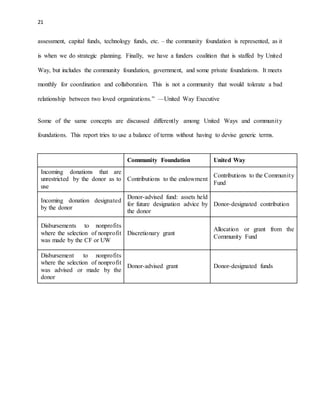
Some of the same concepts are discussed differently among United Ways and communit y 
foundations. This report tries to use a balance of terms without having to devise generic terms. 
Community Foundation United Way 
Incoming donations that are 
unrestricted by the donor as to 
use 
Contributions to the endowment 
Contributions to the Communit y 
Fund 
Incoming donation designated 
by the donor 
Donor-advised fund: assets held 
for future designation advice by 
the donor 
Donor-designated contribution 
Disbursements to nonprofits 
where the selection of nonprofit 
was made by the CF or UW 
Discretionary grant 
Allocation or grant from the 
Community Fund 
Disbursement to nonprofits 
where the selection of nonprofit 
was advised or made by the 
donor 
Donor-advised grant Donor-designated funds
22 
Relationships between the organizations span a continuum from interdependence 
to direct competition 
2 
How would you characterize the overall quality of the 
leadership between the two organizations? 
0 
10 
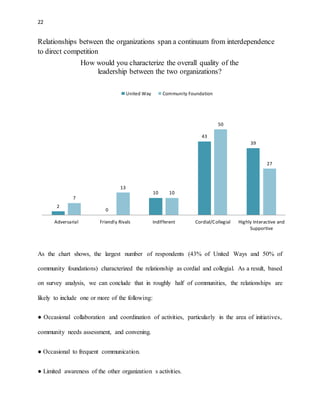
As the chart shows, the largest number of respondents (43% of United Ways and 50% of 
community foundations) characterized the relationship as cordial and collegial. As a result, based 
on survey analysis, we can conclude that in roughly half of communities, the relationships are 
likely to include one or more of the following: 
● Occasional collaboration and coordination of activities, particularly in the area of initiatives, 
community needs assessment, and convening. 
● Occasional to frequent communication. 
● Limited awareness of the other organization s activities. 
43 
39 
7 
13 
10 
50 
27 
Adversarial Friendly Rivals Indifferent Cordial/Collegial Highly Interactive and 
Supportive 
United Way Community Foundation
23 
● Absence of a proactive joint strategy or joint projects. 
A smaller number of respondents characterized the relationship as friendly rivalry, indifferent, or 
adversarial (19% of United Ways and 23% of community foundations respectively). In interviews 
and discussions with the researchers, respondents were more likely to characterize the relationships 
as adversarial or indifferent than the written surveys demonstrate. This divergence may mean that 
relationships are more collegial and supportive than conventional wisdom suggests, or it may 
reflect a desire in writing to be positive and statesmanlike. 
On the other end of the spectrum was unfriendly and even occasional acrimonious competition, 
often characterized by: 
● Competition for the position of community leader and “ownership” of initiatives or communit y 
successes 
●Direct competition for major donors 
● Infrequent or nonexistent communication between the leaders; 
● Frustration with the other organization about perceived duplication of services, products or 
fundraising strategy; 
●Relatively little funding of the other’s initiatives and participation in the other’s convening’s, 
often resentfully done. 
●Little discussion within either organization about an intentional strategy or stance towards the 
other.
24 
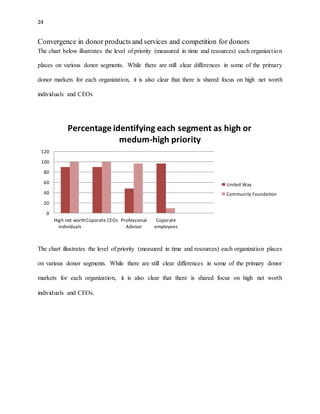
Convergence in donor products and services and competition for donors 
The chart below illustrates the level of priority (measured in time and resources) each organiza t ion 
places on various donor segments. While there are still clear differences in some of the primary 
donor markets for each organization, it is also clear that there is shared focus on high net worth 
individuals and CEOs 
120 
100 
80 
60 
40 
20 
0 
Percentage identifying each segment as high or 
High net worth 
individuals 
medum-high priority 
Coporate CEOs Professional 
The chart illustrates the level of priority (measured in time and resources) each organization places 
on various donor segments. While there are still clear differences in some of the primary donor 
markets for each organization, it is also clear that there is shared focus on high net worth 
individuals and CEOs. 
Advisor 
Coporate 
employees 
United Way 
Community Foundation
25 
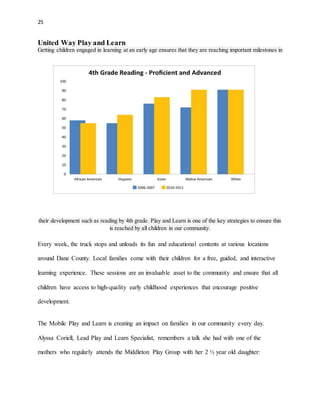
United Way Play and Learn 
Getting children engaged in learning at an early age ensures that they are reaching important milestones in 
their development such as reading by 4th grade. Play and Learn is one of the key strategies to ensure this 
is reached by all children in our community. 
Every week, the truck stops and unloads its fun and educational contents at various locations 
around Dane County. Local families come with their children for a free, guided, and interactive 
learning experience. These sessions are an invaluable asset to the community and ensure that all 
children have access to high-quality early childhood experiences that encourage positive 
development. 
The Mobile Play and Learn is creating an impact on families in our community every day. 
Alyssa Coriell, Lead Play and Learn Specialist, remembers a talk she had with one of the 
mothers who regularly attends the Middleton Play Group with her 2 ½ year old daughter:
26 
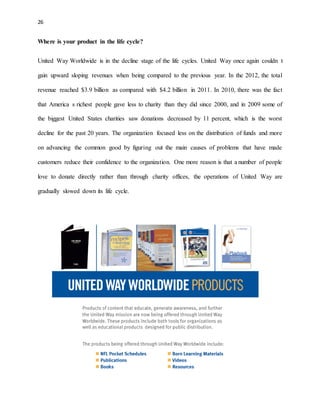
Where is your product in the life cycle? 
United Way Worldwide is in the decline stage of the life cycles. United Way once again couldn t 
gain upward sloping revenues when being compared to the previous year. In the 2012, the total 
revenue reached $3.9 billion as compared with $4.2 billion in 2011. In 2010, there was the fact 
that America s richest people gave less to charity than they did since 2000, and in 2009 some of 
the biggest United States charities saw donations decreased by 11 percent, which is the worst 
decline for the past 20 years. The organization focused less on the distribution of funds and more 
on advancing the common good by figuring out the main causes of problems that have made 
customers reduce their confidence to the organization. One more reason is that a number of people 
love to donate directly rather than through charity offices, the operations of United Way are 
gradually slowed down its life cycle.
27 
What kind of strategies did your company have, and what kind do you need now? 
In 2009, United Way Worldwide started a 10 year program, “Live United”, focused less on 
distribution of funds and more on advancing the common good by addressing main causes of 
problems in the major fields of education, financial stability, and health. 
To reply to troubles about confidence, CEO of United Way Worldwide set up new membership 
priorities to improve the scale of belief and transparency in United Way affiliates operation. He 
also aimed United Way as doing “what matters” in the communities involved. At last, he applied 
the “standard of excellence”, providing a description of benchmark codes and best practices to 
better reflects the organization s strategic shift from its traditional role as strictly a fund – raiser to 
a new mission concentrate on figuring out the long term needs of communities. 
As for finance, United Way provided fund raising operations, mainly through donor organizat ions 
employee payroll deductions, then distributed those funds to agencies that could actually deliver 
services to clients in the target community. 
The company should make their plans and campaigns public or perform on media so that the 
donors know clearly about their donations flow in order to gain their confidence because almost 
all donors love their money for charity to be directly sent to the people in need. 
Moreover, the company needs to focus on disasters victims and solutions to relieve their suffer ings 
in short-term and long-term to raise fund for suitable time periods to show that UW pays special 
attention to victims and people in need not only in urgent cases but also in upgrading solutions 
after disasters with the help of multi-media systems residentially, locally to boost donors care and 
shares.
28 
Learning Opportunities 
Providing a broad range of learning opportunities that allow local United Ways to succeed is an 
important function of United Way Worldwide. These learning opportunities give United Ways the 
ability to create connected strategic goals that enrich and maintain a consistent brand experience. 
Programs, Meetings, and Conference 
Learning programs span all United Way functions, including brand strategy and marketing, 
community engagement and public policy, resource development and relationship building. 
Conferences and regional meetings around the world, in-person courses and summits are some of the 
learning opportunities offered. A portion of each United Way’s membership investment (dues) is set 
aside as flexible training credits to offset the cost of training and professional development. An online 
United Way learning opportunities catalog has a full listing of offerings and how to use flexible 
training credits. 
Virtual Trainers and Webinars 
United Way Virtual Trainers and webinars are online and distance learning programs. They provide 
an opportunity for greater reach and increase the number of staff trained, while avoiding travel costs 
and time out of the office. Weekly webinars are available for utilization by our worldwide network, 
and are featured in “Breakfast with United Way” each day and indexed in the learning catalog. In 
2012, United Way Worldwide presented more than 110 webinars. 
Toolkits 
United Way Worldwide creates toolkits and assists in the implementation of new strategies. They 
provide examples of forms and publications, along with best practices from other United Ways. In 
many cases, progress is tracked through conference and follow-up calls with users. 
Examples of toolkits provided by United Way Worldwide include:
29 
 Born Learning Business Communications and Engagement Toolkits 
 Early Grade Reading Toolkit 
 Out-of-School Time Toolkit 
 Churn Tool and Matrix 
 Retention and Loyalty Toolkit 
Online Resources 
United Way Online, United Way World wide’s extranet, is the main form of communication between 
United Way Worldwide and United Way Member Organizations. Designed to facilitate continuous 
learning, development and exchange, new materials and tools are offered constantly. In addition, the 
online talent recruitment platform posted more than 500 positions for United Ways in 2012. Lusters 
provide real-time information sharing and assistance among network members.
30 
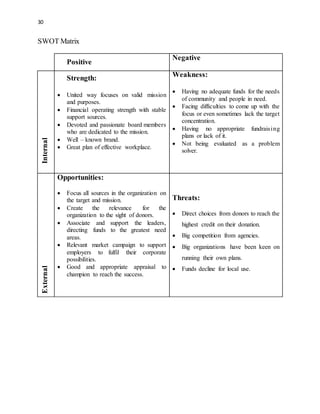
SWOT Matrix 
Positive 
Negative 
Internal 
Strength: 
 United way focuses on valid mission 
and purposes. 
 Financial operating strength with stable 
support sources. 
 Devoted and passionate board members 
who are dedicated to the mission. 
 Well – known brand. 
 Great plan of effective workplace. 
Weakness: 
 Having no adequate funds for the needs 
of community and people in need. 
 Facing difficulties to come up with the 
focus or even sometimes lack the target 
concentration. 
 Having no appropriate fundrais ing 
plans or lack of it. 
 Not being evaluated as a problem 
solver. 
External 
Opportunities: 
 Focus all sources in the organization on 
the target and mission. 
 Create the relevance for the 
organization to the sight of donors. 
 Associate and support the leaders, 
directing funds to the greatest need 
areas. 
 Relevant market campaign to support 
employers to fulfil their corporate 
possibilities. 
 Good and appropriate appraisal to 
champion to reach the success. 
Threats: 
 Direct choices from donors to reach the 
highest credit on their donation. 
 Big competition from agencies. 
 Big organizations have been keen on 
running their own plans. 
 Funds decline for local use.
31 
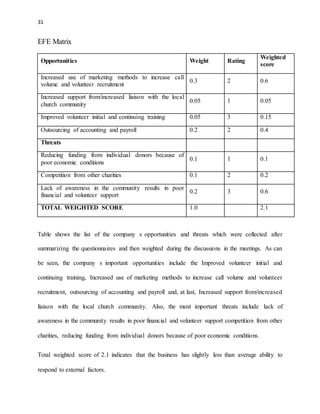
EFE Matrix 
Opportunities Weight Rating 
Weighted 
score 
Increased use of marketing methods to increase call 
volume and volunteer recruitment 
0.3 2 0.6 
Increased support from/increased liaison with the local 
church community 
0.05 1 0.05 
Improved volunteer initial and continuing training 0.05 3 0.15 
Outsourcing of accounting and payroll 0.2 2 0.4 
Threats 
Reducing funding from individual donors because of 
poor economic conditions 
0.1 1 0.1 
Competition from other charities 0.1 2 0.2 
Lack of awareness in the community results in poor 
financial and volunteer support 
0.2 3 0.6 
TOTAL WEIGHTED SCORE 1.0 2.1 
Table shows the list of the company s opportunities and threats which were collected after 
summarizing the questionnaires and then weighted during the discussions in the meetings. As can 
be seen, the company s important opportunities include the Improved volunteer initial and 
continuing training, Increased use of marketing methods to increase call volume and volunteer 
recruitment, outsourcing of accounting and payroll and, at last, Increased support from/increased 
liaison with the local church community. Also, the most important threats include lack of 
awareness in the community results in poor financial and volunteer support competition from other 
charities, reducing funding from individual donors because of poor economic conditions. 
Total weighted score of 2.1 indicates that the business has slightly less than average ability to 
respond to external factors.
32 
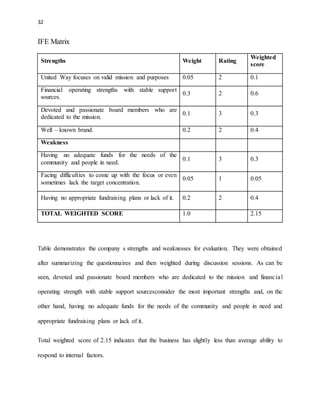
IFE Matrix 
Strengths Weight Rating 
Weighted 
score 
United Way focuses on valid mission and purposes 0.05 2 0.1 
Financial operating strengths with stable support 
sources. 
0.3 2 0.6 
Devoted and passionate board members who are 
dedicated to the mission. 
0.1 3 0.3 
Well – known brand. 0.2 2 0.4 
Weakness 
Having no adequate funds for the needs of the 
community and people in need. 
0.1 3 0.3 
Facing difficulties to come up with the focus or even 
sometimes lack the target concentration. 
0.05 1 0.05 
Having no appropriate fundraising plans or lack of it. 0.2 2 0.4 
TOTAL WEIGHTED SCORE 1.0 2.15 
Table demonstrates the company s strengths and weaknesses for evaluation. They were obtained 
after summarizing the questionnaires and then weighted during discussion sessions. As can be 
seen, devoted and passionate board members who are dedicated to the mission and financia l 
operating strength with stable support sourcesconsider the most important strengths and, on the 
other hand, having no adequate funds for the needs of the community and people in need and 
appropriate fundraising plans or lack of it. 
Total weighted score of 2.15 indicates that the business has slightly less than average ability to 
respond to internal factors.
33 
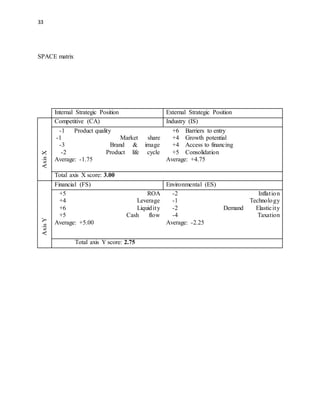
SPACE matrix 
Internal Strategic Position External Strategic Position 
Competitive (CA) Industry (IS) 
Axis X 
-1 Product quality 
-1 Market share 
-3 Brand & image 
-2 Product life cycle 
Average: -1.75 
+6 Barriers to entry 
+4 Growth potential 
+4 Access to financing 
+5 Consolidation 
Average: +4.75 
Total axis X score: 3.00 
Financial (FS) Environmental (ES) 
Axis Y 
+5 ROA 
+4 Leverage 
+6 Liquidity 
+5 Cash flow 
Average: +5.00 
-2 Inflat ion 
-1 Technology 
-2 Demand Elastic ity 
-4 Taxation 
Average: -2.25 
Total axis Y score: 2.75
34 
+6 
+2.75 
+1 
-1 +1 
Conservative 
-6 
-6 
+6 
(3.00; 2.75) 
+3 
Defensive 
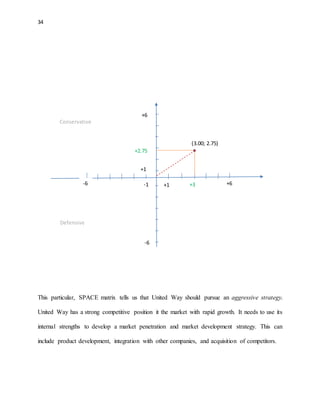
This particular, SPACE matrix tells us that United Way should pursue an aggressive strategy. 
United Way has a strong competitive position it the market with rapid growth. It needs to use its 
internal strengths to develop a market penetration and market development strategy. This can 
include product development, integration with other companies, and acquisition of competitors.
35 
Quantitative Strategic Planning Matrix 
Key Factors Market 
development 
Market 
penetration 
Opportunities Weight AS TAS AS TAS 
Increased use of marketing methods to 
0.3 2 0.6 - - 
increase call volume and volunteer 
recruitment 
Increased support from/increased liaison 
with the local church community 
0.05 1 0.05 2 0.1 
Improved volunteer initial and continuing 
training 
0.05 3 0.15 1 0.05 
Outsourcing of accounting and payroll 0.2 4 0.8 2 0.4 
Threats 
Reducing funding from individual donors 
0.1 2 0.2 3 0.3 
because of poor economic conditions 
Competition from other charities 0.1 3 0.3 3 0.3 
Lack of awareness in the community 
0.2 3 0.6 1 0.2 
results in poor financial and volunteer 
support 
1.0 
Strengths 
United way focuses on valid mission and 
purposes 
0.05 2 0.1 1 0.05 
Financial operating strength with stable 
support sources. 
0.3 2 0.6 2 0.6 
Devoted and passionate board members 
who are dedicated to the mission. 
0.1 4 0.4 1 0.1 
Well – known brand. 0.2 2 0.4 4 0.8 
Weakness 
Having no adequate funds for the needs of 
0.1 3 0.3 2 0.2 
community and people in need. 
Facing difficulties to come up with the 
focus or even sometimes lack the target 
concentration. 
0.05 2 0.1 3 0.15 
Having no appropriate fundraising plans 
or lack of it. 
0.2 1 0.2 2 0.4 
1.0 
Total sum of attractiveness score 4.8 3.65 
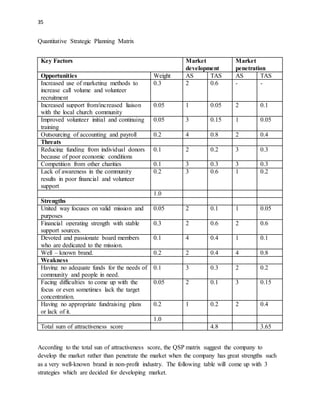
According to the total sun of attractiveness score, the QSP matrix suggest the company to 
develop the market rather than penetrate the market when the company has great strengths such 
as a very well-known brand in non-profit industry. The following table will come up with 3 
strategies which are decided for developing market.
36 
Key Factors 
CORPORATION: 
NFL & United 
Way Hometown 
Huddle 
and United Way 
TEAM NFL 
Create event: 
Share Your 
Story and 
improving 
financial status 
through 
donating 
Use technology to 
EDUCATE your 
employees and co 
workers 
Opportunities Weight AS TAS AS TAS AS TAS 
Increased use of 
0.3 2 0.6 2 0.6 3 0.9 
marketing methods 
to increase call 
volume and 
volunteer 
recruitment 
Increased support 
from/increased 
liaison with the 
local church 
community 
0.05 1 0.05 2 0.1 2 0.1 
Improved volunte er 
initial and 
continuing training 
0.05 3 0.15 1 0.05 4 0.2 
Outsourcing of 
accounting and 
payroll 
0.2 4 0.8 2 0.4 3 0.6 
Threats 
Reducing funding 
from individual 
donors because of 
poor economic 
conditions 
0.1 2 0.2 3 0.3 2 0.2 
Competition from 
other charities 
0.1 3 0.3 3 0.3 2 0.2 
Lack of awareness 
in the communit y 
results in poor 
financial and 
volunteer support 
0.2 3 0.6 4 0.8 4 0.8 
1.0 
Strengths 
United way focuses 
on valid mission 
and purposes 
0.05 2 0.1 1 0.05 2 0.1
37 
Financial operating 
strength with stable 
support sources. 
0.3 2 0.6 2 0.6 3 0.9 
Devoted and 
passionate board 
members who are 
dedicated to the 
mission. 
0.1 4 0.4 1 0.1 3 0.3 
Well – known 
brand. 
0.2 2 0.4 4 0.8 1 0.2 
Weakness 
Having no adequate 
funds for the needs 
of community and 
people in need. 
0.1 3 0.3 2 0.2 2 0.2 
Facing difficult ies 
to come up with the 
focus or even 
sometimes lack the 
target 
concentration. 
0.05 2 0.1 3 0.15 3 0.15 
Having no 
appropriate 
fundraising plans or 
lack of it. 
0.2 1 0.2 2 0.4 2 0.4 
1.0 
Total sum of the 
attractiveness score 
4.8 4.85 5.25 
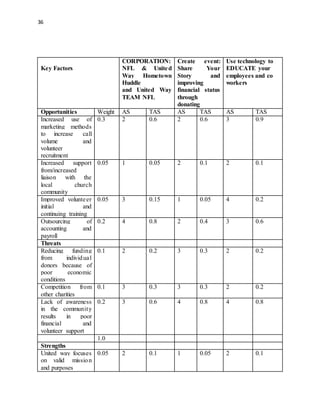
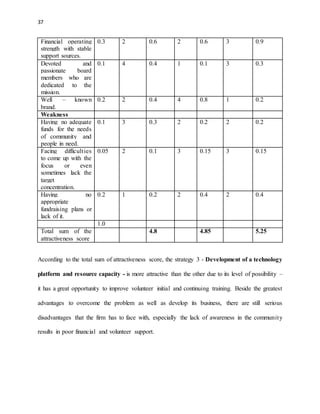
According to the total sum of attractiveness score, the strategy 3 - Development of a technology 
platform and resource capacity - is more attractive than the other due to its level of possibility – 
it has a great opportunity to improve volunteer initial and continuing training. Beside the greatest 
advantages to overcome the problem as well as develop its business, there are still serious 
disadvantages that the firm has to face with, especially the lack of awareness in the communit y 
results in poor financial and volunteer support.
38 
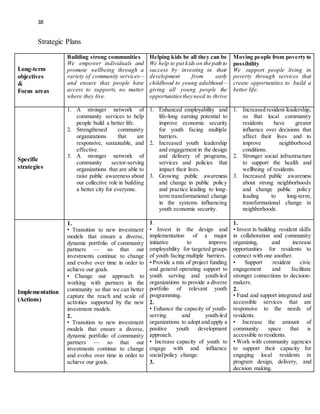
Strategic Plans 
Long-term 
objectives 
& 
Focus areas 
Building strong communities 
We empower individuals and 
promote wellbeing through a 
variety of community services— 
and ensure that people have 
access to supports, no matter 
where they live. 
Helping kids be all they can be 
We help to put kids on the path to 
success by investing in their 
development from early 
childhood to young adulthood— 
giving all young people the 
opportunities they need to thrive 
Moving people from poverty to 
possibility 
We support people living in 
poverty through services that 
create opportunities to build a 
better life. 
Specific 
strategies 
1. A stronger network of 
community services to help 
people build a better life. 
2. Strengthened community 
organizations that are 
responsive, sustainable, and 
effective. 
3. A stronger network of 
community sector-serving 
organizations that are able to 
raise public awareness about 
our collective role in building 
a better city for everyone. 
1. Enhanced employability and 
life-long earning potential to 
improve economic security 
for youth facing multiple 
barriers. 
2. Increased youth leadership 
and engagement in the design 
and delivery of programs, 
services and policies that 
impact their lives. 
3. Growing public awareness 
and change in public policy 
and practice leading to long-term 
transformational change 
in the systems influencing 
youth economic security. 
1. Increased resident leadership, 
so that local community 
residents have greater 
influence over decisions that 
affect their lives and to 
improve neighborhood 
conditions. 
2. Stronger social infrastructure 
to support the health and 
wellbeing of residents. 
3. Increased public awareness 
about strong neighborhoods 
and change public policy 
leading to long-term, 
transformational change in 
neighborhoods. 
Implementation 
(Actions) 
1. 
• Transition to new investment 
models that ensure a diverse, 
dynamic portfolio of community 
partners — so that our 
investments continue to change 
and evolve over time in order to 
achieve our goals. 
• Change our approach to 
working with partners in the 
community so that we can better 
capture the reach and scale of 
activities supported by the new 
investment models. 
2. 
• Transition to new investment 
models that ensure a diverse, 
dynamic portfolio of community 
partners — so that our 
investments continue to change 
and evolve over time in order to 
achieve our goals. 
1. 
• Invest in the design and 
implementation of a major 
initiative to improve 
employability for targeted groups 
of youth facing multiple barriers. 
• Provide a mix of project funding 
and general operating support to 
youth serving and youth-led 
organizations to provide a diverse 
portfolio of relevant youth 
programming. 
2. 
• Enhance the capacity of youth-serving 
and youth-led 
organizations to adopt and apply a 
positive youth development 
approach. 
• Increase capacity of youth to 
engage with and influence 
social/policy change. 
3. 
1. 
• Invest in building resident skills 
in collaboration and community 
organizing, and increase 
opportunities for residents to 
connect with one another. 
• Support resident civic 
engagement and facilitate 
stronger connections to decision-makers. 
2. 
• Fund and support integrated and 
accessible services that are 
responsive to the needs of 
residents. 
• Increase the amount of 
community space that is 
accessible to residents. 
• Work with community agencies 
to support their capacity for 
engaging local residents in 
program design, delivery, and 
decision making.
39 
• Change our approach to 
working with partners in the 
community so that we can better 
capture the reach and scale of 
activities supported by the new 
investment models. 
3. 
• Support planning, research and 
evaluation activities related to 
key social/policy issues affecting 
the sector. 
• Invest in collaborations / 
partnerships and organizations 
that focus on sector issues. 
• Collaborate with key 
stakeholders (including youth and 
other funders) to influence key 
policies and practices related to 
youth economic security and/or 
positive youth development. 
3. 
• Champion a place-based 
approach among policy makers, 
funders and donors, and 
community organizations in 
targeting efforts where they’re 
needed most. 
• Collaborate with other key 
stakeholders to influence policies 
related to place-based 
interventions. 
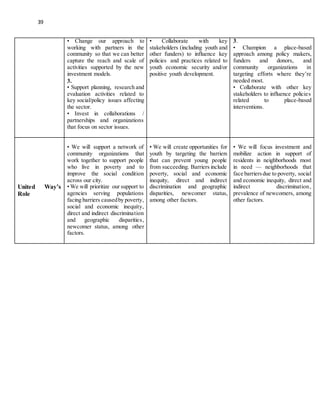
United Way’s 
Role 
• We will support a network of 
community organizations that 
work together to support people 
who live in poverty and to 
improve the social condition 
across our city. 
• We will prioritize our support to 
agencies serving populations 
facing barriers caused by poverty, 
social and economic inequity, 
direct and indirect discrimination 
and geographic disparities, 
newcomer status, among other 
factors. 
• We will create opportunities for 
youth by targeting the barriers 
that can prevent young people 
from succeeding. Barriers include 
poverty, social and economic 
inequity, direct and indirect 
discrimination and geographic 
disparities, newcomer status, 
among other factors. 
• We will focus investment and 
mobilize action in support of 
residents in neighborhoods most 
in need — neighborhoods that 
face barriers due to poverty, social 
and economic inequity, direct and 
indirect discrimination, 
prevalence of newcomers, among 
other factors.
40 
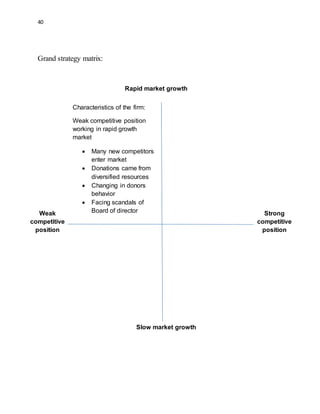
Grand strategy matrix: 
Weak 
competitive 
position 
Strong 
competitive 
position 
Rapid market growth 
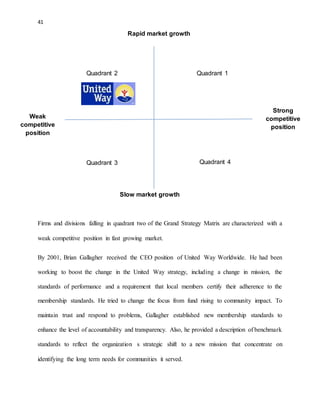
Characteristics of the firm: 
Weak competitive position 
working in rapid growth 
market 
 Many new competitors 
enter market 
 Donations came from 
diversified resources 
 Changing in donors 
behavior 
 Facing scandals of 
Board of director 
Slow market growth
41 
Weak 
competitive 
position 
Rapid market growth 
Firms and divisions falling in quadrant two of the Grand Strategy Matrix are characterized with a 
weak competitive position in fast growing market. 
By 2001, Brian Gallagher received the CEO position of United Way Worldwide. He had been 
working to boost the change in the United Way strategy, including a change in mission, the 
standards of performance and a requirement that local members certify their adherence to the 
membership standards. He tried to change the focus from fund rising to community impact. To 
maintain trust and respond to problems, Gallagher established new membership standards to 
enhance the level of accountability and transparency. Also, he provided a description of benchmark 
standards to reflect the organization s strategic shift to a new mission that concentrate on 
identifying the long term needs for communities it served. 
Strong 
competitive 
position 
Quadrant 2 Quadrant 1 
Quadrant 3 Quadrant 4 
Slow market growth
42 
Financial Statements 
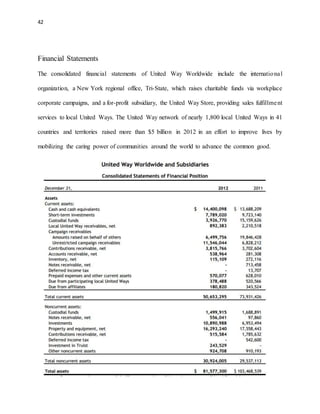
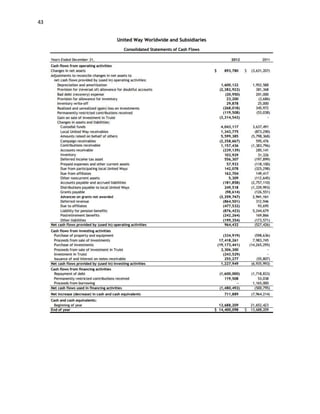
The consolidated financial statements of United Way Worldwide include the international 
organization, a New York regional office, Tri-State, which raises charitable funds via workplace 
corporate campaigns, and a for-profit subsidiary, the United Way Store, providing sales fulfillme nt 
services to local United Ways. The United Way network of nearly 1,800 local United Ways in 41 
countries and territories raised more than $5 billion in 2012 in an effort to improve lives by 
mobilizing the caring power of communities around the world to advance the common good.
43
44 
Accounts Receivable 
Accounts receivable consist primarily of amounts due from the sale of services or goods. The 
allowance method is used to determine the uncollectible amounts. An allowance for uncollectible 
accounts receivable is provided based on management’s judgment, including such factors as 
prior collection history. Accounts receivable are written off if reasonable collection efforts prove 
unsuccessful. 
Inventory 
Inventory consists of United Way products and campaign materials as well as other promotional 
materials held for sale. Inventory is stated at the lower of cost or market, and is valued using the 
weighted-average cost method. When inventory is determined to be excessive or obsolete, it is 
reduced by an allowance for estimated excess or obsolete inventory. UW Store wrote off $29,878 
and $25,000 of obsolete inventory for the years ended 2012 and 2011, respectively, and had an 
allowance of $28,107 and $4,907 at December 31, 2012 and 2011, respectively. 
Investments 
Investments are reported at fair value based on quoted market prices. Investments classified as 
short-term are available for operations in the next fiscal year. Unrealized and realized gains and 
losses are included in the accompanying consolidated statements of activities. Investment 
earnings are reported net of related expenses, such as custodial, commission, and investment 
advisory fees.
45 
Investment in Truist 
The investment in Truist is reported at fair value that reflects the present value of Truist’s 
projected future cash inflows and earnings, which approximates its carrying value of $243,529 at 
December 31, 2012. 
Net Assets 
Unrestricted Net Assets 
Unrestricted net assets are available for use in general operations. Board designated net assets is 
a component of unrestricted net assets, which is a quasi-endowment, established by the Board of 
Trustees for the purpose of securing the Organization’s long-term financial viability. 
Temporarily Restricted Net Assets 
Temporarily restricted net assets consist of amounts that are subject to donor restrictions. The 
Organization is permitted to use or expend the donated assets in accordance with the donor 
restriction. 
Permanently Restricted Net Assets 
Permanently restricted net assets consist of assets whose use is limited by donor-imposed 
restrictions that neither expire by the passage of time nor can be fulfilled or otherwise removed 
by actions of the Organization. The restrictions stipulate that resources be maintained 
permanently but permit the Organization to expend the income generated in accordance with the 
provisions of the agreement.
46 
Summary of Significant Accounting Policies 
Functional Allocation of Expenses 
The costs of providing various program and supporting activities have been summarized on a 
functional basis in the consolidated statements of activities. Accordingly, certain costs have been 
allocated among the programs and supporting services benefited. 
Donated Services and Materials 
A substantial number of volunteers have donated significant amounts of time to the 
Organization’s program services and to its fund-raising campaigns. No amounts have been 
recognized in the consolidated statements of activities since time contributed by Organization 
volunteers do not fall into the criteria established by the Financial Accounting Standards Board 
in this area. Donated materials, including software, are recorded at fair value at the date of 
donation. 
The Organization records donated services, including advertising, at the fair market value of the 
services received. 
Endowment 
The Organization’s endowment consists of one fund established for the purpose of providing 
home care and assisted living to the elderly poor, with specific reference to assisting older people 
to remain in their own homes. As required by generally accepted accounting principles, net 
assets associated with endowment funds are classified and reported based on the existence or 
absence of donor-imposed restrictions.
47 
Revenue Recognition 
UWW Membership Revenue 
Membership revenue is recorded ratably over the calendar year membership term. Membership 
of UWW allows local United Ways to use the name owned by UWW, during the period of 
membership. Membership support is based on a formula driven process. As of December 31, 
2012 and 2011, the amount of the deferred training credit was $2,568,848 and $2,938,165, 
respectively. 
UWW Contributions Revenue 
UWW recognizes contributions received and made, including unconditional promises to give, as 
revenue in the period received or made. Contributions received are reported as unrestricted 
support, temporarily restricted support, or permanently restricted support. Temporarily restricted 
contributions that are used for the purpose specified by the donor in the same year as the 
contribution is received are recognized as temporarily restricted contributions and are 
reclassified as net assets released from restrictions in the same year. Promises to contribute that 
stipulate conditions to be met before the contribution is made are not accrued until the conditions 
are met. As of December 31, 2012 and 2011, UWW had received conditional promises to give 
totaling $5,800,000 for the renovation of the office building in Alexandria, Virginia. 
Expenses 
Expenses are recognized by the Organization during the period in which they are incurred. 
Expenses paid in advance and not yet incurred are deferred to the applicable period.
48 
Recommendation Objectives 
In the 2015 fiscal year, United Way will build on our work to promote volunteerism and develop 
strong organizations able to address community needs. Specifically, we will: 
 Strengthen nonprofit volunteer engagement 
 Connect people to range of volunteer experiences 
 Communicate the impact of volunteerism 
 Mobilize volunteers strategically 
 Increase the number of volunteers 
Whenever possible these approaches will be targeted to support organizations and activities 
aligned with our priorities. Specific strategies and investments include: 
 Volunteer Impact Partnership: VIP 360 (up to 18 organizations engage in planning, peer 
support and training to make better use of volunteers) and VIP Manager Corps (10 hour/week 
pro bono volunteer support for up to 20 organizations) 
 Governance training and resources, including Project LEAD leadership development 
program preparing people of color for civic leadership opportunities 
 Broadening funder support for volunteerism and engaging nonprofit leaders in shifting 
organizational view of volunteers 
 Volunteer mobilization via regional networks, volunteer listings online, Days of Service 
(Day of Caring and Martin Luther King Day), and support for corporate volunteerism.
49 
Recommendation Strategies and Evaluation 
Assumptions behind the Theory 
We recognize that quality and effectiveness require infrastructure and administrative support, 
and flexibility to maximize leverage of other, more rigid funding. We also recognize that stable, 
reliable funding is important to maintaining a healthy service sector. We do our best to balance 
stability in our funding with the nimbleness to learn from results, refine strategy for greater 
community impact, and respond to emerging needs. We maintain high standards for 
administrative capacity, fiscal accountability and outcome evaluation to ensure our grant dollars 
are used to promote real change in the lives of vulnerable people. 
Investment Strategy and Results 
Our central strategy is grant making to fund services to help vulnerable people in our 
community. We invest in services that are essential to a healthy community, are critical to 
addressing our priorities, and are in areas in which our funding makes a difference. These 
investments support seven results connected with our community impact priorities and six results 
that we consider foundational to all our work. In fiscal year 2015, we will invest an estimated 
$11,173,000 in Core Services to Help People in Need that are connected with our priorities. We 
will invest another $10,267,000 in fiscal year 2015 for a broad range of Core Services to Help 
People in Need that are foundational to all our results. Core Service investments will touch the 
lives of 450,000 individuals in this time frame.
50 
Core Services Connected with Priorities: 
Description of specific investment strategies and funding changes are described in the Strategy 
and Investment Plan for each priority and the Appendices. 
Helping People Meet their Basic Needs 
 Food banks will provide services for more than one million visits 
 2,000 people will increase their income through job training and employment services 
Ending Homelessness 
 14,000 people will receive emergency shelter 
 8,000 people will gain or maintain permanent housing through supportive services in shelter 
and housing programs 
Giving All Kids an Equal Chance to Succeed 
 3,000 parents will be informed, supported and engaged through parent education and 
involvement programs 
 Early care and education providers will deliver high quality care through a range of quality 
initiatives for formal and informal care providers including information and referral to 
quality child care for 7,000 parents 
 5,000 young children will be supported in meeting developmental milestones through 
activities and services to ensure early intervention for children with developmental delays 
and child abuse prevention and intervention services
51 
Foundational Core Services 
Foundational Core Services include a diverse set of investments to ensure people have access 
to help when they need it. There are six specific results that we identify as foundational. We 
are currently working to implement best practices in three of these areas. 
These are the goals for the six results in our foundational core services to help people in 
need: 
 1,000 youth and young adults will gain the education and work skills they need to be 
successful in work and life through the middle grades success efforts Approved by the 
United Way of King County Board of Directors January 14, 2014 
 38,000 youth will achieve positive social development through high quality out of school 
time programs 
 3,000 individuals and families will live in safe home environment through services for 
survivors of domestic violence and sexual assault and their families 
 98,000 people will experience optimal mental and emotional well-being through 
counseling and treatment programs 
 4,200 people will be empowered to manage their own health through the Wellness 
Project, community health and dental clinics, and programs for older adults, adults with 
disabilities and adults with chronic health conditions 
 230,000 people will have easy access to services through information lines and 
emergency services
52 
United Way and organized labor work together to: 
 Train union members to assist co-workers and their families with information about 
available local services and to refer them to the appropriate organizations. 
 Recruit, train and help place members of organized labor on the decision-making bodies of 
health and human-service organizations. This is done at the national, state and local levels. 
 Recognize labor leaders who have rendered outstanding United Way volunteer service by 
annually awarding the Joseph A. Bernie Community Services Award, established in 
memory of that remarkable labor leader. 
 Solicit contributions from workers through payroll deduction, which account for 
approximately two-thirds of the funds that United Ways raise each year. Through the Labor 
Letters of Endorsement Program of the Department of Labor Participation, the AFL-CIO 
president asks presidents of AFL-CIO-affiliated unions, state federations and central labor 
councils to send letters endorsing United Way campaigns to their memberships. The Labor 
Letters of Endorsement Program encourages individual union members to volunteer their 
time and contribute their resources to United Way campaigns. 
 Provide a staff of more than 160 full-time AFL-CIO Community Services Liaisons to serve 
as links between their state federations and central labor councils and United Ways in 165 
communities across the United States. In addition, 18 local labor agencies and four state 
labor agencies receive direct United Way support. 
 Support the National Association of Letter Carriers' (NALC) National Food Drive held 
annually on the second Saturday in May. The drive stocks local community food banks, 
pantries and shelters with non-perishables that Letter Carriers collect from customers along 
their mail routes. The drive, which has become the world's largest one-day food drive, was
53 
started by NALC in 1991 in cooperation with the U.S. Postal Service and the AFL-CIO. 
United Way is a full partner in this drive. 
ACCOUNTABILITY 
At United Way, we know success is measured by how our mission is achieved — to make 
measurable improvements in communities. Setting high standards for ourselves and for 
our local partners is critical for that success. 
Annually, all United Way Worldwild certify their adherence to standards that include 
comprehensive requirements for financial reporting, governance, ethics, diversity and operations. 
Specifically, United Ways must meet the following: 
 Tax-Exempt Status — all United Way Worldwild must be tax-exempt under Section 
501(c)(3) of the Internal Revenue Code as well as corresponding provisions of other 
applicable state, local or foreign laws or regulations. 
 Governance — United Way Worldwild are governed by active, responsible, and 
voluntary governing boards to ensure effective governance over the policies and financial 
resources of the organization. These boards are responsible for United Ways delivering 
on their mission to advance the common good. 
 Ethics — all United Way Worldwild follow locally adopted codes of ethics for 
volunteers and staff that include provisions for ethical management, publicity, 
fundraising practices and full and fair disclosure. 
 Diversity — United Way Worldwild have adopted policies/statements to ensure 
volunteers and staff broadly reflect the diversity of the community served.
54 
 Financial Accountability — United Way Worldwild undergo annual financial audits 
conducted by independent certified public accountants whose examination complies with 
generally accepted auditing standards. In addition, United Way Worldwild have 
developed comprehensive requirements for completion of audited financial statements to 
ensure consistency and transparency system-wide. These requirements are based on 
industry best practices and comport with generally accepted accounting principles. 
Smaller United Way Worldwild (with less than $100,000 in annual revenue) may 
undergo an independent financial review. 
 Performance Excellence — every three years, United Way Worldwild conduct self-assessments 
of their governance, financial management and impact in the community. 
 Public Reporting and Disclosure — United Way Worldwild must file the IRS Form 
990 in a timely manner and will provide the IRS Form 990 on their website, at their 
offices, or upon request. 
 Legal — United Ways comply with all applicable local, state and federal operating and 
reporting requirements. 
 Support the United Way Network — United Way Worldwild provide financial support 
to United Way Worldwide and follow standards to use United Way's trademarks. United 
Ways charge fees based on actual expenses for donor-designated gifts and other 
processing services.
55 
MARKETING CAMPAINGE
56 
References 
http://www.compasspoint.org/sites/default/files/docs/research/4_cpunitedwaycommunityfdn.pdf 
http://unway.3cdn.net/dbd6fa2b43834cf086_3dfm60ejh.pdf 
https://s3.amazonaws.com/unway.3cdn.net/44b4e2e585f165a2f4_6tm6vdhyo.pdf 
http://www.unitedway.org/partners/labor/ 
http://www.unitedwayatlanta.org/our-community/it-united/ 
http://conferences.unitedway.org/CLC#header-9 
http://www.unitedway.org/pages/WLC/ 
http://www.unitedway.org/pages/mission-and-goals 
http://www.unitedway.org/partners/corporate-partners/ 
http://www.weareunited.com/img/assets/agendaforcommunity%20impact.pdf 
http://www.unitedwaytoronto.com/document.doc?id=34 
http://worldwide.unitedway.org/pages/what- is-united-way 
http://worldwide.unitedway.org/pages/community-decision-making 
http://worldwide.unitedway.org/pages/organizational-background 
https://secure.worldwide.unitedway.org/page/contribute/ 
http://worldwide.unitedway.org/pages/international-support- fund 
http://worldwide.unitedway.org/news/entry/day-of-action-running- from-the-heart 
http://www.wikiprogress.org/index.php/Community_Assessment_Project_(CAP) 
http://www.unitedway.org/pages/materials-psas 
http://www.unitedway.org/pages/materials-banners

United Way Worldwide Report

  • 1.
    CLASS 1 -GROUP 2 Nguyen Hai Phuong Hanh 295034 Do Thi Phuong Dung 295022 Le Thi Thanh Tam 295897 UNITED WAY WORLDWIDE STRATEGIC MANAGEMENT Lecturer: Prof. Thomas Bradley
  • 2.
    1 Contents BACKGROUND....................................................................................................................................3 United Way Worldwide VISION .....................................................................................................3 United Way Worldwide MISSION...................................................................................................3 Influencing Policy, Systems Change and Development ......................................................................4 Objectives ......................................................................................................................................6 Current Challenges and Key Issues .......................................................................................................8 Core Competencies and Leadership Strategy ....................................................................................9 Technology leaders mobilizing the caring power of the community. .................................................... 10 WHAT IS IT UNITED.................................................................................................................. 10 WHAT WE DO ............................................................................................................................ 10 WHAT IS THE CIO FORUM? ...................................................................................................... 10 Recommendations............................................................................................................................ 12 Proposed Actions .......................................................................................................................... 13 UNITED WAY POLICY ENGAGEMENT .................................................................................................. 15 TIER 1: Legislative Leadership Engagement .................................................................................. 16 TIER 2: Legislative Advocacy Engagement.................................................................................... 16 TIER 3: Legislative Support Engagement ....................................................................................... 16 Corporate Partners ........................................................................................................................... 19 United Way Global Corporate Leadership ...................................................................................... 19 Typical characteristics of a GCL company...................................................................................... 19 United Way Worldwide Competition ................................................................................................. 20 Relationships between the organizations span a continuum .............................................................. 22 Convergence in donor products and services and competition for donors .......................................... 24 United Way Play and Learn ........................................................................................................... 25 Learning Opportunities ..................................................................................................................... 28 Programs, Meetings, and Conference ............................................................................................. 28 Virtual Trainers and Webinars ....................................................................................................... 28 Toolkits........................................................................................................................................ 28 Online Resources .......................................................................................................................... 29 SWOT Matrix .................................................................................................................................... 30 EFE Matrix........................................................................................................................................ 31
  • 3.
    2 IFE Matrix.........................................................................................................................................32 SPACE matrix.................................................................................................................................... 33 Quantitative Strategic Planning Matrix............................................................................................... 35 Strategic Plans .................................................................................................................................. 38 Grand strategy matrix: ...................................................................................................................... 40 Financial Statements......................................................................................................................... 42 Summary of Significant Accounting Policies........................................................................................ 46 Revenue Recognition ........................................................................................................................ 47 Recommendation Objectives............................................................................................................. 48 Recommendation Strategies and Evaluation ...................................................................................... 49 ACCOUNTABILITY.............................................................................................................................. 53 MARKETING CAMPAINGE ................................................................................................................. 55 References ....................................................................................................................................... 56
  • 4.
    3 BACKGROUND UnitedWay Worldwide is the leadership and support organization for the network of nearly 1,800 community-based United Ways in 45 countries and territories. We advance the common good by focusing on improving education, helping people achieve financial stability, and promoting healthy lives, and by mobilizing millions of people to give, advocate, and volunteer to improve the conditions in which they live. United Way Worldwide VISION United Way envisions a world where all individuals and families achieve their human potential through education, income stability and healthy lives. Imagine a world that fosters hope and opportunity for everyone…  Where all children receive a quality education that offers a pathway to a brighter tomorrow  Where the cycle of poverty and financial dependence ends, and productive livelihoods begin for even the most disadvantaged  Where everyone receives effective health care that improves quality of life  Where communities not only set significant and measurable goals to advance these fundamenta l elements of human development, but achieve them United Way Worldwide MISSION To improve lives by mobilizing the caring power of communities around the world to advance the common good. To do this we will:33
  • 5.
    4  Ignitea worldwide social movement, and thereby mobilize millions to action – to give, advocate and volunteer to improve the conditions in which they live  Galvanize and connect all sector of society – individuals, businesses, non-profit organizations and governments – to create long-term social change that produces healthy, well-educated and financially-stable individuals and families  Raise, invest and leverage billions of funds annually in philanthropic contributions to create and support innovative programs and approaches to generate sustained impact in local communities  Hold ourselves accountable to this cause through our steadfast commitment to continua ll y measure – in real terms – improvement in education, income and health. Influencing Policy, Systems Change and Development Public policy and systems change is integral to achieving our Community Impact Priorities and maintaining a strong human services system. We believe that we can bring about positive changes in governmental policies and funding and improve the human services system by identifying problems and system barriers, proposing solutions, aligning our approaches and messaging with partners, educating individuals and policymakers and offering opportunities for United Way stakeholders to advocate. In fiscal year 2015, we will foster greater collaboration between policy and program impact areas around new initiatives resulting in early identification of beneficial policy and system changes and the ability to act as a “broker” in facilitating the identified changes.
  • 6.
    5 Brand Management United Way Worldwide creates and delivers the tools and resources that allow United Ways to provide a consistent brand experience around the world. Along with offering creative guidance and message research and communications strategies, an internal brand management website is available – providing guidelines, logos, templates and many other marketing, advertising and communications assets including radio, TV and out-of-home collateral to facilitate easy local implementation of LIVE UNITED, United Way’s call-to-action and experience. Live United LIVE UNITED is an invitation to advance the common good by focusing on education, income and health. More than 90 percent of United Ways use LIVE UNITED tools and resources, and the Ad Council and the NFL have donated more than USD 135 million in media value since the launch of the LIVE UNITED campaign in 2008. Online Engagement United Way Worldwide deepens relationships with supporters, stakeholders and partners worldwide by cultivating a rapidly growing network of social communities, email and mobile contacts and online donors. The web allows for the creation of stronger communities with greater opportunities for all. Online engagement encompasses: direct donor outreach – calling on them to give, advocate or volunteer; thanking and recognizing partners for their outstanding commitment to advancing the common good; and providing updates on how individuals and companies are joining with United Way to improve the condition of all.
  • 7.
    6 Objectives Cutting the number of students who drop out by half requires improved readiness for kindergarten and closer attention to students as they move through the school system.  Cutting the number of financially unstable working families by half requires strategies to help people increase income, save, and grow long-term assets.
  • 8.
    7  Increasingby one-third the percentage of healthy youth and adults requires that more Americans have access to health coverage and to good primary care from (and even before) birth, as well as the resources to avoid or stop substance abuse and other risky behaviors.
  • 9.
    8 Current Challengesand Key Issues As a large organization with an intricate history, United Way is and has been for some time facing the challenge of picking and retaining the right people to lead their organization. Furthermore, establishing strategic and effective leadership within the individual, regional, and international United Way chapters has proved to be equally if not more difficult to control. One of the biggest issues with United Way and nonprofit charities overall is their organizational capabilities particularly in regards to hiring, motivating, and retaining human capital. Because human capital is the ultimate foundation of charitable giving companies, and because their business is conducted by asking for donations from others, United Way and other non9profit organizations must be able to recruit driven people who are able to ethically lead their organization to success. By first attaining the right employees who identify with the company’s mission and values, and second, successfully training them and developing them for leadership positions, United Way can avoid scandals such as having their president and CEO (as well as several other company executives) be convicted of “fraud, conspiracy, and money laundering” resulting in million dollar losses Another major challenge that United Way is facing now is the rising competition between nonprofit charities. In the wake of disastrous events such as 9/11 and Hurricane Katrina, “over 40 percent of new nonprofits” have appeared since 2000, and more and more single9focus agencies continue to emerge. These new companies attract donors who believe that United Way has “support targets that were too broad, preferring, instead, to specify exactly where donations should go” Additionally, the company lost twenty9one nonprofit group memberships in the D.C. area to competitor Community1st, having been “lured away from United Way by a promise of lower overhead costs, easily customized fund9raising campaigns, and fewer restrictions on
  • 10.
    9 where donorsmoney is directed ” Because of this, and because of their history of fraudulent cases, United Way must work harder than ever to achieve greater accountability in their financial operations. This challenge can be matched by effectively utilizing the people lever. Because people are United Way’s greatest resource, it is extremely important that they be able to collaborate across the different chapters and regions. Since the majority of the people who drive the individual chapters are unpaid volunteers, being able to motivate and excite them by matching them with the right projects is vital. Using social capital to leverage human capital between the parent organization and various local chapters will prove to be an important factor in United Way’s future success or continued demise. Core Competencies and Leadership Strategy United Way’s core competencies are its network of local chapters, partnership with the National Football League, and a strong brand name and organizational identity. There are few other nonprofit organizations that can replicate the UWW network of over 1,800 local affiliates (C18). As a federation the chapters all strive to meet the same mission, “to advance the common good by focusing on improving education, helping people achieve financial stability, and promoting healthy lives” .In order to inspire donors to give, advocate, and volunteer, United Way has partnered with the NFL since 1974 to “increase public awareness of social9service issues facing the country” . In the year following the initial United Way - NFL partnership, United Way became the first organization in history to raise over $1 billion dollars for its annual campaign. The 1974 campaign is only an episode of “120 years of solid financial performance and steady growth”. From such partnerships and a substantial network of local affiliates United Way has established a well9respected and well-known brand name for a nonprofit organization.
  • 11.
    10 Technology leadersmobilizing the caring power of the community. United Way is committed to insuring that our donors and key stakeholders have access to information about our organization in a timely and cost-effective manner. Technology is a great tool to help share this information, connect individuals to what they truly care about while building a community that’s more engaged and involved than ever. WHAT IS IT UNITED IT United is designed to deepen the understanding, commitment and support of technology leaders to United Way and to recognize their deep commitment to service. A team of prominent Chief Information Officers (CIOs) and technology leaders formed IT United in 2007. WHAT WE DO We bring together leaders in the technology industry in greater Atlanta and provide numerous benefits to our member companies, including:  Increased visibility of your organization in your local community.  Further business growth of your company.  A forum to interact with your customers and build stronger relationships.  A synergy for you to work with other technology leaders around a central cause, and through the annual CEO calls allows for individual time with top CIOs in greater Atlanta. WHAT IS THE CIO FORUM? This is an invitation only annual IT United Event that provides attendees a discussion panel of leading CIOs who will address key projects and technology efforts. Two Technology companies are also recognized for their leadership efforts and given awards from United Way of Greater Atlanta. Use technology to EDUCATE your employees and co-workers
  • 12.
    11 • Useelectronic postcards tosend a daily or weekly message about United Way during the campaign • Provide LIVE UNITED video clips provided in the United Way Campaign Toolbox on your workplace intranet site or include them in newsletters. • Share links to key community reports that can be found in the United Way Campaign Toolbox to provide a backdrop of what is going on in the community • Provide a link to United Way on your company Web site. Use a variety of links to highlight different areas of United Way’s work. Use technology to CELEBRATE and SHARE RESULTS Use the electronic thermometer from the United Way’s Campaign Toolbox on your company intranet or via e-mail to track and share your results on a daily or weekly basis • Utilize an online auction forum to gain participation from across your workplace • Encourage employees to become fans of the United Way Facebook page. Feel free to post pictures of your fun company events on page to share
  • 13.
    12 Recommendations Uponbecoming CEO, Brian Gallagher revised United Way’s mission statement and recommended Standards of Excellence. With these new requirements set in place, the local affiliates could serve their communities in a more effective way because they could follow the same goals to achieve success in their different communities. United Way Worldwide hoped “that by adopting these guidelines, the chapters would be able to provide tangible proof to donors, especially wealthy contributors, that United Way chapters and the charities they support were making a difference”. Donors in the different communities wanted to see that their donations were actually making a difference in their areas; with these new requirements for providing financial statements, donors are seeing where their donations are helping in their communities. Additionally, this will help headquarters watch over the different board members and make sure all chapters are financially accountable. These new guidelines help United Way Worldwide to leverage all of their existing resources and put them to use in desirable locations. The local communities will be able to achieve greater success when they have goals and resources that will help improve their communities over time. Moreover, we recommend making the Standards of Excellence mandatory among all affiliates. Through this, United Way will be able to establish commonality and unification. This standardization can be maximized with two new company9wide strategies: an online network to connect affiliates and annual conferences for volunteers and executive leaders. These strategies will generate greater social capital to ultimately leverage United Way’s most valuable resource – its people. These practices will solidify United Way’s competitive advantage in the increasingly competitive non9profit sector.
  • 14.
    13 Proposed Actions To help children and the youth achieve their potential,  Readiness to succeed in school means that children enter kindergarten developmentally on track.  Academic achievement means elementary-age students are prepared to succeed in later grades and to graduate from high school.  Academic achievement means elementary-age students are prepared to succeed in later grades and to graduate from high school.  Young adults, age 18 to 24, are making a successful transition from high school to the working world. To help promoting financial stability,  Achieving greater stability allows lower-income working families to move toward financ ia l independence.  Given the cost of living today, a family needs to earn at least 2.5 times the federal poverty level to be considered financially stable in most communities  Building savings is vital to deal with unexpected, unbudgeted expenses.
  • 15.
    14 To helpimproving the health of children and adults,  Maternal health and infant well-being start children off in the right direction  Health care coverage for children more likely to receive preventive health care  The health of America s youth and adults is also a serious concern.
  • 16.
    15 UNITED WAYPOLICY ENGAGEMENT United Way is a policy leader in the non-profit community because it helps to craft practical long-term solutions to human needs. It remains non-ideological and non-partisan in its advocacy, urging lawmakers to set aside partisanship and to work together. United Way uses its convening Power – bringing together all our partners: business, labor, non-profits, and advocates – to help find policy common ground to Advance the Common Good. United Way World wide’s Policy Agenda for the 113th Congress helps fulfill our obligation to assist policy-makers in crafting the best possible governmental policies in the areas of Education, Income and Health, and is an important component in United Way’s work to meet its 10-year national goals in these critical areas.
  • 17.
    16 United WayWorld wide’s policy agenda reflects the work and strategic direction of United Ways across the country in the areas of education, income, and health. Additionally, United Way Worldwide advocates for policies that will strengthen our communities’ capacity to advance the common good. Within each of these areas, based on United Way’s 10-year goals, United Way Worldwide has established its engagement strategies for each issue for the 113th Congress. The strategies fall into the following tier categories: TIER 1: Legislative Leadership Engagement United Way will assume a leadership role in advocacy on Capitol Hill, before the Administrat ion, and with the human services sector, proactively lobbying and bringing visibility to our issues. United Way will devote resources to research, policy development, grass-roots organization, and advocacy on these issues. TIER 2: Legislative Advocacy Engagement United Way will proactively develop positions, advocate, and generate grassroots support among local United Ways on an as-needed basis. TIER 3: Legislative Support Engagement United Way will monitor and respond to requests for support through such vehicles as “sign-on letters.” United Way will support the work of coalition partners who are the thought leaders on Tier 3 issues. In Education, The United Way system’s 10-year education goal is to cut the nation’s high school dropout rate in half; by 2018, 87% of high school seniors will graduate on time, up from 74% in 2006.To accomplish this goal, United Way will focus on the following policy priorities:  Access to Quality Early Learning Opportunities Beginning at Birth  Middle and High School Retention and Re-enrollment
  • 18.
    17  Parentand Community Engagement in Education In Income, the United Way system’s 10-year income goal is to cut in half the number of lower-income families who are financially unstable. By 2018, 82% of families with one or two parents working 50 or more weeks (combined) during the previous year and incomes less than 250% of the federal poverty level will spend less than 40%of their income on housing, down from 64% in 2006. To accomplish this goal, United Way will focus on the following policy priorities:  Volunteer Income Tax Assistance (VITA)  Emergency Food and Shelter Program  Earned Income Tax Credit (EITC)  Affordable Housing In Health, the United Way system’s 10-year health goal is to increase by one-third the number of youth and adults who are healthy and avoid risky behavior. By 2018, 45% of youth and 47% of adults will be healthy and avoid risky behaviors, up from 34% of youth and 35% of adults in 2005. To accomplish this goal, United Way will focus on the following policy priorities:  Increasing Children’s Health Coverage  Preserving Healthy Start Program Funding  Improving Child and Maternal Nutrition In Nonprofit Strengthening, United Way will strongly support policy initiatives that seek to strengthen the nonprofit sector through expansion of the 2-1-1 system, tax policy, and policy incentives and regulations that encourage philanthropy and volunteerism. To accomplish this goal, United Way will focus on the following policy priorities:
  • 19.
    18  Protectingthe Federal Charitable Deduction for All Those Who Donate to Charity  Preserving the Corporation for National and Community Service and AmeriCorps  Establishing a 2-1-1 Partnership with the Federal Government
  • 20.
    19 Corporate Partners The United Way Global Corporate Leadership (GCL) program leverages the commitment and caring power of national and global corporations with United Way's ability to improve lives and create lasting changes in communities across the country. Partnering with United Way provides companies a way to invest strategically in their communities and advance the common good by creating lasting, sustainable changes that lead to better, stronger places to live and work. United Way Global Corporate Leadership In partnership with 100 national and global corporations and nearly 1,800 community-based United Ways in 41 countries and territories, the Global Corporate Leadership Program (GCL) provides expert advice and resources to support corporate involvement and increase companies' capacity to improve lives and strengthen communities around the world. In the U.S., GCL companies have a combined total of eight million employees operating in more than 40,000 locations and contribute more than $1 billion to their communities. The GCL program manages relationships with companies, providing a strategic, voice for the United Way system and providing opportunities to strengthen corporate philanthropic partnerships in communities. Typical characteristics of a GCL company  Partners with United Way in company's headquarter city  Invests at least US $1.25 million or 50% of campaigns of US $2.5 million or more in United Way's community impact work through annual corporate and employee contributions  Engages with United Way beyond the workplace giving campaign  Commits to partnering in the U.S. and a minimum of two to three additional countries
  • 21.
    20 United WayWorldwide Competition Social entrepreneurship, direct donations, giving circles and a trend toward targeting specific social sectors of need, have all had some effect on local United Way programs. It looks like United Way may have more competition in organizing social fundraising in the future. Nonprofit group leaders involved in Community1st said America s Charities lured them from the United Way by promising lower overhead costs, easily customized fundraising campaigns and fewer restrictions on where donor’s money is directed. In the cities of Austin and Orlando, where the government employees giving campaigns are through America s Charities, the average gift is $70 a person, according Don Sodo, CEO of America s Charities. In the Washington region, he said, so many government employees have declined to donate that the average is $7. Relationships between the organizations span a continuum from interdependence to direct competition “ The United Way has an Organizational Fund at our community foundation, which is endowed but with different criteria from other endowed funds. The community foundation also holds a challenge fund, which is not endowed. Our CEO is the former Executive Director of the United Way and during his tenure, the present Executive Director of United Way worked for him for five years. Several of the community foundation founders were former United Way leaders.”— Community Foundation Executive “ While lines are somewhat blurred now, both boards and executives work hard to maintain a good relationship. On all key community committees at United Way – impact councils, communit y
  • 22.
    21 assessment, capitalfunds, technology funds, etc. – the community foundation is represented, as it is when we do strategic planning. Finally, we have a funders coalition that is staffed by United Way, but includes the community foundation, government, and some private foundations. It meets monthly for coordination and collaboration. This is not a community that would tolerate a bad relationship between two loved organizations.” —United Way Executive Some of the same concepts are discussed differently among United Ways and communit y foundations. This report tries to use a balance of terms without having to devise generic terms. Community Foundation United Way Incoming donations that are unrestricted by the donor as to use Contributions to the endowment Contributions to the Communit y Fund Incoming donation designated by the donor Donor-advised fund: assets held for future designation advice by the donor Donor-designated contribution Disbursements to nonprofits where the selection of nonprofit was made by the CF or UW Discretionary grant Allocation or grant from the Community Fund Disbursement to nonprofits where the selection of nonprofit was advised or made by the donor Donor-advised grant Donor-designated funds
  • 23.
    22 Relationships betweenthe organizations span a continuum from interdependence to direct competition 2 How would you characterize the overall quality of the leadership between the two organizations? 0 10 As the chart shows, the largest number of respondents (43% of United Ways and 50% of community foundations) characterized the relationship as cordial and collegial. As a result, based on survey analysis, we can conclude that in roughly half of communities, the relationships are likely to include one or more of the following: ● Occasional collaboration and coordination of activities, particularly in the area of initiatives, community needs assessment, and convening. ● Occasional to frequent communication. ● Limited awareness of the other organization s activities. 43 39 7 13 10 50 27 Adversarial Friendly Rivals Indifferent Cordial/Collegial Highly Interactive and Supportive United Way Community Foundation
  • 24.
    23 ● Absenceof a proactive joint strategy or joint projects. A smaller number of respondents characterized the relationship as friendly rivalry, indifferent, or adversarial (19% of United Ways and 23% of community foundations respectively). In interviews and discussions with the researchers, respondents were more likely to characterize the relationships as adversarial or indifferent than the written surveys demonstrate. This divergence may mean that relationships are more collegial and supportive than conventional wisdom suggests, or it may reflect a desire in writing to be positive and statesmanlike. On the other end of the spectrum was unfriendly and even occasional acrimonious competition, often characterized by: ● Competition for the position of community leader and “ownership” of initiatives or communit y successes ●Direct competition for major donors ● Infrequent or nonexistent communication between the leaders; ● Frustration with the other organization about perceived duplication of services, products or fundraising strategy; ●Relatively little funding of the other’s initiatives and participation in the other’s convening’s, often resentfully done. ●Little discussion within either organization about an intentional strategy or stance towards the other.
  • 25.
    24 Convergence indonor products and services and competition for donors The chart below illustrates the level of priority (measured in time and resources) each organiza t ion places on various donor segments. While there are still clear differences in some of the primary donor markets for each organization, it is also clear that there is shared focus on high net worth individuals and CEOs 120 100 80 60 40 20 0 Percentage identifying each segment as high or High net worth individuals medum-high priority Coporate CEOs Professional The chart illustrates the level of priority (measured in time and resources) each organization places on various donor segments. While there are still clear differences in some of the primary donor markets for each organization, it is also clear that there is shared focus on high net worth individuals and CEOs. Advisor Coporate employees United Way Community Foundation
  • 26.
    25 United WayPlay and Learn Getting children engaged in learning at an early age ensures that they are reaching important milestones in their development such as reading by 4th grade. Play and Learn is one of the key strategies to ensure this is reached by all children in our community. Every week, the truck stops and unloads its fun and educational contents at various locations around Dane County. Local families come with their children for a free, guided, and interactive learning experience. These sessions are an invaluable asset to the community and ensure that all children have access to high-quality early childhood experiences that encourage positive development. The Mobile Play and Learn is creating an impact on families in our community every day. Alyssa Coriell, Lead Play and Learn Specialist, remembers a talk she had with one of the mothers who regularly attends the Middleton Play Group with her 2 ½ year old daughter:
  • 27.
    26 Where isyour product in the life cycle? United Way Worldwide is in the decline stage of the life cycles. United Way once again couldn t gain upward sloping revenues when being compared to the previous year. In the 2012, the total revenue reached $3.9 billion as compared with $4.2 billion in 2011. In 2010, there was the fact that America s richest people gave less to charity than they did since 2000, and in 2009 some of the biggest United States charities saw donations decreased by 11 percent, which is the worst decline for the past 20 years. The organization focused less on the distribution of funds and more on advancing the common good by figuring out the main causes of problems that have made customers reduce their confidence to the organization. One more reason is that a number of people love to donate directly rather than through charity offices, the operations of United Way are gradually slowed down its life cycle.
  • 28.
    27 What kindof strategies did your company have, and what kind do you need now? In 2009, United Way Worldwide started a 10 year program, “Live United”, focused less on distribution of funds and more on advancing the common good by addressing main causes of problems in the major fields of education, financial stability, and health. To reply to troubles about confidence, CEO of United Way Worldwide set up new membership priorities to improve the scale of belief and transparency in United Way affiliates operation. He also aimed United Way as doing “what matters” in the communities involved. At last, he applied the “standard of excellence”, providing a description of benchmark codes and best practices to better reflects the organization s strategic shift from its traditional role as strictly a fund – raiser to a new mission concentrate on figuring out the long term needs of communities. As for finance, United Way provided fund raising operations, mainly through donor organizat ions employee payroll deductions, then distributed those funds to agencies that could actually deliver services to clients in the target community. The company should make their plans and campaigns public or perform on media so that the donors know clearly about their donations flow in order to gain their confidence because almost all donors love their money for charity to be directly sent to the people in need. Moreover, the company needs to focus on disasters victims and solutions to relieve their suffer ings in short-term and long-term to raise fund for suitable time periods to show that UW pays special attention to victims and people in need not only in urgent cases but also in upgrading solutions after disasters with the help of multi-media systems residentially, locally to boost donors care and shares.
  • 29.
    28 Learning Opportunities Providing a broad range of learning opportunities that allow local United Ways to succeed is an important function of United Way Worldwide. These learning opportunities give United Ways the ability to create connected strategic goals that enrich and maintain a consistent brand experience. Programs, Meetings, and Conference Learning programs span all United Way functions, including brand strategy and marketing, community engagement and public policy, resource development and relationship building. Conferences and regional meetings around the world, in-person courses and summits are some of the learning opportunities offered. A portion of each United Way’s membership investment (dues) is set aside as flexible training credits to offset the cost of training and professional development. An online United Way learning opportunities catalog has a full listing of offerings and how to use flexible training credits. Virtual Trainers and Webinars United Way Virtual Trainers and webinars are online and distance learning programs. They provide an opportunity for greater reach and increase the number of staff trained, while avoiding travel costs and time out of the office. Weekly webinars are available for utilization by our worldwide network, and are featured in “Breakfast with United Way” each day and indexed in the learning catalog. In 2012, United Way Worldwide presented more than 110 webinars. Toolkits United Way Worldwide creates toolkits and assists in the implementation of new strategies. They provide examples of forms and publications, along with best practices from other United Ways. In many cases, progress is tracked through conference and follow-up calls with users. Examples of toolkits provided by United Way Worldwide include:
  • 30.
    29  BornLearning Business Communications and Engagement Toolkits  Early Grade Reading Toolkit  Out-of-School Time Toolkit  Churn Tool and Matrix  Retention and Loyalty Toolkit Online Resources United Way Online, United Way World wide’s extranet, is the main form of communication between United Way Worldwide and United Way Member Organizations. Designed to facilitate continuous learning, development and exchange, new materials and tools are offered constantly. In addition, the online talent recruitment platform posted more than 500 positions for United Ways in 2012. Lusters provide real-time information sharing and assistance among network members.
  • 31.
    30 SWOT Matrix Positive Negative Internal Strength:  United way focuses on valid mission and purposes.  Financial operating strength with stable support sources.  Devoted and passionate board members who are dedicated to the mission.  Well – known brand.  Great plan of effective workplace. Weakness:  Having no adequate funds for the needs of community and people in need.  Facing difficulties to come up with the focus or even sometimes lack the target concentration.  Having no appropriate fundrais ing plans or lack of it.  Not being evaluated as a problem solver. External Opportunities:  Focus all sources in the organization on the target and mission.  Create the relevance for the organization to the sight of donors.  Associate and support the leaders, directing funds to the greatest need areas.  Relevant market campaign to support employers to fulfil their corporate possibilities.  Good and appropriate appraisal to champion to reach the success. Threats:  Direct choices from donors to reach the highest credit on their donation.  Big competition from agencies.  Big organizations have been keen on running their own plans.  Funds decline for local use.
  • 32.
    31 EFE Matrix Opportunities Weight Rating Weighted score Increased use of marketing methods to increase call volume and volunteer recruitment 0.3 2 0.6 Increased support from/increased liaison with the local church community 0.05 1 0.05 Improved volunteer initial and continuing training 0.05 3 0.15 Outsourcing of accounting and payroll 0.2 2 0.4 Threats Reducing funding from individual donors because of poor economic conditions 0.1 1 0.1 Competition from other charities 0.1 2 0.2 Lack of awareness in the community results in poor financial and volunteer support 0.2 3 0.6 TOTAL WEIGHTED SCORE 1.0 2.1 Table shows the list of the company s opportunities and threats which were collected after summarizing the questionnaires and then weighted during the discussions in the meetings. As can be seen, the company s important opportunities include the Improved volunteer initial and continuing training, Increased use of marketing methods to increase call volume and volunteer recruitment, outsourcing of accounting and payroll and, at last, Increased support from/increased liaison with the local church community. Also, the most important threats include lack of awareness in the community results in poor financial and volunteer support competition from other charities, reducing funding from individual donors because of poor economic conditions. Total weighted score of 2.1 indicates that the business has slightly less than average ability to respond to external factors.
  • 33.
    32 IFE Matrix Strengths Weight Rating Weighted score United Way focuses on valid mission and purposes 0.05 2 0.1 Financial operating strengths with stable support sources. 0.3 2 0.6 Devoted and passionate board members who are dedicated to the mission. 0.1 3 0.3 Well – known brand. 0.2 2 0.4 Weakness Having no adequate funds for the needs of the community and people in need. 0.1 3 0.3 Facing difficulties to come up with the focus or even sometimes lack the target concentration. 0.05 1 0.05 Having no appropriate fundraising plans or lack of it. 0.2 2 0.4 TOTAL WEIGHTED SCORE 1.0 2.15 Table demonstrates the company s strengths and weaknesses for evaluation. They were obtained after summarizing the questionnaires and then weighted during discussion sessions. As can be seen, devoted and passionate board members who are dedicated to the mission and financia l operating strength with stable support sourcesconsider the most important strengths and, on the other hand, having no adequate funds for the needs of the community and people in need and appropriate fundraising plans or lack of it. Total weighted score of 2.15 indicates that the business has slightly less than average ability to respond to internal factors.
  • 34.
    33 SPACE matrix Internal Strategic Position External Strategic Position Competitive (CA) Industry (IS) Axis X -1 Product quality -1 Market share -3 Brand & image -2 Product life cycle Average: -1.75 +6 Barriers to entry +4 Growth potential +4 Access to financing +5 Consolidation Average: +4.75 Total axis X score: 3.00 Financial (FS) Environmental (ES) Axis Y +5 ROA +4 Leverage +6 Liquidity +5 Cash flow Average: +5.00 -2 Inflat ion -1 Technology -2 Demand Elastic ity -4 Taxation Average: -2.25 Total axis Y score: 2.75
  • 35.
    34 +6 +2.75 +1 -1 +1 Conservative -6 -6 +6 (3.00; 2.75) +3 Defensive This particular, SPACE matrix tells us that United Way should pursue an aggressive strategy. United Way has a strong competitive position it the market with rapid growth. It needs to use its internal strengths to develop a market penetration and market development strategy. This can include product development, integration with other companies, and acquisition of competitors.
  • 36.
    35 Quantitative StrategicPlanning Matrix Key Factors Market development Market penetration Opportunities Weight AS TAS AS TAS Increased use of marketing methods to 0.3 2 0.6 - - increase call volume and volunteer recruitment Increased support from/increased liaison with the local church community 0.05 1 0.05 2 0.1 Improved volunteer initial and continuing training 0.05 3 0.15 1 0.05 Outsourcing of accounting and payroll 0.2 4 0.8 2 0.4 Threats Reducing funding from individual donors 0.1 2 0.2 3 0.3 because of poor economic conditions Competition from other charities 0.1 3 0.3 3 0.3 Lack of awareness in the community 0.2 3 0.6 1 0.2 results in poor financial and volunteer support 1.0 Strengths United way focuses on valid mission and purposes 0.05 2 0.1 1 0.05 Financial operating strength with stable support sources. 0.3 2 0.6 2 0.6 Devoted and passionate board members who are dedicated to the mission. 0.1 4 0.4 1 0.1 Well – known brand. 0.2 2 0.4 4 0.8 Weakness Having no adequate funds for the needs of 0.1 3 0.3 2 0.2 community and people in need. Facing difficulties to come up with the focus or even sometimes lack the target concentration. 0.05 2 0.1 3 0.15 Having no appropriate fundraising plans or lack of it. 0.2 1 0.2 2 0.4 1.0 Total sum of attractiveness score 4.8 3.65 According to the total sun of attractiveness score, the QSP matrix suggest the company to develop the market rather than penetrate the market when the company has great strengths such as a very well-known brand in non-profit industry. The following table will come up with 3 strategies which are decided for developing market.
  • 37.
    36 Key Factors CORPORATION: NFL & United Way Hometown Huddle and United Way TEAM NFL Create event: Share Your Story and improving financial status through donating Use technology to EDUCATE your employees and co workers Opportunities Weight AS TAS AS TAS AS TAS Increased use of 0.3 2 0.6 2 0.6 3 0.9 marketing methods to increase call volume and volunteer recruitment Increased support from/increased liaison with the local church community 0.05 1 0.05 2 0.1 2 0.1 Improved volunte er initial and continuing training 0.05 3 0.15 1 0.05 4 0.2 Outsourcing of accounting and payroll 0.2 4 0.8 2 0.4 3 0.6 Threats Reducing funding from individual donors because of poor economic conditions 0.1 2 0.2 3 0.3 2 0.2 Competition from other charities 0.1 3 0.3 3 0.3 2 0.2 Lack of awareness in the communit y results in poor financial and volunteer support 0.2 3 0.6 4 0.8 4 0.8 1.0 Strengths United way focuses on valid mission and purposes 0.05 2 0.1 1 0.05 2 0.1
  • 38.
    37 Financial operating strength with stable support sources. 0.3 2 0.6 2 0.6 3 0.9 Devoted and passionate board members who are dedicated to the mission. 0.1 4 0.4 1 0.1 3 0.3 Well – known brand. 0.2 2 0.4 4 0.8 1 0.2 Weakness Having no adequate funds for the needs of community and people in need. 0.1 3 0.3 2 0.2 2 0.2 Facing difficult ies to come up with the focus or even sometimes lack the target concentration. 0.05 2 0.1 3 0.15 3 0.15 Having no appropriate fundraising plans or lack of it. 0.2 1 0.2 2 0.4 2 0.4 1.0 Total sum of the attractiveness score 4.8 4.85 5.25 According to the total sum of attractiveness score, the strategy 3 - Development of a technology platform and resource capacity - is more attractive than the other due to its level of possibility – it has a great opportunity to improve volunteer initial and continuing training. Beside the greatest advantages to overcome the problem as well as develop its business, there are still serious disadvantages that the firm has to face with, especially the lack of awareness in the communit y results in poor financial and volunteer support.
  • 39.
    38 Strategic Plans Long-term objectives & Focus areas Building strong communities We empower individuals and promote wellbeing through a variety of community services— and ensure that people have access to supports, no matter where they live. Helping kids be all they can be We help to put kids on the path to success by investing in their development from early childhood to young adulthood— giving all young people the opportunities they need to thrive Moving people from poverty to possibility We support people living in poverty through services that create opportunities to build a better life. Specific strategies 1. A stronger network of community services to help people build a better life. 2. Strengthened community organizations that are responsive, sustainable, and effective. 3. A stronger network of community sector-serving organizations that are able to raise public awareness about our collective role in building a better city for everyone. 1. Enhanced employability and life-long earning potential to improve economic security for youth facing multiple barriers. 2. Increased youth leadership and engagement in the design and delivery of programs, services and policies that impact their lives. 3. Growing public awareness and change in public policy and practice leading to long-term transformational change in the systems influencing youth economic security. 1. Increased resident leadership, so that local community residents have greater influence over decisions that affect their lives and to improve neighborhood conditions. 2. Stronger social infrastructure to support the health and wellbeing of residents. 3. Increased public awareness about strong neighborhoods and change public policy leading to long-term, transformational change in neighborhoods. Implementation (Actions) 1. • Transition to new investment models that ensure a diverse, dynamic portfolio of community partners — so that our investments continue to change and evolve over time in order to achieve our goals. • Change our approach to working with partners in the community so that we can better capture the reach and scale of activities supported by the new investment models. 2. • Transition to new investment models that ensure a diverse, dynamic portfolio of community partners — so that our investments continue to change and evolve over time in order to achieve our goals. 1. • Invest in the design and implementation of a major initiative to improve employability for targeted groups of youth facing multiple barriers. • Provide a mix of project funding and general operating support to youth serving and youth-led organizations to provide a diverse portfolio of relevant youth programming. 2. • Enhance the capacity of youth-serving and youth-led organizations to adopt and apply a positive youth development approach. • Increase capacity of youth to engage with and influence social/policy change. 3. 1. • Invest in building resident skills in collaboration and community organizing, and increase opportunities for residents to connect with one another. • Support resident civic engagement and facilitate stronger connections to decision-makers. 2. • Fund and support integrated and accessible services that are responsive to the needs of residents. • Increase the amount of community space that is accessible to residents. • Work with community agencies to support their capacity for engaging local residents in program design, delivery, and decision making.
  • 40.
    39 • Changeour approach to working with partners in the community so that we can better capture the reach and scale of activities supported by the new investment models. 3. • Support planning, research and evaluation activities related to key social/policy issues affecting the sector. • Invest in collaborations / partnerships and organizations that focus on sector issues. • Collaborate with key stakeholders (including youth and other funders) to influence key policies and practices related to youth economic security and/or positive youth development. 3. • Champion a place-based approach among policy makers, funders and donors, and community organizations in targeting efforts where they’re needed most. • Collaborate with other key stakeholders to influence policies related to place-based interventions. United Way’s Role • We will support a network of community organizations that work together to support people who live in poverty and to improve the social condition across our city. • We will prioritize our support to agencies serving populations facing barriers caused by poverty, social and economic inequity, direct and indirect discrimination and geographic disparities, newcomer status, among other factors. • We will create opportunities for youth by targeting the barriers that can prevent young people from succeeding. Barriers include poverty, social and economic inequity, direct and indirect discrimination and geographic disparities, newcomer status, among other factors. • We will focus investment and mobilize action in support of residents in neighborhoods most in need — neighborhoods that face barriers due to poverty, social and economic inequity, direct and indirect discrimination, prevalence of newcomers, among other factors.
  • 41.
    40 Grand strategymatrix: Weak competitive position Strong competitive position Rapid market growth Characteristics of the firm: Weak competitive position working in rapid growth market  Many new competitors enter market  Donations came from diversified resources  Changing in donors behavior  Facing scandals of Board of director Slow market growth
  • 42.
    41 Weak competitive position Rapid market growth Firms and divisions falling in quadrant two of the Grand Strategy Matrix are characterized with a weak competitive position in fast growing market. By 2001, Brian Gallagher received the CEO position of United Way Worldwide. He had been working to boost the change in the United Way strategy, including a change in mission, the standards of performance and a requirement that local members certify their adherence to the membership standards. He tried to change the focus from fund rising to community impact. To maintain trust and respond to problems, Gallagher established new membership standards to enhance the level of accountability and transparency. Also, he provided a description of benchmark standards to reflect the organization s strategic shift to a new mission that concentrate on identifying the long term needs for communities it served. Strong competitive position Quadrant 2 Quadrant 1 Quadrant 3 Quadrant 4 Slow market growth
  • 43.
    42 Financial Statements The consolidated financial statements of United Way Worldwide include the international organization, a New York regional office, Tri-State, which raises charitable funds via workplace corporate campaigns, and a for-profit subsidiary, the United Way Store, providing sales fulfillme nt services to local United Ways. The United Way network of nearly 1,800 local United Ways in 41 countries and territories raised more than $5 billion in 2012 in an effort to improve lives by mobilizing the caring power of communities around the world to advance the common good.
  • 44.
  • 45.
    44 Accounts Receivable Accounts receivable consist primarily of amounts due from the sale of services or goods. The allowance method is used to determine the uncollectible amounts. An allowance for uncollectible accounts receivable is provided based on management’s judgment, including such factors as prior collection history. Accounts receivable are written off if reasonable collection efforts prove unsuccessful. Inventory Inventory consists of United Way products and campaign materials as well as other promotional materials held for sale. Inventory is stated at the lower of cost or market, and is valued using the weighted-average cost method. When inventory is determined to be excessive or obsolete, it is reduced by an allowance for estimated excess or obsolete inventory. UW Store wrote off $29,878 and $25,000 of obsolete inventory for the years ended 2012 and 2011, respectively, and had an allowance of $28,107 and $4,907 at December 31, 2012 and 2011, respectively. Investments Investments are reported at fair value based on quoted market prices. Investments classified as short-term are available for operations in the next fiscal year. Unrealized and realized gains and losses are included in the accompanying consolidated statements of activities. Investment earnings are reported net of related expenses, such as custodial, commission, and investment advisory fees.
  • 46.
    45 Investment inTruist The investment in Truist is reported at fair value that reflects the present value of Truist’s projected future cash inflows and earnings, which approximates its carrying value of $243,529 at December 31, 2012. Net Assets Unrestricted Net Assets Unrestricted net assets are available for use in general operations. Board designated net assets is a component of unrestricted net assets, which is a quasi-endowment, established by the Board of Trustees for the purpose of securing the Organization’s long-term financial viability. Temporarily Restricted Net Assets Temporarily restricted net assets consist of amounts that are subject to donor restrictions. The Organization is permitted to use or expend the donated assets in accordance with the donor restriction. Permanently Restricted Net Assets Permanently restricted net assets consist of assets whose use is limited by donor-imposed restrictions that neither expire by the passage of time nor can be fulfilled or otherwise removed by actions of the Organization. The restrictions stipulate that resources be maintained permanently but permit the Organization to expend the income generated in accordance with the provisions of the agreement.
  • 47.
    46 Summary ofSignificant Accounting Policies Functional Allocation of Expenses The costs of providing various program and supporting activities have been summarized on a functional basis in the consolidated statements of activities. Accordingly, certain costs have been allocated among the programs and supporting services benefited. Donated Services and Materials A substantial number of volunteers have donated significant amounts of time to the Organization’s program services and to its fund-raising campaigns. No amounts have been recognized in the consolidated statements of activities since time contributed by Organization volunteers do not fall into the criteria established by the Financial Accounting Standards Board in this area. Donated materials, including software, are recorded at fair value at the date of donation. The Organization records donated services, including advertising, at the fair market value of the services received. Endowment The Organization’s endowment consists of one fund established for the purpose of providing home care and assisted living to the elderly poor, with specific reference to assisting older people to remain in their own homes. As required by generally accepted accounting principles, net assets associated with endowment funds are classified and reported based on the existence or absence of donor-imposed restrictions.
  • 48.
    47 Revenue Recognition UWW Membership Revenue Membership revenue is recorded ratably over the calendar year membership term. Membership of UWW allows local United Ways to use the name owned by UWW, during the period of membership. Membership support is based on a formula driven process. As of December 31, 2012 and 2011, the amount of the deferred training credit was $2,568,848 and $2,938,165, respectively. UWW Contributions Revenue UWW recognizes contributions received and made, including unconditional promises to give, as revenue in the period received or made. Contributions received are reported as unrestricted support, temporarily restricted support, or permanently restricted support. Temporarily restricted contributions that are used for the purpose specified by the donor in the same year as the contribution is received are recognized as temporarily restricted contributions and are reclassified as net assets released from restrictions in the same year. Promises to contribute that stipulate conditions to be met before the contribution is made are not accrued until the conditions are met. As of December 31, 2012 and 2011, UWW had received conditional promises to give totaling $5,800,000 for the renovation of the office building in Alexandria, Virginia. Expenses Expenses are recognized by the Organization during the period in which they are incurred. Expenses paid in advance and not yet incurred are deferred to the applicable period.
  • 49.
    48 Recommendation Objectives In the 2015 fiscal year, United Way will build on our work to promote volunteerism and develop strong organizations able to address community needs. Specifically, we will:  Strengthen nonprofit volunteer engagement  Connect people to range of volunteer experiences  Communicate the impact of volunteerism  Mobilize volunteers strategically  Increase the number of volunteers Whenever possible these approaches will be targeted to support organizations and activities aligned with our priorities. Specific strategies and investments include:  Volunteer Impact Partnership: VIP 360 (up to 18 organizations engage in planning, peer support and training to make better use of volunteers) and VIP Manager Corps (10 hour/week pro bono volunteer support for up to 20 organizations)  Governance training and resources, including Project LEAD leadership development program preparing people of color for civic leadership opportunities  Broadening funder support for volunteerism and engaging nonprofit leaders in shifting organizational view of volunteers  Volunteer mobilization via regional networks, volunteer listings online, Days of Service (Day of Caring and Martin Luther King Day), and support for corporate volunteerism.
  • 50.
    49 Recommendation Strategiesand Evaluation Assumptions behind the Theory We recognize that quality and effectiveness require infrastructure and administrative support, and flexibility to maximize leverage of other, more rigid funding. We also recognize that stable, reliable funding is important to maintaining a healthy service sector. We do our best to balance stability in our funding with the nimbleness to learn from results, refine strategy for greater community impact, and respond to emerging needs. We maintain high standards for administrative capacity, fiscal accountability and outcome evaluation to ensure our grant dollars are used to promote real change in the lives of vulnerable people. Investment Strategy and Results Our central strategy is grant making to fund services to help vulnerable people in our community. We invest in services that are essential to a healthy community, are critical to addressing our priorities, and are in areas in which our funding makes a difference. These investments support seven results connected with our community impact priorities and six results that we consider foundational to all our work. In fiscal year 2015, we will invest an estimated $11,173,000 in Core Services to Help People in Need that are connected with our priorities. We will invest another $10,267,000 in fiscal year 2015 for a broad range of Core Services to Help People in Need that are foundational to all our results. Core Service investments will touch the lives of 450,000 individuals in this time frame.
  • 51.
    50 Core ServicesConnected with Priorities: Description of specific investment strategies and funding changes are described in the Strategy and Investment Plan for each priority and the Appendices. Helping People Meet their Basic Needs  Food banks will provide services for more than one million visits  2,000 people will increase their income through job training and employment services Ending Homelessness  14,000 people will receive emergency shelter  8,000 people will gain or maintain permanent housing through supportive services in shelter and housing programs Giving All Kids an Equal Chance to Succeed  3,000 parents will be informed, supported and engaged through parent education and involvement programs  Early care and education providers will deliver high quality care through a range of quality initiatives for formal and informal care providers including information and referral to quality child care for 7,000 parents  5,000 young children will be supported in meeting developmental milestones through activities and services to ensure early intervention for children with developmental delays and child abuse prevention and intervention services
  • 52.
    51 Foundational CoreServices Foundational Core Services include a diverse set of investments to ensure people have access to help when they need it. There are six specific results that we identify as foundational. We are currently working to implement best practices in three of these areas. These are the goals for the six results in our foundational core services to help people in need:  1,000 youth and young adults will gain the education and work skills they need to be successful in work and life through the middle grades success efforts Approved by the United Way of King County Board of Directors January 14, 2014  38,000 youth will achieve positive social development through high quality out of school time programs  3,000 individuals and families will live in safe home environment through services for survivors of domestic violence and sexual assault and their families  98,000 people will experience optimal mental and emotional well-being through counseling and treatment programs  4,200 people will be empowered to manage their own health through the Wellness Project, community health and dental clinics, and programs for older adults, adults with disabilities and adults with chronic health conditions  230,000 people will have easy access to services through information lines and emergency services
  • 53.
    52 United Wayand organized labor work together to:  Train union members to assist co-workers and their families with information about available local services and to refer them to the appropriate organizations.  Recruit, train and help place members of organized labor on the decision-making bodies of health and human-service organizations. This is done at the national, state and local levels.  Recognize labor leaders who have rendered outstanding United Way volunteer service by annually awarding the Joseph A. Bernie Community Services Award, established in memory of that remarkable labor leader.  Solicit contributions from workers through payroll deduction, which account for approximately two-thirds of the funds that United Ways raise each year. Through the Labor Letters of Endorsement Program of the Department of Labor Participation, the AFL-CIO president asks presidents of AFL-CIO-affiliated unions, state federations and central labor councils to send letters endorsing United Way campaigns to their memberships. The Labor Letters of Endorsement Program encourages individual union members to volunteer their time and contribute their resources to United Way campaigns.  Provide a staff of more than 160 full-time AFL-CIO Community Services Liaisons to serve as links between their state federations and central labor councils and United Ways in 165 communities across the United States. In addition, 18 local labor agencies and four state labor agencies receive direct United Way support.  Support the National Association of Letter Carriers' (NALC) National Food Drive held annually on the second Saturday in May. The drive stocks local community food banks, pantries and shelters with non-perishables that Letter Carriers collect from customers along their mail routes. The drive, which has become the world's largest one-day food drive, was
  • 54.
    53 started byNALC in 1991 in cooperation with the U.S. Postal Service and the AFL-CIO. United Way is a full partner in this drive. ACCOUNTABILITY At United Way, we know success is measured by how our mission is achieved — to make measurable improvements in communities. Setting high standards for ourselves and for our local partners is critical for that success. Annually, all United Way Worldwild certify their adherence to standards that include comprehensive requirements for financial reporting, governance, ethics, diversity and operations. Specifically, United Ways must meet the following:  Tax-Exempt Status — all United Way Worldwild must be tax-exempt under Section 501(c)(3) of the Internal Revenue Code as well as corresponding provisions of other applicable state, local or foreign laws or regulations.  Governance — United Way Worldwild are governed by active, responsible, and voluntary governing boards to ensure effective governance over the policies and financial resources of the organization. These boards are responsible for United Ways delivering on their mission to advance the common good.  Ethics — all United Way Worldwild follow locally adopted codes of ethics for volunteers and staff that include provisions for ethical management, publicity, fundraising practices and full and fair disclosure.  Diversity — United Way Worldwild have adopted policies/statements to ensure volunteers and staff broadly reflect the diversity of the community served.
  • 55.
    54  FinancialAccountability — United Way Worldwild undergo annual financial audits conducted by independent certified public accountants whose examination complies with generally accepted auditing standards. In addition, United Way Worldwild have developed comprehensive requirements for completion of audited financial statements to ensure consistency and transparency system-wide. These requirements are based on industry best practices and comport with generally accepted accounting principles. Smaller United Way Worldwild (with less than $100,000 in annual revenue) may undergo an independent financial review.  Performance Excellence — every three years, United Way Worldwild conduct self-assessments of their governance, financial management and impact in the community.  Public Reporting and Disclosure — United Way Worldwild must file the IRS Form 990 in a timely manner and will provide the IRS Form 990 on their website, at their offices, or upon request.  Legal — United Ways comply with all applicable local, state and federal operating and reporting requirements.  Support the United Way Network — United Way Worldwild provide financial support to United Way Worldwide and follow standards to use United Way's trademarks. United Ways charge fees based on actual expenses for donor-designated gifts and other processing services.
  • 56.
  • 57.
    56 References http://www.compasspoint.org/sites/default/files/docs/research/4_cpunitedwaycommunityfdn.pdf http://unway.3cdn.net/dbd6fa2b43834cf086_3dfm60ejh.pdf https://s3.amazonaws.com/unway.3cdn.net/44b4e2e585f165a2f4_6tm6vdhyo.pdf http://www.unitedway.org/partners/labor/ http://www.unitedwayatlanta.org/our-community/it-united/ http://conferences.unitedway.org/CLC#header-9 http://www.unitedway.org/pages/WLC/ http://www.unitedway.org/pages/mission-and-goals http://www.unitedway.org/partners/corporate-partners/ http://www.weareunited.com/img/assets/agendaforcommunity%20impact.pdf http://www.unitedwaytoronto.com/document.doc?id=34 http://worldwide.unitedway.org/pages/what- is-united-way http://worldwide.unitedway.org/pages/community-decision-making http://worldwide.unitedway.org/pages/organizational-background https://secure.worldwide.unitedway.org/page/contribute/ http://worldwide.unitedway.org/pages/international-support- fund http://worldwide.unitedway.org/news/entry/day-of-action-running- from-the-heart http://www.wikiprogress.org/index.php/Community_Assessment_Project_(CAP) http://www.unitedway.org/pages/materials-psas http://www.unitedway.org/pages/materials-banners